
[Click here (recommended) for desktop mode.]
Jack en Jill
English Translation: Jack and Jill
Year of Release: 1954 / B&W
Director: Mar S. Torres
Screenwriter: Luciano B. Carlos
(Adapted from the serialized komiks novel of the same name by Mars Ravelo)
Producer: Sampaguita Pictures
Cast: Lolita Rodriguez, Dolphy, Rogelio de la Rosa, Matimtiman Cruz, Jose de Villa, Horacio Morelos, Etang Discher, Luis Gonzales, Bella Flores, Bruno Punzalan, Luciano B. Carlos, Herminia Carranza, Teroy de Guzman
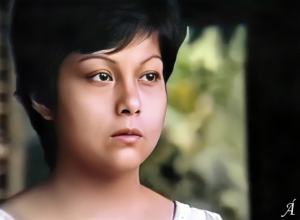
Tomboyish Luisa and cross-dressing Gorio are the children of Ambo, a chauffeur for a rich couple and their son, Gardo. When Ambo gets sick, Luisa takes over his job by pretending to be a boy. Later, Gorio is adopted by Gardo’s parents when they mistake him for a girl. As the siblings get into all sorts of high jinks, the arrival of Gardo’s ladylove complicates matters even further.
Dolphy has always been a difficult figure to revaluate. The strategies he used to attain respectability did not permit much creative leeway, so his innovations as comedian generally tended to observe the limits expected of wholesome family fare. Several of his collaborations with Luciano B. Carlos, another eager-to-please major talent, hold up well as pleasant diversions, particularly during the libertarian bomba [soft-core] period of the early 1970s. Among his sex-themed comedies, the ones where he toyed with the concept of masculinity have provided a legacy that several later generations of comedians were able to draw from.[1] Mar S. Torres’s Jack en Jill, for all its dated assumptions, including its problematic misogyny, marks the moment when the figures of the so-called inverts (effeminate male and masculine female), though prevented from exhibiting same-sex desire and, always in the queer woman’s case, falsely provided with the last-minute discovery of their heterosexual tendencies, were foregrounded and set on a quite-lengthy journey to social acceptability.
Note
[1] A later Sampaguita Pictures production, Kaming mga Talyada (We Who Are Sexy) from 1962, emblematizes a far more complicated discourse, although its problematic nature makes it too unwieldy to enshrine in the present canon list. Directed by Tony Cayado, it features seven sissy men, desired by seven young women but resistant to harsh military discipline by their absentee father, whose “conversion” into the straight and narrow is expedited when they are deployed to Mindanao and have to suppress an Islamic uprising. The film’s selling point was the series of nightclub performances in Manila of Christine Jorgensen, an American inaccurately billed as the first postoperative transgender woman. The essential text that teases out these issues is Susan Stryker’s “We Who Are Sexy: Christine Jorgensen’s Transsexual Whiteness in the Postcolonial Philippines,” Social Semiotics, vol. 19, no. 1 (March 2009), pp. 79–91, DOI:10.1080/10350330802655551.
Back to top
Return to Canon Decampment contents
Go to alphabetized filmmakers list
Á!











 ORCID ID
 Ámauteurish!