
[Click here (recommended) for desktop mode.]
Tatlong Taóng Walang Diyos
English Title: Three Godless Years
Year of Release: 1976 / Color with Sepia
Director & Screenwriter: Mario O’Hara
Producer: NV Productions
Cast: Nora Aunor, Christopher de Leon, Bembol Roco, Orlando Nadres, Peque Gallaga, Mario Escudero, Yolanda Luna
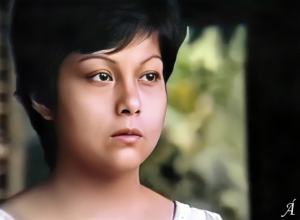
As the global conflicts of World War II intrude upon the peaceful existence of a rural town, Rosario bids farewell to her boyfriend Crispin before he joins some local guerrilla fighters. One night, she is raped by a half-Filipino Japanese officer named Masugi. She initially rejects his apologies but learns to love him later on, and bears his child. When victorious American troops defeat the Japanese, Rosario and the two men who love her face the harsh consequences brought about by the war.
Since Mario O’Hara’s only earlier film, the feverishly envisioned although distressingly misogynistic Mortal (1976), had been legally suppressed and had never been recovered until recently, Tatlong Taóng Walang Diyos effectively functioned as his default debut for several decades. Because of the remarkable performance of local film artists during the year of its release, its merit was definitely largely overlooked. Its all-forgiving humanist perspective on the contending parties during World War II may be too solicitous to possess useful critical value: noble Japanese-Filipino and earnest pro-US guerrilla compete for affections of true-hearted (though easily confused) barrio lass. This willingness to tackle difficult historical questions positions Tatlong Taón on the same plane of ambition as 1976’s major achiever, Eddie Romero’s Ganito Kami Noon…Paano Kayo Ngayon? (As We Were). Unlike the latter, however, Tatlong Taón not only proffers an even more traditional take on gender roles, with the woman, representing the nation as usual, victimized by her contending lovers’ ideological differences. It also gives the parish priest unnecessary moral ascendancy and, more problematically, depicts the women-led rural mass as an unrecognizable (because Western-style) lynch mob. Nevertheless O’Hara’s propensity to inspect the darker side of humanity’s psyche would be a recurrent source of strength in a quite distinguished career as Pinoy film auteur.[1]
Back to top
Return to Canon Decampment contents
Go to alphabetized filmmakers list
1—Condemned
Year of Release: 1984
Director: Mario O’Hara
Screenwriters: Jose Javier Reyes, Mario O’Hara, Frank Rivera
Producer: Golden Dragon Films & NV Productions
Cast: Nora Aunor, Gina Alajar, Gloria Romero, Rio Locsin, Dan Alvaro, Leni Santos, Connie Angeles, Ricky Davao, Toby Alejar, Sonny Parsons, Len Santos, Alicia Alonzo, Romnick Sarmenta
Yolly sells flowers in the tourist district of Ermita while her brother Efren works as a henchperson for Connie, a criminal mastermind. Efren decides to blackmail Connie after discovering how her son turned out to be a violent killer, but her ruthlessness results in his death. Yolly grieves for the only family member left to her, and resolves to avenge the loss of her brother.
2—Bulaklak sa City Jail
English Translation: Flower at City Jail
English Title: Flowers of the City Jail
Year of Release: 1984
Director: Mario O’Hara
Screenwriter: Lualhati Bautista
(Based on her novel serialized in Liwayway, 1982–83)
Producer: Cherubim Films
Cast: Nora Aunor, Gina Alajar, Celia Rodriguez, Perla Bautista, Maya Valdes, Zeneida Amador, Maritess Gutierrez, Gloria Romero, Shyr Valdez, Ricky Davao, Bella Flores, German Moreno, Tom Olivar
Angela is jailed for allegedly trying to kill the wife of a man with whom she has fallen in love. While pregnant with the man’s child, she, along other female detainees, experiences the inhumane conditions of prison life. One night, Angela manages to escape and has to deliver her baby while hiding in the city zoo. But after being apprehended by cops, Angela contemplates what lies ahead for her and her newborn.
Mario O’Hara would turn out to be the filmmaker most closely associated with Nora Aunor, both of them smart, playful, temperamental, stubborn, self-destructive. So much so that most of his major Aunor-less projects resonate with her absence: Bagong Hari (New King, 1986) starred the actor to whom Aunor played elder sister and avenging angel in Condemned (1984); Fatima Buen Story (1994) would have been perfectly cast with her in the title role; and Pangarap ng Puso (2000) benefited from Aunor’s adoptive daughter’s performance. To demonstrate the various ways in which their collaboration can be extended: Bulaklak sa City Jail grows beyond its potentially exploitative women-in-prison theme when regarded as the midpoint of an Aunor noir series, following the twisted thriller Condemned and preceding the happily concluded Tatlong Ina, Isang Anak (Three Mothers, One Daughter, 1987), where the then-infant Matet de Leon, subsequent lead of Pangarap ng Puso, is introduced. The sensible viewer is therefore advised to proceed to the rest of O’Hara’s and Aunor’s marvelous oeuvre, where even the rest of their uneven output separately and together manage to complement each other. As a bonus, try tracking down the now-rare Aunor-directed Greatest Performance (1989), which she also produced and wrote, a paradoxically unfinished-yet-complete, subsequently shelved movie, where she gives her best O’Hara performance, with O’Hara the absent element this time.
Back to top
Return to Canon Decampment contents
Go to alphabetized filmmakers list
Bagong Hari
English Title: The New King
Year of Release: 1986
Director: Mario O’Hara
Screenwriter: Frank Rivera
Producer: CineVentures
Cast: Dan Alvaro, Carmi Martin, Joel Torre, Robert Arevalo, Perla Bautista, Celso Ad. Castillo, Elvira Manahan, Glaiza Herradura, Ruel Vernal, Lito Anzures, Max Laurel, Toby Alejar, Joel Lamangan, Greg Sta. Inez, Becky Misa, Dante Balois, Jerry O’Hara, Don Pepot, Gil Arceo, Greg Rocero, Bobby Henson, Jojo Gamay, Yno Gonzales, Ding Franco, Buddy Aguilar, Liza Lorena
Living with his devoted mother, Addon Labrador pursues a regular working-class existence with his girlfriend Rina, despite his several skills in combat. His estranged father, however, betrays the provincial governor to work as a henchman for their town’s ambitious mayor. When the governor feels threatened by the mayor’s electoral bid, her son Rex takes matters in hand. After Addon agrees to win a gladiatorial showdown with the reigning underworld “king” in order to raise funds for his mother’s operation, Rex kidnaps and tortures Rina in order to coerce him to assassinate a target from behind—who turns out to be his father. Addon’s rampage goes beyond Rex to include the town’s political leadership.
Mario O’Hara’s first definitive masterpiece nearly fell victim to the vagaries of celluloid-era distribution and preservation. After being refused entry in the Christmas season’s film festival because of censorship issues, it was screened to near-empty theaters during the historical period when audiences were caught up in the snap election that eventually resulted in the end of the martial-law regime that it allegorically addressed. After no print could be found during the current millennium, critic-archivist Jojo Devera managed to track down an imperfectly transferred video copy, which is all that remains of the original. A measure of the achievement of Bagong Hari is that much of its engaging suspense and excitement can still be gleaned even in its debased condition, as befits the literally last major action-film release of the Second Golden Age: the people-power uprising occurred a month after its screening, paralleling its narrative’s fairly hopeful ending. Despite the fact that action films constituted the most successful censorship-era genre of the period, too few samples were preserved and even fewer have been able to sustain their original impact over time. The availability of Bagong Hari is the kind of small mercy that more-than-adequately serves the purpose of representing and celebrating a now-mostly-lost filmmaking tradition.
Back to top
Return to Canon Decampment contents
Go to alphabetized filmmakers list
Pangarap ng Puso
English Translation: The Heart’s Longing
English Title: Demons
Additional Languages: Cebuano & Hiligaynon
Year of Release: 2000 / Color, B&W
Director: Mario O’Hara
Screenwriters: Rey de Castro & Mario O’Hara
From a short story by Rosario Cruz Lucero, with poetry by Amado V. Hernandez, Florentino Collantes, and Denise O’Hara
Producer: Good Harvest Productions
Cast: Hilda Koronel, Anita Linda, Matet de Leon, Leo Rabago, Lucita Soriano, Alex Alano, Mike Magat, Arman de Guzman, Judy Teodoro, Eugene Domingo, Dido de la Paz, Robynne von Hagel, Christian Alvear, Ruben Gatmaitan, Lilia Cuntapay, Lalaine de Gola, Sammuel Ebaristo, Judy Lou de Pio, Ruben O’Hara, John Portugal, Edwin O’Hara
Nena grows up in her parents’ hacienda on Negros Island, nourished by nationalist poetry and her nanny’s tales of the mythological kapre, a dark-skinned tree-dwelling giant who stalks any maiden he finds attractive. Although her parents are sufficiently enlightened to assist their workers whenever they can, the escalation of the antidictatorship movement in response to the assassination of Senator Benigno S. Aquino Jr., coupled with the government’s corrupt mismanagement of the sugar industry, leads to severe poverty and grassroots malcontent. Nena extends what help she can to Jose, who comes from the family of their most impoverished tenant, although she keeps her charity a secret so as not to hurt his pride. Matters worsen when the grownup Jose is suspected of aiding rebel forces and his household is raided by militia troops, with bloody (though historically verifiable) results for him and his family. When Nena seeks him out to extend her sympathy, his anger over the abuses of the ruling class extends to her and he attempts to avenge on her what his enemies did to him.
Pangarap ng Puso is saturated with anomalies, from its emergence in a filmography marked by its director’s dodgy social and religious approaches, through its attempt at negotiating progressive politics from the perspective of a class-privileged character, to its possibly oblivious harnessing of third-cinema principles[2] that led to severe and undeserved marginalization by Philippine evaluators. Fortunately for its filmmaker and any prospective appreciator, the film is accomplished enough to reveal any objections to it as originating from careless misinformation. Its departure from its credited literary source indicates how much more willing Mario O’Hara was in prospecting for a resolution that steps way beyond karmic justice, toward a visualization of the horrific consequences of class conciliation as well as a critique of the romanticization of autochthonous cultural signifiers. The fact that the project was implemented as part of its producer’s B-movie program (called pito-pito, or seven location days plus seven post-production days under severe budgetary constraints) aligns it appositely with Ishmael Bernal’s early documentary-style explorations of his multicharacter narrative options. Even his signature performer, Nora Aunor, lends her presence via the startlingly perceptive performance of her adoptive daughter. The Philippine cultural establishment’s oversight notwithstanding, the film secures a sui generis claim as a radical masterpiece in global cinema, the only question being how long before its achievement attains the appreciation it merits.
Back to top
Return to Canon Decampment contents
Go to alphabetized filmmakers list
Babae sa Breakwater
English Title: Woman of the Breakwater
Additional Language: Cebuano
Year of Release: 2003
Director & Screenwriter: Mario O’Hara
Producer: Entertainment Warehouse
Cast: Kristofer King, Katherine Luna, Gardo Versoza, Yoyoy Villame, Alcris Galura, Lou Veloso, Lucita Soriano, Amy Austria, Daniel Fernando, Dick Israel, Rez Cortez, Odette Khan
Brothers Basilio and Buboy leave their home in Leyte and end up in the slums by Manila Bay, where they form a mystical connection with its waters. City life takes its toll on Buboy and he goes missing. Basilio finds loving comfort in Paquita, a prostitute. But Dave, a disabled ex-cop who has subjugated the slum dwellers, turns jealous and makes life difficult for the two lovers.
Given the opportunity and resources to fashion a film epic, most Filipino filmmakers, like their foreign counterparts, wind up with results that range from middling to disastrous. Mario O’Hara’s an exceptional case: an artist with certain problematic quirks: upbeat endings since the trauma of the box-office flop of Tatlong Taóng Walang Diyos (1976), for example, or an uncritical acceptance of religious authority. In common with front-rank masters, he nevertheless possessed an increasingly prodigious philosophy that enabled him to rise above the industry’s limitations. Babae sa Breakwater is ultimate proof of this, where an adequate budget and a proliferation of talent serve a Rabelaisian vision—grotesque, bawdy, and fantastic, often in wondrous combinations—of the city’s dispossessed populace. The degree of inventiveness is vibrant enough to almost offset the use of a physically handicapped, psychologically imbalanced, and sexually impotent villain, standing in for the big bad city, as an ultimately defeatable figure.
Notes
[1] An unusual development in the archival predicament of Tatlong Taóng Walang Diyos is that, because of the existing print’s deterioration, critic-archivist Jojo Devera so successfully experimented with processing the material in black-and-white that ABS-CBN Film Restoration decided to perform the same treatment, although it neglected to officially acknowledge Devera’s innovation. The resulting copy made the film closer to the solid Cold War sensibility that it exemplified, although several 1950s works by Gregorio Fernandez were able to match or even break free of such strictures.
[2] The movement known as Third Cinema is ascribed to the 1969 manifesto written by Fernando Solanas and Octavio Getino, partly based on their experience with their 1968 agitprop documentary La hora de los hornos or The Hour of the Furnaces (see “Towards a Third Cinema: Notes and Experiments toward the Development of a Cinema of Liberation in the Third World,” translated by Julianne Burton and Michael Chanan, in Twenty-Five Years of the New Latin American Cinema, edited by Michael Chanan, Channel Four Television & BFI Books, 1983, pp. 17-27). Its distinction from Third World cinema lies in its rejection of conventions associated with First World film practice, with Hollywood as apex, even if these might appear in Third World contexts. Written without caps, third cinema upholds the movement’s principles without direct organizational links. The concept necessitates some problematization, which I have implicitly attempted in certain selections and citations elsewhere in this canon listing.
Back to top
Return to Canon Decampment contents
Go to alphabetized filmmakers list
Á!










 ORCID ID
 Ámauteurish!