
[Click here (recommended) for desktop mode.]
Ang Damgo ni Eleuteria
English Title: Eleuteria’s Dream
Alternate Title: Ang Damgo ni Eleuteria Kirchbaum
Language: Cebuano
Year of Release: 2010
Director: Remton Siega Zuasola
Screenwriters: Maria Victoria Beltran & Remton Siega Zuasola
Producers: Cinema One Originals & Panumduman Pictures
Cast: Donna Gimeno, Gregg Tecson, Lucia Juezan, Emelda Mabusay, Ara Chawdhury, Daday Melgar
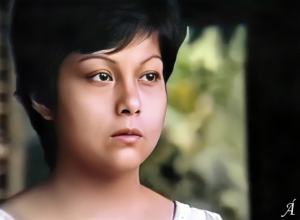
Eleuteria is a young lady who is reluctant to fly to Germany where a rich old man is waiting to claim her as his mail-order bride. However, her mother convinces her that this is the best way she can support their poor family. As she walks toward a harbor en route to the city airport, with her boyfriend pleading with her to stay, she has to choose between her family’s welfare and her own happiness.
A tour de force made even more remarkable by the fact that the material is set on far-flung Olango Island, part of an eponymous island group in Cebu Province and famed as a bird sanctuary. The actors speak in Cebuano and the action unfolds in real time. Remton Siega Zuasola was brazen enough to appropriate, in his first feature-length release, the single-take strategy of a few (appropriately celebrated) Western models.[1] Ang Damgo ni Eleuteria stakes its interests in an issue as vital to the survival of the Philippine nation as it has also become the concern of citizens in more affluent economies: the uprooting of Filipino citizens, occasionally against their will, as constituent elements in the country’s labor-export machinery, its only viable new-millennium industry.
Note
[1] The single-take film can arguably be ascribed to the very first commercially successful instances of cinema, little over a hundred years ago: the Lumière brothers’ so-called actualities, each comprising about a minute’s worth of unedited footage. This may be one of the reasons why people familiar with film history appreciate long unbroken shots. Since commercial-gauge celluloid film could only be exposed continuously for up to ten minutes at a time, Alfred Hitchcock had to use artificial devices (usually panning or zooming into dark surfaces) to mask the cuts in Rope (1948). Because of the extreme difficulty of executing narrative dramas this way, as well as audiences’ unfamiliarity with the technique, most single-take efforts during the pre-digital period were confined to experimental arthouse releases such as Andy Warhol’s eight-hour Empire (1964), a stationary shot of New York City’s Empire State Building, and Michael Snow’s 45-minute zoom Wavelength and whirling-camera La region centrale (The Central Region, 1971). The digital format enabled actual or simulated single takes and provided several notable samples: Mike Figgis’s commercially released Timecode (2000), with four full-length single takes presented in four interactive frames simultaneously; Aleksandr Sokurov’s Russkiy kovcheg (Russian Ark, 2002), where a ghostly narrator, represented by the camera, wanders through Saint Petersburg’s Winter Palace and encounters people and events over the past three centuries; and Alejandro G. Iñárritu’s so-titled Birdman or (The Unexpected Virtue of Ignorance) (2014), a mixed-genre film with reflexive elements that won the US Academy Award for Best Picture. In the Philippines, Zuasola’s subsequent films as well as Pepe Diokno’s Engkwentro (Clash, 2009) were also single-take features.
Back to top
Return to Canon Decampment contents
Go to alphabetized filmmakers list
Á!









 ORCID ID
 Ámauteurish!