

I. Viable Lessons from another Third-World Model
A project of making comparisons between the Philippines and Brazil may not appear too productive at first, considering the geographic separations – i.e., continental (the Philippines in Asia, Brazil in America), oceanic (the Philippines by the Pacific, Brazil by the Atlantic), and hemispheric (the Philippines north of the equator, Brazil south). The two countries, however, may have more in common between them than what, say, the Philippines may have with any other non-Asian nation. Both had Latinate colonizers – Spain in the Philippines, Portugal in Brazil – and were subsequently subject to US neocolonial interventions; the Philippines, in fact, was the US’s first and only colony allowed to nominally retain a measure of national sovereignty and to eventually attain postcolonial status, with Viet Nam unsuccessfully targeted as a second prospect.
11011Although Cinema Novo leader-practitioner Glauber Rocha could write that Brazil was “the only Latin American country that never had a bloody revolution like Mexico, or the baroque fascism of Argentina, or a real political revolution like Cuba, or guerrillas like those found in Bolivia, Colombia, or Venezuela” (“Tricontinental Filmmaker” 78), all of which were common to Philippine historical experience, it would still be possible to point out that the earlier mentioned factors resulted in mixed European and American influences in the national cultures of both countries, as well as systems of economic dependency and political vulnerability, most clearly manifested in their common experiences of military dictatorships supported, if not instigated, by the US.
11011Another basic problem in undertaking this type of comparative study is the fact that most poststructuralist frameworks, while allowing for the syntagmatic juxtapositioning of cultural elements regardless of categories of origin, stop short of allowing definitive prescriptions in the realm of cultural policymaking – a cautionary measure understandably suitable to the First-World contexts where such ideas evolved. Third-World existences, however, do not allow for too much interplay between critical analyses and cultural implementation, beyond what available institutions allow; such limitations may be ascribed to both the countries’ inevitable concern with and prioritizing of economic development and the consequently underdeveloped state of their cultural institutions. One poststructural framework, however, was formulated in similarly indigent circumstances in the USSR; not surprisingly, it appears to hold a potential applicability for the drawing out of lessons from the Philippine and Brazilian cultural experiences.
11011Although utilized primarily for literary analysis, M. M. Bakhtin’s concept of dialogism, by its very formulation, allows for a resistance to the marginalization of the Other that characterizes monologism (292-93). His assertion – that “the single adequate form for verbally expressing authentic human life is the open-ended dialog. Life by its very nature is dialogic. To live means to participate in dialog” (293) – allows for a wider interpretation of what constitutes a cultural unit for analysis, as well as a more comprehensive purview of both source and destination of analytical insights. A more direct formulation of this principle would be to state that, “while dialogism at its root is interpersonal, it applies by extension to the relation between languages, literatures, genres, styles, and even entire cultures” (Stam, Subversive Pleasures 14).
11011A historically viable model, however, would not allow for the Philippines and Brazil relating explicitly with each other, since the level of direct cinecultural exchange between the two never progressed beyond the minor instance of a Filipino production company shooting Gil Portes’s Carnival Queen, a take-off on Marcel Camus’s Black Orpheus (1959), during the samba festival in 1981, with Filipino soft-core actress Alma Moreno and teen idol William Martinez delineating an incestuous dimension to Ricardo Lee’s adaptation. What actually makes possible the act of relating the Philippines and Brazil to each other is both countries’ position as Third-World nations interacting with, or rather (from a different perspective) struggling against, the First World. In this regard it becomes imperative to further define the First World as encompassing both Europe and the US, with all the attendant cultural differences obtaining between the two entities – e.g., in a filmic context, European art cinema vis-à-vis classical Hollywood narrative respectively.
11011Such a fragmentation of an entity traditionally regarded as monolithic can be seen as merely a reverse application of the “monolith’s” fragmentation of its Other: i.e., since the First World had treated the Third World as comprising discrete national units, a conception initially acceded to by the Third World in formulating its oppositional response, the problematics of Third-World relations (not only in relating to the First and then-Second Worlds but also in Third-World countries interacting among themselves) may be traced to the underdeveloped nations’ naturalization of the overdeveloped nations’ essentially self-serving contrivance. One objection that may be raised to this approach, aside from the admonishment from insisting on using the term Third World, is that it requires essentializing certain properties not only of the First-World entities, but those of the Other countries under discussion as well. On the other hand, the need to arrive at more-than-provisional political prescriptions justifies a reformulation of the postmodernist view
that there is only one correct way to discourse on race and culture…. To proclaim pluralism, relativism, oppositionality or anything else instead is just to promote the newest form of essentialism. This is a conjuring trick which signals a pretense to moving away from essentialist thinking while actually moving back toward it. (Blythe 211)
Such a suspension of anti-essentialist principles can be regarded as the start of an understanding of colonialist discourse “through an analysis that maps its ideological function in relation to actual imperialist practices. Such an examination reveals that any evident ‘ambivalence’ is in fact a product of deliberate, if at times subconscious, imperialist duplicity” (JanMohamed 80).
11011To begin with originative instances, film was first presented in Brazil on July 8, 1896 (Johnson and Stam, “The Shape of Brazilian Film History” 19), nearly eight decades after political independence but within the period of “British free-trade imperialism” (17); Filipinos were able to account for an experience of film as early as 1897, during the eve of the Filipino-Spanish War, which was to transmute during the turn of the century into the Fil-American War. As a result, the American government, worried about the growing tide of anti-imperialist sentiment among US citizens, declared the end of the war (with the US winning, as per the prescriptions of Manifest Destiny) only four years after, in 1902, while still sending troops to the Philippines for the next twenty years to supposedly handle isolated instances of banditry; about two decades before V.I. Lenin declared film as the official medium for revolutionary propaganda in the USSR, the private and public American colonial sectors enacted the same thing, though not for the same purpose, in the Philippines.
11011In the opposite direction, the essay “Towards a Third Cinema,” which subtitularly proposes the “Development of a Cinema of Liberation in the Third World,” has been regarded as an attempt at reversing this relation of cultural domination, specifically against neocolonialism (Solanas and Getino 19). It could also can be situated within a struggle against the premises and terms set by a cultural machinery that was expressly utilized during its still-developing stages for First-World (though not always anti-Third World) purposes. Even the Third Cinema essay attests as much, in the contradiction of its call to resist the “fully rounded film structured according to the metrics imposed by bourgeois culture” right after having succumbed to the aesthetic boundaries imposed by presumably the same repressive (Western) cultural source in the essay’s valorization of realist values (23).
11011The handling of a medium that combined intensive capitalist contributions with an extensive mass outreach resulted in an appreciation, and subsequent accommodation (though rarely an appropriation), of critical Third-World film products by First-World entities which may be interpreted as indicative of internal discursive dissension within mutual liberal democratic spaces. Philippine filmmakers critical of Ferdinand Marcos (and his consequent representation by the Left as a US “puppet”), for example, preferred to make their marks in the European festival circuits – the late Lino Brocka and Mike De Leon in Cannes and Ishmael Bernal and Kidlat Tahimik in Berlin in the 1980s, following the lead of Manuel Conde in Venice in the 1950s – rather than in the country’s neo-/colonizer, the US.
11011The situation, however, led to Brocka and De Leon for a time (and Kidlat and a current wave of independent practitioners ever since) making movies that catered more to the tastes of European cineaesthetes rather than of the Hollywood-influenced star- and genre-oriented Filipino moviegoers. Rocha himself interpellated the Third Cinema discourse by warning that “The fact that Cinema Novo is well received abroad in no way justifies the difficulty it has in getting accepted in Brazil” although he problematically though predictably maintained that “the fundamental problem … lies with the public” (“History of Cinema Novo” 25). One may grant that Rocha is privileged by his having gone farther in attempting to reach his local market, since he had earlier enumerated an ambitious agenda for Cinema Novo, namely
a production and distribution organization independent of established points of view or ideas, and the freedom to make films which provide a cinematic expression of Brazilian politics and culture. We all have the same political and economic objectives but a great diversity of styles because we are against the principles of academism. (Crowdus and Starr 5)
He had also believed that Italian neorealism and the French New Wave were “practically destroyed by American distribution which [had] bought off all the cineastes except Godard and a few others,” thus making all the more necessary the founding of institutions to counter the collusion between “big Brazilian commercial film production syndicates” and foreign, specifically American and European, film distributors (6).
11011To further understand such an overriding concern for what may be called institutional safeguards, it would be necessary to delve into the systemic and historical experiences of Brazilian cinema – an inspection that would yield even more startling parallels between it and that of the Philippines. Vera Cruz, described as “the most complete realization Brazil has known of the film industry myth” (Galvão 271), was founded in 1949 to produce “a cinema ‘just like foreign’ cinema, which could be shown with pride to audiences throughout the world” (273-74). At first glance this could be tied in with the establishment of the Philippine studio system during roughly the same period (after the Japanese occupation and during the American reoccupation), which led to the cartel-like control of production and distribution during the 1950s controversially designated as the first Golden Age of Philippine cinema (Garcia 39); this monopoly, however, was busted by the Philippine Supreme Court using – a then-common practice – the US Supreme Court decision on the Paramount case as model.[1]
11011A likelier Filipino counterpart to Vera Cruz was the founding of still-existing Viva Films, as a response to both the control by Chinese Filipinos of the major production companies, as well as the call by then First Lady Imelda Marcos for local films to depict her version of the “the true, the good, and the beautiful.” Viva Films launched the daughter of urban warlord Pablo Cuneta, forty-plus-year-long mayor of once-prosperous Pasay City in Metro Manila, as its signature star in glossy vehicles that featured rich families troubled but not overwhelmed by lower-class villains. After the February 1986 uprising that toppled the Marcos dictatorship, Viva Films was sequestered by the ad-hoc Presidential Commission on Good Government but cleared after no proof could be determined of its having been funded by government money siphoned through the Cultural Center of the Philippines. Ironically, the post-’86 Viva Films contracted the services of Lino Brocka, who directed Sharon Cuneta in rags-to-riches and antihero roles, as well as other stars in hit projects that openly castigated the Marcoses; moreover, the studio itself linked up with one of the two major Chinese Filipino-controlled distribution circuits (the others consist of shopping malls, also owned by Chinese Filipinos, and countryside sex-film circuits, alleged by Corazon Aquino’s censors chief Manuel Morato as military-operated).
11011From this narrativizing can be seen the feasibility of a major studio – three in fact, similar to the 1950s system – thriving within a non-monopolistic system, rather than the Philippine ’50s studio system (and Vera Cruz) representing monopolistic setups that demanded to be challenged. Another factor, that of government involvement, has already been mentioned in passing but actually is indispensable to the film history of both countries. Brazilian state intervention in the local film industry was initiated by the relatively democratic regime of Getulio Vargas in the 1930s and proceeded through periods of military oppression to the present (Johnson 11); Philippine film institutional support, on the other hand, was facilitated by Marcos in impressively variegated forms – including international-festival sponsorship, subsidies for feature and short subjects, production of scriptwriting-contest winners, censorship-exempted exhibitions, archival research and preservation, and tax rebates for aesthetic achievements – after he had implemented martial law.
11011The difference points to how subsequent political generations in both national instances have tended to prefer, or perhaps be less suspicious of, a form of state support which can be associated with democratic processes. This can be seen in how post-Marcos dispensations have so far refused participation in the Filipino movie industry beyond the traditionally restrictive institutions of censorship and taxation. State support, of course, need not always be an end in itself for culture-policy activism. Despite a practically uninterrupted presence in the Brazilian filmmaking scene, for example, the state, as per Randal Johnson’s finding in his study of the industry, “has failed to reconcile its cultural and industrial responsibilities” (15).
11011Outside of the Brazilian government’s concerns certain film-production sectors have still managed to thrive. Johnson mentioned as owing nothing to state support Brazil’s Golden Age (1908-11) and the burlesque musical comedy or chanchada genre’s heyday between 1940 and 1960, plus the pornochanchadas produced by exhibitors to satisfy the quota for national films (14). The Philippines could point to a significant pre-Marcos era of practice that has not been ultimately tainted with the stigma of institutional support: the free-enterprise emergence of one-man (rarely one-woman) auteurs from the 1910s until the Japanese occupation, the “Golden-Age” studio system starting in the late 1940s and the independent producers who replaced the major studios in the 1960s, plus the current uneasy balance between big studios and occasional independents. Regional cinema (based in Metro Cebu rather than Metro Manila), however, has depended on tax exemptions to make a feasible comeback in the 1990s after its latest fadeout during the ’70s, while uncommercial art films are in effect controlled by European financiers. Hard-core sex films, which made an appearance twice – first during the build-up toward the declaration of martial rule and again during the impending deposition of the dictatorship – can now be ascribed to the Marcos machinery’s attempts at cultural engineering, whether to incite public outrage at the breakdown in morality during a period of intensified labor and student activism in the first instance, or to deflect the public’s attention from the growing anti-fascist movement in the second.
11011Although this emphasis paid to governmental activities in the cultural production of film may appear too deterministic in a developed society, it should be seen that, perhaps most especially in the Third World,
Modern forms of cultural politics often have their origins and raison d’être in the governmentalization of culture: that is, the objectives to which they are committed are a by-product of the governmental uses to which specific forms of culture have been put just as those objectives can only be met via modifications to existing governmental programs or the development of new ones. (Bennett, “Useful Culture” 71)
More important for the purposes of this essay, the consideration of cultural-policy contexts will not so much enrich a critical project as suggest what form such a project could take if it is to be envisioned as feasible. To put it another way,
It is only by using the kinds of correctives that would come from putting “policy” into cultural studies that cultural studies may be deflected from precisely those forms of banality which, in some quarters, have already claimed it while also resisting the lure of those debates whose contrived appearance of ineffable complexity makes them a death trap for practical thinking. (Bennett, “Putting Policy into Cultural Studies” 33)
The need, however, to particularize in terms of which national cinema is being discussed and how the critical construction of this cinema and its problems relates to the other arises from the insight that,
in identifying conformities and uniformities, we are seeking and foregrounding likenesses and then projecting those likenesses onto “reality” or history or culture as all there can be and all there is. We need to understand that in so doing, we too are playing a part in suppressing difference and in making singularity invisible and unspeakable. (Bannet 49)
11011In the face then of the mainstream-vs.-independent opposition, with its ambivalent institutional interventions, that characterizes (with the expected specificities) the cinemas of both countries, the singular aspect of the Brazilian historical experience that can still be counted as a genuine contribution to Philippine film history would be what has been comprehensively described as “alternative aesthetic traditions both inside and outside of Europe” (Stam, “Symposium” 34). This connects with Bakhtin’s writings, this time on the carnivalesque, as well as with modernist cannibalistic or anthropophagic art, plus several other heretofore unrecognized principles that “have in common [the] notion of turning tactical weakness into strategic strength” (Stam 34). Three of these traditions may be held up for closer inspection in the Philippine context:
- The carnivalesque, particularly in its extremist emphasis on bodily functions, can be seen as challenging the overriding Vatican-determined Catholic morality in the Philippines, virtually a form of cultural colonization which has resulted in the dubious spectacle of progressive forces occasionally uniting with reactionaries in condemning instances of toilet humor, graphic sex, or gross-out special effects-reliant violence.
- Cannibalism as a conceptual approach forces the reconsideration of what has been termed “originality as vengeance,” wherein cultural resistance to the effects of Western colonialism was (mis)construed in terms of the purist pursuit of themes, treatments, and stylistics in art and literature that were unimplicated by any form of precedent, especially from the West. The notion of “eliminating the foreign and recuperating the national” is particularly difficult, if not impossible, not only because it is again shared by both left and right in conflicting terms (Stam and Xavier 281), but also because it presumes the requisite of industrial advancement in a medium as technology-dependent as film.
- Rocha’s hunger aesthetics, which he opposed to films that were “artistically pretentious, politically innocuous, and commercially disastrous” (“Hunger Aesthetics” 9), can be positioned against the sensibilities of the currently emerging independent filmmakers in Manila, who consistently seek to prove their worth to producers, critics, and audiences by out-Hollywooding, so to speak, established practitioners in the hope of beating the latter at their own game. Rocha’s stipulation that “a precise ‘political’ line from a cultural and an economic point of view” be held as a key to the success of Cinema Novo’s hunger-aesthetics experiment (9) need not be taken in conjunction with his call for the development of more effective means of reaching a local audience through culture-specific means; furthermore, the fissures in traditional and alternative modes of practice suggested by the practice of cannibalist and carnivalesque filmmaking do not allow for the apparently orthodox Marxist conception of political correctness implied by the imposition of political lines, precise or otherwise.
11011What Rocha has pointed out in terms of audience studies can actually be reconfigured in terms of market expansion beyond historically unsuccessful or limited/-ing boundaries. For the Philippines, this means a reconsideration of the worth of any potential outlet, starting with European art circuits (including festivals and German television), in terms of the response of a primarily Filipino mass audience. To reformulate the problem, Philippine filmmakers have been viewing themselves as part, or worthy, of the West, refining their oppositional discourse in terms of which First-World centers are more responsive to the country’s progressive political aspirations. What has been missed out in the leap from a national identity to a foreign audience is the more immediate audience, that of the regional Asian community; perhaps the notion of what is Asian in relation to the Philippines may be even more difficult to resolve than the First-World question, but at the moment all the possible geographic subformations except for Central and South Asias, Indochina, and the Three Chinas (Taiwan, Hong Kong, and the mainland, currently construed in the US as the Asian cinema) have the advantage of including the Philippines in them: the Far East, Southeast Asia, Australasia, Indo-Malaya and Indo-Polynesia, and Asia-Pacific.
11011The postcolonial inquiry into issues beyond national boundaries need not negate other Philippine issues overridden during and by neo-/colonialism. Apart from radical audience studies in popular culture, the study of racial representation is another aspect that can be paralleled with both Brazil and the US (see Stam, “Slow Fade to Afro”). By virtue of their country’s condition as the most colonized in the region (apart from Spain and the US, Britain, the Netherlands, and Japan had had short and sometimes geographically delimited periods of occupation), Filipinos have come to associate racism with Western values; in fact, a counter-racist attitude directed against caucasians may be sensed in current popular-culture products circa the 1990s, while the anti-Japanese sentiment resulting from World War II (encouraged by the Americans, as was the anti-Spanish sentiment after the Filipino-Spanish War) has combined with racism against the Chinese, originally induced by the Spaniards purportedly to discourage the “indio” populace from engaging in entrepreneurship.
11011Moreover, the pre-Hispanic myth of the Malayan baker-god preferring the brown man over the undercooked white and overcooked black men feeds into the emergent critical attitude toward caucasians, aggravates the dominant chauvinism against fair-skinned Asians (Indo-/Chinese, Japanese, Koreans) and Africans (specifically Arabs, compounded by the non- or anti-Christian nature of their religious politics), and does nothing for the residual contempt held for blacks, including the native-Filipino Aetas, forced to live as nomadic highlanders (most famously on the recently erupted Mt. Pinatubo) because of lowland encroachments on their tribal properties. The issue of modern-day Filipino racism can be raised by tracing its origins to the various Christian catechisms which are controlled by the conservative segments of both the Vatican and the US Protestant groups, its immediate result being the multi-levelled discrimination practiced against those perceived as non- or anti-Christian – the Chinese and Indians in the metropolitan centers, Muslims in the rural south, and ethnic minorities throughout the archipelago.
11011In fact the issue of race can prove crucial in forging a new dimension to Filipino identity in terms of regional as well as Asian cinema, which may consider as starting point the example of the New Latin American Cinema as supposedly “a social practice that revels in the diversity and multiplicity of its efforts to create an ‘other’ cinema with ‘other’ social effects as a prerequisite of its principal goal to reveal and analyze the ‘reality,’ the underdevelopment and national characteristics, that decades of dependency have concealed” (Lopez 311). One further area of outward exploration would be the equivalent of diasporic literature, after the fact that the Philippines’s primary export since its economic slippage from the fastest developing to the least-developed Southeast Asian nation has been human labor. In New Latin American Cinema terms, “Geographic and cultural displacement has fostered decentered views on identity and nationality, stressed the dialectics of historical and personal circumstance, and validated autobiography as a reflexive site” (Pick 195) – advantages that benefited not just films produced in exile, but those done in local industries as well.
11011The implication of this enrichment and modification of discourses on Philippine national identity is a renewal of critical efforts away from the currently fashionable deconstructive revaluation of progressive artists toward a truly concerted effort on the part of both critics and practitioners. Texts in this sense can still serve deconstructive purposes, but not for the manner in which they expose the limits of their authors inasmuch as the resultant observation validates the opposition to both works and their authors by the forces of reaction; rather, as propounded by Scott Nygren, “Once recognized, the doubleness inhabiting texts cannot be ‘gone beyond’ in the sense of reestablishing a new syncretic universal transparency of meaning, but idiosyncratic sites can be explored which foreground the displacements of meaning engendered by double contexts” (174). One possible methodology, apart from the available outmoded formalist approach and the unproductive deconstructive strategy, would be Nygren’s recommendation to
somewhat arbitrarily identify … relatively stable areas of activity that function to orient (to use a deliberately loaded term) current work. First, applying the techniques of literary and textual analysis to the domain of cultural studies is now long established but still remarkable…. Second (or as a variation on or partial split within the first), the reorientation of political and ideological analysis toward the domain of cultural forms remains pivotal. (174)
No doubt such a project will engender its own resistance, possibly even from the same sectors that staked claims to radicalism during their time, just as, say, the “cinema of garbage” practitioners were dismissed by Cinema Novo filmmakers after the former viewed the latter as a new establishment force (Xavier 35-36). What remains to be seen is how cinema, which had proved to be vital in discourses on the Marcos dictatorship, will still be able to find a role in the future of Philippine culture.
Note
[1] I must indicate here a failure on my end of determining whether this bit of information, accepted by media experts during an earlier time, was in fact a definitive reality. The Law on the Media textbook used at the national university approached the study of Philippine media law as premised on the observance of legal decisions made in the US legal system. How such an assumption remained acceptable, several decades after postcolonial independence and during the (then) beginning of military dictatorship, went over the heads of students who were after all training for practice in a different field. A more definitive confirmation of the non-existence of a decision on the vertical integration of film production came out much later, in a comprehensive study on Asia-Pacific Antitrust for the Global Competition Review (see Alquisada et al.).
Works Cited
Alquisada, Pamela Joy, Aris L. Galupa, and Norma Margarita Patacsil. “Philippines: Overview.” Asia-Pacific Antitrust Review 2014 section. Global Competition Review (2014). https://globalcompetitionreview.com/review/the-asia-pacific-antitrust-review/the-asia-pacific-antitrust-review-2014/article/philippines-overview.
Bakhtin, M.M. Problems of Dostoevsky’s Poetics. Ed. and trans. C. Emerson. Manchester: Manchester University Press, 1984.
Bannet, Eve Tavor. Postcultural Theory: Critical Theory after the Marxist Paradigm. New York: Paragon House, 1993.
Bennett, Tony. “Putting Policy into Cultural Studies.” Cultural Studies. Ed. Lawrence Grossberg, Cary Nelson, and Paula Treichler. New York: Routledge, 1992. 23-34, Discussion 34-37.
———. “Useful Culture.” Relocating Cultural Studies: Developments in Theory and Research. Ed. Valda Blundell, John Shepherd and Ian Taylor. London: Routledge, 1993. 67-85.
Blythe, Martin. “‘What’s in a Name?’: Film Culture and the Self/Other Question.” Quarterly Review of Film and Video 13.1-3 (1991): 205-15.
Camus, Marcel, dir. Black Orpheus. Scr. Jacques Viot and Marcel Camus. Dispat Films, Gemma, & Tupan Filmes, 1959.
Crowdus, Gary, and Wm. Starr. “Cinema Novo vs. Cultural Colonialism: An Interview with Glauber Rocha.” Cineaste 4.1 (Summer 1970): 2-9, 35.
Galvão, Maria Rita. “Vera Cruz: A Brazilian Hollywood.” Johnson and Stam, Brazilian Cinema 270-80.
Garcia, Jessie B. “The Golden Decade of Philippine Movies.” Readings on Philippine Cinema. Ed. Rafael Ma. Guerrero. [Metro Manila]: Experimental Cinema of the Philippines, 1983. 39-54.
JanMohamed, Abdul R. “The Economy of Manichean Allegory: The Function of Racial Difference in Colonialist Literature.” “Race,” Writing and Difference. Ed. Henry Louis Gates Jr. Chicago: University of Chicago Press, 1986. 78-106.
Johnson, Randal. The Film Industry in Brazil: Culture and the State. Pittsburgh: University of Pittsburgh Press, 1987.
Johnson, Randal, and Robert Stam, eds. Brazilian Cinema. Austin: University of Texas Press, 1982.
———. “The Shape of Brazilian Film History.” Johnson and Stam, Brazilian Cinema 17-51.
Lopez, Ana M. “An ‘Other’ History: The New Latin American Cinema.” Sklar and Musser 308-30.
Lumbera, Bienvenido. Revaluation: Essays on Philippine Literature, Cinema and Popular Culture. [Quezon City]: Index, 1984.
Nygren, Scott. “Doubleness and Idiosyncrasy in Cross-Cultural Analysis.” Quarterly Review of Film and Video 13.1-3 (1991): 173-87.
Pick, Zuzana M. The New Latin American Cinema: A Continental Project. Austin: University of Texas Press, 1993.
Portes, Gil, dir. Carnival Queen. Scr. Ricardo Lee. Amore Films, 1981.
Rocha, Glauber. “The History of Cinema Novo.” Trans. Jon Davis. Framework: A Film Journal 12 (Winter 1979): 18-27.
———. “Hunger Aesthetics vs. Profit Aesthetics.” Trans. Jon Davis. Framework: A Film Journal 11 (Autumn 1979): 8-10.
———. “The Tricontinental Filmmaker: That Is Called the Dawn.” Trans. Burnes Hollyman and Robert Stam. Johnson and Stam, Brazilian Cinema 77-80.
Sklar, Robert, and Charles Musser, eds. Resisting Images: Essays on Cinema and History. Philadelphia: Temple University Press, 1990.
Solanas, Fernando, and Octavio Getino. “Towards a Third Cinema: Notes and Experiences for the Development of a Cinema of Liberation in the Third World.” Trans. rev. Julianne Burton and Michael Chanan. Twenty-Five Years of the New Latin American Cinema. Ed. Michael Chanan. London: Channel Four Television, BFI Books, 1983. 17-27.
Stam, Robert. “Slow Fade to Afro: The Black Presence in Brazilian Cinema.” Film Quarterly 36.2 (Winter 1982-83): 16-32.
———. Subversive Pleasures: Bakhtin, Cultural Criticism, and Film. Baltimore: Johns Hopkins University Press, 1989.
———. “A Symposium on Popular Culture and Political Correctness.” Ed. Andrew Ross. Social Text 36 (1993): 1-39.
Stam, Robert, and Ismail Xavier. “Transformations of National Allegory: Brazilian Cinema From Dictatorship to Redemocratization.” Sklar and Musser 279-307.
Xavier, Ismail Norberto. “Allegories of Underdevelopment: From the ‘Aesthetics of Hunger’ to the ‘Aesthetics of Garbage.’” Diss. New York University, 1982.
Back to top
Return to Wages of Cinema contents
II. Race as Discourse in Southeast Asia Film Ethnographies
The discourse of race is arguably the core of the controversy over film ethnography in the West, particularly in the aspect, unresolvable as it is, of the definition of the term ethnographic film that pertains to the activities of Others, i.e. “non-western people doing non-western things” (Banks 120). The spread of this kind of blanket category could include film samples from the “non-western” continents of Africa, South America, and Asia, particularly the Southeastern areas comprising ethnic groups in Indonesia and Papua New Guinea. This essay focuses on the Southeast Asian coverage by ethnographic film practitioners, for two reasons: first, that a development or progression, to use unsatisfactory euphemisms, can be drawn for productive lessons in the area of both race and film ethnography; and second, these cultures are where my geographic affinities lie.
11011Significantly, a number of film ethnographers who engaged in the more frontal and pressing racial issues pertaining to African and South American cultures also made works set in Southeast Asia. By “also” I do not mean to say that issues of race where I come from are not as important as anywhere else, but that these issues are informed by an ambivalence derived from an exoticizing of the Orient. Henry Louis Gates Jr. provides the means by which this could be further explained:
Race has become a trope of ultimate, irreducible difference between cultures, linguistic groups, or adherents of specific belief systems which – more often than not – also have fundamentally opposed economic interests. Race is the ultimate trope of difference because it is so very arbitrary in its application. The biological criteria used to determine “difference” in sex simply do not hold when applied to “race.” Yet we carelessly use language in such a way as to will this sense of natural difference into our formulations. (“Writing ‘Race’” 5)
Where European and American colonial and neocolonial interests became more widespread, then, the practice of racism has been marked with less ambivalence – in Africa, because of the slave trade and direct appropriation of resources, and in South America, because of direct and then indirect control of economic systems through the use of local elite groups. In Asia, the one instance where Western racism has had an effect on the formation of a national culture was that of the Philippines, which was the only Asian country ever colonized by the US, after an earlier occupation by the Spaniards; one might argue that almost all the other Asian countries were similarly colonized by other Western powers, but the Philippine experience is marked by an absence of a pre-colonial civilization as developed as were those of its neighbors. Another way of looking at this is that prior to the 16th-century arrival from the Pacific West of the Spaniards, the spread of civilizing influence in the region was in the opposite direction, from India and China through Indochina toward the Indo-Malayan peninsula, with the Philippine islands as the prospective point of culmination.
11011Hence no other Asian country has put up less resistance to the influx of Western culture than the Philippines did – a fact that is acknowledged in Western and other Asian countries’ patronization of popular-culture performers and products from the country. The notion of an ancient civilization providing a form of resistance to Western culture, however, cannot be as simply described as in Abdul R. JanMohamed’s contention that “in the hegemonic phase (or neocolonialism) the natives accept a version of the colonizers’ entire system of values, attitudes, morality, institutions, and, more important, mode of production. This stage of imperialism does rely on the active and direct ‘consent’ of the dominated” (81). In the case of the Philippines, the process of reliance on Western culture became increasingly economic in nature as the country’s status declined from the fastest-developing to the least-developed in Southeast Asia; ironically, although the populace has managed to equate the country’s suffering with the degree of US-conducted intervention (as evidenced in a 1980s box-office film trend in depicting white characters as movie villains), the dependency on expertise in popular-culture forms, including the use of the English language, has also never been stronger than it is at present. Tzvetan Todorov implies that in analogous cases a cycle may be in place, owing, in the Philippine example, to the country’s unique political predicament:
Racism (like sexism) becomes an increasingly influential social phenomenon as societies approach the contemporary ideal of democracy. A possible explanation of this fact might be that in traditional, hierarchical societies, social differences are acknowledged by the common ideology; hence, physical differences play a less crucial role. (371)
The “contemporary ideal of democracy” is something that other Asian leaders, notably former Prime Minister Lee Kuan Yew of Singapore, maintain as inapplicable for the Oriental temperament of the Philippines. On the other hand, right-wing and militaristic tendencies alike have been incapable of prospering in electoral exercises since the restoration of democratic institutions after the so-called revolution of February 1986; in this instance, the voters’ preference for candidates who, regardless of their political or economic competence, present themselves as democratic alternatives may be attributed to the historical trauma brought about by what the Philippine Left termed the “US-Marcos dictatorship.”
11011This consideration of the Philippine experience can be taken as one possible springboard for approaching certain ethnographic films on Southeast Asia. Undeniably, the ones set in Bali, Indonesia, work within the framework of a possibly resisting, or at least intervening, ancient culture, while Cannibal Tours, for example, set in Papua New Guinea, assumes that the native culture would give way to the West were it not for the West’s interest in maintaining it. Margaret Mead, perhaps unwittingly, set up an oppositional relation between the two cultures, particularly in certain installments of her Character Formation in Culture series. Not only did she have films on one or the other – “Trance and Dance in Bali” and “First Days in the Life of a New Guinea Baby,” with the settings defined in the titles – she also used other footage or combined some from existing titles in a work intended for comparative study: “Childhood Rivalry in Bali and New Guinea,” where such disputably irrelevant differences as sibling rivalry and mothers teasing their babies are set against the anthropologist’s own observation that such acts are “rarely seen in America.” Mead’s contextual bias gets foregrounded with an even more problematic presentation called “Bathing Babies in Three Cultures,” where the Bali and New Guinea segments are not only made to sandwich those of the US, but also suffer in comparison to a then-and-now demonstration of how American practice inevitably improved over the course of a decade.
11011James Clifford may have made the generalization in “On Ethnographic Allegory” that allegory, in the instance of ethnographic film, serves a narrativizing function (100), but JanMohamed goes further in the direction of race discourse:
The imperialist is not fixated on specific images or stereotypes of the Other but rather on the affective benefits proffered by the manichean allegory, which generates the various stereotypes…. The manichean allegory, with its highly efficient exchange mechanism, permits various kinds of rapid transformations, for example, metonymic displacement … and metaphoric condensation…. (87)
The Mead films in this respect come close to a manichean perspective in the verbal juxtapositioning of a culture with that of the West; the literal centering of the US in “Bathing Babies” then sets forth Mead’s agenda as straightforwardly as it could possibly get, although its value for the cultures under both political and filmic subjugation is just as diminished by this confirmation. From a different direction, however, Mead can also be seen as functioning in response to the limits delineated by the practice of the likes of Robert J. Flaherty and even Dziga Vertov. Although Vertov’s practice made no claims for realist documentation, Man with a Movie Camera could be seen as an advancement of certain principles that could be derived from Nanook of the North; obviously, since these principles could impressively further the aesthetic projects of constructivism, their usefulness for ethnographic filmmaking remained all the more doubtful. By in effect reining in Flaherty’s tendency toward narrative aestheticism, Mead may have been hoping to find a more credible approach to ethnographic filmmaking in the opposite direction.
11011Timothy and Patsy Asch, occasionally with Linda Connor, concentrated on Bali for their part, as Dennis O’Rourke dealt with New Guinea for Cannibal Tours. Thus what may be called the Asch films can be seen vis-à-vis O’Rourke’s, although further and differing concepts in race discourse inform either side. JanMohamed provides a useful typology in his study of colonialist literature that makes a distinction between the “imaginary” and the “symbolic” (84). By way of definition, he states that “The emotive as well as the cognitive intentionalities of the ‘imaginary’ text are structured by objectification and aggression. In such works the native functions as an image of the imperialist self in such a manner that it reveals the latter’s self-alienation” (84).
11011Almost as if describing Mead’s films, he clarifies further that the power of the “imaginary” field binding the narcissistic colonialist text “is nowhere better illustrated than in its fetishization of the Other … by substituting natural or generic categories for those that are socially or ideologically determined” (86). “Symbolic” text writers, “on the other hand, are more aware of the inevitable necessity of using the native as a mediator of [Western] desires. Grounded more firmly and securely in the egalitarian imperatives of Western societies, these authors tend to be more open to a modifying dialectic of self and Other” (85). It might be readily apparent from this definition that the Asch and O’Rourke films under consideration both conform to a Western egalitarianism in a manner overridden by Mead’s projects. In fact, prior to interrogating the limits of the practice, it would be instructive to see just how it constitutes a form of progress over “imaginary” texts:
The “symbolic” text’s openness toward the Other is based on a greater awareness of potential identity and a heightened sense of the concrete socio-politico-cultural differences between self and Other. Although the “symbolic” writer’s understanding of the Other proceeds through self-understanding, he is freer from the codes and motifs of the deeper, collective classification system of his culture. In the final analysis, his success in comprehending or appreciating alterity will depend on his ability to bracket the values and bases of his culture. (93)
11011Between the Asch films and that of O’Rourke, though, a further distinction can be drawn through the same framework being propounded by JanMohamed in his enumeration of two types of “symbolic” texts: the first type “attempts to find syncretic solutions to the manichean opposition of the colonizer and the colonized” (85). The “syncretic solutions” in the Asch films on Jero consist of conscious deployments of image and text against the grain, so to speak, of the complicities of Western filmmaking style enumerated by David MacDougall. The problem, however, is that a wholesale analysis of how Western filmmaking has played into the hands of dominant ideological interests actually leaves no space for creative (as in manipulative) intervention, since the history of filmmaking, in terms of its technological developments at least, is virtually inseparable from what may now be amorphous but still politically salient twentieth-century Western culture.
11011This echoes Clifford’s critique, in “On Orientalism,” of the totalizing effect of Edward Said’s (anti-)Orientalist vision, specifically in his (Clifford’s) conclusion that “There is no need to discard theoretically all conceptions of ‘cultural’ difference, especially once this is seen as not simply received from tradition, language, or environment but also as made in new political-cultural conditions of global relationality” (274). The Jero films abide by the avoidance of complicit stylistics in the use of long takes which situate the center of reflexivity in the filmmaker – in this case the male cameraperson – with the soundtrack taking extra care to assure viewers of the subject’s credibility within her own cultural context. Such displacement of creative prerogatives results, on the one hand, in an increased understanding of the dynamics of the culture under observation; it also, on the other hand, leads to a cul-de-sac in responding to the next order of questions: how, for example, could such an otherwise Western-exposed culture still believe in trance healing, and more important, what do the filmmakers themselves think of such challenges to scientific logic?
11011Cannibal Tours approaches a culture closer to that of the Philippines, in the sense that both it and New Guinea share about the same distance from the generalizable Indochinese and Indo-Malayan source of the original Eastern cultural spread, thereby resulting in an openness toward, or helplessness against, Western imperialist influences. In implementing (unawares?) JanMohamed’s second type of “symbolic” text, O’Rourke appears to have realized
that syncretism is impossible within the power relations of colonial society because such a context traps the writer in the libidinal economy of the “imaginary.” Hence, becoming reflexive about its context, by confining itself to a rigorous examination of the “imaginary” mechanism of colonialist mentality, this type of [literature] manages to free itself from the manichean allegory. (JanMohamed 85)
O’Rourke’s original contribution to race discourse is twofold in this regard. First, his reflexivity draws not from Asch (who in turn had appropriated Jean Rouch’s practice), but from fictional cinema, wherein the reflexive subject is rarely the cameraperson and more likely a stand-in for her, usually in the form of an individual or group engaged in artistic, literary, or media activity. Second, his disengagement from the manichean allegory is facilitated in a similar manner, by transposing the struggle between the West and the Other to a conflict between Westerners themselves – i.e., the tacitly enlightened though visually absent filmmaker vs. the visually present unenlightened tourists – that in effect restores a manicheanism reversed in its alignment of the enlightened view with the voice of the Other.
11011A progressive rupture in Cannibal Tours comes to the fore precisely with the filmmaker’s distantiation from the reflexive subject – i.e., the tourists – in favor of the film subject, the native ex-cannibals. A poststructural doubleness, explicable in race discourse as a function that repositions “difference from a dialectical or oppositional otherness within a closed system to a plural process of conflict and exchange where the ideological determinants of a system themselves come into question” (Nygren 174), arises from the awareness that the filmmaker, by being racially a member of the same society that constitutes the reflexive subject, may be implicitly criticizing himself as well. I would argue, however, from an admittedly more extreme (and perhaps ultimately futile) position, namely that of the interests of the natives themselves, on the basis of the principle that
any cross-cultural project must be compound and reversible: no universal system or grand récit (to use Lyotard’s term) exists that transcends cultural difference, but no cultural specificity thereby escapes critical evaluation. Cross-cultural reading is always at least double, and articulates both cultural situations, that of the reader and that of the read, unavoidably and simultaneously. No absolute truth-value can ever inhere in any reading or metareading, but cultural difference can at times be most clear at idiosyncratic junctures that undermine and multiply the imaginary transcendence of unitary approaches. (Nygren 184)
The “idiosyncratic juncture” in Cannibal Tours may be seen as embedded in the formal devices the filmmaker has resorted to. Since the cinematic terms utilized by the presentation – irony, alienation, authorial intervention, in short an impressive arsenal of modernist devices – were actually formulated in Western literary practice, it would require a more advanced Westernization of the native subjects in order for them to fully understand and appreciate the filmmaker’s intentions. Moreover, this would not necessarily indicate for them a role as agents of change, since the truly active subjects in the triangulation of the native subject, reflexive subject (the tourist), and filmmaker are the last two. To make things worse, the kind of change being advocated is implicated by the nature of the critique: that is, since these devices connote an intellectual receptivity and bourgeois genteelism, the immediate solution appears to be tied in with becoming better, more sensitive, not to mention more generous, tourists. The nature of the idiosyncratic avers as much, since it is regarded as
the illuminating or captivating detail where desire comes into play, where psychoanalytic configurations inform the text, and the unconscious of the text emerges…. Power, desire, and knowledge are inextricably interwoven in the intertextual fabric that constitutes social process. The result of such a project may risk subordination within the tropes of an unreflexive postmodern or poststructural analysis, but we should be wary of any moves in cross-cultural work, especially those projecting themselves as “new,” which do not go so far even as this. The risk instead would be a lapse back to empiricist, logocentric, humanist assumptions already irretrievably problematized by contemporary critical methodology. (Nygren 184)
One could say for the sake of both subjects caught up in the reverse manicheanism that both sides would have benefited from an awakening to the nature of the economic and political dependency that has typified colonialism’s legacies; this may have lessened the excitement of witnessing the natives complain about never getting enough money from their trade, or the tourists patronize the natives too readily, but it may also have generated certain more feasible and fundamental courses of action on both sides.
11011The racial issues raised by Cannibal Tours similarly feed into a postmodern ambivalence – not in the form of a postracism, but rather Etienne Balibar’s concept of neoracism, which
fits into a framework of “racism without races” … whose dominant theme is not biological heredity but the insurmountability of cultural differences, a racism which, at first sight, does not postulate the superiority of certain groups or peoples in relation to others but “only” the harmfulness of abolishing frontiers, the incompatibility of lifestyles and traditions; in short … a differentialist racism. (21)
One logical extreme of such a situation is the erasure of the old meaning of race, as opposed to a still-current operability of racism as
the name given to a type of behavior which consists in the display of contempt or aggressiveness toward other people on account of physical differences (other than those of sex) between them and oneself. It should be noted that this definition does not contain the word “race,” and this observation leads us to the first surprise in this area which contains many: whereas racism is a well-attested social phenomenon, “race” itself does not exist! Or, to put it more clearly: there are a great number of physical differences among human groups but these differences cannot be superimposed; we obtain completely divergent subdivisions of the human species according to whether we base our description of the “races” on an analysis of their epiderms or their blood types, their genetic heritages or their bone structures. For contemporary biology, the concept of “race” is therefore useless. This fact has no influence, however, on racist behavior: to justify their contempt or aggressiveness, racists invoke not scientific analyses but the most superficial and striking of physical characteristics (which, unlike “races,” do exist) – namely, differences in skin color, pilosity, and body structure. (Todorov 370-71)
The difficulty in facing up to this challenge of newer though no less insidious forms of social injustice appears overwhelming only if the perceived solution were to be arrogated unto one kind of agency – the same social group that promotes this injustice in the first place. The call on the part of contemporary ethnographic filmmakers to provide prospective subjects with the means to film themselves, and perhaps even train the camera on their providers’ social group, becomes even more urgent in this regard:
When the voice of that which academic discourses – including cultural studies – constitute as popular begins in turn to theorize its speech, then … that theorization may well go round by way of the procedures that Homi Bhabha has theorized as “colonial mimicry,” for example, but may also come around eventually in a different, and as yet utopian, mode of enunciative practice. (Morris 41)
Whether or not political movements based on such principles lead racism out of its neoracial modality toward a still-seemingly utopian condition of postracism, the only way to find out is by constantly finding ways out.
Works Cited
Asch, Timothy, and Patsy Asch, dirs. and scrs. A Balinese Trance Seance. Timothy Asch & Patsy Asch, 1978.
———, dirs. and scrs. Releasing the Spirits: A Village Cremation in Bali. Timothy Asch & Patsy Asch, 1979.
Asch, Timothy, Patsy Asch, and Linda Connor, dirs. and scrs. Jero on Jero: A Balinese Trance Seance Observed. Timothy Asch, Patsy Asch, & Linda Connor, 1980.
Balibar, Etienne. “Is There a Neo-Racism?” Trans. Chris Turner. Race, Nation, Class: Ambiguous Identities. Immanuel Wallerstein, co-author. London: Verso, 1991. 17-28.
Banks, Marcus. “Which Films are the Ethnographic Films?” Crawford and Turton 116-29.
Clifford, James. “On Ethnographic Allegory.” Writing Culture: The Poetics and Politics of Ethnography. Ed. James Clifford and George E. Marcus. Berkeley: University of California Press, 1986. 98-121.
———. “On Orientalism.” The Predicament of Culture: Twentieth-Century Ethnography, Literature, and Art. Cambridge: Harvard University Press, 1988. 255-76.
Crawford, Peter Ian, and David Turton, eds. Film as Ethnography. Manchester: Manchester University Press, 1992.
Flaherty, Robert J., dir. and scr. Nanook of the North. Les Frères Revillon & Pathé Exchange, 1922.
Gates, Henry Louis Jr., ed. “Race,” Writing and Difference. Chicago: University of Chicago Press, 1986.
———. “Writing ‘Race’ and the Difference It Makes.” Introduction. Gates, “Race” 1-20.
JanMohamed, Abdul R. “The Economy of Manichean Allegory: The Function of Racial Difference in Colonialist Literature.” Gates, “Race” 78-106.
MacDougall, David. “Complicities of Style.” Crawford and Turton 90-98.
Mead, Margaret, dir. and scr. Character Formation in Culture. Margaret Mead, 1951-52.
Morris, Meaghan. “Banality in Cultural Studies.” Logics of Television: Essays in Cultural Criticism. Ed. Patricia Mellencamp. Bloomington: Indiana University Press, 1990. 14-43.
Nygren, Scott. “Doubleness and Idiosyncrasy in Cross-Cultural Analysis.” Quarterly Review of Film and Video 13.1-3 (1991): 173-87.
O’Rourke, Dennis, dir. and scr. Cannibal Tours. Institute of Papua New Guinea Studios, 1987.
Todorov, Tzvetan. “‘Race,’ Writing, and Culture.” Trans. Loulou Mack. Gates, “Race” 370-80.
Vertov, Dziga, dir. and scr. Man With a Movie Camera. Dovzhenko Centre & VUFKU [Ukraine], 1929.
Back to top
Return to Wages of Cinema contents
III. Ideas on Philippine Film: A Critical Survey
Philippine cinema originated as a direct contribution of the country’s colonizing powers – i.e., it was introduced by the Spaniards during the eve of the revolution against Spanish rule, and popularized by the American government in order to assist in its propaganda campaign against the anti-imperialist Filipino rebel army. In both instances the independence fighters were either outwitted (Spain sold the colony to the US for $23 million in the Treaty of Paris and staged a mock battle in Manila Bay to surrender to the American, rather than the Filipino, forces) or successfully suppressed. A relevant by-product of these political frustrations has been the still-continuing linguistic divisiveness in the country, wherein the Constitutionally mandated languages are derided by nationalists as being either foreign (English and, until the 1986 “people-power” uprising, Spanish) or unrepresentative (formerly Manila-centered collaborationists’ Tagalog rather than the numerically superior Cebuano, and since 1986 the still Tagalog-based Filipino). Thus the emergence of cinema can be seen as representing these two sources of tension in national intellectual discourse: on the one hand, it has served as a cultural binding force – a national language, in effect – that has overridden the perhaps unresolvable issue of which among the orally and literarily available languages should take precedence in national applications; on the other hand, its technological nature serves as a clearer reminder than any traditional language can of the country’s defeat in the face of foreign intrusions.
11011Philippine film criticism, like the country’s film industry, has exhibited the tendency to emulate the model of the US, its primary colonizing power (other foreign power sources in the country would be Japan, in the economic sphere, and the Vatican State, in the religious sphere). Unlike local movie industry practitioners, however, Filipino film critics have demonstrated an ambivalence toward acknowledging the ascendency of their models for practice, especially since the rise of the nationalist movement in response to the US’s Cold-War politics and Ferdinand Marcos’s fascistic policies during the 1960s. Nevertheless it is the position of this essay that trends in Philippine film criticism can be outlined according to the general developments of classic, modern, and poststructural schools of approaches in the West.
11011Both the “poetics of fracture” and metacritical method are ascribable to the project of deconstruction, but it would also be helpful to consider William Ray’s caution not to let go of historiographic significances, since “talking about ‘the past’ (can become) a perfectly ‘natural’ way to talk about ourselves; exposing the belief systems of a former age becomes a reasonable strategy for examining our own” (210). One possible (though definitely still deconstructible) means of providing a historical grounding for this type of metacriticism would be to place the critics under consideration within the context of the institutions with which they identified themselves – either as founders or as members. This resort to a structural approach may appear too rudimentary, but it has proved crucial to Philippine practice, as may become evident later.
11011Early film criticism, in the Philippines as in the US, was an outgrowth of an essentially journalistic imperative to provide newspaper readers with increasingly expert accounts of a recently opened film’s merits and/or weaknesses. In fact, decades after making declarations as to which productions were the best of their periods (or of all time, up to that point), the country’s most powerful newspaper group, the Manila Times Publishing Company, instituted the first-ever prizes for Philippine movies, the Maria Clara Film Awards,[1] in 1950. Two years later the Filipino Academy of Movie Arts and Sciences, or FAMAS, was organized to serve as a local award-giving counterpart of Hollywood’s Oscars; interestingly, the founding of the FAMAS was spearheaded and controlled not by the industry, but by the movie press, with the Maria Clara awards dissolved to seemingly give way to the more legitimate group (Lumbera, Pelikula 17-18). This would eventually lead to the current redundancy of having the FAMAS and, since 1982, the Film Academy of the Philippines, which actually comprises guilds within the industry, both dispensing annual trophies. Further proof of film commentators’ need to devise a structure for influence is the existence of other (sometimes overlapping) groups – another (apart from the FAMAS) for the movie press, one for television-based reviewers, one for the Catholic Church, two for local governments (through annual film festivals), and two for film critics.
11011The FAMAS can be regarded as the original organized purveyor of formalist sensibilities in Philippine cinema, with the period of its flourish coinciding with the rise in influence of New Criticism in the US and the Philippines. In fact, the very notion of handing out awards for excellence is itself reducible to the now-problematic issue of formalism – a subject that has had to be grappled with by the critics’ groups in their own awards announcements. Among the leading lights of the FAMAS (and its one-time chair) was the late T.D. Agcaoili, a fictionist, journalist, scenarist, director, and sometime movie teacher and censor; such an agglomeration of grave, even conflicting responsibilities can be traced to the practice of early film practitioners of covering as many fields of specialization as they can, owing to both the lack of trainees then as well as the need to compensate for financially unstable but still necessary functions. Agcaoili, however, became best known as a reviewer-critic, and was at one point considered for an Outstanding Achievement Award by a latter critics’ group, which in the end decided against handing him the prize because of his support for Marcos’s martial law-era cultural policies. Due perhaps to this multiplicity of responsibilities, Agcaoili was unable to venture beyond an unattributed echoing of classicist principles, with such pronouncements as “Proper composition of motion will normally guarantee sound static composition but it must be clearly understood that this will be due not to the direct application of the principles of graphic art, but to the more general canons of esthetics germane to good cinema” (134) and “The film or cinema (and by this is understood the entire body of techniques…) is a time-space art with a unique capacity for creating new temporal-spatial relationships, projecting them with the incontrovertible impact of reality” (138).
11011Alternatives to the ensuing dominance of such ideas were consistently generated in academe, specifically the state-run University of the Philippines, which was founded by the US government during the early years of its occupation. At the forefront of this challenge to establishment-sanctioned aesthetics was the revitalized (pro-China rather than the earlier pro-Soviet) Marxist movement, whose ideologue was a former UP student and teacher, Jose Ma. Sison. Using the nom de guerre Amado Guerrero, Sison maintained that the malaise suffered by the country was due to a combination of imperialism, feudalism, and bureaucrat capitalism, and that a revolutionary struggle must be waged on the peasant front, with the interests of all other forces including the proletariat and bourgeois intellectuals subordinate to this main task (276-86); because of his organizational activities in founding the Communist Party of the Philippines and linking up with the New People’s Army and the National Democratic Front, Sison had to engage in his theorizing underground, on the run from then already emerging Marcos fascism. The so-called Marxist-Leninist-Mao Zhedong movement found aboveground expressions in student activism, as well as on the cultural front; interestingly, a simultaneous experiment in the libertarian lifting of film-censorship controls, which resulted in the proliferation of graphic sex movies, was imputed by Guillermo de Vega (who was later mysteriously assassinated) to Marcos’s martial-rule game plan (see Film and Freedom[2]).
11011Guerrero’s anti-imperialist critique of Philippine culture was paralleled in the aboveground texts of Renato Constantino, who virtually dismissed Filipino films as “reflective of a Westernized society” (Synthetic Culture and Development 31).[2] A more extensive analysis was proffered by Bienvenido Lumbera, who was imprisoned during the early martial law years for alleged subversion. In proposing a revision of Philippine film history from a nationalist perspective (in “Problems in Philippine Film History”), Lumbera was first to point out the exploitation of film as an adjunct of colonialism and its eventual acceptance by the masses as a primary medium of communication and entertainment; he posed the decline of the studio system during the 1960s (following the collapse in Hollywood during the ’50s) as a threat in the production of quality projects, and heralded the founding of the Manunuri ng Pelikulang Pilipino, of which he was a member, as a step toward assisting the practitioners of what he termed the new Philippine cinema. The MPP succeeded in breaking the stronghold of the corruption-ridden FAMAS by introducing the Urian awards, distancing itself from the earlier body by emphasizing both the thoroughness of its nomination and deliberation processes, and its modification of formalist criteria in social-realist terms thus:
In the case of two films which are equally well-made, the film with the more significant subject matter is to be preferred….
11011Accordingly, the content of a film is considered superior if it is a truthful portrayal of the human condition as perceived by the Filipino, and if it deals with the Filipino experience to which the greater number of moviegoers can relate. (“MPP Criteria” 3)
11011The MPP for the most part provided a refuge of sorts for critics of various orientations and persuasions, including formalists who obviously felt that association with the FAMAS would affect their credibility; the most prolific among these was Isagani R. Cruz, who prescribed the three elements of technical excellence, literary value, and cinematic sense (3-10) as his criteria for dispensing ratings from zero to five stars. Lumbera, along with his UP-based colleagues Nicanor G. Tiongson and Petronilo Bn. Daroy, devised a proto-modernist means of approaching films as cultural products, with a then-pioneering consideration of spectatorial activity. This consisted of pinpointing elements shared between film genres and traditional theatrical forms, thus implicating the former with the outmodedness and backwardness of the latter (see Tiongson 94-137, R. Guerrero 83-108). The net result of such efforts was not so much the arrival at reader-response analyses, as in the rejection of what was merely popular, as the FAMAS did, with the additional benefit of replacing the FAMAS’s bourgeois formalism with a more progressive canonical build-up. A dissenting opinion was expressed, still from within the UP and, for a time, the MPP circles, by Alice Guillermo, who described as problematic “the insistence [by Lumbera et al.] … on the role of the theater, which may give one the mistaken impression that cinema is to be considered as an extension or development of the theater” (97).
11011One last critical practitioner, though a non-MPP member, falls within this locus of left-leaning contemporary Philippine film praxis: short filmmaker Nick Deocampo, who has been the director-general of the Movie Workers Welfare Fund (Mowelfund) Film Institute, or MFI, since his completion of a Fulbright grant at New York University during the mid-’80s. In Short Film, his primer for what he appropriated as his version of the new Philippine cinema, Deocampo once more replaced the known canons formalized by first the FAMAS and then the MPP, with one that played up the contributions of short-film or alternative filmmakers: “Due to [the] brevity and independent set-up [of short-film productions], a filmmaker can express his [sic] visions in an undiluted way, untroubled by commercial demands. Only in an independent set-up can this new cinema be created” (104). Deocampo’s consistent self-valorization of his documentary output as the best in its class, coupled with his disparagement of his perceived institutional competitors, has tended to diminish his reliability as a disinterested participant in film politics. Moreover, his positioning of the MFI against the movie industry raises issues in itself, since the Mowelfund was founded and is still led by movie actor-producer and (circa early 1990s) current Philippine Vice President Joseph Estrada, with funds drawn from mainstream industry taxes; also, the MFI’s productions all observe a progression from technical crudeness to Western state-of-the-art sophistication complemented with obscurantist political or psychoanalytic attitudinizings.
11011A final category of MPP membership would be one comprising critics who have been considering questions of the applicability of cultural studies frameworks and practices in the Philippines. The more active among this group have found it necessary, for some reason or other, to break away from the MPP, with a number reorganizing and inviting other active practitioners to form an organization openly critical of the older group. Perhaps as befits those who venture onto multivalenced and even contradictory contemporary directions, the originally unified MPP and post-MPP renegades have also found themselves divided into two main argumentative camps, with the promise of further divisions in store for the future.
11011Emmanuel A. Reyes can be taken to represent the MPP member who conducts his critical practice with contemporary, specifically structuralist, suppositions, within the limits imposed by the MPP’s awards practice (winning in turn an Urian prize for one of his short films). Using David Bordwell’s concept of the classical Hollywood narrative as a springboard, Reyes attempted to redefine Philippine films as reliant on a number of factors in relation to Hollywood practice: scenes rather than plots, overt rather than subtle representations, circumlocutory rather than economical dialog, and the centrality of the star rather than her or his performance (15-25). Aside from the possibility that his grasp of Hollywood classicism may be challenged alongside his confusion with it of certain properties that more properly belong to the new American cinema, Reyes winds up sounding not very different from Isagani R. Cruz where it matters most for local readers – i.e., in his reviews.
11011Both individuals reduce their responses to either liking or disliking the product in question without offering up an inspection of their respective subjective positions, then justify their pronouncements by taking a quick opinionated rundown of elements apparently based on the MPP’s awards categories – direction, screenplay, performances, cinematography, production design, editing, and sound and music. In that order. Such a methodology has become the routine framework of a number of other MPP members now profitably reviewing films on television, where they give out not just five-star-maximum ratings but also yearend awards that may be read as a means of lobbying for certain choices within the larger group.
11011One, admittedly more optimistic, way of viewing this diversification of critical efforts centered on Philippine film discourse would be the recognition of the absence of a common political incentive – which in the past was provided by the call to resist the repressiveness of the Marcos militarist and pro-foreign-interventionist machinery. By reconsidering the dynamics of the current situation, certain priorities could be agreed upon, starting perhaps with the indifference of the post-Marcos dispensations toward culture (especially popular forms), as well as the return of a democracy-threatening form of moralism in the guise of religious-fundamentalist dogmatism in political dialogs. The greater nationalist challenge – that of coping with the effort of reversing the trend of underdevelopment, along with the latter’s consequential furtherance of social repressions and inequalities – suggests itself as a forthcoming and all-but-overwhelming project that promises to tax all practitioners, including critics, of Philippine popular culture in their accountability to their country’s crisis-ridden history.
Notes
[1] Maria Clara is the name of the frail and ultimately tragic romantic interest of the lead character in Jose Rizal’s novel, Noli Me Tangere; Rizal was declared the national hero by the American colonial government because he opposed Spain (and was martyred in the process) and pressed for reform rather than independence. For a long time historians believed that the first Philippine films were two simultaneous rival projects on Rizal’s life, both produced by Americans during the late 1900s. This was superseded by the contestable discovery during the ’80s that foreign films (or possibly prototypes thereof) were first exhibited in 1896 and produced (with still-existing paper prints in some cases) in 1897 by a Spaniard, Antonio Ramos (De Pedro 26-27). Perhaps inevitably, movies based on Rizal’s life or his fiction dominated the Maria Clara prizes.
[2] No confirmation of a decision by martial-law strategists to capitalize on pornographically induced moral panic actually appears in de Vega’s book. Instead, readers have had to read between the lines, where the proliferation of bomba movies is configured as a problem that the New Society resolves. The same pattern of libertarian censorship policy resulting in explicit sex films, in order to make a crackdown on social behavior appear preferable, occurred during the mid-1970s buildup toward the militarization of media-control agencies (including the board of censors) as well as during the series of protests over the assassination of Benigno S. Aquino Jr. – in which the anticipated crackdown was preempted by the people-power revolt.
[3] I would like to acknowledge Patrick D. Flores, for drawing my attention to this little-known fact via a report in a 1990 seminar on Philippine art and society under Brenda V. Fajardo. The review of the literature of Philippine film criticism also takes off from the structure of the aforementioned paper. This bit of information must now be qualified by an alert I received from Nestor de Guzman, who pointed out an unusual addendum to a footnote in Renato Constantino’s Insight & Foresight: after using the figure of the most successful star in Philippine film history, Nora Aunor, to affirm his conviction that the industry aspired to Hollywood-style conservatism and profitability, he acknowledged that Aunor herself had come out with progressive film productions, both in the year prior to the book’s publication: Mario O’Hara’s Tatlong Taóng Walang Diyos and Lupita Kashiwahara’s Minsa’y Isang Gamu-gamo (Constantino, Insight & Foresight 130n3*).
Works Cited
Agcaoili, T.D. “Movies.” Philippine Mass Media in Perspective. Ed. Gloria D. Feliciano and Crispulo J. Icban Jr. Quezon City: Capitol, 1967. 133-61.
Constantino, Renato. Insight & Foresight. Quezon City: Foundation for Nationalist Studies, 1977.
———. Synthetic Culture and Development. Quezon City: Foundation for Nationalist Studies, 1985.
Cruz, Isagani R. Movie Times. [Metro Manila]: National Book Store, 1984.
Deocampo, Nick. Short Film: Emergence of a New Philippine Cinema. [Metro Manila]: Communication Foundation for Asia, 1985.
De Pedro, Ernie A. “Overview of Philippine Cinema.” Filipino Film Review 1:4 (October-December 1983): 26-27.
De Vega, Guillermo. Film and Freedom: Movie Censorship in the Philippines. Manila: De Vega, 1975.
Guerrero, Amado [pseud.]. Philippine Society and Revolution. 1970. Hong Kong: Ta Kung Pao, 1971.
Guerrero, Rafael Ma., ed. Readings in Philippine Cinema. Manila: Experimental Cinema of the Philippines, 1983.
Guillermo, Alice G. Images of Change: Essays and Reviews. Quezon City: Kalikasan, 1988.
Kashiwahara, Lupita, dir. Minsa’y Isang Gamu-gamo. Scr. Marina Feleo-Gonzalez. NV Productions, 1976.
Lumbera, Bienvenido. Pelikula: An Essay on Philippine Film. Tuklas Sining monograph. Manila: Cultural Center of the Philippines, 1989.
———. “Problems in Philippine Film History.” Revaluation: Essays on Philippine Literature, Cinema and Popular Culture. [Quezon City]: Index, 1984. 193-212.
“MPP [Manunuri ng Pelikulang Pilipino] Criteria for Film Evaluation.” Tiongson 3.
O’Hara, Mario, dir. and scr. Tatlong Taóng Walang Diyos. NV Productions, 1976.
Ray, William. Literary Meaning: From Phenomenology to Deconstruction. Oxford: Blackwell, 1984.
Reyes, Emmanuel A. Notes on Philippine Cinema. Manila: De La Salle University Press, 1989.
Tiongson, Nicanor G., ed. The Urian Anthology 1970-1979. Quezon City: Morato, 1983.
Back to top
Return to Wages of Cinema contents
IV. Practice Makes Perfect: Alternative Philippine Cinema
Independent film practice in the Philippines can be productively regarded as an emerging site of contention in film discourse. The reason for this is more a matter of the assertions and actuations of the independent film practitioners themselves rather than the acknowledgment – so far withheld – of Filipino movie-going audiences. In fact it would be historically inaccurate to state that independent film practice had never existed before, even if one were to set aside the still-implicated categories of industrial filmmaking and government propaganda. During the so-called first Golden Age of Philippine Cinema in the 1950s, full-length features by the likes of Lamberto V. Avellana and Gerardo de Leon were regular prizewinners in Asian film-festival competitions, but film shorts by the same directors were what Filipinos were known for in Europe; moreover, outstanding directors even then, notably Manuel Silos, also underwent the equivalent of apprenticeships via the making of film shorts for commercial exhibitions alongside main features.
11011Nevertheless it was only with the arrival of the 1980s that short-film practitioners, through a select number of governmental training institutions, started calling attention to their activities by situating themselves in opposition to commercial cinema. This coincided with two other developments that would later confirm the preferential treatment accorded cinema provided by an otherwise culturally repressive fascist dictatorship, in sharp contrast with the indifference toward the medium exhibited by leaders under the current so-called democratic dispensation.
11011The first development was the setting up of an umbrella state institution, the Experimental Cinema of the Philippines, that provided support activities to the extent of, among other things, exempting films from censorship and taxation, funding projects deemed worthwhile by the organization, and holding an annual international film festival. The other was the recognition acquired by Filipino filmmakers once more in Europe, and this time for full-length features. Both forms of practice came to a head when two of the Filipinos celebrated in the Cannes Film Festival, Mike De Leon and the late Lino Brocka, criticized the government’s Manila International Film Festival for its financial excesses and criminal treatment of workers injured or killed during the construction of its film-palace venue.
11011These two instances also figured significantly in short-film practice in the Philippines, both since the practice, as already mentioned, was sponsored and subsidized by government institutions, and also since the practitioners themselves were to aspire for international recognition via the same European route. The question Why Europe? was never raised at any time before or during this period, but certain speculative replies can be ventured in retrospect. In discussing the three-way debate among Edward W. Said, Fredric Jameson, and Aijaz Ahmad, Michael Sprinker concludes that “The national question, in literature as in politics, cannot be resolved except by situating it within the context of international determinations that exceed the limits imposed by the nation and national culture” (28). Sprinker however describes commitment to nationalism as “a murderous ideology” (28) in the context of the education of transnational citizens; whether this implies the reverse for postcolonial subjects – i.e., that for them a rejection of nationalism can be just as murderous – is out of the coverage of this essay. All that can be maintained is the recognition of the country under consideration, in this case the Philippines, vis-à-vis a colonial past that has resulted in its alienation from Asian culture, especially in its Oriental aspects.
11011The backgrounding that this framework entails is that of the suppression of native historical consciousness by the Spanish colonizers during their three-century occupation, then of the suppression in turn of the ensuing Filipino consciousness of European influences by the American colonizers who supplanted the Spaniards during the turn of the current century. “Consciousness” in this specific instance refers to the traces that enable the naturalization of a politically imposed social ideology, as opposed to the demonizing prescriptions of, for example, the Spaniards in describing pre-Hispanic Philippine society as barbaric, or the Americans in describing the Spaniards (and later the Japanese) as abusive and exploitative. In short, when the imperative of seeking legitimacy for their practice in film presented itself, Filipinos, even progressive artists, tended to think not of their own, but of the West; but in terms of the West, the US, as the country’s former colonizer and then neocolonizer, could not be considered an acceptable context for recognition, due to the guilt, described by Homi K. Bhabha, “that sonorously resists the symbolic organization of the paternal metaphor” (65).
11011One interesting example would be the chronology in the international advancement of the career of Lino Brocka – that is, how he proceeded from France to Spain, where one of his minor works, Angela Markado (1980), won a prize at the San Sebastian Film Festival, and then to other European countries before his first American retrospective in New York City, occasioned by a Time magazine rave over Orapronobis (1989) at the Cannes Film Festival. Apart from bringing to public light his falling out with his Cannes promoter Pierre Rissient, the event also demonstrated a trajectory of avoidance by the colonial subject, in this case Brocka, of the colonial center/present (the US) ironically by accepting a colonial margin/past (Spain in particular but also Europe in general) as an alternative, however provisional.
11011In another and paradoxical sense, this may also have been the crucial factor in facilitating the acceptance by the same subject (Brocka) of the inevitability of his momentum as a rising international film figure in the direction of the very geographical center (the US) accepted as the foremost cultural capital by the country whose presumably progressive interests he was fighting for. The logic of Brocka’s chosen course can be rationalized in retrospect in the realization of how his credibility in the colonial center would (and did) ironically give him leverage in his struggle against its ruling-class agents in his own national context.
11011Filipino short-film practitioners were encouraged by the fact that even before Brocka was invited to the Directors Fortnight at Cannes, Kidlat Tahimik had won the critics’ prize at the Berlin Film Festival a few years earlier for his first film, Mababangong Bangungot (1977), which he had shot in 16mm. non-sync format. Unlike Brocka, Mike De Leon, Ishmael Bernal, Peque Gallaga, the late Gerardo de Leon, and the other Filipinos who followed suit in various European venues, Tahimik managed to acquire a distribution arrangement in the US through Francis Ford Coppola’s Zoetrope company,[1] and has remained the only such case of a Filipino filmmaker getting such a treatment, to the contestable point where Marxist American critic Fredric Jameson would valorize his piece as a structuralist model for Third-World cinema (186-213). By the mid-to-late ’80s, a historical cycle had been circumscribed with Filipino short-film practitioners once more getting recognized in Europe, first with Nick Deocampo for his trilogy titled Ang Lungsod ng Tao Ay Nasa Puso (1986, formerly titled Film Trilogy on the Theme of Poverty and Prostitution) at the Brussels Super-8 Film Festival, then with Raymond Red for his super-8mm. program, for which he was described by British film critic Tony Rayns as his most impressive discovery in “the richest pool of young talent in Asia” (4). Rayns tellingly provides as his basis for appreciation the observation that
there is none of the imaginative constraint that generally brackets such films as “worthy.” And many of the films whose prime concerns are not social or political succeed in blending a distinctly Filipino cultural identity with a larger awareness of issues that gives them a real cosmopolitan edge. Filipino independent cinema has as wide a range as any other independent film culture in the world. (4)
11011With Tahimik virtually unknown in the Philippines, Deocampo and Red constitute the two most prominent figures in local short-film practice. Red has managed to cross over into full-length filmmaking, with his products exhibited at commercial venues, although again it is more his preceding foreign recognition that distinguishes him rather than his apprenticeship in short films, his shooting in 16mm. for subsequent expansion to 35mm., or his choice of select venues.[2] Deocampo’s significance is altogether different, since he first gained recognition for documentary film practice and has persisted in both articulating and appropriating short film practice as the alternative to commercial filmmaking. Before commencing graduate studies at New York University, Deocampo published his book Short Film[3] and edited Movement, a film journal; upon his return, he assumed the directorship of the Film Institute of the Movie Workers Welfare Fund, founded and still headed by current Philippine Vice President Joseph Estrada, and initiated a number of short-film festivals, workshops, and production projects.
11011Consistent in Deocampo’s agenda is his positioning of himself as the primary exponent of alternative film practice in the Philippines, as well as the more semantically disturbing designation of this practice as independent, despite the fact that mainstream Philippine film dynamics have been traditionally premised on a conflict between major studios and non-major outfits also called independents. His latest international-scale writing, for the Queer Looks anthology, merely reprises this egotistic slant in appropriating gay filmmaking as a revolutionary challenge to the long-deposed fascist regime, and of himself as the frontliner in Filipino gay-film practice. Deocampo’s claim that his “awakening to [his] sexuality coincided with the unfolding of a social upheaval” (“Homosexuality as Dissent/Cinema as Subversion” 401) may be stretching the truth to its limit, since by his own admission “Oliver,” the first installment in his super-8mm. trilogy, was done a full four years before the February 1986 uprising which he (as does Estrada) valorizes as revolution.
11011Even more problematic is Deocampo’s schematization of Philippine film history as observing a teleology of parallel progressions after the introduction of the medium by both colonizing nations and the groundwork done by Filipino pioneers: on the one hand are “Master Film Directors” who presumably pass on their mantle of authority to “Contemporary Film Directors” in commercial cinema, while on the other are those of the “Early Short Film Movement” (contemporaneous with the “Masters”) followed by “Filipino Avant-garde Filmmakers” (alongside the contemporary directors), leading to the “Contemporary Short Film Movement,” which has no counterpart in the other camp (Short Film 94). To further drive home his point, Deocampo constructs a Filipino filmography which inevitably begins with temporally short works produced during the 1890s onward, continuing throughout history while eliminating the full-length samples, and culminating with the proliferation of affordable amateur-format works during the ’70s onward with the popularization of super-8mm. by Kodak Philippines. This recalls Stephen Heath’s objections to technological determinism, which
substitutes for the social, the economic, the ideological, proposes the random autonomy of invention and development, coupled often with the vision of a fulfillment of an abstract human essence – and some of the wildest versions of this latter are to be found in accounts of the (then aptly named) “media”…. (226)
11011The forced fragmentation of Philippine filmmaking practice suggested by Deocampo’s developmental chart is made possible by an elision of the colonialist nature of the medium, not only in the fact that film and its predecessors were introduced by the Spaniards, but also, and more important, by the exploitation of it by the Americans to propagandize US imperialist ideology in the wake of continued resistance on the part of Filipino revolutionaries against the replacement of the Spaniards by the Americans as the country’s colonial power. Like Tahimik, and like Brocka before the latter broke away from Rissient, the short-film practitioners under the aegis of Deocampo’s Mowelfund Film Institute (MFI) have tended to make works geared toward the preferences of an audience that can be generally constituted as European, rather than American or even Filipino.
11011This assertion assumes even more significance the more ambitious the project involved, since this would entail bigger grants from sources usually based in Germany, with France conceded as the turf of the likes of Brocka. Thus the transition in the Philippines from super-8mm. to 16mm. (or rather Kodak Philippines’s much-protested phasing out of super-8mm. during the mid-’80s), as well as the introduction of video, have both been appropriated by the MFI in experimentalist film terms, with well-known German art-film figures like Christoph Janetzko and Ingo Petzke supervising workshops and the Goethe-Institut Manila facilitating funding and eventually owning the rights to the productions. Marginalized as a result of this exclusive lifeline to both national and international institutional support systems were the genuine degree-granting programs in Philippine academe, as well as the media activities of non-government organizations, whose ethnographic documentations and advocacy projects constitute a fund of underevaluated works.
11011The problem for Philippine film critical thinking lies in catching up with the standardized classical Hollywood, European art, and Third(-World) cinema divisions (Bordwell 205, Willemen 4-7), and advancing toward strategies more appropriate to the Philippine situation, rather than the delimiting assignation of Hollywood values to commercial practice and European art to short filmmaking. The reliance on broad geographical categories may not bode well for long-term and historically specific applications, as can be seen in the reinsertion of the US as a postcolonial system in The Empire Writes Back (Ashcroft et al. 15-16).
11011A realignment with contemporary ideas in Third-World discourse might help point the way for Filipino film scholars caught in this predicament. Perhaps the most promising one for cultural applications lies in the reconfiguration of development alternatives toward alternatives to development, describable as “a historical possibility already underway in innovative grassroots movements and experiments” (Escobar 27). Such a concept can be opposed to, for one thing, Deocampo’s historical determinism presumably drawing from the US model in situating alternative film practice against the mainstream with the vision, currently being realized, of eventually supplanting established practitioners. Since the evidence of both Deocampo’s and Red’s ideological and stylistic evolution appears to be approaching those of mainstream practitioners, the questions of whether this comprises a strategic phase, or whether this strategy is necessary or desirable in the first place, have to be raised.
11011Certain characteristics in so-called post-development alternatives, four of them in particular, present themselves: first, a consideration of subaltern political domains rather than, say, the hegemony exercised in both national and international circuits by Mowelfund Film Institute; second, the relation of exteriority of a social movement with the state instead of counting on the latter for institutional assistance – an arrangement that had been generously granted ironically with the least generous administration in Philippine history, then denied by its democratic successors; third, the creation of social phenomenologies through a social movement’s own organizing processes instead of relying on prescriptive models drawn from other areas of practice whether within or outside Philippine film culture; and finally, the politicization of discourses on needs, as initiated in Third-World contexts by non-government organizations in contrast with or even opposition to state responses, thus necessitating continual contact with grassroots culture (Escobar 42-46). The prospect of a further alternative to the mainstream-vs.-alternative dichotomy, actually handed down by Western film history, can be summed up thus:
In the long run, it is a matter of generating new ways of seeing, of renewing social and cultural self-descriptions by displacing the categories with which Third World groups have been constructed by dominant forces, and by producing views of reality which make visible the numerous loci of power of those forces; a matter of “regenerating people’s spaces” or creating new ones, with those who have actually survived the age of modernity and development by resisting it or by insinuating themselves creatively in the circuits of capital and modernization. (Escobar 48-49)
The curtain need not be drawn on film development in the Philippines, although the long and continually posed question of what direction it should take may now have to be superceded by the search for an altogether different form.
Notes
[1] Contrary to the romanticist and patronizing impression that Zoetrope may have picked up Mababangong Bangungot out of appreciation for its intrinsic merits and/or admiration for its Berlinale coup, an institutional connection, the University of the Philippines Film Center, would supply the link missing in this relation: Coppola was shooting Apocalypse Now in the Philippines from 1975 to 1978, and was extensively supported by the UPFC, whose circle included Eric de Guia (Kidlat Tahimik); subsequently, UPFC Director Virginia Moreno wrote a reverential and thinly disguised roman à clef, The God Director (apparently unpublished), that alluded to both Coppola and his tropical film-set.
[2] As earlier mentioned, Manuel Silos typified the early-cinema trend of trying out film shorts before doing full-length works; Mike De Leon and Carlitos Siguion-Reyna are examples of movie-business scions who produced 16mm. shorts before embarking on mainstream careers. Dik Trofeo, a cinematographer-turned-director, produced films during the late ’70s and early ’80s in 16mm. blown up to 35mm. through his 1635 Productions; even earlier, during the mid-’70s, was the instance of a regional-Cebuano sample, Jose Macachor’s Ang Manok ni San Pedro, which was shot in super-8mm. then expanded to 35mm. (Co 20). Kidlat had a poorly attended retrospective at the Manila Film Center, the government’s censorship-and-taxation-exempted venue, during the early ’80s.
[3] Deocampo’s book’s subtitle, Emergence of a New Philippine Cinema, arrogated Bienvenido Lumbera’s just-as-problematic historical designation “New Forces in Contemporary Cinema,” periodized from 1976 to the present, circa ’84 (Lumbera 207).
Works Cited
Ashcroft, Bill, Gareth Griffiths, and Helen Tiffin. The Empire Strikes Back: Theory and Practice in Post-Colonial Literatures. London: Routledge, 1989.
Bhabha, Homi K. “Postcolonial Authority and Postmodern Guilt.” Cultural Studies. Ed. Lawrence Grossberg, Cary Nelson, and Paula A. Treichler. New York: Routledge, 1992. 56-66, Discussion 66-68.
Bordwell, David. Narration in the Fiction Film. Madison: University of Wisconsin Press, 1985.
Brocka, Lino, dir. Angela Markado. Scr. Jose F. Lacaba. Four Seasons Films International, 1980.
———, dir. Orapronobis. Scr. Jose F. Lacaba. Bernadette Associates International & Special People Productions, 1989.
Co, Teddy. “In Search of Philippine Regional Cinema.” Movement: Towards a New Visual Literacy 2.1 (1987): 17-20.
Deocampo, Nick. “Homosexuality as Dissent/Cinema as Subversion: Articulating Gay Consciousness in the Philippines.” Queer Looks: Perspectives on Lesbian and Gay Film and Video. Ed. Martha Gever, John Greyson, and Pratibha Parmar. New York: Routledge, 1993. 395-402.
———. Short Film: Emergence of a New Philippine Cinema. Metro Manila: Communication Foundation for Asia, 1985.
———, dir. and scr. Ang Lungsod ng Tao Ay Nasa Puso. Hagmut Brockmann, Communication Foundation for Asia, and Mowelfund Film Institute, 1982-87.
Escobar, Arturo. “Imagining a Post-Development Era?: Critical Thought, Development and Social Movements.” Social Text 31-32 (1992): 20-56.
Heath, Stephen. “The Cinematic Apparatus: Technology as Historical and Cultural Form.” Questions of Cinema. Bloomington: Indiana University Press, 1981. 221-35.
Jameson, Fredric. The Geopolitical Aesthetic: Cinema and Space in the World System. Bloomington: Indiana University Press, 1992.
Lumbera, Bienvenido. Revaluation: Essays on Philippine Literature, Cinema and Popular Culture. [Quezon City]: Index, 1984.
Macachor, Jose, dir. Ang Manok ni San Pedro. Scr. Marcos Navarro Sacol. Narciso Arong & Domingo Arong, 1977.
Rayns, Tony. “New Cinema in the Philippines.” Movement: Towards a New Visual Literacy 2.1 (1987): 3-4.
Sprinker, Michael. “The National Question: Said, Ahmad, Jameson.” Public Culture 6.1 (Fall 1993): 3-29.
Tahimik, Kidlat, dir. and scr. Mababangong Bangungot. Zoetrope Studios, 1977.
Willemen, Paul. “The Third Cinema Question: Notes and Reflections.” Questions of Third Cinema. Ed. Jim Pines and Paul Willemen. London: British Film Institute, 1989. 1-29.
Back to top
Return to Wages of Cinema contents
V. A History of the History of a History-to-Be
The cinema is arguably the United States’s most significant cultural legacy in its only successful East-Hemispheric colonial adventure, in the Republic of the Philippines during the first half of the current century; the only other possible American contribution to Philippine (post)colonial culture would be the imposition of the English language, but one might opt to measure influence here in terms of its effects on national unification, for better or worse – and even then, in linguistic terms, Filipinos “speak,” or more actually read, film language better than any of their national languages (currently English and Filipino, previously English, Tagalog, and Spanish).
11011The importance of an expanded definition of language in this instance can be seen in Simon During’s depiction in “Postmodernism or Postcolonialism Today” of decolonized communities’ search for identity as both “closely connected to nationalism” and centered around language, “partly because in postmodernity identity is barely available elsewhere” (458). Moreover, “The question of language for postcolonialism is political, cultural and literary, not in the transcendental sense that the phrase as différend enables politics, but in the material sense that a choice of language is a choice of identity” (458-59). An understanding of film as it pertains to Philippine culture will therefore prove more useful in evaluating Filipino identity, apart from assuring generations of language teachers that whatever flaws the Filipino character supposedly possesses may not necessarily arise from a weak command of language.
11011The evolution of film as the equivalent of a national language in the Philippines may be unfortunate in certain respects, owing primarily to the inferior status granted the medium in the Western-sourced high-low humanist framework that constitutes the liberal (i.e., secular or Catholic-independent) extreme of local education, as well as to the universalist-language claims made for it in Orientalist discourses in classical film theory. The association of film with colonialism also compounds the situation, in that no language-use alternative could be developed as a counterpart the way that, for example, Filipino is currently being consciously deployed as an alternative to foreign and regional languages despite its technical absences of codification, standardization, etc. Filipino historian Renato Constantino, who was constantly quoted on issues of colonialism and neocolonialism in Roy Armes’s Third World Filmmaking and the West, has made only one reference to Philippine cinema – and a dated one, at that – out of a voluminous textual output, and then merely to deride it as “reflective of a Westernized society because [Filipino films’] themes are too often copied from foreign successes and because the majority of scriptwriters and directors view Philippine life through the lenses of their Western upbringing” (Constantino 31; see endnote 3 in “Ideas on Philippine Film: A Critical Survey” for an essential qualification).
11011In this regard it may not be surprising to find that no history – in the traditional comprehensive, definitive, and authoritative senses – of Philippine cinema exists, even as the centennial of the near-simultaneous invention of film and its intervention in Philippine history approaches. Available historicizations, however, have proliferated during the past two decades, or roughly since the start of what has been called the second Golden Age of Philippine cinema during the country’s period of fascist dictatorship (Davíd 1-17). The more important of these historicizations raise the issue of purposiveness, or what Michel de Certeau has expressed as the dilemma between conditions of understanding and lived experience (35), spelled out by Robert Sklar in “Oh! Althusser!” in the following formulation: “Film historians have tended to emphasize institutions and processes, while radical social historians, not necessarily neglecting either of those subjects, have nevertheless placed their emphasis on the lived experiences of people” (28). De Certeau’s carefully circumscribed valorizations of analyzation (8) as well as practicability, historicity, and closure (21) derive from his premise that “The signified of historical discourse is made from ideological or imaginary structures; but they are affected by a referent outside of the discourse that is inaccessible in itself” (42). More important for specific instances such as the Philippines’s own, he maintains that
a “historical” text (that is to say, a new interpretation, the application of specific methods, the elaboration of other kinds of relevance, a displacement in the definition and use of documents, a characteristic mode of organization, etc.) expresses an operation which is situated within a totality of practices…. A particular study will be defined by the relation that it upholds with others that are contemporaneous with it, with a “state of the question,” with the problematic issues exploited by the group and the strategic points that they constitute, and with the outposts and divergences thus determined or given pertinence in relation to a work in progress. (64)
11011To activate a more historiographic accounting of history, which De Certeau understandably idealizes over historicization, it might be helpful to engage in tandem the still currently appreciated principle of conjecture and the more controversial one of functionalism, along with their respective qualifications. The former may be seen in Carlo Ginzburg’s accentuation of the “imponderable elements” of instinct, insight, and intuition (including its sense-based “low” form) as the strengths of the conjectural paradigm (124-25), while the latter has recently been reconsidered by Dick Eitzen as inadequate for deterministic purposes but still useful for long-term critical applications in film (83). Thus, for purposes of this study, what may be opposed to conjecture would be standard prescriptions for interpretations of historical data on film, while the functional may be constituted within the problematic of Philippine cinema as an originally colonial tool that calls for a reconformation, if ever possible, toward its subjects’ postcolonial interests.
11011Such a framework, although “safe” within certain contexts of Western academia, surprisingly turns out to be more radical than what have been attempted in Philippine film history so far. Apart from the usual and expected narrativizations of Philippine cinema made for contextualizing narrow institutional purposes (mostly festival brochures and commemorative volumes published by now-defunct studios), there are also a number of personal accountings of the story of Philippine cinema; among these could be counted, in fact, the very first Filipino film book, published in 1952 by silent-film auteur Vicente Salumbides, described by Santiago A. Pilar in “The Early Movies” as “a former extra of Lasky Studio’s Famous Players, Hollywood” who returned to the Philippines during the mid-1920s (15). Mostly these texts, generically categorizable as expanded memoirs, wind up pointing up their respective authors’ aggrandizements.
11011More useful, although outside the prescriptive realm of this essay’s framework, would be the comprehensive filmographies claimed as ongoing projects by a number of institutions but with only one actually available, a two-volume library-science master’s thesis by Maria Carmencita A. Momblanco, that covers the period 1908-58; The Urian Anthology 1970-1979 (see Tiongson) contains an appendix that covers the 1970s. Limited filmographies are presumably maintained by the major production houses, two – both active during the first Golden Age mostly covering the 1950s – of which may be sourced, also as appendices, one in a book (Mercado on LVN Studios) and the other in a film undergraduate thesis (Manuel on Premiere Productions).
11011The most significant historicization projects, however, are those being undertaken by Bienvenido Lumbera and Agustin Sotto, both of whom are members and former chairs of the Manunuri ng Pelikulang Pilipino (MPP) or Filipino Film Critics Circle. Both have had their texts published by the Sentrong Pangkultura ng Pilipinas (SPP) or Cultural Center of the Philippines, and have worked on an introductory video documentary on Philippine cinema with Sotto as director and Lumbera as scriptwriter.[1] Lumbera’s textual version, titled “Pelikula: An Essay on Philippine Cinema,” appears in the Tuklas Sining volume, but the two have written more detailed historicizations in simultaneously published monographs both also titled Pelikula, Sotto covering the period 1897-1960 and Lumbera 1961-92.
11011Common to these attempts are two tendencies that are inescapably part of the positivist heritage of liberal-humanist discourse: that of pinpointing an originary moment and that of supplying a periodization that facilitates the discussion of historical issues according to temporal segments that provide narratible openings and closures. The “zero-point” for Philippine cinema has shifted considerably from Salumbides’s celebration of the first film produced and directed by a Filipino, Jose Nepomuceno’s Dalagang Bukid (Country Lass) in 1919, to 1897, when former Film Archives of the Philippines Director Ernie A. de Pedro set the date at January 1 (26) and Sotto, dismissing this (after changing the date to January 8) as “merely a presentation of stills and chronophotographs,” setting instead September 18 as the introduction of “the Lumiere cinematograph along with several Lumiere films” (Pelikula 1897-1960 4).
11011Elided in this contestation over what Janet Staiger, in another historical context, labeled “first-itis” (155) is what she also described, in her essay “Mass-Produced Photoplays,” as
historical representation [being] more complex, mediated and non-linear. Locating single causes also becomes impossible. This means that, in an individual instance, specific historical inquiry will be necessary to understand the impact of the particular practices operating at that time and place on the formation of specific films or groups of films. (153)
Sotto in his Pelikula attempted to move beyond his zero point by mentioning 1895 as the year when “Manila had its first electric plant installed with the help of Japanese electricians” (4), but this is obviously a literal and linear gesture. In fact the complexity of defining a zero point itself within this context can be expressed by starting with the foreign nature of the medium and problematizing each and every step at Filipinization: even with Salumbides’s appreciation of Filipino capital, talent, and audience, on one possible level, there remained then (and mainly still does) the foreignness of the apparatus. The difficulty of zero-point discourses thus stems from the deflection of agential prerogatives away from the supposed beneficiaries of any progressive history; in the Philippine context, the latter could be constituted as not merely spectators of film, but subjects and resisters of American colonization as well.
11011For this same reason periodizing also poses dangers in its premise that historical processes observe discrete linear progressions. Even in Fredric Jameson’s suggestion that period theory be applied to film discourse – i.e., a teleological transition from realism to modernism to postmodernism – his qualifications are so insistent and effusive that virtually any attempt at periodization based on his schema is rendered suspect (Signatures of the Visible 155-56). Within Sotto’s and Lumbera’s respective historicizations, positional problems present themselves in differing ways: those of Sotto call for a radical reorientation on the author’s part while those of Lumbera suggest specific reorientations within the texts themselves.
11011These tendencies may be traced on the one hand to Lumbera’s longer experience in cultural politics and former involvement in organized-left radicalism, with a triangulated trajectory from US graduate studies in the 1950s through political detention during Ferdinand Marcos’s martial-law regime in the 1970s to the winning of the Ramon Magsaysay Award, the Asian equivalent of the Nobel Prize, in 1992; Sotto, on the other hand, was involved in the introduction of Lino Brocka and Mike De Leon to international attention via the Cannes Film Festival while holding a favored position in Imelda Marcos’s Manila International Film Festival, then took charge, after the Marcoses’ downfall, of the SPP’s Coordinating Center for Film, under the patronage of another MPP colleague, Nicanor G. Tiongson. Not surprisingly, it is Sotto who is most often mentioned in foreign writings on Philippine cinema (Armes 152 and Stein 55, on which more later) and who maintains international visibility as official Philippine correspondent of the International Film Guide.
11011The arbitrariness of Sotto’s periodization becomes evident in his other published historicization, “History of Philippine Cinema,” apparently a slight revision of his Pelikula monograph, wherein he simply numbers his periods, nine in all, from first to last. His choices are determined by a primarily technical definition of Philippine cinema, thus resulting in the isolation of the foreign-dominated periods and in a sense conflating World War II Japanese-occupation cinema with those of the Spanish and Americans during the turn of the century, but also controversially claiming that the Japanese introduced “a new role for film – propaganda” (Pelikula 1897-1960 33). The 1992 donation to the Philippines by Japan of a new print of Abe Yutaka’s long-unseen Dawn of Freedom (1944) can be seen as overturning both the quality and level of pre- and post-World War II Philippine-set pro-/American propaganda in terms of budgetary amplitude, technical excellence, and the surprising reconfigurations of ideology (Filipinos as their colonizers’ equals) and gender (Asian men openly physicalizing their mutual solidarity, rather than American men saving the lives of Filipino males and winning the sexual attention of Filipina characters).
11011Sotto also characterizes early American producers as riding on Filipino nationalist sentiments to the extent of “unfortunately … [meeting] with resistance from the censors” (8) and early Filipino filmmakers as “still [having] a lot of learning to do” (13). His ideological motive emerges when he relates how Filipinos had to leave for Hollywood and “returned years later to make their mark in Philippine cinema” (14) after which “films with a nationalist slant [could once more find] favor with the moviegoing public” (32). This attitude is reinforced by his description of “film [weaving] its magic on the masses” (14) and his brief discourse on the bakya or wooden-shoe syndrome as
[encapsulating] the sensibility of those living below the poverty line. It expresses the deep-seated aspirations of the unschooled in very unique ways…. While there are doubtless genuine expressions in the bakya, it, however, tends to excuse illogicalities and anachronisms in plots and favors toilet humor and the mockery of the physically disabled. (“History of Philippine Cinema” under “Eighth Period”)
Sotto’s genteelisms, shared in one respect by Lumbera in his admonition against the use of toilet humor in comedy, actually diverge in origin from Lumbera’s implicit self-criticism in the latter’s attribution of this particular device as “traceable to an unimaginative dependence on a popular stage tradition best abandoned in film” (Pelikula 1961-1992 27). Granting that Sotto’s pro-European career moves preclude accusations of pro-US colonial mentality, what may be raised instead is a classical cinema-inflected case of technophilia as a source of solutions “for problems which ultimately are political, economic, cultural, and moral in kind” (Smart 63), relatable to Stephen Heath’s objections to technological determinism, which “substitutes for the social, the economic, the ideological, proposes the random autonomy of invention and development, coupled often with the vision of a fulfillment of an abstract human essence” (226).
11011Lumbera in this respect commands a more recuperable outlining of what he once titled in separate essays the “Problems” (in Revaluation) and “Prospects” (in Tiongson, Urian Anthology) of Philippine cinema. A standardized though still essentially problematic history may yet be constructed from his propositions, with three of his well-known shifts serving as cautionary examples: from an acknowledgment of the influence of Philippine theatrical traditions (“Problems in Philippine Film History” 197-98) to the abovementioned repudiation; from a valorization of the role of martial-law censors “with a membership that was generally sympathetic to the artistic problems of filmmaking” (“Problems” 207) to a more activated role allowed local scriptwriters in their exploitation of the censors’ “stipulated submission of a finished script prior to the start of filming” (“Pelikula: An Essay on Philippine Cinema” 217); and from a denunciation of pre-martial law sex films (“Problems” 203) to the declaration that “one may now make a case for the bomba[2] film as a subversive genre in which the narrative pretends to uphold establishment values when it is actually intent on undermining audience support for corrupt and outmoded institutions” (“Pelikula” 216). Lumbera’s limits are apparent in his appreciation of the monopolistic studio system of Philippine cinema’s first Golden Age, which was patterned after Hollywood’s pre-Paramount-decision era of production outfits owning their own moviehouses – effectively enforcing a cartel against new competitors and rebellious employees and providing a sympathetic platform for right-wing agitators within the industry itself. Even Sotto, while echoing Lumbera’s lamentation on the rise of independent producers following the collapse of the studio system during the 1960s, qualifies that “this was also the period when the top directors shot their best works” (“History of Philippine Cinema” under “Ninth Period”).
11011Lumbera’s more political orientation is also proscribed, like Sotto’s, by his construction of Filipino audiences as passive spectators. Such an assertion may be attributable to the need to position Philippine film history vis-à-vis the largely great-men approaches of US and world film writing – or, perhaps more accurately, to the perception of US and world film history as consisting significantly of great-men approaches. In writing on Italian cinema, Jameson noted that auteurism can still be utilized as a form of historicist methodology by using it to project backwards “over a body of texts originally produced and received … within the [then] new historical episteme of high modernism” (Signatures of the Visible 199) – thereby situating auteurist discourse within “the art-film or foreign-movie period (the early 1950s to the early 1960s)” (200) which is replicated in the Philippines’s second Golden Age of the mid-’70s to the mid-’80s. The filmmaker, even in the expanded sense of including the producer, need not be opposed in this wise to the spectator, as Angela Dalle-Vacche, also writing on Italian cinema, suggests, on the basis of a spiritual factor common to Latinate countries:
…the human figure [can be used] to explore this tension between culture and nature, abstract ideals and material pressures. This is not surprising in a culture where, over the centuries, the unchallenged hegemony of Catholicism has encouraged the cherishing of transcendent values, in contrast to a reality of poverty and struggles. (206)
An operative rejection of the binary between filmmakers and spectators is carried out in another study of Italian cinema, that of Giuliana Bruno; more important, the latter’s project deals with historical interpretation on the basis of traces rather than the existence of primary filmic samples, a condition akin to nearly the entire pre-World War II situation as well as the entire Cebu-based regional cinema in the Philippines (see Co).
11011Another film context that might be studied productively in relation to that of the Philippines is Quebecois cinema, which, though First World-situated, counts itself, as per Paul Warren in “The French-Canadian Cinema,” as being Catholicized and Hollywoodized and struggling under the larger formation of Canadian cinema (3-4); for its part the latter, at least as of the late 1970s, was in need of its own comprehensive historical account within a culturally emergent-nation context (Harcourt 2-3). Writing on French cinema during the Vichy government, Evelyn Ehrlich describes how a cultural blossoming could occur during a period of subjugation (x), a notion further developed by William Pietz in an essay on Cold-War discourse that noted how the demonizing by Americans of the Russians took the form of Orientalizing the latter (59):
When the will to power (to power for the sheer sake of power) is embodied in the political state, ideology is at last revealed as the sheer will … to control at will all that is most private and personal…. And yet it was this ultimate revelation of the essence of ideology that made it possible for intellectuals for the first time to stand beyond ideology. By recognizing the truth of totalitarianism and embracing an enlightened anti-communism, the intellectual arrived at the end of ideology as such, thereby perfecting [her] vocation as an intellectual, that is, as a critic of the ideological corruption of the intellect. (56)
11011The precise placement of contemporary Philippine political history is itself fraught with contradictions and could benefit from an awareness of available categorizations of marginalized national conditions and a marshalling of their respective agendas (a summation of which is provided in Shohat and Stam 25-27). Madhava Prasad, in asserting a nationalist frame of reference as a preferred basis for “subaltern” or localized analyses (64), critiques Gayatri Spivak’s conceptualization of essentialism as subtheoretical in its strategic mode and thereby (mistakenly regarded as) unworthy of direct discursive practice (66-67). With a fuller recuperation of essentialist imperatives, Prasad manages to frame certain Third-World nationalisms as actually counter-nationalisms (78) – an observation that can be applied constructively to certain periods and phases of Philippine history.
11011The resultant resemblance with Western models of nationalism enables the comparative evaluation of Third- and First-World experiences without necessarily falling into the trap of sharing the same goals. A far more difficult implication would be the corollary of First-World or First-World-based authors undertaking pro-Third World discourse: certainly Aijaz Ahmad, whom Prasad cited in her formulation of Third-World counter-nationalisms (from, it must be noted, First-World perspectives), would not allow the appropriation by Fredric Jameson of the prerogative of essentializing the Third World in opposition to the First. Certainly too, and more tellingly, nothing has prevented Jameson from pursuing this prerogative beyond literature to cinema, upholding, of all things, a locally little-seen Filipino movie, Kidlat Tahimik’s Mababangong Bangungot, as a worthy structural sample (Geopolitical Aesthetic 186-213). Felicidad C. Lim, a Filipina, has responded to Jameson’s celebration of the “third term” in Marxist interpretation (i.e., the “history of the modes of production” or the economic over the political and the social – Jameson 213) by stating that
Such a framework leads to crucial elisions and misrepresentations of the conditions of Third-World production, ironically engendering another scholarly colonization of the fictions produced by the Third World under the rubrics of “cognitive mapping” or of “a new political culture” in the desperate effort to decolonize and resist oppressive forces that refuse to be simply and necessarily discovered and positioned. (7)
11011Ironically Jameson’s disquisition on Mababangong Bangungot represents a radical departure, ideologically speaking, from the typical run of foreign-written commentary on Philippine cinema. Armes’s and the Brocka-film analyses of Cahiers du Cinéma critic Charles Tesson (rpt. in Guerrero and in Hernando) and Positif’s Alain Garsault (rpt. in Hernando) appear heavily reliant on Sotto, with Garsault quoting a universalist passage from Filipino literary critic Lucila Hosillos; John D.H. Downing’s anthology on Third-World cinema, for its part, solicited from a foreign-based source, in effect reproducing the prevalent foreign perspective that valorized a Filipino filmmaking community idiosyncratically centered on Brocka.
11011In contrast, Elliott Stein’s report on the Philippine-cinema module of the 1983 Manila International Film Festival surprised Filipino film observers when it came out because its reading strategies turned out similar to what may be regarded as representative of then-prevalent local sentiment. Pending a closer inspection of these foreign authors’ respective circumstances, one may be able to posit for the meantime a reverse exemplification of Prasad’s prescription – i.e., that it may also be the postcolonizing country’s representative who has the potential of understanding her or his country’s former colony, but that going the distance in making the trip – literally in this case – could spell the difference between an inapposite though highly developed argument (e.g. Jameson’s) and an accurate though unscholarly critical reportage (Stein’s). These special instances of what Henk Wesseling has titled “Overseas History” open into two approaches – one a historical macrosociology which “singles out a specific social phenomenon or topic … and analyzes this in various historical contexts” (88) and the other a more traditional attempt
to distinguish a certain pattern in the development of modern history and [consider] the writing of history as the description of concrete historical processes and events. History is also studied in a comparative way but within the framework of chronological developments. There is more interest in the differences between various developments and the uniqueness of certain events than in their similarities. (88)
Between then the necessary production of a Philippine film history among Filipinos and the always-historical intervention by non-Filipinos in Philippine film discourse, what remains to be seen is how the inevitably forthcoming shape(s) of the history of Philippine cinema will respond to the forces that aim to influence its emergence.
Notes
[1] The CCP Encyclopedia of Philippine Art’s eighth volume, titled Philippine Film, opens with revised versions of Lumbera’s introductory monograph on Philippine cinema, Sotto’s historical account of the first half and Lumbera’s of the second half of Philippine cinema (Tiongson 18-49).
[2] Literally pump or bomb (from the Spanish), intertextually associable with pre-martial law political bombast arising from intensified social conflicts; among the many possible references, two specific ones would be the bombing of the anti-Marcos opposition’s electoral rally as well as the flourishing of a hard-hitting radio commentator, Roger Arrienda, who adopted the moniker “Bomba,” was incarcerated during martial law, underwent a fundamentalist religious conversion, and ran for President against Marcos, in which the latter (and Arrienda) lost to Corazon Aquino.
Works Cited
Armes, Roy. Third World Filmmaking and the West. Berkeley: University of California Press, 1987.
Bruno, Giuliana. Streetwalking on a Ruined Map: Cultural Theory and the City Films of Elvira Notari. Princeton: Princeton University Press, 1993.
Co, Teddy. “In Search of Philippine Regional Cinema.” Movement: Towards a New Visual Literacy 2.1 (1987): 17-20.
Constantino, Renato. Synthetic Culture and Development. Quezon City: Foundation for Nationalist Studies, 1985.
Dalle-Vacche, Angela. From the Statuesque to the Protean: The National Body in Italian Cinema (1934-1982). Diss. University of Iowa, 1985. Ann Arbor: UMI, 1985. 8527967.
Davíd, Joel. The National Pastime: Contemporary Philippine Cinema. Pasig City: Anvil, 1990.
De Certeau, Michel. The Writing of History. Trans. Tom Conley. New York: Columbia University Press, 1988.
De Pedro, Ernie. “Overview of Philippine Cinema.” Filipino Film Review 1.4 (Oct.-Dec. 1983): 26-27.
Downing, John D.H., ed. Film and Politics in the Third World. New York: Autonomedia, 1987.
During, Simon. “Postmodernism or Postcolonialism Today.” Postmodernism: A Reader. Ed. Thomas Docherty. New York: Columbia University Press, 1993. 448-62.
Ehrlich, Evelyn. Cinema of Paradox: French Filmmaking Under the German Occupation. New York: Columbia University Press, 1985.
Eitzen, Dick. “Evolution, Functionalism and the Study of American Cinema.” The Velvet Light Trap: Review of Cinema 28 (Fall 1991): 73-85.
Garsault, Alain. “Slum Triptych: The Struggle for Dignity: A Review of Jaguar and Bona.” Trans. Carolina S. Malay. Hernando 180-81.
Ginzburg, Carlo. “Clues: Roots of an Evidential Paradigm.” Clues, Myths, and the Historical Method. Trans. John and Anne Tedeschi. Baltimore: Johns Hopkins University Press, 1989. 96-125.
Guerrero, Rafael Ma., ed. Readings in Philippine Cinema. Manila: Experimental Cinema of the Philippines, 1983.
Harcourt, Peter. Movies and Mythologies: Towards a National Cinema. Toronto: Canadian Broadcasting Corp., 1977.
Heath, Stephen. “The Cinematic Apparatus: Technology as Historical and Cultural Form.” Questions of Cinema. Bloomington: Indiana University Press, 1981. 221-35.
Hernando, Mario A., ed. Lino Brocka: The Artist and His Times. Manila: Cultural Center of the Philippines, 1993.
Jameson, Fredric. The Geopolitical Aesthetic: Cinema and Space in the World System. Bloomington: Indiana University Press, 1992.
———. Signatures of the Visible. New York: Routledge, 1990.
Lim, Felicidad C. “Perfumed Nightmare and the Perils of Jameson’s ‘New Political Culture.’” Philippine Critical Forum 1.1 (1995): 24-37.
Lumbera, Bienvenido. “Kasaysayan at Tunguhin ng Pelikulang Pilipino (The History and Prospects of the Filipino Film).” Tiongson, Urian Anthology 24-47, English abstract 22-23.
———. “Pelikula: An Essay on Philippine Cinema.” Tuklas Sining: Essays on the Philippine Arts. Ed. Nicanor G. Tiongson. Manila: Cultural Center of the Philippines, 1991. 190-229.
———. Pelikula: An Essay on the Philippine Film: 1961-1992. [Manila]: Cultural Center of the Philippines Special Publications Office, 1992.
———. “Problems in Philippine Film History.” Revaluation: Essays on Philippine Literature, Cinema and Popular Culture. [Quezon City]: Index, 1984. 193-212.
Manuel, Joseph Dauz. “Premiere Productions, Inc.: A Historical Study.” Thesis. University of the Philippines, 1993.
Mercado, Monina, ed. Doña Sisang and Filipino Movies. [Quezon City]: Vera-Reyes, 1977.
Momblanco, Maria Carmencita A. “Philippine Motion Pictures, 1908-1958: A Checklist of the First Fifty Years.” Thesis, 2 vols. University of the Philippines, 1979.
Nepomuceno, Jose. Dalagang Bukid. Words and music by Hermogenes Ilagan and Leon Ignacio, 1919.
Pietz, William. “The ‘Post-Colonialism’ of Cold War Discourse.” Social Text: Theory/Culture/Ideology 19-20 (Fall 1988): 55-75.
Pilar, Santiago A. “The Early Movies.” Guerrero 8-17.
Prasad, Madhava. “On the Question of a Theory of (Third World) Literature.” Social Text 31-32 (1992): 57-83.
Salumbides, Vicente. Motion Pictures in the Philippines. Manila: V.S., 1952.
Shohat, Ella, and Robert Stam. Unthinking Eurocentrism: Multiculturalism and the Media. London: Routledge, 1994.
Sklar, Robert. “Oh! Althusser!: Historiography and the Rise of Cinema Studies.” Resisting Images: Essays on Cinema and History. Ed. Robert Sklar and Charles Musser. Philadelphia: Temple University Press, 1990. 12-35.
Smart, Barry. Modern Conditions, Postmodern Controversies. London: Routledge, 1992.
Sotto, Agustin. “History of Philippine Cinema (1897-1969).” Pelikula at Lipunan: Festival of Filipino Film Classics and Short Films. [Quezon City]: National Commission for Culture and the Arts Cinema Committee, Film Academy of the Philippines, and Movie Workers Welfare Fund, 1994. N.pag.
———, dir. Pelikula. Scr. Bienvenido Lumbera. Cultural Center of the Philippines, 1990.
———. Pelikula: An Essay on the Philippine Film: 1897-1960. [Manila]: Cultural Center of the Philippines Special Publications Office, 1992.
Staiger, Janet. “Mass-Produced Photoplays: Economic and Signifying Practices in the First Years of Hollywood.” Movies and Methods, Volume II: An Anthology. Ed. Bill Nichols. Berkeley: University of California Press, 1985. 144-61.
Stein, Elliott. “Manila’s Angels.” Film Comment 19.5 (Sept.-Oct. 1983): 48-55.
Tesson, Charles. “The Cult of the Image in Lino: A Review of Tinimbang [Ka Ngunit Kulang], Maynila[: Sa mga Kuko ng Liwanag], and Dung-aw.” Trans. Ma. Teresa Manuel. Guerrero 236-39. Rpt. in Hernando 160-62.
———. “Gerardo de Leon: An Amazing Discovery.” Trans. Federico Miguel Olbes. Guerrero 195-99.
Tiongson, Nicanor G., ed. Philippine Film. Vol. 8 of CCP Encyclopedia of Philippine Art. Manila: Cultural Center of the Philippines, 1994. 9 vols. + index.
———, ed. The Urian Anthology 1970-1979. Quezon City: Manuel L. Morato, 1983.
Warren, Paul. “The French-Canadian Cinema: A Hyphen between Documentary and Fiction.” Essays on Quebec Cinema. Ed. Joseph I. Donohoe Jr. East Lansing: Michigan State University Press, 1991. 3-14.
Wesseling, Hank. “Overseas History.” New Perspectives on Historical Writing. Ed. Peter Burke. University Park, PA: Pennsylvania State University Press, 1991. 67-92.

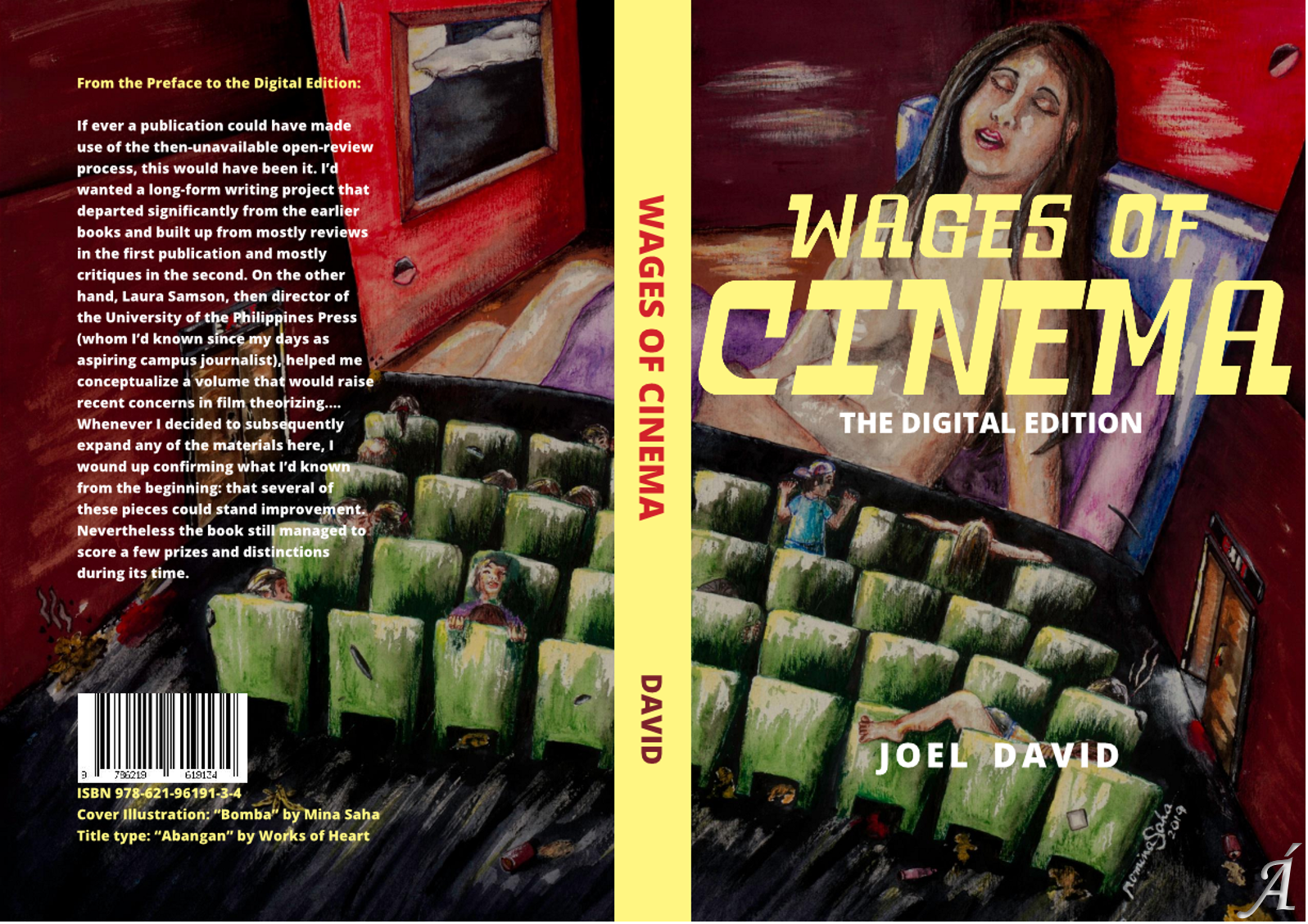












 ORCID ID

