

[Click here (recommended) for desktop mode.]
Ang Daigdig Ko’y Ikaw
English Translation: My World Is You
Additional Languages: Hiligaynon, Cebuano
Year of Release: 1965 / B&W
Director: Efren Reyes
Screenwriter: Fred Navarro
(From a story by Efren Reyes)
Producer: FPJ Productions
Cast: Fernando Poe Jr., Susan Roces, Oscar Keesee, Lito Anzures, Victor Bravo, Pablo Virtuoso, Dencio Padilla, Vic Varrion, Mario Escudero, Rudy Meyer, Philip Coo, Marilou Murray, Esther Vizconde, Romy Nario, Resty Sandel, Angelo Buenaventura.
At the Manila Yacht Club, Don Larrazabal has asked his men to lock his daughter Vicky in the cabin of his vessel, to take her away from Daniel, the man she wants to marry. When they arrive at Matabungkay Beach in Batangas, however, they remain unaware that she jumped overboard and swam to shore. She finds a dilapidated cargo truck driven by Roman, who has stopped for lunch with his two employees. She steals their food and boards the open-air cargo section. Roman and his companions think that one of them has been sneezing, but when they stop they discover Vicky. She pleads with them to take her to Baguio, offering to help in their work and even drive the truck herself. Since her clothes are wet, they offer her Roman’s spare clothes while Roman later says he can provide her with work if she needs it. When her father and his men pass by in their car, the truck occupants hide her and deny they’ve seen her. But when the father finds out that Daniel has gone to Baguio, he and his men proceed to the summer capital, believing they might find Vicky there.
Male actors who became directors were such a guarantee of film quality that one or two overlooked names would not be such a big deal. (In a satisfying twist of fate, the country’s last excellent actor-director was a woman, Laurice Guillen.) As a performer, Efren Reyes also lingered in the shadow of Gerardo de Leon, another actor-director. Fortunately he made a number of films for yet another actor-director, Fernando Poe Jr., whose most significant contribution was … as producer. FPJ spent a major portion of his fortune on maintaining prints of his films, even those produced by others. He may have been artistically limited as a consequence of this commitment, but the rewards—the best video transfers of any official distributor in Philippine cinema, not to mention occasionally excellent titles not stored at the Singapore (now Asian) Film Archive, by directors who would have otherwise remained unrepresented—are available for anyone with a passing interest in local pop culture. Ang Daigdig Ko’y Ikaw acquired a patina of nostalgia for its distinction of being the first film where FPJ teamed up with Susan Roces, over a decade since their emergence as major stars of competing First Golden Age studios, when their respective personas were already fully formed. Not surprisingly, these factors, alongside Poe’s and Roces’s equally matched levels of charm and ability, enable ADKI to sustain more strongly than most other first-time star teamups. The film’s success is evidenced in several more of their costarred projects over the next couple of decades as the most enduring lead duo in local cinema, although Roces’s tradition-enforced inactivity after her marriage to Poe must be counted as a regrettable loss, considering the superiority of her skills set relative to most of her star-level contemporaries. Their status as film royalty also contributed to a certain anxiety over the presumably dismissive response to their first project together: subsequent Roces-Poe movies were marked by a striving for allegorical serviceability, seemingly apologetic over the excessive pleasures provided by ADKI, which was supposedly further compromised by several moments reminiscent of its obvious source of inspiration, Frank Capra’s It Happened One Night (1934). Yet ADKI does not aim to surpass the Capra, providing instead a credibly indigenous counterpart. It elects to resolve as an open tribute to another local film, outstanding but now lost: Cesar Amigo’s Sa Atin ang Daigdig (The World Is Ours, 1963)[1]—proof that it had not just its heart in the right place, but also its feet on the right turf.
Note
[1] Spoiler alert: Both Ang Daigdig Ko’y Ikaw and Sa Atin ang Daigdig function as romantic comedies; the former is expanded by scope and locale in constituting for the most part a road trip, but the latter manages to focus more effectively on class differences. One might remark that the references to It Happened One Night diffuse the concentration of ADKI, but then again, social commentary is not its primary purpose. The parallels with SAD might be suggested by the commonality of the Filipino word for “world” in their titles, but the ending of ADKI dispels any doubt when it mounts a variation on the climax of SAD, where the central pair, played by Robert Arevalo and Nida Blanca, arrive at an understanding of their possibly irresolvable differences and the less-privileged Blanca character walks away from Arevalo, toward the camera; when Arevalo realizes he wishes to work out their relationship and calls to her, she continues advancing but this time with a knowing smile as he starts running, upon which the film ends. Film critic and scriptwriter (and National Artist for Theater and Literature) Rolando S. Tinio went on record to describe SAD as the best Filipino film he had ever seen, circa the early 1980s; I had included it as one of two black-and-white titles, along with Gregorio Fernandez’s Malvarosa (1958), in my top-ten canon—see Joel David and Melanie Joy C. Garduño, “The Ten Best Filipino Films Ever Made,” National Midweek (July 4, 1990), pp. 125–36, rpt. in Fields of Vision: The Digital Edition (Amauteurish Publishing, 2014), posted online. A local article that interrogates instances of film appropriations is “Imitation and Indigenization in Melodramas in the Late 1950s,” Huwaran/Hulmahan Atbp.: The Film Writings of Johven Velasco (University of the Philippines Press, 2009), pp. 113–24. For a useful recent discussion that teases out the complexities of cross-cultural appropriation from relatively marginal locales to the center, see Alex Taek-Gwang Lee’s “From Porcelain to Chips: A Genealogy of Global Technology and Capitalism,” Everyday Analysis (August 29, 2025), posted online.
Back to top
Return to Canon Decampment contents
Go to alphabetized filmmakers list
Á!
















 ORCID ID
 Ámauteurish!
Madonna of the Revolution
Lakambini [Noblewoman]
Directed by Arjanmar H. Rebeta
Written by Rody Vera
The biggest still-to-be-resolved controversy about the Philippines’s anticolonial revolution, the first in Asia, centers on the status of Andrés Bonifacio, founder of its liberation army, the Katipunan. Most adequately schooled natives would be aware that recognition of his stature as head of the country’s liberated territories was wrested by a faction that derided his status as uneducated and low-born, despite overwhelming evidence that he’d attained higher levels of historical and political awareness, a result of persistent self-education, than his critics. As a result of duplicitous maneuvering, he and his brother were subjected to a mock trial and summarily executed, their bodies never found despite an arduous month-long search covering two mountains by his widow, Gregoria de Jesús.
11011Also known as Oryang, de Jesus specified Lakambini as her nom de guerre, in acknowledgment of her husband’s position as Lakan or ruler. She accused agents of the usurpation forces of rape and was warned that she could be targeted for assassination. Julio Nakpil, one of her late husband’s lieutenants, married her and kept her safe, enabling her to survive nearly half a century after Bonifacio’s death. A lesser-known fact is that Bonifacio had appointed her his Vice President, which would have made her his successor if the revolution had not been betrayed by Emilio Aguinaldo.
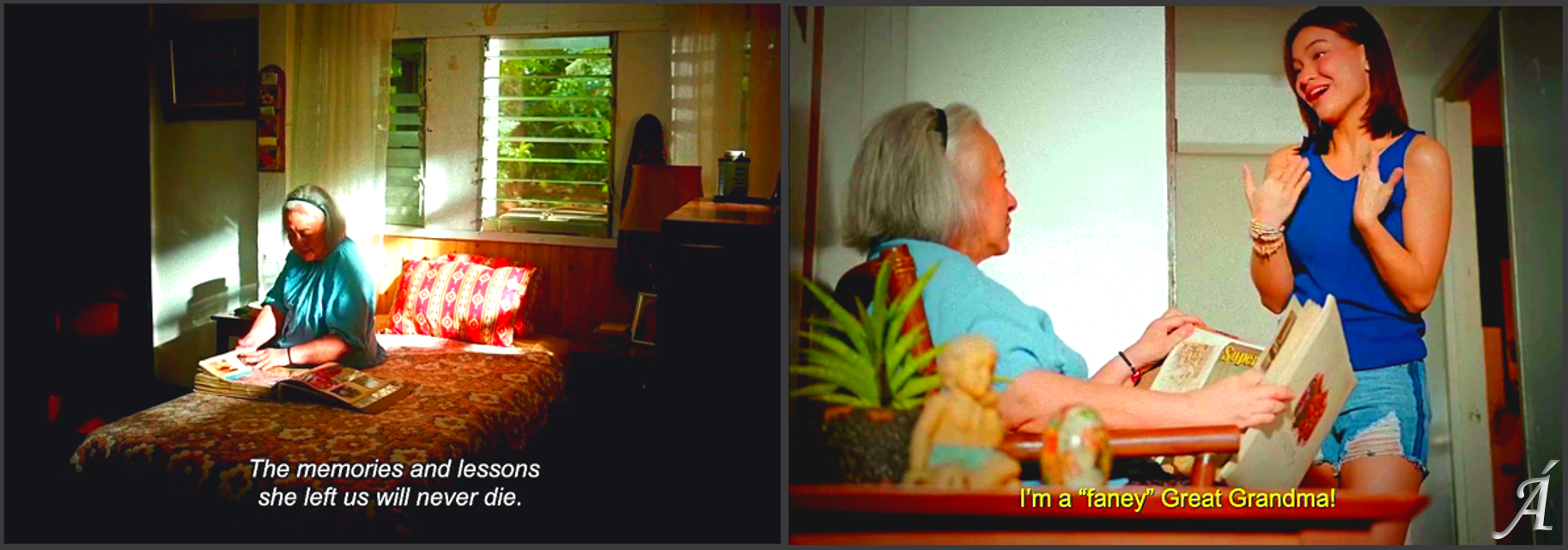
Rocco Nacino & Paulo Avelino (left) as the young Andrés Bonifacio and Julian Nakpil; and Spanky Manikan (right) as the elderly Julian Nakpil. [Screencaps by the author]
Lovie Poe (left) and Elora Españo (right) as the young Gregoria de Jesús. [Screencaps by the author]
Gina Pareño as the elderly Gregoria de Jesús. [Screencap by the author]
11011The only possible hesitation for most audiences, apart from the film’s formal novelty, would be the unremitting sadness of Oryang’s story: not only was she, like the revolution, violated by the very people expected to support her cause, she also lived through all three periods of vicious colonization, dying during World War II before the country attained any form of liberation. She allows herself some consolation in hearing the news of the failure of the fraudulent president’s attempt to legitimize his bloody power-grab via national elections, but issues perhaps the most important historical principle ever made by any Philippine political entity: that history, in its own time, will unmask hidden iniquity (preceding by a few decades Martin Luther King’s much-quoted statement on the arc of the moral universe bending toward justice).
11011Yet the filmmakers involved in the project had been capable in the past of creating difficult reflexive material with light-handed, even comic applications.[1] The daring with which they packaged the narrative of Gregoria de Jesús has not only accurately represented her as a polysemic figure, capable of addressing folks from several generations and persuasions and possibly even nationalities; it has also made her recognizable to millennial audiences, with their preference for experiencing multimedia banter and tolerance for crisscrossing various levels of reality. Lakambini has enabled her to step into the here and now, and the pleasant surprise is that her messages continue to resonate.
Note
Previously published July 27, 2025, in The FilAm. Non-essential disclosures: I was present during the feature film’s first day of shooting, intending to occasionally attend in order to observe a post-celluloid production, since the technological transition to digital occurred while I was busy writing my doctoral dissertation. I was also chair of the board of jurors during the short film festival where Arjanmar H. Rebeta’s entry (see note below) won several prizes. Finally, before production started, I wrote “Theater, Film, & Everything In-Between,” effectively an introduction to Two Women as Specters of History: Lakambini and Indigo Child by Rody Vera (Ateneo de Manila University Press, 2019), the annotated and translated screenplays of two prizewinning films; the book, also a prizewinner, was edited by Ellen Ongkeko-Marfil.
[1] Each of the names who directorially participated had works that may be classified as reflexive but in differing respects: Ellen Ongkeko-Marfil’s last completed film, Indigo Child (2016), was a documentation of a restaged play; Arjanmar H. Rebeta’s previous work, “Libro for Ransom” (2023), was a short film on an investigative journalist’s pursuit of the truth behind the disappearance and recovery of the novels of José Rizal in 1961. Jeffrey Jeturian had two titles, Tuhog (Larger than Life, 2001) and Bikini Open (2005), the first a tracking of the process of the adaptation of a rape case for a commercial film project and the second a mockumentary on a beauty contest.
Back to top
Leave a comment | tags: Commentaries | posted in Film Criticism