
Click here to go directly to the list of entries.
Jojo Devera was already a highly regarded archivist, with perhaps the most comprehensive collection anywhere of Philippine film and television material on video. For processing some of the rarest significant items in his collection and making them available to the general public at no charge, he received a special prize from the Filipino Arts & Cinema International (FACINE) Film Festival in 2017. Unfortunately lawyers claiming to represent some of the country’s studios forced him to shut down his website, although academics were occasionally still able to avail from him of samples they needed for research. (Said studios posted their own collections on YouTube pages they set up during the pandemic, also for free but often in badly preserved, unprocessed, and/or censored versions.)
11011Since then, Devera focused on posting a series of remarkable reviews of remastered Filipino films on his Facebook account, evaluating the final output vis-à-vis their original celluloid properties, pointing out when necessary how the text’s signification process is enhanced, modified, or even betrayed by technological intervention. He also has an auteurist study of neglected Second Golden Age master Elwood Perez, titled Feel Beautiful, currently awaiting publication (personal disclosure: I agreed to provide a foreword for it).
11011Not long after this year’s announcement of the Order of the National Artists of the Philippines finally included Nora Cabaltera Villamayor, he embarked on a series of evaluations of Nora Aunor’s performance record, one film at a time, followed presently by performances of Aunor’s contemporaries in films made by the other National Artists for film (scriptwriter Ricky Lee and director Marilou Diaz-Abaya). Folks in my long-time critical circle immediately realized that this was one more contribution that had never been provided before in Philippine film commentary. I requested permission from Devera to upload his series in chronological order. It has been updated up to May 2023, when Devera revived his essential Sari-Saring Sineng Pinoy blog.
11011Collages and audiovisual material appearing below are all from Devera’s Facebook posts. Sidebar pic is from Pag-ibig Ko’y Awitin Mo (dir. Eddie Rodriguez, 1977), also originally uploaded on his account by Devera, who owns copyright on these visual and textual materials. To jump directly to the performance assessment of a specific title, select the appropriate category below and click on the relevant entry:
Feature films with Nora Aunor:
• Bad Bananas sa Puting Tabing (1983);
• Bakit May Kahapon Pa? (1996);
• Batu-bato sa Langit (1975);
• Beloved (1985);
• Bilangin ang Bituin sa Langit (1989);
• Bona (1980);
• Dalaga si Misis, Binata si Mister (1981);
• Dementia (2014);
• Greatest Performance (1989);
• Himala (1982);
• Kinabukasan (2014);
• Kung Ako’y Iiwan Mo (1980);
• Maalaala Mo Kaya? (1973);
• Magnanakaw (1995);
• Minsan, May Isang Ina (1983);
• Minsa’y Isang Gamu-Gamo (1976);
• Naglalayag (2004);
• Padre de Familia (2016);
• Palengke Queen (1982);
• Sidhi (1999);
• T-Bird at Ako (1982);
• Taklub (2015);
• Tatlong Taóng Walang Diyos (1976);
• Thy Womb (2012);
• Ang Totoong Buhay ni Pacita M. (1991); and
• Mga Uod at Rosas (1982).
Non-Features with Nora Aunor:
• “Bubog na Dangal” (Lovingly Yours, Helen episode, 1983);
• “Kahit Konting Awa” (with song performance, 1985);
• La Aunor … Beyond Time (with video excerpts, 1994);
• Sa Ngalan ng Ina (2011);
• “Saan Ako Nagkamali” & “Kahit Na” (with song performances); and
• “Serye” (Star Drama Presents Nora episode, 1993).
Films that Feature Other Performers:
• Brutal (1980);
• A Hard Day (2021);
• Imbisibol (2015);
• Itim (1976);
• Lihis (2013);
• Mahjong Nights (2023);
• May Nagmamahal sa Iyo (1996);
• Memories of a Love Story (2022);
• Ang mga Kaibigan ni Mama Susan (2023);
• Minsan Pa Nating Hagkan ang Nakaraan (1983);
• Pamilya sa Dilim (2023);
• Raket ni Nanay (2006);
• Sensual (1986);
• Silip sa Apoy (2022);
• Somewhere (1984); and
• Write Here (1984).
POWERFUL SIMPLICITY
by Jojo Devera
(Facebook, June 25, 2022)
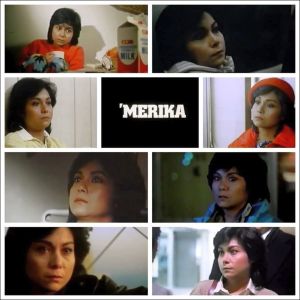
In ’Merika (1984), director Gil M. Portes, with screenwriters Clodualdo del Mundo Jr. and Jose Gil Quito, did something quietly daring and different. The framework is refreshingly simple, but it never feels claustrophobic, boring, or lacking in anything. Probably because Nora Aunor breathes life into the plot, channeling a kind of rare and subdued power. I commend the source material for providing Aunor with a backdrop to do incredible work. Because the character of Milagros Cruz had room to be well-rounded and complex, Aunor was able to expand her character by way of an intelligent performance. She does something smart with Mila, something that aids the holistic vision of the film. Aunor imbues Mila with commanding subtlety, so that the simplification becomes an advantage. ’Merika is a film obsessed with identity, as most immigration narratives are, but if the titular character strips herself from belonging to any one place, we are certain that the woman standing before us belongs exactly where she is, onscreen.
11011In my opinion, ’Merika owes much of its success to Aunor. That’s not to say it isn’t a beautiful film, it just relies heavily on its lead to work. Aunor’s nuances, the way the whole narrative is refracted through her movements and at times what feels like just her eyes, carries the film through all its own quiet uncertainties. You can see the wheels spinning, wheels of both deliberation and trepidation, in Aunor’s eyes, as she deals with losing things and gaining others (new friends, a career, romance). It should be noted that Aunor’s chemistry with everyone in the film is palpable and that their performances are stunning. Still, I’d argue it’s only because of Aunor that ’Merika never becomes compromised by its own confinement, but rather heightened because of it. Her powerful simplicity mirrors that of the film, as she steadily grows into something much larger and more meaningful than the sum of its parts. It’s both rare and heartening to see a movie that grasps the poignancy of everyday life decisions, where to live, what job to take, who to partner with, and how to press forward when every road promises something gained and something forever lost.
MEASURED INTENSITY
by Jojo Devera
(Facebook, June 25, 2022)

The heroine of Mario O’Hara’s Tatlong Taóng Walang Diyos (1976) is a woman of contradictory attributes that isn’t easy to imagine in the flesh. Rosario would seem too oversized to be embodied by any actress, even by an actress of extraordinary resourcefulness and versatility. Nora Aunor has already established herself as a performer of that caliber. She accomplishes the near-impossible, presenting Rosario in believably human terms. In a role affording every opportunity for overstatement, Aunor offers a performance of such measured intensity that the results are by turns exhilarating and heartbreaking. There is hardly an emotion that she doesn’t touch and yet we’re never aware of her straining. This is one of the most astonishing, unaffected and natural performances I can imagine. She looks more translucently beautiful and what Aunor has wrought, with O’Hara’s help, is a psychological verity for Rosario that is revealed through patterns of motion. She seems to be shunning the close scrutiny of others. Yes, she often faces people, often embraces, converses with them, but the overall impression of her movement is sidling, gently attempting to hide herself in open space. Through this kinetic concept, Aunor gives Rosario an aura of concealment. Sometimes O’Hara hands the picture over to Aunor. The camera fixes on her in medium close-up and, virtually without any change of shot, she tells a story. It’s what Ingmar Bergman has done a number of times with Liv Ullmann and it’s been done before with Aunor.
BRASSY, SOUL-STIRRING
by Jojo Devera
(Facebook, June 26, 2022)

In Ang Totoong Buhay ni Pacita M. (1991), Nora Aunor created one of the most indelible heroines in Philippine cinema, a rough-around-the-edges woman who can’t quite shake her working-class ways as she does whatever it takes to give her daughter Grace (Lotlot de Leon) a better life. Aunor is terrific as Pacing, injecting much-needed humor playing her image as a gauche vulgarian to the hilt. This is melodrama in its purest, most undistilled form, ruthlessly wringing pathos from its nerve-shredding themes of class, motherhood, and self-sacrifice. Beyond the wonder of Aunor’s performance, which is simultaneously brassy and soul-stirring, the other key to Pacita M.’s magic is that only the audience truly knows her. As a viewer, it feels like a privilege to know Pacing as nobody in her world truly can and appreciate what she decides to do, however questionable or downright deluded her actions are. The other characters are in the dark as we are in the dark too, weeping. Through it all, Aunor is a miracle, pouring the just-below-the-surface vulnerability she’s got into the endearingly crude Pacing, before going in for the kill with the titanic heartbreak of the impossible-to-forget ending. Coupled with Elwood Perez’s skillful direction and Ricky Lee’s memorable screenplay, Aunor’s performance evokes copious tears.
ADAPTABILITY AND RANGE
by Jojo Devera
(Facebook, June 27, 2022)

Though Lino Brocka’s Bona (1980) might seem like an unlikely place from which to launch a discussion of the craft of one the great Filipino actors, it illuminates several threads that run through Nora Aunor’s body of work. Foremost is her adaptability and range as a performer, which are unparalleled. Bona also demonstrates the centrality of collaboration to Aunor’s practice and the rigorous preparation that facilitates her singular spontaneity and openness to chance in the moment of performance. Her almost otherworldly range has generated certain tropes in reviews of her work: she is said to “disappear into the character.” But this take, which suggests an innate and natural ability for imitation or even an erasure of the self, doesn’t capture the careful calibrations of Aunor’s craft. Rather than disappearing into her characters, she deconstructs the performance process on screen. Aunor achieves layers of reflexivity, performing the character’s own fleeting performance of the self. Her ability to highlight the incongruities within a character without resolving them is one of her greatest strengths as a performer. Aunor’s face has a striking ability to embody that luminous star power while also cracking it open like brittle armor. As Bona, Aunor draws the camera to herself, seducing us like her mark, even as she tilts her face to give in to the sexual advances of Gardo (Phillip Salvador). That same face sours when she claims her bitter revenge. Indeed, across a range of characters, Aunor’s carefully tempered expressions bring to the surface an array of subtle revelations and momentary ruptures. Across many projects, Aunor has embraced different facets of her characters, resisting the temptation to explain them. One is left with the impression that for her, anything is possible, a prospect that is at once thrilling and a bit terrifying.
IMMEASURABLE BRAVERY
by Jojo Devera
(Facebook, June 28, 2022)
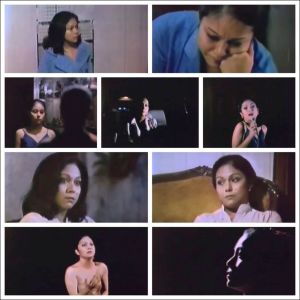
Every once in a while, you witness a performance so brilliant that it leaves you in a state of total awe. It’s the kind of performance which really blurs the line between the actor and character being portrayed. You don’t see any trace of the actor because the latter has succeeded in fully inhabiting a character, as opposed to just playing one. An actor’s job is never easy as it looks, involving the tearing down of those layers we surround ourselves with to protect us emotionally. This requires an immeasurable amount of bravery, and if the actor succeeds in what may seem impossible, you will be left believing that no one else could have played a role as well as the actor did. After witnessing Nora Aunor as Beatrice Alcala in Laurice Guillen’s Kung Ako’y Iiwan Mo (1980), in a performance bursting with emotion, her portrayal is never less than believable. She nails every moment perfectly, never missing a beat. Watching her infinite happiness when she meets Mike (Rolly Quizon), the look in her eyes is beautiful and simply enthralling. I’m still thinking about her long after the movie ended, trying to figure out how she accomplished all of this without falling into the trap of playing a caricature. I can’t stop gushing over how phenomenal she is.
COMPELLING AND TRAGIC
by Jojo Devera
(Facebook, June 29, 2022)

As good as Charito Solis and Maricel Soriano are, Minsan, May Isang Ina (1983) is Nora Aunor’s film and she owns every moment. Ruth is a repressed character, and yet Aunor makes her both compelling and tragically human. The film never attempts to explain why Ruth is the way she is, but Aunor paints her as a profoundly broken woman, someone so socially malnourished that normal simply isn’t an option for her. This is such a meaty, fascinating role. While the film isn’t especially interested in explaining where Ruth’s dysfunctions come from, it doesn’t try to judge her either, no matter how derailed her psyche becomes. Instead, director Maryo J. de los Reyes just watches, often letting scenes play out as a single shot of Aunor even when a cut might be merciful. It’s an undeniably effective approach. Aunor wears her own face like a mask. Throughout, she registers emotion with minimalist precision. Her performance is all eyes. When feelings escalate, she lets her look dart around the room. In other scenes, the willed blankness of her stare, refusing cues and context, does the same.
PRIVACY AND MYSTERY
by Jojo Devera
(Facebook, July 1, 2022)

Despite how inextricable Nora Aunor’s personal pain is from Greatest Performance (1989), the arrival of catharsis twenty minutes in feels audaciously premature. At this point Aunor’s character, an unknown singer named Laura Villa, has been established only in broad strokes. The voice exposes interiority, the inside of a body and self, the very things that get obscured in a genre so invested in surface beauty. But if ever a narrative movie could be said to fulfill some sort of ideal of a singer’s film, Greatest Performance is it, in the way it visually mythologizes the singer in the act. Where most emotionally driven musical numbers serve as outlets for what’s being felt in the heat of a given moment, the anguish surging through “Iisa Pa Lamang” exists independent of any apparent catalyst. Aunor’s voice becomes all the more compelling for having wriggled out of contextual constraints, for stopping us in our tracks without the justifications of narrative or character development. It’s Aunor’s voice that makes it difficult to hear the song as anything other than an authentic cry of pain. And it’s their sharing of this same inimitable sound that makes actor and character impossible to disentangle. The scene assumes that, in Aunor’s hands, any sad love song is inescapably personal. Without her, such an unseemly outpouring would lack all credibility. “Iisa Pa Lamang” lingers like an aftertaste, an agonizingly short-lived moment of clarity that the rest of the film feels all the more poignant for failing to recreate.
11011It’s the self-knowing and effortfulness of the acting, the moment-to-moment decisions moving it forward, that foreground the song’s seemingly inevitable candor. In “Iisa Pa Lamang,” we catch glimpses of a shift in her acting style that becomes more pronounced. Aunor, the filmmaker, in her detached authorial power, has captured what she needs while Aunor, the performer, is left with all that emotional excess roiling inside her. It’s a brief moment, one that evokes its obsessive chronicling of the singer’s transformations in and out of performance and its cold observation of everyone else’s indifference toward the toll it must be taking on her. Greatest Performance honors the chameleonic dexterity and creative agency of the performer whose constant self-making may exist within another’s vision but is never any less her own. Laura becomes a palimpsest of the actor’s accumulated public self and because we know the beauty of the singing originates from the depths of a life lived, we are led to acknowledge an offscreen Laura who for all we know may have suffered a pain that likewise preceded the camera. Aunor’s public life sheds light on the places where her character has been granted relative privacy and mystery.
EFFORT AND ACHIEVEMENT
by Jojo Devera
(Facebook, July 2, 2022)

Adolfo Borinaga Alix Jr.’s Kinabukasan (2014) is a film composed of gestures and glances, its delicacy a veiled promise of abandon. And it could not exist without Nora Aunor’s extraordinary performance, which summons Ernest’s entire lifetime in those eyes and in the timbre of her voice. Aunor truly comes alive in the subtle changes in her expression. She slowly, gracefully, expertly raises the corners of her lips into a soft smile as her eyes begin to pool with tears. Seeing Ernest slowly revealing her pain is like being invited into her secret world. Aunor has the ability to transform herself vocally, facially, and physically although we’ve already seen how thoroughly she can merge with other people’s bodies and voices, notably as Elsa in Ishmael Bernal’s Himala (1982). She is stellar in wordless scenes. Aunor makes unexpected choices with dialogue too, but she resists the temptation for overstatement, her delivery touching in its directness. What Aunor’s performance exposes is the duplicity intrinsic to the phenomenon of the star; no matter how precise and specific the performance, we never for a second lose sight of the actor, virtuosically performing a different person. The drama on display is the effort and achievement of the acting itself.
DISARMING AND DEFERENTIAL
by Jojo Devera
(Facebook, July 2, 2022)

It’s always special when a director is able to create a world that shows off his unique sense of humor in a comedy. With Batu-Bato sa Langit (1975), Luciano B. Carlos has done that in spades. Taken as a whole, in the sum of its dizzy parts, Batu-Bato sa Langit showcases a disarming and deferential comic brilliance. The best comedy has its roots in the painful encumbrances of human existence, the cinema screen being the mirror that delivers to the audience its filmic reflection. It’s easy to imagine Orang’s foibles being exploited for cheap laughs. Certainly the character’s breathy demeanors are easily overplayed external factors, but Nora Aunor’s talent is in humanizing even the most minor behavioral tics. Orang, no hollow comic shell, is a full-blooded creation of the emotional interior. It would be an insult to merely laugh at her or with her and so we respond in complex kind, our hearty guffaws barely concealing winces of individual recognition. Aunor recognizes the importance of moving beyond the symbolic, of trumping hollow laughter and infusing it with depth of feeling. Her comic means are used toward humanistic ends. Despite Orang’s awkwardness, Aunor never invites the viewer to ridicule her character. It’s fantastic to see her completely unaware she is in a comedy. A cut to Aunor’s reactions is the perfect punchline and her line deliveries, masterly.
IMPERILED SOLITUDE
by Jojo Devera
(Facebook, July 3, 2022)

Brillante Ma Mendoza’s Taklub (2015) is gripping drama based on a true story. Flinging herself, ego-free and vulnerable, into Bebeth’s shredded soul with utter conviction, Nora Aunor embodies everyday maternal heroism. Hers is a beautiful performance that couldn’t exist without access to the character’s emotional truth. Thanks to her ability in conveying empathy, courage, and motherly love, Aunor has created a moving tribute to the real-life woman she portrays and every single soul affected by the horrific natural disaster that was Typhoon Yolanda. Her utterly exhausting and convincing portrayal of a tragedy-stricken mother is enormously amazing and carries the entire film. For Aunor, it’s as if pain is a renewable resource for her characterization skills and of late, she seems to have specialized in the allure of the imperiled solitude with all the physicality and interiority required, whether or not the movies themselves are any good. Aunor brings that same full-bodied intensity to Bebeth. As survival cinema, Taklub has a certain unpredictable energy which Aunor embodies with a combination of compassion and exasperation. It’s the aftermath, however, in which we learn the root of Bebeth’s experience, that exposes Taklub for the well-intentioned film about grief that it is.
WEIGHT AND HEFT
by Jojo Devera
(Facebook, July 4, 2022)
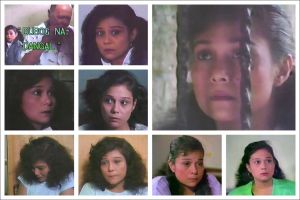
“Bubog na Dangal” (1983) was the 9th anniversary presentation, directed by Mario O’Hara, of the long-running weekly drama series Lovingly Yours, Helen. As the story begins, the unthinkable has already happened. Lourdes (Nora Aunor) is in emotional hell from the first second and, over the course of an hour, finds no relief. The reasons for her torment may change or deepen, but they inevitably find their source in an awful foreboding, a sense of ceaseless guilt. Every frame she shows up in demonstrates her ability to articulate emotions through undefinable facial expressions. Aunor’s presence gives a sense of yearning to accept the fate of the inevitable. Watch out for the passive straight face she makes throughout in spite of the agony and the unspeakable feeling she is undergoing. Aunor makes everything uncomplicated with her ability to explore the character in silence. On camera, she gives a tour-de-force performance, effortlessly conveying every thought racing through her character’s mind. Aunor is is not just the star, but also the larger-than-life presence that lends the episode weight and heft.
STAGGERING POWER
by Jojo Devera
(Facebook, July 5, 2022)

Himala (1982), directed by Ishmael Bernal, is a powerful and successful experiment in minimalism. Ricardo Lee’s screenplay takes on a documentary aesthetic, following characters as seemingly nothing of consequence is happening. There is great emotional resonance to the film, particularly in a handful of immensely powerful key scenes. Nora Aunor’s detractors claimed that she did nothing and played a bland character. While these claims are utterly unfounded, it’s not hard to see where they stem from. Elsa spends most of the film being swayed by the currents of other characters’ desires. She almost doesn’t feel like a protagonist due to her passivity. Yet Aunor plays her with immense authenticity. Perhaps it’s because of the similarities between actress and character. Her role as Elsa is a perfect example of an actress not being given the credit she deserves because of quietude. Aunor’s acting is almost masked by her naturalness in the role. It is the best performance Bernal has ever directed. Elsa speaks more than a sentence or two at a time and says nothing at all about life in the village or her childhood. But Elsa remains a cipher, her interests and experiences, her inner life remain inaccessible to Bernal. The spoken word is not cinema’s most powerful tool. As anyone in the field knows all too well, cinema developed originally as a mute medium, dependent on images and editing to convey meaning. Himala is entirely structured around Elsa’s point of view and this is the narrative paradigm that drives the film. I therefore have a hard time accepting the view that it silences Elsa, despite her demeanor. Aunor’s lack of pretense, the naturalism with which she embodies this character is astounding. Elsa is a stoic but complex woman who witnessed hardship largely silently, but when she speaks, she is resplendent. Her final monologue showed she’s reflexive, more aware about her motives and mixed emotions than all the other characters. There are those who diminished the turn as a non-performance, but they are sorely mistaken. Aunor’s work is of staggering power and it is, without question, one of her best.
INSECURITY AND GRIEF
by Jojo Devera
(Facebook, July 5, 2022)

A memorably bitter highlight in Adolf Alix Jr.’s Padre de Familia (2016) is the coruscating funeral scene. The tone of this disastrous wake is set by Noel (Coco Martin), whose resentment against his mother, Aida (Nora Aunor), as well as against various others near and dear, gets a thorough and unhinged airing. There’s too much potential in Noel’s outbursts and the revelations they unleash. The last act is a series of gobsmacking handbrake turns practically sending the entire cast off packing. Aida, mother of the family, is probably the most interesting character in the film, played to perfection by Aunor. She stubbornly resists any external show of the emotional turmoil she undoubtedly feels. Aida inexplicably gives priority to keeping up appearances and wants to give no one outside the family any inkling of their troubles. But her pretense extends within the family as well, where she comes across as disconnected, her brittle surface barely concealing the depth of insecurity and grief that lie underneath. The strain between Aida and Noel is written with raw truth, it becomes achingly apparent. In one of the most finely wrought scenes in the film, Aida attempts to bridge the gap, but she possesses neither the energy nor the skill to break through the emotional carapace with which her son has armored himself. When Aida reaches the point where she is ready to confront the issues that have created a wall between them, Noel pushes her away, by obliquely criticizing her relationship with Job (Joem Bascon). Padre de Familia artfully affirms a universal truth about the human condition. It epitomizes what a Filipino independent film can be when the director is willing to abandon the safety net.
AMBIGUOUS VOLATILITY
by Jojo Devera
(Facebook, July 6, 2022)
 Afflicted with anxiety attacks as well as trust and intimacy problems, Delia (Nora Aunor) is a woman on the verge of a nervous breakdown. She’s helpless and Danny Holmsen’s Maalaala Mo Kaya? (1973) is utterly drenched in the feeling of helplessness. Aunor embodies the depths and contradictions of psychological trauma and the hidden strengths it can uncover. Aunor’s performance sears into my being as Delia’s frustration and desperation build. The emotions coursing through the film are palpable. What keeps us rooting for Delia is the quicksilver complexity Aunor brings to every aspect of her performance. A jangle of nerves and manic energy, she infuses Delia with realness and easily invites sympathy as she endures the horrors of confinement in a mental institution. Throughout, Aunor inhabits all the breakdowns necessitated by her role. The revelations are heart-stopping. Aunor’s performance is so rich that she turns her character’s ambiguous volatility into a virtue.
UTTERLY CAPTIVATING
by Jojo Devera
(Facebook, July 8, 2022)
 Magnanakaw (1995) is built around a towering performance by Nora Aunor that is itself about giving. Not only is she mind-blowingly terrific, her delivery’s a spectacle of facial expressions, primal screams, and howling monologues. Rosing is a mess of hurt trying to find a form of rapture that permits others to transcend loss. As the story moves along, Aunor’s character slowly descends into madness, leaving the viewer, like Rosing, not fully knowing what is going on. As brilliant as Aunor is at suggesting a rapidly compartmentalizing consciousness, her directors Nick Lizaso and Soxie Topacio aren’t taking any chances. Aunor plays Rosing with absolute perfection, alarm, and terror that she embodies from within, an inner commitment to the refusing of anything close to compromise. The stares are another reoccurring ideation, whether it is Rosing facing off against Oca (William Lorenzo) or the detailed monologues in the presence of her best friend (Tetchie Agbayani). There are always two from either gender using their persuasive influence on her. Aunor isn’t afraid to fully commit herself to the madness that’s unfolding within Rosing as well as delve into the very necessary side of acting that captures the impetus of the scene at hand. Her performance is utterly captivating. Aunor’s face can quickly transform into a mask of rage, horror or pain. She also always understands what her directors are up to.
SWEEPING AND ELEGIAC
by Jojo Devera
(Facebook, July 9, 2022)
 Most great singers, from Billie Holiday to Frank Sinatra to Edith Piaf, tell part of their story in music. The key is to let the song do the work. Nora Aunor did that with her opener, “The Windmills of Your Mind.” Her voice has lost nothing and she seems to understand songs better. Continuing with the classics “What Now My Love?,” “In My Life,” “Kapantay ay Langit,” she delivers beloved songs all night. Watching Aunor perform her “Alpha Hits Medley,” singing “Yesterday When I Was Young,” sounding heart-stopping, tear-jerking, or whatever superlatives you want to throw at it, is a reminder that some legends are legendary for a reason. When she steps up to the microphone and opens her mouth, Aunor’s breezy stage manner, her ability to be silly and sexy within the course of a lyric, to bring you in with a whisper and to belt out a crescendo, are so magnetizing, you can’t look away. For the next hour, Aunor commands the stage, singing and telling jokes. Then she brings out her voice teacher, Louie Reyes, to duet for the first time ever on a live stage, performing a mashup of Seawind’s “Follow Your Road” and The Beatles’s “Let It Be.” Later on, she takes the stage with the Side A Band, singing “Foolish Heart,” before Asia’s Songbird, Regine Velasquez, gets the biggest cheer of the night with their duet of “People.” Aunor’s version of George Canseco’s “Paano Kita Mapasasalamatan” is tender and beautiful. La Aunor … Beyond Time (1994) concludes with her well-known low-key, melancholic take on Florante’s anthem “Handog,” now sweeping and elegiac.
VERSATILITY, VULNERABILITY, VALIANCE
by Jojo Devera
(Facebook, July 9, 2022)
Nora Aunor is one of the strongest vocalists of her generation, imbuing her reality into the several songs that littered her life and lit our stages. The songs embody a certain level of engagement and adulation, so her vocals are always committed to the cause they have engaged with. In a career that has lasted decades, she has emerged as one of the most important artists of her generation. The singer has embellished her body of work with a series of striking vocals that show growth and development as a person and as a woman. Aunor shows her versatility, vulnerability and valiance as a person of great composure and poise. Such is the vastness of the work, it goes beyond the restrictions and trappings of mere padding.
“Saan Ako Nagkamali”
There’s a lot more depth and density to her work in this shimmering ballad by George Canseco. Aunor was strong enough to capture an entirely new form of music. It’s a vocal performance of integrity and assurance, a malleable voice that only grows grander with every passing verse.
“Kahit Na”
Notable for putting emphasis on the words in question, as the feelings that cement the song are what lead to such a strong vocal. She’s strident and singular in her resolve, capturing the propensity and proclivities of Willy Cruz’s words to bring her truth to the forefront. Emotion soaks through the vocal, veering into more intellectual territory, as the song creates a new pathway for the singer to express herself, both as a musician and, more important, as a woman.
FUNNY AND DIMINUTIVE
by Jojo Devera
(Facebook, July 10, 2022)
 Many of the most memorable appearances in cinema history have also been among the briefest, as big-name stars take the opportunity to steal the show with a small but perfectly formed cameo. In fact, cameos can sometimes be more memorable than full-length roles. Sometimes cameos enhance a story, at other times they’re just there to make you laugh. In 1983, Nora Aunor had a brief role in Peque Gallaga’s Metro Manila Film Festival entry, Bad Bananas sa Puting Tabing, which was most notable for Aunor’s funny character, diminutive Secret Agent Maria Clara Cayugyug. Her performance was the perfect blend of energy and comedy, without being too over-the-top. Aunor is a great example of a comedic performer making a lot out of very little. Bigger than her tiny frame might suggest, she’s driven and has perfect comic timing. We can only wish there were more of her.
SYMPATHETIC AND AGNOSTIC
by Jojo Devera
(Facebook, July 10, 2022)
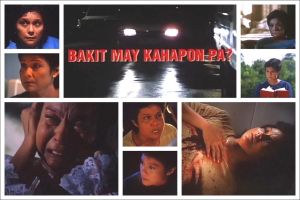 There is something so enthralling about watching a woman who has gone off the rails. In Joel Lamangan’s Bakit May Kahapon Pa? (1996), Karina Salvacion (Nora Aunor) is training viewers to recognize the sudden changes in her personality to help them understand the real meaning behind her words. Karina is definitely a memorable character not because she’s mixed up. What’s really interesting is how, ultimately, she’s just trying to piece her life together but lacks the mental stability and social understanding to do so. She ends up being a sympathetic character, despite her overbearing and obsessive traits, and the things she’s capable of. Karina is complex. There’s a mixture of her being someone who has snapped yet basically knows what she’s doing. Her need to regain composure and appear normal after she overreacts makes her a unique, tortured character. Karina creates most of her problems, and is aware of it. It’s a chilling portrayal. Aunor interchangeably makes the viewer feel both sympathetic and agnostic about her character. When the narrative careens into pulp territory, she anchors the conflict. Situations become increasingly far-fetched, but Karina reacts to the outrageous circumstances in a true and reasoned way.
FAMILIARITY AND EMPATHY
by Jojo Devera
(Facebook, July 11, 2022)
 Beautifully written and performed, Mga Uod at Rosas (1982) goes far beyond stereotyping, never patronizing. The film has a static look with many shots of characters talking or sitting and waiting. Ingmar Bergman, one of the greatest filmmakers, used to say he believed the real subject of cinema is the human face. Nora Aunor has an astonishing face that can hold a close-up. The tiny inflections in her face open an overwhelming blend of frustration, patience, determination, her own kind of unpretentious clarity, and above all deep sadness. Tremendously played by Aunor, Socorro is a woman who generally likes to keep her emotions in check. Director Romy V. Suzara makes her face the center of the movie. Many films refer to a lead character’s face – the reaction shot is not a new technique, but here, it’s about as well as it can be done. The real highlight of the film, though, is Aunor. Socorro’s complexity is phenomenally conveyed by Aunor, who is able to portray her character’s internal struggle with a few simple facial gestures. Socorro feels lived in, and it’s the kind of performance that evokes a sense of familiarity and empathy with the audience. Aunor commands the proceedings, and Suzara lets you know it with lingering close-ups of her face, underscoring her beauty and boundless ability to make us care deeply no matter what role she undertakes. Aunor is always good, but performances like this suggest that for all her acclaim, she might actually be underrated.
VERVE AND FLAIR
by Jojo Devera
(Facebook, July 12, 2022)
 The center in Leroy Salvador’s Beloved (1985) is provided by the finely woven portrait of relationships with all their attendant joy and pain. The screenplay by Orlando Nadres (based on Nerissa G. Cabral’s King Komiks serial) also offers an ending that seems perfectly in tune with the balance of the film. Salvador lets the camera linger on how Adora Bernal (Nora Aunor) looks at her boyfriend of five years, Dindo Tuason (Christopher de Leon). Aunor communicates with her body and face in ways that speak volumes. Adora is a performance of herself, crafted from necessity. Played with raw vulnerability that’s contained by a kind of performative hauteur, Aunor’s Adora makes her sacrifice wrenching, gilded with gestures that give her verve and flair that prove irresistible. She’s packaging herself to be unavailable, protecting herself against rejection should her instincts prove wrong. Aunor’s marvelous performance lets us watch Adora fall in love from the inside out. Her eyes, set close in her achingly open face, register every shock of feeling. Aunor performs with the same precision and masterly calibration as demonstrated by her director. Beloved is a sophisticated and complex drama that stays with its audience long after it cuts to black.
FRONT AND CENTER
by Jojo Devera
(Facebook, July 13, 2022)
 Loneliness and independence aren’t opposites but twins of each other, gemini states of being that can give even the shyest among us, courage to stride forth. Yet Maryo J. de los Reyes and Nora Aunor, paired as director and lead actor for Naglalayag (2004), capture this not-really-a-paradox in a cerebral pas de deux, as if each has found an unspoken understanding in each other. Their seemingly disparate sensibilities – de los Reyes’s attention to craft and sense of decorum, Aunor’s forthright crispiness, which serves as a fortress for her eggshell fragility – merge in this odd-couple picture. Naglalayag is about how fear of living is more paralyzing than fear of death. Its ending should seem sad, yet it’s piercingly jubilant, like a celebratory cocktail with a complex, bittersweet finish. De los Reyes heightens the film’s tragedy by actively empathizing with all of his subjects, especially Dorinda, whose mild restlessness is treated with profound sensitivity. Aunor beautifully imbues Dorinda with a recognizable sense of discontent (she’s not unhappy per se, but she’s quietly weary of middle-aged life’s doldrums), and de los Reyes supports her performance with warm compositions and delicate close-ups, placing her perspective front and center. Aunor’s eyes always seem to be giving her feelings away, and so every time she widens, lowers, or shifts them, there is a great deal of suspense.
11011Naglalayag is a romance between Dorinda and Noah (Yul Servo), two people in search of an unnameable connection, and we warm to the way they find solace in each other. But the fleeting nature of this affair is its most golden element; it is romantic precisely because it can’t last. In the end, Naglalayag is really a romance of the self, a celebration of the person you can become when someone else touches you deeply. We’re all souvenirs of our own experiences, and what we take away from love affairs is sometimes of more value than what we gain when we try to wrest them into some ill-fitting frame of permanence. A kept memento is a sad thing, but a memory remains alive and supple forever. It’s the flower you don’t catch, the one you never crush by pressing it into a book. Dorinda’s triumph in Naglalayag isn’t a conquering of loneliness – some form of that will always be with her. Dorinda’s victory is that she has said yes – not just to a younger man but to herself. Loneliness can’t be cured, but it can change shape. What appealed to me in the idea of Naglalayag? Loneliness – a more common emotion than love, but we speak less about it. We are ashamed of it. We think perhaps that it shows a deficiency in ourselves. That if we were more attractive, more entertaining, and less ordinary, we would not be lonely.
COMPLEX AND REVELATORY
by Jojo Devera
(Facebook, July 14, 2022)
 The luminescent tryst between Baby (Vilma Santos) and Roy (Phillip Salvador) in Baby Tsina (1984) remains to be Marilou Diaz-Abaya’s most complex and revelatory examination of unfulfilled love. She doesn’t solely rely on the flashier aspects of her patented style to convey a character’s fated desires or failures. She positions individuals as pieces of a larger mosaic, one populated by burgeoning and disintegrating relationships that reach beyond the frame. This construct produces subtext-heavy conversations containing real conflict and tension at their core. As Baby Tsina turns into a masterly dissection of loyalty, Ricardo Lee’s dialogue expresses the characters’ way of maneuvering around emotional responsibility, of circumventing the betrayals that are lingering in plain sight. This conflict builds for long sequences before erupting in stunning moments of physical violence. In this very banal-looking world, unfulfilled desire turns sour from all the repression and guilt. Baby and Roy’s conversations grow shorter and more kinetic, jumping past traditional banter. The unique ways emotional expression shifts mid-moment really distinguishes the film as an organic work, a morphing cinematic experience that changes with the years to fit our individual perspective of unrequited love. Unlike the showy emotional relationships in Abaya’s other films, the connection between Baby and Roy feels bonded in actual human emotion. Baby Tsina centers on the title character – played with gusto by an always illuminating Santos. Her tremendous poise is visible at once in the opening credit sequence introducing the tone and protagonist of this very different film. The precisely edited sequence serves Santos exceedingly well. Baby Tsina is perhaps one of the most successful protagonists Lee has crafted. Her desires and motivations are clear, her thought process shown in full. And best of all, she feels real.
STRENGTH AND CONFIDENCE
by Jojo Devera
(Facebook, July 14, 2022)
 Lino Brocka finds the right tone in Dalaga si Misis, Binata si Mister (1981), and it’s not always very easy because he wants to make his film both true and funny, not sacrificing laughs for the truth. But what was the right tone? It gives us the release we need, and sets Nora Aunor’s personality for the movie’s second act, with scenes of loneliness and the beginning of emotional recovery. Brocka isn’t afraid to pull out all the romantic stops at the right moment. He wants to record the exact textures and ways of speech and emotional complexities of his characters. There are scenes so well written and acted that our laughter is unsettling. Aunor takes chances here, never seems concerned about protecting herself, and reveals as much in a character as anyone ever has. Doria Navarro is out on an emotional limb. Aunor is letting us see and experience things that many actresses simply couldn’t reveal. It’s a lesson for critics on the dangers of assessing performance in a movie, a medium in which the actors may be more at the mercy of the other craftspersons than we can readily realize. Rather than solely embodying the strength and confidence of a single protagonist, Dalaga si Misis, Binata si Mister mobilizes Doria’s arc as a signifier of feminist freedom without becoming didactic or trite. Brocka perfects the ending by de-centering his perspective and the audience-centric satisfaction of a nihilistic open-ended conclusion, allowing the protagonist the final say regarding her personal satisfaction.
BROAD STROKES
by Jojo Devera
(Facebook, July 15, 2022)
 For writers Ricky Lee and Shaira Mella-Salvador, May Nagmamahal sa Iyo (1996) seems like an occasion to tweak familiar formulas, as they exhibit a compulsive need to distance themselves from the story’s intrinsic sentimentality. For director Marilou Diaz-Abaya, it’s a chance to play up that same sentimentality, underscoring emotional moments with excessive bathetic flourishes. Working at cross purposes, these two sides make for a fractious movie whose internal conflicts mirror those experienced by its lead character. Lorna Tolentino stars as Louella, a woman who gave up her son for adoption. Years later, still wrestling with that part of her past, she has become curious about her son’s whereabouts. Louella confides in Nestor (Ariel Rivera), who offers to help, as she begins the journey of discovery. May Nagmamahal sa Iyo features a deeply felt and gripping performance from Tolentino and a supporting performance from Jaclyn Jose, equally brilliant as Edith, that reminds us just how wonderful this actress has been throughout her career. Just a momentary gaze is enough to convey what many actors spend whole hours in a film not-conveying. While the movie sets up the plot catering to our need for nice, neat, and orderly boxes, the story weaves in and out of them, upending our conventional views and presenting us with more questions that drive us further into the narrative. This perfectly mirrors Louella’s frustration as she encounters roadblocks in her journey to find her son. In fact, this arc is the one most powerfully portrayed in the film by Tolentino as she vacillates within the pain she feels. It is the driving force behind her search, and the means by which she finds resolution. The fact that we all have weaknesses and identify in the struggles, hopes, and journeys of others is more indicative of the need for such stories so that we might find the strength to rise up and pursue life’s greater aims. These are the film’s broad strokes, and they are all true. They will make you angry, and tear your heart to pieces.
INTERIORITY AND COMPLEXITY
by Jojo Devera
(Facebook, July 15, 2022)
 Sa Ngalan ng Ina (2011) was a TV soap opera in which melodrama peers into the public and private lives of political adversaries in the fictional province of Verano. Nora Aunor has long-captivated audiences with her portrayals of complex women. Needless to say, it was hardly surprising to see Aunor deliver a performance that felt as though it had been lived in for decades. Governor Elena Deogracias is a stoic, reliable presence in most episodes, and absolutely dominant when she needs to be. Beyond convincing and unafraid to let things get a little messy if that’s what the moment calls for – Aunor allows Elena to hold her own against biggest rival Lucia (Rosanna Roces), scheming wife of Pepe Ilustre (Christopher de Leon). It’s a wrenching transformation to watch, and one that Aunor turns into the central crux of the story by sheer force of will. She gives the drama a commanding center as a determined woman keen on taking control of her surroundings even as they slowly close in on her. Aunor exudes desperation but never takes it to histrionic extremes; much about the success of the performance extends from frustrated glances and baffled reactions as her stepchildren Andrea (Nadine Samonte) and Alfonso (Alwyn Uytingco) continue to heap discomfort on her life. Her resilience adds a transcendent dimension to the role. It would be even more accurate to say that Aunor’s face becomes the narrative’s primary location. Directors Mario O’Hara and Jon Red set the most pivotal scenes in the actress’s desolate eyes, or in the blank face that’s had all of its expression siphoned out of it. Aunor’s commitment to the part allows the performance to assume the intimacy of watching a loved one confront death. She rises to that challenge with extraordinary interiority and complexity. Aunor weaves joy, sadness and rage all on her quiet face, and with astonishing ease – an effortlessness that turns more suspenseful with each scene.
SILENCE AS VIRTUE
by Jojo Devera
(Facebook, July 16, 2022)
 Depending on how you look at it, silence can be either a virtue or a weakness. To remain quiet, to not covet attention might seem admirable. This type of silence has been co-opted and leveled at people as a means of oppression. The implication is that those who are silent have nothing of value to say, rather than valuing what they do not say. Silence of this kind is less about what is said and more about who is heard. Choosing to be quiet is different from being made to be so. When silence is used as a tool of oppression, it stamps out the voices of those most in need of being heard. In Joel C. Lamangan’s Sidhi (1999), the issue of when to be silent and when to speak is central. Ana (Nora Aunor) finds pleasure in a situation that looks, initially, to be problematic. Yet she plays a role in defining the parameters of her interactions. She pushes back against the advances of Miguel (Albert Martinez) and draws lines on what she will or won’t do. Lacking dialogue, Aunor has to rely on expression through movement. She captures Ana’s vulnerability while avoiding mawkishness. It’s impossible not to be captivated by the climactic scene between her and Martinez – Lamangan’s camera lingers on Aunor’s face to capture the pain and betrayal in her eyes, then follows the way she stumbles away from his grasp like a wounded deer. Ricardo Lee’s adaptation of Rolando S. Tinio’s teleplay, Ang Kwento ni A, is measured by the quality of the characters and their relationships. Aunor has an austere, powerful presence, like that of the great silent-film actresses, but there’s nothing at all genteel about her face. It’s rough and drawn and it has a hypnotic severity, the features so starkly focused, but Aunor handles it beautifully. She knows how to subtly convey emotion at each moment. We can read what she is feeling or how she interprets a certain situation. Being robbed of her wonderfully expressive voice – not to mention being displaced from the sorts of modern settings in which she shines – turned out more liberating than limiting.
PAST AND PRESENT
by Jojo Devera
(Facebook, July 17, 2022)
 Textured by the substance of humanity, Brutal (1980) dwells on the inelegance of real-life interactions. Written by Ricardo Lee and directed by Marilou Diaz-Abaya, the film’s capacity for vulnerability bonds its audience to the material. Typically, filmmakers will segue into a flashback in an obvious way so that viewers can instantly make the distinction between past and present. In the case of Brutal, Abaya chose to use unannounced flashbacks. Amy Austria’s interminable numbness draws dimension from flashbacks to Monica’s past, the film’s enduring tragedy that the director never washes over with some artificial, cathartic resolution. Austria carries her wounds under the surface, and in the face of the internalized performance, she manages to evoke incredible emotion through her walled exterior. Rare expressions accompany Monica’s long silences, lending a sense of hope that the character may still heal, but Abaya seems more interested in exploring the pain of someone fully broken. Gina Alajar’s Cynthia eviscerates in her scenes, particularly during an unexpected reunion with Monica that shows the wounds both characters have been carrying around. Monica can barely speak and refuses to connect, while Cynthia falls apart from regret. It’s an exchange where almost nothing of substance is said between them, with both characters seemingly incapable of communicating their pain in any graceful way. So much is touched by the actors in this moment, feeling their way through what will become the film’s most memorable scene.
11011Clara (Charo Santos) brings the same degree of sympathy to Monica’s mother, Aling Charing, working alongside a brief appearance by Perla Bautista. Jay Ilagan also delivers a strong turn as Monica’s abusive husband Tato, though his scenes are mostly in flashback. Brutal is a movie that pays careful attention to detail: note how Cynthia quickly registers as a very different kind of woman from Monica. And watch, through Austria’s ravishingly honest performance, how Monica becomes a shadow in the flashback scenes, wanting to reach out, but unable to take that step. The observations, nuances, and revelations all add up to a masterly narrative structure. Rather than following characters through their day-to-day transactions, Brutal interrupts the flow with its flashback structure. These flashbacks are interestingly integrated with a visual consistency and sharp delineation of actors in middle-distance, beautifully shot by Manolo R. Abaya. The associations that link the past and the present are controlled by Monica’s distant stares. Abaya keeps our minds constantly in gear by making us fill in the blanks the character leaves behind. It is the epitome of what makes film a unique medium: the ability to tell stories through moving pictures.
GENUINELY HEROIC
by Jojo Devera
(Facebook, July 18, 2022)
 The tricot of cinematography, mise-en-scène and modern narrative style makes Elwood Perez’s Bilangin ang Bituin sa Langit (1989) a powerful film. This time, rapturous moments overcome the traditional flow of time, preserved by desire and accessed when longing calls upon the experience. The experience is phenomenological, rooted in consciousness and quieted yearning, an intangible immersion into the nimbus of emotion. The film’s lovers never realize their affections, at least not in the customary manner of cinematic representation, reinforcing Perez’s emphasis on plotting which would not be too pointed to describe as a mood piece. Bilangin contains depth and sophistication beyond other films, a masterly interweaving of texts, including a complex formal approach and historical references. It demands investigation and, like the most venerable works, teases its meaning even as it invites the viewer back to obsess over its intimations. No plot summary could adequately capture the information withheld by Perez, which he communicates in subtle motions and impressions that must be observed and interpreted.
11011Nora Aunor lights up the movie like the polar star lights up the winter sky. She is one actress who understands her own physical beauty as an expressive instrument, and who also has the smarts and intuition to take it somewhere substantial. There have been plenty of portraits of repression in Filipino movies, but they have rarely been as filled-out or as radiant as this one. Aunor understands that the machinery of repression can’t reveal itself too readily, but can only be divined through the character’s strenuous efforts to keep it up and running. She understands the inherent sadness of being a good person. It’s a portrait of beauty in the service of a thankless goal – to draw a veil over a heart that’s sacrificed itself to the happiness of others. Aunor’s is a genuinely heroic piece of acting. Perez develops an interiority to his style, where everything onscreen seems to come from within his characters, specifically Noli. This represents a sharp contrast to his other, more outward displays in films such as Till We Meet Again or I Can’t Stop Loving You, which adopt an uninhibited expressivity. Bilangin operates on instinct and intuition, engendering a tender sensation that is ultimately transient but creates the illusion of permanency. It’s a love story about love itself and how it lingers in the minds of its subjects far longer than any one relationship ever can.
NATIONAL TREASURE
by Jojo Devera
(Facebook, July 19, 2022)
 Lupita A. Concio’s Minsa’y Isang Gamu-Gamo (1976) is one of those films whose great qualities put its elements in sharp relief. Proof is in Nora Aunor’s performance, a chameleonic disappearance into the role. The way she inhabits Corazon de la Cruz with wounded grace is overwhelming work. Concio employs long takes that let her breathe, and uses close-ups sparingly, but with tremendous effectiveness. A shot of Corazon near the window, watching a funeral pass by, ranks among the best moments in the careers of all those involved. Additionally, Marina Feleo Gonzalez’s dialogue is natural and smart, delivered by Aunor with masterly authenticity. Aunor achieves an outstanding height in this performance. Her voice is tender, lilting, mellifluous. She carefully unravels her character almost with a surgical precision that seems to elevate such a character, one which could easily be written off if done by actresses of lesser talent. Aunor has shown throughout her career that she can do anything. Her face, a mobile canvas onto which she paints angst, confusion, and deep melancholy, is masterly. Minsa’y Isang Gamu-Gamo features what still remains Aunor’s most complex film performance, solidifying her as an actress of tremendous faculties and overall technical prowess. Aunor is not just a superstar, she’s a super-artist. Her range evokes envy and her presence is indomitable. Aunor’s moving treatment of the material is some of the finest screen time she has ever occupied. It established her reputation for tugging at the heartstrings in a film’s final moments with a unique kind of emotional control. In 1976, Nora Aunor was already a national treasure.
DELICACY AND PERCEPTION
by Jojo Devera
(Facebook, July 19, 2022)
 Most romantic movies are so determined to chart the course of a love story that they miss the intensity and import of beginnings. Marilou Diaz-Abaya’s Minsan Pa Nating Hagkan ang Nakaraan (1983) lingers on the initial sparks of an emotional connection. The film captures a truth most others only imply. It’s not an exaggeration to say that almost every scene in the film feels pivotal, momentous. Split-second decisions carry enormous weight, small gestures mean the world. Character-driven dramas are not supposed to make a show of backstory, but in the genre of romance focused on Helen (Vilma Santos) and Rod (Christopher de Leon), there is nothing more natural than exposition. Much of MPNHN is devoted to defining these characters, watching in turn how they define themselves in streams of free-flowing but perfectly calibrated talk. With an ear for naturalistic dialogue, Abaya embeds several discoveries along the way most crucially, the catch that immediately lends its meandering conversations a heightened urgency. Working within a traditional romance of missed opportunity, she uses certain tropes to contain moments that are anything but traditional. We know that Abaya and her actors are working in a more intimate emotional realm than usual from the first conversation Helen and Rod share. This conversation is so specific and so unapologetically personal that even progressive audiences may feel uncomfortable.
11011The writing and acting aren’t stylized in a manner that’s inappropriate to the context. Helen knows she’s pushed something in Rod, that they’ve done something with a level of intensity that challenges Rod’s comfortable, casual disengagement. This scene is Helen’s show, at least it is at first, as she’s stunned when she sees that Rod is willing to match her combative form. Rod startles Helen, allowing the real dance to begin. MPNHN would be worth seeing for the delicacy and perception of the opening ten minutes alone, but Abaya never allows the tone to falter. Every moment advances the push and pull between Helen and Rod, which represents the classic argument between two romantics who repress that romanticism in differing fashion. The film’s biggest triumph is a scene that begins as a wide shot and then slowly zooms into a tightly framed close-up. It signals an important moment of character development and delivers a powerful emotional surge. Tia Salud (Mona Lisa), offscreen, yells an invective at Helen’s husband Cenon (Eddie Garcia) that is almost directed straight at the audience. In a brilliant masterstroke, Abaya drowns out a piece of key dialogue with onscreen noise. It results in a moment so private not even the viewer gets to fully share it. Abaya’s unadorned observational style means entrusting her actors with the sustained ebb and flow of scenes that are highly dependent on minutely calibrated nuances, and the payoff is enormous.
A VOICE FOR EVERY SONG
by Jojo Devera
(Facebook, July 21, 2022)
Nora Aunor has sustained an auspicious career as a popular singer for more than four decades. While most of her fame is inextricably linked to her film work, she also has a large and faithful following when it comes to record sales. Her success in the music world is remarkable considering the unusual path she has taken, having had record-breaking singles and live concert exposure. But her repertoire is far from undifferentiated. She clearly prefers songs that tell a story or show a character in development. Attention to the dramatization of narratives points to her acting even when the focus is on her singing: the subtext of the lyric, the multiple layers, the character’s tentativeness while feeling great inner passion. The lyrics of “Kahit Konting Awa” (1995), composed by Vehnee Saturno, illustrate this point. Aunor frequently sings songs characterized by a melody requiring a more advanced singing technique than most popular songs. She has many voices, a voice for every song. Aunor has a remarkable ability to hold notes with solid breath control, and this skill is among her most potent. As compared with earlier performances, in the accompanying music video, Aunor has developed a more standard vocal posture. Her tone is naturally much brighter, projecting a more regal carriage, and greater physical relaxation. Aunor possesses a fine-tuned sense of timbre and dynamic control for word painting. Her ability to meet the interpretive needs of a text or even a single word is exceptional. On the other hand, her style is not dependent on constant variation or mere surface effect. She consistently exhibits strong vocal production throughout, approaching diction from a natural point of view. Still, Aunor indulges a few idiosyncrasies that mark many of her recordings, some even dating back to her teen years. Her vocal success can be summarized briefly by stating that she sings compellingly, and her acting enhances her singing. Many of her faithful long-time fans seem to be drawn to her effortless style and instinctive abilities, both technical and dramatic. Even during the years that only non-visual recordings were available, the listener could still hear the acting in her singing.
PAIN AND HOPE
by Jojo Devera
(Facebook, July 22, 2022)
 Marilou Diaz-Abaya’s impressionistic, radiant, and feverish romance Sensual (1986), is anchored by the remarkable performances of the film’s two leads. At its heart is an incandescent performance by Barbra Benitez, who captures the mood swings of late adolescence with a wonderfully spontaneous fluency. She conveys not only the intelligence and willpower of a young woman bursting out of her chrysalis like a butterfly, but also the vestigial shyness of a child in the throes of self-discovery, playing the character with honesty and restraint. Benitez brings a sweetness and naïveté to Niña that makes her struggle more compelling. She is introduced in the first scene of the film with her best friend Elsa. In Lara Jacinto, Abaya finds a woman without many a facial feature to note, a blank canvas on which to paint the story, the mise-en-scène and the management of her inevitably intelligent performance. This suggests that Sensual will be exploring an exotic subcultural space, but in fact Niña’s story shares the most basic concerns of coming-of-age narratives: affirming burgeoning sexual identities, negotiating friendships, and learning how to be in the world. It’s also refreshing to see these stories take center stage. The girls’ relationship moves from sisterly to sexual and beyond, into the kind of all-consuming intimacy that makes everything else seem insubstantial. Curiosity quickly develops into an intoxicating infatuation after Niña visits Ariel (Lito Gruet). Abaya’s treatment of the love scene is refreshingly natural, free of any tinge of discomfort with sexuality – in many ways theirs could be an adult relationship. Ariel’s seduction of Niña leads her to believe that she has at last found true love. Sensual closes on a bittersweet note, one that sees Niña transformed, establishing herself not just bound by sexual identity, but by shared pain and hope. Although Abaya reimagines the love story as a tale of evocative romance, she stays true to its fleeting essence.
WARM AND VULNERABLE
by Jojo Devera
(Facebook, July 24, 2022)
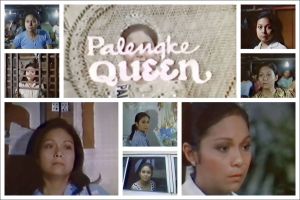 While ostensibly unassuming, Palengke Queen (1982) is affecting where it counts. Directors Arman Reyes and Freddie Sarrol (who co-wrote the screenplay with Ricky Dalu, based on Pat V. Reyes’s Bondying Weekly Movie Special Komiks serial), tap into the experience of expressing the inexpressible. The resulting confusion creates an infectious form of humor that percolates throughout and leads nicely into the unexpected outbursts of emotions in the closing scenes. It helps that Palengke Queen never distracts from these strengths with overt stylistic indulgences. The swiftness with which the film can swing between funny and serious is astounding. The shifts feel seamless and fitting. By finding this balance, Reyes and Sarrol makes sure their film is affecting but not morose. With her expert comic timing and nuanced dramatic shading, Nora Aunor is, quite simply, astonishing. Tibang is an empathetic personality whose assertiveness is a form of habitual overcompensation for personal issues. All of that can be felt in Aunor’s performance, which navigates these tricky emotional straits with confidence. She keeps things in focus with her innately natural portrayal of Tibang as a woman of integrity and resolve. Aunor doesn’t just sell Tibang’s exterior, she nails the unspoken elements, giving an incredibly multidimensional lead character. It’s easy to like Tibang for the good that she does, but Aunor adds another layer through her naturally commanding and mesmerizing screen presence. Nobody seizes the spotlight quite like Aunor. It’s a beautiful star performance. Palengke Queen is complex without feeling contrived. What could have easily become overwrought or melodramatic is instead warm and vulnerable. There are different ways the ending can make you cry. I’ll settle for one: the bittersweet feeling of having watched someone become a different and in some ways improved version of herself, which is the reason we need movies.
UNWORLDLY GLAMOUR
by Jojo Devera
(Facebook, July 26, 2022)
 At its simplest, Chito Roño’s “Serye” (1993), an episode of Star Drama Presents Nora, is an account focused on the relationship between television director Vera (Nora Aunor) and her husband Emil (Cesar Montano). Written by Gina Marissa Tagasa, it’s also about the TV industry, with observations about the process of making television dramas. Roño relishes the clash between the sublime and the banal. Scenes of Vera and Emil bickering could come straight from any soap opera, but instead the characters take on an unworldly glamour. The startling point is that none of the aesthetic sensations matter, within the face of emotional devastation where no cultural bauble will distract you from the uncomfortable sight of your deepest interior realms. Our first real introduction to Vera is integral to the story. It gives Aunor such an immediate moment to dig her claws into our sympathies. She acts with all the wound-up fury of a workaholic. Throughout the story, you can see the emotion bubble up inside of her to the point where she can’t do anything else but expel it. Aunor takes the episode by the throat in the dramatic sequences, yet she’s equally compelling in the story’s smaller moments. She flawlessly channels Vera’s open and exposed self, as well as her extraordinary intensity. It is not a self-conscious performance. The story is dependent on the woman at the holding center, compulsively enacted through raw nerves made flesh, powerfully embodied by Aunor’s efforts. Vera thinks she can compartmentalize her emotional needs like she does everything else in her life. She further breaks down potentially frustrating tropes that career women often fall into. Vera immediately inhabits capability and professional talent. These emotional expulsions give background to her character. Vera is aggressively self-assured, but she never becomes the typical workplace harpy dealing exclusively in internalized misogyny. Her self-assuredness is backed up by hard work and striving proficiency, even as her private emotional baggage supplies context.
THE BEST OF BOTH WORLDS
by Jojo Devera
(Facebook, August 9, 2022)
 Minsan Lang Kita Iibigin (1994) represents the best of both worlds. It excites the emotions the way a good melodrama should, but it also stirs the quieter feelings of pity and helplessness associated with tragedy. Director Chito S. Roño gives MLKI much more than surface elegance. The choice of angles and colors, his mastery of editing all work to create a unified psychological texture. He’s aided by an unusually honest and perceptive script by Ricky Lee, and by Maricel Soriano, Gabby Concepcion, and Zsa Zsa Padilla, whose performances go to a place of complete emotional nakedness. If the movie allows Padilla to give her best performance to date, it also provides Soriano with a chance to do more. The play of degradation and guilt on her face is the movie’s real story. Soriano’s work in the film’s intriguing second half, however, wouldn’t be possible without Concepcion’s own understated duplicity. As these two circle each other, their marriage held together by the very cycle of forbidden act that’s also tearing it apart, MLKI becomes a thriller myth of the perils of adultery, which few filmmakers can heighten like Roño.
REVEALING AND HEARTBREAKING
by Jojo Devera
(Facebook, August 16, 2022)
 Rooted in deep emotions and life-altering decisions, Thy Womb (2012), under Brillante Ma Mendoza’s skilled guidance, is a mesmerizing, engrossing, and beautifully realized cinematic experience. Nora Aunor is hypnotic as Shaleha. We see the plot develop from her perspective and the story unfold from vantage points close to her face. Ensuing choices and consequences rife with tension and heartache, extreme close-ups convey Shaleha’s internal woes with an earnestness few working actors can match. In her most wrenching scenes, Aunor presents Shaleha as a woman drowning in waves of longing. Still, you feel for her because there’s no way to look into her eyes and dismiss the sorrow that has made a home there. Aunor is at the peak of her acting powers here, conveying incredible depths of emotion with a stare. Thy Womb clearly belongs to Shaleha and Aunor, who does career-best work here as the aging village midwife, whose every expression, every gesture is revealing and heartbreaking. Her body language speaks volumes. Mendoza knows how to use visual and dramatic means to make a milieu palpable to an audience by providing an introduction to the complex blend of emotion that permeates the film. Feel and think through Thy Womb and it will never leave you.
UNSETTLING, AMBIGUOUS, AND UNUSUAL
by Jojo Devera
(Facebook, August 20, 2022)
 The final image of Mara (Nora Aunor) in Dementia (2014), Perci Intalan’s arresting horror debut, isn’t particularly scary. But it’s easily one of the most unsettling, ambiguous, and unusual movie tableaus I’ve seen in some time. From its ominous opening, the movie proves successful, even wrenching, in how it considers dementia as a bedrock of horror. What is more horrifying than losing your own sense of self, or watching a loved one on such a depressing journey? Intalan demonstrates a strong handle on tone as he carefully charts Mara’s emotions with tension going unsaid, but remaining evident in Aunor’s moving performance. Mara oscillates between moments of sharp clarity, fuzziness, and sudden rage as her failing memory begins to outpace her; Aunor deftly carries all of Mara’s swinging moods and her heartbreaking desperation as the lights of her mind begin to burn out. Dementia as the bedrock for a horror film is an intriguing idea given the ways it’s primed to explore dramatically shifting moods, the loss of self, and the heartbreak of witnessing someone you love become a stranger. Intalan and his collaborators – writer Renei Dimla, cinematographer Mackie Galvez, and editor Lawrence Ang – are cunning in their ability to craft the dread that is instilled from the very beginning. But if you’re looking for answers to the film’s ambiguities, you won’t find them. In its place are a surpassingly creepy atmosphere and a patiently ratcheting unease as the movie deftly merges the familiar bumps and groans with a potent allegory for the devastation of dementia.
SLICK AND SILVERY
by Jojo Devera
(Facebook, August 23, 2022)
 A hit-and-run incident lands a detective in more trouble than he could have ever imagined in A Hard Day (Viva Films, 2021), a thriller that finds director Law Fajardo handling a taut yet elaborately plotted narrative with control and near-faultless technical execution. The resourcefulness and resistance to intimidation of Edmund Villon (Dingdog Dantes) makes us root for him, despite his professional conduct and lack of moral fiber. In a morbid example of necessity being the mother of invention, Villon hits upon a novel way of disposing of the victim’s body in an extraordinary stunt sequence. With increasing freneticism, Fajardo moves Villon relentlessly forward in the face of an obstacle course filled with pop-up hurdles and an occasional kick in the gut. Dantes’s disciplined performance ties all of A Hard Day’s inventivenesses together, investing the film with visceral panic. He plays Villon as a henpecked nice guy, this delusion serving as self-fulfilling prophecy.
11011At just about the time it seems Fajardo should soon be running on empty, he introduces a new threat, Lieutenant Ace Franco. Played by a spectacular John Arcilla adding a bespoke dash to the villainous picture, he slips into the story and soon engulfs it. Arcilla has a face that can freeze into a stone-cold slab of pure malice, even as Fajardo keeps the chaos moving at a breathless tempo. He’s a remarkably fluid orchestrator of action kinetics, always springing his surprises a beat faster than one expects, only to occasionally slow things down to prevent the viewer from acclimating to his quicksilver timing. An explosion is timed with nightmarish precision perhaps because Fajardo caps a phenomenal, self-consciously Hitchcockian set piece with an unexpected commonplace payoff. Throughout, the images are sleek and silvery, informing the debauchery with an aura of impersonality. A Hard Day is ultimately a parody of self-entitlement, though the carnage dramatically registers. The filmmaker walks as many tightropes as Arcilla does, and one gratefully submits to both artists’ dexterity.
AUTHENTIC, STIRRING, HEARTFELT
by Jojo Devera
(Facebook, August 24, 2022)
 In Joselito Altarejos’s Memories of a Love Story (Viva Films, 2076Kolektib, 2022), love paves the way to personal growth, creating a keen sense of one’s self-worth. Altarejos presents the romance between Eric (Oliver Aquino) and Jericho (Migs Almendras) within a frame of Eric’s memories of it. Despite notable differences in background and interests, Eric and Jericho bring out something in each other both emotionally and physically. Great partners teach us new things about ourselves, and MLS really gets that element of human relationship without overplaying it. Altarejos’s approach is tactile without feeling exploitative or manipulative. Actually, one could argue that parts of MLS are too low-register, but that’s reflective of its protagonists’ personality in a way that keeps this love story from devolving into melodrama when it could do so at several points. Almendras is very good here, but the movie really belongs to Aquino, who reminds us how incredible he can be with the right material. He avoids every single trap into which his character could have tumbled. There’s so much grace and nuance in this performance that it could be studied to consider all the decisions that Aquino makes in each scene. He conveys an overwhelming amount of inner conflict. It’s never once forced or manufactured. And Almendras matches him beat for beat, especially in the second half of the film. He too has been changed, but responds to that change differently. Newcomers Awin Valencia and James Ramada convey so much in discrete movements and muted words, lending their characters dimension in their every scene. Altarejos allows awkward moments and intimacies to unfold naturally, as if we’re watching them in real time, undetected and yet somehow invited to observe. MLS is authentic, stirring, heartfelt. As the camera closes in on Eric crying, we find ourselves profoundly moved. MLS offers enduring images not just of longing – Eric suffers, but he also exults, and this is why we watch movies.
INTRACTABLE ATTRACTION
by Jojo Devera
(Facebook, September 19, 2022)
 McArthur C. Alejandre, in Silip sa Apoy (2022), knows how much we enjoy seeing a character work boldly outside the rules. We keep waiting for the movie to lose its nerve and it never does. Working with Viva Films, which also produced My Husband, My Lover the year before, Alejandre cast Angeli Khang, who had scuttled about in various projects, most notably as Alexa in Lawrence Fajardo’s Mahjong Nights. In a marvelous opening punctuated by Khang’s face, Emma is an obstinate seductress of classic noir displaced in an erotic thriller. She’s adept at thinking on her feet, weaponizing sexuality and manipulating simple-minded men. However, throughout the story, the motive for this woman’s life-changing evasion is traced back to the violence of her husband Ben (Sid Lucero). He hits her, she acts shocked and hurt, but the surprise quickly melts into performative quiet. Khang keeps us at a distance, letting us guess how much the domestic altercation’s indignancy shook her character. In any case, her following actions are swift and oriented around a straightforward impulse. It’s difficult to parse out what actions are organic and what behaviors are calculated measures.
11011Emma makes love for Ben’s horny amusement. She’s in a moment of intimate pause that’s only for us, the camera and the audience. There’s no similar instant for contemplation in the ensuing narrative, seeing as Emma is constantly on the alert, seducing and setting the pieces on her mental chessboard that will result in an astonishing checkmate. For her part, Khang is brilliant at this kind of opaque character construction. That’s what attracts men in the film to her Emma. She feels impenetrable, a challenging impossibility that harkens back to how audiences regarded bigger-than-life movie stars. She’s out of this world, but instead of alienation, this personal quality produces intractable attraction. Consider the seduction of her lover, Alfred (Paolo Gumabao). Cocksure and touched by a hint of self-aggrandizing intoxication, he never quite catches on to the full depth of Emma’s deception. The way she does it is effortless – she tosses off her commands, aloof but never completely uninvested. The femme fatale never hides her contempt for the lesser creatures at her feet, becoming all the more eager to get a sign of unattainable approval. All that, and there’s the way she moves as well. Khang embodies a physical demeanor characterized by such great confidence that it’s difficult to regard her as a sexual object. Alejandre deserves plenty of plaudits too. Ricky Lee’s screenplay is taut and gripping, revealing devastating surprises along the way.
UNRELENTING MOMENTUM
by Jojo Devera
(Facebook, October 10, 2022)
 A thriller conjured out of suppressed fears, Joselito Altarejos’ Pamilya sa Dilim (2023) is a concentration of ecstasy and violence devised in a perfect union of ideological paradox and existential instability. Through a combination of headstrong ambition and opportunistic abandon, Altarejos managed to tap this mother lode of disquietude. The basic premise is so thunderously resonant that it’s easy to overlook the skill with which Altarejos has gotten to its dramatic turning point. With simmering tensions and fractured psyches, Altarejos presented an ideal platform for his cast to deliver some of the finest work of their careers. Allen Dizon is fascinating yet vulnerable as Eddie Boy, but it’s Laurice Guillen’s complex portrayal of Mamang Anita, the matriarch of the Medialdea family, that remains to be the film’s most captivating element. Her ability to mine gravitas may have brought her closer to the core of the movie than her celebrated co-stars could reach. Guillen’s and the film’s showcase scene comes when she recalls how her husband met his fate, then all of a sudden the figures in her story appear and begin speaking their parts. From watching her past unfold, Mamang Anita exits the shot and then joins the ghostly tableau: she has come unstuck in time. Memory is a selection of images, some elusive, others imprinted indelibly on the brain. In this spectral pageant, Mamang Anita shows us the pain of her memories and misfortune. This moment of attenuated stillness is pure cinema, and so is the eruption that follows. It takes a formidable talent to play mother to Allen Dizon (at his most magnetic here), but Guillen upstages him. She has a way of gliding into a room as though on a dolly and her reaction shots are so acute that the film uses them as punctuation. Her unsettlingly wide eyes flicker between emotions outsize and minute. Pamilya sa Dilim is about trauma and the way it surreptitiously weaves its way into the lives of every member of the Medialdeas, even Minda (Sunshine Cruz) and Marie (Therese Malvar), who are emotionally volatile despite being in the dark about the abuse that happened. Altarejos is not shy about suggesting parallels with current politics. The narrative pushes forward through a parade of digressions and asides with unrelenting momentum. Pamilya sa Dilim never stops breaking rules, creating an intentionally tremulous tone, implications of incest making us pause. Rarely in such drama is there a no-turning-back moment like the truth-telling that anchors Pamilya sa Dilim. Altarejos is a filmmaker who demonstrates both an energetic technical style and a keen interest in people reckoning with emotional trauma. For Mamang Anita, trauma is not so easily overcome. The effect is overwhelming, the final indignity from a family that has so long turned a blind eye. As with all great melodrama, there is catharsis here but it seems clear it is just a temporary balm for wounds that may never heal.
QUIRKY, OFFBEAT
by Jojo Devera
(Facebook, January 15, 2023)
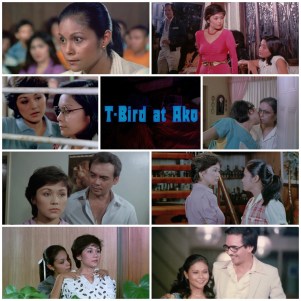 Much like Kapag Tumabang ang Asin (1976), T-Bird at Ako (Film Ventures, 1982) peeks into the creative and sometimes delusional nature of desire. Director Danny L. Zialcita plays the characters’ pettiness for some great laughs but at its core, the film expresses something true about love’s power to obliterate all other considerations, including close friendship. TBaA may be a little too neatly drawn, but Zialcita’s enthusiasm and vitality compensate for more than they rationally should. This is a film easier to love than to like. Zialcita has not only a great feel for hip sophisticates in deep conversations, he also has a great eye. With cinematographer Felizardo Bailen, he managed to turn TBaA into a stylish affair. There is cleverness in the film’s many tight shots that do double duty, playing to the intimacy of the piece as well as eliminating the need for elaborate sets. There are risky plot choices along the way, but the risks are what keep the pot boiling as the complexities of the relationship between lady lawyer Sylvia Salazar (Nora Aunor) and nightclub dancer Isabel Mongcal (Vilma Santos) heat up and cool down. It all serves to make TBaA a delightful romance charged with fierce intelligence. As Sylvia, Aunor is the picture of watchful uncertainty whose mixture of physical presence and self-mockery contributes to the film’s quirky, offbeat mood. Her performance is the best reason to see the movie. Santos manages to convey much sensuality, infusing Isabel with complexity.
11011This new high-definition transfer reveals the movie like never before, yielding a picture so pristine that watching it is practically like seeing the film for the first time. It’s clean yet filmic. Obvious elements like skin and clothing textures reveal some of the most innately complex details imaginable, down to the most nuanced fabrics. The biggest improvements however, are in the area of color reproduction. There are completely new color tonalities and image saturation is far better. As a result, the entire film looks richer and lusher. Interiors are beautiful, yielding an inviting warmth that’s substantially more nuanced and exacting. Unfortunately, the film’s two-channel track is woefully dull and uninspired. Dialogue is often poorly prioritized, effects are typically brazen and weak. None of it strangles the presentation, at least not entirely, but it all takes a significant toll. In an earlier scene, Isabel dances to the tune of Queen’s Body Language. The song was replaced with a mediocre version of the original, ruining the punchline to the greatest joke near the end of the movie. The audio mix is frustrating at worst, but for the viewer who just wants to watch, it’s not a bad little endeavor.
A TRIUMPH TO SAVOR
by Jojo Devera
(Facebook, January 18, 2023)
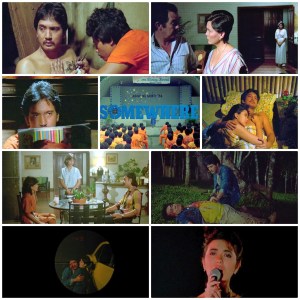 Romy Suzara’s Somewhere (Viva Films, 1984) achieves thematic unity through its theme, that people are victims of circumstances. Silvio Logarte (Rudy Fernandez) is imprisoned for a crime he did not commit. Similarly, his attack on Logan (Johnny Delgado) is as much a product of fear for his own life as it is revenge for the death of his best friend Tengteng (Dencio Padilla). In a sense, Silvio is guiltless, both legally and morally. Despite his innocence, he is convicted, discriminated against, and finally killed. Somewhere succeeds by putting violence in its rightful place: it is violent because the film can only end in violence. In a powerful performance, Fernandez is able to show Silvio’s charm as well as his violent side. He navigates every nuance of Silvio’s soul, showing the haunted logic of a man shut out of society. Somewhere has a blunt, repetitive structure – essentially, it’s one victimization scene after another. Yet the movie’s paradox is embodied by singing sensation Shirley Morena (Lorna Tolentino). As she slips into her role as Silvio’s obsession, Shirley begins to come alive as a character. Tolentino has an emotional presence that brings out her tremulous vulnerability. To break free, Shirley has to look into Silvio’s eyes, and when she finally does, it’s a triumph to savor.
11011This high-definition release is sourced from a preexisting master. The majority of the well-lit close-ups, for instance, boast decent depth. Shadow definition could be better managed. A fuller restoration would undoubtedly produce an overall balanced image. Contrast levels remain stable. Fluidity is good, but occasionally some light unevenness pops up. Grain is present throughout the entire film, but it could have been better resolved. Still, despite some very small fluctuations, there are no troubling anomalies. Colors are stable and natural although some small nuances are missing. There are no large bits of debris, cuts, stains, damage marks, or warped frames. There is some room for improvement and a brand-new master would have certainly given the film a fresher appearance, but this is a fine organic presentation, making it easy to enjoy even on fairly large screens. The audio has not been remastered – though in fact, in segments where George Canseco’s score has a prominent role, depth and balance are surprisingly good. The dialog is clean, stable, and easy to follow. Somewhere is a story of pain and courage, uncommonly honest and unflinching.
ON EVEN GROUND
by Jojo Devera
(Facebook, January 29, 2023)
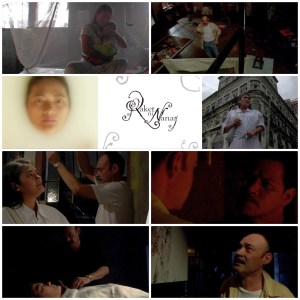 Lawrence Fajardo’s Raket ni Nanay (Creative Programs, Indiopendence, & National Commission for Culture and the Arts, 2006) is the best film I have seen about the physical creation of art and the painful bond between an artist and his muse. Mimosa arrives at Badong’s studio where unpleasantries give way to a sense of nervous social obligation. The reminder of his artistic stasis makes Badong prickly toward Mimosa. He scraps a piece of paper before his drawing takes shape, even the pages look so abstract and nondescript that one wonders what exactly makes Mimosa so special to him. Badong also takes an interest in Joy (Tess Jamias) though not in a particularly lustful way. Badong is played by Mark Gil, whose eyes can bore through other actors. With his high forehead and sculpted profile, he looks intelligent but it is a formidable, threatening intelligence. He never plays the fall-guy, he always knows the story. Sarsi Emmanuelle is Mimosa, the woman who inspires him, startingly beautiful with sensuous lips and deep eyes under arched brows. The artist will attempt to seduce her but he wants more than that. Badong wants to possess her. And he wants to draw from Mimosa’s irritating willfulness the inspiration for his rebirth. He must have an abrasive in order to create. The great central passage of the film involves creation: Fajardo, using a static camera and long takes, rarely cuts away. We see a blank sheet of paper and the drawing taking shape, Badong’s fingers and thumb smearing the washes into rough shapes.
11011Of the performances, there is nothing to be said about Mark Gil except that he communicates exactly what Badong needs from his art and doesn’t need many words to do it. Sarsi Emmanuelle has an ethereal beauty, but it is her talent that has made her a leading actress of her generation. We quickly feel, without any dialog or behavior to spell it out, Mimosa’s nuisance quality. Tess Jamias finds the perfect and difficult note for Joy. Fajardo’s use of long takes gives his actors the freedom to modulate their interactions, capturing the incremental steps by which people become more familiar with one another and give themselves over to more bold actions. Close-ups show Mimosa trembling from a combination of embarrassment and exhaustion. Yet it’s in her resistance, not her compliance, that Badong seems to get the most inspiration as he builds toward his intended masterpiece. Mimosa’s willingness to confront the painter has the effect of gradually eroding the distinction between the creation of the painting and what it represents. The studio scenes correspondingly progress from the naturalistic to the impressionistic, with Mimosa lit luminously against backgrounds that collapse the distance between the real woman and Badong’s sketches. That fusion of subject and form eventually expands to include the artist himself, most visibly in a scene where both Badong and Mimosa break down, undermining the tacit power of artists over their models by placing them on even ground. It’s a direct, cathartic illustration of the film’s deconstruction of accepted artist and muse roles.
ANGUISHED LOVE
by Jojo Devera
(Facebook, February 21, 2023)
 The political landscape that seeps through Joel C. Lamangan’s Lihis (Film Development Council of the Philippines, BG Films International, 2013) is as deep as the movie’s heartbreaking story of two idealistic young men who fall in love almost by accident. It is embedded in this landscape where their idyll begins and ends. The same mood of acute desolation permeates Ricardo Lee’s screenplay. Their intimacy just happens to unfold in ways that bring tragedy to the surface while keeping the viewer at a certain remove. What happens between Cesar (Jake Cuenca) and Ador (Joem Bascon) builds slowly then explodes, after which they retire to opposite corners. Their rough, impulsive coupling could have been a fight, as it almost is. In fact Lamangan filmed it with the frankness of a boxing match. Both Cuenca and Bascon make this anguished love story physically palpable. Cuenca disappears beneath the skin of his sinewy character. The pain and disappointment felt by Cesar, who is more self-aware and self-accepting, continually registers in his sad, expectant eyes. Cesar is able to accept a little more willingly that he is inescapably gay. Lihis is ultimately not about sex (there is very little of it in the film) but about love – love stumbled into, love thwarted, love held sorrowfully. What Ador craved in a way he could neither help nor understand was when Cesar pulled him close, the silent embrace satisfying some shared hunger. One tender moment’s reprieve from loneliness can illuminate a life. In the end, this is Jake Cuenca’s picture, the final scenes allowing him to unequivocally and credibly express Cesar’s sorrow. Joem Bascon plays the more callow of the two men; coincidentally or not, his performance doesn’t dig as deep as you might want it to. Lovi Poe as Cecilia, whose youth and spiritedness slowly drain away in the face of an infidelity she can’t encompass, adds a beautiful low-rent weariness to the performances.
11011The grading brings a sense of brilliance to the color spectrum, an accuracy and nuance that befits the film and the high-definition format. It offers depth and tonal detail where natural greens delight, clothes pop, and earthy tones around the frame enjoy a sense of pinpoint accuracy bringing the film to life. Bright outdoor scenes are delightful, the contrast between sun-drenched portions and shadowy elements lifelike. Skin tones are perfect, black level is remarkable, whites are intense. The image is razor-sharp, bringing out refined details on faces and complex environments. The soundtrack delivers crisply defined support elements. Richly realized environmental atmospherics add bursts of heightened activity capable of handling every core element with commendable ease, enriching scene-shaping and mood-enhancing clarity. Though it’s mostly front-heavy, dialogue is perfectly prioritized, positioned and detailed. Lihis is extraordinarily well done from a technical and emotional perspective, though potential viewers must tread carefully.
THROUGH UNFAMILIAR EYES
by Jojo Devera
(Facebook, March 5, 2023)
 Making a virtue of simplicity and a vice of melodrama, Imbisibol (Sinag Maynila, 2015) is a well-intentioned low-income drama. This is a genre in which work – exhausting, repetitive, unreliable – is the story’s engine and the characters’ sole means of survival. Holding on to a job or finding a better one takes precedence over anything life can throw at them. Without a doubt, Imbisibol forms Lawrence Fajardo’s most assured work, owing a lot of its initial momentum to John Bedia and Herlyn Gail Alegre’s unhurried screenplay. The film doesn’t lack for integrity, educating the audience on the desperation of living as an illegal entirely from the perspective of its characters. Carefully buried in a wealth of gesture and speech, from Linda (the perennially underutilized Ces Quesada) and Benjie’s (Bernardo Bernardo) plaintiveness to Manuel (Allen Dizon) and Rodel’s (JM de Guzman) wistfulness, the actors in Imbisibol are remarkable. De Guzman’s superb slow simmer of a performance as a pleading, recessive man is a silent striver who embodies a humanity that is ultimately heartbreaking. Dizon brings a crafty venality to his character that we suspect people must actually possess in a trade such as his. Bernardo Bernardo conveys decency, enthusiasm, and self-restraint. Quesada creates a character that is sensitive and vulnerable. Who among us can say that pragmatism is less virtuous than innocence? Jane Austen, Anton Chekhov are artists who come to mind when we confront a story told through such tactful revelations of temperament and states of mind. Fajardo often shows a room before people enter and lingers a second after they leave. Every single shot is intended to have a perfect composition of its own. If a character is speaking, he presents the entire speech. He is comfortable with silences, insisting that every person has the right to be heard in full. In his other films, Fajardo deploys his distinctive techniques more playfully, but here he seems chiefly concerned with creating a quiet world in which his characters’ personalities can stand out. In some cases they speak little and imply much.
11011An elegantly refined style places people in the foreground, Fajardo focusing on the nuances of everyday life. His is the most humanistic of styles, choosing to touch the viewer with feeling rather than workshop storytelling technique. By having established the rhythm of his characters’ lives with such precision, Fajardo’s presentation is not conventionally melodramatic or histrionic. From one part of the world to another, Imbisibol stirs with its torrents of feeling. Dramas about illegal immigrants have often focused on the journey, an odyssey pocked with exploitation and fear, but one that ends on a note of road-weary triumph. In Imbisibol, the focus is on the plight of undocumented immigrants who are already ensconced in Japan, and how they live in constant fear of immigration officials who want to deport them even though a modern Western economy could not function without these shadow workers. Imbisibol walks a delicate line between visceral cinema and complex emotional trauma, yet it never seems to struggle at balancing the two; and if my description of precisely why seems vague, that’s purely because it deserves to be experienced through unfamiliar eyes. The adroit Fajardo doesn’t overemphasize the acrid, fetid atmosphere of hard-working immigrants clambering from one job to the next. The spartan, bleary-eyed plainness of the urban landscape of immigrant Japan makes Imbisibol more arresting. Fajardo’s low-key curiosity toward what drives outsiders is a crucial element that lubricates the tough, noirish melodramatics of the narrative engine. As businesslike as the immigrants who work several jobs to stay afloat, Imbisibol grows more compelling as it builds a head of steam.
A TRANSCENDENT HOWL OF HOPE
by Jojo Devera
(Facebook, March 27, 2023)
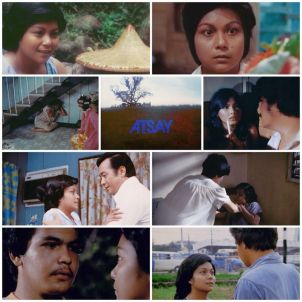 The main focus of Eddie Garcia’s 1978 feature, Atsay (Ian Film Productions), is Nelia de Leon’s odyssey, and its emotional core is provided by Nora Aunor’s intense, gestural performance, which is strengthened further by Romeo Vitug’s quietly observant camera. The whole drama is revealed through quotidian details. Atsay features a direct storytelling style, and depicts working-class people struggling against bleak social conditions and human foibles. Garcia subsumes this wellspring of complexity into the form of his central character, Nelia. Mostly silent with her employers, Nelia nonetheless speaks volumes through her expressive face – not that they would notice. She is treated with brusque tolerance, which soon gives way to hostility, from Mrs. Tulio (Armida Siguion-Reyna). In one of the film’s most upsetting moments, Garcia’s camera remains distant as the husband, Mr. Tulio (Renato Robles), stares at Nelia’s behind while she is dusting. Atsay is especially sharply observant of the corrupted social contracts, and Garcia roots these observations most effectively in the relationship between Nelia and Mrs. Tulio. One solitary, charged glance between Nelia and the husband, midway through the film, is enough to suggest that a similar psychosexual panic has taken root in the wife’s mind, precipitating her increasingly heinous behavior. Nelia is a victim, it’s true, but she is also a refreshingly multidimensional character. A succession of scenes illustrates her romance with construction worker Pol (Ronald Corveau). Nelia’s situation is obviously tragic, but Garcia’s ability to match his contempt for society’s failings with a non-judgmental eye toward all his characters defuses any danger of the movie slipping into polemics. For the most part, Garcia keeps us at a distance, but when he judiciously cuts to huge close-ups of Aunor’s doleful, open face – tears in her eyes – her anguish registers like an uppercut to the solar plexus. In Atsay’s closing moments, a desperately sad saga is transformed into a transcendent howl of hope. Garcia was congenitally incapable of making indifferent films, and everything that marked him out – his skill, compassion, and vision – is fully present in this startling, unforgettable return to filmmaking.
11011The new digital transfer, undertaken by the Film Development Council of the Philippines and the Philippine Film Archive, was created in 4K resolution by the Korean Film Archive, with preliminary fixes to the image and sound from seven reels of 35mm color prints provided by the Philippine Information Agency. Central Digital Lab performed extensive digital restoration on a dry-scanned transfer to minimize visible scratches and spots that were the results of processing errors and that had been aggravated by time. I do not know exactly what type of improvements were made during the restoration process, but I am convinced that this is the very best Atsay has ever looked in any format. Excluding a few light blemishes that can be spotted during the opening, the film looks spotless. Detail and clarity are excellent with the outdoor footage looking particularly fresh. Depth is optimal, though it appears that some careful rebalancing adjustments were made to ensure that in a couple of areas where some traces of aging might have impacted fluidity, the end result is as pleasing as it could be. The color grading is convincing. There is a good range of solid blacks and healthy whites with no traces of compromising sharpening adjustments. Image stability is very good. There is only one standard audio track on this presentation. English subtitles are provided for the main feature. Dialogue is clean, stable, nicely balanced, and easy to follow. Dynamic intensity is modest, but given the nature of the film and the manner in which it was shot, this is hardly surprising. Eddie Garcia’s Atsay’s recent restoration in 4K looks impressive indeed in high-definition.
DEEPLY SATISFYING
by Jojo Devera
(Facebook, April 13, 2023)
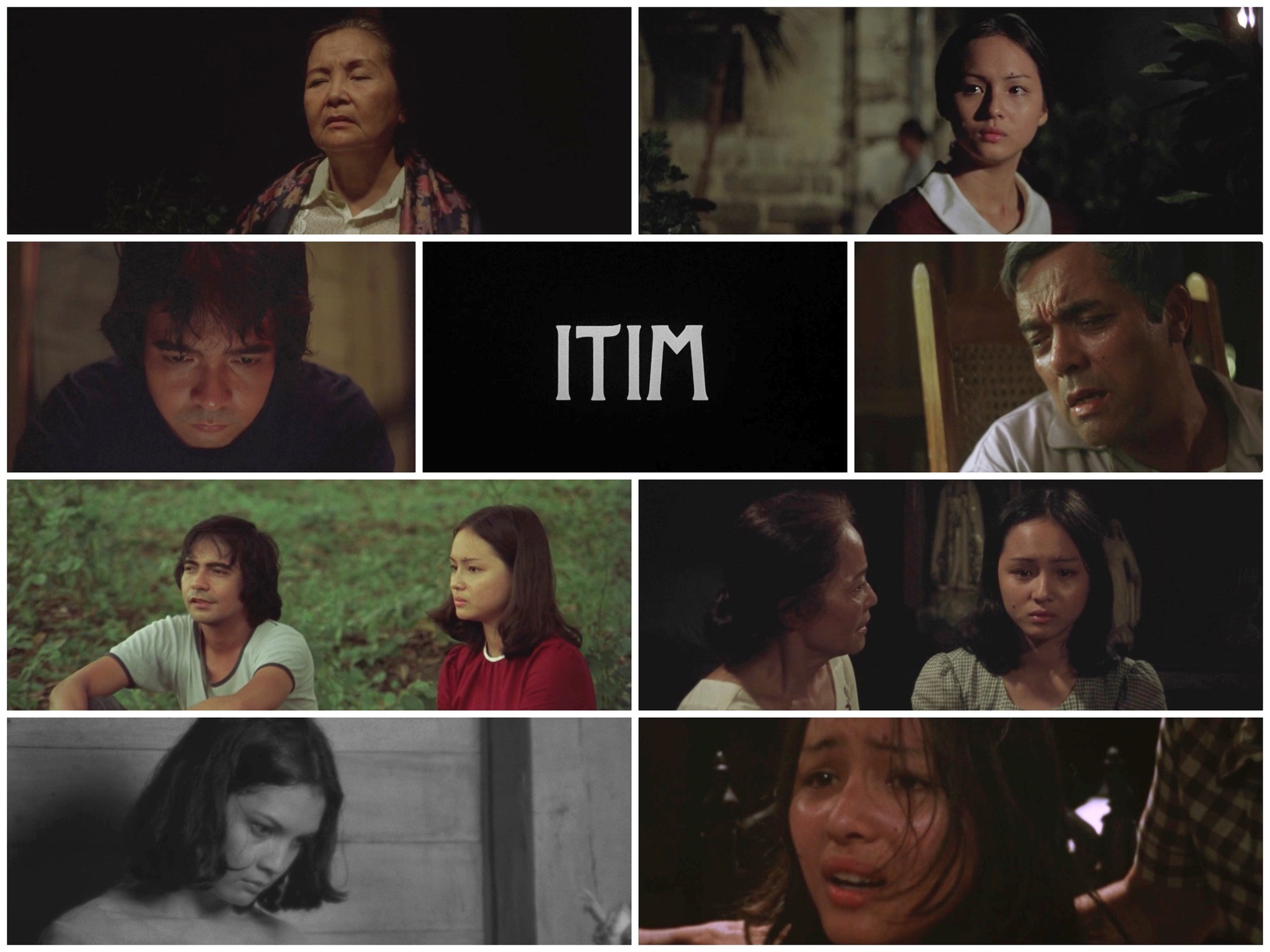 Mike de Leon’s Itim (Cinema Artists Philippines, 1976) is a quiet, delicate piece, one aching with loss and regret. It’s the kind of film which demands patience, not least because of the static photography and the largely wordless storytelling de Leon employs. The characters are established with quick, subtle strokes. Perhaps more than anything, it is Charo Santos’ presence (in her feature film appearance) that really stands out. There are few actresses who can quite match the way in which she is able to exude an ethereal beauty while simmering something below the surface, and her performance here as the beautiful and independent Teresa is a superb early example of just that. There are prolonged stretches which unfold without dialogue with only the flourishes of a score. De Leon’s tendency as a director is to privilege images over dialogue. Sometimes he hangs on an image for minutes more than we’re conditioned to expect by most Filipino films, forcing us to contemplate what we’re seeing. The storytelling is conveyed through style over narrative, both in Ely Cruz and Rody Lacap’s lingering visuals and Ike Jarlego Jr.’s editing. You have to watch, feel and experience what’s onscreen in order to follow the story, which begins to play with our expectations in ways that are deeply satisfying, almost cathartic. De Leon repurposes elements of horror and makes them melancholic.
11011Itim is presented on blu-ray courtesy of Carlotta Films with an AVC-encoded 1080p transfer in its original aspect ratio of 1.85:1. As with all of the films in the set, there are some preliminary text cards describing the restoration. Itim has been digitally restored by L’Immagine Ritrovata. The original 35mm camera negative was scanned in 4K resolution and the audio remastered from the optical soundtrack negatives preserved at the British Film Institute. The transfer was supervised by director of photography Rody Lacap and approved by de Leon. This is an impressive-looking presentation from just about every angle, with a gorgeously suffused palette. The release is noticeably less flushed, something that I personally found preferable. There are still some very minor and inconsequential nicks and blemishes. Grain is tightly and organically resolved throughout the presentation. The mono track presented in DTS-HD offers more than capable support for the film’s sound design, offering a more spacious account of Max Jocson’s haunting score. There are no issues with regard to damage, dropouts or distortion. Dialogue is rendered cleanly and clearly throughout. Optional French subtitles are available. In Itim, Mike de Leon gave us a film to rewatch and remember.
PROVOCATIVE & SATISFYING
by Jojo Devera
(Facebook, May 22, 2023)
 Stylized and visually arresting, Lawrence Fajardo’s Mahjong Nights (Viva Films, 2021) complicates and perverts the simplest of interactions. It unfolds at a languorous pace, ultimately leaving viewers with a haunted feeling, an uneasy sense of always having something to worry about, some constraint on expression or behavior. The perversion of natural impulse begins with Angeli Khang, whose achievement ultimately comes from how she renders Alexa. We’ve all seen the film where an actor chooses to dramatize the relationship between a performative character and the role they’ve taken on by underlining skill and barely contained nerves. Khang avoids this route entirely and instead shows us a performer with an intuitive, bodily understanding of who she’s playing. When we first see Alexa we don’t get the sense of a technically immaculate interpreter but of an instinctive, in-the-moment performer committed to the goal she’s been given. In the rare moments she looks distracted, we get the sense of a performer stuck in her own head. We never forget the stakes that inform her ever-evolving crisis, yet Khang communicates all of this cleanly and dexterously. Jay Manalo’s Leo is stern and forbidding, rarely letting the cold mask drop. Fajardo’s cast (which also features Mickey Ferriols as Leo’s wife Esther) is exceptional and Tad Tadioan gives an impassioned performance as Big Boy. Like Fajardo’s other films, Mahjong Nights grows out of a tension between essence and form – between a person’s emotions and the role he or she must play.
11011What made the second half so mesmerizing was the interplay of glances between Alexa and Sean de Guzman’s Gaspar. Much of the appreciation of the choreography of looks has to do with understanding the history of electric eyes. There’s a specific moment when the battle of the stares begins. It’s at a mahjong table where the characters communicate on two levels: through speech as they exchange pleasantries and talk about the game, but whose true intentions are spoken with their eyes. Some may find the film excruciatingly dull, but pay close attention – beneath the surface, there’s usually more going on. The underlying plot gradually reveals itself. We do not see Leo at work, but Manalo is able to project the man’s capability for menace and begins to do that in bed with Alexa. Mahjong Nights is a film of deceptive subtlety that springs shut in its final moments like a steel trap. Fajardo is clearly having fun with audience preconceptions of a mahjong game that reveals plenty about the milieu we’re about to move in while balancing all sorts of layers effortlessly. Mahjong and Fajardo are a good fit – which I don’t mean remotely as an insult. The game is elegant, formal, and deliberate, but with a hint of repressed violence. As the story unfolds, Leo’s cruelty stops being simply vile and starts to become fascinating and even paradoxical, infusing a potentially two-dimensional villain with humanity and pathos, leading to a terrific, unexpectedly amusing scene when Alexa’s conflicting emotions finally boil over and when her facade eventually breaks down, Fajardo’s story finally jerking into focus. It may seem like a long time getting there, but when Mahjong Nights finally reels you in, the payoff is both provocative and satisfying.
SKILLED FOOTING
by Jojo Devera
(Facebook, May 26, 2023)
 It’s a testament to director Chito S. Roño’s Ang mga Kaibigan ni Mama Susan (Regal Entertainment, Inc., CSR Films.Ph, Black Sheep, 2023) that it manages to incorporate so many of the visual and storytelling elements from lesser movies to create something compelling. Roño has executed the most effective, most rewarding horror film by exploring a demanding scenario that is all the scarier because he has constructed a dramatically tense situation to draw out our emotional involvement. What’s more, the experience is grueling because the imposing imagery employed is truly the stuff of nightmares. There’s an emotional cause behind every horrible turn. Joshua Garcia plays Galo Manansala with amazing intensity – the kind that makes you wonder how the filmmakers incited the volatile performance, making his character’s state so believable. Garcia’s slow transformation leaves room for Bob Ong’s screenplay to find new ways of highlighting Galo’s uneasiness in relinquishing the past. Most viewers, if they’re honest with themselves, will probably hate Mama Susan (Angie Ferro) and they’ll be uncomfortable with the extent of their hatred and what that says about their capacity for empathy. This discomfort is conditioned by the shrill soundtrack dreading Mama Susan’s whimpering or all-around act of invasion. Roño’s treatment is masterly in how he uses our imagination to build up Mama Susan’s “friends” and delivers them in expert cinematic reality.
11011Moreover, he creates a highly stylized mise-en-scène constructed as a contained environment from which Galo, Niko (Yñigo Delen), and Jezel (Jewel Milag) are exposed to a frightening blend of psychological and real horror. Equally vital are cinematographer Eli Balce’s shadowy interiors, as well as Roño’s enveloping sense of mood and attention to detail. Every piece of furniture has a deliberate placement. Best of all, the treatment avoids strict adherence to genre rules; he refuses to make this a typical supernatural yarn and instead uses his supporting cast – Aling Delia, played by Vangie Labalan and church caretaker Mang Narcing (Soliman Cruz) – to deepen his central characters. AKMS takes great care to sharpen the details in Galo’s life so that when trouble comes along, it magnifies his anxiety. Perhaps the only elements that compare to Roño’s approach are Ferro’s and Garcia’s performances, especially the latter, since the young actor fully commits to his role with a mercurial presence, sending us further into the story. But it’s how Roño balances the film’s unnerving quality, genuine scares, and its deep-rooted psychological impetus that leave us in full awe of how well AKMS has been assembled and how it walks the fine line between reality and nightmare with skilled footing. The unexpected ending finds a rare emotional realism in what could have been a run-of-the-mill creepshow.
UNRESTRAINED TENDERNESS
by Jojo Devera
(Facebook, May 26, 2023)
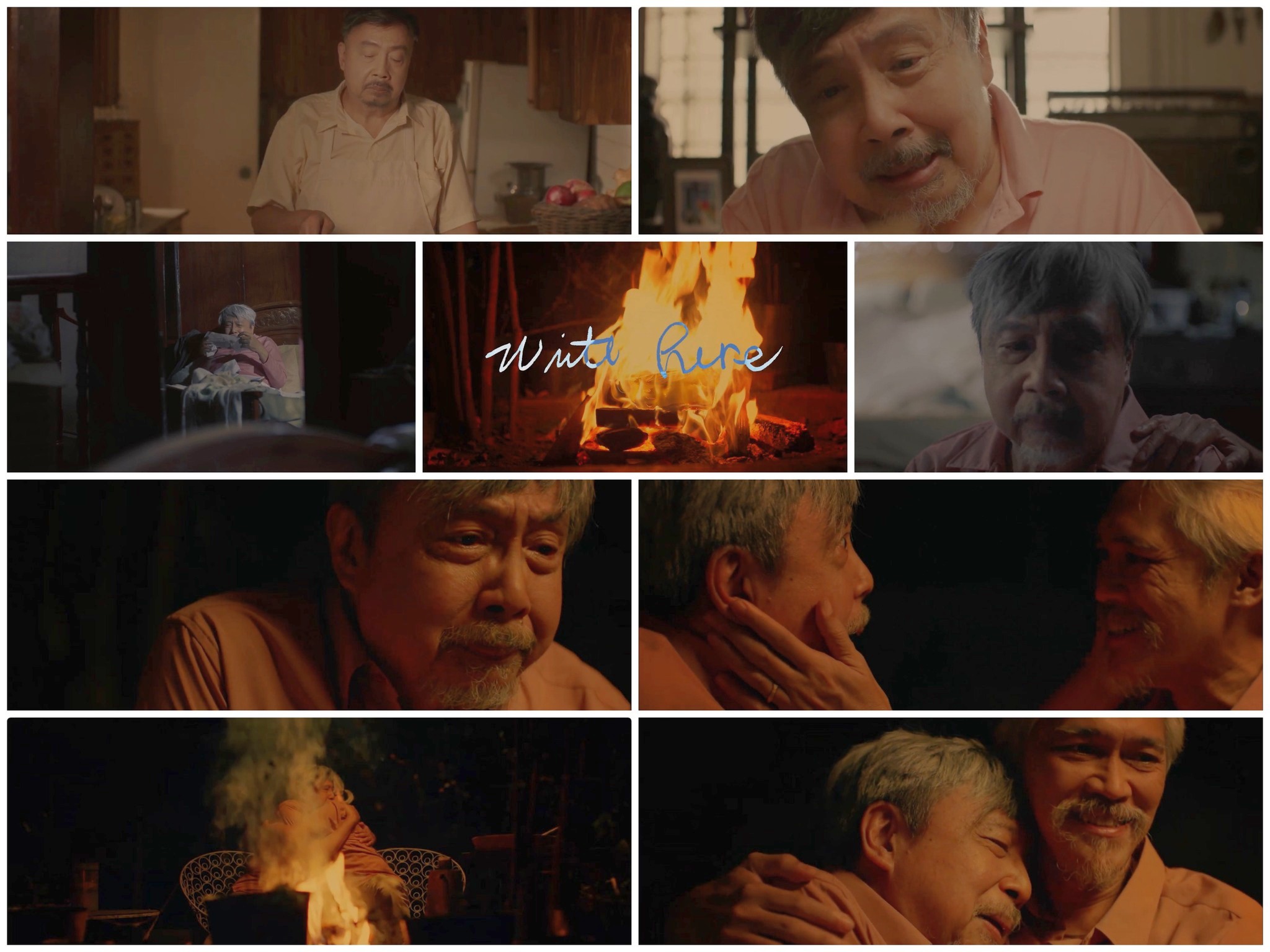 It’s rare to see a cinematic drama executed with such consistent care as Write Here (Seiga Productions, 2022), written and directed by Jake Muñoz Consing, starring Bodjie Pascua and Rolando Inocencio. And that care pays off to devastating effect. Write Here is marked by that kind of knowing restraint that delineates the difference between sentiment (true, earned emotion) and sentimentality (the cheap, manipulative attempt to tug at our heartstrings). Movies about the decay of the human mind can be unrelenting or, worse, sentimental, but Write Here is spare and understated. Consing places the fate of his film on the shoulders of his two leads. Emotional vulnerability has always been Inocencio’s strength as a performer and Bernie grants him the space to do the tenderest, most moving work of his career. Pascua is masterfully understated, turning in a modulated performance that ranks with his work in Pan de Salawal (2018). For an actor who has made a career of being the memorable support, he soars in the lead role as Eddie, a man who is acutely aware of his mind’s erosion. Pascua underplays accordingly, registering the outward signs of encroaching dementia – a forgotten word, a misplaced memory – and then quietly minimizing those very signs.
11011Once you’ve seen Write Here, that fact will be hard to wrap your head around, as the actors seem so well-suited to their respective characters. They likely would have proved just as capable at capturing the intimacy that Eddie and Bernie shared, but it’s hard to imagine that they found the small, individual grace notes they do here – wordless moments that express an understated delight in what they had. But as we watch Eddie’s control slowly slip through his grasp, we realize that we’re watching a man mourn what he once was. Consing approaches the reality of letting go with measured sorrow, unrestrained tenderness, and even moments of joy. This in many ways lends itself to Write Here’s singular strength: the sense of knowing history between these men and, with it, the things that need not be said for our benefit, because they’ve already been said.












 ORCID ID


A Formative Sojourn
The primary difficulty for me in writing this piece is that certain influential personalities are involved. Their ability to strike back (as they once already did) is not what gives me pause. The truth is that they’ve made a number of positive contributions, so I wouldn’t want to override the good they’ve done by providing an account of what they did wrong. I don’t have the expert fictionist’s skill in detailing moral triumph and failure in the same person, so the only claim I’ll make for now is that these were truths whose bases were definitive in my experience, but which I figured out only in retrospect, sometimes after years of doubts and after consultations with colleagues who were in a better position to clarify the issues I was pondering.
11011I’ll make my starting point the now-infamous article where I ascribed the problems of film criticism to the well-intentioned but ultimately calciferous influence of the Filipino Film Critics Circle (henceforth FFCC): it sought to provide a corrective to the corruption-ridden choices of the spurious Filipino film academy (about a half-decade before an actual film academy comprising practitioners’ guilds was formed), but could not extricate itself from the valorization that a supposedly credible awards system provided. My claim to credibility proceeds from the fact that I was once a member of this group, and attempted to redefine my membership to exclude my participation in its awards activity. I was dissuaded by the then-chair (now gone), and I realized, also in retrospect, that the group had no means of recognizing and initiating any activity – say, of advanced learning, which was my goal – that had nothing to do with its annual recognition ceremony.
11011So I strove to function as an unaffiliated critical practitioner, returning to college to pursue the country’s first undergraduate program in film, and garnering a “resident film critic” post in a short-lived weekly periodical (where my initially pseudonymous reviews led to an invitation to join the same critics’ org that I’d distanced myself from, until the group’s contact person uncovered my identity). It also led to my participation in alternative critics’ groups, with other former members as well as active critics who didn’t relish the idea of being identified with the group I left. After completing foreign graduate studies and returning to the Philippines, I was sounded out by all the existing critics groups that I’d been involved in, including (yet again) the FFCC. I decided I could operate better by maintaining distance from these orgs, which was how I was able to formulate my critique of Philippine film criticism’s troubles being derived from the backward and unproductive example set by the FFCC.
11011The members’ response was over the top, although I should not have been surprised. Many of the members were officials at the University of the Philippines Film Institute, which I had set up and led until I left in disgust over the politicking indulged in by these same FFCC members. The then-dean said outright that he preferred faculty who got their degrees locally, like he did – a major hint that he wanted other FFCC members to take over my position; when his long-time ally and writer advised me that I was bound for more trouble if I stayed on, I took advantage of the lifting of the standard two-year travel ban for US-educated scholars and accepted an offer from a Korean university, also to be able to repay my graduate-student loans.
Back to top
11011When my critique lambasting the FFCC was published, the UPFI faculty organized a “roundtable” that I was unable to join because my teaching schedule had already begun. It turned out to be a Stalinist-style denunciation session where the UPFI participants cum FFCC members claimed, in so many words, that they did not deserve to be criticized – without naming me or the article I wrote. The same (now-former) dean who wanted me replaced by colleagues (who could not pass their screening committees because of alleged corruption) said that the most credible critics in the country were the ones who proved their integrity by dispensing awards “that could not be bought” (my translation of his words from the Filipino), in a transcription of a discussion that was subsequently deleted from the journal that reprinted the roundtable’s papers. What remained instead was still a carefully formulated set of specifications of “the qualifications that are necessary to be able to analyze and evaluate films well,” including “A healthy respect for other critics in order to encourage dialogue; and ¶Above all, an attitude of balance and fairness, which is free of all personal agenda and self-promotion.”
11011That of course was an intellectual fallacy premised on an extremely problematic assumption – that “other critics” are automatically worthy of respect and thereby deserve “an attitude of balance and fairness.” The more vital question in so far as my own approaches are concerned is: why was I anonymized? This is not a matter of egotism on my end, as those who know me will be able to attest; rather, it disenables the outside observer from tracking the writer’s source of annoyance and checking out the article I wrote, where I set my argument in no uncertain terms. Typically after the fact, I managed to deduce why the writer had to write that way: to put it bluntly, I’m not the one living in a glass house. In the same issue where the article came out, the lecture by that year’s Plaridel Awardee for Film was published. That awardee was Nora Aunor, who was not the first PAF; that distinction was given to Aunor’s rival, Vilma Santos, during the deanship of the same writer who responded to my critique of the FFCC.
11011In fact, the primary social-network controversy over the declaration of Aunor as recipient of the Order of the National Artist centered on why Santos did not get it at the same time, or even earlier than Aunor. Where did this conceit come from? Followers of Santos would need more than just her record as the first PAF, since Aunor was not only the first FFCC best actress winner but also the first in her batch of performers to win the FFCC life-achievement prize. The source of their clamor is: the FFCC gave more best-actress trophies to Santos, and those for Aunor were often shared with other winners. After years of going over the various historical incidents, in consultation with contemporaries who were also close observers during the period of these two performers’ emergence and rivalry, I concluded that I had enough to provide an explanatory account. It will involve exactly the same critical personality I’ve been referring to, regarded at the moment as the most senior authority among FFCC members, and it will not result in a rosy image. Even then, I’ll have to leave out a lot more supporting details just so we can follow the most basic narrative through-line.
11011Fortunately (in the ironic sense), my tenure with the FFCC covered the years when Santos won her first acting trophy, and followed it with two more in as many years – an FFCC record not equalled before or since. This specific personality I’ve been referring to, an FFCC founding member and former chair and subsequently former national university mass communication dean, was the most enthusiastic campaigner for Santos during this entire period. This caused major expressions of outrage during Santos’s first win, since Aunor was defeated for what was subsequently regarded as one of the best performances in local cinema. In fact the films of both actresses had the same director and scriptwriter, both of whom had been reliable practicing critics; not surprisingly, both expressed strong disagreement with the results. (Personal disclosure: I was the first person to make this declaration regarding Aunor’s output, in an assessment of film performances during the Second Golden Age, which I was also first to name; I subsequently qualified my upholding of both items in updates to the lead article in my first book, The National Pastime.)
Back to top
11011Why did I and most other people not find anything suspicious about this member’s campaigns for Santos? Because, among other things, he had on record an article, typically old-fashioned in its reliance on dualisms in order to uphold orthodox-left principles. The article discussed a set of values in Philippine cinema, stating that then-current filmmaking practice was lacking because of its reliance on spectacle, martyr characters, optimistic narratives, but first and foremost, fair-skinned performers. The oppositions he raised would be easily deconstructible by college freshmen (though not in the Philippines, sadly) but in case we prove incapable of figuring it out, he proceeded to articulate the solutions. The first, of course, was in upholding “kayumanggi” or brown-colored actors, naming Aunor as first exemplar.
11011Fast-forward to the current millennium, after Santos earned her record-breaking FFCC trophies even for performances that were vitally flawed like the first one she won for, and Aunor losing or tying with others during the several decades when she had peaked as performer. Why would this person desist from identifying me when I never hesitated to call out his organization and colleagues for their several problematic actuations? During a casual exchange with a former FFCC member who became a successful scriptwriter with his own gripes against the group, we got to talking about this anomaly and I suddenly made a deduction, which my conversation partner said he was aware of from the beginning. Because what was playing out, specifically with the person in question, was not admiration for Santos, but hostility toward Aunor. This became evident when I thought further back, during the year I first joined the group. Aunor nearly lost her second acting prize – for a film that she had favored for the yearend film festival. The film that she disfavored was the one that the critic in question had scripted.
11011One other conversation I had boosted this new interpretation of events. It was with the only surviving Second Golden Age filmmaker who had never won an FFCC award despite his coming up with the year’s best film at least twice. “They never gave me an award,” he told me, “because of what I did with [the FFCC member’s] script.” He described it as unworkable and even improperly formatted, so much so that he needed to ask a more experienced scriptwriter to help; said veteran writer was associated with non-prestigious commercial projects, so presumably the member felt insulted. This amounted to two people whom the member wanted to penalize, and the FFCC was the means by which he could carry it out. No wonder, after asserting his association with the FFCC and their fairness in dispensing their awards, he needed to be discreet in attacking me. And for the record, I may as well provide the essential conclusion: the relative artistic accomplishments of Vilma Santos and Nora Aunor, among others, were mostly only incidental considerations when it came to the FFCC deciding on whether or not they deserved to win.
Back to top
Á!
Leave a comment | tags: Commentaries | posted in Film Criticism