
Lockdown
Directed by Joel C. Lamangan
Written by Troy Espiritu
A recent Philippine film release will be easy to overlook because it appears exploitative and merely topical – starting with its title, Lockdown. It recently ended its extended streaming run and has been slated to compete at the Asian Film Festival in Barcelona as well as this year’s FACINE International Film Festival in San Francisco (also with a streaming option). The latter festival has what may be the strongest lineup in any millennial Philippine film event, reminiscent of the glory years of the long-diminished Metro Manila Film Festival.
11011At first glance, Lockdown may be regarded as part of the series of films initiated by Lino Brocka’s Macho Dancer (1988, hereafter MD), where rentboys contend with the sordid realities of Third-World existence. The Lockdown director’s previous film, in fact, claimed to be the first authentic sequel to Brocka’s biggest global hit, as indicated in its title, Son of Macho Dancer.[1] Most entries in this series tended to be weighed down (as MD was) by their insistence on the dignity claimed against all odds by their central characters, as well as by the insularity of the sex workers’ situation. MD nodded toward the degeneracy induced by the presence of US military bases, but abandoned those concerns once the title character set out for the metropolitan center.

Danny lifts his handicapped father. Screen cap from Lockdown (For the Love of Art Films, 2021).
11011Joel C. Lamangan, who played the role of an unruly queer madam in MD, invests Lockdown with the same vision of an infernal underworld, but relocates the community to a coastal district, where Danny, an overseas worker forced to return after the global pandemic shut down the Dubai hotel where he worked, escapes from the mandatory 14-day quarantine to be able to raise funds for the recuperation of his recently handicapped father while acting as family breadwinner. The suburban setting considerably facilitates the mapping of territories that separate the seaside slum from the more affluent (and safeguarded) business centers, as well as the most militarized location of them all: the police compound with its discreet cluster of cottages for legally indefensible activities.
11011Like more aspirational working-class graduates than we realize, Danny worked out a gay-for-pay arrangement with Lito, a young entrepreneur, to be able to complete his studies; but since the pandemic was no respecter of overseas boundaries, Lito’s catering business also had to suspend its operations. The only income-earning activity Lito happened to be aware of was the one sustained by foreign customers, via live video exchanges, where native hunks offer to dance naked and engage in increasingly salacious displays, depending on the price the viewer pays. (The local term, vidjakol, is both a pun for video call and a portmanteau of video and the clipped slang term for ejaculation.)
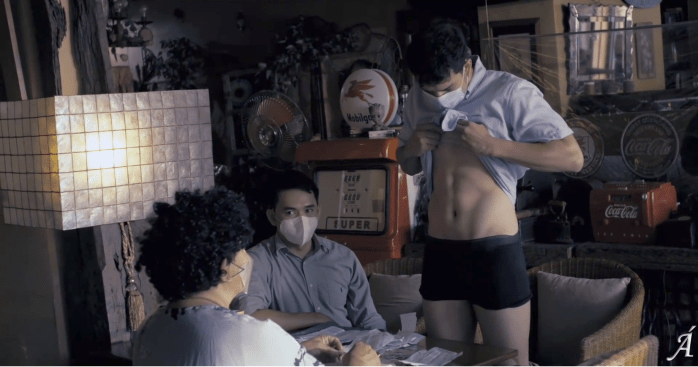
Danny auditions for Mama Rene. Screen cap from Lockdown (For the Love of Art Films, 2021).
11011The necessarily clandestine activity is conducted in Mama Rene’s Café, with the proprietor acting as barker, webmaster, trainer, and financier in charge of the performers’ income as well as a police official’s protection payment. Littered with antique appliances, the coffeehouse’s ground floor serves as audition space as well as lounge area for Mama Rene and his stud collection. The income-generating activities take place in crammed cubicles on the next floor, all darkened except for video monitors and spotlights illuminating the on-cam performances. Although initially nauseated by the abject nature of this version of sex work (as opposed to the escort service he used to do), Danny manages to find some professional equanimity in the tasks at hand, motivated by his father’s deteriorating condition and buoyed by the camaraderie of his fellow performers.
11011As it turns out, the further challenges that lie in store for the narrative hero escalate from this point onward, rapidly and terrifyingly. The turning point is occasioned by a comic lovers’ quarrel that turns violent and leads to wholesale betrayal. Throughout these dramatic shifts, Lamangan ensures that we remain mindful of Danny’s plight by maintaining unconditional empathy with the character; his strategy is matched by a performance startling in its fierce commitment from Paolo Gumabao, one of the exceptional local cases where an offspring manages to surpass anything done by his actor-parent, Dennis Roldan.

Camaraderie among fellow performers. Screen cap from Lockdown (For the Love of Art Films, 2021).
11011Even with less-than-ideal material, Lamangan is capable of guaranteeing stellar performances, from himself as well as for others. (For adequate proof, check out his other FACINE filmfest entry, One More Rainbow, where he draws out heart-tugging ensemble work from a trio of now-elderly stars from the Second Golden Age.) In Lockdown, he manages to differentiate a motley mix of vidjakol players via sharp performative strokes: the final sob story, for example, is rendered by a cherubic actor who actually smiles throughout – a masterly touch that indicates how the speaker is aware that he uses the same lines to elicit sympathy (and, consequently, larger tips) from his customers, yet intends to inform his peers without adding to their already overwhelming burdens.
11011PC guardians will be thrown off by the resolutely negative queer imaging in Lockdown, where the higher the out-gay character’s position, the more malevolent he turns out to be. Yet this perturbing state of affairs should be seen as postqueer, rather than homophobic. The characters presume to stake their claims on limited resources and rewards, enabling impoverished local citizens to conduct transactions with better-heeled clients that they would never be able to encounter otherwise in their daily lives. More crucially, the global circuits of cash and power tracked via these personalities demonstrate the inroads made in the lives of our dispossessed by internet media – implicating in no uncertain terms the very same types of viewers who would be ultimately watching presentations like Lockdown.[2]

Danny as Mama Rene’s special payment. Screen cap from Lockdown (For the Love of Art Films, 2021).
11011A reflexive glance might help us appreciate the movie’s achievement better. Brocka first attempted to depict the underworld of male hustling via an extensively improvised sequence in Maynila: Sa mga Kuko ng Liwanag (1975), most of which was excised after the author of the source novel objected to the contrivance. MD was therefore more of a more carefully planned (though also highly unstable) treatment of the material. Who should turn up as the embodiment of the apex exploiter in Lockdown? None other than Allan Paule, MD’s lead actor, who in effect provides both an extension of the earlier film’s triumphant ending as well as a critical suggestion of where all its desperation and inhumanity could wind up, with a character thoroughly incapable of evoking the warmth and concern he was once able to summon for his fellow sex pros.
11011Considering the defiance and frustration that Brocka expressed right before his unexpectedly sudden death, Lockdown might well be the movie he would have made if he survived into the present millennium and its discontents. No higher accolade can be granted to a Filipino filmmaker than stating that she or he has made a work worthy of Brocka’s highest aspirations, and Lockdown happens to be one such rare instance.
Notes
First published September 27, 2021, as “Macho Dancing Goes Virtual in Joel Lamangan’s Lockdown” in The FilAm and reprinted in the November 2021 issue of The FilAm: Newsmagazine Serving Filipino Americans in New York. Constant thanks to Jerrick Josue David (no relation) and Mauro Feria Tumbocon Jr. for alerting me to the creative ascent in the recent output of my namesake.
[1] An interesting sample, exploitative in the extreme but tackling head-on the issue of human trafficking, is Lamangan’s No Way Out (2008), worth tracking down for a look-see. The films regarded as MD’s direct successors, completed and marketed following the same sure-fire circuit as Brocka’s landmark release, are Midnight Dancers (1994), Burlesk King (1999), and Twilight Dancers (2006), all directed by the late Mel Chionglo.
[2, spoiler alert] As further elaborated in the succeeding paragraphs, a comparison with Lino Brocka, this time in terms of his handling of the reflexive potential of media, would be in order: it may be considered a weakness of Brocka that he was unable to subject media to critical reconsideration during his short and abruptly terminated career. In his overtly political films, either the media were inexplicably absent (as they generally were in MD) or they served as empirical chroniclers of history-in-the-making, even occasionally providing a counterweight to government corruption. The presence of a TV reporter in Lockdown, who feeds on the police department’s hypocritical suppression of what they announced as an offense to public decency, and who instructs her crew to film the hapless performers against their will, is given insidious significance once an abusive official repeats her words to justify torturing some of the prisoners.













 ORCID ID
 Ámauteurish!
The Political Is Personal
“Marcos and Memory: The Past in Our Future”
Sheila Coronel
2022 Adrian E. Cristobal Lecture
One curious development, still within the first quarter of the third year of a history-changing global pandemic, is that the audiovisual material which most Filipino netizens are burring over at the moment is expectedly streaming, but it’s neither a film nor a TV series. It’s the latest installment of the decade-plus Adrian E. Cristobal Lecture Series, sponsored by the Writers Union of the Philippines. Titled “Marcos and Memory: The Past in Our Future,” the material promised topical urgency in the wake of the so-far certain possibility of the Marcos family recapturing the seat of power that their patriarch, Ferdinand Sr., occupied for over two decades and refused to let go until he was expelled by a popular uprising.
11011The Marcos strategy – proffering the only son instead of his smarter sisters – resonates with the Catholicized culture’s belief in a messiah sent by a stern father to point the way to salvation; it also dodges the gender association with the still-alive and possibly already-daft Imelda, notorious during her heyday for her tackily excessive shopping sprees and hatred of anything that reminded her of how dirt-poor she used to be. This is enhanced by the likelihood that the sisters may be in charge of their father’s plundered billions, with Imee exposed when her grandchildren’s names were listed as beneficiaries in the Pandora Papers leakage in 2021, and side reports of the ongoing Credit Suisse scandal reminding readers that the Marcos couple were some of the bank’s most infamous confidential depositors.
Portions of the pseudonymous contracts drawn up with Credit Suisse by the Marcos couple. From Raissa Robles, “How the Law Caught Up with the Philippines’ Imelda Marcos and Her Stolen Millions,” South China Morning Post (November 17, 2018).
11011The Marcos campaign has proved particularly divisive for the generation that was able to participate in the anti-dictatorship movement that became an inexorable force when oppositionist-in-exile Benigno S. Aquino Jr. was assassinated upon his return to the country in August 1983. Those who count themselves as keepers of the democratic flame lament that later generations have been miseducated and incapable of the intelligence and strength of character to resist the Marcoses’ brazen attempt to launder their ill-gotten wealth, if not add a few billions more. A number of people who reversed course point to the post-Marcos administrations’ failure in preventing the reassumption of political influence of sectors that Marcos had started to marginalize, specifically the old oligarchy and the church (exempting pro-US neocolonial compradors, of which even Marcos strove to depict himself as one).
The Marcos regime: at the start (1965 presidential campaign) and at the end (1986 people-power uprising). From “Marcos and Memory,” courtesy of Sheila Coronel.
Back to top
11011Most people invested in the issue would have picked one or the other position to uphold; a select few would have rejected both. Sheila Coronel, Toni Stabile Professor of Professional Practice in Investigative Journalism at Columbia University, performed the most unexpected act of deconstruction imaginable, by placing herself in both camps in order to explain why the Marcosist phenomenon is more deeply entrenched than we think, and why in order to confront it, we must begin by confronting ourselves. The premise of her lecture turns inside-out the self-righteous tendency to regard the support for the Marcoses as our Other, a monstrosity that only needs to be identified so it can be successfully resisted.
Sheila Coronel with her father, lawyer Antonio Coronel. From “Marcos and Memory,” courtesy of Sheila Coronel.
11011“If Marcos has such a hold on our collective imagination, it is in part because of the lies and half-truths he and his courtiers have told over and over again until they were accepted as fact,” Coronel leads off. “The Marcoses have been at this since 1935…. The rewriting of history didn’t begin after the fall [of the regime in 1986].”[1] Coronel then proceeds to recall how her own father, a well-known lawyer, defended individuals accused of acting on behalf of the martial-law administration. “He teased me about my objections to his clients but not to the shoes and dresses his lawyer’s fees bought me.”
11011The level of familiarity with which Coronel spells out her argument paradoxically provides her with an authority missing in those of us who profess to stand apart from the loyalty and devotion that the Marcoses inspire. (Essential disclosure: Coronel was a classmate and campus-journalism colleague during my first undergraduate program at the national university – and those of us who closely observed her could already see her capacity for ambitious, reflexive, research-based writing; her many global distinctions since then confirmed her determination to use her gifts in the service of the least-privileged among us.)
11011Toward the end of her narrative-driven account, she shared her recurrent nightmare of repeatedly attempting to write but with her pen failing to generate any ink. This is the point where she prescribes a call to action. Accepting the worst qualities that the Marcoses represent as an essential component of the Philippine character could easily result in our quiescence, if not despair. On the contrary, Coronel maintains, “resisting normalization means resisting disempowering narratives.”
11011It would be pointless to continue finding fault with whoever we believe should have been responsible for ensuring that the Marcoses’ record of atrocities and abominations be inscribed in the country’s educational curriculum, but just to make our terms clear (and affirm Coronel’s point): our historians and popular-culture artists have done everything they could to set the record down, even when the Marcos patriarch was still around. Coronel’s text (available both as a live recording and as a published transcription[2]) suggests ways in refining, if not redefining, the Marcos narrative, and if the present trend persists, it will soon be time to designate our younger subjects to take charge of fixing the mess that their elders left them in.
Back to top
Notes
First published March 6, 2022, in The FilAm; reprinted in May 2022 issue ofThe FilAm: Newsmagazine Serving Filipino Americans in New York.
[1] I thought of going over Roland Barthes’s 1957 text Mythologies (trans. Annette Lavers, New York: Noonday, 1972) to check if he had any suggestions on how to “read” the delivery of a lecture. He didn’t cover the topic, but I came up with something more useful: “Myth on the Right” (150-56), which for some reason I completely forgot after thinking it would be applicable in discussing the then-recently deposed Marcos dictatorship. As part of a section titled Myth Today (as opposed to the book’s eponymous primary section), Barthes describes myth as being “statistically” on the right, and enumerates seven rhetorical forms that typify bourgeois myth, all fascinating but too complicated to bring up here. The first property he mentions, for example, is inoculation, “which consists in admitting the accidental evil of a class-bound institution the better to conceal its principal evil” (151). The succeeding figures are: the privation of History; identification; tautology; neither-norism; the quantification of quality; and the statement of fact.
[2] Still on the matter of approaches to evaluating a lecture, all the academic discussions I could find dealt with transcriptions rather than with audiovisual material; I look forward to more balanced coverage now that streaming websites have made available some of the more famous recordings by prominent thinkers of the recent past. Regarding “Marcos and Memory,” which was delivered live at the Facebook page of the Unyon ng mga Manunulat ng Pilipinas, the recording has been uploaded on the organization’s YouTube page, along with preliminary material and subsequent Q&A exchanges. Coronel’s draft, on the other hand, was reprinted in Rappler as well as in Positively Filipino, MindaNews (with a Cebuano translation), and the Philippine Center for Investigative Journalism (which Coronel founded). The audio recording of the lecture has also been posted on the PCIJ’s Spotify channel.
Back to top
Leave a comment | tags: Commentaries | posted in Politics