
Several erroneous definitions and/or etymyological explanations of Filipino slang have been sprouting online. This is a compilation drawn from the endnotes of Manila by Night (Regal Films, 1980) that may help clarify some terms by situating them in the time frame referenced in the text. The full post may be found in the special issue of Kritika Kultura devoted to the film. A copy of R. David Zorc & Rachel San Miguel’s Tagalog Slang Dictionary (De La Salle University Press, 1993), mentioned in certain instances below, may be found in the Extras section’s Fil(m)ipiniana list.
Acheng. A regional variation on Ate (elder sister); the seemingly French resonance has made it a preference for gay (and women) “femme” speakers.
Award. Ironic usage, a reference to failure or long-suffering condition, thereby resulting in a mock-worthy public performance of personal drama that deserves recognition.
Baclaran. At the end of the former red-light district, stretching all the way into the seedier environs of Pasay City, is the shrine of Our Lady of Perpetual Help in Baclaran; because of its location, underworld figures (gangsters and sex workers) as well as working-class citizens attend its novenas and Masses.
Bayside. A popular night club along Roxas Boulevard.
Bongga. A slang term, usually used as a compliment meaning stylish, outlandish, extravagant, awesome.
Boots Anson-Roa. A film and TV actress, known for playing wholesome women characters.
Consciousness Three. A reference to Charles Reich’s then-influential bestseller The Greening of America (1970), wherein a utopic condition is attained consisting of the counterculture’s embrace of personal happiness over material success.
Datung. Dough [from “the tong” or extortion money] in gay lingo; semantically shifted from the original meaning of tong as the US-based Chinese underworld organization. The query for demanding money, “ang datung” or “an’ datung” (the payment), has been clipped to “anda,” which puns on the Spanish verb for moving forward. The Tagalog Slang Dictionary however ascribes the term “datung” to the Cebuano word for rich, “dato” (page 37).
’Day [rhymes with “guy”]. A shortening of the regional term “inday” (girl), adopted initially as gay lingo and now mainstreamed.
Del Pilar vs. Boulevard. Del Pilar Street is in what used to be central Ermita’s red-light district, which was patronized mostly by American servicepersons stationed at the former US Naval Station Sangley Point (now the Cavite Naval Base), joined by Japanese sex tourists during the Cold War period. (Ironically, some of the Philippines’s original batch of colonial-era sex workers were migrants from Japan.) [Roxas] Boulevard, although running parallel a few blocks away, directly faces Manila Bay and thereby exudes respectability because of its ideal location; the US Embassy and a number of five-star hotels and upscale apartments are located on this strip.
Echeng. From “echos,” to mooch or sponge or sweet-talk.
Evita. A name that references the eponymous Andrew Lloyd Webber and Tim Rice musical (then banned in the Philippines) on Eva Perón, Argentina’s controversial First Lady, whose life had too many parallels with that of Imelda Marcos. In a later disco scene, Festival’s dance version of the musical’s most popular hit will be played.
Joanne Drew. A shortening of Joanne Drew Figure Salon (Australia-based, founded by Joan Andrews), a popular slimming facility for Manila socialites. The character who mentions it would be referring to her lower waist area, including her crotch.
Juwawa. Gay-lingo Frenchification of the Tagalog “asawa” or spouse; currently shortened to (and mainstreamed as) “jowa.” See page 67 of the Tagalog Slang Dictionary.
Kumakain ng kuhol. Literally “eating [freshwater] snails,” a local delicacy which requires sucking and use of the tongue to get at the flesh of the cooked mollusk; in reference to the character’s aggressive use of his tongue in deep (or French or tongue) open-mouth kissing.
Kyeme. Spanish-sounding gay-lingo coinage (quieme) that means “nonsense.”
Mare [MA-reh]. A shortening of “kumare,” feminine of “kumpare” (from the Italian comare, godmother; and compare, godfather) – best friend; technically, a person who stands as Catholic-baptismal godparent of one’s child, i.e., someone who’s trusted enough to take care of the godchild if the parent is incapacitated or dies.
Misericordia. Red-light street for less-wealthy locals and Chinese visitors in Chinatown district. “Huwag kang madaan-daan sa Misericordia (Don’t let me find you in Misericordia)” implies that the speaker may have started work there and upgraded to a sauna parlor as massage attendant while maintaining her residence in the area.
Mogs. Short for Mogadon, a hypnotic prescription sedative popular among drug users.
Pangasinan [pang-GAHsinan]. A northern coastal province, 4-6 hours away by bus north of Manila, named and known for salt (“asin”) as well as seafood products including the fermented fish or krill paste called bagoong [bago-ong], used as condiment.
Rhapsody. An extension of “rap-sa,” verlanization of “sarap,” the Tagalog word for pleasure.
Rosa Rosal. A film actress who first became famous for her femme fatale roles, then starred in a number of prestige projects during the studio system era of the 1950s. She became known to a new generation of admirers for her humanitarian work with the Red Cross as well as for hosting her own TV charity program.
Sensation. [Provisional, pending confirmation] One of the euphemisms that emerged for polite-society discussions of sex in then-gendered massage-parlor activities, pertaining to any of client-preferred positions where the masseuse performs with her hand, mouth, breast, and/or vagina on a passive recipient. Filipinized in the Tagalog Slang Dictionary to “senseysyon” (page 125) and equated with orgasmic release.
Seven Seas. A popular motel chain providing two-hour room rentals for quickie sex.
Shotgun. Same sense as American slang: weed shotgun is performed with the lit part of the joint held in the mouth, while the other end is positioned in the recipient’s mouth or nostril (with hands forming an air tunnel); when the holder blows, the recipient will be able to inhale a stronger whiff.
Soraya. A dated reference, possibly referring to a Muslim-like appearance because of the turban that the character is wearing (provided by Paul H. Roquia and Ka Deniz Reyes of the Facebook Pinoy Film Buffs group); also possibly a playful corruption of “suray,” untidy or disarranged (as suggested by Nestor de Guzman of the same group).
Sward. Not the rarely used English term for grassland, but a Filipino coinage for “gay male,” free of the pejorative associated with traditional terms; ascribed to film critic and director Nestor U. Torre. Though sward is phonetically articulated [i.e., swahrd], the Tagalog Slang Dictionary claims “sword” as its origin, referencing its double-edged nature (page 135).
Toro/Torero. From the Spanish for “bull,” connoting studly expertise as well as bullfighting, since inexpensive live sex is performed in the round (like a bullring), where the central couple is expected to display a variety of unusual and athletically demanding positions before the torero climaxes. See as well the Japanese title of Nagisa Oshima’s In the Realm of the Senses: Ai no corrida, literally “bullfight of love.”
TY. Pronounced “tiway,” an acronym of the letters abbreviating “thank you,” occasionally used as a verb (“tiwayin,” to pay with verbal thanks; to exploit).
Type. A double-clipped form of “Type ko [my type],” in turn a clipping of “Yan ang type ko [that’s my type].”
Vito Cruz. A still-existent street toward the end of the former red-light district of Ermita, which had also catered to American servicepersons during the period when the US had military bases in the Philippines. Because of its farther location (closer to the seedier portion of Pasay City), it catered to older and/or non-Caucasian clientele.
Á!
 Several elements in this pair of pictures are capable of generating discussions in themselves, but would detract significantly from the concerns of the book text. To bring up a novel example: one figure is common to both – Ferdinand “Bongbong” Marcos Jr., only son of the Marcos couple and latter-day frustrated vice presidential aspirant. This detail would alter most people’s impression that the first presidential offspring to perform in movies was Corazon Aquino’s daughter Kris. (At one point, Lino Brocka was considering casting Imee Marcos in the title role of his Cannes breakout entry Insiang, but fortunately managed in time to cast aside that phantasmagoria; see pp. 125-26 of Jo-Ann Q. Maglipon’s “The Brocka Battles,” in Lino Brocka: The Artist and His Times, ed. Mario A. Hernando, Manila: Sentrong Pangkultura ng Pilipinas, 1993, pp. 118-54.) During the euphoric period that followed the 1986 “people-power” revolt that deposed the Marcoses and installed Cory Aquino, playwright Bienvenido M. Noriega Jr. (formerly with Imee Marcos’s Experimental Cinema of the Philippines) wrote a popular stage comedy premised on a speculative Romeo & Juliet-inspired romance titled Bongbong at Kris (1987).
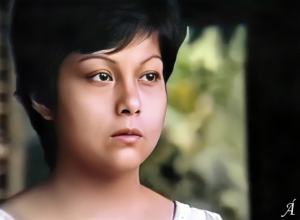
 I would have preferred to use the evocative pic below (click to enlarge) in place of this solo portrait of Elena Bernal. Unfortunately its source, the phenomenal Pro Bernal Anti Bio volume (Manila: ABS-CBN Publishing, 2017) – drafted as an autobiography of Ishmael Bernal, passed on to his confidant Jorge Arago, and completed by Angela Stuart-Santiago in honor of her late friends – came out about the same time as Manila by Night: A Queer Film Classic. It would also have corrected the commonly misspelled and uncompleted name of the café run by Bernal, with “When It Is a Gray November in Your Soul Coffee Shop” rather than “When It’s a Grey November in Your Soul.”
 The pic in question came from a framed entry in Cinema Paraiso (Film Paradise), an exhibit of Filipino movie memorabilia with film screenings and lectures, held February to April 2003 at the National Commission for Culture and Arts gallery in Intramuros, Manila. According to historian and archivist Teddy Co, one of the organizers, “It’s actually from my collection of bomba magazines, ca. 1969-70. I cannot find the issue anymore so I cannot name the magazine and what month it was in. The other exhibit curators were Josephine Atienza and Cesar Hernando…. The pic was in a section called A History of Kissing in Filipino Movies, starting from the first smooch between Dimples Cooper and Luis Tuazon to a digitally rendered kiss from Lastikman [dir. Tony Y. Reyes, 2003]” (Facebook Messenger exchange, June 5, 2020). The explanation may be too long for a caption and should be written as a footnote.
 I could have replaced either one of two exterior shots of the Manila Film Center with the mural in the lobby, painted by Victor Cabisada Jr. and Peter Alcántara, then-impossible to access after a fire damaged the building (see this blog’s header image). In September 2020, an art historian, John Paul “Lakan” Olivares, posted the pic below (click to enlarge), apparently taken when the object was still new, on his blog
 Re the caption: upon the prompting of director-writer and actor Bibeth Orteza, a close associate of the accused comedians (one of whom had died), I reread available material on the controversy and was surprised to find that the case for reasonable doubt was strong. Pepsi Paloma advanced her accusation of rape in the media on the basis of a photograph where she was apparently being held against her will. Splashed on the front pages of tabloids and now inexplicably unavailable, the picture showed Joey de Leon kissing an unwilling Paloma, with the other comedians looking on with amusement. The worst that the picture denotes would be molestation, rather than rape.










 ORCID ID
 Ámauteurish!