
[Click here (recommended) for desktop mode.]
Brutus, ang Paglalakbay
English Translation: Brutus, the Journey
Additional Language: Buhid
Year of Release: 2008
Director: Tara Illenberger
Screenwriters: Tara Illenberger & Arah Jell Badayos
Producers: Bonfire Productions, Cinemalaya Foundation, National Commission for Culture and the Arts
Cast: Ronnie Lazaro, Yul Servo, Rhea Medina, Timothy Castillo, Flor Salanga, Melario Nazareno, Jerey Aguilar, Irene Medina, Lagum Pasag, Yagum Maansig Solina, Aniway Solina, “Mayor” Yaum Sumbad, Mandy Sumbad, Tulay Yam-an, Ian Pagcaliwagan, Drandred Afundar, Fritz Silorio, Oyot Solina, Jimmy Rodaje, Jayvee Lachica, Raymond Abia, Charisse Pagcaliwagan, Jopeter Galicha, McDaniel Famisaran, Charles Kim Pagcaliwagan, Benjamin Jovinal, Marianne Oandasan, Roland Pagcaliwagan, Ramy Gadon, Jaimie Lazo, Christopher Arsega, Dennis Alegre, Sarah Pagcaliwagan, Randy Salibio, Ariel Molina, Arlan Lachica, Richner Solangan, Alfredo Mabalot, Leonises Feticio, Jim Augie Bergado, Japhset A. Bahian, Sonny Gado
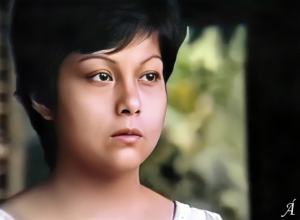
When her father falls ill from malaria, Payang Mansik is instructed by her mother to accompany Adag Ayan to perform brutus—i.e., transporting wood for illegal loggers from Manila, so she can earn enough money to buy medicine in their Oriental Mindoro town. Payang also looks forward to finding her brother, who went missing after an earlier brutus task, unusual for members of their Buhid tribe of indigenous Mangyan folk. After hauling the logs down a mountain, they construct a raft so they can paddle on the way to town. Although Adag warns that the current is getting stronger, Payang insists on going further, resulting in their raft crashing against some rocks. In the morning, having drifted away from their deliverables, they are picked up by an army unit led by Sgt. Sarosa, who asks them if they had seen a rebel leader named Ka Milo. Sarosa warns them that performing brutus is illegal, but he also tells them where they can find the logs they lost. While reassembling the raft, a stranger who introduces himself as Carlito helps them in exchange for hitching a ride.
The neorealist social-problem film, largely repressed during the increasingly prohibitive cost of film production during the late celluloid era, made a comeback via the transition to digital filmmaking. Its proportion was more abundant in Pinas than in Western cinema, largely owing to media critics and teachers romanticizing the output of artists identified with the antidictatorship movement during the martial-law period’s Second Golden Age. While some of these titles garnered attention, even prizes, in global events, no one dared to voice the possibility of affirmative action at play, or even their insidious insistence that what used to be called Third World subjects should confine themselves to political miserabilism, resulting in a reactionary downgrading of the local audience that would have horrified SGA practitioners.[1] Brutus, ang Paglalakbay demonstrates how smart filmmakers could observe these requisites and thereby win the approval of funding agencies, but also figure out ways to improve on the formula. The work’s title is derived from the hardy though now-discontinued 140cc Kawasaki motorcycle used for hauling logs uphill, a term exclusive to the Buhid tribe featured in the film (per a Messenger response by the filmmaker); it commences like every other neorealist-inspired work, through which a line may be traced all the way to the output of the Belgian brothers Jean-Pierre and Luc Dardenne, the trend’s primary contemporary exponents. Yet though BaP diverts through the expected worrisome and increasingly stressful developments, it insists even more stubbornly on a light-handed, even tender depiction of its dramatis personae, even the most threatening and dangerous ones. It’s an unusual perspective, feminine in its most empowering sense, although those who may have traversed the many possible routes through which lifestyles caught in the crosshairs of capitalist and militaristic pressures find their own resistance in maintaining the distance and wonderment that so-called primitive cultures provide, will be able to recognize the behavioral patterns depicted in the film. Lyrical realism was supposed to be one of the traditions that neorealism meant to improve on, if not displace; Brutus makes us see how approaches faithful to the sensibilities of sufficiently Othered subjects can provide their own vindication in the face of more pragmatic but overused options.
Back to top
Return to Canon Decampment contents
Go to alphabetized filmmakers list
High Tide
Language: Hiligaynon
Year of Release: 2017
Director & Screenwriter: Tara Illenberger [as Tara Barrera Illenberger][2]
Producers: Bonfire Productions, Dark Media Creations, Universal Harvester
Cast: Arthur Solinap, Dalin Sarmiento, Sunshine Teodoro, Forrest Kyle Buscto, Christine Mary Demaisip, Riena Christal Shin, Nathan Sotto, Onal Golez, Allen Rivera Galindo, Allain Hablo, Runshien Olivete, Mitch Fresnillo, Kyle Fermindoza, Christian Demaisip, Farida Kabayao, Dianna Baloran, Joan Paulette, Mary Libo-on, Edwin Caro-Lauran Jr., Ma. Luisa Nalupano, Elvie B. Razon-Gonzales, Emilyn Espera, Genina Toledo, Jeremy Descuatan, Wenil Bautista, Melita Penafiel, Daniella Julieta Caro, Tracy Baky, Jocelyn dela Cruz, Jennifer Tobongbanwa, EJ Mier, Stephanie Rodriguez, Joemel Banas, Harlen Grace Esmajer, Leonard Villanueva, Rafael Dionio, Genie Delareman, Jeffrey Dilag, Ignacio Dumancas, Lily Belle Palma, Ivan Kenjie Villalobos, Roshiel Fernandez, Zahara Shane Lino, Allen Rivera Galindo, Jeson Panes, Lily Belle Palma, Mark Joseph Magada, James Gulles, Josh Berso, Jeren Sola, Zedric Bacolena, Ivan Kenjie Villalobos, Rynshien Olivete, Marilou Doloritos, Jade Claire Villa, Prince Jarandilla, Leo Quiachon, Mereyel Salvacion
Young sisters Dayday and Laila are sent to school by their fisherfolk parents despite their hand-to-mouth existence on an island in Iloilo. When disaster strikes a neighboring island, their neighbor Mercy agrees to adopt a boy, Unyok, who’d lost both his parents and barely speaks as a result of trauma. The sisters develop a bond with Unyok, with whom they scrounge for shellfish on the beach to sell directly to a restaurant, but the proprietor complains because the sizes of the mollusks they harvest are too small. When the sisters’ mother is diagnosed with an ectopic pregnancy and they need to raise funds beyond their means, the three stop attending school and look for ways to help. Unyok remembers how the sea harvest where he used to live was always plentiful, so he convinces the sisters to go there during low tide and return to their island before the tide rises.
Climate change is the impassive and increasingly destructive force that confronts the most dispossessed citizens everywhere, with the Philippines already marked by meteorologists as the most vulnerable country in the world. Much like the issue of the nuclear arms race in the twentieth century, this ensures an existentialist pessimism in any discourse where the prospect might arise. Hence the expression of any form of hope, as High Tide endeavors to furnish, might sound like whistling in the dark. Yet the film manages to exempt its narrative’s future generation from the defeatism that we know lies in store for them—ironically by focusing on its future generation. To witness them already battered by the ravages of the natural environment, when previously tried and tested measures like calendrical almanacs and miniature timepieces no longer function as they should, yet insist on persevering for the sake of their loved ones and for one another, is to imagine them carving out enough space for their fantasy to prevail, if only in fiction. This makes of HT that rarity among independent productions: a work rooted in solid scientific findings and closely observed ethnographic reality, that nevertheless refuses to drown in harsh and overwhelming data. It will make sense primarily for characters like the ones who populate its story, but within a framework where no winners can be guaranteed, the attempt may be seen as possibly desperate, but heroic in its desperation.
Notes
[1] The differences between Fredric Jameson and Aijaz Ahmad actually began with the former’s discursive appreciation of a Filipino film, Kidlat Tahimik’s Mababangong Bangungot (Perfumed Nightmare, 1977): in “‘Art Naïf’ and the Admixture of Worlds,” the final chapter of The Geopolitical Aesthetic: Cinema and Space in the World System, Indiana University Press, 1992, pp. 186–213, Jameson argued that Third-World films essentially present as political allegories, refining an argument he first articulated in “Third World Literature in the Era of Multinational Capitalism,” Social Text, vol. 15, Fall 1986, pp. 65–88, doi:10.2307/466493; Ahmad, in “Jameson’s Rhetoric of Otherness and the ‘National Allegory,’” Social Text, vol. 17, Fall 1987, pp. 3–25, doi:10.1002/9781119118589.ch6, spearheaded the response of several cultural critics, some of them understandably from Pinas, in pointing out how Jameson had to suppress “the multiplicity of significant difference among and within both the advanced capitalist countries and the imperialized formations.” For a tracking of the critical shortcomings that led to this state of affairs, see Joel David, “From Cloud to Resistance,” Amateurish (August 30–September 13, 2022), uploaded in three installments starting at amauteurish.com/2022/08/30/the-problem-of-our-critical-approaches/.
[2] The landgrabbing family in the director’s 2008 film Brutus, ang Paglalakbay is introduced as “Barrera.” The filmmaker speculated that she probably associated her maternal grandfather’s name with the issue of land: “Friends’ and family members’ names show up in my films…. My grandfather was not landed. He was a soldier in the war. But later he became a successful businessman. And people would borrow money from him, offering their small land titles. And that’s how he acquired property, some of which he didn’t really want” (Messenger reply, October 17, 2025).
Back to top
Return to Canon Decampment contents
Go to alphabetized filmmakers list
Á!












 ORCID ID
 Ámauteurish!