
[Click here (recommended) for desktop mode. Click to jump to: Medusae, 2017.]
Pascalina
Year of Release: 2012
Director & Screenwriter: Pam Miras
Producers: Cinema One Originals, Tito & Tita
Cast: Marie Veronica Santiago, Jet Leyco, Anna Vecin, Jessie Silvestre, Randy Punsal, Sanchi Catura, Peewee O’Hara, Cara Eriguel, Alex Medina, Ian Galliguez, Danzen Santos, Marija Vicente, Cora Buenaventura, Rey dela Cruz, Jericho Vega, Jasper Manlangit, Virginia Marcos, Ian Lomongo, Jacyn Esquillon, Ally Lumbera, Teng Cortez, Timmy Harn, Malay Javier, Lili Esquillon, Vicente Diaz, Aila Torre, Kev Abadam, Ei Salcedo, Paolo Domingo, John Arzadon, Divine Aucina, Andrei Lumbera
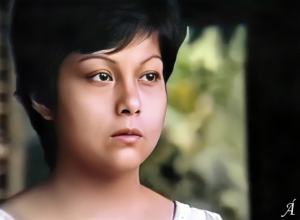
Pascalina Lagumbay, Lina for short, wakes up on a day packed with a series of unfortunate events. She picks the wrong color for her hair, forgets to shut the faucet, leaves on time for work but has to chase a thief who snatches her bag then cops a feel before he lets go, discovers a new nurse at her workplace station, confronts her boss while red dye streaks her face and uniform—and gets informed that she’s been fired, although her boss pays for the sandwich that she couldn’t buy; her boyfriend Jeff screws her beyond the literal sense, by introducing to her his flirty office coworker who’ll be accompanying him to an out-of-town assignment. She manages to find employment in the same building where Jeff works, but when she meets her sisters for a family get-together, an elderly though unrelated aunt arrives and tells them that their blood relative, to whom she’s devoted, is about to die and needs to pass on her power as an aswang or flesh-devouring monster. No one believes her although Lina, always the pushover, agrees to accompany the lady to visit their sick aunt.
Of the many possibly obscure titles in the canon list, Pascalina will be sure to reward the adventurous viewer setting out to uncover difficult-to-access samples. Its primary distinction lies in purveying an urban-set horror narrative, a rare achievement considering how most successful horror films have to locate themselves in rural wildernesses, the better to distance the viewer from the double wallop of antinatural material packaged in a technologically sophisticated medium: any shred of doubt by the film artists in their material gets automatically aggrandized at the expense of believability in the presentation. Pascalina preempts these pitfalls by bravely harnessing its third-cinema limitations. As confirmed by the filmmaker (via Messenger reply on April 23, 2026), it made use of low-end technology during a time when digital production still had to attain its now-standard 4k polish, via the use of the Digital Harinezumi, a plastic toy camera whose manufacturing company halted production a decade ago; the low-resolution imagery might require some playback adjustments—which will nevertheless be entirely worth the trouble. The content is perfectly matched to the technology, with the aswang or flesh-eating candidate introduced as a mousy pushover, bullied by everyone who encounters her, reminiscent of the title character in Aki Kaurismäki’s Tulitikkutehtaan tyttö (The Match Factory Girl, 1990),[1] complete with casually abusive boyfriend. Both dark comedies immerse in developmental detritus and deploy the strategy of enabling identification with central figures disadvantaged by class and gender, so badly treated by people who have to survive by turning a blind eye to any evidence of humanity, that the audience looks forward to their inevitable tipping point. What adds to the movie’s cognitive shock, beyond the negligence visited on it by a critical community confident that it knew better, is the fact that Lina’s pain was also counted as insufficient by political history. A few years after the movie’s release, the larger social horror of murderous extrajudicial violence would descend on a people already stripped of basic decency and barely able to cope with everyday survival.
Back to top
Return to Canon Decampment contents
Go to alphabetized filmmakers list
Year of Release: 2017
Director & Screenwriter: Pam Miras
Producer: Quiapost Productions
Cast: Desiree del Valle, Carl Palaganas, Liz Alindogan, Cris Garrido, Rico Fernandez, Edna Leal, Roberta de Leon, Jocelyn Tan, Rener Concepcion, Ria Miranda, Lee Marvin Torres, Honey Grace Mendoza, Jaime Dominguez, Justin Halili, Nori Ann Napeñas, Ana Velle N. Surreda, Glenda A. Alcala, Jayson A. Leal, Ricky Dator, Elson Leal, Joselyn de Guzman, Leonito A. Orantia, Wilfredo Vilanueva, Onel Matriano, Dante Atimtar, Joselyn Paz, Jimmy Laynes, Reynaldo Map, Rodel Buefano, Junar Luna, Rogelio Kinagpisan, Dionisio Laynes, Mamert Asis, Nono Cabrera, Reynaldo Mapi, Benido Embili, Glicerio Cabrera, Rex Rigodon, Federico Coronel, Romana Verzo, Paterno Calamigan, Tomas Santos, Camille Abigaille Yumang, Ayla de Joya, Gerald Nacua
Since her son Luni had been acting up and was expelled from his school, single mother Alfa takes him to her documentary assignment in a remote fishing village. Luni misses his city friends and easily gets bored by the slow pace of life in the village, so Alfa makes sure to provide him with sufficient sunscreen for his albinic condition and asks him to help her as soundperson during her first interview. Later she quarrels with him when she discovers that he failed to record the answers of the respondent in her first interview. He refuses to accompany her the next day so she locks him in their hut, but when she returns, she finds him gone. A health worker informs her that someone who might be her son arrived with serious jellyfish stings, but when she gets to the clinic, she’s told that he left with another adult. When she checks the closed-circuit recording, she sees Luni leaving with what appears to be her blind twin. She starts worrying about the town’s belief that firstborn children are ritually offered to the sea in exchange for bountiful harvests, but the townspeople tell her to accept her loss just as they accepted theirs in the past.
Medusae encapsulates the predicament of single parenthood, with the further onerosity of a career woman’s situation demonstrated by an initially jarring positioning of extreme samples. In contrast with Alfa, her child Luni is young, male, melanin-deprived, understandably immature; the only definite similarity between them is their fierce intelligence and its resultant stubbornness. Alfa makes an effort to accommodate Luni’s expectations but draws the line in her devotion to her filmmaking career, discovering too late that Luni regards the latter as the equivalent of a rival sibling. She recovers from her anger in scolding him for his negligence in assisting her, but by then his alienation from her (and disappointment in himself) has escalated, and the film, along with her persona, splinters in irrecoverable ways. This schematic description undersells Pam Miras’s confident execution, notably her purveyance of an unsentimental melancholy, appropriate to a recollection of childhood as a domain that can never be revisited once a subject has outgrown it. In the end, the plurality of the titular Medusa extends beyond the motherly options available to Luni; in being as much feminized by his youth and helplessness, and monstrous in the demands he imposes, he becomes as much his mother’s Gorgon as her own self-imposed challenge to thrive in the profession that yielded the work that contained their story.
Note
[1] A more contentious point for me is how, despite being an earlier and comparatively impoverished production, Pascalina succeeds in what Lorcan Finnegan’s Nocebo (2022) aspired to demonstrate, although the latter admittedly had global scope and an overt denunciation of neoliberal exploitation. For a discussion of Nocebo’s depiction of overseas Filipino workers, alongside Ruben Östlund’s Triangle of Sadness from the same year, see Joel David, “Chaotic Waters and Well-Tempered Specters: The Philippines as Source of Overseas Labor,” Kritika Kultura, vol. 43, March 2024, pp. 222–249, doi:10.13185/1656-152x.2084.
Back to top
Return to Canon Decampment contents
Go to alphabetized filmmakers list
Á!












 ORCID ID

