
PREFACE
The manuscript began as a project with Summit Media. My retirement as tenured professor at Inha University necessitated the sudden uploading of the text I prepared on my blogsite in 2023. That time, the films selected totaled around 120. Since that seemed inadequate to me, I picked out several from the titles initially rejected in the original publication project and embarked on an intensive re-viewing of possibly overlooked material. Several owners and distributors were also warming up to the open-access concept and started uploading their holdings on streaming websites, mostly YouTube but also specialized or subscription outlets. For a short spell, the Singapore Film Archives made available its films, including those made for Malay-language distribution by Philippine directors in the 1950s and 1960s; the late Teddy Co alerted me to their availability and forwarded a few others in better or more complete shape. With the advent of artificial intelligence programs, online transcription and/or translation services proliferated online so I was finally able to work out a system for watching these titles, overlooked in all assessments of Philippine cinema except for vague and often incorrect mentions in some historical accounts.
11011I wish to extend thanks to the editor of the now-defunct YES Magazine, Jo-Ann Q. Maglipon, as well as her inhouse staff, for undertaking a film-viewing and deliberation process that was both extensive and intensive. The book title indicates my readiness to let go of canon exercises after this point. I will still be celebrating outstanding work as it comes along, but the practice of determining whether it belongs on an all-time-best list will just have to be taken up by other interested parties—of which I’m sure history will never run out of eager and willing participants. The following are people to whom I owe thanks for calling my attention (whether they were aware of it or not) to titles I may have dismissed or never considered before: Jerome Gomez, Ellen Ongkeko-Marfil, Ricky Lee, Jim Paranal, Emmanuel Dela Cruz, and Monchito Nocon. Crucial to the completion of the mechanics of the project are Park In-kyu, Lee Jinhyoung, Lee Sanghun, Jeong Yeongjae, Kim Min Tae, Choi Hyun, Angelo Magat, Eric Magat, and Sinan Çakiltepe.
11011I’d opt to acknowledge, if I could, all the students I ever taught, regardless of how they opted to regard me afterward. I only hope that I’ve managed to seem higher-evolved than I did in the past, although of course several things (starting with the concern for teaching) deserve to remain the same. If I were to pick out just one name to represent the best of the rest, it would be Corina Bedonia Millado, over whom I’d been exultant for the past several decades and who’ll deserve more accolades than I could bestow.
11011I’ll also have to acknowledge the specific founding members of the critics group who provided me with examples worth emulating: Clodualdo del Mundo Jr., for his careful, rigorous, and persistent scholarship, and the late Petronilo Bn. Daroy, for his constant upgrading of his analytic skills and his deployment of wit and humor. Other founding members were also useful in showing me the pitfalls and weaknesses to avoid, but I’m sure readers will understand why their names will be better left unmentioned unless I need to undertake a closer critical assessment of film criticism in the country.
11011An undertaking of this nature requires two forms of indispensable support. The first and more unusual one is constant pampering, which I knew that I could ensure for myself by remaining in Korea after my retirement: I had to be able to watch the film entries in a receptive frame of mind, and accomplish my writing without castigating myself for some overlooked real-life task or other. But it also entailed a hometown support system, which I thought I could avoid calling on if I could complete the project within the lump-sum retirement benefits that I treated as my personal writing grant. When it ran out before I could finalize the writing, I knew that I had to call on my siblings, where we had the unusual and embarrassing understanding that their eldest will have to be their juvenile. Two of my youngest brothers, Aaron and Nides, were ironically the first to depart, but they and my only sister Peewee performed all the considerable support activities that I could not provide for myself. This time around, my next-elder brothers Aris and Nonoy took charge of raising the funds that the completion phase required.
11011The other form of support was reliable expertise in terms of assessing, discussing, and even sourcing materials. Four friends, two of whom I’d never even met yet in person, allowed themselves to be conscripted in various online message threads and responded as close to real time as they could, considering we were all based in various territories (Manila and two US time zones). All of us shared, in varying degrees and sometimes with different objects, faith in progressive politics, gender critique, popular culture, and star scholarship, with each one having sometimes overlapping areas in terms of temporal and regional familiarities: Jek David’s millennial coverage, Jojo Devera’s insider expertise, Epoy Deyto’s fond familiarity with critically neglected cinema, and Mau Tumbocon’s historical and global reach. Our exchanges were sometimes contentious, often funny, always lively—and I maintain that if the capsule reviews I wrote in consultation with this team were to be properly credited, then their names should be part of the book credits. I could not always accommodate everything that they or anyone else recommended, and I’m sure they might have disagreed with some of my choices, but that was always a limitation on my end, not theirs. Anyone familiar with our ad hoc collective will recognize that the full listing is as much theirs as it is mine.
A note on translation: Several of the tech credits and synopses were done by staff members of YES Magazine. I cross-checked as best as I could, with group rescreenings providing opportunities to adjust credit and storyline details that were in error. We referred generally to the Internet Movie Database with caution, but generally relied on what existing film sources evinced. A measure of how seriously Philippine film preservation has suffered from negligence lies in how many basic credits can no longer be reconstructed, even with deep archival research. The historically invaluable collection of critic-archivist Jojo Devera has proved to be the most helpful in terms of rare-film information. The volume Lilas: An Illustrated History of the Golden Ages of Cebuano Cinema by Paul Douglas Grant and Misha Boris Anissimov was likewise a repository of useful data, as were Mike De Leon’s Citizen Jake outlets, the Pelikulove website of feminist output, and the several YouTube channels of major Pinas studios. The Video 48 posts of Simon Santos and the (currently deactivated) Baul ni Juan uploads of James de la Rosa were indispensable for their untampered features of rare print materials. The language specified in each entry will be understood to be the country’s current national languages (English and Filipino), unless the spoken language is exclusively or primarily in English. When provided, additional writing sources will also be mentioned. In a few instances, I listed actors who did not appear in the film credits.
Back to top
Return to Canon Decampment contents
Go to alphabetized filmmakers list
INTRODUCTION
When a colleague inquired as to what I wanted out of this project, I was stumped. Until we got to talking about some time we shared when I was in graduate school—which was how I remembered a New York icon and blurted out, “To emulate Florence Foster Jenkins and be remembered for a long time, even if I get laughed at for what I’m doing.” I wasn’t kidding, since the many times I hung out at the classical CDs section of the many record shops in the village, the surest way to initiate pleasant, sometimes hysterical, conversations with strangers was by bringing up her name. And though we may have started out laughing, we somehow wound up with some tone of reverence that enabled us to move on and talk about other personal faves.
11011Colleague was expectedly amused, but raised the next stump-worthy question: if you’re the equivalent of FFJ, what does that make of all the other practitioners? After reflecting on and off for months on my reply that “why should that worry me?” I finally realized that there was no other possible valid answer. The older ones will think I was always mistaken and they were right all along, while the younger ones, if they had any ambition, will be looking for ways to equal or supplant this output. The original critics org where I opted to participate for a few formative years organized an event much later that I labeled Stalinistic, in which the oldest conciliatory founder was soon gone, the current oldest said that I should respect critics who hand out awards and never criticize same-statured colleagues (presumably referring to himself), and the current pre-retired elder one claimed I was wrong because I refused to subscribe to his prescription of honoring independent productions that wallowed in poverty depictions that eschewed mainstream appeal and deployed high-art strategies instead.[1]
11011After the near-completion of this project, I realized that the introductory essay I drafted for the original digital edition was too extensive, not to mention defensive, and would be better situated in a collection of articles on critical reflexivity. Hence nothing should stop the curious reader from proceeding forthwith to the canonical choices with their respective writeups, although a recounting of the project’s origins would be helpful. It started as a top-100 listing and soon broke free of that round number. Since the planned print version never came out in time to enable my retirement clearance, I continued making additions and self-publishing the results on my blog—with the clarification that the project was far from finished at that stage.
11011With the present “E-Book Edition,” it can still be further finalized in future, mainly with the remastering of previously damaged or missing files or the recovery of long-presumed-gone prints such as Celso Ad. Castillo’s Burlesk Queen (1977) or Lino Brocka’s Mananayaw (The Dancer, 1978). Ironically, the practice I followed was instilled by the critics group I mentioned, which apparently no longer observes it: repeat screenings to ensure that a work is capable of sustaining long-term appreciation for any number of reasons, with research into production circumstances and discussions with experts to see if we can arrive at any form of consensus. Plus another measure abhorred by the founding members since it challenged their admitted capitalist ideal: the recognition of several possible honorees in any given year, along with the jettisoning of fixed technical or performative categories if these have no relevance to any given text under discussion.
Back to top
Return to Canon Decampment contents
Go to alphabetized filmmakers list
The Quanti-Quali Dilemma
We’ll start at the end, with a rather awkwardly positioned graph of the entries in this study according to year of release. I hope to have made it as scientific as possible via careful selection, but my leftish ideals ensured that a number of titles championed by individuals or institutions would never show up in the text. To make it worse, which is ironically better for me, I conducted this exercise as a final stab, minimizing the possibility of requiring corrections and leaving the task of inspecting post-2020 titles (as well as reinspecting everything from the beginning) up to future interested parties.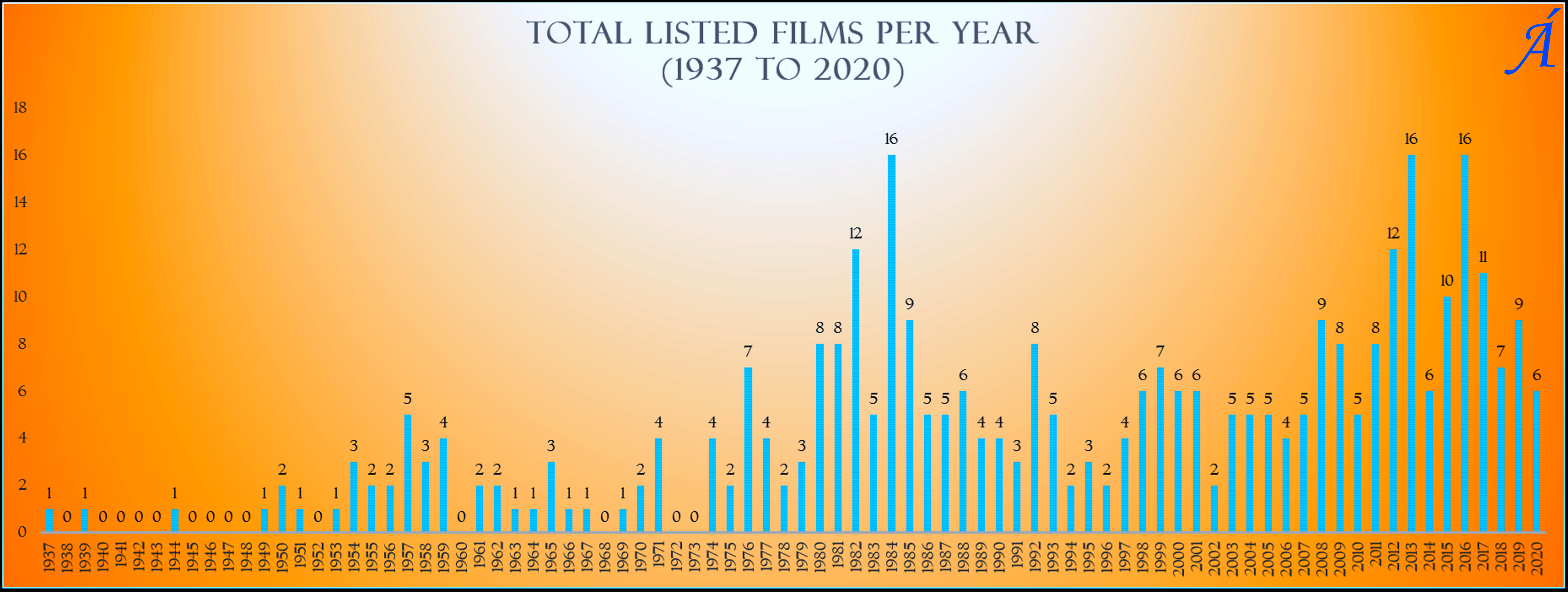
11011Regarding the trends that show up in the graph, we can see a partial confirmation of the claim of the founding members of the Manunuri ng Pelikulang Pilipino or Filipino Film Critics Circle (hereafter FFCC) that 1976, the year of the group’s first awards ceremony, was the best of any such period in Philippine cinema. Their self-serving nature, however, is shown up in the output of the succeeding years: more outstanding films came out during the crisis years comprising the first half of the 1980s, culminating in the people-power protests that followed the assassination of Senator Benigno S. Aquino Jr. and leading to the ouster of the Marcos Sr. dictatorship.
11011What makes the record remarkable is that anyone who lived through this era would not remember any critical celebration of the achievements of the country’s film artists. I’d ascribe this appalling negligence to the orthodox-Marxist orientation of film responders, spelled out in a much-reprinted FFCC member’s screed that true artistic progressivity will always be preempted in an antiprogressive system, and therefore the urgent task lies in changing the system itself first. For better or worse, critical thinking had outgrown this constricting reliance on economic determinism as a tool for critical analysis, but the terms of its arrival in the country still had to occur a few years later, accompanied by violent debates instigated by covertly antipopular sectors.
11011The next rising trend, while not as towering as the first one, occurred during the current millennium, peaking up to the cutoff year of this study. A vulgar materialist would probably readily attribute this to the technological shift from celluloid to digital, although the more impressive results from the preceding period answer the obvious question of why there haven’t there been more canonizable works when production costs have significantly diminished since then. The answer may of course be overdetermined by technological shifts in production and strategic adjustments in distribution, paralleled globally by the rise in digitalization and internet patronage. But an unforeseen factor lies in the essential lie that fuels award-giving film activities, that only one winner in permanently prearranged categories can be selected every year, a nonsensical logic that our practitioners have wisely ignored, for the most part.
11011The decision that emboldened me to pursue this project was not really an exceptional one, if we look at antecedents of cinema: most academically defensible literary canon presentations will find the specification of a decimally round number (meaning one that ends in five but preferably in zero) arbitrary and possibly indefensible. Yet all the film-canon lists I rounded up, including a few of those I was associated with in the Philippines, either observed round-number limits or, in one case, insisted on a lowest-possible total. In this case, serendipitously enough, that final number (350 titles) turned out to be semiround.
11011Hence to my mind, Canon Decampment can stake the claim to creating the first loose canon (awful pun intended) in film listings, anywhere in global film literature that I know. My self-avowed goal was to keep accumulating as many titles as I could defensibly classify as worthy of inclusion, regardless of all possible standard limitations of origin, genre, language, period, budget, format, and so on. The only technical limits I observed were that the entries should be available full-length feature films, using standard global filmfest specs of a one-hour minimum running time.
11011I needed also to set limits of as liberal a definition as possible of formal and ideological progressivity, since I had to draft capsule reviews for each entry, or occasionally pairs and, in rare instances, a series of entries. No further explications will be necessary beyond this point, since the entries ought to be able to speak for themselves, except to mention that product availability dictated when I could finish.
11011The best of Philippine cinema once beckoned, and now I can finally take leave.
Note
[1] See “On Poetics and Practice of Film Criticism in the Philippines–A Roundtable Discussion,” Plaridel: Journal of Communication, Media, and Society, vol. 13, no. 1, June 2016, pp. 148–150, doi:10.52518/2016.13.1-09cmps.
Back to top
Return to Canon Decampment contents
Go to alphabetized filmmakers list
Á!











 ORCID ID

