
Desktop mode is strongly recommended.
Click here to go to the Canon Decampment landing page.
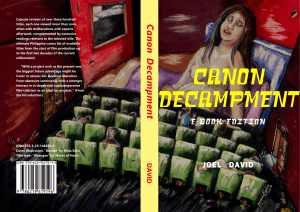
No one has asked why the book is titled “Canon Decampment,” although when a college-age reader noted that the artillery weapon was misspelled, I knew at least that close reading still matters to some local students. Because close reading was more or less the whole point of that monstrous volume. Canon Decampment is a 400-plus-page book available only as a free PDF download (or blog-post series, for those who prefer millennial-style consumption). A few netizens asked “why no hard copies?” and I remarked how this unresolvable quandary pesters us at this stage in the open-access movement, where folks with money to burn demand printed volumes while those unable to afford latter-era codices hope to come across scanned copies posted by intrepid contemporary hacktivists.
11011What people in Pinas seem to find hard to believe is why anyone would write anything and earn nothing from it. But this reflects on scholars who possibly flourish in the practice but plug into the exigencies of commercial publishers and the excessive price-gouging of academic presses. The basic premise of the publish-or-perish model almost always requires expenses for research and writing, although foreign universities’ employment, with their vastly reduced teaching loads and regular replenishment of research funding, renders the process nearly invisible in its casualness. The publication itself, formerly in journal outlets that charged for supposed memberships in academic publications, has become increasingly, to use internet-era terminology, open-access, so much so that journals that still demand payments for publications are obliged to prove that they don’t belong on a list of predatory publishers.
11011There’s a long history of so-called hacktivists, or anticopyright activists, some of whom paid for their support for the open-access movement with their lives, and a few who have to move constantly from one sympathetic country to another as (usually American) intellectual-property lawyers keep hounding them. But how do academics thrive in this system? If it works out the way it should, remuneration arrives in the form of promotions and easier access to grants, along with the receptiveness of more specialized funding agencies. Needless to add, one would have a better chance at pulling off this feat outside a Pinas system, with a few culture-specific caveats. In my case, the Korean educational system’s obsession with global university rankings necessitated that professors focus on writing for journals, the higher-ranked (meaning Web of Science-listed) the better.
11011Which is why I retired with a number of books which were anthologies I edited and with only a short personally drafted volume plus a wish-list of book-writing projects that I could not pursue, ironically when I had the time and funding to pursue them. Meanwhile another volume I’d drafted and received some promotion points for was supposed to get published before I retired; when the deadline for acquiring university clearance approached in late 2023, I had no choice except to post it (which was fortunately recognized as a legitimate book format by the university). I called it the title it still possesses, to distinguish it from the other supposed-to-be-printed book – which eventually came out recently. I then confronted the fact that the initial digital edition of Canon Decampment was too loaded with questionable qualities, starting with the publisher’s insistence that the number of selected canonical film titles be kept as close as possible to the usual round number of 100.
Back to top
Return to Canon Decampment contents
Go to alphabetized filmmakers list
11011I also realized that my recommendation of maintaining an inhouse screening committee could only be effective up to a point. No amount of rescreening a film that’s marked as, for example, too “third-cinema” (a legitimate category originally formulated by Latin American film specialists) will convince a group whose members don’t see any risk in being associated with the project. So a convergence of factors suggested a possibly doable though definitely difficult solution: collect my lump-sum retirement benefits to live on as the equivalent of a book-writing grant; maintain the high-powered film acquaintances I already had, some of whom I’d corralled into productive chat groups, and regard them as consultants if they didn’t mind intensive exchanges, or as specialists if they could be available for occasional references; invest in an initial outlay of a mini-iPad (so I don’t blame existing films if their quality is less-than-ideal), video-processing software, note-taking devices, and the best laptop and repair service money can buy, which turned out to be the LG made-in-Korea brand. I had to live in a place that minimized the expensiveness of Seoul and dispensed with the distractions of Manila, which meant that the campus-adjacent apartment I rented in Incheon City would be ideal for this purpose.
11011The only source of daily expenses would be the places where I could write – customer-friendly coffee shops or all-night non-drinking joints, both of which became available also around this time. I found it difficult to write during the day because I got used to spending that period for consultations and teaching prep, and to draft anything at home because I maintained the smallest livable space I could find and associated any of my residences with resting (a graduate-school habit you should try to avoid if ever those possibilities present themselves). I also recognized I needed to indulge in some self-pampering, so I don’t get to downgrade any film sample only to realize later that I happened to be annoyed by some incidental issue or other. As I also mentioned, I couldn’t set any upper limit to the films I’d be listing as part of the canon, although the final number, 350, turned out to be unexpectedly semi-round. This became increasingly complicated when I realized that several non-Filipino productions can be more recognizably “Noypi” than our own cinema, so my team of consultants came in with the rationale: our country was always “global” from the start, so if any successful self-respecting national cinema (like the US’s) counts any foreign product as one of its own without blinking, then so should ours.
11011I still carried over the original writing project’s specifications of requiring that the films be available, that they should be “feature” in nature even if they resembled documentaries, and that they should observe the standard international film-festival definition of full-length, which is at least 60 minutes running time. Readers of Canon Decampment and even of my previous output will be surprised to learn that the most fundamental lessons in critical practice that I picked up came from the organization whose members I never hesitate to bash for their accumulation of bad habits: the Manunuri ng Pelikulang Pilipino (Filipino Film Critics Circle), which I joined right after I completed my first undergraduate degree as its youngest recruit. That time, we always made sure to cover all the films that got released, rewatched those that deserved to be considered by the entire group, rewatched again if we had doubts about which title should get some prize or other, and subjected our impressions to intensive discussions, with consultations with the artists involved if that could help us arrive at better judgments; some of us even went over scholarly readings, although I was as busy with day jobs as everyone else to wonder why the others didn’t seem all that concerned with theory and history.
Back to top
Return to Canon Decampment contents
Go to alphabetized filmmakers list
11011The gravest misgiving I had with the MPP process was the annual event on which its fame rested – their so-called Urian awards for excellence in several singular categories of film achievement. It didn’t make sense to declare only one winner each time every year, even when the community of artists influenced and competed with one another in order to come up with clusters of noteworthy titles. As a concrete if unsatisfactory (because quantitative) example drawn from the book, certain years could yield as many as sixteen titles during the past and current millennia. Even more awful was the observation I made of aspirants who were hopeful of winning, and who had to be good sports in congratulating someone else who did, and remaining on friendly terms with the members of the group. When some friends and I organized alternate critics’ organizations, we quickly realized that not only did one-time one-choice winners make no sense, so did the existence of fixed categories from one year to the next (and still selecting one winner every time, determined by people who had zero technical expertise). After I returned from graduate school in the early 2000s and refused a now-resentful member’s entreaty to rejoin the group, I noticed that the Urian jurors favored films that ran upward of five hours, sometimes as much as eleven. I already realized that the group would reward works that garnered raves from European film festivals, the higher-ranked the better, and that in my rewatching of films from the period, these did not necessarily stand tall against other titles from the same year.
11011These long-form works (to zero in on a specific preference) generated raves from cineastes just because the Urian declared their noteworthiness. I had my own list of favorite lengthy foreign films, up to sixteen hours in one case, that I’d rewatch at the drop of a hat and encourage friends to watch with me, so I asked each local long-form fan I would meet to accompany me to my first viewing of any of these Philippine titles. Out of several dozens of enthusiasts, zero responded. This meant that the old critics’ practice of rescreening titles that they felt deserved to be considered for awards honors never rubbed off on their followers – a few younger critics even proudly declare they never feel any need to rewatch anything they felt was worthy of discursive attention and openly denounce mass audiences, in the same spirit that national-university critics from an earlier generation, when “intentional fallacy” and “death of the author” buzzwords were in vogue, felt that it demeaned their stature to consult with artists behind any work: the difference being that today’s cultural rightists are more “honest” whereas the earlier left-conservatives had to be more discreet, their prejudices being revealed in their declarations, including their awards announcements. Canon Decampment is intended to demonstrate the advantages of jettisoning these unproductive approaches, as well as revealing the idiocies that beset parochial mindsets – including foreign ones – desperately grasping for explanations while rejecting the obvious anthropological sources, many of which remain within reach.
11011What about the film titles themselves? Serendipitously, the Canon Decampment project coincided with the realization on the part of video copyright owners that with only a few exceptions, the practice of hoarding titles whose window for profitability had expired would only result in a sad collection of non-performing assets with difficult-to-track piracy attempts and a resentful public. The last global pandemic intensified this dynamic, with studios that initiated the uploading of their products generating a lot more appreciative remarks even compared with film owners who claimed to possess a lot more quality products. So several of the more popular titles in the book may turn out to be available on streaming websites starting with YouTube, with a few others available on internet sources that charge minimal subscription fees. Only the most recent, as well as a short list of foreign-owned titles, can be accessed with some difficulty or expense, although friends in the know might be able to share the collections they happen to own. (The surest recourse would be to contact people in production via their social-network accounts; knowledgeable critic-collectors like Jojo Devera, a member of my circle of project consultants, will also be supportive of scholarly-research endeavors.)
11011With the completion of the book, I could be honest about admitting that conducting a historical overview of local cinema was worth the trouble and expense, but that canon formation was an activity I’d outgrown decades ago, as soon as I got out of the organized-critics racket, and had to reattempt only to show future generations how it should be done and raise the challenge for them to do better. As for the award-givers, whose most senior living member once organized a Stalinist-style roundtable that I couldn’t attend, and blasted me for failing to respect his gang when they, not I, were handing out “prestigious” and “unpurchasable” awards … they’re lucky the book’s strictly in digital format, so even if I tell them where they can stick it the only discomfort they’ll feel will be in principle, not in practice (yet).
Back to top
Return to Canon Decampment contents
Go to alphabetized filmmakers list
Á!












 ORCID ID

