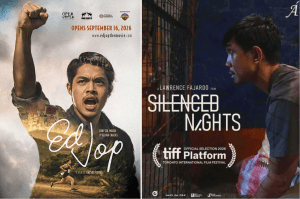
 Edjop
Edjop
Directed by Katski Flores
Written by Jade Castro & Katski Flores
Silenced Nights
Directed by Lawrence Fajardo
Written by Troy Espiritu
[Click here (recommended) for desktop mode.]
Reality has always had a conflicted relationship with art and literature; narrative forms provide a way of promising better representation, but rare is the item that succeeds on every possible level. In two concurrent Philippine film releases, we have tantalizing cases of works based on subjects with whom sufficiently informed netizens might be familiar. Katski Flores’s Edjop, in current general release in Metro Manila theaters, opened to highly appreciative reactions that were later tempered by reservations, mostly regarding its depiction of representatives of orthodox-left forces; Edgar Jopson, its central character, was renowned among progressive sectors for taking a critical stance vis-à-vis his entrepreneurial father’s logical ideal, the authoritarian Ferdinand Marcos Sr.’s presidency. Although he initially distanced himself from extremist student organizations, a series of encounters ranging from Marcos’s classist insult (“You’re only a son of a grocer” became a standard pop-culture retort until it was superseded by “You’re nothing but a second-rate trying-hard copycat”) to his experience in labor organizing, led to his radicalization.
11011His insistence on operating in dangerous territory led to his untimely death, just as the movement he had joined was starting to upheave, culminating in the violence-ridden split between reaffirmists (of Jose Ma. Sison’s leadership) and rejectionists. The conflict manifested in the film’s source material, as Benjamin Pimentel’s 1989 book Edjop: The Unusual Journey of Edgar Jopson was revised by the author and published in 2006 as U.G.: An Underground Tale.[1] The film by Katski Flores takes a further step from Jopson’s story by framing it within his daughter Joyette’s coming to terms with his Jesuit-inspired “man for others” record, necessarily keeping distance from family and friends for their safety’s sake.
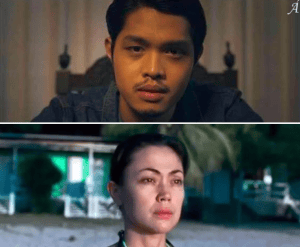
Elijah Canlas as Edgar Jopson and Jodi Sta. Maria as his daughter Joyette.
Back to top
11011The film demands an acceptance of an updated variation of leftist idealism in reversing the nation-as-family formulation, where Joyette arrives at the realization that her father’s preoccupation with the national-democratic project was his way of upholding the family he could not always be with physically. The accusation of ideologically motivated villainizing was apparently initiated on the social network by an anonymous legacy custodian of Luis Jalandoni, who was chair of the National Democratic Front of the Philippines and Jopson’s ally in labor organizing. A more extensive elaboration should proceed from these critiques, although the immediate and unfortunate observation that should be emphasized here is that the film would not have been less effective if a less harsh depiction of the left’s hard-liners were utilized; as it stands, the centrist position renders Edjop’s rationalization of familial negligence vulnerable to the ideal requisites of feminist identity politics.
11011A concurrent release, though not yet in Philippine theaters, would be Lawrence Fajardo’s Silenced Nights, the country’s first competition entry in the Toronto International Film Festival. Like Edjop, it narrates the tale of a victim of fascist repression, in this case situated in the more recent presidency of Rodrigo Duterte. Unlike Edjop, however, SN is based on a figure who would have remained a nobody if he had not been the most ironically celebrated victim of Digong’s disastrous war on drugs: Kian delos Santos, a 17-year-old student who was waylaid, during the “killingest” night of Duterte’s presidency, by rogue police officers out to make a quick killing by literally performing a quick killing, so they could collect the cash rewards handed by the government to anyone who slays alleged drug dealers.
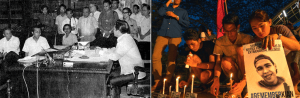
Historical sources: Ferdinand Marcos Sr.’s meeting with Edgar Jopson et al. (left); protesters denounce the killing of Kean delos Santos (right).
Back to top
11011In line with earlier biopic treatments that Philippine audiences would be familiar with, SN fictionalizes the account of delos Santos’s killing, even using a different name for the barely present character, and allowing the audience to comprehend as much as could be gleaned from the responses of his mother, as well as an accidental witness and an investigative journalist; their slum community, paradoxically named Happyland, features breathtaking vantage points that culminate in the funeral processions of extrajudicial killing victims. The trauma of commonplace EJKs, exacerbated by the depraved cheers of so-called diehard Duterte supporters (DDS), makes any form of contextual exposition redundant; the self-incriminating voice of the President alone would have been more than adequate in recalling for contemporary viewers the source of social anxieties that somehow still manage to plague us.
11011Thankfully, SN completes its screening several minutes sooner than Edjop does. Its director is also demonstrating peak ability in suspense filmmaking, with the streaming triumph of The Strangers (2012), overlooked by critics but not by Pinas-cinema afficionados on YouTube, affirming that SN actually draws its most effective skills set from horror production. In contrast with Edjop, it refuses to provide any sense of hope for anyone caught up in the web of fascist-induced terror, and turns the DDS curse on itself: one can wind up inspired and exhilarated by the very act of experiencing a filmed entertainment that amounts to virtually irrefutable condemnation of the grossest human-rights failure of any Philippine presidency since the regime of the man who once vilified Edgar Jopson to his face.
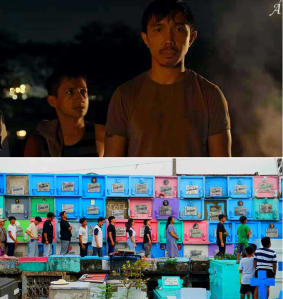
Nico Antonio & Dylan Ray Talon as EJK witness and supportive pal respectively; several EJK victims are simultaneously buried the same day.
Back to top
Note
Published September 30, 2026, in The FilAm as “2 Tales of Fascist Repression.” Edjop was produced by Open Water Productions, The Mad Goats, & Narra Post-Production Studios, while Silenced Nights was produced by Quantum Films & House on Fire.
[1] An early first-person account where the author endured and survived a New People’s Army kangaroo-court trial was Robert Francis B. Garcia’s To Suffer Thy Comrades (2017). An ambitious, sprawling, conflict-ridden but deeply moving narrative underpins the text edited by Susan Quimpo and Nathan Gilbert Quimpo, titled Subversive Lives: A Family Memoir of the Marcos Years (2012), featuring material provided by their siblings and other family members. The most recent salvo is Deeper Ground, Darker Shadows: The Making of a Mindanao Rebel (2026) by Eddie L. Quitoriano, a recollection of an insider’s extensive local and global odyssey in seeking assistance for the insurgent movement that, like the aforementioned narratives, resulted in the author’s distress and eventual disillusionment. The cumulative effect of such concerned critical literature suggests that any apologist for Jose Ma. Sison’s leadership will be compelled to explicate why its position has managed to maintain the radical edge it once claimed to possess.
Back to top











 ORCID ID


Biopic Blowbacks
Directed by Katski Flores
Written by Jade Castro & Katski Flores
Silenced Nights
Directed by Lawrence Fajardo
Written by Troy Espiritu
[Click here (recommended) for desktop mode.]
Reality has always had a conflicted relationship with art and literature; narrative forms provide a way of promising better representation, but rare is the item that succeeds on every possible level. In two concurrent Philippine film releases, we have tantalizing cases of works based on subjects with whom sufficiently informed netizens might be familiar. Katski Flores’s Edjop, in current general release in Metro Manila theaters, opened to highly appreciative reactions that were later tempered by reservations, mostly regarding its depiction of representatives of orthodox-left forces; Edgar Jopson, its central character, was renowned among progressive sectors for taking a critical stance vis-à-vis his entrepreneurial father’s logical ideal, the authoritarian Ferdinand Marcos Sr.’s presidency. Although he initially distanced himself from extremist student organizations, a series of encounters ranging from Marcos’s classist insult (“You’re only a son of a grocer” became a standard pop-culture retort until it was superseded by “You’re nothing but a second-rate trying-hard copycat”) to his experience in labor organizing, led to his radicalization.
11011His insistence on operating in dangerous territory led to his untimely death, just as the movement he had joined was starting to upheave, culminating in the violence-ridden split between reaffirmists (of Jose Ma. Sison’s leadership) and rejectionists. The conflict manifested in the film’s source material, as Benjamin Pimentel’s 1989 book Edjop: The Unusual Journey of Edgar Jopson was revised by the author and published in 2006 as U.G.: An Underground Tale.[1] The film by Katski Flores takes a further step from Jopson’s story by framing it within his daughter Joyette’s coming to terms with his Jesuit-inspired “man for others” record, necessarily keeping distance from family and friends for their safety’s sake.
Elijah Canlas as Edgar Jopson and Jodi Sta. Maria as his daughter Joyette.
Back to top
11011The film demands an acceptance of an updated variation of leftist idealism in reversing the nation-as-family formulation, where Joyette arrives at the realization that her father’s preoccupation with the national-democratic project was his way of upholding the family he could not always be with physically. The accusation of ideologically motivated villainizing was apparently initiated on the social network by an anonymous legacy custodian of Luis Jalandoni, who was chair of the National Democratic Front of the Philippines and Jopson’s ally in labor organizing. A more extensive elaboration should proceed from these critiques, although the immediate and unfortunate observation that should be emphasized here is that the film would not have been less effective if a less harsh depiction of the left’s hard-liners were utilized; as it stands, the centrist position renders Edjop’s rationalization of familial negligence vulnerable to the ideal requisites of feminist identity politics.
11011A concurrent release, though not yet in Philippine theaters, would be Lawrence Fajardo’s Silenced Nights, the country’s first competition entry in the Toronto International Film Festival. Like Edjop, it narrates the tale of a victim of fascist repression, in this case situated in the more recent presidency of Rodrigo Duterte. Unlike Edjop, however, SN is based on a figure who would have remained a nobody if he had not been the most ironically celebrated victim of Digong’s disastrous war on drugs: Kian delos Santos, a 17-year-old student who was waylaid, during the “killingest” night of Duterte’s presidency, by rogue police officers out to make a quick killing by literally performing a quick killing, so they could collect the cash rewards handed by the government to anyone who slays alleged drug dealers.
Historical sources: Ferdinand Marcos Sr.’s meeting with Edgar Jopson et al. (left); protesters denounce the killing of Kean delos Santos (right).
Back to top
11011In line with earlier biopic treatments that Philippine audiences would be familiar with, SN fictionalizes the account of delos Santos’s killing, even using a different name for the barely present character, and allowing the audience to comprehend as much as could be gleaned from the responses of his mother, as well as an accidental witness and an investigative journalist; their slum community, paradoxically named Happyland, features breathtaking vantage points that culminate in the funeral processions of extrajudicial killing victims. The trauma of commonplace EJKs, exacerbated by the depraved cheers of so-called diehard Duterte supporters (DDS), makes any form of contextual exposition redundant; the self-incriminating voice of the President alone would have been more than adequate in recalling for contemporary viewers the source of social anxieties that somehow still manage to plague us.
11011Thankfully, SN completes its screening several minutes sooner than Edjop does. Its director is also demonstrating peak ability in suspense filmmaking, with the streaming triumph of The Strangers (2012), overlooked by critics but not by Pinas-cinema afficionados on YouTube, affirming that SN actually draws its most effective skills set from horror production. In contrast with Edjop, it refuses to provide any sense of hope for anyone caught up in the web of fascist-induced terror, and turns the DDS curse on itself: one can wind up inspired and exhilarated by the very act of experiencing a filmed entertainment that amounts to virtually irrefutable condemnation of the grossest human-rights failure of any Philippine presidency since the regime of the man who once vilified Edgar Jopson to his face.
Nico Antonio & Dylan Ray Talon as EJK witness and supportive pal respectively; several EJK victims are simultaneously buried the same day.
Back to top
Note
Published September 30, 2026, in The FilAm as “2 Tales of Fascist Repression.” Edjop was produced by Open Water Productions, The Mad Goats, & Narra Post-Production Studios, while Silenced Nights was produced by Quantum Films & House on Fire.
[1] An early first-person account where the author endured and survived a New People’s Army kangaroo-court trial was Robert Francis B. Garcia’s To Suffer Thy Comrades (2017). An ambitious, sprawling, conflict-ridden but deeply moving narrative underpins the text edited by Susan Quimpo and Nathan Gilbert Quimpo, titled Subversive Lives: A Family Memoir of the Marcos Years (2012), featuring material provided by their siblings and other family members. The most recent salvo is Deeper Ground, Darker Shadows: The Making of a Mindanao Rebel (2026) by Eddie L. Quitoriano, a recollection of an insider’s extensive local and global odyssey in seeking assistance for the insurgent movement that, like the aforementioned narratives, resulted in the author’s distress and eventual disillusionment. The cumulative effect of such concerned critical literature suggests that any apologist for Jose Ma. Sison’s leadership will be compelled to explicate why its position has managed to maintain the radical edge it once claimed to possess.
Back to top
Share this:
About Joel David