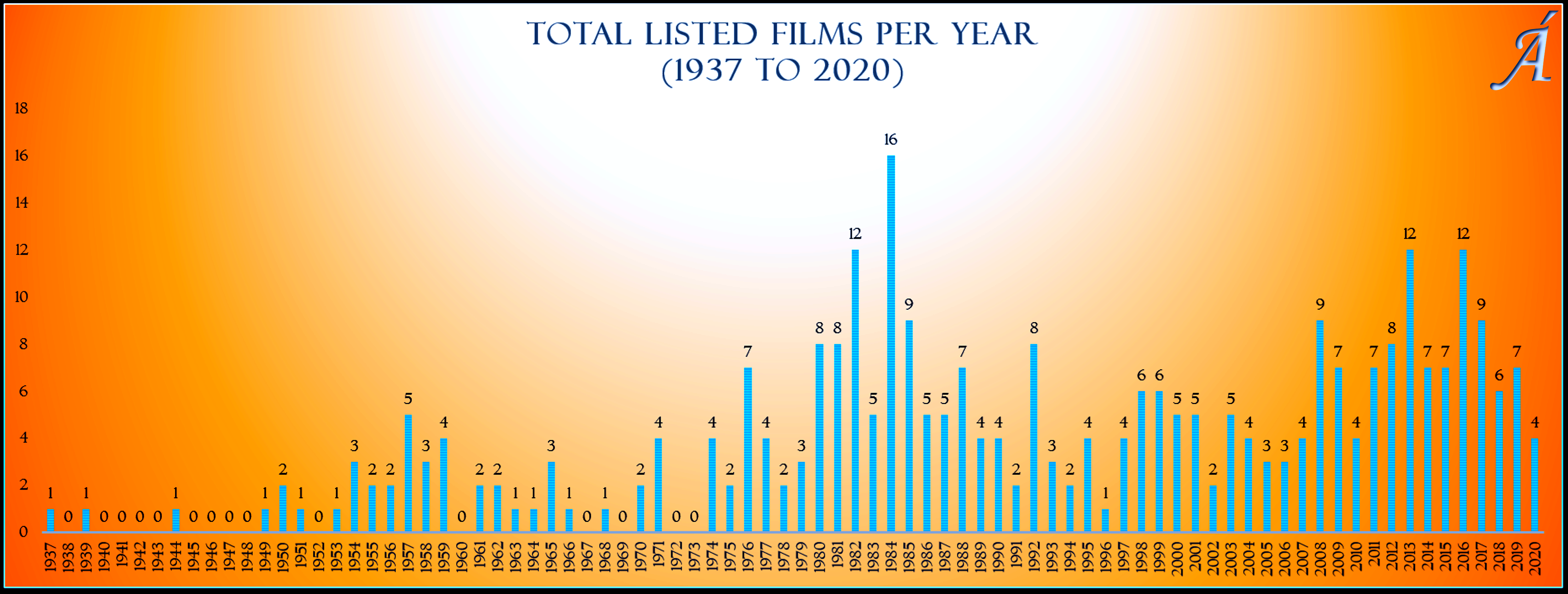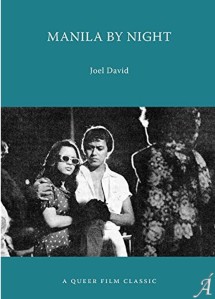
Canon Decampment

Original Digital Edition (2023)
Cover design by Paolo Miguel G. Tiausas
“Bomba” © 2019 by Mina Saha
[Click on pic to enlarge]

ACKNOWLEDGMENTS

The manuscript began as a project with Summit Media. The process is elaborated in the introductory article, “Canon Fire!” and revaluated in the closing article, “Forward March.” I wish to extend thanks to the editor of the now-defunct YES Magazine, Jo-Ann Q. Maglipon, as well as her inhouse staff, for undertaking a film-viewing and deliberation process that was both extensive and intensive. The book title indicates my readiness to let go of canon exercises after this point. I will still be celebrating outstanding work as it comes along, but the practice of determining whether it belongs on an all-time-best list will just have to be taken up by other interested parties—of which I’m sure history will never run out of eager and willing participants. With all this book’s flaws and limitations, I nevertheless hope that any succeeding canonizer (a word that will always embarrass me for all my past associations with it) will take note of the time- and labor-intensive process that went into this current exercise, and either attempt to measure up to it or outdo it, or else admit failure.

11011The volume also happens to coincide with my retirement as tenured professor, in a place where I happen to be the equivalent of a sui-generis canonical entry. It is not a condition that I gloat about, because to me it reflects an entire national culture’s (specifically the Philippines’s) failure in training its regular faculty to become competent scholar-researchers. Nevertheless I’d opt to acknowledge, if I may, all the students I ever taught, in three countries or two continents over close to four (discontinuous) decades, regardless of how they decided to perceive me afterward; I’m at the stage where my stature, not to mention my ego, stands distant and resilient against whatever sticks and stones anyone might feel justified in aiming at me. (Regarding an alarming recent uptick in cheating, though generally not among my students in Korea—that would be one of a few headaches I’ll be relieved to pass on to future generations of teachers.) Always treasurable are the several names who look me up, sometimes years or decades later, just to see how I’ve done since they took my classes. I only hope that I’d managed to seem higher-evolved than I did in the past, although of course several things (starting with the concern for teaching and careful preparation in mentoring) deserve to remain the same. But if I were to pick out just one name to represent the best of the rest, it would be Corina Bedonia Millado, over whom I’ve been exultant for the past few decades and who’ll deserve more accolades than I could bestow.

11011Canon Decampment is an e-book uploaded in fulfillment of final publication obligations at Inha University. The author acknowledges assistance provided by the Inha University Faculty Research Grant as well as by Summit Media. “Canon Fire!” was drafted in 2015 and posted 2022 at Amauteurish, while “Forward March” was published in 2017 as “Muzzled Bombardments: The Philippine Film Canon and Its Discontents” at Plaridel: A Philippine Journal of Communication, Media, and Society. Films that were not included in the original list are, in chronological order: Gregorio Fernandez’s Higit sa Lahat (1955) and Luksang Tagumpay (1956); Gerardo de Leon’s Women in Cages (1971); Jun Raquiza’s Krimen: Kayo ang Humatol (1974); Ishmael Bernal’s Lumapit … Lumayo ang Umaga (1975); Celso Ad Castillo’s Daluyong at Habagat (1976), Paradise Inn (1985), and Ang Daigdig Ay Isang Butil na Luha (1986); Lino Brocka’s Stardoom (1971), Bona (1980), and Cain at Abel (1982); Mario O’Hara’s Condemned (1984) and Pangarap ng Puso (2000); Maryo J. de los Reyes’s Anak ni Waray vs. Anak ni Biday (1984); Marilou Diaz-Abaya’s May Nagmamahal sa Iyo (1996); Arnel Mardoquio’s Ang Paglalakbay ng mga Bituin sa Gabing Madilim (2012); Peque Gallaga and Lore Reyes’s Sonata (2013); Paolo Villaluna’s Pauwi Na (2016); Khavn’s Ang Napakaigsing Buhay ng Alipato (2016); Irene Villamor’s Meet Me in St. Gallen (2018) and On Vodka, Beers, and Regrets (2020); and Joselito Altarejos’s Jino to Mari (2019).

11011All these titles, except for the two earliest, were films that I urged for inclusion but were rejected, sometimes even after a few rescreenings, or that were unavailable at the time. In the case of the Gregorio Fernandez films, I’d initially counted them as overrated because of the major industry prizes that they won, but realized later that they were indispensable to the director’s pursuit of transformation of standard material via a careful working over of its constitutive elements. As film critic Bienvenido Lumbera once remarked, regarding the accumulation of citations for annual film evaluations: in an endeavor where the possibility of error can never be eradicated, it will always be best to err on the side of liberality.

A note on translation: Non-English entry titles are provided with both direct translation and their official version, when these diverge from each other. Any subsequent mention of the title in the same section will therefore be untranslated, while other non-English film titles will be similarly translated only when they are first mentioned. Whenever possible, I have tried to coordinate translations and credits with whatever appears in the far-from-perfect Internet Movie Database, with existing copies serving as final authority; in the case of GDL’s Women in Cages, I managed to identify several performers who were unlisted in the film credits, and included them in the canonical entry.

National Library of the Philippines CIP Data

David, Joel.
11011Canon Decampment / Joel David. — Original Digital Edition. — Quezon City : Amauteurish Publishing, [2023], © 2023.
11011146+x pages ; 15×23 cm

11011ISBN 978-621-96191-8-9 (pdf)

110111. Motion pictures — Criticism and interpretation — Philippines. 2. Motion pictures — Philippines. 3. Film criticism. I. Title.

791.4375111111011PN1995.67.P51111110112023111111011P320230298

US Copyright Office Certificate of Registration:
TXu 2-402-907
Canon Fire!and mini-reviews
separately registered as TXu 2-054-744

Back to top

Contents
© 2025 by Amauteurish Publishing &
College of Social Sciences, Inha University
All Rights Reserved

Part 1. Canon Fire!

Part 2. Canon Munitions: From the Beginning to 2020
Note: This list is ordered chronologically according to premiere or initial release date, each of these 128 entries followed by the inclusive years of the directors’ selected films as well as by the total number of selected titles. Credits and synopses were prepared by the author and/or staff members of YES Magazine. For an alphabetical arrangement of directors, including each entry’s film(s) and year(s) of release, click here. Not all commentaries and synopses are complete as of this time. The links in this section will best be read in desktop mode.

Eduardo de Castro (1937: 1 title)
Carlos Vander Tolosa (1939: 1 title)
Gerardo de Leon & Abe Yutaka (1944: 1 title)
Gerardo de Leon (1951-71: 8 titles)
Susana C. de Guzman (1949: 1 title)
Gregorio Fernandez (1950-58: 6 titles)
Manuel Conde (1950: 1 title)
Mar S. Torres (1954: 1 title)
Lamberto V. Avellana (1956-70: 4 titles)
Tony Cayado (1957: 1 title)
Armando Garces (1957: 1 title)
Ramon A. Estella (1957-65: 4 titles)
Teodorico C. Santos (1957: 1 title)
Conrado Conde (1958: 1 title)
Manuel Silos (1959: 1 title)
Pablo Santiago (1961-82: 3 titles)

George Montgomery (1962: 1 title)
Irving Lerner (1963: 1 title)
Cesar Gallardo (1964: 1 title)
Efren Reyes (1965: 1 title)
Eddie Romero (1966-77: 4 titles)
Leroy Salvador (1968-85: 2 titles)
Lino Brocka (1970-90: 14 titles)
Celso Ad. Castillo (1971-86: 6 titles)
Ishmael Bernal (1971-85: 15 titles)
Jun Raquiza (1974: 1 title)
Joey Gosiengfiao (1974-80: 2 titles)
Mike De Leon (1976-99: 7 titles)
Mario O’Hara (1976-2003: 6 titles)
Kidlat Tahimik (1977: 1 title)
Bobby A. Suarez (1978-88: 2 titles)
Laurice Guillen (1980-93: 6 titles)

Marilou Diaz-Abaya (1980-97: 6 titles)
Fernando Poe Jr. (1980-2000: 6 titles)
Fernando Poe Jr. & Willy Milan (1995: 1 title)
Fernando Poe Jr. & Augusto Salvador (1997: 1 title)
Mel Chionglo (1981-2016: 10 titles)
Romy V. Suzara (1981: 1 title)
Peque Gallaga (1982-85: 3 titles)
Peque Gallaga & Lore Reyes (1988-2013: 3 titles)
Maryo J. de los Reyes (1982-2003: 7 titles)
Danny L. Zialcita (1982-83: 2 titles)
Gil Portes (1983-84: 3 titles)
Emmanuel H. Borlaza (1984-87: 3 titles)
Tata Esteban (1984: 1 title)
Chito S. Roño (1984-2018: 9 titles)
Elwood Perez (1985-2013: 4 titles)
Tikoy Aguiluz (1985-2000: 3 titles)

William Pascual (1986: 1 title)
Abbo Q. dela Cruz (1987: 1 title)
Eddie Garcia (1987: 1 title)
Artemio Marquez (1987-88: 2 titles)
Pepe Marcos (1988: 1 title)
Nora Aunor (1989: 1 title)
Carlos Siguion-Reyna (1991-98: 4 titles)
Toto Natividad (1992-2017: 7 titles)
J. Erastheo Navoa (1992: 1 title)
Junn P. Cabreira (1993: 1 title)
Augusto Salvador (1993: 1 title)
Alan Chui Chung-San & Yuen Bun (1995: 1 title)
Francis Posadas (1997-99: 2 titles)
Joey del Rosario (1998: 1 title)
Jeffrey Jeturian (1999-2006: 6 titles)
Ike Jarlego Jr. (1999: 1 title)

Jon Red (1999: 1 title)
Olivia M. Lamasan (2000-04: 2 titles)
Joyce Bernal (2001-09: 3 titles)
Jose Javier Reyes (2001-03: 2 titles)
Joel Lamangan (2001-13: 3 titles)
Lav Diaz (2002-13: 3 titles)
Rory B. Quintos (2002: 1 title)
Wenn V. Deramas (2003: 1 title)
Mark Meily (2003: 1 title)
Khavn (2005-17: 5 titles)
Auraeus Solito (2005: 1 title)
Emmanuel Dela Cruz (2005: 1 title)
Brillante Mendoza (2007-16: 5 titles)
Cathy Garcia-Sampana (2007: 1 title)
Adolfo Alix Jr. (2007-17: 5 titles)
Joselito Altarejos (2008-9: 3 titles)

Ellen Ongkeko-Marfil (2008-16: 2 titles)
Francis Xavier Pasion (2008: 1 title)
Tara Illenberger (2008-17: 2 titles)
Richard V. Somes (2008: 1 title)
Soxy Topacio (2009: 1 title)
Raya Martin (2009: 1 title)
Vic Acedillo Jr. (2009: 1 title)
Monti Parungao (2009-11: 2 titles)
Armando Lao (2009: 1 title)
Chris Martinez (2010: 1 title)
John Sayles (2010: 1 title)
Sheron R. Dayoc (2010: 1 title)
Remton Siega Zuasola (2010: 1 title)
Lawrence Fajardo (2011-15: 4 titles)
Marlon N. Rivera (2011: 1 title)
Jade Castro (2011-19: 2 titles)

Brandon Relucio & Ivan Zaldarriaga (2011: 1 title)
Dominic Zapata (2012: 1 title)
Marie Jamora (2012: 1 title)
Arnel Mardoquio (2012: 1 title)
Erik Matti (2013: 1 title)
Hannah Espia (2013: 1 title)
Sigrid Andrea Bernardo (2013-19: 3 titles)
Keith Deligero (2013-18: 3 titles)
Mae Cruz-Alviar (2014: 1 title)
Giancarlo Abrahan (2014-19: 2 titles)
Perci M. Intalan (2014: 1 title)
Antoinette Jadaone (2014: 1 title)
Zig Madamba Dulay (2015: 1 title)
Ralston Jover (2015-19: 5 titles)
King Palisoc (2015: 1 title)
Jerrold Tarog (2015: 1 title)

Matthew Abaya (2016: 1 title)
Paolo Villaluna (2016: 1 title)
Louie Ignacio (2016: 1 title)
Bagane Fiola (2016: 1 title)
Jun Robles Lana (2016: 1 title)
Mikhail Red (2016-17: 2 titles)
Arnel Barbarona (2017: 1 title)
Treb Monteras II (2017: 1 title)
Irene Villamor (2018-20: 3 titles)
Jason Paul Laxamana (2018: 1 title)
Roman Perez Jr. (2018: 1 title)
Dan Villegas (2018: 1 title)
Veronica Velasco (2019: 1 title)
Kim Bong-han (2020: 1 title)
Dodo Dayao (2020: 1 title)
Dolly Dulu (2020: 1 title)

Part 3. Forward March

Appendix. An Empirical Exercise

Back to top


Corrosive Criticism

Last month’s just-concluded Cinemalaya Philippine Independent Film Festival, the first after a full year of the presidency of Ferdinand Marcos Jr., yielded a few controversies, the latest of which was centered on the pullout of a politically themed film from the opening ceremony – allegedly because it was censored (per political sectors), or possibly because seven hours was too long to wait out a ceremonial entry (per festival organizers). This would not be surprising, considering that the pre-ousted Marcos family was known to be the most culturally obsessed among Philippine presidential administrations; although truth be told, at the peak of the Marcos Sr. presidency, any politically (and even sexually) daring movie would have been shown at the government’s Manila Film Center venue without anyone bothering to bat a false eyelash.

11011Prior to the current uproar, a commotion over a social-network film reviewer boiled over and took much longer to simmer down. In fact the said reviewer had already been writing for over a year, but the only filmmakers who objected were the ones working for a streaming outlet specializing in sex-themed material. (Personal disclosure: I acceded to several friends’ request to criticize the reviewer and uploaded an article to my blog, my first this year, for that purpose; see “Anonymity & Its Discontents.”) This for me remains the key to the trouble that the festival had with this specific evaluator. The participants – artists, readers, even the reviewer himself – operated from not just an outmoded but also a long-unworkable set of assumptions. No wonder no resolution could be worked out.

11011The premise I’m referring to is the one on which the entire concept of Cinemalaya rests: that of identifying and subsidizing a vanguard of “best” emerging film artists. The necessarily politicized process this generates can be tracked to a well-intended system of adequate training – way back when no such option was available in the country; so even from the start, only aspirants who were sufficiently privileged because of class and/or nationality could actually achieve the necessary qualifications. Meaning it was never sufficient to just be talented and motivated; some form of social entitlement (wealth, foreign training, industry contacts) would more often than not prove more effective. To better articulate the criteria and identify those who best exemplified the worthiness of outstanding aspirants, elite institutions – government and education, conveniently overlapping in the national university – volunteered to make their presence palpable.

Back to top

11011What this led to was a clutch of spectacles by which film commentary would be nearly exclusively identified: annual exercises, in the form of festivals, that showcase entries preselected by supposedly discriminating evaluators, plus sets of prizes either for this closed system or for the entire industry, nearly all of which enact a dramatic process that can still occasionally prove captivating and suspenseful. Said process begins when a group of “deserving” talents would be announced, from which a circle of self-proclaimed authorities would eventually declare (during “normal” conditions) one winner. One can see how entrenched this mentality is when several sets of academe-based groups continue to follow this annual ritual despite supposedly being more alert to its deleterious effects, starting with fostering divisiveness in the community of artists.

11011Hence the fascinating particulars of the Cinemalaya brouhaha, where the aforementioned Facebook reviewer provided rankings for the competition entries, culminating in an alternate set of awards. The complaints predictably came from filmmakers whose works were given low grades, with attendant unflattering commentary. What made this response dubious on its face is immediately evident: would they have voiced any objection if they were given higher evaluations? Earlier outed as singular and biologically male, the reviewer himself posted his rationale – that since film screenings are costly, he’s providing a service to the general public by assessing for them which entries he believes are worth watching and which ones should be shunned.[1]

11011A more sensible set of comments focused on the reviewer’s six-plus scoring system (from zero to five stars), which he had earlier expanded to include negative numbers. At some point, he wound up with a negative-infinity score for a movie he regarded as the worst, then realized that another movie was even worse and awarded it with a square root of negative-infinity score. This attempt to display mathematical competence is innumerate to anyone with a casual familiarity with basic principles in the field.[2] The actual issues, which everyone missed out on, is also what the entire existing system of film evaluation fails to do. First, determining film worth according to quantifiable standards of art, or relevance, or morality, no longer really matters as much as figuring out the issues that generated the work and how its audience responded to it. Hence the reviewer’s attempt at further refining his criteria (the equivalent of the award-givers’ categories) is a step forward … in the wrong direction.

Back to top

11011Second, which was the topic I’d posted about earlier, by presuming to write about practitioners who have no option except to announce their identities, the reviewer will have no ethical justification for insisting on his anonymity. Is the country under a system of colonization or fascism, when underground literature historically became indispensable? Or are the film practitioners capable of criminally endangering those who criticize them? These are only rhetorical questions, of course. The non-rhetorical one is: why is the community of publicists protecting this reviewer’s identity, and why are the complaining artists not seeing anything anomalous about this? The scary answer is – because they all agree that film evaluation can only be expressed one way, by ranking one another, and the more difficult scientific and cultural work doesn’t have to get done. The ultimate winner here is none other than our reviewer-ranker, the one who (in a better world) deserves to be positioned at the bottom of the heap, representing the award-giving critics who can laze around and write unthinkingly and assert their power over industry practitioners when the season for holding their trophies aloft arrives once more.

Notes

First published August 31, 2023, as “Film Critico Incognito” in The FilAm. The specified social-network critic took down all the posts referenced in this article. I am maintaining the current piece as a cautionary example, since in this type of instance, a vacancy left by anyone who attained virality can be easily replaced by some other interested party.

[1] This ranking system was first propagated by a member of the Filipino Film Critics Circle in the 1970s-80s, so it makes sense that other members of this group will be tolerant, if not supportive, of this reviewer. Anyone sufficiently familiar with this system will readily see how cultural products of all types are notoriously irreducible to preordained criteria. The most artistically innovative ones, in fact, demand that their evaluators observe a new set of standards, while the most popularly successful ones demand an entirely different set of approaches premised on historical conditions.

11011In fact, the Cinemalaya outcry echoed an earlier quarrel, this time between the reviewer and Marcos-family hagiographer Darryl Yap. With an army of fanatical followers of his Vincentiments page, Yap was able to lodge enough complaints against the reviewer to get the latter’s page suspended on Facebook. He also posted a photograph of the reviewer’s masked face but desisted from identifying him by name (presumably easily accomplishable by referring to the guest list of any screening attended by the person he wanted to denounce). The reviewer, meanwhile, frantically uploaded material supportive of Bongbong Marcos’s then-already defeated adversary, Leni Robredo.

11011Other close observers have similarly pointed out how the reviewer exhibits biases favoring certain queer or Chinoy filmmakers; whatever the implications of these preferences, the reviewer’s insistence on shielding himself from further inspection places him in an unearned special category, elevated in his own mind and possibly those of other publicists, critics, artists, and his own set of social-network fanatics, all of whom seem to accept his anonymous stature as a right only he had earned one way or another. More disturbingly, in terms of pandering to their respective admirers, Yap conducts himself with relatively more dignity and confidence, despite having to contend with more persistent trolls.

Back to top

[2]
The reviewer’s technical troubles begin with his ranking scheme: since he initially awarded anywhere from zero to five stars, he would write a specific score out of five (from 0/5 through 5/5). In overstepping these arithmetical specifications by providing negative points, his goal was obviously to demonstrate greater distance from the lowest possible value, which is 0/5 or zero. Negative-infinity, however, can be conceptually proved to be no different from infinity (which is why it is extremely rarely invoked in real-world applications, e.g. astronomy or nuclear physics), while the square root of a negative number would be an impossible value. But if we assume that a square root of a number can be taken before turning it negative, then because of the negative placement, the supposedly smaller value is actually larger: say our limit of infinity is 9 (and therefore -9 is negative-infinity); its square root is 3, which then makes -3 actually closer to zero and therefore higher than -9. So the intended lower value (square root of negative infinity) is demonstrably higher than the value that purportedly diminishes it (negative infinity).

11011More deplorable than this abstractional weakness is the reviewer’s moral failure in posting insulting or abusive comments against the films he regards as unworthy of his high scores. Not surprisingly, his followers find this behavior delightful, thus further inciting their pseudo-expert’s immature conduct. Yet again, the educational training of a school population encouraged (even by purportedly progressive educators) to regard pop-culture artifacts as deserving of dismissive treatment results in such lumpenbourgeois spectacles. Lost in this cheap grasping for maximum virality is the reality that any industrial undertaking in a developing country will always be under threat of collapse, with any number of breadwinners facing the possibility of resorting to more desperate forms of fund-raising as a result. In short, regardless of the ranking that any critic assigns to any completed film, the recuperation of its investment will mean, first and foremost, that its workers can continue to hope in the prospect of a follow-up project. From this perspective, any critic who aims to impede this drive for productivity deserves to be regarded as no better than an antiproletarian henchperson.

Back to top


A Future for Pinas Film Criticism

A Foreword to Post-Dilawan Cinema and the Pandemic (Revised Edition)

Difficult truths have always been the unspecified challenge for Philippine critics. The complications have concrete manifestations in film, with its industrial nature, institutional interests, and global networks. This is why the arrival of any new practitioner has to be regarded with caution, especially since the emergence of social media has democratized the activity. What ought to have been a welcome development turned into a debilitating stricture owing to the romantic-humanist siren call of the Western film-as-art movement, compounded by the avant-gardist presumptions of local educators of all kinds of ideological orientations.

11011Epoy Deyto would have had the warning marks of the type of young critic that I quickly learned to be wary of. He could be abrasive (as I used to be, and still occasionally am), bent on sampling as much product as he could absorb, and alert to fine distinctions in theory. What became a source of wonder for me was how he managed to have the orientation that took me decades to finesse: a valuation of the mass audience that proceeded from an identification with them, in recognition of the progressive critic’s call to measure the success of works that bear the descriptor “Filipino” with how effectively they correspond with their intended viewers’ demands and desires, in effect reconfiguring media literacy to a kind “that arms the population to make use of technology to their own advantage.”

11011For this reason, Deyto’s the only Philippine-based film critic I could approach with the combination that I applied to the best film-studies material I have read: confidence that the author is carefully working out a progressive critical project as he goes along, and trepidation that I or some people I hope to uphold might find ourselves in his crosshairs. Then again, critical thinking is a constant process of reflexive development. In writing out a single-volume critique of Manila by Night, I realized that the monographic format is what might be missing in Pinoy film criticism. Not surprisingly, Deyto arrived at the same conclusion on his own and, while I fumbled with a monograph-length layperson’s manual on film criticism, he published the first edition of Post-Dilawan Cinema and the Pandemic (henceforth PDCP) and made it an open-access text.

Back to top

11011One might realize, from past observation of Deyto’s Missing Codec blog, that the contents of PDCP originally appeared on it as stand-alone uploads. I might be accused of defensive motives in defending what is essentially a compilation title, since the two-volume book I published in 2019, with a deliberately overelaborated title that starts with Millennial Traversals, similarly constituted material that I had first posted on my Amauteurish! blog. Yet properly trained graduate students will be (or ought to be) familiar with the process of selecting courses related to their final research project, writing papers that could ideally serve as drafts of chapters, and gathering, organizing, and reframing each one in order to submit a cohesive and defensible thesis or dissertation.

11011Obviously Deyto’s instincts are sharp enough to have figured out the higher potentials of blogging, even without local grad-school advisers informing him of this academic survival strategy. He’d engaged in zine publication, an activity that, more than blogging, is directly linkable to Shonenbat Collective, his publishing proprietorship. He is bilingually capable as well, and has been regularly producing films throughout the preceding decade. In a fuller sense than most millennials can claim, language – the imperative to connect with readers and audiences – is both his vocation and advocation.

11011The radical, borderline-anarchic reworking of Philippine cinema that Deyto presents in PDCP proceeds from a disappointment with the self-identified progressive sector’s notion of the “independence” in local cinema that they champion: “ironic for a nation that has a very long history of struggle for independence … [this notion] comes from a very loose sense of freedom that does not struggle – a freedom that acts with impunity and never faces adversaries” and that sees “‘mainstream’ as its discursive enemy, that later became negotiated with it so that even the very figures of cinematic independence … failed to dodge the interpellation of the state apparatus.”

Back to top

11011Toward this discursive purpose, Deyto trains his observational and analytic skills on the Philippine industry’s political economy, roping in the occasional auteur or film-text that helps to further exemplify the points he raises. Always, he remains anchored by and with the sector for whom he writes – thus recognizing, contrary to conventional wisdom, the usefulness of sex-themed output as a means of challenging censorship. This perspective enables him to regard the shift from liberal-democratic to authoritarian leaderships as “just a change of face and guards but still elitism.” The critique he formulates between the former (dilawan) camp’s hugot or emo-obsessiveness and the latter (post-dilawan) camp’s tokhang or punitive attitudinizing uncovers more disturbing similarities than we have been led by either camp to presuppose.

11011His investigation leads him down pathways too dark and scary for most of us to traverse without anyone leading the way. In contrast, my own practice mainly consisted of pointing out the futility and irrelevance of the critical activities of my colleagues and their followers, yet I could not resist demonstrating how to do these activities properly to begin with. I may have been hoping that by correctly performing (to cite examples) award-giving or canon formation or higher education, they could be induced to move on to more productive stages afterward. In the first edition of PDCP, Deyto skipped these admittedly quotidian concerns and presumed a circle of readers ready for long-overdue change.

11011He takes no prisoners even through the present edition. Be ready to duck as you read, but make sure to go through everything at the pace you require. Deyto has been singularly enduring the material consequences of fearlessly and favorlessly assessing where his peers and predecessors are going wrong – and he’s just getting started. If I expire in the next moment, my anxiety about the future of the field to which I devoted a lifetime will no longer be part of my final-shutdown drama.

Back to top

Á!


Crinkled Lives

Erotica Manila: Foursome
Directed by Lawrence Fajardo
Written by Lawrence Fajardo, Jimmy Flores, & Miguel Legaspi

Pinas fanboy film culture must have worn itself out, or else we’d be hearing lamentations about how our filmmakers have started regressing. After several contemporary talents made their names with increasingly longer modernist works, we now find their successors focused on shorter-length material, sometimes even geared toward televised or streaming platforms. But thank goodness for the dissipation of high-art pretension, or we wouldn’t be able to recognize how some of our best and brightest have been able to respond to the challenge of encapsulating entire narrative worlds within delimited timespans.

11011The possibility was first raised when Erik Matti announced that his sequel to On the Job (2013), titled On the Job 2: The Missing 8 (2021), would be adapted into a six-part miniseries for HBO, with the original film comprising the first two episodes. Then last year, the best entries to the first ShoutOut short film competition were compiled into a two-hour anthology, slated for exhibition at this year’s Cinemalaya Philippine Independent Film Festival. (Essential disclosure: I was chair of the board of jurors that evaluated the films and provided prizes and citations for outstanding titles and participants.) Titled ShoutOut Pinas 2022, the omnibus work is reminiscent of the 2020 anthology Septet: The Story of Hong Kong, where seven filmmakers provided historical dramas covering specific decades in the former British crown colony’s history. [Update: A recent discovery uncovered a now-lost local title, Wanted: Johnny L (1966), which had, like ShoutOut Pinas 2022, five directors participating: Cesar Amigo, Gerardo de Leon, Eddie Romero, Cirio H. Santiago, and Teodorico Santos.]

Film buff (Alex Medina) and pickup girl (Azi Acosta) exchange notes during a screening of Celso Ad. Castillo’s erotic classic Isla. [Erotica Manila “Cinema Parausan” screen cap]

11011One might be able to conjure up the riskiest possible combination for this type of project: a playfully sex-themed series which features minimal interactions among the main characters (since each entry was conceived as an independent featurette), made for the local streaming service condemned by moralistically impelled commentators in social media.[1] Nothing in the content and format of Erotica Manila, a four-episode program still screening at Vivamax, indicates any attempt at formulating any grand or problem-solving social statement. Yet when the filmmaker, Lawrence Fajardo, suggested to film-critic acquaintances to watch the series sans intervening credits – as yet another regular-length movie, in effect – an accomplished entertainment made itself evident, with the promise of further insights affirmed by subsequent viewing.

11011The film that resulted from the concatenated episodes, titled Erotica Manila: Foursome and announced as Vivamax’s intended entry to international filmfest competitions, dispenses the expected turns commonly regarded as weaknesses in standard narrative construction: well before the close of an hour, the focus shifts to the next episode’s primary character, who always happens to be a passerby at the close of the preceding story. Fajardo being Vivamax’s fair-haired inhouse talent (after the apparent departure of the unlamented and unmissed Darryl Yap), carnal fireworks ensue, with unexpected and generally satisfying twists just as the next main character happens along. The agents that the narrative follows are male, but the film’s sexual politics turn increasingly scary, funny, and (unusual for Fajardo) queer, with women providing the plot points on which the stories pivot.

Triumphant cougar (Mercedes Cabral) gloats after bedding a young intern (Vince Rillon) on the set of her latest project. [Erotica Manila “The MILF & the OJT” screen cap]

Back to top

11011The film’s apparent rationale for these shifts – standard in series presentations but usually associated with carelessly developed “trash” material – is its immersion in media activities: from film spectatorship initially, through content management, culminating in actual production, where a predatory older actress preempts her gay directors in laying their horny young assistant. The final episode, set in an urban slum among irregularly employed denizens, might consequently appear to be unrelated to the preceding series; yet its throwback to the poverty-porn trend in Philippine independent cinema makes it the perfect closing material, and then some. The heightened degree of pathos actually masks disturbing sexual-slapstick developments, complete with (technically) a happy ending. The scene where a husband is unaware, while performing in bed, that he’s nailing more than just his wife – these and several other WTF moments actually serve to challenge viewers to LOL if they think they can.

11011It helps to be aware, in approaching EMF, that its director specializes in multicharacter narratives – the Philippines’s most successful practitioner of this fiendishly difficult format since the heyday of Ishmael Bernal. In explaining how he and his coscriptwriters (Jimmy Flores and Miguel Legaspi) conceptualized the project, he initially envisioned a singular intertwined plot. After working out the major lines of action, however, he realized that each one might be misunderstood or trivialized if it were to be juxtaposed with the others, and that the sensational incidents that attend each one would strain the narrative’s credibility if these were presented as simultaneously occuring.

Slum dweller (Felix Roco) feels a revitalized longing for his wife after passing by a sex-film setting. [Erotica Manila “Death by O” screen cap]

11011Those inclined to dismiss the resultant episodic format might want to direct their attention not just to the ancient folkloric texts adapted as an outstanding film series (dubbed the “Trilogy of Life”) by Pier Paolo Pasolini but also to a classic European play, written over a century ago and filmed during mid-20th century as La Ronde by Max Ophüls. With these as reference points, EMF features the same careful attention to plot and character as the latter, while partaking of the graphic and life-affirming bawdiness of the former. Beyond Fajardo’s implicit critique of his multistrand specialization as well as the cunningly parodic handling of standard Noypi “indie” elements, EMF restores a refreshing measure of humor long missing in local sex films since the demise of Celso Ad. Castillo (duly referenced in the opening narrative).[2] With a fairly small team of technical experts sharpened by several years of intensive experience on soft-core material, plus the large stable of attractive and enthusiastic actors that the country’s most successful production house could readily summon, Fajardo has wound up with a heretofore unclassifiable but definitely superior amusement, in many ways his (and Vivamax’s) best output so far.

Notes

First published July 20, 2023, as “Carnal Fireworks in Erotica Manila” in The FilAm. Screenshots supplied by the director.

[1] For essential capsule evaluations of each episode, see the uploads on the Movie Reviews album of the Facebook account of Jojo Devera.

[2] The comedic elements align Erotica Manila: Foursome, alongside the rare sex-themed movies directed by Ishmael Bernal and Celso Ad. Castillo, with the classics of the US’s so-called Golden Age of Porn. Treatments of sexuality in Pinas cinema tend to capitulate to the guilt-ridden prescriptions of Catholicism as well as the antiseptic preferences of high art.

Back to top


Mystique of the Past

An Update to
An Intro to Chapter 16 of Marcos’ Lovie Dovey

Although undeniably a star during her brief moment in Philippine pop history, Dovie Beams will have to be counted as an abject failure in terms of her Hollywood aspirations. She started with supporting roles in two Westerns, Wild Wheels (Ken Osborne, 1969) and Guns of a Stranger (Robert Hinkle, 1973). The genre traditionally gave prominence to male heroes, with a notable exception in Nicolas Ray’s Johnny Guitar (1954), repudiated by its director for Joan Crawford’s insistence on having more screen time than the title character; ironically JG became valued, and rightfully so, for ushering in a new stage in Western genre development, where its once-overlooked types of characters (women, outlaws, Native Americans and other people of color) could now be permitted to present their narratives from their own respective perspectives.

11011Unfortunately the Marcos affair decimated whatever potential Beams was hoping to build up. Her only Hollywood comeback consisted of a marginalized appearance in an otherwise admired comedy, John Landis’s The Kentucky Fried Movie (1977). On the other hand, she was lucky her sole starring role, in Jerry Hopper’s Maharlika (1970), was little-seen because of the scandal she caused and gutsily exacerbated via her lurid tell-all press conference in 1970. Maharlika was reportedly retitled Guerrilla Strike Force and screened in Guam, presumably to recover whatever funds it could hope to generate. Upon the ouster of the Marcoses, its original title was restored and it finally had its premiere run in the Philippines in 1987.

11011Maharlika affirms for posterity that whatever talents Beams possessed, film performing could never be counted as one of them. Like her Western projects, Maharlika’s war-film material situated her character secondary to the hero (actually a stand-in for Marcos, who was out to make a definitive demonstration that he deserved to earn all the war medals he falsely claimed to have garnered from the US government). She complained of having been dismissively treated by her leading man, TV and cult-film star Paul Burke, but we can only speculate as to his motives. Her notoriety might have preceded her, although just as likely, he could have observed how she (quite literally) tackled her scenes.

11011Every shot Beams appears in is filled with a spirited eagerness, celluloid testament to her resolve not to waste any opportunity that she had worked long and hard for, not least of which was the degradation of her function as the future dictator’s sex object, pimped by apparently influential aides whom she knew only by their aliases. Regrettably, she lacked both expert coaching as well as the experience of tempering and matching her execution from one scene to the next, not to mention building up to a carefully modulated character presentation. Her initial appearance as a country maiden confronted by marauding Japanese soldiers and sexually assaulted by them in her backyard, displays a welter of externalized responses too hyperkinetic to be plausible; these types of inadvertently laughable renditions would have sealed her fate as performing artist, had Maharlika been more widely seen.

Back to top

11011An obituary page for “Dovie Leona Osborne Boehms Beam Villagran” is maintained at Dignity Memorial; her movie surname was presumably a modification of “Boehms,” her first husband’s family name. (Greetings from people with “Marcos” and “Villagran” in their names might help dispel any doubt regarding the validity of the website post.) Her Wikipedia entry as of this moment includes a still-to-be-authenticated cause of death (lung cancer and comorbidity due to alcohol and tobacco use), and reports a recent attempt by Imelda Marcos, in a 2022 TV interview by Winnie Monsod, to deny that there ever was an affair between her late hubby and Beams – a disavowal on the same order as her family’s protestation that the Marcoses’ conjugal dictatorship was benign and untainted by record-breaking plunder.

11011A sober-sounding comment on a video upload at the Imperiya.By News Info Center, by a netizen with the initials “RD,” who claims to be a distant relative of Beams, alleges the following: that she’d abandoned her eldest child, who nevertheless subsequently managed to secure bit parts in Beams’s film projects; that she had three grandchildren and a great grandchild by the time she died; that while she spent a spell in prison for fraud, her then-husband Sergio de Villagran managed to flee the US; that a man who claimed to be her son by Marcos managed to befriend her eventually (Dovie Beams love child indeed); and that some moon rocks, officially the property of the US government, were gifted her by “Fred” and are now in her daughter’s possession. Some of these claims obviously call out for investigative reporting, but as to whether the Beams mystique will persist to that extent, all we can do is look to the future.

11011Meanwhile, the Dovie Beams entry in Caroline Hau’s A Glossary of the Marcos Era (1965-1986) in the Philippines at her Ikangablog is packed with all the available essential information you could ask for, duly cited and cross-referenced. Hie on over but make sure you’ve got some extra time to spare, in case the other entries prove irresistible – because they will.

Excursus

On August 17, 2023, James de la Rosa posted, on his “Baul ni Juan” page on Facebook, the newspaper layout (plus supplemental pics) of Gerardo de Leon’s The Gold Bikini, a 1967 release that seemed to foreshadow Maharlika: it featured, in Elizabeth Thompson, what period slang would have described as a “white-leghorn” actress; the lead actor’s code name was Agent 777 (the numerologically obsessed Marcos’s favorite number); and the lead actor’s family name was … Marcos. No serious connection can be made between this and Beams’s project, except for the (still-distant) possibility that Marcos or one of the film producers may have been inspired by it. Pending further though unlikely disclosures, we can chalk this up to one of those serendipitous coincidences that a thriving popular culture occasionally offers up.

11011Where TGB departs from Maharlika is in its high-caliber team of creatives: aside from having been directed by then-future National Artist de Leon, the screenplay was written by Cesar Amigo, and cinematography was handled by Mike Accion. It moreover featured pentjak, “an Indonesian art of self-defense … which is said to be a fight to the finish” that (according to the trainer) “originated during the days of the Dutch occupation in Indonesia when freedom fighters had to learn the art for lack of modern combat equipment” (Screen Stardom 4.7, 1967, qtd. in “Baul ni Juan”).

Back to top

Á!


Trauma at Length

Florentina Hubaldo, CTE
Directed & written by Lav Diaz

Waves of admiration greeted Lav Diaz’s venture into a self-styled version of long-form filmmaking – called “slow cinema” by most observers, a term that Diaz abhors. His first attempt, Batang West Side (West Side Kid, a.k.a. West Side Avenue, 2001), broke the four-hour maximum running time for commercial releases. His next long-form entry, Ebolusyon ng Isang Pamilyang Pilipino (Evolution of a Filipino Family, 2004), ran for about double BWS’s five-hour length, at 9 to nearly 11 hours, depending on which version is being screened. Ebolusyon bore the qualities that would mark the rest of Diaz’s long-form films: done in digital video, utilizing black-and-white cinematography, filled with long takes and long shots, completed with a small crew whose members would double as the movie’s actors, with material drawn from harrowing historical memory. To further challenge audience expectations, he announced a trilogy based on the theme of trauma.[1] Florentina Hubaldo, CTE (2012) is the trilogy’s last entry, and the shortest at six-plus hours. It stands out from Diaz’s other early work in that it was the first and, until recently, the only one to focus on a woman. The title character’s suffering – CTE refers to chronic traumatic encephalopathy, inflicted on her by her father – is so distressful and heartrending that only a mean-spirited viewer would attempt to look away and ponder the movie’s allegorical issues. Unlike its long-form predecessors, it also foregrounds the tranquil beauty of the countryside, with the majestic presence of the Bicol region’s Mayon Volcano overlooking the proceedings. The movie’s stately and formal perfection provides the anchor by which Florentina’s experience becomes bearable enough to witness; in fact, it is the mercifully few moments when she cannot be seen, when only her cries can be heard, that the movie comes closest to visceral horror. Diaz’s storytelling strength is in his handling of time and duration, and Florentina Hubaldo provides further evidence in its interweaving of seemingly distinct strands that, by the movie’s sad-yet-hopeful close, fully reward the patient viewer.

Note

From Canon Decampment (2023), from Amauteurish Publishing.

[1] The materials as well as the narratives in the trilogy are unrelated, and may therefore be viewed individually. For those curious about the other titles, these are the nine-hour Kagadanan sa Banwaan ning mga Engkanto (Death in the Land of Encantos, 2007) and the 7.5-hour Melancholia (2008).

Back to top


Pop for All Seasons

“Balot”
Directed by Marius Talampas
Written by Greggy Gregorio & Ash Vidal

Casanova cornered in “Surprise, Surprise.”

Once in a while popular culture bestows a piece that most of us can take to heart without having to burn our wallets or spend hours to track it down and watch it. The fact that film historian and curator Paolo Cherchi Usai could include “Surprise, Surprise” (dir. Frank Budgen, 1991), a British Airways commercial, in his list of all-time ten-best entries for Sight & Sound magazine’s 2002 survey, demonstrates how canon-formation rules about budget, running time, reception, and authorial talent don’t have to limit our capacity to recognize when a rare exception, originating from nothing but intelligent and intensive cultural assimilation and processing, comes along.

11011The whole point about “Surprise, Surprise,” as those of us who might have seen it on a streaming source have realized, is that despite its “universal” predicament of a two-timer caught in the act, it could be better appreciated by those who could identify more closely with the ad’s audience and their culture, if not those who were situated in the theater where the reflexive event took place. A recent advertising short, titled “Balot” and produced by the still-youthful Gigil Agency[1] for the Philippine branch of Royal Crown Cola, requires even further preparation for those unfamiliar with Philippine culture; those whose encounters span decades will, needless to add, possess greater advantages.

11011Prior to “Balot,” RC Cola was in fact better known for absurdist Japanese-style ad products, always humorous but occasionally lacking in what Noypi pop-culture experts would term hugot (roughly, emo-content). Gigil itself attained some notoriety for a pandemic-themed beauty ad that had PC viewers in fits of (sanitized) hand-wringing, forcing its sponsor to pull out the presentation. “Balot” takes its own share of risks, but these pay off in various degrees of satisfaction, primarily because the creative team opted to wholeheartedly embrace the culture that its target audience presumably shares.

11011It opens with a mother calling her family together as she spreads on the dining table the treats she was able to take home (hence the title, since balot literally means wrapping up) from a neighbor’s birthday party. As she starts taking out increasingly impressive dishes from her bag, a faint breeze blowing on her family’s faces suggests that myth-making is about to take place. When an entire pot of rice is followed by a whole roast piglet, the strains of a fondly remembered movie theme song begin playing, with a somewhat familiar voice crooning the somewhat apt stanza that begins with “Balutin mo ako ng hiwaga ng iyong pagmamahal” (Wrap me up in the wonder of your love).[2]

Back to top

Eken Afuang Matsunaga as Sharon Cuneta in “Balot.”

11011The song continues as party balloons float up from the mother’s bag, followed by the birthday celebrator, a party clown, and finally the song’s singer, Sharon Cuneta. The cultural insight this revelation interplays with is that the act of taking home excess food from a gathering was made less potentially embarrassing by people euphemistically calling it “sharon” – as in “I’ll sharon whatever remains of that later.” When Cuneta herself found out, she good-naturedly hailed and celebrated the appropriation of her name in one of her recent social media posts, in the same teasing spirit that the advert performs. When the extra-large soft drink product is finally taken out and poured, its label descriptor states “Mega Litro,” once more an acknowledgment of Cuneta’s stature as the final multimedia star in Philippine pop culture, prior to its splintering into the several niches that typify millennial-era conditions.

11011In a social-media exchange, Cuneta specialist Jerrick Josue David (not a relation) further explained why the Sharon performance in “Balot” had that touch of the uncanny about it, beyond the narrative’s own marvelous turn. “Bituing Walang Ningning” (“Star without Sparkle,” from the eponymous 1985 film) may have been Cuneta’s most successful movie theme song, but neither singer nor voice in the ad was literally Sharon herself. Like the film as a whole, the impersonation – by drag artist Eken Afuang Matsunaga, with vocals by Leah Patricio – functions as a freestanding star tribute. This proceeds from another Sharonian quality claimed nearly exclusively by the country’s biggest star, Nora Aunor: only these two have on record the presence of drag queens drawn directly from their mass adulators, whose professional careers are premised on replicating their idols’ respective personas.[3] (Sadly, Cuneta’s most famous impersonator, Ate Shawee, passed away during the pandemic.)

11011“Balot” will be capable of sustaining a few theoretical discussions for those inclined to swing in that direction. The fusion of fantastic elements with an identifiably lower-class context could be one starting point, alongside the fearless deployment of narrative elements associated with mainstream (a.k.a. “masa”) aesthetics coupled with a reflexive thrust more audacious than what “Surprise, Surprise” attempted – all packed within a shorter running time. Those who feel guilty about immersing in the manifold pleasures the ad conveys might want to track the points where their educational training made them believe that this element was unworthy of valuation. Perhaps rewatching “Balot,” now or at a later moment, might help clarify these and a few other questions.

Back to top

Notes

First published April 24, 2023, as “Sharon Torch Song Used in Absurd Soda Ad” in The FilAm. Thanks to Grace Leyco, Gigil public relations officer, for providing prompt and comprehensive information. Below is an English-subtitled version.

[1] “Gigil” is commonly listed as one of the several foreign words that describe a universally recognizable condition but possess no singular equivalent in English (e.g. see this posted BBC short video report). It denotes a physiological response – the clenching of one’s teeth and fingers in the presence of excessive adorability or, less commonly, severe annoyance. One of the word’s implications is that the expresser has to control herself or she could wind up hurting the object of cuteness, reminiscent of the hyperbolic English expression “I could just eat you up.” The closest that Western academia has come to describing “gigil” was at a 2013 conference where Yale researchers proposed the term “cute aggression” – see Carrie Arnold, “Cuteness Inspires Aggression,” Scientific American (July 2013). [Update: As of March 2025, the latest edition of the Oxford English Dictionary now includes the word “gigil,” a definitely more useful – not to mention cuter – term than “cute aggression.”]

[2] The English translation of the stanza sung in “Balot” is as follows:

Wrap me up in the wonder of your love
Let it blanket this luster that won’t last
I’d rather be a star that doesn’t sparkle
If I could win your endless devotion instead.

From “Bituing Walang Ningning”
(Willy Cruz, 1985)

[For a larger image, please click on picture.]

[3] A stardom-studies link between the far-and-away two genuine stars of the Philippines’s so-called Second Golden Age of Philippine Cinema, Sharon Cuneta and Nora Aunor, was first articulated by global film scholar Bliss Cua Lim. See “Sharon’s Noranian Turn: Stardom, Embodiment, and Language in Philippine Cinema,” Discourse: Journal for Theoretical Studies in Media and Culture 31.3 (Fall 2009): 318-58.

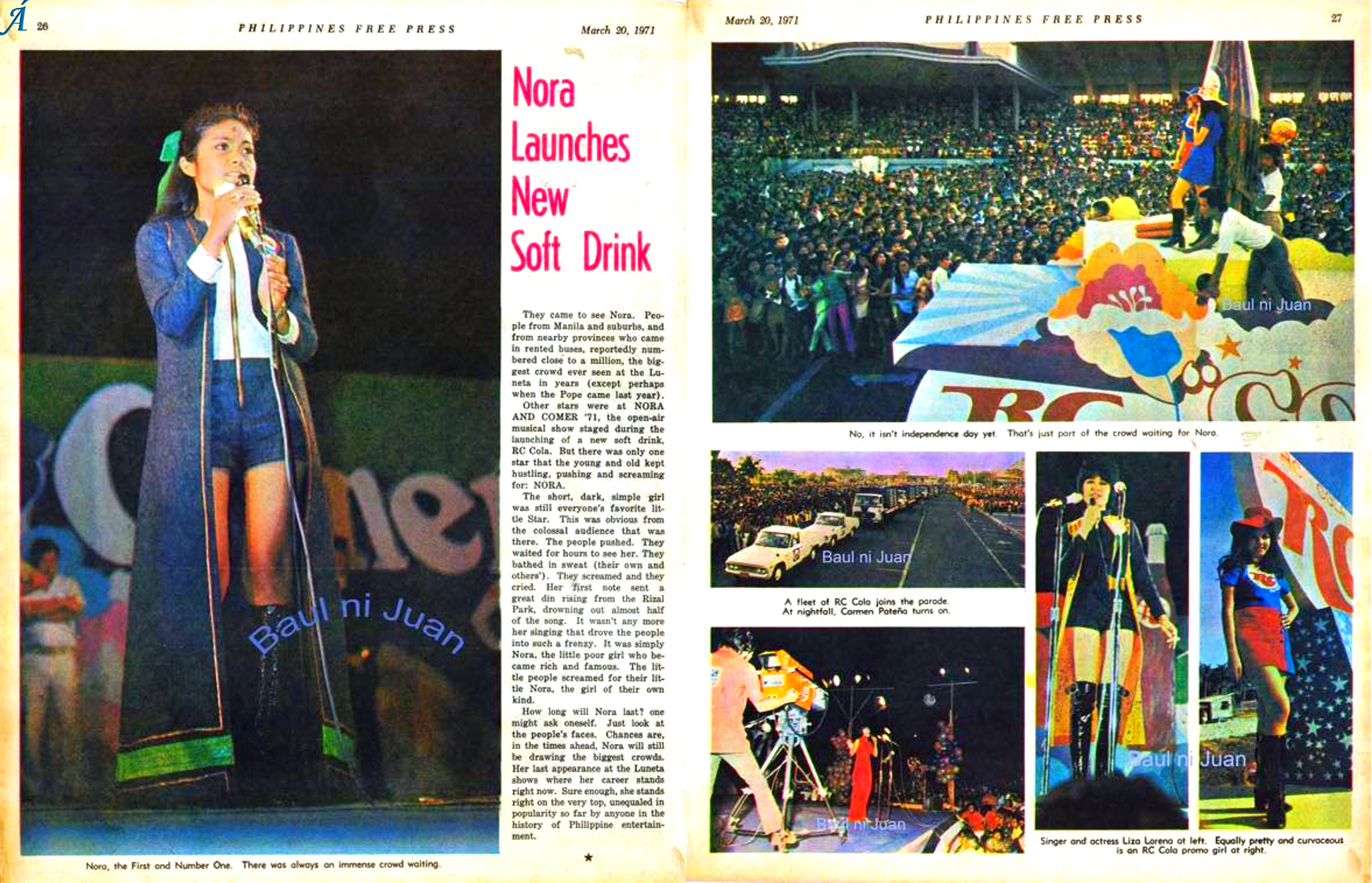
Update: The connection between Aunor and RC Cola turned out to have spanned over half a century. After Gigil Agency released its pop-culture entry for 2024, a less well-received parody of Aunor’s prestige vehicle Himala (dir. Ishmael Bernal, 1982), Mauro Feria Tumbocon Jr. posted an eyewitness account. He recollected that when the softdrink had its Philippine launch in 1971, Aunor, who was tapped to announce the product, “had to be flown in a helicopter just to be onstage on time” inasmuch as “a pandemonium of fans swarmed all parts of the national park in Manila” (Facebook, April 14, 2024). More impressively, the photographs and report that accompanied Tumbocon’s account came out in the March 20, 1971, issue of the Philippines Free Press, the country’s most prestigious periodical, where Nick Joaquin had originally published his culture-changing valuation “Golden Girl.”

Back to top


Condemned Property: Video Piracy as a Form of Nationalist Resistance

Before I proceed, I would like to state what an honor it has been for me to be invited to this event. As you can tell from my family name, Pampanga is the home province of my father’s side of the family. But because of the exigencies of surviving in the ever-expanding metropolis of Manila, which has been starting to claim portions of the neighboring province, Bulacan, for some time now, we stopped visiting our hometown of Magalang while I was still a child. This is therefore my first formal event in Pampanga since I became a professional scholar. As a consequence, the lecture I will be delivering will not be anything like the paper I submitted to the conference – which is probably also a positive thing, considering the proofreading errors I discovered when I went over it again. I would also like to plead for your indulgence in providing an alternate subtitle for my lecture, which is: “A Subjective Odyssey.” Not because I was or will be a video pirate, nor did I go or will go after one, but because the issue of video piracy has left virtually few aspects of our Third-World everyday existence untouched. The aim therefore of this lecture will be to provide the genealogy, or origin, of the paper I submitted. In effect, I will be recounting the narrative of how I came to be researching the recent and now nearly finished phenomenon of video piracy in our country.

11011When our heads of state dialog with bigwigs from our former colonizing center, the United States, regarding the matter they euphemistically term “intellectual property rights,” one would think that the situation has attained the same level of urgency as other issues such as terrorism, poverty, global warming, environmental devastation, new deadly diseases, and internet pornography. What’s subjective about this account was my personal and professional involvement in video presentation, as a teacher, researcher, and former student of film at the University of the Philippines Film Institute, which continued even after I’d left the institution. While completing my M.A. and Ph.D. in Cinema Studies during the 1990s in the US, I and my Filipino colleagues were attuned to an escalating scenario of video piracy in our home country in what was then the compact disc digital video or VCD format. Up to that point it appeared as if we overseas Pinoys would remain permanently out of sync in relation to our counterparts on the other side of the planet. Where the standard videocassette format in the US was VHS, in the Philippines it was Betamax; and where the video disc format we had was laser disc, back home it was VCD.

11011Even this early it was painfully evident that Filipinos would be doomed to the low-end technological option, which provided affordability at the expense of quality. The only consolation – a significant one, as far as we were concerned – was that people would still resort to theatrical film screenings. Before Betamax gave way to VHS and VCD to DVD, the Philippines still enjoyed double-digit annual film production. The numbers were less than half of the mid-two hundred peak realized by the local industry during the nineteen-sixties and -seventies, but even then, I was still able to argue to my dissertation adviser that the output per capita was higher than that of India, which was and continues to be the world record-holder in absolute terms.

Back to top

11011It made sense for people to still troop to movie-houses even when current releases could appear on videocassette or VCD. Audiovisual resolution in these formats was too miserable to be pleasurable; moreover, and here we’re treading on speculation, the continuing saga of political and economic upheavals visited by globalizing trends on our fragile system made it imperative for the population to continue seeking solace in social gatherings, of which film screenings, at their half-dollar admission price then, would still prove irresistible as an attraction.

11011It would be relevant to mention at this point that the world’s successful prosecution of copyright violation using file-sharing software occurred only as recently as 2005, in Hong Kong (“Man Jailed in 1st Copyright Violation Case”). Not surprisingly, the most extensive and useful book-length study of video piracy, Laikwan Pang’s Cultural Control and Globalization in Asia, provides an extensive analysis of VCDs, which served as the format for the supposedly rampant piracy of Hollywood film products in Hong Kong. In a later volume, Creativity and Its Discontents, Pang built on the observation that in the contemporary era, a new system, called the creative economy, centered on the production of original creative material, has effectively supplanted the knowledge economy (Creativity and Its Discontents Introduction). Her approach is premised on Roland V. Bettig’s description of the digital-era dilemma of filmed entertainment: that the cost of reproducing creative content is virtually negligible compared to the cost of producing it (Bettig 93).

11011In the late ’nineties my roommates and I celebrated the First-World film distributors’ decision to adopt and promote the DVD format. At the same time, we wondered how such a relatively expensive system would fare in the Philippines. As it turned out, the DVD pricing scheme in the US was surprisingly competitive and, more important, rationalized enough to challenge early attempts at piracy. In concrete terms, if (and this is a big if, okay) I intended to pirate a new DVD release in the US for myself, the cost I would incur in renting a copy, buying a blank disc, reproducing the cover art and accompanying booklet, and setting up my system to rip and burn the contents would not be that far from the cost of simply walking into a store and buying a legitimate copy. What tips the balance in favor of doing the legally preferred option is a combination of the calculable advantages of enjoying a warranty on the product, as well as the incalculable delights of shopping.

11011Flash-forward to the turn-of-the-millennium, when the installation of a Republican President and the collapse of the Twin Towers indicated to me that I needed to get out of that place, that country, and back to my duties in the backwaters of Asia. As it turned out, the process of dissertation-writing had kept me from catching up on recent developments outside of what was happening to the family of HBO’s Tony Soprano. Upon my return to Manila, my faculty colleagues and students alerted me to the presence of a thriving market in pirated DVDs in Quiapo, Manila’s downscale commercial district, site of occasional populist demonstrations and acts of criminality both political and personal. Its best-known landmark is the sixteenth-century Catholic Church that enshrines the Black Nazarene, one of a few major Filipino icons that make a case for the Africanness of the historical Christ. The Black Nazarene inspires hysterical devotion among lower-class religious males, particularly during its annual procession in January, because of its reputedly miraculous properties, including the ability to completely cleanse one of her or his sins.

Back to top

11011Quiapo is known for other historical events, such as the long-controversial bombing of the opposition’s miting de avance at Plaza Miranda in 1971, attributed by the right-wing pre-martial law government of Ferdinand Marcos to the Communist Party of the Philippines and blamed by the Communists on the Marcos government. There are also the Quiapo-set films of the top action stars in Philippine movie history: Joseph Estrada starring in Geron Busabos: Ang Batang Quiapo, and Fernando Poe Jr. countering much later with his own Batang Quiapo. But one marvel that can still be empirically witnessed today is the fact that the pirated DVD stalls lie just outside the sphere of Catholicity, in the Muslim ghetto on the other side of Quezon Boulevard, the main vehicular and pedestrian artery.

11011For over a year I was unaware of the exact whereabouts of this paradise-within-an-inferno. And meanwhile – big melodramatic moment coming up – my father was rapidly deteriorating from a terminal illness, so I decided to get him a DVD player where I could screen for him some of the films I had brought over from the US. I decided to get him one of his favorites the way I would do it in the US – that is, legitimately. So I looked up one of the biggest mid-priced mall chains in the country, entered its video shop, and bought Crouching Tiger, Hidden Dragon for the equivalent of thirty-six US dollars. Never mind that it was selling for under fifteen dollars at Amazon.com – I figured there were multiple costs involved in importing the product – and well, what do I know, really. Besides, it made my father happy, but at that rate, I figured I’d never be able to get him the classical Hollywood titles he was asking for.

11011After he died, I finally managed to find the exact whereabouts of the flea-market style “illegitimate” DVDs peddled in Quiapo. You guessed right if you thought the first title I looked up was Crouching Tiger, Hidden Dragon. There it was, selling, just like everything else, at the flat rate of about one US dollar. And that was just the start of my long rude awakening to the reality of video distribution outside the First World. For starters, the vendors had all the popular mainstream titles offered by the so-called legitimate outlets – and more, much more, several times over in fact. Allow me to flash a description of the possible categories of products posted online by an even more enthusiastic consumer.

11011To provide ourselves with a handle into the availability of products in this mecca (pardon the pun), I and a few of my faculty colleagues listed the titles we thought would fit the collection of your garden-variety film enthusiast. Every other week or so, we would tally our findings and, unfortunately for the completists among us, eliminate those titles we felt would be available in most “average” households anyway. Thus, no recent Oscar winners, Tom Hanks- and/or Meg Ryan-starrers, martial-arts movies produced in countries that never gave rise to martial arts, humanist dramas unless spoken in a language other than English, TV shows that all carbon-based life forms would have seen anyway … you get the drift.

Back to top

11011The last time I looked up our list, we had over seven hundred “preferred” titles, still an impressive number, dwarfing the individual wish lists we had compiled using “legit” online sources.

11011These discoveries were not ours alone to claim. Several major personalities from media and academe, some of them foreign-based, could be seen scouring the stalls for possible additions to their collections. When a local television program sent out feelers for any of them to come forward, one of those who responded was Joey Reyes, the person who at that time was arguably the most prominent prestige filmmaker in the country. He said, in Tagalog, “I need them for my own growth as a director. Anyway, it’s the big foreign films that are killing the local movie industry. I’m just helping our people slay these giants by buying their films from video pirates” (Diones, n.p.).

11011Moreover, and this is where my subjectivity intersects with his, “The system of piracy can be considered a ‘great equalizer’ because everyone is equal when it comes to purchasing power – even the poor can afford to buy the copies” (Diones, n.p.). Reyes’s assertion jibes with our informal observations, done roughly on a weekly basis over the course of the past three years. What might have sounded incredible anytime during the past millennium – say, a lower-class consumer inquiring about widescreen, subtitling, and extra features – is now commonplace enough to appear as images in local pop culture. As a corollary, the vendors themselves have done their own upgrading. Some of the stalls are now housed in air-conditioned buildings, and the personnel are up to the challenge of helping buyers sort through the wide variety of products on display. Ronnie (not his real name), a physically disabled man who operates the biggest stall in one of the buildings, said that he had taken a film course [not in our university, or I would have recognized him] just to be able to familiarize himself with the more exotic or antique samples available (David, interview).

11011The vendors were more than aware of the historical and political implications of their situation. They had a system of alerts when raids have been scheduled by the police force. Because of their minority status, they were unafraid to stand their ground, meeting force with force when necessary. In fact, the revised guidelines controlling optical media in the country stipulate additional penalties for “violators who employ armed resistance against agents of the [Optical Media Board]” (Republic Act 9239, 4.19.b3), a reference to the exchange of gunfire reported three years ago between the vendors and the raiding team of the now-defunct Videogram Regulatory Board.

Back to top

11011The Philippine Muslim population suffers from the many contradictions brought about by postcolonial development, or the lack of it. The people, currently constituting less than seven percent of the seventy-two-million total population (Joshua Project), are credited by nationalist historians as consistent resisters of foreign colonizers, so much so that the English word “amuck” was taken directly from the Malay original “amok” and had its meaning of righteous resistance distorted, to refer instead to “murderous frenzy” (“Amuck” entry, n.p.). Filipino Muslims have also suffered some of the worst depredations of the Christian majority, including massacres, militarization, land-grabbing, and religion-based vigilantism (see Vitug and Gloria) – not to mention the unconscionable cultural stereotyping that invariably accompanies such dehumanizing treatment.

11011In initiating, controlling, and most important, succeeding in the selling and possibly in the local production of pirated DVDs, Filipino Muslims have forged for themselves a historical intervention unique in at least two significant ways, to wit:

  • Unable to afford the interconnectivity facilitated by the World Wide Web, they have instead opted to be familiar with what has been described by Aaron Barlow in The DVD Revolution as a similar access to information via the interactive features of the new format. This of course applies not just to Filipino Muslims, but to the impoverished majority as well.
  • Aware of the current trends toward scapegoating and guilt-by-association through the links of some members of their community with the al-Qaida network, they have responded with what is recognizably an entrepreneurial innovation, albeit with severe consequences for American corporations yet with profoundly gratifying benefits for the rest of the Filipino nation. During my term as founding Director of the University of the Philippines Film Institute, I openly enjoined faculty and students to defer from calling the practice “DVD piracy”; I proposed instead the term “anti-imperialist video-dubbing service,” to call attention to the positive effects of the exercise.

Curiously, such a liminal position used to be associated with another racialized local group, the Chinese-Filipinos. Suspected, accused, sometimes penalized, and at least at one point executed for an array of socioeconomic transgressions ranging from gun-running, drug-dealing, to pornography, the Chinese-Filipino community had also had to suffer a number of flagrant and rampant human-rights violations, their economic potential circumscribed by retail-trade limits, and attacks on their presence being undertaken even by left-identified authors as recently as the nineteen-sixties. Their politicization as a community arrived after they had achieved economic clout (Hau 15-62) – a trend which appears to be occurring in reverse in the case of Filipino Muslims. In relation to the issue under study, the last wave of active film production in the Philippines, from the late ’seventies to the ’nineties, was also dominated by Chinese-Filipino producers, to the point where the martial-law government felt compelled to set up its own production arm and covertly supported the founding of a Filipino-owned studio to promote wholesome icons, reactionary narratives, and Hollywood-style aesthetics (David, Wages of Cinema 70-71).

Back to top

11011In terms of relations with the regional body-politic, we can take a cue from Michel Foucault’s brief foray into racial politics, originally delivered as a series of lectures at the Collége de France. In looking at European history during the Middle Ages, he noted that what eventually became racist discourse was originally a discourse of race war, which had the useful function of operating as a counterhistory to the then-standard justification and reinforcement of the power of sovereigns (51-84). Here we note – and it goes without saying, with a lot of caution – that three groups within the same nation-state interact diachronically: the Filipinos, who identify with the West, which in this case embraces both Washington and the Vatican; the Chinese, who were regarded as outsiders because of their association with East Asian culture; and the Muslims, whose allegiance extends to the Middle East by way of the larger archipelago comprising Indonesia and Malaysia, the two major Islamic republics of Southeast Asia. From the last reformulation, we can see that the Philippines, from one possible perspective, is not just an unacknowledged component in the term “Indo-Malayan archipelago,” it is also the outsider to Islam, with Christianized Filipinos constituting the minority in the region.

11011Thus a basis for belligerence emerges: just as the West-identified Christianized Filipinos are really Westerners manqué, not white-skinned enough, not to mention wealthy enough, even in relation to East Asians, neither are they adherents of the predominant religion within the immediate region. The connection with Indonesia and Malaysia becomes more direct when we look up the alleged sources of pirated discs and find that it is these two countries that are pinpointed by vendors and administrative officials alike (Inquirer News Service, Arab News). Although as of about a year ago, the Optical Media Board claimed to have closed down DVD-burning equipment involved in “pirate” operations (Valera, n.p.), the insistence by everyone on identifying the Philippines’ neighboring countries as the primary source of illegal products resonates with the larger issue of global terrorism. It were as if our Islamic neighbors first furnished our links to the current millennium’s historical villains, and now this too.

11011But on a level playing field, one in which the voices of the racialized others can speak out, one difference stands out prominently enough to suggest a rupture. The nature of the Muslims’ transgression this time is economic. It lays bare the hypocrisy of American distributors in their desire to police the market so that it would have no choice but pay through the nose for their overpriced products. Such global-scale ironies generate numerous local ones, and I’d venture one fond example: the Filipino legislator who first argued that the US distributors’ best way to combat piracy is by reducing their prices was none other than the daughter of Ferdinand E. Marcos, the dictator installed and supported by a series of American Presidents and businesses until he proved too unpopular to be profitable for them (Villafania, “RP Lashed for Rampant Piracy,” n.p.).

11011One vital process in the study that I still have to fully complete is a content analysis of the so-called Special 301 Reports of the International Intellectual Property Alliance. The IIPA is a US private-sector coalition (IIPA, “Milestones of the International Intellectual Property Alliance” 5). Its formation coincided with the growing concern of copyright-based industries over the emergence of technological advancements that enable consumers to appropriate, process, and reproduce pristine content that had formerly been accessible only through direct purchases from producers and their authorized distributors. As a so-far effective strategy for pursuing its objective of stringent policing of copyright-related acts, the IIPA held entire nations responsible for copyright violations within their territories, and enforced its will through the US Trade Representative. In effect, a country’s economic performance can be affected by the presence of so-called pirates, and anti-piracy measures become part of the preconditions for unimpeded trade relations with the US.

Back to top

11011The IIPA’s Special 301 Reports are annual evaluations of the state of various countries’ degrees of violation of the IP laws of the US. They openly provide no further justification for their existence other than that the US is determined to defend the IP interests of American companies and that it is willing to leverage its trading clout as a means of enforcing its policies. What makes the reports frustrating to evaluate is that they shift in tone and emphasis, not just from one country to another but also from one year to the next for the same country. They start in 1989 comprising eight mimeographed pages and continue that way for all of the 1990s. Then suddenly, during the year of the 9-11 attacks, they become book-length. The 2001 entry is in fact the shortest, at just under 630 pages, with the report on the Philippines running for ten pages – longer than the first complete report.

11011The reports’ recommendations range across a number of unstable categories, some of which get adjusted and even readjusted in later reports. From mildest to worst, these would be: Pending, presumably meaning that the IIPA is awaiting further reports or confirmations from IP companies or associations; Monitoring, which appears to indicate that the IIPA wishes to determine for itself whatever charges are being raised against a country under suspicion; Watch List, which is what most countries fall under, wherein a country has been notified via the report that it is in violation and must endeavor to prove good behavior; Priority Watch List, which applies to countries that are in serious IP rights violations requiring more intensive attention; and finally, Priority Foreign Country, which indicates that a country lacks adequate and effective protection of IP rights or fair and equitable market access to US citizens who rely on IP rights protection. Ukraine is the only country that merited this final designation during the current millennium. Other countries such as Brazil, Paraguay, China, India, Thailand, and Taiwan were declared PFCs at some time or other during the 1990s.

11011The Philippines only reached Priority Watch List status from Watch List and back. But the Special 301 Reports would be disturbing to any student of national security and surveillance. The reports mention specific shops in various areas – along Recto Avenue, for example, or even the recently burned Shopping Center at the Diliman campus of the University of the Philippines. At some point the reports begin dropping the names of Filipino filmmakers who might be deprived of royalties, despite the fact that the so-called pirates of Quiapo avoid selling local titles. Even more awkwardly, the list of names includes artists who had long died, such as Gerardo de Leon, Ishmael Bernal, Eddie Romero, Nick Joaquin, Edith Tiempo, Antonio Molina, Jose Maceda, and Ernani Cuenco.

11011One interesting trend, however, concerns the call to violence. The Special 301 Reports focused on the Philippines tended to observe an escalating call for more raids, speedier court cases, and further legislation. True to colonialist strategy, they recommended the formation of agencies to oversee only specific problem areas and raised the specter of terrorism by echoing the late Jack Valenti’s unfounded claim that the pirates were assisting Islamic-extremist groups. Yet during the late 2000s, this type of agitational use of language suddenly died down. We may say that this reflected the triumph of the previous years’ excesses, but we can also look toward reports where shop owners began resisting raiding parties by using firearm weapons.

Back to top

11011Another development would also have occurred on the home front, from the perspective of the US. The media began criticizing the scare tactics being deployed by IP rights lawyers, mandating jail terms and million-dollar fines even for minors who downloaded files even without the intent of sharing those files with others. Events came to a head when Aaron Swartz, who helped develop RSS feed and Creative Commons and cofounded Reddit, was arrested by the Massachusetts Institute of Technology for allegedly using its guest account in order to download articles from the JSTOR digital library. When his plea bargain was rejected, he committed suicide and caused a backlash against IP rights prosecutions. That same year, 2013, Edward Snowden fled the US in order to leak information classified by the National Security Agency. As a result of these high-profile cases, attention turned to a non-American, Alexandra Elbakyan from Kazakhstan, whose website Sci-Hub [spell] performed the tremendous service to impoverished scholars of downloading articles from paywalled journals.

11011At this point, we find ourselves on the verge of an unprecedented opportunity in information science. Text and image files from most available periods of history are being uploaded online, at a rate that grows faster than anyone can track. Several new fields such as Digital Humanities are premised on what has been termed big-data analysis. The insistence on IP prosecution as well as unlimited copyright is being regarded as one of the final obstructions to this inevitable advance in our instant access to knowledge. So if we were to raise one final question, it may as well be: who exactly has been condemned?

Works Cited

“Amuck.” Word entry. Merriam-Webster Online Dictionary. http://www.m-w.com/cgi-bin/dictionary?book=Dictionary&va=amuck. Accessed Feb. 22, 2005.

Barlow, Aaron. The DVD Revolution: Movies, Culture, and Technology. Westport, Conn.: Praeger, 2004.

Bettig, Roland V. Copyrighting Culture: The Political Economy of Intellectual Property. Westview Press, 1996.

David, Joel. Interview with “Ronnie.” Quiapo, Manila. Jan. 29, 2005.

———. Wages of Cinema: Film in Philippine Perspective. Quezon City: Univ. of the Philippines Press, 1998.

De la Cruz, Julius. “Quiapo Underground.” Experiment Orange. Website publication. http://www.experiment-orange.org/archives/2005/02/08/quiapo-underground/#more-103. Accessed Feb. 21, 2005.

Diones, Allan. “‘Pirated’ Watches, Pinagkaguluhan ng mga Artista” [Actors Go Crazy Over “Pirated” Watches]. Abante Tonite. Website publication. http://www.abante-tonite.com/issue/dec03/enter_others2.htm. Accessed Feb. 22, 2005.

Foucault, Michel. “Society Must Be Defended”: Lectures at the Collége de France, 1975-1976. Eds. Mauro Bertani and Alessandro Fontana. Trans. David Macey. New York: Picador, 1997.

Hau, Caroline S. On the Subject of the Nation: Filipino Writings from the Margins, 1981 to 2004. Quezon City: Ateneo de Manila Univ. Press, 2004.

Inquirer News Service, Arab News. “Optical Media Board Head Denies Anti-Muslim Bias.” Arab News. Website publication. http://www.arabnews.com/node/255847. Accessed Feb. 20, 2005.

International Intellectual Property Alliance (IIPA). Special 301 Report on Copyright Protection and Enforcement. Annual. The Philippine sections per year are as follows: 2001, pp. 175-84; 2002, pp. 197-214; 2003, pp. 213-28; 2004, pp. 165-76; 2005, pp. 215-34; 2006, pp. 127-40; 2007, pp. 371-91; 2008, pp. 295-311; 2009, pp. 110-21; 2010, pp. 108-20; 2011, pp. 76-86; 2012, pp. 222-34; 2013, pp. 327-38; 2014, pp. 199-202. http://www.iipa.org/reports/reports-by-country?country_filter=120&q=.

———. “Milestones of the International Intellectual Property Alliance: Twenty Years of Global Copyright Reform (1984-2004).” Press release, October 2004. http://www.iipa.com/pdf/IIPA_Milestones_20_years_100704b.pdf.

Joshua Project: People Cluster Listings. Entries for “Filipino, Central” and “Filipino, Muslim.” http://www.joshuaproject.net/peopcluster.php. Accessed Feb. 22, 2005.

“Man Jailed in 1st Copyright Violation Case.” BizReport, 7 Nov. 2005, http://www.bizreport.com/print/9473. Accessed 18 April 2006.

Pang, Laikwan. Creativity and Its Discontents: China’s Creative Industries and Intellectual Property Rights Offenses. Duke UP, 2012.

———. Cultural Control and Globalization in Asia: Copyright, Piracy, and Cinema. Kindle ed., Routledge, 2006.

Republic Act 9239. “An Act Regulating Optical Media, Reorganizing for this Purpose the Videogram Regulatory Board, Providing Penalties Therefor, and for Other Purposes.” Congress of the Philippines. Passed Jan. 13, 2004 and approved Feb. 10, 2004.

US Embassy Manila Public Affairs Section. “Piracy Has Become a Serious Problem in the Philippines.” Official website. manila.usembassy.gov/wwwhpira.html. Accessed Feb. 20, 2005.

Valera, Nini. “Edu Offers $5,000 Reward for Information on Pirates.” Inq7.net. Website Publication. news.inq7.net/entertainment/index.php?index=1&story_id=15103. Accessed Feb. 20, 2005.

———. “RP Lashed for Rampant Piracy.” Metropolitan Computer Times. Website publication. http://www.mctimes.net/News-01162003-RP%20Lashed%20for%20Rampant%20Piracy.html. Accessed Feb. 20, 2005.

Vitug, Marites Dañguilan and Glenda M. Gloria. Under the Crescent Moon: Rebellion in Mindanao. Quezon City: Ateneo Center for Social Policy and Social Affairs, 2000.

Back to top


In the Beholder’s Eyes

A Foreword to Feel Beautiful

Jojo Devera and I share more than just the same pen-name initials. It was 2015, and then-President PNoy Aquino had just rejected the National Commission for Culture and the Arts’s recommendation for Nora Aunor to be one of that year’s recipients of the Order of the National Artist. The response I wrote was the most-shared post I did during the few years I spent traipsing around on social media. I organized as many of the sharers as I could gather into an online chat group, mostly in preparation for a special journal issue on media stardom that I was editing.

11011After I found that we had the same generational markers as well as some friends in common, I continued corresponding with Jojo on a regular basis. I was able to write on an auteurist project (produced, directed, written, starring, and sung by the artist we fondly called Ate Guy) even though no celluloid copies of the rough cut could be found after she abandoned the project and ordered all evidence of it destroyed. Jojo not only forwarded the only known remnant, on fast-degrading video, to me, but also secured Aunor’s permission after I concluded that the material could sustain a regular Web of Science-indexed journal article. Greatest Performance may have been exceptional, but Jojo’s support was just as remarkable. For a later project, I (and the team that solicited my assistance) managed to watch several now-rare titles from copies he provided, in order to finalize an “ultimate” list of canon-worthy Filipino films.

11011In fact, I already knew that I wasn’t the first scholar that Jojo assisted. Several other names, regarded as global authorities in areas that pertain to or focus on Philippine cinema, kept including him in their list of acknowledgments. It was therefore no surprise for Jojo and I to learn that we shared the same attitude regarding the necessity of upholding the public domain, in our function as collectors. All that this entailed was making our holdings available to everyone, if possible without even being asked to. Since my materials were primarily in printed form (alongside some knowledge gained from operating covertly during the Marcos martial-law dictatorship), I encountered less trouble. With the same brand of camp-inspired playfulness and transgressiveness, Jojo became someone I regarded as my high-profile counterpart, a lightning rod for people who mistook his attempts at selfless pastiche and appropriation for serious challenges at whatever authority they wanted to claim.

11011This would also be the same values we shared with Elwood Perez, the subject of the book he wrote. I remember speculating with some activist friends whether Elwood or his then-producer, Lily Monteverde, would wind up heavily penalized, if not worse, after Imelda Marcos made her extreme displeasure known over one of their “bold” projects, Disgrasyada (1979). Like another filmmaker, Ishmael Bernal, who had close calls with censorship officials and similarly upset the meddlesome Imelda with Manila by Night (1980), Elwood persisted and brought his craft to several peaks of achievement that still have to be matched by any of the artists who succeeded him. Unlike in Ishma’s case, however, organized film critics have been remiss in acknowledging Elwood’s record. The members of the Manunuri ng Pelikulang Pilipino could not bring themselves to recognize and honor Celso Ad. Castillo’s Burlesk Queen in 1977, but they never even acknowledged their own founding chair’s Ang Isinilang Ko Ba’y Kasalanan? and Elwood’s Masikip, Maluwang: Paraisong Parisukat; over a decade later, in 1989, they honored Ishma’s Pahiram ng Isang Umaga but not Bilangin ang Bituin sa Langit; not long afterward, it was Ang Totoong Buhay ni Pacita M.’s turn to be snubbed.

Back to top

11011Fortunately, a breakaway group of critics that I associated with provided Pacita M. with the prizes it deserved, as did most of the local award-giving bodies for that year (1991). This millennium, the installments of Elwood’s planned autobiographical trilogy on the Filipino artist’s condition (Otso in 2013 and Esoterika: Maynila in 2014) elicited gasps of wonderment from a few observers paying attention, but with nothing from self-proclaimed “credible” critical voices. But history, as one of its victims memorably uttered, will always wind up correcting anomalies and injustices in its own time (remarkably, and movingly, Gregoria de Jesus, the country’s first and fully deserving First Lady, maintained her truth despite having been grossly abused and betrayed by people who were supposed to be her comrades and protectors, and never was indemnified to the end of her life).

11011In an ideal world, everyone would be scrambling to ensconce Elwood in his rightful place as the most successful transformer of Pinas film genres, fusing edgy sociological insight with the subtle deployment of formal requisites, along with the one quality that endeared him to mass audiences as much as it encouraged know-it-alls to conclude that he had no notion of serious discourse: humor. In my defense, I need first to attend to an even more badly neglected talent from an earlier period of film practice, director-actor Gregorio Fernandez. But remember the canon project I mentioned? While I had long ago crossed the line in regarding auteurism as an ultimately futile and useless means of analysis, I agreed to participate therein in order to ensure, once and for all, that a “most definitive” list can be drawn up. The names regarded as our usual Second Golden Age suspects – Ishmael Bernal, Lino Brocka, Mike de Leon – dominate, in quantitative terms (and I might add that after the First Golden Age’s Gerardo de Leon, next in line is Yoyong Fernandez). And Elwood Perez? Up there with next-placers Marilou Diaz-Abaya and Chito Roño – also names that might surprise local old-timers as much as it took the canon-deciders aback after watching and rewatching all of the old films we could lay our eyes on in over a decade of screenings and deliberations; feisty old Fernando Poe Jr. also snuck in, by having the Panday titles he directed honored as a series.

11011So the Elwood Perez recuperation project has only just begun, and I’m endlessly flattered and humbled to herald the very first major contribution by Jojo Devera, the Elwood Perez of Pinas film archiving. One final point that should seal the deal for any remaining doubters out there regarding this present volume’s worthiness: the only Philippine critics’ group that awarded an Elwood film was spearheaded by Mauro Feria Tumbocon Jr., a discontented straggler from the older award-giving organization (as I was). Mau took the matter of introducing Philippine cinema to a global audience in ways that organized critics only believed they could but never did, by founding and running the annual film festival of the Filipino Arts & Cinema International in San Francisco, California, these past several decades. In separate years, Elwood, Jojo, and I dropped by, to be recognized for our separate specializations. For obvious and admittedly selfish reasons I’ve always maintained that FACINE’s prizes trump those of our former organized colleagues, but to my pleasant surprise, the years have been consistently affirming that claim. Elwood should of course be able to demand much more than that, but every moment that he’s denied his rightful recognition begins to reflect more and more on people who’ve assumed the audacity to impose their poorly considered decisions on the rest of us. Our starting point should of course be Elwood’s entire body of work, but for a one-stop initial explainer, just Feel Beautiful.

Back to top

Á!


Anonymity & Its Discontents

The presence of a couple (so far) of unidentifiable Pinas cinema-focused film-evaluation websites on the social network, one of which has accumulated a following in the thousands, induces a strong measure of unease and disgust in me. It didn’t require any extensive Freudian cure to figure out the cause. In what now seems like a lifetime ago, right before I embarked on foreign graduate studies, I found myself on one side of a conflict with an organized band of self-identified critics. A movie reporter suspected of being a government agent provided them with an outlet – a tabloid that only a few people bothered to read – from which they launched their attacks on everyone whom they considered guilty of supporting pop-culture capitalism.

11011Obviously the most complicit sector, the mass audience, became the structuring absence in their critiques, since their supposed Marxist position was intended to benefit the “people,” presumably including pop-product consumers. Their write-ups were, I kid you not, extremely convoluted and horrendously unreadable, with fog-index ratings that would overshoot Robert Gunning’s comprehensibility charts several times over. The reason was easy to deduce even then: call yourself a progressive, then denounce the people who produce and support samples that prove to be popular, and you’ll find yourself crawling and jumping through all the bumps, hoops, and handicaps that your own logic instantly sets up on your way to the self-valorizing endpoint where you install yourself as society’s cultural messiah. Add to this an unexamined aspiration to be an alternate and superior source of literature and you wind up with attempts at obscure metaphorical flights and unnecessary syntactic complexities, closer to doggerel than to poetry.

11011No wonder nothing from that outburst of self-righteous pretension survived to the present. The only vexation that gang provided was in masculinistically identifying their perceived “enemies of the people” (while fearlessly maintaining their invisibility of course) – specifically artists who took the extra effort of investing their social and political critiques with popular appeal,[1] and critics (like me and a few others) who made sure that their troubles were rewarded with good notices, if nothing else. A cousin of mine, who was then an experienced lawyer and later became a judge but died recently from the pandemic, said he could help me file a case for libel if I wanted to; I replied that I was already on my final extension in postponing the commencement of my Fulbright grant, so I couldn’t focus on anything else until I completed the study program.

Back to top

11011Where the contemporary socnet-based reviewers and the self-declared progressive critics of that era intersected was, as I belatedly realized, in their cowardly resort to anonymity. I would even argue that their motives were similar, even if the current anonymous reviewers would, from the looks of it, deny any left sympathies. Both types attempt to draw from an association with the heroic record of freedom fighters (initially against colonialism, subsequently against fascism) evading tyrannical systems by operating underground. Both are also, ironically and hypocritically, impelled by essentially antipopular animosities – which is why you can find the same kind of logic in the current anonymous socnet reviewers: they’ll find and grasp onto any academically validated excuse to denounce successful practitioners, although they’ve made exceptions for certain auteurs.[2] This is the reason why their claim to objectivity can be easily deconstructed, if our school-trained population only knew how to go about the process; if their actual identities were known, it would be a far simpler matter of determining how they benefit from the practitioners and producers they support.

11011Best we can do for now is turn to an analogous recent situation in politics. In the wake of an extremely divisive electoral exercise that was actually more regionalistic than ideological, certain supporters on either side of conflicting party-led campaigns started adopting aliases before issuing hard-hitting social-media posts. Their aggrieved opponents would then conduct investigations to uncover who these authors were, and initiate name-and-shame blitzes once their identities were determined. It would be easy to comprehend the tendency of an avid supporter of either side to inevitably harbor and express hatred for the opposite side, inasmuch as religious fundamentalists would be encouraged to do the same, and guess where this secular tendency springs from. The resort to the concealment of identity would likewise be understandable, but morally indefensible in the same instance, whichever side happened to be benefiting from the ruckus. As in the case of the tabloid gang I mentioned, the Philippine state no longer looms as an enforcer of proper behavior with total authority over one’s existence, where one can be legally declared a menace to morality and/or national security without the benefit of a public trial and consequently openly apprehended and punished by state agents.

11011Owing to the lessons from that highly contentious political transition about a half-decade ago, political propagandists have known better since then than to attempt romantic underground-activism drama the way that we used to practice it during the martial-law era of Marcos Sr. Hence to put it bluntly, these current anonyms infesting film commentary need to be flushed out as well, their backgrounds and affiliations held up to the light, the way that the rest of us – including the very folks I have differences with today, unlike the deservingly forgotten tabloidists of yesteryear – allow ourselves. Then again, just to uphold my constant contrarianism, how else would we be able to have examples of failed criticism that needs to cower behind masked identities, if bad critics were to think twice before making their declarations and announcing their ratings?[3] They’d be ridiculed out of existence, even if they were too clueless to realize their own mediocrity.

Back to top

11011They may have a few thousand followers now, but then there will always be privileged people too miseducated to be able to appreciate anything local, much less pop-cultural. One side fulfills a pathological need in the other, and I’d venture to bring in organized critics while we’re on a search for people who ought to know the right thing to do and have the means of doing it. While I’d expect critics’ orgs to watch out for these samples and call them out for their adverse impact on critical practice, once more I can figure out why they’d rather pretend they have better things to attend to. Because who else would be invested in protecting failed practice using organizational prerogatives? That doesn’t excuse their passivity, and when one day the history of Pinas film criticism gets drafted, their inaction regarding reviewers who function as faceless terrorizers of otherwise serious practitioners (who also offer up their names for historical judgment) will definitely be listed under the category of destructive negligence.

11011The long-term game is what these pseudonymous losers will be unable to play, unless they draw on humongous self-promotional resources. Extensive (and still-growing) is the list of critics who thought their claims to fame entitled them to compile their output for posterity, and whose volumes will be forgotten as soon as they’re no longer around to hype them up themselves. Then again, how about more anonymous film reviewers joining the fray and eventually organizing their own invisible critics organization, complete with annual awards dispensing air trophies for untitled films made by hidden talents, with a secret anthology to celebrate their historical intervention? Might as well have as much imaginative fun as possible while it lasts.

Notes

[1] While I would caution against regarding awards as infallible indicators of prestige, the processes of the Order of the National Artist have been irreproachable for the most part, outside of the meddling of Philippine politicians. As of 2022, all of the artists who were singled out for attack by these state university-based know-it-alls have become recipients of the award. Not to play the game of whether or not these names deserved the recognition, but what the title of the order bestowed was exactly what they strove for – artistry made for the nation, intended to be comprehended and valued by the nation. Which is where I put an end to this line of argument.

[2] One fascinating point made by observers is that the more popular anonymous reviewer(s) seemed to prefer selected openly queer practitioners, a commendable progressive turn in and by itself. But without foregrounding the website’s familiarity or benefit (or lack of either) with its author’s or authors’ favored practitioners, this kind of bias can be described with any number of adjectives, all of them neutral or unflattering. To my mind, the worst possible descriptor for its championing of some (but not all) Others for not-all-that-exceptional accomplishments, while denigrating these Others’ rivals as lesser artists and using a strategy associated with subversive activists, is that it’s as conservatively unqueer as it’s possible to get. Anyone remember that social mechanism called the closet?

[3] Another point that must be raised, which might help explain my seeming ambivalence. In media I remain libertarian, so just as the tabloid writers of long ago were unfairly mistaken in thinking I wanted to censor criticism that I disliked, I just as strongly would insist that awful net-era authors go about their business, so long as we know who they are, and so that any potentially sensible reader could be better informed before she continues patronizing the garbage they spew. As an enthusiastic appreciator of certain achievements in “trash” cinema, I wouldn’t mind making room for trash criticism, which has always been around anyway and which serves an admittedly selfish purpose for my occasional bouts of insecurity: how else would I know that I’m not really as terrible as my hypercritical inner self often declares, if none of these lousy practitioners ever existed?

Back to top