Book Launch Lecture: Manila by Night

The summer of 2018 marked my first visit home after three of my four book volumes (actually two of my three books) had come out. I was invited to speak at the book launch of Pro Bernal, Anti Bio, Angela Stuart Santiago’s completion of Jorge Arago’s interrupted biography of Ishmael Bernal; the occasion was titled Queer & Defiant: Ishmael Bernal, Bernardo Bernardo, & Manila by Night. I took the occasion to talk about Manila by Night, the movie as well as the monograph I contributed to Arsenal Pulp Press’s Queer Film Classics series. About a week later I was guest speaker once more, this time at the website launch of the University of Santo Tomas’s UNITAS journal, where I was requested to speak about the two volumes of Millennial Traversals. The Manila by Night lecture below was followed by a percipient set of questions by my colleague, Patrick D. Flores, but unfortunately I was unable to take time to recall them after the event. (To enlarge the pics, please click on them. To go to the Manila by Night book feature on this blog, please click here.)

QUEERNESS AS DEFIANCE IN MANILA BY NIGHT

Facebook announcements. (Courtesy of Katrina Stuart-Santiago)

Many thanks for making the effort to trek all the way to what was once known as the centerpiece of the City of Man, the [Cultural Center of the Philippines] Complex. I used to work at one of the edifices here, the now-condemned Manila Film Center, and even though public transportation then was far more efficient and inexpensive, coming all the way here is not something I can be easily persuaded to do, now that I can find all the excuses I want.

11011Katrina Stuart-Santiago was extremely patient and encouraging in making all the necessary arrangements, but my interaction with her goes all the way back, in discussing the botched National Artist Awards procedure during the second Aquino regime, and later in going over some points of the book that she worked on with her mother, Angela. My association with Patrick Flores goes even further back, nearly three decades if I’m not mistaken. We were contributors to the review section of National Midweek, and when his review of Bilangin ang Bituin sa Langit came out, friends asked me if I resorted to using a pen name again. I told them no – I wasn’t ready to write anything as accomplished as he did on the subject of local melodrama.

11011We had a conflicted and sometimes contentious relationship, but I bring out this history here so that I might be able to demonstrate to you that the lessons I learned, some of them painful, helped me evolve further as a film commenter and scholar. Some of these lessons still have to be played out more fully – and again, this is not in the spirit of TMI (or too much information) but rather in pointing out that the movie that will be screened after this talk, also suffered and continues to suffer from several hard-to-resolve problems.

11011As everyone here who lived through the middle period of Marcos martial law would remember, Manila by Night was subjected to the worst censorship case ever visited on a Philippine movie. It was banned for nearly a year, disallowed from participating as a competition entry in the Berlin International Film Festival, and released with the longest listing ever of visual cuts and aural deletions. Since all reference to Manila was prohibited, the title itself was changed, to City After Dark. Unknown to the public, the director had intended to prepare a definitive cut for the thwarted Berlin screening. He was discouraged from doing so by the festival director of the Berlinale – although after Imelda Marcos decided that the movie could not be permitted to represent the country on foreign screens, that issue was no longer even relevant from that point onward.

11011I provide a more extensive explanation of how Ishmael Bernal arrived at the particular stylistic decisions he used during the period when he made Manila by Night, roughly from 1979 to 1981. What matters in our looking back on this same period is how his approach was misconstrued as a lack, an inability to measure up to the level of competence exhibited by his contemporaries, including his friendly rival, Lino Brocka. His stylistic choices, which were drawn from Third-World cinema samples as well as his documentary training and internship, resulted in his being penalized by reviewers as well as the award-giving critics. You have the jaw-dropping anomaly of the group acknowledging Manila by Night as the best film they were privileged to recognize, but Bernal losing the prize for direction. After Brocka made a splash at the Cannes Film Festival, the next Filipino lined up for that supposedly most prestigious of all film venues was a much younger aspirant, rather than the filmmaker who was definitely Brocka’s equal, and in all possibility his superior.

Back to top

11011There is one more historical detail that recently re-emerged, as proof of the queerness of Manila by Night’s existence: Bernal made what we might call Manila by Day – a documentary, rather than a feature film, that upheld rather than critiqued the city, commissioned by Madame Iron Butterfly Imelda Marcos, rather than Mother China, Lily Monteverde. A few netizens expressed disappointment with what Bernal did, since it contrasted with the decision by Lino Brocka and Mike de Leon to boycott anything associated with the Marcos martial-law regime. But this overlooks several matters, from Bernal’s sense of duty in securing the good standing of his producers, to the later news of his active participation in the left underground during and after the people-power uprising of 1986.

11011So the generally positive development of intensive film study and training in the Philippines, an option unavailable during Bernal’s time, also holds a disadvantage for older critics and historians of film. What we have among us is a generation of film participants and observers not only schooled in film, but also adhering to film-school values without the need to start from a wider historical, cultural, and philosophical analysis of their place in the world – a set of values that an earlier generation like Bernal’s and Bernardo Bernardo’s had no choice except to pursue. Instead of measuring friends by their choices of favorite films or music or books as social-network folks do today, they would start by articulating their social or political positions vis-à-vis urgent local or global issues, and proceed to infer which contemporary or classical philosophers, if any, informed their new acquaintances’ opinions.

11011Bernal and Bernardo – but if you’ll permit me I’d prefer to call them Ishma and BB respectively, to distinguish between them more easily – were exponents of a queer sensibility way before the word “queer” was recuperated in lesbian and gay activism via the AIDS Coalition to Unleash Power’s even more radical breakaway group, Queer Nation. Formed in 1990, the group was credited with reversing the derogatory connotation of the word in mainstream media. The term “queer” is intended for oppositional activism, wherein a practitioner can be anyone who or anything that challenges whatever happens to be the acceptable or decent set of values of the moment. As an example, when I mentioned to BB the word and how it was defined in gender politics, in the context of his self-identification as a gay man who had a few celebrated heterosexual romances, he said, “Then I’m definitely not bisexual, but I’m also more queer than gay.”

11011We would therefore be correct in describing Manila by Night as a queer text even before New Queer Cinema first emerged in the 1990s. (I would even argue that many of the so-called queer cinema films are really nothing more than rom-coms with same-sex pairings, but that would open up a can of worms that we in this kind of event would not be able to wriggle out of.) Crucial to this description would be the kind of bohemian lifestyle that people like Ishma and BB designed for themselves, and that would be evident in their artistic output. They readily crossed boundaries of class – and gender, in BB’s case – and were consequently fluent in a wide variety of lingos, costumes, mentalities, and professions. To paraphrase Terence, nothing Filipino was alien to them.

11011Yet Manila by Night possesses a distinction shared in fainter degrees by any number of exceptional Filipino movies, including Bernal’s own follow-up projects. Even by global-cinema standards, one would be hard-put to put together a canon of films with multiple-lead characters whose achievement equals or exceeds Manila by Night’s. Robert Altman’s Nashville, Bernal’s direct inspiration, would be part of that list, as would Jean Renoir’s Rules of the Game, Mizoguchi Kenji’s last film Street of Shame, and an obscure Italian title, Liliana Cavani’s La Pelle. These are all multicharacter movies, but they move beyond the depiction of a small group or community that has become one of the standard formats of independent cinema. They make use of types rather than characters, since the number of protagonists is so large that it would be impossible to develop any one of them unless the filmmaker abandons everyone else to focus on a few, sometimes on only one, the singular hero.

Back to top

11011And yet, rather than failing from this inability to provide a classically well-rounded character, these films give us a weird, or shall we say queer, impression that a characterization has been achieved. A characterization that does not reside in any of the characters, but rather in the social impression they create, via their couplings and conflicts, their onscreen interactions and offscreen further developments. The impression we get is that of an abstract super-character, one that we may define according to geography – the city of Nashville in Nashville, Manila in Manila by Night, Tokyo’s Yoshiwara district in Street of Shame, Naples in La Pelle. And because no single character is privileged, it becomes possible to define and redefine society according to the perspective of any character we choose to identify with.

11011Most people would get the impression that queerness in Manila by Night resides in BB’s character, Manay. BB himself affirmed that Manay was meant to function as the movie’s conscience – an unusual one, considering that this moral center indulged in promiscuity without batting the proverbial eyelash. Yet when we pick out Manay as our reference point, we find that the men he sleeps with are straight-identified, and that the women he tries to help occasionally turn out to be undeserving of his kindness. From Manay and through one of his charity cases, we arrive at the figure of Kano, the lesbian drug pusher, the only character in Manila by Night who (as described by my colleague Libay Linsangan Cantor) is never seen during daytime, much less in a home of her own, so totally liminal that all we can do is guess, from her name and origin in the US naval base, about her parentage and childhood. And as if this experience of trauma weren’t enough, several more come up, one worse than the other.

11011Ishma took pains to explain that all the unusual events in the film were drawn from his or his friends’ experiences. (I won’t go into too much detail so as to avoid ruining your experience of the revelations in the film.) With Kano, he had no definite real-life model, at least from what I remember. Yet it is Kano who resonates with the burning issue of our time – worsening poverty, homelessness, the drug war and its concomitant extrajudicial executions. In the monograph I wrote for the Queer Films Series of Arsenal Pulp Press, I claimed that Kano, by herself and as a focalizer who allows us to reconfigure the other characters, displays the radical potential described by such lesbian theorists like Judith Butler, Teresa de Lauretis, and Peggy Phelan, who argue in favor of invisibility, constant reinvention, and dangerous sexualization.

11011All that I would like to point out, by way of ending this elaborate argument, is that these qualities, in a Third-World context, raise the specter of guerrilla resistance. For me, this poses a challenge to scholarly colleagues who assert that nothing of political import arises from Manila by Night. It may be not completed according to the preference of its director, it may suffer from the technical weaknesses inherent in its deployment of unpolished surfaces and improvised performances, it may partake of a nihilistic vision packaged with a comically incongruous happy ending. Like some of the most gifted people we’ve known, Ishma and BB included, it is a difficult movie to love, yet it makes itself impossible to dismiss. Thank you everyone for listening.

Above: The author and Patrick D. Flores await their turn during the program. Below: The author, Angela Stuart-Santiago, and Rodolfo Vera (who performed a reading with Noel Añonuevo) pose before a picture of Ishmael Bernal. (Photos courtesy of Dempster P. Samarista)

(Delivered August 7, 2018, at the Silangan Hall, Cultural Center of the Philippines, Roxas Blvd, Pasay City)

Back to top


Innocence Regained

Balangiga: Howling Wilderness
Directed [“not a film”] by Khavn
Written by Jerry Gracio, Achinette Villamor, & Khavn

A small town (now a municipality) on the eastern part of Samar island in the Philippines, Balangiga [balan-HEEga] was the site of the bloodiest conflict during the Philippine war of resistance against American colonization. In 1901, after the capture of “first President” Emilio F. Aguinaldo allowed Americans to hope that the war was nearing its end, Philippine revolutionaries succeeded in overpowering the 9th Infantry’s Company C soldiers stationed in the town, as a retaliation for the harsh measures it imposed to hasten the process of colonial attrition.[1] Less than 50 Americans were killed, but at that point it was considered the US’s worst overseas defeat, and evoked memories of the then-25-year-old Battle of the Little Big Horn (more popularly known as Custer’s Last Stand), where over 270 American soldiers died.

11011Little Big Horn had massive and far-reaching consequences for Native American opposition to Manifest Destiny, which by then had transmuted into “Indian removal.” The US’s overseas expansion was also premised on this mystical self-serving belief, with several veterans of the wars against Native Americans participating in the resubjugation of the first formal European territory in the Orient, then known as Las Islas Filipinas (translated by the next colonizers as Philippine Islands). General Jacob H. Smith claimed to be one such veteran, but had actually only seen action in the Civil War. Deploying racist and apocalyptic language, he ordered his subordinates to “kill and burn … [all persons] capable of bearing arms” on the entire island of Samar (the third biggest in the Philippines, after Luzon and Mindanao). Smith earned for himself the nickname “Howling” by announcing his intention to turn the island into a “howling wilderness.”

11011The US Army’s retaliation made American newspapers’ term for the account of the Philippine revolutionaries’ attack, the Balangiga massacre, ironic in contrast. A number of Filipino authors have called the retaliation the burning of Samar (with a 1974 Joey Gosiengfiao movie, scripted by novelist Wilfrido Nolledo, titled Sunugin ang Samar [Burn Down Samar]). The entire occurrence makes it the precursor of subsequent American atrocities in Viet Nam and the Middle East, but is lesser known than the later media-covered incidents or even the historical recounting of the “pacification” offensives directed against Native Americans.

11011A recent release, titled Balangiga: Howling Wilderness, is premised on the retaliatory campaign, and made its own mark on local film history by winning best-film prizes in both the original academy as well as the original critics’ competitions. (Both groups have selected only five similar best-picture winners earlier, in over four decades of their rivalrous coexistence.[2] The version of Balangiga that they awarded, and which I also viewed, was a work-in-progress prior to being further trimmed to significantly less than its two-hour running time.) The film is scheduled for theatrical release mid-August in the Philippines and will be screened at a few major (non-Euro) festivals, with US screenings still in the planning stage.

Back to top

11011Balangiga details the flight of an old man and his eight-year-old grandson, from whose perspective and consciousness the entire narrative unfolds.[3] The boy’s name, Kulas, links him with another contemporaneous though older character from an earlier film, Eddie Romero’s Ganito Kami Noon … Paano Kayo Ngayon? [As We Were] (1976); both share the pre-automotive road-trip structure encompassing their lead characters’ coming-of-age. But whereas the earlier Kulas was also a dispossessed peasant traversing the turn-of-the-century Philippine countryside, good fortune smiles on him at several points in his journey and adequately prepares him for participating in the anticolonial resistance movement suggested by a benevolent and principled Chinese Filipino that he meets along the way. Balangiga’s Kulas, despite his and his grandfather’s flight from conflict, cuts an even more radical figure. The fact that the movie resolutely refuses to share the feel-good humanism of Ganito Kami Noon and strews the otherwise ravishing archipelagic landscape with dead mammals (mostly human corpses) is only the starting point in articulating this difference.

11011What makes Kulas transgressive is the authenticity of his participation in the nightmare of war, whenever the opportunity presents or imposes itself. He saves a toddler, the only survivor in a village massacre, and successfully attacks an American soldier-straggler, by way of avenging the murder of Melchora, his beloved water buffalo. Yet in defiance of the war’s horrific reality, he persists in having playful, though understandably surreal, dreams, and plays childhood games by himself and with Bola, the kid he saved and calls his brother. Balangiga is, in a sense, simply a commemoration of Kulas’s rites of passage – confronting death, rescuing Melchora and Bola from harm, contending with older men’s cruelty, learning to pacify a traumatized infant and cook food properly, ministering to the sick, and burying the dead, among other skills that Filipino children have since then been forced to learn on their own.

11011The narrative also allows Kulas to be haunted by his memory of the massacre of his hometown, with the still-controversial church bells (confiscated by the US Army but being reclaimed by the Philippine government) worked in seamlessly via some of Kulas’s nightmares. The notion of haunting resonates with several turning points in Philippine history, most eloquently (and just as poignantly) with the still-contemporary reputation of Samar as a rebel-supportive territory during the period of growth of the New People’s Army.[4]

11011The reconfiguration of hauntology to mark the end of Communism as a historical option and its subsequent spectral transformation that reminds resisters of neoliberalism and globalization that the past once held a reason to hope in the future: this may be, in a parallel sense, the lesson of Balangiga as well. The US Army retaliation convinced several anti-colonial fighters that resisting the advance of the Americans was futile, when in fact the Balangiga attack can be seen as one of the most forward-looking acts in the history of guerrilla warfare: the freedom fighters cross-dressed in women’s mourning attire and organized a procession of children’s coffins that actually contained the weapons that would be used in the attack.[5]

Back to top

11011The film’s director, Khavn (whose credit is preceded by “This is not a film by”), has made over fifty feature films and over a hundred film shorts (in a list he titles “This Is Not a Filmography”) since the 1990s. Aside from already being the most prolific Filipino filmmaker at such a relatively youthful age, he also has the distinction of presenting the temporally longest Filipino film, the 13-hour Simulacrum Tremendum, classifiable as a poetic, creative, or hybrid documentary screened at the Rotterdam Film Festival in 2016, with the director accompanying the presentation, on the piano.

11011Self-identifying as punk, Khavn collaborated on Balangiga with his partner, Achinette Villamor, as writer and producer, and the gifted queer author Jerry B. Gracio as co-scriptwriter. Villamor and Gracio are articulate, humorous, and (not surprisingly) unruly social-media influencers, while Khavn prefers a more low-key presence. In one of his rare past interviews, he extolled the system of independent production for how it had allowed him to be extraordinarily productive; some of his more recent work, Pusong Wazak: Isa Na Namang Kwento ng Pag-ibig sa Pagitan ng Kriminal at Puta [Ruined Heart: Another Lovestory between a Criminal and a Whore] (2014) and Ang Napakaigsing Buhay ng Alipato [Alipato: The Very Brief Life of an Ember] (2016), possibly even more impressive a work than Balangiga, already evince a longing to speak to the Philippine mass audience.

11011Yet it is Balangiga that manages the feat, with little better than a shoestring budget enhanced by percipient performers and audacious cameos by other Pinoy punk celebrities. Khavn deploys cinematic tricks (stop-motion animation, disorienting lenses, startling drone footage, ghostly superimpositions, etc.) as well as basic special effects that serve to emblematize the childhood world of Kulas. His persistent though inevitably sordid humor, tenderhearted embrace of Otherness, and contempt for everything represented by modern existence and its enforcement via wholesale genocidal-if-necessary violence – these make of Balangiga all that Filipinos can claim so far as their retribution for the incredible injustice visited on the country’s distant central island over a century ago. Its triumph as a work of art keeps the memory alive, marks the emergence of the first people’s artist from the high-art Valhalla of European film festivals, and calls for further progressive people’s initiatives that the still-ravaged nation will have to find ways of summoning.

[First published July 16, 2018, as “Amid the Nightmare of War, a Coming-of-Age” in The FilAm]

Notes

[1] In a social-media post, Rolando Borrinaga, one of the prime movers in the campaign to recover the bells of Balangiga, recalled “what happened on the afternoon of Sunday, September 22, 1901”:

After a tuba store incident wherein two drunken American soldiers who tried to molest the girl waiting on them were mauled by her two brothers, Capt. Thomas Connell, commander of Company C, 9th US Infantry Regiment, then called for a town meeting and ordered the setting up of two Sibley tents off the northwest corner of the municipal building. When the townspeople had gathered, Connell ordered the arrest of all males, about 143 of them, and their detention overnight under the two tents without food and water. This act started the build-up of tensions that resulted in the famous attack one week later on September 28, 1901 and the subsequent taking of the now-returned bells. (Facebook, December 23, 2018)

[2] These five were: Celso Ad. Castillo’s Pagputi ng Uwak, Pag-itim ng Tagak [When the Crow Turns White and the Heron Black] (1978); Lino Brocka’s Jaguar (1979); Carlos Siguion-Reyna’s Ikaw Pa Lang ang Minahal [You Were the Only One I Loved] (1992); Gil Portes’s Mga Munting Tinig [Small Voices] (2002); and Maryo J. de los Reyes’s Magnifico (2003).

[3] “Howling Jake” Smith had originally defined people “capable of bearing arms” as those who were ten years old and above. In the frenzy of carrying out his command, however, US soldiers could no longer allow themselves the luxury of determining the precise age of preteen individuals, or trust the natives’ claims about the ages of their children. Hence a child such as Kulas was in as much danger as any other young teenager, and would have had to flee the site of carnage that had been his hometown (Facebook Messenger note from Khavn de la Cruz, July 21, 2018).

[4] More than a year prior to the attack by Filipino revolutionaries on the US unit in Balangiga, a guerrilla group laid siege to the town of Catubig, in what is now Northern Samar; the US Army’s efforts to regain control of the island accounted for the harsh measures that built up to the so-called Balangiga massacre (see endnote 1 for a more recent historical insight). From another period, in “The Fate of the People’s War,” an interview with Denis Rogatyuk in Jacobin Mag, José Mariá Sison said of the New People’s Army “that there is always a region which shines during a certain period. It shines in terms of being effective during offensives…. The most conspicuous development was Samar in 1976, with the NPA repeatedly taking over the police stations and construction companies in a few years’ time” (July 28, 2018).


11011The most popular global impression of Samareños derives from the song “Waray, Waray” – recorded by Eartha Kitt and available in her 1965 live album, In Person at the Plaza. It uses the popular term for the people and their language, and humorously focuses on women to reinforce their typology as a hot-headed and always battle-ready ethnic group. (A translation of the song’s lyrics is available on this link.) With regard to the bells confiscated from the Church of San Lorenzo de Martir, these were repatriated to the Philippines by the US Department of Defense in December 2018, after 117 years.

[5] In A Question of Heroes (1977, rpt. Mandaluyong City: Anvil, 2005), Nick Joaquin disputes the “[Gregorio] del Pilar legend: how [in 1897,] he and his men [supposedly] entered Paombong dressed as women, carrying their arms dressed as babies, and heard Sunday mass along with the unsuspecting guardia civil, on whom, at the bell of the Sanctus, they sprang with knife and gun, slaying the Spanish soldiers and making away with their arms” (p. 192). The fact that revolutionary sentiment at the moment of the inception of the nation found cross-dressing a feasible weapon against the invading American troops demands a scholarly treatment of its own.

Back to top


Book Texts – Pinoy Filmfests

Pinoy Filmfests ca. 2013

To jump to later sections, please click here for: Festivities; Sample “Fringe” Events; Masters’ Degrees; Power of Two; and Notes.

This year would be as good as – better, actually, than – any in many a Pinoy’s lifetime to talk about local cinema.[1] This early (last quarter, as of this writing), 2013 will be remembered as one of the major watershed moments in Philippine film activity, of which the most impressive ones transpired during the Marcos dictatorship: 1976, followed by the even-numbered years of the early ’80s: 1980, 1982, and 1984. Actually closer inspection of any of this era’s readily available filmographies will support the argument that some of these “years” were in fact longer than 12 months. The first period, for example, began in 1975 with Lino Brocka’s Maynila: Sa mga Kuko ng Liwanag, while the early 1980s was actually a sustained half-decade of growth, with the culminating year, 1984, extending way to the end of 1985. Sadly, for someone who had gone through those years, I’d tend to associate 2013 not with 1976 (when the country was benefiting from the then-recent stability provided by the implementation of martial law, but with 1984, when Pinoy film artists were performing at their peak right at the moment when the nation was reeling from the economic trauma wrought by widespread corruption and civil disobedience, exacerbated by the US-activated global economic recession.

11011The disasters of 2013 may have been partly environmental rather than entirely political this time around, but it should never be too premature to call attention to the productivity of local filmmakers, again because of the way that the 1980s anti-dictatorship movement overrode most reasonable responses to Pinoy film achievements: the early ’80s seemed impressive enough only in retrospect, mainly because what succeeded the Marcos era was several years of sub-quality productions followed by a spell of near-total inactivity and the studios’ inevitable attempts at profitability via the desperate measures of infantile fantasies, toilet-humor comedies, and exploitative sex dramas. If one were to read mainstream film commentary during the late Marcos period, it would seem that nothing of import was being done then – an attitude meant to reflect on the decline of the regime as a whole.

11011Hence any responsible observer would be obliged to declare that the evidence of quality film production in 2013 has so far been solid enough so that, if nothing else gets released during the rest of the year except for the middlebrow romances and funny-face comedies that established studios had been leaning on for the past couple of decades, we would still have more than enough reason to commemorate the year. Fortuitously, the promise of interesting productions has not been entirely exhausted: the very last event, the Christmas season’s Metro Manila Film Festival (MMFF), has been attempting a throwback to its glory years via its “New Wave” module, a side event of lesser-budgeted “independent” projects.

Back to top

Festivities

In ironic contrast with the present, the MMFF’s past role had been central to so-called Golden Age activity, with 1976’s first December edition yielding Eddie Romero’s Ganito Kami Noon … Paano Kayo Ngayon? and Brocka’s Insiang, and subsequent editions showcasing some of the best output of their respective years, all more or less deserving of canonical stature: Celso Ad. Castillo’s Burlesk Queen in 1977, Marilou Diaz-Abaya’s Brutal and Brocka’s Bona in 1980, Mike de Leon’s Kisapmata in 1981, Ishmael Bernal’s Himala and Diaz-Abaya’s Moral in 1982, Diaz-Abaya’s Karnal in 1983, Mario O’Hara’s Bulaklak sa City Jail in 1984, and Castillo’s Paradise Inn in 1985 (two of the better festival franchises, the Panday and Shake, Rattle & Roll series, were also initiated during this period). From 1986 onward the MMFF had to struggle mightily but only wound up at best with also-rans, finally surrendering to the prerogative of stipulating box-office success as a major awards criterion about a decade ago, right at the point when it assumed a national character by appending “Philippines” to its name (MMFF-P). The process by which the event squandered its founding ideals should be an urgent problematic for any serious student of local cinema; unfortunately, the auteur-infatuated and canon-obsessed orientation of most local film scholars tends to preclude any initiative toward this end. Instead, the response of concerned individuals and institutions seems to have mirrored their reactions to the limitations of award-giving bodies: that is, first draw up a series of complaints about the flawed organization, then introduce a new award-giving system claiming to be an improved version of the earlier one – which in turn would be subject to the same dynamics that result in another process of deterioration, leading once more to the formation of still another group introducing its claim to award-giving validity.

11011Hence during the early 2000s, when film production had dwindled close to single-digit levels, there were actually more awards in existence than films produced annually;[2] similarly, there appeared to have been a subsequent trend toward the proliferation of film festivals, with 2013 marking the year when their numbers began to escalate. The critical response to the MMFF’s problems was immediate, expressed as early as the year it first introduced commercial performance as a measure for artistic recognition. Yet the formulation of a solution to its problems arrived only after several other MMFF-inspired festivals had sprouted, and only as an apparent afterthought, with the December festival being required to showcase “digital indies” (à la Cinemalaya, Cinema One, and Cinemanila) – as a pre-festival side event rather than in direct competition with the main entries.

11011One may argue (persuasively, to my mind) that film festivals are more directly productive than award-giving activities. More films being produced is always good news, and I’d maintain that in the most progressive sense, quality should become at best a secondary consideration: industrial activity always signifies that some people, few though they may be, are being gainfully employed, so no matter how loud the complaints against MMFF rise up, there will always be voices, belonging to the least privileged participants in the festival’s film projects, who will have been grateful for the event’s continuance simply because at the end of the day, they were able to earn an adequate living from a legal undertaking.

11011Yet the dangers of unreflective festivalizing (per Kanye West’s useful coinage) ought to have been inferred from the problems that awards activities have faced: not for nothing has an award-giving component been institutionalized in standard filmfest arrangements. So when an innovation like the MMFF can be bowdlerized to the point where in its current phase it could never be recognized as a kindred spirit by any of its earlier versions, the first issue to keep in mind is a paradox: that its current failure actually proceeded from its earlier success. The current iterations of the project-subsidizing merit-conscious festivalization of noteworthy film output stand at a remove from (and assert their superiority to) the MMFF in large part because of their inability to amass the same amount of profits – i.e., their moral superiority is perceived by critical observers in direct proportion to these events’ symbolic distance from filthy lucre. Once these admittedly enormous differences dwindle enough to relieve the seeming atrociousness of the older festival, there had better be mechanisms (not based on the personal preferences of their founding leaders) in the younger events to ensure that these do not follow the MMFF’s disgraceful about-face.

Back to top

Sample “Fringe” Events

As long as the MMFF is around, any of the newer events can claim to be an Other type of undertaking: the “Cine” triumvirate of Cinemalaya, Cinema One, and Cinemanila are only begrudged a limited measure of institutional support, while 2013’s Juanas-come-lately share the earlier trio’s troubles, plus they have to operate in their predecessors’ shadows.[3] Yet, if I may beg the reader’s indulgence, I would like to demonstrate how festival Otherness can never be pure, and can always be a matter of what anyone – organizer, participant, even observer – can be capable of imagining. In doing so we might be able to run through a few significant products of one of these events, so we’d even be returning to the auteurist and canonical issues that I had attempted to shunt aside earlier.

11011The redundantly titled Sineng Pambansa National Film Festival, like the MMFF, is more overtly a government-sponsored undertaking than, say, Cinemalaya, which is run by a team of outsiders in a government agency. The Sineng Pambansa organizer’s clout was demonstrated when the Film Development Council of the Philippines managed to wangle a full week’s run at SM Cinemas, the country’s top movie-theater chain. Also, all the names in its so-called All Masters Edition (hereafter AME) would be recognized by the relatively elderly among us as veterans of the MMFF, either as direct participants or as the latter’s contemporaries, and with an early winner (Celso Ad. Castillo) represented posthumously. How then does this event become its own Other?

11011From the fairly basic process of tracking its participants’ career trajectories. Inasmuch as the MMFF itself, as we noted earlier, had transmogrified into the very condition – excessively commercial film practice – that it had originally sought to rectify, the auteurs who had been its prestige era’s most successful players would have had to give way to more mercenary colleagues or newcomers, or to their own less illustrious tendencies. Since the newer digital-indie festivals stake their reputation on the breaks they provide younger practitioners (Cinemalaya and Cinema One even reverse the MMFF’s tokenism by allowing side events for masters – which in fact results in the same kind of Othering for the same group of people), we can provisionally conclude that at this point, it is the favored practitioners of yesteryears, the names that get listed immediately after the local Parthenon’s top-ranked Brocka and Bernal, who get marginalized when it comes to festival film production projects.

11011The AME’s decision to dispense with the standard award-giving procedure (performed via the equalizing decision of declaring all the directors winners) has distinguished it further from both the MMFF and its “Cine” rivals. In a sense, this forces us to appreciate what this festival has been able to achieve that the others will be unable to: a throwback to the old MMFF, wherein even the least successful entries guarantee the mass-identified viewer that she or he is not going to be regarded as unworthy of understanding whatever statements the texts wish to make. In this instance, one’s disappointment will always be tempered by a personal longing, the same way one gets let down by a close friend; we are able to understand the intention behind the effort, and wish that the person had been up to the challenge, or had been capable of the kind of reflective and ego-free honesty that would have prevented this kind of waste of time and money. In terms of the type of disappointment one occasionally encounters in a contemporary digi-indie filmfest, where even an otherwise impressive display of school-trained skills could not mask the sense that the filmmakers would rather skip the local screening process and fast-forward to the Euro-filmfest circuit, I would be willing to rewind to a few decades back and slap around my younger self for having wished for more of this type of sensibility.

Back to top

Masters’ Degrees

About half of the AME entries – a higher average actually than the typical local festival, except for the exception-that-proved-the-rule 1977 MMFF – may be regarded as noteworthy, in both the positive and the negative resonances that such a term conveys these days. In fact, in the case of Mel Chionglo’s Lauriana, Chito Roño’s Badil, and Peque Gallaga and Lore Reyes’s Sonata, the worst that can be said is that these filmmakers had done better work – capable of laying claim to lengthy lists that would be the envy of any directorial newcomer – in the past. In the case of Jose Javier Reyes’s Ano ang Kulay ng mga Nakalimutang Pangarap?, Joel Lamangan’s Lihis, and Elwood Perez’s Otso, one could even make the more brazen assertion (beyond contention, in the case of Perez) that these were their respective directors’ career best.

11011I had been able to focus on half of these aforementioned titles mainly because these were the ones I was able to rewatch, for highly subjective as well as pragmatic reasons; given a freer schedule and even freer budget, I would gladly reacquaint myself with the rest as well. Nevertheless, we could begin by taking note here of the manner in which two of these six constitute throwbacks to the debates on cultural politics circa the Marcos era. Gallaga, whose Oro, Plata, Mata launched the Experimental Cinema of the Philippines’ production scheme (the mother of all quality-determined film-subsidy programs in the country) in 1982, experienced pushback from leftist quarters for his alleged empathy for the plight of the landed class in his home province. This perspective belies the arguably stronger sympathy his debut film extended to the movie’s underclass characters, including the disgruntled and sexually exploited lumpen gang whose (initially successful) response lay closer to anarchy than to principled revolt; this would conceivably have aggravated the critical perception of any concerned-though-Orthodox Marxist observer, enough to override the film’s larger achievement as a triumph of naturalist cine-aesthetics.

11011Sonata references Oro, Plata, Mata in a literal manner, by setting the narrative not just in Bacolod but also in the very house, in the older film, where the extended family and their servants had their extensive idyll, before the incursion of the Japanese Imperial Army forced them further into the jungle and incited the behavior that one character described as asal-hayop or beastly. In contrast, Sonata presents a major character (played by the same actress who essayed the asal-hayop character, and who also happened to be the first female face to appear after the opening credits, in the earlier film) without the benefit of the perspective of secondary characters; the fact that she happens to be an eccentric crisis-ridden global artist – a middle-aged woman alienated from her society and culture, one eager to interact with social outcasts since she perceives herself as one – ought to have clued overeager commenters to the warning that the narrative is not meant to be read as a “correct” allegory of class relations.

11011The Gallaga-Reyes command of feature filmmaking craft has reached a point where one may note the ways in which the filmmakers tread on possibly politically contentious territory yet revel in the seductive pleasures of high culture, scenic bounties, childlike innocence, and honest emotions foregrounded in the film, held together by the larger-than-life delivery of Cherie Gil, who in her prime has been towering over her gifted clan and who, in a just system, should now have several other bigger stars begging for her mercy and producers begging for her service. As a way of further qualifying my notions about Sonata, I decided to rewatch Behn Cervantes’s Sakada (1976), which purported to depict the aspect of sugar plantation workers supposedly neglected by Gallaga (prior to and with Reyes), and a curious event took place: I witnessed a film where the harshness of hacenderos was received without humor or goodwill from otherwise sufficiently mature characters on both sides of the divide; the area they lived in was devoid of natural attractions, except for the grotesquerie displayed by the lords of the place; and in its world no perversion, much less perverse pleasure, could thrive beyond always-politicized decadence. I would believe myself capable of accepting both versions of reality proffered by these two conflicting texts, but I might have to state that one of them might be closer to the real-life existence I had been able to observe in my peripatetic lifetime; and once Sakada eventually qualifies its political agenda by laying conflictual blame on middle persons rather than on the enlightened and essentially well-meaning plantation owners, I knew that at least in this regard, the Gallaga texts display a more progressive attitude.

11011Another AME entry, Lihis, set me off in another direction, this time the recent past through a still-to-be-realized future. Joel Lamangan had announced a few years ago that he had decided to embark on a series of projects that would constitute his legacy as Pinoy filmmaker: a coverage, via digital feature-film texts, of organized resistance to institutional repressions, as a means of commemorating (and in the process redefining) people power.[4] The few that I had seen among his half-dozen installments so far evince a mature artist seeking to grapple with new technology as well as material that walks a tightrope in bypassing the generic excesses of commercial practice while acknowledging its audience’s entertainment expectations. In particular, one of the early texts, the Cinemalaya entry Sigwa (2010), goes to the extent of acknowledging the internal divisions that had effectively balkanized the once-monolithic Communist Party of the Philippines, although one’s receptiveness would depend on what position one would take regarding the legitimacy of the organization’s founding leadership.

11011Lihis allows for an externalized critique that may be shared by outsiders, a fact which might have enhanced its achievement as the most successful box-office performer among what we might provisionally term Lamangan’s progressive film series. The primary reason for its appeal is its clever reconfiguration of the inseparability of the personal from the political, in situating a then-disallowed preference, homosexuality, within the set-up of the still-disallowed New People’s Army. From observing the mostly young and presumably straight mass viewers who watched it, I’d speculate that their shock of recognition lay not in the now-tolerated display of male queerness, but in the intense romanticism that it could engender, with the idealism of a liberation army, ennobled by its opposition to the fascist dictatorship then ensconced in the country’s seat of power, affirming the tendency’s righteousness (per Foucauldian discourse) paradoxically by repressing it.

11011Thus, just as Marxist principles had to struggle against right-wing forces, so did queer desire set out to prove that an organization claiming to uphold radical change had its own limitations to confront. That it succeeded in doing so redounds to the NPA’s credit, inasmuch as it soon thereafter opted to recognize same-sex marriage, and in fact preceded the US, the object of its anti-imperialist critique, in introducing this socio-legal innovation. Lihis primes an audience conceivably less sympathetic to the historically demonized options of communal commitment and queer love by relying on capable storytelling as well as strong performances; Jake Cuenca in particular had my memory scrambling for any previous depiction in local cinema of such an intense combination of male longing and frustration – and when I finally remembered an equivalent sample, it was (not surprisingly) Eddie Garcia’s in Brocka’s Tubog sa Ginto. The other means by which Lihis makes a connection with unaffiliated viewers is through its feminist advocacy, not just in framing the narrative via the investigative research of the daughter of one of the gay male characters, but also in allowing the daughter’s mother, excluded by the inevitable fruition of her husband’s same-sex relationship, to express her disappointment not in her eventually divorced husband’s preference but in the hypocrisy of the movement’s leadership in declaring the relationship wrong but condoning it anyway for militaristic reasons.

11011Lamangan continues to earn flak for having once been extremely successful as a commercial player in the industry. In this regard, he has risked his own recuperation as Pinoy film artist by selecting material that requires the very opposite of flashy style – the cinematic “value” that over-schooled critics and aspirants regard as proof that one is not (or is no longer) profit-oriented, as if wasting producers’ currency and consumers’ patience were the whole point, or even a major part, of justifying one’s participation in industrial activity. A major local filmmaker, Ishmael Bernal, had been similarly penalized for resorting to aesthetic strategies that were more apt for Third-World contexts, and it would be tantamount to critical arrogance to maintain that Lamangan’s previous modes of practice and the stylistic decisions he makes for his progressive film series belong in the same realm just because they share the same credit. One could be disabused of this notion by watching the series chronologically; a still-forthcoming but already completed entry, Burgos, might soon be available and boasts of an even more subtle command of what may be described as a resolutely stylish stylelessness, with the same clutch of strong performances (Lorna Tolentino first and foremost playing against type, to surprisingly effective results) that help propel the narrative toward an open ending filled with grace and wonder.

Back to top

Power of Two

With Elwood Perez and Otso, the AME could claim that it has performed a signal intervention in the historical narrative of Philippine cinema. Otso is the kind of work that incites observers to return to the filmmaker’s early output, usually in order to search for evidence of how she or he had been dropping hints of the genius that had lately just bloomed and taken everyone by surprise. Allow me to simplify the hunt by stating that it gets easier the closer we get to the present. In his early years Perez was identified, whether rightly or wrongly, as part of a circle of “camp” filmmakers that, in its most basic configuration, included Joey Gosiengfiao and Cloyd Robinson; not only was the group mislabeled (they used some elements of camp and were therefore campy in style whereas camp, in contrast, could never be deliberate by definition), the membership was not one of equals, with poor Robinson the least significant of the three. Gosiengfiao peaked early and came up with at least one successful genre satire; those puzzled by the current cult devotion paid to Temptation Island (1980) can rest easy, since it’s Underage (from the same year) that I’d champion, for its gleeful skewering of the poor-little-rich-kids tearjerker movie without having to resort to easy misogyny and sloppy execution.

11011More relevant to the issue of reception, Gosiengfiao and Perez (and, why not, Robinson) were generally ignored, if not reviled, by serious commentators of the time for indulging in what were perceived as frivolities – humor, soft-core sex, reflexivity, genre send-ups, avoidance of or cynicism toward political issues – and, even worse for the critics though obviously not for the producers, profiting considerably from these attempts. This was the period when martial law was starting to worsen, after all. The price extracted from Perez must have stung since, after the Marcos regime, when Robinson and Gosiengfiao were becoming less active, he came into his own, possibly by accident, the same way that Otso appears to have been unexpected. In 1989 he completed the final installment of Regal Films’ revival of the Guy-and-Pip musical romance and provided the definitive sample of how a genre that seemed irredeemable, for having been excessively profitable for so long that it had gone out of circulation and had to be forcibly revived, could be reconceptualized as an epically proportioned social melodrama. Bilangin ang Bituin sa Langit ought to have had a continuing impact, especially in today’s artificial separation between “artistic” indie practitioners and “commercial” romantic-comedy specialists, but it was downgraded by the critics’ group during its annual recognition ceremony in favor of a decidedly minor achievement by the more highly statured Bernal.

11011Bilangin ang Bituin, unlike, say, Bernal’s Pahiram ng Isang Umaga (the film that the organized critics preferred), exhibited a number of emotional high points, customary characterizations, plot coincidences, and anticlimaxes that might have doomed its chances for people still unable to appreciate the creative rigor required to pull off generic transformation. Its prefiguration of Otso can in fact be seen in one of its most audacious (and consequently heavily criticized) stunts, that of casting the same love-team performers to play their own respective children, who in turn attempt to form a love team of their own, and who assuage their heartbreak upon discovering their relationship as siblings by counting out 2,001 stars in the night sky and driving off a cliff.

11011Perez’s movies thereafter seemed bent on insisting on such a predilection for the perverse, which he had been able to indulge previously only in his sex-themed films.[5] With Otso he had come across a kindred spirit in the film’s writer and performer, Vince Tañada, and finally had an opportunity to bring together fantastic symbolism, absurd logic, slapstick humor, surreal developments, substantial in-joke references, and that intangible element, the ability to continually tickle and titillate the audience so that they wind up forgiving the movie’s several flights of fancy and pretentions to meanings that often get overturned in the end. Who could have imagined that a Pinoy film could present a full character’s conflicted existence and multi-levelled disputes with political and showbiz figures without requiring several hours’ worth of footage, and without aspiring to deaden its viewers’ sense of fascination and discovery?

11011With Otso, Perez brings himself, and the rest of Philippine art and literature, to what we might be able to hope would be one of several peaks in postmodern practice. It should be made required viewing for the filmfest greenhorn hoping to impress occasionally even more clueless jurors on who should be the actual appreciators of cinematic achievements, just as mainstream filmmakers need to study it closely to learn how they can provide entertainment and still wind up with artistic self-respect. Tall order, I know, and it would be far easier to simply begin revising the assessment of Elwood Perez’s significance. And if works with Otso’s quota of audacity, substance, and pleasure can be ensured in future film festivals, then I’d be willing to revise my doom-and-gloom assessment of their future possibilities: let a hundred filmfests bloom.

Back to top

Notes

[1] The author wishes to express gratitude for help extended by Mauro Feria Tumbocon, Jr. and Patrick Flores; Peque Gallaga, Joel Lamangan and Ricardo Lee, Elwood Perez and Vince Tañada; Ellen Ongkeko-Marfil; Ronald Arguelles, Tammy B. Dinopol, and Nestor de Guzman; and Leloy Claudio.

[2] The late Johven Velasco, author of Huwaran/Hulmahan Atbp. (Quezon City: University of the Philippines Press, 2009), pointed this out to me in 2002, when I first returned to the country from graduate studies in the US. Since the movie press and original “academy” had not yet split up into schismatic rival blocs with their own award-giving mechanisms, and the academe- as well as the internet-based organizations still had to emerge, I wondered how he could say that the dozen-or-so award-giving bodies could exceed the few dozens of local titles being released, even if the non-celluloid productions were then still being excluded from the award-givers’ major prizes. He replied that I was thinking in terms of singular “best film” trophies, when in fact each awards entity would have several other prizes at stake, with the smallest number, those handed out by the Young Critics Circle, starting at six (film including direction, screenplay, performance, “cinematography and visual design,” editing, and “sound and aural orchestration”).

[3] Among the newly launched or relaunched occurrences are: an additional digital independent event (Cine Filipino); a few local-government revivals; a number of regional fests; auteur retrospectives; and foreign screenings of Pinoy products, highlighted by the twentieth anniversary of the Filipino Arts & Cinema International in San Francisco, California.

[4] Apart from the movies discussed in this section, the films that Joel Lamangan set out to direct as part of his legacy project are Dukot from 2009; Patikul from 2011; and Migrante from 2012. In an interview with the author, Lamangan stated that he has no plans so far of determining at what point the series will end, and that he hopes to be able to focus on the plight of rural workers in future assignments.

[5] Another distinction that Elwood Perez had, relative to his “camp” buddies, was his willingness to depict ambitiously narrated sexual kinks and anomalies, thus aligning himself with such innovators as Ishmael Bernal and Celso Ad. Castillo. Disgrasyada in 1979 solidified Regal Films’ status as purveyor of the “bold” trend, and supposedly instigated a dressing down of producer Lily Monteverde by Imelda Marcos (in her infamous though possibly apocryphal “bamboo” speech castigating “Mother” Lily for being, in effect, un-Filipino); Shame launched Claudia Zobel in 1983 as the hottest sex kitten of her time, her career cut short in the next year by a fatal car accident; Silip (1985) rode on the censorship-exempt Manila Film Center’s propensity to offer increasingly extreme material.

[First published February 2014 in The Manila Review]

Back to top


Book Texts – Metacriticism

FILM CRITICS SPEAK
[Prepared with Mauro Feria Tumbocon Jr. & Patrick D. Flores]

To begin with, we observed that the entire spectrum of existent Filipino criticism is evident in film; in short, cinema is the most widely discussed art form in the Philippines. Practically all publications acknowledge this widespread interest by devoting regular sections to film, and film commentary is also making inroads in television and radio. It is the level of commentary, however, that leaves much to be desired. As far as general impact can be gauged, we can safely state that serious film evaluation is performed and sustained primarily by the handing out of awards by various bodies. We cannot deny the publicity mileage this generates, especially since the sheer number of award-giving winners could go on for as long as the very last trophy during the very last ceremony still has to be handed out.

11011There are six established award-giving groups, as of last count, some of them clearly overlapping in claims and functions. Although one could argue the relative merits of each, we would rather take the larger and more controversial stance of stating that film discussion, although heavily promoted, is also seriously trivialized by award-giving. There is no focus of discussion, except the comparative aesthetic achievements of the nominees – and even then the fact that film is too complex an aesthetic system to be subjected to this treatment is glossed over. We would also like to point out that the movie industry labors under government neglect, particularly when compared with the institutional support provided by the Marcos dictatorship. We do not endorse the kind of self-serving and overscaled meddling suffered by our practitioners during the latter years of the dictatorship. On the other hand, we agree with some of the industry’s advanced sectors that relief from taxation and censorship, as well as cash incentives for quality productions, no matter how occasional, resulted in an atmosphere of sanguinity then, and would still be welcome features today.

11011At this point we would like to go into one particular, and that is – the need to implement an honest-to-goodness system of film classification, one that does not result in the tampering of the work on anyone’s part, and that also presumes the liability of the practitioners strictly within the context of absolute freedom of expression. Meaning to say, one should be held responsible for violating our existing laws on the limits of expression, but one should also be allowed to complete the process of expression to begin with. We welcome the role that education plays in making the audience more aware of the nature and potentials of its favorite mass medium. However, we believe that the availability of such education is too elitist to be truly effective. A student first has to reach college and study in particular schools, mostly the expensive ones, in order to be able to take courses dealing with film. To specialize in the field, the student has available to her only one school, the national university. For advanced studies, she has to go abroad.

11011We enjoin all our fellow film critics to persist in popularizing film discussion without trivializing it. We seek to encourage sober discussions in as wide a spectrum of our audiences as possible, and recognize the cruciality of the role that Filipino film artists have been playing in conducting dialogues, no matter how limited, among themselves, with film commentators, and with the audience. In cooperation with our educational institutions as well as the mass media, we call for the expansion and development of local film scholarship, in order to provide a firm basis for popularizing film commentaries.

11011Lastly we would like to maintain the manifold advantages of expanding opportunities in film. Government could help a great deal in facilitating our filmmakers’ participation in foreign festivals and markets, counting the costs in terms of additional income and prestige rather than the personalistic self-image of whoever happens to wield power at the moment. We need to have more schools offering film courses and full-blown degrees in the field, as well as higher studies specializing in the medium. We envision the resulting network as a possible venue for alternative film products, with an eventual bearing on mainstream production. We also stand as one with our colleagues in pursuing the thoroughgoing professionalization of criticism in the Philippines, so as to enable serious film commentators to practice and grow in the craft without the distractions of unrelated income-generating activities or the temptations of public relations work that could compromise the formation of well-informed, carefully thought out and expertly articulated opinions on film.

[First published October 3, 1990, in National Midweek]

Back to top
Return to Book Texts contents

TEN BEST FILIPINO FILMS UP TO 1990

Before this report came out as the cover story of National Midweek, canonical surveys of Philippine cinema were extremely delimited, essentially dismissible novelties. The most extensive one I remember was a national daily’s Sunday supplement asking a handful of respondents to list their three “best” films – without any attempt at tabulating the results and arriving at (the semblance of) a group consensus. Among the several quantitative exercises I decided to undertake, this was the one that took off and refused to be shot down despite the limits that inhered even here, the very first attempt. Although these are discussed at length in the article, it still bears pointing out that: the circle of respondents is not homogeneous – a positive quality in terms of diversification of choices, but an essential flaw in the sense that the relative exposure of individuals might have been too wide for comfort; this means that some people might have seen more available (and a few later-unavailable) titles and would therefore be potentially better-informed than others. In discussing the results with some of my colleagues, we speculated that the ideal, in terms of having an “informed” circle, would be to get together a team and watch all the possible canonical candidates to be able to have common premises for deliberation. None of the succeeding internet-era exercises has done this, although all of them attempt to update the list below and a few managed to gather a larger number of respondents. Hence even if my intention was to provide as many examples of film canonizations in order to dispense with them and move on to serious critique, an “ultimate” canonizing project still remains to be accomplished.[1]

Click the pic to open a PDF scan of the original article.11011The by-line for the article was “Joel David, with Melanie Joy C. Garduño”; when it was anthologized in Fields of Vision, I included Violeda A. Umali, professor of communication research at the national university, as project consultant, as well as the list of students who conducted the survey.[2] Looking over the now-faded respondents’ submissions, I noticed how I later discussed the answers that my Midweek colleague, Raul Regalado, submitted, and noted in his sheet that he preferred one film to be upheld over the rest of his equally ranked choices. The adjustment has been incorporated in the report below. The Midweek publication date was July 4, 1990 (pp. 3-9), while the inclusive pages in Fields of Vision (which added the helpful qualifier “Up to 1990” in the title) were 125-36.

Ten best lists are sure to secure attention and controversy. The procedure – taking a survey of acknowledged authorities in the field concerned and tallying the data to arrive at a final ranking – is fraught with booby traps, beginning from the issue of whom to take into account as respondents, through the validity of the statistical methods employed, right down to the presentation of results, if not the results themselves. Any activity with intense cultural participation will inevitably provoke the issue of standards and, compared with the challenge of critical writing, survey-taking would seem to be a more exact, though perhaps less lasting (and, in addition, too guiltily easy) resort. The entire science of statistics can be arguably ascribed to this innate passion for comparative evaluation, and nowhere in recent years has this been more heatedly exhibited, outside of economics, than in film.

11011The standard reference in film listings is the decadal survey by the British magazine Sight & Sound, which has been responsible for the reputation of Orson Welles’s Citizen Kane as the best movie of all time – at least for the past three decades, and never mind if the second best onward could not seem to be established, or if one’s viewing gets upended by great expectations unfulfilled.[3] All other critical institutions have their own means of bestowing rank, most visibly the outstanding achievement trophies proffered by every major award-giving body.

11011In the Philippines, similar attempts at duplicating the Sight and Sound activity have been made, except that the statistical universe, small as it already is, has never been represented comprehensively enough; mostly the respondents were confined to the survey-taker’s circle of acquaintances, if not the survey-taker herself bothering to inform the public of her own opinions and preferences. In 1982, as secretary of the Manunuri ng Pelikulang Pilipino, I undertook such a project limited exclusively to the members of what was then after all the country’s only organized group of film commentators. In the end, after collating and tabulating everything, I had to conclude that the number of respondents was still not enough – that on the basis of sustained industry evidence, there was still a critical community somewhere left unrepresented; leakage of the results found its way to the movie press, but I decided that at that point, silence would be the more sensible course of action to take.

11011Between then and now two crucial developments intervened: the Philippines’s first and so far only degree program in film was opened at the University of the Philippines, providing me with the opportunity of exploring (in my various preparations and sometimes with my students) the various forms and directions of critical thinking in local film practice; furthermore, the February 1986 revolution, for a complex of reasons whose long-term worth still has to be determined, placed an effective halt to the intense and concentrated artistic output in cinema which I had elsewhere called our second Golden Age.

11011In my third year of handling the UP film criticism course, I decided that the students, what with the consistent upgrading of our curriculum’s theoretical foundation, might be ready for a ten-best exercise. Proposed as a class project, the activity generated sufficient enthusiasm for an entire class of about twenty to publish forms and follow up the responses of more than fifty people, using our expanded definition of film critic, to wit: published film criticism (which should be differentiated from film reviewing) is only a small, perhaps even relatively insignificant proportion of true critical activity; most criticism may in fact be unarticulated by both audiences (which would be nearly impossible to tease out, except in terms of box-office patronage) and artists, who provide proof of their capabilities in the progressions evident in their output. Hence the list consisted of a number of practicing writers on film (including Manunuri members), plus those film artists whose body of work could be defensibly classified as exhibiting critical exploration and growth. Necessarily directors and scriptwriters constituted this grouping, with a much lesser number of producers, performers, and technicians.

11011For a number of reasons not everyone could be surveyed. Within the time frame of the first semester of Philippine academic year 1989-90, some respondents were out of town or the country, or were otherwise indisposed by their work schedules. The whereabouts of a few could not be determined, and some (mostly those contacted by mail) just did not bother to reply. Certain personalities declined on the bases of delicadeza (tact or propriety in Filipino) and apprehension over the consequences of such an undertaking. All in all twenty-eight individuals submitted their lists of Filipino films ranked from best to tenth-best, with three providing no ranking, another three submitting less than ten and six submitting more – the most of which was seventeen. The complete list of lists, so to speak, with titles enumerated per respondent, makes up Table 1.

11011Numerical values equivalent to the ranking given were assigned the films, with averages given for those titles stipulated to have equal rank (for example, three titles all ranked first would each carry a value of two, the number corresponding to the middle rank). A total of eighty-one titles was tallied, with thirty-three or over forty percent being mentioned only once, and two top-notchers being mentioned sixteen times. To provide as much equal opportunity to each film as possible, as well as clarify the relative rankings of those mentioned against those which the respondents may have seen but did not rank, we planned a second phase in which the complete listing would be returned to the respondents, for them to indicate those which they had seen and to rank these further as carefully as possible. Again, time constraints overtook the execution of such a plan inasmuch as several respondents delayed in submitting their lists. In the end the waiting period took a good part of the semester, necessitating the cancellation of the second phase and leaving the tabulation for me to accomplish.

11011The list of titles mentioned, in alphabetical order, is given in Table 2, with year of release and director(s) following in parentheses, and films mentioned only once being marked by an asterisk. As might be expected, the most number of films, about thirty, comes from the current (1980s) decade, with even one unreleased title, Orapronobis, listed (Mel Chionglo, who had viewed only the rushes, also gave it special mention). The preceding decades decline in terms of frequency of mention – sixteen titles from the 1970s, nine from the ’60s – until we come to the 1950s, where twenty-three films are named; this may be attributable to the long-standing reputation of that era as the first Golden Age of Philippine cinema. Another surprisingly strong showing, considering that a good part of the decade suffered a shutdown in production because of the war, was the listing of three titles from the ’40s. On a sadder note is the inclusion of one of the three pre-war features still in existence (the only film from the ’30s figuring in the survey); relative to this would be the need to raise an alarm about the condition of all remaining Filipino films – some of which have seen their very last screening (Hanggang sa Dulo ng Daigdig at a Manila Film Center retrospective), exist only in reduced format (Sa Atin ang Daigdig in 16mm.), failed to have their negatives preserved (Sisa being only a duplicate of another positive), or worst of all, persist only in the memory of those who have seen then (Daigdig ng mga Api, among several others).[4]

11011Thirty-two directors were mentioned, about a dozen of them deceased. Gerardo de Leon heads the list with twelve complete films plus two installments in omnibus projects, followed equally by Ishmael Bernal and Lino Brocka with nine each, Mike de Leon with six, and Lamberto V. Avellana and Peque Gallaga (one codirected with Lore Reyes) with four apiece. Three titles each are ascribed to Marilou Diaz-Abaya, Manuel Conde, and Gregorio Fernandez, while Celso Ad. Castillo, Cesar Gallardo, Eddie Romero, and Mar S. Torres share two titles each. Those mentioned once include Tikoy Aguiluz, Cesar J. Amigo, Augusto Buenaventura, Tony Cayado, Behn Cervantes, Abbo Q. de la Cruz, Armando Garces, Laurice Guillen, Lupita Aquino-Kashiwahara, Mario O’Hara, Gil Portes, Maryo J. de los Reyes, Chito Roño, Manuel Silos, Octavio Silos, Artemio Tecson, Carlos Vander Tolosa, and Robert Ylagan. Aside from Gerardo de Leon, those credited with episodes in omnibus films are Avellana, Manuel Silos, and F.H. Constantino.

11011Given these results, two approaches were possible, providing in effect a two-step procedure. One, the first, was to tabulate the frequency of mention of each film; all the films scored frequencies of two and above except for thirty-three as already mentioned. Next was to total the ranks of each film and divide this by the number of respondents, to get the average ranking. With this operation it would be possible to order each title according to its relative position on a scale from the smallest (i.e., the closest to a perfect “1”) to the largest average ranking, which turned out to be “17.” A comprehensive list would be too baffling without the breakdown and computation of figures, and too overdone with these, so as a sample demonstration, Table 3 contains the ranking of the thirty-three films which had only one respondent each.

11011In the end there were three types of ranking possible, two of them conforming to the top-ten mode of requirement. The first, with nineteen films in all, is a tabulation of the respondents’ number-one choices. The second is a ranking according to the frequency of mention of individual titles: the top films Ganito Kami Noon…Paano Kayo Ngayon? and Maynila: Sa mga Kuko ng Liwanag shared sixteen respondents, while the tenth, Moral, had eight, which quite neatly turns out to be half of the maximum. The third and, in the best way, final ranking is that done after the computation described earlier had been carried out, and the list confined, like the earlier ranking, to films mentioned by eight respondents and above; necessarily this would contain the same titles as the second ranking, but rearranged in consideration of the individual values accorded them by the respondents.

11011The value of the first ranking, the number-one choices, is that these are the titles that the respondents felt strongest about during the survey; it would be safe to say that each individual respondent wouldn’t mind finding her choice of number one making it to the magic circle, if not the very top. The second ranking is more independent of subjective opinion, since the films mentioned here presumably came about after the more emotional issue of determining the top-rank holder had been settled. On the other hand, such a ranking did not take into account the relative opinions of each respondent: most, for example, mentioned Ganito Kami Noon and Maynila, but does this mean they’d give either title top-rank as well? The answer is provided by the so-far final ranking, in which Manila by Night, mentioned by ten, turned out to be higher in their esteem.

11011In keeping with further categories formulated by James Monaco for a decade-wide survey, I checked the individual respondents’ respective lists against the final ranking and came up with originality quotients, wherein none or the least number of choices tallied with the results, and accuracy quotients, wherein all or the most number of choices did.[5] Agustin Sotto had a perfect originality quotient – more remarkable since he also had the most number of titles, seventeen. Next in line were Marra PL. Lanot with one choice out of ten, Armida Siguion-Reyna with two, and Ishmael Bernal, Vic Delotavo, Nestor U. Torre, and Romeo Vitug with three each (although Torre listed only five Filipino films in all). No one on the other hand had a perfect accuracy quotient, but Butch Francisco, Christian Ma. Guerrero, and Nicanor G. Tiongson came up with seven correct titles, followed by Mario Hernando with six, and Marilou Diaz-Abaya with five out of seven. Petronilo Bn. Daroy, Laurice Guillen, Nick Lizaso, and I also scored with five choices, while all the rest – Mario Bautista, Mel Chionglo, Isagani Cruz, Nick Cruz, Justino Dormiendo, Jose F. Lacaba, Bienvenido Lumbera, Antonio Mortel, Tezza O. Parel, Raul Regalado, Eddie Romero, and Raquel Villavicencio – selected four each, roughly the average performance of the entire body of respondents taken as a whole.

11011The final outcome can of course be subjected to criticism in various ways, but at this point I believe two things must first be pointed out: the individuals who submitted their lists took the risk of opening themselves to all manner of dissension, and not everyone would have the courage or conviction to do the same; more important, such results as presented should be regarded as the beginning of healthy debate, rather than the final word on the matter. Among the urgent by-products that should begin to see light would be the already-mentioned need for archival preservation of this vital aspect of our cultural heritage, and the development of the practice of revaluation, which may be generally (and mistakenly) perceived as too much of a luxury for these times of crises that we live in. A more or less regular revision of a ten best list would belong to this agenda, and that should probably be the primary context of this existing ranking – as the first, not the last, of its kind.

Back to top

Table 1. List of Individual Choices

Mario Bautista [submitted 2 titles listed as #10]: 1 – Maynila: Sa mga Kuko ng Liwanag; 2 – Nunal sa Tubig; 3 – Ikaw Ay Akin; 4 – Minsa’y Isang Gamu-gamo; 5 – Insiang; 6 – Manila by Night; 7 – Bayan Ko: Kapit sa Patalim; 8 – Sister Stella L.; 9 – Bukas…May Pangarap; 10.5 – Brutal; 10.5 – Moral.

Ishmael Bernal: 1 – Sisa; 2 – Anak Dalita; 3 – Kundiman ng Lahi; 4 – Sawa sa Lumang Simboryo; 5 – Tinimbang Ka Ngunit Kulang; 6 – Boatman; 7 – Burlesk Queen; 8 – Moral; 9 – Kisapmata; 10 – Genghis Khan.

Mel Chionglo: 1 – Jaguar; 2 – Batch ’81; 3 – Bona; 4 – Kisapmata; 5 – Himala; 6 – Salome; 7 – Maynila: Sa mga Kuko ng Liwanag; 8 – Oro, Plata, Mata; 9 – Burlesk Queen; 10 – Sister Stella L.

Isagani Cruz: 1 – Itim; 2 – Jaguar; 3 – Ganito Kami Noon…Paano Kayo Ngayon?; 4 – Himala; 5 – Manila by Night; 6 – Genghis Khan; 7 – Maynila: Sa mga Kuko ng Liwanag; 8 – The Moises Padilla Story; 9 – Badjao; 10 – Portait of the Artist as Filipino.

Nick Cruz, S.J.: 1 – Biyaya ng Lupa; 2 – Sakada; 3 – Sister Stella L.; 4 – Insiang; 5 – Miguelito: Batang Rebelde; 6 – Hinugot sa Langit; 7 – Batch ’81; 8 – Himala; 9 – Broken Marriage; 10 – Ganito Kami Noon…Paano Kayo Ngayon?

Petronilo Bn. Daroy: 1 – Genghis Khan; 2 – Nunal sa Tubig; 3 – Manila by Night; 4 – Ganito Kami Noon…Paano Kayo Ngayon?; 5 – Anak Dalita; 6 – Oro, Plata, Mata; 7 – Orapronobis; 8 – Insiang; 9 – Hubad na Bayani; 10 – Sawa sa Lumang Simboryo.

Joel David [submitted 11 titles]: 1 – Manila by Night; 2 – Moral; 3 – Ganito Kami Noon…Paano Kayo Ngayon?; 4 – Malvarosa; 5 – Maynila: Sa mga Kuko ng Liwanag; 6 – Sa Atin ang Daigdig; 7 – Miguelito: Batang Rebelde; 8 – Kakabakaba Ka Ba?; 9 – Virgin Forest; 10 – Himala; 11 – Orapronobis.

Vic Delotavo [submitted 14 titles]: 1 – Daigdig ng mga Api; 2 – Hanggang sa Dulo ng Daigdig; 3 – El Filibusterismo; 4 – Noli Me Tangere; 5 – Ifugao; 6 – Sanda Wong; 7 – Dyesebel; 8 – Medalyong Perlas; 9 – Bicol Express; 10 – Sawa sa Lumang Simboryo; 11 – Ganito Kami Noon…Paano Kayo Ngayon?; 12 – Oro, Plata, Mata; 13 – Insiang; 14 – Pahiram ng Isang Umaga.

Marilou Diaz-Abaya [submitted 7 titles]: 1 – Manila by Night; 2 – The Moises Padilla Story; 3 – Tinimbang Ka Ngunit Kulang; 4 – Kisapmata; 5 – Moral; 6 – Ganito Kami Noon…Paano Kayo Ngayon?; 7 – Badjao.

Justino Dormiendo: 1 – Maynila: Sa mga Kuko ng Liwanag; 2 – Nunal sa Tubig; 3 – Salome; 4 – Kisapmata; 5 – Oro, Plata, Mata; 6 – El Filibusterismo; 7 – Daigdig ng mga Api; 8 – Biyaya ng Lupa; 9 – Insiang; 10 – Badjao.

Butch Francisco: 1 – Oro, Plata, Mata; 2 – Kisapmata; 3 – Manila by Night; 4 – Hinugot sa Langit; 5 – Maynila: Sa mga Kuko ng Liwanag; 6 – Ganito Kami Noon…Paano Kayo Ngayon; 7 – Anak Dalita; 8 – Batch ’81; 9 – Biyaya ng Lupa; 10 – Relasyon.

Christian Ma. Guerrero [submitted 12 titles]: 1 – Burlesk Queen; 2 – Maynila: Sa mga Kuko ng Liwanag; 3 – Ganito Kami Noon…Paano Kayo Ngayon?; 4 – Biyaya ng Lupa; 5 – Anak Dalita; 6 – Oro, Plata, Mata; 7 – Himala; 8 – Insiang; 9 – Itim; 10 – Aguila; 11 – Virgin Forest; 12 – Misteryo sa Tuwa.

Laurice Guillen: 1 – Sisa; 2 – The Moises Padilla Story; 3 – Insiang; 4 – Oro, Plata, Mata; 5 – Salome; 6 – Biyaya ng Lupa; 7 – Kisapmata; 8 – Ifugao; 9 – Anak Dalita; 10 – Burlesk Queen.

Mario Hernando: 1 – Anak Dalita; 2 – Biyaya ng Lupa; 3 – Maynila: Sa mga Kuko ng Liwanag; 4 – Manila by Night; 5 – Ganito Kami Noon…Paano Kayo Ngayon?; 6 – Sister Stella L.; 7 – Batch ’81; 8 – Kisapmata; 9 – Nunal sa Tubig; 10 – Bayan Ko: Kapit sa Patalim.

Jose F. Lacaba: 1 – Daigdig ng mga Api; 2 – Anak Dalita; 3 – Sawa sa Lumang Simboryo; 4 – Nunal sa Tubig; 5 – Himala; 6 – Insiang; 7 – Ganito Kami Noon…Paano Kayo Ngayon?; 8 – Salome; 9 – Brutal; 10 – Bona.

Marra PL. Lanot [submitted without any specification of order]: 5.5 – Bona; 5.5 – Brutal; 5.5 – Himala; 5.5 – Hinugot sa Langit; 5.5 – Inay; 5.5 – Jaguar; 5.5 – Kung Mangarap Ka’t Magising; 5.5 – Sakada; 5.5 – Tatlong Taóng Walang Diyos; 5.5 – Tinimbang Ka Ngunit Kulang.

Nick Lizaso: 1 – Noli Me Tangere; 2 – Tatlong Taóng Walang Diyos; 3 – Himala; 4 – Itim; 5 – Ganito Kami Noon…Paano Kayo Ngayon?; 6 – Badjao; 7 – Anak Dalita; 8 – Oro, Plata, Mata; 9 – Kisapmata; 10 – Anak Dalita.

Bienvenido Lumbera: 1 – Maynila: Sa mga Kuko ng Liwanag; 2 – Nunal sa Tubig; 3 – Ganito Kami Noon…Paano Kayo Ngayon?; 4 – Kisapmata; 5 – Noli Me Tangere; 6 – Isumpa Mo, Giliw; 7 – Kundiman ng Lahi; 8 – Biyaya ng Lupa; 9 – Kadenang Putik; 10 – Bayan Ko: Kapit sa Patalim.

Antonio Mortel: 1 – Minsa’y Isang Gamu-gamo; 2 – Badjao; 3 – Anak Dalita; 4 – Noli Me Tangere; 5 – Kisapmata; 6 – Itim; 7 – Himala; 8 – Oro, Plata, Mata; 9 – Ito ang Pilipino; 10 – Isang Araw Walang Diyos.

Tezza O. Parel [submitted 9 titles]: 1 – Himala; 2 – Moral; 3 – Jaguar; 4 – Maynila: Sa mga Kuko ng Liwanag; 5 – Itim; 6 – High School Circa ’65; 7 – Kakabakaba Ka Ba?; 8 – Kisapmata; 9 – Broken Marriage.

Raul Regalado [submitted in alphabetical order but subsequently specified one “all-time favorite”]: 1 – Moral; 6 – Boatman; 6 – Burlesk Queen; 6 – Kakabakaba Ka Ba?; 6 – Ganito Kami Noon…Paano Kayo Ngayon?; 6 – Manila by Night; 6 – Maynila: Sa mga Kuko ng Liwanag; 6 – Private Show; 6 – Scorpio Nights; 6 – Virgin Forest.

Eddie Romero: 1 – Tinimbang Ka Ngunit Kulang; 2 – Kisapmata; 3 – Manila by Night; 4 – Moral; 5 – Scorpio Nights; 6 – Maynila: Sa mga Kuko ng Liwanag; 7 – Hinugot sa Langit; 8 – Salome; 9 – Tatlong Taóng Walang Diyos; 10 – Paradise Inn.

Armida Siguion-Reyna: 1 – Insiang; 2 – Maynila: Sa mga Kuko ng Liwanag; 3 – Miguelito: Batang Rebelde; 4 – Hinugot sa Langit; 5 – Virgin Forest; 6 – Brutal; 7 – Relasyon; 8 – Bayan Ko: Kapit sa Patalim; 9 – High School Circa ’65; 10 – Working Girls.

Agustin Sotto [submitted 17 titles]: 1 – Mga Ligaw na Bulaklak; 2 – Sanda Wong; 3 – 48 Oras; 4 – Geron Busabos: Ang Batang Quiapo; 5 – Hanggang sa Dulo ng Daigdig; 6 – Juan Tamad Goes to Congress; 7 – Luksang Tagumpay; 8 – ₱1,000 Kagandahan; 9 – Apat na Taga; 10 – Jack en Jill; 11 – ROTC; 12 – Sino’ng Maysala?; 13 – Cofradia; 14 – Dyesebel; 15 – Badjao; 16 – Giliw Ko; 17 – Ibong Adarna.

Nicanor G. Tiongson [submitted 11 titles]: 1 – El Filibusterismo; 2 – Ganito Kami Noon…Paano Kayo Ngayon?; 3 – Maynila: Sa mga Kuko ng Liwanag; 4 – Insiang; 5 – Jaguar; 6 – Broken Marriage; 7 – Anak Dalita; 8 – Himala; 9 – Moral; 10 – Oro, Plata, Mata; 11 – Sisa.

Nestor U. Torre [submitted a list of “15 Good Movies” including 10 foreign titles]: 1 – El Filibusterismo; 2 – Ganito Kami Noon…Paano Kayo Ngayon; 3 – Itim; 4 – Manila by Night; 5 – Maynila: Sa mga Kuko ng Liwanag.

Raquel N. Villavicencio: 1 – Tinimbang Ka Ngunit Kulang; 2 – Maynila: Sa mga Kuko ng Liwanag; 3 – Biyaya ng Lupa; 4 – Badjao; 5 – Sakada; 6 – Ganito Kami Noon…Paano Kayo Ngayon?; 7 – Minsa’y Isang Gamu-gamo; 8 – Jaguar; 9 – Itim; 10 – Insiang.

Romeo Vitug: 1 – Biyaya ng Lupa; 2 – Anak Dalita; 3 – Hanggang sa Dulo ng Daigdig; 4 – Sawa sa Lumang Simboryo; 5 – Insiang; 6 – Relasyon; 7 – Salome; 8 – Burlesk Queen; 9 – Paradise Inn; 10 – Karnal.

Back to top

Table 2. Alphabetical List of Titles
[Asterisks indicate films mentioned only once – see next Table]

Aguila (1980, Eddie Romero)*
Anak Dalita (1956, Lamberto V. Avellana)
Apat na Taga (1954, Mar S. Torres)*

Badjao (1957, Lamberto V. Avellana)
Batch ’81 (1982, Mike de Leon)
Bayan Ko: Kapit sa Patalim (1985, Lino Brocka)
Bicol Express (1957, Gerardo de Leon et al.)*
Biyaya ng Lupa (1959, Manuel Silos)
Boatman (1984, Tikoy Aguiluz)
Bona (1980, Lino Brocka)
Broken Marriage (1983, Ishmael Bernal)
Brutal (1980, Marilou Diaz-Abaya)
Bukas…May Pangarap (1984, Gil Portes)*
Burlesk Queen (1977, Celso Ad. Castillo)

Cofradia (1953, Artemio Tecson)*

Daigdig ng mga Api (1965, Gerardo de Leon)
Dyesebel (1953, Gerardo de Leon)

El Filibusterismo (1962, Gerardo de Leon)

Ganito Kami Noon…Paano Kayo Ngayon? (1976, Eddie Romero)
Genghis Khan (1950, Manuel Conde)
Geron Busabos: Ang Batang Quiapo (1964, Cesar Gallardo)*
Giliw Ko (1939, Carlos Vander Tolosa)*

Hanggang sa Dulo ng Daigdig (1958, Gerardo de Leon)
High School Circa ’65 (1979, Maryo J. de los Reyes)
Himala (1982, Ishmael Bernal)
Hinugot sa Langit (1985, Ishmael Bernal)
Hubad na Bayani (1977, Robert Ylagan)*

Ang Ibong Adarna (1941, Manuel Conde)*
Ifugao (1954, Gerardo de Leon)
Ikaw Ay Akin (1978, Ishmael Bernal)*
Inay (1977, Lino Brocka)*
Insiang (1976, Lino Brocka)
Isang Araw Walang Diyos (1989, Peque Gallaga and Lore Reyes)*
₱1,000 Kagandahan (1948, Gregorio Fernandez)*
Isumpa Mo, Giliw (1947, Gerardo de Leon)*
Itim (1976, Mike de Leon)
Ito ang Pilipino (1966, Augusto Buenaventura)*

Jack en Jill (1954, Mar S. Torres)*
Jaguar (1979, Lino Brocka)
Juan Tamad Goes to Congress (1959, Manuel Conde)*

Kadenang Putik (1960, Cesar Gallardo)*
Kakabakaba Ka Ba? (1980, Mike de Leon)
Karnal (1983, Marilou Diaz-Abaya)*
Kisapmata (1982, Mike de Leon)
Kundiman ng Lahi (1959, Lamberto V. Avellana)
Kung Mangarap Ka’t Magising (1977, Mike de Leon)*
48 Oras (1950, Gerardo de Loen)*

Mga Ligaw na Bulaklak (1957, Tony Cayado)*
Luksang Tagumpay (1956, Gregorio Fernandez)*

Malvarosa (1958, Gregorio Fernandez)*
Manila by Night (1980, Ishmael Bernal)
Maynila: Sa mga Kuko ng Liwanag (1975, Lino Brocka)
Medalyong Perlas (1956, Lamberto V. Avellana, F.H. Constantino, Gerardo de Leon, and Manuel Silos)
Miguelito: Batang Rebelde (1985, Lino Brocka)
Minsa’y Isang Gamu-gamo (1976, Lupita Aquino Kashiwahara)
Misteryo sa Tuwa (1984, Abbo Q. de la Cruz)*
The Moises Padilla Story (1961, Gerardo de Leon)
Moral (1982, Marilou Diaz-Abaya)

Noli Me Tangere (1961, Gerardo de Leon)
Nunal sa Tubig (1976, Ishmael Bernal)

Orapronobis (1989, Lino Brocka)

Oro, Plata, Mata (1982, Peque Gallaga)

Pahiram ng Isang Umaga (1989, Ishmael Bernal)*
Paradise Inn (1985, Celso Ad. Castillo)
Portrait of the Artist as Filipino (1966, Lamberto V. Avellana)*
Private Show (1985, Chito Roño)*

Relasyon (1982, Ishmael Bernal)
ROTC (1955, Octavio Silos)*

Sa Atin ang Daigdig (1963, Cesar J. Amigo)*
Sakada (1976, Behn Cervantes)
Salome (1982, Laurice Guillen)
Sanda Wong (1955, Gerardo de Leon)
Sawa sa Lumang Simboryo (1952, Gerardo de Leon)
Scorpio Nights (1985, Peque Gallaga)
Sino’ng Maysala? (1957, Armando Garces)*
Sisa (1951, Gerardo de Leon)
Sister Stella L. (1984, Mike de Leon)

Tatlong Taóng Walang Diyos (1976, Mario O’Hara)
Tinimbang Ka Ngunit Kulang (1974, Lino Brocka)

Virgin Forest (1985, Peque Gallaga)

Working Girls (1984, Ishmael Bernal)*

Back to top

Table 3. Ranking of Films Mentioned Only Once

1    Mga Ligaw na Bulaklak

2.5  Ikaw Ay Akin
2.5  48 Oras

4.5  Geron Busabos: Ang Batang Quiapo
4.5  Malvarosa

7    Inay
7    Kung Mangarap Ka’t Magising
7    Private Show

10    Isumpa Mo, Giliw
10    Juan Tamad Goes to Congress
10    Sa Atin ang Daigdig

12    Luksang Tagumpay

13.5  ₱1,000 Kagandahan
13.5  Medalyong Perlas

17.5  Apat na Taga
17.5  Bicol Express
17.5  Bukas…May Pangarap
17.5  Hubad na Bayani
17.5  Ito ang Pilipino
17.5  Kadenang Putik

23.5  Aguila
23.5  Isang Araw Walang Diyos
23.5  Jack en Jill
23.5  Karnal
23.5  Portrait of the Artist as Filipino
23.5  Working Girls

27    ROTC

28.5  Misteryo sa Tuwa
28.5  Sino’ng Maysala?

30    Cofradia

31    Pahiram ng Isang Umaga

32    Giliw Ko

33    Ang Ibong Adarna

Back to top

Table 4. Ranking 1: Number-One Choices

Thrice mentioned:

Maynila: Sa mga Kuko ng Liwanag

Twice mentioned:

Biyaya ng Lupa
Daigdig ng mga Api
El Filibusterismo
Manila by Night
Sisa
Tinimbang Ka Ngunit Kulang

Once Mentioned:

Anak Dalita
Burlesk Queen
Genghis Khan
Himala
Insiang
Itim
Jaguar
Mga Ligaw na Bulaklak
Minsa’y Isang Gamu-gamo
Moral
Noli Me Tangere
Oro, Plata, Mata

Table 5. Ranking 2: Frequency of Mention

1.5. Ganito Kami Noon…Paano Kayo Ngayon?
1.5. Maynila: Sa mga Kuko ng Liwanag

3.5. Insiang
3.5. Kisapmata

5.5. Anak Dalita
5.5. Himala

7.5. Manila by Night
7.5. Oro, Plata, Mata

9.    Biyaya ng Lupa

10.  Moral

Table 6. Ranking 3: Integration of Individual Rankings

1.    Manila by Night
2.    Maynila: Sa mga Kuko ng Liwanag
3.    Anak Dalita
4.    Biyaya ng Lupa
5.    Ganito Kami Noon…Paano Kayo Ngayon?
6.    Moral
7.    Kisapmata
8.    Himala
9.    Insiang
10.  Oro, Plata, Mata

Note

[1] After I drafted this introduction for the digital edition, Pinoy Rebyu, a website managed by Skilty C. Labastilla of the Ateneo de Manila University, started performing an aggregational function for contemporary Filipino film critics and has been impeccable so far in this capacity. Professor Labastilla is also a member of the Young Critics Circle.

[2] The survey team comprised Jesselyn Aldea, Jonathan Aligada, Andrea Angala, Concepcion Ante, Michael Antigua, Alejandro “Kim” Atienza, Felisa Basco, Ely Buendia, Joseph de Guzman, Elaine Eleazar, Nolan Estacio, Raul Guerrero, Domingo Landicho Jr., Gerard Legaspi, Jenina Limlengco, Rafael Lukban, Marjorie Neri, Lorenza Salcedo, Patricia Sim, Jennifer Tanseco, Cristina Uykim, Joanne Ybiernas, and Manolito Zafaralla.

[3] While preparing to finalize my dissertation, I received an email from Sight & Sound, inviting me to participate in the 2002 survey cycle. I decided to take a stab and wound up with some unexpected results, which I wrote about in “Sight & Sound 2002,” in Part II: Expanded Perspectives of Millennial Traversals: Outliers, Juvenilia, & Quondam Popcult Blabbery (Quezon City: Amauteurish Publishing, 2019), pp. 88-94 (also available online as the May 2016 issue of UNITAS: Semi-Annual Peer-Reviewed International Online Journal of Advanced Research in Literature, Culture, and Society).

[4] Since then, all the other semi-available titles mentioned in this list are, for all intents and purposes, missing: Hanggang sa Dulo ng Daigdig has not been recopied while Sa Atin ang Daigdig disappeared via the all-too-typical case of an irresponsible borrower losing the last tracked VHS copy.

[5] Originally titled “What’s the Score? The Best of the Decade” and published in the July 1978 issue of the Canadian magazine Take One, the survey covered the decade 1969-78. James Monaco reprinted the article as “Critics and Critical Choices: The Best Films of the Decade,” in American Film Now: The People, The Power, The Money, The Movies (revised edition, New York: New York Zoetrope and New American Library, 1984), on pages 441-53, with the table of originality and accuracy quotients appearing on page 452.

Back to top
Return to Book Texts contents

ONE-SHOT AWARDS CEREMONY

This attempt at what I originally titled “Great Philippine All-Time One-Shot Awards Ceremony” (with due acknowledgment of Alfred A. Yuson’s marvelous Great Philippine Jungle Energy Café [Quezon City: Adriana, 1988]) arose directly from the objections I raised with the Manunuri ng Pelikulang Pilipino or Filipino Film Critics Circle’s reliance on fixed-category annual award-giving. The intent was semi-satirical, indicated by the titles (of the article as well as the award itself – so kindly avoid quoting in earnest any of the results as a “Joel David Award” or some variation thereof). This was originally printed in National Midweek’s February 20, 1991, issue (pp. 28-29), but by the time it was anthologized in 1995 in Fields of Vision, I wished I had updated it with a category I thought I could subsume under, or list after, Cinematography. Just for the sake of demonstrating the flexibility of the exercise, I added the new award, for Production Design, for the digital edition, and note that the post-Manunuri group I helped organize uses a variation of the description I provided in the Performance category.

With the 1980s’ decade-end approaches the prospect of yet another season of award-giving. Traditionally there’ve been two questions associated with this practice – both of which lend themselves to a whole lot of seemingly intellectual and deliciously controversial debates: first, who’ll be the top-grosser(s) in tems of trophies? and second (and more important, in the eyes of serious observers), which body will be the most credible in its choices?

11011I must admit I’d indulged once or twice in these issues in the span of my short critical career thus far; moreover, I found the ready response of readers, regardless of their professed distance from my position, spirit-stirring. Actually I suspect any Filipino critic will be overwhelmed by any form of reader response, judging by the sheer rarity of feedback activity in this field. On the other hand, after an entire decade of witnessing award-sweepers and award-giving bodies multiplying like loaves in fishnets, one eventually gets to wondering about the purpose of the miracle: it’s fish that belong in fishnets, and loaves that ought to be on well-serviced tabletops. In short, when what we need are various species of opinion, what we get are not-too-dissimilar spheres of judgment rendered in the exact same format of formal ceremonies that dispense sets of identical statuettes.

11011I suppose an entirely new distinction lies in store for the first award-giving body that owns up to this state of affairs. If it weren’t too painfully paradoxical, I’d suggest a trophy-in-waiting for the first such body that consciously and willingly folds up, in recognition of the superfluity of having too many, and even functionally overlapping, award-giving groups, as well as the need to advance filmic discourse beyond the scope of absolutist pronouncements.[1] Toward this end I’d also strategize by exploiting another parallel paradox, the ultimate awards ceremony, the one that should end all others, at least up to this point in history. This we can do by opening at least the most basic categories to all existing achievements in Philippine cinema, deciding on winners to the best of our ability, then holding the main event. Since the last would be the most difficult for me to accomplish, I’d like to presume, on the basis of my being this idea’s proponent, the sole execution of the first two procedures.

Back to top

11011So without much ado, not even your usual performance numbers and acceptance speeches, attend herewith the Joel David Awards for Excellence in Philippine Cinema:

Best Film. Regal Films’ Manila by Night (1980), a vote seconding that of the biggest majority of Filipino film critics and experts – including myself and supervised by myself again – the survey results of which helped sell out the magazine that published it. The film had one of the most precarious origins among local movies, with the original version banned and later mangled and its title changed (to City after Dark) by Marcos-era censors.[2] The integral version was later released, this time by another Marcos-era film body, the Experimental Cinema of the Philippines, due to a providential cultural quirk: the ECP had to justify its exemption from censorship and taxation by resorting mainly to artistically defensible activities.

11011It won’t be much of a surprise then to discover that some of the other winners in this here’s batch were in some way or other connected with the organization; not that I was once connected either (I was with the public relations department), but this was also the period in which local artistic expertise was at an admirable acme. Manila by Night is figuring out as the central example of a formal discourse on local cinema that I’m attending to and I’m sure that most other types of theoretical activity won’t be able to deny its masterliness as well.

Best Direction. Logically, the best film is always the best-directed. Ishmael Bernal, whose censored version of Manila by Night won the Urian best-film prize, lost in the best director category by a slim margin for an unusual reason: the film had a defective plastic surface, which was compounded by its mangled condition. This form of logic was subsequently and successfully challenged by the release of the integral version (apparently intended for the film’s aborted international screening), which benefited greatly from careful laboratory supervision. No more cruel twists of fate this time, the wind being presumably clear of cultural and critics’ politics: Ishmael Bernal in Manila by Night has done the most impressive local directorial job ever – thus far.

Best Screenplay. I cast my vote for Ricardo Lee in Moral in 1982, along with only one other member in that year’s Urian body, and I could say that if there ever was a Manunuri member who had integrity and renown, it was (and still is) him, Bienvenido Lumbera. Moral itself can be defended in retrospect as its year’s best film, but on the level of the category under discussion, the screenplay’s been published in book form for everyone to judge for herself. Lee has labored under a lot of early conquests and later rebuffs, with his pre-Moral scripts for Jaguar (co-written with Jose F. Lacaba) and Salome winning Urian awards and the back-to-back book edition of Brutal and Salome copping a special prize from the first National Book Awards batch of the Manila Critics Circle.

11011Moral (an ECP Film Fund-subsidized product and official Manila International Film Festival entry) is cast in the same multiple-character mold as Manila by Night, but it delimits itself by concentrating on fewer and female characters and compensates thorugh a whole lot of impressive characterization and intelligent structuring. The screenplay (and its published version) did not receive any recognition whatsoever, except from the Metro Manila Film Festival, which also holds the distinction of awarding by its lonesome the next category’s winner.

Best Performance. When we speak of actor, actress and their respective supports we actually refer to performance one and all. In this category the winner was easy for me to determine as early as the year she was competing for the Urian – and, as in the instance of Moral, she lost. No other performance, male or female, lead or supporting, comes close, and all later screenings of whatever other films may be in contention bear this out: the entry, produced by ECP and directed by Ishmael Bernal and scripted by Ricardo Lee, is Himala, and the performer is, of course, Nora Aunor.[3]

11011For the record, several times did a vociferous La Aunor bloc demand a recount in the Urian, but we just could not muster the extra vote that would alter the decision. Himala qualified for the same international festival where Manila by Night almost competed, but the ECP refused to send the actress on her terms; again, she lost by a single vote. I may be perceived as kind in championing such lost causes, but my fearless prediction is that history will be far kinder. Already Himala, wherever it is being re-screened, is eliciting the same reaction: what a difficult role, and what a transcendent performance.

Back to top

Best Cinematography. The best Filipino cinematographer who ever lived has died, but not before perfecting his transition from black-and-white to color, and attaining his peak – and that, by simple extrapolation, of Philippine cinema as well. All that had to happen was for Peque Gallaga, who did the epic ECP production Oro, Plata, Mata, to recruit Conrado Baltazar, who was then already being credited for making a series of Lino Brocka films noirs seem larger than they actually were, for Regal Films’ Virgin Forest.

11011The film itself incribed a semi-circle in Gallaga’s career by being screened at the ECP venue, the Manila Film Center, where his earlier release (also by Regal), the sex film Scorpio Nights, had acquired for him a strong measure of notoriety from both establishment and opposition moralists. Virgin Forest, despite being Gallaga’s best film ever, bore the brunt of the backlash, Baltazar’s work along with it. Baltazar’s expertise can be gleaned by inspecting a near-contemporaneous project, Marilou Diaz-Abaya’s Sensual (1986), where he made credible use of (feminine) colorist textures worthy of Romy Vitug, although he never found another such oppurtunity on the same scale: both Gallaga’s and Brocka’s next significant epics, Isang Araw Walang Diyos and Orapronobis respectively (curiously dealing with the same subject matter of rural vigilantism), were to be made almost simultaneously the year after his death.

Best Production Design. How fitting that a belated addition acknowledges the variability of film presentations. The winner in this category, in contradistinction to the rest, never had a regular theatrical run. This was not so much because it was shorter than most regular releases (since, as most film historians will be capable of confirming, early films tended to observe far shorter screening times than they do today); it was because the product itself was unclassifiable by standard-release categories, with fictional and documentary elements, and with its achievements ascribable to both the filmmaker as well as the subject/performer, attaining the status of “art film” not just aesthetically but by literally presenting the subject’s art work onscreen.

11011The complete title of the work as originally released in 1991 was Yuta: The Earth Art of Julie Lluch Dalena, with Hesumaria Sescon listed as director, although the Internet Movie Database shortens the secondary title to The Earth Art and includes Dalena as co-director. The members of the Manunuri ng Pelikulang Pilipino declared this their “best short film” for the year, but Kritika, the short-lived critics’ organization I participated in, listed it and Elwood Perez’s Ang Totoong Buhay ni Pacita M. as Gold Prize winners.

Best Editing. A kink came up in this category, after a discussion with a film expert who, for some important reason, shall remain unnamed. My choice was Lino Brocka’s Orapronobis, which was edited, as per its credits, by George Jarlego and two non-Filipinos, Sabine Mamou and Bob Wade. The complication isn’t so much the fact that the film may have been finished counter to its makers’ preference, although some amount of hush-hush talk to this effect once circulated. The issue dwells more on the reality that certain types of material may seem less expertly edited precisely because of the greater ambitions they aspire toward. Manila by Night and Moral, for example, may be sprawling and ambiguous in parts, but this could only certainly be ascribed to the necessity of letting go of pure or perfected technique in order to allow some non-plastic aspect of the material to develop.

11011In this respect my source suggested Mike de Leon’s Kakabakaba Ka Ba?, which won the Urian directing and editing trophies over Manila by Night. I find both positions valid: Orapronobis is as editorially perfect as anyone has ever gotten hereabouts while Kakabakaba is as editorially ambitious in the same sense. Both were done by brothers, Kakabakaba by Ike Jarlego Jr. The phenomenon of tie-giving has its place in our awards system, so my preference is for both titles – and, in effect, for the gifted clan that has been putting together some wonderful films for several generations now.

Best Sound. Another clan holds fort in this area, the Reyeses. Luis and his son Ramon teamed up for some impressive sound-studio results, mostly in Mike de Leon films. The elder Reyes had also worked with, among others, Gerardo de Leon, while the younger one continues the tradition with some of our better filmmakers. Technically I’d say that a Gallaga film, Oro, Plata, Mata, which credits Ramon Reyes for sound, would be one of the best I’ve seen – and the best I’ve heard, in the strictly plastic sense.

11011But in an interview with Ramon himself, he avowed that his ideal of good film sound is one that draws from the more difficult live-recording option than from the more controlled studio-dubbed system. Over the years I’ve learned to appreciate what he meant: you give up some amount of crispness and clarity in exchange for ambience and authenticity, and a good soundperson can always make the tradeoff preferable. Reyes held up as an example Brocka’s Maynila: Sa mga Kuko ng Liwanag, which he and his father worked on, and I still have to find a better live-sound (and living-vision, which is of course directorial) film. Even the music, done by the precocious Max Jocson, was as unprepossessing yet eerily natural as the film’s aural design. The Reyeses earned a well-deserved trophy from the 1975 Filipino Academy of Movie Arts and Sciences for this film, and they earn mine all the way too.

Best Music. I’d settle for a Jocson score, with its incomparable admixture of minimalist principles and observance of the primacy of natural film sound. On the other hand, we’re really speaking of music here as distinct from sound, so I guess this could justify a score that heralds itself as unabashedly Orphic, capable if necessary of existing independently of the film that it accompanies.

11011The many times I watched Tikoy Aguiluz’s Boatman, whether at the MFC, a downtown theater, or on videotape playback, it’s the lush, expressive, achingly beautiful music I always wound up appreciating. Jaime Fabregas did some other highly competent scoring before and after this film, and even won an Urian for a relatively minor accomplishment in Scorpio Nights. Boatman was in the running the last year I was a voting member, but the prejudice against “bold” MFC films was then going too strong. This time around Fabregas in Boatman still gets my vote, man.

Sequitur

The problem with such state-of-the-art criteria is that early-state entries get excluded. The earliest awardee, Brocka’s Maynila, is from only fifteen years back, while the latest (prior to a post-publication addition), Orapronobis (another Brocka film), still has to be locally released. As problematic proof of its cyber-age existence, Orapronobis also happens to be the first Filipino film made available in laser-disc format.

11011Maybe someone else should come up with a qualified set of awards, like the best silent work (if anyone can remember or find any such thing) or black-and-white title. I would be very much embarrassed to hand out qualified awards though, much less receive them. I would rather stick to my list, and draw up a new one once the scenario changes too significantly to be ignored. Who knows? It could be as soon as the next couple of film releases, or as far away as, heaven forbid, the closing credits of our lifetime.

Notes

[1] In fact the last critics group I participated in, named Kritika, stopped functioning after a few years of handing awards using pragmatic, liberal, and flexible criteria of selection and recognition. The reason was simple and straightforward: the members had to leave for overseas residence – work, migration, or (in my case) study. The innovations I remember were: specifying a category only if the year’s output demonstrated productivity in it, designating more than one winner if such a number proved deserving, and specifying any number of output for any artist who merited the recognition. Individual citations were contained in a critical summary for the year under consideration.

[2] Queries from all over (including from foreign scholars) proceed from the appropriate title for the film: it appears that the members of the Manunuri ng Pelikulang Pilipino insist on using other titles – City after Dark and even Manila after Dark, which never appeared on any of the film’s celluloid or print credits. Since these people took charge of cultural and educational institutions after the collapse of the dictatorship of Ferdinand Marcos, the movie’s censored title, rather than Manila by Night, kept appearing in “official” records. The historical narrative though remains transparent and unambivalent: when the producers applied for a permit in 1979, the local censors board, after imposing a total ban for months, disallowed any reference to Manila in the film as one of the conditions for its release, so the badly mangled print screened in Philippine theaters in November 1980 had the City after Dark title.

11011Weirdly enough, the MPP opted to nominate this version for its annual awards and effectively penalized it by withholding the award for director from Ishmael Bernal (personal disclosure: this was my first year as a voting member, and my questioning of awards logic since then has only intensified through the years). So this is the version that the MPP wishes to uphold? Sadly the group, despite its claims to the contrary, is so anti-reflexive that we may never find out exactly what goes on in its members’ brilliant minds. Worth reiterating here is the fact that even the Marcos government’s own official film agency restored the Manila by Night title when it allowed the integral version to be screened at its venue.

[3] This selection, a reaffirmation of a throwaway subsection in The National Pastime’s opening essay “A Second Golden Age,” was so widely echoed that it became entrenched as some form of virtual dogma during the internet era. It was referenced when the film and the central performance were separately recognized in region-wide assessments that I only remotely became aware of afterward. My own reassessment of Nora Aunor’s record pointed to a different-though-related outcome, which I outlined in “Firmament Occupation: The Philippine Star System” (Kritika Kultura 25, August 2015, pp. 248-84): while her superiority to all other Filipino film performers had been evident for the past several years, Himala was one of several peaks in a run that has arguably continued to the present, spilling over to stage, television, and new-media presentations.

11011An Aunor peak can be defined as a major project whose achievement is enlarged or boosted by her delivery. The coverage is admittedly slippery, since flawed or outright potboiler material can be rendered amusing, engaging, or at least tolerable because of her skills display. For this reason, I would now opt to identify an entire body of work, ironically culminating in her abandoned auteurist project, Greatest Performance, where the title’s claim is adequately fulfilled. As for the possible personal reasons for any of the Manunuri members’ downgrading of Aunor, the group’s very first major awardee for female performance – these deserve further interrogation but lie beyond the scope of this commentary.

Back to top
Return to Book Texts contents

LEVELS OF INDEPENDENCE

The current catchword in film circles is independence, and it’s a measure of how far film awareness has progressed when the sector laying claim to the term intends it to refer to a format-based difference vis-à-vis commercial-gauge products. But first a few technical clarifications. The fact that [circa 1990] film exists in varying formats, measured in widths, is ascribed to the practicality of various industry-based purposes: super-8mm., an improvement over 16mm.-halved 8mm., was home-movie stock until video became far more economical; 16mm. serves specialized industrial purposes, mainly advertising; 35mm. is for what may be called mainstream production, normally national but preferably international in scope of distribution; outside the country lies the possibility of 35mm.-anamorphic projection (which expands to twice the image width with the use of the proper lens) plus its real-thing equivalent, 70mm. wide-screen, for roadshow presentations.

11011Such a convenient availability for most conceivable filmic requirements belies the historical origins of the medium. Film formats differed not because usages varied, but because every investor who had the money and foresight was racing to get his standard – which may have been the first clear instance of the desperate competition that the medium has been exhibiting since, without letup, this first century of its existence. One way of providing some value to the numbers is by scaling them from least to most, and assigning some factors that observe the same principle of ascension or descension. Super-8mm., 8mm. and 16mm. provide maximum individual freedom at minimum cost, while 35mm. and 70mm. provide maximum profitability and audience exposure.

11011From the extremes it becomes immediately clear that both sides could formulate claims to the ideals of independence, presuming that such an ideal matters in this sort of undertaking. A practitioner in super 8mm., or even video (a non-filmic medium which could accommodate certain basic principles anyway), could point to the minimalization of authorship problems on the basis of the fewer workforce requirements of such a format; on the other hand, a mainstream person could counter that the essence of freedom is material-based, and so only those with sufficient financial, industrial, distributional, and popular support could achieve social change – which, after all, is (or should be) the goal of independence.

11011Proponents of 16mm., including film-educational institutions, have come up with their rationalization for its increased usage: assuming that both sides of the extremes’ arguments are valid but not necessarily conflicting, 16mm. offers a resemblance to mainstream technology at considerably affordable cost; though several times more expensive than super-8, it also happened to be more accessible in this country since 1985, when Kodak Philippines phased out local super-8 processing.

11011Within mainstream practice, however, the issue of independence also assumes as many possible claims as there are self-conscious institutions. “Independence” actually originally referred to the production outfits that were relegated to the fringes during the post-war heyday of the studio system up to the early 1960s; once the majors were weakened by internal problems (talents’ dissatisfaction leading to labor problems) and external pressures (busting of production-and-distribution monopolies), the so-called independents closed in and instituted a system, if the word could still apply, of free-for-all enterprise. A subsystem of outfits based on stars, who were eventually distinguished from the rest of the constellation by the term superstars, has proved more enduring – and in fact constitutes what we can consider the mainstream independents of today.

11011Of course, the big three – Regal, Viva, and Seiko – in our current studio-dominated system all started out as independents relative to now inactive or defunct production houses. As mentioned earlier, any of these giants could claim, if they had a mind to do so, to being the true exponent of independent cinema in the country: all they have to do is admit that they don’t care to exercise this prerogative at the moment, and offer a genuine industry break to anyone who’d challenge their stature. The mad scramble for assignments in itself could serve as proof of the dissenters’ double-minded acknowledgment that, yes, enslavement to filthy lucre does liberate one from the poverty of cheap formats.

11011Meanwhile, there are the past and future processes of mainstream independence to contend with. Until as late as the early 1980s certain filmmakers could break free of, well, the Filipino language at least, by doing regional cinema in the Cebuano or, though rarely, Ilocano tongue. The system of distribution – outside the Tagalog region (and the attendant demands of Metro Manila moviegoers) – also enabled drastic reductions in budget costs and the use of non-stars: the profitability of such an option is still being realized by today’s countryside-circuit penekula or hard-core sex-film investors; in fact, the first color Cebuano film (and one of the last as well) was actually shot in super-8 and blown up, grains and all, to commercial-gauge 35mm., reportedly clobbering Manila and even foreign releases at the box office wherever it was shown. There’s a disturbing analogy somewhere, though, for future film scholars to ponder on: since we could say that regional movies have been replaced by sex films, does this mean that our provincial folk have “progressed” in their preference for spoken language to the inarticulate dictates of the, er, heart?

11011Finally, the most promising aspect of independence thus far almost became a local tradition were it not for the reckless conduct of an international film festival by the previous regime during the early 1980s. Exhibition in foreign film circuits proved favorable for Filipino directors fortunate enough to have been invited by patrons, but the problem is actually greater than the sanguinity of local producers in the sufficiency of the local film makers: Filipino authorities are pathetically simple-minded about the prospects of exporting our most impressive cultural body of work, preferring to dwell on the implications for the national image, as if that were all that the medium is good for.

11011The opening up of international film opportunities (confirmed by a corresponding ferment in film-theory circles) to Third-World cinema might find the Philippines typically left behind in an endeavor where we were in a sense pioneers – cf. our participation in foreign festivals during the 1950s. It’s a good thing that certain individual practitioners have gone as far as preempting both local producers and officials, notably the censors, in getting their dream projects produced not by themselves or by fellow Filipinos, but the foreign entities who’d have better access to worldwide distribution.

11011Such a notion of relying on foreigners for institutional support is, of course, profoundly antithetical to the concept of independence in the political scheme of things – which only goes to prove that the ideal of film may be more than merely material, or even political. In Japan, the world’s most economically independent nation, the best directors (Akira Kurosawa and Shohei Imamura, among recent examples) look toward non-Japanese investors for aesthetic salvation. Tokyo also happens to be the closest capital where we can get super-8mm. films processed. Something like having one’s sushi and sashimi, too.

[First published April 25, 1990, in National Midweek]

Back to top
Return to Book Texts contents


Book Texts – Critic in Academe

The following comprises the original introduction of this Q&A exchange as it appeared in the April 4, 1990, issue of National Midweek (pp. 20-22, 46):

When Bienvenido Lumbera’s candidacy for the directorship of the University of the Philippines Film Center was announced, he reacted with typical modesty; at least, he told himself, this could be another opportunity for him to carry out some of his proposals for film study and research in the Philippines.

11011Such self-effacement contradistinguished a critic and scholar whose reputation in certain sober circles in academe and the film industry is almost legendary; this, plus his clarity of purpose, clinched for him the highly visible and passionately contested UPFC post. A professor at the Filipino department of the UP College of Arts and Letters, Lumbera, who holds an MA and a PhD in comparative literature from Indiana University, headed the English and Philippine Studies departments of the Ateneo de Manila University until his stint in prison as a Marcos-era political detainee. He has authored three books on Philippine culture – Revaluation: Essays on Philippine Literature, Cinema, and Popular Culture ([Manila]: Index, 1984), Tagalog Poetry 1570-1898: Tradition and Influences in Its Development (Quezon City: Ateneo de Manila University, 1986); and Abot-Tanaw: Sulyap at Suri ng Nagbabagong Kultura at Lipunan (Quezon City: Linangan ng Kamalayang Makabansa, 1987), all winners of National Book Awards – and holds a number of distinctions for his other creative and critical output. Now pushing 60, Bien, as he is fondly called, is regarded as the pioneer in modern criticism in Philippine literature, theater, and popular culture in general, but most especially in film.

11011This interview was originally conducted in two Taglish sessions at his poster-wallpapered UP Faculty Center cubicle, between breaks from his hectic schedule as teacher, center director, occasional lecturer, and creative writer-cum-cultural consultant. Lost in the transcription are the subject’s avuncularity and clearheaded delivery of answer, although an infectious (and youthful) enthusiasm for topics dealing with cultural and criticism, booby-trapped with an ironic sense of humor, can still be detected.

11011Bien is married to the former Cynthia Nograles, with whom he has three daughters.

[Two links: the original, untranslated transcript of the interview; and an update circa November 2021.]

In your early years, it seems you were also doing critiques in other areas aside from film.

I actually started as a student of literature. Then, because of my involvement in the nationalist movement, I slowly realized that many Filipinos are more influenced by cultural forms that cannot be classified as literature – such as komiks, television, and film.

The fact that you have recognized the reality of change – does this mean that you had to adjust your original perceptions as well?

The first time I wrote about film – this was in the early 1960s – I attempted to explain why Filipino films could not be as good as foreign films. Initially I thought that was what was originally described in the circles in which I moved as catering to the taste of the uneducated masses. Like, for example, I would look for what I called the logic of irony. There were only one or two films out of maybe about eight or ten that talked about which I thought answered my demands – Kadenang Putik (1960, dir. Conrado Conde & Cesar Gallardo) and, I think, Huwag Mo Akong Limutin (1960, dir. Gerardo de Leon). Later I realized, if my criteria could allow only a few films to be considered valid for discussion, there must be something askew. Fortunately, by now I think I’ve gotten over this.

Are there certain other things that you wanted then that have been realized today?

I think now we see the application of theory, largely drawn from Western theory, in the films that are shown. When some people view films, they go beyond regarding these as mere entertainment. Films now are being studied for how they reflect culture and society, whether consciously or directly or not.

What would be some other things that disappoint you at present?

One of the things that I hoped would happen would be for more Filipino movies to be of the same weight and quality as those that were produced in 1976. My expectation was that after all, since the industry had been able to produce these films before, perhaps in the coming years more would come out – no longer exclusively for elite viewers or with overt artistic intentions, but with technical polish, thematic sophistication, or subtleties of performance whether in writing, direction, or acting as part of local industry ethics. I think the crucial context here is the system that prevailed during the 1950s: filmmakers were each committed to working for a single studio, so even if their projects were not all highly intelligent or aesthetic, they’d still have the chance to do different types of films in one year.

But there also seems to be a form of studio domination today.

Seiko, Viva, Regal have what they call a stable of directors and actors, but when it comes to giving out assignments, it’s like: “We’ve finally contracted Phillip [Salvador] and we have to do a movie, but what’s hot nowadays? Action? Then let’s make an action star out of Phillip.” No longer do people consider where an actor or actress or director excels, unlike before, when there was more latitude [for one’s capabilities].

11011Now I’m not saying that Doña Sisang [LVN’s Narcisa de Leon], Doc Perez [Sampaguita’s Jose Perez], [or] Doña Adela [Premiere’s Adela Santiago] was interested only in art, but perhaps during the 1950s businessmen had more confidence in the industry: “If our movie flops, that’s all right. We have a big production scheduled next that will surely draw in the crowds.” Such a procedure essentially is a rational kind of capitalist thinking. I believe at present what we have is a highly manipulative system, essentially exploitive in its use of filmmaking talent, and I’m tempted to call it unprincipled in handling out assignments.

Do you think then we should make moves to initiate a return to the old ways?

No, I do not envision a return to the studio system in the 1950s. Even in the States that arrangement is gone for good; but when that happened, the so-called independent filmmakers were able to do films which had earlier been difficult to produce because of commercial dictates, and standards of technical excellence were carried over. In our case, the independents did not have sufficient equipment to go around, so whoever had larger capital could rent the better machines and facilities, and those who could cut costs did so. Gone are the productions that could instill pride in the industry. For example, if we mention [Regal’s] Mother Lily’s production of Sister Stella L. (1984, dir. Mike de Leon), I’m sure what she remembers is the big financial loss incurred by that movie, and whatever else it achieved, she’s determined not to make that kind of project again. That kind of perspective can’t be helped among those who invest their money, but neither does it contribute to enthusiasm and experimentation and pride in what our filmmakers do.

Back to top

But isn’t there a continuity between the system at present and the one that came out with so many quality products during the ’70s?

The ’70s were a conjuncture of several factors. The censors demanded to see a complete script before they could give a permit for shooting, so they could scrutinize film projects as early as the pre-production stage. Studios turned to journalist and creative writers in order to be able to impress the censors. Young filmmakers and writers saw here an opportunity to break into the industry and inject some seriousness in terms of content. Then: “Too bad, these movies don’t make money” – so producers backtracked.

11011But from that point on, the writers and directors who were able to get in already had a foothold. They’re still disadvantaged at present by the fact that the producers have become safe players. Plus, taxes, both national and local, have increased considerably. This is why producers always aim at having megahits, since only then can they hope to profit from film production. No longer do we have modest pictures that are not going to realize a lot of income but won’t flop entirely either.

Other industry people say that this decline in the profitability of film is just part of an international trend – what is known as the video revolution.

I think that’s definitely true in First-World countries. Few Japanese now watch their own films because most of their stars appear on TV shows. In our case, TV probably doesn’t have the same reach as the movies. Those away from city centers, who’d commute to the province during weekends and watch a movie before leaving – I’m sure they constitute a large number of moviegoers in this country.

So is it in this context – of hopefulness because the masses still patronize our own films, and on the other hand the desperation of the industry in surviving – that you expect academe to step in make changes?

Academe cannot intervene actively and has no power to compel capitalists to make better movies. All that can be done – on this, I can speak with some degree of certainty – is for the industry to be taken seriously, its products evaluated regardless of aesthetic quality, and a report given of what these products tell us about Philippine society.

Wouldn’t you say there has been a trend, at least in politics, to link up with academic institutions – something that the industry tolerates inasmuch as this doesn’t have anything to do with business anyway?

The government doesn’t really have any profound understanding of the workings and implications of moviemaking. They get bothered by films that they think will disturb people, like Orapronobis (1989, dir. Lino Brocka) and, in the past, Batch ’81 (1982, dir. Mike de Leon) and City after Dark (a.k.a. Manila by Night; 1980, dir. Ishmael Bernal), but these are isolated cases. In their consciousness films are produced so that capitalists can make a killing, and so the government should be in on the profits. Those are the simple facts of thinking among bureaucrats about the industry.

The creativity of our filmmakers during the Marcos regime contrasts with those in other countries who benefited more from political freedom; would you say that this indicates a peculiarity in the Filipino psychology?

I think what happened here was not just a matter of individual initiatives on the part of filmmakers. The artist’s discontent, if not assisted by others from outside his circles, becomes a private protest, since she tends more to reflect upon herself than to go out and join groups. I guess that’s what happened in the case of Mike de Leon’s films: Mike is a very private person, as can be attested to by those who observe the local film scene. But his outputs leave no doubt that he has some political consciousness operating, and I would attribute that simply to the fact he knew that – it sounds corny, but – hindi siya nag-iisa [he wasn’t alone], others were protesting and organizing. Assuming a situation where there is no movement, Mike de Leon might just stay put; I doubt if he would have the inclination to put into film his discontent with the situation.

How would you compare the present crop of filmmakers with the previous one?

With Ishmael Bernal, Lino Brocka, and Eddie Romero then, you could separate their narrative since their films purposefully set out to tell a story. But if we consider Peque Gallaga, Laurice Guillen, Marilou Diaz-Abaya – offhand, I notice, they give emphasis to specific qualities of film. You don’t remember them for the materials that they handle, but for what they did to the medium, like Laurice’s attempt at trying to tell different versions [of the same incident] in Salome (1981). Even in [Guillen’s first film] Kasal (1980) there was that kind of exploration of levels of reality and motivations of characters. It seems like their group prescinded from the overtly philosophical, political telling of material; what becomes immediately obvious is the attention they lavish on details that one finds in reality. It’s not so much the material anymore but the approach to reality that matters.

Would you say this has had an effect on film practice?

I would say it is an advancement. They must have seen what Lino and Ishmael had accomplished in the past, so they try to go beyond. It is hoped that there would be an integration of the kind of film work done by the earlier masters in the direction of a more complex use of narrative, if possible, in the future. But more and more, I think the old approach to seriousness in film practice, where the artist does a narrative that has a line that can be easily plotted out, is becoming a thing of the past.

What was the role of film critics in this kind of progression?

Nothing, because you see critics –

– were ignored by the artist?

Yes. And besides, strictly speaking, we cannot talk about intensive critical activity in the local film world since outlets are not available, and critics do not work full time, they dabble only when the occasion arises. That is something that will have to be worked at, possibly in academe: to create activity more productive of critiques and reviews.

Would it be possible to say that Filipino film artists have assumed the functions that should have been performed for them by critics, in terms of evaluating their own work and integrating the lessons in their succeeding output?

Actually, artists are the ones who set the direction for what they want to be doing – assuming that they live in a society which provides them with a sense of history. But the act of taking the cue from critics – I don’t think that has ever happened here.

I remember, in the Manunuri, the time when we had some feedback from the industry saying that the only reason why some of us were into criticism was because we wanted to break eventually into the industry.

I don’t think that’s something that should be begrudged any film critic. I suspect that that was engineered by publicists who had taken advantage of their position in order to advance themselves in the industry. One reason why a person goes into analysis of film is that she’s interested in whatever it is that makes a good film. I think the real criticism is that some people go into criticism so that producers will take notice, then they’d say bad things about certain movies so that the producers will mollify them.

Would you say that the ideal balance between theory and practice was the same reason why you maintained some creative output – doing translations and librettos, writing for the stage, and performing occasionally?

In my case, I never made a strict separation between the creative part of me and the analytic part. My writing for the theater derives from an original urge to do creative writing when I was in college and immediately after. Then I got into teaching, so I began to do more criticism, more history. But essentially, I guess I saw myself as a creative artist.

Some practitioners, I heard, were also into criticism before they went into active industry work.

Ishmael [Bernal] wrote some articles on film, now I remember, for the magazine Balthazar.

Back to top

What would be the qualities of a good film critic?

She likes movies; she would have seen a lot of films, not only local but also foreign ones. She has a good eye – meaning if she sees something on the screen, she’s capable of recalling the details and immediately relating the elements of particular image. And also, of course, she knows how to write: her command of style should enable her to communicate her insights. Very important, in my view, is her respect for her intended audience. Once a critic assumes that only she knows whereof she speaks and the audience should be content with whatever her pronouncements are, she’ll make an offensive impression on the reader.

Mel Chionglo once told me that a liberal arts preparation is crucial to a filmic sensibility.

Yes, I think it’s very important that the writer can fall back on a fund of insights and information from previous exposure to the arts. Because if all one can rely on is one’s personal prejudices, the narrow concept of art that can be derived from reading some books, one can’t provide any substantial commentary for even the worst kind of products.

11011One time when I was speaking at the [Cultural Center of the Philippines] about theater, I said – I gave a number of dos and don’ts – that the writer must not be imprisoned by cuteness or katarayan [snark]. I think that’s a very strong tendency when one is beginning to write, when you fall in love with manner, an expression, a point that you want to make, and you put that across and sacrifice the object you’re talking about. I went through that experience when I was younger. Time magazine in the 1950s had very elegant stylists, so their reviews were always quotable, memorable.

How much further does local criticism have to go before it can assume a significant role in the filmmaking industry?

It’s not so much criticism that has to change but media which has to be more receptive to serious comment on film – meaning to say, not just anymore can be made to become a film reviewer, and the publications themselves have to be prepared to print serious articles that might offend the [advertising] producer. Then there also has to be an adjustment in the economic structure to enable people to become professional critics – like, you’re a newsperson whose beat is the movies, and your reviews are now considered the results of the discharging of your responsibilities. That will not come to be until the country has achieved a certain degree of prosperity, when movie writers won’t need to do press releases or hack-write for actors in order to make a decent living.

You’re implying that theorizing in film will also have to wait, since the practice of film criticism will take some time before it can flourish.

Not wait in the sense of postponing theoretical or critical activity, but accepting that no reasonable compensation can be offered at the moment. You can’t expect to survive on criticism, that the industry will appreciate and accommodate your actuations, and that the rest of society will support what you’re trying to accomplish.

Isn’t your scenario rather grim?

[Smilingly.] Really, there’s no other word for it. It’s a grim world that the Filipino critic lives in. So the fewer illusions she has about the viability of her profession, the better for her.

Do you think we’ll be able to realize a theory on film that we can call our own?

Well, not in my lifetime, because I only have a few more years to live. Right now we have not yet come up with a definitive film history, and you need history in order to be able to propose or suggest a theory of film. The fact that LVN could show a lot of its old films, and Sampaguita also has some of its own left – these are good signs, these are the texts that students will study. From such a study maybe the beginnings of a theory can be proposed; there’s no other substitute for this procedure. When I saw some films in the 1950s and even earlier in the late ’40s, I was watching not as a critic or even as a student of film, I was just an ordinary fan who followed the films of certain actors and actresses whom I liked. When I look back, I simply think of one as a movie in which Oscar Moreno appeared, another in which Paraluman played this kind of role. It was not until the 1970s that I began to think of film as a field of study. For instance, I once saw something by Gerry de Leon, Isumpa Mo, Giliw (1947). Among the movies of the past that I vividly recall, that was it – [it featured] Elsa Oria, Angel Esmeralda, Fely Vallejo. I found it very moving. But I remember only certain moments and highlights, so I cannot discuss the totality of that film as a work of art. That’s a problem with film, it’s such an ephemeral experience, and once the text is lost, it’s difficult to reconstruct.

Back to top


Book Texts – The Fantasy World of Rey de la Cruz

The surge of renewed interest in the suspicious circumstances surrounding the death of too-young Pepsi Paloma in 1985 has still not raised any eyebrows regarding what subsequently happened to her rabble-rousing manager, Rey de la Cruz. Shot dead in the optical clinic where he lived, de la Cruz had deliberately cultivated an unsavory reputation – but mainly in his showbiz affairs. When Communist party renegade Felimon “Popoy” Lagman was also slain by unidentified assassins, the Bukluran ng Manggagawang Pilipino, which he led, mentioned that an arrest warrant for him still had to be served for the murder of de la Cruz. So the question of who killed de la Cruz, unlike the issue of whether poor Pepsi was murdered, appears to have been resolved, but only because his supposed killer can no longer attest to or deny the charge. [This article originally appeared in the Business Day supplement New Day (October 6, 1986: 12, 14), with the unqualified support and encouragement of the section editor, Daisy Catherine L. Mandap, who now heads the Hong Kong-based Sun publication; an earlier interview with Rey de la Cruz, along with other star-builders, appears here.] To jump to later sections, please click here for: Distinctions; JQ Connection; Trendsetting; Legacies; and Notes.

New Day Ray de la Cruz


A tall leather chair behind an appropriately imposing table provides film personality Rey de la Cruz, incidentally Doctor of Optometry, with a suitable position from which to survey prospective applicants, patients, and interviewers who get to sit on depressed and low-backed receiving chairs. “I have always been a star-builder,” he smiles beatifically, “even when I was still a student. Everything you see here, without exception, comes from the blood, sweat, and tears I invested in my work in the movies.”

11011“Everything” I took to include an entire floor space of a relatively tall building in the Lilliputian backside of Quiapo, two blocks near the subject’s famed optical clinic, where a rugged male attendant directs correctly credentialed curiosity-seekers like me to search the doctor’s residence downstreet. “You won’t miss it,” he assures me, and sure enough, the first building that seems to assert an air of dignity in this polluted part of the district yields Rey de la Cruz’s name, and nothing else, for the fifth-floor portion of its directory.

11011The address where de la Cruz holds court will immediately impress the outsider with its overabundance of the trappings of fast accumulated wealth. A pair of gossiping old women, an alert girl Friday, a half-dressed teenage kid, and some children quietly at play make sure that you get ushered into the right parlor, instead of the kitchen, bathroom, or private chambers where, de la Cruz clarifies later, starlets Lampel Cojuangco and Mishelle Zobel, his latest acquisitions – rather, alagas, reside.

Distinctions

Dr. de la Cruz starts out by showing a recent issue of Asia magazine, which featured him in a sidebar on an article on the local bold-movie trend. “I was also voted ‘Most Controversial Guest of the Year’ in See-True[1] – he points to a plaque on a side table – “and was interviewed for Channel 2’s Variety program as well as another international magazine.”

11011Then he quickly gets to the point. “I don’t understand why people take my controversial status against me. I provide a living for my discoveries, I give the masa the entertainment they want, and I make a living in the process – ano’ng masama duon? I even agreed to become barangay captain of Quiapo to be able to render more and systematic service to my fellowmen, and then a nuisance like Polly Cayetano questions my appointment, charges me in court for exploitation of minors, and calls me a pimp on the air. Sa dami ng sumasakay sa akin, kailangang mag-rationalize ako, otherwise matagal na sana akong nawalan ng pag-asa.”

11011Sooner or later it becomes clear to even the most casual observer that the very subject of Rey de la Cruz may require some rationalizing too. I had interviewed him a half-decade ago for an omnibus write-up on the state of star-building in the country[2] and, in contrast to pros like Jesse Ejercito and Douglas Quijano, he had seemed much more guarded and tentative way back then.

11011Marami na akong na-build up,” he continues, “and each time na me kumakalas sa akin, I’d tell myself tama na, ayoko na. And then me bagong dumarating, me responsibilidad na naman ako, balik na naman sa star-building.”

11011At this point he cannot seem to resist a digression. “Tulad nung case ni Lala Montelibano – hindi ko naman intensyon na mang-iskandalo. I heard she wanted to break away from me, so when I learned she was appearing in See-True, I presented her with her real mother, as if to tell her, ‘We are all responsible for other people in our lives, so don’t forget whom you are responsible for.’ E siguro, her adoptive mother thought the real mother was there to get back Lala, di pati yung thirty-percent commission niya sa bata e mawawala, kaya ayun, nagkagulo na.”

11011Although aware that the incident has generated a generous amount of public outrage, de la Cruz will admit that at the most “I tell only white lies, in the interest of promoting a movie. Sino naman ba’ng hindi gumagawa nuon? Pero if ever I resort to a gimmick, ginigimikan ko lang ang totoo. Example: yung Tondo-girl gimmick ko ke Myrna Castillo, maraming nagalit doon dahil hindi raw kapani-paniwala na me ganung kaganda sa slum area. Nag-white lie na ako nung pino-promote yung launching movie niya, when I said na me tattoo siya sa boobs, pero it turned out na mas effective yung gimmick ko kesa sa promotion nung pelikula.”

11011In the long run, he has seen to it that, as far as he’s concerned, only good comes out of whatever vulgarities he foists upon the public to capture their attention. “Hindi alam ng marami,” he explains, “na behind all the publicity, I train my discoveries to become model citizens. Lahat ng social graces ini-introduce ko sa kanila. Pati sa acting, me workshop sila conducted at my expense, exclusively for them.” He proudly points out that two of his female stars have attained well-earned reputations as serious actresses, even though one of them – Rio Locsin – had a painful and public falling-out with him, and another – Sarsi Emmanuelle – has been having difficulty in sustaining her popularity because of alleged professional indifference.

Back to top

The JQ Connection

“If you still cannot take what I’m doing,” he says between chuckles, “blame Joe Quirino.” As his journalism professor at the Manuel L. Quezon University, the inimitable JQ took him away by introducing him to Mars Ravelo and Jose “Doc” Perez. The former may account for his propensity in plotting komiks-like twists and turns to publicize his wards, but it is the Sampaguita Pictures mogul he credits for teaching him “the ABCs of star-building. All in all Doc gave me ten valuable tips, all of them confidential.”

11011That was twenty years ago, when the Stars ’66 batch of discoveries had a tantalizing effect on him, coming as he did “fresh from a small town in Cagayan, where I was the seventh among eleven children; ako lang ang bakla, ako lang ang napadpad sa showbiz, at ako lang,” he finishes with relish, “ang nakapagpaaral sa twenty-five na kamag-anak ko, some of whom are now big-timers in the States.”

11011He strokes a thinning crop of hair and directs his professorial mien toward a forever-gone era of innocence, of roses and lollipops and Zandro Zamora. “I was only twenty when I started out. I had ten thousand pesos, all my savings, to begin with, so I bought my first car, a second-hand Triumph Herald, para maging karapat-dapat kay Zandro Zamora. Bini-build up ko siya pero nasira ang ulo ko sa kanya, masyado ako naging possessive. We parted ways as friends – if he ever considered me a friend – pero since then babae na lang ang kadalasang bini-build up ko. I get too involved with my men, and then they get involved with my female discoveries, as in the case of Gil Guerrero and Myrna Castillo. People get the impression tuloy na pinapares-pares ko yung mga alaga ko.”

11011After he made it big with Rio Locsin in the mid-’70s, he launched Myrna Castillo (initially as Rio Locsin II, to replace the then already-gone original) and, after she paired off with Guerrero – only to lately return to de la Cruz – he launched his first batch of female starlets. Because of their literally commercialized designations they became known collectively as the “softdrink beauties”: Coca Nicolas, Sarsi Emmanuelle, and the tragic Pepsi Paloma, who figured in a messy rape case (capped by an exploitation vehicle) before she allegedly took her own life. Introduced along with them was what de la Cruz describes as “the only uncola, Myra Manibog.” Then the “hard-drink beauties” followed – Remy Martin, Chivas Regal, Vodka Zobel, and Brandy Ayala; only the last, according to de la Cruz, “has survived in showbiz. The rest are in Japan earning two thousand dollars a month each as live entertainers.”

Trendsetting

De la Cruz’s arrival as a promo personality was accorded a dubious form of flattery during the early ’80s when his concept of launching discoveries in batches was imitated. Into the movie pages (as well as a few actual productions) marched the “street beauties,” who sported such throw-away appellations as Ayala Buendia, Aurora Boulevard, Remedios Malate, Lerma Morayta, and Bridget Jones. A parade of pulchritudinous hopefuls has been following suit since, assuming de la Cruz-inspired sobriquets like Lyka Ugarte, Claudia Zobel (another tragic waste), and, in keeping up with his latest batch, Cristina Crisol and Elsa Enrile.

11011Yes, he has decided to contribute his share to the political awakening of the country by presenting, on the heels of the runaway Lala Montelibano, the “revolutionary beauties,” complete with farcically flippant anecdote: “Nagkita-kita raw sila sa EDSA during the revolution, hindi na makauwi sa dami ng tao, so they decided to stay together with the rest of people power.” An enumeration of what sound like noms de guerre, instead of screen names, follows, showing that by now, the guy has crossed the line between wordplay and downright irreverence: “Aida Dimaporo, sixteen; Ava Manotoc, Vanessa Ver, and straight from Cebu, Lota Misuari, all nineteen; plus a tribute to my tormentor, Polly Cayetano, seventeen. I chose those names,” he hastens to add, “because I want people to become less emotional about political personalities. I’d like to see them smile when they hear those names.”

11011But what about the names’ real owners? “My legal research reveals that there’s no law against using other people’s names. Of course I might desist if the origs want me to, pero I’m sure that if they see the girls, with their beauty and sex appeal, baka matuwa pa pati sila.”

11011What de la Cruz tries his best to suppress is the notion that his girls are “available” – the subject of his interview with Asia magazine. “If ever they do it on their own, I have to make sure na hindi naa-associate yung ginagawa nila sa akin.” He applies the same tack to an even more sensational recent development in local film practice: “Beware, I tell them, if your director wants you to do penetration scenes, because I can’t be around to keep watch all the time. Ask yourselves na lang, in a practical way: gusto niyo ba, type niyo ba yung makakapareha niyo, tama ba yung bayad sa puri niyo, and dapat, money down. Kung maaatim ng kalooban niyo e bakit hindi, basta hindi kayo pinupuwersa. Pero kung ako ang tatanungin kung ano’ng advice ko, sabihin niyong sabi ko, huwag.”

Legacies

By a mysterious coincidence a side door opens, and out drifts a pale and fragile wisp of a girl in housefrock, smiling shyly at everyone present and receding before anyone could figure out what she was about. “Si Lampel Cojuangco,” Rey de la Cruz whispers, almost conspiratorially. “Hindi na ’yan mabobola ng producer sa mga penetration scenes.”

11011For every extreme development de la Cruz has required a balancing factor; it must be alarmingly reflective of the times that he claims to have resorted recently to, of all things, Bible-reading. “Dito ko kinukuha ngayon yang mga lessons na ina-apply ko sa kanila,” he says, picking up a voluminous edition from his desk and putting it down just as quickly.

11011One wonders how far he is willing to enforce the scarily stiff Judeo-Christian tradition on his present and prospective talents. “Me male applicant pa nga aka dito from the States” – he takes out photos of a mean-looking Oriental in progressive stages of dishabille and spreads them over the scriptures – “at mahina na yung dalawang walk-in applicants a day, from both sexes, sa akin. That’s because I can claim now that my stars get sold partly on the basis of their association with me. Pati masa nakikilala na yung hitsura ko.”

11011Talking about his image and popularity leads him to articulate his longing for “a legitimate ‘bold’ center, para magka-outlet ang artistic bold films, para ma-develop ang taste ng local audience, at higit sa lahat, para may pagkakakitaan ang mga taong umaasa sa ganung klaseng hanapbuhay, kesa mapilitang gumawa ng mas masama pa. I don’t understand why people get mad when the censors get strict, tapos they get mad again when there are bold films released. Most of all I don’t mind being associated with bold, pero ayun na nga, it’s always taken against me.”

11011Maybe you’ve become a symbol of sorts? I suggest. Rey de la Cruz smiles. He seems to like the idea.

Notes

[1] A then-popular TV talk show featuring mostly film personalities, hosted by Inday Badiday (screen name of Lourdes Jimenez Carvajal, sister of magazine editor Letty Jimenez-Magsanoc).

[2]Star-Building Pays,” Times Journal (May 26, 1980): 21, 23.

Back to top


Book Texts – The Critic as Creator

Completed on assignment at the Experimental Cinema of the Philippines, this interview was seemingly afflicted by the several strokes of ill fortune that befell it, its production agency, and eventually the government that had set up, best intentions notwithstanding, the ECP. As Soltero was being finalized, Senator Benigno S. Aquino was murdered by still officially unknown assailants – and no amount of goodwill from this point onward could ever save the Marcos government. The ECP was dissolved and replaced by a more profit-oriented institution prior to the downfall of the regime. Pio de Castro III suffered a near-fatal stroke a few years later and died thereafter, as did Bienvenido Noriega Jr.; Jay Ilagan perished in a vehicular accident. The hotel where the bulk of the interview was conducted, Hyatt Terraces in Baguio City, collapsed in 1990, during the last major Luzon earthquake of the 20th century. The article itself was intended for SineManila, an ECP film magazine which was unceremoniously shut down by a turf-obsessed intelligence agent in the organization; it eventually came out in an older outlet of mine, the December 4, 1984, issue of the Philippine Collegian (pp. 4-7), a student paper. As de Castro had feared, critical responses to Soltero ranged from cool to frozen; how much of this may have been due to the media’s civic duty of denouncing any move (including any movie) made by the Marcos government will have to be determined more carefully, at some future time. To jump to later sections, please click here for: Foundations; Resemblances; and Notes

Pio de Castro

Anyone who wills himself success in filmmaking must at least be competent in the less compound medium of literature. Hence the several cases of serious writers on film – often lumped together under the dubious heading of “film critics” – who eventually go into film practice, and the occasional instances of film practitioners who set down their thinking on print through interviews or articles or book writing. Not surprisingly, the field is replete with some of the best minds at work in any national art scene, a veritable namedropper’s delight: the French New Wave, the New American Cinema, to cite the more familiar foreign contexts hereabouts. More relevant still are the treats of Ishmael Bernal accommodating any interviewer daring enough to take him on, or Eddie Romero discoursing lucidly on the aesthetics and politics of local cinema under his own byline.

11011Such rare examples of talent awesome enough to cross over limitations inherent in various media make of us lesser mortals, if not trustful admirers, then suspicious watchdogs of that remote realm of genius. Any artist who distinguishes himself in a particular field cannot repeat his success elsewhere unless he were more than just another diligent craftsman: when Pauline Kael abandoned her New Yorker post, upon which she built a reputation as the most influential critic in America, the entire movie press called itself to attention; when her first project as script doctor, James Toback’s Love and Money (1982), flopped both critically and financially (notwithstanding an impressive debut by its director in Fingers [1978], which Kael was among the few to appreciate), howls of self-righteous protest resounded beyond Hollywood. Smug silence accompanied the still-plucky Pauline’s return from peril to the pages of her all-too-forgiving publication.

11011A similar posture prevails in the country. About the worst thing you could say of a tried-and-tested film writer who has “legitimized” his status via membership in the local film critics’ circle is that he is using the organization as a stepping-stone for breaking into the industry. All those contacts, all that goodwill, all that theoretical sharpening, where else could everything lead but toward practical application? Sooner than later another founding member of the Manunuri ng Pelikulang Pilipino, Pio de Castro III, will be going the same route attempted by his colleagues Behn Cervantes and Nestor U. Torre Jr. – right into the mainstream of filmmaking. As most frustrated film buffs would delight in pointing out, de Castro’s predecessors – whether deservedly or not – did not meet the expectations accordant to individuals of their stature, proof of which lies in their inactivity as film directors at the moment. (Never mind that perhaps the most successful critical and commercial filmmaker of the moment, Ishmael Bernal, was also a practicing critic before his entry into the industry.)

11011“You might consider me a bit different,” de Castro clarifies at the outset. “I was into filmmaking way before I went into film criticism. Even as a Manunuri member, I derived my subsistence primarily from commercial filmmaking. My practice of film criticism was more of an avocation, something that followed from my delight in the medium and not the other way around.” Pio de Castro III is the 40-year-old multi-awarded advertising and television director – and erstwhile Manunuri chairman – unanimously recommended by the board of jurors of last year’s scriptwriting contest of the Experimental Cinema of the Philippines to direct the third-place winner, Bienvenido Noriega Jr.’s Soltero. The movie follows the outfit’s first major (1982) successes, Ishmael Bernal’s Himala (from the screenplay by Ricardo Lee) and Peque Gallaga’s Oro, Plata, Mata (from the screenplay of Jose Javier Reyes).

11011All the awards and distinctions garnered by both only serve to complicate the prospects begin brought to bear on de Castro’s Soltero by an audience already made vigilant with the awareness that the feature film debutant had been and can still be capable of passing reliable judgment on his colleagues-to-be. With the great probability of confronting unreasonably high criteria for aesthetic acceptance, de Castro has decided this early upon a stance of self-effacement. “I’ll be very happy just to get mixed reviews for this film,” the heavily built authoritative director and occasional character actor coolheadedly declares. “If some like it and others hate it, that would be good enough for me.” Such modesty belies what may be the most auspicious motion picture debut since, well, Oro, Plata, Mata although again the absurdity of latching reputations onto first works would be validated in the cases of established artists whose subsequent outputs render even well-received first films less significant, and vice versa.

11011Post-production observers can attest to the project’s evolution from literary winner to cinematic aggregate, from a disjointed three-hour rough cut to (as of press time) a coherent two-hour interlock. “I wanted to pursue the ‘experimentalism’ of the project by shooting the script exactly as the writer finished it,” says de Castro. “Normally you would have the director revising a script to suit the demands of his particular sensibilities, if not discarding it altogether and retaining just the plotline and the names of the characters. With Soltero it was different. I had to audition for the role of director. I could have been rejected; so the way I saw it, my passing the trial for the position meant my being qualified to direct the script as written.”

11011De Castro certainly had credibility in so far as being a “soulmate,” a key word in the film, to the central character in Soltero was concerned. He married late, about five years ago, and so was a soltero, or bachelor, for most of his life thus far. Almost immediately upon graduation from Ateneo, he took up his M.A. in film and TV at Wayne State University as a Fulbright-Hays scholar. When he returned to the country in the early 1970s, he applied for and got into Image Film, the advertising outfit with which he is still connected. He also moved into a small apartment near his office at LVN Studios; it was here where the Manunuri used to meet until de Castro, then already married, moved to San Juan where, needless to add, the Manunuri still goes to during sessions.

Back to top

Foundations

Soltero the screenplay tells the story of Crispin Rodriguez, a banking executive in this late 20s, whose singular pursuit is that of love in its various forms. In three particular areas of his life – romantic, familial, and professional – he realizes his aim in varying degrees of success. The film, in contrast, focuses on the aforesaid areas according to the amount of personal commitment involved on the part of the lead character – i.e., the most on Crispin’s love life, some on his family, and a few on his officemates. The evolution of emphases from the abstract whole of the screenplay to the more accessible simplification of the earlier mentioned interlock commenced only after it became literally evident that strict observance of the written work would have necessitated a final cut which exceeded three hours in length. “It would have been nice to see what the three-hour-plus finished product would be like,” says scriptwriter Noriega, “but we won’t be able to sell it. Having two versions of the same film – a long one and a short one – would also be financially inadvisable because of the expense involved.”

11011De Castro and Noriega, in apparent disregard of the traditionally individualistic processes acknowledged in undertakings of “high” art, conferred with expert acquaintances and arrived at the hierarchy of emphases essential to delimiting the running time of the final version.

11011As it is, however, the film’s present form will be undergoing a few more reconsiderations induced by its problematic transition from script to screen. A rich exposition, for example, appears to raise some issues which are not all pursued, while a few resolutions ask to be expounded on beforehand. “I’m amazed,” says de Castro in a more typically candid mood, “that a lot of people have been passing judgment on the project as if it were already finished. So many things can still be accomplished in the course of post-production.”

11011He may be merely reacting to a manifestation of the high expectations he had already anticipated. Those fortunate enough to have attended screenings of both rough cut and interlock, for example, will marvel over the remarkable job of restructuring accomplished in the present form, in which shots and sometimes entire scenes intended for mutually exclusive purposes were transposed to other sequences without any noticeable diminution of credulity. Given such expertise, the tendency of insiders to extrapolate their expectations could very well soar out of control. The notion that this course need not apply to established directors who have consistently maintained a level of mediocrity would be patently unfair, but de Castro is not one to take the whole thing seriously. As he announced during audition sessions for the movie, “I just want to do a successful commercial exercise – a ‘bold’ tearjerker!”

11011As a result of what may be considered the streamlining of the screenplay, lead character Crispin Rodriguez’s story has been constructed to begin with the end of a romantic relationship and end with the end of another one. The multi-leveled treatment carried over from the original screenplay allows for a meaningful overlap of the two women’s stories, not to mention the several ingressions into the affairs of Crispin’s family and officemates, which serve as commentaries on the lead character’s condition. A series of events arranged chronologically provides a throwback to the narrative requisites of commercial cinema, but the overall emotional wallop is more exhaustive without being as blatant as the commonly encountered cases of box-office melodrama, primarily because of the high degree of intellectual involvement demanded by the unconventional storytelling mode.

11011Yet preview audiences agreed that the product so far has demonstrated more commercial potential than could be expected from a prototype of the existentialist art film, purveyed most capably by contemporary German filmmakers. For with perhaps an eye out for the genre’s absence of appeal among Filipinos (witness, if you can, the availability of Ingmar Bergman releases), de Castro seems to have surmounted its individualistic nature by infusing it with a more popular, and therefore mass, accessibility. Or has he? Experts at home in the territory of personal cinema constantly allude to the humor, the ease with which the best samples are executed; after all, ethereality, when it becomes more than just the subject of the work itself, can never, at least in theory, be mistaken for its antithesis, ponderosity. In this respect, the director of Soltero can be said to have hit the right formula in his approach to the work – that is, to regard leaden material with the levity of familiarity. But then again, would that be a fair remark to make about a presumably perspicacious artist?

11011Extra-creative factors will determine the permanence of Soltero’s contribution to local filmic history, but at this time at least one declaration can confidently be made: the movie succeeds on its own terms not because of its commercial concessions or its generic faithfulness, but because of its conscious verisimilitude to a heretofore unexplored aspect of Philippine social reality, an achievement which draws a historical affinity through Crispin Rodriguez from other characters of contemporary cinema grappling with the entanglements of their respective social fabrics – e.g., the Kulas of Eddie Romero’s Ganito Kami Noon. . . Paano Kayo Ngayon? (1976), the Miguelito Lorenzo of Oro, Plata, Mata (1982), even the Julio Madiaga and the Poldo Miranda of Lino Brocka’s Maynila: Sa mga Kuko ng Liwanag (1975) and Jaguar (1979) respectively. The fundamental difference, however, between Crispin Rodriguez and the other names mentioned is that the Soltero character achieves historical significance paradoxically by his distance from the historical vortex. Whereas the other characters get caught up, whether or not against their will, in the velocity of their respective social eras (and therewith become signposts of some sort for scholars of local culture), Crispin Rodriguez could never attain fulfillment as a realist character except through the mutual exclusion between himself and his particular reality, which, because of its alienating affects, can never be disclosed in any other way.

11011He may be loath to consider the comparison, but Pio de Castro III bears such a visionary resemblance to Crispin Rodriguez. His wife, the former Joy Soler, describes him as “a very quiet, contemplative, into-Zen person. I’ve never seen anyone so placid. It takes a large amount of negative stimulation to get him angry at something.” The de Castros first met while they were both performing for the Philippine Educational Theater Association during the early ’70s. “He was visiting [founding chair] Cecile Garrucho then,” Joy recalls, “when he got persuaded to act for PETA. In one summer he did Bertolt Brecht’s [The Good Person of] Szechuan, the passion play Kalbaryo where he played Jesus Christ, and an Off-Broadway production, [Gretchen Cryer & Nancy Ford’s] The Last Sweet Days of Isaac.” De Castro’s acting career shifted media when Lino Brocka cast him as the ambitious worker Imo in Maynila, where he garnered critical notices for his sharply drawn portrayal of a single-minded proletarian who leaves his hopeless existence behind for the higher living of a white-collar employee. His last screen appearance was in Romy Suzara’s Mga Uod at Rosas (1982), in which he appeared as a commercial artist who again leaves behind a starvation lifestyle, this time as a serious painter, for the more lucrative lure of advertising.

Back to top

Resemblances

Again the parallelisms prove too tempting to resist. “The guy’s determination is fantastic,” avers Joy. “During film festivals where he decided to participate, for example, he could watch movies round-the-clock, sleeping less to watch more, and still retain what he saw for critical discussions” – reference here being made especially to de Castro’s involvement in both editions of the Manila International Film Festival, the second of which he participated in as chair of the committee in charge of a well-received comprehensive retrospective of Filipino films. Unlike his filmic portrayals, however, de Castro does not believe in brandishing his curriculum vitae so readily. “He takes care to keep most of his achievements discreet,” says Joy, without any hint of disappointment whatsoever. “Whenever he gets wind of a big break coming his way, he never tells me unless it’s been formalized. As a person close to him, I have the impression that his expectations are in inverse proportion to his efforts.”

11011Casual observers can easily corroborate the couple’s selfless dynamicism. Their residence is inadvertently referred to as the Manunuri headquarters even by the members themselves; for most of the group’s profitless subsistence, the de Castros “subsidized” meetings by preparing hearty meals (then as now the main incentive for attendance) for an inadequate token among the members present. Joy maintains that “there was no prior agreement between Pio and myself to support the group as well as we could. The Manunuris are the sort of people I don’t need in my career, but that’s precisely why I enjoy their company so much: they provide a welcome respite, these artistically inclined individuals who are honest and humane for a change. Also I make a deliberate effort to link up with Pio’s concerns, and serving the group is one of the most gratifying ways I know.”

11011“I learned a few thins while doing Soltero, says de Castro in Baguio, after a day of shooting some pivotal sequences, accommodating an unexpected TV interview in between, taking the ECP public relations staff to a few interesting locations (including a general hospital for the treatment of a member’s eye infection), and staying up past midnight to answer some off-the-record questions while preparing to leave for Manila by early morning. “No, actually I learned a lot. What we see on the screen in movie-house, the things we can criticize so easily after a short period of practice – those weren’t created with as much facility. I believe in film criticism, I believe there’s a place for it not only within the interests of the general public but those of the industry itself; I have always been into filmmaking, but working for the first time inside the industry has given me a different perspective. Whereas before I could assent to some sympathy for local artists, today I might even become vehement about it. I have this newly emerging conviction that if only to help them appreciate first-hand the plight of local filmmakers, all the film critics around us should be given the opportunity to direct.”

11011De Castro did not exactly push himself forward in a director’s direction, if one were to judge by the number of breaks he broke. One of the more recent ones went to an established director and was shown last year to a good box-office crowd which seemed to have excluded serious film observers, while another has been on hold ever since the local censors demanded a certification from the material’s writer, who has been dead long enough for his works to be made required reading even in institutions where they were previously banned. “I was always on the fringes of the industry, more as a filmmaker than as a critic. In a sense I still am, because of the nature of ECP. I tried my hand in advertising first and TV next, to be able to gauge my capability for film direction. With advertising, I thought that if I could make a minute or less worthy of my client’s money, then maybe I could use longer time to greater advantage; with TV it was more of an experiment: I did a limited series film-style, with more complicated set-ups, matching shots, and so on. When people said I did well, I felt more confident.”

11011A host of awards of merit and excellence from local and international advertising congresses, plus positive reviews and a Catholic Mass Media Award for the TV series Pira-Pirasong Pangarap[1] all serve to back up the assurance – of production experts if not de Castro himself. “I’m glad I had the opportunity to work with ECP; it’s the only outfit which could have produced a project like Soltero – an unconventional movie without traditional exposition, obvious conflicts, surface climax. I was also given leeway in the casting, except for Jay Ilagan, for whom the screenplay was written and who was specified from the start. I chose the performers solely on the basis of their individual proficiencies.” The actors referred to can likewise enjoy the privilege of a certain amount of pre-judgment. “If anyone asks me how any of the actors performed according to expectations,” says de Castro, “I would say simply that the very fact that they were cast implies that expectations were already met.” Jay Ilagan, who delineates the character of Crispin Rodriguez, may at this point in his life claim to have enacted the role of his career,[2] just as Vic Silayan did in Mike de Leon’s Kisapmata (1982) where Ilagan won his only other acting awards (Metro Manila Film Festival and the Manunuri’s Urian as supporting actor), a year after his MMFF trophy, also for supporting actor, for Marilou Diaz-Abaya’s Brutal (1980).

11011Based on the controversies (or absence thereof) attendant to the production of Soltero, de Castro can assert that the project thus far seems to have acquired the approval of ECP observers. Previous ECP films always elicited adverse reactions regarding budgeting, with Soltero so far the only exception, notwithstanding last year’s economic inflation. “In fairness to finance experts connected with the project,” adds de Castro, “when they saw the results they understood why a few seconds’ take could cost so much and take so long to set up.” In contrast with its spectacle-scale ECP precedents, Soltero may yet chart a new and more affordable course for future productions – both within ECP and, more important, an industry whose audience has been estranged from essential intimacy in cinema … that is, if and when Soltero achieves its expected impact upon film experts and unexpected acceptance among movie-goers.

11011The movie’s director would rather not be too optimistic about either. “The movie has its moments, to say the least. I don’t want to be disappointed by the way it turns out, artistically and financially.” A performance by the film on both levels as modest as its filmmaker would suffice for the purposes of the film lover who only wanted to do good. The future can be just as modest: “I want to do a gangster film,” for a change of pace. I want to let out all the fury and excitement which I had to keep under control in Soltero.” A slight pause, then “I just hope I did well enough to deserve to make another movie.”[3]

Notes

[1] A moderately successful early ’80s program, rather than the ’90s series with the same title.

[2] After a recent re-viewing of Ishmael Bernal’s Salawahan (1979), I realized that this was Jay Ilagan’s indisputable peak as actor. For some reason, all his performances seemed to decrease in effectivity the further we get from this point.

[3] As it turned out, Pio de Castro III and Bienvenido Noriega Jr. managed to make one more movie each after Soltero; Noriega in fact had died before one of his plays was adapted for the screen.

Back to top


Book Texts – Interviews

PERSEVERANCE IN A NEGLECTED DIMENSION

I had planned a series of interviews with outstanding film practitioners and had, by this time, already conducted limited Q&A sessions with Ishmael Bernal and Ricardo Lee. What intervened was my sudden return to university, for my second bachelor’s degree, in film. Needless to point out, I learned much less from the program (and some teachers I had had probably learned more) than from my interactions with practitioners; but other factors cropped up, from individual (the death of cinematographer Conrado Baltazar) to political (the people-power uprising that shut down the Experimental Cinema of the Philippines, which in effect had sponsored my studies). I had never gone over this article again since its original publication in the March-April 1984 issue of the Diliman Review (volume 32, issue 2, pp. 66-72); it sounded stiff then from being defensive about the choice of subject, and still does. I was gratified however to realize that the claims I made about the interviewee had only intensified through the decades, and that if I’d been fated to write about only one technical contributor, I could do worse than focus on the typically least-celebrated talent on most film projects. The original exchanges, which were conducted over several sessions at Ramon Reyes’s studio and home, were recorded by hand (ironic, considering the nature of Reyes’s craft, but he was not one to point that out); the notes have been lost, but I remember our speaking in Taglish and drafting the article accordingly, then deciding, with Reyes’s approval, on translating our conversations to English to dispense with the extensive translations. To jump to later sections, please click here for: The Once and Always Expert; Sound Principles; Sound Lessons; Within Hearing Range; Soundperson as Person; and Notes & Works Cited.

Ramon Reyes

If he had settled for security and stability, Ramon Reyes would not appear as imposing as he does now. South Asian features set in a six-foot frame, he confronts a career which has consistently resisted the efforts of his predecessors to draw forth some sense of importance, if not material well-being, from the star-blind business of movie-making. An impression of street-smart confidence rounds out an aura of intimidation, a trait the real character does not share: Reyes will be quick to point to himself as an epitome of his profession’s paradoxical nature. “The fact that producers reserve sound mixing for last among the phases of film production,” he growls, “implies that the process itself is indispensable. It’s the phase that finalizes every project, that in a sense prepares it for exhibition. Yet I still have to come across a film other than Mike de Leon’s which has a design for sound ready even at the pre-production stage.”

11011The voice derives a resonance not from volume but through a capacity to articulate with sound logic (pun intended). Close attention will eventually reveal, however, a modesty which would have disadvantaged most film aspirants who have only talent to fall back on. In spite of his attempts to draw attention to his profession instead of himself, Reyes can hardly help his propensity for perfection. Ten awards in a span of a little over seven years from four award-giving bodies, plus a special trophy intended as a commendation for collective technical excellence – no other track record remains as impressive so far in his or any other technical field of Philippine filmmaking. What makes the achievement extraordinary is not so much the ordinariness of the victor as the fact that no one who understands the import would begrudge him for it.

11011A Manileño from birth, Ramon Arevalo Reyes was a spark in the post-war baby boom which made possible the entrenchment of the star system in the 1960s and the emergence of movie patronage as a national distinction in the ’70s. The succession by Filipinos of nearby Taiwanese as the most movie-going people in the world, estimated for posterity by the latest edition of the Guinness Book of World Records (McWhirter) at almost twenty films per capita per annum, just about says all that needs to be told about the prevalence of the practice. And with the steady decline of the Filipino birth rate (ironically due in no small part to increased sexual awareness through films, which in turn has triggered off the social psyche’s conditioned conservatism as evidenced in family planning and anti-smut campaigns), filmmaking in the Philippines may revert to the purely commercial orientation of the late ’60s – minus the fanatic adulation afforded by a predominantly youthful population – unless an international market for local quality films be developed, or the high population growth rate returns.[1]

11011The attendant demand for formal training Reyes admits would faze him. “Except for Amang Sanchez, I know of no other soundman who has taken up sound engineering. That’s why I insist on being credited for ‘sound’ instead of for ‘sound engineering.’” Reyes himself holds an Associate in Electronics, which he finished in 1965 at the University of the East after two years of preparation for his childhood aspiration, a B.S. in Mechanical Engineering. Prior to that, he had typical middle-class preparations comprising elementary schooling at San Sebastian College and intermediate schooling at Don Bosco Technical Institute, where he spent his free time tinkering with machine shop equipment.

11011Movies then he watched purely for entertainment, until Mike de Leon, already an LVN Studios busybody, approached Reyes’s father Luis, already a star soundman recently rewarded by the Filipino Academy of Movie Arts and Sciences for his work in Gerardo de Leon’s El Filibusterismo (1962), for a possible successor in the studio’s tradition of technical expertise. Although dynasticism was (and still remains) a feature of Philippine filmmaking, the elder Reyes refused responsibility for his son’s employment – more from a sense of propriety than self-preservation. Two other awards from regional festivals later, Luis Reyes shared his second FAMAS award with his son’s first for their work in Lino Brocka’s Maynila: Sa mga Kuko ng Liwanag (1975). The paternal team-up was to prove durable enough for a few more trophies for two consecutive years afterward – the first another FAMAS and the second an Urian from the Manunuri ng Pelikulang Pilipino for Itim (with Sebastian Sayson) and the third another Urian for Kung Mangarap Ka’t Magising, both by Mike de Leon, who has since defined a cycle in the Reyes line by retaining Ramon for all his succeeding projects. In 1979 the Reyeses worked on another Brocka film, Jaguar, which, like Maynila, was destined to capture the admiration of European critics in the early ’80s.

11011Yet for all his filial gratitude, Ramon Reyes would not encourage his children Carmelite, Lawrence, and Angelica, all under ten years of age, to work for film. “My success – if you could call it that – was due to a combination of luck and hard work, fifty-fifty. I would not want to have my kids take such big risks.” The family recently moved into a house of its own, after transferring several times from one residence to another, to a modest bungalow in Greenland subdivision in Cainta, Rizal. Reyes’ wife of twelve years, the former Virginia Alvarez, understands. She occasionally drops by LVN Studios, about an hour’s public-vehicle ride away from their place, to bring him some food or sometimes just keep him company. Consolation, however small, Reyes derives from realization that “other soundpersons are not paid well at all, especially when compared to movie workers in other fields.”

11011The Reyes household is always busy, accommodating an average of eight – residents, househelp, visitors, not to mention pets – at a time. The entrance leads to a living room which barely distinguishes itself from the adjacent dining room; this in turn leads to the garage, from which one could either cross the lawn back to the entrance or take a slightly longer route out through Sampaguita Road and back into the front gate. Ease of access is reinforced by the reassuring arrangement of available space as defined by cushions by the front door opposed by a hi-fidelity component rack built into book and record shelves, then by aquaria and aquatic equipment opposed by kitchen appliances in the dining room. Faced at thirty-seven with all this material evidence, Reyes would certainly feel left behind when compared with his would-have-been colleagues in engineering school. “I couldn’t even afford to sustain my fondness for raising goldfish,” he muses, brushing silver-streaked hair away from leaden-rimmed spectacles. “I simply discovered I could spend my leisure time on activities more appropriate to my profession.”

Back to top

The Once and Always Expert

Work for Ramon Reyes normally begins after lunch at the LVN sound studio and could proceed way into the night, to avoid the distraction caused by office transactions. While occupied last year with Oro, Plata, Mata, he often worked until morning with Peque Gallaga, whose first solo credit as director it was. Gallaga’s staid wife Madie, who line-produced the project for the Experimental Cinema of the Philippines, becomes uncharacteristically garrulous to praise the efforts Reyes expended on the film: “He would work with Peque like mad, sometimes insisting on perfecting what already seemed to us an acceptable soundtrack.” After a first print converted highbrow preview audiences from skepticism to acclamation, Reyes and Gallaga, in typical celebratory form, retreated into the cold gloom of the LVN sound studio to remix certain portions of the film, including the entire first and last reels.

11011It was the subtly improved soundtrack of snatches of dialogue floating more distinctly above the din of party chatter in the opening sequence that dispelled the only major complaint against Reyes’s work in Oro, Plata, Mata during the Urian deliberations. For what may stand an the most outstanding achievement ever – luxuriance and evocation in eight channels, instead of the already extravagant four – in sound engineering in local cinema, Reyes won his latest Urian as well as the Film Academy of the Philippines awards. As further evidence, however, that his work was no fluke, Reyes’ closest competitor would have been himself, for his work in Mike de Leon’s Batch ’81 where, in contrast with that of Oro, Plata, Mata, the use of sound observed austere prescriptions so as to epitomize the disembodiment of the characters from the rest of their social environment.

11011Reyes’s latest Urian trophy means a lot more to him than just another acknowledgment of a job well done: “My colleagues have been teasing me about winning the Urian only for films directed by Mike de Leon. This time I managed to somehow prove that I could outdo myself regardless of my familiarity with the filmmaker.” The Oro, Plata, Mata soundtrack Reyes recalls as a “very complicated effort, involving various mixing levels.” For one thing, he points out, the clarity of dialogue depended upon the purpose of the scene – meaning that dialogue may be either distinct, as in the intimate scenes, or almost drowned out, as in the party, outdoor, or massacre scenes. Sound effects, for another thing, had to be carefully filtered so as to avoid conflicts of purpose. The country-house generator, for example, had to sound practically subliminal so as not to intrude in the depiction of activity at the rural estate, while on the other hand the burning fields had to sound cacophonic so as to contrast with the stillness of the forest retreat in the next scene.

11011Behind Reyes’s exploit in Oro, Plata, Mata lies the experience of what he remembers as “learning almost purely from practice” – by his calculation, more than eighty field recordings and three hundred sound engineering work for films since his first credit, Romy Villaflor’s Assignment: Hongkong, in 1965; a more immediate predecessor in his use of naturalistic sound effects would be his then year-old output in Laurice Guillen’s Salome. “I used to work on about fifty films a year until Magna Tech Omni emerged as a major competitor in 1977, after which I could do only about thirty, sometimes as few as twenty, a year. Since sound mixing for film is my bread and butter, I don’t have the option of choosing whether I want to work on a given project or not; but at least one good project a year will compensate for all the mediocre ones.”

11011Reyes prefers to work on “relatively quiet” undertakings like Mike de Leon’s Itim and Kisapmata (1981), since these would be both creatively challenging yet “easy to work on, without the need to experiment with unnecessary sounds.” When the project bears more noise than promise, however, Reyes tries to sustain himself as far as the film would allow him to. “The advantage here is that the producers of such projects would not take the artistic side seriously, so they pay attention only to the earlier portions of the film. If my inspiration doesn’t last until the end, neither would their interest anyway. Usually we wind up impressed with each other, they in my efficiency and I in their carelessness.”

11011Although fluent in the abstractions pertaining to his profession, Reyes allows instinct to influence his performance. “Normally I allow an equal ratio between instinct and routine. But the more challenging the project, the more I tend to rely on instinct.” Contrary to logical expectations, he resorts to routine only when a “quantity, as opposed to quality,” project imposes purely professional, as opposed to artistic, demands, especially in terms of deadline. “You wouldn’t believe how some producers think post-production can be accomplished within one week but sometimes I get notices to finish my work in three days. In which case I’d barely have time to concentrate on quality, much less allow for inspiration.”

11011Before working on an artistically difficult project, Reyes would allow himself a whole day of rest. This he more often than not realizes through staying at home and listening to music. His stereo component system, an ingenious combination of old-fashioned speakers and contemporary hardware set in space-saving set-ups, provides him with all the fidelity he requires. Reyes believes in serious music as an extender of sound appreciation, and goes at the moment for the aural sensualities in old-time jazz and futuristic renditions of classics ranging from Bach to Wagner.

Back to top

Sound Principles

“Music,” Ramon Reyes maintains while playing Tomita’s synthesizer version of Debussy’s “Clair de Lune” (from the Suite bergamasque), “is just another form of sound.” Reyes is beyond the assertion of the superiority of his element as justification for the existence of his profession; in fact he believes in the functional subordination of film sound to action. “During fight or chase scenes I avoid the use of music as much as possible. If it has to, music can come in more effectively before or after the action.” Indeed the current crop of progressive film musicians has been able to harmonize well with Reyes when it comes to projects they work on together – proof of which resides in the regularity with which a particular musician would win an award in the same film Reyes wins for. Among the aforementioned scorers would be Ryan Cayabyab, Lorrie Ilustre, Lutgardo Labad, Jun Latonio, Winston Raval/Vanishing Tribe, and foremost of all Max Jocson, whose efforts for de Leon’s Itim and Brocka’s Cain at Abel and Maynila can be taken as textbook samples of the unobtrusive deployment of film music.

11011In so far as the Urian, the award which ensconced Reyes as the best craftsperson in his field, is concerned, Reyes says: “The criterion the critics use for sound is correct.” Said criterion goes: Sound in a film is effective if dialogue, music, sound effects, and silence are vividly reproduced and are creatively orchestrated. “I would prefer, however, that artistic approach be given more weight.” A preferable direction lies in the integration of art and technique as presumed in the criterion stipulated by the MPP for music, thus: Music in a film is considered effective if it underscores meaning, heightens mood and emotion, helps define character, and reinforces the rhythm and pace of the film. Replacement of the word music with sound, however, would result in an ambiguity brought about by the differences between organized and disorganized sound. Hence a more ideal criterion would have the latter starting out as sound, particularly the use of dialogue, music, sound effects, and silence – granting, of course, that such a conception would be comprehensible for the average industry practitioner. “In itself,” Reyes concedes, “the existing criterion is already too advanced for second-rate associates. One time I argued with a producer over as basic a technicality as perspective. He refused to consider the possibility that the volume of dialogue may diminish when the speaker moves to a distance or out of the frame.”

11011In any case, the resolution of the conflict between style and substance in sound engineering could then facilitate concentration on more advanced theoretical issues, among which the pre-eminence of original sound over artificial sound Reyes would propound as his favorite crusade: “The reputation of movie soundpersons suffered with the emergence of the sound studio. I used to disagree with my father over the limitations of dubbing, but now I realize that I wouldn’t mind sacrificing clarity for ambience and perspective anytime.” The technical clean-up assured by the availability of the sound studio developed a set of conventions that do not necessarily meet the requisites of realistic reproduction. Ambience, for example, is usually idealized to the point where a rarefied audibility is preferred to the sonority of an enclosed marketplace, even when the setting in question happens to be, say, an enclosed marketplace. This anti-realistic anomaly Reyes traces to the abuse of the studio’s capability of controlling unwanted effects: as a result, serious performers are themselves expected to vocalize in a normal indoor range of volume, a standard which slurs over a national mentality acquired from centuries of conditioning under loquacious colonizers.

11011“I remember my father’s very first piece of advice: observe rehearsal carefully for the cuing of dialogue, or the magic of the moment will be lost. That was the time when the expertise of mikepersons was indispensable to the set.” One of the more obvious examples Reyes mentions is the feeding of lines in comedy. “Since performers dub their lines one at a time all by themselves, the sense of timing, not to mention spontaneity, is difficult to recapture.” An element of nostalgia never fails to inform Reyes’ ideal of a project as “one hundred-percent original sound.” He started out as a field recorder and successfully survived the transition to studio engineering. At AM Productions, wherein he practiced for eight months in 1966, he had the opportunity to work with the late Gerardo de Leon, now generally regarded as the most significant filmmaker of his time, on an omnibus project called Tatlong Kasaysayan ng Pag-ibig. “We had already exposed some two hundred feet of film for a master shot when I shouted ‘Cut!’ because of the intrusion of extraneous sound. ‘Manong’ displayed no anger, he just offered friendly advice regarding how unnecessary sounds on the set can become effective incidental sounds on the screen.”

Back to top

Sound Lessons

Such training for sound expertise Reyes declares cannot be acquired from studio work alone. “When I suggested to Mike de Leon that we fill in a pause when Ward Luarca sees Chanda Romero for the first time at the gate in Batch ’81, I didn’t even consider the symbolic significance of a jet plane roaring overhead. I just thought that if I were recording on the set and a plane did fly overhead, I would think first, just as ‘Manong’ would have, of how interesting it might turn out to be.” Reyes points with pride to his work in Brocka’s Maynila, which exploited the field sounds of Chinatown, Quiapo, and Diliman, requiring only about thirty-percent studio dubbing. The foreign-trained Amang Sanchez he refers to as evidence of how “locally, we’re still catching up with the refinements of dubbing when a big-budget prestige project like [Francis Coppola’s] Apocalypse Now (1979), which I managed to observe, used original sound almost entirely throughout.” Sanchez may have pioneered in alerting contemporary local audiences to the viability of original sound through his work in Marilou Diaz-Abaya’s Brutal (1980) and Moral (1982), but Reyes looks forward to single-handedly dissipating the myth of its inadequacy once and for all.

11011The local film industry fell behind its foreign counterparts ironically by trying to overtake what appeared to have been a trend toward studio engineering in the 1960s. But considering the fact that other local industries were (and still are) reliant upon foreign, and particularly American, ones, the transition from field to studio would have been inevitable anyway. Besides, as Reyes recalls, the lack of professionalism among performers then as now incurred additional production expenses. “While waiting for a latecomer, ambience would be modified, mainly because set noise varies according to the time of day.” A thoroughly professional production like Lamberto V. Avellana’s filmization of national artist Nick Joaquin’s A Portrait of the Artist as Filipino (1966) could have benefited then from an expensive process called “direct optical,” where sound was transferred directly from field to film. This was during a time, according to Reyes, “when urban centers were not as congested as they are now,” thereby enabling field sound, as handled by his father, to be recorded with a minimum of intrusions. “Today’s typical prestige productions would not risk as much as LVN did then,” Reyes reflects. “Modest casting, domestic situations would normally be given proportionate technical treatment, not the kind of services enjoyed by Avellana’s particular project.”

11011In contrast, the disuse of field sound in Oro, Plata, Mata makes the younger Reyes’s achievement therein all the more admirable. “It’s a shame,” says Madie Gallaga, “that we decided upon ‘Monching’ only during the post-production stage. Several sounds in the rain forests of Negros are not available on standard sound-effects tracks. Also some stage-trained performers could not re-deliver their particular brand of upper-class hysteria in the studio. If we had managed to capture all the field sounds expertly enough for the final track, I would say that there would have been a qualitative difference.” Aware of the profit-oriented realities of the ’80s, Reyes would rather pin his hopes for the resurgence of original sound on the now-famous persistence of the Filipino filmmaker. “We are definitely behind the industries of other countries when it comes to facilities for recording original sound, but available local equipment might prove competent enough.” Resistance Reyes foresees as dual in nature: “Industry bigwigs will of course refuse to consider costlier arrangements on the set, much less buy additional equipment. But I’m also afraid that a cult of purists has developed among filmmakers – many of them might think twice before giving up technical deftness for authenticity.”

Back to top

Within Hearing Range

Artistic issues are not the only problems confronting the Filipino film craftsperson. More immediate ones center on the need to survive. Although Reyes acknowledges that “our pay here [at LVN] is okay – we earn better compared to the average movie worker,” he is also aware that most of his colleagues “have to resort to sidelines.” Of the nearly one hundred members of the Sound Technicians Association for Motion Pictures or STAMP, only about ten are actively involved in the more lucrative phase of post-production. The two-year-old FAP guild, first headed by FAMAS multi-awardee Juanito Clemente and now by Magna Tech Omni resident soundperson Rolando Ruta (helping out Reyes’ indisposed father, who at present is recovering from a mild stroke), has been striving to finalize a standardization of rates for duly accredited members.

11011Compared with the experience of the other FAP guilds, the STAMP could run into a lot of static owing to the crosslines involved in the allocation of a post-production budget which could reach as low as Php 20,000 out of the Php 1 million required for a passable production.[2] Frets Reyes, “How can you demand an increase in salary when you still have to look out for what you can get for your particular phase of production?” More often than not, a practitioner can get too grateful for a generous budget for sound engineering to be able to worry about how much will go to her or him as payment for her or his services. As can readily be gleaned from application forms for workshops and courses of the Movie Workers Welfare Fund, bright-eyed locals raring to crash into the festive world of filmmaking almost one-to-a-person rank sound supervision as their least-preferred field of specialty. “It doesn’t have glamour, and it doesn’t have the capacity, financial or otherwise, to compensate for the absence of glamour,” Reyes says. “The age range of sound supervisors is thirty-five to thirty-eight and increasing. The young ones think it’s not rewarding enough as a craft while the older ones say it’s not rewarding enough as a profession.”

11011And then of course there are the several discordant influences prevailing upon filmmaking as both art and craft. Censorship at the moment has generated the loudest uproar: “Sound doesn’t suffer as much from [celluloid] cuts as do the visuals, although the effect is more pronounced on music. The more important repercussion is the limitation the process imposes on post-production. The extra time the film spends with the censors should be used for necessary improvements on the finished product.” As to the provision of help for candidates for legal derailment, Reyes admits that soundpersons can only supply creative detours – “the creaking of a bed or the moaning of a couple in a lovemaking scene can be toned down so as not to become too suggestive.”

11011Other professional hazards come even from well-meaning sources, or what in a broad sense may be termed “self-styled sound critics.” Reyes enumerates three examples: the clumsy synchronizing of dialogue, the re-processing of prints from positives instead of master negatives, and the absence of standards for sound equipment in commercial theaters – all of which have detrimental effects on film sound. “When people hear out-of-sync delivery, hisses and scratches, or just plain bad playback, they tend to blame the soundperson without figuring out that the film editor is responsible for synchronization, the laboratory technician for print processing, and the theater owner for playback equipment. The solutions to these problems would require greater effort than the STAMP can muster, but we can go a long way if we start with enlightened movie-goers.” He tactfully avoids mentioning critics, but the implication is, or should be, deafening enough.

Back to top

Soundperson as Person

For his part, Reyes intends to persist in the pursuit of his career in the neglected dimension of film sound. Given the opportunity, he would not hesitate to work “for about three or four years in a more competitive milieu – the United States would be perfect – to acquire familiarity with advanced facilities and exchange knowledge and experience with experts.” Immigration would be out of the question though. “I’d still prefer to practice here, although a generation from now, when new blood comes in, I might have to start a stable business of my own just to be able to get by.” Such pessimism may not be in keeping with the promise of progress in local cinema, but for Reyes it will do. “At least by then I might be able to contribute a few things on my own terms.”

11011The prospects would not seem too far-fetched when Reyes’s status as the country’s premier soundperson is taken into account. He has just finished working double-time on another ECP project called Misteryo sa Tuwa (dir. Abbo de la Cruz), is winding up work with Sebastian Sayson on still another ECP film called Soltero (dir. Pio de Castro III) as well as with Juanito Clemente on a Regal production called Sinner or Saint (dir. Mel Chionglo), and is set to tackle the latest Mike de Leon film, Sister Stella L. Believers in historical determinism might all-too-readily concede that Reyes’s award-based recognition for this year will be ensured by any of the four titles mentioned.[3] Whatever the turnout of events, Ramon Reyes would be content with awaiting his next quality offer while earning his keep from the usual ones and relaxing with biking and ball games. “I could get by with a good massage or an out-and-out comedy movie, so long as I don’t get to dwell too much on the technical side of life.” So says one compleat professional, the ace technician in his field of endeavor, and his colleagues, competitors, and audience can dwell on the certainty that his craft, consummate as it is, will contain enough humor and humanity to go around for some time to come.

Notes

[1] By some estimates rapid population growth not only returned to the Philippines, though as of 2020 it is still outpaced by Singapore, which is also comparatively highly developed (World Factbook).

[2] Excluding inflation, Php 20,000 would be about 500 and Php 1 million about 20,000 US dollars. These relative costs will be difficult to adjust to current rates, since the digitalization of production has restandardized film practice. Contemporary independent films, for example, are known to have cost as little as Php 2 million, while low-cost studio productions might cost at least ten times that amount.

[3] As it turned out, Reyes (during my last year as a member) did compete with himself and received his latest critics’ award for Mike de Leon’s Sister Stella L.; with four more trophies afterward, he would emerge as topnotch winner, though lifetime achievement awards have so far been given to practitioners in other categories.

Works Cited

Avellana, Lamberto V., dir. A Portrait of the Artist as Filipino. Scr. Donato Valentin and Trinidad Reyes. Diadem Productions, 1965.

Brocka, Lino, dir. Cain at Abel. Scr. Ricardo Lee. Cine Suerte, 1982.

———, dir. Jaguar. Scr. Ricardo Lee and Jose F. Lacaba. Bancom Audiovision, 1979.

———, dir. Maynila: Sa mga Kuko ng Liwanag. Scr. Clodualdo del Mundo, Jr. Cinema Artists, 1975.

Chionglo, Mel, dir. Sinner or Saint. Scr. Ricardo Lee. Regal Films, 1984.

Coppola, Francis Ford, dir. & co-scr. Apocalypse Now. Co-scr. John Milius. American Zoetrope, 1979.

De Castro, Pio III, dir. Soltero. Scr. Bienvenido Noriega, Jr. Experimental Cinema of the Philippines, 1984.

De la Cruz, Abbo, dir. & scr. Misteryo sa Tuwa. Experimental Cinema of the Philippines, 1984.

De Leon, Gerardo, dir. El Filibusterismo. Scr. Adrian Cristobal. Bayanihan and Arriba Film Productions, 1962.

———, dir. Tatlong Kasaysayan ng Pag-ibig. Scr. Pierre Salas. AM Productions, 1966.

De Leon, Mike, dir. & co-scr. Batch ’81. Co-scr. Clodualdo del Mundo, Jr. and Raquel Villavicencio. MVP Pictures, 1982.

———, dir. Itim. Scr. Clodualdo del Mundo, Jr. and Gil Quito. Cinema Artists, 1976.

———, dir. & co-scr. Kisapamata. Co-scr. Clodualdo del Mundo, Jr. and Raquel Villavicencio. Bancom Audiovision, 1981.

———, dir. & co-scr. Kung Mangarap Ka’t Magising. Co-scr. Rey Santayana. LVN Pictures, 1977.

———, dir. & co-scr. Sister Stella L. Co-scr. Jose F. Lacaba and Jose Almojuela. Regal Films, 1984.

Diaz-Abaya, Marilou, dir. Brutal. Scr. Ricardo Lee. Bancom Audiovision, 1980.

———, dir. Moral. Scr. Ricardo Lee. Seven Stars, 1982.

Gallaga, Peque, dir. Oro, Plata, Mata. Scr. Jose Javier Reyes. Experimental Cinema of the Philippines, 1982.

Guillen, Laurice, dir. Salome. Scr. Ricardo Lee. Bancom Audiovision, 1981.

McWhirter, Norris. Guinness Book of World Records. New York: Bantam, 1983.

Villaflor, Romy, dir. Assignment: Hongkong. Scr. Ben Feleo. Ambassador Productions, 1965.

World Bank. “Population Growth (Annual %).” Table to 2010-2014.

The World Factbook. “Country Comparisons – Population Growth Rate.” 2020.

Back to top


Book Texts – Features

LOVE WAS THE DRUG

Huwaran Hulmahan
Warning: emo material coming up.

11011A basic personal contradiction underlies the existence of this introductory essay. Johven Velasco had asked me, as his colleague and sometime mentor, to write one for his first book, Huwaran/Hulmahan: Reading Stars, Icons, and Genre Films in Philippine Cinema, then at the manuscript stage (n.b.: a distinction must be made between the aforementioned Huwaran/Hulmahan and the present Huwaran/Hulmahan Atbp.). My reply, in so many words, was that an intro would be more useful for a young author who needed some sort of validation from an established personage; in his case, he’d had enough of a stature to introduce himself, so to speak, so I told him he’d be better off asking friends like me to just review his manuscript for the benefit of the reading public.

11011The outpour of grief that attended his sudden death on September 1, 2007 might have surprised those who knew him as only an occasional credit or by-line or lumbering, cane-dependent figure. Velasco, for the most part and increasingly toward the end of his life, epitomized as nearly complete a combination of Othernesses that anyone could find in an individual in his situation. He was a teacher without the necessary advanced qualifications, illegitimate and impoverished in a middle-class milieu, intelligent and overweight in the face of middle-brow pop culture’s philosophobia and lookism, spiritual amid the materialist orientation of liberal academia, principled even when surrounded by pragmatists, and openly queer by any measure, when most men from generations later than his still opted for the comforts and conveniences of the closet. To top it all, his was a looming presence – about as in-your-face as Otherness could get.

11011When he lost his full-time teaching position at the University of the Philippines Film Institute (UPFI), his cri de coeur in the form of a mobile-phone SMS became the equivalent of a much-quoted haiku, the lamentation of a Pinoy Job: Bakit ako pinarurusahan? Naging tamad ba ako? Naging masama ba ako? [Why am I being punished? Did I turn lazy? Did I become venal?] No one had the heart to point out to him that what had changed was not so much him but the world around him. For where he had remained an old-school maestro, benevolent toward friends and gentlemanly toward enemies, everyone else, even those who walked the hallowed halls of academe, had long already internalized the dog-eat-dog values that typify periods of developmental haste.

11011Huwaran/Hulmahan was one of the means by which he had hoped to recover from the devastating financial and psychological blow dealt by the loss of his UPFI instructorship, the one incident from which he could actually never recover, the straw that finally broke his over-burdened back. He had originally been assigned to a number of non-compensatory academic functions, all of which he tackled in his usual selfless and enthusiastic manner. But when it came time for everyone else to take stock of his situation vis-á-vis the university’s up-or-out policy for untenured faculty, no one came to his defense to explain to higher authorities why he had not been able to make any headway in completing his master’s degree.

Back to top
Return to Book Texts contents
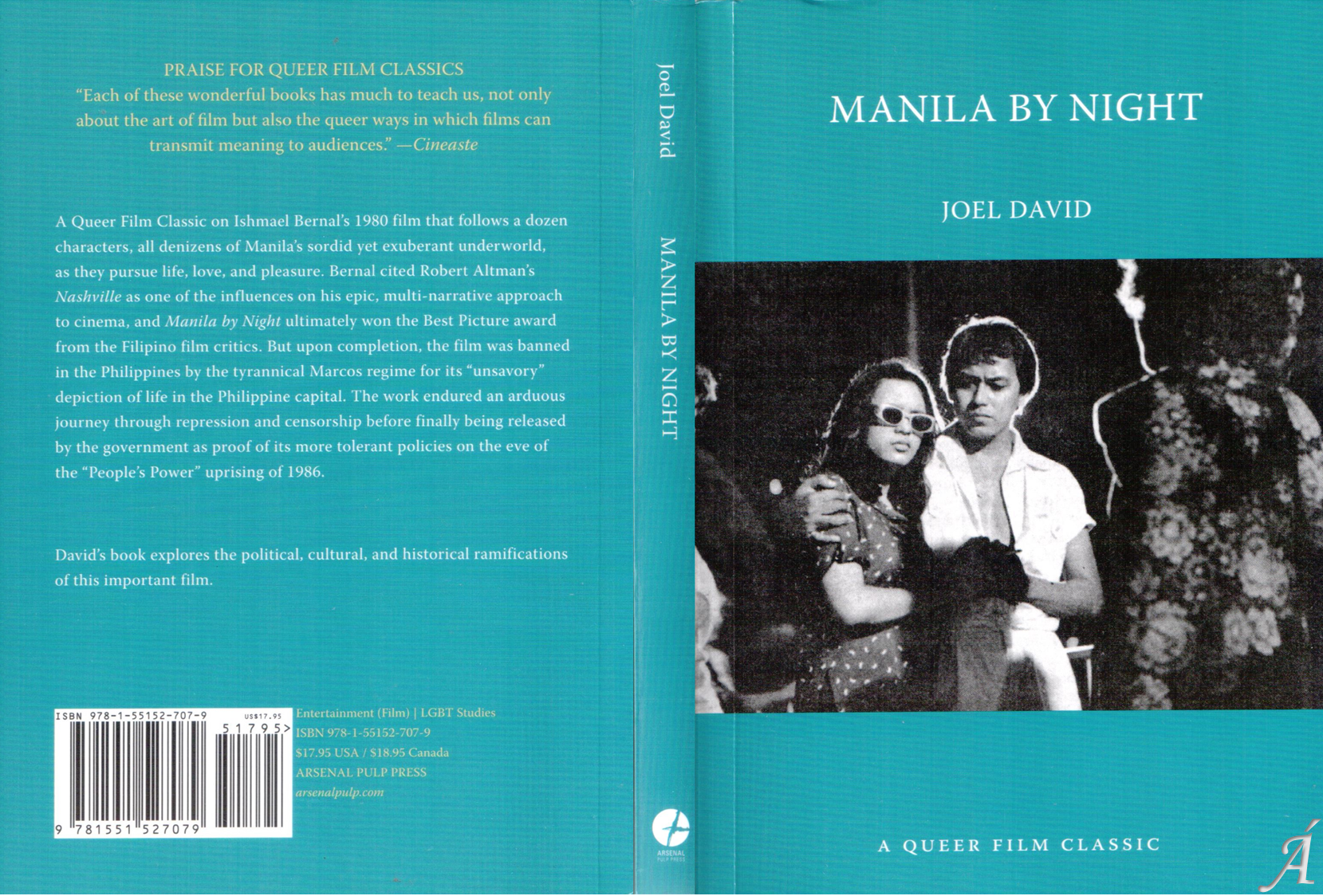
11011When he told me this kind of casually brutal though legally defensible negligence would not have happened if, among other factors, I had stayed on instead of decamping for the proverbial greener pastures, I figured I owed him a favor, but I let him apply on his own terms. In response to a call for papers to the Korean conference I was coordinating, he submitted the Huwaran/Hulmahan manuscript – to which I had to answer that he had enough quality material to constitute an entire panel unto himself. His response to his experience of attending the conference was to re-assess his predicaments and formulate a few resolutions, but the form it took was an amazing and much-circulated (and tragically self-prophetic) epistolary piece that now serves as the epilogue of this collection – a funny, self-deprecating, astutely observed, yet ultimately heart-breaking narrative that reflected as much of the peoples surrounding him as it revealed a heretofore unheralded ability: Velasco the raconteur. Philippine film commentary is rife with personal essays, but “Korean Rhapsody” stands out for having been written during its author’s fullest maturation, where a peculiar combination of wisdom and kindness suffuses the usual gestures toward camp, ambition, self-doubt, and defiant hopefulness.

11011Huwaran/Hulmahan Atbp. may be translated as “Model/Mold Etc.” The present volume differs from Velasco’s earlier compilation in that it contains, apart from his autobiographical essay and all the original Huwaran/Hulmahan pieces, a number of journalistic contributions that started appearing in a number of periodicals since the start of Velasco’s term as UP faculty, as well as some of his plans for revisions (notably the splitting up of the longest article into one essay and a short fan article). Upon my return from my stint as exchange teacher in Korea, I kept asking him about his Huwaran/Hulmahan manuscript, with the intention of convincing him to submit it as the equivalent of a creative thesis before presenting it to a university press for publication. He was receptive to the idea – it was consistent with the resolutions he listed in his personal re-assessment – yet in a few months he seemed to have turned against everything he wanted to continue or complete, and instead talked, albeit jokingly, about setting himself up for his eventual retirement. The day he failed to wake up, he was scheduled to take a trip to a farm to consider some options in agri-business, a direction that he’d said he was reluctant to take. His partner of several decades, Jess Evardone, stayed over at his house to accompany him, and was the first person to discover that he was no longer alive. But in staying on first in the hearts of a few, and later in the minds of many more, his Otherness was thus in the end both completed by his death yet paradoxically also now fully absent.

11011An expanding circle of friends decided that Velasco’s legacy was worth maintaining, and the present volume is only one of several planned outputs. In putting together all the writings we could salvage, from hard drives and disks through email attachments to scanned manuscripts, I got to realize in hindsight that Velasco’s hesitation in getting his original manuscript published was not really because he had given up on accomplishing anything. On the contrary, he had lately discovered the psychic rewards of being a public intellectual operating in the feedback-intensive field of popular culture, so much so that one way, perhaps the only way, and definitely the first way of looking at Huwaran/Hulmahan Atbp. is that it is a work in progress, whose final form would have been defined possibly a year or two later had he lived on, depending on the insights that he could have drawn from his intensive coverage of the local movie scene.

11011Yet the current manuscript, for all its gaps, overlaps, and reversals, already constitutes an impressive achievement in itself, one that makes it possible to canonize its author as the millennium’s first major Filipino film commentator, relegating a significant number of other aspirants (myself included) to the status of also-rans, Salieris to his Mozart. Even in its still-to-be-finished state, Huwaran/Hulmahan Atbp. is indicative of Velasco’s ability to bridge distant and contemporary periods and subject their emblematic phenomena to sharp critical scrutiny leavened with wry humor. But more than a mere display of intellectual acrobatics is one quality that remains in full, regardless of the condition of the compilation or of its individual articles: Velasco’s unabashed affection for his material, his refreshingly frank appreciation and admission of cultural pleasure, as evident in the collection’s emphasis on performers and their films.

11011“In Praise of the Film ‘Star,’” the very last article he wrote and his first to be published posthumously, serves to determine the general direction of the collection as a whole. It is quickly followed (in Part 1: Fan Texts) by a series of fan articles, and the selection of subjects says as much about the author as they do about the performers themselves: chronologically, Velasco first wrote about someone he identified with (Susan Roces), then about those he had known personally, which in a sense amount to the same thing. The articles grow in length as Velasco proceeds to problematize questions of culture and political economy. Before discussing stardom itself, we turn to a section where Velasco foregrounds the issue that lurks behind everything he wrote as an academic – i.e., gender politics, the best thing, he said once, that graduate studies ever gave him. When he first heard me use the word “transgressiveness” as an indicator of progressivity he remarked that he’d always wanted to aspire to that type of ideal, and was glad that it could now be openly acknowledged in contemporary scholarship; I must add that he took the concept much farther than I could have imagined it could go in Philippine film studies.

Back to top
Return to Book Texts contents

11011Hence under Part 2: Gender Texts he goes to town in imbuing female personae with masculine attributes and vice versa, and objectifies the Filipino male with admirably shameless delight, to the extent of embracing (figuratively in print and, who knows, literally in real life) a veritable stable of “bad” boys. In returning to a consideration of the movie star (Part 3: Star Texts), he discourses with renewed authority, effectively restoring to prominence the real-life reel couple he regarded as king and queen of the make-believe world that had provided him with much-needed solace during his formative years. The collection closes with a large group of articles, Part 4: Film Texts, that in one respect derive directly from his fascination with star personalities; the other respect is the one that also justifies Velasco’s position as our foremost film expert in the new millennium: he could write knowingly about the present, without the need to demonstrate any high-art or film-buff pretension, mainly because he maintained so much fondness for a past he knew first-hand. This section ends with his challenge to both organized and practicing Filipino film critics (often two discrete categories, as it happens nowadays): after demonstrating how to properly evaluate first a festival period and then a calendar year of sustained film practice, Velasco points out, in laypersons’ terms, precisely what makes award-giving and comparative auteurist analyses so dissatisfying – i.e., their practitioners use critical-sounding evaluation as a subterfuge instead of facing up to the manifold challenges and contradictions of genuine critical writing.

11011All of which brings us back to Velasco’s primary motive for writing – his love for all kinds of media of expression, whether belonging to high art or mass culture. In retrospect it wasn’t just the discursive potentials of local cinema that Velasco approached with this strange (in both senses of unusual and queer) combination of tenderness, acceptance, and rigor. Whenever he reflected on his personal and professional misfortunes, his tendency to break down in private followed by his refusal to protest the many injustices visited on him seemed then like a confirmation of the multiplicity of weaknesses that inexorably brought about his utter marginalization and ultimately his demise. But with this volume in hand, it has become evident that he was determined to fight after all, and the form that his resistance took was the hardest for anyone to muster, more so for someone in his condition: to struggle, to the bitter end if necessary, for love of everyone, and to respond to those who abused him with an even greater dose of forgiveness and understanding.

11011He died enviably, peacefully in his sleep, just as he had lived unenviably for most of his too-short fifty-nine years (or a full sixty, by East Asian reckoning), constantly worrying where his next red centavo would come from just so that he could write one more article, teach one more class, mentor one more advisee, direct one more script, crack one more joke, celebrate one more friend’s achievement. Huwaran/Hulmahan Atbp. is one among several proofs of how generous he had been, to a country, a society, and a university that could not properly figure out just how much he was giving out, so that he could be given in return the basic things he needed in order to attain all that he had ever asked for – a decent living, nothing more. First our Job, then our Christ: he died brokenhearted so that we could all now, if we choose to do so, relish the many delights bequeathed unto us by his selflessness.

[Originally published as “Context” in Huwaran/Hulmahan Atbp. (Quezon City: University of the Philippines Press, 2009): ix-xiv]

Back to top
Return to Book Texts contents

THE DOLPHY CONUNDRUM

An earlier generation of Pinoy media observers would have thought that the death of Dolphy, once it arrived, would have left behind the issue of his profligacy: the usual tally of the deceased’s offspring and their corresponding mothers alone would already bring up the issue of his sexual insatiability and the potency of his allegedly humongous “secret weapon.” Yet it is a measure of the extent of the Philippines’ cultural maturation that the only controversy left literally in his wake is the question of why he had not been declared a National Artist, the country’s highest official distinction for people in his profession.

11011His earlier nomination, during the previous round, was supposedly sabotaged by the objection of a highly influential culturatus. The ensuing round of exchanges has been seemingly obsessed with the violation of a confidentiality agreement – a strange and moot assertion, considering that the National Artist selection process is performed as part of a mandate of the national government and is therefore always open to public inquiry. Nevertheless a resolution, as far as one can be determined, has been promised by no less than the President, with his assurance of support for any future recommendation for the award to be handed to the late comedian.

11011At this point a personal disclosure ought to be made: not so much because of my past association with some of the institutions involved in the controversy, but because of my incomplete coverage of a film artist who I presume to critically evaluate. I can probably count about a dozen Dolphy films that I have seen, and a whole lot of film excerpts, but this would not pass my own test for serious attention to someone’s body of work. Yet for someone with over 220 film titles (not to mention a successful TV crossover) dating to over 60 years back, Dolphy himself might be able to forgive anyone who’d been unable to watch a hundred or more of his own titles.

11011With the National Artist question, the answer may be parsed as simply and literally as possible: he was a major star (possibly the Philippines’ most prolific one even solely in terms of film projects) and was therefore “national,” and he had possessed sufficient artistry not only in maintaining this status but also in impressing colleagues and (certain) critics, including the official mainstream organization (with which I was also once associated) that had given him a lifetime achievement prize. Yet the next logical question, of whether being both nationally renowned and unquestionably artistic automatically makes one deserving of being called a National Artist, is where a lot of qualifiers have to be raised.

11011Dolphy had been part of the wave of local stars who wrested control of their careers from the vertically integrated studio system of the 1950s (the so-called First Golden Age) by producing their own projects; one such figure, Fernando Poe, Jr., had already been granted the recognition, while an arguably just-as-vital name, deposed Pinoy President Joseph “Erap” Estrada, may never receive it, because first and foremost, the distinction is inevitably political, and it would simply be more politic to bestow it on Dolphy than on Erap. Yet unlike the major stars who emerged immediately after World War II, Dolphy had been saddled with twin disadvantages that make his triumph more remarkable for its time.

11011One of those liabilities, poverty, was an acceptable one, in the sense that the democratic system being upheld by the republic (exemplified by the social mobility afforded by media stardom) allowed for individuals to transcend such class-based limitations. The other matter, his East Asianness, was a far trickier situation for anyone to navigate. The war had traumatized the population into an affirmation of the racial stereotyping originally propagated by the early European colonizers – that of distinguishing between the “right” kind of fair-skinned people (Caucasians) and the “wrong” kind (East Asians, who were earlier demonized as pagans and were later imaged as ruthless colonizers). Hence Filipino aspirants to movie stardom had to misrepresent their mestizo features as non-Asian; or, if this were impossible to pull off, then they had to settle for less-profitable second-tier status as villains (e.g. Bruno Punzalan), seductresses (Bella Flores), or comedians, where Dolphy (alongside Chichay, Babalu, and a long list of other names) found – and managed to build on – his niche.

11011It was certainly no help when newly emerging nationalists with anti-imperialist sentiments sought to critique Philippine culture’s excessive white love by producing xenophobic literature that targeted the local Chinese community. This context helps explain not just Dolphy’s long-term political neutrality (just as Chinese Filipinos were known to support both establishment and opposition candidates during elections) but also why his type of comedy evolved toward a safe, family-friendly, middle-brow variety. Of his few forays with “serious” filmmakers, none had been with Manuel Conde or Ishmael Bernal, the National Artist auteurs who had reputations for scathing social satire. In fact he had tended to fall into the same misconception that the biggest Hollywood clowns, from Charlie Chaplin to Tom Hanks and Jim Carrey, had about serious material: that it had to be unfunny in order to “deserve” respect.

11011Ironically it was also as a result of this nationalist resurgence that East Asians (Filipinos or otherwise) were finally able to attain star status in local media, starting with the distinctly chinita Vilma Santos all the way through the frankly named Rico Yans, Sandara Parks, and Kim Chius of the present, with his own children deploying his once-suppressed surname; any number of leaders – all the way to Presidents and Cardinals – no longer need to remain silent about their overseas ancestry.

11011How then should good old Pidol be assessed? His National Artist award will be handed down, barring unforeseen abnormal circumstances,[1] and that would restore some symbolic balance to the excesses in our history of racism, however long-gone this tendency might have been. But it would be far more instructive for his audiences to remain aware of his weaknesses as much as his virtues, and the all-too-human reasons that had forced him to resort to the self-limiting career measures that he, in a sense, had no way of avoiding.

[First published July 12, 2012, in The FilAm]

Note

[1] Essential supplemental reading should be this post by Angela Stuart Santiago on her StuartSantiago blog, titled “Peque Gallaga on Dolphy, the Artist.”

Back to top
Return to Book Texts contents

MANOY TAKES HIS LEAVE

The sudden end to the long and productive life of actor-director Eddie Garcia was unnecessarily tragic, with corporate negligence compounding the foolhardiness of an artist too game to retire at an age when most other people would have completed two or more entire careers. The evaluation of netizens is on the mark in this case: Garcia’s willingness to take risks, typical of his approach throughout an extended and colorful career, should have been tempered by the studio that had apparently bet on countering the most successful serial program of the moment by showcasing, among other novelties, the physical agility of the country’s oldest active action performer.[1]

11011First appearing as a contract performer by the most star-obsessed among the 1950s First Golden Age studios, Garcia’s unconventional attractiveness positioned him a degree apart from full star stature: he could occasionally headline a project, but never the romantic leads that required the Euro-mestizo prettiness claimed by any number of now-forgotten actors. Having decided to make the most of a range of skills that allowed him to dabble in genres as disparate as horror, action, comedy, even soft-core melodrama, as leading man or villain, he settled on making himself indispensable as a competent ensemble performer who could draw on reserves of brilliance in case the role happened to demand it of him.

11011His filmography of over 650 film appearances (a possible local record) attests to the success of his strategy, but he had a higher purpose in mind: to be able to carve out a parallel career as film director. His choices were informed by the same principle of populist entertainment that he maintained for his acting career. One can see how his efforts could be occasionally penalized for being too mainstream, in a system that prized (then as now) “independent” efforts: when his best film, Saan Nagtatago ang Pag-ibig? (1987), came out, the Filipino critics’ group declared that no film during that year was worth considering for its annual prizes. Saan Nagtatago has since then been regarded as one of the high points in Pinoy melodrama.

11011Observers were also prone to concluding that his expertise as director accounted for his actorly acumen. This may be safely accepted as conventional wisdom, in conjunction with his pronouncement that his original dream was to be a military official. His work ethic, arriving about an hour ahead of call time, lines already committed to memory, was typical of performers of his generation, and those of theater-trained actors even today. Yet there were fault lines in this ultra-professional approach, and it occasionally showed up in his filmmaking record. He directed (and won his first directorial award for) the second biographical campaign movie of Ferdinand Marcos, Pinagbuklod ng Langit (1969). When later, the then-newly founded directors’ guild declared a boycott of the film projects of Gabby Concepcion, Garcia defied guild president Lino Brocka by accepting a Concepcion assignment for Viva Films.

Back to top
Return to Book Texts contents

11011Ironically, Garcia’s acting projects with Brocka constituted his most rewarding body of work. He had memorable roles in the first few films of Ishmael Bernal, showed up in some of Eddie Romero’s more ambitious projects, and endeared himself to camp fans in the sex-comedies of Danny L. Zialcita. But as the most politically committed Filipino director, Brocka required effective representations of political villainy, and no one delivered the goods as well as Garcia, in a series of acclaimed works: Tinimbang Ka Ngunit Kulang (1974), Miguelito: Batang Rebelde (1985), and Gumapang Ka sa Lusak (1990), among others. Their collaboration was cemented early on, in Brocka’s second film assignment and first serious work, Tubog sa Ginto (1970), still arguably the highest peak in male Philippine film performance.

11011The mystery in Tubog lies in how Brocka managed to create his best queer film during the period when he still had to come around as an openly queer artist. His later “out” movies, notably Macho Dancer (1988), pale in comparison to the early work. People tended to ascribe some credit to Garcia, to his admission that he conducted intensive research among colleagues in the industry, plus his earlier attempt in essaying a comic version of the closeted authority in Kaming mga Talyada (1962), affirmed by his subsequent willingness to tackle similar roles (comic and dramatic) even in his old age – including his last film assignment, Rainbow’s Sunset (2018). To be honest, the results were always mixed and not as definitive as Tubog itself; in a comic ensemble work, Mga Paru-parong Buking (1985), he was upstaged predictably by Bernardo Bernardo and unexpectedly by George Estregan.

11011Eight years ago, in one of those confluences that make pop culture an endlessly fascinating phenomenon for its devotees, several identifiably masculine actors admitted to past same-sex experiences. One of them was Garcia, who said that his own episode occurred early, when he was 15, as part of a quest to determine his own preference. One could look at the group of confessors and note for the record that they were all extremely accomplished performers. Yet the measure of the audience’s distractability, as well as Garcia’s own volatility, is that most people remembered his queer performances, but not his own acknowledgment of the roots of his appreciation. All in all an occasionally spotty record then, but generously strewn with gems worth treasuring: rarely have we been so lucky.

[First published June 23, 2019, in The FilAm]

Note

[1] In the wake of the tragedy, the studio, GMA-7, announced that its series, Rosang Agimat, was shelved. The new program was intended to challenge ABS-CBN’s long-dominant Ang Probinsyano, where Garcia had (ironically) also been a featured player.

Back to top
Return to Book Texts contents
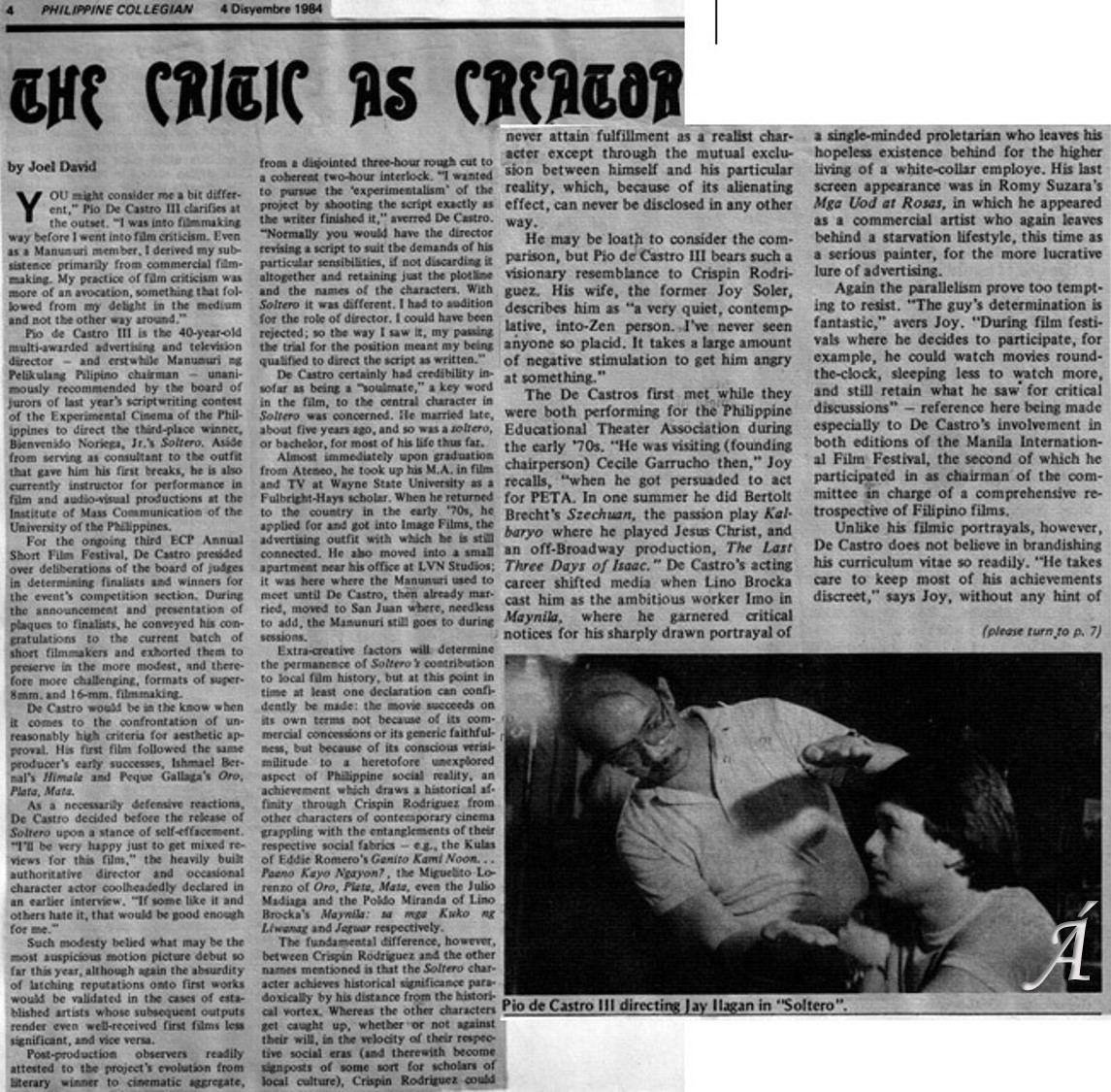
THE CARNAL MORAL OF A BRUTAL MIRACLE

One fascinating thing about having been present during the emergence of critical awareness in Philippine cinema was observing how games of auteur favoritism played out: who would be the critics’ pets and how would the rest fare in relation to them? The way the rules were formulated – a series of commentaries by organized critics that built up toward an annual awards ceremony – made for dramatic though ultimately hollow displays as a community of artists would be set one against another, with those who won more trophies regarded as first among their peers. The problem would be not so much the occasional lapse in judgment (Ishmael Bernal losing as director of Manila by Night [1980], Nora Aunor undervalued for some of the best performances in global cinema) as the regressive impact of film awards on cultural understanding; awards could not serve as periodic summations of critical evaluation simply because there is rarely any real criticism behind them. Influence-peddling probably, favoritism definitely, but critical thinking? Only if we accept celeb-fetishism as worthy of serious scholarly consideration.

11011Marilou Diaz-Abaya was one of the early victims of this still-ongoing practice of intellectual barbarism masquerading as earnest cultural analysis. Emerging fully formed and initiating a so-far unparalleled film series on Philippine femininities, mostly with the same team of close associates providing assistance, she met with dismissive responses from the exact same group of people who should have known best. Her recent death, after an extended bout with breast cancer, had met with a lot of appreciative reminiscences, evidence of the care and humor with which she prepared for the end; yet whether this kind of appreciation will ultimately extend to her body of work – that both remains to be seen and does not excuse the neglect with which her practice had been met. None of her major films (except for two star vehicles on Viva Films) is available on DVD; their restoration might be all that remains, if justice deserves to be served, toward the rehabilitation of her stature as major Pinoy film artist.

11011In retrospect, it would be easy to see how Diaz-Abaya could be so casually written off. Not only was she young, she had come from financial privilege and so could afford extensive film training, then-unavailable locally. Her circle included some of the most prestigious players the industry had ever seen: Ishmael Bernal mentored her, Jesse Ejercito produced her projects, and Ricardo Lee (the only one still actively practicing his craft) wrote scripts for her. It were as if she had been an interloper, and she had enough self-deprecating humility to preempt everyone in cracking jokes about her sheltered upbringing. Moreover, film practice at the time had attracted the finest talents in the country, facilitated in no small part by the fact that the Marcoses, despite their ruthless control of media, were sufficiently star-struck (Ferdinand won the presidency via biographical blockbusters, Imelda had screen-tested for the studio that produced her husband’s films) to treat film as their fair-haired child, their showcase of progressivity and proof to the world of their cultivation of democratic space.

11011Thus critics had no lack of talent to uphold, and shelving a relatively young newcomer who came from the “wrong” (that is, the right) side of the tracks would not count for much when so many others and so much else could be celebrated. Lino Brocka could come up with an instantly recognizable global classic in Maynila: Sa mga Kuko ng Liwanag (1975), and Ishmael Bernal could presently respond with Manila by Night, arguably an even more significant contribution. Diaz-Abaya staked her claim to this order of filmic discourse by proffering Moral (1982), which expanded the city-film setting to include the newly formed metropolitan area and focused on women’s issues. Differing from Maynila, Moral sustained the sexual politics and multi-character format of Manila by Night; if the Bernal film still stood heads and shoulders above everything else, then both Maynila and Moral might be seen as its proper bookends, one anticipating and the other upholding the middle production and sharing its stature as major Philippine film confabulations.

11011Interviewed by phone, Lee recalled how Diaz-Abaya knew the long-term value of their output: Moral was “the only movie where my name and [producer] Jesse Ejercito’s appeared along with hers above the title,” he said, adding how her readiness to share credit extended to a directing class where he handled the writing portion as well as to the joint memoir of their professional collaboration that they had nearly finalized when the end arrived. He explained further why his scripts with her, and her films with him, have marked each other like no other Filipino director-writer team-up had ever had: “No other director treated my material with the openness and care that she did. Some of the materials we tackled were new to her – queerness, prostitution, incest, promiscuity, atheism – but with her I always had the assurance that she would set aside her biases and preferences and come around to the vision in our material.”

11011What compounds the difficulty of evaluating Diaz-Abaya’s output was her restlessness which, given how limited her time had been, may now appear as an eagerness to cover as much ground as her seemingly boundless energy could allow. I had occasion to interact with her twice, once in graduate school when she dropped by New York on her way home from a European film festival, and another time about a year ago when her cancer had been in remission; each time I was with a “younger Marilou,” first film critic Bliss Cua Lim and then filmmaker Ellen Ongkeko-Marfil, and both times it still amazes me to recall how she had no other agenda except to indulge in intelligent exchanges. Earlier she had just finished Milagros (1997) and announced that she felt it was time to tackle films about men: “I’m not sure I’ll be as successful as I had been with [films on] women,” she said, “but I have to take this risk so I can know for sure.” More recently, she had just released her last film project, Ikaw ang Pag-ibig (2011), but she talked with undiminished excitement about teaching, research, writing, and spiritual preparation – everything (except perhaps the last) that I and everyone else I know had been doing.

11011What will always haunt me about her is my envy about how she never allowed any limitation to stand in her way: she consorted with far older adults when she was young, opted for a profession dominated by biological men, ran with a crowd far removed from her genteel and well-heeled origins, pursued topics and challenges way beyond her comfort zone, and kept looking forward even with death staring her down for years. She welcomed the revitalization of film practice via the shift to digital technology, but was never remiss in cautioning against the dangers of excess privilege – and who better to know about this than her? In one of several excellent interviews that have cropped up all over Philippine news outlets, she made mention of how indie-film production could entrap its practitioners; after affirming how respect for the audience should be “non-negotiable,” she proceeded to explain the merits of the currently most popular (and consequently most derided) local genre, the romantic comedy. This was a lesson that her generation of filmmakers learned the hard way: that the way to improve a much-abused mode of practice is not to reject it, but rather to seize it and transform it so that the people who attend to it will benefit from patronizing it.

11011Marilou Diaz-Abaya had always connected and insisted on learning and never hesitated to share what she had. In a too-short lifespan she had earned much more than a beautiful farewell, but in the meanwhile that is all we had been able to give, even as the harder long-term work of revaluation lies ahead.

[First published December 12, 2012, as “Marilou Diaz-Abaya, 57: Rule Breaker, Risk Taker” in The FilAm]

Back to top
Return to Book Texts contents

A NATIONAL ARTIST WE DESERVE

Of whether Nora Cabaltera Villamayor, legally a senior citizen of the Philippines and permanent resident of the US, is an accomplished artist there can be no doubt. One might inspect the record of her multimedia accomplishments – as recording artist, television performer, stage actress, concert act, and film producer and thespian – and concede that she may have excelled in many, if not most, of these areas; one might even be a serious observer of any of these fields of endeavor (as I have been) and assert that no one else comes close, although many certainly aspire to her level of achievement.

11011Not surprisingly, the rejection by President Benigno Aquino III of the National Commission for Culture and the Arts’s endorsement of Aunor has occasioned a number of impassioned and articulate responses, starting with social networks, by now filtering through mass media, and inevitably destined to land in scholarly discussions, with the Philippines’s own major indexed humanities journal, Kritika Kultura of Ateneo de Manila University, slated to publish a special section devoted to her. (Personal disclosure: I am in charge of this specific project, as forum editor.) The nature of the reactions should not surprise anyone attuned to Philippine popular culture: the late-1960s working-class devotees who demanded for, and got, the teen idols they wanted have since grown along with them, many gentrifying and positioned in various capacities all over the globe.

11011It would have been instructive for the president’s culture team to have looked into the origin of what National Artist for Literature and Magsaysay Awardee Nick Joaquin described as a phenomenon, in one of his landmark journalism articles. For way before the 1986 middle-class people-power revolt that restored the oligarchy that Aquino effectively represents, an earlier, limited, though genuinely working-class form of people power, comprising mostly rural migrants working as factory hands and domestic labor, discovered the pleasures of pop-culture consumerism and ignored the dictates of the then-already enfeebled studio system of the so-called First Golden Age of Philippine cinema.

11011Rather than flock to the presentations of the typical European-featured and bourgeoisified talents then still being insistently launched by the major studios, the new urbanites, still capable of earning disposable income without seeking overseas employment, used their peso-votes to signify what types of idols they preferred. Today’s intellectuals replicate an error of historical interpretation when they position Aunor and her teen-star rival, Vilma Santos, as belonging to the native-vs.-mestizo division that observers during that time believed was at play: although Santos first emerged as a child star during the waning years of the Golden Age, her fairness did not conform to the anti-Asian requisites of the time; grown-ups with distinctly Oriental features like hers would have been relegated to serious secondary roles as male villains or femmes fatales or, at best, comic roles (where, instructively, the biggest star, Dolphy, had to suppress his Chinese surname).

11011Hence the masses’ new choices represented iconographies long withheld by the elite-controlled studio system, with the two biggest stars no longer male, and either morena or chinita (as their types used to be termed). By the arrival of the 1970s, the more Western-looking types accommodated this new demand for transformative appearances by exploring unusual options, including the pornography genre now remembered as bomba – also a reference to then-emerging student and labor unrest.

11011Since then this social experiment in discovering new types of media performers for popular consumption has either ended or changed, depending on what perspective one opts to adopt. East Asian-type candidates have managed to swing the door wide open, thanks to the example initiated by Santos and followed through by the middle-brow Chinoy-ethnocentric efforts of Philippine cinema’s most successful producer, Lily Yu Monteverde. But proof that this progressive window has also long slammed shut lies in the fact that no other brown-skinned female star has emerged since Aunor.[1]

11011To confound matters for the race- and class-conscious arbiters of social acceptability, Aunor’s Otherness was too close for comfort to her mass adulators’ condition – i.e., like them she was born poor and far from the capital city, enduring the then-standard harsh treatment reserved for those perceived as unable to call on socially influential contacts for protection, cursed with disproportionate ambition and fated to rely on wit, talent, and industry to attain her dreams. Not surprisingly, for the period of what might count as her on-the-job internship, she displayed an earnest studiousness, carefully enunciating her song lyrics and delivering over-rehearsed renditions of even the most casual lines of dialogue and investing whatever spare funds she had in art or period film projects that baffled her fans and accounted for her occasional impoverishment (by movie-star standards).

11011Nevertheless, when her artistic maturity had peaked, roughly toward the close of the 1970s, the fruits of such unmatched discipline and struggle went on glorious display and earned her an entirely new generation of followers, many of them academically trained in cultural and media appreciation. I remember suspecting her then of finagling her performance record by paying attention to only her serious projects (as other major performers and directors were wont to do), and watching the several potboilers she appeared in during her many periods of financial difficulty: to my amazement, each one, without exception, was stamped with a level of expertise that performing arts majors would have killed for.

11011This background also helps explain her disdain for the trappings of social respectability, having realized (as most long-lived artists do) that the widest range of experiential possibilities can always be harnessed in the service of interpretive craft. Small wonder that when she had the assurance of serious coverage during her current career resurgence, she spelled it out for the world, without apologies: chemical dependencies, multiple (including same-sex) partners, neuroses and anxieties, an inexplicable wanderlust, regret in the innocence of the now-lost past and hope in the uncertainties of the future. It was a source of amusement for me to see her fans scrambling to rationalize her statements, with a few of them abandoning their devotion to her because of their newfound fundamentalist religious convictions.

11011Less amusing was the spectacle of a supposedly enlightened presidential administration decreeing, in effect, that it did not want to be represented by such a powerfully transgressive figure.[2] Its ignorance of the artist’s temperament gets exposed when we look up the list of names who had already made it to the ranks of the country’s officially endorsed masters and see that the best among them had made use of similar methods of exploring hidden or difficult truths and realities. The kind of sensibility that counts a public record like Aunor’s as contaminated by her less-than-“exemplary” lifestyle encourages medieval institutions like the Catholic Church to attempt a takeover of official cultural functions; worse, it plays into the dangerous oligarchic fantasy that a commodified, infantile, unexceptional mass culture is the perfectly satisfactory consequence of a wholesome moral existence.

[First published June 21, 2014, in The FilAm]

Notes

[1] In fact, a reversal of the casting of mestizas in sex films seems to have occurred, with brown-skinned actresses such as Maribel Lopez and Sarsi Emmanuelle (featured together in Elwood Perez’s Silip [1985]) and Elizabeth Oropesa “permitted” to star in such productions. This merely reflects the more libertarian values inherent in these projects, as well as the need to cast as wide a net as possible, mestizas still welcome, in order to meet the demand for such willing talent. Also worth noting is the possibly not-incidental fact that these actresses remained capable of delivering outstanding performances.

[2] Update (with trigger warning for those who insist on observing eternal respect for the dead): The demise of Benigno Aquino III on June 24, 2021, occasioned a few recollections from his colleagues regarding the possible causes of his lack of empathy, a character flaw that resulted, during the disaster-packed final year of his administration, in public resentment overwhelming enough to ensure that the presidential candidate who launched the most forceful attacks on him won the election. Most of these explanatory attempts were, not surprisingly, aligned with the local cultural practice of lionizing the recently departed: one of his staff members speculated that PNoy Aquino had to uphold the role of being the only male in a household comprising a slain father, a mother, and several sisters, in effect enacting a local variation on stiff-upper-lip stoicism.

11011A colleague of mine and PNoy’s high-school batch mate, the late Bangy Dioquino, recalled how the surviving family members made sure that their youngest offspring and only son was always kept safe – a response that intensified when one of the several coup attempts against his mother (during her presidential term) nearly killed him. Aquino wound up so sheltered, per Professor Dioquino, that he did not even know how to approach the women he was attracted to, among other indications of excessive social awkwardness. The implications of these limitations were of direct consequence in his leadership style, but I prefer to leave the task of teasing these out to psychologists and management specialists.

Back to top
Return to Book Texts contents


Book Texts – Commentaries: Elsewheres

A NEW ROLE FOR KOREA

The forthcoming ASEAN-Korea Commemorative Summit will have been preceded by a related event, fraught with symbolic implications: the sixtieth anniversary of diplomatic relations between Korea and the Philippines (celebration ceremonies had to be postponed due to the period of mourning for the late President Roh Moo-hyun). Both countries underwent traumatic parallel upheavals in their encounter with modernization during the last century. In fact, the link between Korea and the Philippines may be traced to as far back as over an entire century, when the U.S. and Japan executed the secret diplomatic document now known as the 1905 Taft-Katsura Memorandum, a sort of gentleman’s agreement between colonizers to divide up the major Far Eastern territories between themselves – Korea for Japan and the Philippines for the U.S. For this reason I will focus initially on comparing and contrasting the two countries, before discussing Korea in relation to the larger ASEAN region.

11011Otherwise well-informed professors in the Philippines react with surprise when I tell them about the Taft-Katsura manuscript, about whose existence I’d learned in an English-language translation of a Korean high-school history textbook. The first half of the twentieth century resulted in divergent colonial experiences for both countries, with Korea opposing the Japanese occupation to the extent of forming an overseas exile government, and the Philippines growing loyal enough to fight alongside the Americans against the Japanese during World War II. The convergence of Korean and Philippine interests (pro-U.S., anti-Japan and later anti-Communist) continued through the Korean War, when the Philippines sent the biggest Asian delegation in support of South Korean combatants. Nationalists on both sides also expressed dismay that the conflicts were essentially proxy wars fought by the U.S. against its imperialist rivals, leaving the battleground territories (Manila in World War II, Seoul in the Korean War) utterly devastated, and with both Asian countries persuaded to subsequently assist the U.S. against the eventually victorious Vietnamese during a longer-drawn-out conflict.

11011Up to this point, the Philippines generally fared better. The country had a head-start in economic recovery and lucked out initially in its post-war import-substitution industrialization strategy. Its status as a long-Westernized, recently Americanized capital made it an attractive destination for other Asian citizens, so when it embarked on the U.S.-supported authoritarianist experiment that many other Third-World countries were pursuing, logic dictated that it would continue to lead the rest of Asia in finally attaining industrial development. (As partners in the regional strong-men club, Park Chung-hee and Ferdinand Marcos were able to meet up in Manila during an earlier version of the ASEAN, the 1966 conference of the Southeast Asia Treaty Organization.)

11011The end of the periods of dictatorship all over Asia proved to be generally beneficial for their respective countries’ economies – with the egregious and embarrassing exception of the Philippines (once described as a “banana republic” by the Nobel-winning economist Paul Krugman). While Filipino experts tried to figure out what went wrong and how the Marcos era’s mistakes may be avoided in future, Korea made itself over into the most impressive economy in the region, next to Japan. In fact, from the point of view of other Asian countries outside East Asia, Korea’s example is not merely worthy of emulation; it is a moral triumph. For while Japan may have had a longer run and a still-larger annual income, Korea, like the rest of the ASEAN countries, had been and has remained resolutely postcolonial: at any point in its drive toward modernization, its wealth was never achieved at any other country’s expense, and if any people had to endure suffering, it was always first and foremost its own population.

11011This is the (admittedly simplistic, probably reductive, and strictly tentative) logic that I use in explaining why Korea holds such a strong fascination in the imaginaries of the other ASEAN member-countries. A few observers might want to believe that the Korean pop-culture wave might be over, or that it might not even have existed at all. Yet the record of, say, Korean TV dramas dominating the ratings of Southeast Asian media since the start of the current millennium speaks for itself. A Korean performer, virtually unknown hereabouts, has leading-lady status in Philippine movies, and the latter country acknowledged last year that the number of Korean visitors has now exceeded those of all other countries in the world, displacing the previous and long-time record-holders, the Japanese.

11011One way of illustrating how the exceptionally high regard for things Korean persists in the ASEAN region is by contemplating an alternative situation. If another major East Asian country were to initiate its counterpart of the Korean pop-culture wave, most Southeast Asian countries would likely respond with some degree of hesitation, if not outright coolness. For better or worse, the Chinese have been marked with an overriding (though much-envied) profit motive, while the Japanese’s espionage activities prior to their World War II imperialist expansion cannot be easily expunged from the other countries’ historical memories. This partly explains why most successful Chinese or Japanese cultural products circulate in the region through Western distribution circuits.

11011Hence among the “senior” non-ASEAN Asian economies, Korea may well be the country that is in a position to assume an influential role in the region. Why then has its leadership function remained largely theoretical, a kind of guidance by example, when the other East Asian countries have been more or less actively staking their claims to representing the rest of Asia? There are two interlocking ways of answering this question, one internal (to Korea) and the other external, which I will attempt first. From the perspective of the ASEAN members, the organization has been doing well enough without any form of outside interference. A cultural historian might be able to argue that, were it not for the intervention of European colonization, the region could constitute an entire super-nation or subcontinent (comprising a seemingly endless array of cultures and peoples and languages) unto itself. In a sense, ASEAN fulfills this might-have-been vision through an ideal of cooperative self-sufficiency.

11011Korea, for its part, has always had the historical propensity to turn inward. Its comfort zone as a nation remained within its boundaries, among its people, hermitic (to use its self-descriptor) to a fault. By now its leading lights might have figured that such a response could prove debilitating in an age of globalization, just as it had proved disastrous during preceding eras of colonizations and proxy wars. Moreover, a genuine internal consolidation will be impossible for a long while, at least while the northern half of the country remains ideologically estranged and materially impoverished. Meanwhile, the Southeast Asian region remains for the most part organized, appreciative, determined to succeed on terms that do not seem all that different from what the people of this country had been able to achieve not too long ago. Spring is in the air. A period of mutual courtship is long overdue.

[First published June 2, 2009, in Korea Times]

Back to top
Return to Book Texts contents
CRESCENT TENSE

One subjective measure of the distress over the recent killings in Mindanao’s Maguindanao province (also called the Ampatuan massacre) is how Philippine-based foreigners, including the few Koreans I advise mainly for their thesis completion, seem as traumatized as the Pinoy bourgeoisie, in stark contrast with the rest of the natives. This is not to say that the working-class majority feels unaffected by the tragedy. In fact the oft-noted peculiarity of the local response to crises – marked by the incongruent use of humor, or in this case silence – can be read as a form of fatalistic acceptance of the brutalities of fate, as well as a means by which the individual could refocus her or his attention on the exigencies of personal survival.

11011I must confess that I encourage my Korean advisees to indulge in something approaching xenophobic paranoia. Most Koreans who visit the Philippines are impressed by the local culture’s excessive libertarianism, a welcome relief from the severe patriarchal hierarchisms that invariably confront most East Asians from birth onward. Yet the country’s seemingly boundless promiscuity misleads foreigners into thinking that its culture is as benevolent as it is tolerant.

11011More than once some of my Manila-based colleagues had informed me that one or another of my male Korean students had set out, usually alone, for some unannounced inter-island itinerary, with the person’s mobile phone occasionally losing signal due to the underdeveloped condition of some far-flung destination. So far the guys have returned safely, convinced all the more of the kindness of the “other” Filipinos vis-à-vis the relatively cynical and materialistic Manileños, even as my friends and I wonder how to impress on these wide-eyed innocents the kind of dangers they were lucky to have skirted.

11011The Maguindanao massacre was not, even in my wildest and weirdest and saddest dreams, the example I had hoped for, but there it is. The widespread response to the event turns on its perpetrators’ bald-faced assumption that they could get away with such an extensive and bloodcurdling criminal operation, directed in open-space broad daylight against a large and influential group comprising mostly women, uninvolved passersby, and (the ultimate indication of contemporary hubris) media professionals. Beyond the jaw-droppingly pathological stupidity of a group of men driven by old-line machismo and power-hungriness, one could somehow sense a shock of recognition, even among Koreans who happen to belong to an old-enough generation.

11011For this is how people with absolute power (with the concomitant absolute corruption) have always tended to behave, down to the knee-jerk assignation of blame to armed seditionists. Just replace the unsophisticated provincial dynasty with more charming, urbane, and eloquent types and one would have the U.S.-sanctioned Third-World dictatorships that most middle-aged Southeast Asians (and Koreans and Latin Americans) still remember all too vividly.

11011Which makes the actuations of the Maguindanao-massacre perps as backward as they are barbaric, locked in a period and setting that ought to have been relegated to a permanently passed past. What provides an underlying unease regarding the response of the current Philippine administration is the fact that both sides of the political fence, the outraged ruling party as well as the infuriated opposition, are calling for immediate and unqualified intervention, thus conjuring up spectacles once more associable with the excesses of the long-deposed Marcos regime: the deployment of Philippine army troops to predominantly, supposedly autonomous Muslim areas, with hasty arrests of elements perceived as rebellious, and everything conveniently blanketed by the imposition (since lifted) of martial law, possibly as prelude to a transition of power to a bereaved rival who, it must be stressed, mirrors his opponents’ penchant for maintaining a militia force.

11011How the Philippines’ second largest (and richest, resources-wise) island ever reached such a sorry state of affairs, with the Maguindanao case a culmination of a long and so-far unending series of tragic events, can be best understood via a sufficiently distant geopolitical perspective. From, say, an orbiting satellite’s view, what may be regarded as the Philippines’ Christian majority is actually the Indo-Malayan archipelago’s regional minority, disproportionately empowered by the historical accident of the U.S.’s current undisputed status as global police.

11011After largely successfully resisting foreign attempts at colonization, the Philippines’ Muslim population found itself at the receiving end of a series of ill-advised political trade-offs initiated by the American reoccupation of the country after World War II. First, the U.S. reneged on its promise of benefits to the local Communist army after contracting it to undertake the bulk of anti-Japanese resistance. The peasant-based insurgency that ensued from this instance of Cold War-era duplicity suffered severe repression, and the then-fledgling Philippine administration sought to mollify increasing antipathy by providing ex-rebels with settlements in Mindanao, many of which were located in still-undocumented Muslim ancestral properties.

11011The disgruntlement that percolated under the social surface finally erupted with the Marcos government’s decision to infiltrate, destabilize, and reclaim Sabah in Malaysia using a commando unit (code-named Jabidah) of Filipino Muslims, trained on a ship without being informed of the nature of their mission. Upon learning what they were expected to carry out, the young men attempted to mutiny and were summarily executed (in a scenario reminiscent of then-concurrent events in Korea depicted in Kang Woo-suk’s 2003 blockbuster Silmido). Having since been radicalized by the Jabidah massacre, several generations of separatist Muslims experienced some of the most harrowing peace-time assaults by Philippine armed forces, punctuated by a few truce periods.

11011The US’s so-called war on terror did not ease matters for the severely put-upon Pinoy Islamic populace. In the current millennium, a few individuals attempted to meet half-way the globalist call for entrepreneurship by supplying, to an extremely responsive and grateful nationwide market, affordable copies of otherwise unfairly priced digital content; instead they were continually hounded and accused of more than just video piracy by the Motion Pictures Association of America, whose leader, the late Jack Valenti, claimed (but never proved) before the U.S. Senate, as a way to justify harsher measures, that the profits made by “pirates” were donated to terrorist organizations.

11011Where the recent return of the Philippine army to Muslim areas in Mindanao might lead this time is anyone’s guess, but if history were to serve as indicator, what may appear to be a solution at present might only lead to further heartbreak in future.

[First published December 14, 2009, as “Heartbreak in Mindanao”]

Back to top
Return to Book Texts contents

ASIAN CASANOVAS

When the only serious contenders during the last US presidential election were a woman and a black man, most commentators wondered which category, gender or race, would prove worthier of the patronage of the electorate. As it turned out, voters felt more confident about being led by a black man, although in a show of buyer’s remorse typical of history’s most successful consumer society, some Americans nowadays tend to write how Hillary Clinton would have had the leadership qualities that Barack Obama, for all his Kennedyesque charisma, sadly lacks in a time of serious global crises.

11011Yet the bigger picture has largely been overlooked. The standard presidential qualities of maleness, whiteness, wealth, and old age have become more and more difficult to assert, due to the rise of identity politics during the only truly progressive revolution the US ever came close to, comprising the various cultural upheavals of the 1960s. After the election of the non-WASP John F. Kennedy ushered in the Camelot spirit, the old boys’ club managed to hold on for a few more decades afterward, although it became increasingly apparent that successful candidates could, and then should, be sold on the basis of their deviation from the norm: Jimmy Carter had been a peanut farmer, Ronald Reagan a B-movie actor, Bill Clinton an impoverished native son who could complete his education only through scholarship grants. In this context, even “Dubya” Bush connected with voters despite his monstrous incompetence precisely because he was an aw-shucks underachieving everyday guy, in dull contrast with his father, the US’s (and by extension the world’s) last patriarchal President.

11011The foregrounding of the formerly immovable categories of race and gender during last year’s election recalls another category, one where both qualities reside, and which (officially, at least) supposedly no longer exists: that of Orientalism. Ever since Edward Said published his eponymous study, Orientalism (or, more accurately, anti-Orientalism) became an area of scholarly pursuit, first within comparative race studies, where Said had originally located his ideas. Not long after, feminist scholars joined the growing body of work critiquing Orientalism, but in fact improved on Said’s framework by incorporating the issue of desire.

11011In other words, where Said pointed out instances in Western literature where the Oriental was presented as inferior to the Western subject, more recent studies of Orientalism, focusing mainly on popular culture, acknowledge that racial bias (expressed via Christianity-inspired moral chauvinism) had a tense and often conflicting relationship with desire, often by the West for the Other. For all its potentially contentious, controversial, even occasionally pornographic implications, this view helped explain several phenomena, including the feminizing attitudes Western nations and peoples had toward Orientals, as well as the West’s comparatively less destructive colonization projects, rather than the outright enslavement or extermination wrought on populations that early conquistadores regarded as subhuman.

11011In order to see just how far Orientalism might have transformed, I have been casually following the still-unfolding sagas of three celebrities, all males in their 30s, more or less Asian, and beset by women trouble. Tiger Woods, who describes himself as “Cablinasian” (Caucasian, black, [American] Indian, Asian), is actually more Asian than any of his other racial designations, but like Obama, exhibits the more genetically dominant African skin color. Pinoy boxer Manny Pacquiao is the more “native” Asian sportsman, a multiple-division champ, while Lee Byung-hun, as close to the stereotypical Oriental as any East Asian can get, is a Korean actor who has appeared in local and global blockbusters. One can “rank” them, as I had just listed them, in terms of increasing “Asianness,” but the way that twinned conditions occur among them is even more fascinating: Pacquiao and Lee are more racially Asian, Woods and Lee have middle-class backgrounds, and Woods and Pacquiao are already-legendary title holders in the traditionally masculinist profession of sports.

11011If we proceed from the feminization of Orientals by the self-masculinizing West, then Woods would be the person least subject to this outlook, mainly due to his most-mixed and consequently least-Asian ancestry. Ironically he has been the one so far whose stature has regressed the most, largely because of his incursion in a field, professional golf, which had been the bulwark of a type that would have once included former US Presidents. The outing, so to speak, of his sex addiction was undertaken by women who were, to put it mildly, unruly and, more significantly, white.

11011Lee, like Pacquiao and unlike Woods, only has to worry about a single female complainant, non-white at that. Although the specifically Korean offense of honin-bingja-ganeumjoi, or obtaining sex under a false promise of marriage, is no longer in force, it nevertheless points up the disparity between Lee and his way-too-young ex. Lee’s advantage over the other two is that, as an unmarried man, he is still technically free to play the field.

11011Pacquiao, if we were to take his detractors’ assertion that his philandering is more than just a gimmick intended to drumbeat his and his alleged paramour’s media projects, might not suffer the same extreme fall from grace that Woods did, but nevertheless still has to contend with his status as a family man. Yet he is the one blessed with a partner who has been fully supportive, who holds back her outraged responses whenever he prepares for one of his much-anticipated matches, and displays a warmth and graciousness during her interviews that have disarmed even those who had long gotten over her husband’s mystique.

11011This is where a further insight into Orientalism makes itself indispensable: within even a Western domestic sphere, where no racial Others might be present, the woman can still be configured as the Oriental of the man. (This is in fact a more optimistic view than Billie Holiday’s remark, famously quoted by John Lennon, that “woman is the nigger of the world.”) In a situation like the Philippines, which has been Orientalized several times over – by multiple colonizations, rapacious rulers, and possibly permanent underdevelopment – it is the country’s women, the close-to-legendary Pinays, who have managed to keep heart and hearth alive, further proof that, as Korea had earlier demonstrated, the most Oriental among us just might persevere in the end.

[First published January 25, 2010, as “A Few Insights into Our Asian Casanovas”]

Back to top
Return to Book Texts contents

THE SINS OF THE FATHERS

The recent sensational revelations about ungodly, sometimes literally closeted goings-on in the Catholic hierarchy would not surprise those with a passing familiarity with Philippine colonial history. An early 20th-century report by James A. LeRoy in the Academy of Political Science’s journal listed a litany of excesses, all economic and political in nature, culminating in the charge that the Spanish friars “in general encourage[d] stagnation rather than progress.” By way of explaining such behavior, the author remarked that the majority of religious-order members “seem[ed], from their appearance, manners, and personal habits, to have been recruited from certainly not the best classes of Spain.”

11011It would be possible to tease out certain strands to explain both the character of religious officials posted to distant colonies, as well as the antipathy of the American observers who provided such condemnatory remarks. On the one hand, it would be next-to-impossible to persuade the most promising administrators, religious or otherwise, to accept an assignment in a destination that would have taken months of travel to reach, and from which a return to Spain, the colonial center, might never materialize. One extreme allegation was that out of desperation, some of the orders would seek potential recruits from the ranks of convicts and use their “conversion” as a means of petitioning for their release and subsequent deployment to Las Islas Filipinas.

11011I would not wish to cast the first stone, as it were, in maintaining that genuine repentance cannot occur in real life, even outside the pale of the then-raging European Enlightenment. But the actuations of many such shepherds of the flock did turn nothing less than wolf-like once they reached their Oriental destination. The first recorded account of a Philippine lynching, for instance, consisted of a mob of Spanish friars fatally assaulting their very own Governor General, a liberal administrator who had ordered investigations into and arrests of corrupt government officials and their religious defenders.

11011And as in public comportment, so in private: the climax of one of the multiple narrative strands in José Rizal’s masterly 1887 roman à clef, Noli Me Tangere, consisted of the revelation that the heroine, María Clara, had actually been sired by the hero’s mortal enemy, Father Dámaso; believing that her true love had perished as a falsely accused subversive, María Clara insists on entering the nunnery, only to fall into the waiting clutches of her ardent secret admirer, Father Salvi. The upshot of such common-knowledge instances of devilry among the country’s Holy-Joe imports is that even today, when someone with distinct European features turns up in an impoverished rural area, people simply shrug and say that a foreign priest must have intercepted the person in question’s ancestral line.

11011Such historical material can, at best, only serve as backdrop for the burgeoning tales about clerical scandals, which have so far been confined to the First World. That they involve this particular Catholic pope, at this particular historical moment, when in fact these stories extend into conditions whenever and wherever patriarchy holds sway (not just the present, and not just in Christendom), bespeaks of interests that had been at play even during the specific period when Spanish rule, epitomized by friar power, was being demonized in the Philippines: then as now, it was the Americans, the incoming colonizers, who took the lead in exposing the abuses of the Church – so just as we may be grateful for the outing of previously suppressed information, we might also do well to wonder who stands to benefit from such exposés in the end.

11011Joseph Ratzinger’s insistence on ideals that had been bypassed by several centuries of liberalization efforts (the last occurring as recently as the 1960s, during the Second Vatican Council) has led to the ugly quagmire that his dispensation finds itself in. The fact that priests all over the Western sphere believed they could continue to rape and torture minors with impunity is consistent with, not counter to, the position that women have no right to their bodies, queers have no right to happiness, humans (poor ones especially) have no right to reproductive health, and all opposing faiths ought to make way for the “one” “true” church, complete with god’s original (though long-dead) language, Latin. Emblematic of the darkest possible humor, were it not a real-life situation, would be the dozens of deaf children who attempted for decades to communicate their experience of abuse in the hands of an American priest who had meanwhile petitioned for, and received, clemency from the pope.

11011One more image, drawn from pedophile literature, would be that of hawks preying on hapless chickens. Once more, hard as it may seem, one must first attempt to withhold judgment; so yes, great literature can come out of such disturbing desire (witness Lolita, or Death in Venice), and a number of successful long-term relationships may have started from such distressing origins, if we were to accept some child-bride narratives at face value. However, as admitted atheist columnist Christopher Hitchens pointed out, the very people who represent an institution that upholds the most stringent moral standards (to the point where most of these have in fact already been rendered obsolete by modern history) ought themselves to conform to the most basic requisites of human decency, starting with the injunction to visit no harm, first and foremost, on the innocent and helpless.

11011In this instance of (pardon the pun) chickens eventually coming home to roost, one might hope, pray even, that Ratzinger and his minions could make the leap, resistant though they may seem to be, straight into the second millennium A.D. For starters: maintain the separation of church and state, accord reproductive health the import that good science has long acknowledged, respect the variegated possibilities of human sexual desire, provide for the ordination of women priests (and eventually a woman and/or non-white pope), and yield criminal transgressions to the jurisdiction of civil authorities. The apices of European classical art, music, architecture, and literature betoken the possibilities of lofty, if not divine, inspiration, but there remains no reason to restore the Roman Empire just to be able to partake of these pleasures.

[First published April 12, 2010]

Back to topReturn to Book Texts contents