Category Archives: Book

Book Texts – Pinoy Film Reviews I: Celluloid (Pre-1990s) Era

Exceptions

Kamakalawa
Directed and written by Eddie Romero

Kisapmata
Directed by Mike de Leon
Written by Mike de Leon, Clodualdo del Mundo Jr., and Raquel Villavicencio

Two movies – one by an old-school director and another by a considerably younger one – serve to demonstrate the classic conflict between theme and technique. Eddie Romero’s Kamakalawa is prevented from being entirely effective by its defective production values; Mike de Leon’s Kisapmata, on the other hand, very effectively says little. Kamakalawa is Eddie Romero’s third ambitious production since his auspicious comeback in 1976 (the other two are Ganito Kami Noon … Paano Kayo Ngayon? and Aguila). Set during the local pre-Spanish era, it tells the story of Kauing, a commoner who becomes involved in the intrigues among gods and noblemen. His adventures begin with the assassination of the reigning sultan by a rebel datu, upon which the princess calls on him to accompany her in summoning loyalist reinforcements. The mission is temporarily abandoned, however, as Kauing decides to save some elves and noblemen from the tyranny of the river goddess, in the process unwittingly seducing her. Meanwhile the sea god has to maintain his dominion over people, if not over nature. The river goddess, for her part, will have nothing to do with such to-dos, so long as her territorial concerns are left in order. Inevitably the sea and mountain gods confront and destroy each other, just as their respective mortal armies do. The river goddess’s downfall lies in her love for Kauing, which the fire god will not permit; to solve her predicament she embodies Kauing’s true love, the princess. In like manner, the surviving populace abandons its conflicting causes and acknowledges Kauing for his confidence in and compassion for humankind – a portrait of the leader as less concerned with than ignorant of politics, yet accomplished in the skills of diplomacy.

11011There is considerable intelligence in the interrelation of divine and temporal issues in Kamakalawa – at least enough to justify the combination of various local mythologies into a new and original whole which will annoy no one except purists. When, for example, the forest god beckons vampires to vanquish his peeves, the realization of a hierarchy among supernatural creatures, which makes them no better than their moral counterparts, is made clear, regional incompatibility notwithstanding. Even Philippine pre-Spanish society in Kamakalawa is somehow tailored to fit the filmmaker’s imaginative fabric. In a specific instance, Kauing, a tiller of soil (“clodhopper,” as the international version’s subtitles translate), proves his prowess over a haughty nobleman by first sparing his life in a royal bout and then saving him from various enchantments wrought by the gods of nature. The consideration of chronology – of the emergence of peasants only after the decline of indentured slavery and its attendant nobility – hardly matters anymore, subsumed as it is under the filmmaker’s interest in the superiority of productive forces over non-productive ones.

11011Filmic brilliance, however, cannot be confirmed to conceptualization alone. As in any other artistic medium, substance could be either enhanced or subverted by style. In the case of Kamakalawa Romero’s statements are not exactly negated by his direction; nevertheless, considering their scope and magnitude, they have not been handled with the high degree of expertise they deserve either. The most embarrassing examples of technique getting in the way in Kamakalawa are in its use of special effects. To put it kindly, the in-camera tricks and special laboratory processes employed in the movie are inferior to those of local fantasy films of lesser budgets. Care could have been exercised in minor matters such as the depiction of proportions among gods, mortals, and elves, the exploration by Kauing of the river goddess’s lair, or the appearance of a musical ghost. If these instances sound interesting, then the movie’s supernatural highlights are definite downers. The climatic showdown between the forest god and the sea god is appalling – but not because the protagonists lay the landscape to waste; their weapons do not behave like the flashes of lightning they are supposed to be, their clashes are mere washouts, the havoc they wreak could be outdone by faulty firecrackers.

11011This is not to say, however, that Kamakalawa is downright disastrous. As pointed out earlier, Romero’s healthy humanism is reason enough for the movie to be seriously taken. No other local director would have the sagacity, not to mention the audacity (considering the speaker’s ridiculous costume), to furnish a character, the fire god, with a monologue on power, existence, and eternity – and make it sound sincere enough for comfort.

11011Kisapmata, meanwhile, has everything it takes – and more, if one were to quantify Vic Silayan’s performance – to succeed where Kamakalawa fails. Taken as independent contributions to a creative collective, the various filmic elements of Kisapmata are, without exception, exceptional. In audiovisual terms, nothing in the film is obtrusive or inadequate – a balancing feat by any technical standard. Hence while watching the movie the viewer would be drawn along from beginning to end by correct composition and consistent visual tone; one would be helped along by sparse but purposeful auditory exploits; one would even be moved by the performances of individual members of the cast. On the whole, however, Kisapmata is nothing more than a narration of the events that lead to a father’s killing of his wife, daughter, son-in-law, and self; any relevant issue – incest, obsession, fascism, rebellion – is treated as an incidental angle, then quickly cast aside in the pursuit of plot.

11011Consider, say, the incest angle. The act itself is suggested by the father’s entrance into his daughter’s bedroom, with a little help from an earlier confrontation between the mother and daughter confirming the practice within the family. This is a discreet manner of presentation of a social taboo, which no doubt facilitated the movie’s passage through the eye of our rusty censorship needle. Whether it serves the movie’s purpose is a different consideration altogether. In fact the graphic depiction of another social taboo – the killing of kinsfolk – would not be in keeping with this attempt at adumbrating a comparatively lesser aberration. The social issues are just as inadequately treated. Lip service is paid to progressive concerns, such as references to political detention centers and acceptance of police corruption. Mere mention, however, is not the same as discussion: for all the complexity of the issues raised, the movie’s singular dialectic begins and ends with the father’s fatal obsession with his daughter.

11011This disturbing dichotomy between technical wealth and thematic poverty is best exemplified in the relationships among the characters. For in Kisapmata, the excellence of individual performances provides an illusion of successful characterization where there actually is none. The practice of incest, for example, should have introduced psychological changes in the daughter beyond normative dimensions. As it turns out, she responds to her mother’s calls for aid and rebels when she finds out that these are pretenses planned by her father; also, in spite of her conventionality (she resorts to religion regularly), she submits to another man – her husband, with whom she had premarital relations – without discernible traumatic consequences. The father, played with a plethora of nuances by Vic Silayan, comes on as an imposing figure right from the start, and remains that way throughout. In this regard, his fateful outburst at the movie’s climax may be safely logical – but not, by any means, tragic. A serious oversight on the filmmaker’s part prevented the evolution of the father into an understandable figure; before the shootout he is simplistically dismissed by his family as a psychotic. But since he is made to carry out the climax literally and figuratively singlehandedly, his character, to say the least, should have been provided with subjective developments.

11011Creating sympathy thus for the father would have been less bold than the incest angle, but it would have made the shootout at the end cathartic instead of simply shocking. In this sense Kisapmata can be regarded as representative of the Hollywood influence on contemporary Philippine cinema: technique-conscious, paradoxically to a fault. A return to thematic awareness in the manner of old guards like Romero would be more welcome – presuming, of course, that the filmmaker concerned is already capable of technical competence to begin with.

[First published November-December 1981 in The Review]

Back to top
Return to Book Texts contents

Down but Not Out

Nektar
Directed by Francis Posadas
Written by Eric and Susan Kelly Posadas

Tubusin Mo ng Dugo
Directed by Pepe Marcos
Written by Jose Carreon

This year’s first local entries classifiable under the troublesome categories of bold and action indicate some bright spots ahead for post-revolution Philippine cinema. To review recent cultural developments, bold and action films used to be the closest that our serious filmmakers utilized in working out compromises with their financiers; comedy and melodrama were simply considered incapable of presenting “messages,” and therefore generally unworthy of aesthetic attention. I recall how, in a period of only occasional filmic achievement (which was most of the time, then as now), I would go to a name director’s bold or action entry in the hope of encountering sensible discourse, but would disabuse myself of such a notion when it came to comedies and melodramas.

11011Then came 1986, and notwithstanding pessimists’ claims, things did change, even in the local film scene. Comedy and melodrama took the forefront in both box-office and artistic terms, while bold films permutated into the hard-core quickies reminiscent of pre-martial law times, and action movies ventured in the opposite direction – real-life stories done with the ultimate in production costs. Nektar and Tubusin Mo ng Dugo, bold and action films respectively, seem to point toward a return to the median, as it were, for these temporarily lost film types. I’ll readily own that I might be too optimistic about the first title, but the second can be taken as a case for generic survival: instead of breaking as far away as possible from the films that seem to be doing well, why not figure out how best to adopt the factors that excite the mass viewership about them?

11011Hence, the spectacle of witnessing some form of industrial osmosis, with a bold film attempting to take on the plot complications and technical competence of melodrama, and an action film spiced (spiked, even) with comic routines. I’d like to be kind enough, at least in print, in pointing out that, the way most current bold films go, Nektar could have been worse. It’s bad enough as it is, but you could sense an aspiration toward, well, making sense. The story’s our well-worn odyssey of the Virginal Barrio Lass getting corrupted by the Big City, with the melodramatic, or at least komiks-influenced, twist of Morality Triumphing in the End. Before you start groaning in your creaky theater seats, let me remind you that this material has proved remarkably resilient through the decades, with each movie generation having its own claim to posterity in a least one such topical example: Maynila: Sa mga Kuko ng Liwanag honors the moviemakers of the seventies in this way, although of course Nektar could only hope to distinguish its own specific period in time, and no more.

11011There’s an even more painful aspect to the movie, and that’s the care, believe it or not, with which it was executed. Nektar must be the most carefully made bold film since Takaw Tukso two years ago – but one must be careful to take this in the context of the common run of such films, rather than the quality of the specific titles being compared. The difference, and this is where Nektar fails, is that its makers have just not been up to the challenge, meaning the effort shows in the final product. It becomes almost embarrassing to see a movie so sincere yet nevertheless substandard in all respects. A few portions do stand as set pieces, specifically the heroine wandering in the Luneta by night, and then much later discovering how her supposed savior betrayed her.

11011Of course this only makes the rest of the movie almost unbearable in its pursuit of a reasonable but overworked story framework. I guess in the final analysis, a little figuring out about the specific nature of filmwork could have helped: Maynila, although it resembles Nektar on paper, salvaged itself by opting for a semi-documentary approach; in the other direction, melodrama films contain the potential for degenerating into camp, which though not as promising at least provides a provocative element of fun. How sad to fall in between, losing the interest of both serious observers and escapists – unless a hard-core version exists somewhere; but then that takes the fun out of knowing you did a good movie and showing it to friends and potential acquaintances. In which case how sad again, etc.

11011After Nektar, Tubusin Mo ng Dugo emerges as a minor cause for celebration. Pepe Marcos, a former editor (who also doubles for the same function in his films) who turned director four years ago, first came up with a passable debut, also a Rudy Fernandez starrer, in Sumuko Ka … Ronquillo! Neither practitioner has come up with totally execrable work since, but in Tubusin I’m happy to report a rarity of sorts – their best individual work so far. The qualifications should not be far behind though. Tubusin’s still a customary product, made for no greater shakes than the usual action entertainment contained in its main plotline. Normally I’d say it suffers from an imbalance in story development, but in fact this is where its strong point emerges. Instead of the usual establishment of good guys being lined up against bad guys, Tubusin takes an expository detour and provides a picaresque description of the lead character’s misadventures within a shrewdly observed social milieu.

11011Yessir, your average martyr of a mother happens to be a nag, your friendly neighborhood police chief resorts to third-degree, and your noble working-class savage gambles and drinks when he can, and even sets himself up for an occasional hustle! I was bewildered, to put it mildly, and then I started to wonder how long such a good thing could last. My worries were answered as soon as they occurred to me. Turned out that the mother feared for her son’s future, ditto the police chief, and though the hero-son gets to sire a family of his own, his involvement – unwilling, of course – in a big-time crime syndicate leaves him without much choice, were it not for the long, long arm of the law, yawn, yawn. I should have suspected something amiss after the hero rapes his best friend, a butch lesbian, and she forthwith disappears; what do you know, she reemerges much later, converted by her heterosexual encounter and therefore happily married to a poor unsuspecting atmosphere person.

11011Meanwhile a few instances of the early part’s humor, coupled with some really fierce action sequences, manage to pull the reluctant viewer through; the mass audience will of course be more forgiving, so I guess I ought to be honest about my admiration of how perceptive the filmmakers of Tubusin have been in their appropriation of current commercial preferences in a film genre that would otherwise have been as good as obsolete. In the end, Tubusin will be remembered mainly for just that – revitalizing a film type to conform to the mood of the times. Like Nektar, it will have acquired the box-office profits it intended to make in the first place, although with much less outrage about competence and entertainment appeal. We should all be so glad Armageddon might somehow take longer than tomorrow.

[First published February 17, 1988, in National Midweek]

Back to top
Return to Book Texts contents
Chauvinist’s Nightmare

Kumander Gringa
Directed and written by Mike Relon Makiling

One cultural paradox of our current national existence is the fact that at this point, close to the second anniversary of the February 1986 revolution, our favorite mass medium still has to yield an unqualified triumph in political discourse. Once in a while, or sometimes too often, the movie industry would come up with an alleged true-to-life depiction of a still-living and militaristically significant political personality. The samples so far have proved to be viable for box-office business, but understandably self-serving for their respective subjects; in short, bad for the spirit in the long run. I hope this sufficies to demonstrate the minimum of cynicism in my appreciation of Kumander Gringa as our most successful post-revolution political movie so far. True-la-la, as the lead character (or more accurately one of two) would say: the item, like its subject matter, is far cleverer than what it would have us believe.

11011To begin with, Kumander Gringa arrives on the (high) heels of Ako si Kiko, Ako si Kikay, which features not only the same director, Mike Relon Makiling, and performer, Roderick Paulate, but also the same comic premise – that of two characters identical in physical appearance but worlds (well, sexes actually) apart in orientation. Notice the twin defensive measures resorted to here, in terms of intention: not only is the undertaking a comedy, it also features the least offensive of Pinoy stock comic characters. And just in case this still couldn’t serve to appease the moralists in our midst, it further halves the lead character in two, the better to drive home the contrast between sexual differences, playing as it does the comic gay against his straight and serious counterpart.

11011But where Ako si Kiko was content to exploit this condition for strictly commercial comedic ends, Kumander Gringa pursues a far more ambitious and ultimately more appreciable, if not actually radical, course. Where the aforementioned biopictures were content to simplify political arguments by reformulating the left-vs.-right conflict into a center-vs.-extreme argument, Kumander Gringa provides sex-based embodiments for each side of the debate. Instead of the good-guy peace-lover caught between the bad-guy war-freaks on both sides of the political fence, we’ve got the gay lead straddling the contradictions between the more realizable concepts of civism and militarism, as represented by traditionally defined women on the one hand and similarly self-imposed men on the other. For the first time in any major local movie, both sides are made to succumb to the camp aspects of the gay option.[1]

11011The limitation of this sort of approach should be obvious to any perceptive social observer. It’s still too schematic to allow for innovation within specific sexual orientations, whether conventional or queer. Where our current biopictures attempt one over run-of-the-mill action movies by imbuing the psychologically motivated protagonists with political significations, the likes of Kumander Gringa in turn transform these political valuations into sexual differences. The approach is actually more analytical than dramatic, and in the final reckoning all these titles share the common property of editorializing in the wrong medium. They strive for the attention-getting appurtenance of thematic novelty without having fine-tuned (and as a consequence they cover up) the essential mechanisms of character and plot development. Using rhetoric metaphor, the machine looks new and therefore potentially workable, but it could never run itself into the long-term required for classical stature.

11011That would of course be tantamount to expecting Dostoyevskian rewards from a Mills & Boon paperback, and in fact I’d go as far as conceding that a Mad magazine feature would be closer to the nature of Kumander Gringa. But the mere fact that the discussion could initiate this level of polemics indicates that Mike Relon Makiling and Roderick Paulate, and by association contemporary Philippine motion-picture comedy, might be going somewhere. Kumander Gringa will also offer some slight film-educational, or more appropriately performing-arts, insights, particularly on the cruciality of the comic performer’s contribution. Again this carries on where Ako si Kiko, Ako si Kikay had left off, this time with the lesson more pronounced. What I mean is that, compared with most of Roderick Paulate’s previous gay-persona outings, Kumander Gringa to begin with has dangerously weak histrionic support: no Nida Blanca, Tessie Tomas, Nova Villa, not even a Maricel Soriano in close range, just a bunch of well-meaning and congenial talents eager to do their best but whose capabilities definitely fall outside the lead star’s caliber.

11011The risk Makiling took in response to this limitation has paid off in most parts, of which the financial aspect isn’t yet the least. In Kumander Gringa Paulate comes into his own in a definitive manner, proving for all practical purposes that he’s the prime comedian of the day, fully capable and confident in getting away with even the worst conventions his specialized kind of craft can proffer. Shrewdly, as it turned out, Makiling built the movie’s highlights on scenes intended to be carried by one, the other, or both of Paulate’s characters, and in fact allowed his star the bravura opportunity of creating a character-within-a-character, with the gay lead barely though riotously managing to impersonate his macho counterpart.

11011But instead of leaving Paulate to assume the burden of taking the movie to climax in this one-upmanship manner, Makiling eased the project itself onto parodic territory. I wonder how aware the filmmakers were of how close to radical the movie’s climax was, wherein the gay survivor delivers the lines and actions so far reserved for our most revered male movie personae. The incongruity is downright outrageous, but no one who has ever been moved, as I’d sometimes been, with all those mythologizing endings in our action movies will fail to feel that almost-reflexive swell of emotion. On the other hand, if everything were deliberately done, at least as much as would be enough to hold up under this sort of scrutiny, then the movie couldn’t have been as casual, as disarming even, as it turned out to be.

11011Then again on further thought the literal notion of disarmament is made a vital part of Kumander Gringa’s denouement. I guess clever’s the word, and I mean it as a compliment, true-la-la, but somehow I couldn’t help suspecting that there might be more where this came from.

[First published January 13, 1988, in National Midweek]

Note

[1] One of the films made in the wake of the groundbreaking success of Mar S. Torres’s 1954 Dolphy starrer, Jack en Jill, was Tony Cayado’s 1962 Kaming mga Talyada, where seven effeminate brothers are transformed into masculine heterosexuals via army training coupled with the endangerment of their potential objects of desire; the very last shot, however, depicts their hyper-masculine commanding officer as having been “infected” with the effeminacy that he had sought so desperately to eliminate in his charges, as he follows the now-normativized couples with a distinctly waddling gait. That it took a quarter of a century before this (for want of a better term) condition could be acknowledged as vital enough to induce its proponent to undertake heroic action and transform an entire army camp into happy campers may be read in two ways: as merely a reaction to the recent spate of (again pun incidental) straight-faced people-power heroicizing biofilms; or, on a broader scale, as an expression of relief that the masculinist nightmare of martial rule has finally been dispelled.

11011A further development must also be brought up here: the final doppelgänger roles essayed by Roderick Paulate was in Maryo J. de los Reyes’s Bala at Lipistik in 1994. This takes a step back from political discourse and focuses on the several comic predicaments that may be the stock-in-trade of the action film set-up, notably the abduction of the gay twin after being mistaken for his long-lost toxic-masculine gangster brother. Where it compensates is in the crucial aspect absent in the Makiling films: the beauty-parlor proprietor is partnered with a gay-for-pay stud, who proves chivalrous enough in upholding his sugar parent’s social respectability, despite the standard resolution where he has to settle for the best biological female who comes his way and require his same-sex partner to acknowledge the arrangement.

Back to top
Return to Book Texts contents

O’Hara Strikes Again

Tatlong Ina, Isang Anak
Directed by Mario O’Hara
Written by Mario O’Hara and Frank Rivera

Mario O’Hara’s problem also happens to redound to the advantage of the sensible viewer. Either his films are worth sitting through from the beginning, or they warn you when a walkout is in order right from the start. Like his contemporaries when they were at or approaching their peak, O’Hara refuses to create any middle ground. Give any of his latest titles the benefit of a quarter hour or so, and you get assured that your money will be well-spent, or else you’re given the option of refusing a nonsensical product.

11011He also seems to have found the ideal level of balance between working on a moderate budget yet making the most out of his own storytelling and his performers’ histrionic potentials. Of particular interest over the years are his collaborations with Nora Aunor, and since his resumption of a directorial career during the 1980s, his batting average of roughly one well-made movie annually during the past four years places him on a par with no other local director except Peque Gallaga. For belligerence’s sake, I suppose one could list down the latter’s Virgin Forest and Scorpio Nights (both 1985), Unfaithful Wife (1986), and Once Upon a Time (1987), and on the other hand name Condemned and Bulaklak sa City Jail (both 1984), Bagong Hari (1986), and add Tatlong Ina, Isang Anak as O’Hara’s 1987 entry. Funny, as a final sidelight, how one happens to be identified with the art-for-art’s sake camp, while the other’s associated with the social-realism group – reflecting the earlier dichotomization between the public personae of Ishmael Bernal and Lino Brocka.

11011Tatlong Ina, Isang Anak isn’t exactly a movie one should rave about indiscriminately – let’s reserve that reaction for the first title that recalls the glory days of the early eighties. What Tatlong Ina does is provide a conventional good time (an irony for a film whose main characters are illegitimate kids, sex workers, and gangsters) – and it sure reflects tellingly on the state of the industry when a movie without any major ambition turns out to be in many ways the year’s best so far. The strange thing about Tatlong Ina, coming as it does from a filmmaker with a presumably progressive political orientation, is the property it shares with O’Hara’s other recent good films: happy endings. (Of instructive socio-psychological value would be a comparison between these and Gallaga’s serious efforts, which in contrast, except for Once Upon a Time, present tragic resolutions.) Although suffused with film noir stylizations, especially in an overabundance of shadows and equally shady characters, O’Hara films are entertaining to a degree that would definitely appall dogmatic proponents of social realism.

11011Never has his strategy become more obvious than in Tatlong Ina, where the happy ending finally ties in most satisfyingly with all the preceding developments. For all its realist imagery and subject matter, the movie is actually a proletariat’s fantasy – a wide-eyed daydream on how personal virtues operating within the proper social circumstances might just suffice in surmounting classic class conflicts. As further proof of Tatlong Ina’s political sophistication – or cleverness, depending upon your preference for the conventional – the proletarian heroes encounter opposition from not only the orthodox villains, the bourgeoisie, but also the so-called bad elements from whom they (the heroes) may initially be indistinguishable. The unlikely team of golden-hearted prostitutes and noble-minded bums subdue kid-snatchers and snobbish aristocrats through the use of force and charm respectively, with sexual attraction for each other and sympathy for a fallen comrade’s love child as motivating force.

11011The abstraction does sound ridiculous, and isn’t helped any by a series of coincidences that help propel the major characters toward ultimate victory. Only an artist’s strong convictions in the face of all this silliness could create a semblance of integrity through technical consistency. Which, luckily, O’Hara provides, by way of skills rooted in theater and well-hewn in cinema.

11011It wouldn’t be too pedantic then to maintain that Tatlong Ina, as typical of O’Hara at his best, is an effective accumulation of finely observed and captured incidents with above-average performances providing the crucial credibility factor. His storyteller’s sense of proportion fails him this time in only two instances, both of them admittedly minor in relation to the movie’s overall accomplishment. One is the use of the child as commentator, when her narrative functions at the start would have sufficed. Of course the expansion of the precocious Matet’s role fits in with her lead-star status, which in turn has served as the movie’s main come-on; but the problem of explaining real time – when, where, and why is she telling the story of her “mothers’” uphill struggles? – eventually emerges, and is never given even a perfunctory explanation. Secondly, and more seriously for the film’s narrative purposes, the story suddenly permutes into the standard (and, by now, quite kinky) Nora Aunor requisite of pairing off a mousy character with an extremely improbable mestizo-type; the fact that the Adonis in Tatlong Ina also happens to come from old-rich stock practically promises to be the movie’s undoing.

11011To a certain extent this particular instance of indulgence is mitigated by O’Hara’s bravura staging of the most original wedding sequence since such endings recently became de rigueur once more in commercial romantic outings. To be sure, the mise-en-scène appears in this case to be simple enough; it is the working out of the various class reactions, specifically the reverse snobbery of the about-to-be-redeemed ex-prostitutes, that ensures that this wedding scene’s reliance less on pomp than on circumstance will make acceptable its appendage to the movie. The aforementioned reservations aside, Tatlong Ina can stake a short-term claim on memory, if only for its admirable exposition on the underworld milieu, comparable to the same director’s prison portion in his other Nora Aunor movie, Bulaklak sa City Jail. Tatlong Ina’s is more loosely structured, but then it covers a whole lot more territory, and as explained earlier, its upbeat ending fits the entire schema less awkwardly than does the earlier work. If this presages a cautious breaking away from the predictable and admittedly tiresome traditions of social relevance in moviemaking, then O’Hara’s next moves certainly merit closer attention.

[First published September 2, 1987, in National Midweek]

Back to top
Return to Book Texts contents

Mellow Drama

Paano Kung Wala Ka Na
Directed by Mel Chionglo
Written by Ricardo Lee

Reviewing early this year a movie titled Kung Aagawin Mo ang Lahat sa Akin, I recall having given the much-maligned genre of melodrama more potential than most critics were willing to concede. Just to give you an idea of how ivory-tower snobbish mainstream film observation can get, what I’d written was tantamount to saying that melodrama could achieve its intention to entertain without being downright insulting. Maybe it was because the film under discussion then happened to have flowed out of the run-of-the-mill melodrama-maker, which in these shores can only be equated with a singular production outfit: Viva Films. Well, I had some quibbles then about the title being reviewed, and the only constant reaction I’ve had to Viva melodramas hadn’t differed before and hasn’t differed since. Somehow, somewhere, something just doesn’t work out, usually in terms of story development, internal logic, or characterization – or what the academically inclined would call the classical values in narrative craft.

11011This time we’ve just had another output that contains all the elements of the melodrama we’ve come to be suspicious, if not intolerant, about. Happily, for the purposes of my thesis, the film works in several crucial areas, except maybe for the fact that it wasn’t produced by the company I was hoping would be able to perfect the form. Paano Kung Wala Ka Na has a beginning and ending that are unmistakably happy, unless you’re one of the few misanthropes around who denies the celebratory tone commonly associated with partying. All the main characters are unmitigatedly and unforgivably rich, and by that token could pass for being beautiful; the fact that they are physically so increases their distance from us lesser mortals.

11011They enjoy the luxury of playing at love, though not as intricately as the old French romantic comedies could depict it, but then who among our audiences have been exposed to this tradition, much less understand French? When these characters cry their hearts out, which at the most occurs roughly every other scene, only the heartless can resist agreeing that such perfect specimens don’t deserve such cruelties of fate. Even the hoariest convention in contemporary romantic works – the Lovers’ Interlude, a meaningless montage of a young couple having their fill of life (to the tune of the movie’s theme, for which reason blame MTV) – can be considered herein a mere irritant, a distraction if you will, justifiable only in the sense that the film’s plot complexities could use some breathing space. The best part of all, the one aspect which local melodrama, for some strange reason, finds difficulty in presenting, is the fact that all the characters are given equal time – not in the literal sense, but according to a great classicist’s dictum that everyone, most especially a character in a well-told story, has her reasons for acting (in the dramatic, not the histrionic sense) the way she does.

11011In Paano Kung Wala Ka Na this realization is pursued through a clever ploy. In the guise of allowing the marital problems of elderly couples to reflect on their young, the movie proceeds to develop the oldies’ stories into a finely woven tapestry held taut by a commanding sense of irony. The fact that the young ones’ love triangle inadvertently reverts to a disconcerting triteness is one way in which truly creative film artists could subvert conventions while seeming to indulge in them. In this sense Paano Kung Wala Ka Na could still be considered at best a transitory milestone, whose final goal would be a product that manages to discuss the problems of the elderly according to updated notions of morality, without having to resort to young stars seemingly being taken seriously for understandable (though not always acceptable) box-office reasons. More important, it points the way for current state-of-the-craft melodrama-making: that twists and reversals associable with the genre are best employed in the service of humane characterization rather than the plot complications that typify current approaches. I’m sure someday someone will castigate Paano for making all melodrama characters predictably likeable, but for the moment such a device is innovative enough, and therefore desirable in itself.

11011The film’s director-writer team-up (Mel Chionglo and Ricardo Lee respectively) has had some even more commendable output before, including Playgirl and Bomba Arienda, plus what I consider one of the most underrated movies of the current decade, Sinner or Saint. What an assuring development to realize that their decision to play around with current conventions of commercialism has provided them with invaluable skills and insights into that kind of challenge, and some sensible entertainment for the viewing public as well.

[First published October 14, 1987, in National Midweek]

Back to top
Return to Book Texts contents

Campout

Natutulog Pa ang Diyos
Directed by Lino Brocka
Written by Orlando Nadres

Paano Tatakasan ang Bukas?
Directed by Emmanuel H. Borlaza
Written by Orlando Nadres

Sa Puso Ko Hahalik ang Mundo
Directed and written by Artemio Marquez

The trouble with prevalent local film criticism is that either it isn’t critical or it is. Either it’s an advertising package, with a usually minimal veneer of subtlety, or it’s the diametrical opposite – a pronouncement of definitive proportions utilizing criteria culled from the dwindling groves of academe. Hence the nature of incentives available to practitioners is encompassed on the one hand by publicity machineries of various makes and capabilities, and on the other hand by awards and ratings bodies, each designed to counter the other side: the academy award(s) for the studio system, the religious award for (presumably) the unscrupulous sector, the critics’ award for the movie press, and the movie press award for what seems to be the critics’ group. Currently the controversies in this aspect seem to center on the propriety of the existence of rivalries. Certainly one or the other so-named academy award group would rather be the only one of its kind, and even having the movie writers’ group divided between the critics and the, well, non-critics correctly implies one set of trophies too many.[1]

11011Lost in the lollapalooza is the reality that film output is actually more variegated than what the apologists of this state of affairs would have us believe. Never mind the alternatives – those products finished in non-commercial formats for usually non-commercial, or at least non-mainstream, ends. What about the majority – the film products that fall in between by refusing to pander outright to either side of the industry conflict? What we usually take notice of are the extreme instances that justify the polarizations within: the box-office success that proves the necessity of publicity, the artistic triumph that provides another excuse for the annual award-giving ritual, and rarer still, the popular and critically acclaimed product that reconciles both sides for the moment, until the next non-artistic top-grosser or artistic box-office flop comes along.

11011Few movies, Filipino or otherwise, are unqualified masterstrokes either way, and so for the most part (or so I believe) regular moviegoers actually attend to the national pastime more mindful of one another’s responses rather than what people in media have to say. Which is just as well. It would be the height of absurdity to subject movies like Natutulog Pa ang Diyos, Paano Tatakasan ang Bukas?, and Sa Puso Ko Hahalik ang Mundo to the declaration of the box-office winner, since the mere fact of doing good financially is already a reward in itself; on the other hand, it would also be the height of cruelty to impose criteria of artistry on efforts that may have set out to accomplish something more than just returns on investments, but definitely not “art.” Maybe one could approach them then from the perspective of entertainment? This would admittedly be difficult, premised as it is on pertinent cultural assumptions and connoting a good deal of subjectivity in the process. The easier option is to behave, instead of think, like a typical Filipino moviegoer, but then the responsibility of rendering some insights, however tentative, gets forsaken.

11011So here goes. Natutulog Pa ang Diyos is surprisingly effective, if you’ve been following Lino Brocka’s progression. Where he used to concentrate mainly on surfaces, testing a technical or technological approach or two while remaining faithful to a predetermined text, here he seems more relaxed about merely being competent and allowing himself or his actors some latitude in on-the-set explorations, and possibly even revisions. (The same atmosphere informed, to more effective results, Mike de Leon’s last commercial-format movie.) Brocka’s attempts are highly uneven, but when they work, they do so in unexpected ways, notably the clowning of Gina Pareño in the suspenseful expository portions and the rejection of reconciliation (and thus predictable sainthood) by the Lorna Tolentino character in the end.

11011Only time can tell how far Brocka can push this method (and look, no caps!); although widely practiced among local directors, so far only one, Ishmael Bernal, could exploit it and still retain some measure of integrity. Emmanuel H. Borlaza, for his part, has used it to better advantage in the past. Paano Tatakasan ang Bukas? evinces no perceptible amount of conviction whatsoever, save for the regionalist humor of Chanda Romero; the tandem between director and actress recalls their glory days in regional (Cebuano-language) cinema, although Paano Tatakasan may be forward-looking in its own way too. About midway through the story the lead character starts spouting evangelical propaganda, and the others straightaway follow suit. The instance demonstrates the supreme incompatibility of a conservative movement seeking legitimacy via a still-radical medium of expression; it upholds one’s faith in film just as it exposes the hypocrisy of moralists, who just as easily would have us reject the medium for its alleged immoral influences.

11011The upshot then of this triple-fare viewing is that Sa Puso Ko Hahalik ang Mundo may prove to be the least offensive, and therefore the most preferable, of the three. Well, nuts to the naïve. Sa Puso Ko is the most effective precisely because it dares to offend the most, and manages to sustain this mode of presentation, sometimes referred to as camp, to an admirably intolerable degree. Yet there is a value in Sa Puso Ko more felt than visualized. Where previous local efforts in modern-day camp, notably by the likes of Joey Gosiengfiao, proved too calculated (and therefore self-defeating), Sa Puso Ko contains the same deadly sincerity that made the same director’s previous outing, The Untold Story of Melanie Marquez, so difficult to dismiss in the face of its wholly dismissible material.

11011Sa Puso Ko in fact does one better by having not one but three lead characters delineating impossibly lachrymose tales within the all-too-ludicrous contexts of virginity, proletarian dignity, and filial piety. This plus the added advantage of fictional premises have provided Artemio Marquez with what may arguably be his mortal best, Brocka and Borlaza notwithstanding. And so this is what one sometimes gets for giving a well-intentioned film practitioner a well-deserved break. No mind-blowing mergence of art and craft, or sheer commercialist actuations. Just a curiously convoluted and intellectually refracted achievement of sorts. The mark of a master lies in how easy to make the whole thing seems to be, until you try to figure out a personal project along the same lines. You could just wind up smiling.

[First published November 9, 1988, in National Midweek]

Note

[1] When this article was written, the only available genuine (guild-formed) academy group was the Film Academy of the Philippines (FAP), whose name was shared by the oldest continuous award-giving body, the Filipino Academy of Movie Arts and Sciences or FAMAS – which in turn actually comprised older movie press members; the younger press practitioners formed the Philippine Movie Press Club (PMPC) with their own set of prizes, called Star Awards; the specialized type of movie press was the Manunuri ng Pelikulang Pilipino (or Filipino film reviewers circle), which was formed in response to the increasingly detectable influence-peddling in the FAMAS. Since then, the FAP has had a splinter group, as did the PMPC, each of which also hands out awards. The MPP, which is actually dominated by academics, generated two other types of award-givers: a teachers group, and another academe-based group calling themselves the Young Critics Circle. (Personal disclosure: along with another member, Mauro Feria Tumbocon Jr., I was involved with the MPP and the YCC, as well as with a third critics group called Kritika.)

Back to top
Return to Book Texts contents

After the Revolution

Orapronobis
Directed by Lino Brocka
Written by Jose F. Lacaba

The inveterate optimist’s reward for enduring an inordinately long dry spell in Philippine cinema, after a commendable inundation that should never have ended (but did anyway), has arrived in the form of, well, a Filipino film that’s alien-produced, concerning a local subject that’s universally topical, and with short-term consequences that should be urgently overridden in the light of significant long-term implications. Orapronobis, Lino Brocka’s latest cause célèbre, stands to be the most significant closing film of an impressive decade in the history of Philippine cinema – and although a handful of other films (Brocka’s own included) may have equal if not greater artistic value, Orapronobis holds the additional distinction of being the first arguably superlative Filipino movie since the February 1986 revolution.

11011It also arrives, like those twin big-city masterpieces – Ishmael Bernal’s Manila by Night and Brocka’s Maynila: Sa mga Kuko ng Liwanag – in a swirl of controversies complicated no end by the project’s internationality this time around. No doubt discourses on the director’s differences with his foreign financiers and own government, plus the movie’s inherent capability of provoking debates on ideological and public-relations policy issues, contain the potential to continue beyond the resolutions of whatever problems can be formulated, for whatever motives possible. This is the main reason why Orapronobis is being discussed by practically every major opinionist who happens to have an outlet for publication or broadcast. And the determination of the movie’s ultimate worth being buried in the avalanche of articulate, well-meaning, but conflicting points set loose by political perturbations remains, as lawyers love to put it, a clear and present danger.

11011Orapronobis would probably be a fitting marker for the end of its director’s second decade in his profession – or, for that matter, the beginning of his third. Like any other Filipino filmmaker gifted with vision and intelligence, Brocka would be the last to admit that his career has been a tranquil and restful one. To make matters worse (for himself, that is), he happened to assume the extra burden of pioneering for Philippine cinema in foreign shores. It would be only logical to conclude three things, each proceeding from the other: that Brocka’s artistry, intersected as it had been at about the midpoint of his career so far by international attention, would exhibit permutations unique to his case; that these would be more difficult to analyze than similar case studies of local directors, since internationalized interactions presumably induce a system of dialectics which may be occasionally complementary with, but which may also at other times be tangential or opposed to, that of local dynamics; and finally, it would take even the most sincere and driven director (and Brocka is nothing if not one) quite a time, given these constraints, before he can come up with a definitive body of work.

11011Orapronobis is proof positive of the last conclusion. Prior to this, the only truly major movies Brocka ever made were Maynila and Miguelito: Batang Rebelde; naturally, the course of his international impaction did not always conform to the pattern formed by these three titles. If anything, Brocka became better – and unfairly, if I may say so – known for efforts that were minor to a fault, minimalist in style, and badly balanced by what could only be explained as an overeager willingness to please an ill-advised combination of foreign admirers and the local masses, neglecting the crucial element of local observers (including the community of artists Brocka belongs to). Ultimately the director will be known as more than just another Third-World filmmaker. With the three aforementioned titles, a case can be made for his versatility in three disparate and difficult film approaches: documentary realism in Maynila, milieu formation in Miguelito, and advocatory moviemaking in Orapronobis. Each milestone holds its own significance with respect to Brocka’s career development. Maynila was a stunning coup d’essai, coming as it did without any antecedent among any of the major talents (apart from Brocka, scriptwriter Clodualdo del Mundo Jr., cinematographer Mike de Leon, and lead performer Rafael Roco Jr.) associated with it; Miguelito displayed the range and extent of Brocka’s discipline in being able to pick up from what he had left off more than a decade earlier, improving on a better-forgotten first attempt in Tinimbang Ka Ngunit Kulang; Orapronobis, for its part, has drawn directly from a number of impassioned works but responded to the need to depart from a scantiness of details and devices on the one hand and a surfeit of bathos on the other.

11011Of particular interest in this last instance is Bayan Ko: Kapit sa Patalim, the previous collaboration between Brocka and Orapronobis’s writer Jose F. Lacaba. Released locally the same year as Miguelito, Bayan Ko managed to ride a crest of sentiment swollen by the anti-dictatorship movement (which had resulted in the temporary interdiction of the movie and incarceration of its director), sufficient to surpass in critical attention not just its superior contemporary but also a number of other better works. Ironically the 1986 revolution, in negating Bayan Ko’s source of suffering, did the same to its artistic raison d’être, in effect allowing its basic thematic weakness of justifying both proletarian nobility and lumpenist imperatives in the same character to now become a commanding concern. Such historical reversals may soon similarly obtain in the case of Orapronobis, but in the opposite direction. Reviled, at least in certain quarters, where Bayan Ko was admired, the current opus will definitely be capable of prevailing on its own merits as film – that is, if it manages to survive what is turning out to be typical establishment resistance to its divulgence of disillusionment and dissent.

11011The achievement is all the more noteworthy when one considers that Bayan Ko essentially constituted a throwback to Maynila, in the sense that the intention was for the viewer’s perception of reality to be transformed after the viewing experience; no plastic manipulations were imposed on reality as raw material, and at one point the action was in fact transposed to an ongoing protest march, rather than, as in Maynila, the march being staged for more effective filmic exploitation. Comparatively, Orapronobis consigns documentary events onscreen to the onslaught of a narrative which has drawn voraciously from known facts – hence sandwiching the presentation between history, on the one hand, and realistic imagery, on the other. The method would be daring for those who happen to share the movie’s conclusions, but even those who don’t will have to admit that cleverness of a high order is involved herein: the post-experiential transformation of reality may or may not take place, depending upon one’s ideological position, but in the meantime an alteration has already been accomplished, facilitated by the act of viewing itself, and the return to a stance of disagreement would require a strong (and possibly disturbing) triumph of the will.

11011The matter becomes clearer when one reduces Orapronobis to its most basic level of argumentation. All possible worst-scenario charges against the existing political dispensation are stacked up front, crowding out in the end any possible apology (as represented by the lead character’s initial frame of mind) for even the minutest offense. There is nothing really dramatic about this sort of attitude: in fact the only motivation, if we may extend our definition, allowed the main antagonist is that he suffers from a psychosis stemming from a lethal combination of colonialism, religiosity, and machismo. Yet in a schematic way the movie manages to convey a cautionary world-view that surpasses even the commonplace businesses that it purports to treat. If domestic relationships are regarded, as well they may be in Philippine culture, as basis for an ideal, then the movie’s protagonists can be seen to function in a context not far removed from the potential for abusiveness and callousness that their enemies have gone over into. The lead’s underground contact turns out to be a hit man who targets a policeman shown as having a family of his own (cf. the more exploitative treatment of this recent urban-guerrilla strategy in the previous Brocka international release, Macho Dancer); more saliently, the lead himself ultimately abandons his wife and newborn child to rejoin the underground movement, more in retaliation for the death of his illegitimate family than from any need for personal security.

11011The performances constitute a vital aspect in delineating this state of affairs. The legal wife’s predicament works only in retrospect mainly because Dina Bonnevie, despite a strong presence, loses out to the skills of Gina Alajar, who may originally have been intended as a foil, an impetus to the male lead’s change of heart, but actually succeeds in becoming a dominating figure in the movie through the sheer resplendency of her portrayal. Phillip Salvador is for once given again the opportunity to work with a fully rounded character, this time smoothing out the rough edges observable in Jaguar (his first film and the first Brocka-Lacaba collaboration, with co-writer Ricardo Lee). Jaguar though would be more instructive than coincidental this time around: here the antagonist, unlike that of Bembol Roco in Orapronobis, is treated with enough sympathy to create an involving conflict between him and the title character.

11011Hence the means by which Orapronobis elicits audience alertness is not so much representational as technical. It would be valid, though somewhat pedantic, to say that montage is actually the main actor in the movie – the engrossing alternation between romanticism and paranoia, the intricate correlation between imagery and anxiety, and finally the successful transmutation of symbols of personal comfort (religion, politics, even escapist cinema) into objects of social menace. When an editor – actually three of them in the opening credits – doesn’t hesitate to use jump cuts to compress time, then she knows and appreciates her film language; but when she uses them to facilitate transitions and make narrative commentaries in the process (as in the use of the religious-icon insert in the final rape scene), then she has progressed beyond film language to imaginative storytelling. Mature editorial judgments resist the usual confinements of style and genre; although essentially a political thriller, with several shots timed at split-seconds, Orapronobis’s climax comprises a series of prolonged takes, the longest of which consists of an excruciating yet exhilarating slow zoom into the lead character rocking his dead son in church.[1]

11011It may be said, on the basis of Orapronobis, that an aspect of Brocka’s artistic persona may have died along with his long-time cinematographer Conrado Baltazar. Gone are the cavernous compositions and light-and-shadow interplay that used to suggest more than what the script was capable of conveying. This is not to say, however, that Brocka has merely returned to the functionalism of his early, pre-Tinimbang Ka movies. What the latest work suggests is that the director has become more confident with the tools of his medium and may now pay more attention to how these can be made to serve the purposes of straightforward storytelling – not in the manner of recreating history in terms of imagery or narratory momentum, but through the realization of a vision whose relationship with actualities becomes secondary to its awareness of and approach to film. All told, Orapronobis bodes both ways for Philippine cinema in the next decade – or what we should all hope to be another Golden Age, if not a continuation of the previous one. It confirms the increasing technical sophistication of Filipino filmmakers even as it dares to challenge and reverse popular notions of existing reality. What ought to be anticipated is the reflexive backlash against such an appropriation of what has long been the jurisdiction of social institutions, rather than entertainment industries: the privilege to uphold or change values or attitudes. No doubt experience has proved that artists do it better, and less painfully besides, but then it’s the other types who maintain positions of influence in the end.

11011As for the particular artist behind Orapronobis, the time may well be near when a Brocka film could be appreciated fully on its own, rather than as part of an indispensable body of work, no matter how impressively sustained the individual entries may be. In this regard a long-time lesson from that part of the world where he has been introduced to the global film community could serve as appropriate starting point. Not long before Lino Brocka began making films, the French managed to prove, first in theory and then in New-Wave practice, that several styles may be successfully combined in singular works, which in turn would be limited only by their filmmakers’ command of the styles being used. When the next major Brocka movie would be putting to use in one summarist masterpiece his accumulation of skills through the years, instead of the pursuit of too-distinctive modes of expression and content, might just be one of the more welcome developments in the near future of Philippine cinema.

[First published January 10, 1990, in National Midweek]

Note

[1] For some reason one non-Filipino scholar, in writing about Orapronobis, seized on these passages in a Pauline Kael-style demolition of responses by Philippine commentators, minus Kael’s thoroughness (he held up an exception) and expert grasp of filmmaking processes. He described the insight as “keen” and “very astute,” then proceeded to fault the use of “highly aestheticizing language…. While David’s sharp critical comments stand, they are in danger of being lost in the precious supplications of the aesthete” (Beller 159) – a definite consequence if one were to isolate the paragraph from the rest of the review, duh.

11011Elsewhere the author echoes his local source in describing Orapronobis and Manila by Night as instances of “socialist realism” (145 & 159 resp.), an even more baffling conclusion, since neither presidential regime under which these were produced (Ferdinand Marcos’s and Corazon Aquino’s respectively) was socialist in name or in practice; nor were the directors hard-line members of the Communist Party of the Philippines (which had been and continues to be outlawed) when the films were made. It would be reasonable to speculate that both Lino Brocka and Ishmael Bernal would hesitate (to say the least) in appreciating actual samples of socialist-realist cinema – a creature far removed from the worthier though also dated practice of social realism – and adopting these as worthy models, outside of campy comedic traditions. See Jonathan Beller, Acquiring Eyes: Philippine Visuality, Nationalist Struggle, and the World-Media System (Quezon City: Ateneo de Manila University Press, 2006).

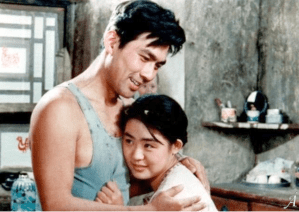
IYKYK: The Herdsman (Xie Jin & Huang Shuqin, 1982).

Back to top
Return to Book Texts contents


Book Texts – Autobio

MOVING PICTURE: WORLD’S SHORTEST PREQUEL

Floodwaters in certain parts of Sampaloc district would rise chest-high by grade-schooler’s proportions as recently as during the late 1960s, and my brothers and I would wallow through invisible potholes and visible sewage just to be able to get home in time to avoid alerting the household to our absence. It didn’t seem as depressing as it sounds, because soon as we got home we’d drop paper boats from the window sill and marvel at how automobile spillage would form rainbow-colored patterns amid the raindrops and waves. How to convey the values and dimensions of this primal aesthetic experience, beauty in detritus, has been the greater challenge of my work as film critic and teacher. Often my impatience has engendered a style that’s reflective of both aspects of such a childhood impression – didactic, I think, but with an incongruous informality. Formal college-level training dwelled on the incompatibility of the combination, and so my early work tended to assume the tone of Moses mandating monotheism on Mount Sinai, handing down revelations whose densities abhorred loose or open ends.

11011The further from academe I grew, the less self-conscious my notions of style became; at the same time I could not help but uphold the same standards for the works I selected for evaluation. With the inevitable maturation of my personal faculties, I somehow approached an ideal (rarely achieved, of course) of readability amid discourse complicated even for myself. Necessarily this involved periods of selectivity as well as rest and consolidation, but methinks the consequences are different for critics who rely on exigencies of artistic production, rather than artists who depend on critical evaluation; for in the final analysis, the artist could assume critical functions, at the very least for herself, while the critic can never really work in a vacuum, even (or perhaps especially) when working on theoretical issues.

11011I do badly regret not having come of age during the start of my self-proclaimed second Golden Age of Philippine cinema during the mid-seventies, although I suspect that more effective groundwork had been accomplished during the more turbulent pre-martial law years. As a college-fresh neophyte who honed my fangs on political and economic animadversions, I could draw from the likes of, say, Aliw and Aguila, but Manila by Night and Kakabakaba Ka Ba? from the same period seemed too intricate to unravel and too deep to reach then. I found sufficient leeway to try various approaches thereafter, but at the expense of otherwise praiseworthy attempts in Angela Markado and Batch ’81. And just when I decided to return to school, for which I had to hold down a job – both as full-time preoccupations, out came a full and consistent flowering of films, unaware even that late of the searing effect of the then-forthcoming February 1986 people-power uprising.

11011Only afterward could I graduate from chronicler to confident commentator, with the rather desperate optimism that, like what happened after the early post-martial rule dry spell, another Golden Age would not be long in following. Invariably my appreciation of paper boats and grease rainbows made the excursion through Manila’s bloodstreams worth the plunge. Along the way I could get my fill of doing retrospective commentaries, but then the best part consisted of divining what could come next and occasionally seeing it fulfilled in some form or other.

Alternative author’s pic for The National Pastime, taken by National Midweek official photographer Gil Nartea.

11011My list of great film-writers all have some profound contradictions crisscrossing their works, and this, more than anything else, makes reading them doubly difficult. Given the luxury of a lifetime, I’m sure I’ll be developing a few swivels and turnabouts here and there; already I know which of my past output, aside from the ones I’ve already mentioned, I could renounce in the name of personal progress, but meantime I did write them once, and became interested enough to stand by them even through the trauma of publication. So they appear as they do now, contextualized only by their respective dates of issue, in order to maybe show how far I’ve come (or gone), and perhaps qualify the shortcomings of the worthier items.

11011There’ll be an entire future to face, marked in the meantime by the impending close of the current century. Film, as I’d written elsewhere, will undergo further and radical transformations in terms of technology and approach, and what we consider Third-World practice is on an ascendency. There won’t be just floodwaters to cross, there’ll be entire oceans to swim, and though by then I might be sounding different, difficult even, I guess we’ll all be lucky, though we’ve long deserved it, to be where it’s at come the time.

[First published October 3, 1990 in National Midweek]

Back to top
Return to Book Texts contents

THE LAST OF LINO

The standard opposition in Philippine film culture between Lino Brocka and Ishmael Bernal existed mostly in the minds of film observers and practitioners who were invested in the stature of one or the other, despite the fact that both filmmakers expressed fondness for each other and engaged in, at its worst, a friendly rivalry. The differences between them unfortunately infested critical opinion, magnified in malignant proportion when European filmfest agents swooped into town and decided that the politically naïve director who nevertheless boasted of polished surfaces would be preferable to the campy and boisterous sophisticate who had a deeper understanding of and preference for Third-cinema traditions.[1] Although initially less threatening to his global marketers because of his reliance on generic Hollywood models and steadfast opposition to Ferdinand Marcos’s martial-law dictatorship, Brocka inevitably outgrew his mid-career orientation and made perceptible stabs at narrative complexity, thematic ambiguities, and spectatorial appeal – qualities that were associated with Bernal, just as Bernal made a disturbing turn into orthodox leftism. That both adventures were cut short before their protagonists realized what ends they would lead to is one of the many tragedies that, in the minds of many of us, confirmed the end of a significant era. This semi-autobiographical piece was originally drafted as the epilogue to my second volume of film articles, Fields of Vision.

My affinity with Lino Brocka became more literal than I could have ever imagined after he had died. My instinctive response was to declare a study of his works as master’s thesis topic, but I eventually had to face the fact that, apart from the formidable resources the attempt would require, this was also my way of evading the reality of the loss his death had engendered. Meanwhile I had requested my librarian mother to clip whatever biographical information was available, and it was she who discovered that Lino’s father’s first wife was the Bicolano Brocka that we were somehow related to. What impressed me was the distance between us – a remoteness that could only be bridged, had he still been alive, by a complex social formality. Strangely, it was such a formality that characterized the few interactions I had with him. The first time we were introduced, I had just published my first (and fortunately last) John Simon-inspired review, which happened to deal with his then-latest release, Angela Markado.[2] I’d been forewarned by accounts, from acquaintances and the media, of his temperamental responses to criticism, but we carried on as if I had commented on something as irrelevant to our concerns as the weather.

11011Maybe he understood my obsession with trying out as many approaches to film writing and analysis as possible; in any case, my encounter with him opened to me the possibility that the artists I was dealing with could be concerned with the same thing, differences in media practice notwithstanding. Having witnessed what Lino and his colleagues, in their pursuit of knowledge through praxis, had to endure from commentators who were more concerned with their own personal criteria of correctness than with the artist’s learning process, I had the dubious benefit of knowing right from the start that I was placing myself in a somewhat similar situation.

11011The interventions of history were of not much help either. The machinators of martial rule were clever – and I grant this as someone who was privileged to work within the Marcos administration – but they necessarily left little room for cultural sophistication, beyond the basic and ultimately frustrating application of guerrilla principles. Hence mass media were approached by their practitioners with an understanding reminiscent of First-World appreciation circa the 1950s, when US media institutions were both monopolistic and discomfortingly allied with government. Artistry in the classicist sense constituted the surest acceptable defense for subversive practice, so in general the more mass the medium (and therefore the more subject to establishment interests), the harsher the critique toward it; such a view also conveniently induced a critical attitude toward the government, since this was the entity that exercised control over media.

11011Practice in media was therefore regarded as compromise at best, and nowhere was this principle more in evidence than in film. Competition-oriented awards served to emblemize this essentially watchdog function, providing a much-needed alternative to financial and political incentives. The 1986 people-power uprising, in its dismantling of the structures of cultural patronage in film, similarly obliterated the modes of practice that were utilized to counter the excesses of the dictatorship. The question Who/What is the best artist/product of the season? (effectively akin then to asking who or what best embodied opposition to the dictatorship) has given way to Why should only one winner at a time be proclaimed in so many categories, why these categories in the first place, and why this set of winners at this time?

Back to top
Return to Book Texts contents

11011Using the development of Western critical thought as framework, I realized that entire schools had passed us by, in the meantime that we had to rely on early useful ones. One’s mission could then be facilitated by simply flash-forwarding (or should we say push-processing?) to the present, accepting contemporary theorists’ assertion that past approaches had proved flawed and were thereby generally dismissible. Other people had other ideas – Lino Brocka, for one. Where it would have been easy for him, given his international stature and local clout, to simply assimilate state-of-the-art competence, he preferred to run the gantlet in wooing back the mass audience that had accounted for his early triumphs in the industry. This meant a modification of his film-noir expertise and a whole lot of melodramatizations, so much so that prior to his resumption of foreign-financed production, he was being written off by most critical quarters as no better than the other Marcos-era talents, who were regarded as more decent in their preference for inactivity over crass practice.

11011Lino possibly had as many tragedies as there were who loved him. To my mind, his greatest was expiring right on the verge of what could have been an astounding artistic take-off, judging from the evidence of his last few serious local works: Hahamakin Lahat, Gumapang Ka sa Lusak, Sa Kabila ng Lahat, and the still-unreleased Orapronobis, plus the projects that had to be taken up by others – Huwag Mong Salingin ang Sugat Ko and Lucia and, in play form, Miserere Nobis and Noli Me Tangere; and these were just the ones that had already attained some measure of development – many more of equal or greater ambition were allegedly being considered. At no other time, in terms of his mastery of the medium and understanding of its mass appreciators, was he better qualified to stake a claim as major Filipino artist than when he bowed out. Many of us local critics managed to sharpen our faculties at the expense of Lino’s less-than-able output; but much more was lost to us by his death.

11011His own contribution to my convictions appears to be more lasting. I managed to somehow catch the tail end of formal awareness and appreciation of whatever media one happened to be interested in – film and literature, in my case. This has somehow enabled me to relate with a small and highly select number of local critics who extend their notion of praxis to include artistic production, inform their critical practice with an understanding or at least the pursuit of what constitutes effective expression in the local context, and believe in the importance of historical continuity for our specific purposes. One would think at first that between, say, a believer who comes in straight from the latest cultural theories and someone who exhibits the qualities mentioned above, the distinctions would be too subtle as to be negligible. Recent organizational practice, however, has demonstrated that the differences can be both salient and crucial.

11011In the final analysis, one needs to reckon with the current state of cultural maturity and proceed from there. Artists may be up for annihilation in the West, and well they may be, given the overly extended period of their ascendancy. But to impose the same attitude here, where people still exhibit difficulty in distinguishing true artists from bogus ones and cannot even always count on cultural institutions for assistance in this regard, would be tantamount to misguided zealotry. To go about busting canons is perfectly called for, if the canons have themselves been drawn up with the maximum possible systematization and thoroughness. But with all our available ones so far shot through with methodological imperfections, then the act of assisting in creating better ones first will prove more helpful in refocusing attention on issues of credibility, reliability, and defensibility. The critique of such a listing (of which I hope the ten-best survey appearing in this volume will be the first definitive one for Philippine cinema) will of course be more difficult and complex, but this only means a more advanced and rewarding discourse in the long run.

11011I could not always hope to convey the fun I had in what was in a sense a new adventure every time; I could certainly indicate here though the heavy-heartedness with which I accept that such a mode of practice cannot be sustained forever, at least not while our concrete local condition remains the way it is and has been for as long as I remember. Sometimes I still find it hard to believe that certain foreign practitioners have built careers on the basis of one or a few others of these occasionally all-too-easy attempts at film coverage and analysis, but then even Lino himself realized, sometimes to everyone’s discomfiture, that material existence was never always fair.

Back to top
Return to Book Texts contents

11011What comes after this work will, or at least should, strive to be something as different as this was from the first. It could be more tightly structured and cognizant of recent philosophical issues, or it could be either one or the other or nothing like anything I mentioned. Whether my colleagues in criticism like it or not, my cue has somehow already been set … by among others Lino Brocka, who never allowed anything humanly surmountable to get in the way of what could have been merely fun. What a way to go.

Notes

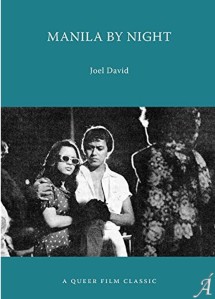
[1] It should no longer surprise observers from this period that the person being referenced here was Cannes Film Festival publicist and selector Pierre Rissient, who died in May 2018. Wolf Donner and Moritz de Hadeln, directors of the Berlin International Film Festival, were more appreciative of Third-cinema traditions – and therefore supportive of filmmakers like Kidlat Tahimik and Ishmael Bernal – but were far less influential than Rissient. I managed to mention a further so-far undiscussed issue in my monograph Manila by Night: A Queer Film Classic (Vancouver: Arsenal Pulp Press, 2017): “Brocka, like his serious films, was formal, reserved, and masculine in deportment; Bernal was boisterous, catty, inclined to camp, and effeminate. Although both acknowledged being homosexual, Brocka … went through a phase of being ‘discreet,’ forbidding queer behavior at the Philippine Educational Theater Association and quarreling with journalists who played up his gay inclinations. Whether this implies that homophobia played a factor in the Cannes festival’s gatekeeping is up to scholars of gender to tease out” (99n15).

[2] A problematic aspect of Lino Brocka’s personality, evident in the many interviews he granted and (mostly) compiled in the posthumously published volume Lino Brocka: The Artist and His Times (ed. Mario A. Hernando, Manila: Sineng Pangkultura ng Pilipinas, 1993), is that he refused to acknowledge any error that may have arisen in his filmmaking or real-life output. Yet his subsequent works would evince that he had reconsidered those same positions and was striving as best he could to rectify them. In the instance of his films panned by local critics, he would point out how foreign film festivals provided those specific titles with raves and prizes. Local reception to Philippine releases that bypass the process of securing audience patronage in order to garner overseas esteem has shifted considerably since then: filmmakers no longer need to evade censorship, and have been known to disparage Filipino audiences to court the sympathy of foreign commenters and viewers. It would certainly not be meaningless to speculate that Brocka, had he still been around, would be the first to repudiate this state of affairs.

Back to top
Return to Book Texts contents

ORDINARY PEOPLE: MOVIE WORKER

To commemorate its second anniversary issue, National Midweek announced an “Ordinary People” omnibus feature and asked four authors (including me, as well as Rudy Villanueva, Juaniyo Arcellana, and Melanie Manlogon) to detail our ironically non-ordinary experiences in the arena of labor. A rather cringe-inducing tagline, accompanying an inapposite TV studio setting, announced: “As continuity person, his work was to record everything that went on during the shooting. But he also carried camera equipment, made coffee for the star, parried the verbal abuse of irritable crew members. And he was a University of the Philippines graduate.” I loved my work at the magazine so much it didn’t matter. Curiously, the fantasy I expressed toward the end of the article – that of local film (and media) work acquiring a semblance of professionalism in terms of academic preparation – eventually came to pass, not exactly in the way I anticipated, but then such are the vagaries of fate. [Published November 4, 1987, on pp. 15-16.]

Midweek Movie Worker

Confession of the week: I was an ordinary movie person. Actually I still am, were it not for the impression that film commentators hold significant influence over the industry – a consensus held by most industry personalities including, not surprisingly, film commentators. But to get to the point: I once actually started wondering what all the hoopla over the position of film critic was. I’d been writing more or less regularly on local cinema since the turn of the decade, and had a membership (and occasional officer status) in the Manunuri ng Pelikulang Pilipino [Filipino Film Critics Circle], plus employment in the Experimental Cinema of the Philippines, to show for it.

11011Still, there remained that disturbing atmosphere during movie occasions – previews, premieres, parties, and other such assemblages outside of the physical processes of movie-making – that anyone who could be present only at the presentation of a work could not actually have been involved with it and was therefore, for all intents and purposes, an outsider. A critic, for that matter, got away with slightly better treatment, some form of deference really, that to my mind has lost its original basis for existence, but that ought to be another story.

11011So in 1984, when the University of the Philippines announced the opening of a bachelor’s degree in film – the first not just in the country but in the immediate Asian region as well – I lost no time in re-applying for student status at the mass communication institute which was handling the course program. (Not quite accurate: I lost an entire semester, having learned of the program’s existence exactly when the ’84-85 academic year started, too late to arrange for my return to school.)

11011I had the advantage of holding an earlier degree (journalism, batch ’79) at the institute, plus the determination to finish as fast as possible whatever the cost, and maybe the first batch wasn’t so appreciative of the distinctions in store; they pointed out my exemption from the thesis requirement (already fulfilled by my earlier degree), but I retorted to myself that, unlike them, I had to finish a final individual film project, which the program’s coordinators justified as my equivalent of a production thesis.[3]

11011Anyway there I stood, for more than a year the only qualified film applicant in the history of Philippine education, willing to undergo whatever it would take to make me a part of the movie system at last.

11011What lay ahead, I wouldn’t wish on my worst enemies. A major outfit sounded out a call for assistants in production, and as far as I knew, I was the only one who responded then. More than a month of follow-ups afterward, I finally got in – as an apprentice, I was forewarned, and for the rival of the company I had applied with. An apprentice, I was made to understand, gets free food but no pay, and is responsible for … well, whatever comes up during production. Break a leg then.

11011Someone who took charge instructed me to record everything that went on during the shooting – the blocking of everyone and everything on the set (including the lights), the position of everything that appeared in the camera viewfinder, the lines of dialog, the movement of actors, atmosphere people (a euphemism for extras), and physical objects, not to mention the usual details of date and sequence and scene numbers, location and performer(s) – for which I needed to continually refer to the script, a copy of which was provided me much, much later. Continuity, the job was called, although I distinctly recall carrying camera and related equipment, preparing coffee for a certain performer, and parrying the verbal abuse of several particularly irritable crew members. Plus I had to buy a stopwatch (I borrowed one instead) to time the individual takes, and reproduce as many copies of a certain form on which to keep my records.

11011I finally was able to plead for the reimbursement of the two reams of continuity forms that I had to mimeograph, and the film’s director, who provided me with invaluable recollections of the previously flourishing regional cinema with which he’d been involved, batted for a consolatory sum of money that the producers provided to defray part of my transportation expenses. At this point the creditors, who extended financial assistance so that I could be able to finish my second degree, were impatient for some material results. Without the benefit of clear thinking, I agreed to replace a would-have-been batch mate in a big-budget semi-period piece. As it turned out, the guy and his group mates edged me out in a more substantial fund-raising project, while the movie project I got into got shelved for alleged shortage of funds.

11011To the rescue came the muse I had abandoned. A colleague in writing, now into editing (while I was contemplating the feasibility of going insane), asked me to write for the publication she was handling. On what? I asked. The movies, she answered, since that’s where you’re now. I lay aside insanity for the moment but it arrived anyway in another form. The first production outfit I had applied with immediately after graduation this time offered me a respectable-enough designation in an out-of-town project. By then I was already making twice as much as the offer (which, I was assured, was already somewhat beyond standard rates) just writing for the publication and a television show on the side. When the movie I said no to got released, it made good box-office business and was reportedly its producer’s critical favorite, while the publication I had cast my lot with folded up and the TV show shut down.

11011Hope springs eternal even for those who never learn, but I’ll respect whatever way you interpret that: my alma mater somehow remembered it had an only graduate lying around (close to the literal sense) somewhere, who’d not only be the only academically qualified film worker in the country but also the only qualified film instructor as well.

11011So coming full circle now, what easier way to augment the predictably pitiful (but not for me, you bet) income that teachers receive? Why nothing else, or nothing less, than good old-fashioned semi-scholarly commentary on films. At least, this way I get to torment not only my students but my readers as well, and with a little bit of luck and a considerable amount of self-delusion, even the industry might consider restructuring its professional set-up in lieu of an oncoming onslaught by starry-eyed and financially secure film graduates – and doesn’t that add up quite logically, dramatically even, with this historical era of countless coup attempts? Anyway, till that moment arrives, I’ll be happy where I am. I guess.

Note

[1] After a few other (expected) false starts, the production thesis became a viable option in the eventually upgraded College of Mass Communication. Extremely few undergraduate candidates, in fact, choose the research option.

Back to top
Return to Book Texts contents

A CULTURAL POLICY EXPERIENCE IN PHILIPPINE CINEMA

The autobiographical voice can be used to upset stable notions of the subject. That voice can tell not only of the past but of the difficulties that fragment and unsettle the narrative flow. And against [a] rather generalized account of the problems inherent in speaking, the autobiographical voice may yield specific instances of struggle against the ideological centering of the subject. (Probyn 115)

The final account of an object says as much about the observer as it does about the object itself. Accounts can be read “backwards” to uncover and explicate the consciousness, culture and theoretical organization of the observer. (Willis 90)

Overquotation can bore your readers and might lead them to conclude that you are neither an original thinker nor a skillful writer. (Gibaldi and Achtert 56)

In 1982, at the age of 23, I was designated Head of the Writers Section of the Public Relations Division of the Experimental Cinema of the Philippines. Barely three years earlier I was in semi-hiding while finishing my bachelor’s degree in journalism at the University of the Philippines, on account of my aboveground involvement as managing editor of the student paper, which had run exposés on, among other things, the identity of the thrill-killer (a nephew of Ferdinand Marcos) of a UP student, as well as Imelda Marcos’s plan to raze down slum shanties (blamed in the Marcos-controlled press on arsonists) in order to construct recreation and commercial centers in their stead. I was also in charge of a propaganda unit of the student underground, and it was always ironically safer to assume that the military intelligence was aware of the fact, given the ease with which activist circles could be infiltrated. Upon getting my degree I was invited, along with a select few, to observe a newly opened guerrilla zone in the Cordillera mountains north of Manila; we had to carry arms, move along steep trails and cross the Chico River (whose proposed dam the Igorot and Kalinga tribes were opposing) by night, partake of the tribes’ viands consisting of insects, dog meat, and carabeef, and hide in rice granaries when the local militia raided the villages.

11011I backed out of my underground commitments after that experience, partly because I decided (as might be expected of a petit-bourgeois intellectual, as per classical Marxist prescriptions) that I much preferred to write, but also because the whole cause of our difficulties in the student movement – sudden shifts in assignments, reversals in criteria for evaluation, special projects without follow-up instructions – was laid bare for us by the New People’s Army officials who were our guides: the Communist Party of the Philippines was undergoing one of its most serious political upheavals ever, one which would result in a split between those who advocated the implementation of Mao Zhedong’s policy of encirclement of urban centers from the countryside and those who believed in carrying guerrilla warfare into the cities via assassinations of selected enemy targets (Abinales 40-43). I was too young to be overwhelmed by the implications of such challenges, but I also was not old enough to overcome my feeling of betrayal over the fact that such vital (and, I felt, life-threatening) information was withheld from me and my comrades, ostensibly to ensure our complicity with whoever happened to be in charge of our cell systems.

11011I therefore proceeded to undertake legit media freelance assignments, though I also had to avoid my earlier specialization in political and economic issues. Culture it had to be, then, which in Philippine terms is virtually synonymous with movies. True to my orthodox Marxist orientation, I preferred film reviewing to society-page reporting, and by 1980 I was invited to join the Manunuri ng Pelikulang Pilipino, which was then the only other award-giving body for local cinema, as opposed to the corruption-ridden Filipino Academy of Movie Arts and Sciences or FAMAS. About this time the eldest Marcos offspring, Imee, was negotiating with the MPP and the Concerned Artists of the Philippines, headed by such Marcos oppositionists in culture as Cannes Film Festival mainstay Lino Brocka, in order to get their cooperation in setting up the institutional support system that would become the Experimental Cinema of the Philippines. I got in through the recommendations of contacts in both the MPP and the CAP.

11011The fact that this was an activity that could fall under the rumpled rubric of cultural policy could not have occurred to me then. By the standards of the still-in-place Marxist-Leninist-Mao Zhedong Thought that I was coming from, I had compromised my ideals the moment I severed my links with the underground; anything I did aboveground, even in conjunction with people who might still have been in touch with subterranean personalities, was my own Cross to bear or nut to crack, mixed idioms notwithstanding. About a decade later, halfway around the world, I might have taken heart from Tony Bennett’s suggestion that

Cultural studies might envisage its role as consisting of the training of cultural technicians: that is, of intellectual workers less committed to cultural critique as an instrument for changing consciousness than to modifying the functioning of culture by means of technical adjustments to its governmental deployment. (Bennett, “Useful Culture” 83)

11011Bennett of course was drawing from a number of assumptions that had transformed certain principles that may have been originally attributable to Marx. In terms of my field of involvement, for example, Stuart Hall was already then writing that popular culture may be formulated in terms of “the people versus the power-bloc: this, rather than ‘class-against-class,’ is the central line of contradiction around which the terrain of culture is polarized” (238). Bennett’s take on this formulation of the field of contestation for the cultural activist would have sounded strange to any Marxist engaged in political tasks then: cultural policy, he declared, would entail cooperating with ideological state apparatuses (ISAs) “rather than writing them off from the outset and then … criticizing them again when they seem to affirm one’s direst functionalist predictions” (“Putting Policy into Cultural Studies” 32).

11011Philippine politics under martial law would have been reconcilable with this perspective, but only through a roundabout process. Genuine opposition then (as contrasted with the state’s series of official opposition parties) was divided between the so-called national democrats or natdems (an alliance comprising the CPP, NPA, and the National Democratic Front, a coalition of aboveground left-leaning organizations) and the considerably smaller circle of social democrats or socdems, identified with the also-then-outlawed Social Democratic Party. It would be possible to relate the agitation within the natdems to defy Maoist dogma by taking the revolution into the cities with the socdems’ better-funded and more visible Light-a-Fire Movement – i.e., first attempts at what the Marcos regime declared was urban terrorist bombings. Natdem support was Third-World-based, if China were to be taken on its claim to being part of the Third World, while the socdems, whom the establishment press branded as steak commandos, were living (it up?) in exile in the US. The natdem line on Marcos was that he was a US-supported fascist, while that of the socdem – in order to whip up US support – was that he was a Communist. In retrospect, and with a little stretching, both were technically correct: Marcos was as much a reactionary authoritarian who sanctioned the brutal oppression of disenfranchised groups (though this was minor compared with his other abuses), while his apparently pathological quest for affluence and system of crony capitalism led him to using fail-safe legal justifications for the takeover by government of the most profitable economic institutions in the country, converting these into monopolies.

11011Hence, if the Marcos regime were not Communist, as the socdems charged, but pseudo-socialist in terms of state control of capital, then would it not be possible to work out ways and means of furthering leftist ideals within, say, a receptive government institution such as the ECP? As I had already related, this way of thinking could never have occurred to me, and my guess is that it might have sounded, to use Fredric Jameson’s term in his reaction to Bennett, obscene to Bennett himself, had he found himself in such a context. This is not to dismiss however Bennett’s inquisition into the thorny/muddy (the Philippines is tropical) realm of cultural policy. Closer to what most of us then were sensing, and managed to confirm by our participation, was Bennett’s oral response to a conference question thus:

Even where the government – in the sense of the party in power – is conservative, it does not follow that the bureaucracies that they [sic] superintend function like seamless webs and that there are no contradictions within them…. One of the most instructive aspects of the experience of working with government cultural agencies is to realize that – whilst Althusser says they function via the category of the subject – some of them just don’t seem to function at all! There’s a real lack of coordination between different branches of government and this makes many openings that can be utilized. (“Putting Policy” 36)

Again, though, it would not be entirely accurate to say that Marcos’s martial-law machinery was as inefficient as all that – after all, the man had held onto the presidency for over two decades during which he (in a manner of speaking) singlehandedly made himself one of the richest men – and his wife the richest woman, per a 1980s Fortune edition – in the world at one point, while reversing an entire country’s status from the fastest-developing to the least developed in Southeast Asia. More to the point is the personalistic nature of Philippine social relations, traceable to the communal values of the country’s rural and tribal communities; among the first things about Filipinos that foreigners notice, for example, are (traditionalist) Filipinos’ unabashed tactility as well as embarrassment over the handling of wealth and private property – hence, to indulge the issue further, Marcos’s renown for having or forcing his way with women and his infamous concealment of his financial and real holdings.

11011As far as the ECP went, people were participating with ears attuned to the goings-on in Malacañang Palace, the presidential residence. It was consistently observable that Imee Marcos was as contemptuous of her mother as she was attached to her father. Imelda in turn was vocal about her desire to get some genuine European royalty interested in Imee; when the latter had an affair with a sportsman from an oppositionist family, who (to make matters worse) was married to a beauty queen who was widely speculated to have been one of Marcos’s conquests, things started falling into place. In a way, this foreshadowed the succession of hubris and stop-gap measures that characterized the assassination of socdem figure Benigno Aquino Jr. (hubris) and the call, under international pressure, for snap presidential elections (stop-gap) which resulted in the so-called people-power revolution of February 1986.

11011What happened in 1982 was the kidnapping of Imee’s lover, Tommy Manotoc, by the NPA, according to the military, though of course this was already getting recognized as a knee-jerk reaction on the part of the government (Aquino’s assassin, also assassinated, was to be similarly identified as a Communist gunman). Mysteriously, Imee got back both her man, in a crudely staged rescue mission, and the position of Director-General of the ECP – which everyone expected to be headed by Imelda or John J. Litton, her (and Jack Valenti’s) subordinate. Imee’s fulfillment in her role as wife and mother-to-be was something which both cultural activists (aligned in Imee’s camp) and Imelda’s loyalists sought to take advantage of; so long as Imee held the top position, however, it was “our” camp that mostly won out in the end.

11011On two levels, then, we at the ECP had to contend with Hall’s observation that

If the forms of provided commercial popular culture are not purely manipulative, then it is because, alongside the false appeals, the foreshortenings, the trivialization and short-circuits, there are also elements of recognition and identification, something approaching a recreation of recognizable experiences and attitudes, to which people are responding. (233)

Our admittedly not-conscious application of this principle had to do with both working within, through, or out of the range and breadth afforded by palace intrigues, and at the same time providing at least a semblance of actual support for the ECP’s constituencies whenever possible. The degrees of successful possibilities also varied between mother and daughter: in Imelda’s case I could only hope to put in a few words of universal encouragement to artists’ struggles against authoritarian systems in her Manila International Film Festival speech welcoming Xie Jin, then recently “rehabilitated” by the People’s Republic of China; in the case of Imee (who asked for material on extremely short notice), I could sneak in, for example, a promise that she would provide subsidies for independent film projects, then derived secret satisfaction in learning that some filmmakers called on her next day to seek fulfillment of her pledge. This was not to denigrate the symbolic achievement in marshaling Imelda’s MIFF, however. Despite Bennett’s claim that “the programmatic, institutional, and governmental conditions in which cultural practices are inscribed … have a substantive priority over the semiotic properties of such practices” (“Putting Policy” 28), it might be possible to re-assess the expulsion by Imee of the MIFF from the ECP as resulting in comparable status for both institutions, and providing the ECP with less of the goodwill (along with the notoriety of the Manila Film Center’s scaffolding collapsing on about 200 workers, many of whom had to be buried or killed in order for the construction to be completed on time) that the first MIFF had engendered.

11011In terms of the ECP’s camp (pun incidental) positions, then, the MIFF, as already mentioned, was Imelda territory, as were the Film Archives of the Philippines and the Film Fund, which provided subsidies for mainstream film projects. The service groups – public relations, where I functioned, and theater management – were in good hands, as far as we were concerned – meaning these were controlled and staffed by people from Imee’s circles in theater or the UP (where she and I were non-acquainted classmates before my activist years); more significant in terms of industry impact were the Film Ratings Board, which rebated the taxes of quality (measured according to plastic aesthetic worth) productions, and the Alternative Cinema Department, which produced full-length works by new directors and screened heretofore unavailable, censored, or banned foreign and local productions. One consideration in evaluating the efforts expended in attempting to implement progressivity in these areas is Hall’s admonition to avoid thinking “of cultural forms as whole and coherent: either wholly corrupt or wholly authentic. Whereas,… [in actual practice,] they play on contradictions” (233). Accordingly, it would be possible to say that, for example, the trend in sex films initiated by the MIFF, while denounced by both the censors and the left (including the MPP and the CAP), also made it possible for a number of filmmakers to come up with critiques of contemporary Philippine society using frameworks of social decadence (Scorpio Nights, dir. Peque Gallaga, 1985), protofeminist consciousness (Company of Women, dir. Mel Chionglo, 1985), or neocolonialist intrusions (Boatman, dir. Tikoy Aguiluz, 1984); moreover, in order to prove that the libertarian spirit applied to more than just sexual themes, previously suppressed films (notably Manila by Night, dir. Ishmael Bernal, 1980 and Sakada, dir. Behn Cervantes, 1976) were granted permission to be exhibited at the Manila Film Center. On the other hand, the breaks provided new talents by the Alternative Cinema Department also proved to be a mixed blessing, but in the opposite direction; the newcomers turned out to be either politically uncommitted or incapable of surviving in the industry at large. A more rewarding activity was the same department’s unofficial mobilization, along with the CAP, of film artists in a series of mass actions against censorship. The irony of one government institution agitating against another was not lost on the chief censor, the late Maria Kalaw-Katigbak, who promptly invoked the fact of her being a presidential appointee and therefore on the same bureaucratic level as Imee Marcos.

11011The Aquino assassination led to a number of responses: the abandonment by Imee of her ECP responsibilities (supposedly to concentrate on her legislative assignments, although it became clear eventually that she was preparing to emigrate with her new family); the defection of a number of key personnel – some to opposition media, others (including myself) to the government’s less high-profile media center; and, finally, the dissolution of ECP, to be reconstituted as the Film Development Foundation of the Philippines under Litton – an entity which set about screening quickie sex films without regard to their sources, and sending its officials to trips abroad to solicit support for an MIFF that was already announced as not forthcoming in the foreseeable future. One way – perhaps the easiest – of accounting for this ultimate instability in what has turned out to be the only largely positive contribution of the Filipino government to its film industry is to maintain that bigger political considerations overrode such smaller cultural concerns. This leads us to Jameson’s dissent with Bennett’s call for participation in ISAs, stemming from the former’s view that culture

is not a “substance” or a phenomenon in its own right, it is an objective mirage that arises out of the relationship between at least two groups. This is to say that no group “has” a culture all by itself: culture is the nimbus perceived by one group when it comes into contact with and observes another one. It is the objectification of everything alien and strange about the contact group. (Jameson 33)

From the preceding account we can discern that the “two groups” in Jameson’s stipulation did not, perhaps even could not, remain consistent over time: first were the us-and-them formation of the Imee-vs.-Imelda camps, which almost instinctively coalesced into the ECP vis-à-vis the higher government organ (constructible in this sense as the Office of the President of the republic) as a response to the Aquino assassination, leading in the end – of the Marcos dictatorship, that is – to a still-to-be-problematized government-vs.-the people/the opposition binary. This fluidity, in the delimited sense used here, somehow serves to confirm Ian Hunter’s critique of the implications of Hall’s concept of articulation:

The notion of a general struggle between contending classes or “rival hegemonic principles” over ideologies or cultural meanings becomes unintelligible. Instead of appealing to the ideological articulation (in either sense) of class interests, we must look to the differentiated array of organizational forms in which cultural interests and capacities are formulated, if we are to engage with the forms in which they are assessed and argued over. (Hunter 118)

11011Hunter poses an even more difficult challenge in cultural practice, especially when such practice is ongoing, when he opines that “It is necessary to abandon the ethical posture and forms of cultural judgment invested in the concept of culture as complete development and true reflection” (115); in the ECP experience, this became manifest in the concurrence between the MPP and CAP on the one hand and the Board of Censors for Motion Pictures, which in turn called on a then-oppositionist Catholic Church to denounce the proliferation of sex-genre films at the Manila Film Center. The puritanism of the left has continued to play into the hands of media-control advocates consisting of both commercialist producers and always-interested conservative politicians, including members of the clergy. The absence of any form of support (apart from box-office responses) for sex films resulted in the marginalization of both their production and distribution after the February 1986 “revolution” – i.e., they continued to be produced, but only as B-items for exhibition in provincial circuits that could not be restrained by the censors (who wield police powers) because, as Corazon Aquino’s censors chief alleged, these circuits were military-operated. What may be necessary here is therefore an appreciation, on the part of responders, especially those in academe, of the “play on contradictions” mentioned by Hall (233) in the continuing popularity of the sex-film genre, beyond its strictly pornographic dimensions.

11011A further direction – that of the spectator – is implied by Meaghan Morris in her consideration of colonialist interventions:

When the voice of that which academic discourses – including cultural studies – constitute as popular begins in turn to theorize its speech, then … that theorization may well go round by way of the procedures that Homi Bhabha has theorized as “colonial mimicry,” for example, but may also come around eventually in a different, and as yet utopian, mode of enunciative practice. However, I think that this can happen only if the complexity of social experience investing our “place” as intellectuals today – including the proliferation of different places in and between which we may learn and teach and write – becomes a presupposition of, and not an anecdotal adjunct to, our practice. (Morris 41)

What this in effect suggests is the creation of a divide, if necessary, between what Philippine academicians and the media (which is heavily influenced by representatives from academia) hold onto as moral even in their most radical political agenda, and what “the people,” properly problematized, believe anyway, as manifest in their insistence on such supposedly disreputable film fare as escapist fantasies, blood-and-guts violence, stops-out melodrama, and graphic sex outings. Simon Frith’s recuperatory reformulation of the high-low dichotomy might prove to be a more workable starting point, rather than the poststructural extreme of discarding all measures for excellence as implicated by their formulators:

If one strand of the mass cultural critique was an indictment of low culture from the perspective of high art (as was obviously the case for Adorno, for example), then to assert the value of the popular is also, certainly, to query the superiority of high culture. Most populist writers, though, draw the wrong conclusion; what needs challenging is not the notion of the superior, but the claim that it is the exclusive property of the “high.” (105)

11011Of relevance here might be the concept of subcultures, so as not to fall into the trap of homogenizing the movie-going masses:

The study of subcultural style which seemed at the outset to draw us back towards the real world, to reunite us with “the people,” ends by merely confirming the distance between the reader and the “text,” between everyday life and the “mythologist” whom it surrounds, fascinates and finally excludes. It would seem that we are still, like Barthes, “condemned for some time yet to speak excessively about reality.” (Hebdige 140)

While therefore it may be necessary to accept Jameson’s description of the intellectual’s necessary and constitutive distance from classes of origin and chosen affiliation, and from social groups as well (40), it would also be useful to consider the principles, rather than the prescriptions, that underlie Bennett’s pronouncements on cultural policy:

If we are to write an adequate history of culture in the modern period, it is to the changing contours of its instrumental refashioning in the context of new and developing cultural and governmental technologies that we must look. This is not to say that the changing coordinates of “culture’s” semantic destinies are unimportant. However, it is to suggest that these derive their significance from their relations to culture’s governmental and technological refashioning. (“Useful Culture” 77)

How these tensions apply to a Third-World context characterized by a triple form of neocolonial (US) political, (Japanese) economic, and (Vatican-State) religious dependence is the question that Filipino cultural activists will have to seek answers to. I could, to be flippant about it, complete my tour of these colonizing influences by visiting the Vatican; or, more seriously, I could return to the Philippines and assume once more a role in cultural policy, or remain in academe and provide critical responses to developments in local culture. Where I come from, I can only productively engage in one activity at a time. Like those of the Philippines, my (mis)adventures still have to be played out.

Works Cited

Abinales, P. N. “Jose Maria Sison and the Philippine Revolution: A Critique of an Interface.” Kasarinlan: A Philippine Quarterly of Third World Studies 8.1 (3rd qtr. 1992): 5-81.

Aguiluz, Amable IV, dir. Boatman. Scr. Rafael Ma. Guerrero and Alfred A. Yuson. AMA Communications, 1984.

Bennett, Tony. “Putting Policy into Cultural Studies.” Cultural Studies. Ed. Lawrence Grossberg, Cary Nelson, and Paula Treichler. New York: Routledge, 1992. 23-34, Discussion 34-37.

———. “Useful Culture.” Blundell et al. 67-85.

Bernal, Ishmael, dir. and scr. Manila by Night. Regal Films, 1980.

Blundell, Valda, John Shepherd, and Ian Taylor, eds. Relocating Cultural Studies: Developments in Theory and Research. London: Routledge, 1993.

Cervantes, Behn, dir. Sakada. Scr. Oscar Miranda and Lualhati Cruz. Sagisag Films, 1976.

Chionglo, Mel, dir. Company of Women. Scr. Raquel N. Villavicencio. Athena Productions, 1985.

Experimental Cinema of the Philippines. The Second Edition. Unpublished annual report. Metro Manila: ECP Public Relations Division, 1984.

———. Year One. Annual report. Metro Manila: ECP Public Relations Division, 1983.

Frith, Simon. “The Good, the Bad, and the Indifferent: Defending Popular Culture from the Populists.” Diacritics 21.4 (Winter 1991): 102-15.

Gallaga, Peque, dir. Scorpio Nights. Scr. Rosauro de la Cruz. Regal Films, 1985.

Gibaldi, Joseph, and Walter S. Achtert. MLA Handbook for Writers of Research Papers. 3rd ed. New York: Modern Language Association of America, 1988.

Hall, Stuart. “Notes on Deconstructing ‘The Popular.’” People’s History and Socialist Theory. Ed. Raphael Samuel. London: Routledge, 1981. 227-39.

Hebdige, Dick. Subculture: The Meaning of Style. London: Routledge, 1979.

Hunter, Ian. “Setting Limits to Culture.” New Formations 4 (1988): 103-23.

Jameson, Fredric. “On Cultural Studies.” Social Text 34 (1993): 17-52.

Morris, Meaghan. “Banality in Cultural Studies.” Logics of Television: Essays in Cultural Criticism. Ed. Patricia Mellencamp. Bloomington: Indiana University Press, 1990. 14-43.

Philippine Collegian. Weekly student newspaper. Quezon City: University of the Philippines, 1978-79.

Probyn, Elspeth. “True Voices and Real People: The ‘Problem’ of the Autobiographical in Cultural Studies.” Blundell et al. 105-22.

Willis, Paul. “Notes on Method.” Culture, Media, Language. Ed. Stuart Hall, Dorothy Hobson, Andrew Lowe, and Paul Willis. London: Hutchinson, 1980. 88-95.

Back to top
Return to Book Texts contents

SMALL WORM, BIG APPLE

Commissioned by a student publication during my exchange stint in Korea. I knew then that other folk would be paying attention, so I did a roundabout way of name-dropping the previous foreign locale I’d lived and worked in.

I could have been one of the many jinxes that started upending the Paradise that was New York City since the nineties. The World Trade Center was first bombed a few months after I arrived and collapsed a few months before I finally left for home. A demented tourist shot a number of sightseers at the observation deck of the EmpireState building – a structure that loomed right outside the office where I worked for almost eight years. An unemployed immigrant also shot several passengers on a train leaving the city for the suburbs. The stock market plunged twice, first because of the Asian economic recession, then because of the overvaluation of dot-com shares.

11011In all instances except the last, foreigners were considered responsible for what happened. Yet this was one of the contradictions about living in that city, as opposed to living elsewhere in North America: everyone there was a foreigner, or had descended from one. Of course virtually all Americans are non-native, but it seemed that only when they get to New York do they care to point out how, at some point in the past, they actually belonged elsewhere.

11011The place had a certain way of exacting payback. I was supposed to be able to finish my studies, my share of the all-American dream, through the all-American method of working hard. What didn’t show up in the equation was that the money I’d earn, the largest I’d ever make in my life up to that point, would amount to less than nothing in the face of the exorbitant cost of living. I eventually wound up with my graduate degrees, plus a few thousand dollars’ worth of student loans.

11011In the face of such an unwelcome and unmitigated disaster, how did I manage to muddle through? If I thought then, as I do now, that the place was just as badly (or even worse) hit than I was, that would have been no consolation. Once I left the city, I’d have to wait out two years working in the Philippine national university before I could find a job that paid decently enough to pay off the loans.

11011The answer would be self-evident enough to anyone living in New York. The place itself has enough talent and diversity to make even the poorest resident occasionally feel lucky to be alive. A master violinist from a major Chinese orchestra, a black doo-wop trio with remarkable timing and perfect harmony, a female performance artist who could assume unusual poses for long stretches, Peruvian musicians invoking the Andes through their charango and panpipes, and so on … and these were just the characters one could encounter performing for loose change in the subway.

11011When the major opera houses announced their new seasons, I’d be in line for my student-priced tickets, each one a tenth of what a Broadway musical would cost me. One of the little secrets of long-time “cultured” New Yorkers is that they never go to Broadway, only to the opera, although my reason for attending was that I was a student of the spectacle (of cinema, but before that, historically speaking, there was only the stage). When my out-of-town friends would insist on Broadway shows then complain about how backward the stories were and how old-fashioned their politics played out, I’d try to convince them to try an opera, which would have the same brand of outmoded ideological positions, but with better music, finer singing, and grander staging. Besides, I’d say, Broadway’s origins lay in a lesser form, the Viennese operetta. No go, though; seemed like people in the rest of the world would not respect any of their friends who went to New York and spent their time on presentations that did not feature pop stars and current music.

11011I always envied those who’d been to the great museums of Europe, but every so often the New York institutions would mount retrospectives that would be the equivalent of the usually-dead artists coming back to rework their magic: Joan Miró, Jackson Pollock, Robert Rauschenberg, the circle of French surrealists, and of course the shock artists whose exhibits Rudy Giuliani attempted to thwart. In my specialization, I’d taken the number of free and discounted film screenings so much for granted that, when my home university asked me for my first-year viewing list, I was amazed to jot down, based on my notes, brochures, and tickets, over 300 titles of the widest possible array of movies, from high art to trash, from festival favorite to disreputable pre-Disneyfied Times Square run, from fun genre sample to structural-materialist cerebration (my favorite, which I made sure to watch twice in its entirety, was two hours of Michael Snow whirling his camera on various axes from atop a Canadian mountain).

11011There’d be food my friends and I would treat ourselves to when we had the spare funds, categorized according to nationality: Greek (authentic but also occasionally the code word for all-around New York diner), Italian, Mexican, French, Spanish, Ethiopian, Malaysian, Indian, Korean, and the always-reliable Chinese. Wines could be found for as low as $3 a bottle, so I could indulge my alcoholic depression by pretending I was learning vintage and vinification.

11011All in all the range and breadth of distractions would be enough to make you believe the place was worth living in despite its inadequate services and pugnacious population (and hey, I was one of them too for a time). Enough to sometimes forget what you originally came for, in fact. The first time my late father saw me again, he said: “I can’t believe it – I never thought I’d live to see the day when you grew old.” He said I reminded him of Rip van Winkle, a New York character created by a New York author. And at that point I knew the dream was over. I was finally back home.

[First published May 2, 2005, as “Growing Old in New York (Or Small Worm, Big Apple)” in The Hallym Post]

Back to top
Return to Book Texts contents


Book Texts – A Second Golden Age

When Ishmael Bernal used the exact same term “Second Golden Age” in his last major interview, with Aruna Vasudev (16-23), I knew that it had effectively supplanted Bienvenido Lumbera’s coinage “New Philippine Cinema” in his “Problems in Philippine Film History” (193-212).[1] Not that that was my intention though; in fact I deliberately maintained a non-titular preference for the uncapitalized “second,” even though I succumbed to standard capitalization practice later. The essay was the opening salvo (to use Patrick D. Flores’s review description) in a series of provocations that I was hoping would initiate productive, even dissentious, exchanges. Yet even the negative responses to The National Pastime seemed willing to accept, or maybe reluctant to question, the premise behind the assertion that the martial-law era ironically provided a fecund playing field for cinema, or shall we say Ciné-mah.

11011My own attempt at questioning the Golden Ages idea was (to me) too late, too rushed, and too reasonable (see “The Golden Ages of Philippine Cinema: A Critical Reassessment”), even if it also happened to be the first to do so. On the other hand, my elaboration of the aesthetic issues raised in the present article (via Fields of Vision’s “The ‘New’ Cinema in Retrospect”) appears increasingly defensive and interminable, the longer I look back on it. Nevertheless I submit that the following article encapsulates Marcos-era film policy and its overall-favorable impact on film practice, as well as film observers’ urgent need to find useful historical frameworks for further applications (and incidentally, to fellow Nora Aunor fans: “Performances of the Age” is only a section of the present article, not a stand-alone write-up). “A Second Golden Age” was originally published in the October-December 1989 issue of the Cultural Center of the Philippines journal Kultura (pp. 14-26 – p. 14 is below), then edited by Bien Lumbera; its title was modified by the publisher of The National Pastime (where it appeared on pp. 1-17) to include the parenthesized phrase “An Informal History.” To jump to later sections, click here for:


Click the pic to open a PDF scan of a photocopy of the original article.

Talk has been current, but not ardent enough, about the recent conclusion of a second Golden Age in Philippine cinema. Of course the notion of a Golden Age has its share of reputable disputants. No less than Eddie Romero, who surged forward at the start of what may be considered our filmic Golden Age II, cited ancient Greece in claiming that no such period of clear and concentrated artistic achievement could be reasonably circumscribed anywhere. On the other hand lies a just-as-ancient necessity of defining parameters for purposes of easier classification and, more important, to enable contemporary observers to draw significant lessons therefrom. Presuming that Golden Ages do exist, no other period becomes more needful in finding out how and why they do than that immediately following the conclusion of such a one.

11011More to the point of Romero’s argument, however, would be the obvious difficulty in pinpointing specific periods of artistic productivity. The flowering of Athenian culture could be studied intensively within the context of entire centuries of ancient Greek life; true, certain important artists and philosophers were contemporaries of one another – but this was more of the exception, the rule being one major practitioner being followed, chronologically speaking, by another who would either break away from the elder’s school or tradition, or venture completely on her own in a new, unpredictable direction.

11011The soundness of Romero’s assertion actually derives from the fail-safe construction of his logic. Nothing in human history can ever compare to the Greeks’ cultural exploits – and so, if we grant that they never had a Golden Age, then there never could have been any such thing since. Rather than despair over our modern-day limitations in the face of such insurmountable criteria of excellence, I believe we could do well enough in assessing ourselves for more sober, though perhaps less immortalizing, reasons. By this account a Golden Age need not be a wholly intensive and sustained national outbreak of cultural creativity. A limited period in a specific field, defined according to the concentration of output relative to periods preceding and succeeding it, should prove adequate for the moment.

Back to top
Return to Book Texts contents

Golden Age I

The first Golden Age in Philippine cinema has had slightly varied reckonings of its exact duration.[2] All, however, agree to the inclusion of the entire decade of the 1950s. The most important feature of this period was the political stability brought about by postwar reconstruction and the aggressive suppression of the Communist insurgency, paralleled in film by the stabilization of the studio system.

11011That this phase ever came to a close indicates the short-sightedness of the solutions being applied. Reconstruction commits itself only to the attainment of a previous level of accomplishment (in this case the prewar situation), whereas insurgency addresses itself to the overthrow of a government on the basis of a problem – agrarian reform – more persistent that its leaders’ understandable aspirations to political power. The movie industry’s studio system, in seeking to institutionalize professionalism and (incidentally?) control the means of distribution, overlooked the natural inclination of talents, including stars, to seek more abundant means of remuneration outside the system if necessary, as well as the willingness of independent production outfits to forsake the studios’ long-term advantages and meet the demands of talents in return for faster and more immediate profits.

11011Hence the interval between the first and the second Golden Ages saw the rise of the independents and the superstars, backgrounded by the revitalization of the peasant-based insurgency and an engineered economic instability that paved the way for the imposition and eventual acceptance of fascist rule.

Back to top
Return to Book Texts contents

A Near-Golden Age

The declaration of martial law in 1972 promoted hopes for an end to the country’s political and economic difficulties. It also may have forestalled a creative resurgency in local moviemaking, brought about through a subsequently admitted social experiment by censors chief and presidential adviser Guillermo de Vega, who was later assassinated under mysterious circumstances.

11011A casual view of the products of the pre-martial law seventies reveals what we might have been headed for: socially conscious and psychologically frank products, without a compulsion to alienate the vast majority of moviegoers, even in the most artistic instances. Apparently neutral or even antipathetic projects actually allowed for a lot of leeway in the selection of material and permutations of form and expression. Most significant was the proliferation of bomba or hard-core sex films, the direct result of de Vega’s extreme libertarianism; but just as important were the counter-reactions, the musicals and love triangles, that provided relief in opposing formats, even for serious practitioners. Moreover, regional (Cebuano-language) cinema had mellowed at the latter portion of a wondrously long curve, providing assurances of alternatives for Manila-based practitioners (which included Emmanuel H. Borlaza and Leroy Salvador), as well as an additional stable for the recruitment of onscreen talent, notably the Amado Cortez – Gloria Sevilla and Eddie Mesa – Rosemarie Gil clans.

11011Ismael Bernal came up with the last major black-and-white Filipino film and the most important debut of his generation with Pagdating sa Dulo. Lino Brocka, who was to share with Bernal the rivalry for artistic supremacy in the Golden Age that was to come, rebounded quick with a pair of highly inspired komiks-adapted titles for his studio base, Lea Productions, namely Stardoom and Tubog sa Ginto, plus an otherwise effective Fernando Poe Jr. epic, Santiago. This era, rather than the mid-seventies as commonly supposed, also signalled the maturation of Celso Ad. Castillo. In another Poe-starrer, Asedillo, as well as in a horrific bomba entry, Nympha, he exhibited a fascination for unconventional visual values and thematic daring, properties that were to serve him well during the latter part of the decade.

11011Other names associated with academe- and theater-based artist circles made their mark with relatively serious attempts, including Elwood Perez with Blue Boy and Nestor U. Torre with Crush Ko si Sir. Perhaps more significantly, a number of scriptwriters who were to figure prominently during the forthcoming Golden Age first emerged here, with either solo or shared credits: Torre with his debut film, Bernal with Luis Enriquez’s Ah, Ewan! Basta sa Maynila Pa Rin Ako!,[3] and Orlando Nadres with Tony Cayado’s Happy Hippie Holiday. Brocka, after writing for Luciano B. Carlos’s Arizona Kid, provided breaks for several scriptwriting aspirants, among them Nadres with Stardoom, Mario O’Hara with Lumuha Pati mga Anghel, and Alfred Yuson with Cherry Blossoms.

11011Right after Marcos’s martial-rule clampdown, and in a sense a consequence of the aforementioned near-anarchic (and therefore procreative) bent, came names like Peque Gallaga and Butch Perez with Binhi, Romy Suzara with Tatlong Mukha ni Rosa Vilma, Jun Raquiza with Dalawang Mukha ng Tagumpay, and George Rowe with Paru-Parung Itim, Nora Aunor’s first production, serious film, and (it wasn’t to be the last such combination) box-office flop. Rolando Tinio wrote for Bernal’s Now and Forever and Ricardo Lee, using the pseudonym R.H. Laurel, for the late Armando Garces’s Dragnet.

Back to top
Return to Book Texts contents

Pre-Golden Age II

Critics currently carping at the discernible decline in the quality of film output relative to the period prior to the 1986 revolution should actually have more to be grateful for, aside from the usual evolutionary benefits of better technology and more formalized media, even film-specific, education. At least an excess of film awards, a heritage of the just-concluded second Golden Age, ensures that truly deserving products will now have a greater chance of acquiring recognition, no matter how belated. In the first half of the seventies all we ever really had was the Filipino Academy of Movie Arts and Sciences (FAMAS), then suffering a downswing in sensibility from which it has never fully recovered; and so, despite the long list of titles mentioned above, its early seventies best-film winners were forgettables like Kill the Pusher, Mga Anghel na Walang Langit, Nueva Vizcaya, and Gerardo de Leon’s regrettable Lilet.

11011Keeping the faith were Bernal, Perez, and Joey Gosiengfiao with their usually combinative Sine Pilipino/Juan de la Cruz Productions; Castillo with his horror films; Raquiza with his thrillers; Suzara with his sober dramas; and Nora Aunor with her admirable acting vehicles, including the only project that could boast of crediting both de Leon and Lamberto Avellana, the omnibus Fe, Esperanza, Caridad.

11011It was Brocka, however, who returned from a period of inactivity with two productions that combined the then-impossible characteristics of being both major and personal, Tinimbang Ka Ngunit Kulang in 1974 and Maynila: Sa mga Kuko ng Liwanag in 1975. The direct beneficiaries of this renewal of artistic consciousness in film included Brocka himself, with his three-in-one Tatlo, Dalawa, Isa; Perez with his three-in-one Isang Gabi, Tatlong Babae!; Gosiengfiao with the last Filipino black-and-white movie La Paloma, ang Kalapating Ligaw; Castillo with his careful revivification of the bomba (later to be called “bold” and initiated with the wet look) in Ang Pinakamagandang Hayop sa Balat ng Lupa; and Bernal with Mister Mo, Lover Boy Ko.

Back to top
Return to Book Texts contents

Golden Age II: Beginnings

Maynila could properly serve as the marker for the second Golden Age of Philippine cinema. It was a more precious and accomplished work than the same director’s Tinimbang, and ushered in a tendency toward new talents and novel projects that was to intensify in the coming year. Brockas’s triumphs, overwhelming even the FAMAS, can be regarded as the conclusive cause, especially in the light of his current and still single-handed renewal of filmic consciousness, this time on an international scale, with his post-’86 works Macho Dancer and Orapronobis.

11011There are, however, other attributable semi- or even non-industrial reasons for the phenomenon. The relative sanguinity brought about by the sudden infusion of foreign loans (before these assumed malignant proportions), coupled with the enforced stability of early martial rule, encouraged several newly prosperous entities to invest their money in a business that could be both glamorous and profitable. The youthful mass audience of the early seventies was prepared for a divergence and diversification of its favorite diversion, which was to culminate in a sophistication of its command of visual language that may still be extant at present. De Vega’s widow, Ma. Rocio, took over after his death and, for some reason or other, saw fit to return to his pre-martial law policy of libertarianism – which the military was to exploit as an excuse for its small-scale takeover of film-censorship prerogatives.

11011Maynila’s impact was meanwhile long-ranging enough, boosted as it was by the earlier success of Tinimbang, and a whole new breed of filmmakers came to the fore; in chronological order: Lupita Concio (later Kashiwahara) with Alkitrang Dugo, Eduardo Palmos co-directing Saan Ka Pupunta, Miss Lutgarda Nicolas?, Behn Cervantes 1976’s first debutant with Sakada, O’Hara with Mortal, Dindo Angeles with Sinta! Ang Bituing Bagong Gising, Gil Portes with Tiket Mama, Tiket Ale, sa Linggo ang Bola, and Mike de Leon with Itim.

11011And these were just the ones who either started big or had major follow-up projects. A cursory look at the 1976 Filipino filmography would reveal a handful of other new names which would probably be of interest to those determined to delve deeper into the dynamics of the period. Again, however, the writers ought to sustain more productive study than the also-rans: Clodualdo del Mundo Jr. was responsible for the adaptation of Maynila from the novel by Edgardo Reyes, who himself was to cross over presently into the medium with Bernal’s Ligaw na Bulaklak. Preceding them were newsmen Antonio Mortel and Diego Cagahastian, who co-wrote Mister Mo, Lover Boy Ko, and fictionists Alberto Florentino and Wilfredo Nolledo, who were to be joined shortly by Jose F. Lacaba in Gosiengfiao’s omnibus Babae … Ngayon at Kailanman. Mauro Gia Samonte was to write for Castillo’s Tag-ulan sa Tag-araw, Jorge Arago for Bernal’s Nunal sa Tubig, and Marina Feleo-Gonzalez for Kashiwahara’s Minsa’y Isang Gamu-gamo. Lamberto Antonio collaborated with O’Hara on Brocka’s Insiang, Roy Iglesias with Eddie Romero on the latter’s Ganito Kami Noon … Paano Kayo Ngayon?, and Gil Quito with del Mundo (and Ricardo Lee without credit) on Mike de Leon’s Itim.

11011Sakada would have been the military establishment’s typical target for repression, but it unfortunately enjoyed the endorsement of de Vega; Danilo Cabreira’s Uhaw na Bulaklak, Part II served the purpose even better, deflecting as it did potentially confrontational politics toward the issue of moral rectitude; typically again, both titles had new writers—Lualhati Bautista and Oscar Miranda (with an uncredited Reuel Aguila) for the former, Franklin Cabaluna for the latter.

Back to top
Return to Book Texts contents

Guideposts for the Times

Three developments, all of the same kind, served to temper the disheartening reality of the military’s assumption of local film censorship. The fact that the reconstituted body announced itself as “interim” in nature, implying an eventual return to civilian rule, was belied by its initial action of enforcing stricter measures, to the point of requiring the approval of storylines and screenplays and imposing a code that seemed deliberately directed against the output of serious practitioners. An entire catalog of anecdotes, sometimes humorous and often infuriating, primarily comprising dialogs between military censors and intelligent film practitioners, awaits documentation and will definitely help in particularizing the naïveté and arrogance of Filipinos suddenly imbued with power and influence.

11011The already mentioned developments actually consist of the introduction of award-giving mechanisms by three sectors that were to make bids of varying degrees of urgency on mass media in general, and film in particular: the Catholic Church, government, and intelligentsia. The Catholic sector, in reviving its Citizens’ Award for Television, expanded it to encompass locally existent media of communications. Significantly, the first best-film winner of the Catholic Mass Media Award was Nunal sa Tubig, which had seen rough sailing with the censors. The government, for its part, centralized all the annual city festivals in the newly organized metropolitan area in one major undertaking held during the lucrative spell between Christmas and New Year. The first few editions were either idealistic or disorganized or both, so that sensible film producers tended toward a policy of reserving prestige productions for this season. Despite occasional protestations from the bloc of foreign-film distributors and an ill-advised attempt to require developmental messages during the late seventies, the Metro Manila Film Festival (MMFF) has endured as the government’s singular contribution to the pursuit of quality in local cinema, its awards being coveted not so much for the prestige they bestow as for the free and favorable publicity they afford otherwise commercially imperiled releases.

11011The third, and for our purposes the most important, film awards for this period consist of those handed out by the reviewers’ circle, the Manunuri ng Pelikulang Pilipino (MPP), organized in 1976 and barely in time for the first flowering of the second Golden Age. The Urian awards, as these were called, served to recall and amplify the impact of the first MMFF in their echoing of the latter’s best-picture choice, Ganito Kami Noon. In fact the FAMAS, so as not to be left too far behind, selected another MMFF entry, Minsa’y Isang Gamu-gamo, for its top-prize winner, and observed the Urian’s dark-horse selection of Nora Aunor as the year’s best actress for her performance in her latest flop-production, O’Hara’s Tatlong Taong Walang Diyos. The Urian remained the most serious award-giving body for the most part of its first decade of existence, employing a system of viewing assignments, repeated screenings, and exhaustive deliberations that would have proved perfect had it been implemented conscientiously and consistently. Whatever the turnout of the MPP’s choices for any given year, the fact remains that its nominations were generally reliable reflections of the industry’s achievements in the medium, and thereby serve as better indicators of the state of the art than the awards themselves.

11011This point was to be driven home as early as the next year of its existence. Where the MMFF actually defied the cultural establishment, which responded by withdrawing the prizes it handed out to Castillo’s Burlesk Queen, the Urian responded against the film as a representation of the MMFF’s process, selecting an academically defensible but less artistically vital entry as its year’s winner, and coming around to the Burlesk Queen filmmaker by awarding his next-year entry, which like the previous year’s winner was period and epic in scope. Such subjectivity of vision, coupled by a preference for underdog nominees, prompted Brocka, the fourth best-director awardee, to castigate the group and reject its future commendations. Nevertheless, as mentioned earlier, the MPP’s process right up to the deliberation of prizewinners was refined enough to ensure the accommodation of accomplishments that were major by the reasonably highest possible standards of filmic evaluation.

Back to top
Return to Book Texts contents

Four Peaks

By this account it becomes evident that the performance output of the local film industry’s best and brightest tended to observe peaks and valleys, instead of a consistent (and therefore easily predictable) plateau or slope. The first was of course the already described beginning, that yielded Maynila on one end and Ganito Kami Noon on the other. The second was a good four years after, when the highest artistic point of the Golden Age and, by reasonable extension, of Philippine cinema thus far, was attained with Bernal’s Manila by Night. Afterward major-status entries on the order of Bernal’s innovations with filmic milieu arrived with regular frequency, with Marilou Diaz-Abaya’s Moral two years later; Brocka’s Miguelito: Batang Rebelde still another three years after would close the era, curiously with the same director who helped open it.

11011This regularity of productivity was in fact cut short by the 1986 revolution, in much the same way that Proclamation 1081 ended the early seventies’ creative outbursts. Sociopolitical upheavals may be the most obvious, but definitely not the only, similarities between the periods in question. Prior to 1986, as before 1972, an era of moral permissiveness held sway in cinema. Immediately after the upheavals, audiences tended to shy away from moviegoing, and had to be lured back with blatantly commercial products that all but outlawed conscious attempts at artistry. The second Golden Age in this regard was distinguished by some of the riskiest filmmaking projects in local history: during the turn of the decade, one movie after another vied in laying claim to being the most expensive Filipino production ever, with audiences seemingly willing to reward these efforts if only for the sheer audacity of the claims.

11011Each artistic peak mentioned, in fact, also had clusters of other big-budget, even period productions attending it. Maynila was period by necessity, since early martial rule forbade derogatory references to the Marcos regime;[4] Ganito Kami Noon combined an ideological concern – the origin of “Filipino” as a historical designation – with the period of its metamorphosis, the transition from Spanish to American colonial rule. Romero was to further flesh out his pursuit of the identity of the Filipino with some other big-budget and period titles: Aguila, which covered the current century; Kamakalawa, which was situated during the pre-Spanish mythological era; and Hari sa Hari, Lahi sa Lahi, which was begun during but released after the Golden Age, and set also during the pre-Spanish era of regional trade relations. None of these other movies attained the balance between technical competence (Aguila would have been the closest) and storytelling superiority (Kamakalawa excelled only in this aspect) manifested by Ganito Kami Noon, and meanwhile Romero, who was a movie-generation removed from Brocka and Bernal, was exceeded in medium-based modernization by the practitioners who were to follow.

11011Brocka, on his part, responded to international exposure with a deliberate and sometimes disconcerting minimalization of his filmic abilities. Insiang, Jaguar, Angela Markado, Bona, PX, Cain at Abel, and Bayan Ko: Kapit sa Patalim (in order of release) all may have followed Maynila chronologically, but actually antedate it in terms of the filmmaker’s capability of matching sweeping social concerns with an appropriately expansive vision. Aside from this, their distinction of having had international exposure in various festival venues here and abroad could perhaps only develop a case for Brocka as an auteur in the now-conventional sense of the word, where one work will have to be viewed in relation to all the rest before it could be appreciated. Miguelito, on the other hand, as a vastly improved reworking of Tinimbang Ka, is a contemporary but still-critical view of the body politic with its social and, more important, dramatic distensions intact, rather than deflated to microcosmic dimensions as Brocka had been wont to do in the case of the other films.

11011Bernal benefited the most from the effervescence of this period, mapping out a strategy that may have seemed erratic during the time but which denotes in retrospect the most impressive directorial figuring out and working over of the medium since Gerardo de Leon adopted the principles of deep-focus realism. Like de Leon, Bernal proceeded to adopt a foreign trend, this time the then-emergent character-based multi-narrative process, first experimenting with limited success in Nunal sa Tubig then introducing commercial elements on a more modest scale in Aliw. The greater profitability of the latter, in terms of both audience and critical reception this time, most likely emboldened him enough to return to large-scale businesses in Manila by Night, which in turn may have overstretched his technological capabilities somewhat but also served to accommodate his contributions to an international filmmaking mode, in a way that de Leon never managed to.

11011Manila by Night in effect proved that a personalized and multi-stylized approach to this manner of presentation of subject matter was possible, and that the filmmaker could choose to oppose the expectation of a final and logical conclusion and still justify an open-endedness in terms of his material. After such an accomplishment a more conventionalized orientation overtook Bernal – one that drew from the domestic dramas and comedies he directed prior to Manila by Night, the most memorable being Ikaw Ay Akin. His only other epic-scale project since, Himala, recalled Nunal sa Tubig in its choice of material (the eternal countryside, as contrasted with the contemporary big city in all of his other films), but the treatment this time observed classic unities rather than the versatilities which had brought him attention in the first place. Bernal’s other multi-character projects fared even less triumphantly, among them Ito Ba ang Ating mga Anak?, Working Girls, and The Graduates. A Working Girls sequel, released after the Golden Age, so dismayed everyone involved that Bernal has since tended to inhibit himself from such ventures, concentrating instead on small-scale projects where he had considerable success right after Manila by Night: Relasyon, Broken Marriage, and Hinugot sa Langit, among others.

Back to top
Return to Book Texts contents

New Generation

Expediently for Brocka and Bernal, as well as Romero and, in a sense, Castillo before them, the second Golden Age lent an aura of legitimacy to the infusion of new blood into the system. Early on Mike de Leon and O’Hara persisted with always prestigious and occasionally remunerative projects; with the arrival of the eighties, the splashy debuts of women directors Marilou Diaz-Abaya and Laurice Guillen recalled the heyday of Kashiwahara, then already inactive.

11011It was Peque Gallaga, however, who demonstrated that even newcomers could buck the system and turn it to their advantage: first he won the scriptwriting contest of the Experimental Cinema of the Philippines (ECP) for the storyline proposal of Oro, Plata, Mata, then acquired the right to direct it, and saw it right through copping a special jury prize from the Manila International Film Festival (MIFF) as well as major Urian awards, including best film. Curiously, however, succeeding aspirants could not duplicate Gallaga’s procedure; the closest anyone came to doing so was in using the ECP venue, the Manila Film Center (MFC), as Tikoy Aguiluz did for Boatman, rather than directing ECP productions, as Pio de Castro III and Abbo Q. de la Cruz were to discover after finishing Soltero and Misteryo sa Tuwa respectively; in this instance the dynamics of governmental support for the industry supplied the causative factors, and a thorough investigation of the matter would yield invaluable lessons for the future.

11011Before Gallaga’s virtual one-man coup, the female directors managed to call attention to themselves as viable entities; but how much of the appreciation was prepared by prevalent feminist sentiments still has to be quantified. Guillen had a modest and well-appreciated hit with her first film Kasal?, then after a box-office trauma went on to a more notable achievement with Salome, which won the Urian best-film prize. Diaz-Abaya, on the other hand, saw her first production, Tanikala, sink to the depths of anonymity – and her investment along with it, but rebounded vigorously enough with the MMFF multi-awardee and box-office placer Brutal.

11011In common with the early ascendency of these two was their scriptwriter, Ricardo Lee. Coming from a shared distinction (with Jose F. Lacaba) for Brocka’s box-office bomb but Urian winner and Cannes Film Festival competition entry Jaguar, Lee had his first solo masterstroke with Brutal and followed up in an even bigger way with Salome. His association with Bernal cemented as consultant for Manila by Night and writer for Ito Ba, Relasyon, and Himala, he proceeded to devise a female-humanist (typically mistaken for early-wave feminist) milieu movie, Moral, which Diaz-Abaya directed. Moral stands as the only other Golden Age product clearly in the same league as Manila by Night; the other possible sharers of this category would be Miguelito and, from the first Golden Age, Gregorio Fernandez’s Malvarosa – both of which suffer inadequacies that disallow declarations of unqualified masterliness within the terms of the multicharacter format. Thereafter Lee’s collaborations with Diaz-Abaya would result in relatively less satisfactory products, particularly Karnal and Alyas Baby Tsina. He subsequently realized higher degrees of literacy in cinema in his scripts for Mel Chionglo’s Sinner or Saint and Chito Roño’s Private Show, produced at the tail end of and released after the Golden Age; more fulfilling accomplishments, however, were awaiting him in other film-related media, notably journalism, metafiction, and playwriting, all of which he would turn to after the Golden Age.

11011The other directors fared fairly enough in establishing a respectable level of artistic sensibility in their works. Gallaga had a slightly better epic than Oro, Plata, Mata in Virgin Forest, which met with a counter-reaction probably inevitable considering the earliness and eagerness of the initial response that greeted him. After dabbling in melodrama with Unfaithful Wife, he would make one last epic, the fantasy feature Once Upon a Time, which had the misfortune of being released during the period of transition following the Golden Age, when no movie could hope to recoup its investments. Thereafter he would concentrate on and rise in favor again for expertly handling the horror genre, which would facilitate his return to epic filmmaking with Isang Araw Walang Diyos.

Back to top
Return to Book Texts contents

Fringes of the Avant-Garde

Gallaga deserves a more lasting recognition for his revitalization of the sex film in Scorpio Nights, released at about the same period as his Virgin Forest and Aguiluz’s Boatman, and for the same venue, the MFC. In being less defensive about its social conscience, Scorpio Nights turned out to be a more effective evocation of proletarian decadence than any local erotic movie ever made.

11011Two significant directors, Castillo and Mike de Leon, reached their prime in the medium during the middle part of the Golden Age, then settled for relative obscurity afterward. Castillo came out with a series of mostly sex films that never matched the precocity of Burlesk Queen, while de Leon observed the Stanley Kubrick model, emulated to a lesser extent by Gallaga, of dabbling in one genre after another. His comeback in 1980 after a three-year hiatus resulted in a major-status movie that has managed to outlast all his other works so far, the political absurdist comedy-musical Kakabakaba Ka Ba? Along with Brocka, de Leon became a prominent figure at Cannes, where his subsequent output – the thriller Kisapmata and propagandistic Sister Stella L., plus Batch ’81, his misanthropic contribution to milieu delineation – were exhibited to mostly favorable commentaries. After an excursion into melodrama that disappointed him but not his financiers, de Leon shifted, right with the close of the Golden Age, to video with a feature, Bilanggo sa Dilim, that exemplified his directorial coming-of-age.

11011O’Hara similarly advanced in expertise as the period wore on. After making a financially fruitful comeback (after an absence about as long as de Leon’s), he came up with a partially successful milieu movie, Bulaklak sa City Jail, and followed up a previous action-thriller, Condemned, with another, Bagong Hari. Mostly O’Hara continued his association with Nora Aunor, who had more resounding results with Brocka and Bernal, but nevertheless managed to augment her store of talent with O’Hara.

11011One last directorial debutant, Chito Roño, whose Private Show came out almost too late for the Golden Age, bears comparison with the aforementioned names. In the period to come, Brocka, by virtue of his conscious holding back, may have already reprised his role as harbinger of what ought to turn out to be another, or at least an extension of the previous, Golden Age. Chionglo, Gallaga, O’Hara, Roño, Diaz-Abaya, and Guillen are in a position to assume artistic leadership, with Bernal, Castillo, and de Leon making authoritative contributions alongside Brocka, and Romero upholding the value of verified virtues in the craft.

11011The writer will be privileged with greater responsibility, as indeed almost all of these enumerated individuals are capable of scripting their and others’ works if desirable or necessary. Ricardo Lee will continue holding forth as a major non-directing filmmaker, with del Mundo, Lacaba, and newer members like Jose N. Carreon (Ikaw Ay Akin, Broken Marriage), Jose Dalisay Jr. (Miguelito), Rosauro de la Cruz (Scorpio Nights, Virgin Forest), and Amado Lacuesta Jr. (Hinugot sa Langit, Working Girls) regularly providing thematic worth and structural strength. A number of other writers, including Armando Lao and Bibeth Orteza, may have had apprenticeships during the Golden Age, but would seem to have considerable opportunities of playing the field thence.

Back to top
Return to Book Texts contents

Performances of the Age

Award-sweeping became the in thing, what with the addition of more and overlapping bodies to the already flourishing FAMAS, Urian, MMFF, and CMMA – to wit, the Philippine Movie Press Club (PMPC), with its Star trophy, and the Film Academy of the Philippines (FAP). Two of these, the FAP and the FAMAS, claim to be industry-based recognitions, although the FAP is more systematically organized according to guilds; this advantage of legitimacy also brings with it the disadvantages of the prevalence of popularity choices,[5] just as between the Urian and Star, the former may comprise a number of serious critics, but the latter possesses the humility necessary for thoroughgoing review and evaluation processes.

11011Despite the propensity of these groups, both collectively and as individual bodies, in setting records for favored artists, the outstanding performance of the period belongs to that of Nora Aunor in Himala, which was honored only by the MMFF. Aunor had been possessed with a search for superior acting vehicles, and threw away a lot of her own money in the process, since in essence she mostly had to run against the preferences of her mass supporters. With Brocka she made perceptible strides in ensuring her lead over the rest of the pack, particularly in Ina Ka ng Anak Mo and Bona. But all that was really required of her was a project that had enough scope to demonstrate her far-reaching prowess, with a minimum of editorial manipulation. In Himala the director and writer seemed to have agreed to a mutual stand-off, thus amplifying the theatrical potential of an expansive locale with protracted takes; stage-trained talents ensured the competent execution of histrionic stylizations, with the climax set on an open-air platform before a hysterical audience. It was a truly great actress’s opportunity of a lifetime, and Nora Aunor seized it and made it not just her role, but her film as well.

Nora Aunor on the set of Ishmael Bernal’s Himala (1982).

11011Not since Anita Linda in Gerardo de Leon’s Sisa (circa the first Golden Age) had there been such a felicitous exploitation by a performer of ideal filmmaking conditions – and in this instance, Himala has the decided advantage of being major-league and universal. Other consistent stand-outs during the period – and these would be formidable enough as they are – demand to be taken in terms of body of work, not any individual movie: Vic Silayan for Ligaw na Bulaklak, Kisapmata, and Karnal; Gina Alajar for Brutal, Salome, Moral, and Bayan Ko; Nora Aunor for whatever title she appeared in during the eighties, regardless of budget, intention, or box-office result. Record-setters of this period, specifically Phillip Salvador, Nida Blanca, and Vilma Santos, deserve mention if only for the skills and supreme good fortune necessary in attaining their respective feats. Among newcomers, only Jaclyn Jose of Private Show seems to hold forth promise of an order comparable to most of those listed herein.

Back to top
Return to Book Texts contents

Institutional Developments

What factors could have contributed to this concentration of creativity? The only trend that could be cited with confidence is something commonly perceived as a hindrance, its claims to patronage notwithstanding: active governmental intervention. The irony here can be traced from the very beginning (of the second Golden Age, that is) – the militarization of film censorship, and even beyond, if we were to particularize the controls on culture that the declaration of martial law brought about. With the fullest possible flowering of the Golden Age during the turn of the decade, the irony could not but have been heightened further. The government then set in motion the machinery of total institutional support that was to be known presently as the Experimental Cinema of the Philippines, eventually housed at the aforementioned Manila Film Center (MFC).

The Manila Film Center, site of some of the best and worst excesses of the Marcos dictatorship.

11011To be sure, a compounded series of half-hearted inclinations betrayed the ultimate objectives of the ECP. First it was founded not to respond to any industrial necessity, but to legitimize the then-First Lady’s Manila International Film Festival. Then, to appease a First Daughter angered by the kidnapping of her paramour, control of the legitimizing body was turned over to her; this must have been perceived as a shrewd decision, since Imee Marcos-Manotoc, perhaps partly out of her rebellion against her parents, had been soliciting the advice of Marcos oppositionists in culture, most of whom had castigated the first MIFF. The granting to her of ECP was expected therefore to placate both her and too-outspoken Filipino film artists.

11011Palace politics in this regard kept the Marcos family too busy among themselves to pay attention to the moves of film practitioners. Film producers meanwhile were lured by the prospect of greater returns on investment with the introduction of an international venue (specifically the MIFF’s film market module) on these very shores. Hence films with big budgets and attendant artistic ambitions began to see the light of, er, theatrical exhibitions.

11011Marcos-Manotoc herself proved to be sincere about her responsibilities, at least during a crucial early phase of her assumption of ECP leadership. The rejection of the MIFF was just a signal to Malacañang of her sincere intentions. By then she had several projects running simultaneously, most of which had a highly favorable impact on film as artistic endeavor. Witness: the production of scriptwriting contest winners, subsidies for worthy full-length film proposals, tax rebates for deserving productions, exhibition of otherwise shunned or banned releases, plus a number of relatively minor benefits – first-rate screening venues, a library of film titles and books, short-film competitions with cash incentives, book and journal publications, archival research and preservation, seminars and workshops, etc.

11011The arrangement was too good to be true, and eventually succumbed to the regime’s self-destructive tendencies, embodied in this instance in the irrepressible Imelda Marcos. Once Marcos-Manotoc had been distracted by her election to the so-called legislature, the ECP quickly went moribund, with funds hemorrhaged for the alleged promotion of MIFF in foreign countries and with the MFC operated according to a prohibitive maintenance cost. This meant that not only would all charitable functions cease, including film productions and subsidies, but also only sure-fire highly profitable titles, which then as now denoted hard-core sex films, could be exhibited at the MFC’s exclusive venues.

11011The expected denunciation by the industry of the ECP’s exemption from censorship and taxation, premised on the grounds of unfair competition, was reinforced in part by a bid for survival by the censors body, which with the ECP had reverted to civilian status; a retaliation was also in order, since the ECP under Marcos-Manotoc had initiated moves to outlaw film censorship. All this controversy served to act as check on the choice of films for MFC exhibition, ensuring that the new leadership would resort to artistic quality (the very same excuse invoked for the MIFF), if nothing else, as defense. The outcome, in practical terms, was a handful of local erotica, including the previously mangled Manila by Night, unmatched in art consciousness relative to any other period in local history.

11011The Marcos government, however, could not stem the tide of the anti-dictatorship movement, especially as fortified by the outrage over the Aquino-Galman assassination, and the post-Imee ECP proved to be a most attractive target. In the end the by-now predictable, and thereby ineffectual, Marcos solution of establishing new institutions or transforming existing ones to conform ostensibly to legal requisites was applied to the ECP. The body was dissolved and another one, the Film Development Foundation of the Philippines (FDFP), set up in its place, without any change in the organization itself, save for its avowal of now being less public in nature; in fact it was intended to enjoy the best of both worlds – semi-private and thus exempt from censorship, semi-public and thus exempt from taxation.

11011That the FDFP did not differ from ECP except in name would have induced a renewed struggle for the formation of a truly responsive organ for institutional support, but at this point the nation’s attention was diverted by the snap elections that led to the people-power uprising that in turn expelled Marcos, shut down his film institution for good, and drew to a close the second Golden Age of Philippine cinema.

Back to top
Return to Book Texts contents

Intrinsic Reasons

The futility of pinpointing institutional causes, a legacy of materialist orientations which even artists are prone to resort to, becomes evident when we take other national experiences into consideration. In South American countries, whose colonial and religious histories most closely resemble the Philippines’ own, artistic creativity has always been a direct function of political freedom. The same observation applies to contexts closer to home – in neighboring Asian countries. One would expect that the combination of both features – Hispanization and Orientalism – would only strengthen this correlation between the practice of politics and the production of art.

11011Not only do the Marcos years disprove this extrapolation; the few years since provide enough dramatic contrast to further affirm this deviation from an otherwise logical deduction. Part of the answer may lie in the Machiavellianism of the Marcos regime, its perverse pleasure in playing cat-and-mouse games with its opponents. In the case of industry-based artists, who themselves are no strangers to such dialectics between ideals and realities, this inculcates a disposition toward subtlety and the sublime.

11011This answer could of course cut both ways. A practitioner may just as well be cowed by the double jeopardy of having to please both an immediate boss and an Orwellian Big Brother, and if the displeasure of either may already mean the loss of career and prestige – in short, everything for the artist – then the displeasure of both would amount to sheer terror, if not paralysis. In actuality, a number of local filmmakers did exhibit indications of the latter syndrome, but these may on the whole be balanced by the others who found favor with either a producer or the regime, in certain cases one against the other.

11011In the end we could only grant that a major factor for the occurrence of the second Golden Age lies in the superstructure itself – more concretely, in the confluence of film artists who somehow attained a level of individual maturity and collective strength within roughly a common time frame – a force, in effect, capable of transforming what would normally be political and industrial liabilities into aesthetic assets.

11011This situation couldn’t be too phenomenal; a similar one was realized in Italy during the neorealist era’s inception during the twilight of the fascist regime of Benito Mussolini.[6] Locally, the trend toward the organizing of artists, systematization of training (resulting in one extreme in the introduction of formal film studies at the State University), and the expansion of art consciousness in alternative film and related formats all betoken this contemporaneous ripening of occasional genius, regular expertise, and general resourcefulness in the country’s most popular mass medium. Final and conclusive proof of course lies in the works themselves – over a decade’s worth of major contributions to the art of cinema, on the whole outstanding by any standard, awaiting a comprehensive presentation to a global community that remains all the poorer for not having had the opportunity to strike the proper acquaintance so far.

Back to top
Return to Book Texts contents

Notes

[1] Even a foreign “history” volume like Bryan L. Yeatter’s mostly dispensable write-up observes a 1974-85 periodization (129-65) that acknowledges a “Second Golden Era” without any clue about its provenance – a sign that the idea had become paradigmatic. As recent a text as Neferti X.M. Tadiar’s Things Fall Away (in Chapter 8, endnote 36), on the other hand, erroneously ascribes the Second Golden Age idea to Bienvenido Lumbera’s “Brocka, Bernal and Co.: The Arrival of New Filipino Cinema.” Based on a conference paper, Lumbera’s article was drafted in 1998 and made use of the term “New Filipino Cinema” (132, 135), a slight modification of his earlier catchphrase, “New Philippine Cinema,” that appeared in a number of his previous articles. Nowhere in any of Lumbera’s texts does “Second Golden Age” show up.

[2] The original argument for the existence of a First Golden Age was articulated by Jessie B. Garcia, in his article “The Golden Decade of Filipino Movies,” originally published in three issues of Weekly Graphic in April-May 1972 and reprinted in Readings in Philippine Cinema, ed. Rafael Ma. Guerrero (Manila: Experimental Cinema of the Philippines, 1983), pp. 39-54.

[3] In fact the long-cherished record of a National Artist for Film may have to be revised, or at least qualified. Culture critic Petronilo Bn. Daroy wrote that “Although his name was retained in the credits [of the Ah, Ewan! Basta sa Maynila Pa Rin Ako!] as director, [Ishmael] Bernal, on the first day of the showing of the film, was compelled to disown it” (Bernal et al. 6); the publicity layout, as if in response, bore the name of Luis Enriquez (Eddie Rodriguez’s actual name). No way of confirming what name appeared on the film credits is possible, since the film is considered lost; Nestor U. Torre, however, provided an inadvertent confirmation: “No, I told the film students – and they were ‘shocked’ to hear it – it wasn’t Pagdating sa Dulo [that was Bernal’s debut], as they had been taught in their film history subjects, but a Virgo Productions movie titled (take a deep breath) Ah, Ewan! Basta sa Maynila Pa Rin Ako!

[4] A disclaimer, in the form of the year “1970” superimposed on one of the opening shots of Maynila: Sa mga Kuko ng Liwanag, was deleted in the film’s global release, thereby situating the narrative in martial-law present. The insertion – described in Bienvenido Lumbera’s review as “[having] reset the time to the turbulent opening year of the 1970s” (201) – enabled the film to be passed by the censors during its initial release in July 1975, on the argument that the poverty depicted onscreen belonged to the old system (dubbed a “sick society” by Marcos, to contrast with the New Society ushered in by PD 1081). Its subsequent deletion, on the other hand, gave foreign observers the impression that the film had dared to critique the martial-law administration, effectively overwhelming it to the point of sweeping the industry awards for its year of release. In “The Brocka Battles,” Jo-Ann Q. Maglipon provided further proof of how Brocka was able to trick Imelda Marcos (the country’s de facto chief film censor) to allow his films to be exhibited at the Cannes Film Festival: he considered casting Imee Marcos in Insiang and convinced Sean Connery to plead with Mrs. Marcos to allow Jaguar to be exported, as proof that censorship was not practiced in the Philippines (125-27).

[5] During the launching ceremony for the Film Academy of the Philippines, Imee Marcos, then-recently appointed Director-General of the Experimental Cinema of the Philippines, announced that the FAP would be replacing the Filipino Academy of Movie Arts and Sciences (inasmuch as the latter was an academy only in name). Joseph Estrada, then still the mayor of San Juan City, had just won two FAMAS awards, each one his fifth as producer and as actor, thereby qualifying him for elevation to its Hall of Fame in two capacities (a historic first-and-only achievement) during the next year’s ceremony. He therefore waged a campaign in favor of maintaining the FAMAS, forcing film authorities to agree to allow the new academy and the old pseudo-academy to continue; ironically, the FAP would also experience its own schism in the new millennium, resulting in two sets of awards claiming to emanate from the same organization.

[6] My last conversation with Imee Marcos took place during her term as Congressperson representing her father’s Ilocos Norte district, in her office located at the University Hotel in Diliman; I was also serving as founding Director of the national university’s film institute and was invited to discuss the Experimental Cinema of the Philippines. She pointed out (rightfully) that the Philippine film industry managed to recover from the trauma of the late-millennium Asian financial crisis coupled with the phaseout of celluloid production, by adopting the strategies introduced by the ECP via its departments. I mentioned that the only previous country famed for introducing a FIAPF A-rated international film festival as well as a crucial support organization was Italy, during the regime of Benito Mussolini. I then ventured to point out the similarity between the name of the defunct ECP and the still-operational Centro sperimentale di cinematografia. She laughed and said it was a deliberate move on her end to give the Marcos film agency such a name, to find out how many people could pick up on the joke. (It was also possible that her then-rebellious streak may have been a factor, but I was aware that she had already reconciled herself to her parents’ legacy, for better or worse, by then.)

Back to top
Return to Book Texts contents

Works Cited

Bernal, Ishmael, Jorge Arago, and Angela Stuart Santiago. Pro Bernal Anti Bio. Manila: ABS-CBN Publishing, 2017.

David, Joel. “The Golden Ages of Philippine Cinema: A Critical Reassessment.” Millennial Traversals: Outliers, Juvenilia, & Quondam Popcult Blabbery (Part I: Traversals within Cinema). Special issue of UNITAS: Semi-Annual Peer-Reviewed International Online Journal of Advanced Research in Literature, Culture, and Society 88.1 (May 2015): 1-15.

Lumbera, Bienvenido. “Brocka, Bernal and Co.: The Arrival of New Filipino Cinema.” Re-Viewing Filipino Cinema. Mandaluyong City: Anvil Publishing, 2011. 124-35.

———. “Maynila: Sa mga Kuko ng Liwanag: A Review.” Revaluation 1997: Essays on Philippine Literature, Cinema and Popular Culture. Manila: University of Santo Tomas Publishing House, 1997. 200-03.

———. “Problems in Philippine Film History.” Revaluation 1997: Essays on Philippine Literature, Cinema and Popular Culture. Manila: University of Santo Tomas Publishing House, 1997. 177-87.

Maglipon, Jo-Ann Q. “The Brocka Battles.” Lino Brocka: The Artist and His Times. Ed. Mario A. Hernando. Manila: Sentrong Pangkultura ng Pilipinas, 1993. 118-54.

Tadiar, Neferti X.M. Things Fall Away: Philippine Historical Experience and the Makings of Globalization. Post-Contemporary Interventions series. Durham: Duke University Press, 2009.

Torre, Nestor U. “Ishmael Bernal’s Life Was His ‘Performance.’” Philippine Daily Inquirer (September 19, 2011). Posted online.

Vasudev, Aruna. “Cast in Another Mould.” Interview with Ishmael Bernal. Cinemaya 27 (April-June 1995): 16-23.

Yeatter, Bryan L. Cinema of the Philippines: A History and Filmography, 1897-2005. Jefferson, NC: McFarland & Co., 2007.

Back to top
Return to Book Texts contents


Comprehensive Pinas Film Biblio: Chronologized

Important: To see these entries in reverse-chronological order, click here; to see them grouped by category, click here; the entries in alphabetical order, listed by author, can be found here; for an alphabetical listing by title, please click here. To return to the landing page, click here. Any notes that follow each entry’s name of publisher are annotations made by the author, which fall under copyright. Out-of-print books and chapters that I wrote or edited may be found in this blog’s Books section.

11011For years in chronological order beyond the 1910s: 1929, 1938, 1943, 1949, 1952, 1958, 1967, 1971, 1972, 1973, 1975, 1976, 1977, 1978, 1979, 1980, 1981, 1982, 1983, 1984, 1985, 1986, 1987, 1988, 1989, 1990, 1991, 1992, 1993, 1994, 1995, 1996, 1997, 1998, 1999, 2000, 2001, 2002, 2003, 2004, 2005, 2006, 2007, 2008, 2009, 2010, 2011, 2012, 2013, 2014, 2015, 2016, 2017, 2018, 2019, and 2020.

1912

A Campaign for Public Decency and Civic Morality. Manila: Santo Tomas.

1918

Internal Revenue, Philippines Bureau of. Cinematographic Film Regulations: Administrative Order No. 50. Manila: Bureau of Internal Revenue.

1929

Way, Eugene Irving. Motion Pictures in Japan, Philippine Islands, Netherland East Indies, Siam, British Malaya, and French Indo-China. Trade Information Bulletin No. 634, series of the United States Bureau of Foreign and Domestic Commerce. Washington, DC: Government Publishing Office.

1938

Virrey, Teodoro. Ang Pelikulang Tagalog… [The Tagalog Movie…]. Publications of the Institute of National Language, vol. 4, no. 11. Manila: Bureau of Printing.

1943

Yutaka Abe, and Hitō Hakengun. Dawn of Freedom: A Toho Super Production. [Manila: Eiga Haikyūsha.] Commemorative volume for Dawn of Freedom, dirs. Abe Yutaka and Gerardo de Leon (Eiga Haikyūsha & Toho, 1944).

1949

Silver Book: A Movie Directory of the Philippines. [City & publisher unkn.].

1952

The Philippine Screen Golden Book Album ng mga Artista [Album of Actors]: Favorite Movie Stars with Autographed Fotos. [Manila: Philippine Screen Publishing.]

Salumbides, Vicente. Motion Pictures in the Philippines. Manila: V.S.

1958

United States Business and Defense Services Administration’s Scientific, Motion Picture, and Photographic Products Division. Motion Pictures Abroad: Philippines. Washington, DC: US Government Printing Office.

1967

Feliciano, Gloria D., and Crispulo J. Icban Jr., eds. Philippine Mass Media in Perspective. Quezon City: Capitol. T.D. Agcaoili, “Movies.”

1971

Martinez, Jose Reyes, ed. Nora Aunor: Tagumpay sa Bawat Awit [Triumph in Every Song]. Sitsiritsit Special No. 1. Quezon City: Asia-Pacific Publications. “Book-length fully illustrated biography” featuring various topics plus “her songs, with guitar chords” (cover description).

1972

Quinton, Rustum G. Ang Tunay na Kasaysayan ni Nora Aunor, Superstar [The True History of Nora Aunor, Superstar]. Manila: RMD&A Publishing.

Robledo, Aniceto. Artist Becomes Delegate of God (Artistang Naging Alagad ng Diyos): Completely Authorized and Illustrated Biography of Msgr. Aniceto Robledo. Quezon City: Fidimica Enterprises. Religious testimonial of film actor Aniceto Robledo, known for Ang Lumang Simbahan [The Old Church], dir. Jose Nepomuceno (Malayan Movies, 1928).

1973

Silverio, Julio F. Sulyap sa Buhay ng mga Artistang Pilipino [Glimpse into the Life of Philippine Movie Actors]. Manila: National Book Store.

Vego, Herbert L. Getting to Know Nora. Manila: Herbert L. Vego. On film actor Nora Aunor, published “with permission from Philippines Daily Express” (cover text).

1975

De Vega, Guillermo. Film and Freedom: Movie Censorship in the Philippines. Manila: De Vega. Includes reviews of Tubog sa Ginto [Dipped in Gold], dir. Lino Brocka (Lea Productions, 1970); and Kung Bakit Dugo ang Kulay ng Gabi [Why Blood Is the Color of Night], dir. Celso Ad. Castillo (AA Productions, 1973).

McCarthy, Todd, and Charles Flynn. Kings of the B’s: Working within the Hollywood System. New York: E.P. Dutton. “Eddie Romero.”

1976

Del Rosario, Simeon G. The Subversive Impact: Sakada [Plantation Laborer] of Behn Cervantes (A Critique). Quezon City: Simeon G. del Rosario. A study of Sakada, dir. Behn Cervantes (Sagisag Films, 1976).

Makabenta, Yen, ed. Book of the Philippines. Manila: Research and Analysis Center for Communications and Aardvark Associates. Includes biographies for Nora Aunor, Lamberto V. Avellana, et al.

Mijares, Primitivo. The Conjugal Dictatorship of Ferdinand and Imelda Marcos. San Francisco: Union Square Publications. “The Loves of Marcos,” on Ferdinand Marcos’s predilection for movie stars, having married a beauty queen and aspiring film performer. Revised & annotated in 2017.

United States Information Agency Office of Research. Audience Reaction to IMV Films. Series E-7-76. [Washington, DC]: USIA Office of Research. Audience tests in the Philippines, Colombia, and Lebanon.

1977

Alatas, Syed Hussein. The Myth of the Lazy Native: A Study of the Image of the Malays, Filipinos and Javanese from the 16th to the 20th Century and Its Function in the Ideology of Colonial Capitalism. London: Frank Cass.

Constantino, Renato. Insight & Foresight. Quezon City: Foundation for Nationalist Studies. “Entertainment as Tranquilizer” contains a reference to the author’s Manila Chronicle article “Nora Nora” (February 27, 1971), with a footnote qualifying its criticism of Nora Aunor’s lack of “progressive content” by acknowledging her 1976 productions, Mario O’Hara’s Tatlong Taóng Walang Diyos [Three Godless Years] (NV Productions) and Lupita Aquino-Kashiwahara’s Minsa’y Isang Gamu-gamo [Once a Moth] (Premiere Productions); per Nestor de Guzman’s research.

Joaquin, Nick [as Quijano de Manila]. Amalia Fuentes and Other Etchings. [Manila]: National Book Store.

——— [as Quijano de Manila]. Gloria Diaz and Other Delineations. [Manila]: National Book Store.

——— [as Quijano de Manila]. Joseph Estrada and Other Sketches. [Manila]: National Book Store.

——— [as Quijano de Manila]. Nora Aunor and Other Profiles. [Manila]: National Book Store.

——— [as Quijano de Manila]. Ronnie Poe and Other Silhouettes. [Manila]: National Book Store. “Ronnie Poe” is the nickname of actor, director, and producer Fernando Poe Jr.

Mercado, Monina A., ed. Doña Sisang and Filipino Movies. [Quezon City]: Vera-Reyes. Articles on Narcisa Buencamino de Leon (founder of LVN Pictures), her professional principles, and the films she produced; includes a filmography of LVN productions from 1939 to 1961.

1978

Fernandez, Ricardo V., ed. Film Directory of the Philippines. [Manila: Philippine Motion Pictures Producers Association?].

Hosillos, Lucila V. Movies in a Third World Country. Third World Studies Dependency series no. 15. [Quezon City]: Third World Studies Program [of the] University of the Philippines College of Arts and Sciences.

Infante, J. Eddie. All the Stars in the Sky: An Autobiography. Manila: Front Page Newsmakers. On the actor and director Eddie Infante, whose heyday was during the First Golden Age of the 1950s.

Lent, John A, ed. Broadcasting in Asia and the Pacific: A Continental Survey of Radio and Television. International and Comparative Broadcasting series. Philadelphia: Temple University Press.

1979

Momblanco, Maria Carmencita A. “Philippine Motion Pictures, 1908-1958: A Checklist of the First Fifty Years.” Master’s thesis, 2 vols. University of the Philippines.

1981

Del Mundo, Clodualdo Jr. Writing for Film. [Manila]: Communication Foundation for Asia.

Film Blockbusters from the Philippines. [Manila]: Manila International Film Festival. “Dry run” for the regular MIFF, to be held starting the next year.

Lee, Ricky [as Ricardo Lee]. Brutal/Salome. [Quezon City]: Cine Gang. Back-to-back screenplays of Brutal, dir. Marilou Diaz-Abaya (Bancom Audiovision, 1980); and Salome, dir. Laurice Guillen (Bancom Audiovision, 1981). The script of Salome was reprinted and translated in a foreign edition in 1993.

Velarde, Emmie G. All-Star Cast. Quezon City: Cine Gang.

1982

The First Experimental Cinema of the Philippines Annual Short Film Festival: November 16-21, 1982, Manila Film Center, [Cultural Center of the Philippines] Complex. Manila: ECP.

Garcia, Jessie B. Stars in the Raw. Bacolod City: [publisher unkn.].

Kabristante, George Vail. Gabby [Concepcion]. Quezon City: Jingle Clan Publications. On the then-emerging teen star.

Lee, Ricky [as Ricardo Lee]. Moral. [Quezon City]: Seven-Star Productions. Screenplay of Moral, dir. Marilou Diaz-Abaya (Seven Stars Productions, 1982).

Tobias, Mel. Memoirs of an Asian Moviegoer. Hong Kong: South China Morning Post.

1983

ASEAN Country Reports on Film. Manila: Office of Media Affairs [of the] National Media Production Center. “A project of the Working Group on Film of the [Association of Southeast Asian Nations] Committee on Culture and Information” (self-description); includes “The Film Industry in the Philippines.”

Experimental Cinema of the Philippines. Year One. Annual report. Metro Manila: ECP Public Relations Division.

Film Academy of the Philippines. Filmography of Filipino Films, 1982. [Manila]: Film Academy of the Philippines. Launch publication for what has been subsequently called the Luna Awards, first held in 1984.

Focus on Filipino Films: A Sampling, 1951-1982. Manila: Manila International Film Festival. Brochure for a special module selected by the Filipino Film Screening Committee and presented during the second MIFF edition, accompanied by freshly struck positive prints subtitled in English & French.

Guerrero, Rafael Ma., ed. Readings in Philippine Cinema. Manila: Experimental Cinema of the Philippines.

Guevara-Fernandez, Pacita, ed. Keeping the Flame Alive: Essays in the Humanities. Diamond Jubilee Publication. Quezon City: University of the Philippines Press. Behn Cervantes’s “Ganyan Lang Talaga Yan [That’s Just How It Is]” describes the Philippine situation as “a large market that can be redirected in its tastes and attitudes so that they [sic] can dictate what types of movies should be made.”

Jimenez, Baby K. Ang True Story ni Guy, Ikalawang Aklat [The True Story of Guy, Volume Two]. Quezon City: Mass Media Promotions. On film actor Nora Aunor; in 2 vols.

———. Ang True Story ni Guy, Unang Aklat [The True Story of Guy, Volume One]. Quezon City: Mass Media Promotions. On film actor Nora Aunor; in 2 vols.

Quirino, Joe. Don Jose [Nepomuceno] and the Early Philippine Cinema. History of the Philippine Cinema series no. 1. Quezon City: Phoenix Publishing House. First in the author’s projected 3-volume history series; no other volumes followed.

Rotea, Hermie. Marcos’ Lovey Dovie. Los Angeles: Liberty Publishing. On the affair between then-President Ferdinand E. Marcos and Dovie Beams, leading lady of Maharlika, dir. Jerry Hopper (Roadshow Films International & Solar Films, 1970); Beams sued Rotea for allegedly pilfering some of her personal items pertaining to her account of her romance with Marcos, whom she professed to still love years later.

Tiongson, Nicanor G., ed. The Urian Anthology 1970-1979. Quezon City: Manuel L. Morato. “Selected essays on tradition and innovation in the Filipino cinema of the 1970s by the Manunuri ng Pelikulang Pilipino: with about 550 photos and illustrations and a filmography of Philippine movies, 1970-1979” (title page descriptor).

1984

Constantino, Renato. Synthetic Culture and Development. Quezon City: Foundation for Nationalist Studies. Rare direct mention of cinema in the nationalist author’s texts (from Patrick D. Flores’s findings).

Cruz, Isagani R. Movie Times. Manila: National Book Store.

Garcia, Jessie B. Claudia Zobel: An Untold Story. Iloilo City: [publisher unkn.]. On the short life of the sex-film star.

———. Queen Vi: An Intimate Biography. Bacolod City: Jessie B. Garcia. On film star Vilma Santos; allegedly unauthorized and pulled from distribution after initial sales.

Lee, Ricky [as Ricardo Lee]. Bukas … May Pangarap [Tomorrow … There’ll Be a Dream]. [Quezon City: Markenprint]. Screenplay of Bukas … May Pangarap, dir. Gil Portes (Tri Films, 1984).

Lumbera, Bienvenido. Revaluation: Essays on Philippine Literature, Cinema and Popular Culture. [Quezon City]: Index. Reprinted and expanded as Revaluation 1997.

1985

David, Rina, and Pennie Azarcon de la Cruz. Towards Our Own Image: An Alternative Philippine Report on Women and Media. PWRC Pamphlet Series no. 1. [Manila]: Philippine Women’s Research Collective. Continued in Wilhelmina S. Orozco’s Towards Our Own Image.

Deocampo, Nick. Short Film: Emergence of a New Philippine Cinema. Ed. Alfred A. Yuson. Manila: Communication Foundation for Asia. Translated to Spanish as El Cortometraje (1986).

Noriega, Bienvenido M. Jr. Soltero [Bachelor]. Trans. Rolando S. Tinio. Quezon City: New Day Publishers. Screenplay of Soltero, dir. Pio de Castro III (Experimental Cinema of the Philippines, 1984).

Orozco, Wilhelmina S. Towards Our Own Image: An Alternative Philippine Report on Women and Media. PWRC Pamphlet Series no. 2. [Manila]: Philippine Women’s Research Collective. Continued from Rina David and Pennie Azarcon de la Cruz’s Towards Our Own Image.

Thompson, Kristin. Exporting Entertainment: America in the World Film Market, 1907-34. London: British Film Institute Publishing. Describes how the Philippines, as the sole US colony, became the regional center for distribution of Hollywood film prints – which were flawed or easily damaged, since the Orient was regarded as a “junk” market: “90% of the prints from American exchanges were worn almost beyond being showable, with splices, torn sprockets, ends and titles missing” (per an exhibitor’s account).

1986

Del Mundo, Clodualdo Jr., and Jose Mari Magpayo, eds. Philippine Mass Media: A Book of Readings. Manila: Communication Foundation for Asia. Mario A. Hernando, “Against All Odds: The Story of the Filipino Film Industry (1978-1982)”; Bienvenido Lumbera, “Problems in Philippine Film History”; Eduardo Sazon, “Film Distribution and Exhibition.”

Deocampo, Nick. El Cortometraje: Surgimiento de un nuevo cine filipino. Trans. Mark Garner & Matxalen Goiria. Bilbao: Certámen Internacional del Cine Documental y Cortometraje. Spanish translation of Short Film (1985).

Downing, John, ed. Film & Politics in the Third World. New York: Autonomedia. Luis Francia, “Philippine Cinema: The Struggle against Repression.”

Screenwriters Guild of the Philippines. Artista sa Pelikula ’85 / Actors’ Yearbook ’85. [Manila]: Fil-Asia Graphics.

1987

Andres, Tomas D. How to Enjoy a Film Intelligently for Value Education. [Manila]: Our Lady of Manaoag Publishers.

Armes, Roy. Third World Film Making and the West. Berkeley: University of California Press.

Garcellano, Edel E. First Person, Plural: Essays. Quezon City: Edel E. Garcellano.

Lumbera, Bienvenido. Abot-Tanaw: Sulyap at Suri sa Nagbabagong Kultura at Lipunan [Purview: Glancing and Critiquing a Changing Culture and Society]. Quezon City: Linangan ng Kamalayang Makabansa.

1988

Guillermo, Alice. Images of Change: Essays and Reviews. Quezon City: Kalikasan Press.

Lee, Ricky [as Ricardo Lee]. Si Tatang at mga Himala ng Ating Panahon: Koleksyon ng mga Akda [Old Man and the Miracles of Our Time: Collection of Writings]. Quezon City: Bagong Likha Publications. Screenplay of Himala, dir. Ishmael Bernal (Experimental Cinema of the Philippines, 1982), reviews of other films, and interview articles; reprinted in 2009.

1989

Export Trade Promotion, Philippines Bureau of. A Profile on Motion Pictures. Product Profile series. [Manila]: Product Research and Strategy Group, Bureau of Export Trade Promotion, Department of Trade & Industry.

Lumbera, Bienvenido. Pelikula: An Essay on the Philippine Film. [Manila]: Sentrong Pangkultura ng Pilipinas. Later expanded in the Tuklas Sining series by Lumbera, Agustin Sotto, and Nestor U. Torre.

Reyes, Emmanuel A. Notes on Philippine Cinema. Manila: De La Salle University Press. Includes an interview conducted for the documentary Vic Silayan: An Actor Remembers, dir. Manny Reyes (Manny Reyes, 1984).

Salazar, Zeus A., Agustin Sotto, and Prospero Reyes Covar. Unang Pagtingin sa Pelikulang Bakbakan: Tatlong Sanaysay [A First Glance at the Action Film: Three Essays]. Manila: Sentrong Pangkultura ng Pilipinas.

Itiel, Joseph. Philippine Diary: A Gay Guide to the Philippines. San Francisco: International Wavelength. Lists film theaters in major cities where gay cruising occurred circa the late 1980s.

1990

AMAUAN Filipino American Multi-Arts Center and Anthology Film Archives. Films by Lino Brocka: A Retrospective, November 14 [to] December 2, 1990, American Film Archives. AMAUAN Notebook series 7.1. New York: AMAUAN Filipino American Multi-Arts Center.

Cultural Center of the Philippines Library. Union Catalog on Philippine Culture: Film. CCP Library Research Guide Series no. 4. Manila: Cultural Center of the Philippines Library.

David, Joel. The National Pastime: Contemporary Philippine Cinema. Book edition. Pasig City: Anvil Publishing. Revised & updated for a digital edition in 2014.

Lent, John A. The Asian Film Industry. Texas Film Studies Series. Austin: University of Texas Press. “Philippines” (case study).

1991

Goodman, Grant K., ed. Japanese Cultural Policies in Southeast Asia During World War II. New York: MacMillan. Motoe Terami-Wada, “The Japanese Propaganda Corps in the Philippines: Laying the Foundation.”

Infante, J. Eddie. Inside Philippine Movies, 1970-1990: Essays for Students of Philippine Cinema. Quezon City: Ateneo de Manila University Press.

Ishizaka Kenji, ed. Philippine Film Festival: Fiesta of the Filmmakers. Introducing Southeast Asian Cinema series no. 3. Tokyo: Masaru Inoue.

Reyes, Soledad S., ed. Reading Popular Culture. Quezon City: Office of Research and Publications [of the] Ateneo de Manila University. Papers presented at the First National Conference on Popular Culture at the Ateneo de Manila University on November 17-19, 1988; includes Ruth Elynia Mabanglo, “Mula sa Altar nina Huli at Maria Clara: Imahen ng Babae sa Ilang Dramang Pilipino [From the Altar of (José Rizal characters) Huli and Maria Clara: Images of Women in Selected Philippine Dramas]”; and Soledad S. Reyes, “Women on Television.”

Tiongson, Nicanor G., ed. Tuklas Sining [Art Discovery]: Essays on the Philippine Arts. Manila: Sentrong Pangkultura ng Pilipinas.

1992

Barte, Gina V., ed. Panahon ng Hapon: Sining sa Digmaan, Digmaan sa Sining [The Japanese Period: Art in War, War in Art]. Studies on Philippine Art and Society, 1942-1945 series. Manila: Sentrong Pangkultura ng Pilipinas. Exhibition & conference publication, including Agustin Sotto, “War and the Aftermath in Philipine Cinema”; and Motoe Terami-Wada, “Strategy in Culture: Cultural Policy and Propaganda in the Philippines, 1942-1945.”

Del Mundo, Clodualdo Jr. Maynila: Sa mga Kuko ng Liwanag [Manila: In the Claws of Neon], ’Merika [with Gil Jose Quito], at Alyas Raha Matanda [with Herky del Mundo]: Tatlong Dulang Pampelikula [Three Screenplays]. Manila: De La Salle University Press. Screenplays of Maynila: Sa mga Kuko ng Liwanag, dir. Lino Brocka (Cinema Artists, 1975); and ’Merika, dir. Gil Portes (Adrian Films, 1984).

Directory of Filipino Women in Radio, TV & Film Media. [Manila]: National Commission on the Role of Filipino Women, National Printing Office, and Philippine Information Agency.

Jameson, Fredric. The Geopolitical Aesthetic: Cinema and Space in the World System. Perspectives series. Bloomington: Indiana University Press. “Art Naïf and the Admixture of Worlds” is an appreciation of Kidlat Tahimik’s Mababangong Bangungot [Perfumed Nightmare] (Zoetrope Studios, 1977).

Lumbera, Bienvenido. Pelikula: An Essay on the Philippine Film, 1961-1992. Tuklas Sining series. [Manila]: Sentrong Pangkultura ng Pilipinas. Continuation of Agustin Sotto’s Pelikula: An Essay on the Philippine Film, 1897-1960 and supplemented by Nestor U. Torre’s Pelikula: An Essay on Philippine Film, Touchstones of Excellence.

Reyes, Soledad S., ed. Kritisismo: Mga Teorya at Antolohiya para sa Epektibong Pagtuturo ng Panitikan [Criticism: Theories and an Anthology for the Effective Teaching of Literature]. Pasig City: Anvil Publishing. Isagani R. Cruz, “Si Lam-ang, si Fernando Poe Jr., at si Aquino: Ilang Kuro-Kuro tungkol sa Epikong Filipino [(Mythological figure) Lam-ang, (film auteur) Fernando Poe Jr., and (Benigno S.) Aquino (Jr.): A Few Ideas on the Philippine Epic].”

Sotto, Agustin. Pelikula: An Essay on the Philippine Film, 1897-1960. Tuklas Sining series. [Manila]: Sentrong Pangkultura ng Pilipinas. Continued in Bienvenido Lumbera’s Pelikula: An Essay on the Philippine Film, 1961-1992 and supplemented by Nestor U. Torre’s Pelikula: An Essay on Philippine Film, Touchstones of Excellence.

1993

Barnouw, Erik. Documentary: A History of the Non-Fiction Film. 1974. 2nd. rev. ed. Oxford: Oxford University Press. Mentions Thomas Alva Edison’s fake documentaries produced to propagandize the US’s bid to expand its overseas territories, including the colonization of the Philippines.

Dissanayake, Wimal, ed. Melodrama and Asian Cinema. Cambridge Studies in Film. Cambridge University Press. Teresita A. Herrera and Wimal Dissanayake, “Power, Pleasure, and Desire: The Female Body in Filipino Melodrama.”

Fajardo, Deo J. Robin Padilla: Bad Boy ng Showbiz [Bad Boy of Showbiz]. [Manila]: Concept Society. On the controversial lifestyle of a member of the respected Padilla clan.

Gever, Martha, John Greyson, and Pratibha Parmar, eds. Queer Looks: Perspectives on Lesbian and Gay Film and Video. New York: Routledge. Nick Deocampo, “Homosexuality as Dissent / Cinema as Subversion: Articulating Gay Consciousness in the Philippines.”

Hernando, Mario A., ed. Lino Brocka: The Artist and His Times. Manila: Sentrong Pangkultura ng Pilipinas.

Lee, Ricky [as Ricardo Lee]. Salome: A Filipino Filmscript by Ricardo Lee. Trans. Rofel G. Brion. Madison: Center for Southeast Asian Studies, University of Wisconsin, Madison. Screenplay of Salome, dir. Laurice Guillen (Bancom Audiovision, 1981). Originally published untranslated in 1981.

Maglipon, Jo-Ann Q. Primed: Selected Stories 1972-1992. Reportage on an Archipelago series. Pasig City: Anvil Publishing. “MIFFed [Manila International Film Festival]”; “Free the Artist!”; “The Republic of the Philippines vs. Lino Brocka, et al.”; “Canuplin: The Little Tramp Time Left Behind”; “Erap [Joseph Estrada]”; “Phantoms of the Cinema”; “Starlight, Starbright”; “Mega Mother Lily [Monteverde]: Superstar for All Seasons.”

1994

Aitken, Stuart C., and Leo E. Zonn, eds. Place, Power, Situation and Spectacle: A Geography of Film. Lanham, MD: Rowman & Littlefield. Gerald M. Macdonald’s “A Mapping of Cinematic Places: Icons, Ideology, and the Power of (Mis)Representation” provides an assessment of Kidlat Tahimik’s Mababangong Bangungot [Perfumed Nightmare] (Zoetrope Studios, 1977).

Constantino, Ronald K., and Ricardo F. Lo, eds. The Golden Years: Memorable Tagalog Movie Ads 1946-1956 (From the Collection of Danny Dolor). Manila: Danny Dolor.

Diamond Anniversary of Philippine Cinema. Brochure for the 43rd awards ceremony of the Filipino Academy of Movie Arts and Sciences. Manila: [Movie Workers Welfare Fund]. Includes a filmography of Philippine productions from the beginning to 1993 prepared by Lynn Pareja; significant for being the first published listing of Filipino movies made during the 1960s.

Hamamoto, Darrell Y. Monitored Peril: Asian Americans and the Politics of TV Representation. Minneapolis: University of Minnesota Press. Includes discussions of Francis Ford Coppola’s Apocalypse Now (American Zoetrope, 1979), the work of Lino Brocka, and the impact of the Marcos regime.

Pelikula at Lipunan [Film and Society]: Festival of Filipino Film Classics and Short Films. [Quezon City]: National Commission for Culture and the Arts Cinema Committee, Film Academy of the Philippines, and Movie Workers Welfare Fund.

Pertierra, Raul, and Eduardo F. Ugarte, eds. Cultures and Texts: Representations of Philippine Society. Quezon City: University of the Philippines Press.

Sklar, Robert. Movie-Made America: A Cultural History of American Movies. Revised and updated. New York: Vintage Books. First published as Movie-Made America: A Social History of the American Movie (New York: Random House, 1975); Sklar observed that “because whenever wars were in progress the US government would pressure Hollywood to assist in the war effort, ‘echoes and shadows’ of the Viet Nam conflict could only be provided” via the Blood-Island film cycle initiated by Gerardo de Leon’s Terror Is a Man, a.k.a. Creature from Blood Island (Lynn-Romero Productions & Premiere Productions, 1959), a takeoff from H.G. Wells’s The Island of Doctor Moreau (1896) (from Joel David, “Phantom Limbs in the Body Politic,” Plaridel, vol. 11, no. 1, February 2014).

Tiongson, Nicanor G., ed. Philippine Film. Vol. 8 (of 10 vols.) of CCP [Cultural Center of the Philippines] Encyclopedia of Philippine Art. 1st edition. Manila: Sentrong Pangkultura ng Pilipinas. 2nd edition’s equivalent volume is titled Film.

Torre, Nestor U. Pelikula: An Essay on Philippine Film, Touchstones of Excellence. Tuklas Sining series. [Manila]: Sentrong Pangkultura ng Pilipinas. Supplementary to Agustin Sotto’s and Bienvenido Lumbera’s 1992 Pelikula accounts.

1995

Coppola, Eleanor. Notes: On the Making of Apocalypse Now. 1979 (1st printing). London: Faber and Faber. Regarding Apocalypse Now, dir. Francis Ford Coppola (American Zoetrope, 1979).

David, Joel. Fields of Vision: Critical Applications in Recent Philippine Cinema. Book edition. Quezon City: Ateneo de Manila University Press. Revised & updated for a digital edition in 2014.

Garcia, Fanny A., and Armando Lao, eds. Pitong Teleplay [Seven Teleplays]. Pasig City: Anvil Publishing. TV scripts by Ricky Lee, Armando Lao, Lualhati Bautista, Jose F. Bartolome, Rosalie Matilac, Dado C. Lumibao, and Fanny A. Garcia.

Garcia, Jessie B. Showbiz Uncensored. [Iloilo City]: Moviola Publishing House.

Ishizaka Kenji, ed. Symposium on Gerardo de Leon. Tokyo: Japan Foundation & [Association of Southeast Asian Nations] Culture Center.

Lo, Ricardo F. Star Studded. Makati City: Virtusio Books.

Ocampo, Ambeth. Bonifacio’s Bolo. Pasig City: Anvil Publishing. Includes “The Nora Aunor Mystique.”

Reyes, Soledad S. Pagbasa ng Panitikan at Kulturang Popular: Piling Sanaysay, 1976-1996 [Reading Literature and Popular Culture: Selected Essays, 1976-1996]. Quezon City: Ateneo de Manila University Press.

Sotto, Agustin, and Marilou Diaz-Abaya. Political and Social Issues in Philippine Film: Two Perspectives. Political and Social Change Working Paper Series, No. 12. Canberra: Department of Political and Social Change, Division of Politics and International Relations, Research School of Pacific and Asian Studies, Australian National University.

Vergara, Benito M. Displaying Filipinos: Photography and Colonialism in Early 20th Century Philippines. Quezon City: University of the Philippines Press.

1996

Flores, Patrick D. Sites of Review: Critical Practice in Media. San Pablo City: Oraciones.

Kenny, James, and Isabel Enriquez Kenny, eds. Making Documentaries & News Features in the Philippines. Pasig City: Anvil Publishing.

Kintanar, Thelma B., “and Associates.” The University of the Philippines Cultural Dictionary for Filipinos. Quezon City & Pasig City: University of the Philippines Press & Anvil Publishing, 1996. “Communication and Mass Media.”

Reyes, Emmanuel A. Malikhaing Pelikula: Mga Sanaysay Tungkol sa Pelikulang Pilipino [Creative Film: Essays on Philippine Cinema]. Makati: Media Plus. Includes the screenplays of Dreaming Filipinos (Manny Reyes Productions, 1991) and Suwapings [The Laughing Barrio] (Safari Films, 1994), both directed by the author [as Manny Reyes].

Trzcinski, Kevin, and Owen Hughes. Philippines Media Yearbook. Hong Kong: Cornerstone Associates Ltd.

1997

Deocampo, Nick. Beyond the Mainstream: The Films of Nick Deocampo. Ed. Lolita R. Lacuesta. Pasig City: Anvil Publishing. Production notes and essays on short filmmaking, plus the screenplays of the following short films by the author: “Oliver” (Deocampo, 1983); “Children of the Regime” (Deocampo, 1985); “Revolutions Happen Like Refrains in a Song” (Deocampo, 1987); “Ynang-Bayan [Mother-Country]: To Be a Woman Is to Live in a Time of War” (Deocampo, 1991); “Memories of Old Manila” ([Movie Workers Welfare Fund] Film Institute, 1993); “Isaak” (Metro Manila Film Festival Executive Committee, 1994); and “Sex Warriors and the Samurai” (Deocampo, 1995).

Flores, Patrick D., and Cecilia Sta. Maria de la Paz. Sining at Lipunan [Art and Society]. Aklat Sanyata series. Quezon City: Sentro ng Wikang Filipino – Diliman. 2nd edition (2014) is listed as de la Paz & Flores.

Lumbera, Bienvenido. Revaluation 1997: Essays on Philippine Literature, Cinema and Popular Culture. Manila: University of Santo Tomas Publishing House. Reprint of 1984 edition with additional 22 articles and interview.

Movie and Television Review and Classification Board. Implementing Rules and Regulations Pursuant to Section 3(a) of Presidential Decree No. 1986: The Movie and Television Review and Classification Board (MTRCB). Quezon City: Office of the President, Republic of the Philippines.

1998

David, Joel. Wages of Cinema: Film in Philippine Perspective. Book edition. Quezon City: University of the Philippines Press. Revised & updated for a digital edition in 2014.

De la Cruz, Enrique B., and Pearlie Rose S. Baluyut, eds. Confrontations, Crossings, and Convergence: Photographs of the Philippines and the United States, 1898-1998. Los Angeles: Asian American Studies Center Press. A “companion to the photographic display [titled] Confrontations, Crossings and Convergence, on exhibit at UCLA’s Fowler Museum from August 19, 1998 to January 3, 1999[, as] curated by Enrique B. de la Cruz and Pearlie Rose Baluyut of UCLA’s Asian American Studies Center and art history department respectively, and Rico Reyes, an innovative, San Francisco-based artist” (from Augusto Fauni Espiritu’s review in the Journal of Asian American Studies).

Del Mundo, Clodualdo Jr. Native Resistance: Philippine Cinema and Colonialism, 1898-1941. Manila: De La Salle University Press.

Garcellano, Edel E. Interventions. Manila: Polytechnic University of the Philippines Press.

Intellectual Property Code of the Philippines and Related Laws: With Movie and Television Review and Classification Board (PD 1986), Videogram Regulatory Board (PD 1987), Children’s Television Act of 1997 and Others. Manila: Central Book Supply.

Kasaysayan at Pelikula [History and Film]: 100 Years of Cinema in the Philippines. Manila: National Centennial Commission, Presidential Management Staff, and Movie and Television Review and Classification Board.

Lee, Ricky. Trip to Quiapo: Scriptwriting Manual. Quezon City: Bagong Likha Publishing.

Lim, Jonah Añonuevo. Creative Imaging: An Introduction to Film. [Dumaguete City]: Jonah Lim.

Murray, Raymond. Images in the Dark: An Encyclopedia of Gay and Lesbian Film and Video (Revised and Updated). London: Titan Books. Originally published 1994; includes an entry on Macho Dancer, dir. Lino Brocka (Award Films, Special People Productions, & Viva Films, 1988).

The National Artists of the Philippines. Manila: Cultural Center of the Philippines & Anvil Publishing, 1998. Followed by The National Artists of the Philippines 1999-2003 (2003). Lena S. Pareja, “Lamberto V. Avellana (Theater/Film, 1976): An Innate Love for Truth and Beauty”; Amadis Ma. Guerrero, “Gerardo de Leon (Film, 1982): Views from the Master Filmmaker”; Ramil Digal Gulle, “Rolando S. Tinio (Theater/Literature, 1997): The Song of Rolando: Creative Genius.” The entry “Lino Brocka (Film/Broadcast Arts, 1997): Human Being, Artist, Filipino” contains the following tagline credits: the Ramon Magsaysay Awards Foundation program brochure (September 1985), Mario A. Hernando, and Marilou Diaz-Abaya.

Patajo-Legasto, Priscelina, ed. Filipiniana Reader: A Companion Anthology of Filipiniana Online. Quezon City: University of the Philippines Open University. Clodualdo del Mundo Jr., “Komiks: An Industry, a Potent Medium, Our National ‘Book,’ and Pablum of Art Appreciation” & “Philippine Television: A History of Politics and Commerce”; Patrick D. Flores, “Philippine Cinema and Society”; Bienvenido Lumbera, “Brocka, Bernal & Co.: The Arrival of New Filipino Cinema” & “Problems in Philippine Film History”; Soledad S. Reyes, “The Philippine Komiks”; Nicanor G. Tiongson, “Becoming Filipino: 1565-1898”; Rolando B. Tolentino, “‘Inangbayan’ (Mother-Nation) in Lino Brocka’s Bayan Ko: Kapit sa Patalim (My Country: Clutching a Knife [Malaya Films & Stephan Films], 1985) and Orapronobis (Fight for Us [Bernadette Associates International], 1989).”

Tobias, Mel. One Hundred Acclaimed Tagalog Movies: Sineng Mundo [Film World], Best of Philippine Cinema. Vancouver: Peanut Butter Publishing.

1999

Buensalido, Joy, and Abe Florendo. 100 Women of the Philippines: Celebrating Filipino Womanhood in the New Millennium. Makati City: Buensalido & Associates. Including Ophelia Alcantara-Dimalanta, Zeneida Amador, Nora Aunor, Marilou Diaz-Abaya, Laurice Guillen, Lea Salonga, Vilma Santos, Sharon Cuneta, Regine Velasquez, Monique Wilson, et al.

Coronel, Sheila S., ed. From Loren to Marimar: The Philippine Media in the 1990s. Quezon City: Philippine Center for Investigative Journalism.

Cultural Center of the Philippines in Cooperation with the Centennial Commission. The CCP Centennial Honors for the Arts. Manila: CCP. Includes entries for Nora Aunor, Daisy H. Avellana, Ishmael Bernal, Salvador F. Bernal, Amelia L. Bonifacio, Ryan Cayabyab, Benjamin H. Cervantes, Manuel Conde, Ernani J. Cuenco, Mike de Leon, Narcisa B. de Leon, et al.

Diaz-Abaya, Marilou. José Rizal. Quezon City: University of the Philippines College of Mass Communication. Commemorative volume for José Rizal, dir. Marilou Diaz-Abaya (GMA Films, 1998).

Lanot, Marra PL. Deja Vu & Other Essays. Quezon City: University of the Philippines Press.

———. The Trouble with Nick [Joaquin] & Other Profiles. Philippine Writers series. Quezon City: University of the Philippines Press. Includes “That Gal Named Guy” (nickname of film actor Nora Aunor).

Lee, Ricky [as Ricardo Lee], Jun Lana, & Peter Ong. Ang Screenplay ng José Rizal [The Screenplay of José Rizal]. Makati City : Butz Jimenez and Jimmy Duavit for GMA Network. Screenplay of José Rizal, dir. Marilou Diaz-Abaya (GMA Films, 1998).

Solomon R. Guggenheim Museum. Empire and Memory: Repercussions and Evocations of the 1899 Philippine-American War. [New York: Solomon R. Guggenheim Museum.]

Sulong Pilipina! Sulong Pilipinas! [Forward Filipina! Forward Philippines!] A Compilation of Filipino Women Centennial Awardees. Manila: Women Sector [of the] National Centennial Commission. Includes Liwayway A. Arceo, Fides S. Asensio, Nora Aunor, Daisy H. Avellana, Susana C. de Guzman, Narcisa B. de Leon, et al.

2000

Del Mundo, Clodualdo Jr., and Mike de Leon. Rizal [and] Bayaning 3rd World [3rd World Hero]: Dalawang Dulang Pampelikula [Two Screenplays]. Manila: De La Salle University Press. Screenplays of Rizal, dir. Mike de Leon (unfinished); and Bayaning 3rd World, dir. Mike de Leon (Cinema Artists, 2000).

Grossman, Andrew, ed. Queer Asian Cinema: Shadows in the Shade. New York: Harrington Park Press. Co-published simultaneously as Journal of Homosexuality’s vol. 39, nos. 3-4 issues; Rolando B. Tolentino, “Transvestites and Transgressions: Panggagaya [Mimicry] in Philippine Gay Cinema.”

Hau, Caroline S. Necessary Fictions: Philippine Literature and the Nation, 1946-1980. Quezon City: Ateneo de Manila University Press. “Alien Nation” discusses the characters of Quiroga in José Rizal’s Noli Me Tángere [Touch Me Not] (1887), Ah Tek in Edgardo M. Reyes’s Sa mga Kuko ng Liwanag [In the Claws of Neon] (1967), and Wei-fung in Ricardo Lee’s short story “Huwag, Huwag Mong Kukuwentuhan ang Batang si Wei Fung [Don’t, Don’t Tell Stories to Young Wei Fung]” (1969) – works and/or authors associated with films; Necessary Fictions is complemented by another text by the same author, titled On the Subject of the Nation: Filipino Writings from the Margins, 1981-2004 (2004).

Hedman, Eva-Lotta E., and John T. Sidel. Philippine Politics and Society in the Twentieth Century: Colonial Legacies, Postcolonial Trajectories. Politics in Asia series. London: Routledge. Discusses the “mockery of mimicry” in the films of Joey de Leon and Rene Requiestas.

Kalaw-Tirol, Lorna. Above the Crowd. Pasig City: Anvil Publishing. More showbiz-focused than Public Faces, Private Lives.

———. Public Faces, Private Lives. Pasig City: Anvil Publishing. Emphasizes less prominent celebrities than Above the Crowd.

Lacaba, Jose F., ed. The Films of ASEAN. Quezon City: Association of Southeast Asian Nations Committee on Culture and Information. Clodualdo del Mundo Jr., “Philippines.”

Lumbera, Bienvenido. Writing the Nation / Pag-akda ng Bansa. Quezon City: University of the Philippines Press. Revision of several previously anthologized film articles.

Rafael, Vicente L. White Love and Other Events in Filipino History. American Encounters/Global Interactions series. Durham: Duke University Press. “Patronage, Pornography, and Youth: Ideology and Spectatorship during the Early Marcos Years.”

Tolentino, Rolando B., ed. Geopolitics of the Visible: Essays on Philippine Film Cultures. Quezon City: Ateneo de Manila University Press.

———. Richard Gomez at ang Mito ng Pagkalalake, Sharon Cuneta at ang Perpetwal na Birhen at Iba Pang Sanaysay ukol sa Bida sa Pelikula Bilang Kultural na Texto [Richard Gomez and the Myth of Masculinity, Sharon Cuneta and the Perpetual Virgin and Other Essays about Movie Stars as Cultural Texts]. Pasig City: Anvil Publishing.

Varnedoe, Kirk, Paola Antonelli, and Joshua Siege, eds. Modern Contemporary: Art Since 1980 at MOMA. New York: Museum of Modern Art. Features Bona, dir. Lino Brocka (NV Productions, 1980).

2001

Cajayon, Gene, John Manal Castro, and Dawn Bohulano Mabalon. The Debut: The Making of a Filipino American Film. Chicago: Tulitos. Regarding The Debut, dir. Gene Cajayon (5 Card Productions, Celestial Pictures, Center for Asian American Media, National Asian American Telecommunications Association, Visual Communication, 2000).

Cordero-Fernando, Gilda, and M.G. Chaves. Pinoy Pop Culture. [Manila]: Bench/Suyen Corp., G.C. Fernando, and M.G. Chaves.

Cowie, Peter. The Apocalypse Now Book. 2000 (1st edition). Boston, Mass.: Da Capo Press. “The making of Francis Ford Coppola’s epic [American Zoetrope, 1979], based on unprecedented access to his private archives,… with 80 photographs, and exclusive detailed descriptions of material restored by Coppola for Apocalypse Now Redux (2001)” (cover description).

Garcellano, Edel E. Knife’s Edge: Selected Essays. Ed. Caroline S. Hau. Quezon City: University of the Philippines Press.

Goquingco, Leonor Orosa. Curtain Call: Selected Reviews, 1957-2000. Quezon City: University of the Philippines Press. Includes reviews of performances of film actor Nora Aunor at the Philippine Educational Theater Association.

Hanan, David, ed. Film in South East Asia: Views from the Region (Essays on Film in 10 South East Asia – Pacific Countries). Hanoi: Southeast Asia-Pacific Audio Visual Archive Association. Agustin Sotto, “Philippines: A Brief History of Philippine Cinema.”

Lo, Ricardo F. Conversations with Ricky Lo. Mandaluyong City: Anvil Publishing. Followed by Conversations Pa More (2016).

Mella-Salvador, Shaira, Raymond Lee, and Laurice Guillen. Tanging Yaman [A Change of Heart], the Film Book: Screenplay. Pasig City: Anvil Publishing, ABS-CBN Consumer Products & Star Cinema. Screenplay of Tanging Yaman, dir. Laurice Guillen (Star Cinema, 2001).

Orellana, Ricky. Mowelfund Film Institute Catalog. Quezon City: [Movie Workers Welfare Fund] Film Institute.

Shiel, Mark, and Tony Fitzmaurice, eds. Cinema and the City: Film and Urban Societies in a Global Context. Oxford: Blackwell Publishers. Rolando B. Tolentino, “Cityscape: The Capital Infrastructuring and Technologization of Manila.”

Tiongson, Nicanor G., ed. The Urian Anthology 1980-1989. Manila: Antonio P. Tuviera. Includes filmography of 1980-89 Philippine film releases.

Tolentino, Rolando B. National/Transnational: Subject Formation and Media in and on the Philippines. Quezon City: Ateneo de Manila University Press. “‘Inangbayan’ (Mother-Nation) in Lino Brocka’s Bayan Ko: Kapit sa Patalim (My Country: Clutching a Knife [Malaya Films & Stephan Films], 1985) and Orapronobis (Fight for Us [Bernadette Associates International], 1989)”; “Issues of the ‘Filipino/a’ in Asia-Pacific American Media Arts”; “Kidlat Tahimik in the Rhetoric of First World Theory”; “Subcontracting Imagination and Imageries of Bodies and Nations.”

2002

De la Torre, Visitacion “Chit” R. Cultural Icons of the Philippines. Makati City: Tower Book House.

Feng, Peter X. Identities in Motion: Asian American Film and Video. Durham: Duke University Press. “The Camera as Microscope: Cinema and Ethnographic Discourse” discusses Bontoc Eulogy, dir. Marlon Fuentes & Bridget Yearian (Corporation for Public Broadcasting & National Asian American Telecommunications Association, 2008).

———, ed. Screening Asian Americans. New Brunswick: Rutgers University Press. Rolando B. Tolentino, “Identity and Difference in ‘Filipino/a American’ Media Arts.”

Holt, Elizabeth Mary. Colonizing Filipinas: Nineteenth-Century Representations of the Philippines in Western Historiography. Quezon City: Ateneo de Manila University Press. “History as Visual Spectacle”; “Filipinas and Photography.”

King, Jenny. Great & Famous Filipinos. [Cainta, Rizal]: Worldlink Marketing Corp. Includes a number of pop-culture figures.

Parks, Lisa, and Shanti Kumar, eds. Planet TV: A Global Television Studies Reader. New York: New York University Press. José B. Capino, “Soothsayers, Politicians, Lesbian Scribes: The Philippine Movie Talk Show.”

Pulido, Rod. The Flip Side: A Filipino American Comedy. Chicago: Tulitos. Screenplay of The Flip Side, dir. Rod Pulido (Pure Pinoy, 2001).

Rodell, Paul A. Culture and Customs of the Philippines. Culture and Customs of Asia series. Westport, CT: Greenwood Press. “Festivals, Theater, Film, Media, and Other Entertainment.”

Shaw, Angel Velasco, and Luis H. Francia, eds. Vestiges of War: The Philippine-American War and the Aftermath of an Imperial Dream, 1899-1999. New York: New York University Press. In conjunction with an exhibit titled Vestiges of War, “a project of Asian/Pacific/American Studies Program and Institute, New York University”; includes Nick Deocampo, “Imperialist Fictions: The Filipino in the Imperialist Imaginary.”

Tam Kwok-kan, Wimal Dissanayake, and Terry Siu-han Yip, eds. Sights of Contestation: Localism, Globalism and Cultural Production in Asia and the Pacific. Hong Kong: Chinese University Press. Rolando B. Tolentino, “Subcontracting Imagination and Imageries of Bodies and Nations: The Philippines in Contemporary Transnational Asia Pacific Cinemas.”

Vasudev, Aruna, Latika Padgaonkar, and Rashmi Doraiswamy, eds. Being & Becoming: The Cinemas of Asia. New Delhi: MacMillan. Clodualdo del Mundo Jr., “Philippines: Liver & Alive (1990s-2001)”; Luis H. Francia, “Side-stepping History: Beginnings to 1980s.”

Villasanta, Boy [as Julianito “Boy” Villasanta]. Tio Ticong: Pelikula at Pulitika (Vicente Salumbides) [Uncle Ticong: Film and Politics (of) Vicente Salumbides]. Manila: University of Santo Tomas Publishing House.

Young Critics Circle[’s Film Desk]. Sampúng Taóng Sine [Ten Film Years]: Philippine Cinema 1990-1999. Manila: National Commission for Culture and the Arts.

2003

Guneratne, Antony R., and Wimal Dissanayake, eds. Rethinking Third Cinema. New York: Routledge. Sumita S. Chakravarty’s “The Erotics of History: Gender and Transgression in the New Asian Cinema” closes with a discussion of Ishmael Bernal’s Himala [Miracle] (Experimental Cinema of the Philippines, 1982) as an example of the “relationship between eroticism and spirituality, [exploring] its implications for Filipino constructions of history and identity.”

Gutierrez, Ben Paul B., ed. Cases on Arts and Culture Management in the Philippine Setting. Quezon City: University of the Philippines Press. Manuel C. Dioquino Jr., “E-mail Conversations with Keith [Sicat] and Sari [Dalena]” (married film directors).

Laurel, Pedro C. Jr., Ramonfelipe A. Sarmiento, and Rody [as Rodolfo C.] Vera. Tatlong Dulang Pampelikula [Three Screenplays]. Quezon City: University of the Philippines Press. Pedro C. Laurel Jr., “Ang Diego at Gabriela: Lagablab sa Ilocos [The (story of) Diego and Gabriela: Firestorm in Ilocos]”; Ramonfelipe A. Sarmiento, “Batingaw [Chime]”; Rody [as Rodolfo C.] Vera, “Senyor Pascual.”

Lico, Gerard. Edifice Complex: Power, Myth, and Marcos State Architecture. Quezon City: Ateneo de Manila University Press. “The Cultural Center of the Philippines Complex,” with emphasis on the catastrophic construction history of the Manila Film Center.

The National Artists of the Philippines 1999-2003. Manila: Cultural Center of the Philippines & Anvil Publishing, 2003. Preceded by National Artists of the Philippines (1998). Justino Dormiendo, “Ishmael Bernal (Film, 2001): The Finest Poet of Philippine Cinema”; Lena S. Pareja, “Eddie Romero (Film, 2003): World-Class Filmmaker.”

Rivera, Frank G., and Mars Ravelo. Frank G. Rivera’s Darna, Etc.: Screenplays Based on Characters Created by Mars Ravelo. Manila: University of Santo Tomas Publishing House. Adaptations by Frank G. Rivera of Mars Ravelo stories, including two produced films: Darna, dir. Joel Lamangan (Viva Films, 1991); and Dyesebel, dir. Emmanuel H. Borlaza (Viva Films, 1995; co-written with Borlaza).

Shohat, Ella, and Robert Stam, eds. Multiculturalism, Postcoloniality, and Transnational Media. Rutgers Depth of Field Series. New Brunswick: Rutgers University Press. Talitha Espiritu, “Multiculturalism, Dictatorship, and Cinema Vanguards: Philippine and Brazilian Analogies.”

Tobias, Mel. Life Letters: Stories of a Wanderer. Vancouver: New Hogarath Press.

Zafra, Jessica. Twisted Flicks. Pasig City: Anvil Publishing.

2004

De Guzman, Nestor, and Albert M. Sunga, eds. Nora Aunor: Through the Years…. San Juan City: Ace Entertainment. Commemorative volume for the Through the Years concert.

Garcia, Jessie B. A Movie Album Quizbook. Iloilo City: Erehwon Books & Magazines.

Presidential Decree No. 1986 Creating the Movie & Television Review and Classification Board and Implementing Rules and Regulations, 2004. [Manila]: MTRCB.

Tadiar, Neferti X.M. [as Neferti Xina M. Tadiar]. Fantasy-Production: Sexual Economies and Other Philippine Consequences for the New World Order. Hong Kong: Hong Kong University Press. “Himala, Miracle [dir. Ishmael Bernal (Regal Films, 1980)]: The Heretical Potential of Nora Aunor’s Star Power.”

Tiongson, Nicanor G., and Violeda A. Umali, eds. Critical Voice in Media Studies. Special issue of Plaridel: A Philippine Journal of Communication, Media, and Society, vol. 1, no. 1. Quezon City: College of Mass Communication [of the] University of the Philippines. José B. Capino, “Prosthetic Hysteria: Staging the Cold War in Filipino/American Docudrama”; Johven [as Jovenal] Velasco, “Filipino Film Melodrama of the Late 1950s: Two Case Studies of Accommodation of Hollywood Genre Models”; Anne Marie G. de Guzman, “Philippine Experimental Film Practice: Influences and Directions through the Films of Roxlee.”

Tolentino, Rolando B. Si Darna, ang Mahal na Birhen ng Peñafrancia, si Pepsi Paloma [Darna, the Blessed Virgin of Peñafrancia, (and) Pepsi Paloma]. Kulturang Popular Series No. 3. Pasig City: Anvil Publishing.

———. Paghahanap ng Virtual na Identidad [The Search for Virtual Identity]. Kulturang Popular Series No. 5. Pasig City: Anvil Publishing.

2005

Abel, Richard, ed. Encyclopedia of Early Cinema. London: Routledge. Nick Deocampo, “The Philippines.”

De Guzman, Nestor, ed. Si Nora Aunor sa mga Noranian: Mga Paggunita at Pagtatapat [Nora Aunor to the Noranians: Remembrances and Confessions]. Quezon City: Milflores Publishing.

De Jesús, Melinda L., ed. Pinay Power (Peminist Critical Theory): Theorizing the Filipina/American Experience. New York: Routledge. The phrase Peminist Critical Theory does not appear on the cover; includes Celine Parreñas Shimizu, “Theory in/of Practice: Filipina American Feminist Filmmaking.”

Deocampo, Nick. Films from a “Lost” Cinema: A Brief History of Cebuano Films. Quezon City: [Movie Workers Welfare Fund] Film Institute.

Tolentino, Rolando B., ed. Media and Popular Culture. Special issue of Plaridel: A Philippine Journal of Communication, Media, and Society, vol. 2, no. 2. Quezon City: College of Mass Communication [of the] University of the Philippines. Emil Flores, “The Concept of the Superhero in Filipino Films.”

Vera, Noel. Critic after Dark: A Review of Philippine Cinema. Singapore: BigO Books.

2006

Arriola, Joyce L. Postmodern Filming of Literature: Sources, Contexts, and Adaptations. Manila: University of Santo Tomas Publishing House.

Beller, Jonathan. Acquiring Eyes: Philippine Visuality, Nationalist Struggle, and the World-Media System. Quezon City: Ateneo de Manila University Press. “Directing the Real: Orapronobis [Fight for Us, dir. Lino Brocka (Bernadette Associates International, 1989)] against Philippine Totalitarianism (2000)”; “Third Cinema in a Global Frame: Curacha[: Ang Babaeng Walang Pahinga / A Woman without Rest, dir. Chito Roño (Regal Films, 1998)], Yahoo! and Manila by Night [dir. Ishmael Bernal (Regal Films, 1980)].”

Ciecko, Anne Tereska, ed. Contemporary Asian Cinema: Popular Culture in a Global Frame. Asian Cinema series. New York: Berg. José B. Capino, “Philippines: Cinema and Its Hybridity (Or You’re Nothing but a Second-Rate, Trying Hard Copycat).”

David, Joel, ed. Proceedings of the Whither the Orient: Asians in Asian and Non-Asian Cinema Conference, Kimdaejung Convention Center, Gwangju, Korea, 28-29 October 2006. Seoul: Asia Culture Forum.

Deocampo, Nick, ed. Lost Films of Asia. Pasig City: Anvil Publishing.

Deza, Alfonso B. Mythopoeic Poe: Understanding the Masa as Audience through the Films of Fernando Poe Jr. Manila: Great Books Publications.

Dimaranan, Irma V. Naglalayag [Silent Passage]. Quezon City: University of the Philippines Press. Screenplay of Naglalayag, dir. Maryo J. de los Reyes (Angora Films, 2004).

Encanto, Georgina, ed. Media and History. Special issue of Plaridel: A Philippine Journal of Communication, Media, and Society, vol. 3, no. 2. Quezon City: College of Mass Communication [of the] University of the Philippines. Michael Hawkins, “The Colonial Past in the Postcolonial Present: Eddie Romero’s Cavalry Command [Cirio H. Santiago Film Organization & Premiere Productions, 1958]”; Joyce Arriola, “The Impact of United States Colonization on the Rizalian Tradition in Cinema and Literature: A View of the Popular Arts as Postcolonial Historiography.”

Guardiola, Juan. El Imaginario colonial: Fotografia en Filipinas durante el periodo Español 1860-1898 [The Colonial Imaginary: Photography in the Philippines during the Spanish Period 1860-1898]. Barcelona: Casa Asia.

Halili, Servando D. Jr. Iconography of the New Empire: Race and Gender Images and the American Colonization of the Philippines. Quezon City: University of the Philippines Press.

Higgins, Steve. Still Moving: The Film and Media Collections of the Museum of Modern Art. New York: Museum of Modern Art. Features Bona, dir. Lino Brocka (NV Productions, 1980).

Isaac, Allan Punzalan. American Tropics: Articulating Filipino America. Critical American Studies Series. Minneapolis: University of Minnesota Press. Includes discussions of Philippines-set mid-century Hollywood productions as well as of Andrew Cunanan, subject of several films & TV specials as the spree killer whose last victim was Gianni Versace.

Kramer, Paul A. The Blood of Government: Race, Empire, the United States, and the Philippines. Chapel Hill: University of North Carolina Press. Includes accounts of Dean C. Worcester’s activities and banning in the Philippines of the newsreel coverage of the heavyweight championship fight between Jack Johnson and James J. Jeffries, where Johnson (a black man) defeated his white contender.

Lehman, Peter, ed. Pornography and Culture. New Brunswick: Rutgers University Press. José B. Capino, “Asian College Girls and Oriental Men with Bamboo Poles: Reading Asian Pornography.”

Pasadilla, Gloria O., ed. The Global Challenge in Services Trade: A Look at Philippine Competitiveness. Makati City: Philippine Institute for Development Studies and German Technical Cooperation. Gloria O. Pasadilla and Angelina M. Lantin, “Audiovisual Services Sector: Can the Philippines Follow ‘Bollywood’?”

Pilapil, Pilar V. The Woman without a Face: The Life Story of Pilar Pilapil. Pasig City: Pilar Pilapil Foundation. Autobiography of the beauty queen and actor.

Torres-Yu, Rosario, ed. Kilates: Panunuring Pampanitikan ng Pilipinas [Appraisal: Critical Literature of the Philippines]. Quezon City: University of the Philippines Press. Isagani R. Cruz, “Si Lam-ang, si Fernando Poe Jr., at si Aquino: Ilang Kuro-Kuro tungkol sa Epikong Filipino [(Mythological figure) Lam-ang, (film auteur) Fernando Poe Jr., and (Benigno S.) Aquino (Jr.): A Few Ideas on the Philippine Epic].”

2007

Almario, Virgilio S., ed. 101 Filipino Icons. Quezon City: Adarna House.

Avecilla, Victor, and Josefina Santos, eds. Media and Freedom. Special issue of Plaridel: A Philippine Journal of Communication, Media, and Society, vol. 4, no. 1. Quezon City: College of Mass Communication [of the] University of the Philippines. Armida Vallejo Santiago, “The Liberative Role of Discourse in Articulating Women’s Issues and Concerns in Filipino Melodramatic Films from 1990 to 2000”; Leticia Tojos, “Empowering Marginalized Filipinos Through Participatory Video Production.”

Baumgärtel, Tilman, ed. Kino-Sine: Philippine-German Cinema Relations. Makati City: Goethe-Institut Manila.

Deocampo, Nick. Cine: Spanish Influences on Early Cinema in the Philippines. Vol. 1 (out of 5) of Reflections on One Hundred Years of Cinema in the Philippines series. Manila: Cinema Values Reorientation Program, National Commission for Culture and the Arts. Succeeded by Film (2011).

Fabros, David. Piolo, Believing: A Pictorial Biography of Piolo Pascual. Quezon City: Vibal Foundation. On the contemporary producer & actor.

Film Development Council of the Philippines. Philippine Film Catalogue. Pasig City: Film Development Council of the Philippines.

Fujiwara, Chris, ed. The Little Black Book [of] Movies: Over a Century of the Greatest Films, Stars, Scenes, Speeches and Events that Rocked the Movie World. London: Cassell Illustrated. “Part expert selection of [1,000] seminal moments, part glorious celebration of 100 years of cinema” (product description); includes contributions by Nick Deocampo and Noel Vera.

Malone, Peter, ed. Through a Catholic Lens: Religious Perspectives of 19 Film Directors from Around the World. Communication, Culture, and Religion Series. Lanham, MD: Rowman & Littlefield Publishers. Nicasio Cruz, “The Legacy of Lino Brocka.”

Marchetti, Gina, and Tan See Kam, eds. Hong Kong Film, Hollywood and the New Global Cinema. London: Routledge. Bliss Cua Lim, “Generic Ghosts: Remaking the New ‘Asian Horror Film.’”

Orsal, Cesar D. Movie Queen: Pagbuo ng Mito at Kapangyarihang Kultural ng Babae sa Lipunan [Formation of the Myth and Cultural Dominance of Women in Society]. Quezon City: New Day Publishers.

Shimizu, Celine Parreñas. The Hypersexuality of Race: Performing Asian/American Women on Screen and Scene. Durham: Duke University Press. Includes discussions of the film releases Francis Ford Coppola’s Apocalypse Now (American Zoetrope, 1979) and PJ Raval’s Call Her Ganda (Unraval Pictures, Fork Films, & Naked Edge Films, 2018); the stage musical Miss Saigon (with Lea Salonga and Monique Wilson originally cast as title characters in 1989); the stag movie Philippino Couple (1970-71); and the author’s short films “Mahal Means Love and Expensive” (1993), “Her Uprooting Plants Her” (1995), “Super Flip” (1997), and “The Fact of Asian Women” (2002).

Tolentino, Rolando B. Sipat Kultura: Tungo sa Mapagpalayang Pagbabasa, Pag-aaral at Pagtuturo ng Panitikan [Culture View: Toward the Liberative Reading, Study and Teaching of Literature]. Quezon City: Ateneo de Manila University Press.

Villasanta, Boy. Exposé: Peryodismong Pampelikula sa Pilipinas [Movie Journalism in the Philippines]. Manila: University of Santo Tomas Publishing House.

Yeatter, Bryan L. Cinema of the Philippines: A History and Filmography, 1897-2005. Jefferson, NC: McFarland.

2008

Aguila, Almond Pilar, Danilo Araña Arao, Alfonso Deza, Lourdes Portus, and Fernando Paragas, eds. Proceedings of the 8th ASEAN [Association of Southeast Asian Nations] Inter-University Conference on Social Development. CD-ROM format. Quezon City: University of the Philippines, Union Network International – Asia and Pacific, Free Trade Alliance, & National University of Singapore. Sheryl Rose M. Andes, “A Peek at the Winners of the Most Gender-Sensitive Film Awards of the Metro Manila Film Festival”; David R. Corpuz, “Subverting Zsa-Zsa Zaturnnah: A Critique of the Original Graphic Novel and Stage and Film Adaptations of Ang Kagila-gilalas na Pakikipagsapalaran ni Zsa-Zsa Zaturnnah [The Spectacular Adventures of Zsa-Zsa Zaturnnah]”; Joel David, “The Cold War and Marcos-Era Cinema in the Philippines”; Jongsuk Ham, “Online Games and Gender Issues in South Korea and the Philippines”; Roy Nicolas R. Molon Jr., “Women in a Better Light”; Danny Yu, “Gun-Toting Orientals: Global and Local Media Coverage of Andrew Cunanan and Cho Seung Hui.”

Carpio, Rustica C. Shuttling through Stage and Screen. Manila: Far Eastern University Publications. Veteran performer’s memoir.

Deocampo, Nick, ed. Sinegabay: A Film Study Guide. Pasig City: Anvil Publishing.

Enriquez, Elizabeth L. Appropriation of Colonial Broadcasting: A History of Early Radio in the Philippines, 1922-1946. Quezon City: University of the Philippines Press. Includes a CD-ROM of available audio samples.

Fernandez, Marie P. My Life with My Brother Rudy Fernandez. [City unkn.]: Marie P. Fernandez. On the late action star, son of film director Gregorio Fernandez; book has “Daboy” (Rudy Fernandez’s nickname) on cover but not on title page.

Garcia, J. Neil C. Philippine Gay Culture: Binabae to Bakla, Silahis to MSM [Invert to Gay, Bisexual to Men Who Have Sex with Men]. Quezon City: University of the Philippines Press. Reprint of Philippine Gay Culture, the Last Thirty Years: Binabae to Bakla, Silahis to MSM (1996). Mentions problematic depictions of queer sexualities in Philippine commercial cinema.

Holmlund, Chris, ed. American Cinema of the 1990s. New Brunswick: Rutgers University Press. José B. Capino, “Cinema and the Usable Past.”

Martin, Fran, Peter A. Jackson, Mark McLelland, and Audrey Yue, eds. AsiaPacifiQueer: Rethinking Genders and Sexualities. Urbana: University of Illinois Press. Ronald Baytan, “Bading na Bading [Really Queer]: Evolving Identities in Philippine Cinema.”

Orteza, Bibeth. Dolphy: Hindi Ko Ito Narating Mag-isa [I Did Not Attain This by Myself]. Quezon City: Kaizz Ventures. Authorized biography of actor-producer Rodolfo Vera Quizon, a.k.a. Dolphy.

Patajo-Legasto, Priscelina, ed. Philippine Studies: Have We Gone Beyond St. Louis? Quezon City: University of the Philippines Press. Joel David, “Awake in the Dark: Philippine Film during the Marcos Era”; Eleanor Sarah D. Reposar, “Carlo Vergara’s ZsaZsa Zaturnnah and the Tradition of Subversion in Philippine Komiks”; Johven [as Jovenal] D. Velasco, “‘Feminized’ Heroes and ‘Masculinized’ Heroines: Changing Gender Roles in Contemporary Phiippine Cinema?”

Perdon, Renato. Footnotes to Philippine History. Manila: Manila Prints. Includes a citation of Himala [Miracle], dir. Ishmael Bernal (Experimental Cinema of the Philippines, 1982), in discussing religious belief.

Remoto, Danton. Rampa: Mga Sanaysay [Sashay: Essays]. Pasig City: Anvil Publishing. Includes discourses on Freddie Aguilar, Nora Aunor, Ishmael Bernal, Darna, Joel Lamangan, Manila by Night [dir. Ishmael Bernal (Regal Films, 1980)], and Miss Saigon.

Samson, Laura, Brenda V. Fajardo, Cecilia B. Garrucho, Lutgardo L. Labad, and Ma. Gloriosa Santos Cabangon. A Continuing Narrative on Philippine Theater: The Story of PETA (Philippine Educational Theater Association). Quezon City: Philippine Educational Theater Association. “PETA’s Foray into Broadcast Theater.”

San Juan, E. Jr. From Globalization to National Liberation: Essays of Three Decades. Quezon City: University of the Philippines Press. “Allegories of National Liberation” discusses Savage Acts and Fairs – possibly Savage Acts, dir. Pennee Bender, Joshua Brown, and Andrea Ades Vasquez (American Social History Productions, 1995) – as well as Lino Brocka’s opposition to Imelda Marcos’s edifice complex; similar passages appear in a number of earlier books by the author.

Sarmenta, Severino R. Jr., ed. Movies that Matter: A Festschrift in Honor of [film critic & professor] Nicasio D. Cruz, S.J. [Quezon City]: Office of Research and Publications, Loyola Schools, Ateneo de Manila University.

Tiongson, Nicanor G. The Cinema of Manuel Conde. Manila: University of Santo Tomas Publishing House. On the director, producer, and actor a.k.a. Juan Urbano, including a filmography of his productions.

Yu-Jose, Lydia N., ed. The Past, Love, Money and Much More: Philippines-Japan Relations since the End of the Second World War. Quezon City: Ateneo de Manila University Press. Tito Genova Valiente, “The Japanese in the Filipino Cinematic Space.”

2009

Arao, Danilo, ed. Media and Communication Discourse. Special issue of Plaridel: A Philippine Journal of Communication, Media, and Society, vol. 6, no. 2. Quezon City: College of Mass Communication [of the] University of the Philippines. Jose Gutierrez III, “Images of the Mother in Lino Brocka Films: 1970-1991.”

Avellana, Daisy Hontiveros. The Drama of It: A Life on Film and Theater. Pasig City: Anvil Publishing. Stage & film performer’s memoir of her life with Lamberto V. Avellana.

Lee, Ricky. Si Tatang at mga Himala ng Ating Panahon: Koleksyon ng mga Akda [Old Man and the Miracles of Our Time: Collection of Writings]. Special edition. Quezon City: Writers Studio Foundation. Screenplay of Himala, dir. Ishmael Bernal (Experimental Cinema of the Philippines, 1982), reviews of other films, and interview articles; reprinted [as Ricardo Lee] from 1988.

Lico, Gerard. PA(ng)LABAS: Architecture + Cinema – Projection of Filipino Space in Film. Manila: National Commission for Culture and the Arts.

Lim, Bliss Cua. Translating Time: Cinema, the Fantastic, and Temporal Critique. Durham: Duke University Press. The book “interweaves scholarship on visuality with postcolonial historiography” (Duke University Press website) and discusses horror samples including Itim [The Rites of May], dir. Mike de Leon (Cinema Artists, 1976); Haplos [Caress], dir. Antonio Jose Perez (Mirick Films International, 1982); and Aswang [Viscera Sucker], dir. Peque Gallaga & Lore Reyes (Regal Films, 1992).

Lim, Jeanne. In My Own Little Corner: Stories and Screenplays. Tubao Book Series of the Davao Writers Guild. Manila: National Commission for Culture and the Arts. “No Passport Needed,” dir. Pepe Diokno (Cinemalaya Independent Film Festival, 2006); and Gulong, dir. Sockie Fernandez (Creative Programs, 2007).

———. Tradisyon: Two Screenplays. Tubao Book Series of the Davao Writers Guild. Manila: National Commission for Culture and the Arts. “Tradisyon follows the life of Ramon Co, a patriarch of [a] Filipino-Chinese family…. Laloma [sic] [is] set in the eponymous cemetery” (NCCA website description).

Paz, Consuelo J., ed. Ginhawa, Kapalaran, Dalamhati: Essays on Well-being, Opportunity/Destiny, and Anguish. Quezon City: University of the Philippines Press. Patrick D. Flores, “Hanapbuhay sa mga Pelikula ni Nora Aunor [Occupation in the Films of Nora Aunor].”

Reyes, Soledad S. From Darna to ZsaZsa Zaturnnah: Desire and Fantasy (Essays on Literature and Popular Culture). Pasig City: Anvil Publishing. Includes studies on komiks-to-film crossovers including the title texts.

Sala, Letty T., and Felipe L. Reyes, eds. Glimpses: Essays, Letters, Memoirs (A Selection from the Writing Class from February to April, 2009). “Book concept” and foreword by Monina Allarey Mercado. Quezon City: Gabriel Books. A chapter by Michelle Gallaga comprises essays on her family, including her parents, producer-scriptwriter Madeleine Gallaga and director Peque Gallaga.

Sayles, John. Amigo [Friend]: Screenplay. Culver City, CA: Anarchist’s Convention Films. Screenplay of Amigo, dir. John Sayles (Anarchist’s Convention Films, 2010); paywalled access available online via John Sayles Blog.

See, Sarita Echavez. The Decolonized Eye: Filipino American Art and Performance. Minneapolis, MN: University of Minnesota Press. “An Open Wound” discusses Angel Velasco Shaw’s experimental documentary Nailed (Angel Velasco Shaw, 1992).

Tadiar, Neferti X.M. Things Fall Away: Philippine Historical Experience and the Makings of Globalization. Post-Contemporary Interventions series. Durham: Duke University Press. Mentions Nora Aunor and the career boost given by her performance in The Flor Contemplacion Story, dir. Joel Lamangan (Viva Films, 1995); discusses Sharon Cuneta’s stature as “arguably the most popular female movie star in the Philippines today”; and erroneously ascribes the “Second Golden Age” concept to an essay by Bienvenido Lumbera.

Tiongson, Nicanor G., ed. Media and Folklore. Special issue of Plaridel: A Philippine Journal of Communication, Media, and Society, vol. 6, no. 1. Quezon City: College of Mass Communication [of the] University of the Philippines. Patrick F. Campos, “The Fantasy-Adventure Films as Contemporary Epics, 2000-2007”; Alvin Yapan, “Nang Mauso ang Pagpapantasya: Isang Pag-aaral sa Estado ng Kababalaghan sa Telebisyon [When Fantasizing Was in Vogue: A Study on the State of Wonderment on Television].”

Velasco, Johven. Huwaran/Hulmahan Atbp. [Model/Mold Etc.]: The Film Writings of Johven Velasco. Ed. Joel David. Quezon City: University of the Philippines Press.

Villasanta, Boy. Seksinema. San Pedro, Laguna: World Publishing.

Young Critics Circle. Sining ng Sineng Filipino [Art of the Filipino Film]. Aklat Sanyata series. Quezon City: University of the Philippines Sentro ng Wikang Filipino.

2010

Arao, Danilo, ed. Global Makeover: Media and Culture in Asia. Seoul: Asian Media and Culture Forum & Development Center for Asia Africa Pacific. Conference proceedings, including Patrick F. Campos, “The New Fantasy-Adventure Film as Contemporary Epic, 2000-2007”; Joel David, “Orientalism and Classical Film Practice”; and Shirley Palileo-Evidente, “The Alternative Metaphor in Metaphors: Discursive ‘Readings’ on Language, Symbols, and Enculturation in Philippine Cinema and other Media.”

Bailey, Cameron, Frederic Maire, Piers Handling, Sergio Wolf, Wieland Speck, Kim Dong-Ho, Marco Muller, Michel Ouedraogo, and Li Cheuk-to. The Future of Film: 100 New Directors. Take 100 series. London: Phaidon Press Ltd. Each of ten film festival directors – representing Locarno, Toronto, Buenos Aires, Berlin, Pusan, Venice, Ouagadougou (Burkina Faso), and Hong Kong – selected ten of “the world’s most exceptional emerging film directors” along with a representative recent film from each one (from the Library of Congress’s publisher description); includes Philippine filmmakers Raya Martin with Maicling Pelicula nañg Ysañg Indio Nacional [A Short Film About the Indio Nacional] (Atopic films & The Hubert Bals Fund of the Rotterdam Festival, 2005), Brillante Mendoza with Masahista [The Masseur] (Gee Films International & Centerstage Productions, 2005), Pepe Diokno with Engkwentro [Clash] (Cinemalaya Foundation, 2009), and Auraeus Solito with Ang Pagdadalaga ni Maximo Oliveros [The Blossoming of Maximo Oliveros] (Cinemalaya Foundation & UFO Pictures, 2005).

Bayot, David Jonathan Y., ed. Inter/Sections: Isagani R. Cruz and Friends. Pasig City: Anvil Publishing. “A festival of writings by mentors, colleagues, friends, and students – writing in honor of [film & literary critic] Isagani R. Cruz” (David Jonathan Y. Bayot).

Brody, David. Visualizing American Empire: Orientalism and Imperialism in the Philippines. Chicago: University of Chicago Press. “Strange Travelogues: Charles Longfellow in the Orient” is about the son of Henry Wadsworth Longfellow; against his father’s wishes, he toured Asian countries, settled in the Philippines, transformed his appearance, and accumulated souvenirs & photographs (in effect, an archive) of himself and his environment.

Capino, José B. Dream Factories of a Former Colony: American Fantasies, Philippine Cinema. Minneapolis: University of Minnesota Press.

Carballo, Bibsy M. Filipino Directors Up Close: The Golden Ages of Philippine Cinema, 1950-2010. Pasig City: Anvil Publishing.

Day, Tony, and Maya H.T. Liem, eds. Cultures at War: The Cold War and Cultural Expression in Southeast Asia. Studies on Southeast Asia No. 51. Ithaca, NY: Southeast Asia Program Publications. Francisco Benitez, “Filming Philippine Modernity During the Cold War: The Case of Lamberto [V.] Avellana.”

De la Cruz, Khavn, Dodo Dayao, and Mabie Alagbate. Philippine New Wave: This Is Not a Film Movement. Quezon City: Noel D. Ferrer, MovFest, and Instamatic Writings.

Del Mundo, Clodualdo Jr, ed. Spirituality and the Filipino Film. Film and Faith series. Manila: Communication Foundation for Asia.

Doraiswamy, Rashmi, and Latika Padgaonkar, eds. Asian Film Journeys: Selections from Cinemaya. New Delhi: Wisdom Tree & [Network for the Promotion of Asian Cinema]. Teddy Co, “New Philippine Cinema: Season of Hope”; Luis H. Francia, “Unchanging Times”; Aruna Vasudev & Philip Cheah, “Interview: Lino Brocka, On His Own Terms”; Clodualdo del Mundo Jr., “Eddie Romero [dir.]: Reviewing This Is the Way It Was … How Is It Today?” (Hemisphere Pictures, 1976); Noel Vera, “Call Him Ishmael [Bernal]”; Teddy Co, “Ramon A. Estella: Troubadour Filmmaker.”

Downing, John, ed. Film & Politics in the Third World. New York: Autonomedia, 1986. Luis Francia, “Philippine Cinema: The Struggle against Repression.”

Enriquez, Elizabeth L., ed. Media, Gender and Sexuality. Special issue of Review of Women’s Studies, vol. 20, nos. 1-2. Quezon City: Center for Women’s Studies [of the] University of the Philippines.

Francisco, Butch. Eat Bulaga: Ang Unang Tatlong Dekada [Lunchtime Surprise: The First Three Decades]. Pasig City: TAPE. On the still-running daily noontime TV program that first aired in 1979.

Guardiola, Juan, ed. Cinema Filipinas: Historia, teoría y crítica fílmica (1999-2009) [Philippine Cinema: History, Theory, and Film Criticism (1999-2009)]. [Andalucía]: Juna de Andalucía, Consejería de Cultura Fundación El Legado Andalusí. Retrospective volume, with English translations.

Lacaba, Jose F. Showbiz Lengua: Chika and Chismax about Chuvachuchu [Showbiz Lingo: Small Talk and Gossip about Everything]. Pasig City: Anvil Publishing. A “compilation of 68 columns that [the author] wrote for YES! Magazine from 2003 to 2009” (Jose F. Lacaba, Ka Pete blog, November 2010).

Pertierra, Raul. The Anthropology of New Media in the Philippines. IPC Culture and Development Series No. 7. Quezon City: Institute of Philippine Culture, Ateneo de Manila University.

Pichay, Nicolas B. A Guide to the Intellectual Property Code of the Philippines: Understanding the Law, Empowering the Artist. Pasig City: Anvil Publishing.

Portus, Lourdes M., ed. Communication and Media Studies in Asia. Special issue of Plaridel: A Philippine Journal of Communication, Media, and Society, vol. 7, no. 2. Quezon City: College of Mass Communication [of the] University of the Philippines. Taeyun Yu, “Eastern Gunslingers: Andrew Cunanan and Seung-Hui Cho in Western Media Imaginary.”

Protacio, Romeo M. Romualdo. Balik Tanaw [Recollection]: The Filipino Movie Stars of Yesteryears. [San Diego]: Asian Journal San Diego. “Volume I” and “By Dr. Romy Protacio” appear on front cover.

Reyes, Edgardo M. Mga Uod at Rosas [Caterpillars and Roses]. Quezon City: C & E Publishing. Novelization of Mga Uod at Rosas, dir. Romy V. Suzara (Ian Film Productions, 1982).

Tiongson, Nicanor G., ed. The Urian Anthology 1990-1999. Quezon City: University of the Philippines Press. Includes filmography of 1990-99 Philippine film releases.

Torres, Cristina Evangelista. The Americanization of Manila: 1898-1921. Quezon City: University of the Philippines Press. Includes accounts of Dean C. Worcester’s activities.

Yapan, Alvin, and Glenda Oris, eds. Burador [Draft]. Quezon City: Ateneo de Manila University Press. Classical & contemporary studies on Philippine popular culture.

2011

Cheung, Esther M.K., Gina Marchetti, and Tan See-Kam, eds. Hong Kong Screenscapes: From the New Wave to the Digital Frontier. Hong Kong: Hong Kong University Press. Roger Garcia, John Woo, & Jessica Hagedorn’s “Alternative Perspectives/Alternative Cinemas: Modern Films and the Hong Kong Experimental Scene” comprises “a discussion of a representative program of experimental films by three filmmakers – Jim Shum, Comyn Mo, and [Filipino] Raymond Red, all produced in Hong Kong and Manila in the 1980s under Garcia’s Modern Films Productions company, and shown at the Hollywood/Hong Kong at the Borders: Alternative Perspectives, Alternative Cinema symposium in April 2004” (chapter description in Oxford Index).

Deocampo, Nick. Film: American Influences on Philippine Cinema. Vol. 2 (out of 5) of Reflections on One Hundred Years of Cinema in the Philippines series. Mandaluyong City: Anvil Publishing. Preceded by Cine (2007) and succeeded by Eiga (2016).

Devera, Jojo. Si Elwood, Pelikula, Atbp. [Elwood, Film, Etc.]. Quezon City: Jojo Devera. A study of Elwood Perez as filmmaker.

Kapur, Jyotsna, and Keith B. Wagner, eds. Neoliberalism and Global Cinema: Capital, Culture, and Marxist Critique. New York: Routledge. Bliss Cua Lim, “Gambling on Life and Death: Neoliberal Rationality and the Films of Jeffrey Jeturian.”

Lumbera, Bienvenido. Re-Viewing Filipino Cinema. Mandaluyong City: Anvil Publishing. Includes articles previously published in Revaluation (1984 & 1997).

Orengo, Oscar Fernández. 44 cineastas Filipinos / 44 Filipino Filmmakers / 44 mga Sineastang Pilipino. [Manila]: Instituto Cervantes de Manila.

Pertierra, Raul, ed. Cultural Hybridities of the Philippines. Special issue of Asian Studies: Journal of Critical Perspectives on Asia, vol. 47. Quezon City: Asian Center [of the] University of the Philippines. Mizhelle D. Agcaoili, “Hybrid Identities: Filipino Fansubbers of Japanese Media and Self-Construction.”

Philippine LGBT-Related Films, Including: Masahista [Masseur, dir. Brillante Mendoza (Gee Films Productions International & Centerstage Productions, 2005)], Aishite Imasu 1941: Mahal Kita [I Love You, dir. Joel Lamangan (Regal Films, 2004)], Miguel/Michelle [dir. Gil Portes (Forefront Films, 1998)], Macho Dancer [dir. Lino Brocka (Award Films, Special People Productions & Viva Films, 1988)], Ang Lalaki sa Buhay ni Selya [The Man in Selya’s Life, dir. Carlos Siguion-Reyna (Reyna Films & Star Pacific Cinema, 1987)], The Blossoming of Maximo Oliveros [dir. Aureaus Solito (Cinemalaya & UFO Pictures, 2005)], Paper Dolls (film) [dir. Tomer Heymann (Claudius Films, L.M. Media, Heymann Brothers Films, & The Film Sales, 2006)], Twilight Dancers [dir. Mel Chionglo (Centerstage Productions, 2006)], Burlesk King [dir. Mel Chionglo (Seiko Films, 1999)], Markova: Comfort Gay [dir. Gil Portes (RVQ Productions, 2000)]. [Toronto: Hephaestus Books.]

San Juan, Edgar, Son-hwa Yi, Aramch’an Yi, and Hye-jong Mok. Kidlat Tahimik. JIFF ch’ongso series. [Jeonju]: Jeonju International Film Festival. On film director Kidlat Tahimik.

Santiago, Arminda Vallejo, ed. Youth and Media. Special issue of Plaridel: A Philippine Journal of Communication, Media, and Society, vol. 8, no. 2. Quezon City: College of Mass Communication [of the] University of the Philippines. Jongsuk Ham, “Fluid Identities in the Structure of Cyberspace: A Comparison of Philippine and Korean Experiences”; Pamela Marie Cruz, “Ang Karanasan ng Nakaraan sa Gunitang Viswal: Pagsusuri sa mga Pelikulang Romantiko sa Baguio [The Past Experienced via Visual Recollection: Critique of Romantic Films (set in) Baguio].”

Tolentino, Rolando B., ed. Vaginal Economy. Special issue of Positions: Asia Critique, vol. 19, no. 2. Durham: Duke University Press. On “Cinema and Sexuality in the Post-Marcos, Post-Brocka Philippines” (guest editor’s introduction).

Velarde, Emmie G. Show Biz, Seriously: A Collection of Essays and Feature Articles. Manila: University of Santo Tomas Publishing House.

2012

Baluyut, Pearlie Rose S. Institutions and Icons of Patronage: Arts and Culture in the Philippines during the Marcos Years, 1965-1986. Manila: University of Santo Tomas Publishing House.

Baumgärtel, Tilman, ed. Southeast Asian Independent Cinema. Hong Kong: Hong Kong University Press. Tilman Baumgärtel, “The Downside of Digital: A German Media Critic Plays Devil’s Advocate.”

Cruz, Denise. Transpacific Femininities: The Making of the Modern Filipina. Durham: Duke University Press. “Transpacific Femininities, Multimedia Archives, and the Global Marketplace” discusses the figure of Imelda Marcos via David Byrne & Fatboy Slim’s musical Here Lies Love: A Song Cycle about Imelda Marcos & Estrella Cumpas (Nonesuch Records & Todomundo, 2010), and describes how the deluxe edition’s DVD makes use of images from “footage of late 1970s and early 1980s club scenes [and] news clips of violence and revolt during the martial law years,” as well as scenes from Iginuhit ng Tadhana [Determined by Destiny]: The Ferdinand E. Marcos Story, dir. Conrado Conde, Jose de Villa, & Mar S. Torres (777 Films & Sampaguita Pictures, 1965).

David, Joel, ed. A Closer Look at Manila by Night. Forum of Kritika Kultura, no. 19. Quezon City: Department of English [of the] Ateneo de Manila University. A study of Manila by Night, dir. Ishmael Bernal (Regal Films, 1980); includes the screenplay by Ishmael Bernal, transcribed by Joel David and translated to English by Alfred A. Yuson.

Ingawanij, May Adadol, and Benjamin McKay, eds. Glimpses of Freedom: Independent Cinema in Southeast Asia. Ithaca, NY: Cornell Southeast Asia Program Publications. Tilman Baumgärtel, “The Piracy Generation: Media Piracy and Independent Film in Southeast Asia”; Eloisa May P. Hernandez, “The Beginnings of Digital Cinema in Southeast Asia”; Alexis A. Tioseco, “Like the Body and the Soul: Independence and Aesthetics in Contemporary Philippine Cinema”; John Torres, “Piracy Boom Boom.”

Kim Youna, ed. Women and the Media in Asia: The Precarious Self. London: Palgrave Macmillan. Bliss Cua Lim, “Fandom, Consumption and Collectivity in the Philippine New Cinema: Nora and the Noranians.”

Lanot, Marra PL. Darna & Other Idols. Mandaluyong City: Anvil Publishing. Feature articles on Ryan Agoncillo, Gina Alajar, Lualhati Bautista, Ryan Cayabyab, Lucy & Richard Gomez, Marian Rivera, Rosanna Roces, Vilma Santos & Ralph Recto, Ali Sotto, et al.

Lee, Ricky. Sa Puso ng Himala [In the Heart of Miracle]. Quezon City: Philippine Writers Studio Foundation. Screenplay of Himala, dir. Ishmael Bernal (Experimental Cinema of the Philippines, 1982), production notes, interviews.

Reyes, Soledad S. Salungat [Opposed]: A Soledad S. Reyes Reader. Ed. David Jonathan Y. Bayot. Academica Filipina series. Quezon City: Vibal Foundation. “Si Erap Para sa Mahirap [Joseph Estrada for the Poor]: The Discourse of the Powerless”; “Fernando Poe Jr.: The Making of a Legend.”

Shimizu, Celine Parreñas. Straitjacket Sexualities: Unbinding Asian American Manhoods in the Movies. Asian America series. Stanford: Stanford University Press. “The Marvelous Plenty of Asian American Men: Independent Film as a Technology of Ethics” discusses The Debut, dir. Gene Cajayon (5 Card Productions, Celestial Pictures, Center for Asian American Media, National Asian American Telecommunications Association, Visual Communication, 2000), among other titles.

Tolentino, Rolando B., ed. Queer Media and Representations. Special issue of Plaridel: A Philippine Journal of Communication, Media, and Society, vol. 9, no. 2. Quezon City: College of Mass Communication [of the] University of the Philippines. Joel David, “Thinking Straight: Queer Imaging in Lino Brocka’s Maynila[: Sa mga Kuko ng Liwanag / Manila: In the Claws of Neon, dir. Lino Brocka, prod. Cinema Artists] (1975)”; J. Neil C. Garcia, “Postcolonial Camp: Hybridity and Performative Inversions in ZsaZsa Zaturnnah [Ze Moveeh, dir. Joel Lamangan, prod. Regal Films, Regal Multimedia, & Ignite Entertainment (2006)].”

2013

Almajose, Kathy, and JV Ramos. Kakaibang Tingin, Kakaibang Titig [Different Look, Different Gaze]: An Appreciation of the Golden Period in Philippine Cinema. [Batangas City]: La Abuela Publishing House.

Castillo, Celso Ad. Celso Ad. Castillo: An Autobiography & His Craft. [Manila]: CELCAS Film Entertainment.

Enriquez, Elizabeth L., ed. Media and Gender Identity. Special issue of Plaridel: A Philippine Journal of Communication, Media, and Society, vol. 10, no. 2. Quezon City: College of Mass Communication [of the] University of the Philippines. Rommel B. Rodriguez, “Representasyon ng Pagkalalaki sa Pelikulang Bakbakan ni FPJ [Representation of Masculinity in the Action Film of Fernando Poe Jr.].”

Fabie, Celine Beatrice. Mona Lisa: A Portrait from the Memoirs of a Grandmother. Parañaque City: Mona Lisa Publication. On the globally renowned film performer.

Fernandez, Manuel B., and Ronald K. Constantino. A Tribute to the Movie Queen Carmen Rosales: Ang Tangi Kong Pag-ibig [My Only Love]. Makati City: DLD Publishing.

Gamboa, Jose T. Brocka: The Filmmaker without Fear. Modern Heroes for the Filipino Youth series. Makati City: Bookmark. On Filipino director Lino Brocka.

Hau, Caroline S., Isabelita O. Reyes, and Katrina Tuvera, eds. Querida [Paramour]: An Anthology. Mandaluyong City: Anvil Publishing. Ricky [as Ricardo] Lee, Raquel Villavicencio, & Ishmael Bernal, Relasyon [Affair], screenplay of the film, dir. Ishmael Bernal (Regal Films, 1982).

Nepales, Ruben. My Filipino Connection: The Philippines in Hollywood. Mandaluyong City: Anvil Publishing. Includes articles on Bernardo Bernardo, Vanessa Hudgens, Charice Pempengco [deadname of Jake Zyrus], Darren Criss, Bessie Badilla, Matthew Libatique, Ramona Diaz, Mikey Bustos, et al.

Tiongson, Nicanor G., ed. Media and History. Special issue of Plaridel: A Philippine Journal of Communication, Media, and Society, vol. 10, no. 1. Quezon City: College of Mass Communication [of the] University of the Philippines. José S. Buenconsejo, “Orientalism in the Narrative, Music and Myth of the Amok in the 1937 Film Zamboanga [dir. Eduardo de Castro, prod. Filippine Productions]”; Ma. Rina Locsin, “A Brief History of the Baguio Sine.”

———, ed. The Urian Anthology 2000-2009: The Rise of the Philippine New Wave Indie Film. Quezon City: University of the Philippines Press. Includes filmography of 2000-10 Philippine film releases.

Yoneno-Reyes, Michiyo, ed. East Asian Popular Culture: Philippine Perspectives. Quezon City: University of the Philippines Asian Center.

2014

Barker, Joshua, Erik Harris, and Johan Lindquist, eds. Figures of Southeast Asian Modernity. Honolulu: University of Hawai’i Press. José B. Capino, “Domestic Helper.”

Barrow, Sarah, Sabine Haenni, and John White, eds. The Routledge Encyclopedia of Films. Abingdon, Oxon: Routledge. José B. Capino, “Manila: In the Claws of Neon / Maynila: Sa mga Kuko ng Liwanag[, dir. Lino Brocka (Cinema Artists, 1975)].”

Cañete, Reuben Ramas. Masculinity, Media, and Their Publics in the Philippines: Selected Essays. Media and Communication series. Quezon City: University of the Philippines Press. “Subjects of [the] essays in the book include post-EDSA homoerotic cinema, outright pornography, Bench billboard ads, Manny Pacquiao, and the [University of the Philippines’s symbolic] Oblation” (UP Press Facebook announcement).

David, Joel, ed. [Overseas Filipino Workers] in Foreign Cinema. Monograph of Kritika Kultura, nos. 21 & 22. Quezon City: Department of English [of the] Ateneo de Manila University.

———. Fields of Vision: The Digital Edition. Quezon City: Amauteurish Publishing. Revision & update of the 1995 book edition, available at the Ámauteurish! website.

———. The National Pastime: The Digital Edition. Quezon City: Amauteurish Publishing. Revision & update of the 1990 book edition, available at the Ámauteurish! website.

———. Wages of Cinema: The Digital Edition. Quezon City: Amauteurish Publishing. Revision & update of the 1998 book edition, available at the Ámauteurish! website.

David, Joel, and Violeda A. Umali, eds. Media and the Diaspora. Special issue of Plaridel: A Philippine Journal of Communication, Media, and Society, vol. 11, no. 1. Quezon City: College of Mass Communication [of the] University of the Philippines. Louie Jon A. Sanchez, “Koreanovelas, Teleseryes, and the ‘Diasporization’ of the Filipino/the Philippines”; Joel David, “Phantom Limbs in the Body Politic: Filipinos in Foreign Cinema”; Andrew Leavold, “Bamboo Gods and Bionic Boys: A Brief History of the Philippines’ B Films.”

De la Paz, Cecilia S., and Patrick D. Flores. Sining at Lipunan [Art and Society]. Aklat Sanyata series. Quezon City: Sentro ng Wikang Filipino – Diliman. 2nd edition of Patrick D. Flores & Cecilia S. de la Paz’s Sining at Lipunan (1997).

Del Mundo, Clodualdo Jr., ed. Making Waves: 10 Years of Cinemalaya [Philippine Independent Film Festival]. Mandaluyong City: Anvil Publishing.

Garcia, J. Neil C. The Postcolonial Perverse: Critiques of Contemporary Philippine Culture, Volume 1. Quezon City: University of the Philippines Press. Table of Contents contains the heading “Volume One: The Postcolonial”; includes “Philippine Cinema: The State of the Art.”

Gutierrez-Ang, Jaime. Tanglaw Introduction to Film: An Outcomes-Based Text Manual in Film Aesthetics, Appreciation, Theory and Criticism for the Filipino Student. Manila: Mindshapers.

Hau, Caroline S. The Chinese Question: Ethnicity, Nation, and Region in and Beyond the Philippines. Quezon City: Ateneo de Manila University Press, 2014. Includes discussions of the works of scriptwriter Ricardo Lee and producer Lily Monteverde (particularly Regal Films’ Mano Po [Your Blessing, Please] series), as well as of Armando Garces’s Dragnet (1973, scripted by Lee), Eddie Romero’s Ganito Kami Noon … Paano Kayo Ngayon? [As We Were] (1976), and Mark Meily’s Crying Ladies (2003).

Hernandez, Eloisa May P. Digital Cinema in the Philippines, 1999-2009. Quezon City: University of the Philippines Press.

Rice, Mark. Dean Worcester’s Fantasy Islands: Photography, Film, and the Colonial Philippines. Ann Arbor: University of Michigan Press.

Tolentino, Rolando B. Contestable Nation-Space: Cinema, Cultural Politics, and Transnationalism in the Marcos-Brocka Philippines. Quezon City: University of the Philippines Press. On the anti-dictatorship activism of film director Lino Brocka during the regime of Ferdinand E. Marcos.

Tolentino, Rolando B., and Josefina M.C. Santos, eds. Media at Lipunan [Media and Society]. Media and Communication Textbook Series. Quezon City: University of the Philippines Press. Nicanor G. Tiongson, “The Politics of Film Censorship.”

Tolentino, Rolando B., Patrick F. Campos, Randy Jay C. Solis, and Choy S. Pangilinan, eds. Communication and Media Theories. Media and Communication Textbook Series. Quezon City: University of the Philippines Press. Isagani R. Cruz, “Si Lam-ang, si Fernando Poe Jr., at si Aquino: Ilang Kuro-Kuro tungkol sa Epikong Filipino [(Mythological figure) Lam-ang, (film auteur) Fernando Poe Jr., and (Benigno S.) Aquino (Jr.): A Few Ideas on the Philippine Epic]”; Rolando B. Tolentino, “Masses, Power, and Gangsterism in the Films of Joseph ‘Erap’ Estrada”; Soledad Reyes, “Ang Mambabasa/Manonood, ang ‘Mass Media,’ at ang Paglikha ng Kahulugan [The Reader/Viewer, the ‘Mass Media,’ and the Production of Meaning]”; Patrick D. Flores, “Bodies of Work: Sexual Circulation in Philippine Cinema”; Eulalio R. Guieb III, “Worlding the Third World (O Kung Paanong Nagkadaigdig ang Ikatlong Daigdig sa mga Pelikula ni Kidlat Tahimik) [Or How the Third World Became Worlded in the Films of Kidlat Tahimik].”

Uy, Liz. StyLIZed: Liz Uy’s 10 Style Essentials. Pasig City: Summit Publishing. From the film and TV performer and stylist; “each essential featured in the book was modeled by her friends and celebrity clients like Georgina Wilson, Julia Barretto, Anne Curtis, Sarah Geronimo, Isabelle Daza, Marian Rivera, Bianca Gonzales, Bea Alonzo, Toni Gonzaga, and of course, Kris Aquino” (Summit Media website).

2015

Bandhauer, Andrea, and Michelle Royer, eds. Stars in World Cinema: Screen Icons and Star Systems Across Cultures. London: I.B. Tauris. Bliss Cua Lim, “Sharon’s Noranian Turn: Stardom, Race, and Language in Philippine Cinema” discusses Sharon Cuneta’s successful replication of Nora Aunor’s early rags-to-riches-via-singing film persona.

Baumgärtel, Tilman, ed. A Reader on International Media Piracy: Pirate Essays. MediaMatters series. Amsterdam: Amsterdam University Press. Tilman Baumgärtel, “The Triumph of the Pirates: Books, Letters, Movies, and Vegan Candy – Not a Conclusion.”

David, Joel, ed. On Nora Aunor and the Philippine Star System. Forum of Kritika Kultura, no. 25. Quezon City: Department of English [of the] Ateneo de Manila University.

Escudero, Love Marie [screen name Heart Evangelista]. This Is Me, Love Marie. Pasig City: Summit Publishing. “The very first beauty guide by a Filipino actress” (Summit Media website); succeded by Styled With Heart (2019).

Ferrer, Noel D. Mag-Artista Ka! Mga Dapat Mong Malaman Para Sumikat sa Showbiz sa Tamang Paraan, sa Tamang Panahon [Be a Star! What You Should Learn to Get Famous in Showbiz in the Right Way, at the Right Time]. Mandaluyong City: Anvil Publishing. Filipino version of Sisikat Din Ako!

I Am Bubble Gang: The Bubble Gang 20th Anniversary Commemorative Comedy Chronicles. Pasig City: Summit Publishing. Cover text includes “IMBG” as a logo framed by “The Show – The Cast – The Viewers – The Network.”

———. Sisikat Din Ako! [I’ll Also Get Famous!] Your Guide to Making Your Mark in Show Business. Mandaluyong City: Anvil Publishing. English version of Mag-Artista Ka!

Jimenez, Ruby Rosa A., ed. Heneral Luna: The History Behind the Movie. Mandaluyong City: Anvil Publishing. Regarding Heneral Luna, dir. Jerrold Tarog (Artikulo Uno Productions, 2015), based on “an interview with Dr. Vivencio R. Jose, author of The Rise and Fall of Antonio Luna” (cover text).

Kwon Dong Hwan. Westernized Visual Representation of Jesus and the Construction of Religious Meanings: A Reception Analysis of The Jesus Film (1979) among the Mangyan Tribes. Asbury Theological Seminary Series in Christian Revitalization Studies. Lexington, KY: Emeth Press. Study of The Jesus Film, dirs. John Krish & Peter Sykes (Inspirational Films & The Genesis Project, 1979).

Lacuesta, Angelo Rodriguez, ed. Contra Mundum [Against the World]: On the Film Restoration of Nick Joaquin’s A Portrait of the Artist as Filipino. [Quezon City]: Miguel P. de Leon Publishing. Regarding A Portrait of the Artist as Filipino, dir. Lamberto V. Avellana (Diadem Productions & Cinema Artists Philippines, 1965). See Girlie Rodis (ed.), Ang Larawan [The Portrait]: From Stage to Screen (2017), for the text of the play.

Miller, Toby, ed. The Routledge Companion to Global Popular Culture. New York: Routledge. Talitha Espiritu, “Performing Native Identities: Human Displays and Indigenous Activism in Marcos’s Philippines.”

Rodriguez, Simon Godfrey, Nina Macaraig-Gamboa, and Wylzter Gutierrez. Legacy. Modern Heroes for the Filipino Youth series. Makati City: Bookmark & Studio Graphics Corp. On film & theater director Lamberto V. Avellana.

Sevilla, Juan Miguel. One More Chance. Quezon City: ABS-CBN Publishing. Novelization of One More Chance, dir. Cathy Garcia-Molina (ABS-CBN Film Productions & Star Cinema, 2007).

Siguion-Reyna, Armida, and Nelson A. Navarro. Armida. Quezon City: ABS-CBN Publishing. Comprising “The Unfinished Memoirs” by Armida Siguion-Reyna; and “Armida Siguion-Reyna: The Singer and the Song” by Nelson A. Navarro.

Tolentino, Rolando B., and Gary C. Devilles, eds. Kritikal na Espasyo ng Kulturang Popular [Critical Spaces of Popular Culture]. Quezon City: Ateneo de Manila University Press.

V., Michael. The Bubble Bible by Bitoy. Pasig City: Summit Publishing. Featuring characters created by the author for the Bubble Gang TV comedy program.

2016

Africa, Antonio P. Expressions of Tagalog Imaginary: The Tagalog Sarswela and Kundiman in Early Films in the Philippines (1939-1959). Full issue of UNITAS: Semi-Annual Peer-Reviewed International Online Journal of Advanced Research in Literature, Culture, and Society, vol. 89, no. 2. Manila: University of Santo Tomas.

Aitken, Ian, and Camille Deprez, eds. The Colonial Documentary Film in South and South-East Asia. Edinburgh: Edinburgh University Press. José B. Capino, “Figures of Empire: American Documentaries in the Philippines.”

Balce, Nerissa. Body Parts of Empire: Visual Abjection, Filipino Images, and the American Archive. Ann Arbor: University of Michigan Press.

Bernardo, Kathryn. Everyday Kath: Kathryn Bernardo’s 365 Ways To Be Your Own Teen Queen. Pasig City: Summit Publishing. “Compiles 365 anecdotes, lessons and tips that you can use so you can also become your own Teen Queen” (Facebook page).

The Best of Ang Pinaka [The Most]. Pasig City: Summit Publishing. Cover is spiked with text including “Kilig na [Thrilling] Showbiz Loveteams”; “Convincing Evidence Aliens Are Real”; “Exotic Pinoy Food”; “Controversial Selfies”; “#GGSS [Gandang-Ganda (or Guwapong-Guwapo) sa Sarili, meaning Feeling Beautiful (or Handsome) about Oneself]”; “Amazing Wonders ng Pilipinas [of the Philippines]”; “Featuring Some of the Funniest, Wittiest, and Most Memorable Episodes from [Global Media Arts Network]’s Award-Winning Info-tainment Show!”; “Plus! A Whole New List of Topics na Magpapatawa, Mananakot, at Magpapakilig sa Lahat [that Will Amuse, Scare, and Titillate Everyone]!”

Campos, Patrick F. The End of National Cinema: Filipino Film at the Turn of the Century. Quezon City: University of the Philippines Press.

———, ed. Intellectuals, the Public Arena, and the Nation. Special issue of Plaridel: A Philippine Journal of Communication, Media, and Society, vol. 13, no. 1. Quezon City: College of Mass Communication [of the] University of the Philippines. Joyce Arriola, “Visual Artists as Literary Artists: Fantasy and Folklore in 1950s Komiks-to-Film Adaptations.”

David, Adam, Carljoe Javier, Noel Pascual, and Mervin Malonzo. Shake Rattle & Roll: Kahindik-hindik na Klasikong Katatakutan [Terrifying Horror Classics]. Quezon City: ABS-CBN Publishing. Based on Shake, Rattle & Roll II, dir. Peque Gallaga & Lore Reyes (Regal Films, 1990).

David, Joel. Book Texts: A Pinoy Film Course. Original digital edition. Quezon City: Amauteurish Publishing. A collection drawn from previous book publications, available exclusively at the Ámauteurish! website.

Deocampo, Nick. Eiga: Cinema in the Philippines during World War II. Vol. 3 (out of 5) of Reflections on One Hundred Years of Cinema in the Philippines series. Mandaluyong City: Anvil Publishing. Preceded by Film (2011) and succeeded by Alter/Native (2021).

Deramas, Wenn V. Direk 2 da Poynt [Direct(or) to the Point]. Pasig City: VRJ Books. Written and published autobiography, posthumously launched.

Elly, Queen. Vince & Kath series. 7 volumes, with vols. 6 & 7 titled Vince & Kath & James. Quezon City: ABS-CBN Publishing. Origin of and takeoff from Vince & Kath & James, dir. Theodore Boborol (Star Cinema, 2016). Originally a “textserye” (“social serye” on the book covers) appearing on Facebook, comprising exchanges among the characters, with the later books bearing individual titles: Book 2, Remember; Book 3, Promise; Book 4, Walang Titibag [None Can Destroy]; Book 5, Cheer and Var (Kath & Vince’s respective terms of endearment); Book 6, The Reunion; and Book 7, The Finale. (Per Roumella Nina L. Monge, in an email exchange, “books 5 & 6 were developed alongside the creation of the film.”)

Grant, Paul Douglas, and Misha Boris Anissimov. Lilas [Film]: An Illustrated History of the Golden Ages of Cebuano Cinema. Cebu City: University of San Carlos Press.

Lo, Ricardo F. Conversations Pa More. Pasig City: VRJ Books. Sequel of Conversations with Ricky Lo (2001).

Loriga, Renato. Autohystoria: Visioni postcoloniali del nuovo cinema filippino [Postcolonial Visions of the New Filipino Cinema]. Studi postcoloniali di cinema e media series no. 4. Canterano, RM: Aracne editrice. A study of Autohystoria, dir. Raya Martin (Cinematografica, 2007).

Manalansan, Martin F., and Augusto F. Espiritu, eds. Filipino Studies: Palimpsests of Nation and Diaspora. New York: New York University Press. Robert Diaz’s “Redressive Nationalisms, Queer Victimhood, and Japanese Duress” discusses the claims of Walter Dempster Jr. a.k.a. [Walterina] Markova: Comfort Gay [male enslaved for sex work by the Japanese Imperial Army during World War II], dir. Gil Portes (RVQ Productions, 2000).

Manzanilla, JPaul S., and Caroline S. Hau, eds. Remembering/Rethinking EDSA. Mandaluyong City: Anvil Publishing. Joel David, “Grains & Flickers”; Patrick D. Flores, “A Cinema in Transition: Initial Incursions.”

Pascual, Chuckberry J. Pagpasok sa Eksena: Ang Sinehan sa Panitikan at Pag-aaral ng Piling Sinehan sa Recto [Scene Entrance: The Movie House in Literature and the Study of Selected Theaters along Recto (Avenue)]. Quezon City: University of the Philippines Press.

Richards, Alden. Alden Richards: In My Own Words. Pasig City: Summit Publishing. On the actor who attained TV prominence with the AlDub kalyeserye (street series) via a fictional romance with Maine Mendoza.

Tolentino, Rolando B. Indie Cinema at mga Sanaysay sa Topograpiya ng Pelikula ng Filipinas [Indie Cinema and Essays on the Topography of Philippine Cinema]. Manila: University of Santo Tomas Publishing House.

———. Keywords: Essays on Philippine Media Cultures and Neocolonialisms. Quezon City: Ateneo de Manila University Press.

Travers, Steven. Coppola’s Monster Film: The Making of Apocalypse Now. Jefferson, NC: McFarland. Regarding Apocalypse Now, dir. Francis Ford Coppola (American Zoetrope, 1979).

Velasquez, Regine. Bongga sa Kusina [Fab in the Kitchen]: Recipes from Sarap Diva. Pasig City: Summit Publishing. “Sarap” means “delicious,” although “sarap diva” also resembles gayspeak for “yummy, isn’t it.”

Yoneno-Reyes, Michiyo, & Yuko O. Hirano, eds. Filipino Nurse Migration under [Japan-Philippines Economic Partnership Agreement]. Special issue of Asian Studies: Journal of Critical Perspectives on Asia, vol. 52, no. 2. Quezon City: Asian Center [of the] University of the Philippines. Angelo Arriola, review of Anthony Chen’s Ilo Ilo (Singapore Film Commission, Ngee Ann Polytechnic, & Fisheye Pictures, 2013); Domar Balmes, review of Lawrence Fajardo’s Imbisibol (Sinag Maynila & Solar Entertainment, 2015).

2017

Ancheta, Maria Rhodora G. Halakhak [Laughter]: National Humor in Philippine Popular Cultural Forms. Quezon City: University of the Philippines Press. Includes studies on comic strips, digital media, and the films of Dolphy.

Bernal, Ishmael, Jorge Arago, and Angela Stuart Santiago. Pro Bernal Anti Bio. Manila: ABS-CBN Publishing. Biography of Ishmael Bernal, authorizing Jorge Arago, completed by Angela Stuart Santiago.

Cabahug, Eric. Deadma Walking [Superciliously Walking]. Pasig City: VRJ Books. Novelization of Deadma Walking, dir. Julius Alfonso (T-Rex Entertainment Productions, 2017); “dedma,” a contraction of “dead malice” (a transliteration of “patay malisya”), refers to feigning ignorance.

Chua, Jonathan, Rosario Cruz-Lucero, and Rolando B. Tolentino, eds. A Reader in Philippine Film: History and Criticism (Essays in Honor of [film & culture critic] Nicanor G. Tiongson). Quezon City: University of the Philippines Press.

David, Joel. Manila by Night: A Queer Film Classic. Queer Film Classics series, eds. Thomas Waugh & Matthew Hays. Vancouver: Arsenal Pulp Press. A study of Manila by Night, dir. Ishmael Bernal (Regal Films, 1980).

Deocampo, Nick, ed. Early Cinema in Asia. Bloomington: Indiana University Press.

Dizon, Christianne, ed. Team Real: Your All-Access Pass into James Reid & Nadine Lustre’s World. Pasig City: VRJ Books.

Espiritu, Talitha. Passionate Revolutions: The Media and the Rise and Fall of the Marcos Regime. Ohio University Research in International Studies Southeast Asia Series No. 132. Athens: Ohio University Press. “National Discipline and the Cinema”; “The New Politics, Lino Brocka, and People Power”; “The Force of National Allegory.”

Fantauzzo, Laurel. The First Impulse. Mandaluyong City: Anvil Publishing. On the unsolved September 2009 murder case of film critics Alexis Tioseco and his Slovenian partner Nika Bohinc.

Gomez, Jerome. Batch ’81: The Making of a Mike de Leon Film. Singapore: Asian Film Archive. Regarding Batch ’81, dir. Mike de Leon (MVP Pictures, 1982).

Ha Ju-yong, ed. Hallyu in and for Asia. Forum of Kritika Kultura, no. 28. Quezon City: Department of English [of the] Ateneo de Manila University. Joel David, “Remembering the Forgotten War: Origins of the Korean War Film and Its Development during Hallyu”; Maria Luisa Torres Reyes, “Multicultural Bildungsroman: Coming of Age between Han and Sana.”

Lacap, Iris. Crazy Beautiful You: The Novel. Quezon City: ABS-CBN Publishing. Novelization of Crazy Beautiful You, dir. Mae Czarina Cruz [as Mae Cruz-Alviar] (ABS-CBN Film Productions & Star Cinema, 2015).

Laxamana, Jason Paul. 100 Tula Para Kay Stella [100 Poems for Stella]. Pasig City: VRJ Books. Novelization of 100 Tula Para Kay Stella, dir. Jason Paul Laxamana (Viva Films, 2017).

Leavold, Andrew. The Search for Weng Weng. Melbourne: LedaTape Organisation. On the filming of The Search for Weng Weng documentary, dir. Andrew Leavold (Death Rides a Red Horse & Turkeyshoot Productions, 2013).

Lopez, Lori Kido, and Vincent Pham, eds. The Routledge Companion to Asian American Media. Routledge Media and Cultural Studies Companions. New York: Routledge. Cecilia S. Uy-Tioco, “Transnational Ties: Elite Filipino Migrants and Polymedia Environments.”

Mendoza, Maine. Yup, I Am that Girl. Pasig City: Summit Publishing. On the comedian, host, and viral internet personality who attained TV prominence with the AlDub kalyeserye (street series) via a fictional romance with Alden Richards.

Mijares, Primitivo. The Conjugal Dictatorship of Ferdinand and Imelda Marcos: Revised and Annotated. Quezon City: Bughaw. Original published in 1976.

National Commission for Culture and the Arts. Bilang Filipinas: A Primer on Philippine Cultural Statistics. Manila: NCCA. “Bilang” means both counting and representing.

Pichay, Nicolas B. Maxie: Book & Lyrics by Nicolas B. Pichay, Adapted from the Screenplay of Michiko Yamamoto. Manila: University of Santo Tomas Publishing House. Based on Ang Pagdadalaga ni Maximo Oliveros [The Blossoming of Maximo Oliveros], dir. Aureaus Solito (Cinemalaya & UFO Pictures, 2005).

Ramsey, Sansu. Elizabeth Ramsey: Queen of Philippine Rock n’ Roll. Scotts Valley, CA: CreateSpace Independent Publishing Platform. Authorized biography of the late multimedia entertainer, of Jamaican and Spanish descent, by her daughter.

Rodis, Girlie, ed. Ang Larawan [The Portrait]: From Stage to Screen. Mandaluyong City: Anvil Publishing. Includes the screenplay by Alemberg Ang, Loy Arcenas, Ryan Cayabyab, Waya Gallardo, Celeste Legaspi, Dennis Marasigan, Girlie Rodis, & Rolando Tinio of Ang Larawan, dir. Loy Arcenas (Culturtain Musicat Productions, 2017).

Tiongson, Nicanor G., ed. Broadcast Arts. Vol. 10 (of 12 vols.) of Cultural Center of the Philippines Encyclopedia of Philippine Art. 2nd edition. Manila: Cultural Center of the Philippines & the Office of the Chancellor, University of the Philippines Diliman. No equivalent volume in the 1st edition of the CCP Encyclopedia of Philippine Art.

———, ed. Film. Vol. 6 (of 12 vols.) of Cultural Center of the Philippines Encyclopedia of Philippine Art. 2nd edition. Manila: Cultural Center of the Philippines & the Office of the Chancellor, University of the Philippines Diliman. Equivalent volume of Philippine Film, vol. 8 in the 1st edition of the CCP Encyclopedia of Philippine Art.

2018

Baltazar, Dwein. Exes Baggage. Quezon City: ABS-CBN Publishing. Screenplay of Exes Baggage, dir. Dan Villegas (Black Sheep, 2018).

Bautista, Mark. Beyond the Mark. Pasig City: VRJ Books. Singer, actor, & model’s coming-out narrative.

Bernardo, Sigrid Andrea. Kita Kita [I See You]: The Novel. Pasig City: VRJ Books. Novelization of Kita Kita, dir. Sigrid Andrea Bernardo (Spring Films, 2017).

Bonifacio, Bobby Jr., and Juvy G. Galamiton. Hospicio [Hospice]: The Original Screenplay. Quezon City: ABS-CBN Publishing. Screenplay of Hospicio, dir. Bobby Bonifacio Jr. (Cinema One & Project 8 Corner San Joaquin Projects, 2018).

Cabagnot, Edward delos Santos. Martin Heidegger’s Being and Time & Manuel Silos’s Biyaya ng Lupa [Blessings of the Land]. Media and Communication series. Quezon City: University of the Philippines Press. A study of the 1927 Seit und Zeit text (in English translation) vis-à-vis Biyaya ng Lupa, dir. Manuel Silos (LVN Pictures, 1959).

Cais, Ethelinda. Mr. and Mrs. Cruz: The Novel. Pasig City: VRJ Books. Novelization of Mr. and Mrs. Cruz, dir. Sigrid Andrea Bernardo (IdeaFirst & Viva Films, 2018).

De Veyra, Lourd Ernest H. History with Lourd: Tsismis Noon, Kasaysayan Ngayon [Once Rumor, Now History]. Pasig City: Summit Publishing. The volume “gathers in book form noteworthy episodes from the multi-awarded history program of the same name which ran on TV5 from 2013 to 2016” (Summit Books website).

Deyto, Epoy. Krisis at Pelikula: Mga Paunang Tala tungkol sa mga Imahe at Eksena sa Panahon ng Digma [Crisis and Film: Preliminary Notes about Images and Scenes during a Time of War]. Pasig City: TollidBilly & Shonenbat Collective. Available at the author’s Missing Codec blog.

Flores, Pao. She’s the One: The Novel. Quezon City: ABS-CBN Publishing. Novelization of She’s the One, dir. Mae Czarina Cruz (ABS-CBN Film Productions & Star Cinema, 2013).

Goyo: Ang Batang Heneral [The Young General]: The History Behind the Movie. Mandaluyong City: Anvil Publishing. Regarding Goyo: Ang Batang Heneral, dir. Jerrold Tarog (TBA Studios, Artikulo Uno Productions, & Globe Studios, 2018); containing “an interview with Isagani Giron” (cover description).

Gracio, Jerry B. Bagay Tayo [We’re Compatible]. Pasay City: Visprint. On the scriptwriter’s professional experience and intense personal relationship with Raymond Reña, nicknamed “Pitbull”; accompanied by a simultaneously published book of poetry titled Hindi Bagay [Incompatible].

Icabandi, Arlo. Double Twisting Double Back: The Novel. Quezon City: ABS-CBN Publishing. Novelization of Double Twisting Double Back, dir. Joseph Abello (Cinema One Originals, #TeamMSB, & Black Maria Pictures, 2018).

Kim Young-woo, ed. Centennial Anniversary of the Philippine Cinema: Cinema, as a Response to the Nation. Busan: Busan International Film Festival. Retrospective volume, with Korean translations.

Lapus, John. Pang MMK [For (the television program) Maalaala Mo Kaya / Would You Remember]: The Original Screenplay. Quezon City: ABS-CBN Publishing. Screenplay of Pang MMK, dir. John Lapus (Cinema One Originals, 2018).

Lasar, Charmaine. The Hows of Us: The Novel. Quezon City: ABS-CBN Publishing. Novelization of The Hows of Us, dir. Cathy Garcia-Molina (ABS-CBN Film Productions & Star Cinema, 2018).

Ner, Sonia P., Louise Arianne C. Ferriols, and Angelo J. Aguinaldo. Filming in the Philippines. [Pasig City]: Film Development Council of the Philippines.

Olgado, Benedict Salazar, ed. Cinema and the Archives in the Philippines. Special issue of Plaridel: A Philippine Journal of Communication, Media, and Society, vol. 15, no. 2. Quezon City: College of Mass Communication [of the] University of the Philippines. Bliss Cua Lim, “Fragility, Perseverance, and Survival in State-Run Philippine Archives”; Bernadette Rose Alba Patino, “From Colonial Policy to National Treasure: Tracing the Making of Audiovisual Heritage in the Philippines”; Rosemarie O. Roque, “Artsibo at Sineng Bayan: Pagpapanatili ng Kolektibong Alaala at Patuloy na Kolektibong Pagsalungat sa Kasinungalingan at Panunupil [Archive and National Cinema: Preserving Collective Memory and the Continuing Collective Resistance against Lies and Repression]”; Nick Deocampo, “Envisioning a Rhizomic Audio-Visual Archiving for the Future.”

Sycip, Rinka. Miss Granny. Pasig City: VRJ Books. Screenplay of Miss Granny, dir. Joyce Bernal (Viva Films & N2 Productions, 2018), remake of Soo-sang-han geun-yeo, dir. Dong-hyuk Hwang (Yeinplus Entertainment & CJ Entertainment, 2014); also “with lots of scenes not found in the movie, and several photos from the movie itself” (Viva Books website).

Villamor, Irene Emma. Meet Me in St. Gallen. Pasig City: VRJ Books. Screenplay of Meet Me in St. Gallen, dir. Irene Emma Villamor (Spring Films & Viva Films, 2018).

———. Sid & Aya (Not A Love Story). Pasig City: VRJ Books. Screenplay of Sid & Aya (Not A Love Story), dir. Irene Emma Villamor (Viva Films & N2 Productions, 2018).

Zyrus, Jake. I Am Jake. Mandaluyong City: Anvil Publishing. Transition account of the singer deadnamed Charice Pempengco.

2019

Arriola, Joyce L. Pelikulang Komiks [Comics Films]: Toward a Theory of Filipino Film Adaptation. Quezon City: University of the Philippines Press.

Bolisay, Richard. Break It to Me Gently: Essays on Filipino Film. Makati City: Everything’s Fine. Compiled primarily from author’s blog, Lilok Pelikula [Sculpting Film].

Chuaunsu, Jen, and Katherine Labayen. Isa Pa, with Feelings [Once More, with Feelings]: The Original Screenplay. Quezon City: ABS-CBN Publishing. Screenplay of Isa Pa, With Feelings, dir. Prime Cruz (Black Sheep & APT Entertainment, 2019). Includes “interviews with cast and crew, and exclusive content inside” (cover description).

Cielo, Carlo. White AF. [Pasig City]: Shonenbat Collective. A “loose account of the current ‘whiteness’ in Pinoy politics and culture” (product self-description); available at Shonenbat Collective on Facebook.

Coenen, Michael. The Apocalypse of Marlon Brando: Death and Retribution in the Philippine Jungle. St. Paul, MN: Ex Nihilo Media. Fiction “inspired by real events” (back cover), specifically the making of Francis [Ford] Coppola’s Apocalypse Now (1979).

David, Joel. Millennial Traversals: Outliers, Juvenilia, & Quondam Popcult Blabbery. Book edition. Quezon City: Amauteurish Publishing. Also available online as editions of UNITAS: Semi-Annual Peer-Reviewed International Online Journal of Advanced Research in Literature, Culture, and Society: Part 1 (Traversals within Cinema) in vol. 88, no. 1 (May 2015) and Part 2 (Expanded Perspectives) in vol. 89, no. 1 (May 2016). More information at the Ámauteurish! website.

Del Mundo, Clodualdo Jr., and Shirley Lua, eds. Direk [Director]: Essays on Filipino Filmmakers. Critical Voices series. Eastbourne, East Sussex: Sussex Academic Press.

Dhar, Nirmal. Bhin Desher Cinema [Cinema from Foreign Countries]. Howrah, India: Sahajpaath Publishers. In Bengali, for the Cinema Federation’s International Film Festival; 101 movies from countries outside India, including Posas [Shackled], dir. Lawrence Fajardo (Quantum Films & Cinemalaya Foundation, 2012).

Escudero, Love Marie [screen name Heart Evangelista]. Styled With Heart. Pasig City: Summit Publishing. “Besides letting readers in on her styling mindset, Heart also lets them into her private life by sharing stories about her family, her showbiz beginnings, her life with Senator Chiz Escudero and their dogs, and the penchant for painting that has led her to hold art exhibits, create handbag paintings, and have her very own collection under womenswear label Kamiseta” (Summit Media website); preceded by This Is Me, Love Marie (2015).

Gacoscos, Blaise C. Just a Stranger. Pasig City: VRJ Books. Novelization of Just a Stranger, dir. Jason Paul Laxamana (Viva Films, 2019).

Guillermo, Alice. Frisson: The Collected Criticism of Alice Guillermo. Ed. Patrick D. Flores & Roberto G. Paulino. Quezon City: Philippine Contemporary Art Network. “The Walking Tall Syndrome”; “National Identity and the Artist”; “The Many Faces of Censorship”; “Rejecting the Anti-Women in Art and Media”; “Book-Burning in the 20th Century,” on the censorship of the Isip Pinoy [Pinoy Mentality] TV program. Available at the Philippine Contemporary Art Network website.

Hanna, Monica, and Rebecca A. Sheehan, eds. Border Cinema: Reimagining Identity through Aesthetics. New Brunswick: Rutgers University Press. José B. Capino, “Filipinos at the Border: Migrant Workers in Transnational Philippine Cinema.”

Icabandi, Arlo. Clarita: Hanggang Saan Ka Kayang Dalhin ng Iyong Pananampalataya? [How Far Can Your Faith Take You?]. Quezon City: ABS-CBN Publishing. Novelization of Clarita, dir. Derick Cabrido (Black Sheep, Purple Pig, & Clever Minds, 2019).

Jadaone, Antoinette. Alone/Together. Quezon City: ABS-CBN Publishing. Screenplay of Alone/Together, dir. Antoinette Jadaone (Black Sheep & Project 8 Corner San Joaquin Projects, 2019).

Keppy, Peter. Tales of Southeast Asia’s Jazz Age: Filipinos, Indonesians and Popular Culture, 1920-1936. Singapore: National University of Singapore Press.

Lacap, Iris. Barcelona: A Love Untold. Quezon City: ABS-CBN Publishing. Novelization of Barcelona: A Love Untold, dir. Olivia M. Lamasan (ABS-CBN Film Productions & Star Cinema, 2016).

Lasar, Charmaine. Hello, Love, Goodbye: The Novel. Quezon City: ABS-CBN Publishing. Novelization of Hello, Love, Goodbye, dir. Cathy Garcia-Molina (Star Cinema, 2019).

Lim, Michael Kho. Philippine Cinema and the Cultural Economy of Distribution. Cham, Switzerland: Palgrave Macmillan.

Makinwander [Maki De Luna]. Between Maybes. Quezon City: ABS-CBN Books. “A novel based on the motion picture” (cover description) of Jason Paul Laxamana, titled Between Maybes (Black Sheep, 2019).

Malanum, Ash M. Unforgettable. Pasig City: VRJ Books. Novelization of Unforgettable, dirs. Perci Intalan & Jun Robles Lana (Viva Films & Ideafirst, 2019).

Mique, Benedict. MOMOL Nights: The Original Screenplay. Quezon City: ABS-CBN Publishing. Screenplay of MOMOL Nights, dir. Benedict Mique (Dreamscape Digital & Lonewolf Films, 2019); MOMOL is the anagram for “make-out make-out lang” or engaging in “merely” non-penetrative sexual activity.

Promkhuntong, Wikanda, and Bertha Chin, eds. Fandom and Cinephilia in Southeast Asia. Special issue of Plaridel: A Philippine Journal of Communication, Media, and Society, vol. 16, no. 2. Quezon City: College of Mass Communication [of the] University of the Philippines. Richard Bolisay, “‘Yes, You Belong to Me!’ Reflections on the JaDine [James Reid & Nadine Lustre] Love Team Fandom in the Age of Twitter and in the Context of Filipino Fan Culture”; Leticia Tojos, “Empowering Marginalized Filipinos Through Participatory Video Production.”

Vera, Rody. Two Women as Specters of History: Lakambini [Noblewoman] and Indigo Child. Ed. Ellen Ongkeko-Marfil. Quezon City: Ateneo de Manila University Press. Screenplays of Lakambini, dir. Ellen Ongkeko-Marfil & Jeffrey Jeturian (unfinished); and Indigo Child, dir. Ellen Ongkeko-Marfil (Erasto Films, 2017).

Viva Films. Miracle in Cell No. 7. Pasig City: VRJ Books. Regarding the production of Miracle in Cell No. 7, dir. Nuel C. Naval (Viva Films, 2019), remake of 7-beon-bang-ui seon-mul, dir. Hwan-kyung Lee (Fineworks & CL Entertainment, 2013).

Yap, Darryl. Jowable [Lover Material]. Pasig City: VRJ Books. Novelization of #Jowable, dir. Darryl Yap (Viva Films & VinCentiments, 2019). Based on videos first posted on Facebook; “jowa” is a contraction of “jowawa,” originally gay lingo for asawa or spouse, with the first sound replaced by “j-” (sometimes “sh-”) as a pseudo-French affectation from the 1970s.

2020

Bolisay, Richard, ed. Daang Dokyu: A Festival of Philippine Documentaries. Philippines [city unkn.]: FilDocs. A “DokBook” for the eponymous film festival; available as an Issuu digital file at the Daang Dokyu website.

Capino, José B. Martial Law Melodrama: Lino Brocka’s Cinema Politics. Berkeley: University of California Press.

Dalisay, Butch. A Richness of Embarrassments and Other Easy Essays. Quezon City: University of the Philippines Press, 2020. “Couple, Clan, and Country” is a review of Dekada ’70, dir. Chito Roño (Star Cinema, 2002); “Learning from Lino” is an account of the author’s scriptwriting experience with Lino Brocka.

David, Joel. Authoring Auteurs: The Comprehensive Pinas Film Bibliography. Original digital edition. Quezon City: Ámauteurish Publishing. Available exclusively at the Ámauteurish! website.

David, Joel, and Joyce Arriola, eds. Film Criticism in the Philippines. Special issue of UNITAS: Semi-Annual Peer-Reviewed International Online Journal of Advanced Research in Literature, Culture, and Society, vol. 93, no. 1. Manila: University of Santo Tomas.

Deyto, Epoy. The Years of Permanent Midnight and Other Unedited Essays. 2018 (1st edition). Pasig City: TollidBilly & Shonenbat Collective. Available at the author’s Missing Codec blog; new issue includes an additional essay.

Gimenez-Maceda, Teresita, Amado Anthony G. Mendoza III, and Galileo S. Zafra, eds. Bien! Bien! Alagad ng Sining, Anak ng Bayan [Art’s Adherent, the Nation’s Offspring]. Festschrift for Bienvenido L. Lumbera. Quezon City: University of the Philippines Sentro ng Wikang Filipino. Roland B. Tolentino, “Desire, Neoliberalism, Hollywood, and Asian Cinemas”; Romulo P. Baquiran Jr, “Pagtagos ng Mitiko at Modernidad sa mga Piling Metasineng Tula/Sugidanon [Infusion of Myth and Modernity in Selected Metafilmic Poetry / Panay Epics].”

Grant, Paul Douglas, ed. Vernacular and Regional Cinemas in the Philippines. Special issue of Plaridel: A Philippine Journal of Communication, Media, and Society, vol. 17, no. 2. Quezon City: College of Mass Communication [of the] University of the Philippines.

Guarneri, Michael. Conversations with Lav Diaz. Bologna: Massimiliano Piretti Editore.

Isla, Veronica L. The Face of Urban Poverty in the Cinema of [Lino] Brocka. Quezon City: University of the Philippines Press.

Jacobo, Jaya, ed. Nora [Aunor]. Special issue of Bikol Studies: Perspectives & Advocacies, issue no. 1. Naga City: Ateneo de Naga University.

Kung, Kaby Wing-Sze, ed. Reconceptualizing the Digital Humanities in Asia: New Representations of Art, History and Culture. Digital Culture and Humanities series no. 2 (Challenges and Developments in a Globalized Asia). Singapore: Springer Nature. Jose Gutierrez III, “Cinematic Contemplation Online: The Art and Philosophy of Life-world Series (2017)”; regarding Life-world Series, dir. Joni Gutierrez (Hong Kong Baptist University, 2017).

Labiste, Ma. Diosa, ed. Duterte and Disinformation. Special issue of Plaridel: A Philippine Journal of Communication, Media, and Society, vol. 17, no. 1. Quezon City: College of Mass Communication [of the] University of the Philippines. Adjani Guerrero Arumpac, “Regenerative Documentary: Posthuman Art in the Context of the Philippine Drug War”; Carlo Gabriel “Choy” Pangilinan, “Mula kay GMA Hanggang kay Duterte: Kritika sa Ilang Dokumentaryong Politikal at Pagmamapa sa Tunguhin ng Dokumentaryo sa Panahong Pinapaslang ang Politikal [From (Philippine Presidents Gloria Macapagal Arroyo) to (Rodrigo Roa) Duterte: A Critique of Selected Political Documentaries and a Mapping of Documentary Trends during the Slaughter of Political (Participants)].”

Lacuesta, Angelo Rodriguez [as Sarge Lacuesta], and Mookie Katigbak-Lacuesta. Walking the City of Literature: A Film and Literary Guide to Quezon City. Quezon City: Office of the City Mayor.

Lee, Ricky. Kulang na Silya at Iba Pang Kuwentong Buhay [Missing Chairs and Other Life Stories]: Essays on Life and Writing. Quezon City: Philippine Writers Studio Foundation. Reminiscences and lessons by the country’s premiere scriptwriter.

Lico, Gerard. PA(ng)LABAS: Architecture + Cinema – Projection of Filipino Space in Film. 2nd ed. Quezon City: Arc Lico International Services. “A new essay tracing the development and decline of Filipino cinema houses, referred to in this book as Popcorn Palaces, is the main highlight of this book and features rare archival images” (author’s Facebook announcement).

Lim, Noel F., Joey Agbayani, and David Hontiveros. Hotel Purgatorio. Los Angeles: Dizzy Emu Publishing. Unproduced filmscript.

Malay, Tato. How to Become a Star.. Now!!! The Seven Universal Laws and Principles of Attraction to Be a Star. [Metro Manila]: Tato Malay. Philippine-edition cover is titled 7 Universal Laws and Principles of Attraction to Be a Star and contains the all-caps text “Nobody gives you a break except yourself, you attract it,” while the foreign edition excludes the text The Seven Universal Laws and Principles of Attraction to Be a Star from the cover though not in bookstore listings; emphasis is on local and foreign musicians including crossover talents Lea Salonga, Rico J. Puno, Andrew E., Marco Sison, Jojo Alejar, and Jenine Desiderio (double-dot ellipsis in original title).

Peterson, Andrea L., Gaspar A. Vibal, Christopher A. Datol, and Nicanor A. Lajom. Fifty Shades of Philippine Art: Philippine Cinematic Art. 50 Shades of Philippine Art series. Quezon City: Vibal.

Renske, David. Cirio H. Santiago: Unbekannter Meister des B-Films [Unknown Master of B-Films]. Birkenfeld, Germany: Creepy*Images. “Unlike our other publications this book is very text-heavy and therefore in German language only! But we are already discussing the release of an English version as well” (Creepy*Images website announcement).

Shimizu, Celine Parreñas. The Proximity of Other Skins: Ethical Intimacy in Global Cinema. New York: Oxford University Press. Chapters tackle Gerardo Calagui’s Mga Gabing Kasinghaba ng Hair Ko [Those Long Haired Nights] (Epicmedia & Outpost Visual Frontier, 2017) and PJ Raval’s Call Her Ganda (Unraval Pictures, Fork Films, & Naked Edge Films, 2018); Brillante Mendoza’s Tirador [Slingshot] (Centerstage Productions, Rollingball Entertainment, & Ignite Media, 2007), Serbis [Service] (Centerstage Productions, Swift Productions, & Asian Cinema Fund, 2008), and Ma’ Rosa (Centerstage Productions, 2016); and Ramona S. Diaz’s Imelda (CineDiaz, ITVS, & String and Can, 2004) and David Byrne’s Here Lies Love (Nonesuch Records & Todomundo, 2010-17).

Sollano, Francis, and Jose Mari B. Cuartero, eds. Interdisciplinarity in the Philippine Academia: Theory, History, and Challenges. Forum of Kritika Kultura, nos. 33 & 34. Quezon City: Department of English [of the] Ateneo de Manila University, 2020. Louie Jon A. Sánchez, “Ilang Eksplorasyon sa Pag-Aaral ng Kulturang Popular sa Filipinas [Some Explorations in the Study of Popular Culture in the Philippines].”

Vibal, Gaspar A., and Dennis S. Villegas. Philippine Cinema: 1897-2020. Ed. Teddy Co. Quezon City: Vibal Foundation. A “lavishly illustrated art book [that] not only provides a dazzling retrospective of over a hundred years of Philippine cinema…. The volume also boldly looks at the seamier side of the industry” (cover description).

[as of January 2021]

Gonzalez, Vernadette Vicuña. Empire’s Mistress, Starring Isabel Rosario Cooper. Durham: Duke University Press. On movie actor Elizabeth Cooper, nicknamed Dimples, famed for the first onscreen kiss in Jose Nepomuceno’s Ang Tatlong Hambog [The Three Braggarts] (Malayan Movies & Nepomuceno Productions, 1926), who later became the consort of General Douglas MacArthur.

Trice, Jasmine Nadua. City of Screens: Imagining Audiences in Manila’s Alternative Film Culture. Durham: Duke University Press.

Back to top


Comprehensive Pinas Film Biblio: Alphabetized by Title

Important: To see these entries alphabetized by author, click here; to see them grouped by category, click here; the entries in reverse-chronological order can be found here. To return to the landing page, click here. Any notes that follow each entry’s year of publication are annotations made by the author, which fall under copyright. Out-of-print books and chapters that I wrote or edited may be found in this blog’s Books section. For list of titles beyond the initial (Numerals & A) group: B, C, D, E, F, G, H, I, J, K, L, M, N, O, P, Q, R, S, T, U, V, W, Y.

Numerals & A

100 Tula Para Kay Stella [100 Poems for Stella]. By Jason Paul Laxamana. Pasig City: VRJ Books, 2017. Novelization of 100 Tula Para Kay Stella, dir. Jason Paul Laxamana (Viva Films, 2017).

100 Women of the Philippines: Celebrating Filipino Womanhood in the New Millennium. By Joy Buensalido and Abe Florendo. Makati City: Buensalido & Associates, 1999. Including Ophelia Alcantara-Dimalanta, Zeneida Amador, Nora Aunor, Marilou Diaz-Abaya, Laurice Guillen, Lea Salonga, Vilma Santos, Sharon Cuneta, Regine Velasquez, Monique Wilson, et al.

101 Filipino Icons. Ed. Virgilio S. Almario. Quezon City: Adarna House, 2007.

44 cineastas Filipinos / 44 Filipino Filmmakers / 44 mga Sineastang Pilipino. By Oscar Fernández Orengo. [Manila]: Instituto Cervantes de Manila, 2011.

Abot-Tanaw: Sulyap at Suri sa Nagbabagong Kultura at Lipunan [Purview: Glancing and Critiquing a Changing Culture and Society]. By Bienvenido Lumbera. Quezon City: Linangan ng Kamalayang Makabansa, 1987.

Above the Crowd. By Lorna Kalaw-Tirol. Pasig City: Anvil Publishing, 2000. More showbiz-focused than Public Faces, Private Lives.

Acquiring Eyes: Philippine Visuality, Nationalist Struggle, and the World-Media System. By Jonathan Beller. Quezon City: Ateneo de Manila University Press, 2006. “Directing the Real: Orapronobis [Fight for Us, dir. Lino Brocka (Bernadette Associates International, 1989)] against Philippine Totalitarianism (2000)”; “Third Cinema in a Global Frame: Curacha[: Ang Babaeng Walang Pahinga / A Woman without Rest, dir. Chito Roño (Regal Films, 1998)], Yahoo! and Manila by Night [dir. Ishmael Bernal (Regal Films, 1980)].”

Alden Richards: In My Own Words. By Alden Richards. Pasig City: Summit Publishing, 2016. On the actor who attained TV prominence with the AlDub kalyeserye (street series) via a fictional romance with Maine Mendoza.

All-Star Cast. By Emmie G. Velarde. Quezon City: Cine Gang, 1981.

All the Stars in the Sky: An Autobiography. By J. Eddie Infante. Manila: Front Page Newsmakers, 1978. On the actor and director Eddie Infante, whose heyday was during the First Golden Age of the 1950s.

Alone/Together. By Antoinette Jadaone. Quezon City: ABS-CBN Publishing, 2019. Screenplay of Alone/Together, dir. Antoinette Jadaone (Black Sheep & Project 8 Corner San Joaquin Projects, 2019).

Amalia Fuentes and Other Etchings. By Nick Joaquin [as Quijano de Manila]. [Manila]: National Book Store, 1977.

American Cinema of the 1990s. Ed. Chris Holmlund. New Brunswick: Rutgers University Press, 2008. José B. Capino, “Cinema and the Usable Past.”

American Tropics: Articulating Filipino America. By Allan Punzalan Isaac. Critical American Studies Series. Minneapolis: University of Minnesota Press, 2006. Includes discussions of Philippines-set mid-century Hollywood productions as well as of Andrew Cunanan, subject of several films & TV specials as the spree killer whose last victim was Gianni Versace.

The Americanization of Manila: 1898-1921. By Cristina Evangelista Torres. Quezon City: University of the Philippines Press, 2010. Includes accounts of Dean C. Worcester’s activities.

Amigo [Friend]: Screenplay. By John Sayles. Culver City, CA: Anarchist’s Convention Films, 2009. Screenplay of Amigo, dir. John Sayles (Anarchist’s Convention Films, 2010); paywalled access available online via John Sayles Blog.

The Anthropology of New Media in the Philippines. By Raul Pertierra. IPC Culture and Development Series No. 7. Quezon City: Institute of Philippine Culture, Ateneo de Manila University, 2010.

The Apocalypse Now Book. By Peter Cowie. 2000. Boston, Mass.: Da Capo Press, 2001. “The making of Francis Ford Coppola’s epic [American Zoetrope, 1979], based on unprecedented access to his private archives,… with 80 photographs, and exclusive detailed descriptions of material restored by Coppola for Apocalypse Now Redux (2001)” [cover description].

The Apocalypse of Marlon Brando: Death and Retribution in the Philippine Jungle. By Michael Coenen. St. Paul, MN: Ex Nihilo Media, 2019. Fiction “inspired by real events” (back cover), specifically the making of Francis [Ford] Coppola’s Apocalypse Now (1979).

Appropriation of Colonial Broadcasting: A History of Early Radio in the Philippines, 1922-1946. By Elizabeth L. Enriquez. Quezon City: University of the Philippines Press, 2008. Includes a CD-ROM of available audio samples.

Armida. By Armida Siguion-Reyna and Nelson A. Navarro. Quezon City: ABS-CBN Publishing, 2015. Comprising “The Unfinished Memoirs” by Armida Siguion-Reyna; and “Armida Siguion-Reyna: The Singer and the Song” by Nelson A. Navarro.

Artist Becomes Delegate of God (Artistang Naging Alagad ng Diyos): Completely Authorized and Illustrated Biography of Msgr. Aniceto Robledo. By Aniceto Robledo. Quezon City: Fidimica Enterprises, 1972. Religious testimonial of film actor Aniceto Robledo, known for Ang Lumang Simbahan [The Old Church], dir. Jose Nepomuceno (Malayan Movies, 1928).

Artista sa Pelikula ’85 / Actors’ Yearbook ’85. By the Screenwriters Guild of the Philippines. [Manila]: Fil-Asia Graphics, 1986.

The Asian Film Industry. By John A. Lent. Texas Film Studies Series. Austin: University of Texas Press, 1990. “Philippines” (case study).

Asian Film Journeys: Selections from Cinemaya. Ed. Rashmi Doraiswamy and Latika Padgaonkar. New Delhi: Wisdom Tree & [Network for the Promotion of Asian Cinema], 2010. Teddy Co, “New Philippine Cinema: Season of Hope”; Luis H. Francia, “Unchanging Times”; Aruna Vasudev & Philip Cheah, “Interview: Lino Brocka, On His Own Terms”; Clodualdo del Mundo Jr., “Eddie Romero [dir.]: Reviewing This Is the Way It Was … How Is It Today?” (Hemisphere Pictures, 1976); Noel Vera, “Call Him Ishmael [Bernal]”; Teddy Co, “Ramon A. Estella: Troubadour Filmmaker.”

AsiaPacifiQueer: Rethinking Genders and Sexualities. Ed. Fran Martin, Peter A. Jackson, Mark McLelland, and Audrey Yue. Urbana: University of Illinois Press, 2008. Ronald Baytan, “Bading na Bading [Really Queer]: Evolving Identities in Philippine Cinema.”

[Association of Southeast Asian Nations] Country Reports on Film. Manila: Office of Media Affairs [of the] National Media Production Center, 1983. “A project of the Working Group on Film of the ASEAN Committee on Culture and Information” (self-description); includes “The Film Industry in the Philippines.”

Audience Reaction to IMV Films. By the United States Information Agency Office of Research. Series E-7-76. [Washington, DC]: USIA Office of Research, 1976. Audience tests in the Philippines, Colombia, and Lebanon.

Authoring Auteurs: The Comprehensive Pinas Film Bibliography. By Joel David. Original digital edition. Quezon City: Ámauteurish Publishing, 2020. Available exclusively at the Ámauteurish! website.

Autohystoria: Visioni postcoloniali del nuovo cinema filippino [Postcolonial Visions of the New Filipino Cinema]. By Renato Loriga. Studi postcoloniali di cinema e media series no. 4. Canterano, RM: Aracne editrice, 2016. A study of Autohystoria, dir. Raya Martin (Cinematografica, 2007).

Back to top

B

Bagay Tayo [We’re Compatible]. By Jerry B. Gracio. Pasay City: Visprint, 2018. On the scriptwriter’s professional experience and intense personal relationship with Raymond Reña, nicknamed “Pitbull”; accompanied by a simultaneously published book of poetry titled Hindi Bagay [Incompatible].

Balik Tanaw [Recollection]: The Filipino Movie Stars of Yesteryears. By Romeo M. Romualdo Protacio. [San Diego]: Asian Journal San Diego, [2010]. “Volume I” and “By Dr. Romy Protacio” appear on front cover.

Barcelona: A Love Untold. By Iris Lacap. Quezon City: ABS-CBN Publishing, 2019. Novelization of Barcelona: A Love Untold, dir. Olivia M. Lamasan (ABS-CBN Film Productions & Star Cinema, 2016).

Batch ’81: The Making of a Mike de Leon Film. By Jerome Gomez. Singapore: Asian Film Archive, 2017. Regarding Batch ’81, dir. Mike de Leon (MVP Pictures, 1982).

Being & Becoming: The Cinemas of Asia. Ed. Aruna Vasudev, Latika Padgaonkar, and Rashmi Doraiswamy. New Delhi: MacMillan, 2002. Clodualdo del Mundo Jr., “Philippines: Liver & Alive (1990s-2001)”; Luis H. Francia, “Side-stepping History: Beginnings to 1980s.”

The Best of Ang Pinaka [The Most]. Pasig City: Summit Publishing, 2016. Cover is spiked with text including “Kilig na [Thrilling] Showbiz Loveteams”; “Convincing Evidence Aliens Are Real”; “Exotic Pinoy Food”; “Controversial Selfies”; “#GGSS [Gandang-Ganda (or Guwapong-Guwapo) sa Sarili, meaning Feeling Beautiful (or Handsome) about Oneself]”; “Amazing Wonders ng Pilipinas [of the Philippines]”; “Featuring Some of the Funniest, Wittiest, and Most Memorable Episodes from [Global Media Arts Network]’s Award-Winning Info-tainment Show!”; “Plus! A Whole New List of Topics na Magpapatawa, Mananakot, at Magpapakilig sa Lahat [that Will Amuse, Scare, and Titillate Everyone]!”

Between Maybes. By Makinwander [Maki De Luna]. Quezon City: ABS-CBN Books, 2019. “A novel based on the motion picture” (cover description) of Jason Paul Laxamana, titled Between Maybes (Black Sheep, 2019).

Beyond the Mainstream: The Films of Nick Deocampo. By Nick Deocampo, ed. Lolita R. Lacuesta. Pasig City: Anvil Publishing, 1997. Production notes and essays on short filmmaking, plus the screenplays of the following short films by the author: “Oliver” (Deocampo, 1983); “Children of the Regime” (Deocampo, 1985); “Revolutions Happen Like Refrains in a Song” (Deocampo, 1987); “Ynang-Bayan [Mother-Country]: To Be a Woman Is to Live in a Time of War” (Deocampo, 1991); “Memories of Old Manila” ([Movie Workers Welfare Fund] Film Institute, 1993); “Isaak” (Metro Manila Film Festival Executive Committee, 1994); and “Sex Warriors and the Samurai” (Deocampo, 1995).

Beyond the Mark. By Mark Bautista. Pasig City: VRJ Books, 2018. Singer, actor, & model’s coming-out narrative.

Bhin Desher Cinema [Cinema from Foreign Countries]. By Nirmal Dhar. Howrah, India: Sahajpaath Publishers, 2019. In Bengali, for the Cinema Federation’s International Film Festival; 101 movies from countries outside India, including Posas [Shackled], dir. Lawrence Fajardo (Quantum Films & Cinemalaya Foundation, 2012).

Bien! Bien! Alagad ng Sining, Anak ng Bayan [Art’s Adherent, the Nation’s Offspring]. Ed. Teresita Gimenez-Maceda, Amado Anthony G. Mendoza III, and Galileo S. Zafra. Festschrift for Bienvenido L. Lumbera. Quezon City: University of the Philippines Sentro ng Wikang Filipino, 2020. Roland B. Tolentino, “Desire, Neoliberalism, Hollywood, and Asian Cinemas”; Romulo P. Baquiran Jr., “Pagtagos ng Mitiko at Modernidad sa mga Piling Metasineng Tula/Sugidanon [Infusion of Myth and Modernity in Selected Metafilmic Poetry / Panay Epics].”

Bilang Filipinas: A Primer on Philippine Cultural Statistics. By the National Commission for Culture and the Arts. Manila: NCCA, 2017. “Bilang” means both counting and representing.

The Blood of Government: Race, Empire, the United States, and the Philippines. By Paul A. Kramer. Chapel Hill: University of North Carolina Press, 2006. Includes accounts of Dean C. Worcester’s activities and banning in the Philippines of the newsreel coverage of the heavyweight championship fight between Jack Johnson and James J. Jeffries, where Johnson (a black man) defeated his white contender.

Body Parts of Empire: Visual Abjection, Filipino Images, and the American Archive. By Nerissa Balce. Ann Arbor: University of Michigan Press, 2016.

Bongga sa Kusina [Fab in the Kitchen]: Recipes from Sarap Diva. By Regine Velasquez. Pasig City: Summit Publishing, 2016. “Sarap” means “delicious,” although “sarap diva” also resembles gayspeak for “yummy, isn’t it.”

Bonifacio’s Bolo. By Ambeth Ocampo. Pasig City: Anvil Publishing, 1995. Includes “The Nora Aunor Mystique.”

Book of the Philippines. Ed. Yen Makabenta. Manila: Research and Analysis Center for Communications and Aardvark Associates, 1976. Includes biographies for Nora Aunor, Lamberto V. Avellana, et al.

Book Texts: A Pinoy Film Course. By Joel David. Original digital edition. Quezon City: Amauteurish Publishing, 2016. A collection drawn from previous book publications, available exclusively at the Ámauteurish! website.

Border Cinema: Reimagining Identity through Aesthetics. Ed. Monica Hanna and Rebecca A. Sheehan. New Brunswick: Rutgers University Press, 2019. José B. Capino, “Filipinos at the Border: Migrant Workers in Transnational Philippine Cinema.”

Break It to Me Gently: Essays on Filipino Film. By Richard Bolisay. Makati City: Everything’s Fine, 2019. Compiled primarily from author’s blog, Lilok Pelikula. [Sculpting Film]

Broadcast Arts. Ed. Nicanor G. Tiongson. Vol. 10 (of 12 vols.) of Cultural Center of the Philippines Encyclopedia of Philippine Art. 2nd edition. Manila: Cultural Center of the Philippines & the Office of the Chancellor, University of the Philippines Diliman, 2017. No equivalent volume in the 1st edition of the CCP Encyclopedia of Philippine Art.

Broadcasting in Asia and the Pacific: A Continental Survey of Radio and Television. Ed. John A. Lent. International and Comparative Broadcasting series. Philadelphia: Temple University Press, 1978.

Brocka: The Filmmaker without Fear. By Jose T. Gamboa. Modern Heroes for the Filipino Youth series. Makati City: Bookmark, 2013. On Filipino director Lino Brocka.

Brutal/Salome. By Ricky Lee [as Ricardo Lee]. [Quezon City]: Cine Gang, 1981. Back-to-back screenplays of Brutal, dir. Marilou Diaz-Abaya (Bancom Audiovision, 1980); and Salome, dir. Laurice Guillen (Bancom Audiovision, 1981). The script of Salome was reprinted and translated in a foreign edition in 1993.

The Bubble Bible by Bitoy. By Michael V. Pasig City: Summit Publishing, 2015. Featuring characters created by the author for the Bubble Gang TV comedy program.

Bukas … May Pangarap [Tomorrow … There’ll Be a Dream]. By Ricky Lee [as Ricardo Lee]. [Quezon City: Markenprint, 1984]. Screenplay of Bukas … May Pangarap, dir. Gil Portes (Tri Films, 1984).

Burador [Draft]. Ed. Alvin Yapan and Glenda Oris. Quezon City: Ateneo de Manila University Press, 2010. Classical & contemporary studies on Philippine popular culture.

Back to top

C

A Campaign for Public Decency and Civic Morality. Manila: Santo Tomas, 1912.

Cases on Arts and Culture Management in the Philippine Setting. Ed. Ben Paul B. Gutierrez. Quezon City: University of the Philippines Press, 2003. Manuel C. Dioquino Jr., “E-mail Conversations with Keith [Sicat] and Sari [Dalena]” (married film directors).

Celso Ad. Castillo: An Autobiography & His Craft. By Celso Ad. Castillo. [Manila]: CELCAS Film Entertainment, 2013.

Centennial Anniversary of the Philippine Cinema: Cinema, as a Response to the Nation. Ed. Kim Young-woo. Busan: Busan International Film Festival, 2018. Retrospective volume, with Korean translations.

The Chinese Question: Ethnicity, Nation, and Region in and Beyond the Philippines. By Caroline S. Hau. Quezon City: Ateneo de Manila University Press, 2014. Includes discussions of the works of scriptwriter Ricardo Lee and producer Lily Monteverde (particularly Regal Films’ Mano Po [Your Blessing, Please] series), as well as of Armando Garces’s Dragnet (1973, scripted by Lee), Eddie Romero’s Ganito Kami Noon … Paano Kayo Ngayon? [As We Were] (1976), and Mark Meily’s Crying Ladies (2003).

Cine: Spanish Influences on Early Cinema in the Philippines. By Nick Deocampo. Vol. 1 (out of 5) of Reflections on One Hundred Years of Cinema in the Philippines series. Manila: Cinema Values Reorientation Program, National Commission for Culture and the Arts, 2007. Succeeded by Film (2011).

Cinema and the Archives in the Philippines. Ed. Benedict Salazar Olgado. Special issue of Plaridel: A Philippine Journal of Communication, Media, and Society, vol. 15, no. 2. Quezon City: College of Mass Communication [of the] University of the Philippines, 2018. Bliss Cua Lim, “Fragility, Perseverance, and Survival in State-Run Philippine Archives”; Bernadette Rose Alba Patino, “From Colonial Policy to National Treasure: Tracing the Making of Audiovisual Heritage in the Philippines”; Rosemarie O. Roque, “Artsibo at Sineng Bayan: Pagpapanatili ng Kolektibong Alaala at Patuloy na Kolektibong Pagsalungat sa Kasinungalingan at Panunupil [Archive and National Cinema: Preserving Collective Memory and the Continuing Collective Resistance against Lies and Repression]”; Nick Deocampo, “Envisioning a Rhizomic Audio-Visual Archiving for the Future.”

Cinema and the City: Film and Urban Societies in a Global Context. Ed. Mark Shiel and Tony Fitzmaurice. Oxford: Blackwell Publishers, 2001. Rolando B. Tolentino, “Cityscape: The Capital Infrastructuring and Technologization of Manila.”

Cinema Filipinas: Historia, teoría y crítica fílmica (1999-2009) [Philippine Cinema: History, Theory, and Film Criticism (1999-2009)]. Ed. Juan Guardiola. [Andalucía]: Juna de Andalucía, Consejería de Cultura Fundación El Legado Andalusí, [2010]. Retrospective volume, with English translations.

The Cinema of Manuel Conde. By Nicanor G. Tiongson. Manila: University of Santo Tomas Publishing House, 2008. On the director, producer, and actor a.k.a. Juan Urbano, including a filmography of his productions.

Cinema of the Philippines: A History and Filmography, 1897-2005. By Bryan L. Yeatter. Jefferson, NC: McFarland, 2007.

Cinematographic Film Regulations: Administrative Order No. 50. By the Philippine[ Island]s Bureau of Internal Revenue. Manila: Bureau of Internal Revenue, 1918.

Cirio H. Santiago: Unbekannter Meister des B-Films [Unknown Master of B-Films]. By David Renske. Birkenfeld, Germany: Creepy*Images, 2020. “Unlike our other publications this book is very text-heavy and therefore in German language only! But we are already discussing the release of an English version as well” (Creepy*Images website announcement).

City of Screens: Imagining Audiences in Manila’s Alternative Film Culture. By Jasmine Nadua Trice. Durham: Duke University Press, 2021.

Clarita: Hanggang Saan Ka Kayang Dalhin ng Iyong Pananampalataya? [How Far Can Your Faith Take You?]. By Arlo Icabandi. Quezon City: ABS-CBN Publishing, 2019. Novelization of Clarita, dir. Derick Cabrido (Black Sheep, Purple Pig, & Clever Minds, 2019).

Claudia Zobel: An Untold Story. By Jessie B. Garcia. Iloilo City: [publisher unkn.], 1984. On the short life of the sex-film star.

A Closer Look at Manila by Night. Ed. Joel David. Forum of Kritika Kultura, no. 19. Quezon City: Department of English [of the] Ateneo de Manila University, 2012. A study of Manila by Night, dir. Ishmael Bernal (Regal Films, 1980); includes the screenplay by Ishmael Bernal, transcribed by Joel David and translated to English by Alfred A. Yuson.

The Colonial Documentary Film in South and South-East Asia. Ed. Ian Aitken and Camille Deprez. Edinburgh: Edinburgh University Press, 2016. José B. Capino, “Figures of Empire: American Documentaries in the Philippines.”

Colonizing Filipinas: Nineteenth-Century Representations of the Philippines in Western Historiography. By Elizabeth Mary Holt. Quezon City: Ateneo de Manila University Press, 2002. “History as Visual Spectacle”; “Filipinas and Photography.”

Communication and Media Studies in Asia. Ed. Lourdes M. Portus. Special issue of Plaridel: A Philippine Journal of Communication, Media, and Society, vol. 7, no. 2. Quezon City: College of Mass Communication [of the] University of the Philippines, 2010. Taeyun Yu, “Eastern Gunslingers: Andrew Cunanan and Seung-Hui Cho in Western Media Imaginary.”

Communication and Media Theories. Ed. Rolando B. Tolentino, Patrick F. Campos, Randy Jay C. Solis, and Choy S. Pangilinan. Media and Communication Textbook Series. Quezon City: University of the Philippines Press, 2014. Isagani R. Cruz, “Si Lam-ang, si Fernando Poe Jr., at si Aquino: Ilang Kuro-Kuro tungkol sa Epikong Filipino [(Mythological figure) Lam-ang, (film auteur) Fernando Poe Jr., and (Benigno S.) Aquino (Jr.): A Few Ideas on the Philippine Epic]”; Rolando B. Tolentino, “Masses, Power, and Gangsterism in the Films of Joseph ‘Erap’ Estrada”; Soledad Reyes, “Ang Mambabasa/Manonood, ang ‘Mass Media,’ at ang Paglikha ng Kahulugan [The Reader/Viewer, the ‘Mass Media,’ and the Production of Meaning]”; Patrick D. Flores, “Bodies of Work: Sexual Circulation in Philippine Cinema”; Eulalio R. Guieb III, “Worlding the Third World (O Kung Paanong Nagkadaigdig ang Ikatlong Daigdig sa mga Pelikula ni Kidlat Tahimik) [Or How the Third World Became Worlded in the Films of Kidlat Tahimik].”

Confrontations, Crossings, and Convergence: Photographs of the Philippines and the United States, 1898-1998. Ed. Enrique B. de la Cruz and Pearlie Rose S. Baluyut. Los Angeles: Asian American Studies Center Press, 1998. A “companion to the photographic display [titled] Confrontations, Crossings and Convergence, on exhibit at UCLA’s Fowler Museum from August 19, 1998 to January 3, 1999[, as] curated by Enrique B. de la Cruz and Pearlie Rose Baluyut of UCLA’s Asian American Studies Center and art history department respectively, and Rico Reyes, an innovative, San Francisco-based artist” (from Augusto Fauni Espiritu’s review in the Journal of Asian American Studies).

The Conjugal Dictatorship of Ferdinand and Imelda Marcos. By Primitivo Mijares. San Francisco: Union Square Publications, 1976. “The Loves of Marcos,” on Ferdinand Marcos’s predilection for movie stars, having married a beauty queen and aspiring film performer. Revised & annotated in 2017.

The Conjugal Dictatorship of Ferdinand and Imelda Marcos: Revised and Annotated. By Primitivo Mijares. Quezon City: Bughaw, 2017. Original published in 1976.

Contemporary Asian Cinema: Popular Culture in a Global Frame. Ed. Anne Tereska Ciecko. Asian Cinema series. New York: Berg, 2006. José B. Capino, “Philippines: Cinema and Its Hybridity (Or You’re Nothing but a Second-Rate, Trying Hard Copycat).”

Contestable Nation-Space: Cinema, Cultural Politics, and Transnationalism in the Marcos-Brocka Philippines. By Rolando B. Tolentino. Quezon City: University of the Philippines Press, 2014. On the anti-dictatorship activism of film director Lino Brocka during the regime of Ferdinand E. Marcos.

A Continuing Narrative on Philippine Theater: The Story of PETA (Philippine Educational Theater Association). By Laura Samson, Brenda V. Fajardo, Cecilia B. Garrucho, Lutgardo L. Labad, and Ma. Gloriosa Santos Cabangon. Quezon City: Philippine Educational Theater Association, 2008. “PETA’s Foray into Broadcast Theater.”

Contra Mundum [Against the World]: On the Film Restoration of Nick Joaquin’s A Portrait of the Artist as Filipino. Ed. Angelo Rodriguez Lacuesta. [Quezon City]: Miguel P. de Leon Publishing, 2015. Regarding A Portrait of the Artist as Filipino, dir. Lamberto V. Avellana (Diadem Productions & Cinema Artists Philippines, 1965). See Ang Larawan [The Portrait]: From Stage to Screen, ed. Girlie Rodis, for the text of the play.

Conversations Pa More. By Ricardo F. Lo. Pasig City: VRJ Books, 2016. Sequel of Conversations with Ricky Lo (2001).

Conversations with Lav Diaz. By Michael Guarneri. Bologna: Massimiliano Piretti Editore, 2020.

Conversations with Ricky Lo. By Ricardo F. Lo. Mandaluyong City: Anvil Publishing, 2001. Followed by Conversations Pa More (2016).

Coppola’s Monster Film: The Making of Apocalypse Now. By Steven Travers. Jefferson, NC: McFarland, 2016. Regarding Apocalypse Now, dir. Francis Ford Coppola (American Zoetrope, 1979).

El Cortometraje: Surgimiento de un nuevo cine filipino. By Nick Deocampo, trans. Mark Garner & Matxalen Goiria. Bilbao: Certámen Internacional del Cine Documental y Cortometraje, 1986. Spanish translation of Short Film (1985).

Crazy Beautiful You: The Novel. By Iris Lacap. Quezon City: ABS-CBN Publishing, 2017. Novelization of Crazy Beautiful You, dir. Mae Czarina Cruz [as Mae Cruz-Alviar] (ABS-CBN Film Productions & Star Cinema, 2015).

Creative Imaging: An Introduction to Film. By Jonah Añonuevo Lim. [Dumaguete City]: Jonah Lim, 1998.

Critic after Dark: A Review of Philippine Cinema. By Noel Vera. Singapore: BigO Books, 2005.

Critical Voice in Media Studies. Ed. Nicanor G. Tiongson and Violeda A. Umali. Special issue of Plaridel: A Philippine Journal of Communication, Media, and Society, vol. 1, no. 1. Quezon City: College of Mass Communication [of the] University of the Philippines, 2004. José B. Capino, “Prosthetic Hysteria: Staging the Cold War in Filipino/American Docudrama”; Johven [as Jovenal] Velasco, “Filipino Film Melodrama of the Late 1950s: Two Case Studies of Accommodation of Hollywood Genre Models”; Anne Marie G. de Guzman, “Philippine Experimental Film Practice: Influences and Directions through the Films of Roxlee.”

The [Cultural Center of the Philippines] Centennial Honors for the Arts. By the Cultural Center of the Philippines in Cooperation with the Centennial Commission. Manila: CCP, 1999. Includes entries for Nora Aunor, Daisy H. Avellana, Ishmael Bernal, Salvador F. Bernal, Amelia L. Bonifacio, Ryan Cayabyab, Benjamin H. Cervantes, Manuel Conde, Ernani J. Cuenco, Mike de Leon, Narcisa B. de Leon, et al.

Cultural Hybridities of the Philippines. Ed. Raul Pertierra. Special issue of Asian Studies: Journal of Critical Perspectives on Asia, vol. 47. Quezon City: Asian Center [of the] University of the Philippines, 2011. Mizhelle D. Agcaoili, “Hybrid Identities: Filipino Fansubbers of Japanese Media and Self-Construction.”

Cultural Icons of the Philippines. By Visitacion “Chit” R. de la Torre. Makati City: Tower Book House, 2002.

Culture and Customs of the Philippines. By Paul A. Rodell. Culture and Customs of Asia series. Westport, CT: Greenwood Press, 2002. “Festivals, Theater, Film, Media, and Other Entertainment.”

Cultures and Texts: Representations of Philippine Society. Ed. Raul Pertierra and Eduardo F. Ugarte. Quezon City: University of the Philippines Press, 1994.

Cultures at War: The Cold War and Cultural Expression in Southeast Asia. Ed. Tony Day and Maya H.T. Liem. Studies on Southeast Asia No. 51. Ithaca, NY: Southeast Asia Program Publications, 2010. Francisco Benitez, “Filming Philippine Modernity During the Cold War: The Case of Lamberto [V.] Avellana.”

Curtain Call: Selected Reviews, 1957-2000. By Leonor Orosa Goquingco. Quezon City: University of the Philippines Press, 2001. Includes reviews of performances of film actor Nora Aunor at the Philippine Educational Theater Association.

Back to top

D

Daang Dokyu: A Festival of Philippine Documentaries. Ed. Richard Bolisay. Philippines [city unkn.]: FilDocs, 2020. A “DokBook” for the eponymous film festival; available as an Issuu digital file at the Daang Dokyu website.

Darna & Other Idols. By Marra PL. Lanot. Mandaluyong City: Anvil Publishing, 2012. Feature articles on Ryan Agoncillo, Gina Alajar, Lualhati Bautista, Ryan Cayabyab, Lucy & Richard Gomez, Marian Rivera, Rosanna Roces, Vilma Santos & Ralph Recto, Ali Sotto, et al.

Si Darna, ang Mahal na Birhen ng Peñafrancia, si Pepsi Paloma [Darna, the Blessed Virgin of Peñafrancia, (and) Pepsi Paloma]. By Rolando B. Tolentino. Kulturang Popular Series No. 3. Pasig City: Anvil Publishing, 2004.

Dawn of Freedom: A Toho Super Production. By Yutaka Abe and Hitō Hakengun. [Manila: Eiga Haikyūsha, 1943.] Commemorative volume for Dawn of Freedom, dirs. Abe Yutaka and Gerardo de Leon (Eiga Haikyūsha & Toho, 1944).

Deadma Walking [Superciliously Walking]. By Eric Cabahug. Pasig City: VRJ Books, 2017. Novelization of Deadma Walking, dir. Julius Alfonso (T-Rex Entertainment Productions, 2017); “dedma,” a contraction of “dead malice” (a transliteration of “patay malisya”), refers to feigning ignorance.

Dean Worcester’s Fantasy Islands: Photography, Film, and the Colonial Philippines. By Mark Rice. Ann Arbor: University of Michigan Press, 2014.

The Debut: The Making of a Filipino American Film. By Gene Cajayon, John Manal Castro, and Dawn Bohulano Mabalon. Chicago: Tulitos, 2001. Regarding The Debut, dir. Gene Cajayon (5 Card Productions, Celestial Pictures, Center for Asian American Media, National Asian American Telecommunications Association, Visual Communication, 2000).

The Decolonized Eye: Filipino American Art and Performance. By Sarita Echavez See. Minneapolis, MN: University of Minnesota Press, 2009. “An Open Wound” discusses Angel Velasco Shaw’s experimental documentary Nailed (Angel Velasco Shaw, 1992).

Deja Vu & Other Essays. By Marra PL. Lanot. Quezon City: University of the Philippines Press, 1999.

Diamond Anniversary of Philippine Cinema. Brochure for the 43rd awards ceremony of the Filipino Academy of Movie Arts and Sciences. Manila: [Movie Workers Welfare Fund], 1994. Includes a filmography of Philippine productions from the beginning to 1993 prepared by Lynn Pareja; significant for being the first published listing of Filipino movies made during the 1960s.

Digital Cinema in the Philippines, 1999-2009. By Eloisa May P. Hernandez. Quezon City: University of the Philippines Press, 2014.

Directory of Filipino Women in Radio, TV & Film Media. [Manila]: National Commission on the Role of Filipino Women, National Printing Office, and Philippine Information Agency, 1992.

Direk [Director]: Essays on Filipino Filmmakers. Ed. Clodualdo del Mundo Jr. and Shirley Lua. Critical Voices series. Eastbourne, East Sussex: Sussex Academic Press, 2019.

Direk 2 da Poynt [Direct(or) to the Point]. By Wenn V. Deramas. Pasig City: VRJ Books, 2016. Written and published autobiography, posthumously launched.

Displaying Filipinos: Photography and Colonialism in Early 20th Century Philippines. By Benito M. Vergara. Quezon City: University of the Philippines Press, 1995.

Documentary: A History of the Non-Fiction Film. By Erik Barnouw. 1974. 2nd. rev. ed. Oxford: Oxford University Press, 1993. Mentions Thomas Alva Edison’s fake documentaries produced to propagandize the US’s bid to expand its overseas territories, including the colonization of the Philippines.

Dolphy: Hindi Ko Ito Narating Mag-isa [I Did Not Attain This by Myself]. By Bibeth Orteza. Quezon City: Kaizz Ventures, 2008. Authorized biography of actor-producer Rodolfo Vera Quizon, a.k.a. Dolphy.

Don Jose [Nepomuceno] and the Early Philippine Cinema. By Joe Quirino. History of the Philippine Cinema series no. 1. Quezon City: Phoenix Publishing House, 1983. First in the author’s projected 3-volume history series; no other volumes followed.

Doña Sisang and Filipino Movies. Ed. Monina A. Mercado. [Quezon City]: Vera-Reyes, 1977. Articles on Narcisa Buencamino de Leon (founder of LVN Pictures), her professional principles, and the films she produced; includes a filmography of LVN productions from 1939 to 1961.

Double Twisting Double Back: The Novel. By Arlo Icabandi. Quezon City: ABS-CBN Publishing, 2018. Novelization of Double Twisting Double Back, dir. Joseph Abello (Cinema One Originals, #TeamMSB, & Black Maria Pictures, 2018).

The Drama of It: A Life on Film and Theater. By Daisy Hontiveros Avellana. Pasig City: Anvil Publishing, 2009. Stage & film performer’s memoir of her life with Lamberto V. Avellana.

Dream Factories of a Former Colony: American Fantasies, Philippine Cinema. By José B. Capino. Minneapolis: University of Minnesota Press, 2010.

Duterte and Disinformation. Ed. Ma. Diosa Labiste. Special issue of Plaridel: A Philippine Journal of Communication, Media, and Society, vol. 17, no. 1. Quezon City: College of Mass Communication [of the] University of the Philippines, 2020. Adjani Guerrero Arumpac, “Regenerative Documentary: Posthuman Art in the Context of the Philippine Drug War”; Carlo Gabriel “Choy” Pangilinan, “Mula kay GMA Hanggang kay Duterte: Kritika sa Ilang Dokumentaryong Politikal at Pagmamapa sa Tunguhin ng Dokumentaryo sa Panahong Pinapaslang ang Politikal [From (Philippine Presidents Gloria Macapagal Arroyo) to (Rodrigo Roa) Duterte: A Critique of Selected Political Documentaries and a Mapping of Documentary Trends during the Slaughter of Political (Participants)].”

Back to top

E

Early Cinema in Asia. Ed. Nick Deocampo. Bloomington: Indiana University Press, 2017.

East Asian Popular Culture: Philippine Perspectives. Ed. Michiyo Yoneno-Reyes. Quezon City: University of the Philippines Asian Center, 2013.

Eat Bulaga: Ang Unang Tatlong Dekada [Lunchtime Surprise: The First Three Decades]. By Butch Francisco. Pasig City: TAPE, 2010. On the still-running daily noontime TV program that first aired in 1979.

Edifice Complex: Power, Myth, and Marcos State Architecture. By Gerard Lico. Quezon City: Ateneo de Manila University Press, 2003. “The Cultural Center of the Philippines Complex,” with emphasis on the catastrophic construction history of the Manila Film Center.

Eiga: Cinema in the Philippines during World War II. By Nick Deocampo. Vol. 3 (out of 5) of Reflections on One Hundred Years of Cinema in the Philippines series. Mandaluyong City: Anvil Publishing, 2016. Preceded by Film (2011) and succeeded by Alter/Native (2021).

Elizabeth Ramsey: Queen of Philippine Rock n’ Roll. By Sansu Ramsey. Scotts Valley, CA: CreateSpace Independent Publishing Platform, 2017. Authorized biography of the late multimedia entertainer, of Jamaican and Spanish descent, by her daughter.

Empire’s Mistress, Starring Isabel Rosario Cooper. By Vernadette Vicuña Gonzalez. Durham: Duke University Press, 2021. On movie actor Elizabeth Cooper, nicknamed Dimples, famed for the first onscreen kiss in Jose Nepomuceno’s Ang Tatlong Hambog [The Three Braggarts] (Malayan Movies & Nepomuceno Productions, 1926), who later became the consort of General Douglas MacArthur.

Si Elwood, Pelikula, Atbp. [Elwood, Film, Etc.]. By Jojo Devera. Quezon City: Jojo Devera, 2011. A study of Elwood Perez as filmmaker.

Empire and Memory: Repercussions and Evocations of the 1899 Philippine-American War. By the Solomon R. Guggenheim Museum. [New York: Solomon R. Guggenheim Museum, 1999.]

Encyclopedia of Early Cinema. Ed. Richard Abel. London: Routledge, 2005. Nick Deocampo, “The Philippines.”

The End of National Cinema: Filipino Film at the Turn of the Century. By Patrick F. Campos. Quezon City: University of the Philippines Press, 2016.

Everyday Kath: Kathryn Bernardo’s 365 Ways To Be Your Own Teen Queen. By Kathryn Bernardo. Pasig City: Summit Publishing, 2016. “Compiles 365 anecdotes, lessons and tips that you can use so you can also become your own Teen Queen” (Facebook page).

Exes Baggage. By Dwein Baltazar. Quezon City: ABS-CBN Publishing, 2018. Screenplay of Exes Baggage, dir. Dan Villegas (Black Sheep, 2018).

Exporting Entertainment: America in the World Film Market, 1907-34. By Kristin Thompson. London: British Film Institute Publishing, 1985. Describes how the Philippines, as the sole US colony, became the regional center for distribution of Hollywood film prints – which were flawed or easily damaged, since the Orient was regarded as a “junk” market: “90% of the prints from American exchanges were worn almost beyond being showable, with splices, torn sprockets, ends and titles missing” (per an exhibitor’s account).

Exposé: Peryodismong Pampelikula sa Pilipinas [Movie Journalism in the Philippines]. By Boy Villasanta. Manila: University of Santo Tomas Publishing House, 2007.

Expressions of Tagalog Imaginary: The Tagalog Sarswela and Kundiman in Early Films in the Philippines (1939-1959). By Antonio P. Africa. Full issue of UNITAS: Semi-Annual Peer-Reviewed International Online Journal of Advanced Research in Literature, Culture, and Society, vol. 89, no. 2. Manila: University of Santo Tomas, 2016.

Back to top

F

The Face of Urban Poverty in the Cinema of [Lino] Brocka. By Veronica L. Isla. Quezon City: University of the Philippines Press, 2020.

Fandom and Cinephilia in Southeast Asia. Ed. Wikanda Promkhuntong and Bertha Chin. Special issue of Plaridel: A Philippine Journal of Communication, Media, and Society, vol. 16, no. 2. Quezon City: College of Mass Communication [of the] University of the Philippines, 2019. Richard Bolisay, “‘Yes, You Belong to Me!’ Reflections on the JaDine [James Reid & Nadine Lustre] Love Team Fandom in the Age of Twitter and in the Context of Filipino Fan Culture”; Leticia Tojos, “Empowering Marginalized Filipinos Through Participatory Video Production.”

Fantasy-Production: Sexual Economies and Other Philippine Consequences for the New World Order. By Neferti X.M Tadiar [as Neferti Xina M. Tadiar]. Hong Kong: Hong Kong University Press, 2004. “Himala, Miracle [dir. Ishmael Bernal (Regal Films, 1980)]: The Heretical Potential of Nora Aunor’s Star Power.”

Fields of Vision: Critical Applications in Recent Philippine Cinema. By Joel David. Book edition. Quezon City: Ateneo de Manila University Press, 1995. Revised & updated for a digital edition in 2014.

Fields of Vision: The Digital Edition. By Joel David. Quezon City: Amauteurish Publishing, 2014. Revision & update of the 1995 book edition, available at the Ámauteurish! website.

Fifty Shades of Philippine Art: Philippine Cinematic Art. By Andrea L. Peterson, Gaspar A. Vibal, Christopher A. Datol, and Nicanor A. Lajom. 50 Shades of Philippine Art series. Quezon City: Vibal, 2020.

Figures of Southeast Asian Modernity. Ed. Joshua Barker, Erik Harris, and Johan Lindquist. Honolulu: University of Hawai’i Press, 2014. José B. Capino, “Domestic Helper.”

Filipiniana Reader: A Companion Anthology of Filipiniana Online. Ed. Priscelina Patajo-Legasto. Quezon City: University of the Philippines Open University, 1998. Clodualdo del Mundo Jr., “Komiks: An Industry, a Potent Medium, Our National ‘Book,’ and Pablum of Art Appreciation” & “Philippine Television: A History of Politics and Commerce”; Patrick D. Flores, “Philippine Cinema and Society”; Bienvenido Lumbera, “Brocka, Bernal & Co.: The Arrival of New Filipino Cinema” & “Problems in Philippine Film History”; Soledad S. Reyes, “The Philippine Komiks”; Nicanor G. Tiongson, “Becoming Filipino: 1565-1898”; Rolando B. Tolentino, “‘Inangbayan’ (Mother-Nation) in Lino Brocka’s Bayan Ko: Kapit sa Patalim (My Country: Clutching a Knife [Malaya Films & Stephan Films], 1985) and Orapronobis (Fight for Us [Bernadette Associates International], 1989).”

Filipino Directors Up Close: The Golden Ages of Philippine Cinema, 1950-2010. By Bibsy M. Carballo. Pasig City: Anvil Publishing, 2010.

Filipino Nurse Migration under [Japan-Philippines Economic Partnership Agreement]. Ed. Michiyo Yoneno-Reyes & Yuko O. Hirano. Special issue of Asian Studies: Journal of Critical Perspectives on Asia, vol. 52, no. 2. Quezon City: Asian Center [of the] University of the Philippines, 2016. Angelo Arriola, review of Anthony Chen’s Ilo Ilo (Singapore Film Commission, Ngee Ann Polytechnic, & Fisheye Pictures, 2013); Domar Balmes, review of Lawrence Fajardo’s Imbisibol (Sinag Maynila & Solar Entertainment, 2015).

Filipino Studies: Palimpsests of Nation and Diaspora. By Martin F. Manalansan and Augusto F. Espiritu. New York: New York University Press, 2016. Robert Diaz’s “Redressive Nationalisms, Queer Victimhood, and Japanese Duress” discusses the claims of Walter Dempster Jr. a.k.a. [Walterina] Markova: Comfort Gay [male enslaved for sex work by the Japanese Imperial Army during World War II], dir. Gil Portes (RVQ Productions, 2000).

Film. Ed. Nicanor G. Tiongson. Vol. 6 (of 12 vols.) of Cultural Center of the Philippines Encyclopedia of Philippine Art. 2nd edition. Manila: Cultural Center of the Philippines & the Office of the Chancellor, University of the Philippines Diliman, 2017. Equivalent volume of Philippine Film, vol. 8 in the 1st edition of the CCP Encyclopedia of Philippine Art.

Film: American Influences on Philippine Cinema. By Nick Deocampo. Vol. 2 (out of 5) of Reflections on One Hundred Years of Cinema in the Philippines series. Mandaluyong City: Anvil Publishing, 2011. Preceded by Cine (2007) and succeeded by Eiga (2016).

Filming in the Philippines. By Sonia P. Ner, Louise Arianne C. Ferriols, and Angelo J. Aguinaldo. [Pasig City]: Film Development Council of the Philippines, [2018].

Film and Freedom: Movie Censorship in the Philippines. By Guillermo de Vega. Manila: De Vega, 1975. Includes reviews of Tubog sa Ginto [Dipped in Gold], dir. Lino Brocka (Lea Productions, 1970); and Kung Bakit Dugo ang Kulay ng Gabi [Why Blood Is the Color of Night], dir. Celso Ad. Castillo (AA Productions, 1973).

Film & Politics in the Third World. Ed. John Downing. New York: Autonomedia, 1986. Luis Francia, “Philippine Cinema: The Struggle against Repression.”

Film Blockbusters from the Philippines. [Manila]: Manila International Film Festival, [1981]. “Dry run” for the regular MIFF, to be held starting the next year.

Film Criticism in the Philippines. Ed. Joel David and Joyce Arriola. Special issue of UNITAS: Semi-Annual Peer-Reviewed International Online Journal of Advanced Research in Literature, Culture, and Society, vol. 93, no. 1. Manila: University of Santo Tomas, 2020.

Film Directory of the Philippines. Ed. Ricardo V. Fernandez. [Manila: Philippine Motion Pictures Producers Association?], 1978.

Film in South East Asia: Views from the Region (Essays on Film in 10 South East Asia – Pacific Countries). Ed. David Hanan. Hanoi: Southeast Asia-Pacific Audio Visual Archive Association, 2001. Agustin Sotto, “Philippines: A Brief History of Philippine Cinema.”

Filmography of Filipino Films, 1982. By the Film Academy of the Philippines. [Manila]: Film Academy of the Philippines, [1983]. Launch publication for what has been subsequently called the Luna Awards, first held in 1984.

Films by Lino Brocka: A Retrospective, November 14 [to] December 2, 1990, American Film Archives. By the AMAUAN Filipino American Multi-Arts Center and Anthology Film Archives. AMAUAN Notebook series 7.1. New York: AMAUAN Filipino American Multi-Arts Center, 1990.

Films from a “Lost” Cinema: A Brief History of Cebuano Films. By Nick Deocampo. Quezon City: [Movie Workers Welfare Fund] Film Institute, 2005.

The Films of ASEAN. Ed. Jose F. Lacaba. Quezon City: Association of Southeast Asian Nations Committee on Culture and Information, 2000. Clodualdo del Mundo Jr., “Philippines.”

The First Experimental Cinema of the Philippines Annual Short Film Festival: November 16-21, 1982, Manila Film Center, [Cultural Center of the Philippines] Complex. Manila: ECP, 1982.

The First Impulse. By Laurel Fantauzzo. Mandaluyong City: Anvil Publishing, 2017. On the unsolved September 2009 murder case of film critics Alexis Tioseco and his Slovenian partner Nika Bohinc.

First Person, Plural: Essays. By Edel E. Garcellano. Quezon City: Edel E. Garcellano, 1987.

The Flip Side: A Filipino American Comedy. By Rod Pulido. Chicago: Tulitos, 2002. Screenplay of The Flip Side, dir. Rod Pulido (Pure Pinoy, 2001).

Focus on Filipino Films: A Sampling, 1951-1982. Manila: Manila International Film Festival, [1983]. Brochure for a special module selected by the Filipino Film Screening Committee and presented during the second MIFF edition, accompanied by freshly struck positive prints subtitled in English & French.

Footnotes to Philippine History. By Renato Perdon. Manila: Manila Prints, 2008. Includes a citation of Himala [Miracle], dir. Ishmael Bernal (Experimental Cinema of the Philippines, 1982), in discussing religious belief.

Frank G. Rivera’s Darna, Etc.: Screenplays Based on Characters Created by Mars Ravelo. By Frank G. Rivera and Mars Ravelo. Manila: University of Santo Tomas Publishing House, 2003. Adaptations by Frank G. Rivera of Mars Ravelo stories, including two produced films: Darna, dir. Joel Lamangan (Viva Films, 1991); and Dyesebel, dir. Emmanuel H. Borlaza (Viva Films, 1995; co-written with Borlaza).

Frisson: The Collected Criticism of Alice Guillermo. By Alice Guillermo, ed. Patrick D. Flores & Roberto G. Paulino. Quezon City: Philippine Contemporary Art Network, 2019. “The Walking Tall Syndrome”; “National Identity and the Artist”; “The Many Faces of Censorship”; “Rejecting the Anti-Women in Art and Media”; “Book-Burning in the 20th Century,” on the censorship of the Isip Pinoy [Pinoy Mentality] TV program. Available at the Philippine Contemporary Art Network website.

From Darna to ZsaZsa Zaturnnah: Desire and Fantasy (Essays on Literature and Popular Culture). By Soledad S. Reyes. Pasig City: Anvil Publishing, 2009. Includes studies on komiks-to-film crossovers including the title texts.

From Globalization to National Liberation: Essays of Three Decades. By E. San Juan Jr. Quezon City: University of the Philippines Press, 2008. “Allegories of National Liberation” discusses Savage Acts and Fairs – possibly Savage Acts, dir. Pennee Bender, Joshua Brown, and Andrea Ades Vasquez (American Social History Productions, 1995) – as well as Lino Brocka’s opposition to Imelda Marcos’s edifice complex; similar passages appear in a number of earlier books by the author.

From Loren to Marimar: The Philippine Media in the 1990s. Ed. Sheila S. Coronel. Quezon City: Philippine Center for Investigative Journalism, 1999.

The Future of Film: 100 New Directors. By Cameron Bailey, Frederic Maire, Piers Handling, Sergio Wolf, Wieland Speck, Kim Dong-Ho, Marco Muller, Michel Ouedraogo, and Li Cheuk-to. Take 100 series. London: Phaidon Press Ltd., 2010. Each of ten film festival directors – representing Locarno, Toronto, Buenos Aires, Berlin, Pusan, Venice, Ouagadougou (Burkina Faso), and Hong Kong – selected ten of “the world’s most exceptional emerging film directors” along with a representative recent film from each one (from the Library of Congress’s publisher description); includes Philippine filmmakers Raya Martin with Maicling Pelicula nañg Ysañg Indio Nacional [A Short Film About the Indio Nacional] (Atopic films & The Hubert Bals Fund of the Rotterdam Festival, 2005), Brillante Mendoza with Masahista [The Masseur] (Gee Films International & Centerstage Productions, 2005), Pepe Diokno with Engkwentro [Clash] (Cinemalaya Foundation, 2009), and Auraeus Solito with Ang Pagdadalaga ni Maximo Oliveros [The Blossoming of Maximo Oliveros] (Cinemalaya Foundation & UFO Pictures, 2005).

Back to top

G

Gabby [Concepcion]. By George Vail Kabristante. Quezon City: Jingle Clan Publications, 1982. On the then-emerging teen star.

The Geopolitical Aesthetic: Cinema and Space in the World System. By Fredric Jameson. Perspectives series. Bloomington: Indiana University Press, 1992. “Art Naïf and the Admixture of Worlds” is an appreciation of Kidlat Tahimik’s Mababangong Bangungot [Perfumed Nightmare] (Zoetrope Studios, 1977).

Geopolitics of the Visible: Essays on Philippine Film Cultures. Ed. Rolando B. Tolentino. Quezon City: Ateneo de Manila University Press, 2000.

Getting to Know Nora. By Herbert L. Vego. Manila: Herbert L. Vego, 1973. On film actor Nora Aunor, published “with permission from Philippines Daily Express” (cover text).

Ginhawa, Kapalaran, Dalamhati: Essays on Well-being, Opportunity/Destiny, and Anguish. Ed. Consuelo J. Paz. Quezon City: University of the Philippines Press, 2009. Patrick D. Flores, “Hanapbuhay sa mga Pelikula ni Nora Aunor [Occupation in the Films of Nora Aunor].”

Glimpses: Essays, Letters, Memoirs (A Selection from the Writing Class from February to April, 2009). Ed. Letty T. Sala and Felipe L. Reyes. “Book concept” and foreword by Monina Allarey Mercado. Quezon City: Gabriel Books, 2009. A chapter by Michelle Gallaga comprises essays on her family, including her parents, producer-scriptwriter Madeleine Gallaga and director Peque Gallaga.

Glimpses of Freedom: Independent Cinema in Southeast Asia. Ed. May Adadol Ingawanij and Benjamin McKay. Ithaca, NY: Cornell Southeast Asia Program Publications, 2012. Tilman Baumgärtel, “The Piracy Generation: Media Piracy and Independent Film in Southeast Asia”; Eloisa May P. Hernandez, “The Beginnings of Digital Cinema in Southeast Asia”; Alexis A. Tioseco, “Like the Body and the Soul: Independence and Aesthetics in Contemporary Philippine Cinema”; John Torres, “Piracy Boom Boom.”

The Global Challenge in Services Trade: A Look at Philippine Competitiveness. Ed. Gloria O. Pasadilla. Makati City: Philippine Institute for Development Studies and German Technical Cooperation, 2006. Gloria O. Pasadilla and Angelina M. Lantin, “Audiovisual Services Sector: Can the Philippines Follow ‘Bollywood’?”

Global Makeover: Media and Culture in Asia. Ed. Danilo Arao. Seoul: Asian Media and Culture Forum & Development Center for Asia Africa Pacific, 2010. Conference proceedings, including Patrick F. Campos, “The New Fantasy-Adventure Film as Contemporary Epic, 2000-2007”; Joel David, “Orientalism and Classical Film Practice”; and Shirley Palileo-Evidente, “The Alternative Metaphor in Metaphors: Discursive ‘Readings’ on Language, Symbols, and Enculturation in Philippine Cinema and other Media.”

Gloria Diaz and Other Delineations. By Nick Joaquin [as Quijano de Manila]. [Manila]: National Book Store, 1977.

The Golden Years: Memorable Tagalog Movie Ads 1946-1956 (From the Collection of Danny Dolor). Ed. Ronald K. Constantino and Ricardo F. Lo. Manila: Danny Dolor, 1994.

Goyo: Ang Batang Heneral [The Young General]: The History Behind the Movie. Mandaluyong City: Anvil Publishing, 2018. Regarding Goyo: Ang Batang Heneral, dir. Jerrold Tarog (TBA Studios, Artikulo Uno Productions, & Globe Studios, 2018); containing “an interview with Isagani Giron” (cover description).

Great & Famous Filipinos. By Jenny King. [Cainta, Rizal]: Worldlink Marketing Corp., 2002. Includes a number of pop-culture figures.

A Guide to the Intellectual Property Code of the Philippines: Understanding the Law, Empowering the Artist. By Nicolas B. Pichay. Pasig City: Anvil Publishing, 2010.

Back to top

H

Halakhak [Laughter]: National Humor in Philippine Popular Cultural Forms. By Maria Rhodora G. Ancheta. Quezon City: University of the Philippines Press, 2017. Includes studies on comic strips, digital media, and the films of Dolphy.

Hallyu in and for Asia. Ed. Ha Ju-yong. Forum of Kritika Kultura, no. 28. Quezon City: Department of English [of the] Ateneo de Manila University, 2017. Joel David, “Remembering the Forgotten War: Origins of the Korean War Film and Its Development during Hallyu”; Maria Luisa Torres Reyes, “Multicultural Bildungsroman: Coming of Age between Han and Sana.”

Hello, Love, Goodbye: The Novel. By Charmaine Lasar. Quezon City: ABS-CBN Publishing, 2019. Novelization of Hello, Love, Goodbye, dir. Cathy Garcia-Molina (Star Cinema, 2019).

Heneral Luna: The History Behind the Movie. Ed. Ruby Rosa A. Jimenez. Mandaluyong City: Anvil Publishing, 2015. Regarding Heneral Luna, dir. Jerrold Tarog (Artikulo Uno Productions, 2015), based on “an interview with Dr. Vivencio R. Jose, author of The Rise and Fall of Antonio Luna” (cover text).

History with Lourd: Tsismis Noon, Kasaysayan Ngayon [Once Rumor, Now History]. By Lourd Ernest H. de Veyra. Pasig City: Summit Publishing, 2018. The volume “gathers in book form noteworthy episodes from the multi-awarded history program of the same name which ran on TV5 from 2013 to 2016” (Summit Books website).

Hong Kong Film, Hollywood and the New Global Cinema. Ed. Gina Marchetti and Tan See Kam. London: Routledge, 2007. Bliss Cua Lim, “Generic Ghosts: Remaking the New ‘Asian Horror Film.’”

Hong Kong Screenscapes: From the New Wave to the Digital Frontier. Ed. Esther M.K. Cheung, Gina Marchetti, and Tan See-Kam. Hong Kong: Hong Kong University Press, 2011. Roger Garcia, John Woo, & Jessica Hagedorn’s “Alternative Perspectives/Alternative Cinemas: Modern Films and the Hong Kong Experimental Scene” comprises “a discussion of a representative program of experimental films by three filmmakers – Jim Shum, Comyn Mo, and [Filipino] Raymond Red, all produced in Hong Kong and Manila in the 1980s under Garcia’s Modern Films Productions company, and shown at the Hollywood/Hong Kong at the Borders: Alternative Perspectives, Alternative Cinema symposium in April 2004” (chapter description in Oxford Index).

Hospicio [Hospice]: The Original Screenplay. By Bobby Bonifacio Jr. and Juvy G. Galamiton. Quezon City: ABS-CBN Publishing, 2018. Screenplay of Hospicio, dir. Bobby Bonifacio Jr. (Cinema One & Project 8 Corner San Joaquin Projects, 2018).

The Hows of Us: The Novel. By Charmaine Lasar. Quezon City: ABS-CBN Publishing, 2018. Novelization of The Hows of Us, dir. Cathy Garcia-Molina (ABS-CBN Film Productions & Star Cinema, 2018).

Hotel Purgatorio. By Noel F. Lim, Joey Agbayani, and David Hontiveros. Los Angeles: Dizzy Emu Publishing, 2020. Unproduced filmscript.

How to Become a Star.. Now!!! The Seven Universal Laws and Principles of Attraction to Be a Star. By Tato Malay. [Metro Manila]: Tato Malay, 2020. Philippine-edition cover is titled 7 Universal Laws and Principles of Attraction to Be a Star and contains the all-caps text “Nobody gives you a break except yourself, you attract it,” while the foreign edition excludes the text The Seven Universal Laws and Principles of Attraction to Be a Star from the cover though not in bookstore listings; emphasis is on local and foreign musicians including crossover talents Lea Salonga, Rico J. Puno, Andrew E., Marco Sison, Jojo Alejar, and Jenine Desiderio (double-dot ellipsis in original title).

How to Enjoy a Film Intelligently for Value Education. By Tomas D. Andres. [Manila]: Our Lady of Manaoag Publishers, 1987.

Huwaran/Hulmahan Atbp. [Model/Mold Etc.]: The Film Writings of Johven Velasco. By Johven Velasco, ed. Joel David. Quezon City: University of the Philippines Press, 2009.

The Hypersexuality of Race: Performing Asian/American Women on Screen and Scene. By Celine Parreñas Shimizu. Durham: Duke University Press, 2007. Includes discussions of the film releases Francis Ford Coppola’s Apocalypse Now (American Zoetrope, 1979) and PJ Raval’s Call Her Ganda (Unraval Pictures, Fork Films, & Naked Edge Films, 2018); the stage musical Miss Saigon (with Lea Salonga and Monique Wilson originally cast as title characters in 1989); the stag movie Philippino Couple (1970-71); and the author’s short films “Mahal Means Love and Expensive” (1993), “Her Uprooting Plants Her” (1995), “Super Flip” (1997), and “The Fact of Asian Women” (2002).

Back to top

I

I Am Bubble Gang: The Bubble Gang 20th Anniversary Commemorative Comedy Chronicles. Pasig City: Summit Publishing, 2015. Cover text includes “IMBG” as a logo framed by “The Show – The Cast – The Viewers – The Network.”

I Am Jake. By Jake Zyrus. Mandaluyong City: Anvil Publishing, 2018. Transition account of the singer deadnamed Charice Pempengco.

Iconography of the New Empire: Race and Gender Images and the American Colonization of the Philippines. By Servando D. Halili Jr. Quezon City: University of the Philippines Press, 2006.

Identities in Motion: Asian American Film and Video. By Peter X. Feng. Durham: Duke University Press, 2002. “The Camera as Microscope: Cinema and Ethnographic Discourse” discusses Bontoc Eulogy, dir. Marlon Fuentes & Bridget Yearian (Corporation for Public Broadcasting & National Asian American Telecommunications Association, 2008).

Images in the Dark: An Encyclopedia of Gay and Lesbian Film and Video (Revised and Updated). By Raymond Murray. London: Titan Books, 1998. Originally published 1994; includes an entry on Macho Dancer, dir. Lino Brocka (Award Films, Special People Productions, & Viva Films, 1988).

Images of Change: Essays and Reviews. By Alice Guillermo. Quezon City: Kalikasan Press, 1988.

El Imaginario colonial: Fotografia en Filipinas durante el periodo Español 1860-1898 [The Colonial Imaginary: Photography in the Philippines during the Spanish Period 1860-1898]. By Juan Guardiola. Barcelona: Casa Asia, [2006].

Implementing Rules and Regulations Pursuant to Section 3(a) of Presidential Decree No. 1986: The Movie and Television Review and Classification Board (MTRCB). By the Movie and Television Review and Classification Board. Quezon City: Office of the President, Republic of the Philippines, 1997.

Indie Cinema at mga Sanaysay sa Topograpiya ng Pelikula ng Filipinas [Indie Cinema and Essays on the Topography of Philippine Cinema]. By Rolando B. Tolentino. Manila: University of Santo Tomas Publishing House, 2016.

In My Own Little Corner: Stories and Screenplays. By Jeanne Lim. Tubao Book Series of the Davao Writers Guild. Manila: National Commission for Culture and the Arts, 2009. “No Passport Needed,” dir. Pepe Diokno (Cinemalaya Independent Film Festival, 2006); and Gulong, dir. Sockie Fernandez (Creative Programs, 2007).

Inside Philippine Movies, 1970-1990: Essays for Students of Philippine Cinema. By J. Eddie Infante. Quezon City: Ateneo de Manila University Press, 1991.

Insight & Foresight. By Renato Constantino. Quezon City: Foundation for Nationalist Studies, 1977. “Entertainment as Tranquilizer” contains a reference to the author’s Manila Chronicle article “Nora Nora” (February 27, 1971), with a footnote qualifying its criticism of Nora Aunor’s lack of “progressive content” by acknowledging her 1976 productions, Mario O’Hara’s Tatlong Taóng Walang Diyos [Three Godless Years] (NV Productions) and Lupita Aquino-Kashiwahara’s Minsa’y Isang Gamu-gamo [Once a Moth] (Premiere Productions); per Nestor de Guzman’s research.

Institutions and Icons of Patronage: Arts and Culture in the Philippines during the Marcos Years, 1965-1986. By Pearlie Rose S. Baluyut. Manila: University of Santo Tomas Publishing House, 2012.

Intellectual Property Code of the Philippines and Related Laws: With Movie and Television Review and Classification Board (PD 1986), Videogram Regulatory Board (PD 1987), Children’s Television Act of 1997 and Others. Manila: Central Book Supply, 1998.

Intellectuals, the Public Arena, and the Nation. Ed. Patrick F. Campos. Special issue of Plaridel: A Philippine Journal of Communication, Media, and Society, vol. 13, no. 1. Quezon City: College of Mass Communication [of the] University of the Philippines, 2016. Joyce Arriola, “Visual Artists as Literary Artists: Fantasy and Folklore in 1950s Komiks-to-Film Adaptations.”

Inter/Sections: Isagani R. Cruz and Friends. Ed. David Jonathan Y. Bayot. Pasig City: Anvil Publishing, 2010. “A festival of writings by mentors, colleagues, friends, and students – writing in honor of [film & literary critic] Isagani R. Cruz” (David Jonathan Y. Bayot).

Interdisciplinarity in the Philippine Academia: Theory, History, and Challenges. Ed. Francis Sollano and Jose Mari B. Cuartero. Forum of Kritika Kultura, nos. 33 & 34. Quezon City: Department of English [of the] Ateneo de Manila University, 2020. Louie Jon A. Sánchez, “Ilang Eksplorasyon sa Pag-Aaral ng Kulturang Popular sa Filipinas [Some Explorations in the Study of Popular Culture in the Philippines].”

Interventions. By Edel E. Garcellano. Manila: Polytechnic University of the Philippines Press, 1998.

Isa Pa, with Feelings [Once More, with Feelings]: The Original Screenplay. By Jen Chuaunsu and Katherine Labayen. Quezon City: ABS-CBN Publishing, 2019. Screenplay of Isa Pa, With Feelings, dir. Prime Cruz (Black Sheep & APT Entertainment, 2019). Includes “interviews with cast and crew, and exclusive content inside” (cover description).

Back to top

J

Japanese Cultural Policies in Southeast Asia During World War II. Ed. Grant K. Goodman. New York: MacMillan, 1991. Motoe Terami-Wada, “The Japanese Propaganda Corps in the Philippines: Laying the Foundation.”

José Rizal. By Marilou Diaz-Abaya. Quezon City: University of the Philippines College of Mass Communication, 1999. Commemorative volume for José Rizal, dir. Marilou Diaz-Abaya (GMA Films, 1998).

Joseph Estrada and Other Sketches. By Nick Joaquin [as Quijano de Manila]. [Manila]: National Book Store, 1977.

Jowable [Lover Material]. By Darryl Yap. Pasig City: VRJ Books, 2019. Novelization of #Jowable, dir. Darryl Yap (Viva Films & VinCentiments, 2019). Based on videos first posted on Facebook; “jowa” is a contraction of “jowawa,” originally gay lingo for asawa or spouse, with the first sound replaced by “j-” (sometimes “sh-”) as a pseudo-French affectation from the 1970s.

Just a Stranger. By Blaise C. Gacoscos. Pasig City: VRJ Books, 2019. Novelization of Just a Stranger, dir. Jason Paul Laxamana (Viva Films, 2019).

Back to top

K

Kakaibang Tingin, Kakaibang Titig [Different Look, Different Gaze]: An Appreciation of the Golden Period in Philippine Cinema. By Kathy Almajose and JV Ramos. [Batangas City]: La Abuela Publishing House, 2013.

Kasaysayan at Pelikula [History and Film]: 100 Years of Cinema in the Philippines. Manila: National Centennial Commission, Presidential Management Staff, and Movie and Television Review and Classification Board, 1998.

Keeping the Flame Alive: Essays in the Humanities. Ed. Pacita Guevara-Fernandez. Diamond Jubilee Publication. Quezon City: University of the Philippines Press, 1983. Behn Cervantes’s “Ganyan Lang Talaga Yan [That’s Just How It Is]” describes the Philippine situation as “a large market that can be redirected in its tastes and attitudes so that they [sic] can dictate what types of movies should be made.”

Keywords: Essays on Philippine Media Cultures and Neocolonialisms. By Rolando B. Tolentino. Quezon City: Ateneo de Manila University Press, 2016.

Kidlat Tahimik. By Edgar San Juan, Son-hwa Yi, Aramch’an Yi, and Hye-jong Mok. JIFF ch’ongso series. [Jeonju]: Jeonju International Film Festival, 2011. On film director Kidlat Tahimik.

Kilates: Panunuring Pampanitikan ng Pilipinas [Appraisal: Critical Literature of the Philippines]. Ed. Rosario Torres-Yu. Quezon City: University of the Philippines Press, 2006. Isagani R. Cruz, “Si Lam-ang, si Fernando Poe Jr., at si Aquino: Ilang Kuro-Kuro tungkol sa Epikong Filipino [(Mythological figure) Lam-ang, (film auteur) Fernando Poe Jr., and (Benigno S.) Aquino (Jr.): A Few Ideas on the Philippine Epic].”

Kings of the B’s: Working within the Hollywood System. By Todd McCarthy and Charles Flynn. New York: E.P. Dutton, 1975. “Eddie Romero.”

Kino-Sine: Philippine-German Cinema Relations. Ed. Tilman Baumgärtel. Makati City: Goethe-Institut Manila, 2007.

Kita Kita [I See You]: The Novel. By Sigrid Andrea Bernardo. Pasig City: VRJ Books, 2018. Novelization of Kita Kita, dir. Sigrid Andrea Bernardo (Spring Films, 2017).

Knife’s Edge: Selected Essays. By Edel E. Garcellano, ed. Caroline S. Hau. Quezon City: University of the Philippines Press, 2001.

Krisis at Pelikula: Mga Paunang Tala tungkol sa mga Imahe at Eksena sa Panahon ng Digma [Crisis and Film: Preliminary Notes about Images and Scenes during a Time of War]. By Epoy Deyto. Pasig City: TollidBilly & Shonenbat Collective, 2018. Available at the author’s Missing Codec blog.

Kritikal na Espasyo ng Kulturang Popular [Critical Spaces of Popular Culture]. Ed. Rolando B. Tolentino and Gary C. Devilles. Quezon City: Ateneo de Manila University Press, 2015.

Kritisismo: Mga Teorya at Antolohiya para sa Epektibong Pagtuturo ng Panitikan [Criticism: Theories and an Anthology for the Effective Teaching of Literature]. Ed. Soledad S. Reyes. Pasig City: Anvil Publishing, 1992. Isagani R. Cruz, “Si Lam-ang, si Fernando Poe Jr., at si Aquino: Ilang Kuro-Kuro tungkol sa Epikong Filipino [(Mythological figure) Lam-ang, (film auteur) Fernando Poe Jr., and (Benigno S.) Aquino (Jr.): A Few Ideas on the Philippine Epic].”

Kulang na Silya at Iba Pang Kuwentong Buhay [Missing Chairs and Other Life Stories]: Essays on Life and Writing. By Ricky Lee. Quezon City: Philippine Writers Studio Foundation, 2020. Reminiscences and lessons by the country’s premiere scriptwriter.

Back to top

L

Ang Larawan [The Portrait]: From Stage to Screen. Ed. Girlie Rodis. Mandaluyong City: Anvil Publishing, 2017. Includes the screenplay by Alemberg Ang, Loy Arcenas, Ryan Cayabyab, Waya Gallardo, Celeste Legaspi, Dennis Marasigan, Girlie Rodis, & Rolando Tinio of Ang Larawan, dir. Loy Arcenas (Culturtain Musicat Productions, 2017).

Legacy. By Simon Godfrey Rodriguez, Nina Macaraig-Gamboa, and Wylzter Gutierrez. Modern Heroes for the Filipino Youth series. Makati City: Bookmark & Studio Graphics Corp., 2015. On film & theater director Lamberto V. Avellana.

Life Letters: Stories of a Wanderer. By Mel Tobias. Vancouver: New Hogarath Press, 2003.

Lilas [Film]: An Illustrated History of the Golden Ages of Cebuano Cinema. By Paul Douglas Grant and Misha Boris Anissimov. Cebu City: University of San Carlos Press, 2016.

Lino Brocka: The Artist and His Times. Ed. Mario A. Hernando. Manila: Sentrong Pangkultura ng Pilipinas, 1993.

The Little Black Book [of] Movies: Over a Century of the Greatest Films, Stars, Scenes, Speeches and Events that Rocked the Movie World. Ed. Chris Fujiwara. London: Cassell Illustrated, 2007. “Part expert selection of [1,000] seminal moments, part glorious celebration of 100 years of cinema” (product description); includes contributions by Nick Deocampo and Noel Vera.

Lost Films of Asia. Ed. Nick Deocampo. Pasig City: Anvil Publishing, 2006.

Back to top

M

Mag-Artista Ka! Mga Dapat Mong Malaman Para Sumikat sa Showbiz sa Tamang Paraan, sa Tamang Panahon [Be a Star! What You Should Learn to Get Famous in Showbiz in the Right Way, at the Right Time]. By Noel D. Ferrer. Mandaluyong City: Anvil Publishing, 2015. Filipino version of Sisikat Din Ako!

Making Documentaries & News Features in the Philippines. Ed. James Kenny and Isabel Enriquez Kenny. Pasig City: Anvil Publishing, 1996.

Making Waves: 10 Years of Cinemalaya [Philippine Independent Film Festival]. Ed. Clodualdo del Mundo Jr. Mandaluyong City: Anvil Publishing, 2014.

Malikhaing Pelikula: Mga Sanaysay Tungkol sa Pelikulang Pilipino [Creative Film: Essays on Philippine Cinema]. By Emmanuel A Reyes. Makati: Media Plus, 1996. Includes the screenplays of Dreaming Filipinos (Manny Reyes Productions, 1991) and Suwapings [The Laughing Barrio] (Safari Films, 1994), both directed by the author [as Manny Reyes].

Manila by Night. By Ishmael Bernal. Screenplay of Manila by Night, dir. Ishmael Bernal (Regal Films, 1980). See A Closer Look at Manila by Night, ed. Joel David.

Manila by Night: A Queer Film Classic. By Joel David. Queer Film Classics series, eds. Thomas Waugh & Matthew Hays. Vancouver: Arsenal Pulp Press, 2017. A study of Manila by Night, dir. Ishmael Bernal (Regal Films, 1980).

Marcos’ Lovey Dovie. By Hermie Rotea. Los Angeles: Liberty Publishing, 1983. On the affair between then-President Ferdinand E. Marcos and Dovie Beams, leading lady of Maharlika, dir. Jerry Hopper (Roadshow Films International & Solar Films, 1970); Beams sued Rotea for allegedly pilfering some of her personal items pertaining to her account of her romance with Marcos, whom she professed to still love years later.

Martial Law Melodrama: Lino Brocka’s Cinema Politics. By José B. Capino. Berkeley: University of California Press, 2020.

Martin Heidegger’s Being and Time & Manuel Silos’s Biyaya ng Lupa [Blessings of the Land]. By Edward delos Santos Cabagnot. Media and Communication series. Quezon City: University of the Philippines Press, 2018. A study of the 1927 Seit und Zeit text (in English translation) vis-à-vis Biyaya ng Lupa, dir. Manuel Silos (LVN Pictures, 1959).

Masculinity, Media, and Their Publics in the Philippines: Selected Essays. By Reuben Ramas Cañete. Media and Communication series. Quezon City: University of the Philippines Press, 2014. “Subjects of [the] essays in the book include post-EDSA homoerotic cinema, outright pornography, Bench billboard ads, Manny Pacquiao, and the [University of the Philippines’s symbolic] Oblation” (UP Press Facebook announcement).

Maxie: Book & Lyrics by Nicolas B. Pichay, Adapted from the Screenplay of Michiko Yamamoto. By Nicolas B. Pichay. Manila: University of Santo Tomas Publishing House, 2017. Based on Ang Pagdadalaga ni Maximo Oliveros [The Blossoming of Maximo Oliveros], dir. Aureaus Solito (Cinemalaya & UFO Pictures, 2005).

Maynila: Sa mga Kuko ng Liwanag [Manila: In the Claws of Neon], ’Merika [with Gil Jose Quito], at Alyas Raha Matanda [with Herky del Mundo]: Tatlong Dulang Pampelikula [Three Screenplays]. By Clodualdo del Mundo Jr. Manila: De La Salle University Press, 1992. Screenplays of Maynila: Sa mga Kuko ng Liwanag, dir. Lino Brocka (Cinema Artists, 1975); and ’Merika, dir. Gil Portes (Adrian Films, 1984).

Media and Communication Discourse. Ed. Danilo Arao. Special issue of Plaridel: A Philippine Journal of Communication, Media, and Society, vol. 6, no. 2. Quezon City: College of Mass Communication [of the] University of the Philippines, 2009. Jose Gutierrez III, “Images of the Mother in Lino Brocka Films: 1970-1991.”

Media and Folklore. Ed. Nicanor G. Tiongson. Special issue of Plaridel: A Philippine Journal of Communication, Media, and Society, vol. 6, no. 1. Quezon City: College of Mass Communication [of the] University of the Philippines, 2009. Patrick F. Campos, “The Fantasy-Adventure Films as Contemporary Epics, 2000-2007”; Alvin Yapan, “Nang Mauso ang Pagpapantasya: Isang Pag-aaral sa Estado ng Kababalaghan sa Telebisyon [When Fantasizing Was in Vogue: A Study on the State of Wonderment on Television].”

Media and Freedom. Ed. Victor Avecilla and Josefina Santos. Special issue of Plaridel: A Philippine Journal of Communication, Media, and Society, vol. 4, no. 1. Quezon City: College of Mass Communication [of the] University of the Philippines, 2007. Armida Vallejo Santiago, “The Liberative Role of Discourse in Articulating Women’s Issues and Concerns in Filipino Melodramatic Films from 1990 to 2000”; Leticia Tojos, “Empowering Marginalized Filipinos Through Participatory Video Production.”

Media and Gender Identity. Ed. Elizabeth L Enriquez. Special issue of Plaridel: A Philippine Journal of Communication, Media, and Society, vol. 10, no. 2. Quezon City: College of Mass Communication [of the] University of the Philippines, 2013. Rommel B. Rodriguez, “Representasyon ng Pagkalalaki sa Pelikulang Bakbakan ni FPJ [Representation of Masculinity in the Action Film of Fernando Poe Jr.].”

Media and History. Ed. Georgina Encanto. Special issue of Plaridel: A Philippine Journal of Communication, Media, and Society, vol. 3, no. 2. Quezon City: College of Mass Communication [of the] University of the Philippines, 2006. Michael Hawkins, “The Colonial Past in the Postcolonial Present: Eddie Romero’s Cavalry Command [Cirio H. Santiago Film Organization & Premiere Productions, 1958]”; Joyce Arriola, “The Impact of United States Colonization on the Rizalian Tradition in Cinema and Literature: A View of the Popular Arts as Postcolonial Historiography.”

Media and History. Ed. Nicanor G. Tiongson. Special issue of Plaridel: A Philippine Journal of Communication, Media, and Society, vol. 10, no. 1. Quezon City: College of Mass Communication [of the] University of the Philippines, 2013. José S. Buenconsejo, “Orientalism in the Narrative, Music and Myth of the Amok in the 1937 Film Zamboanga [dir. Eduardo de Castro, prod. Filippine Productions]”; Ma. Rina Locsin, “A Brief History of the Baguio Sine.”

Media and Popular Culture. Ed. Rolando B. Tolentino. Special issue of Plaridel: A Philippine Journal of Communication, Media, and Society, vol. 2, no. 2. Quezon City: College of Mass Communication [of the] University of the Philippines, 2005. Emil Flores, “The Concept of the Superhero in Filipino Films.”

Media and the Diaspora. Ed. Joel David and Violeda A. Umali. Special issue of Plaridel: A Philippine Journal of Communication, Media, and Society, vol. 11, no. 1. Quezon City: College of Mass Communication [of the] University of the Philippines, 2014. Louie Jon A. Sanchez, “Koreanovelas, Teleseryes, and the ‘Diasporization’ of the Filipino/the Philippines”; Joel David, “Phantom Limbs in the Body Politic: Filipinos in Foreign Cinema”; Andrew Leavold, “Bamboo Gods and Bionic Boys: A Brief History of the Philippines’ B Films.”

Media at Lipunan [Media and Society]. Ed. Rolando B. Tolentino and Josefina M.C. Santos. Media and Communication Textbook Series. Quezon City: University of the Philippines Press, 2014. Nicanor G. Tiongson, “The Politics of Film Censorship.”

Media, Gender and Sexuality. Ed. Elizabeth L. Enriquez. Special issue of Review of Women’s Studies, vol. 20, nos. 1-2. Quezon City: Center for Women’s Studies [of the] University of the Philippines, 2010.

Meet Me in St. Gallen. By Irene Emma Villamor. Pasig City: VRJ Books, 2018. Screenplay of Meet Me in St. Gallen, dir. Irene Emma Villamor (Spring Films & Viva Films, 2018).

Melodrama and Asian Cinema. Ed. Wimal Dissanayake. Cambridge Studies in Film. Cambridge University Press, 1993. Teresita A. Herrera and Wimal Dissanayake, “Power, Pleasure, and Desire: The Female Body in Filipino Melodrama.”

Memoirs of an Asian Moviegoer. By Mel Tobias. Hong Kong: South China Morning Post, 1982.

Millennial Traversals: Outliers, Juvenilia, & Quondam Popcult Blabbery. By Joel David. Book edition. Quezon City: Amauteurish Publishing, 2019. Also available online as editions of UNITAS: Semi-Annual Peer-Reviewed International Online Journal of Advanced Research in Literature, Culture, and Society: Part 1 (Traversals within Cinema) in vol. 88, no. 1 (May 2015) and Part 2 (Expanded Perspectives) in vol. 89, no. 1 (May 2016). More information at the Ámauteurish! website.

Miracle in Cell No. 7. By Viva Films. Pasig City: VRJ Books, 2019. Regarding the production of Miracle in Cell No. 7, dir. Nuel C. Naval (Viva Films, 2019), remake of 7-beon-bang-ui seon-mul, dir. Hwan-kyung Lee (Fineworks & CL Entertainment, 2013).

Miss Granny. By Rinka Sycip. Pasig City: VRJ Books, 2018. Screenplay of Miss Granny, dir. Joyce Bernal (Viva Films & N2 Productions, 2018), remake of Soo-sang-han geun-yeo, dir. Dong-hyuk Hwang (Yeinplus Entertainment & CJ Entertainment, 2014); also “with lots of scenes not found in the movie, and several photos from the movie itself” (Viva Books website).

Mr. and Mrs. Cruz: The Novel. By Ethelinda Cais. Pasig City: VRJ Books, 2018. Novelization of Mr. and Mrs. Cruz, dir. Sigrid Andrea Bernardo (IdeaFirst & Viva Films, 2018).

Modern Contemporary: Art Since 1980 at MOMA. Ed. Kirk Varnedoe, Paola Antonelli, and Joshua Siege. New York: Museum of Modern Art, 2000. Features Bona, dir. Lino Brocka (NV Productions, 1980).

MOMOL Nights: The Original Screenplay. By Benedict Mique. Quezon City: ABS-CBN Publishing, 2019. Screenplay of MOMOL Nights, dir. Benedict Mique (Dreamscape Digital & Lonewolf Films, 2019); MOMOL is the anagram for “make-out make-out lang” or engaging in “merely” non-penetrative sexual activity.

Mona Lisa: A Portrait from the Memoirs of a Grandmother. By Celine Beatrice Fabie. Parañaque City: Mona Lisa Publication, [2013]. On the globally renowned film performer.

Monitored Peril: Asian Americans and the Politics of TV Representation. By Darrell Y. Hamamoto. Minneapolis: University of Minnesota Press, 1994. Includes discussions of Francis Ford Coppola’s Apocalypse Now (American Zoetrope, 1979), the work of Lino Brocka, and the impact of the Marcos regime.

Moral. By Ricky Lee [as Ricardo Lee]. [Quezon City]: Seven-Star Productions, 1982. Screenplay of Moral, dir. Marilou Diaz-Abaya (Seven Stars Productions, 1982).

Motion Pictures Abroad: Philippines. By the United States Business and Defense Services Administration’s Scientific, Motion Picture, and Photographic Products Division. Washington, DC: US Government Printing Office, 1958.

Motion Pictures in Japan, Philippine Islands, Netherland East Indies, Siam, British Malaya, and French Indo-China. By Eugene Irving Way. Trade Information Bulletin No. 634, series of the United States Bureau of Foreign and Domestic Commerce. Washington, DC: Government Publishing Office, 1929.

Motion Pictures in the Philippines. By Vicente Salumbides. Manila: V.S., 1952.

A Movie Album Quizbook. By Jessie B. Garcia. Iloilo City: Erehwon Books & Magazines, 2004.

Movie-Made America: A Cultural History of American Movies. By Robert Sklar. Revised and updated. New York: Vintage Books, 1994. First published as Movie-Made America: A Social History of the American Movie (New York: Random House, 1975); Sklar observed that “because whenever wars were in progress the US government would pressure Hollywood to assist in the war effort, ‘echoes and shadows’ of the Viet Nam conflict could only be provided” via the Blood-Island film cycle initiated by Gerardo de Leon’s Terror Is a Man, a.k.a. Creature from Blood Island (Lynn-Romero Productions & Premiere Productions, 1959), a takeoff from H.G. Wells’s The Island of Doctor Moreau (1896) (from Joel David, “Phantom Limbs in the Body Politic,” Plaridel, vol. 11, no. 1, February 2014).

Movie Queen: Pagbuo ng Mito at Kapangyarihang Kultural ng Babae sa Lipunan [Formation of the Myth and Cultural Dominance of Women in Society]. By Cesar D. Orsal. Quezon City: New Day Publishers, 2007.

Movie Times. By Isagani R. Cruz. Manila: National Book Store, 1984.

Movies in a Third World Country. By Lucila V. Hosillos. Third World Studies Dependency series no. 15. [Quezon City]: Third World Studies Program [of the] University of the Philippines College of Arts and Sciences, 1978.

Movies that Matter: A Festschrift in Honor of [film critic & professor] Nicasio D. Cruz, S.J. Ed. Severino R. Sarmenta, Jr. [Quezon City]: Office of Research and Publications, Loyola Schools, Ateneo de Manila University, 2008.

Mowelfund Film Institute Catalog. By Ricky Orellana. Quezon City: [Movie Workers Welfare Fund] Film Institute, 2001.

Multiculturalism, Postcoloniality, and Transnational Media. Ed. Ella Shohat and Robert Stam. Rutgers Depth of Field Series. New Brunswick: Rutgers University Press, 2003. Talitha Espiritu, “Multiculturalism, Dictatorship, and Cinema Vanguards: Philippine and Brazilian Analogies.”

My Filipino Connection: The Philippines in Hollywood. By Ruben Nepales. Mandaluyong City: Anvil Publishing, 2013. Includes articles on Bernardo Bernardo, Vanessa Hudgens, Charice Pempengco [deadname of Jake Zyrus], Darren Criss, Bessie Badilla, Matthew Libatique, Ramona Diaz, Mikey Bustos, et al.

My Life with My Brother Rudy Fernandez. By Marie P. Fernandez. [City unkn.]: Marie P. Fernandez, 2008. On the late action star, son of film director Gregorio Fernandez; book has “Daboy” (Rudy Fernandez’s nickname) on cover but not on title page.

The Myth of the Lazy Native: A Study of the Image of the Malays, Filipinos and Javanese from the 16th to the 20th Century and Its Function in the Ideology of Colonial Capitalism. By Syed Hussein Alatas. London: Frank Cass, 1977.

Mythopoeic Poe: Understanding the Masa as Audience through the Films of Fernando Poe Jr. By Alfonso B. Deza. Manila: Great Books Publications, 2006.

Back to top

N

Naglalayag [Silent Passage]. By Irma V. Dimaranan. Quezon City: University of the Philippines Press, 2006. Screenplay of Naglalayag, dir. Maryo J. de los Reyes (Angora Films, 2004).

The National Artists of the Philippines. Manila: Cultural Center of the Philippines & Anvil Publishing, 1998. Followed by The National Artists of the Philippines 1999-2003 (2003). Lena S. Pareja, “Lamberto V. Avellana (Theater/Film, 1976): An Innate Love for Truth and Beauty”; Amadis Ma. Guerrero, “Gerardo de Leon (Film, 1982): Views from the Master Filmmaker”; Ramil Digal Gulle, “Rolando S. Tinio (Theater/Literature, 1997): The Song of Rolando: Creative Genius.” The entry “Lino Brocka (Film/Broadcast Arts, 1997): Human Being, Artist, Filipino” contains the following tagline credits: the Ramon Magsaysay Awards Foundation program brochure (September 1985), Mario A. Hernando, and Marilou Diaz-Abaya.

The National Artists of the Philippines 1999-2003. Manila: Cultural Center of the Philippines & Anvil Publishing, 2003. Preceded by National Artists of the Philippines (1998). Justino Dormiendo, “Ishmael Bernal (Film, 2001): The Finest Poet of Philippine Cinema”; Lena S. Pareja, “Eddie Romero (Film, 2003): World-Class Filmmaker.”

The National Pastime: Contemporary Philippine Cinema. By Joel David. Book edition. Pasig City: Anvil Publishing, 1990. Revised & updated for a digital edition in 2014.

The National Pastime: The Digital Edition. By Joel David. Quezon City: Amauteurish Publishing, 2014. Revision & update of the 1990 book edition, available at the Ámauteurish! website.

National/Transnational: Subject Formation and Media in and on the Philippines. By Rolando B. Tolentino. Quezon City: Ateneo de Manila University Press, 2001. “‘Inangbayan’ (Mother-Nation) in Lino Brocka’s Bayan Ko: Kapit sa Patalim (My Country: Clutching a Knife [Malaya Films & Stephan Films], 1985) and Orapronobis (Fight for Us [Bernadette Associates International], 1989)”; “Issues of the ‘Filipino/a’ in Asia-Pacific American Media Arts”; “Kidlat Tahimik in the Rhetoric of First World Theory”; “Subcontracting Imagination and Imageries of Bodies and Nations.”

Native Resistance: Philippine Cinema and Colonialism, 1898-1941. By Clodualdo del Mundo Jr. Manila: De La Salle University Press, 1998.

Necessary Fictions: Philippine Literature and the Nation, 1946-1980. By Caroline S. Hau. Quezon City: Ateneo de Manila University Press, 2000. “Alien Nation” discusses the characters of Quiroga in José Rizal’s Noli Me Tángere [Touch Me Not] (1887), Ah Tek in Edgardo M. Reyes’s Sa mga Kuko ng Liwanag [In the Claws of Neon] (1967), and Wei-fung in Ricardo Lee’s short story “Huwag, Huwag Mong Kukuwentuhan ang Batang si Wei Fung [Don’t, Don’t Tell Stories to Young Wei Fung]” (1969) – works and/or authors associated with films; Necessary Fictions is complemented by another text by the same author, titled On the Subject of the Nation: Filipino Writings from the Margins, 1981-2004 (2004).

Neoliberalism and Global Cinema: Capital, Culture, and Marxist Critique. Ed. Jyotsna Kapur and Keith B. Wagner. New York: Routledge, 2011. Bliss Cua Lim, “Gambling on Life and Death: Neoliberal Rationality and the Films of Jeffrey Jeturian.”

Nora [Aunor]. Ed. Jaya Jacobo. Special issue of Bikol Studies: Perspectives & Advocacies, issue no. 1. Naga City: Ateneo de Naga University, 2020.

Nora Aunor and Other Profiles. By Nick Joaquin [as Quijano de Manila]. [Manila]: National Book Store, 1977.

Si Nora Aunor sa mga Noranian: Mga Paggunita at Pagtatapat [Nora Aunor to the Noranians: Remembrances and Confessions]. Ed. Nestor de Guzman. Quezon City: Milflores Publishing, 2005.

Nora Aunor: Tagumpay sa Bawat Awit [Triumph in Every Song]. Ed. Jose Reyes Martinez. Sitsiritsit Special No. 1. Quezon City: Asia-Pacific Publications, 1971. “Book-length fully illustrated biography” featuring various topics plus “her songs, with guitar chords” (cover description).

Nora Aunor: Through the Years…. Ed. Nestor de Guzman and Albert M. Sunga. San Juan City: Ace Entertainment, 2004. Commemorative volume for the Through the Years concert.

Notes on Philippine Cinema. By Emmanuel A Reyes. Manila: De La Salle University Press, 1989. Includes an interview conducted for the documentary Vic Silayan: An Actor Remembers, dir. Manny Reyes (Manny Reyes, 1984).

Notes: On the Making of Apocalypse Now. By Eleanor Coppola. 1979. London: Faber and Faber, 1995. Regarding Apocalypse Now, dir. Francis Ford Coppola (American Zoetrope, 1979).

Back to top

O

On Nora Aunor and the Philippine Star System. Ed. Joel David. Forum of Kritika Kultura, no. 25. Quezon City: Department of English [of the] Ateneo de Manila University, 2015.

One Hundred Acclaimed Tagalog Movies: Sineng Mundo [Film World], Best of Philippine Cinema. By Mel Tobias. Vancouver: Peanut Butter Publishing, 1998.

One More Chance. By Juan Miguel Sevilla. Quezon City: ABS-CBN Publishing, 2015. Novelization of One More Chance, dir. Cathy Garcia-Molina (ABS-CBN Film Productions & Star Cinema, 2007).

[Overseas Filipino Workers] in Foreign Cinema. Ed. Joel David. Monograph of Kritika Kultura, nos. 21 & 22. Quezon City: Department of English [of the] Ateneo de Manila University, 2014.

Back to top

P

Pagbasa ng Panitikan at Kulturang Popular: Piling Sanaysay, 1976-1996 [Reading Literature and Popular Culture: Selected Essays, 1976-1996]. By Soledad S. Reyes. Quezon City: Ateneo de Manila University Press, 1997.

Paghahanap ng Virtual na Identidad [The Search for Virtual Identity]. By Rolando B. Tolentino. Kulturang Popular Series No. 5. Pasig City: Anvil Publishing, 2004.

Pagpasok sa Eksena: Ang Sinehan sa Panitikan at Pag-aaral ng Piling Sinehan sa Recto [Scene Entrance: The Movie House in Literature and the Study of Selected Theaters along Recto (Avenue)]. By Chuckberry J. Pascual. Quezon City: University of the Philippines Press, 2016.

Panahon ng Hapon: Sining sa Digmaan, Digmaan sa Sining [The Japanese Period: Art in War, War in Art]. Ed. Gina V. Barte. Studies on Philippine Art and Society, 1942-1945 series. Manila: Sentrong Pangkultura ng Pilipinas, 1992. Exhibition & conference publication, including Agustin Sotto, “War and the Aftermath in Philipine Cinema”; and Motoe Terami-Wada, “Strategy in Culture: Cultural Policy and Propaganda in the Philippines, 1942-1945.”

PA(ng)LABAS: Architecture + Cinema – Projection of Filipino Space in Film. By Gerard Lico. Manila: National Commission for Culture and the Arts, 2009.

PA(ng)LABAS: Architecture + Cinema – Projection of Filipino Space in Film. By Gerard Lico. 2nd ed. Quezon City: Arc Lico International Services, 2020. “A new essay tracing the development and decline of Filipino cinema houses, referred to in this book as Popcorn Palaces, is the main highlight of this book and features rare archival images” (author’s Facebook announcement).

Pang MMK [For (the television program) Maalaala Mo Kaya / Would You Remember]: The Original Screenplay. By John Lapus. Quezon City: ABS-CBN Publishing, 2018. Screenplay of Pang MMK, dir. John Lapus (Cinema One Originals, 2018).

Passionate Revolutions: The Media and the Rise and Fall of the Marcos Regime. By Talitha Espiritu. Ohio University Research in International Studies Southeast Asia Series No. 132. Athens: Ohio University Press, 2017. “National Discipline and the Cinema”; “The New Politics, Lino Brocka, and People Power”; “The Force of National Allegory.”

The Past, Love, Money and Much More: Philippines-Japan Relations since the End of the Second World War. Ed. Lydia N. Yu-Jose. Quezon City: Ateneo de Manila University Press, 2008. Tito Genova Valiente, “The Japanese in the Filipino Cinematic Space.”

Pelikula: An Essay on the Philippine Film. By Bienvenido Lumbera. [Manila]: Sentrong Pangkultura ng Pilipinas, 1989. Later expanded in the Tuklas Sining [Art Discovery] series by Lumbera, Agustin Sotto, and Nestor U. Torre.

Pelikula: An Essay on the Philippine Film, 1897-1960. By Agustin Sotto. Tuklas Sining [Art Discovery] series. [Manila]: Sentrong Pangkultura ng Pilipinas, 1992. Continued in Bienvenido Lumbera’s Pelikula: An Essay on the Philippine Film, 1961-1992 and supplemented by Nestor U. Torre’s Pelikula: An Essay on Philippine Film, Touchstones of Excellence.

Pelikula: An Essay on the Philippine Film, 1961-1992. By Bienvenido Lumbera. Tuklas Sining [Art Discovery] series. [Manila]: Sentrong Pangkultura ng Pilipinas, 1992. Continuation of Agustin Sotto’s Pelikula: An Essay on the Philippine Film, 1897-1960 and supplemented by Nestor U. Torre’s Pelikula: An Essay on Philippine Film, Touchstones of Excellence.

Pelikula: An Essay on Philippine Film, Touchstones of Excellence. By Nestor U. Torre. Tuklas Sining [Art Discovery] series. [Manila]: Sentrong Pangkultura ng Pilipinas, 1994. Supplementary to Agustin Sotto’s and Bienvenido Lumbera’s 1992 Pelikula accounts.

Pelikula at Lipunan [Film and Society]: Festival of Filipino Film Classics and Short Films. [Quezon City]: National Commission for Culture and the Arts Cinema Committee, Film Academy of the Philippines, and Movie Workers Welfare Fund, 1994.

Pelikulang Komiks [Comics Films]: Toward a Theory of Filipino Film Adaptation. By Joyce L. Arriola. Quezon City: University of the Philippines Press, 2019.

Ang Pelikulang Tagalog… [The Tagalog Movie…]. By Teodoro Virrey. Publications of the Institute of National Language, vol. 4, no. 11. Manila: Bureau of Printing, 1938.

Philippine Cinema and the Cultural Economy of Distribution. By Michael Kho Lim. Cham, Switzerland: Palgrave Macmillan, 2019.

Philippine Cinema: 1897-2020. By Gaspar A. Vibal and Dennis S. Villegas, ed. Teddy Co. Quezon City: Vibal Foundation, 2020. A “lavishly illustrated art book [that] not only provides a dazzling retrospective of over a hundred years of Philippine cinema…. The volume also boldly looks at the seamier side of the industry” (cover description).

Philippine Diary: A Gay Guide to the Philippines. By Joseph Itiel. San Francisco: International Wavelength, 1989. Lists film theaters in major cities where gay cruising occurred circa the late 1980s.

Philippine Film. Ed. Nicanor G. Tiongson. Vol. 8 (of 10 vols.) of CCP [Cultural Center of the Philippines] Encyclopedia of Philippine Art. 1st edition. Manila: Sentrong Pangkultura ng Pilipinas, 1994. 2nd edition’s equivalent volume is titled Film.

Philippine Film Catalogue. By the Film Development Council of the Philippines. Pasig City: Film Development Council of the Philippines, [2007].

Philippine Film Festival: Fiesta of the Filmmakers. Ed. Ishizaka Kenji. Introducing Southeast Asian Cinema series no. 3. Tokyo: Masaru Inoue, 1991.

Philippine Gay Culture: Binabae to Bakla, Silahis to MSM [Invert to Gay, Bisexual to Men Who Have Sex with Men]. By J. Neil C. Garcia. Quezon City: University of the Philippines Press, 2008. Reprint of Philippine Gay Culture, the Last Thirty Years: Binabae to Bakla, Silahis to MSM (1996). Mentions problematic depictions of queer sexualities in Philippine commercial cinema.

Philippine LGBT-Related Films, Including: Masahista [Masseur, dir. Brillante Mendoza (Gee Films Productions International & Centerstage Productions, 2005)], Aishite Imasu 1941: Mahal Kita [I Love You, dir. Joel Lamangan (Regal Films, 2004)], Miguel/Michelle [dir. Gil Portes (Forefront Films, 1998)], Macho Dancer [dir. Lino Brocka (Award Films, Special People Productions & Viva Films, 1988)], Ang Lalaki sa Buhay ni Selya [The Man in Selya’s Life, dir. Carlos Siguion-Reyna (Reyna Films & Star Pacific Cinema, 1987)], The Blossoming of Maximo Oliveros [dir. Aureaus Solito (Cinemalaya & UFO Pictures, 2005)], Paper Dolls (film) [dir. Tomer Heymann (Claudius Films, L.M. Media, Heymann Brothers Films, & The Film Sales, 2006)], Twilight Dancers [dir. Mel Chionglo (Centerstage Productions, 2006)], Burlesk King [dir. Mel Chionglo (Seiko Films, 1999)], Markova: Comfort Gay [dir. Gil Portes (RVQ Productions, 2000)]. [Toronto: Hephaestus Books, 2011.]

Philippine Mass Media: A Book of Readings. Ed. Clodualdo del Mundo Jr. and Jose Mari Magpayo. Manila: Communication Foundation for Asia, 1986. Mario A. Hernando, “Against All Odds: The Story of the Filipino Film Industry (1978-1982)”; Bienvenido Lumbera, “Problems in Philippine Film History”; Eduardo Sazon, “Film Distribution and Exhibition.”

“Philippine Motion Pictures, 1908-1958: A Checklist of the First Fifty Years.” By Maria Carmencita A. Momblanco. Master’s thesis, 2 vols. University of the Philippines, 1979.

Philippine Mass Media in Perspective. Ed. Gloria D. Feliciano and Crispulo J. Icban Jr. Quezon City: Capitol, 1967. T.D. Agcaoili, “Movies.”

Philippine New Wave: This Is Not a Film Movement. By Khavn de la Cruz, Dodo Dayao, and Mabie Alagbate. Quezon City: Noel D. Ferrer, MovFest, and Instamatic Writings, 2010.

Philippine Politics and Society in the Twentieth Century: Colonial Legacies, Postcolonial Trajectories. By Eva-Lotta E. Hedman and John T. Sidel. Politics in Asia series. London: Routledge, 2000. Discusses the “mockery of mimicry” in the films of Joey de Leon and Rene Requiestas.

The Philippine Screen Golden Book Album ng mga Artista [Album of Actors]: Favorite Movie Stars with Autographed Fotos. [Manila: Philippine Screen Publishing, 1952.]

Philippine Studies: Have We Gone Beyond St. Louis? Ed. Priscelina Patajo-Legasto. Quezon City: University of the Philippines Press, 2008. Joel David, “Awake in the Dark: Philippine Film during the Marcos Era”; Eleanor Sarah D. Reposar, “Carlo Vergara’s ZsaZsa Zaturnnah and the Tradition of Subversion in Philippine Komiks”; Johven [as Jovenal] D. Velasco, “‘Feminized’ Heroes and ‘Masculinized’ Heroines: Changing Gender Roles in Contemporary Phiippine Cinema?”

Philippines Media Yearbook. By Kevin Trzcinski and Owen Hughes. Hong Kong: Cornerstone Associates Ltd., 1996.

Pinay Power (Peminist Critical Theory): Theorizing the Filipina/American Experience. Ed. Melinda L. de Jesús. New York: Routledge, 2005. The phrase Peminist Critical Theory does not appear on the cover; includes Celine Parreñas Shimizu, “Theory in/of Practice: Filipina American Feminist Filmmaking.”

Pinoy Pop Culture. By Gilda Cordero-Fernando and M.G. Chaves. [Manila]: Bench/Suyen Corp., G.C. Fernando, and M.G. Chaves, 2001.

Piolo, Believing: A Pictorial Biography of Piolo Pascual. By David Fabros. Quezon City: Vibal Foundation, 2007. On the contemporary producer & actor.

Pitong Teleplay [Seven Teleplays]. Ed. Fanny A. Garcia and Armando Lao. Pasig City: Anvil Publishing, 1995. TV scripts by Ricky Lee, Armando Lao, Lualhati Bautista, Jose F. Bartolome, Rosalie Matilac, Dado C. Lumibao, and Fanny A. Garcia.

Place, Power, Situation and Spectacle: A Geography of Film. Ed. Stuart C. Aitken and Leo E. Zonn. Lanham, MD: Rowman & Littlefield, 1994. Gerald M. Macdonald’s “A Mapping of Cinematic Places: Icons, Ideology, and the Power of (Mis)Representation” provides an assessment of Kidlat Tahimik’s Mababangong Bangungot [Perfumed Nightmare] (Zoetrope Studios, 1977).

Planet TV: A Global Television Studies Reader. Ed. Lisa Parks and Shanti Kumar. New York: New York University Press, 2002. José B. Capino, “Soothsayers, Politicians, Lesbian Scribes: The Philippine Movie Talk Show.”

Political and Social Issues in Philippine Film: Two Perspectives. By Agustin Sotto and Marilou Diaz-Abaya. Political and Social Change Working Paper Series, No. 12. Canberra: Department of Political and Social Change, Division of Politics and International Relations, Research School of Pacific and Asian Studies, Australian National University, [1995].

Pornography and Culture. Ed. Peter Lehman. New Brunswick: Rutgers University Press, 2006. José B. Capino, “Asian College Girls and Oriental Men with Bamboo Poles: Reading Asian Pornography.”

The Postcolonial Perverse: Critiques of Contemporary Philippine Culture, Volume 1. By J. Neil C. Garcia. Quezon City: University of the Philippines Press, 2014. Table of Contents contains the heading “Volume One: The Postcolonial”; includes “Philippine Cinema: The State of the Art.”

Postmodern Filming of Literature: Sources, Contexts, and Adaptations. By Joyce L. Arriola. Manila: University of Santo Tomas Publishing House, 2006.

Presidential Decree No. 1986 Creating the Movie & Television Review and Classification Board and Implementing Rules and Regulations, 2004. [Manila]: MTRCB, [2004].

Primed: Selected Stories 1972-1992. By Jo-Ann Q. Maglipon. Reportage on an Archipelago series. Pasig City: Anvil Publishing, 1993. “MIFFed [Manila International Film Festival]”; “Free the Artist!”; “The Republic of the Philippines vs. Lino Brocka, et al.”; “Canuplin: The Little Tramp Time Left Behind”; “Erap [Joseph Estrada]”; “Phantoms of the Cinema”; “Starlight, Starbright”; “Mega Mother Lily [Monteverde]: Superstar for All Seasons.”

Pro Bernal Anti Bio. By Ishmael Bernal, Jorge Arago, and Angela Stuart Santiago. Manila: ABS-CBN Publishing, 2017. Biography of Ishmael Bernal, authorizing Jorge Arago, completed by Angela Stuart Santiago.

Proceedings of the 8th ASEAN [Association of Southeast Asian Nations] Inter-University Conference on Social Development. Ed. Almond Pilar Aguila, Danilo Araña Arao, Alfonso Deza, Lourdes Portus, and Fernando Paragas. CD-ROM format. Quezon City: University of the Philippines, Union Network International – Asia and Pacific, Free Trade Alliance, & National University of Singapore, 2008. Sheryl Rose M. Andes, “A Peek at the Winners of the Most Gender-Sensitive Film Awards of the Metro Manila Film Festival”; David R. Corpuz, “Subverting Zsa-Zsa Zaturnnah: A Critique of the Original Graphic Novel and Stage and Film Adaptations of Ang Kagila-gilalas na Pakikipagsapalaran ni Zsa-Zsa Zaturnnah [The Spectacular Adventures of Zsa-Zsa Zaturnnah]”; Joel David, “The Cold War and Marcos-Era Cinema in the Philippines”; Jongsuk Ham, “Online Games and Gender Issues in South Korea and the Philippines”; Roy Nicolas R. Molon Jr., “Women in a Better Light”; Danny Yu, “Gun-Toting Orientals: Global and Local Media Coverage of Andrew Cunanan and Cho Seung Hui.”

Proceedings of the Whither the Orient: Asians in Asian and Non-Asian Cinema Conference, Kimdaejung Convention Center, Gwangju, Korea, 28-29 October 2006. Ed. Joel David. Seoul: Asia Culture Forum, 2006.

A Profile on Motion Pictures. By the Philippines Bureau of Export Trade Promotion. Product Profile series. [Manila]: Product Research and Strategy Group, Bureau of Export Trade Promotion, Department of Trade & Industry, 1989.

Public Faces, Private Lives. By Lorna Kalaw-Tirol. Pasig City: Anvil Publishing, 2000. Emphasizes less prominent celebrities than Above the Crowd.

The Proximity of Other Skins: Ethical Intimacy in Global Cinema. By Celine Parreñas Shimizu. New York: Oxford University Press, 2020. Chapters tackle Gerardo Calagui’s Mga Gabing Kasinghaba ng Hair Ko [Those Long Haired Nights] (Epicmedia & Outpost Visual Frontier, 2017) and PJ Raval’s Call Her Ganda (Unraval Pictures, Fork Films, & Naked Edge Films, 2018); Brillante Mendoza’s Tirador [Slingshot] (Centerstage Productions, Rollingball Entertainment, & Ignite Media, 2007), Serbis [Service] (Centerstage Productions, Swift Productions, & Asian Cinema Fund, 2008), and Ma’ Rosa (Centerstage Productions, 2016); and Ramona S. Diaz’s Imelda (CineDiaz, ITVS, & String and Can, 2004) and David Byrne’s Here Lies Love (Nonesuch Records & Todomundo, 2010-17).

Back to top

Q

Queen Vi: An Intimate Biography. By Jessie B. Garcia. Bacolod City: Jessie B. Garcia, 1984. On film star Vilma Santos; allegedly unauthorized and pulled from distribution after initial sales.

Queer Asian Cinema: Shadows in the Shade. Ed. Andrew Grossman. New York: Harrington Park Press, 2000. Co-published simultaneously as Journal of Homosexuality’s vol. 39, nos. 3-4 issues; Rolando B. Tolentino, “Transvestites and Transgressions: Panggagaya [Mimicry] in Philippine Gay Cinema.”

Queer Looks: Perspectives on Lesbian and Gay Film and Video. Ed. Martha Gever, John Greyson, and Pratibha Parmar. New York: Routledge, 1993. Nick Deocampo, “Homosexuality as Dissent / Cinema as Subversion: Articulating Gay Consciousness in the Philippines.”

Queer Media and Representations. Ed. Rolando B. Tolentino. Special issue of Plaridel: A Philippine Journal of Communication, Media, and Society, vol. 9, no. 2. Quezon City: College of Mass Communication [of the] University of the Philippines, 2012. Joel David, “Thinking Straight: Queer Imaging in Lino Brocka’s Maynila[: Sa mga Kuko ng Liwanag / Manila: In the Claws of Neon, dir. Lino Brocka, prod. Cinema Artists] (1975)”; J. Neil C. Garcia, “Postcolonial Camp: Hybridity and Performative Inversions in ZsaZsa Zaturnnah [Ze Moveeh, dir. Joel Lamangan, prod. Regal Films, Regal Multimedia, & Ignite Entertainment (2006)].”

Querida [Paramour]: An Anthology. Ed. Caroline S. Hau, Isabelita O. Reyes, and Katrina Tuvera. Mandaluyong City: Anvil Publishing, 2013. Ricky [as Ricardo] Lee, Raquel Villavicencio, and Ishmael Bernal, Relasyon [Affair], screenplay of the film, dir. Ishmael Bernal (Regal Films, 1982).

Back to top

R

Rampa: Mga Sanaysay [Sashay: Essays]. By Danton Remoto. Pasig City: Anvil Publishing, 2008. Includes discourses on Freddie Aguilar, Nora Aunor, Ishmael Bernal, Darna, Joel Lamangan, Manila by Night [dir. Ishmael Bernal (Regal Films, 1980)], and Miss Saigon.

A Reader in Philippine Film: History and Criticism (Essays in Honor of [film & culture critic] Nicanor G. Tiongson). Ed. Jonathan Chua, Rosario Cruz-Lucero, and Rolando B. Tolentino. Quezon City: University of the Philippines Press, 2017.

A Reader on International Media Piracy: Pirate Essays. Ed. Tilman Baumgärtel. MediaMatters series. Amsterdam: Amsterdam University Press, 2015. Tilman Baumgärtel, “The Triumph of the Pirates: Books, Letters, Movies, and Vegan Candy – Not a Conclusion.”

Reading Popular Culture. Ed. Soledad S. Reyes. Quezon City: Office of Research and Publications [of the] Ateneo de Manila University, 1991. Papers presented at the First National Conference on Popular Culture at the Ateneo de Manila University on November 17-19, 1988; includes Ruth Elynia Mabanglo, “Mula sa Altar nina Huli at Maria Clara: Imahen ng Babae sa Ilang Dramang Pilipino [From the Altar of (José Rizal characters) Huli and Maria Clara: Images of Women in Selected Philippine Dramas]”; and Soledad S. Reyes, “Women on Television.”

Readings in Philippine Cinema. Ed. Rafael Ma. Guerrero. Manila: Experimental Cinema of the Philippines, 1983.

Reconceptualizing the Digital Humanities in Asia: New Representations of Art, History and Culture. Ed. Kaby Wing-Sze Kung. Digital Culture and Humanities series no. 2 (Challenges and Developments in a Globalized Asia). Singapore: Springer Nature, 2020. Jose Gutierrez III, “Cinematic Contemplation Online: The Art and Philosophy of Life-world Series (2017)”; regarding Life-world Series, dir. Joni Gutierrez (Hong Kong Baptist University, 2017).

Relasyon [Affair], by Ricky Lee [as Ricardo Lee], Raquel Villavicencio, and Ishmael Bernal, screenplay of the film, dir. Ishmael Bernal (Regal Films, 1982). See Querida [Paramour]: An Anthology, ed. Caroline S. Hau, Isabelita O. Reyes, and Katrina Tuvera.

Remembering/Rethinking EDSA. Ed. JPaul S. Manzanilla and Caroline S. Hau. Mandaluyong City: Anvil Publishing, 2016. Joel David, “Grains & Flickers”; Patrick D. Flores, “A Cinema in Transition: Initial Incursions.”

Rethinking Third Cinema. Ed. Antony R. Guneratne and Wimal Dissanayake. New York: Routledge, 2003. Sumita S. Chakravarty’s “The Erotics of History: Gender and Transgression in the New Asian Cinema” closes with a discussion of Ishmael Bernal’s Himala [Miracle] (Experimental Cinema of the Philippines, 1982) as an example of the “relationship between eroticism and spirituality, [exploring] its implications for Filipino constructions of history and identity.”

Revaluation: Essays on Philippine Literature, Cinema and Popular Culture. By Bienvenido Lumbera. [Quezon City]: Index, 1984. Reprinted and expanded as Revaluation 1997.

Revaluation 1997: Essays on Philippine Literature, Cinema and Popular Culture. By Bienvenido Lumbera. Manila: University of Santo Tomas Publishing House, 1997. Reprint of 1984 edition with additional 22 articles and interview.

Re-Viewing Filipino Cinema. By Bienvenido Lumbera. Mandaluyong City: Anvil Publishing, 2011. Includes articles previously published in Revaluation (1984 & 1997).

Richard Gomez at ang Mito ng Pagkalalake, Sharon Cuneta at ang Perpetwal na Birhen at Iba Pang Sanaysay ukol sa Bida sa Pelikula Bilang Kultural na Texto [Richard Gomez and the Myth of Masculinity, Sharon Cuneta and the Perpetual Virgin and Other Essays about Movie Stars as Cultural Texts]. By Rolando B. Tolentino. Pasig City: Anvil Publishing, 2000.

A Richness of Embarrassments and Other Easy Essays. By Butch Dalisay. Quezon City: University of the Philippines Press, 2020. “Couple, Clan, and Country” is a review of Dekada ’70, dir. Chito Roño (Star Cinema, 2002); “Learning from Lino” is an account of the author’s scriptwriting experience with Lino Brocka.

Rizal [and] Bayaning 3rd World [3rd World Hero]: Dalawang Dulang Pampelikula [Two Screenplays]. By Clodualdo del Mundo Jr. and Mike de Leon. Manila: De La Salle University Press, 2000. Screenplays of Rizal, dir. Mike de Leon (unfinished); and Bayaning 3rd World, dir. Mike de Leon (Cinema Artists, 2000).

Robin Padilla: Bad Boy ng Showbiz [Bad Boy of Showbiz]. By Deo J. Fajardo. [Manila]: Concept Society, 1993. On the controversial lifestyle of a member of the respected Padilla clan.

Ronnie Poe and Other Silhouettes. By Nick Joaquin [as Quijano de Manila]. [Manila]: National Book Store, 1977. “Ronnie Poe” is the nickname of actor, director, and producer Fernando Poe Jr.

The Routledge Companion to Asian American Media. Ed. Lori Kido Lopez and Vincent Pham. Routledge Media and Cultural Studies Companions. New York: Routledge, 2017. Cecilia S. Uy-Tioco, “Transnational Ties: Elite Filipino Migrants and Polymedia Environments.”

The Routledge Companion to Global Popular Culture. Ed. Toby Miller. New York: Routledge, 2015. Talitha Espiritu, “Performing Native Identities: Human Displays and Indigenous Activism in Marcos’s Philippines.”

The Routledge Encyclopedia of Films. Ed. Sarah Barrow, Sabine Haenni, and John White. Abingdon, Oxon: Routledge, 2014. José B. Capino, “Manila: In the Claws of Neon / Maynila: Sa mga Kuko ng Liwanag[, dir. Lino Brocka (Cinema Artists, 1975)].”

Back to top

S

Salome: A Filipino Filmscript by Ricardo Lee. By Ricky Lee [as Ricardo Lee]. Trans. Rofel G. Brion. Madison: Center for Southeast Asian Studies, University of Wisconsin, Madison, 1993. Screenplay of Salome, dir. Laurice Guillen (Bancom Audiovision, 1981). Originally published untranslated in 1981.

Salungat [Opposed]: A Soledad S. Reyes Reader. By Soledad S. Reyes, ed. David Jonathan Y. Bayot. Academica Filipina series. Quezon City: Vibal Foundation, 2012. “Si Erap Para sa Mahirap [Joseph Estrada for the Poor]: The Discourse of the Powerless”; “Fernando Poe Jr.: The Making of a Legend.”

Sampúng Taóng Sine [Ten Film Years]: Philippine Cinema 1990-1999. By the Young Critics Circle[’s Film Desk]. Manila: National Commission for Culture and the Arts, 2002.

Sa Puso ng Himala [In the Heart of Miracle]. By Ricky Lee. Quezon City: Philippine Writers Studio Foundation, 2012. Screenplay of Himala, dir. Ishmael Bernal (Experimental Cinema of the Philippines, 1982), production notes, interviews.

Screening Asian Americans. Ed. Peter X. Feng. New Brunswick: Rutgers University Press, 2002. Rolando B. Tolentino, “Identity and Difference in ‘Filipino/a American’ Media Arts.”

Ang Screenplay ng José Rizal [The Screenplay of José Rizal]. By Ricky Lee [as Ricardo Lee], Jun Lana, and Peter Ong. Makati City: Butz Jimenez and Jimmy Duavit for GMA Network, 1999. Screenplay of José Rizal, dir. Marilou Diaz-Abaya (GMA Films, 1998).

The Search for Weng Weng. By Andrew Leavold. Melbourne: LedaTape Organisation, 2017. On the filming of The Search for Weng Weng documentary, dir. Andrew Leavold (Death Rides a Red Horse & Turkeyshoot Productions, 2013).

Seksinema. By Boy Villasanta. San Pedro, Laguna: World Publishing, 2009.

Shake Rattle & Roll: Kahindik-hindik na Klasikong Katatakutan [Terrifying Horror Classics]. By Adam David, Carljoe Javier, Noel Pascual, and Mervin Malonzo. Quezon City: ABS-CBN Publishing, 2016. Based on Shake, Rattle & Roll II, dir. Peque Gallaga & Lore Reyes (Regal Films, 1990).

She’s the One: The Novel. By Pao Flores. Quezon City: ABS-CBN Publishing, 2018. Novelization of She’s the One, dir. Mae Czarina Cruz (ABS-CBN Film Productions & Star Cinema, 2013).

Short Film: Emergence of a New Philippine Cinema. By Nick Deocampo, ed. Alfred A. Yuson. Manila: Communication Foundation for Asia, 1985. Translated to Spanish as El Cortometraje (1986).

Showbiz Lengua: Chika and Chismax about Chuvachuchu [Showbiz Lingo: Small Talk and Gossip about Everything]. By Jose F. Lacaba. Pasig City: Anvil Publishing, 2010. A “compilation of 68 columns that [the author] wrote for YES! Magazine from 2003 to 2009” (Jose F. Lacaba, Ka Pete blog, November 2010).

Show Biz, Seriously: A Collection of Essays and Feature Articles. By Emmie G. Velarde. Manila: University of Santo Tomas Publishing House, 2011.

Showbiz Uncensored. By Jessie B. Garcia. [Iloilo City]: Moviola Publishing House, [1995].

Shuttling through Stage and Screen. By Rustica C. Carpio. Manila: Far Eastern University Publications, 2008. Veteran performer’s memoir.

Sid & Aya (Not A Love Story). By Irene Emma Villamor. Pasig City: VRJ Books, 2018. Screenplay of Sid & Aya (Not A Love Story), dir. Irene Emma Villamor (Viva Films & N2 Productions, 2018).

Sights of Contestation: Localism, Globalism and Cultural Production in Asia and the Pacific. Ed. Tam Kwok-kan, Wimal Dissanayake, and Terry Siu-han Yip. Hong Kong: Chinese University Press, 2002. Rolando B. Tolentino, “Subcontracting Imagination and Imageries of Bodies and Nations: The Philippines in Contemporary Transnational Asia Pacific Cinemas.”

Silver Book: A Movie Directory of the Philippines. [City & publisher unkn.], 1949.

Sinegabay: A Film Study Guide. Ed. Nick Deocampo. Pasig City: Anvil Publishing, 2008.

Sining at Lipunan [Art and Society]. By Cecilia S. de la Paz and Patrick D. Flores. Aklat Sanyata series. Quezon City: University of the Philippines Sentro ng Wikang Filipino, 2014. 2nd edition of Patrick D. Flores & Cecilia S. de la Paz’s Sining at Lipunan (1997).

Sining at Lipunan [Art and Society]. By Patrick D. Flores and Cecilia Sta. Maria de la Paz. Aklat Sanyata series. Quezon City: University of the Philippines Sentro ng Wikang Filipino, 1997. 2nd edition (2014) is listed as de la Paz & Flores.

Sining ng Sineng Filipino [Art of the Filipino Film]. By the Young Critics Circle. Aklat Sanyata series. Quezon City: University of the Philippines Sentro ng Wikang Filipino, 2009.

Sipat Kultura: Tungo sa Mapagpalayang Pagbabasa, Pag-aaral at Pagtuturo ng Panitikan [Culture View: Toward the Liberative Reading, Study and Teaching of Literature]. By Rolando B. Tolentino. Quezon City: Ateneo de Manila University Press, 2007.

Sisikat Din Ako! [I’ll Also Get Famous!] Your Guide to Making Your Mark in Show Business. By Noel D. Ferrer. Mandaluyong City: Anvil Publishing, 2015. English version of Mag-Artista Ka!

Sites of Review: Critical Practice in Media. By Patrick D. Flores. San Pablo City: Oraciones, 1996.

Soltero [Bachelor]. By Bienvenido M. Noriega Jr., trans. Rolando S. Tinio. Quezon City: New Day Publishers, 1985. Screenplay of Soltero, dir. Pio de Castro III (Experimental Cinema of the Philippines, 1984).

Southeast Asian Independent Cinema. Ed. Tilman Baumgärtel. Hong Kong: Hong Kong University Press, 2012. Tilman Baumgärtel, “The Downside of Digital: A German Media Critic Plays Devil’s Advocate.”

Spirituality and the Filipino Film. Ed. Clodualdo del Mundo Jr. Film and Faith series. Manila: Communication Foundation for Asia, 2010.

Star Studded. By Ricardo F. Lo. Makati City: Virtusio Books, 1995.

Stars in the Raw. By Jessie B. Garcia. Bacolod City: [publisher unkn.], 1982.

Stars in World Cinema: Screen Icons and Star Systems Across Cultures. Ed. Andrea Bandhauer and Michelle Royer. London: I.B. Tauris, 2015. Bliss Cua Lim, “Sharon’s Noranian Turn: Stardom, Race, and Language in Philippine Cinema” discusses Sharon Cuneta’s successful replication of Nora Aunor’s early rags-to-riches-via-singing film persona.

Still Moving: The Film and Media Collections of the Museum of Modern Art. By Steve Higgins. New York: Museum of Modern Art, 2006. Features Bona, dir. Lino Brocka (NV Productions, 1980).

Straitjacket Sexualities: Unbinding Asian American Manhoods in the Movies. By Celine Parreñas Shimizu. Asian America series. Stanford: Stanford University Press, 2012. “The Marvelous Plenty of Asian American Men: Independent Film as a Technology of Ethics” discusses The Debut, dir. Gene Cajayon (5 Card Productions, Celestial Pictures, Center for Asian American Media, National Asian American Telecommunications Association, Visual Communication, 2000), among other titles.

Styled With Heart. By Love Marie Escudero [screen name of Heart Evangelista]. Pasig City: Summit Publishing, 2019. “Besides letting readers in on her styling mindset, Heart also lets them into her private life by sharing stories about her family, her showbiz beginnings, her life with Senator Chiz Escudero and their dogs, and the penchant for painting that has led her to hold art exhibits, create handbag paintings, and have her very own collection under womenswear label Kamiseta” (Summit Media website); preceded by This Is Me, Love Marie (2015).

StyLIZed: Liz Uy’s 10 Style Essentials. By Liz Uy. Pasig City: Summit Publishing, 2014. From the film and TV performer and stylist; “each essential featured in the book was modeled by her friends and celebrity clients like Georgina Wilson, Julia Barretto, Anne Curtis, Sarah Geronimo, Isabelle Daza, Marian Rivera, Bianca Gonzales, Bea Alonzo, Toni Gonzaga, and of course, Kris Aquino” (Summit Media website).

The Subversive Impact: Sakada [Plantation Laborer] of Behn Cervantes (A Critique). By Simeon G. del Rosario. Quezon City: Simeon G. del Rosario, 1976. A study of Sakada, dir. Behn Cervantes (Sagisag Films, 1976).

Sulong Pilipina! Sulong Pilipinas! [Forward Filipina! Forward Philippines!] A Compilation of Filipino Women Centennial Awardees. Manila: Women Sector [of the] National Centennial Commission, 1999. Includes Liwayway A. Arceo, Fides S. Asensio, Nora Aunor, Daisy H. Avellana, Susana C. de Guzman, Narcisa B. de Leon, et al.

Sulyap sa Buhay ng mga Artistang Pilipino [Glimpse into the Life of Philippine Movie Actors]. By Julio F. Silverio. Manila: National Book Store, 1973.

Symposium on Gerardo de Leon. Ed. Ishizaka Kenji. Tokyo: Japan Foundation & [Association of Southeast Asian Nations] Culture Center, 1995.

Synthetic Culture and Development. By Renato Constantino. Quezon City: Foundation for Nationalist Studies, 1984. Rare direct mention of cinema in the nationalist author’s texts (from Patrick D. Flores’s findings).

Back to top

T

Tales of Southeast Asia’s Jazz Age: Filipinos, Indonesians and Popular Culture, 1920-1936. By Peter Keppy. Singapore: National University of Singapore Press, 2019.

Tanging Yaman [A Change of Heart], the Film Book: Screenplay. By Shaira Mella-Salvador, Raymond Lee, and Laurice Guillen. Pasig City: Anvil Publishing, ABS-CBN Consumer Products & Star Cinema, 2001. Screenplay of Tanging Yaman, dir. Laurice Guillen (Star Cinema, 2001).

Tanglaw Introduction to Film: An Outcomes-Based Text Manual in Film Aesthetics, Appreciation, Theory and Criticism for the Filipino Student. By Jaime Gutierrez-Ang. Manila: Mindshapers, 2014.

Si Tatang at mga Himala ng Ating Panahon: Koleksyon ng mga Akda [Old Man and the Miracles of Our Time: Collection of Writings]. By Ricky Lee [as Ricardo Lee]. Quezon City: Bagong Likha Publications, 1988. Screenplay of Himala, dir. Ishmael Bernal (Experimental Cinema of the Philippines, 1982), reviews of other films, and interview articles; reprinted in 2009.

Si Tatang at mga Himala ng Ating Panahon: Koleksyon ng mga Akda [Old Man and the Miracles of Our Time: Collection of Writings]. By Ricky Lee. Special edition. Quezon City: Writers Studio Foundation, 2009. Screenplay of Himala, dir. Ishmael Bernal (Experimental Cinema of the Philippines, 1982), reviews of other films, and interview articles; reprinted [as Ricardo Lee] from 1988.

Tatlong Dulang Pampelikula [Three Screenplays]. By Pedro C. Laurel Jr., Ramonfelipe A. Sarmiento, and Rody [as Rodolfo C.] Vera. Quezon City: University of the Philippines Press, 2003. Pedro C. Laurel Jr., “Ang Diego at Gabriela: Lagablab sa Ilocos [The (story of) Diego and Gabriela: Firestorm in Ilocos]”; Ramonfelipe A. Sarmiento, “Batingaw [Chime]”; Rody [as Rodolfo C.] Vera, “Senyor Pascual.”

Team Real: Your All-Access Pass into James Reid & Nadine Lustre’s World. Ed. Christianne Dizon. Pasig City: VRJ Books, 2017.

Things Fall Away: Philippine Historical Experience and the Makings of Globalization. By Neferti X.M Tadiar. Post-Contemporary Interventions series. Durham: Duke University Press, 2009. Mentions Nora Aunor and the career boost given by her performance in The Flor Contemplacion Story, dir. Joel Lamangan (Viva Films, 1995); discusses Sharon Cuneta’s stature as “arguably the most popular female movie star in the Philippines today”; and erroneously ascribes the “Second Golden Age” concept to an essay by Bienvenido Lumbera.

This Is Me, Love Marie. By Love Marie Escudero [screen name of Heart Evangelista]. Pasig City: Summit Publishing, 2015. “The very first beauty guide by a Filipino actress” (Summit Media website); succeded by Styled With Heart (2019).

Third World Film Making and the West. By Roy Armes. Berkeley: University of California Press, 1987.

Through a Catholic Lens: Religious Perspectives of 19 Film Directors from Around the World. Ed. Peter Malone. Communication, Culture, and Religion Series. Lanham, MD: Rowman & Littlefield Publishers, 2007. Nicasio Cruz, “The Legacy of Lino Brocka.”

Tio Ticong: Pelikula at Pulitika (Vicente Salumbides) [Uncle Ticong: Film and Politics (of) Vicente Salumbides]. By Boy Villasanta [as Julianito “Boy” Villasanta]. Manila: University of Santo Tomas Publishing House, 2002.

Towards Our Own Image: An Alternative Philippine Report on Women and Media. By Rina David and Pennie Azarcon de la Cruz. PWRC Pamphlet Series no. 1. [Manila]: Philippine Women’s Research Collective, 1985. Continued in Wilhelmina S. Orozco’s Towards Our Own Image.

Towards Our Own Image: An Alternative Philippine Report on Women and Media. By Wilhelmina S. Orozco. PWRC Pamphlet Series no. 2. [Manila]: Philippine Women’s Research Collective, 1985. Continued from Rina David and Pennie Azarcon de la Cruz’s Towards Our Own Image.

Tradisyon: Two Screenplays. By Jeanne Lim. Tubao Book Series of the Davao Writers Guild. Manila: National Commission for Culture and the Arts, 2009. “Tradisyon follows the life of Ramon Co, a patriarch of [a] Filipino-Chinese family…. Laloma [sic] [is] set in the eponymous cemetery” (NCCA website description).

Translating Time: Cinema, the Fantastic, and Temporal Critique. By Bliss Cua Lim. Durham: Duke University Press, 2009. The book “interweaves scholarship on visuality with postcolonial historiography” (Duke University Press website) and discusses horror samples including Itim [The Rites of May], dir. Mike de Leon (Cinema Artists, 1976); Haplos [Caress], dir. Antonio Jose Perez (Mirick Films International, 1982); and Aswang [Viscera Sucker], dir. Peque Gallaga & Lore Reyes (Regal Films, 1992).

Transpacific Femininities: The Making of the Modern Filipina. By Denise Cruz. Durham: Duke University Press, 2012. “Transpacific Femininities, Multimedia Archives, and the Global Marketplace” discusses the figure of Imelda Marcos via David Byrne & Fatboy Slim’s musical Here Lies Love: A Song Cycle about Imelda Marcos & Estrella Cumpas (Nonesuch Records & Todomundo, 2010), and describes how the deluxe edition’s DVD makes use of images from “footage of late 1970s and early 1980s club scenes [and] news clips of violence and revolt during the martial law years,” as well as scenes from Iginuhit ng Tadhana [Determined by Destiny]: The Ferdinand E. Marcos Story, dir. Conrado Conde, Jose de Villa, & Mar S. Torres (777 Films & Sampaguita Pictures, 1965).

A Tribute to the Movie Queen Carmen Rosales: Ang Tangi Kong Pag-ibig [My Only Love]. By Manuel B. Fernandez and Ronald K. Constantino. Makati City: DLD Publishing, 2013.

Trip to Quiapo: Scriptwriting Manual. By Ricky Lee. Quezon City: Bagong Likha Publishing, 1998.

The Trouble with Nick [Joaquin] & Other Profiles. By Marra PL. Lanot. Philippine Writers series. Quezon City: University of the Philippines Press, 1999. Includes “That Gal Named Guy” (nickname of film actor Nora Aunor).

Ang True Story ni Guy, Ikalawang Aklat [The True Story of Guy, Volume Two]. By Baby K. Jimenez. Quezon City: Mass Media Promotions, 1983. On film actor Nora Aunor; in 2 vols.

Ang True Story ni Guy, Unang Aklat [The True Story of Guy, Volume One]. By Baby K. Jimenez. Quezon City: Mass Media Promotions, 1983. On film actor Nora Aunor; in 2 vols.

Tuklas Sining [Art Discovery]: Essays on the Philippine Arts. Ed. Nicanor G. Tiongson. Manila: Sentrong Pangkultura ng Pilipinas, 1991.

Ang Tunay na Kasaysayan ni Nora Aunor, Superstar [The True History of Nora Aunor, Superstar]. By Rustum G. Quinton. Manila: RMD&A Publishing, 1972.

Twisted Flicks. By Jessica Zafra. Pasig City: Anvil Publishing, 2003.

Two Women as Specters of History: Lakambini [Noblewoman] and Indigo Child. By Rody Vera, ed. Ellen Ongkeko-Marfil. Quezon City: Ateneo de Manila University Press, 2019. Screenplays of Lakambini, dir. Ellen Ongkeko-Marfil & Jeffrey Jeturian (unfinished); and Indigo Child, dir. Ellen Ongkeko-Marfil (Erasto Films, 2017).

Back to top

U

Unang Pagtingin sa Pelikulang Bakbakan: Tatlong Sanaysay [A First Glance at the Action Film: Three Essays]. By Zeus A. Salazar, Agustin Sotto, and Prospero Reyes Covar. Manila: Sentrong Pangkultura ng Pilipinas, 1989.

Unforgettable. By Ash M. Malanum. Pasig City: VRJ Books, 2019. Novelization of Unforgettable, dirs. Perci Intalan & Jun Robles Lana (Viva Films & Ideafirst, 2019).

Union Catalog on Philippine Culture: Film. By the Cultural Center of the Philippines Library. CCP Library Research Guide Series no. 4. Manila: Cultural Center of the Philippines Library, 1990.

The University of the Philippines Cultural Dictionary for Filipinos. By Thelma B. Kintanar “and Associates.” Quezon City & Pasig City: University of the Philippines Press & Anvil Publishing, 1996. “Communication and Mass Media.”

Mga Uod at Rosas [Caterpillars and Roses]. By Edgardo M. Reyes. Quezon City: C & E Publishing, 2010. Novelization of Mga Uod at Rosas, dir. Romy V. Suzara (Ian Film Productions, 1982).

The Urian Anthology 1970-1979. Ed. Nicanor G. Tiongson. Quezon City: Manuel L. Morato, 1983. “Selected essays on tradition and innovation in the Filipino cinema of the 1970s by the Manunuri ng Pelikulang Pilipino: with about 550 photos and illustrations and a filmography of Philippine movies, 1970-1979” (title page descriptor).

The Urian Anthology 1980-1989. Ed. Nicanor G. Tiongson. Manila: Antonio P. Tuviera, 2001. Includes filmography of 1980-89 Philippine film releases.

The Urian Anthology 1990-1999. Ed. Nicanor G. Tiongson. Quezon City: University of the Philippines Press, 2010. Includes filmography of 1990-99 Philippine film releases.

The Urian Anthology 2000-2009: The Rise of the Philippine New Wave Indie Film. Ed. Nicanor G. Tiongson. Quezon City: University of the Philippines Press, 2013. Includes filmography of 2000-10 Philippine film releases.

Back to top

V

Vaginal Economy. Ed. Rolando B. Tolentino. Special issue of Positions: Asia Critique, vol. 19, no. 2. Durham: Duke University Press, 2011. On “Cinema and Sexuality in the Post-Marcos, Post-Brocka Philippines” (guest editor’s introduction).

Vernacular and Regional Cinemas in the Philippines. Ed. Paul Douglas Grant. Special issue of Plaridel: A Philippine Journal of Communication, Media, and Society, vol. 17, no. 2. Quezon City: College of Mass Communication [of the] University of the Philippines, 2020.

Vestiges of War: The Philippine-American War and the Aftermath of an Imperial Dream, 1899-1999. Ed. Angel Velasco Shaw and Luis H. Francia. New York: New York University Press, 2002. In conjunction with an exhibit titled Vestiges of War, “a project of Asian/Pacific/American Studies Program and Institute, New York University”; includes Nick Deocampo, “Imperialist Fictions: The Filipino in the Imperialist Imaginary.”

Vince & Kath series. By Queen Elly. 7 volumes, with vols. 6 & 7 titled Vince & Kath & James. Quezon City: ABS-CBN Publishing, 2016. Origin of and takeoff from Vince & Kath & James, dir. Theodore Boborol (Star Cinema, 2016). Originally a “textserye” (“social serye” on the book covers) appearing on Facebook, comprising exchanges among the characters, with the later books bearing individual titles: Book 2, Remember; Book 3, Promise; Book 4, Walang Titibag [None Can Destroy]; Book 5, Cheer and Var (Kath & Vince’s respective terms of endearment); Book 6, The Reunion; and Book 7, The Finale. (Per Roumella Nina L. Monge, in an email exchange, “books 5 & 6 were developed alongside the creation of the film.”)

Visualizing American Empire: Orientalism and Imperialism in the Philippines. By David Brody. Chicago: University of Chicago Press, 2010. “Strange Travelogues: Charles Longfellow in the Orient” is about the son of Henry Wadsworth Longfellow; against his father’s wishes, he toured Asian countries, settled in the Philippines, transformed his appearance, and accumulated souvenirs & photographs (in effect, an archive) of himself and his environment.

Back to top

W

Wages of Cinema: Film in Philippine Perspective. By Joel David. Book edition. Quezon City: University of the Philippines Press, 1998. Revised & updated for a digital edition in 2014.

Wages of Cinema: The Digital Edition. By Joel David. Digital edition. Quezon City: Amauteurish Publishing, 2014. Revision & update of the 1998 book edition, available at the Ámauteurish! website.

Walking the City of Literature: A Film and Literary Guide to Quezon City. By Angelo Rodriguez Lacuesta [as Sarge Lacuesta] and Mookie Katigbak-Lacuesta. Quezon City: Office of the City Mayor, 2020.

Westernized Visual Representation of Jesus and the Construction of Religious Meanings: A Reception Analysis of The Jesus Film (1979) among the Mangyan Tribes. By Kwon Dong Hwan. Asbury Theological Seminary Series in Christian Revitalization Studies. Lexington, KY: Emeth Press, 2015. Study of The Jesus Film, dirs. John Krish & Peter Sykes (Inspirational Films & The Genesis Project, 1979).

White AF. By Carlo Cielo. [Pasig City]: Shonenbat Collective, 2019. A “loose account of the current ‘whiteness’ in Pinoy politics and culture” (product self-description); available at Shonenbat Collective on Facebook.

White Love and Other Events in Filipino History. By Vicente L. Rafael. American Encounters/Global Interactions series. Durham: Duke University Press, 2000. “Patronage, Pornography, and Youth: Ideology and Spectatorship during the Early Marcos Years.”

The Woman without a Face: The Life Story of Pilar Pilapil. By Pilar V. Pilapil. Pasig City: Pilar Pilapil Foundation, 2006. Autobiography of the beauty queen and actor.

Women and the Media in Asia: The Precarious Self. Ed. Kim Youna. London: Palgrave Macmillan, 2012. Bliss Cua Lim, “Fandom, Consumption and Collectivity in the Philippine New Cinema: Nora and the Noranians.”

Writing for Film. By Clodualdo del Mundo Jr. [Manila]: Communication Foundation for Asia, 1981.

Writing the Nation / Pag-akda ng Bansa. By Bienvenido Lumbera. Quezon City: University of the Philippines Press, 2000. Revision of several previously anthologized film articles.

Back to top

Y

Year One. By the Experimental Cinema of the Philippines. Annual report. Metro Manila: ECP Public Relations Division, 1983.

The Years of Permanent Midnight and Other Unedited Essays. By Epoy Deyto. 2018. Pasig City: TollidBilly & Shonenbat Collective, 2020. Available at the author’s Missing Codec blog; new issue includes an additional essay.

Youth and Media. Ed. Arminda Vallejo Santiago. Special issue of Plaridel: A Philippine Journal of Communication, Media, and Society, vol. 8, no. 2. Quezon City: College of Mass Communication [of the] University of the Philippines, 2011. Jongsuk Ham, “Fluid Identities in the Structure of Cyberspace: A Comparison of Philippine and Korean Experiences”; Pamela Marie Cruz, “Ang Karanasan ng Nakaraan sa Gunitang Viswal: Pagsusuri sa mga Pelikulang Romantiko sa Baguio [The Past Experienced via Visual Recollection: Critique of Romantic Films (set in) Baguio].”

Yup, I Am that Girl. By Maine Mendoza. Pasig City: Summit Publishing, 2017. On the comedian, host, and viral internet personality who attained TV prominence with the AlDub kalyeserye (street series) via a fictional romance with Alden Richards.

Back to top


Wages of Cinema – By Way of an Epilogue

Commemorating Laura Samson
(September 1, 1953 – September 10, 2020)

Laura Samson, retired sociology professor at the Philippines’s national university, passed away recently. She was the first of my book publishers to leave, and ironically the youngest. Our association stretched way back to my undergraduate years during the military-dictatorship era, when she conducted a kick-ass writing workshop for the sub-rosa student writers’ collective I was in charge of. I made sure to take her popular-culture class later for the interdisciplinary master’s degree I never completed, and congratulated her on her appointment to the University of the Philippines Press. She gave the most invaluable practical advice when I informed her that I was accepted to a US doctoral program despite the expiration of my Fulbright grant: finish everything, including the dissertation, before returning home, or else accept that you will never be able to complete the program.

11011It was during my last visit during my graduate-studies years when she insisted on an extended merienda at a café near the press. She asked me about the books I’d written, so I described the first and second and how one differed from the other (demonstrating some teleological development, or so I hoped). She responded by mentioning how she convinced O.D. Corpuz to allow her to publish his monumental study of Philippine economic history by working on an earlier manuscript of his, and then she came up with the clincher: she wanted a book out of me, during her term as UP Press director. Of course she recognized that dissertation writing had to remain my priority, so we needed to look at existing materials that I already had on hand – term papers, reports, notes, and the like.

11011I mentioned the classes I took and conferences I attended (I was ABD by then) and the essays I wrote for each one, as she scribbled on a piece of paper. After my recollection, she presented me with a structure, essentially a ready-made table of contents. I forget the exact proposal she prepared, but I was astonished: this was the way our grad-school advisers were telling us to get our dissertations ready with minimal suffering, by writing papers that could serve as chapters. The first of four sections that she suggested focused on formalist arguments, but I wound up jettisoning some papers here (as well as in the other sections) and incorporating the others in the other three sections – specificities, subjectivities, and sexualities.

11011This was how I came up with Wages of Cinema, a book for which I hold much ambivalence. I told her afterward why I thought it suffered several lacks and lapses, but she brought up a crucial insight: no book (and this includes any thesis and dissertation) will ever be satisfactory enough, and the ratio of the author’s discontent will be in direct proportion to its ambition. Through the years, with several titles preceding and succeeding it, WoC remains the book I have the most complaints about, even though I’ve been able to draw forth several journal articles, my dissertation, and my first book monograph from it. But I’ve also learned to keep Laura’s admonition in mind: like having an unruly brood of siblings or a classroom of restless students, the most gifted will invariably cause the most headaches.

11011What unusual mentors I’ve had, and what an exceptional one Laura was.

Back to top

Á!


Bibliographic Mini-Reviews: Memoirs & Bios

Please click here to jump ahead to reviews (listed alphabetically by title) of:

Bagay Tayo [We’re Compatible] (Jerry B. Grácio);
Filipino Directors Up Close: The Golden Ages of Philippine Cinema, 1950-2010 (Bibsy M. Carballo);
Lino Brocka: The Artist and His Times (Mario A. Hernando, ed.);
Si Nora Aunor sa mga Noranian: Mga Paggunita at Pagtatapat [Nora Aunor to the Noranians: Remembrances and Confessions] (Nestor de Guzman, ed.);
Pro Bernal Anti Bio (Ishmael Bernal, Jorge Arago, & Angela Stuart Santiago); and
Ang True Story ni Guy, Unang & Ikalawang Aklat [The True Story of Guy, Volumes One & Two] (Baby K. Jimenez).

My original intent was to draft an article that provided a report on the state-of-the-writing of this area in Philippine film-book publication. I learned about a much-awaited completed draft, by a practitioner who had passed away, that might take a while to process for publication, then learned about a couple of others being finished, plus plans for several more. At this rate, it would take too long before I could write on what has turned out to be the largest category of books on Philippine cinema.

11011This was when I opted to fall back on a less-than-satisfactory critical format, the listicle. Incapable of providing a macro view, true, but then it’s updatable. I’d already raised some points in “Authoring Auteurs,” the bibliographical essay I wrote, but these are worth repeating for the sake of the present posting: the country’s very first non-institutional film book, Vicente Salumbides’s Motion Pictures in the Philippines (Manila: V.S., 1952), would have been a full-blown memoir if it did not have to assume the unwieldy challenges of representing an industry and narrating a history; and the impetus for active film-book publication that started roughly with the declaration of martial law by then-President Ferdinand E. Marcos covered the same individual, Nora Aunor, as did a number of other film books (and film-book chapters) that emerged afterward. I didn’t mind expanding my coverage to include intellectual bios, if any should come along, as well as investigative or even muckraking reports, if these prove to be productive of critical insight. What I had to exclude were the several essentially biographical encyclopedias, since these would comprise listicles (like, but not like, this post) that were premised on a predetermined Who’s Who-style of maximal appeal with minimal analytics. Collections that comprise more than paragraph-length entries, on the other hand, are included, as they deserve to be.

11011All blog entries, as anyone with a Facebook account can attest, can be subjected to endless tinkering – corrections, revisions, even outright deletions. Some foreground this changeable condition less than others, and this post resembles the front page of Ámauteurish! in being updated whenever and wherever I manage to go over a new entry. The books will be alphabetically ordered by their respective authors’ family names, but will also be tagged with the date of uploading. These may best be regarded as extended annotations rather than reviews, with an index of entries (see above) providing both coverage and links to individual commentaries.

Back to top


Ishmael Bernal, Jorge Arago, & Angela Stuart Santiago, Pro Bernal Anti Bio (Manila: ABS-CBN Publishing, 2017), 394+x.

Jessica Zafra once headlined that this was “the best Filipino film book of the year, maybe of all time,” but that assertion raises questions of comparative criteria (in a field where I’ve got a few entries myself, but I think my reservation’s valid nevertheless, even outside of my books’ areas). Where Pro Bernal Anti Bio can definitely win is in the Pinas bio category: controversially, it’s the best in its own way. It swings a few of these achievements by being sufficiently nothing and everything in the same instance: an autobio that wasn’t finished by its subject, a bio that also wasn’t finished by its author, a memoir that draws in voices and perspectives from everyone else, finished after the autobio and bio writers passed away. Any Filipino film observer would know Ishmael Bernal, and a better-informed one would also know Jorge Arago, but it’s Angela Stuart Santiago who accomplishes what the previous authors probably only instinctively envisioned when they went about writing their entries: a literary equivalent of Bernal’s specialization, the multicharacter movie. Part of the reason it succeeds is because of a paradox: Ishma may have turned into a leftist ideologue toward the end of his life, but he remained irrepressible and transgressive, and would probably have abandoned vulgar Marxism if he had hung around longer, claiming that that phase of his life was just for the lulz.

11011PBAB could get by on Bernal & co.’s intelligence and wit alone, but the instinctive, nearly experimental structure commands closer scrutiny. Inevitably, several details conflict among themselves and/or with the historical record, despite Stuart-Santiago’s alert interventions. But this is the exception to the flawed-data project: the typical non-fiction text can be critiqued on its author’s inadequate analysis, with its errors indicating careless or lazy handling. In this instance, these troubles assume minor proportion in relation to the impressive achievement of recapturing a life lived to the hilt, the mind in constant overdrive, the heart always anxious to keep up. I had never pulled myself away from a Philippine book so many times, in order to slow down the process of completing it. Anyone who wants to learn about celebrity and/or queer culture in the Philippines would do well to make this book her first stop. [July 30, 2020]

Back to top

Bibsy M. Carballo, Filipino Directors Up Close: The Golden Ages of Philippine Cinema, 1950-2010 (Pasig City: Anvil Publishing, 2010), 206+xvi.

Bibsy Carballo stood apart as more than the public-relations practitioner that the public knew. She handled top-flight talents, line-produced prestige film projects, hobnobbed with bohemians, and had the ability to write like a journalism graduate and professor, both of which she was. One of the pleasant surprises of Filipino Directors Up Close derives from her account of its writing process. The articles were written purposefully for compilation in this volume, rather than for various publications at opportune periods, and though she observed the canonical practice of starting with winners of the Order of the National Artist, she readily and good-naturedly included filmmakers who were breaking ground in merging quality and commerce, shining a light, for example, on what she called Star Cinema’s “Three Marias” (Olive Lamasan, Rory Quintos, and Cathy Garcia-Molina, misnamed Cathy Molina Garcia in the table of contents and Cathy Grace Molina in a caption). Although the articles draw from standard references and even take care to specify bibliographic information, they never fall back on standard or predictable narratives, mainly because Carballo had the ability to identify telling details or raise crucial questions. She claimed to have enough leftover material for a second volume, and that is the tragedy that attends this publication: she could have persisted in an impressively creative and productive career if a terminal illness did not cut her life short. [August 2, 2020]

Back to top

Nestor de Guzman (ed.), Si Nora Aunor sa mga Noranian: Mga Paggunita at Pagtatapat [Nora Aunor to the Noranians: Remembrances and Confessions] (Quezon City: Milflores Publishing, 2005), 238+viii.

You may think that a collection of testimonials about someone who has been written about, more than anyone else, in local publications and not just film books, could constitute star overload. Yet these are (necessarily) fans and appreciators writing at the point when their object of adulation had grown up, and when they also underwent their own process of maturation. Nestor de Guzman – who put together a historical first for Philippine pop culture, the Noraniana [memorabilia] Collection at the public library in Iriga City, Camarines Sur (Nora Aunor’s hometown) – zeroed in on the star’s most articulate and devoted admirers. Wilfredo O. Pascual Jr., the first essayist to win first prize in the Don Carlos Palanca Memorial Awards for Literature for his Noranian appreciation, provides his own awakening to her pervasive cultural presence; a number of academics and professionals, film and literary critics, even a drag queen whose performance is premised on mimicking Aunor: all stand up to be counted. Most impressive, in terms of Aunor’s star record, are fans who became famous precisely for being her fans, notably the late Armando “Mandy” Diaz Jr. True to the Philippines’s own historical exigencies, many of the contributors are now based in foreign countries, and nearly all of them are identified according to their membership in one or the other Aunor fan club. All of course are effusive about their particular experience of Noramania, so the best approach is to keep the book on a nearby shelf and dip into it a few articles at a time, preferably after going over a sampling of the subject-artiste’s output. [July 30, 2020]

Back to top

Jerry B. Grácio, Bagay Tayo [We’re Compatible] (Pasay City: Visprint, 2018), 274+vi.

Those who were fortunate enough to track Jerry B. Grácio’s now-deleted Facebook posts would have had an inkling of what Bagay Tayo would have been about: an account of his life with his husband Raymond Reña, whom he nicknamed Pitbull. Yet BT is still so much more than its already-rewarding hyper-romantic queerness portends. Some of these details may spoil your discovery, so we’ll leave it at that for now. Grácio was approaching his peak as scriptwriter when he set down his historia de amor (cowriting in the same period the script of Khavn’s Balangiga: Howling Wilderness), so his navigation of the class and culture differences between him and Pitbull would not be too surprising. What makes BT extra-special is the manner in which he partakes of Pitbull’s way of thinking, seemingly to the point where he can take the place of his partner entirely, if that kind of arrangement became necessary. Grácio deactivated his social-media account at the point when Pitbull’s spell in prison was about to end (spoiler, I know, but not if you were in his FB circle), and any further questions you may have are dealt with in the text, in the most painfully honest way you can imagine. BT’s actually romantic only to the extent that Grácio allows it to be, and to ensure that you don’t get too much of a wonderful thing, he made sure to come up with what appears to be a miniaturized version of the book: Hindi Bagay [Incompatible], which is actually a collection of poems about love, including the end of it. [July 30, 2020]

Back to top

Mario A. Hernando (ed.), Lino Brocka: The Artist and His Times (Manila: Sentrong Pangkultura ng Pilipinas, 1993), 312+viii.

The Philippines’s most internationally renowned filmmaker was a combative pro-democracy activist when he was alive, with his output about to explore a set of formal and social-semiotic innovations when he unexpectedly perished in a vehicular accident. He always had a conflicted relationship with government institutions and film critics, so a government volume handled by one of his allies (and occasional nemesis) had to be primarily hagiographic or be accused of grinding an ax or two. For that reason, the more extensive articles work out better than the reviews and publicity interviews (some of which are frankly substandard), and the material more closely approximates Lino Brocka’s constantly, if slowly, shifting sensibility the closer it was written in the book’s present time. Two contributions in particular complement each other historically and provide novel revelations: Johven Velasco’s “Brocka’s Theater: Something from the Heart” points out where Brocka actually started out as rightist in both gender- and political-activist terms, with the Philippine Educational Theater Association enduring his virulence. Jo-Ann Maglipon’s “The Brocka Battles” picks up on the director’s realization that the Communist left had the most prepared program and personnel in confronting the dictatorship of Ferdinand E. Marcos, although he also started considering anarchy as a more appropriate approach to his style of radicalism after Marcos’s ouster. Always, one has to exercise caution in taking Brocka at his word: to the end, he remained defensive about his past missteps, notably in his capitulations to the left-leaning literati’s sexism, homophobia, and anti-Asian racism. His output indicated that he was sensitive to oppressed people’s objections and took cognizance even if he would occasionally fall short, so the volume works best as a dialogical sampling of Brocka, his colleagues, and his body of work. [July 30, 2020]

Back to top

Baby K. Jimenez, Ang True Story ni Guy, Unang Aklat [The True Story of Guy, Volume One] and Ang True Story ni Guy, Ikalawang Aklat [The True Story of Guy, Volume Two] (Quezon City: Mass Media Promotions, 1983), 208+nulla and 296+nulla resp.

Until Ishmael Bernal et al.’s Pro Bernal Anti Bio came along, this was the definitive entry of its type. Written in then-unusual Taglish, complemented by dozens of snapshots, by a confidant of someone who has actually been the most successful multimedia star in Philippine history, at the point when she became the country’s premiere film performer. It is no fault of Baby K. Jimenez that at least a third volume seems to be missing, since Nora Aunor (the “Guy” in the title) ventured even further, and continues staking new ground well into her 60s. Fortunately BKJ herself is updating her text and promises anyone who asks that it will be appearing within her and Guy’s lifetime. Just for context, Ang True Story ni Guy arrived after a few other books on Aunor jump-started the so-far still-flourishing trend in Pinas film book publication, and was followed by a few other books and book chapters, all no longer primarily biographical. But if you still can’t get enough Guy in your life, she recently authorized another author, Ricky Lee, to cover the areas that ATSG 1&2 avoided: in a word, the scandals, the same elements that would have defeated most of us but what an artistic genius (Bernal’s description of her) knew how to work into her craft. We still haven’t heard the last of her – and she’s still around, if you can imagine the mythic possibilities. [July 30, 2020]

Back to top

Á!


Comprehensive Pinas Film Biblio: Categorized

Important: A listing of all the entries in all the categories, alphabetized by author, can be found here, while the entries in reverse-chronological order can be found here. To return to the landing page, click here. Any notes that follow each entry’s year of publication are annotations made by the author, which fall under copyright. Out-of-print books and chapters that I wrote or edited may be found in this blog’s Books section. “Literary Adaptations” refers mainly to novelizations but also includes short stories and a stage musical that were based on film releases.

11011The following will take you to other categories after Local Anthologies (although entries in the last item, Forthcoming Titles, will not appear in the other iterations of the bibliography):


Local Anthologies

Almario, Virgilio S., ed. 101 Filipino Icons. Quezon City: Adarna House, 2007.

Coronel, Sheila S., ed. From Loren to Marimar: The Philippine Media in the 1990s. Quezon City: Philippine Center for Investigative Journalism, 1999.

Feliciano, Gloria D., and Crispulo J. Icban Jr., eds. Philippine Mass Media in Perspective. Quezon City: Capitol, 1967. T.D. Agcaoili, “Movies.”

Guerrero, Rafael Ma., ed. Readings in Philippine Cinema. Manila: Experimental Cinema of the Philippines, 1983.

De la Torre, Visitacion “Chit” R. Cultural Icons of the Philippines. Makati City: Tower Book House, 2002.

Del Mundo, Clodualdo Jr., ed. Spirituality and the Filipino Film. Film and Faith series. Manila: Communication Foundation for Asia, 2010.

Del Mundo, Clodualdo Jr., and Jose Mari Magpayo, eds. Philippine Mass Media: A Book of Readings. Manila: Communication Foundation for Asia, 1986. Mario A. Hernando, “Against All Odds: The Story of the Filipino Film Industry (1978-1982)”; Bienvenido Lumbera, “Problems in Philippine Film History”; Eduardo Sazon, “Film Distribution and Exhibition.”

Feliciano, Gloria D., and Crispulo J. Icban Jr., eds. Philippine Mass Media in Perspective. Quezon City: Capitol, 1967. T.D. Agcaoili, “Movies.”

Guerrero, Rafael Ma., ed. Readings in Philippine Cinema. Manila: Experimental Cinema of the Philippines, 1983.

Guevara-Fernandez, Pacita, ed. Keeping the Flame Alive: Essays in the Humanities. Diamond Jubilee Publication. Quezon City: University of the Philippines Press, 1983. Behn Cervantes’s “Ganyan Lang Talaga Yan [That’s Just How It Is]” describes the Philippine situation as “a large market that can be redirected in its tastes and attitudes so that they [sic] can dictate what types of movies should be made.”

Kintanar, Thelma B., “and Associates.” The University of the Philippines Cultural Dictionary for Filipinos. Quezon City & Pasig City: University of the Philippines Press & Anvil Publishing, 1996. “Communication and Mass Media.”

Maglipon, Jo-Ann Q. Primed: Selected Stories 1972-1992. Reportage on an Archipelago series. Pasig City: Anvil Publishing, 1993. “MIFFed [Manila International Film Festival]”; “Free the Artist!”; “The Republic of the Philippines vs. Lino Brocka, et al.”; “Canuplin: The Little Tramp Time Left Behind”; “Erap [Joseph Estrada]”; “Phantoms of the Cinema”; “Starlight, Starbright”; “Mega Mother Lily [Monteverde]: Superstar for All Seasons.”

Manzanilla, JPaul S., and Caroline S. Hau, eds. Remembering/Rethinking EDSA. Mandaluyong City: Anvil Publishing, 2016. Joel David, “Grains & Flickers”; Patrick D. Flores, “A Cinema in Transition: Initial Incursions.”

Patajo-Legasto, Priscelina, ed. Filipiniana Reader: A Companion Anthology of Filipiniana Online. Quezon City: University of the Philippines Open University, 1998. Clodualdo del Mundo Jr., “Komiks: An Industry, a Potent Medium, Our National ‘Book,’ and Pablum of Art Appreciation” & “Philippine Television: A History of Politics and Commerce”; Patrick D. Flores, “Philippine Cinema and Society”; Bienvenido Lumbera, “Brocka, Bernal & Co.: The Arrival of New Filipino Cinema” & “Problems in Philippine Film History”; Soledad S. Reyes, “The Philippine Komiks”; Nicanor G. Tiongson, “Becoming Filipino: 1565-1898”; Rolando B. Tolentino, “‘Inangbayan’ (Mother-Nation) in Lino Brocka’s Bayan Ko: Kapit sa Patalim (My Country: Clutching a Knife [Malaya Films & Stephan Films], 1985) and Orapronobis (Fight for Us [Bernadette Associates International], 1989).”

———, ed. Philippine Studies: Have We Gone Beyond St. Louis? Quezon City: University of the Philippines Press, 2008. Joel David, “Awake in the Dark: Philippine Film during the Marcos Era”; Eleanor Sarah D. Reposar, “Carlo Vergara’s ZsaZsa Zaturnnah and the Tradition of Subversion in Philippine Komiks”; Johven [as Jovenal] D. Velasco, “‘Feminized’ Heroes and ‘Masculinized’ Heroines: Changing Gender Roles in Contemporary Phiippine Cinema?”

Paz, Consuelo J., ed. Ginhawa, Kapalaran, Dalamhati: Essays on Well-being, Opportunity/Destiny, and Anguish. Quezon City: University of the Philippines Press, 2009. Patrick D. Flores, “Hanapbuhay sa mga Pelikula ni Nora Aunor [Occupation in the Films of Nora Aunor].”

Pertierra, Raul, and Eduardo F. Ugarte, eds. Cultures and Texts: Representations of Philippine Society. Quezon City: University of the Philippines Press, 1994.

Peterson, Andrea L., Gaspar A. Vibal, Christopher A. Datol, and Nicanor A. Lajom. Fifty Shades of Philippine Art: Philippine Cinematic Art. 50 Shades of Philippine Art series. Quezon City: Vibal, 2020.

Reyes, Soledad S., ed. Kritisismo: Mga Teorya at Antolohiya para sa Epektibong Pagtuturo ng Panitikan [Criticism: Theories and an Anthology for the Effective Teaching of Literature]. Pasig City: Anvil Publishing, 1992. Isagani R. Cruz, “Si Lam-ang, si Fernando Poe Jr., at si Aquino: Ilang Kuro-Kuro tungkol sa Epikong Filipino [(Mythological figure) Lam-ang, (film auteur) Fernando Poe Jr., and (Benigno S.) Aquino (Jr.): A Few Ideas on the Philippine Epic].”

———. Salungat [Opposed]: A Soledad S. Reyes Reader. Ed. David Jonathan Y. Bayot. Academica Filipina series. Quezon City: Vibal Foundation, 2012. “Si Erap Para sa Mahirap [Joseph Estrada for the Poor]: The Discourse of the Powerless”; “Fernando Poe Jr.: The Making of a Legend.”

Tiongson, Nicanor G., ed. Broadcast Arts. Vol. 10 (of 12 vols.) of Cultural Center of the Philippines Encyclopedia of Philippine Art. 2nd edition. Manila: Cultural Center of the Philippines & the Office of the Chancellor, University of the Philippines Diliman, 2017. No equivalent volume in the 1st edition of the CCP Encyclopedia of Philippine Art.

———, ed. Film. Vol. 6 (of 12 vols.) of Cultural Center of the Philippines Encyclopedia of Philippine Art. 2nd edition. Manila: Cultural Center of the Philippines & the Office of the Chancellor, University of the Philippines Diliman, 2017. Equivalent volume of Philippine Film, vol. 8 in the 1st edition of the CCP Encyclopedia of Philippine Art.

———, ed. Philippine Film. Vol. 8 (of 10 vols.) of CCP [Cultural Center of the Philippines] Encyclopedia of Philippine Art. 1st edition. Manila: Sentrong Pangkultura ng Pilipinas, 1994. 2nd edition’s equivalent volume is titled Film.

———, ed. Tuklas Sining [Art Discovery]: Essays on the Philippine Arts. Manila: Sentrong Pangkultura ng Pilipinas, 1991.

———, ed. The Urian Anthology 1970-1979. Quezon City: Manuel L. Morato, 1983. “Selected essays on tradition and innovation in the Filipino cinema of the 1970s by the Manunuri ng Pelikulang Pilipino: with about 550 photos and illustrations and a filmography of Philippine movies, 1970-1979” (title page descriptor).

———, ed. The Urian Anthology 1980-1989. Manila: Antonio P. Tuviera, 2001. Includes filmography of 1980-89 Philippine film releases.

———, ed. The Urian Anthology 1990-1999. Quezon City: University of the Philippines Press, 2010. Includes filmography of 1990-99 Philippine film releases.

———, ed. The Urian Anthology 2000-2009: The Rise of the Philippine New Wave Indie Film. Quezon City: University of the Philippines Press, 2013. Includes filmography of 2000-10 Philippine film releases.

Tolentino, Rolando B., ed. Geopolitics of the Visible: Essays on Philippine Film Cultures. Quezon City: Ateneo de Manila University Press, 2000.

Tolentino, Rolando B., Patrick F. Campos, Randy Jay C. Solis, and Choy S. Pangilinan, eds. Communication and Media Theories. Media and Communication Textbook Series. Quezon City: University of the Philippines Press, 2014. Isagani R. Cruz, “Si Lam-ang, si Fernando Poe Jr., at si Aquino: Ilang Kuro-Kuro tungkol sa Epikong Filipino [(Mythological figure) Lam-ang, (film auteur) Fernando Poe Jr., and (Benigno S.) Aquino (Jr.): A Few Ideas on the Philippine Epic]”; Rolando B. Tolentino, “Masses, Power, and Gangsterism in the Films of Joseph ‘Erap’ Estrada”; Soledad Reyes, “Ang Mambabasa/Manonood, ang ‘Mass Media,’ at ang Paglikha ng Kahulugan [The Reader/Viewer, the ‘Mass Media,’ and the Production of Meaning]”; Patrick D. Flores, “Bodies of Work: Sexual Circulation in Philippine Cinema”; Eulalio R. Guieb III, “Worlding the Third World (O Kung Paanong Nagkadaigdig ang Ikatlong Daigdig sa mga Pelikula ni Kidlat Tahimik) [Or How the Third World Became Worlded in the Films of Kidlat Tahimik].”

Tolentino, Rolando B., and Gary C. Devilles, eds. Kritikal na Espasyo ng Kulturang Popular [Critical Spaces of Popular Culture]. Quezon City: Ateneo de Manila University Press, 2015.

Tolentino, Rolando B., and Josefina M.C. Santos, eds. Media at Lipunan [Media and Society]. Media and Communication Textbook Series. Quezon City: University of the Philippines Press, 2014. Nicanor G. Tiongson, “The Politics of Film Censorship.”

Torres-Yu, Rosario, ed. Kilates: Panunuring Pampanitikan ng Pilipinas [Appraisal: Critical Literature of the Philippines]. Quezon City: University of the Philippines Press, 2006. Isagani R. Cruz, “Si Lam-ang, si Fernando Poe Jr., at si Aquino: Ilang Kuro-Kuro tungkol sa Epikong Filipino [(Mythological figure) Lam-ang, (film auteur) Fernando Poe Jr., and (Benigno S.) Aquino (Jr.): A Few Ideas on the Philippine Epic].”

Yoneno-Reyes, Michiyo, ed. East Asian Popular Culture: Philippine Perspectives. Quezon City: University of the Philippines Asian Center, 2013.

Young Critics Circle[’s Film Desk]. Sampúng Taóng Sine [Ten Film Years]: Philippine Cinema 1990-1999. Manila: National Commission for Culture and the Arts, 2002.

———. Sining ng Sineng Filipino [Art of the Filipino Film]. Aklat Sanyata series. Quezon City: University of the Philippines Sentro ng Wikang Filipino, 2009.

Back to top

Non-Filipino Publications
(with chapter/s or section/s on Philippine cinema)

Abel, Richard, ed. Encyclopedia of Early Cinema. London: Routledge, 2005. Nick Deocampo, “The Philippines.”

Aitken, Ian, and Camille Deprez, eds. The Colonial Documentary Film in South and South-East Asia. Edinburgh: Edinburgh University Press, 2016. José B. Capino, “Figures of Empire: American Documentaries in the Philippines.”

Aitken, Stuart C., and Leo E. Zonn, eds. Place, Power, Situation and Spectacle: A Geography of Film. Lanham, MD: Rowman & Littlefield, 1994. Gerald M. Macdonald’s “A Mapping of Cinematic Places: Icons, Ideology, and the Power of (Mis)Representation” provides an assessment of Kidlat Tahimik’s Mababangong Bangungot [Perfumed Nightmare] (Zoetrope Studios, 1977).

Armes, Roy. Third World Film Making and the West. Berkeley: University of California Press, 1987.

Barker, Joshua, Erik Harris, and Johan Lindquist, eds. Figures of Southeast Asian Modernity. Honolulu: University of Hawai’i Press, 2014. José B. Capino, “Domestic Helper.”

Barrow, Sarah, Sabine Haenni, and John White, eds. The Routledge Encyclopedia of Films. Abingdon, Oxon: Routledge, 2014. José B. Capino, “Manila: In the Claws of Neon / Maynila: Sa mga Kuko ng Liwanag[, dir. Lino Brocka (Cinema Artists, 1975)].”

Baumgärtel, Tilman, ed. A Reader on International Media Piracy: Pirate Essays. MediaMatters series. Amsterdam: Amsterdam University Press, 2015. Tilman Baumgärtel, “The Triumph of the Pirates: Books, Letters, Movies, and Vegan Candy – Not a Conclusion.”

———, ed. Southeast Asian Independent Cinema. Hong Kong: Hong Kong University Press, 2012. Tilman Baumgärtel, “The Downside of Digital: A German Media Critic Plays Devil’s Advocate.”

Cheung, Esther M.K., Gina Marchetti, and Tan See-Kam, eds. Hong Kong Screenscapes: From the New Wave to the Digital Frontier. Hong Kong: Hong Kong University Press, 2011. Roger Garcia, John Woo, & Jessica Hagedorn’s “Alternative Perspectives/Alternative Cinemas: Modern Films and the Hong Kong Experimental Scene” comprises “a discussion of a representative program of experimental films by three filmmakers – Jim Shum, Comyn Mo, and [Filipino] Raymond Red, all produced in Hong Kong and Manila in the 1980s under Garcia’s Modern Films Productions company, and shown at the Hollywood/Hong Kong at the Borders: Alternative Perspectives, Alternative Cinema symposium in April 2004” (chapter description in Oxford Index).

Ciecko, Anne Tereska, ed. Contemporary Asian Cinema: Popular Culture in a Global Frame. Asian Cinema series. New York: Berg, 2006. José B. Capino, “Philippines: Cinema and Its Hybridity (Or You’re Nothing but a Second-Rate, Trying Hard Copycat).”

De Jesús, Melinda L., ed. Pinay Power (Peminist Critical Theory): Theorizing the Filipina/American Experience. New York: Routledge, 2005. The phrase Peminist Critical Theory does not appear on the cover; includes Celine Parreñas Shimizu, “Theory in/of Practice: Filipina American Feminist Filmmaking.”

Dissanayake, Wimal, ed. Melodrama and Asian Cinema. Cambridge Studies in Film. Cambridge University Press, 1993. Teresita A. Herrera and Wimal Dissanayake, “Power, Pleasure, and Desire: The Female Body in Filipino Melodrama.”

Doraiswamy, Rashmi, and Latika Padgaonkar, eds. Asian Film Journeys: Selections from Cinemaya. New Delhi: Wisdom Tree & [Network for the Promotion of Asian Cinema], 2010. Teddy Co, “New Philippine Cinema: Season of Hope”; Luis H. Francia, “Unchanging Times”; Aruna Vasudev & Philip Cheah, “Interview: Lino Brocka, On His Own Terms”; Clodualdo del Mundo Jr., “Eddie Romero [dir.]: Reviewing This Is the Way It Was … How Is It Today?” (Hemisphere Pictures, 1976); Noel Vera, “Call Him Ishmael [Bernal]”; Teddy Co, “Ramon A. Estella: Troubadour Filmmaker.”

Downing, John, ed. Film & Politics in the Third World. New York: Autonomedia, 1986. Luis Francia, “Philippine Cinema: The Struggle against Repression.”

Feng, Peter X., ed. Screening Asian Americans. New Brunswick: Rutgers University Press, 2002. Rolando B. Tolentino, “Identity and Difference in ‘Filipino/a American’ Media Arts.”

Fujiwara, Chris, ed. The Little Black Book [of] Movies: Over a Century of the Greatest Films, Stars, Scenes, Speeches and Events that Rocked the Movie World. London: Cassell Illustrated, 2007. “Part expert selection of [1,000] seminal moments, part glorious celebration of 100 years of cinema” (product description); includes contributions by Nick Deocampo and Noel Vera.

Gever, Martha, John Greyson, and Pratibha Parmar, eds. Queer Looks: Perspectives on Lesbian and Gay Film and Video. New York: Routledge, 1993. Nick Deocampo, “Homosexuality as Dissent / Cinema as Subversion: Articulating Gay Consciousness in the Philippines.”

Grossman, Andrew, ed. Queer Asian Cinema: Shadows in the Shade. New York: Harrington Park Press, 2000. Co-published simultaneously as Journal of Homosexuality’s vol. 39, nos. 3-4 issues; Rolando B. Tolentino, “Transvestites and Transgressions: Panggagaya [Mimicry] in Philippine Gay Cinema.”

Guneratne, Antony R., and Wimal Dissanayake, eds. Rethinking Third Cinema. New York: Routledge, 2003. Sumita S. Chakravarty’s “The Erotics of History: Gender and Transgression in the New Asian Cinema” closes with a discussion of Ishmael Bernal’s Himala [Miracle] (Experimental Cinema of the Philippines, 1982) as an example of the “relationship between eroticism and spirituality, [exploring] its implications for Filipino constructions of history and identity.”

Hanna, Monica, and Rebecca A. Sheehan, eds. Border Cinema: Reimagining Identity through Aesthetics. New Brunswick: Rutgers University Press, 2019. José B. Capino, “Filipinos at the Border: Migrant Workers in Transnational Philippine Cinema.”

Holmlund, Chris, ed. American Cinema of the 1990s. New Brunswick: Rutgers University Press, 2008. José B. Capino, “Cinema and the Usable Past.”

Ingawanij, May Adadol, and Benjamin McKay, eds. Glimpses of Freedom: Independent Cinema in Southeast Asia. Ithaca, NY: Cornell Southeast Asia Program Publications, 2012. Tilman Baumgärtel, “The Piracy Generation: Media Piracy and Independent Film in Southeast Asia”; Eloisa May P. Hernandez, “The Beginnings of Digital Cinema in Southeast Asia”; Alexis A. Tioseco, “Like the Body and the Soul: Independence and Aesthetics in Contemporary Philippine Cinema”; John Torres, “Piracy Boom Boom.”

Lehman, Peter, ed. Pornography and Culture. New Brunswick: Rutgers University Press, 2006. José B. Capino, “Asian College Girls and Oriental Men with Bamboo Poles: Reading Asian Pornography.”

Kung, Kaby Wing-Sze, ed. Reconceptualizing the Digital Humanities in Asia: New Representations of Art, History and Culture. Digital Culture and Humanities series no. 2 (Challenges and Developments in a Globalized Asia). Singapore: Springer Nature, 2020. Jose Gutierrez III, “Cinematic Contemplation Online: The Art and Philosophy of Life-world Series (2017)”; regarding Life-world Series, dir. Joni Gutierrez (Hong Kong Baptist University, 2017).

Lent, John A. The Asian Film Industry. Texas Film Studies Series. Austin: University of Texas Press, 1990. “Philippines” (case study).

———, ed. Broadcasting in Asia and the Pacific: A Continental Survey of Radio and Television. International and Comparative Broadcasting series. Philadelphia: Temple University Press, 1978.

Lopez, Lori Kido, and Vincent Pham, eds. The Routledge Companion to Asian American Media. Routledge Media and Cultural Studies Companions. New York: Routledge, 2017. Cecilia S. Uy-Tioco, “Transnational Ties: Elite Filipino Migrants and Polymedia Environments.”

Malone, Peter, ed. Through a Catholic Lens: Religious Perspectives of 19 Film Directors from Around the World. Communication, Culture, and Religion Series. Lanham, MD: Rowman & Littlefield Publishers, 2007. Nicasio Cruz, “The Legacy of Lino Brocka.”

Manalansan, Martin F., and Augusto F. Espiritu, eds. Filipino Studies: Palimpsests of Nation and Diaspora. New York: New York University Press, 2016. Robert Diaz’s “Redressive Nationalisms, Queer Victimhood, and Japanese Duress” discusses the claims of Walter Dempster Jr. a.k.a. [Walterina] Markova: Comfort Gay [male enslaved for sex work by the Japanese Imperial Army during World War II], dir. Gil Portes (RVQ Productions, 2000).

Marchetti, Gina, and Tan See Kam, eds. Hong Kong Film, Hollywood and the New Global Cinema. London: Routledge, 2007. Bliss Cua Lim, “Generic Ghosts: Remaking the New ‘Asian Horror Film.’”

Miller, Toby, ed. The Routledge Companion to Global Popular Culture. New York: Routledge, 2015. Talitha Espiritu, “Performing Native Identities: Human Displays and Indigenous Activism in Marcos’s Philippines.”

Murray, Raymond. Images in the Dark: An Encyclopedia of Gay and Lesbian Film and Video (Revised and Updated). London: Titan Books, 1998. Originally published 1994; includes an entry on Macho Dancer, dir. Lino Brocka (Award Films, Special People Productions, & Viva Films, 1988).

Parks, Lisa, and Shanti Kumar, eds. Planet TV: A Global Television Studies Reader. New York: New York University Press, 2002. José B. Capino, “Soothsayers, Politicians, Lesbian Scribes: The Philippine Movie Talk Show.”

Rodell, Paul A. Culture and Customs of the Philippines. Culture and Customs of Asia series. Westport, CT: Greenwood Press, 2002. “Festivals, Theater, Film, Media, and Other Entertainment.”

Shiel, Mark, and Tony Fitzmaurice, eds. Cinema and the City: Film and Urban Societies in a Global Context. Oxford: Blackwell Publishers, 2001. Rolando B. Tolentino, “Cityscape: The Capital Infrastructuring and Technologization of Manila.”

Shohat, Ella, and Robert Stam, eds. Multiculturalism, Postcoloniality, and Transnational Media. Rutgers Depth of Field Series. New Brunswick: Rutgers University Press, 2003. Talitha Espiritu, “Multiculturalism, Dictatorship, and Cinema Vanguards: Philippine and Brazilian Analogies.”

Tam Kwok-kan, Wimal Dissanayake, and Terry Siu-han Yip, eds. Sights of Contestation: Localism, Globalism and Cultural Production in Asia and the Pacific. Hong Kong: Chinese University Press, 2002. Rolando B. Tolentino, “Subcontracting Imagination and Imageries of Bodies and Nations: The Philippines in Contemporary Transnational Asia Pacific Cinemas.”

Back to top

Manuals & Reports

Andres, Tomas D. How to Enjoy a Film Intelligently for Value Education. [Manila]: Our Lady of Manaoag Publishers, 1987.

ASEAN Country Reports on Film. Manila: Office of Media Affairs [of the] National Media Production Center, 1983. “A project of the Working Group on Film of the [Association of Southeast Asian Nations] Committee on Culture and Information” (self-description); includes “The Film Industry in the Philippines.”

A Campaign for Public Decency and Civic Morality. Manila: Santo Tomas, 1912.

Cultural Center of the Philippines in Cooperation with the Centennial Commission. The CCP Centennial Honors for the Arts. Manila: CCP, 1999. Includes entries for Nora Aunor, Daisy H. Avellana, Ishmael Bernal, Salvador F. Bernal, Amelia L. Bonifacio, Ryan Cayabyab, Benjamin H. Cervantes, Manuel Conde, Ernani J. Cuenco, Mike de Leon, Narcisa B. de Leon, et al.

Cultural Center of the Philippines Library. Union Catalog on Philippine Culture: Film. CCP Library Research Guide Series no. 4. Manila: Cultural Center of the Philippines Library, 1990.

David, Joel. Authoring Auteurs: The Comprehensive Pinas Film Bibliography. Original digital edition. Quezon City: Ámauteurish Publishing, 2020. Available exclusively at the Ámauteurish! website.

Del Mundo, Clodualdo Jr. Writing for Film. [Manila]: Communication Foundation for Asia, 1981.

Deocampo, Nick, ed. Sinegabay: A Film Study Guide. Pasig City: Anvil Publishing, 2008.

Directory of Filipino Women in Radio, TV & Film Media. [Manila]: National Commission on the Role of Filipino Women, National Printing Office, and Philippine Information Agency, 1992.

Export Trade Promotion, Philippines Bureau of. A Profile on Motion Pictures. Product Profile series. [Manila]: Product Research and Strategy Group, Bureau of Export Trade Promotion, Department of Trade & Industry, 1989.

Fernandez, Ricardo V., ed. Film Directory of the Philippines. [Manila: Philippine Motion Pictures Producers Association?], 1978.

Ferrer, Noel D. Mag-Artista Ka! Mga Dapat Mong Malaman Para Sumikat sa Showbiz sa Tamang Paraan, sa Tamang Panahon [Be a Star! What You Should Learn to Get Famous in Showbiz in the Right Way, at the Right Time]. Mandaluyong City: Anvil Publishing, 2015. Filipino version of Sisikat Din Ako!

———. Sisikat Din Ako! [I’ll Also Get Famous!] Your Guide to Making Your Mark in Show Business. Mandaluyong City: Anvil Publishing, 2015. English version of Mag-Artista Ka!

Film Development Council of the Philippines. Philippine Film Catalogue. Pasig City: Film Development Council of the Philippines, [2007].

Gutierrez-Ang, Jaime. Tanglaw Introduction to Film: An Outcomes-Based Text Manual in Film Aesthetics, Appreciation, Theory and Criticism for the Filipino Student. Manila: Mindshapers, 2014.

Intellectual Property Code of the Philippines and Related Laws: With Movie and Television Review and Classification Board (PD 1986), Videogram Regulatory Board (PD 1987), Children’s Television Act of 1997 and Others. Manila: Central Book Supply, 1998.

Internal Revenue, Philippines Bureau of. Cinematographic Film Regulations: Administrative Order No. 50. Manila: Bureau of Internal Revenue, 1918.

Itiel, Joseph. Philippine Diary: A Gay Guide to the Philippines. San Francisco: International Wavelength, 1989. Lists film theaters in major cities where gay cruising occurred circa the late 1980s.

Kenny, James, and Isabel Enriquez Kenny, eds. Making Documentaries & News Features in the Philippines. Pasig City: Anvil Publishing, 1996.

Lacaba, Jose F., ed. The Films of ASEAN. Quezon City: Association of Southeast Asian Nations Committee on Culture and Information, 2000. Clodualdo del Mundo Jr., “Philippines.”

———. Showbiz Lengua: Chika and Chismax about Chuvachuchu [Showbiz Lingo: Small Talk and Gossip about Everything]. Pasig City: Anvil Publishing, 2010. A “compilation of 68 columns that [the author] wrote for YES! Magazine from 2003 to 2009” (Jose F. Lacaba, Ka Pete blog, November 2010).

Lacuesta, Angelo Rodriguez [as Sarge Lacuesta], and Mookie Katigbak-Lacuesta. Walking the City of Literature: A Film and Literary Guide to Quezon City. Quezon City: Office of the City Mayor, 2020.

Lee, Ricky. Trip to Quiapo: Scriptwriting Manual. Quezon City: Bagong Likha Publishing, 1998.

Lim, Jonah Añonuevo. Creative Imaging: An Introduction to Film. [Dumaguete City]: Jonah Lim, 1998.

Makabenta, Yen, ed. Book of the Philippines. Manila: Research and Analysis Center for Communications and Aardvark Associates, 1976. Includes biographies for Nora Aunor, Lamberto V. Avellana, et al.

Malay, Tato. How to Become a Star.. Now!!! The Seven Universal Laws and Principles of Attraction to Be a Star. [Metro Manila]: Tato Malay, 2020. Philippine-edition cover is titled 7 Universal Laws and Principles of Attraction to Be a Star and contains the all-caps text “Nobody gives you a break except yourself, you attract it,” while the foreign edition excludes the text The Seven Universal Laws and Principles of Attraction to Be a Star from the cover though not in bookstore listings; emphasis is on local and foreign musicians including crossover talents Lea Salonga, Rico J. Puno, Andrew E., Marco Sison, Jojo Alejar, and Jenine Desiderio (double-dot ellipsis in original title).

Movie and Television Review and Classification Board. Implementing Rules and Regulations Pursuant to Section 3(a) of Presidential Decree No. 1986: The Movie and Television Review and Classification Board (MTRCB). Quezon City: Office of the President, Republic of the Philippines, 1997.

National Commission for Culture and the Arts. Bilang Filipinas: A Primer on Philippine Cultural Statistics. Manila: NCCA, 2017. “Bilang” means both counting and representing.

Orellana, Ricky. Mowelfund Film Institute Catalog. Quezon City: [Movie Workers Welfare Fund] Film Institute, 2001.

Pichay, Nicolas B. A Guide to the Intellectual Property Code of the Philippines: Understanding the Law, Empowering the Artist. Pasig City: Anvil Publishing, 2010.

Presidential Decree No. 1986 Creating the Movie & Television Review and Classification Board and Implementing Rules and Regulations, 2004. [Manila]: MTRCB, [2004].

Silver Book: A Movie Directory of the Philippines. [City & publisher unkn.], 1949.

Sulong Pilipina! Sulong Pilipinas! [Forward Filipina! Forward Philippines!] A Compilation of Filipino Women Centennial Awardees. Manila: Women Sector [of the] National Centennial Commission, 1999. Includes Liwayway A. Arceo, Fides S. Asensio, Nora Aunor, Daisy H. Avellana, Susana C. de Guzman, Narcisa B. de Leon, et al.

Tolentino, Rolando B. Keywords: Essays on Philippine Media Cultures and Neocolonialisms. Quezon City: Ateneo de Manila University Press, 2016.

Trzcinski, Kevin, and Owen Hughes. Philippines Media Yearbook. Hong Kong: Cornerstone Associates Ltd., 1996.

United States Business and Defense Services Administration’s Scientific, Motion Picture, and Photographic Products Division. Motion Pictures Abroad: Philippines. Washington, DC: US Government Printing Office, 1958.

Way, Eugene Irving. Motion Pictures in Japan, Philippine Islands, Netherland East Indies, Siam, British Malaya, and French Indo-China. Trade Information Bulletin No. 634, series of the United States Bureau of Foreign and Domestic Commerce. Washington, DC: Government Publishing Office, 1929.

Back to top

Screenplays & Teleplays

Baltazar, Dwein. Exes Baggage. Quezon City: ABS-CBN Publishing, 2018. Screenplay of Exes Baggage, dir. Dan Villegas (Black Sheep, 2018).

Bernal, Ishmael. Manila by Night. Screenplay of Manila by Night, dir. Ishmael Bernal (Regal Films, 1980). See Joel David, A Closer Look at Manila by Night, in Studies, Festschrifts, & Special Journal Issues.

Bonifacio, Bobby Jr., and Juvy G. Galamiton. Hospicio [Hospice]: The Original Screenplay. Quezon City: ABS-CBN Publishing, 2018. Screenplay of Hospicio, dir. Bobby Bonifacio Jr. (Cinema One & Project 8 Corner San Joaquin Projects, 2018).

Chuaunsu, Jen, and Katherine Labayen. Isa Pa, with Feelings [Once More, with Feelings]: The Original Screenplay. Quezon City: ABS-CBN Publishing, 2019. Screenplay of Isa Pa, With Feelings, dir. Prime Cruz (Black Sheep & APT Entertainment, 2019). Includes “interviews with cast and crew, and exclusive content inside” (cover description).

Del Mundo, Clodualdo Jr. Maynila: Sa mga Kuko ng Liwanag [Manila: In the Claws of Neon], ’Merika [with Gil Jose Quito], at Alyas Raha Matanda [with Herky del Mundo]: Tatlong Dulang Pampelikula [Three Screenplays]. Manila: De La Salle University Press, 1992. Screenplays of Maynila: Sa mga Kuko ng Liwanag, dir. Lino Brocka (Cinema Artists, 1975); and ’Merika, dir. Gil Portes (Adrian Films, 1984).

Del Mundo, Clodualdo Jr., and Mike de Leon. Rizal [and] Bayaning 3rd World [3rd World Hero]: Dalawang Dulang Pampelikula [Two Screenplays]. Manila: De La Salle University Press, 2000. Screenplays of Rizal, dir. Mike de Leon (unfinished); and Bayaning 3rd World, dir. Mike de Leon (Cinema Artists, 2000).

Deocampo, Nick. Beyond the Mainstream: The Films of Nick Deocampo. Ed. Lolita R. Lacuesta. Pasig City: Anvil Publishing, 1997. Production notes and essays on short filmmaking, plus the screenplays of the following short films by the author: “Oliver” (Deocampo, 1983); “Children of the Regime” (Deocampo, 1985); “Revolutions Happen Like Refrains in a Song” (Deocampo, 1987); “Ynang-Bayan [Mother-Country]: To Be a Woman Is to Live in a Time of War” (Deocampo, 1991); “Memories of Old Manila” ([Movie Workers Welfare Fund] Film Institute, 1993); “Isaak” (Metro Manila Film Festival Executive Committee, 1994); and “Sex Warriors and the Samurai” (Deocampo, 1995).

De Veyra, Lourd Ernest H. History with Lourd: Tsismis Noon, Kasaysayan Ngayon [Once Rumor, Now History]. Pasig City: Summit Publishing, 2018. The volume “gathers in book form noteworthy episodes from the multi-awarded history program of the same name which ran on TV5 from 2013 to 2016” (Summit Books website).

Dimaranan, Irma V. Naglalayag [Silent Passage]. Quezon City: University of the Philippines Press, 2006. Screenplay of Naglalayag, dir. Maryo J. de los Reyes (Angora Films, 2004).

Garcia, Fanny A., and Armando Lao, eds. Pitong Teleplay [Seven Teleplays]. Pasig City: Anvil Publishing, 1995. TV scripts by Ricky Lee, Armando Lao, Lualhati Bautista, Jose F. Bartolome, Rosalie Matilac, Dado C. Lumibao, and Fanny A. Garcia.

Hau, Caroline S., Isabelita O. Reyes, and Katrina Tuvera, eds. Querida [Paramour]: An Anthology. Mandaluyong City: Anvil Publishing, 2013. Ricky [as Ricardo] Lee, Raquel Villavicencio, and Ishmael Bernal, Relasyon [Affair], screenplay of the film, dir. Ishmael Bernal (Regal Films, 1982).

Jadaone, Antoinette. Alone/Together. Quezon City: ABS-CBN Publishing, 2019. Screenplay of Alone/Together, dir. Antoinette Jadaone (Black Sheep & Project 8 Corner San Joaquin Projects, 2019).

Lapus, John. Pang MMK [For (the television program) Maalaala Mo Kaya / Would You Remember]: The Original Screenplay. Quezon City: ABS-CBN Publishing, 2018. Screenplay of Pang MMK, dir. John Lapus (Cinema One Originals, 2018).

Laurel, Pedro C. Jr., Ramonfelipe A. Sarmiento, and Rody [as Rodolfo C.] Vera. Tatlong Dulang Pampelikula [Three Screenplays]. Quezon City: University of the Philippines Press, 2003. Pedro C. Laurel Jr., “Ang Diego at Gabriela: Lagablab sa Ilocos [The (story of) Diego and Gabriela: Firestorm in Ilocos]”; Ramonfelipe A. Sarmiento, “Batingaw [Chime]”; Rody [as Rodolfo C.] Vera, “Senyor Pascual.”

Lee, Ricky [as Ricardo Lee]. Brutal/Salome. [Quezon City]: Cine Gang, 1981. Back-to-back screenplays of Brutal, dir. Marilou Diaz-Abaya (Bancom Audiovision, 1980); and Salome, dir. Laurice Guillen (Bancom Audiovision, 1981). The script of Salome was reprinted and translated in a foreign edition in 1993.

——— [as Ricardo Lee]. Bukas … May Pangarap [Tomorrow … There’ll Be a Dream]. [Quezon City: Markenprint, 1984]. Screenplay of Bukas … May Pangarap, dir. Gil Portes (Tri Films, 1984).

——— [as Ricardo Lee]. Moral. [Quezon City]: Seven-Star Productions, 1982. Screenplay of Moral, dir. Marilou Diaz-Abaya (Seven Stars Productions, 1982).

——— [as Ricardo Lee]. Salome: A Filipino Filmscript by Ricardo Lee. Trans. Rofel G. Brion. Madison: Center for Southeast Asian Studies, University of Wisconsin, Madison, 1993. Screenplay of Salome, dir. Laurice Guillen (Bancom Audiovision, 1981). Originally published untranslated in 1981.

———. Sa Puso ng Himala [In the Heart of Miracle]. Quezon City: Philippine Writers Studio Foundation, 2012. Screenplay of Himala, dir. Ishmael Bernal (Experimental Cinema of the Philippines, 1982), production notes, interviews.

——— [as Ricardo Lee]. Si Tatang at mga Himala ng Ating Panahon: Koleksyon ng mga Akda [Old Man and the Miracles of Our Time: Collection of Writings]. Quezon City: Bagong Likha Publications, 1988. Screenplay of Himala, dir. Ishmael Bernal (Experimental Cinema of the Philippines, 1982), reviews of other films, and interview articles; reprinted in 2009.

———. Si Tatang at mga Himala ng Ating Panahon: Koleksyon ng mga Akda [Old Man and the Miracles of Our Time: Collection of Writings]. Special edition. Quezon City: Writers Studio Foundation, 2009. Screenplay of Himala, dir. Ishmael Bernal (Experimental Cinema of the Philippines, 1982), reviews of other films, and interview articles; reprinted [as Ricardo Lee] from 1988.

Lee, Ricky [as Ricardo Lee], Jun Lana, and Peter Ong. Ang Screenplay ng José Rizal [The Screenplay of José Rizal]. Makati City: Butz Jimenez and Jimmy Duavit for GMA Network, 1999. Screenplay of José Rizal, dir. Marilou Diaz-Abaya (GMA Films, 1998).

Lee, Ricky [as Ricardo Lee], Raquel Villavicencio, and Ishmael Bernal. Relasyon [Affair], screenplay of the film, dir. Ishmael Bernal (Regal Films, 1982). See Caroline S. Hau, Isabelita O. Reyes, and Katrina Tuvera, eds., Querida [Paramour]: An Anthology.

Lim, Jeanne. In My Own Little Corner: Stories and Screenplays. Tubao Book Series of the Davao Writers Guild. Manila: National Commission for Culture and the Arts, 2009. “No Passport Needed,” dir. Pepe Diokno (Cinemalaya Independent Film Festival, 2006); and Gulong, dir. Sockie Fernandez (Creative Programs, 2007).

———. Tradisyon: Two Screenplays. Tubao Book Series of the Davao Writers Guild. Manila: National Commission for Culture and the Arts, 2009. “Tradisyon follows the life of Ramon Co, a patriarch of [a] Filipino-Chinese family…. Laloma [sic] [is] set in the eponymous cemetery” (NCCA website description).

Lim, Noel F., Joey Agbayani, and David Hontiveros. Hotel Purgatorio. Los Angeles: Dizzy Emu Publishing, 2020. Unproduced filmscript.

Mella-Salvador, Shaira, Raymond Lee, and Laurice Guillen. Tanging Yaman [A Change of Heart], the Film Book: Screenplay. Pasig City: Anvil Publishing, ABS-CBN Consumer Products & Star Cinema, 2001. Screenplay of Tanging Yaman, dir. Laurice Guillen (Star Cinema, 2001).

Mique, Benedict. MOMOL Nights: The Original Screenplay. Quezon City: ABS-CBN Publishing, 2019. Screenplay of MOMOL Nights, dir. Benedict Mique (Dreamscape Digital & Lonewolf Films, 2019); MOMOL is the anagram for “make-out make-out lang” or engaging in “merely” non-penetrative sexual activity.

Noriega, Bienvenido M. Jr. Soltero [Bachelor]. Trans. Rolando S. Tinio. Quezon City: New Day Publishers, 1985. Screenplay of Soltero, dir. Pio de Castro III (Experimental Cinema of the Philippines, 1984).

Pulido, Rod. The Flip Side: A Filipino American Comedy. Chicago: Tulitos, 2002. Screenplay of The Flip Side, dir. Rod Pulido (Pure Pinoy, 2001).

Reyes, Emmanuel A. Malikhaing Pelikula: Mga Sanaysay Tungkol sa Pelikulang Pilipino [Creative Film: Essays on Philippine Cinema]. Makati: Media Plus, 1996. Includes the screenplays of Dreaming Filipinos (Manny Reyes Productions, 1991) and Suwapings [The Laughing Barrio] (Safari Films, 1994), both directed by the author [as Manny Reyes].

Rivera, Frank G., and Mars Ravelo. Frank G. Rivera’s Darna, Etc.: Screenplays Based on Characters Created by Mars Ravelo. Manila: University of Santo Tomas Publishing House, 2003. Adaptations by Frank G. Rivera of Mars Ravelo stories, including two produced films: Darna, dir. Joel Lamangan (Viva Films, 1991); and Dyesebel, dir. Emmanuel H. Borlaza (Viva Films, 1995; co-written with Borlaza).

Rodis, Girlie, ed. Ang Larawan [The Portrait]: From Stage to Screen. Mandaluyong City: Anvil Publishing, 2017. Includes the screenplay by Alemberg Ang, Loy Arcenas, Ryan Cayabyab, Waya Gallardo, Celeste Legaspi, Dennis Marasigan, Girlie Rodis, & Rolando Tinio of Ang Larawan, dir. Loy Arcenas (Culturtain Musicat Productions, 2017).

Sayles, John. Amigo [Friend]: Screenplay. Culver City, CA: Anarchist’s Convention Films, 2009. Screenplay of Amigo, dir. John Sayles (Anarchist’s Convention Films, 2010); paywalled access available online via John Sayles Blog.

Sycip, Rinka. Miss Granny. Pasig City: VRJ Books, 2018. Screenplay of Miss Granny, dir. Joyce Bernal (Viva Films & N2 Productions, 2018), remake of Soo-sang-han geun-yeo, dir. Dong-hyuk Hwang (Yeinplus Entertainment & CJ Entertainment, 2014); also “with lots of scenes not found in the movie, and several photos from the movie itself” (Viva Books website).

Vera, Rody. Two Women as Specters of History: Lakambini [Noblewoman] and Indigo Child. Ed. Ellen Ongkeko-Marfil. Quezon City: Ateneo de Manila University Press, 2019. Screenplays of Lakambini, dir. Ellen Ongkeko-Marfil & Jeffrey Jeturian (unfinished); and Indigo Child, dir. Ellen Ongkeko-Marfil (Erasto Films, 2017).

Villamor, Irene Emma. Meet Me in St. Gallen. Pasig City: VRJ Books, 2018. Screenplay of Meet Me in St. Gallen, dir. Irene Emma Villamor (Spring Films & Viva Films, 2018).

———. Sid & Aya (Not A Love Story). Pasig City: VRJ Books, 2018. Screenplay of Sid & Aya (Not A Love Story), dir. Irene Emma Villamor (Viva Films & N2 Productions, 2018).

Back to top

Literary Adaptations & Accounts

Bernardo, Sigrid Andrea. Kita Kita [I See You]: The Novel. Pasig City: VRJ Books, 2018. Novelization of Kita Kita, dir. Sigrid Andrea Bernardo (Spring Films, 2017).

Cabahug, Eric. Deadma Walking [Superciliously Walking]. Pasig City: VRJ Books, 2017. Novelization of Deadma Walking, dir. Julius Alfonso (T-Rex Entertainment Productions, 2017); “dedma,” a contraction of “dead malice” (a transliteration of “patay malisya”), refers to feigning ignorance.

Cais, Ethelinda. Mr. and Mrs. Cruz: The Novel. Pasig City: VRJ Books, 2018. Novelization of Mr. and Mrs. Cruz, dir. Sigrid Andrea Bernardo (IdeaFirst & Viva Films, 2018).

Cajayon, Gene, John Manal Castro, and Dawn Bohulano Mabalon. The Debut: The Making of a Filipino American Film. Chicago: Tulitos, 2001. Regarding The Debut, dir. Gene Cajayon (5 Card Productions, Celestial Pictures, Center for Asian American Media, National Asian American Telecommunications Association, Visual Communication, 2000).

Coppola, Eleanor. Notes: On the Making of Apocalypse Now. 1979. London: Faber and Faber, 1995. Regarding Apocalypse Now, dir. Francis Ford Coppola (American Zoetrope, 1979).

Cowie, Peter. The Apocalypse Now Book. 2000. Boston, Mass.: Da Capo Press, 2001. “The making of Francis Ford Coppola’s epic [American Zoetrope, 1979], based on unprecedented access to his private archives,… with 80 photographs, and exclusive detailed descriptions of material restored by Coppola for Apocalypse Now Redux (2001)” (cover description).

David, Adam, Carljoe Javier, Noel Pascual, and Mervin Malonzo. Shake Rattle & Roll: Kahindik-hindik na Klasikong Katatakutan [Terrifying Horror Classics]. Quezon City: ABS-CBN Publishing, 2016. Based on Shake, Rattle & Roll II, dir. Peque Gallaga & Lore Reyes (Regal Films, 1990).

Elly, Queen. Vince & Kath series. 7 volumes, with vols. 6 & 7 titled Vince & Kath & James. Quezon City: ABS-CBN Publishing, 2016. Origin of and takeoff from Vince & Kath & James, dir. Theodore Boborol (Star Cinema, 2016). Originally a “textserye” (“social serye” on the book covers) appearing on Facebook, comprising exchanges among the characters, with the later books bearing individual titles: Book 2, Remember; Book 3, Promise; Book 4, Walang Titibag [None Can Destroy]; Book 5, Cheer and Var (Kath & Vince’s respective terms of endearment); Book 6, The Reunion; and Book 7, The Finale. (Per Roumella Nina L. Monge, in an email exchange, “books 5 & 6 were developed alongside the creation of the film.”)

Flores, Pao. She’s the One: The Novel. Quezon City: ABS-CBN Publishing, 2018. Novelization of She’s the One, dir. Mae Czarina Cruz (ABS-CBN Film Productions & Star Cinema, 2013).

Gacoscos, Blaise C. Just a Stranger. Pasig City: VRJ Books, 2019. Novelization of Just a Stranger, dir. Jason Paul Laxamana (Viva Films, 2019).

Gomez, Jerome. Batch ’81: The Making of a Mike de Leon Film. Singapore: Asian Film Archive, 2017. Regarding Batch ’81, dir. Mike de Leon (MVP Pictures, 1982).

Goyo: Ang Batang Heneral [The Young General]: The History Behind the Movie. Mandaluyong City: Anvil Publishing, 2018. Regarding Goyo: Ang Batang Heneral, dir. Jerrold Tarog (TBA Studios, Artikulo Uno Productions, & Globe Studios, 2018); containing “an interview with Isagani Giron” (cover description).

Icabandi, Arlo. Clarita: Hanggang Saan Ka Kayang Dalhin ng Iyong Pananampalataya? [How Far Can Your Faith Take You?]. Quezon City: ABS-CBN Publishing, 2019. Novelization of Clarita, dir. Derick Cabrido (Black Sheep, Purple Pig, & Clever Minds, 2019).

———. Double Twisting Double Back: The Novel. Quezon City: ABS-CBN Publishing, 2018. Novelization of Double Twisting Double Back, dir. Joseph Abello (Cinema One Originals, #TeamMSB, & Black Maria Pictures, 2018).

Jimenez, Ruby Rosa A., ed. Heneral Luna: The History Behind the Movie. Mandaluyong City: Anvil Publishing, 2015. Regarding Heneral Luna, dir. Jerrold Tarog (Artikulo Uno Productions, 2015), based on “an interview with Dr. Vivencio R. Jose, author of The Rise and Fall of Antonio Luna” (cover text).

Lacap, Iris. Barcelona: A Love Untold. Quezon City: ABS-CBN Publishing, 2019. Novelization of Barcelona: A Love Untold, dir. Olivia M. Lamasan (ABS-CBN Film Productions & Star Cinema, 2016).

———. Crazy Beautiful You: The Novel. Quezon City: ABS-CBN Publishing, 2017. Novelization of Crazy Beautiful You, dir. Mae Czarina Cruz [as Mae Cruz-Alviar] (ABS-CBN Film Productions & Star Cinema, 2015).

Lacuesta, Angelo Rodriguez, ed. Contra Mundum [Against the World]: On the Film Restoration of Nick Joaquin’s A Portrait of the Artist as Filipino. [Quezon City]: Miguel P. de Leon Publishing, 2015. Regarding A Portrait of the Artist as Filipino, dir. Lamberto V. Avellana (Diadem Productions & Cinema Artists Philippines, 1965). See Girlie Rodis (ed.), Ang Larawan [The Portrait]: From Stage to Screen, for the text of the play.

Lasar, Charmaine. Hello, Love, Goodbye: The Novel. Quezon City: ABS-CBN Publishing, 2019. Novelization of Hello, Love, Goodbye, dir. Cathy Garcia-Molina (Star Cinema, 2019).

———. The Hows of Us: The Novel. Quezon City: ABS-CBN Publishing, 2018. Novelization of The Hows of Us, dir. Cathy Garcia-Molina (ABS-CBN Film Productions & Star Cinema, 2018).

Laxamana, Jason Paul. 100 Tula Para Kay Stella [100 Poems for Stella]. Pasig City: VRJ Books, 2017. Novelization of 100 Tula Para Kay Stella, dir. Jason Paul Laxamana (Viva Films, 2017).

Leavold, Andrew. The Search for Weng Weng. Melbourne: LedaTape Organisation, 2017. On the filming of The Search for Weng Weng documentary, dir. Andrew Leavold (Death Rides a Red Horse & Turkeyshoot Productions, 2013).

Makinwander [Maki De Luna]. Between Maybes. Quezon City: ABS-CBN Books, 2019. “A novel based on the motion picture” (cover description) of Jason Paul Laxamana, titled Between Maybes (Black Sheep, 2019).

Malanum, Ash M. Unforgettable. Pasig City: VRJ Books, 2019. Novelization of Unforgettable, dirs. Perci Intalan & Jun Robles Lana (Viva Films & Ideafirst, 2019).

Pichay, Nicolas B. Maxie: Book & Lyrics by Nicolas B. Pichay, Adapted from the Screenplay of Michiko Yamamoto. Manila: University of Santo Tomas Publishing House, 2017. Based on Ang Pagdadalaga ni Maximo Oliveros [The Blossoming of Maximo Oliveros], dir. Aureaus Solito (Cinemalaya & UFO Pictures, 2005).

Reyes, Edgardo M. Mga Uod at Rosas [Caterpillars and Roses]. Quezon City: C & E Publishing, 2010. Novelization of Mga Uod at Rosas, dir. Romy V. Suzara (Ian Film Productions, 1982).

Sevilla, Juan Miguel. One More Chance. Quezon City: ABS-CBN Publishing, 2015. Novelization of One More Chance, dir. Cathy Garcia-Molina (ABS-CBN Film Productions & Star Cinema, 2007).

Travers, Steven. Coppola’s Monster Film: The Making of Apocalypse Now. Jefferson, NC: McFarland, 2016. Regarding Apocalypse Now, dir. Francis Ford Coppola (American Zoetrope, 1979).

Viva Films. Miracle in Cell No. 7. Pasig City: VRJ Books, 2019. Regarding the production of Miracle in Cell No. 7, dir. Nuel C. Naval (Viva Films, 2019), remake of 7-beon-bang-ui seon-mul, dir. Hwan-kyung Lee (Fineworks & CL Entertainment, 2013).

Yap, Darryl. Jowable [Lover Material]. Pasig City: VRJ Books, 2019. Novelization of #Jowable, dir. Darryl Yap (Viva Films & VinCentiments, 2019). Based on videos first posted on Facebook; “jowa” is a contraction of “jowawa,” originally gay lingo for asawa or spouse, with the first sound replaced by “j-” (sometimes “sh-”) as a pseudo-French affectation from the 1970s.

Yutaka Abe, and Hitō Hakengun. Dawn of Freedom: A Toho Super Production. [Manila: Eiga Haikyūsha, 1943.] Commemorative volume for Dawn of Freedom, dirs. Abe Yutaka and Gerardo de Leon (Eiga Haikyūsha & Toho, 1944).

Back to top

Reviews & Criticism
(single-author anthologies)

Bolisay, Richard. Break It to Me Gently: Essays on Filipino Film. Makati City: Everything’s Fine, 2019. Compiled primarily from author’s blog, Lilok Pelikula [Sculpting Film].

Campos, Patrick F. The End of National Cinema: Filipino Film at the Turn of the Century. Quezon City: University of the Philippines Press, 2016.

Cruz, Isagani R. Movie Times. Manila: National Book Store, 1984.

Dalisay, Butch. A Richness of Embarrassments and Other Easy Essays. Quezon City: University of the Philippines Press, 2020. “Couple, Clan, and Country” is a review of Dekada ’70, dir. Chito Roño (Star Cinema, 2002); “Learning from Lino” is an account of the author’s scriptwriting experience with Lino Brocka.

David, Joel. Book Texts: A Pinoy Film Course. Original digital edition. Quezon City: Amauteurish Publishing, 2016. A collection drawn from previous book publications, available exclusively at the Ámauteurish! website.

———. Fields of Vision: Critical Applications in Recent Philippine Cinema. Book edition. Quezon City: Ateneo de Manila University Press, 1995. Revised & updated for a digital edition in 2014.

———. Fields of Vision: The Digital Edition. Quezon City: Amauteurish Publishing, 2014. Revision & update of the 1995 book edition, available at the Ámauteurish! website.

———. Millennial Traversals: Outliers, Juvenilia, & Quondam Popcult Blabbery. Book edition. Quezon City: Amauteurish Publishing, 2019. Also available online as editions of UNITAS: Semi-Annual Peer-Reviewed International Online Journal of Advanced Research in Literature, Culture, and Society: Part 1 (Traversals within Cinema) in vol. 88, no. 1 (May 2015) and Part 2 (Expanded Perspectives) in vol. 89, no. 1 (May 2016). More information at the Ámauteurish! website.

———. The National Pastime: Contemporary Philippine Cinema. Book edition. Pasig City: Anvil Publishing, 1990. Revised & updated for a digital edition in 2014.

———. The National Pastime: The Digital Edition. Quezon City: Amauteurish Publishing, 2014. Revision & update of the 1990 book edition, available at the Ámauteurish! website.

———. Wages of Cinema: Film in Philippine Perspective. Book edition. Quezon City: University of the Philippines Press, 1998. Revised & updated for a digital edition in 2014.

———. Wages of Cinema: The Digital Edition. Quezon City: Amauteurish Publishing, 2014. Revision & update of the 1998 book edition, available at the Ámauteurish! website.

Deyto, Epoy. Krisis at Pelikula: Mga Paunang Tala tungkol sa mga Imahe at Eksena sa Panahon ng Digma [Crisis and Film: Preliminary Notes about Images and Scenes during a Time of War]. Pasig City: TollidBilly & Shonenbat Collective, 2018. Available at the author’s Missing Codec blog.

———. The Years of Permanent Midnight and Other Unedited Essays. 2018. Pasig City: TollidBilly & Shonenbat Collective, 2020. Available at the author’s Missing Codec blog; new issue includes an additional essay.

Flores, Patrick D. Sites of Review: Critical Practice in Media. San Pablo City: Oraciones, 1996.

Garcellano, Edel E. First Person, Plural: Essays. Quezon City: Edel E. Garcellano, 1987.

———. Interventions. Manila: Polytechnic University of the Philippines Press, 1998.

———. Knife’s Edge: Selected Essays. Ed. Caroline S. Hau. Quezon City: University of the Philippines Press, 2001.

Goquingco, Leonor Orosa. Curtain Call: Selected Reviews, 1957-2000. Quezon City: University of the Philippines Press, 2001. Includes reviews of performances of film actor Nora Aunor at the Philippine Educational Theater Association.

Guillermo, Alice. Frisson: The Collected Criticism of Alice Guillermo. Ed. Patrick D. Flores & Roberto G. Paulino. Quezon City: Philippine Contemporary Art Network, 2019. “The Walking Tall Syndrome”; “National Identity and the Artist”; “The Many Faces of Censorship”; “Rejecting the Anti-Women in Art and Media”; “Book-Burning in the 20th Century,” on the censorship of the Isip Pinoy [Pinoy Mentality] TV program. Available at the Philippine Contemporary Art Network website.

———. Images of Change: Essays and Reviews. Quezon City: Kalikasan Press, 1988.

Lumbera, Bienvenido. Abot-Tanaw: Sulyap at Suri sa Nagbabagong Kultura at Lipunan [Purview: Glancing and Critiquing a Changing Culture and Society]. Quezon City: Linangan ng Kamalayang Makabansa, 1987.

———. Revaluation: Essays on Philippine Literature, Cinema and Popular Culture. [Quezon City]: Index, 1984. Reprinted and expanded as Revaluation 1997.

———. Revaluation 1997: Essays on Philippine Literature, Cinema and Popular Culture. Manila: University of Santo Tomas Publishing House, 1997. Reprint of 1984 edition with additional 22 articles and interview.

———. Re-Viewing Filipino Cinema. Mandaluyong City: Anvil Publishing, 2011. Includes articles previously published in Revaluation (1984 & 1997).

———. Writing the Nation / Pag-akda ng Bansa. Quezon City: University of the Philippines Press, 2000. Revision of several previously anthologized film articles.

Reyes, Emmanuel A. Notes on Philippine Cinema. Manila: De La Salle University Press, 1989. Includes an interview conducted for the documentary Vic Silayan: An Actor Remembers, dir. Manny Reyes (Manny Reyes, 1984).

Tobias, Mel. One Hundred Acclaimed Tagalog Movies: Sineng Mundo [Film World], Best of Philippine Cinema. Vancouver: Peanut Butter Publishing, 1998.

Velasco, Johven. Huwaran/Hulmahan Atbp. [Model/Mold Etc.]: The Film Writings of Johven Velasco. Ed. Joel David. Quezon City: University of the Philippines Press, 2009.

Vera, Noel. Critic after Dark: A Review of Philippine Cinema. Singapore: BigO Books, 2005.

Zafra, Jessica. Twisted Flicks. Pasig City: Anvil Publishing, 2003.

Back to top

Histories: Early to Before Marcos

Balce, Nerissa. Body Parts of Empire: Visual Abjection, Filipino Images, and the American Archive. Ann Arbor: University of Michigan Press, 2016.

Barnouw, Erik. Documentary: A History of the Non-Fiction Film. 1974. 2nd. rev. ed. Oxford: Oxford University Press, 1993. Mentions Thomas Alva Edison’s fake documentaries produced to propagandize the US’s bid to expand its overseas territories, including the colonization of the Philippines.

Brody, David. Visualizing American Empire: Orientalism and Imperialism in the Philippines. Chicago: University of Chicago Press, 2010. “Strange Travelogues: Charles Longfellow in the Orient” is about the son of Henry Wadsworth Longfellow; against his father’s wishes, he toured Asian countries, settled in the Philippines, transformed his appearance, and accumulated souvenirs & photographs (in effect, an archive) of himself and his environment.

Constantino, Ronald K., and Ricardo F. Lo, eds. The Golden Years: Memorable Tagalog Movie Ads 1946-1956 (From the Collection of Danny Dolor). Manila: Danny Dolor, 1994.

Day, Tony, and Maya H.T. Liem, eds. Cultures at War: The Cold War and Cultural Expression in Southeast Asia. Studies on Southeast Asia No. 51. Ithaca, NY: Southeast Asia Program Publications, 2010. Francisco Benitez, “Filming Philippine Modernity During the Cold War: The Case of Lamberto [V.] Avellana.”

Del Mundo, Clodualdo Jr. Native Resistance: Philippine Cinema and Colonialism, 1898-1941. Manila: De La Salle University Press, 1998.

Deocampo, Nick. Cine: Spanish Influences on Early Cinema in the Philippines. Vol. 1 (out of 5) of Reflections on One Hundred Years of Cinema in the Philippines series. Manila: Cinema Values Reorientation Program, National Commission for Culture and the Arts, 2007. Succeeded by Film.

———, ed. Early Cinema in Asia. Bloomington: Indiana University Press, 2017.

———. Eiga: Cinema in the Philippines during World War II. Vol. 3 (out of 5) of Reflections on One Hundred Years of Cinema in the Philippines series. Mandaluyong City: Anvil Publishing, 2016. Preceded by Film (2011) and succeeded by Alter/Native (2021).

———. Film: American Influences on Philippine Cinema. Vol. 2 (out of 5) of Reflections on One Hundred Years of Cinema in the Philippines series. Mandaluyong City: Anvil Publishing, 2011. Preceded by Cine (2007) and succeeded by Eiga (2016).

Enriquez, Elizabeth L. Appropriation of Colonial Broadcasting: A History of Early Radio in the Philippines, 1922-1946. Quezon City: University of the Philippines Press, 2008. Includes a CD-ROM of available audio samples.

Goodman, Grant K., ed. Japanese Cultural Policies in Southeast Asia During World War II. New York: MacMillan, 1991. Motoe Terami-Wada, “The Japanese Propaganda Corps in the Philippines: Laying the Foundation.”

Guardiola, Juan. El imaginario colonial: Fotografia en Filipinas durante el periodo Español 1860-1898 [The Colonial Imaginary: Photography in the Philippines during the Spanish Period 1860-1898]. Barcelona: Casa Asia, [2006].

Halili, Servando D. Jr. Iconography of the New Empire: Race and Gender Images and the American Colonization of the Philippines. Quezon City: University of the Philippines Press, 2006.

Holt, Elizabeth Mary. Colonizing Filipinas: Nineteenth-Century Representations of the Philippines in Western Historiography. Quezon City: Ateneo de Manila University Press, 2002. “History as Visual Spectacle”; “Filipinas and Photography.”

Kramer, Paul A. The Blood of Government: Race, Empire, the United States, and the Philippines. Chapel Hill: University of North Carolina Press, 2006. Includes accounts of Dean C. Worcester’s activities and banning in the Philippines of the newsreel coverage of the heavyweight championship fight between Jack Johnson and James J. Jeffries, where Johnson (a black man) defeated his white contender.

Quirino, Joe. Don Jose [Nepomuceno] and the Early Philippine Cinema. History of the Philippine Cinema series no. 1. Quezon City: Phoenix Publishing House, 1983. First in the author’s projected 3-volume history series; no other volumes followed.

Rice, Mark. Dean Worcester’s Fantasy Islands: Photography, Film, and the Colonial Philippines. Ann Arbor: University of Michigan Press, 2014.

Salumbides, Vicente. Motion Pictures in the Philippines. Manila: V.S., 1952.

Sklar, Robert. Movie-Made America: A Cultural History of American Movies. Revised and updated. New York: Vintage Books, 1994. First published as Movie-Made America: A Social History of the American Movie (New York: Random House, 1975); Sklar observed that “because whenever wars were in progress the US government would pressure Hollywood to assist in the war effort, ‘echoes and shadows’ of the Viet Nam conflict could only be provided” via the Blood-Island film cycle initiated by Gerardo de Leon’s Terror Is a Man, a.k.a. Creature from Blood Island (Lynn-Romero Productions & Premiere Productions, 1959), a takeoff from H.G. Wells’s The Island of Doctor Moreau (1896) (from Joel David, “Phantom Limbs in the Body Politic,” Plaridel, vol. 11, no. 1, February 2014).

Sotto, Agustin. Pelikula: An Essay on the Philippine Film, 1897-1960. Tuklas Sining [Art Discovery] series. [Manila]: Sentrong Pangkultura ng Pilipinas, 1992. Continued in Bienvenido Lumbera’s Pelikula: An Essay on the Philippine Film, 1961-1992 and supplemented by Nestor U. Torre’s Pelikula: An Essay on Philippine Film, Touchstones of Excellence.

Thompson, Kristin. Exporting Entertainment: America in the World Film Market, 1907-34. London: British Film Institute Publishing, 1985. Describes how the Philippines, as the sole US colony, became the regional center for distribution of Hollywood film prints – which were flawed or easily damaged, since the Orient was regarded as a “junk” market: “90% of the prints from American exchanges were worn almost beyond being showable, with splices, torn sprockets, ends and titles missing” (per an exhibitor’s account).

Torres, Cristina Evangelista. The Americanization of Manila: 1898-1921. Quezon City: University of the Philippines Press, 2010. Includes accounts of Dean C. Worcester’s activities.

Vergara, Benito M. Displaying Filipinos: Photography and Colonialism in Early 20th Century Philippines. Quezon City: University of the Philippines Press, 1995.

Back to top

Histories: Marcos Years & After
(including material that culminates during Ferdinand Marcos’s presidency)

Almajose, Kathy, and JV Ramos. Kakaibang Tingin, Kakaibang Titig [Different Look, Different Gaze]: An Appreciation of the Golden Period in Philippine Cinema. [Batangas City]: La Abuela Publishing House, 2013.

Baluyut, Pearlie Rose S. Institutions and Icons of Patronage: Arts and Culture in the Philippines during the Marcos Years, 1965-1986. Manila: University of Santo Tomas Publishing House, 2012.

Baumgärtel, Tilman, ed. Kino-Sine: Philippine-German Cinema Relations. Makati City: Goethe-Institut Manila, 2007.

The Best of Ang Pinaka [The Most]. Pasig City: Summit Publishing, 2016. Cover is spiked with text including “Kilig na [Thrilling] Showbiz Loveteams”; “Convincing Evidence Aliens Are Real”; “Exotic Pinoy Food”; “Controversial Selfies”; “#GGSS [Gandang-Ganda (or Guwapong-Guwapo) sa Sarili, meaning Feeling Beautiful (or Handsome) about Oneself]”; “Amazing Wonders ng Pilipinas [of the Philippines]”; “Featuring Some of the Funniest, Wittiest, and Most Memorable Episodes from [Global Media Arts Network]’s Award-Winning Info-tainment Show!”; “Plus! A Whole New List of Topics na Magpapatawa, Mananakot, at Magpapakilig sa Lahat [that Will Amuse, Scare, and Titillate Everyone]!”

Infante, J. Eddie. Inside Philippine Movies, 1970-1990: Essays for Students of Philippine Cinema. Quezon City: Ateneo de Manila University Press, 1991.

Constantino, Renato. Insight & Foresight. Quezon City: Foundation for Nationalist Studies, 1977. “Entertainment as Tranquilizer” contains a reference to the author’s Manila Chronicle article “Nora Nora” (February 27, 1971), with a footnote qualifying its criticism of Nora Aunor’s lack of “progressive content” by acknowledging her 1976 productions, Mario O’Hara’s Tatlong Taóng Walang Diyos [Three Godless Years] (NV Productions) and Lupita Aquino-Kashiwahara’s Minsa’y Isang Gamu-gamo [Once a Moth] (Premiere Productions); per Nestor de Guzman’s research.

———. Synthetic Culture and Development. Quezon City: Foundation for Nationalist Studies, 1984. Rare direct mention of cinema in the nationalist author’s texts (from Patrick D. Flores’s findings).

Cruz, Denise. Transpacific Femininities: The Making of the Modern Filipina. Durham: Duke University Press, 2012. “Transpacific Femininities, Multimedia Archives, and the Global Marketplace” discusses the figure of Imelda Marcos via David Byrne & Fatboy Slim’s musical Here Lies Love: A Song Cycle about Imelda Marcos & Estrella Cumpas (Nonesuch Records & Todomundo, 2010), and describes how the deluxe edition’s DVD makes use of images from “footage of late 1970s and early 1980s club scenes [and] news clips of violence and revolt during the martial law years,” as well as scenes from Iginuhit ng Tadhana [Determined by Destiny]: The Ferdinand E. Marcos Story, dir. Conrado Conde, Jose de Villa, & Mar S. Torres (777 Films & Sampaguita Pictures, 1965).

De la Cruz, Khavn, Dodo Dayao, and Mabie Alagbate. Philippine New Wave: This Is Not a Film Movement. Quezon City: Noel D. Ferrer, MovFest, and Instamatic Writings, 2010.

De Vega, Guillermo. Film and Freedom: Movie Censorship in the Philippines. Manila: De Vega, 1975. Includes reviews of Tubog sa Ginto [Dipped in Gold], dir. Lino Brocka (Lea Productions, 1970); and Kung Bakit Dugo ang Kulay ng Gabi [Why Blood Is the Color of Night], dir. Celso Ad. Castillo (AA Productions, 1973).

Del Mundo, Clodualdo Jr., ed. Making Waves: 10 Years of Cinemalaya [Philippine Independent Film Festival]. Mandaluyong City: Anvil Publishing, 2014.

Deocampo, Nick. El Cortometraje: Surgimiento de un nuevo cine filipino. Trans. Mark Garner & Matxalen Goiria. Bilbao: Certámen Internacional del Cine Documental y Cortometraje, 1986. Spanish translation of Short Film (1985).

———. Films from a “Lost” Cinema: A Brief History of Cebuano Films. Quezon City: [Movie Workers Welfare Fund] Film Institute, 2005.

———, ed. Lost Films of Asia. Pasig City: Anvil Publishing, 2006.

———. Short Film: Emergence of a New Philippine Cinema. Ed. Alfred A. Yuson. Manila: Communication Foundation for Asia, 1985. Translated to Spanish as El Cortometraje (1986).

Espiritu, Talitha. Passionate Revolutions: The Media and the Rise and Fall of the Marcos Regime. Ohio University Research in International Studies Southeast Asia Series No. 132. Athens: Ohio University Press, 2017. “National Discipline and the Cinema”; “The New Politics, Lino Brocka, and People Power”; “The Force of National Allegory.”

Fantauzzo, Laurel. The First Impulse. Mandaluyong City: Anvil Publishing, 2017. On the unsolved September 2009 murder case of film critics Alexis Tioseco and his Slovenian partner Nika Bohinc.

Francisco, Butch. Eat Bulaga: Ang Unang Tatlong Dekada [Lunchtime Surprise: The First Three Decades]. Pasig City: TAPE, 2010. On the still-running daily noontime TV program that first aired in 1979.

Grant, Paul Douglas, and Misha Boris Anissimov. Lilas [Film]: An Illustrated History of the Golden Ages of Cebuano Cinema. Cebu City: University of San Carlos Press, 2016.

Hau, Caroline S. Necessary Fictions: Philippine Literature and the Nation, 1946-1980. Quezon City: Ateneo de Manila University Press, 2000. “Alien Nation” discusses the characters of Quiroga in José Rizal’s Noli Me Tángere [Touch Me Not] (1887), Ah Tek in Edgardo M. Reyes’s Sa mga Kuko ng Liwanag [In the Claws of Neon] (1967), and Wei-fung in Ricardo Lee’s short story “Huwag, Huwag Mong Kukuwentuhan ang Batang si Wei Fung [Don’t, Don’t Tell Stories to Young Wei Fung]” (1969) – works and/or authors associated with films; Necessary Fictions is complemented by another text by the same author, titled On the Subject of the Nation: Filipino Writings from the Margins, 1981-2004 (2004).

Hedman, Eva-Lotta E., and John T. Sidel. Philippine Politics and Society in the Twentieth Century: Colonial Legacies, Postcolonial Trajectories. Politics in Asia series. London: Routledge, 2000. Discusses the “mockery of mimicry” in the films of Joey de Leon and Rene Requiestas.

Hernandez, Eloisa May P. Digital Cinema in the Philippines, 1999-2009. Quezon City: University of the Philippines Press, 2014.

I Am Bubble Gang: The Bubble Gang 20th Anniversary Commemorative Comedy Chronicles. Pasig City: Summit Publishing, 2015. Cover text includes “IMBG” as a logo framed by “The Show – The Cast – The Viewers – The Network.”

Infante, J. Eddie. Inside Philippine Movies, 1970-1990: Essays for Students of Philippine Cinema. Quezon City: Ateneo de Manila University Press, 1991.

Kasaysayan at Pelikula [History and Film]: 100 Years of Cinema in the Philippines. Manila: National Centennial Commission, Presidential Management Staff, and Movie and Television Review and Classification Board, 1998.

Lumbera, Bienvenido. Pelikula: An Essay on the Philippine Film. [Manila]: Sentrong Pangkultura ng Pilipinas, 1989. Later expanded in the Tuklas Sining [Art Discovery] series by Lumbera, Agustin Sotto, and Nestor U. Torre.

———. Pelikula: An Essay on the Philippine Film, 1961-1992. Tuklas Sining [Art Discovery] series. [Manila]: Sentrong Pangkultura ng Pilipinas, 1992. Continuation of Agustin Sotto’s Pelikula: An Essay on the Philippine Film, 1897-1960 and supplemented by Nestor U. Torre’s Pelikula: An Essay on Philippine Film, Touchstones of Excellence.

Mijares, Primitivo. The Conjugal Dictatorship of Ferdinand and Imelda Marcos. San Francisco: Union Square Publications, 1976. “The Loves of Marcos,” on Ferdinand Marcos’s predilection for movie stars, having married a beauty queen and aspiring film performer. Revised & annotated in 2017.

———. The Conjugal Dictatorship of Ferdinand and Imelda Marcos: Revised and Annotated. Quezon City: Bughaw, 2017. Original published in 1976.

Perdon, Renato. Footnotes to Philippine History. Manila: Manila Prints, 2008. Includes a citation of Himala [Miracle], dir. Ishmael Bernal (Experimental Cinema of the Philippines, 1982), in discussing religious belief.

Rafael, Vicente L. White Love and Other Events in Filipino History. American Encounters/Global Interactions series. Durham: Duke University Press, 2000. “Patronage, Pornography, and Youth: Ideology and Spectatorship during the Early Marcos Years.”

Rotea, Hermie. Marcos’ Lovey Dovie. Los Angeles: Liberty Publishing, 1983. On the affair between then-President Ferdinand E. Marcos and Dovie Beams, leading lady of Maharlika, dir. Jerry Hopper (Roadshow Films International & Solar Films, 1970); Beams sued Rotea for allegedly pilfering some of her personal items pertaining to her account of her romance with Marcos, whom she professed to still love years later.

Samson, Laura, Brenda V. Fajardo, Cecilia B. Garrucho, Lutgardo L. Labad, and Ma. Gloriosa Santos Cabangon. A Continuing Narrative on Philippine Theater: The Story of PETA (Philippine Educational Theater Association). Quezon City: Philippine Educational Theater Association, 2008. “PETA’s Foray into Broadcast Theater.”

Torre, Nestor U. Pelikula: An Essay on Philippine Film, Touchstones of Excellence. Tuklas Sining [Art Discovery] series. [Manila]: Sentrong Pangkultura ng Pilipinas, 1994. Supplementary to Agustin Sotto’s and Bienvenido Lumbera’s 1992 Pelikula accounts.

Vasudev, Aruna, Latika Padgaonkar, and Rashmi Doraiswamy, eds. Being & Becoming: The Cinemas of Asia. New Delhi: MacMillan, 2002. Clodualdo del Mundo Jr., “Philippines: Liver & Alive (1990s-2001)”; Luis H. Francia, “Side-stepping History: Beginnings to 1980s.”

Vibal, Gaspar A., and Dennis S. Villegas. Philippine Cinema: 1897-2020. Ed. Teddy Co. Quezon City: Vibal Foundation, 2020. A “lavishly illustrated art book [that] not only provides a dazzling retrospective of over a hundred years of Philippine cinema…. The volume also boldly looks at the seamier side of the industry” (cover description).

Yeatter, Bryan L. Cinema of the Philippines: A History and Filmography, 1897-2005. Jefferson, NC: McFarland, 2007.

Yu-Jose, Lydia N., ed. The Past, Love, Money and Much More: Philippines-Japan Relations since the End of the Second World War. Quezon City: Ateneo de Manila University Press, 2008. Tito Genova Valiente, “The Japanese in the Filipino Cinematic Space.”

Back to top

Studies, Festschrifts, & Special Journal Issues

Africa, Antonio P. Expressions of Tagalog Imaginary: The Tagalog Sarswela and Kundiman in Early Films in the Philippines (1939-1959). Full issue of UNITAS: Semi-Annual Peer-Reviewed International Online Journal of Advanced Research in Literature, Culture, and Society, vol. 89, no. 2. Manila: University of Santo Tomas, 2016.

Arao, Danilo, ed. Media and Communication Discourse. Special issue of Plaridel: A Philippine Journal of Communication, Media, and Society, vol. 6, no. 2. Quezon City: College of Mass Communication [of the] University of the Philippines, 2009. Jose Gutierrez III, “Images of the Mother in Lino Brocka Films: 1970-1991.”

Avecilla, Victor, and Josefina Santos, eds. Media and Freedom. Special issue of Plaridel: A Philippine Journal of Communication, Media, and Society, vol. 4, no. 1. Quezon City: College of Mass Communication [of the] University of the Philippines, 2007. Armida Vallejo Santiago, “The Liberative Role of Discourse in Articulating Women’s Issues and Concerns in Filipino Melodramatic Films from 1990 to 2000”; Leticia Tojos, “Empowering Marginalized Filipinos Through Participatory Video Production.”

Bayot, David Jonathan Y., ed. Inter/Sections: Isagani R. Cruz and Friends. Pasig City: Anvil Publishing, 2010. “A festival of writings by mentors, colleagues, friends, and students – writing in honor of [film & literary critic] Isagani R. Cruz” (David Jonathan Y. Bayot).

Campos, Patrick F., ed. Intellectuals, the Public Arena, and the Nation. Special issue of Plaridel: A Philippine Journal of Communication, Media, and Society, vol. 13, no. 1. Quezon City: College of Mass Communication [of the] University of the Philippines, 2016. Joyce Arriola, “Visual Artists as Literary Artists: Fantasy and Folklore in 1950s Komiks-to-Film Adaptations.”

Chua, Jonathan, Rosario Cruz-Lucero, and Rolando B. Tolentino, eds. A Reader in Philippine Film: History and Criticism (Essays in Honor of [film & culture critic] Nicanor G. Tiongson). Quezon City: University of the Philippines Press, 2017.

David, Joel, ed. A Closer Look at Manila by Night. Forum of Kritika Kultura, no. 19. Quezon City: Department of English [of the] Ateneo de Manila University, 2012. A study of Manila by Night, dir. Ishmael Bernal (Regal Films, 1980); includes the screenplay by Ishmael Bernal, transcribed by Joel David and translated to English by Alfred A. Yuson.

———, ed. [Overseas Filipino Workers] in Foreign Cinema. Monograph of Kritika Kultura, nos. 21 & 22. Quezon City: Department of English [of the] Ateneo de Manila University, 2014.

———, ed. On Nora Aunor and the Philippine Star System. Forum of Kritika Kultura, no. 25. Quezon City: Department of English [of the] Ateneo de Manila University, 2015.

David, Joel, and Joyce Arriola, eds. Film Criticism in the Philippines. Special issue of UNITAS: Semi-Annual Peer-Reviewed International Online Journal of Advanced Research in Literature, Culture, and Society, vol. 93, no. 1. Manila: University of Santo Tomas, 2020.

David, Joel, and Violeda A. Umali, eds. Media and the Diaspora. Special issue of Plaridel: A Philippine Journal of Communication, Media, and Society, vol. 11, no. 1. Quezon City: College of Mass Communication [of the] University of the Philippines, 2014. Louie Jon A. Sánchez, “Koreanovelas, Teleseryes, and the ‘Diasporization’ of the Filipino/the Philippines”; Joel David, “Phantom Limbs in the Body Politic: Filipinos in Foreign Cinema”; Andrew Leavold, “Bamboo Gods and Bionic Boys: A Brief History of the Philippines’ B Films.”

David, Rina, and Pennie Azarcon de la Cruz. Towards Our Own Image: An Alternative Philippine Report on Women and Media. PWRC Pamphlet Series no. 1. [Manila]: Philippine Women’s Research Collective, 1985. Continued in Wilhelmina S. Orozco’s Towards Our Own Image.

Encanto, Georgina, ed. Media and History. Special issue of Plaridel: A Philippine Journal of Communication, Media, and Society, vol. 3, no. 2. Quezon City: College of Mass Communication [of the] University of the Philippines, 2006. Michael Hawkins, “The Colonial Past in the Postcolonial Present: Eddie Romero’s Cavalry Command [Cirio H. Santiago Film Organization & Premiere Productions, 1958]”; Joyce Arriola, “The Impact of United States Colonization on the Rizalian Tradition in Cinema and Literature: A View of the Popular Arts as Postcolonial Historiography.”

Enriquez, Elizabeth L., ed. Media and Gender Identity. Special issue of Plaridel: A Philippine Journal of Communication, Media, and Society, vol. 10, no. 2. Quezon City: College of Mass Communication [of the] University of the Philippines, 2013. Rommel B. Rodriguez, “Representasyon ng Pagkalalaki sa Pelikulang Bakbakan ni FPJ [Representation of Masculinity in the Action Film of Fernando Poe Jr.].”

———, ed. Media, Gender and Sexuality. Special issue of Review of Women’s Studies, vol. 20, nos. 1-2. Quezon City: Center for Women’s Studies [of the] University of the Philippines, 2010.

Gimenez-Maceda, Teresita, Amado Anthony G. Mendoza III, and Galileo S. Zafra, eds. Bien! Bien! Alagad ng Sining, Anak ng Bayan [Art’s Adherent, the Nation’s Offspring]. Festschrift for Bienvenido L. Lumbera. Quezon City: University of the Philippines Sentro ng Wikang Filipino, 2020. Roland B. Tolentino, “Desire, Neoliberalism, Hollywood, and Asian Cinemas”; Romulo P. Baquiran Jr., “Pagtagos ng Mitiko at Modernidad sa mga Piling Metasineng Tula/Sugidanon [Infusion of Myth and Modernity in Selected Metafilmic Poetry / Panay Epics].”

Ha Ju-yong, ed. Hallyu in and for Asia. Forum of Kritika Kultura, no. 28. Quezon City: Department of English [of the] Ateneo de Manila University, 2017. Joel David, “Remembering the Forgotten War: Origins of the Korean War Film and Its Development during Hallyu”; Maria Luisa Torres Reyes, “Multicultural Bildungsroman: Coming of Age between Han and Sana.”

Grant, Paul Douglas, ed. Vernacular and Regional Cinemas in the Philippines. Special issue of Plaridel: A Philippine Journal of Communication, Media, and Society, vol. 17, no. 2. Quezon City: College of Mass Communication [of the] University of the Philippines, 2020.

Jacobo, Jaya, ed. Nora [Aunor]. Special issue of Bikol Studies: Perspectives & Advocacies, issue no. 1. Naga City: Ateneo de Naga University, 2020.

Labiste, Ma. Diosa, ed. Duterte and Disinformation. Special issue of Plaridel: A Philippine Journal of Communication, Media, and Society, vol. 17, no. 1. Quezon City: College of Mass Communication [of the] University of the Philippines, 2020. Adjani Guerrero Arumpac, “Regenerative Documentary: Posthuman Art in the Context of the Philippine Drug War”; Carlo Gabriel “Choy” Pangilinan, “Mula kay GMA Hanggang kay Duterte: Kritika sa Ilang Dokumentaryong Politikal at Pagmamapa sa Tunguhin ng Dokumentaryo sa Panahong Pinapaslang ang Politikal [From (Philippine Presidents Gloria Macapagal Arroyo) to (Rodrigo Roa) Duterte: A Critique of Selected Political Documentaries and a Mapping of Documentary Trends during the Slaughter of Political (Participants)].”

Momblanco, Maria Carmencita A. “Philippine Motion Pictures, 1908-1958: A Checklist of the First Fifty Years.” Master’s thesis, 2 vols. University of the Philippines, 1979.

Ner, Sonia P., Louise Arianne C. Ferriols, and Angelo J. Aguinaldo. Filming in the Philippines. [Pasig City]: Film Development Council of the Philippines, [2018].

Olgado, Benedict Salazar, ed. Cinema and the Archives in the Philippines. Special issue of Plaridel: A Philippine Journal of Communication, Media, and Society, vol. 15, no. 2. Quezon City: College of Mass Communication [of the] University of the Philippines, 2018. Bliss Cua Lim, “Fragility, Perseverance, and Survival in State-Run Philippine Archives”; Bernadette Rose Alba Patino, “From Colonial Policy to National Treasure: Tracing the Making of Audiovisual Heritage in the Philippines”; Rosemarie O. Roque, “Artsibo at Sineng Bayan: Pagpapanatili ng Kolektibong Alaala at Patuloy na Kolektibong Pagsalungat sa Kasinungalingan at Panunupil [Archive and National Cinema: Preserving Collective Memory and the Continuing Collective Resistance against Lies and Repression]”; Nick Deocampo, “Envisioning a Rhizomic Audio-Visual Archiving for the Future.”

Orozco, Wilhelmina S. Towards Our Own Image: An Alternative Philippine Report on Women and Media. PWRC Pamphlet Series no. 2. [Manila]: Philippine Women’s Research Collective, 1985. Continued from Rina David and Pennie Azarcon de la Cruz’s Towards Our Own Image.

Pasadilla, Gloria O., ed. The Global Challenge in Services Trade: A Look at Philippine Competitiveness. Makati City: Philippine Institute for Development Studies and German Technical Cooperation, 2006. Gloria O. Pasadilla and Angelina M. Lantin, “Audiovisual Services Sector: Can the Philippines Follow ‘Bollywood’?”

Pertierra, Raul, ed. Cultural Hybridities of the Philippines. Special issue of Asian Studies: Journal of Critical Perspectives on Asia, vol. 47. Quezon City: Asian Center [of the] University of the Philippines, 2011. Mizhelle D. Agcaoili, “Hybrid Identities: Filipino Fansubbers of Japanese Media and Self-Construction.”

Philippine LGBT-Related Films, Including: Masahista [Masseur, dir. Brillante Mendoza (Gee Films Productions International & Centerstage Productions, 2005)], Aishite Imasu 1941: Mahal Kita [I Love You, dir. Joel Lamangan (Regal Films, 2004)], Miguel/Michelle [dir. Gil Portes (Forefront Films, 1998)], Macho Dancer [dir. Lino Brocka (Award Films, Special People Productions & Viva Films, 1988)], Ang Lalaki sa Buhay ni Selya [The Man in Selya’s Life, dir. Carlos Siguion-Reyna (Reyna Films & Star Pacific Cinema, 1987)], The Blossoming of Maximo Oliveros [dir. Aureaus Solito (Cinemalaya & UFO Pictures, 2005)], Paper Dolls (film) [dir. Tomer Heymann (Claudius Films, L.M. Media, Heymann Brothers Films, & The Film Sales, 2006)], Twilight Dancers [dir. Mel Chionglo (Centerstage Productions, 2006)], Burlesk King [dir. Mel Chionglo (Seiko Films, 1999)], Markova: Comfort Gay [dir. Gil Portes (RVQ Productions, 2000)]. [Toronto: Hephaestus Books, 2011.]

Portus, Lourdes M., ed. Communication and Media Studies in Asia. Special issue of Plaridel: A Philippine Journal of Communication, Media, and Society, vol. 7, no. 2. Quezon City: College of Mass Communication [of the] University of the Philippines, 2010. Taeyun Yu, “Eastern Gunslingers: Andrew Cunanan and Seung-Hui Cho in Western Media Imaginary.”

Promkhuntong, Wikanda, and Bertha Chin, eds. Fandom and Cinephilia in Southeast Asia. Special issue of Plaridel: A Philippine Journal of Communication, Media, and Society, vol. 16, no. 2. Quezon City: College of Mass Communication [of the] University of the Philippines, 2019. Richard Bolisay, “‘Yes, You Belong to Me!’ Reflections on the JaDine [James Reid & Nadine Lustre] Love Team Fandom in the Age of Twitter and in the Context of Filipino Fan Culture”; Leticia Tojos, “Empowering Marginalized Filipinos Through Participatory Video Production.”

Santiago, Arminda Vallejo, ed. Youth and Media. Special issue of Plaridel: A Philippine Journal of Communication, Media, and Society, vol. 8, no. 2. Quezon City: College of Mass Communication [of the] University of the Philippines, 2011. Jongsuk Ham, “Fluid Identities in the Structure of Cyberspace: A Comparison of Philippine and Korean Experiences”; Pamela Marie Cruz, “Ang Karanasan ng Nakaraan sa Gunitang Viswal: Pagsusuri sa mga Pelikulang Romantiko sa Baguio [The Past Experienced via Visual Recollection: Critique of Romantic Films (set in) Baguio].”

Sarmenta, Severino R. Jr., ed. Movies that Matter: A Festschrift in Honor of [film critic & professor] Nicasio D. Cruz, S.J. [Quezon City]: Office of Research and Publications, Loyola Schools, Ateneo de Manila University, 2008.

Sollano, Francis, and Jose Mari B. Cuartero, eds. Interdisciplinarity in the Philippine Academia: Theory, History, and Challenges. Forum of Kritika Kultura, nos. 33 & 34. Quezon City: Department of English [of the] Ateneo de Manila University, 2020. Louie Jon A. Sánchez, “Ilang Eksplorasyon sa Pag-Aaral ng Kulturang Popular sa Filipinas [Some Explorations in the Study of Popular Culture in the Philippines].”

Tiongson, Nicanor G., ed. Media and Folklore. Special issue of Plaridel: A Philippine Journal of Communication, Media, and Society, vol. 6, no. 1. Quezon City: College of Mass Communication [of the] University of the Philippines, 2009. Patrick F. Campos, “The Fantasy-Adventure Films as Contemporary Epics, 2000-2007”; Alvin Yapan, “Nang Mauso ang Pagpapantasya: Isang Pag-aaral sa Estado ng Kababalaghan sa Telebisyon [When Fantasizing Was in Vogue: A Study on the State of Wonderment on Television].”

———, ed. Media and History. Special issue of Plaridel: A Philippine Journal of Communication, Media, and Society, vol. 10, no. 1. Quezon City: College of Mass Communication [of the] University of the Philippines, 2013. José S. Buenconsejo, “Orientalism in the Narrative, Music and Myth of the Amok in the 1937 Film Zamboanga [dir. Eduardo de Castro, prod. Filippine Productions]”; Ma. Rina Locsin, “A Brief History of the Baguio Sine.”

Tiongson, Nicanor G., and Violeda A. Umali, eds. Critical Voice in Media Studies. Special issue of Plaridel: A Philippine Journal of Communication, Media, and Society, vol. 1, no. 1. Quezon City: College of Mass Communication [of the] University of the Philippines, 2004. José B. Capino, “Prosthetic Hysteria: Staging the Cold War in Filipino/American Docudrama”; Johven [as Jovenal] Velasco, “Filipino Film Melodrama of the Late 1950s: Two Case Studies of Accommodation of Hollywood Genre Models”; Anne Marie G. de Guzman, “Philippine Experimental Film Practice: Influences and Directions through the Films of Roxlee.”

Tolentino, Rolando B., ed. Media and Popular Culture. Special issue of Plaridel: A Philippine Journal of Communication, Media, and Society, vol. 2, no. 2. Quezon City: College of Mass Communication [of the] University of the Philippines, 2005. Emil Flores, “The Concept of the Superhero in Filipino Films.”

———, ed. Queer Media and Representations. Special issue of Plaridel: A Philippine Journal of Communication, Media, and Society, vol. 9, no. 2. Quezon City: College of Mass Communication [of the] University of the Philippines, 2012. Joel David, “Thinking Straight: Queer Imaging in Lino Brocka’s Maynila[: Sa mga Kuko ng Liwanag / Manila: In the Claws of Neon, dir. Lino Brocka, prod. Cinema Artists] (1975)”; J. Neil C. Garcia, “Postcolonial Camp: Hybridity and Performative Inversions in ZsaZsa Zaturnnah [Ze Moveeh, dir. Joel Lamangan, prod. Regal Films, Regal Multimedia, & Ignite Entertainment (2006)].”

———, ed. Vaginal Economy. Special issue of Positions: Asia Critique, vol. 19, no. 2. Durham: Duke University Press, 2011. On “Cinema and Sexuality in the Post-Marcos, Post-Brocka Philippines” (guest editor’s introduction).

United States Information Agency Office of Research. Audience Reaction to IMV Films. Series E-7-76. [Washington, DC]: USIA Office of Research, 1976. Audience tests in the Philippines, Colombia, and Lebanon.

Virrey, Teodoro. Ang Pelikulang Tagalog… [The Tagalog Movie…]. Publications of the Institute of National Language, vol. 4, no. 11. Manila: Bureau of Printing, 1938.

Yoneno-Reyes, Michiyo, & Yuko O. Hirano, eds. Filipino Nurse Migration under [Japan-Philippines Economic Partnership Agreement]. Special issue of Asian Studies: Journal of Critical Perspectives on Asia, vol. 52, no. 2. Quezon City: Asian Center [of the] University of the Philippines, 2016. Angelo Arriola, review of Anthony Chen’s Ilo Ilo (Singapore Film Commission, Ngee Ann Polytechnic, & Fisheye Pictures, 2013); Domar Balmes, review of Lawrence Fajardo’s Imbisibol (Sinag Maynila & Solar Entertainment, 2015).

Back to top

Auteurist Materials

Bailey, Cameron, Frederic Maire, Piers Handling, Sergio Wolf, Wieland Speck, Kim Dong-Ho, Marco Muller, Michel Ouedraogo, and Li Cheuk-to. The Future of Film: 100 New Directors. Take 100 series. London: Phaidon Press Ltd., 2010. Each of ten film festival directors – representing Locarno, Toronto, Buenos Aires, Berlin, Pusan, Venice, Ouagadougou (Burkina Faso), and Hong Kong – selected ten of “the world’s most exceptional emerging film directors” along with a representative recent film from each one (from the Library of Congress’s publisher description); includes Philippine filmmakers Raya Martin with Maicling Pelicula nañg Ysañg Indio Nacional [A Short Film About the Indio Nacional] (Atopic films & The Hubert Bals Fund of the Rotterdam Festival, 2005), Brillante Mendoza with Masahista [The Masseur] (Gee Films International & Centerstage Productions, 2005), Pepe Diokno with Engkwentro [Clash] (Cinemalaya Foundation, 2009), and Auraeus Solito with Ang Pagdadalaga ni Maximo Oliveros [The Blossoming of Maximo Oliveros] (Cinemalaya Foundation & UFO Pictures, 2005).

Bandhauer, Andrea, and Michelle Royer, eds. Stars in World Cinema: Screen Icons and Star Systems Across Cultures. London: I.B. Tauris, 2015. Bliss Cua Lim, “Sharon’s Noranian Turn: Stardom, Race, and Language in Philippine Cinema” discusses Sharon Cuneta’s successful replication of Nora Aunor’s early rags-to-riches-via-singing film persona.

Buensalido, Joy, and Abe Florendo. 100 Women of the Philippines: Celebrating Filipino Womanhood in the New Millennium. Makati City: Buensalido & Associates, 1999. Including Ophelia Alcantara-Dimalanta, Zeneida Amador, Nora Aunor, Marilou Diaz-Abaya, Laurice Guillen, Lea Salonga, Vilma Santos, Sharon Cuneta, Regine Velasquez, Monique Wilson, et al.

Capino, José B. Martial Law Melodrama: Lino Brocka’s Cinema Politics. Berkeley: University of California Press, 2020.

Carballo, Bibsy M. Filipino Directors Up Close: The Golden Ages of Philippine Cinema, 1950-2010. Pasig City: Anvil Publishing, 2010.

Coenen, Michael. The Apocalypse of Marlon Brando: Death and Retribution in the Philippine Jungle. St. Paul, MN: Ex Nihilo Media, 2019. Fiction “inspired by real events” (back cover), specifically the making of Francis [Ford] Coppola’s Apocalypse Now (1979).

Cordero-Fernando, Gilda, and M.G. Chaves. Pinoy Pop Culture. [Manila]: Bench/Suyen Corp., G.C. Fernando, and M.G. Chaves, 2001.

De Guzman, Nestor, ed. Si Nora Aunor sa mga Noranian: Mga Paggunita at Pagtatapat [Nora Aunor to the Noranians: Remembrances and Confessions]. Quezon City: Milflores Publishing, 2005.

Del Mundo, Clodualdo Jr., and Shirley Lua, eds. Direk [Director]: Essays on Filipino Filmmakers. Critical Voices series. Eastbourne, East Sussex: Sussex Academic Press, 2019.

Devera, Jojo. Si Elwood, Pelikula, Atbp. [Elwood, Film, Etc.]. Quezon City: Jojo Devera, 2011. A study of Elwood Perez as filmmaker.

Deza, Alfonso B. Mythopoeic Poe: Understanding the Masa as Audience through the Films of Fernando Poe Jr. Manila: Great Books Publications, 2006.

Dizon, Christianne, ed. Team Real: Your All-Access Pass into James Reid & Nadine Lustre’s World. Pasig City: VRJ Books, 2017.

Fabros, David. Piolo, Believing: A Pictorial Biography of Piolo Pascual. Quezon City: Vibal Foundation, 2007. On the contemporary producer & actor.

Escudero, Love Marie [screen name Heart Evangelista]. Styled With Heart. Pasig City: Summit Publishing, 2019. “Besides letting readers in on her styling mindset, Heart also lets them into her private life by sharing stories about her family, her showbiz beginnings, her life with Senator Chiz Escudero and their dogs, and the penchant for painting that has led her to hold art exhibits, create handbag paintings, and have her very own collection under womenswear label Kamiseta” (Summit Media website); preceded by This Is Me, Love Marie (2015).

———. This Is Me, Love Marie. Pasig City: Summit Publishing, 2015. “The very first beauty guide by a Filipino actress” (Summit Media website); succeded by Styled With Heart (2019).

Fernandez, Manuel B., and Ronald K. Constantino. A Tribute to the Movie Queen Carmen Rosales: Ang Tangi Kong Pag-ibig [My Only Love]. Makati City: DLD Publishing, 2013.

Gamboa, Jose T. Brocka: The Filmmaker without Fear. Modern Heroes for the Filipino Youth series. Makati City: Bookmark, 2013. On Filipino director Lino Brocka.

Garcia, Jessie B. A Movie Album Quizbook. Iloilo City: Erehwon Books & Magazines, 2004.

———. Showbiz Uncensored. [Iloilo City]: Moviola Publishing House, [1995].

———. Stars in the Raw. Bacolod City: [publisher unkn.], 1982.

Gonzalez, Vernadette Vicuña. Empire’s Mistress, Starring Isabel Rosario Cooper. Durham: Duke University Press, 2021. On movie actor Elizabeth Cooper, nicknamed Dimples, famed for the first onscreen kiss in Jose Nepomuceno’s Ang Tatlong Hambog [The Three Braggarts] (Malayan Movies & Nepomuceno Productions, 1926), who later became the consort of General Douglas MacArthur.

Guarneri, Michael. Conversations with Lav Diaz. Bologna: Massimiliano Piretti Editore, 2020.

Hernando, Mario A., ed. Lino Brocka: The Artist and His Times. Manila: Sentrong Pangkultura ng Pilipinas, 1993.

Jameson, Fredric. The Geopolitical Aesthetic: Cinema and Space in the World System. Perspectives series. Bloomington: Indiana University Press, 1992. “Art Naïf and the Admixture of Worlds” is an appreciation of Kidlat Tahimik’s Mababangong Bangungot [Perfumed Nightmare] (Zoetrope Studios, 1977).

Kalaw-Tirol, Lorna. Above the Crowd. Pasig City: Anvil Publishing, 2000. More showbiz-focused than Public Faces, Private Lives.

———. Public Faces, Private Lives. Pasig City: Anvil Publishing, 2000. Emphasizes less prominent celebrities than Above the Crowd.

Kapur, Jyotsna, and Keith B. Wagner, eds. Neoliberalism and Global Cinema: Capital, Culture, and Marxist Critique. New York: Routledge, 2011. Bliss Cua Lim, “Gambling on Life and Death: Neoliberal Rationality and the Films of Jeffrey Jeturian.”

Kim Youna, ed. Women and the Media in Asia: The Precarious Self. London: Palgrave Macmillan, 2012. Bliss Cua Lim, “Fandom, Consumption and Collectivity in the Philippine New Cinema: Nora and the Noranians.”

King, Jenny. Great & Famous Filipinos. [Cainta, Rizal]: Worldlink Marketing Corp., 2002. Includes a number of pop-culture figures.

Lanot, Marra PL. Darna & Other Idols. Mandaluyong City: Anvil Publishing, 2012. Feature articles on Ryan Agoncillo, Gina Alajar, Lualhati Bautista, Ryan Cayabyab, Lucy & Richard Gomez, Marian Rivera, Rosanna Roces, Vilma Santos & Ralph Recto, Ali Sotto, et al.

———. Deja Vu & Other Essays. Quezon City: University of the Philippines Press, 1999.

———. The Trouble with Nick [Joaquin] & Other Profiles. Philippine Writers series. Quezon City: University of the Philippines Press, 1999. Includes “That Gal Named Guy” (nickname of film actor Nora Aunor).

Lo, Ricardo F. Conversations Pa More. Pasig City: VRJ Books, 2016. Sequel of Conversations with Ricky Lo (2001).

———. Conversations with Ricky Lo. Mandaluyong City: Anvil Publishing, 2001. Followed by Conversations Pa More (2016).

———. Star Studded. Makati City: Virtusio Books, 1995.

Martinez, Jose Reyes, ed. Nora Aunor: Tagumpay sa Bawat Awit [Triumph in Every Song]. Sitsiritsit Special No. 1. Quezon City: Asia-Pacific Publications, 1971. “Book-length fully illustrated biography” featuring various topics plus “her songs, with guitar chords” (cover description).

McCarthy, Todd, and Charles Flynn. Kings of the B’s: Working within the Hollywood System. New York: E.P. Dutton, 1975. “Eddie Romero.”

Mercado, Monina A., ed. Doña Sisang and Filipino Movies. [Quezon City]: Vera-Reyes, 1977. Articles on Narcisa Buencamino de Leon (founder of LVN Pictures), her professional principles, and the films she produced; includes a filmography of LVN productions from 1939 to 1961.

The National Artists of the Philippines. Manila: Cultural Center of the Philippines & Anvil Publishing, 1998. Followed by The National Artists of the Philippines 1999-2003 (2003). Lena S. Pareja, “Lamberto V. Avellana (Theater/Film, 1976): An Innate Love for Truth and Beauty”; Amadis Ma. Guerrero, “Gerardo de Leon (Film, 1982): Views from the Master Filmmaker”; Ramil Digal Gulle, “Rolando S. Tinio (Theater/Literature, 1997): The Song of Rolando: Creative Genius.” The entry “Lino Brocka (Film/Broadcast Arts, 1997): Human Being, Artist, Filipino” contains the following tagline credits: the Ramon Magsaysay Awards Foundation program brochure (September 1985), Mario A. Hernando, and Marilou Diaz-Abaya.

The National Artists of the Philippines 1999-2003. Manila: Cultural Center of the Philippines & Anvil Publishing, 2003. Preceded by National Artists of the Philippines (1998). Justino Dormiendo, “Ishmael Bernal (Film, 2001): The Finest Poet of Philippine Cinema”; Lena S. Pareja, “Eddie Romero (Film, 2003): World-Class Filmmaker.”

Ocampo, Ambeth. Bonifacio’s Bolo. Pasig City: Anvil Publishing, 1995. Includes “The Nora Aunor Mystique.”

Orengo, Oscar Fernández. 44 cineastas Filipinos / 44 Filipino Filmmakers / 44 mga Sineastang Pilipino. [Manila]: Instituto Cervantes de Manila, 2011.

Protacio, Romeo M. Romualdo. Balik Tanaw [Recollection]: The Filipino Movie Stars of Yesteryears. [San Diego]: Asian Journal San Diego, [2010]. “Volume I” and “By Dr. Romy Protacio” appear on front cover.

Renske, David. Cirio H. Santiago: Unbekannter Meister des B-Films [Unknown Master of B-Films]. Birkenfeld, Germany: Creepy*Images, 2020. “Unlike our other publications this book is very text-heavy and therefore in German language only! But we are already discussing the release of an English version as well” (Creepy*Images website announcement).

Rodriguez, Simon Godfrey, Nina Macaraig-Gamboa, and Wylzter Gutierrez. Legacy. Modern Heroes for the Filipino Youth series. Makati City: Bookmark & Studio Graphics Corp., 2015. On film & theater director Lamberto V. Avellana.

Sala, Letty T., and Felipe L. Reyes, eds. Glimpses: Essays, Letters, Memoirs (A Selection from the Writing Class from February to April, 2009). “Book concept” and foreword by Monina Allarey Mercado. Quezon City: Gabriel Books, 2009. A chapter by Michelle Gallaga comprises essays on her family, including her parents, producer-scriptwriter Madeleine Gallaga and director Peque Gallaga.

Screenwriters Guild of the Philippines. Artista sa Pelikula ’85 / Actors’ Yearbook ’85. [Manila]: Fil-Asia Graphics, 1986.

Tiongson, Nicanor G. The Cinema of Manuel Conde. Manila: University of Santo Tomas Publishing House, 2008. On the director, producer, and actor a.k.a. Juan Urbano, including a filmography of his productions.

Tolentino, Rolando B. Contestable Nation-Space: Cinema, Cultural Politics, and Transnationalism in the Marcos-Brocka Philippines. Quezon City: University of the Philippines Press, 2014. On the anti-dictatorship activism of film director Lino Brocka during the regime of Ferdinand E. Marcos.

———. Richard Gomez at ang Mito ng Pagkalalake, Sharon Cuneta at ang Perpetwal na Birhen at Iba Pang Sanaysay ukol sa Bida sa Pelikula Bilang Kultural na Texto [Richard Gomez and the Myth of Masculinity, Sharon Cuneta and the Perpetual Virgin and Other Essays about Movie Stars as Cultural Texts]. Pasig City: Anvil Publishing, 2000.

V., Michael. The Bubble Bible by Bitoy. Pasig City: Summit Publishing, 2015. Featuring characters created by the author for the Bubble Gang TV comedy program.

Uy, Liz. StyLIZed: Liz Uy’s 10 Style Essentials. Pasig City: Summit Publishing, 2014. From the film and TV performer and stylist; “each essential featured in the book was modeled by her friends and celebrity clients like Georgina Wilson, Julia Barretto, Anne Curtis, Sarah Geronimo, Isabelle Daza, Marian Rivera, Bianca Gonzales, Bea Alonzo, Toni Gonzaga, and of course, Kris Aquino” (Summit Media website).

Vego, Herbert L. Getting to Know Nora. Manila: Herbert L. Vego, 1973. On film actor Nora Aunor, published “with permission from Philippines Daily Express” (cover text).

Velarde, Emmie G. All-Star Cast. Quezon City: Cine Gang, 1981.

———. Show Biz, Seriously: A Collection of Essays and Feature Articles. Manila: University of Santo Tomas Publishing House, 2011.

Velasquez, Regine. Bongga sa Kusina [Fab in the Kitchen]: Recipes from Sarap Diva. Pasig City: Summit Publishing, 2016. “Sarap” means “delicious,” although “sarap diva” also resembles gayspeak for “yummy, isn’t it.”

Back to top

Memoirs

Avellana, Daisy Hontiveros. The Drama of It: A Life on Film and Theater. Pasig City: Anvil Publishing, 2009. Stage & film performer’s memoir of her life with Lamberto V. Avellana.

Bautista, Mark. Beyond the Mark. Pasig City: VRJ Books, 2018. Singer, actor, & model’s coming-out narrative.

Bernal, Ishmael, Jorge Arago, and Angela Stuart Santiago. Pro Bernal Anti Bio. Manila: ABS-CBN Publishing, 2017. Biography of Ishmael Bernal, authorizing Jorge Arago, completed by Angela Stuart Santiago.

Bernardo, Kathryn. Everyday Kath: Kathryn Bernardo’s 365 Ways To Be Your Own Teen Queen. Pasig City: Summit Publishing, 2016. “Compiles 365 anecdotes, lessons and tips that you can use so you can also become your own Teen Queen” (Facebook page).

Carpio, Rustica C. Shuttling through Stage and Screen. Manila: Far Eastern University Publications, 2008. Veteran performer’s memoir.

Castillo, Celso Ad. Celso Ad. Castillo: An Autobiography & His Craft. [Manila]: CELCAS Film Entertainment, 2013.

Deramas, Wenn V. Direk 2 da Poynt [Direct(or) to the Point]. Pasig City: VRJ Books, 2016. Written and published autobiography, posthumously launched.

Fabie, Celine Beatrice. Mona Lisa: A Portrait from the Memoirs of a Grandmother. Parañaque City: Mona Lisa Publication, [2013]. On the globally renowned film performer.

Fajardo, Deo J. Robin Padilla: Bad Boy ng Showbiz [Bad Boy of Showbiz]. [Manila]: Concept Society, 1993. On the controversial lifestyle of a member of the respected Padilla clan.

Fernandez, Marie P. My Life with My Brother Rudy Fernandez. [City unkn.]: Marie P. Fernandez, 2008. On the late action star, son of film director Gregorio Fernandez; book has “Daboy” (Rudy Fernandez’s nickname) on cover but not on title page.

Garcia, Jessie B. Claudia Zobel: An Untold Story. Iloilo City: [publisher unkn.], 1984. On the short life of the sex-film star.

———. Queen Vi: An Intimate Biography. Bacolod City: Jessie B. Garcia, 1984. On film star Vilma Santos; allegedly unauthorized and pulled from distribution after initial sales.

Gracio, Jerry B. Bagay Tayo [We’re Compatible]. Pasay City: Visprint, 2018. On the scriptwriter’s professional experience and intense personal relationship with Raymond Reña, nicknamed “Pitbull”; accompanied by a simultaneously published book of poetry titled Hindi Bagay [Incompatible].

Infante, J. Eddie. All the Stars in the Sky: An Autobiography. Manila: Front Page Newsmakers, 1978. On the actor and director Eddie Infante, whose heyday was during the First Golden Age of the 1950s.

Jimenez, Baby K. Ang True Story ni Guy, Ikalawang Aklat [The True Story of Guy, Volume Two]. Quezon City: Mass Media Promotions, 1983. On film actor Nora Aunor; in 2 vols.

———. Ang True Story ni Guy, Unang Aklat [The True Story of Guy, Volume One]. Quezon City: Mass Media Promotions, 1983. On film actor Nora Aunor; in 2 vols.

Joaquin, Nick [as Quijano de Manila]. Amalia Fuentes and Other Etchings. [Manila]: National Book Store, 1977.

——— [as Quijano de Manila]. Gloria Diaz and Other Delineations. [Manila]: National Book Store, 1977.

——— [as Quijano de Manila]. Joseph Estrada and Other Sketches. [Manila]: National Book Store, 1977.

——— [as Quijano de Manila]. Nora Aunor and Other Profiles. [Manila]: National Book Store, 1977.

——— [as Quijano de Manila]. Ronnie Poe and Other Silhouettes. [Manila]: National Book Store, 1977. “Ronnie Poe” is the nickname of actor, director, and producer Fernando Poe Jr.

Kabristante, George Vail. Gabby [Concepcion]. Quezon City: Jingle Clan Publications, 1982. On the then-emerging teen star.

Lee, Ricky. Kulang na Silya at Iba Pang Kuwentong Buhay [Missing Chairs and Other Life Stories]: Essays on Life and Writing. Quezon City: Philippine Writers Studio Foundation, 2020. Reminiscences and lessons by the country’s premiere scriptwriter.

Mendoza, Maine. Yup, I Am that Girl. Pasig City: Summit Publishing, 2017. On the comedian, host, and viral internet personality who attained TV prominence with the AlDub kalyeserye (street series) via a fictional romance with Alden Richards.

Nepales, Ruben. My Filipino Connection: The Philippines in Hollywood. Mandaluyong City: Anvil Publishing, 2013. Includes articles on Bernardo Bernardo, Vanessa Hudgens, Charice Pempengco [deadname of Jake Zyrus], Darren Criss, Bessie Badilla, Matthew Libatique, Ramona Diaz, Mikey Bustos, et al.

Orteza, Bibeth. Dolphy: Hindi Ko Ito Narating Mag-isa [I Did Not Attain This by Myself]. Quezon City: Kaizz Ventures, 2008. Authorized biography of actor-producer Rodolfo Vera Quizon, a.k.a. Dolphy.

The Philippine Screen Golden Book Album ng mga Artista [Album of Actors]: Favorite Movie Stars with Autographed Fotos. [Manila: Philippine Screen Publishing, 1952.]

Pilapil, Pilar V. The Woman without a Face: The Life Story of Pilar Pilapil. Pasig City: Pilar Pilapil Foundation, 2006. Autobiography of the beauty queen and actor.

Quinton, Rustum G. Ang Tunay na Kasaysayan ni Nora Aunor, Superstar [The True History of Nora Aunor, Superstar]. Manila: RMD&A Publishing, 1972.

Ramsey, Sansu. Elizabeth Ramsey: Queen of Philippine Rock n’ Roll. Scotts Valley, CA: CreateSpace Independent Publishing Platform, 2017. Authorized biography of the late multimedia entertainer, of Jamaican and Spanish descent, by her daughter.

Richards, Alden. Alden Richards: In My Own Words. Pasig City: Summit Publishing, 2016. On the actor who attained TV prominence with the AlDub kalyeserye (street series) via a fictional romance with Maine Mendoza.

Robledo, Aniceto. Artist Becomes Delegate of God (Artistang Naging Alagad ng Diyos): Completely Authorized and Illustrated Biography of Msgr. Aniceto Robledo. Quezon City: Fidimica Enterprises, 1972. Religious testimonial of film actor Aniceto Robledo, known for Ang Lumang Simbahan [The Old Church], dir. Jose Nepomuceno (Malayan Movies, 1928).

Siguion-Reyna, Armida, and Nelson A. Navarro. Armida. Quezon City: ABS-CBN Publishing, 2015. Comprising “The Unfinished Memoirs” by Armida Siguion-Reyna; and “Armida Siguion-Reyna: The Singer and the Song” by Nelson A. Navarro.

Silverio, Julio F. Sulyap sa Buhay ng mga Artistang Pilipino [Glimpse into the Life of Philippine Movie Actors]. Manila: National Book Store, 1973.

Tobias, Mel. Life Letters: Stories of a Wanderer. Vancouver: New Hogarath Press, 2003.

———. Memoirs of an Asian Moviegoer. Hong Kong: South China Morning Post, 1982.

Villasanta, Boy [as Julianito “Boy” Villasanta]. Tio Ticong: Pelikula at Pulitika (Vicente Salumbides) [Uncle Ticong: Film and Politics (of) Vicente Salumbides]. Manila: University of Santo Tomas Publishing House, 2002.

Zyrus, Jake. I Am Jake. Mandaluyong City: Anvil Publishing, 2018. Transition account of the singer deadnamed Charice Pempengco.

Back to top

Cultural Studies & Political Economy

Alatas, Syed Hussein. The Myth of the Lazy Native: A Study of the Image of the Malays, Filipinos and Javanese from the 16th to the 20th Century and Its Function in the Ideology of Colonial Capitalism. London: Frank Cass, 1977.

Ancheta, Maria Rhodora G. Halakhak [Laughter]: National Humor in Philippine Popular Cultural Forms. Quezon City: University of the Philippines Press, 2017. Includes studies on comic strips, digital media, and the films of Dolphy.

Arriola, Joyce L. Pelikulang Komiks [Comics Films]: Toward a Theory of Filipino Film Adaptation. Quezon City: University of the Philippines Press, 2019.

———. Postmodern Filming of Literature: Sources, Contexts, and Adaptations. Manila: University of Santo Tomas Publishing House, 2006.

Beller, Jonathan. Acquiring Eyes: Philippine Visuality, Nationalist Struggle, and the World-Media System. Quezon City: Ateneo de Manila University Press, 2006. “Directing the Real: Orapronobis [Fight for Us, dir. Lino Brocka (Bernadette Associates International, 1989)] against Philippine Totalitarianism (2000)”; “Third Cinema in a Global Frame: Curacha[: Ang Babaeng Walang Pahinga / A Woman without Rest, dir. Chito Roño (Regal Films, 1998)], Yahoo! and Manila by Night [dir. Ishmael Bernal (Regal Films, 1980)].”

Cabagnot, Edward delos Santos. Martin Heidegger’s Being and Time & Manuel Silos’s Biyaya ng Lupa [Blessings of the Land]. Media and Communication series. Quezon City: University of the Philippines Press, 2018. A study of the 1927 Seit und Zeit text (in English translation) vis-à-vis Biyaya ng Lupa, dir. Manuel Silos (LVN Pictures, 1959).

Cañete, Reuben Ramas. Masculinity, Media, and Their Publics in the Philippines: Selected Essays. Media and Communication series. Quezon City: University of the Philippines Press, 2014. “Subjects of [the] essays in the book include post-EDSA homoerotic cinema, outright pornography, Bench billboard ads, Manny Pacquiao, and the [University of the Philippines’s symbolic] Oblation” (UP Press Facebook announcement).

Capino, José B. Dream Factories of a Former Colony: American Fantasies, Philippine Cinema. Minneapolis: University of Minnesota Press, 2010.

Cielo, Carlo. White AF. [Pasig City]: Shonenbat Collective, 2019. A “loose account of the current ‘whiteness’ in Pinoy politics and culture” (product self-description); available at Shonenbat Collective on Facebook.

David, Joel. Manila by Night: A Queer Film Classic. Queer Film Classics series, eds. Thomas Waugh & Matthew Hays. Vancouver: Arsenal Pulp Press, 2017. A study of Manila by Night, dir. Ishmael Bernal (Regal Films, 1980).

De la Paz, Cecilia S., and Patrick D. Flores. Sining at Lipunan [Art and Society]. Aklat Sanyata series. Quezon City: University of the Philippines Sentro ng Wikang Filipino, 2014. 2nd edition of Patrick D. Flores & Cecilia S. de la Paz’s Sining at Lipunan (1997).

Del Rosario, Simeon G. The Subversive Impact: Sakada [Plantation Laborer] of Behn Cervantes (A Critique). Quezon City: Simeon G. del Rosario, 1976. A study of Sakada, dir. Behn Cervantes (Sagisag Films, 1976).

Feng, Peter X. Identities in Motion: Asian American Film and Video. Durham: Duke University Press, 2002. “The Camera as Microscope: Cinema and Ethnographic Discourse” discusses Bontoc Eulogy, dir. Marlon Fuentes & Bridget Yearian (Corporation for Public Broadcasting & National Asian American Telecommunications Association, 2008).

Flores, Patrick D., and Cecilia Sta. Maria de la Paz. Sining at Lipunan [Art and Society]. Aklat Sanyata series. Quezon City: University of the Philippines Sentro ng Wikang Filipino, 1997. 2nd edition (2014) is listed as de la Paz & Flores.

Garcia, J. Neil C. Philippine Gay Culture: Binabae to Bakla, Silahis to MSM [Invert to Gay, Bisexual to Men Who Have Sex with Men]. Quezon City: University of the Philippines Press, 2008. Reprint of Philippine Gay Culture, the Last Thirty Years: Binabae to Bakla, Silahis to MSM (1996). Mentions problematic depictions of queer sexualities in Philippine commercial cinema.

———. The Postcolonial Perverse: Critiques of Contemporary Philippine Culture, Volume 1. Quezon City: University of the Philippines Press, 2014. Table of Contents contains the heading “Volume One: The Postcolonial”; includes “Philippine Cinema: The State of the Art.”

Gutierrez, Ben Paul B., ed. Cases on Arts and Culture Management in the Philippine Setting. Quezon City: University of the Philippines Press, 2003. Manuel C. Dioquino Jr., “E-mail Conversations with Keith [Sicat] and Sari [Dalena]” (married film directors).

Hamamoto, Darrell Y. Monitored Peril: Asian Americans and the Politics of TV Representation. Minneapolis: University of Minnesota Press, 1994. Includes discussions of Francis Ford Coppola’s Apocalypse Now (American Zoetrope, 1979), the work of Lino Brocka, and the impact of the Marcos regime.

Hau, Caroline S. The Chinese Question: Ethnicity, Nation, and Region in and Beyond the Philippines. Quezon City: Ateneo de Manila University Press, 2014. Includes discussions of the works of scriptwriter Ricardo Lee and producer Lily Monteverde (particularly Regal Films’ Mano Po [Your Blessing, Please] series), as well as of Armando Garces’s Dragnet (1973, scripted by Lee), Eddie Romero’s Ganito Kami Noon … Paano Kayo Ngayon? [As We Were] (1976), and Mark Meily’s Crying Ladies (2003).

Hosillos, Lucila V. Movies in a Third World Country. Third World Studies Dependency series no. 15. [Quezon City]: Third World Studies Program [of the] University of the Philippines College of Arts and Sciences, 1978.

Isaac, Allan Punzalan. American Tropics: Articulating Filipino America. Critical American Studies Series. Minneapolis: University of Minnesota Press, 2006. Includes discussions of Philippines-set mid-century Hollywood productions as well as of Andrew Cunanan, subject of several films & TV specials as the spree killer whose last victim was Gianni Versace.

Isla, Veronica L. The Face of Urban Poverty in the Cinema of [Lino] Brocka. Quezon City: University of the Philippines Press, 2020.

Keppy, Peter. Tales of Southeast Asia’s Jazz Age: Filipinos, Indonesians and Popular Culture, 1920-1936. Singapore: National University of Singapore Press, 2019.

Kwon Dong Hwan. Westernized Visual Representation of Jesus and the Construction of Religious Meanings: A Reception Analysis of The Jesus Film (1979) among the Mangyan Tribes. Asbury Theological Seminary Series in Christian Revitalization Studies. Lexington, KY: Emeth Press, 2015. Study of The Jesus Film, dirs. John Krish & Peter Sykes (Inspirational Films & The Genesis Project, 1979).

Lico, Gerard. Edifice Complex: Power, Myth, and Marcos State Architecture. Quezon City: Ateneo de Manila University Press, 2003. “The Cultural Center of the Philippines Complex,” with emphasis on the catastrophic construction history of the Manila Film Center.

Lim, Bliss Cua. Translating Time: Cinema, the Fantastic, and Temporal Critique. Durham: Duke University Press, 2009. The book “interweaves scholarship on visuality with postcolonial historiography” (Duke University Press website) and discusses horror samples including Itim [The Rites of May], dir. Mike de Leon (Cinema Artists, 1976); Haplos [Caress], dir. Antonio Jose Perez (Mirick Films International, 1982); and Aswang [Viscera Sucker], dir. Peque Gallaga & Lore Reyes (Regal Films, 1992).

Lim, Michael Kho. Philippine Cinema and the Cultural Economy of Distribution. Cham, Switzerland: Palgrave Macmillan, 2019.

Martin, Fran, Peter A. Jackson, Mark McLelland, and Audrey Yue, eds. AsiaPacifiQueer: Rethinking Genders and Sexualities. Urbana: University of Illinois Press, 2008. Ronald Baytan, “Bading na Bading [Really Queer]: Evolving Identities in Philippine Cinema.”

Orsal, Cesar D. Movie Queen: Pagbuo ng Mito at Kapangyarihang Kultural ng Babae sa Lipunan [Formation of the Myth and Cultural Dominance of Women in Society]. Quezon City: New Day Publishers, 2007.

Pascual, Chuckberry J. Pagpasok sa Eksena: Ang Sinehan sa Panitikan at Pag-aaral ng Piling Sinehan sa Recto [Scene Entrance: The Movie House in Literature and the Study of Selected Theaters along Recto (Avenue)]. Quezon City: University of the Philippines Press, 2016.

Pertierra, Raul. The Anthropology of New Media in the Philippines. IPC Culture and Development Series No. 7. Quezon City: Institute of Philippine Culture, Ateneo de Manila University, 2010.

Remoto, Danton. Rampa: Mga Sanaysay [Sashay: Essays]. Pasig City: Anvil Publishing, 2008. Includes discourses on Freddie Aguilar, Nora Aunor, Ishmael Bernal, Darna, Joel Lamangan, Manila by Night [dir. Ishmael Bernal (Regal Films, 1980)], and Miss Saigon.

Reyes, Soledad S. From Darna to ZsaZsa Zaturnnah: Desire and Fantasy (Essays on Literature and Popular Culture). Pasig City: Anvil Publishing, 2009. Includes studies on komiks-to-film crossovers including the title texts.

———. Pagbasa ng Panitikan at Kulturang Popular: Piling Sanaysay, 1976-1996 [Reading Literature and Popular Culture: Selected Essays, 1976-1996]. Quezon City: Ateneo de Manila University Press, 1997.

Salazar, Zeus A., Agustin Sotto, and Prospero Reyes Covar. Unang Pagtingin sa Pelikulang Bakbakan: Tatlong Sanaysay [A First Glance at the Action Film: Three Essays]. Manila: Sentrong Pangkultura ng Pilipinas, 1989.

San Juan, E. Jr. From Globalization to National Liberation: Essays of Three Decades. Quezon City: University of the Philippines Press, 2008. “Allegories of National Liberation” discusses Savage Acts and Fairs – possibly Savage Acts, dir. Pennee Bender, Joshua Brown, and Andrea Ades Vasquez (American Social History Productions, 1995) – as well as Lino Brocka’s opposition to Imelda Marcos’s edifice complex; similar passages appear in a number of earlier books by the author.

See, Sarita Echavez. The Decolonized Eye: Filipino American Art and Performance. Minneapolis, MN: University of Minnesota Press, 2009. “An Open Wound” discusses Angel Velasco Shaw’s experimental documentary Nailed (Angel Velasco Shaw, 1992).

Shimizu, Celine Parreñas. The Hypersexuality of Race: Performing Asian/American Women on Screen and Scene. Durham: Duke University Press, 2007. Includes discussions of the film releases Francis Ford Coppola’s Apocalypse Now (American Zoetrope, 1979) and PJ Raval’s Call Her Ganda (Unraval Pictures, Fork Films, & Naked Edge Films, 2018); the stage musical Miss Saigon (with Lea Salonga and Monique Wilson originally cast as title characters in 1989); the stag movie Philippino Couple (1970-71); and the author’s short films “Mahal Means Love and Expensive” (1993), “Her Uprooting Plants Her” (1995), “Super Flip” (1997), and “The Fact of Asian Women” (2002).

———. The Proximity of Other Skins: Ethical Intimacy in Global Cinema. New York: Oxford University Press, 2020. Chapters tackle Gerardo Calagui’s Mga Gabing Kasinghaba ng Hair Ko [Those Long Haired Nights] (Epicmedia & Outpost Visual Frontier, 2017) and PJ Raval’s Call Her Ganda (Unraval Pictures, Fork Films, & Naked Edge Films, 2018); Brillante Mendoza’s Tirador [Slingshot] (Centerstage Productions, Rollingball Entertainment, & Ignite Media, 2007), Serbis [Service] (Centerstage Productions, Swift Productions, & Asian Cinema Fund, 2008), and Ma’ Rosa (Centerstage Productions, 2016); and Ramona S. Diaz’s Imelda (CineDiaz, ITVS, & String and Can, 2004) and David Byrne’s Here Lies Love (Nonesuch Records & Todomundo, 2010-17).

———. Straitjacket Sexualities: Unbinding Asian American Manhoods in the Movies. Asian America series. Stanford: Stanford University Press, 2012. “The Marvelous Plenty of Asian American Men: Independent Film as a Technology of Ethics” discusses The Debut, dir. Gene Cajayon (5 Card Productions, Celestial Pictures, Center for Asian American Media, National Asian American Telecommunications Association, Visual Communication, 2000), among other titles.

Sotto, Agustin, and Marilou Diaz-Abaya. Political and Social Issues in Philippine Film: Two Perspectives. Political and Social Change Working Paper Series, No. 12. Canberra: Department of Political and Social Change, Division of Politics and International Relations, Research School of Pacific and Asian Studies, Australian National University, [1995].

Tadiar, Neferti X.M. [as Neferti Xina M. Tadiar]. Fantasy-Production: Sexual Economies and Other Philippine Consequences for the New World Order. Hong Kong: Hong Kong University Press, 2004. “Himala, Miracle [dir. Ishmael Bernal (Regal Films, 1980)]: The Heretical Potential of Nora Aunor’s Star Power.”

———. Things Fall Away: Philippine Historical Experience and the Makings of Globalization. Post-Contemporary Interventions series. Durham: Duke University Press, 2009. Mentions Nora Aunor and the career boost given by her performance in The Flor Contemplacion Story, dir. Joel Lamangan (Viva Films, 1995); discusses Sharon Cuneta’s stature as “arguably the most popular female movie star in the Philippines today”; and erroneously ascribes the “Second Golden Age” concept to an essay by Bienvenido Lumbera.

Tolentino, Rolando B. Si Darna, ang Mahal na Birhen ng Peñafrancia, si Pepsi Paloma [Darna, the Blessed Virgin of Peñafrancia, (and) Pepsi Paloma]. Kulturang Popular Series No. 3. Pasig City: Anvil Publishing, 2004.

———. Indie Cinema at mga Sanaysay sa Topograpiya ng Pelikula ng Filipinas [Indie Cinema and Essays on the Topography of Philippine Cinema]. Manila: University of Santo Tomas Publishing House, 2016.

———. National/Transnational: Subject Formation and Media in and on the Philippines. Quezon City: Ateneo de Manila University Press, 2001. “‘Inangbayan’ (Mother-Nation) in Lino Brocka’s Bayan Ko: Kapit sa Patalim (My Country: Clutching a Knife [Malaya Films & Stephan Films], 1985) and Orapronobis (Fight for Us [Bernadette Associates International], 1989)”; “Issues of the ‘Filipino/a’ in Asia-Pacific American Media Arts”; “Kidlat Tahimik in the Rhetoric of First World Theory”; “Subcontracting Imagination and Imageries of Bodies and Nations.”

———. Paghahanap ng Virtual na Identidad [The Search for Virtual Identity]. Kulturang Popular Series No. 5. Pasig City: Anvil Publishing, 2004.

———. Sipat Kultura: Tungo sa Mapagpalayang Pagbabasa, Pag-aaral at Pagtuturo ng Panitikan [Culture View: Toward the Liberative Reading, Study and Teaching of Literature]. Quezon City: Ateneo de Manila University Press, 2007.

Trice, Jasmine Nadua. City of Screens: Imagining Audiences in Manila’s Alternative Film Culture. Durham: Duke University Press, 2021.

Villasanta, Boy. Exposé: Peryodismong Pampelikula sa Pilipinas [Movie Journalism in the Philippines]. Manila: University of Santo Tomas Publishing House, 2007.

———. Seksinema. San Pedro, Laguna: World Publishing, 2009.

Yapan, Alvin, and Glenda Oris, eds. Burador [Draft]. Quezon City: Ateneo de Manila University Press, 2010. Classical & contemporary studies on Philippine popular culture.

Back to top

Conference Proceedings & Film/Festival Brochures

Aguila, Almond Pilar, Danilo Araña Arao, Alfonso Deza, Lourdes Portus, and Fernando Paragas, eds. Proceedings of the 8th ASEAN [Association of Southeast Asian Nations] Inter-University Conference on Social Development. CD-ROM format. Quezon City: University of the Philippines, Union Network International – Asia and Pacific, Free Trade Alliance, & National University of Singapore, 2008. Sheryl Rose M. Andes, “A Peek at the Winners of the Most Gender-Sensitive Film Awards of the Metro Manila Film Festival”; David R. Corpuz, “Subverting Zsa-Zsa Zaturnnah: A Critique of the Original Graphic Novel and Stage and Film Adaptations of Ang Kagila-gilalas na Pakikipagsapalaran ni Zsa-Zsa Zaturnnah [The Spectacular Adventures of Zsa-Zsa Zaturnnah]”; Joel David, “The Cold War and Marcos-Era Cinema in the Philippines”; Jongsuk Ham, “Online Games and Gender Issues in South Korea and the Philippines”; Roy Nicolas R. Molon Jr., “Women in a Better Light”; Danny Yu, “Gun-Toting Orientals: Global and Local Media Coverage of Andrew Cunanan and Cho Seung Hui.”

AMAUAN Filipino American Multi-Arts Center and Anthology Film Archives. Films by Lino Brocka: A Retrospective, November 14 [to] December 2, 1990, American Film Archives. AMAUAN Notebook series 7.1. New York: AMAUAN Filipino American Multi-Arts Center, 1990.

Arao, Danilo, ed. Global Makeover: Media and Culture in Asia. Seoul: Asian Media and Culture Forum & Development Center for Asia Africa Pacific, 2010. Conference proceedings, including Patrick F. Campos, “The New Fantasy-Adventure Film as Contemporary Epic, 2000-2007”; Joel David, “Orientalism and Classical Film Practice”; and Shirley Palileo-Evidente, “The Alternative Metaphor in Metaphors: Discursive ‘Readings’ on Language, Symbols, and Enculturation in Philippine Cinema and other Media.”

Barte, Gina V., ed. Panahon ng Hapon: Sining sa Digmaan, Digmaan sa Sining [The Japanese Period: Art in War, War in Art]. Studies on Philippine Art and Society, 1942-1945 series. Manila: Sentrong Pangkultura ng Pilipinas, 1992. Exhibition & conference publication, including Agustin Sotto, “War and the Aftermath in Philipine Cinema”; and Motoe Terami-Wada, “Strategy in Culture: Cultural Policy and Propaganda in the Philippines, 1942-1945.”

Bolisay, Richard, ed. Daang Dokyu: A Festival of Philippine Documentaries. Philippines [city unkn.]: FilDocs, 2020. A “DokBook” for the eponymous film festival; available as an Issuu digital file at the Daang Dokyu website.

David, Joel, ed. Proceedings of the Whither the Orient: Asians in Asian and Non-Asian Cinema Conference, Kimdaejung Convention Center, Gwangju, Korea, 28-29 October 2006. Seoul: Asia Culture Forum, 2006.

De Guzman, Nestor, and Albert M. Sunga, eds. Nora Aunor: Through the Years…. San Juan City: Ace Entertainment, 2004. Commemorative volume for the Through the Years concert.

De la Cruz, Enrique B., and Pearlie Rose S. Baluyut, eds. Confrontations, Crossings, and Convergence: Photographs of the Philippines and the United States, 1898-1998. Los Angeles: Asian American Studies Center Press, 1998. A “companion to the photographic display [titled] Confrontations, Crossings and Convergence, on exhibit at UCLA’s Fowler Museum from August 19, 1998 to January 3, 1999[, as] curated by Enrique B. de la Cruz and Pearlie Rose Baluyut of UCLA’s Asian American Studies Center and art history department respectively, and Rico Reyes, an innovative, San Francisco-based artist” (from Augusto Fauni Espiritu’s review in the Journal of Asian American Studies).

Dhar, Nirmal. Bhin Desher Cinema [Cinema from Foreign Countries]. Howrah, India: Sahajpaath Publishers, 2019. In Bengali, for the Cinema Federation’s International Film Festival; 101 movies from countries outside India, including Posas [Shackled], dir. Lawrence Fajardo (Quantum Films & Cinemalaya Foundation, 2012).

Diamond Anniversary of Philippine Cinema. Brochure for the 43rd awards ceremony of the Filipino Academy of Movie Arts and Sciences. Manila: [Movie Workers Welfare Fund], 1994. Includes a filmography of Philippine productions from the beginning to 1993 prepared by Lynn Pareja; significant for being the first published listing of Filipino movies made during the 1960s.

Diaz-Abaya, Marilou. José Rizal. Quezon City: University of the Philippines College of Mass Communication, 1999. Commemorative volume for José Rizal, dir. Marilou Diaz-Abaya (GMA Films, 1998).

Experimental Cinema of the Philippines. Year One. Annual report. Metro Manila: ECP Public Relations Division, 1983.

Film Academy of the Philippines. Filmography of Filipino Films, 1982. [Manila]: Film Academy of the Philippines, [1983]. Launch publication for what has been subsequently called the Luna Awards, first held in 1984.

Film Blockbusters from the Philippines. [Manila]: Manila International Film Festival, [1981]. “Dry run” for the regular MIFF, to be held starting the next year.

The First Experimental Cinema of the Philippines Annual Short Film Festival: November 16-21, 1982, Manila Film Center, [Cultural Center of the Philippines] Complex. Manila: ECP, 1982.

Focus on Filipino Films: A Sampling, 1951-1982. Manila: Manila International Film Festival, [1983]. Brochure for a special module selected by the Filipino Film Screening Committee and presented during the second MIFF edition, accompanied by freshly struck positive prints subtitled in English & French.

Guardiola, Juan, ed. Cinema Filipinas: Historia, teoría y crítica fílmica (1999-2009) [Philippine Cinema: History, Theory, and Film Criticism (1999-2009)]. [Andalucía]: Juna de Andalucía, Consejería de Cultura Fundación El Legado Andalusí, [2010]. Retrospective volume, with English translations.

Hanan, David, ed. Film in South East Asia: Views from the Region (Essays on Film in 10 South East Asia – Pacific Countries). Hanoi: Southeast Asia-Pacific Audio Visual Archive Association. Agustin Sotto, “Philippines: A Brief History of Philippine Cinema.”

Higgins, Steve. Still Moving: The Film and Media Collections of the Museum of Modern Art. New York: Museum of Modern Art, 2006. Features Bona, dir. Lino Brocka (NV Productions, 1980).

Ishizaka Kenji, ed. Philippine Film Festival: Fiesta of the Filmmakers. Introducing Southeast Asian Cinema series no. 3. Tokyo: Masaru Inoue, 1991.

———, ed. Symposium on Gerardo de Leon. Tokyo: Japan Foundation & [Association of Southeast Asian Nations] Culture Center, 1995.

Kim Young-woo, ed. Centennial Anniversary of the Philippine Cinema: Cinema, as a Response to the Nation. Busan: Busan International Film Festival, 2018. Retrospective volume, with Korean translations.

Lico, Gerard. PA(ng)LABAS: Architecture + Cinema – Projection of Filipino Space in Film. Manila: National Commission for Culture and the Arts, 2009.

———. PA(ng)LABAS: Architecture + Cinema – Projection of Filipino Space in Film. 2nd ed. Quezon City: Arc Lico International Services, 2020. “A new essay tracing the development and decline of Filipino cinema houses, referred to in this book as Popcorn Palaces, is the main highlight of this book and features rare archival images” (author’s Facebook announcement).

Loriga, Renato. Autohystoria: Visioni postcoloniali del nuovo cinema filippino [Postcolonial Visions of the New Filipino Cinema]. Studi postcoloniali di cinema e media series no. 4. Canterano, RM: Aracne editrice, 2016. A study of Autohystoria, dir. Raya Martin (Cinematografica, 2007).

Pelikula at Lipunan [Film and Society]: Festival of Filipino Film Classics and Short Films. [Quezon City]: National Commission for Culture and the Arts Cinema Committee, Film Academy of the Philippines, and Movie Workers Welfare Fund, 1994.

Reyes, Soledad S., ed. Reading Popular Culture. Quezon City: Office of Research and Publications [of the] Ateneo de Manila University, 1991. Papers presented at the First National Conference on Popular Culture at the Ateneo de Manila University on November 17-19, 1988; includes Ruth Elynia Mabanglo, “Mula sa Altar nina Huli at Maria Clara: Imahen ng Babae sa Ilang Dramang Pilipino [From the Altar of (José Rizal characters) Huli and Maria Clara: Images of Women in Selected Philippine Dramas]”; and Soledad S. Reyes, “Women on Television.”

San Juan, Edgar, Son-hwa Yi, Aramch’an Yi, and Hye-jong Mok. Kidlat Tahimik. JIFF ch’ongso series. [Jeonju]: Jeonju International Film Festival, 2011. On film director Kidlat Tahimik.

Shaw, Angel Velasco, and Luis H. Francia, eds. Vestiges of War: The Philippine-American War and the Aftermath of an Imperial Dream, 1899-1999. New York: New York University Press, 2002. In conjunction with an exhibit titled Vestiges of War, “a project of Asian/Pacific/American Studies Program and Institute, New York University”; includes Nick Deocampo, “Imperialist Fictions: The Filipino in the Imperialist Imaginary.”

Solomon R. Guggenheim Museum. Empire and Memory: Repercussions and Evocations of the 1899 Philippine-American War. [New York: Solomon R. Guggenheim Museum, 1999.]

Varnedoe, Kirk, Paola Antonelli, and Joshua Siege, eds. Modern Contemporary: Art Since 1980 at MOMA. New York: Museum of Modern Art, 2000. Features Bona, dir. Lino Brocka (NV Productions, 1980).

Forthcoming Titles[1]

Bernardo, Bernardo. Acting with Legends: Myth Pa Po Ako! [I’m Still a Myth!]. Publisher TBA, 2021.

Co, Teddy. FFF: Film Festival Flaneur. Publisher TBA, 2024.

David, Joel. Genders and Sexualities in Asian Cinemas. Forum of Kritika Kultura, no. 39. Quezon City: Department of English [of the] Ateneo de Manila University, 2022.

———. Writing Pinas Film Commentary. Quezon City: Amauteurish Publishing, 2021.

David, Joel, and Jo-Ann Q. Maglipon. Sine: 100+ Films That Celebrate Philippine Cinema (pre-revised title). Mandaluyong City: Summit Media, 2021.

De Chavez, Jeremy C., ed. Archipelagothic: Studies in the Philippine Gothic. Anthem Studies in Gothic Literature. London: Anthem Press, 2021.

De Leon, Mike. Last Look Back [tentative title]. Publisher & date TBA.

Deocampo, Nick. Alter/Native: History of Philippine Alternative Cinema. Vol. 4 (out of 5) of Reflections on One Hundred Years of Cinema in the Philippines series. Publisher TBA, 2021. Preceded by Eiga (2016).

Henares, Ivan Anthony, Kyno Aquino, and Lia Pangilinan. Kapampangan Ku: Encyclopedia of Kapampangan Biographies. Angeles City: Center for Kapampangan Studies & Holy Angel University Press, 2021. Tikoy Aguiluz, apl.de.ap, Carlo Catu, Joel David, Ryzza Mae Dizon, Dolphy, Sarah Geronimo, Cherie Gil, Lito Lapid, Ferdinand Lapuz, Jason Paul Laxamana, Cecile Licad, Melanie Marquez, Coco Martin, Brillante Mendoza, Elwood Perez, Rosa Rosal, Lea Salonga, Nicanor Tiongson, Vilma Santos, Robby Tantingco, et al.

Leavold, Andrew. Aloha Little Manila. Makati City: Archivo 1984, 2021. On the distribution of Filipino releases in Hawai’i, California, and Guam.

Lee, Ricky. Trip to Quiapo, Part 2. Publisher TBA, 2021. Sequel to the 1998 scriptwriting manual.

———. Untitled anthology of screenplays. Publisher TBA, 2021.

———. Untitled biography of Nora Aunor. Publisher TBA, 2021.

Quintos, Jay Jomar F., ed. The Invisibility of the Visible: Emancipated Mindanaw and Sulu in Philippine Cinema. Davao: University of the Philippines Mindanao, 2021.

Sánchez, Louie Jon A. Abangán: Mga Pambungad na Resepsiyon sa Kultura ng Teleserye [Watch: Initial Reception in TV Series Culture]. Manila: University of Santo Tomas Publishing House, 2021.

Note

[1] Kindly apprise the blog author of any additions, modifications, or deletions in the final (Forthcoming) category listings via the Ámauteurish! Queries page.

Back to top


Comprehensive Pinas Film Biblio: Alphabetized by Author

Important: To see these entries alphabetized by title, click here; to see them grouped by category, click here; the entries in reverse-chronological order can be found here. To return to the landing page, click here. Any notes that follow each entry’s year of publication are annotations made by the author, which fall under copyright. Out-of-print books and chapters that I wrote or edited may be found in this blog’s Books section. For list of authors beyond A: B, C, D, E, F, G, H, I, J, K, L, M, N, O, P, Q, R, S, T, U, V, W, Y, Z.

A

Abel, Richard, ed. Encyclopedia of Early Cinema. London: Routledge, 2005. Nick Deocampo, “The Philippines.”

Africa, Antonio P. Expressions of Tagalog Imaginary: The Tagalog Sarswela and Kundiman in Early Films in the Philippines (1939-1959). Full issue of UNITAS: Semi-Annual Peer-Reviewed International Online Journal of Advanced Research in Literature, Culture, and Society, vol. 89, no. 2. Manila: University of Santo Tomas, 2016.

Aguila, Almond Pilar, Danilo Araña Arao, Alfonso Deza, Lourdes Portus, and Fernando Paragas, eds. Proceedings of the 8th ASEAN [Association of Southeast Asian Nations] Inter-University Conference on Social Development. CD-ROM format. Quezon City: University of the Philippines, Union Network International – Asia and Pacific, Free Trade Alliance, & National University of Singapore, 2008. Sheryl Rose M. Andes, “A Peek at the Winners of the Most Gender-Sensitive Film Awards of the Metro Manila Film Festival”; David R. Corpuz, “Subverting Zsa-Zsa Zaturnnah: A Critique of the Original Graphic Novel and Stage and Film Adaptations of Ang Kagila-gilalas na Pakikipagsapalaran ni Zsa-Zsa Zaturnnah [The Spectacular Adventures of Zsa-Zsa Zaturnnah]”; Joel David, “The Cold War and Marcos-Era Cinema in the Philippines”; Jongsuk Ham, “Online Games and Gender Issues in South Korea and the Philippines”; Roy Nicolas R. Molon Jr., “Women in a Better Light”; Danny Yu, “Gun-Toting Orientals: Global and Local Media Coverage of Andrew Cunanan and Cho Seung Hui.”

Aitken, Ian, and Camille Deprez, eds. The Colonial Documentary Film in South and South-East Asia. Edinburgh: Edinburgh University Press, 2016. José B. Capino, “Figures of Empire: American Documentaries in the Philippines.”

Aitken, Stuart C., and Leo E. Zonn, eds. Place, Power, Situation and Spectacle: A Geography of Film. Lanham, MD: Rowman & Littlefield, 1994. Gerald M. Macdonald’s “A Mapping of Cinematic Places: Icons, Ideology, and the Power of (Mis)Representation” provides an assessment of Kidlat Tahimik’s Mababangong Bangungot [Perfumed Nightmare] (Zoetrope Studios, 1977).

Alatas, Syed Hussein. The Myth of the Lazy Native: A Study of the Image of the Malays, Filipinos and Javanese from the 16th to the 20th Century and Its Function in the Ideology of Colonial Capitalism. London: Frank Cass, 1977.

Almajose, Kathy, and JV Ramos. Kakaibang Tingin, Kakaibang Titig [Different Look, Different Gaze]: An Appreciation of the Golden Period in Philippine Cinema. [Batangas City]: La Abuela Publishing House, 2013.

Almario, Virgilio S., ed. 101 Filipino Icons. Quezon City: Adarna House, 2007.

AMAUAN Filipino American Multi-Arts Center and Anthology Film Archives. Films by Lino Brocka: A Retrospective, November 14 [to] December 2, 1990, American Film Archives. AMAUAN Notebook series 7.1. New York: AMAUAN Filipino American Multi-Arts Center, 1990.

Ancheta, Maria Rhodora G. Halakhak [Laughter]: National Humor in Philippine Popular Cultural Forms. Quezon City: University of the Philippines Press, 2017. Includes studies on comic strips, digital media, and the films of Dolphy.

Andres, Tomas D. How to Enjoy a Film Intelligently for Value Education. [Manila]: Our Lady of Manaoag Publishers, 1987.

Arao, Danilo, ed. Global Makeover: Media and Culture in Asia. Seoul: Asian Media and Culture Forum & Development Center for Asia Africa Pacific, 2010. Conference proceedings, including Patrick F. Campos, “The New Fantasy-Adventure Film as Contemporary Epic, 2000-2007”; Joel David, “Orientalism and Classical Film Practice”; and Shirley Palileo-Evidente, “The Alternative Metaphor in Metaphors: Discursive ‘Readings’ on Language, Symbols, and Enculturation in Philippine Cinema and other Media.”

———, ed. Media and Communication Discourse. Special issue of Plaridel: A Philippine Journal of Communication, Media, and Society, vol. 6, no. 2. Quezon City: College of Mass Communication [of the] University of the Philippines, 2009. Jose Gutierrez III, “Images of the Mother in Lino Brocka Films: 1970-1991.”

Armes, Roy. Third World Film Making and the West. Berkeley: University of California Press, 1987.

Arriola, Joyce L. Pelikulang Komiks [Comics Films]: Toward a Theory of Filipino Film Adaptation. Quezon City: University of the Philippines Press, 2019.

———. Postmodern Filming of Literature: Sources, Contexts, and Adaptations. Manila: University of Santo Tomas Publishing House, 2006.

ASEAN Country Reports on Film. Manila: Office of Media Affairs [of the] National Media Production Center, 1983. “A project of the Working Group on Film of the [Association of Southeast Asian Nations] Committee on Culture and Information” (self-description); includes “The Film Industry in the Philippines.”

Avecilla, Victor, and Josefina Santos, eds. Media and Freedom. Special issue of Plaridel: A Philippine Journal of Communication, Media, and Society, vol. 4, no. 1. Quezon City: College of Mass Communication [of the] University of the Philippines, 2007. Armida Vallejo Santiago, “The Liberative Role of Discourse in Articulating Women’s Issues and Concerns in Filipino Melodramatic Films from 1990 to 2000”; Leticia Tojos, “Empowering Marginalized Filipinos Through Participatory Video Production.”

Avellana, Daisy Hontiveros. The Drama of It: A Life on Film and Theater. Pasig City: Anvil Publishing, 2009. Stage & film performer’s memoir of her life with Lamberto V. Avellana.

Back to top

B

Bailey, Cameron, Frederic Maire, Piers Handling, Sergio Wolf, Wieland Speck, Kim Dong-Ho, Marco Muller, Michel Ouedraogo, and Li Cheuk-to. The Future of Film: 100 New Directors. Take 100 series. London: Phaidon Press Ltd., 2010. Each of ten film festival directors – representing Locarno, Toronto, Buenos Aires, Berlin, Pusan, Venice, Ouagadougou (Burkina Faso), and Hong Kong – selected ten of “the world’s most exceptional emerging film directors” along with a representative recent film from each one (from the Library of Congress’s publisher description); includes Philippine filmmakers Raya Martin with Maicling Pelicula nañg Ysañg Indio Nacional [A Short Film About the Indio Nacional] (Atopic films & The Hubert Bals Fund of the Rotterdam Festival, 2005), Brillante Mendoza with Masahista [The Masseur] (Gee Films International & Centerstage Productions, 2005), Pepe Diokno with Engkwentro [Clash] (Cinemalaya Foundation, 2009), and Auraeus Solito with Ang Pagdadalaga ni Maximo Oliveros [The Blossoming of Maximo Oliveros] (Cinemalaya Foundation & UFO Pictures, 2005).

Balce, Nerissa. Body Parts of Empire: Visual Abjection, Filipino Images, and the American Archive. Ann Arbor: University of Michigan Press, 2016.

Baltazar, Dwein. Exes Baggage. Quezon City: ABS-CBN Publishing, 2018. Screenplay of Exes Baggage, dir. Dan Villegas (Black Sheep, 2018).

Baluyut, Pearlie Rose S. Institutions and Icons of Patronage: Arts and Culture in the Philippines during the Marcos Years, 1965-1986. Manila: University of Santo Tomas Publishing House, 2012.

Bandhauer, Andrea, and Michelle Royer, eds. Stars in World Cinema: Screen Icons and Star Systems Across Cultures. London: I.B. Tauris, 2015. Bliss Cua Lim, “Sharon’s Noranian Turn: Stardom, Race, and Language in Philippine Cinema” discusses Sharon Cuneta’s successful replication of Nora Aunor’s early rags-to-riches-via-singing film persona.

Barker, Joshua, Erik Harris, and Johan Lindquist, eds. Figures of Southeast Asian Modernity. Honolulu: University of Hawai’i Press, 2014. José B. Capino, “Domestic Helper.”

Barnouw, Erik. Documentary: A History of the Non-Fiction Film. 1974. 2nd. rev. ed. Oxford: Oxford University Press, 1993. Mentions Thomas Alva Edison’s fake documentaries produced to propagandize the US’s bid to expand its overseas territories, including the colonization of the Philippines.

Barrow, Sarah, Sabine Haenni, and John White, eds. The Routledge Encyclopedia of Films. Abingdon, Oxon: Routledge, 2014. José B. Capino, “Manila: In the Claws of Neon / Maynila: Sa mga Kuko ng Liwanag[, dir. Lino Brocka (Cinema Artists, 1975)].”

Barte, Gina V., ed. Panahon ng Hapon: Sining sa Digmaan, Digmaan sa Sining [The Japanese Period: Art in War, War in Art]. Studies on Philippine Art and Society, 1942-1945 series. Manila: Sentrong Pangkultura ng Pilipinas, 1992. Exhibition & conference publication, including Agustin Sotto, “War and the Aftermath in Philipine Cinema”; and Motoe Terami-Wada, “Strategy in Culture: Cultural Policy and Propaganda in the Philippines, 1942-1945.”

Baumgärtel, Tilman, ed. Kino-Sine: Philippine-German Cinema Relations. Makati City: Goethe-Institut Manila, 2007.

———, ed. A Reader on International Media Piracy: Pirate Essays. MediaMatters series. Amsterdam: Amsterdam University Press, 2015. Tilman Baumgärtel, “The Triumph of the Pirates: Books, Letters, Movies, and Vegan Candy – Not a Conclusion.”

———, ed. Southeast Asian Independent Cinema. Hong Kong: Hong Kong University Press, 2012. Tilman Baumgärtel, “The Downside of Digital: A German Media Critic Plays Devil’s Advocate.”

Bautista, Mark. Beyond the Mark. Pasig City: VRJ Books, 2018. Singer, actor, & model’s coming-out narrative.

Bayot, David Jonathan Y., ed. Inter/Sections: Isagani R. Cruz and Friends. Pasig City: Anvil Publishing, 2010. “A festival of writings by mentors, colleagues, friends, and students – writing in honor of [film & literary critic] Isagani R. Cruz” (David Jonathan Y. Bayot).

Beller, Jonathan. Acquiring Eyes: Philippine Visuality, Nationalist Struggle, and the World-Media System. Quezon City: Ateneo de Manila University Press, 2006. “Directing the Real: Orapronobis [Fight for Us, dir. Lino Brocka (Bernadette Associates International, 1989)] against Philippine Totalitarianism (2000)”; “Third Cinema in a Global Frame: Curacha[: Ang Babaeng Walang Pahinga / A Woman without Rest, dir. Chito Roño (Regal Films, 1998)], Yahoo! and Manila by Night [dir. Ishmael Bernal (Regal Films, 1980)].”

Bernal, Ishmael. Manila by Night. Screenplay of Manila by Night, dir. Ishmael Bernal (Regal Films, 1980). See Joel David, A Closer Look at Manila by Night.

Bernal, Ishmael, Jorge Arago, and Angela Stuart Santiago. Pro Bernal Anti Bio. Manila: ABS-CBN Publishing, 2017. Biography of Ishmael Bernal, authorizing Jorge Arago, completed by Angela Stuart Santiago.

Bernardo, Kathryn. Everyday Kath: Kathryn Bernardo’s 365 Ways To Be Your Own Teen Queen. Pasig City: Summit Publishing, 2016. “Compiles 365 anecdotes, lessons and tips that you can use so you can also become your own Teen Queen” (Facebook page).

Bernardo, Sigrid Andrea. Kita Kita [I See You]: The Novel. Pasig City: VRJ Books, 2018. Novelization of Kita Kita, dir. Sigrid Andrea Bernardo (Spring Films, 2017).

The Best of Ang Pinaka [The Most]. Pasig City: Summit Publishing, 2016. Cover is spiked with text including “Kilig na [Thrilling] Showbiz Loveteams”; “Convincing Evidence Aliens Are Real”; “Exotic Pinoy Food”; “Controversial Selfies”; “#GGSS [Gandang-Ganda (or Guwapong-Guwapo) sa Sarili, meaning Feeling Beautiful (or Handsome) about Oneself]”; “Amazing Wonders ng Pilipinas [of the Philippines]”; “Featuring Some of the Funniest, Wittiest, and Most Memorable Episodes from [Global Media Arts Network]’s Award-Winning Info-tainment Show!”; “Plus! A Whole New List of Topics na Magpapatawa, Mananakot, at Magpapakilig sa Lahat [that Will Amuse, Scare, and Titillate Everyone]!”

Bolisay, Richard. Break It to Me Gently: Essays on Filipino Film. Makati City: Everything’s Fine, 2019. Compiled primarily from author’s blog, Lilok Pelikula [Sculpting Film].

———, ed. Daang Dokyu: A Festival of Philippine Documentaries. Philippines [city unkn.]: FilDocs, 2020. A “DokBook” for the eponymous film festival; available as an Issuu digital file at the Daang Dokyu website.

Bonifacio, Bobby Jr., and Juvy G. Galamiton. Hospicio [Hospice]: The Original Screenplay. Quezon City: ABS-CBN Publishing, 2018. Screenplay of Hospicio, dir. Bobby Bonifacio Jr. (Cinema One & Project 8 Corner San Joaquin Projects, 2018).

Brody, David. Visualizing American Empire: Orientalism and Imperialism in the Philippines. Chicago: University of Chicago Press, 2010. “Strange Travelogues: Charles Longfellow in the Orient” is about the son of Henry Wadsworth Longfellow; against his father’s wishes, he toured Asian countries, settled in the Philippines, transformed his appearance, and accumulated souvenirs & photographs (in effect, an archive) of himself and his environment.

Buensalido, Joy, and Abe Florendo. 100 Women of the Philippines: Celebrating Filipino Womanhood in the New Millennium. Makati City: Buensalido & Associates, 1999. Including Ophelia Alcantara-Dimalanta, Zeneida Amador, Nora Aunor, Marilou Diaz-Abaya, Laurice Guillen, Lea Salonga, Vilma Santos, Sharon Cuneta, Regine Velasquez, Monique Wilson, et al.

Back to top

C

Cabagnot, Edward delos Santos. Martin Heidegger’s Being and Time & Manuel Silos’s Biyaya ng Lupa [Blessings of the Land]. Media and Communication series. Quezon City: University of the Philippines Press, 2018. A study of the 1927 Seit und Zeit text (in English translation) vis-à-vis Biyaya ng Lupa, dir. Manuel Silos (LVN Pictures, 1959).

Cabahug, Eric. Deadma Walking [Superciliously Walking]. Pasig City: VRJ Books, 2017. Novelization of Deadma Walking, dir. Julius Alfonso (T-Rex Entertainment Productions, 2017); “dedma,” a contraction of “dead malice” (a transliteration of “patay malisya”), refers to feigning ignorance.

Cais, Ethelinda. Mr. and Mrs. Cruz: The Novel. Pasig City: VRJ Books, 2018. Novelization of Mr. and Mrs. Cruz, dir. Sigrid Andrea Bernardo (IdeaFirst & Viva Films, 2018).

Cajayon, Gene, John Manal Castro, and Dawn Bohulano Mabalon. The Debut: The Making of a Filipino American Film. Chicago: Tulitos, 2001. Regarding The Debut, dir. Gene Cajayon (5 Card Productions, Celestial Pictures, Center for Asian American Media, National Asian American Telecommunications Association, Visual Communication, 2000).

A Campaign for Public Decency and Civic Morality. Manila: Santo Tomas, 1912.

Campos, Patrick F. The End of National Cinema: Filipino Film at the Turn of the Century. Quezon City: University of the Philippines Press, 2016.

———, ed. Intellectuals, the Public Arena, and the Nation. Special issue of Plaridel: A Philippine Journal of Communication, Media, and Society, vol. 13, no. 1. Quezon City: College of Mass Communication [of the] University of the Philippines, 2016. Joyce Arriola, “Visual Artists as Literary Artists: Fantasy and Folklore in 1950s Komiks-to-Film Adaptations.”

Cañete, Reuben Ramas. Masculinity, Media, and Their Publics in the Philippines: Selected Essays. Media and Communication series. Quezon City: University of the Philippines Press, 2014. “Subjects of [the] essays in the book include post-EDSA homoerotic cinema, outright pornography, Bench billboard ads, Manny Pacquiao, and the [University of the Philippines’s symbolic] Oblation” (UP Press Facebook announcement).

Capino, José B. Dream Factories of a Former Colony: American Fantasies, Philippine Cinema. Minneapolis: University of Minnesota Press, 2010.

———. Martial Law Melodrama: Lino Brocka’s Cinema Politics. Berkeley: University of California Press, 2020.

Carballo, Bibsy M. Filipino Directors Up Close: The Golden Ages of Philippine Cinema, 1950-2010. Pasig City: Anvil Publishing, 2010.

Carpio, Rustica C. Shuttling through Stage and Screen. Manila: Far Eastern University Publications, 2008. Veteran performer’s memoir.

Castillo, Celso Ad. Celso Ad. Castillo: An Autobiography & His Craft. [Manila]: CELCAS Film Entertainment, 2013.

Cheung, Esther M.K., Gina Marchetti, and Tan See-Kam, eds. Hong Kong Screenscapes: From the New Wave to the Digital Frontier. Hong Kong: Hong Kong University Press, 2011. Roger Garcia, John Woo, & Jessica Hagedorn’s “Alternative Perspectives/Alternative Cinemas: Modern Films and the Hong Kong Experimental Scene” comprises “a discussion of a representative program of experimental films by three filmmakers – Jim Shum, Comyn Mo, and [Filipino] Raymond Red, all produced in Hong Kong and Manila in the 1980s under Garcia’s Modern Films Productions company, and shown at the Hollywood/Hong Kong at the Borders: Alternative Perspectives, Alternative Cinema symposium in April 2004” (chapter description in Oxford Index).

Chua, Jonathan, Rosario Cruz-Lucero, and Rolando B. Tolentino, eds. A Reader in Philippine Film: History and Criticism (Essays in Honor of [film & culture critic] Nicanor G. Tiongson). Quezon City: University of the Philippines Press, 2017.

Chuaunsu, Jen, and Katherine Labayen. Isa Pa, with Feelings [Once More, with Feelings]: The Original Screenplay. Quezon City: ABS-CBN Publishing, 2019. Screenplay of Isa Pa, With Feelings, dir. Prime Cruz (Black Sheep & APT Entertainment, 2019). Includes “interviews with cast and crew, and exclusive content inside” (cover description).

Ciecko, Anne Tereska, ed. Contemporary Asian Cinema: Popular Culture in a Global Frame. Asian Cinema series. New York: Berg, 2006. José B. Capino, “Philippines: Cinema and Its Hybridity (Or You’re Nothing but a Second-Rate, Trying Hard Copycat).”

Cielo, Carlo. White AF. [Pasig City]: Shonenbat Collective, 2019. A “loose account of the current ‘whiteness’ in Pinoy politics and culture” (product self-description); available at Shonenbat Collective on Facebook.

Coenen, Michael. The Apocalypse of Marlon Brando: Death and Retribution in the Philippine Jungle. St. Paul, MN: Ex Nihilo Media, 2019. Fiction “inspired by real events” (back cover), specifically the making of Francis [Ford] Coppola’s Apocalypse Now (1979).

Constantino, Renato. Insight & Foresight. Quezon City: Foundation for Nationalist Studies, 1977. “Entertainment as Tranquilizer” contains a reference to the author’s Manila Chronicle article “Nora Nora” (February 27, 1971), with a footnote qualifying its criticism of Nora Aunor’s lack of “progressive content” by acknowledging her 1976 productions, Mario O’Hara’s Tatlong Taóng Walang Diyos [Three Godless Years] (NV Productions) and Lupita Aquino-Kashiwahara’s Minsa’y Isang Gamu-gamo [Once a Moth] (Premiere Productions); per Nestor de Guzman’s research.

———. Synthetic Culture and Development. Quezon City: Foundation for Nationalist Studies, 1984. Rare direct mention of cinema in the nationalist author’s texts (from Patrick D. Flores’s findings).

Constantino, Ronald K., and Ricardo F. Lo, eds. The Golden Years: Memorable Tagalog Movie Ads 1946-1956 (From the Collection of Danny Dolor). Manila: Danny Dolor, 1994.

Coppola, Eleanor. Notes: On the Making of Apocalypse Now. 1979. London: Faber and Faber, 1995. Regarding Apocalypse Now, dir. Francis Ford Coppola (American Zoetrope, 1979).

Cordero-Fernando, Gilda, and M.G. Chaves. Pinoy Pop Culture. [Manila]: Bench/Suyen Corp., G.C. Fernando, and M.G. Chaves, 2001.

Coronel, Sheila S., ed. From Loren to Marimar: The Philippine Media in the 1990s. Quezon City: Philippine Center for Investigative Journalism, 1999.

Cowie, Peter. The Apocalypse Now Book. 2000. Boston, Mass.: Da Capo Press, 2001. “The making of Francis Ford Coppola’s epic [American Zoetrope, 1979], based on unprecedented access to his private archives,… with 80 photographs, and exclusive detailed descriptions of material restored by Coppola for Apocalypse Now Redux (2001)” (cover description).

Cruz, Denise. Transpacific Femininities: The Making of the Modern Filipina. Durham: Duke University Press, 2012. “Transpacific Femininities, Multimedia Archives, and the Global Marketplace” discusses the figure of Imelda Marcos via David Byrne & Fatboy Slim’s musical Here Lies Love: A Song Cycle about Imelda Marcos & Estrella Cumpas (Nonesuch Records & Todomundo, 2010), and describes how the deluxe edition’s DVD makes use of images from “footage of late 1970s and early 1980s club scenes [and] news clips of violence and revolt during the martial law years,” as well as scenes from Iginuhit ng Tadhana [Determined by Destiny]: The Ferdinand E. Marcos Story, dir. Conrado Conde, Jose de Villa, & Mar S. Torres (777 Films & Sampaguita Pictures, 1965).

Cruz, Isagani R. Movie Times. Manila: National Book Store, 1984.

Cultural Center of the Philippines in Cooperation with the Centennial Commission. The CCP Centennial Honors for the Arts. Manila: CCP, 1999. Includes entries for Nora Aunor, Daisy H. Avellana, Ishmael Bernal, Salvador F. Bernal, Amelia L. Bonifacio, Ryan Cayabyab, Benjamin H. Cervantes, Manuel Conde, Ernani J. Cuenco, Mike de Leon, Narcisa B. de Leon, et al.

Cultural Center of the Philippines Library. Union Catalog on Philippine Culture: Film. CCP Library Research Guide Series no. 4. Manila: Cultural Center of the Philippines Library, 1990.

Back to top

D

Dalisay, Butch. A Richness of Embarrassments and Other Easy Essays. Quezon City: University of the Philippines Press, 2020. “Couple, Clan, and Country” is a review of Dekada ’70, dir. Chito Roño (Star Cinema, 2002); “Learning from Lino” is an account of the author’s scriptwriting experience with Lino Brocka.

David, Adam, Carljoe Javier, Noel Pascual, and Mervin Malonzo. Shake Rattle & Roll: Kahindik-hindik na Klasikong Katatakutan [Terrifying Horror Classics]. Quezon City: ABS-CBN Publishing, 2016. Based on Shake, Rattle & Roll II, dir. Peque Gallaga & Lore Reyes (Regal Films, 1990).

David, Joel. Authoring Auteurs: The Comprehensive Pinas Film Bibliography. Original digital edition. Quezon City: Ámauteurish Publishing, 2020. Available exclusively at the Ámauteurish! website.

———. Book Texts: A Pinoy Film Course. Original digital edition. Quezon City: Amauteurish Publishing, 2016. A collection drawn from previous book publications, available exclusively at the Ámauteurish! website.

———, ed. A Closer Look at Manila by Night. Forum of Kritika Kultura, no. 19. Quezon City: Department of English [of the] Ateneo de Manila University, 2012. A study of Manila by Night, dir. Ishmael Bernal (Regal Films, 1980); includes the screenplay by Ishmael Bernal, transcribed by Joel David and translated to English by Alfred A. Yuson.

———. Fields of Vision: Critical Applications in Recent Philippine Cinema. Book edition. Quezon City: Ateneo de Manila University Press, 1995. Revised & updated for a digital edition in 2014.

———. Fields of Vision: The Digital Edition. Quezon City: Amauteurish Publishing, 2014. Revision & update of the 1995 book edition, available at the Ámauteurish! website.

———. Manila by Night: A Queer Film Classic. Queer Film Classics series, eds. Thomas Waugh & Matthew Hays. Vancouver: Arsenal Pulp Press, 2017. A study of Manila by Night, dir. Ishmael Bernal (Regal Films, 1980).

———. Millennial Traversals: Outliers, Juvenilia, & Quondam Popcult Blabbery. Book edition. Quezon City: Amauteurish Publishing, 2019. Also available online as editions of UNITAS: Semi-Annual Peer-Reviewed International Online Journal of Advanced Research in Literature, Culture, and Society: Part 1 (Traversals within Cinema) in vol. 88, no. 1 (May 2015) and Part 2 (Expanded Perspectives) in vol. 89, no. 1 (May 2016). More information at the Ámauteurish! website.

———. The National Pastime: Contemporary Philippine Cinema. Book edition. Pasig City: Anvil Publishing, 1990. Revised & updated for a digital edition in 2014.

———. The National Pastime: The Digital Edition. Quezon City: Amauteurish Publishing, 2014. Revision & update of the 1990 book edition, available at the Ámauteurish! website.

———, ed. [Overseas Filipino Workers] in Foreign Cinema. Monograph of Kritika Kultura, nos. 21 & 22. Quezon City: Department of English [of the] Ateneo de Manila University, 2014.

———, ed. On Nora Aunor and the Philippine Star System. Forum of Kritika Kultura, no. 25. Quezon City: Department of English [of the] Ateneo de Manila University, 2015.

———, ed. Proceedings of the Whither the Orient: Asians in Asian and Non-Asian Cinema Conference, Kimdaejung Convention Center, Gwangju, Korea, 28-29 October 2006. Seoul: Asia Culture Forum, 2006.

———. Wages of Cinema: Film in Philippine Perspective. Book edition. Quezon City: University of the Philippines Press, 1998. Revised & updated for a digital edition in 2014.

———. Wages of Cinema: The Digital Edition. Quezon City: Amauteurish Publishing, 2014. Revision & update of the 1998 book edition, available at the Ámauteurish! website.

David, Joel, and Joyce Arriola, eds. Film Criticism in the Philippines. Special issue of UNITAS: Semi-Annual Peer-Reviewed International Online Journal of Advanced Research in Literature, Culture, and Society, vol. 93, no. 1. Manila: University of Santo Tomas, 2020.

David, Joel, and Violeda A. Umali, eds. Media and the Diaspora. Special issue of Plaridel: A Philippine Journal of Communication, Media, and Society, vol. 11, no. 1. Quezon City: College of Mass Communication [of the] University of the Philippines, 2014. Louie Jon A. Sanchez, “Koreanovelas, Teleseryes, and the ‘Diasporization’ of the Filipino/the Philippines”; Joel David, “Phantom Limbs in the Body Politic: Filipinos in Foreign Cinema”; Andrew Leavold, “Bamboo Gods and Bionic Boys: A Brief History of the Philippines’ B Films.”

David, Rina, and Pennie Azarcon de la Cruz. Towards Our Own Image: An Alternative Philippine Report on Women and Media. PWRC Pamphlet Series no. 1. [Manila]: Philippine Women’s Research Collective, 1985. Continued in Wilhelmina S. Orozco’s Towards Our Own Image.

Day, Tony, and Maya H.T. Liem, eds. Cultures at War: The Cold War and Cultural Expression in Southeast Asia. Studies on Southeast Asia No. 51. Ithaca, NY: Southeast Asia Program Publications, 2010. Francisco Benitez, “Filming Philippine Modernity During the Cold War: The Case of Lamberto [V.] Avellana.”

De Guzman, Nestor, ed. Si Nora Aunor sa mga Noranian: Mga Paggunita at Pagtatapat [Nora Aunor to the Noranians: Remembrances and Confessions]. Quezon City: Milflores Publishing, 2005.

De Guzman, Nestor, and Albert M. Sunga, eds. Nora Aunor: Through the Years…. San Juan City: Ace Entertainment, 2004. Commemorative volume for the Through the Years concert.

De Jesús, Melinda L., ed. Pinay Power (Peminist Critical Theory): Theorizing the Filipina/American Experience. New York: Routledge, 2005. The phrase Peminist Critical Theory does not appear on the cover; includes Celine Parreñas Shimizu, “Theory in/of Practice: Filipina American Feminist Filmmaking.”

De la Cruz, Enrique B., and Pearlie Rose S. Baluyut, eds. Confrontations, Crossings, and Convergence: Photographs of the Philippines and the United States, 1898-1998. Los Angeles: Asian American Studies Center Press, 1998. A “companion to the photographic display [titled] Confrontations, Crossings and Convergence, on exhibit at UCLA’s Fowler Museum from August 19, 1998 to January 3, 1999[, as] curated by Enrique B. de la Cruz and Pearlie Rose Baluyut of UCLA’s Asian American Studies Center and art history department respectively, and Rico Reyes, an innovative, San Francisco-based artist” (from Augusto Fauni Espiritu’s review in the Journal of Asian American Studies).

De la Cruz, Khavn, Dodo Dayao, and Mabie Alagbate. Philippine New Wave: This Is Not a Film Movement. Quezon City: Noel D. Ferrer, MovFest, and Instamatic Writings, 2010.

De la Paz, Cecilia S., and Patrick D. Flores. Sining at Lipunan [Art and Society]. Aklat Sanyata series. Quezon City: University of the Philippines Sentro ng Wikang Filipino, 2014. 2nd edition of Patrick D. Flores & Cecilia S. de la Paz’s Sining at Lipunan (1997).

De la Torre, Visitacion “Chit” R. Cultural Icons of the Philippines. Makati City: Tower Book House, 2002.

Del Mundo, Clodualdo Jr., ed. Making Waves: 10 Years of Cinemalaya [Philippine Independent Film Festival]. Mandaluyong City: Anvil Publishing, 2014.

———. Maynila: Sa mga Kuko ng Liwanag [Manila: In the Claws of Neon], ’Merika [with Gil Jose Quito], at Alyas Raha Matanda [with Herky del Mundo]: Tatlong Dulang Pampelikula [Three Screenplays]. Manila: De La Salle University Press, 1992. Screenplays of Maynila: Sa mga Kuko ng Liwanag, dir. Lino Brocka (Cinema Artists, 1975); and ’Merika, dir. Gil Portes (Adrian Films, 1984).

———. Native Resistance: Philippine Cinema and Colonialism, 1898-1941. Manila: De La Salle University Press, 1998.

———, ed. Spirituality and the Filipino Film. Film and Faith series. Manila: Communication Foundation for Asia, 2010.

———. Writing for Film. [Manila]: Communication Foundation for Asia, 1981.

Del Mundo, Clodualdo Jr., and Mike de Leon. Rizal [and] Bayaning 3rd World [3rd World Hero]: Dalawang Dulang Pampelikula [Two Screenplays]. Manila: De La Salle University Press, 2000. Screenplays of Rizal, dir. Mike de Leon (unfinished); and Bayaning 3rd World, dir. Mike de Leon (Cinema Artists, 2000).

Del Mundo, Clodualdo Jr., and Shirley Lua, eds. Direk [Director]: Essays on Filipino Filmmakers. Critical Voices series. Eastbourne, East Sussex: Sussex Academic Press, 2019.

Del Mundo, Clodualdo Jr., and Jose Mari Magpayo, eds. Philippine Mass Media: A Book of Readings. Manila: Communication Foundation for Asia, 1986. Mario A. Hernando, “Against All Odds: The Story of the Filipino Film Industry (1978-1982)”; Bienvenido Lumbera, “Problems in Philippine Film History”; Eduardo Sazon, “Film Distribution and Exhibition.”

Del Rosario, Simeon G. The Subversive Impact: Sakada [Plantation Laborer] of Behn Cervantes (A Critique). Quezon City: Simeon G. del Rosario, 1976. A study of Sakada, dir. Behn Cervantes (Sagisag Films, 1976).

Deocampo, Nick. Beyond the Mainstream: The Films of Nick Deocampo. Ed. Lolita R. Lacuesta. Pasig City: Anvil Publishing, 1997. Production notes and essays on short filmmaking, plus the screenplays of the following short films by the author: “Oliver” (Deocampo, 1983); “Children of the Regime” (Deocampo, 1985); “Revolutions Happen Like Refrains in a Song” (Deocampo, 1987); “Ynang-Bayan [Mother-Country]: To Be a Woman Is to Live in a Time of War” (Deocampo, 1991); “Memories of Old Manila” ([Movie Workers Welfare Fund] Film Institute, 1993); “Isaak” (Metro Manila Film Festival Executive Committee, 1994); and “Sex Warriors and the Samurai” (Deocampo, 1995).

———. Cine: Spanish Influences on Early Cinema in the Philippines. Vol. 1 (out of 5) of Reflections on One Hundred Years of Cinema in the Philippines series. Manila: Cinema Values Reorientation Program, National Commission for Culture and the Arts, 2007. Succeeded by Film (2011).

———. El Cortometraje: Surgimiento de un nuevo cine filipino. Trans. Mark Garner & Matxalen Goiria. Bilbao: Certámen Internacional del Cine Documental y Cortometraje, 1986. Spanish translation of Short Film (1985).

———, ed. Early Cinema in Asia. Bloomington: Indiana University Press, 2017.

———. Eiga: Cinema in the Philippines during World War II. Vol. 3 (out of 5) of Reflections on One Hundred Years of Cinema in the Philippines series. Mandaluyong City: Anvil Publishing, 2016. Preceded by Film (2011) and succeeded by Alter/Native (2021).

———. Film: American Influences on Philippine Cinema. Vol. 2 (out of 5) of Reflections on One Hundred Years of Cinema in the Philippines series. Mandaluyong City: Anvil Publishing, 2011. Preceded by Cine (2007) and succeeded by Eiga (2016).

———. Films from a “Lost” Cinema: A Brief History of Cebuano Films. Quezon City: [Movie Workers Welfare Fund] Film Institute, 2005.

———, ed. Lost Films of Asia. Pasig City: Anvil Publishing, 2006.

———. Short Film: Emergence of a New Philippine Cinema. Ed. Alfred A. Yuson. Manila: Communication Foundation for Asia, 1985. Translated to Spanish as El Cortometraje (1986).

———, ed. Sinegabay: A Film Study Guide. Pasig City: Anvil Publishing, 2008.

Deramas, Wenn V. Direk 2 da Poynt [Direct(or) to the Point]. Pasig City: VRJ Books, 2016. Written and published autobiography, posthumously launched.

De Vega, Guillermo. Film and Freedom: Movie Censorship in the Philippines. Manila: De Vega, 1975. Includes reviews of Tubog sa Ginto [Dipped in Gold], dir. Lino Brocka (Lea Productions, 1970); and Kung Bakit Dugo ang Kulay ng Gabi [Why Blood Is the Color of Night], dir. Celso Ad. Castillo (AA Productions, 1973).

Devera, Jojo. Si Elwood, Pelikula, Atbp. [Elwood, Film, Etc.]. Quezon City: Jojo Devera, 2011. A study of Elwood Perez as filmmaker.

De Veyra, Lourd Ernest H. History with Lourd: Tsismis Noon, Kasaysayan Ngayon [Once Rumor, Now History]. Pasig City: Summit Publishing, 2018. The volume “gathers in book form noteworthy episodes from the multi-awarded history program of the same name which ran on TV5 from 2013 to 2016” (Summit Books website).

Deyto, Epoy. Krisis at Pelikula: Mga Paunang Tala tungkol sa mga Imahe at Eksena sa Panahon ng Digma [Crisis and Film: Preliminary Notes about Images and Scenes during a Time of War]. Pasig City: TollidBilly & Shonenbat Collective, 2018. Available at the author’s Missing Codec blog.

———. The Years of Permanent Midnight and Other Unedited Essays. 2018. Pasig City: TollidBilly & Shonenbat Collective, 2020. Available at the author’s Missing Codec blog; new issue includes an additional essay.

Deza, Alfonso B. Mythopoeic Poe: Understanding the Masa as Audience through the Films of Fernando Poe Jr. Manila: Great Books Publications, 2006.

Dhar, Nirmal. Bhin Desher Cinema [Cinema from Foreign Countries]. Howrah, India: Sahajpaath Publishers, 2019. In Bengali, for the Cinema Federation’s International Film Festival; 101 movies from countries outside India, including Posas [Shackled], dir. Lawrence Fajardo (Quantum Films & Cinemalaya Foundation, 2012).

Diamond Anniversary of Philippine Cinema. Brochure for the 43rd awards ceremony of the Filipino Academy of Movie Arts and Sciences. Manila: [Movie Workers Welfare Fund], 1994. Includes a filmography of Philippine productions from the beginning to 1993 prepared by Lynn Pareja; significant for being the first published listing of Filipino movies made during the 1960s.

Diaz-Abaya, Marilou. José Rizal. Quezon City: University of the Philippines College of Mass Communication, 1999. Commemorative volume for José Rizal, dir. Marilou Diaz-Abaya (GMA Films, 1998).

Dimaranan, Irma V. Naglalayag [Silent Passage]. Quezon City: University of the Philippines Press, 2006. Screenplay of Naglalayag, dir. Maryo J. de los Reyes (Angora Films, 2004).

Directory of Filipino Women in Radio, TV & Film Media. [Manila]: National Commission on the Role of Filipino Women, National Printing Office, and Philippine Information Agency, 1992.

Dissanayake, Wimal, ed. Melodrama and Asian Cinema. Cambridge Studies in Film. Cambridge University Press, 1993. Teresita A. Herrera and Wimal Dissanayake, “Power, Pleasure, and Desire: The Female Body in Filipino Melodrama.”

Dizon, Christianne, ed. Team Real: Your All-Access Pass into James Reid & Nadine Lustre’s World. Pasig City: VRJ Books, 2017.

Doraiswamy, Rashmi, and Latika Padgaonkar, eds. Asian Film Journeys: Selections from Cinemaya. New Delhi: Wisdom Tree & [Network for the Promotion of Asian Cinema], 2010. Teddy Co, “New Philippine Cinema: Season of Hope”; Luis H. Francia, “Unchanging Times”; Aruna Vasudev & Philip Cheah, “Interview: Lino Brocka, On His Own Terms”; Clodualdo del Mundo Jr., “Eddie Romero [dir.]: Reviewing This Is the Way It Was … How Is It Today?” (Hemisphere Pictures, 1976); Noel Vera, “Call Him Ishmael [Bernal]”; Teddy Co, “Ramon A. Estella: Troubadour Filmmaker.”

Downing, John, ed. Film & Politics in the Third World. New York: Autonomedia, 1986. Luis Francia, “Philippine Cinema: The Struggle against Repression.”

Downing, John, ed. Film & Politics in the Third World. New York: Autonomedia, 1986. Luis Francia, “Philippine Cinema: The Struggle against Repression.”

Back to top

E

Elly, Queen. Vince & Kath series. 7 volumes, with vols. 6 & 7 titled Vince & Kath & James. Quezon City: ABS-CBN Publishing, 2016. Origin of and takeoff from Vince & Kath & James, dir. Theodore Boborol (Star Cinema, 2016). Originally a “textserye” (“social serye” on the book covers) appearing on Facebook, comprising exchanges among the characters, with the later books bearing individual titles: Book 2, Remember; Book 3, Promise; Book 4, Walang Titibag [None Can Destroy]; Book 5, Cheer and Var (Kath & Vince’s respective terms of endearment); Book 6, The Reunion; and Book 7, The Finale. (Per Roumella Nina L. Monge, in an email exchange, “books 5 & 6 were developed alongside the creation of the film.”)

Encanto, Georgina, ed. Media and History. Special issue of Plaridel: A Philippine Journal of Communication, Media, and Society, vol. 3, no. 2. Quezon City: College of Mass Communication [of the] University of the Philippines, 2006. Michael Hawkins, “The Colonial Past in the Postcolonial Present: Eddie Romero’s Cavalry Command [Cirio H. Santiago Film Organization & Premiere Productions, 1958]”; Joyce Arriola, “The Impact of United States Colonization on the Rizalian Tradition in Cinema and Literature: A View of the Popular Arts as Postcolonial Historiography.”

Enriquez, Elizabeth L. Appropriation of Colonial Broadcasting: A History of Early Radio in the Philippines, 1922-1946. Quezon City: University of the Philippines Press, 2008. Includes a CD-ROM of available audio samples.

———, ed. Media and Gender Identity. Special issue of Plaridel: A Philippine Journal of Communication, Media, and Society, vol. 10, no. 2. Quezon City: College of Mass Communication [of the] University of the Philippines, 2013. Rommel B. Rodriguez, “Representasyon ng Pagkalalaki sa Pelikulang Bakbakan ni FPJ [Representation of Masculinity in the Action Film of Fernando Poe Jr.].”

———, ed. Media, Gender and Sexuality. Special issue of Review of Women’s Studies, vol. 20, nos. 1-2. Quezon City: Center for Women’s Studies [of the] University of the Philippines, 2010.

Escudero, Love Marie [screen name Heart Evangelista]. Styled With Heart. Pasig City: Summit Publishing, 2019. “Besides letting readers in on her styling mindset, Heart also lets them into her private life by sharing stories about her family, her showbiz beginnings, her life with Senator Chiz Escudero and their dogs, and the penchant for painting that has led her to hold art exhibits, create handbag paintings, and have her very own collection under womenswear label Kamiseta” (Summit Media website); preceded by This Is Me, Love Marie (2015).

———. This Is Me, Love Marie. Pasig City: Summit Publishing, 2015. “The very first beauty guide by a Filipino actress” (Summit Media website); succeded by Styled With Heart (2019).

Espiritu, Talitha. Passionate Revolutions: The Media and the Rise and Fall of the Marcos Regime. Ohio University Research in International Studies Southeast Asia Series No. 132. Athens: Ohio University Press, 2017. “National Discipline and the Cinema”; “The New Politics, Lino Brocka, and People Power”; “The Force of National Allegory.”

Experimental Cinema of the Philippines. Year One. Annual report. Metro Manila: ECP Public Relations Division, 1983.

Export Trade Promotion, Philippines Bureau of. A Profile on Motion Pictures. Product Profile series. [Manila]: Product Research and Strategy Group, Bureau of Export Trade Promotion, Department of Trade & Industry, 1989.

Back to top

F

Fabie, Celine Beatrice. Mona Lisa: A Portrait from the Memoirs of a Grandmother. Parañaque City: Mona Lisa Publication, [2013]. On the globally renowned film performer.

Fabros, David. Piolo, Believing: A Pictorial Biography of Piolo Pascual. Quezon City: Vibal Foundation, 2007. On the contemporary producer & actor.

Fajardo, Deo J. Robin Padilla: Bad Boy ng Showbiz [Bad Boy of Showbiz]. [Manila]: Concept Society, 1993. On the controversial lifestyle of a member of the respected Padilla clan.

Fantauzzo, Laurel. The First Impulse. Mandaluyong City: Anvil Publishing, 2017. On the unsolved September 2009 murder case of film critics Alexis Tioseco and his Slovenian partner Nika Bohinc.

Feliciano, Gloria D., and Crispulo J. Icban Jr., eds. Philippine Mass Media in Perspective. Quezon City: Capitol, 1967. T.D. Agcaoili, “Movies.”

Feng, Peter X. Identities in Motion: Asian American Film and Video. Durham: Duke University Press, 2002. “The Camera as Microscope: Cinema and Ethnographic Discourse” discusses Bontoc Eulogy, dir. Marlon Fuentes & Bridget Yearian (Corporation for Public Broadcasting & National Asian American Telecommunications Association, 2008).

———, ed. Screening Asian Americans. New Brunswick: Rutgers University Press, 2002. Rolando B. Tolentino, “Identity and Difference in ‘Filipino/a American’ Media Arts.”

Fernandez, Manuel B., and Ronald K. Constantino. A Tribute to the Movie Queen Carmen Rosales: Ang Tangi Kong Pag-ibig [My Only Love]. Makati City: DLD Publishing, 2013.

Fernandez, Marie P. My Life with My Brother Rudy Fernandez. [City unkn.]: Marie P. Fernandez, 2008. On the late action star, son of film director Gregorio Fernandez; book has “Daboy” (Rudy Fernandez’s nickname) on cover but not on title page.

Fernandez, Ricardo V., ed. Film Directory of the Philippines. [Manila: Philippine Motion Pictures Producers Association?], 1978.

Ferrer, Noel D. Mag-Artista Ka! Mga Dapat Mong Malaman Para Sumikat sa Showbiz sa Tamang Paraan, sa Tamang Panahon [Be a Star! What You Should Learn to Get Famous in Showbiz in the Right Way, at the Right Time]. Mandaluyong City: Anvil Publishing, 2015. Filipino version of Sisikat Din Ako!

———. Sisikat Din Ako! [I’ll Also Get Famous!] Your Guide to Making Your Mark in Show Business. Mandaluyong City: Anvil Publishing, 2015. English version of Mag-Artista Ka!

Film Academy of the Philippines. Filmography of Filipino Films, 1982. [Manila]: Film Academy of the Philippines, [1983]. Launch publication for what has been subsequently called the Luna Awards, first held in 1984.

Film Blockbusters from the Philippines. [Manila]: Manila International Film Festival, [1981]. “Dry run” for the regular MIFF, to be held starting the next year.

Film Development Council of the Philippines. Philippine Film Catalogue. Pasig City: Film Development Council of the Philippines, [2007].

The First Experimental Cinema of the Philippines Annual Short Film Festival: November 16-21, 1982, Manila Film Center, [Cultural Center of the Philippines] Complex. Manila: ECP, 1982.

Flores, Pao. She’s the One: The Novel. Quezon City: ABS-CBN Publishing, 2018. Novelization of She’s the One, dir. Mae Czarina Cruz (ABS-CBN Film Productions & Star Cinema, 2013).

Flores, Patrick D. Sites of Review: Critical Practice in Media. San Pablo City: Oraciones, 1996.

Flores, Patrick D., and Cecilia Sta. Maria de la Paz. Sining at Lipunan [Art and Society]. Aklat Sanyata series. Quezon City: University of the Philippines Sentro ng Wikang Filipino, 1997. 2nd edition (2014) is listed as de la Paz & Flores.

Focus on Filipino Films: A Sampling, 1951-1982. Manila: Manila International Film Festival, [1983]. Brochure for a special module selected by the Filipino Film Screening Committee and presented during the second MIFF edition, accompanied by freshly struck positive prints subtitled in English & French.

Francisco, Butch. Eat Bulaga: Ang Unang Tatlong Dekada [Lunchtime Surprise: The First Three Decades]. Pasig City: TAPE, 2010. On the still-running daily noontime TV program that first aired in 1979.

Fujiwara, Chris, ed. The Little Black Book [of] Movies: Over a Century of the Greatest Films, Stars, Scenes, Speeches and Events that Rocked the Movie World. London: Cassell Illustrated, 2007. “Part expert selection of [1,000] seminal moments, part glorious celebration of 100 years of cinema” (product description); includes contributions by Nick Deocampo and Noel Vera.

Back to top

G

Gacoscos, Blaise C. Just a Stranger. Pasig City: VRJ Books, 2019. Novelization of Just a Stranger, dir. Jason Paul Laxamana (Viva Films, 2019).

Gamboa, Jose T. Brocka: The Filmmaker without Fear. Modern Heroes for the Filipino Youth series. Makati City: Bookmark, 2013. On Filipino director Lino Brocka.

Garcellano, Edel E. First Person, Plural: Essays. Quezon City: Edel E. Garcellano, 1987.

———. Interventions. Manila: Polytechnic University of the Philippines Press, 1998.

———. Knife’s Edge: Selected Essays. Ed. Caroline S. Hau. Quezon City: University of the Philippines Press, 2001.

Garcia, Fanny A., and Armando Lao, eds. Pitong Teleplay [Seven Teleplays]. Pasig City: Anvil Publishing, 1995. TV scripts by Ricky Lee, Armando Lao, Lualhati Bautista, Jose F. Bartolome, Rosalie Matilac, Dado C. Lumibao, and Fanny A. Garcia.

Garcia, J. Neil C. Philippine Gay Culture: Binabae to Bakla, Silahis to MSM [Invert to Gay, Bisexual to Men Who Have Sex with Men]. Quezon City: University of the Philippines Press, 2008. Reprint of Philippine Gay Culture, the Last Thirty Years: Binabae to Bakla, Silahis to MSM (1996). Mentions problematic depictions of queer sexualities in Philippine commercial cinema.

———. The Postcolonial Perverse: Critiques of Contemporary Philippine Culture, Volume 1. Quezon City: University of the Philippines Press, 2014. Table of Contents contains the heading “Volume One: The Postcolonial”; includes “Philippine Cinema: The State of the Art.”

Garcia, Jessie B. Claudia Zobel: An Untold Story. Iloilo City: [publisher unkn.], 1984. On the short life of the sex-film star.

———. A Movie Album Quizbook. Iloilo City: Erehwon Books & Magazines, 2004.

———. Queen Vi: An Intimate Biography. Bacolod City: Jessie B. Garcia, 1984. On film star Vilma Santos; allegedly unauthorized and pulled from distribution after initial sales.

———. Showbiz Uncensored. [Iloilo City]: Moviola Publishing House, [1995].

———. Stars in the Raw. Bacolod City: [publisher unkn.], 1982.

Gever, Martha, John Greyson, and Pratibha Parmar, eds. Queer Looks: Perspectives on Lesbian and Gay Film and Video. New York: Routledge, 1993. Nick Deocampo, “Homosexuality as Dissent / Cinema as Subversion: Articulating Gay Consciousness in the Philippines.”

Gimenez-Maceda, Teresita, Amado Anthony G. Mendoza III, and Galileo S. Zafra, eds. Bien! Bien! Alagad ng Sining, Anak ng Bayan [Art’s Adherent, the Nation’s Offspring]. Festschrift for Bienvenido L. Lumbera. Quezon City: University of the Philippines Sentro ng Wikang Filipino, 2020. Roland B. Tolentino, “Desire, Neoliberalism, Hollywood, and Asian Cinemas”; Romulo P. Baquiran Jr., “Pagtagos ng Mitiko at Modernidad sa mga Piling Metasineng Tula/Sugidanon [Infusion of Myth and Modernity in Selected Metafilmic Poetry / Panay Epics].”

Gomez, Jerome. Batch ’81: The Making of a Mike de Leon Film. Singapore: Asian Film Archive, 2017. Regarding Batch ’81, dir. Mike de Leon (MVP Pictures, 1982).

Gonzalez, Vernadette Vicuña. Empire’s Mistress, Starring Isabel Rosario Cooper. Durham: Duke University Press, 2021. On movie actor Elizabeth Cooper, nicknamed Dimples, famed for the first onscreen kiss in Jose Nepomuceno’s Ang Tatlong Hambog [The Three Braggarts] (Malayan Movies & Nepomuceno Productions, 1926), who later became the consort of General Douglas MacArthur.

Goodman, Grant K., ed. Japanese Cultural Policies in Southeast Asia During World War II. New York: MacMillan, 1991. Motoe Terami-Wada, “The Japanese Propaganda Corps in the Philippines: Laying the Foundation.”

Goquingco, Leonor Orosa. Curtain Call: Selected Reviews, 1957-2000. Quezon City: University of the Philippines Press, 2001. Includes reviews of performances of film actor Nora Aunor at the Philippine Educational Theater Association.

Goyo: Ang Batang Heneral [The Young General]: The History Behind the Movie. Mandaluyong City: Anvil Publishing, 2018. Regarding Goyo: Ang Batang Heneral, dir. Jerrold Tarog (TBA Studios, Artikulo Uno Productions, & Globe Studios, 2018); containing “an interview with Isagani Giron” (cover description).

Gracio, Jerry B. Bagay Tayo [We’re Compatible]. Pasay City: Visprint, 2018. On the scriptwriter’s professional experience and intense personal relationship with Raymond Reña, nicknamed “Pitbull”; accompanied by a simultaneously published book of poetry titled Hindi Bagay [Incompatible].

Grant, Paul Douglas, ed. Vernacular and Regional Cinemas in the Philippines. Special issue of Plaridel: A Philippine Journal of Communication, Media, and Society, vol. 17, no. 2. Quezon City: College of Mass Communication [of the] University of the Philippines, 2020.

Grant, Paul Douglas, and Misha Boris Anissimov. Lilas [Film]: An Illustrated History of the Golden Ages of Cebuano Cinema. Cebu City: University of San Carlos Press, 2016.

Grossman, Andrew, ed. Queer Asian Cinema: Shadows in the Shade. New York: Harrington Park Press, 2000. Co-published simultaneously as Journal of Homosexuality’s vol. 39, nos. 3-4 issues; Rolando B. Tolentino, “Transvestites and Transgressions: Panggagaya [Mimicry] in Philippine Gay Cinema.”

Guardiola, Juan, ed. Cinema Filipinas: Historia, teoría y crítica fílmica (1999-2009) [Philippine Cinema: History, Theory, and Film Criticism (1999-2009)]. [Andalucía]: Juna de Andalucía, Consejería de Cultura Fundación El Legado Andalusí, [2010]. Retrospective volume, with English translations.

———. El Imaginario colonial: Fotografia en Filipinas durante el periodo Español 1860-1898 [The Colonial Imaginary: Photography in the Philippines during the Spanish Period 1860-1898]. Barcelona: Casa Asia, [2006].

Guarneri, Michael. Conversations with Lav Diaz. Bologna: Massimiliano Piretti Editore, 2020.

Guerrero, Rafael Ma., ed. Readings in Philippine Cinema. Manila: Experimental Cinema of the Philippines, 1983.

Guevara-Fernandez, Pacita, ed. Keeping the Flame Alive: Essays in the Humanities. Diamond Jubilee Publication. Quezon City: University of the Philippines Press, 1983. Behn Cervantes’s “Ganyan Lang Talaga Yan [That’s Just How It Is]” describes the Philippine situation as “a large market that can be redirected in its tastes and attitudes so that they [sic] can dictate what types of movies should be made.”

Guillermo, Alice. Frisson: The Collected Criticism of Alice Guillermo. Ed. Patrick D. Flores & Roberto G. Paulino. Quezon City: Philippine Contemporary Art Network, 2019. “The Walking Tall Syndrome”; “National Identity and the Artist”; “The Many Faces of Censorship”; “Rejecting the Anti-Women in Art and Media”; “Book-Burning in the 20th Century,” on the censorship of the Isip Pinoy [Pinoy Mentality] TV program. Available at the Philippine Contemporary Art Network website.

———. Images of Change: Essays and Reviews. Quezon City: Kalikasan Press, 1988.

Guneratne, Antony R., and Wimal Dissanayake, eds. Rethinking Third Cinema. New York: Routledge, 2003. Sumita S. Chakravarty’s “The Erotics of History: Gender and Transgression in the New Asian Cinema” closes with a discussion of Ishmael Bernal’s Himala [Miracle] (Experimental Cinema of the Philippines, 1982) as an example of the “relationship between eroticism and spirituality, [exploring] its implications for Filipino constructions of history and identity.”

Gutierrez, Ben Paul B., ed. Cases on Arts and Culture Management in the Philippine Setting. Quezon City: University of the Philippines Press, 2003. Manuel C. Dioquino Jr., “E-mail Conversations with Keith [Sicat] and Sari [Dalena]” (married film directors).

Gutierrez-Ang, Jaime. Tanglaw Introduction to Film: An Outcomes-Based Text Manual in Film Aesthetics, Appreciation, Theory and Criticism for the Filipino Student. Manila: Mindshapers, 2014.

Back to top

H

Ha Ju-yong, ed. Hallyu in and for Asia. Forum of Kritika Kultura, no. 28. Quezon City: Department of English [of the] Ateneo de Manila University, 2017. Joel David, “Remembering the Forgotten War: Origins of the Korean War Film and Its Development during Hallyu”; Maria Luisa Torres Reyes, “Multicultural Bildungsroman: Coming of Age between Han and Sana.”

Halili, Servando D. Jr. Iconography of the New Empire: Race and Gender Images and the American Colonization of the Philippines. Quezon City: University of the Philippines Press, 2006.

Hamamoto, Darrell Y. Monitored Peril: Asian Americans and the Politics of TV Representation. Minneapolis: University of Minnesota Press, 1994. Includes discussions of Francis Ford Coppola’s Apocalypse Now (American Zoetrope, 1979), the work of Lino Brocka, and the impact of the Marcos regime.

Hanan, David, ed. Film in South East Asia: Views from the Region (Essays on Film in 10 South East Asia – Pacific Countries). Hanoi: Southeast Asia-Pacific Audio Visual Archive Association. Agustin Sotto, “Philippines: A Brief History of Philippine Cinema.”

Hanna, Monica, and Rebecca A. Sheehan, eds. Border Cinema: Reimagining Identity through Aesthetics. New Brunswick: Rutgers University Press, 2019. José B. Capino, “Filipinos at the Border: Migrant Workers in Transnational Philippine Cinema.”

Hau, Caroline S. The Chinese Question: Ethnicity, Nation, and Region in and Beyond the Philippines. Quezon City: Ateneo de Manila University Press, 2014. Includes discussions of the works of scriptwriter Ricardo Lee and producer Lily Monteverde (particularly Regal Films’ Mano Po [Your Blessing, Please] series), as well as of Armando Garces’s Dragnet (1973, scripted by Lee), Eddie Romero’s Ganito Kami Noon … Paano Kayo Ngayon? [As We Were] (1976), and Mark Meily’s Crying Ladies (2003).

———. Necessary Fictions: Philippine Literature and the Nation, 1946-1980. Quezon City: Ateneo de Manila University Press, 2000. “Alien Nation” discusses the characters of Quiroga in José Rizal’s Noli Me Tángere [Touch Me Not] (1887), Ah Tek in Edgardo M. Reyes’s Sa mga Kuko ng Liwanag [In the Claws of Neon] (1967), and Wei-fung in Ricardo Lee’s short story “Huwag, Huwag Mong Kukuwentuhan ang Batang si Wei Fung [Don’t, Don’t Tell Stories to Young Wei Fung]” (1969) – works and/or authors associated with films; Necessary Fictions is complemented by another text by the same author, titled On the Subject of the Nation: Filipino Writings from the Margins, 1981-2004 (2004).

Hau, Caroline S., Isabelita O. Reyes, and Katrina Tuvera, eds. Querida [Paramour]: An Anthology. Mandaluyong City: Anvil Publishing, 2013. Ricky [as Ricardo] Lee, Raquel Villavicencio, and Ishmael Bernal, Relasyon [Affair], screenplay of the film, dir. Ishmael Bernal (Regal Films, 1982).

Hedman, Eva-Lotta E., and John T. Sidel. Philippine Politics and Society in the Twentieth Century: Colonial Legacies, Postcolonial Trajectories. Politics in Asia series. London: Routledge, 2000. Discusses the “mockery of mimicry” in the films of Joey de Leon and Rene Requiestas.

Hernandez, Eloisa May P. Digital Cinema in the Philippines, 1999-2009. Quezon City: University of the Philippines Press, 2014.

Hernando, Mario A., ed. Lino Brocka: The Artist and His Times. Manila: Sentrong Pangkultura ng Pilipinas, 1993.

Higgins, Steve. Still Moving: The Film and Media Collections of the Museum of Modern Art. New York: Museum of Modern Art, 2006. Features Bona, dir. Lino Brocka (NV Productions, 1980).

Holmlund, Chris, ed. American Cinema of the 1990s. New Brunswick: Rutgers University Press, 2008. José B. Capino, “Cinema and the Usable Past.”

Holt, Elizabeth Mary. Colonizing Filipinas: Nineteenth-Century Representations of the Philippines in Western Historiography. Quezon City: Ateneo de Manila University Press, 2002. “History as Visual Spectacle”; “Filipinas and Photography.”

Hosillos, Lucila V. Movies in a Third World Country. Third World Studies Dependency series no. 15. [Quezon City]: Third World Studies Program [of the] University of the Philippines College of Arts and Sciences, 1978.

Back to top

I

I Am Bubble Gang: The Bubble Gang 20th Anniversary Commemorative Comedy Chronicles. Pasig City: Summit Publishing, 2015. Cover text includes “IMBG” as a logo framed by “The Show – The Cast – The Viewers – The Network.”

Icabandi, Arlo. Clarita: Hanggang Saan Ka Kayang Dalhin ng Iyong Pananampalataya? [How Far Can Your Faith Take You?]. Quezon City: ABS-CBN Publishing, 2019. Novelization of Clarita, dir. Derick Cabrido (Black Sheep, Purple Pig, & Clever Minds, 2019).

———. Double Twisting Double Back: The Novel. Quezon City: ABS-CBN Publishing, 2018. Novelization of Double Twisting Double Back, dir. Joseph Abello (Cinema One Originals, #TeamMSB, & Black Maria Pictures, 2018).

Infante, J. Eddie. All the Stars in the Sky: An Autobiography. Manila: Front Page Newsmakers, 1978. On the actor and director Eddie Infante, whose heyday was during the First Golden Age of the 1950s.

———. Inside Philippine Movies, 1970-1990: Essays for Students of Philippine Cinema. Quezon City: Ateneo de Manila University Press, 1991.

Ingawanij, May Adadol, and Benjamin McKay, eds. Glimpses of Freedom: Independent Cinema in Southeast Asia. Ithaca, NY: Cornell Southeast Asia Program Publications, 2012. Tilman Baumgärtel, “The Piracy Generation: Media Piracy and Independent Film in Southeast Asia”; Eloisa May P. Hernandez, “The Beginnings of Digital Cinema in Southeast Asia”; Alexis A. Tioseco, “Like the Body and the Soul: Independence and Aesthetics in Contemporary Philippine Cinema”; John Torres, “Piracy Boom Boom.”

Intellectual Property Code of the Philippines and Related Laws: With Movie and Television Review and Classification Board (PD 1986), Videogram Regulatory Board (PD 1987), Children’s Television Act of 1997 and Others. Manila: Central Book Supply, 1998.

Internal Revenue, Philippines Bureau of. Cinematographic Film Regulations: Administrative Order No. 50. Manila: Bureau of Internal Revenue, 1918.

Isaac, Allan Punzalan. American Tropics: Articulating Filipino America. Critical American Studies Series. Minneapolis: University of Minnesota Press, 2006. Includes discussions of Philippines-set mid-century Hollywood productions as well as of Andrew Cunanan, subject of several films & TV specials as the spree killer whose last victim was Gianni Versace.

Ishizaka Kenji, ed. Philippine Film Festival: Fiesta of the Filmmakers. Introducing Southeast Asian Cinema series no. 3. Tokyo: Masaru Inoue, 1991.

———, ed. Symposium on Gerardo de Leon. Tokyo: Japan Foundation & [Association of Southeast Asian Nations] Culture Center, 1995.

Isla, Veronica L. The Face of Urban Poverty in the Cinema of [Lino] Brocka. Quezon City: University of the Philippines Press, 2020.

Itiel, Joseph. Philippine Diary: A Gay Guide to the Philippines. San Francisco: International Wavelength, 1989. Lists film theaters in major cities where gay cruising occurred circa the late 1980s.

Back to top

J

Jacobo, Jaya, ed. Nora [Aunor]. Special issue of Bikol Studies: Perspectives & Advocacies, issue no. 1. Naga City: Ateneo de Naga University, 2020.

Jadaone, Antoinette. Alone/Together. Quezon City: ABS-CBN Publishing, 2019. Screenplay of Alone/Together, dir. Antoinette Jadaone (Black Sheep & Project 8 Corner San Joaquin Projects, 2019).

Jameson, Fredric. The Geopolitical Aesthetic: Cinema and Space in the World System. Perspectives series. Bloomington: Indiana University Press, 1992. “Art Naïf and the Admixture of Worlds” is an appreciation of Kidlat Tahimik’s Mababangong Bangungot [Perfumed Nightmare] (Zoetrope Studios, 1977).

Jimenez, Baby K. Ang True Story ni Guy, Ikalawang Aklat [The True Story of Guy, Volume Two]. Quezon City: Mass Media Promotions, 1983. On film actor Nora Aunor; in 2 vols.

———. Ang True Story ni Guy, Unang Aklat [The True Story of Guy, Volume One]. Quezon City: Mass Media Promotions, 1983. On film actor Nora Aunor; in 2 vols.

Jimenez, Ruby Rosa A., ed. Heneral Luna: The History Behind the Movie. Mandaluyong City: Anvil Publishing, 2015. Regarding Heneral Luna, dir. Jerrold Tarog (Artikulo Uno Productions, 2015), based on “an interview with Dr. Vivencio R. Jose, author of The Rise and Fall of Antonio Luna” (cover text).

Joaquin, Nick [as Quijano de Manila]. Amalia Fuentes and Other Etchings. [Manila]: National Book Store, 1977.

——— [as Quijano de Manila]. Gloria Diaz and Other Delineations. [Manila]: National Book Store, 1977.

——— [as Quijano de Manila]. Joseph Estrada and Other Sketches. [Manila]: National Book Store, 1977.

——— [as Quijano de Manila]. Nora Aunor and Other Profiles. [Manila]: National Book Store, 1977.

——— [as Quijano de Manila]. Ronnie Poe and Other Silhouettes. [Manila]: National Book Store, 1977. “Ronnie Poe” is the nickname of actor, director, and producer Fernando Poe Jr.

Back to top

K

Kabristante, George Vail. Gabby [Concepcion]. Quezon City: Jingle Clan Publications, 1982. On the then-emerging teen star.

Kalaw-Tirol, Lorna. Above the Crowd. Pasig City: Anvil Publishing, 2000. More showbiz-focused than Public Faces, Private Lives.

———. Public Faces, Private Lives. Pasig City: Anvil Publishing, 2000. Emphasizes less prominent celebrities than Above the Crowd.

Kapur, Jyotsna, and Keith B. Wagner, eds. Neoliberalism and Global Cinema: Capital, Culture, and Marxist Critique. New York: Routledge, 2011. Bliss Cua Lim, “Gambling on Life and Death: Neoliberal Rationality and the Films of Jeffrey Jeturian.”

Kasaysayan at Pelikula [History and Film]: 100 Years of Cinema in the Philippines. Manila: National Centennial Commission, Presidential Management Staff, and Movie and Television Review and Classification Board, 1998.

Kenny, James, and Isabel Enriquez Kenny, eds. Making Documentaries & News Features in the Philippines. Pasig City: Anvil Publishing, 1996.

Keppy, Peter. Tales of Southeast Asia’s Jazz Age: Filipinos, Indonesians and Popular Culture, 1920-1936. Singapore: National University of Singapore Press, 2019.

Kim Youna, ed. Women and the Media in Asia: The Precarious Self. London: Palgrave Macmillan, 2012. Bliss Cua Lim, “Fandom, Consumption and Collectivity in the Philippine New Cinema: Nora and the Noranians.”

Kim Young-woo, ed. Centennial Anniversary of the Philippine Cinema: Cinema, as a Response to the Nation. Busan: Busan International Film Festival, 2018. Retrospective volume, with Korean translations.

King, Jenny. Great & Famous Filipinos. [Cainta, Rizal]: Worldlink Marketing Corp., 2002. Includes a number of pop-culture figures.

Kintanar, Thelma B., “and Associates.” The University of the Philippines Cultural Dictionary for Filipinos. Quezon City & Pasig City: University of the Philippines Press & Anvil Publishing, 1996. “Communication and Mass Media.”

Kramer, Paul A. The Blood of Government: Race, Empire, the United States, and the Philippines. Chapel Hill: University of North Carolina Press, 2006. Includes accounts of Dean C. Worcester’s activities and banning in the Philippines of the newsreel coverage of the heavyweight championship fight between Jack Johnson and James J. Jeffries, where Johnson (a black man) defeated his white contender.

Kung, Kaby Wing-Sze, ed. Reconceptualizing the Digital Humanities in Asia: New Representations of Art, History and Culture. Digital Culture and Humanities series no. 2 (Challenges and Developments in a Globalized Asia). Singapore: Springer Nature, 2020. Jose Gutierrez III, “Cinematic Contemplation Online: The Art and Philosophy of Life-world Series (2017)”; regarding Life-world Series, dir. Joni Gutierrez (Hong Kong Baptist University, 2017).

Kwon Dong Hwan. Westernized Visual Representation of Jesus and the Construction of Religious Meanings: A Reception Analysis of The Jesus Film (1979) among the Mangyan Tribes. Asbury Theological Seminary Series in Christian Revitalization Studies. Lexington, KY: Emeth Press, 2015. Study of The Jesus Film, dirs. John Krish & Peter Sykes (Inspirational Films & The Genesis Project, 1979).

Back to top

L

Labiste, Ma. Diosa, ed. Duterte and Disinformation. Special issue of Plaridel: A Philippine Journal of Communication, Media, and Society, vol. 17, no. 1. Quezon City: College of Mass Communication [of the] University of the Philippines, 2020. Adjani Guerrero Arumpac, “Regenerative Documentary: Posthuman Art in the Context of the Philippine Drug War”; Carlo Gabriel “Choy” Pangilinan, “Mula kay GMA Hanggang kay Duterte: Kritika sa Ilang Dokumentaryong Politikal at Pagmamapa sa Tunguhin ng Dokumentaryo sa Panahong Pinapaslang ang Politikal [From (Philippine Presidents Gloria Macapagal Arroyo) to (Rodrigo Roa) Duterte: A Critique of Selected Political Documentaries and a Mapping of Documentary Trends during the Slaughter of Political (Participants)].”

Lacaba, Jose F., ed. The Films of ASEAN. Quezon City: Association of Southeast Asian Nations Committee on Culture and Information, 2000. Clodualdo del Mundo Jr., “Philippines.”

———. Showbiz Lengua: Chika and Chismax about Chuvachuchu [Showbiz Lingo: Small Talk and Gossip about Everything]. Pasig City: Anvil Publishing, 2010. A “compilation of 68 columns that [the author] wrote for YES! Magazine from 2003 to 2009” (Jose F. Lacaba, Ka Pete blog, November 2010).

Lacap, Iris. Barcelona: A Love Untold. Quezon City: ABS-CBN Publishing, 2019. Novelization of Barcelona: A Love Untold, dir. Olivia M. Lamasan (ABS-CBN Film Productions & Star Cinema, 2016).

———. Crazy Beautiful You: The Novel. Quezon City: ABS-CBN Publishing, 2017. Novelization of Crazy Beautiful You, dir. Mae Czarina Cruz [as Mae Cruz-Alviar] (ABS-CBN Film Productions & Star Cinema, 2015).

Lacuesta, Angelo Rodriguez, ed. Contra Mundum [Against the World]: On the Film Restoration of Nick Joaquin’s A Portrait of the Artist as Filipino. [Quezon City]: Miguel P. de Leon Publishing, 2015. Regarding A Portrait of the Artist as Filipino, dir. Lamberto V. Avellana (Diadem Productions & Cinema Artists Philippines, 1965). See Girlie Rodis (ed.), Ang Larawan [The Portrait]: From Stage to Screen, for the text of the play.

Lacuesta, Angelo Rodriguez [as Sarge Lacuesta], and Mookie Katigbak-Lacuesta. Walking the City of Literature: A Film and Literary Guide to Quezon City. Quezon City: Office of the City Mayor, 2020.

Lanot, Marra PL. Darna & Other Idols. Mandaluyong City: Anvil Publishing, 2012. Feature articles on Ryan Agoncillo, Gina Alajar, Lualhati Bautista, Ryan Cayabyab, Lucy & Richard Gomez, Marian Rivera, Rosanna Roces, Vilma Santos & Ralph Recto, Ali Sotto, et al.

———. Deja Vu & Other Essays. Quezon City: University of the Philippines Press, 1999.

———. The Trouble with Nick [Joaquin] & Other Profiles. Philippine Writers series. Quezon City: University of the Philippines Press, 1999. Includes “That Gal Named Guy” (nickname of film actor Nora Aunor).

Lapus, John. Pang MMK [For (the television program) Maalaala Mo Kaya / Would You Remember]: The Original Screenplay. Quezon City: ABS-CBN Publishing, 2018. Screenplay of Pang MMK, dir. John Lapus (Cinema One Originals, 2018).

Lasar, Charmaine. Hello, Love, Goodbye: The Novel. Quezon City: ABS-CBN Publishing, 2019. Novelization of Hello, Love, Goodbye, dir. Cathy Garcia-Molina (Star Cinema, 2019).

———. The Hows of Us: The Novel. Quezon City: ABS-CBN Publishing, 2018. Novelization of The Hows of Us, dir. Cathy Garcia-Molina (ABS-CBN Film Productions & Star Cinema, 2018).

Laurel, Pedro C. Jr., Ramonfelipe A. Sarmiento, and Rody [as Rodolfo C.] Vera. Tatlong Dulang Pampelikula [Three Screenplays]. Quezon City: University of the Philippines Press, 2003. Pedro C. Laurel Jr., “Ang Diego at Gabriela: Lagablab sa Ilocos [The (story of) Diego and Gabriela: Firestorm in Ilocos]”; Ramonfelipe A. Sarmiento, “Batingaw [Chime]”; Rody [as Rodolfo C.] Vera, “Senyor Pascual.”

Laxamana, Jason Paul. 100 Tula Para Kay Stella [100 Poems for Stella]. Pasig City: VRJ Books, 2017. Novelization of 100 Tula Para Kay Stella, dir. Jason Paul Laxamana (Viva Films, 2017).

Leavold, Andrew. The Search for Weng Weng. Melbourne: LedaTape Organisation, 2017. On the filming of The Search for Weng Weng documentary, dir. Andrew Leavold (Death Rides a Red Horse & Turkeyshoot Productions, 2013).

Lee, Ricky [as Ricardo Lee]. Brutal/Salome. [Quezon City]: Cine Gang, 1981. Back-to-back screenplays of Brutal, dir. Marilou Diaz-Abaya (Bancom Audiovision, 1980); and Salome, dir. Laurice Guillen (Bancom Audiovision, 1981). The script of Salome was reprinted and translated in a foreign edition in 1993.

——— [as Ricardo Lee]. Bukas … May Pangarap [Tomorrow … There’ll Be a Dream]. [Quezon City: Markenprint, 1984]. Screenplay of Bukas … May Pangarap, dir. Gil Portes (Tri Films, 1984).

———. Kulang na Silya at Iba Pang Kuwentong Buhay [Missing Chairs and Other Life Stories]: Essays on Life and Writing. Quezon City: Philippine Writers Studio Foundation, 2020. Reminiscences and lessons by the country’s premiere scriptwriter.

——— [as Ricardo Lee]. Moral. [Quezon City]: Seven-Star Productions, 1982. Screenplay of Moral, dir. Marilou Diaz-Abaya (Seven Stars Productions, 1982).

———. Sa Puso ng Himala [In the Heart of Miracle]. Quezon City: Philippine Writers Studio Foundation, 2012. Screenplay of Himala, dir. Ishmael Bernal (Experimental Cinema of the Philippines, 1982), production notes, interviews.

——— [as Ricardo Lee]. Salome: A Filipino Filmscript by Ricardo Lee. Trans. Rofel G. Brion. Madison: Center for Southeast Asian Studies, University of Wisconsin, Madison, 1993. Screenplay of Salome, dir. Laurice Guillen (Bancom Audiovision, 1981). Originally published untranslated in 1981.

——— [as Ricardo Lee]. Si Tatang at mga Himala ng Ating Panahon: Koleksyon ng mga Akda [Old Man and the Miracles of Our Time: Collection of Writings]. Quezon City: Bagong Likha Publications, 1988. Screenplay of Himala, dir. Ishmael Bernal (Experimental Cinema of the Philippines, 1982), reviews of other films, and interview articles; reprinted in 2009.

———. Si Tatang at mga Himala ng Ating Panahon: Koleksyon ng mga Akda [Old Man and the Miracles of Our Time: Collection of Writings]. Special edition. Quezon City: Writers Studio Foundation, 2009. Screenplay of Himala, dir. Ishmael Bernal (Experimental Cinema of the Philippines, 1982), reviews of other films, and interview articles; reprinted [as Ricardo Lee] from 1988.

———. Trip to Quiapo: Scriptwriting Manual. Quezon City: Bagong Likha Publishing, 1998.

Lee, Ricky [as Ricardo Lee], Jun Lana, and Peter Ong. Ang Screenplay ng José Rizal [The Screenplay of José Rizal]. Makati City: Butz Jimenez and Jimmy Duavit for GMA Network, 1999. Screenplay of José Rizal, dir. Marilou Diaz-Abaya (GMA Films, 1998).

Lee, Ricky [as Ricardo Lee], Raquel Villavicencio, and Ishmael Bernal. Relasyon [Affair], screenplay of the film, dir. Ishmael Bernal (Regal Films, 1982). See Caroline S. Hau, Isabelita O. Reyes, and Katrina Tuvera, eds., Querida [Paramour]: An Anthology.

Lehman, Peter, ed. Pornography and Culture. New Brunswick: Rutgers University Press, 2006. José B. Capino, “Asian College Girls and Oriental Men with Bamboo Poles: Reading Asian Pornography.”

Lent, John A. The Asian Film Industry. Texas Film Studies Series. Austin: University of Texas Press, 1990. “Philippines” (case study).

———, ed. Broadcasting in Asia and the Pacific: A Continental Survey of Radio and Television. International and Comparative Broadcasting series. Philadelphia: Temple University Press, 1978.

Lico, Gerard. Edifice Complex: Power, Myth, and Marcos State Architecture. Quezon City: Ateneo de Manila University Press, 2003. “The Cultural Center of the Philippines Complex,” with emphasis on the catastrophic construction history of the Manila Film Center.

———. PA(ng)LABAS: Architecture + Cinema – Projection of Filipino Space in Film. Manila: National Commission for Culture and the Arts, 2009.

———. PA(ng)LABAS: Architecture + Cinema – Projection of Filipino Space in Film. 2nd ed. Quezon City: Arc Lico International Services, 2020. “A new essay tracing the development and decline of Filipino cinema houses, referred to in this book as Popcorn Palaces, is the main highlight of this book and features rare archival images” (author’s Facebook announcement).

Lim, Bliss Cua. Translating Time: Cinema, the Fantastic, and Temporal Critique. Durham: Duke University Press, 2009. The book “interweaves scholarship on visuality with postcolonial historiography” (Duke University Press website) and discusses horror samples including Itim [The Rites of May], dir. Mike de Leon (Cinema Artists, 1976); Haplos [Caress], dir. Antonio Jose Perez (Mirick Films International, 1982); and Aswang [Viscera Sucker], dir. Peque Gallaga & Lore Reyes (Regal Films, 1992).

Lim, Jeanne. In My Own Little Corner: Stories and Screenplays. Tubao Book Series of the Davao Writers Guild. Manila: National Commission for Culture and the Arts, 2009. “No Passport Needed,” dir. Pepe Diokno (Cinemalaya Independent Film Festival, 2006); and Gulong, dir. Sockie Fernandez (Creative Programs, 2007).

———. Tradisyon: Two Screenplays. Tubao Book Series of the Davao Writers Guild. Manila: National Commission for Culture and the Arts, 2009. “Tradisyon follows the life of Ramon Co, a patriarch of [a] Filipino-Chinese family…. Laloma [sic] [is] set in the eponymous cemetery” (NCCA website description).

Lim, Jonah Añonuevo. Creative Imaging: An Introduction to Film. [Dumaguete City]: Jonah Lim, 1998.

Lim, Michael Kho. Philippine Cinema and the Cultural Economy of Distribution. Cham, Switzerland: Palgrave Macmillan, 2019.

Lim, Noel F., Joey Agbayani, and David Hontiveros. Hotel Purgatorio. Los Angeles: Dizzy Emu Publishing, 2020. Unproduced filmscript.

Lo, Ricardo F. Conversations Pa More. Pasig City: VRJ Books, 2016. Sequel of Conversations with Ricky Lo (2001).

———. Conversations with Ricky Lo. Mandaluyong City: Anvil Publishing, 2001. Followed by Conversations Pa More (2016).

———. Star Studded. Makati City: Virtusio Books, 1995.

Lopez, Lori Kido, and Vincent Pham, eds. The Routledge Companion to Asian American Media. Routledge Media and Cultural Studies Companions. New York: Routledge, 2017. Cecilia S. Uy-Tioco, “Transnational Ties: Elite Filipino Migrants and Polymedia Environments.”

Loriga, Renato. Autohystoria: Visioni postcoloniali del nuovo cinema filippino [Postcolonial Visions of the New Filipino Cinema]. Studi postcoloniali di cinema e media series no. 4. Canterano, RM: Aracne editrice, 2016. A study of Autohystoria, dir. Raya Martin (Cinematografica, 2007).

Lumbera, Bienvenido. Abot-Tanaw: Sulyap at Suri sa Nagbabagong Kultura at Lipunan [Purview: Glancing and Critiquing a Changing Culture and Society]. Quezon City: Linangan ng Kamalayang Makabansa, 1987.

———. Pelikula: An Essay on the Philippine Film. [Manila]: Sentrong Pangkultura ng Pilipinas, 1989. Later expanded in the Tuklas Sining [Art Discovery] series by Lumbera, Agustin Sotto, and Nestor U. Torre.

———. Pelikula: An Essay on the Philippine Film, 1961-1992. Tuklas Sining [Art Discovery] series. [Manila]: Sentrong Pangkultura ng Pilipinas, 1992. Continuation of Agustin Sotto’s Pelikula: An Essay on the Philippine Film, 1897-1960 and supplemented by Nestor U. Torre’s Pelikula: An Essay on Philippine Film, Touchstones of Excellence.

———. Revaluation: Essays on Philippine Literature, Cinema and Popular Culture. [Quezon City]: Index, 1984. Reprinted and expanded as Revaluation 1997.

———. Revaluation 1997: Essays on Philippine Literature, Cinema and Popular Culture. Manila: University of Santo Tomas Publishing House, 1997. Reprint of 1984 edition with additional 22 articles and interview.

———. Re-Viewing Filipino Cinema. Mandaluyong City: Anvil Publishing, 2011. Includes articles previously published in Revaluation (1984 & 1997).

———. Writing the Nation / Pag-akda ng Bansa. Quezon City: University of the Philippines Press, 2000. Revision of several previously anthologized film articles.

Back to top

M

Maglipon, Jo-Ann Q. Primed: Selected Stories 1972-1992. Reportage on an Archipelago series. Pasig City: Anvil Publishing, 1993. “MIFFed [Manila International Film Festival]”; “Free the Artist!”; “The Republic of the Philippines vs. Lino Brocka, et al.”; “Canuplin: The Little Tramp Time Left Behind”; “Erap [Joseph Estrada]”; “Phantoms of the Cinema”; “Starlight, Starbright”; “Mega Mother Lily [Monteverde]: Superstar for All Seasons.”

Makabenta, Yen, ed. Book of the Philippines. Manila: Research and Analysis Center for Communications and Aardvark Associates, 1976. Includes biographies for Nora Aunor, Lamberto V. Avellana, et al.

Makinwander [Maki De Luna]. Between Maybes. Quezon City: ABS-CBN Books, 2019. “A novel based on the motion picture” (cover description) of Jason Paul Laxamana, titled Between Maybes (Black Sheep, 2019).

Malanum, Ash M. Unforgettable. Pasig City: VRJ Books, 2019. Novelization of Unforgettable, dirs. Perci Intalan & Jun Robles Lana (Viva Films & Ideafirst, 2019).

Malay, Tato. How to Become a Star.. Now!!! The Seven Universal Laws and Principles of Attraction to Be a Star. [Metro Manila]: Tato Malay, 2020. Philippine-edition cover is titled 7 Universal Laws and Principles of Attraction to Be a Star and contains the all-caps text “Nobody gives you a break except yourself, you attract it,” while the foreign edition excludes the text The Seven Universal Laws and Principles of Attraction to Be a Star from the cover though not in bookstore listings; emphasis is on local and foreign musicians including crossover talents Lea Salonga, Rico J. Puno, Andrew E., Marco Sison, Jojo Alejar, and Jenine Desiderio (double-dot ellipsis in original title).

Malone, Peter, ed. Through a Catholic Lens: Religious Perspectives of 19 Film Directors from Around the World. Communication, Culture, and Religion Series. Lanham, MD: Rowman & Littlefield Publishers, 2007. Nicasio Cruz, “The Legacy of Lino Brocka.”

Manalansan, Martin F., and Augusto F. Espiritu, eds. Filipino Studies: Palimpsests of Nation and Diaspora. New York: New York University Press, 2016. Robert Diaz’s “Redressive Nationalisms, Queer Victimhood, and Japanese Duress” discusses the claims of Walter Dempster Jr. a.k.a. [Walterina] Markova: Comfort Gay [male enslaved for sex work by the Japanese Imperial Army during World War II], dir. Gil Portes (RVQ Productions, 2000).

Manzanilla, JPaul S., and Caroline S. Hau, eds. Remembering/Rethinking EDSA. Mandaluyong City: Anvil Publishing, 2016. Joel David, “Grains & Flickers”; Patrick D. Flores, “A Cinema in Transition: Initial Incursions.”

Marchetti, Gina, and Tan See Kam, eds. Hong Kong Film, Hollywood and the New Global Cinema. London: Routledge, 2007. Bliss Cua Lim, “Generic Ghosts: Remaking the New ‘Asian Horror Film.’”

Martin, Fran, Peter A. Jackson, Mark McLelland, and Audrey Yue, eds. AsiaPacifiQueer: Rethinking Genders and Sexualities. Urbana: University of Illinois Press, 2008. Ronald Baytan, “Bading na Bading [Really Queer]: Evolving Identities in Philippine Cinema.”

Martinez, Jose Reyes, ed. Nora Aunor: Tagumpay sa Bawat Awit [Triumph in Every Song]. Sitsiritsit Special No. 1. Quezon City: Asia-Pacific Publications, 1971. “Book-length fully illustrated biography” featuring various topics plus “her songs, with guitar chords” (cover description).

McCarthy, Todd, and Charles Flynn. Kings of the B’s: Working within the Hollywood System. New York: E.P. Dutton, 1975. “Eddie Romero.”

Mella-Salvador, Shaira, Raymond Lee, and Laurice Guillen. Tanging Yaman [A Change of Heart], the Film Book: Screenplay. Pasig City: Anvil Publishing, ABS-CBN Consumer Products & Star Cinema, 2001. Screenplay of Tanging Yaman, dir. Laurice Guillen (Star Cinema, 2001).

Mendoza, Maine. Yup, I Am that Girl. Pasig City: Summit Publishing, 2017. On the comedian, host, and viral internet personality who attained TV prominence with the AlDub kalyeserye (street series) via a fictional romance with Alden Richards.

Mercado, Monina A., ed. Doña Sisang and Filipino Movies. [Quezon City]: Vera-Reyes, 1977. Articles on Narcisa Buencamino de Leon (founder of LVN Pictures), her professional principles, and the films she produced; includes a filmography of LVN productions from 1939 to 1961.

Mijares, Primitivo. The Conjugal Dictatorship of Ferdinand and Imelda Marcos. San Francisco: Union Square Publications, 1976. “The Loves of Marcos,” on Ferdinand Marcos’s predilection for movie stars, having married a beauty queen and aspiring film performer. Revised & annotated in 2017.

———. The Conjugal Dictatorship of Ferdinand and Imelda Marcos: Revised and Annotated. Quezon City: Bughaw, 2017. Original published in 1976.

Miller, Toby, ed. The Routledge Companion to Global Popular Culture. New York: Routledge, 2015. Talitha Espiritu, “Performing Native Identities: Human Displays and Indigenous Activism in Marcos’s Philippines.”

Mique, Benedict. MOMOL Nights: The Original Screenplay. Quezon City: ABS-CBN Publishing, 2019. Screenplay of MOMOL Nights, dir. Benedict Mique (Dreamscape Digital & Lonewolf Films, 2019); MOMOL is the anagram for “make-out make-out lang” or engaging in “merely” non-penetrative sexual activity.

Momblanco, Maria Carmencita A. “Philippine Motion Pictures, 1908-1958: A Checklist of the First Fifty Years.” Master’s thesis, 2 vols. University of the Philippines, 1979.

Movie and Television Review and Classification Board. Implementing Rules and Regulations Pursuant to Section 3(a) of Presidential Decree No. 1986: The Movie and Television Review and Classification Board (MTRCB). Quezon City: Office of the President, Republic of the Philippines, 1997.

Murray, Raymond. Images in the Dark: An Encyclopedia of Gay and Lesbian Film and Video (Revised and Updated). London: Titan Books, 1998. Originally published 1994; includes an entry on Macho Dancer, dir. Lino Brocka (Award Films, Special People Productions, & Viva Films, 1988).

Back to top

N

The National Artists of the Philippines. Manila: Cultural Center of the Philippines & Anvil Publishing, 1998. Followed by The National Artists of the Philippines 1999-2003 (2003). Lena S. Pareja, “Lamberto V. Avellana (Theater/Film, 1976): An Innate Love for Truth and Beauty”; Amadis Ma. Guerrero, “Gerardo de Leon (Film, 1982): Views from the Master Filmmaker”; Ramil Digal Gulle, “Rolando S. Tinio (Theater/Literature, 1997): The Song of Rolando: Creative Genius.” The entry “Lino Brocka (Film/Broadcast Arts, 1997): Human Being, Artist, Filipino” contains the following tagline credits: the Ramon Magsaysay Awards Foundation program brochure (September 1985), Mario A. Hernando, and Marilou Diaz-Abaya.

The National Artists of the Philippines 1999-2003. Manila: Cultural Center of the Philippines & Anvil Publishing, 2003. Preceded by National Artists of the Philippines (1998). Justino Dormiendo, “Ishmael Bernal (Film, 2001): The Finest Poet of Philippine Cinema”; Lena S. Pareja, “Eddie Romero (Film, 2003): World-Class Filmmaker.”

National Commission for Culture and the Arts. Bilang Filipinas: A Primer on Philippine Cultural Statistics. Manila: NCCA, 2017. “Bilang” means both counting and representing.

Nepales, Ruben. My Filipino Connection: The Philippines in Hollywood. Mandaluyong City: Anvil Publishing, 2013. Includes articles on Bernardo Bernardo, Vanessa Hudgens, Jake Zyrus [as Charice Pempengco], Darren Criss, Bessie Badilla, Matthew Libatique, Ramona Diaz, Mikey Bustos, et al.

Ner, Sonia P., Louise Arianne C. Ferriols, and Angelo J. Aguinaldo. Filming in the Philippines. [Pasig City]: Film Development Council of the Philippines, [2018].

Noriega, Bienvenido M. Jr. Soltero [Bachelor]. Trans. Rolando S. Tinio. Quezon City: New Day Publishers, 1985. Screenplay of Soltero, dir. Pio de Castro III (Experimental Cinema of the Philippines, 1984).

Back to top

O

Ocampo, Ambeth. Bonifacio’s Bolo. Pasig City: Anvil Publishing, 1995. Includes “The Nora Aunor Mystique.”

Olgado, Benedict Salazar, ed. Cinema and the Archives in the Philippines. Special issue of Plaridel: A Philippine Journal of Communication, Media, and Society, vol. 15, no. 2. Quezon City: College of Mass Communication [of the] University of the Philippines, 2018. Bliss Cua Lim, “Fragility, Perseverance, and Survival in State-Run Philippine Archives”; Bernadette Rose Alba Patino, “From Colonial Policy to National Treasure: Tracing the Making of Audiovisual Heritage in the Philippines”; Rosemarie O. Roque, “Artsibo at Sineng Bayan: Pagpapanatili ng Kolektibong Alaala at Patuloy na Kolektibong Pagsalungat sa Kasinungalingan at Panunupil [Archive and National Cinema: Preserving Collective Memory and the Continuing Collective Resistance against Lies and Repression]”; Nick Deocampo, “Envisioning a Rhizomic Audio-Visual Archiving for the Future.”

Orellana, Ricky. Mowelfund Film Institute Catalog. Quezon City: [Movie Workers Welfare Fund] Film Institute, 2001.

Orengo, Oscar Fernández. 44 cineastas Filipinos / 44 Filipino Filmmakers / 44 mga Sineastang Pilipino. [Manila]: Instituto Cervantes de Manila, 2011.

Orozco, Wilhelmina S. Towards Our Own Image: An Alternative Philippine Report on Women and Media. PWRC Pamphlet Series no. 2. [Manila]: Philippine Women’s Research Collective, 1985. Continued from Rina David and Pennie Azarcon de la Cruz’s Towards Our Own Image.

Orsal, Cesar D. Movie Queen: Pagbuo ng Mito at Kapangyarihang Kultural ng Babae sa Lipunan [Formation of the Myth and Cultural Dominance of Women in Society]. Quezon City: New Day Publishers, 2007.

Orteza, Bibeth. Dolphy: Hindi Ko Ito Narating Mag-isa [I Did Not Attain This by Myself]. Quezon City: Kaizz Ventures, 2008. Authorized biography of actor-producer Rodolfo Vera Quizon, a.k.a. Dolphy.

Back to top

P

Parks, Lisa, and Shanti Kumar, eds. Planet TV: A Global Television Studies Reader. New York: New York University Press, 2002. José B. Capino, “Soothsayers, Politicians, Lesbian Scribes: The Philippine Movie Talk Show.”

Pasadilla, Gloria O., ed. The Global Challenge in Services Trade: A Look at Philippine Competitiveness. Makati City: Philippine Institute for Development Studies and German Technical Cooperation, 2006. Gloria O. Pasadilla and Angelina M. Lantin, “Audiovisual Services Sector: Can the Philippines Follow ‘Bollywood’?”

Pascual, Chuckberry J. Pagpasok sa Eksena: Ang Sinehan sa Panitikan at Pag-aaral ng Piling Sinehan sa Recto [Scene Entrance: The Movie House in Literature and the Study of Selected Theaters along Recto (Avenue)]. Quezon City: University of the Philippines Press, 2016.

Patajo-Legasto, Priscelina, ed. Filipiniana Reader: A Companion Anthology of Filipiniana Online. Quezon City: University of the Philippines Open University, 1998. Clodualdo del Mundo Jr., “Komiks: An Industry, a Potent Medium, Our National ‘Book,’ and Pablum of Art Appreciation” & “Philippine Television: A History of Politics and Commerce”; Patrick D. Flores, “Philippine Cinema and Society”; Bienvenido Lumbera, “Brocka, Bernal & Co.: The Arrival of New Filipino Cinema” & “Problems in Philippine Film History”; Soledad S. Reyes, “The Philippine Komiks”; Nicanor G. Tiongson, “Becoming Filipino: 1565-1898”; Rolando B. Tolentino, “‘Inangbayan’ (Mother-Nation) in Lino Brocka’s Bayan Ko: Kapit sa Patalim (My Country: Clutching a Knife [Malaya Films & Stephan Films], 1985) and Orapronobis (Fight for Us [Bernadette Associates International], 1989).”

———, ed. Philippine Studies: Have We Gone Beyond St. Louis? Quezon City: University of the Philippines Press, 2008. Joel David, “Awake in the Dark: Philippine Film during the Marcos Era”; Eleanor Sarah D. Reposar, “Carlo Vergara’s ZsaZsa Zaturnnah and the Tradition of Subversion in Philippine Komiks”; Johven [as Jovenal] D. Velasco, “‘Feminized’ Heroes and ‘Masculinized’ Heroines: Changing Gender Roles in Contemporary Phiippine Cinema?”

Paz, Consuelo J., ed. Ginhawa, Kapalaran, Dalamhati: Essays on Well-being, Opportunity/Destiny, and Anguish. Quezon City: University of the Philippines Press, 2009. Patrick D. Flores, “Hanapbuhay sa mga Pelikula ni Nora Aunor [Occupation in the Films of Nora Aunor].”

Pelikula at Lipunan [Film and Society]: Festival of Filipino Film Classics and Short Films. [Quezon City]: National Commission for Culture and the Arts Cinema Committee, Film Academy of the Philippines, and Movie Workers Welfare Fund, 1994.

Perdon, Renato. Footnotes to Philippine History. Manila: Manila Prints, 2008. Includes a citation of Himala [Miracle], dir. Ishmael Bernal (Experimental Cinema of the Philippines, 1982), in discussing religious belief.

Pertierra, Raul. The Anthropology of New Media in the Philippines. IPC Culture and Development Series No. 7. Quezon City: Institute of Philippine Culture, Ateneo de Manila University, 2010.

———, ed. Cultural Hybridities of the Philippines. Special issue of Asian Studies: Journal of Critical Perspectives on Asia, vol. 47. Quezon City: Asian Center [of the] University of the Philippines, 2011. Mizhelle D. Agcaoili, “Hybrid Identities: Filipino Fansubbers of Japanese Media and Self-Construction.”

Pertierra, Raul, and Eduardo F. Ugarte, eds. Cultures and Texts: Representations of Philippine Society. Quezon City: University of the Philippines Press, 1994.

Peterson, Andrea L., Gaspar A. Vibal, Christopher A. Datol, and Nicanor A. Lajom. Fifty Shades of Philippine Art: Philippine Cinematic Art. 50 Shades of Philippine Art series. Quezon City: Vibal, 2020.

Philippine LGBT-Related Films, Including: Masahista [Masseur, dir. Brillante Mendoza (Gee Films Productions International & Centerstage Productions, 2005)], Aishite Imasu 1941: Mahal Kita [I Love You, dir. Joel Lamangan (Regal Films, 2004)], Miguel/Michelle [dir. Gil Portes (Forefront Films, 1998)], Macho Dancer [dir. Lino Brocka (Award Films, Special People Productions & Viva Films, 1988)], Ang Lalaki sa Buhay ni Selya [The Man in Selya’s Life, dir. Carlos Siguion-Reyna (Reyna Films & Star Pacific Cinema, 1987)], The Blossoming of Maximo Oliveros [dir. Aureaus Solito (Cinemalaya & UFO Pictures, 2005)], Paper Dolls (film) [dir. Tomer Heymann (Claudius Films, L.M. Media, Heymann Brothers Films, & The Film Sales, 2006)], Twilight Dancers [dir. Mel Chionglo (Centerstage Productions, 2006)], Burlesk King [dir. Mel Chionglo (Seiko Films, 1999)], Markova: Comfort Gay [dir. Gil Portes (RVQ Productions, 2000)]. [Toronto: Hephaestus Books, 2011.]

The Philippine Screen Golden Book Album ng mga Artista [Album of Actors]: Favorite Movie Stars with Autographed Fotos. [Manila: Philippine Screen Publishing, 1952.]

Philippines Bureau of Export Trade Promotion. See Export Trade Promotion, Philippines Bureau of.

Philippines Bureau of Internal Revenue. See Internal Revenue, Philippines Bureau of.

Pichay, Nicolas B. A Guide to the Intellectual Property Code of the Philippines: Understanding the Law, Empowering the Artist. Pasig City: Anvil Publishing, 2010.

———. Maxie: Book & Lyrics by Nicolas B. Pichay, Adapted from the Screenplay of Michiko Yamamoto. Manila: University of Santo Tomas Publishing House, 2017. Based on Ang Pagdadalaga ni Maximo Oliveros [The Blossoming of Maximo Oliveros], dir. Aureaus Solito (Cinemalaya & UFO Pictures, 2005).

Pilapil, Pilar V. The Woman without a Face: The Life Story of Pilar Pilapil. Pasig City: Pilar Pilapil Foundation, 2006. Autobiography of the beauty queen and actor.

Portus, Lourdes M., ed. Communication and Media Studies in Asia. Special issue of Plaridel: A Philippine Journal of Communication, Media, and Society, vol. 7, no. 2. Quezon City: College of Mass Communication [of the] University of the Philippines, 2010. Taeyun Yu, “Eastern Gunslingers: Andrew Cunanan and Seung-Hui Cho in Western Media Imaginary.”

Presidential Decree No. 1986 Creating the Movie & Television Review and Classification Board and Implementing Rules and Regulations, 2004. [Manila]: MTRCB, [2004].

Promkhuntong, Wikanda, and Bertha Chin, eds. Fandom and Cinephilia in Southeast Asia. Special issue of Plaridel: A Philippine Journal of Communication, Media, and Society, vol. 16, no. 2. Quezon City: College of Mass Communication [of the] University of the Philippines, 2019. Richard Bolisay, “‘Yes, You Belong to Me!’ Reflections on the JaDine [James Reid & Nadine Lustre] Love Team Fandom in the Age of Twitter and in the Context of Filipino Fan Culture”; Leticia Tojos, “Empowering Marginalized Filipinos Through Participatory Video Production.”

Protacio, Romeo M. Romualdo. Balik Tanaw [Recollection]: The Filipino Movie Stars of Yesteryears. [San Diego]: Asian Journal San Diego, [2010]. “Volume I” and “By Dr. Romy Protacio” appear on front cover.

Pulido, Rod. The Flip Side: A Filipino American Comedy. Chicago: Tulitos, 2002. Screenplay of The Flip Side, dir. Rod Pulido (Pure Pinoy, 2001).

Back to top

Q

Quinton, Rustum G. Ang Tunay na Kasaysayan ni Nora Aunor, Superstar [The True History of Nora Aunor, Superstar]. Manila: RMD&A Publishing, 1972.

Quirino, Joe. Don Jose [Nepomuceno] and the Early Philippine Cinema. History of the Philippine Cinema series no. 1. Quezon City: Phoenix Publishing House, 1983. First in the author’s projected 3-volume history series; no other volumes followed.

Back to top

R

Rafael, Vicente L. White Love and Other Events in Filipino History. American Encounters/Global Interactions series. Durham: Duke University Press, 2000. “Patronage, Pornography, and Youth: Ideology and Spectatorship during the Early Marcos Years.”

Ramsey, Sansu. Elizabeth Ramsey: Queen of Philippine Rock n’ Roll. Scotts Valley, CA: CreateSpace Independent Publishing Platform, 2017. Authorized biography of the late multimedia entertainer, of Jamaican and Spanish descent, by her daughter.

Remoto, Danton. Rampa: Mga Sanaysay [Sashay: Essays]. Pasig City: Anvil Publishing, 2008. Includes discourses on Freddie Aguilar, Nora Aunor, Ishmael Bernal, Darna, Joel Lamangan, Manila by Night [dir. Ishmael Bernal (Regal Films, 1980)], and Miss Saigon.

Renske, David. Cirio H. Santiago: Unbekannter Meister des B-Films [Unknown Master of B-Films]. Birkenfeld, Germany: Creepy*Images, 2020. “Unlike our other publications this book is very text-heavy and therefore in German language only! But we are already discussing the release of an English version as well” (Creepy*Images website announcement).

Reyes, Edgardo M. Mga Uod at Rosas [Caterpillars and Roses]. Quezon City: C & E Publishing, 2010. Novelization of Mga Uod at Rosas, dir. Romy V. Suzara (Ian Film Productions, 1982).

Reyes, Emmanuel A. Malikhaing Pelikula: Mga Sanaysay Tungkol sa Pelikulang Pilipino [Creative Film: Essays on Philippine Cinema]. Makati: Media Plus, 1996. Includes the screenplays of Dreaming Filipinos (Manny Reyes Productions, 1991) and Suwapings [The Laughing Barrio] (Safari Films, 1994), both directed by the author [as Manny Reyes].

———. Notes on Philippine Cinema. Manila: De La Salle University Press, 1989. Includes an interview conducted for the documentary Vic Silayan: An Actor Remembers, dir. Manny Reyes (Manny Reyes, 1984).

Reyes, Soledad S. From Darna to ZsaZsa Zaturnnah: Desire and Fantasy (Essays on Literature and Popular Culture). Pasig City: Anvil Publishing, 2009. Includes studies on komiks-to-film crossovers including the title texts.

———, ed. Kritisismo: Mga Teorya at Antolohiya para sa Epektibong Pagtuturo ng Panitikan [Criticism: Theories and an Anthology for the Effective Teaching of Literature]. Pasig City: Anvil Publishing, 1992. Isagani R. Cruz, “Si Lam-ang, si Fernando Poe Jr., at si Aquino: Ilang Kuro-Kuro tungkol sa Epikong Filipino [(Mythological figure) Lam-ang, (film auteur) Fernando Poe Jr., and (Benigno S.) Aquino (Jr.): A Few Ideas on the Philippine Epic].”

———. Pagbasa ng Panitikan at Kulturang Popular: Piling Sanaysay, 1976-1996 [Reading Literature and Popular Culture: Selected Essays, 1976-1996]. Quezon City: Ateneo de Manila University Press, 1997.

———, ed. Reading Popular Culture. Quezon City: Office of Research and Publications [of the] Ateneo de Manila University, 1991. Papers presented at the First National Conference on Popular Culture at the Ateneo de Manila University on November 17-19, 1988; includes Ruth Elynia Mabanglo, “Mula sa Altar nina Huli at Maria Clara: Imahen ng Babae sa Ilang Dramang Pilipino [From the Altar of (José Rizal characters) Huli and Maria Clara: Images of Women in Selected Philippine Dramas]”; and Soledad S. Reyes, “Women on Television.”

———. Salungat [Opposed]: A Soledad S. Reyes Reader. Ed. David Jonathan Y. Bayot. Academica Filipina series. Quezon City: Vibal Foundation, 2012. “Si Erap Para sa Mahirap [Joseph Estrada for the Poor]: The Discourse of the Powerless”; “Fernando Poe Jr.: The Making of a Legend.”

Rice, Mark. Dean Worcester’s Fantasy Islands: Photography, Film, and the Colonial Philippines. Ann Arbor: University of Michigan Press, 2014.

Richards, Alden. Alden Richards: In My Own Words. Pasig City: Summit Publishing, 2016. On the actor who attained TV prominence with the AlDub kalyeserye (street series) via a fictional romance with Maine Mendoza.

Rivera, Frank G., and Mars Ravelo. Frank G. Rivera’s Darna, Etc.: Screenplays Based on Characters Created by Mars Ravelo. Manila: University of Santo Tomas Publishing House, 2003. Adaptations by Frank G. Rivera of Mars Ravelo stories, including two produced films: Darna, dir. Joel Lamangan (Viva Films, 1991); and Dyesebel, dir. Emmanuel H. Borlaza (Viva Films, 1995; co-written with Borlaza).

Robledo, Aniceto. Artist Becomes Delegate of God (Artistang Naging Alagad ng Diyos): Completely Authorized and Illustrated Biography of Msgr. Aniceto Robledo. Quezon City: Fidimica Enterprises, 1972. Religious testimonial of film actor Aniceto Robledo, known for Ang Lumang Simbahan [The Old Church], dir. Jose Nepomuceno (Malayan Movies, 1928).

Rodell, Paul A. Culture and Customs of the Philippines. Culture and Customs of Asia series. Westport, CT: Greenwood Press, 2002. “Festivals, Theater, Film, Media, and Other Entertainment.”

Rodis, Girlie, ed. Ang Larawan [The Portrait]: From Stage to Screen. Mandaluyong City: Anvil Publishing, 2017. Includes the screenplay by Alemberg Ang, Loy Arcenas, Ryan Cayabyab, Waya Gallardo, Celeste Legaspi, Dennis Marasigan, Girlie Rodis, & Rolando Tinio of Ang Larawan, dir. Loy Arcenas (Culturtain Musicat Productions, 2017).

Rodriguez, Simon Godfrey, Nina Macaraig-Gamboa, and Wylzter Gutierrez. Legacy. Modern Heroes for the Filipino Youth series. Makati City: Bookmark & Studio Graphics Corp., 2015. On film & theater director Lamberto V. Avellana.

Rotea, Hermie. Marcos’ Lovey Dovie. Los Angeles: Liberty Publishing, 1983. On the affair between then-President Ferdinand E. Marcos and Dovie Beams, leading lady of Maharlika, dir. Jerry Hopper (Roadshow Films International & Solar Films, 1970); Beams sued Rotea for allegedly pilfering some of her personal items pertaining to her account of her romance with Marcos, whom she professed to still love years later.

Back to top

S

Sala, Letty T., and Felipe L. Reyes, eds. Glimpses: Essays, Letters, Memoirs (A Selection from the Writing Class from February to April, 2009). “Book concept” and foreword by Monina Allarey Mercado. Quezon City: Gabriel Books, 2009. A chapter by Michelle Gallaga comprises essays on her family, including her parents, producer-scriptwriter Madeleine Gallaga and director Peque Gallaga.

Salazar, Zeus A., Agustin Sotto, and Prospero Reyes Covar. Unang Pagtingin sa Pelikulang Bakbakan: Tatlong Sanaysay [A First Glance at the Action Film: Three Essays]. Manila: Sentrong Pangkultura ng Pilipinas, 1989.

Salumbides, Vicente. Motion Pictures in the Philippines. Manila: V.S., 1952.

Samson, Laura, Brenda V. Fajardo, Cecilia B. Garrucho, Lutgardo L. Labad, and Ma. Gloriosa Santos Cabangon. A Continuing Narrative on Philippine Theater: The Story of PETA (Philippine Educational Theater Association). Quezon City: Philippine Educational Theater Association, 2008. “PETA’s Foray into Broadcast Theater.”

San Juan, E. Jr. From Globalization to National Liberation: Essays of Three Decades. Quezon City: University of the Philippines Press, 2008. “Allegories of National Liberation” discusses Savage Acts and Fairs – possibly Savage Acts, dir. Pennee Bender, Joshua Brown, and Andrea Ades Vasquez (American Social History Productions, 1995) – as well as Lino Brocka’s opposition to Imelda Marcos’s edifice complex; similar passages appear in a number of earlier books by the author.

San Juan, Edgar, Son-hwa Yi, Aramch’an Yi, and Hye-jong Mok. Kidlat Tahimik. JIFF ch’ongso series. [Jeonju]: Jeonju International Film Festival, 2011. On film director Kidlat Tahimik.

Santiago, Arminda Vallejo, ed. Youth and Media. Special issue of Plaridel: A Philippine Journal of Communication, Media, and Society, vol. 8, no. 2. Quezon City: College of Mass Communication [of the] University of the Philippines, 2011. Jongsuk Ham, “Fluid Identities in the Structure of Cyberspace: A Comparison of Philippine and Korean Experiences”; Pamela Marie Cruz, “Ang Karanasan ng Nakaraan sa Gunitang Viswal: Pagsusuri sa mga Pelikulang Romantiko sa Baguio [The Past Experienced via Visual Recollection: Critique of Romantic Films (set in) Baguio].”

Sarmenta, Severino R. Jr., ed. Movies that Matter: A Festschrift in Honor of [film critic & professor] Nicasio D. Cruz, S.J. [Quezon City]: Office of Research and Publications, Loyola Schools, Ateneo de Manila University, 2008.

Sayles, John. Amigo [Friend]: Screenplay. Culver City, CA: Anarchist’s Convention Films, 2009. Screenplay of Amigo, dir. John Sayles (Anarchist’s Convention Films, 2010); paywalled access available online via John Sayles Blog.

Screenwriters Guild of the Philippines. Artista sa Pelikula ’85 / Actors’ Yearbook ’85. [Manila]: Fil-Asia Graphics, 1986.

See, Sarita Echavez. The Decolonized Eye: Filipino American Art and Performance. Minneapolis, MN: University of Minnesota Press, 2009. “An Open Wound” discusses Angel Velasco Shaw’s experimental documentary Nailed (Angel Velasco Shaw, 1992).

Sevilla, Juan Miguel. One More Chance. Quezon City: ABS-CBN Publishing, 2015. Novelization of One More Chance, dir. Cathy Garcia-Molina (ABS-CBN Film Productions & Star Cinema, 2007).

Shaw, Angel Velasco, and Luis H. Francia, eds. Vestiges of War: The Philippine-American War and the Aftermath of an Imperial Dream, 1899-1999. New York: New York University Press, 2002. In conjunction with an exhibit titled Vestiges of War, “a project of Asian/Pacific/American Studies Program and Institute, New York University”; includes Nick Deocampo, “Imperialist Fictions: The Filipino in the Imperialist Imaginary.”

Shiel, Mark, and Tony Fitzmaurice, eds. Cinema and the City: Film and Urban Societies in a Global Context. Oxford: Blackwell Publishers, 2001. Rolando B. Tolentino, “Cityscape: The Capital Infrastructuring and Technologization of Manila.”

Shimizu, Celine Parreñas. The Hypersexuality of Race: Performing Asian/American Women on Screen and Scene. Durham: Duke University Press, 2007. Includes discussions of the film releases Francis Ford Coppola’s Apocalypse Now (American Zoetrope, 1979) and PJ Raval’s Call Her Ganda (Unraval Pictures, Fork Films, & Naked Edge Films, 2018); the stage musical Miss Saigon (with Lea Salonga and Monique Wilson originally cast as title characters in 1989); the stag movie Philippino Couple (1970-71); and the author’s short films “Mahal Means Love and Expensive” (1993), “Her Uprooting Plants Her” (1995), “Super Flip” (1997), and “The Fact of Asian Women” (2002).

———. The Proximity of Other Skins: Ethical Intimacy in Global Cinema. New York: Oxford University Press, 2020. Chapters tackle Gerardo Calagui’s Mga Gabing Kasinghaba ng Hair Ko [Those Long Haired Nights] (Epicmedia & Outpost Visual Frontier, 2017) and PJ Raval’s Call Her Ganda (Unraval Pictures, Fork Films, & Naked Edge Films, 2018); Brillante Mendoza’s Tirador [Slingshot] (Centerstage Productions, Rollingball Entertainment, & Ignite Media, 2007), Serbis [Service] (Centerstage Productions, Swift Productions, & Asian Cinema Fund, 2008), and Ma’ Rosa (Centerstage Productions, 2016); and Ramona S. Diaz’s Imelda (CineDiaz, ITVS, & String and Can, 2004) and David Byrne’s Here Lies Love (Nonesuch Records & Todomundo, 2010-17).

———. Straitjacket Sexualities: Unbinding Asian American Manhoods in the Movies. Asian America series. Stanford: Stanford University Press, 2012. “The Marvelous Plenty of Asian American Men: Independent Film as a Technology of Ethics” discusses The Debut, dir. Gene Cajayon (5 Card Productions, Celestial Pictures, Center for Asian American Media, National Asian American Telecommunications Association, Visual Communication, 2000), among other titles.

Shohat, Ella, and Robert Stam, eds. Multiculturalism, Postcoloniality, and Transnational Media. Rutgers Depth of Field Series. New Brunswick: Rutgers University Press, 2003. Talitha Espiritu, “Multiculturalism, Dictatorship, and Cinema Vanguards: Philippine and Brazilian Analogies.”

Siguion-Reyna, Armida, and Nelson A. Navarro. Armida. Quezon City: ABS-CBN Publishing, 2015. Comprising “The Unfinished Memoirs” by Armida Siguion-Reyna; and “Armida Siguion-Reyna: The Singer and the Song” by Nelson A. Navarro.

Silver Book: A Movie Directory of the Philippines. [City & publisher unkn.], 1949.

Silverio, Julio F. Sulyap sa Buhay ng mga Artistang Pilipino [Glimpse into the Life of Philippine Movie Actors]. Manila: National Book Store, 1973.

Sklar, Robert. Movie-Made America: A Cultural History of American Movies. Revised and updated. New York: Vintage Books, 1994. First published as Movie-Made America: A Social History of the American Movie (New York: Random House, 1975); Sklar observed that “because whenever wars were in progress the US government would pressure Hollywood to assist in the war effort, ‘echoes and shadows’ of the Viet Nam conflict could only be provided” via the Blood-Island film cycle initiated by Gerardo de Leon’s Terror Is a Man, a.k.a. Creature from Blood Island (Lynn-Romero Productions & Premiere Productions, 1959), a takeoff from H.G. Wells’s The Island of Doctor Moreau (1896) (from Joel David, “Phantom Limbs in the Body Politic,” Plaridel, vol. 11, no. 1, February 2014).

Sollano, Francis, and Jose Mari B. Cuartero, eds. Interdisciplinarity in the Philippine Academia: Theory, History, and Challenges. Forum of Kritika Kultura, nos. 33 & 34. Quezon City: Department of English [of the] Ateneo de Manila University, 2020. Louie Jon A. Sánchez, “Ilang Eksplorasyon sa Pag-Aaral ng Kulturang Popular sa Filipinas [Some Explorations in the Study of Popular Culture in the Philippines].”

Solomon R. Guggenheim Museum. Empire and Memory: Repercussions and Evocations of the 1899 Philippine-American War. [New York: Solomon R. Guggenheim Museum, 1999.]

Sotto, Agustin. Pelikula: An Essay on the Philippine Film, 1897-1960. Tuklas Sining [Art Discovery] series. [Manila]: Sentrong Pangkultura ng Pilipinas, 1992. Continued in Bienvenido Lumbera’s Pelikula: An Essay on the Philippine Film, 1961-1992 and supplemented by Nestor U. Torre’s Pelikula: An Essay on Philippine Film, Touchstones of Excellence.

Sotto, Agustin, and Marilou Diaz-Abaya. Political and Social Issues in Philippine Film: Two Perspectives. Political and Social Change Working Paper Series, No. 12. Canberra: Department of Political and Social Change, Division of Politics and International Relations, Research School of Pacific and Asian Studies, Australian National University, [1995].

Sulong Pilipina! Sulong Pilipinas! [Forward Filipina! Forward Philippines!] A Compilation of Filipino Women Centennial Awardees. Manila: Women Sector [of the] National Centennial Commission, 1999. Includes Liwayway A. Arceo, Fides S. Asensio, Nora Aunor, Daisy H. Avellana, Susana C. de Guzman, Narcisa B. de Leon, et al.

Sycip, Rinka. Miss Granny. Pasig City: VRJ Books, 2018. Screenplay of Miss Granny, dir. Joyce Bernal (Viva Films & N2 Productions, 2018), remake of Soo-sang-han geun-yeo, dir. Dong-hyuk Hwang (Yeinplus Entertainment & CJ Entertainment, 2014); also “with lots of scenes not found in the movie, and several photos from the movie itself” (Viva Books website).

Back to top

T

Tadiar, Neferti X.M. [as Neferti Xina M. Tadiar]. Fantasy-Production: Sexual Economies and Other Philippine Consequences for the New World Order. Hong Kong: Hong Kong University Press, 2004. “Himala, Miracle [dir. Ishmael Bernal (Regal Films, 1980)]: The Heretical Potential of Nora Aunor’s Star Power.”

———. Things Fall Away: Philippine Historical Experience and the Makings of Globalization. Post-Contemporary Interventions series. Durham: Duke University Press, 2009. Mentions Nora Aunor and the career boost given by her performance in The Flor Contemplacion Story, dir. Joel Lamangan (Viva Films, 1995); discusses Sharon Cuneta’s stature as “arguably the most popular female movie star in the Philippines today”; and erroneously ascribes the “Second Golden Age” concept to an essay by Bienvenido Lumbera.

Tam Kwok-kan, Wimal Dissanayake, and Terry Siu-han Yip, eds. Sights of Contestation: Localism, Globalism and Cultural Production in Asia and the Pacific. Hong Kong: Chinese University Press, 2002. Rolando B. Tolentino, “Subcontracting Imagination and Imageries of Bodies and Nations: The Philippines in Contemporary Transnational Asia Pacific Cinemas.”

Thompson, Kristin. Exporting Entertainment: America in the World Film Market, 1907-34. London: British Film Institute Publishing, 1985. Describes how the Philippines, as the sole US colony, became the regional center for distribution of Hollywood film prints – which were flawed or easily damaged, since the Orient was regarded as a “junk” market: “90% of the prints from American exchanges were worn almost beyond being showable, with splices, torn sprockets, ends and titles missing” (per an exhibitor’s account).

Tiongson, Nicanor G., ed. Broadcast Arts. Vol. 10 (of 12 vols.) of Cultural Center of the Philippines Encyclopedia of Philippine Art. 2nd edition. Manila: Cultural Center of the Philippines & the Office of the Chancellor, University of the Philippines Diliman, 2017. No equivalent volume in the 1st edition of the CCP Encyclopedia of Philippine Art.

———. The Cinema of Manuel Conde. Manila: University of Santo Tomas Publishing House, 2008. On the director, producer, and actor a.k.a. Juan Urbano, including a filmography of his productions.

———, ed. Film. Vol. 6 (of 12 vols.) of Cultural Center of the Philippines Encyclopedia of Philippine Art. 2nd edition. Manila: Cultural Center of the Philippines & the Office of the Chancellor, University of the Philippines Diliman, 2017. Equivalent volume of Philippine Film, vol. 8 in the 1st edition of the CCP Encyclopedia of Philippine Art.

———, ed. Media and Folklore. Special issue of Plaridel: A Philippine Journal of Communication, Media, and Society, vol. 6, no. 1. Quezon City: College of Mass Communication [of the] University of the Philippines, 2009. Patrick F. Campos, “The Fantasy-Adventure Films as Contemporary Epics, 2000-2007”; Alvin Yapan, “Nang Mauso ang Pagpapantasya: Isang Pag-aaral sa Estado ng Kababalaghan sa Telebisyon [When Fantasizing Was in Vogue: A Study on the State of Wonderment on Television].”

———, ed. Media and History. Special issue of Plaridel: A Philippine Journal of Communication, Media, and Society, vol. 10, no. 1. Quezon City: College of Mass Communication [of the] University of the Philippines, 2013. José S. Buenconsejo, “Orientalism in the Narrative, Music and Myth of the Amok in the 1937 Film Zamboanga [dir. Eduardo de Castro, prod. Filippine Productions]”; Ma. Rina Locsin, “A Brief History of the Baguio Sine.”

———, ed. Philippine Film. Vol. 8 (of 10 vols.) of CCP [Cultural Center of the Philippines] Encyclopedia of Philippine Art. 1st edition. Manila: Sentrong Pangkultura ng Pilipinas, 1994. 2nd edition’s equivalent volume is titled Film.

———, ed. Tuklas Sining [Art Discovery]: Essays on the Philippine Arts. Manila: Sentrong Pangkultura ng Pilipinas, 1991.

———, ed. The Urian Anthology 1970-1979. Quezon City: Manuel L. Morato, 1983. “Selected essays on tradition and innovation in the Filipino cinema of the 1970s by the Manunuri ng Pelikulang Pilipino: with about 550 photos and illustrations and a filmography of Philippine movies, 1970-1979” (title page descriptor).

———, ed. The Urian Anthology 1980-1989. Manila: Antonio P. Tuviera, 2001. Includes filmography of 1980-89 Philippine film releases.

———, ed. The Urian Anthology 1990-1999. Quezon City: University of the Philippines Press, 2010. Includes filmography of 1990-99 Philippine film releases.

———, ed. The Urian Anthology 2000-2009: The Rise of the Philippine New Wave Indie Film. Quezon City: University of the Philippines Press, 2013. Includes filmography of 2000-10 Philippine film releases.

Tiongson, Nicanor G., and Violeda A. Umali, eds. Critical Voice in Media Studies. Special issue of Plaridel: A Philippine Journal of Communication, Media, and Society, vol. 1, no. 1. Quezon City: College of Mass Communication [of the] University of the Philippines, 2004. José B. Capino, “Prosthetic Hysteria: Staging the Cold War in Filipino/American Docudrama”; Johven [as Jovenal] Velasco, “Filipino Film Melodrama of the Late 1950s: Two Case Studies of Accommodation of Hollywood Genre Models”; Anne Marie G. de Guzman, “Philippine Experimental Film Practice: Influences and Directions through the Films of Roxlee.”

Tobias, Mel. Life Letters: Stories of a Wanderer. Vancouver: New Hogarath Press, 2003.

———. Memoirs of an Asian Moviegoer. Hong Kong: South China Morning Post, 1982.

———. One Hundred Acclaimed Tagalog Movies: Sineng Mundo [Film World], Best of Philippine Cinema. Vancouver: Peanut Butter Publishing, 1998.

Tolentino, Rolando B. Contestable Nation-Space: Cinema, Cultural Politics, and Transnationalism in the Marcos-Brocka Philippines. Quezon City: University of the Philippines Press, 2014. On the anti-dictatorship activism of film director Lino Brocka during the regime of Ferdinand E. Marcos.

———. Si Darna, ang Mahal na Birhen ng Peñafrancia, si Pepsi Paloma [Darna, the Blessed Virgin of Peñafrancia, (and) Pepsi Paloma]. Kulturang Popular Series No. 3. Pasig City: Anvil Publishing, 2004.

———, ed. Geopolitics of the Visible: Essays on Philippine Film Cultures. Quezon City: Ateneo de Manila University Press, 2000.

———. Indie Cinema at mga Sanaysay sa Topograpiya ng Pelikula ng Filipinas [Indie Cinema and Essays on the Topography of Philippine Cinema]. Manila: University of Santo Tomas Publishing House, 2016.

———. Keywords: Essays on Philippine Media Cultures and Neocolonialisms. Quezon City: Ateneo de Manila University Press, 2016.

———, ed. Media and Popular Culture. Special issue of Plaridel: A Philippine Journal of Communication, Media, and Society, vol. 2, no. 2. Quezon City: College of Mass Communication [of the] University of the Philippines, 2005. Emil Flores, “The Concept of the Superhero in Filipino Films.”

———. National/Transnational: Subject Formation and Media in and on the Philippines. Quezon City: Ateneo de Manila University Press, 2001. “‘Inangbayan’ (Mother-Nation) in Lino Brocka’s Bayan Ko: Kapit sa Patalim (My Country: Clutching a Knife [Malaya Films & Stephan Films], 1985) and Orapronobis (Fight for Us [Bernadette Associates International], 1989)”; “Issues of the ‘Filipino/a’ in Asia-Pacific American Media Arts”; “Kidlat Tahimik in the Rhetoric of First World Theory”; “Subcontracting Imagination and Imageries of Bodies and Nations.”

———. Paghahanap ng Virtual na Identidad [The Search for Virtual Identity]. Kulturang Popular Series No. 5. Pasig City: Anvil Publishing, 2004.

———, ed. Queer Media and Representations. Special issue of Plaridel: A Philippine Journal of Communication, Media, and Society, vol. 9, no. 2. Quezon City: College of Mass Communication [of the] University of the Philippines, 2012. Joel David, “Thinking Straight: Queer Imaging in Lino Brocka’s Maynila[: Sa mga Kuko ng Liwanag / Manila: In the Claws of Neon, dir. Lino Brocka, prod. Cinema Artists] (1975)”; J. Neil C. Garcia, “Postcolonial Camp: Hybridity and Performative Inversions in ZsaZsa Zaturnnah [Ze Moveeh, dir. Joel Lamangan, prod. Regal Films, Regal Multimedia, & Ignite Entertainment (2006)].”

———. Richard Gomez at ang Mito ng Pagkalalake, Sharon Cuneta at ang Perpetwal na Birhen at Iba Pang Sanaysay ukol sa Bida sa Pelikula Bilang Kultural na Texto [Richard Gomez and the Myth of Masculinity, Sharon Cuneta and the Perpetual Virgin and Other Essays about Movie Stars as Cultural Texts]. Pasig City: Anvil Publishing, 2000.

———. Sipat Kultura: Tungo sa Mapagpalayang Pagbabasa, Pag-aaral at Pagtuturo ng Panitikan [Culture View: Toward the Liberative Reading, Study and Teaching of Literature]. Quezon City: Ateneo de Manila University Press, 2007.

———, ed. Vaginal Economy. Special issue of Positions: Asia Critique, vol. 19, no. 2. Durham: Duke University Press, 2011. On “Cinema and Sexuality in the Post-Marcos, Post-Brocka Philippines” (guest editor’s introduction).

Tolentino, Rolando B., Patrick F. Campos, Randy Jay C. Solis, and Choy S. Pangilinan, eds. Communication and Media Theories. Media and Communication Textbook Series. Quezon City: University of the Philippines Press, 2014. Isagani R. Cruz, “Si Lam-ang, si Fernando Poe Jr., at si Aquino: Ilang Kuro-Kuro tungkol sa Epikong Filipino [(Mythological figure) Lam-ang, (film auteur) Fernando Poe Jr., and (Benigno S.) Aquino (Jr.): A Few Ideas on the Philippine Epic]”; Rolando B. Tolentino, “Masses, Power, and Gangsterism in the Films of Joseph ‘Erap’ Estrada”; Soledad Reyes, “Ang Mambabasa/Manonood, ang ‘Mass Media,’ at ang Paglikha ng Kahulugan [The Reader/Viewer, the ‘Mass Media,’ and the Production of Meaning]”; Patrick D. Flores, “Bodies of Work: Sexual Circulation in Philippine Cinema”; Eulalio R. Guieb III, “Worlding the Third World (O Kung Paanong Nagkadaigdig ang Ikatlong Daigdig sa mga Pelikula ni Kidlat Tahimik) [Or How the Third World Became Worlded in the Films of Kidlat Tahimik].”

Tolentino, Rolando B., and Gary C. Devilles, eds. Kritikal na Espasyo ng Kulturang Popular [Critical Spaces of Popular Culture]. Quezon City: Ateneo de Manila University Press, 2015.

Tolentino, Rolando B., and Josefina M.C. Santos, eds. Media at Lipunan [Media and Society]. Media and Communication Textbook Series. Quezon City: University of the Philippines Press, 2014. Nicanor G. Tiongson, “The Politics of Film Censorship.”

Torre, Nestor U. Pelikula: An Essay on Philippine Film, Touchstones of Excellence. Tuklas Sining [Art Discovery] series. [Manila]: Sentrong Pangkultura ng Pilipinas, 1994. Supplementary to Agustin Sotto’s and Bienvenido Lumbera’s 1992 Pelikula accounts.

Torres, Cristina Evangelista. The Americanization of Manila: 1898-1921. Quezon City: University of the Philippines Press, 2010. Includes accounts of Dean C. Worcester’s activities.

Torres-Yu, Rosario, ed. Kilates: Panunuring Pampanitikan ng Pilipinas [Appraisal: Critical Literature of the Philippines]. Quezon City: University of the Philippines Press, 2006. Isagani R. Cruz, “Si Lam-ang, si Fernando Poe Jr., at si Aquino: Ilang Kuro-Kuro tungkol sa Epikong Filipino [(Mythological figure) Lam-ang, (film auteur) Fernando Poe Jr., and (Benigno S.) Aquino (Jr.): A Few Ideas on the Philippine Epic].”

Travers, Steven. Coppola’s Monster Film: The Making of Apocalypse Now. Jefferson, NC: McFarland, 2016. Regarding Apocalypse Now, dir. Francis Ford Coppola (American Zoetrope, 1979).

Trice, Jasmine Nadua. City of Screens: Imagining Audiences in Manila’s Alternative Film Culture. Durham: Duke University Press, 2021.

Trzcinski, Kevin, and Owen Hughes. Philippines Media Yearbook. Hong Kong: Cornerstone Associates Ltd., 1996.

Back to top

U

United States Business and Defense Services Administration’s Scientific, Motion Picture, and Photographic Products Division. Motion Pictures Abroad: Philippines. Washington, DC: US Government Printing Office, 1958.

United States Information Agency Office of Research. Audience Reaction to IMV Films. Series E-7-76. [Washington, DC]: USIA Office of Research, 1976. Audience tests in the Philippines, Colombia, and Lebanon.

Uy, Liz. StyLIZed: Liz Uy’s 10 Style Essentials. Pasig City: Summit Publishing, 2014. From the film and TV performer and stylist; “each essential featured in the book was modeled by her friends and celebrity clients like Georgina Wilson, Julia Barretto, Anne Curtis, Sarah Geronimo, Isabelle Daza, Marian Rivera, Bianca Gonzales, Bea Alonzo, Toni Gonzaga, and of course, Kris Aquino” (Summit Media website).

Back to top

V

V., Michael. The Bubble Bible by Bitoy. Pasig City: Summit Publishing, 2015. Featuring characters created by the author for the Bubble Gang TV comedy program.

Varnedoe, Kirk, Paola Antonelli, and Joshua Siege, eds. Modern Contemporary: Art Since 1980 at MOMA. New York: Museum of Modern Art, 2000. Features Bona, dir. Lino Brocka (NV Productions, 1980).

Vasudev, Aruna, Latika Padgaonkar, and Rashmi Doraiswamy, eds. Being & Becoming: The Cinemas of Asia. New Delhi: MacMillan, 2002. Clodualdo del Mundo Jr., “Philippines: Liver & Alive (1990s-2001)”; Luis H. Francia, “Side-stepping History: Beginnings to 1980s.”

Vego, Herbert L. Getting to Know Nora. Manila: Herbert L. Vego, 1973. On film actor Nora Aunor, published “with permission from Philippines Daily Express” (cover text).

Velarde, Emmie G. All-Star Cast. Quezon City: Cine Gang, 1981.

———. Show Biz, Seriously: A Collection of Essays and Feature Articles. Manila: University of Santo Tomas Publishing House, 2011.

Velasco, Johven. Huwaran/Hulmahan Atbp. [Model/Mold Etc.]: The Film Writings of Johven Velasco. Ed. Joel David. Quezon City: University of the Philippines Press, 2009.

Velasquez, Regine. Bongga sa Kusina [Fab in the Kitchen]: Recipes from Sarap Diva. Pasig City: Summit Publishing, 2016. “Sarap” means “delicious,” although “sarap diva” also resembles gayspeak for “yummy, isn’t it.”

Vera, Noel. Critic after Dark: A Review of Philippine Cinema. Singapore: BigO Books, 2005.

Vera, Rody. Two Women as Specters of History: Lakambini [Noblewoman] and Indigo Child. Ed. Ellen Ongkeko-Marfil. Quezon City: Ateneo de Manila University Press, 2019. Screenplays of Lakambini, dir. Ellen Ongkeko-Marfil & Jeffrey Jeturian (unfinished); and Indigo Child, dir. Ellen Ongkeko-Marfil (Erasto Films, 2017).

Vergara, Benito M. Displaying Filipinos: Photography and Colonialism in Early 20th Century Philippines. Quezon City: University of the Philippines Press, 1995.

Vibal, Gaspar A., and Dennis S. Villegas. Philippine Cinema: 1897-2020. Ed. Teddy Co. Quezon City: Vibal Foundation, 2020. A “lavishly illustrated art book [that] not only provides a dazzling retrospective of over a hundred years of Philippine cinema…. The volume also boldly looks at the seamier side of the industry” (cover description).

Villamor, Irene Emma. Meet Me in St. Gallen. Pasig City: VRJ Books, 2018. Screenplay of Meet Me in St. Gallen, dir. Irene Emma Villamor (Spring Films & Viva Films, 2018).

———. Sid & Aya (Not A Love Story). Pasig City: VRJ Books, 2018. Screenplay of Sid & Aya (Not A Love Story), dir. Irene Emma Villamor (Viva Films & N2 Productions, 2018).

Villasanta, Boy. Exposé: Peryodismong Pampelikula sa Pilipinas [Movie Journalism in the Philippines]. Manila: University of Santo Tomas Publishing House, 2007.

———. Seksinema. San Pedro, Laguna: World Publishing, 2009.

——— [as Julianito “Boy” Villasanta]. Tio Ticong: Pelikula at Pulitika (Vicente Salumbides) [Uncle Ticong: Film and Politics (of) Vicente Salumbides]. Manila: University of Santo Tomas Publishing House, 2002.

Virrey, Teodoro. Ang Pelikulang Tagalog… [The Tagalog Movie…]. Publications of the Institute of National Language, vol. 4, no. 11. Manila: Bureau of Printing, 1938.

Viva Films. Miracle in Cell No. 7. Pasig City: VRJ Books, 2019. Regarding the production of Miracle in Cell No. 7, dir. Nuel C. Naval (Viva Films, 2019), remake of 7-beon-bang-ui seon-mul, dir. Hwan-kyung Lee (Fineworks & CL Entertainment, 2013).

Back to top

W

Way, Eugene Irving. Motion Pictures in Japan, Philippine Islands, Netherland East Indies, Siam, British Malaya, and French Indo-China. Trade Information Bulletin No. 634, series of the United States Bureau of Foreign and Domestic Commerce. Washington, DC: Government Publishing Office, 1929.

Back to top

Y

Yap, Darryl. Jowable [Lover Material]. Pasig City: VRJ Books, 2019. Novelization of #Jowable, dir. Darryl Yap (Viva Films & VinCentiments, 2019). Based on videos first posted on Facebook; “jowa” is a contraction of “jowawa,” originally gay lingo for asawa or spouse, with the first sound replaced by “j-” (sometimes “sh-”) as a pseudo-French affectation from the 1970s.

Yapan, Alvin, and Glenda Oris, eds. Burador [Draft]. Quezon City: Ateneo de Manila University Press, 2010. Classical & contemporary studies on Philippine popular culture.

Yeatter, Bryan L. Cinema of the Philippines: A History and Filmography, 1897-2005. Jefferson, NC: McFarland, 2007.

Yoneno-Reyes, Michiyo, ed. East Asian Popular Culture: Philippine Perspectives. Quezon City: University of the Philippines Asian Center, 2013.

Yoneno-Reyes, Michiyo, & Yuko O. Hirano, eds. Filipino Nurse Migration under [Japan-Philippines Economic Partnership Agreement]. Special issue of Asian Studies: Journal of Critical Perspectives on Asia, vol. 52, no. 2. Quezon City: Asian Center [of the] University of the Philippines, 2016. Angelo Arriola, review of Anthony Chen’s Ilo Ilo (Singapore Film Commission, Ngee Ann Polytechnic, & Fisheye Pictures, 2013); Domar Balmes, review of Lawrence Fajardo’s Imbisibol (Sinag Maynila & Solar Entertainment, 2015).

Young Critics Circle[’s Film Desk]. Sampúng Taóng Sine [Ten Film Years]: Philippine Cinema 1990-1999. Manila: National Commission for Culture and the Arts, 2002.

———. Sining ng Sineng Filipino [Art of the Filipino Film]. Aklat Sanyata series. Quezon City: University of the Philippines Sentro ng Wikang Filipino, 2009.

Yu-Jose, Lydia N., ed. The Past, Love, Money and Much More: Philippines-Japan Relations since the End of the Second World War. Quezon City: Ateneo de Manila University Press, 2008. Tito Genova Valiente, “The Japanese in the Filipino Cinematic Space.”

Yutaka Abe, and Hitō Hakengun. Dawn of Freedom: A Toho Super Production. [Manila: Eiga Haikyūsha, 1943.] Commemorative volume for Dawn of Freedom, dirs. Abe Yutaka and Gerardo de Leon (Eiga Haikyūsha & Toho, 1944).

Z

Zafra, Jessica. Twisted Flicks. Pasig City: Anvil Publishing, 2003.

Zyrus, Jake. I Am Jake. Mandaluyong City: Anvil Publishing, 2018. Transition account of the singer deadnamed Charice Pempengco.

Back to top


Comprehensive Pinas Film Biblio: Reverse-Chronologized

Important: To see these entries in chronological order, click here; to see them grouped by category, click here; the entries in alphabetical order, listed by author, can be found here; for an alphabetical listing by title, please click here. To return to the landing page, click here. Any notes that follow each entry’s name of publisher are annotations made by the author, which fall under copyright. Out-of-print books and chapters that I wrote or edited may be found in this blog’s Books section.

11011To access beyond the latest year: 2020, 2019, 2018, 2017, 2016, 2015, 2014, 2013, 2012, 2011, 2010, 2009, 2008, 2007, 2006, 2005, 2004, 2003, 2002, 2001, 2000, 1999, 1998, 1997, 1996, 1995, 1994, 1993, 1992, 1991, 1990, 1989, 1988, 1987, 1986, 1985, 1984, 1983, 1982, 1981, 1979, 1978, 1977, 1976, 1975, 1973, 1972, 1971, 1967, 1958, 1952, 1949, 1943, 1938, 1929, 1918, and 1912.

2021
[as of January 2021]

Gonzalez, Vernadette Vicuña. Empire’s Mistress, Starring Isabel Rosario Cooper. Durham: Duke University Press. On movie actor Elizabeth Cooper, nicknamed Dimples, famed for the first onscreen kiss in Jose Nepomuceno’s Ang Tatlong Hambog [The Three Braggarts] (Malayan Movies & Nepomuceno Productions, 1926), who later became the consort of General Douglas MacArthur.

Trice, Jasmine Nadua. City of Screens: Imagining Audiences in Manila’s Alternative Film Culture. Durham: Duke University Press.

2020

Bolisay, Richard, ed. Daang Dokyu: A Festival of Philippine Documentaries. Philippines [city unkn.]: FilDocs. A “DokBook” for the eponymous film festival; available as an Issuu digital file at the Daang Dokyu website.

Capino, José B. Martial Law Melodrama: Lino Brocka’s Cinema Politics. Berkeley: University of California Press.

Dalisay, Butch. A Richness of Embarrassments and Other Easy Essays. Quezon City: University of the Philippines Press. “Couple, Clan, and Country” is a review of Dekada ’70, dir. Chito Roño (Star Cinema, 2002); “Learning from Lino” is an account of the author’s scriptwriting experience with Lino Brocka.

David, Joel. Authoring Auteurs: The Comprehensive Pinas Film Bibliography. Original digital edition. Quezon City: Ámauteurish Publishing. Available exclusively at the Ámauteurish! website.

David, Joel, and Joyce Arriola, eds. Film Criticism in the Philippines. Special issue of UNITAS: Semi-Annual Peer-Reviewed International Online Journal of Advanced Research in Literature, Culture, and Society, vol. 93, no. 1. Manila: University of Santo Tomas.

Deyto, Epoy. The Years of Permanent Midnight and Other Unedited Essays. 2018 (1st edition). Pasig City: TollidBilly & Shonenbat Collective. Available at the author’s Missing Codec blog; new issue includes an additional essay.

Gimenez-Maceda, Teresita, Amado Anthony G. Mendoza III, and Galileo S. Zafra, eds. Bien! Bien! Alagad ng Sining, Anak ng Bayan [Art’s Adherent, the Nation’s Offspring]. Festschrift for Bienvenido L. Lumbera. Quezon City: University of the Philippines Sentro ng Wikang Filipino. Roland B. Tolentino, “Desire, Neoliberalism, Hollywood, and Asian Cinemas”; Romulo P. Baquiran Jr., “Pagtagos ng Mitiko at Modernidad sa mga Piling Metasineng Tula/Sugidanon [Infusion of Myth and Modernity in Selected Metafilmic Poetry / Panay Epics].”

Grant, Paul Douglas, ed. Vernacular and Regional Cinemas in the Philippines. Special issue of Plaridel: A Philippine Journal of Communication, Media, and Society, vol. 17, no. 2. Quezon City: College of Mass Communication [of the] University of the Philippines.

Guarneri, Michael. Conversations with Lav Diaz. Bologna: Massimiliano Piretti Editore.

Isla, Veronica L. The Face of Urban Poverty in the Cinema of [Lino] Brocka. Quezon City: University of the Philippines Press.

Jacobo, Jaya, ed. Nora [Aunor]. Special issue of Bikol Studies: Perspectives & Advocacies, issue no. 1. Naga City: Ateneo de Naga University.

Kung, Kaby Wing-Sze, ed. Reconceptualizing the Digital Humanities in Asia: New Representations of Art, History and Culture. Digital Culture and Humanities series no. 2 (Challenges and Developments in a Globalized Asia). Singapore: Springer Nature. Jose Gutierrez III, “Cinematic Contemplation Online: The Art and Philosophy of Life-world Series (2017)”; regarding Life-world Series, dir. Joni Gutierrez (Hong Kong Baptist University, 2017).

Labiste, Ma. Diosa, ed. Duterte and Disinformation. Special issue of Plaridel: A Philippine Journal of Communication, Media, and Society, vol. 17, no. 1. Quezon City: College of Mass Communication [of the] University of the Philippines. Adjani Guerrero Arumpac, “Regenerative Documentary: Posthuman Art in the Context of the Philippine Drug War”; Carlo Gabriel “Choy” Pangilinan, “Mula kay GMA Hanggang kay Duterte: Kritika sa Ilang Dokumentaryong Politikal at Pagmamapa sa Tunguhin ng Dokumentaryo sa Panahong Pinapaslang ang Politikal [From (Philippine Presidents Gloria Macapagal Arroyo) to (Rodrigo Roa) Duterte: A Critique of Selected Political Documentaries and a Mapping of Documentary Trends during the Slaughter of Political (Participants)].”

Lacuesta, Angelo Rodriguez [as Sarge Lacuesta], and Mookie Katigbak-Lacuesta. Walking the City of Literature: A Film and Literary Guide to Quezon City. Quezon City: Office of the City Mayor.

Lee, Ricky. Kulang na Silya at Iba Pang Kuwentong Buhay [Missing Chairs and Other Life Stories]: Essays on Life and Writing. Quezon City: Philippine Writers Studio Foundation. Reminiscences and lessons by the country’s premiere scriptwriter.

Lico, Gerard. PA(ng)LABAS: Architecture + Cinema – Projection of Filipino Space in Film. 2nd ed. Quezon City: Arc Lico International Services. “A new essay tracing the development and decline of Filipino cinema houses, referred to in this book as Popcorn Palaces, is the main highlight of this book and features rare archival images” (author’s Facebook announcement).

Lim, Noel F., Joey Agbayani, and David Hontiveros. Hotel Purgatorio. Los Angeles: Dizzy Emu Publishing. Unproduced filmscript.

Malay, Tato. How to Become a Star.. Now!!! The Seven Universal Laws and Principles of Attraction to Be a Star. [Metro Manila]: Tato Malay. Philippine-edition cover is titled 7 Universal Laws and Principles of Attraction to Be a Star and contains the all-caps text “Nobody gives you a break except yourself, you attract it,” while the foreign edition excludes the text The Seven Universal Laws and Principles of Attraction to Be a Star from the cover though not in bookstore listings; emphasis is on local and foreign musicians including crossover talents Lea Salonga, Rico J. Puno, Andrew E., Marco Sison, Jojo Alejar, and Jenine Desiderio (double-dot ellipsis in original title).

Peterson, Andrea L., Gaspar A. Vibal, Christopher A. Datol, and Nicanor A. Lajom. Fifty Shades of Philippine Art: Philippine Cinematic Art. 50 Shades of Philippine Art series. Quezon City: Vibal.

Renske, David. Cirio H. Santiago: Unbekannter Meister des B-Films [Unknown Master of B-Films]. Birkenfeld, Germany: Creepy*Images. “Unlike our other publications this book is very text-heavy and therefore in German language only! But we are already discussing the release of an English version as well” (Creepy*Images website announcement).

Shimizu, Celine Parreñas. The Proximity of Other Skins: Ethical Intimacy in Global Cinema. New York: Oxford University Press. Chapters tackle Gerardo Calagui’s Mga Gabing Kasinghaba ng Hair Ko [Those Long Haired Nights] (Epicmedia & Outpost Visual Frontier, 2017) and PJ Raval’s Call Her Ganda (Unraval Pictures, Fork Films, & Naked Edge Films, 2018); Brillante Mendoza’s Tirador [Slingshot] (Centerstage Productions, Rollingball Entertainment, & Ignite Media, 2007), Serbis [Service] (Centerstage Productions, Swift Productions, & Asian Cinema Fund, 2008), and Ma’ Rosa (Centerstage Productions, 2016); and Ramona S. Diaz’s Imelda (CineDiaz, ITVS, & String and Can, 2004) and David Byrne’s Here Lies Love (Nonesuch Records & Todomundo, 2010-17).

Sollano, Francis, and Jose Mari B. Cuartero, eds. Interdisciplinarity in the Philippine Academia: Theory, History, and Challenges. Forum of Kritika Kultura, nos. 33 & 34. Quezon City: Department of English [of the] Ateneo de Manila University, 2020. Louie Jon A. Sánchez, “Ilang Eksplorasyon sa Pag-Aaral ng Kulturang Popular sa Filipinas [Some Explorations in the Study of Popular Culture in the Philippines].”

Vibal, Gaspar A., and Dennis S. Villegas. Philippine Cinema: 1897-2020. Ed. Teddy Co. Quezon City: Vibal Foundation. A “lavishly illustrated art book [that] not only provides a dazzling retrospective of over a hundred years of Philippine cinema…. The volume also boldly looks at the seamier side of the industry” (cover description).

2019

Arriola, Joyce L. Pelikulang Komiks [Comics Films]: Toward a Theory of Filipino Film Adaptation. Quezon City: University of the Philippines Press.

Bolisay, Richard. Break It to Me Gently: Essays on Filipino Film. Makati City: Everything’s Fine. Compiled primarily from author’s blog, Lilok Pelikula [Sculpting Film].

Chuaunsu, Jen, and Katherine Labayen. Isa Pa, with Feelings [Once More, with Feelings]: The Original Screenplay. Quezon City: ABS-CBN Publishing. Screenplay of Isa Pa, With Feelings, dir. Prime Cruz (Black Sheep & APT Entertainment, 2019). Includes “interviews with cast and crew, and exclusive content inside” (cover description).

Cielo, Carlo. White AF. [Pasig City]: Shonenbat Collective. A “loose account of the current ‘whiteness’ in Pinoy politics and culture” (product self-description); available at Shonenbat Collective on Facebook.

Coenen, Michael. The Apocalypse of Marlon Brando: Death and Retribution in the Philippine Jungle. St. Paul, MN: Ex Nihilo Media. Fiction “inspired by real events” (back cover), specifically the making of Francis [Ford] Coppola’s Apocalypse Now (1979).

David, Joel. Millennial Traversals: Outliers, Juvenilia, & Quondam Popcult Blabbery. Book edition. Quezon City: Amauteurish Publishing. Also available online as editions of UNITAS: Semi-Annual Peer-Reviewed International Online Journal of Advanced Research in Literature, Culture, and Society: Part 1 (Traversals within Cinema) in vol. 88, no. 1 (May 2015) and Part 2 (Expanded Perspectives) in vol. 89, no. 1 (May 2016). More information at the Ámauteurish! website.

Del Mundo, Clodualdo Jr., and Shirley Lua, eds. Direk [Director]: Essays on Filipino Filmmakers. Critical Voices series. Eastbourne, East Sussex: Sussex Academic Press.

Dhar, Nirmal. Bhin Desher Cinema [Cinema from Foreign Countries]. Howrah, India: Sahajpaath Publishers. In Bengali, for the Cinema Federation’s International Film Festival; 101 movies from countries outside India, including Posas [Shackled], dir. Lawrence Fajardo (Quantum Films & Cinemalaya Foundation, 2012).

Escudero, Love Marie [screen name Heart Evangelista]. Styled With Heart. Pasig City: Summit Publishing. “Besides letting readers in on her styling mindset, Heart also lets them into her private life by sharing stories about her family, her showbiz beginnings, her life with Senator Chiz Escudero and their dogs, and the penchant for painting that has led her to hold art exhibits, create handbag paintings, and have her very own collection under womenswear label Kamiseta” (Summit Media website); preceded by This Is Me, Love Marie (2015).

Gacoscos, Blaise C. Just a Stranger. Pasig City: VRJ Books. Novelization of Just a Stranger, dir. Jason Paul Laxamana (Viva Films, 2019).

Guillermo, Alice. Frisson: The Collected Criticism of Alice Guillermo. Ed. Patrick D. Flores & Roberto G. Paulino. Quezon City: Philippine Contemporary Art Network. “The Walking Tall Syndrome”; “National Identity and the Artist”; “The Many Faces of Censorship”; “Rejecting the Anti-Women in Art and Media”; “Book-Burning in the 20th Century,” on the censorship of the Isip Pinoy [Pinoy Mentality] TV program. Available at the Philippine Contemporary Art Network website.

Hanna, Monica, and Rebecca A. Sheehan, eds. Border Cinema: Reimagining Identity through Aesthetics. New Brunswick: Rutgers University Press. José B. Capino, “Filipinos at the Border: Migrant Workers in Transnational Philippine Cinema.”

Icabandi, Arlo. Clarita: Hanggang Saan Ka Kayang Dalhin ng Iyong Pananampalataya? [How Far Can Your Faith Take You?]. Quezon City: ABS-CBN Publishing. Novelization of Clarita, dir. Derick Cabrido (Black Sheep, Purple Pig, & Clever Minds, 2019).

Jadaone, Antoinette. Alone/Together. Quezon City: ABS-CBN Publishing. Screenplay of Alone/Together, dir. Antoinette Jadaone (Black Sheep & Project 8 Corner San Joaquin Projects, 2019).

Keppy, Peter. Tales of Southeast Asia’s Jazz Age: Filipinos, Indonesians and Popular Culture, 1920-1936. Singapore: National University of Singapore Press.

Lacap, Iris. Barcelona: A Love Untold. Quezon City: ABS-CBN Publishing. Novelization of Barcelona: A Love Untold, dir. Olivia M. Lamasan (ABS-CBN Film Productions & Star Cinema, 2016).

Lasar, Charmaine. Hello, Love, Goodbye: The Novel. Quezon City: ABS-CBN Publishing. Novelization of Hello, Love, Goodbye, dir. Cathy Garcia-Molina (Star Cinema, 2019).

Lim, Michael Kho. Philippine Cinema and the Cultural Economy of Distribution. Cham, Switzerland: Palgrave Macmillan.

Makinwander [Maki De Luna]. Between Maybes. Quezon City: ABS-CBN Books. Novelization of Between Maybes, dir. Jason Paul Laxamana (Black Sheep, 2019).

Malanum, Ash M. Unforgettable. Pasig City: VRJ Books. Novelization of Unforgettable, dirs. Perci Intalan & Jun Robles Lana (Viva Films & Ideafirst Co., 2019).

Mique, Benedict. MOMOL Nights: The Original Screenplay. Quezon City: ABS-CBN Publishing. Screenplay of MOMOL Nights, dir. Benedict Mique (Dreamscape Digital & Lonewolf Films, 2019); MOMOL is the anagram for “make-out make-out lang” or engaging in “merely” non-penetrative sexual activity.

Promkhuntong, Wikanda, and Bertha Chin, eds. Fandom and Cinephilia in Southeast Asia. Special issue of Plaridel: A Philippine Journal of Communication, Media, and Society, vol. 16, no. 2. Quezon City: College of Mass Communication [of the] University of the Philippines. Richard Bolisay, “‘Yes, You Belong to Me!’ Reflections on the JaDine [James Reid & Nadine Lustre] Love Team Fandom in the Age of Twitter and in the Context of Filipino Fan Culture”; Leticia Tojos, “Empowering Marginalized Filipinos Through Participatory Video Production.”

Vera, Rody. Two Women as Specters of History: Lakambini [Noblewoman] and Indigo Child. Ed. Ellen Ongkeko-Marfil. Quezon City: Ateneo de Manila University Press. Screenplays of Lakambini, dir. Ellen Ongkeko-Marfil & Jeffrey Jeturian (unfinished); and Indigo Child, dir. Ellen Ongkeko-Marfil (Erasto Films, 2017).

Viva Films. Miracle in Cell No. 7. Pasig City: VRJ Books. Regarding the production of Miracle in Cell No. 7, dir. Nuel C. Naval (Viva Films, 2019), remake of 7-beon-bang-ui seon-mul, dir. Hwan-kyung Lee (Fineworks & CL Entertainment, 2013).

Yap, Darryl. Jowable [Lover Material]. Pasig City: VRJ Books. Novelization of #Jowable, dir. Darryl Yap (Viva Films & VinCentiments, 2019). Based on videos first posted on Facebook; “jowa” is a contraction of “jowawa,” originally gay lingo for asawa or spouse, with the first sound replaced by “j-” (sometimes “sh-”) as a pseudo-French affectation from the 1970s.

Back to top

2018

Baltazar, Dwein. Exes Baggage. Quezon City: ABS-CBN Publishing. Screenplay of Exes Baggage, dir. Dan Villegas (Black Sheep, 2018).

Bautista, Mark. Beyond the Mark. Pasig City: VRJ Books. Singer, actor, & model’s coming-out narrative.

Bernardo, Sigrid Andrea. Kita Kita [I See You]: The Novel. Pasig City: VRJ Books. Novelization of Kita Kita, dir. Sigrid Andrea Bernardo (Spring Films, 2017).

Bonifacio, Bobby Jr., and Juvy G. Galamiton. Hospicio [Hospice]: The Original Screenplay. Quezon City: ABS-CBN Publishing. Screenplay of Hospicio, dir. Bobby Bonifacio Jr. (Cinema One & Project 8 Corner San Joaquin Projects, 2018).

Cabagnot, Edward delos Santos. Martin Heidegger’s Being and Time & Manuel Silos’s Biyaya ng Lupa [Blessings of the Land]. Media and Communication series. Quezon City: University of the Philippines Press. A study of the 1927 Seit und Zeit text (in English translation) vis-à-vis Biyaya ng Lupa, dir. Manuel Silos (LVN Pictures, 1959).

Cais, Ethelinda. Mr. and Mrs. Cruz: The Novel. Pasig City: VRJ Books. Novelization of Mr. and Mrs. Cruz, dir. Sigrid Andrea Bernardo (IdeaFirst Co. & Viva Films, 2018).

De Veyra, Lourd Ernest H. History with Lourd: Tsismis Noon, Kasaysayan Ngayon [Once Rumor, Now History]. Pasig City: Summit Publishing. The volume “gathers in book form noteworthy episodes from the multi-awarded history program of the same name which ran on TV5 from 2013 to 2016” (Summit Books website).

Deyto, Epoy. Krisis at Pelikula: Mga Paunang Tala tungkol sa mga Imahe at Eksena sa Panahon ng Digma [Crisis and Film: Preliminary Notes about Images and Scenes during a Time of War]. Pasig City: TollidBilly & Shonenbat Collective. Available at the author’s Missing Codec blog.

Flores, Pao. She’s the One: The Novel. Quezon City: ABS-CBN Publishing. Novelization of She’s the One, dir. Mae Czarina Cruz (ABS-CBN Film Productions & Star Cinema, 2013).

Goyo: Ang Batang Heneral [The Young General]: The History Behind the Movie. Mandaluyong City: Anvil Publishing. Regarding Goyo: Ang Batang Heneral, dir. Jerrold Tarog (TBA Studios, Artikulo Uno Productions, & Globe Studios, 2018); containing “an interview with Isagani Giron” (cover description).

Gracio, Jerry B. Bagay Tayo [We’re Compatible]. Pasay City: Visprint. On the scriptwriter’s professional experience and intense personal relationship with Raymond Reña, nicknamed “Pitbull”; accompanied by a simultaneously published book of poetry titled Hindi Bagay [Incompatible].

Icabandi, Arlo. Double Twisting Double Back: The Novel. Quezon City: ABS-CBN Publishing. Novelization of Double Twisting Double Back, dir. Joseph Abello (Cinema One Originals, #TeamMSB, & Black Maria Pictures, 2018).

Kim Young-woo, ed. Centennial Anniversary of the Philippine Cinema: Cinema, as a Response to the Nation. Busan: Busan International Film Festival. Retrospective volume, with Korean translations.

Lapus, John. Pang MMK [For (the television program) Maalaala Mo Kaya / Would You Remember]: The Original Screenplay. Quezon City: ABS-CBN Publishing. Screenplay of Pang MMK, dir. John Lapus (Cinema One Originals, 2018).

Lasar, Charmaine. The Hows of Us: The Novel. Quezon City: ABS-CBN Publishing. Novelization of The Hows of Us, dir. Cathy Garcia-Molina (ABS-CBN Film Productions & Star Cinema, 2018).

Ner, Sonia P., Louise Arianne C. Ferriols, and Angelo J. Aguinaldo. Filming in the Philippines. [Pasig City]: Film Development Council of the Philippines.

Olgado, Benedict Salazar, ed. Cinema and the Archives in the Philippines. Special issue of Plaridel: A Philippine Journal of Communication, Media, and Society, vol. 15, no. 2. Quezon City: College of Mass Communication [of the] University of the Philippines. Bliss Cua Lim, “Fragility, Perseverance, and Survival in State-Run Philippine Archives”; Bernadette Rose Alba Patino, “From Colonial Policy to National Treasure: Tracing the Making of Audiovisual Heritage in the Philippines”; Rosemarie O. Roque, “Artsibo at Sineng Bayan: Pagpapanatili ng Kolektibong Alaala at Patuloy na Kolektibong Pagsalungat sa Kasinungalingan at Panunupil [Archive and National Cinema: Preserving Collective Memory and the Continuing Collective Resistance against Lies and Repression]”; Nick Deocampo, “Envisioning a Rhizomic Audio-Visual Archiving for the Future.”

Sycip, Rinka. Miss Granny. Pasig City: VRJ Books. Screenplay of Miss Granny, dir. Joyce Bernal (Viva Films & N2 Productions, 2018), remake of Soo-sang-han geun-yeo, dir. Dong-hyuk Hwang (Yeinplus Entertainment & CJ Entertainment, 2014); also “with lots of scenes not found in the movie, and several photos from the movie itself” (Viva Books website).

Villamor, Irene Emma. Meet Me in St. Gallen. Pasig City: VRJ Books. Screenplay of Meet Me in St. Gallen, dir. Irene Emma Villamor (Spring Films & Viva Films, 2018).

———. Sid & Aya (Not A Love Story). Pasig City: VRJ Books. Screenplay of Sid & Aya (Not A Love Story), dir. Irene Emma Villamor (Viva Films & N2 Productions, 2018).

Zyrus, Jake. I Am Jake. Mandaluyong City: Anvil Publishing. Transition account of the singer deadnamed Charice Pempengco.

Back to top

2017

Ancheta, Maria Rhodora G. Halakhak [Laughter]: National Humor in Philippine Popular Cultural Forms. Quezon City: University of the Philippines Press. Includes studies on comic strips, digital media, and the films of Dolphy.

Bernal, Ishmael, Jorge Arago, and Angela Stuart Santiago. Pro Bernal Anti Bio. Manila: ABS-CBN Publishing. Biography of Ishmael Bernal, authorizing Jorge Arago, completed by Angela Stuart Santiago.

Cabahug, Eric. Deadma Walking [Superciliously Walking]. Pasig City: VRJ Books. Novelization of Deadma Walking, dir. Julius Alfonso (T-Rex Entertainment Productions, 2017); “dedma,” a contraction of “dead malice” (a transliteration of “patay malisya”), refers to feigning ignorance.

Chua, Jonathan, Rosario Cruz-Lucero, and Rolando B. Tolentino, eds. A Reader in Philippine Film: History and Criticism (Essays in Honor of [film & culture critic] Nicanor G. Tiongson). Quezon City: University of the Philippines Press.

David, Joel. Manila by Night: A Queer Film Classic. Queer Film Classics series, eds. Thomas Waugh & Matthew Hays. Vancouver: Arsenal Pulp Press. A study of Manila by Night, dir. Ishmael Bernal (Regal Films, 1980).

Deocampo, Nick, ed. Early Cinema in Asia. Bloomington: Indiana University Press.

Dizon, Christianne, ed. Team Real: Your All-Access Pass into James Reid & Nadine Lustre’s World. Pasig City: VRJ Books.

Espiritu, Talitha. Passionate Revolutions: The Media and the Rise and Fall of the Marcos Regime. Ohio University Research in International Studies Southeast Asia Series No. 132. Athens: Ohio University Press. “National Discipline and the Cinema”; “The New Politics, Lino Brocka, and People Power”; “The Force of National Allegory.”

Fantauzzo, Laurel. The First Impulse. Mandaluyong City: Anvil Publishing. On the unsolved September 2009 murder case of film critics Alexis Tioseco and his Slovenian partner Nika Bohinc.

Gomez, Jerome. Batch ’81: The Making of a Mike de Leon Film. Singapore: Asian Film Archive. Regarding Batch ’81, dir. Mike de Leon (MVP Pictures, 1982).

Ha Ju-yong, ed. Hallyu in and for Asia. Forum of Kritika Kultura, no. 28. Quezon City: Department of English [of the] Ateneo de Manila University. Joel David, “Remembering the Forgotten War: Origins of the Korean War Film and Its Development during Hallyu”; Maria Luisa Torres Reyes, “Multicultural Bildungsroman: Coming of Age between Han and Sana.”

Lacap, Iris. Crazy Beautiful You: The Novel. Quezon City: ABS-CBN Publishing. Novelization of Crazy Beautiful You, dir. Mae Czarina Cruz [as Mae Cruz-Alviar] (ABS-CBN Film Productions & Star Cinema, 2015).

Laxamana, Jason Paul. 100 Tula Para Kay Stella [100 Poems for Stella]. Pasig City: VRJ Books. Novelization of 100 Tula Para Kay Stella, dir. Jason Paul Laxamana (Viva Films, 2017).

Leavold, Andrew. The Search for Weng Weng. Melbourne: LedaTape Organisation. On the filming of The Search for Weng Weng documentary, dir. Andrew Leavold (Death Rides a Red Horse & Turkeyshoot Productions, 2013).

Lopez, Lori Kido, and Vincent Pham, eds. The Routledge Companion to Asian American Media. Routledge Media and Cultural Studies Companions. New York: Routledge. Cecilia S. Uy-Tioco, “Transnational Ties: Elite Filipino Migrants and Polymedia Environments.”

Mendoza, Maine. Yup, I Am that Girl. Pasig City: Summit Publishing. On the comedian, host, and viral internet personality who attained TV prominence with the AlDub kalyeserye (street series) via a fictional romance with Alden Richards.

Mijares, Primitivo. The Conjugal Dictatorship of Ferdinand and Imelda Marcos: Revised and Annotated. Quezon City: Bughaw. Original published in 1976.

National Commission for Culture and the Arts. Bilang Filipinas: A Primer on Philippine Cultural Statistics. Manila: NCCA. “Bilang” means both counting and representing.

Pichay, Nicolas B. Maxie: Book & Lyrics by Nicolas B. Pichay, Adapted from the Screenplay of Michiko Yamamoto. Manila: University of Santo Tomas Publishing House. Based on Ang Pagdadalaga ni Maximo Oliveros [The Blossoming of Maximo Oliveros], dir. Aureaus Solito (Cinemalaya & UFO Pictures, 2005).

Ramsey, Sansu. Elizabeth Ramsey: Queen of Philippine Rock n’ Roll. Scotts Valley, CA: CreateSpace Independent Publishing Platform. Authorized biography of the late multimedia entertainer, of Jamaican and Spanish descent, by her daughter.

Rodis, Girlie, ed. Ang Larawan [The Portrait]: From Stage to Screen. Mandaluyong City: Anvil Publishing. Includes the screenplay by Alemberg Ang, Loy Arcenas, Ryan Cayabyab, Waya Gallardo, Celeste Legaspi, Dennis Marasigan, Girlie Rodis, & Rolando Tinio of Ang Larawan, dir. Loy Arcenas (Culturtain Musicat Productions, 2017).

Tiongson, Nicanor G., ed. Broadcast Arts. Vol. 10 (of 12 vols.) of Cultural Center of the Philippines Encyclopedia of Philippine Art. 2nd edition. Manila: Cultural Center of the Philippines & the Office of the Chancellor, University of the Philippines Diliman. No equivalent volume in the 1st edition of the CCP Encyclopedia of Philippine Art.

———, ed. Film. Vol. 6 (of 12 vols.) of Cultural Center of the Philippines Encyclopedia of Philippine Art. 2nd edition. Manila: Cultural Center of the Philippines & the Office of the Chancellor, University of the Philippines Diliman. Equivalent volume of Philippine Film, vol. 8 in the 1st edition of the CCP Encyclopedia of Philippine Art.

Back to top

2016

Africa, Antonio P. Expressions of Tagalog Imaginary: The Tagalog Sarswela and Kundiman in Early Films in the Philippines (1939-1959). Full issue of UNITAS: Semi-Annual Peer-Reviewed International Online Journal of Advanced Research in Literature, Culture, and Society, vol. 89, no. 2. Manila: University of Santo Tomas.

Aitken, Ian, and Camille Deprez, eds. The Colonial Documentary Film in South and South-East Asia. Edinburgh: Edinburgh University Press. José B. Capino, “Figures of Empire: American Documentaries in the Philippines.”

Balce, Nerissa. Body Parts of Empire: Visual Abjection, Filipino Images, and the American Archive. Ann Arbor: University of Michigan Press.

Bernardo, Kathryn. Everyday Kath: Kathryn Bernardo’s 365 Ways To Be Your Own Teen Queen. Pasig City: Summit Publishing. “Compiles 365 anecdotes, lessons and tips that you can use so you can also become your own Teen Queen” (Facebook page).

The Best of Ang Pinaka [The Most]. Pasig City: Summit Publishing. Cover is spiked with text including “Kilig na [Thrilling] Showbiz Loveteams”; “Convincing Evidence Aliens Are Real”; “Exotic Pinoy Food”; “Controversial Selfies”; “#GGSS [Gandang-Ganda (or Guwapong-Guwapo) sa Sarili, meaning Feeling Beautiful (or Handsome) about Oneself]”; “Amazing Wonders ng Pilipinas [of the Philippines]”; “Featuring Some of the Funniest, Wittiest, and Most Memorable Episodes from [Global Media Arts Network]’s Award-Winning Info-tainment Show!”; “Plus! A Whole New List of Topics na Magpapatawa, Mananakot, at Magpapakilig sa Lahat [that Will Amuse, Scare, and Titillate Everyone]!”

Campos, Patrick F. The End of National Cinema: Filipino Film at the Turn of the Century. Quezon City: University of the Philippines Press.

———, ed. Intellectuals, the Public Arena, and the Nation. Special issue of Plaridel: A Philippine Journal of Communication, Media, and Society, vol. 13, no. 1. Quezon City: College of Mass Communication [of the] University of the Philippines. Joyce Arriola, “Visual Artists as Literary Artists: Fantasy and Folklore in 1950s Komiks-to-Film Adaptations.”

David, Adam, Carljoe Javier, Noel Pascual, and Mervin Malonzo. Shake Rattle & Roll: Kahindik-hindik na Klasikong Katatakutan [Terrifying Horror Classics]. Quezon City: ABS-CBN Publishing. Based on Shake, Rattle & Roll II, dir. Peque Gallaga & Lore Reyes (Regal Films, 1990).

David, Joel. Book Texts: A Pinoy Film Course. Original digital edition. Quezon City: Amauteurish Publishing. A collection drawn from previous book publications, available exclusively at the Ámauteurish! website.

Deocampo, Nick. Eiga: Cinema in the Philippines during World War II. Vol. 3 (out of 5) of Reflections on One Hundred Years of Cinema in the Philippines series. Mandaluyong City: Anvil Publishing. Preceded by Film (2011) and succeeded by Alter/Native (2021).

Deramas, Wenn V. Direk 2 da Poynt [Direct(or) to the Point]. Pasig City: VRJ Books. Written and published autobiography, posthumously launched.

Elly, Queen. Vince & Kath series. 7 volumes, with vols. 6 & 7 titled Vince & Kath & James. Quezon City: ABS-CBN Publishing. Origin of and takeoff from Vince & Kath & James, dir. Theodore Boborol (Star Cinema, 2016). Originally a “textserye” (“social serye” on the book covers) appearing on Facebook, comprising exchanges among the characters, with the later books bearing individual titles: Book 2, Remember; Book 3, Promise; Book 4, Walang Titibag [None Can Destroy]; Book 5, Cheer and Var (Kath & Vince’s respective terms of endearment); Book 6, The Reunion; and Book 7, The Finale. (Per Roumella Nina L. Monge, in an email exchange, “books 5 & 6 were developed alongside the creation of the film.”)

Grant, Paul Douglas, and Misha Boris Anissimov. Lilas [Film]: An Illustrated History of the Golden Ages of Cebuano Cinema. Cebu City: University of San Carlos Press.

Lo, Ricardo F. Conversations Pa More. Pasig City: VRJ Books. Sequel of Conversations with Ricky Lo (2001).

Loriga, Renato. Autohystoria: Visioni postcoloniali del nuovo cinema filippino [Postcolonial Visions of the New Filipino Cinema]. Studi postcoloniali di cinema e media series no. 4. Canterano, RM: Aracne editrice. A study of Autohystoria, dir. Raya Martin (Cinematografica, 2007).

Manalansan, Martin F., and Augusto F. Espiritu, eds. Filipino Studies: Palimpsests of Nation and Diaspora. New York: New York University Press. Robert Diaz’s “Redressive Nationalisms, Queer Victimhood, and Japanese Duress” discusses the claims of Walter Dempster Jr. a.k.a. [Walterina] Markova: Comfort Gay [male enslaved for sex work by the Japanese Imperial Army during World War II], dir. Gil Portes (RVQ Productions, 2000).

Manzanilla, JPaul S., and Caroline S. Hau, eds. Remembering/Rethinking EDSA. Mandaluyong City: Anvil Publishing. Joel David, “Grains & Flickers”; Patrick D. Flores, “A Cinema in Transition: Initial Incursions.”

Pascual, Chuckberry J. Pagpasok sa Eksena: Ang Sinehan sa Panitikan at Pag-aaral ng Piling Sinehan sa Recto [Scene Entrance: The Movie House in Literature and the Study of Selected Theaters along Recto (Avenue)]. Quezon City: University of the Philippines Press.

Richards, Alden. Alden Richards: In My Own Words. Pasig City: Summit Publishing. On the actor who attained TV prominence with the AlDub kalyeserye (street series) via a fictional romance with Maine Mendoza.

Tolentino, Rolando B. Indie Cinema at mga Sanaysay sa Topograpiya ng Pelikula ng Filipinas [Indie Cinema and Essays on the Topography of Philippine Cinema]. Manila: University of Santo Tomas Publishing House.

———. Keywords: Essays on Philippine Media Cultures and Neocolonialisms. Quezon City: Ateneo de Manila University Press.

Travers, Steven. Coppola’s Monster Film: The Making of Apocalypse Now. Jefferson, NC: McFarland. Regarding Apocalypse Now, dir. Francis Ford Coppola (American Zoetrope, 1979).

Velasquez, Regine. Bongga sa Kusina [Fab in the Kitchen]: Recipes from Sarap Diva. Pasig City: Summit Publishing. “Sarap” means “delicious,” although “sarap diva” also resembles gayspeak for “yummy, isn’t it.”

Yoneno-Reyes, Michiyo, & Yuko O. Hirano, eds. Filipino Nurse Migration under [Japan-Philippines Economic Partnership Agreement]. Special issue of Asian Studies: Journal of Critical Perspectives on Asia, vol. 52, no. 2. Quezon City: Asian Center [of the] University of the Philippines. Angelo Arriola, review of Anthony Chen’s Ilo Ilo (Singapore Film Commission, Ngee Ann Polytechnic, & Fisheye Pictures, 2013); Domar Balmes, review of Lawrence Fajardo’s Imbisibol (Sinag Maynila & Solar Entertainment, 2015).

2015

Bandhauer, Andrea, and Michelle Royer, eds. Stars in World Cinema: Screen Icons and Star Systems Across Cultures. London: I.B. Tauris. Bliss Cua Lim, “Sharon’s Noranian Turn: Stardom, Race, and Language in Philippine Cinema” discusses Sharon Cuneta’s successful replication of Nora Aunor’s early rags-to-riches-via-singing film persona.

Baumgärtel, Tilman, ed. A Reader on International Media Piracy: Pirate Essays. MediaMatters series. Amsterdam: Amsterdam University Press. Tilman Baumgärtel, “The Triumph of the Pirates: Books, Letters, Movies, and Vegan Candy – Not a Conclusion.”

David, Joel, ed. On Nora Aunor and the Philippine Star System. Forum of Kritika Kultura, no. 25. Quezon City: Department of English [of the] Ateneo de Manila University.

Escudero, Love Marie [screen name Heart Evangelista]. This Is Me, Love Marie. Pasig City: Summit Publishing. “The very first beauty guide by a Filipino actress” (Summit Media website); succeded by Styled With Heart (2019).

Ferrer, Noel D. Mag-Artista Ka! Mga Dapat Mong Malaman Para Sumikat sa Showbiz sa Tamang Paraan, sa Tamang Panahon [Be a Star! What You Should Learn to Get Famous in Showbiz in the Right Way, at the Right Time]. Mandaluyong City: Anvil Publishing. Filipino version of Sisikat Din Ako!

I Am Bubble Gang: The Bubble Gang 20th Anniversary Commemorative Comedy Chronicles. Pasig City: Summit Publishing. Cover text includes “IMBG” as a logo framed by “The Show – The Cast – The Viewers – The Network.”

———. Sisikat Din Ako! [I’ll Also Get Famous!] Your Guide to Making Your Mark in Show Business. Mandaluyong City: Anvil Publishing. English version of Mag-Artista Ka!

Jimenez, Ruby Rosa A., ed. Heneral Luna: The History Behind the Movie. Mandaluyong City: Anvil Publishing. Regarding Heneral Luna, dir. Jerrold Tarog (Artikulo Uno Productions, 2015), based on “an interview with Dr. Vivencio R. Jose, author of The Rise and Fall of Antonio Luna” (cover text).

Kwon Dong Hwan. Westernized Visual Representation of Jesus and the Construction of Religious Meanings: A Reception Analysis of The Jesus Film (1979) among the Mangyan Tribes. Asbury Theological Seminary Series in Christian Revitalization Studies. Lexington, KY: Emeth Press. Study of The Jesus Film, dirs. John Krish & Peter Sykes (Inspirational Films & The Genesis Project, 1979).

Lacuesta, Angelo Rodriguez, ed. Contra Mundum [Against the World]: On the Film Restoration of Nick Joaquin’s A Portrait of the Artist as Filipino. [Quezon City]: Miguel P. de Leon Publishing. Regarding A Portrait of the Artist as Filipino, dir. Lamberto V. Avellana (Diadem Productions & Cinema Artists Philippines, 1965). See Girlie Rodis (ed.), Ang Larawan [The Portrait]: From Stage to Screen (2017), for the text of the play.

Miller, Toby, ed. The Routledge Companion to Global Popular Culture. New York: Routledge. Talitha Espiritu, “Performing Native Identities: Human Displays and Indigenous Activism in Marcos’s Philippines.”

Rodriguez, Simon Godfrey, Nina Macaraig-Gamboa, and Wylzter Gutierrez. Legacy. Modern Heroes for the Filipino Youth series. Makati City: Bookmark & Studio Graphics Corp. On film & theater director Lamberto V. Avellana.

Sevilla, Juan Miguel. One More Chance. Quezon City: ABS-CBN Publishing. Novelization of One More Chance, dir. Cathy Garcia-Molina (ABS-CBN Film Productions & Star Cinema, 2007).

Siguion-Reyna, Armida, and Nelson A. Navarro. Armida. Quezon City: ABS-CBN Publishing. Comprising “The Unfinished Memoirs” by Armida Siguion-Reyna; and “Armida Siguion-Reyna: The Singer and the Song” by Nelson A. Navarro.

Tolentino, Rolando B., and Gary C. Devilles, eds. Kritikal na Espasyo ng Kulturang Popular [Critical Spaces of Popular Culture]. Quezon City: Ateneo de Manila University Press.

V., Michael. The Bubble Bible by Bitoy. Pasig City: Summit Publishing. Featuring characters created by the author for the Bubble Gang TV comedy program.

Back to top

2014

Barker, Joshua, Erik Harris, and Johan Lindquist, eds. Figures of Southeast Asian Modernity. Honolulu: University of Hawai’i Press. José B. Capino, “Domestic Helper.”

Barrow, Sarah, Sabine Haenni, and John White, eds. The Routledge Encyclopedia of Films. Abingdon, Oxon: Routledge. José B. Capino, “Manila: In the Claws of Neon / Maynila: Sa mga Kuko ng Liwanag[, dir. Lino Brocka (Cinema Artists, 1975)].”

Cañete, Reuben Ramas. Masculinity, Media, and Their Publics in the Philippines: Selected Essays. Media and Communication series. Quezon City: University of the Philippines Press. “Subjects of [the] essays in the book include post-EDSA homoerotic cinema, outright pornography, Bench billboard ads, Manny Pacquiao, and the [University of the Philippines’s symbolic] Oblation” (UP Press Facebook announcement).

David, Joel, ed. [Overseas Filipino Workers] in Foreign Cinema. Monograph of Kritika Kultura, nos. 21 & 22. Quezon City: Department of English [of the] Ateneo de Manila University.

———. Fields of Vision: The Digital Edition. Quezon City: Amauteurish Publishing. Revision & update of the 1995 book edition, available at the Ámauteurish! website.

———. The National Pastime: The Digital Edition. Quezon City: Amauteurish Publishing. Revision & update of the 1990 book edition, available at the Ámauteurish! website.

———. Wages of Cinema: The Digital Edition. Quezon City: Amauteurish Publishing. Revision & update of the 1998 book edition, available at the Ámauteurish! website.

David, Joel, and Violeda A. Umali, eds. Media and the Diaspora. Special issue of Plaridel: A Philippine Journal of Communication, Media, and Society, vol. 11, no. 1. Quezon City: College of Mass Communication [of the] University of the Philippines. Louie Jon A. Sanchez, “Koreanovelas, Teleseryes, and the ‘Diasporization’ of the Filipino/the Philippines”; Joel David, “Phantom Limbs in the Body Politic: Filipinos in Foreign Cinema”; Andrew Leavold, “Bamboo Gods and Bionic Boys: A Brief History of the Philippines’ B Films.”

De la Paz, Cecilia S., and Patrick D. Flores. Sining at Lipunan [Art and Society]. Aklat Sanyata series. Quezon City: University of the Philippines Sentro ng Wikang Filipino. 2nd edition of Patrick D. Flores & Cecilia S. de la Paz’s Sining at Lipunan (1997).

Del Mundo, Clodualdo Jr., ed. Making Waves: 10 Years of Cinemalaya [Philippine Independent Film Festival]. Mandaluyong City: Anvil Publishing.

Garcia, J. Neil C. The Postcolonial Perverse: Critiques of Contemporary Philippine Culture, Volume 1. Quezon City: University of the Philippines Press. Table of Contents contains the heading “Volume One: The Postcolonial”; includes “Philippine Cinema: The State of the Art.”

Gutierrez-Ang, Jaime. Tanglaw Introduction to Film: An Outcomes-Based Text Manual in Film Aesthetics, Appreciation, Theory and Criticism for the Filipino Student. Manila: Mindshapers.

Hau, Caroline S. The Chinese Question: Ethnicity, Nation, and Region in and Beyond the Philippines. Quezon City: Ateneo de Manila University Press, 2014. Includes discussions of the works of scriptwriter Ricardo Lee and producer Lily Monteverde (particularly Regal Films’ Mano Po [Your Blessing, Please] series), as well as of Armando Garces’s Dragnet (1973, scripted by Lee), Eddie Romero’s Ganito Kami Noon … Paano Kayo Ngayon? [As We Were] (1976), and Mark Meily’s Crying Ladies (2003).

Hernandez, Eloisa May P. Digital Cinema in the Philippines, 1999-2009. Quezon City: University of the Philippines Press.

Rice, Mark. Dean Worcester’s Fantasy Islands: Photography, Film, and the Colonial Philippines. Ann Arbor: University of Michigan Press.

Tolentino, Rolando B. Contestable Nation-Space: Cinema, Cultural Politics, and Transnationalism in the Marcos-Brocka Philippines. Quezon City: University of the Philippines Press. On the anti-dictatorship activism of film director Lino Brocka during the regime of Ferdinand E. Marcos.

Tolentino, Rolando B., and Josefina M.C. Santos, eds. Media at Lipunan [Media and Society]. Media and Communication Textbook Series. Quezon City: University of the Philippines Press. Nicanor G. Tiongson, “The Politics of Film Censorship.”

Tolentino, Rolando B., Patrick F. Campos, Randy Jay C. Solis, and Choy S. Pangilinan, eds. Communication and Media Theories. Media and Communication Textbook Series. Quezon City: University of the Philippines Press. Isagani R. Cruz, “Si Lam-ang, si Fernando Poe Jr., at si Aquino: Ilang Kuro-Kuro tungkol sa Epikong Filipino [(Mythological figure) Lam-ang, (film auteur) Fernando Poe Jr., and (Benigno S.) Aquino (Jr.): A Few Ideas on the Philippine Epic]”; Rolando B. Tolentino, “Masses, Power, and Gangsterism in the Films of Joseph ‘Erap’ Estrada”; Soledad Reyes, “Ang Mambabasa/Manonood, ang ‘Mass Media,’ at ang Paglikha ng Kahulugan [The Reader/Viewer, the ‘Mass Media,’ and the Production of Meaning]”; Patrick D. Flores, “Bodies of Work: Sexual Circulation in Philippine Cinema”; Eulalio R. Guieb III, “Worlding the Third World (O Kung Paanong Nagkadaigdig ang Ikatlong Daigdig sa mga Pelikula ni Kidlat Tahimik) [Or How the Third World Became Worlded in the Films of Kidlat Tahimik].”

Uy, Liz. StyLIZed: Liz Uy’s 10 Style Essentials. Pasig City: Summit Publishing. From the film and TV performer and stylist; “each essential featured in the book was modeled by her friends and celebrity clients like Georgina Wilson, Julia Barretto, Anne Curtis, Sarah Geronimo, Isabelle Daza, Marian Rivera, Bianca Gonzales, Bea Alonzo, Toni Gonzaga, and of course, Kris Aquino” (Summit Media website).

2013

Almajose, Kathy, and JV Ramos. Kakaibang Tingin, Kakaibang Titig [Different Look, Different Gaze]: An Appreciation of the Golden Period in Philippine Cinema. [Batangas City]: La Abuela Publishing House.

Castillo, Celso Ad. Celso Ad. Castillo: An Autobiography & His Craft. [Manila]: CELCAS Film Entertainment.

Enriquez, Elizabeth L., ed. Media and Gender Identity. Special issue of Plaridel: A Philippine Journal of Communication, Media, and Society, vol. 10, no. 2. Quezon City: College of Mass Communication [of the] University of the Philippines. Rommel B. Rodriguez, “Representasyon ng Pagkalalaki sa Pelikulang Bakbakan ni FPJ [Representation of Masculinity in the Action Film of Fernando Poe Jr.].”

Fabie, Celine Beatrice. Mona Lisa: A Portrait from the Memoirs of a Grandmother. Parañaque City: Mona Lisa Publication. On the globally renowned film performer.

Fernandez, Manuel B., and Ronald K. Constantino. A Tribute to the Movie Queen Carmen Rosales: Ang Tangi Kong Pag-ibig [My Only Love]. Makati City: DLD Publishing.

Gamboa, Jose T. Brocka: The Filmmaker without Fear. Modern Heroes for the Filipino Youth series. Makati City: Bookmark. On Filipino director Lino Brocka.

Hau, Caroline S., Isabelita O. Reyes, and Katrina Tuvera, eds. Querida [Paramour]: An Anthology. Mandaluyong City: Anvil Publishing. Ricky [as Ricardo] Lee, Raquel Villavicencio, and Ishmael Bernal, Relasyon [Affair], screenplay of the film, dir. Ishmael Bernal (Regal Films, 1982).

Nepales, Ruben. My Filipino Connection: The Philippines in Hollywood. Mandaluyong City: Anvil Publishing. Includes articles on Bernardo Bernardo, Vanessa Hudgens, Charice Pempengco [deadname of Jake Zyrus], Darren Criss, Bessie Badilla, Matthew Libatique, Ramona Diaz, Mikey Bustos, et al.

Tiongson, Nicanor G., ed. Media and History. Special issue of Plaridel: A Philippine Journal of Communication, Media, and Society, vol. 10, no. 1. Quezon City: College of Mass Communication [of the] University of the Philippines. José S. Buenconsejo, “Orientalism in the Narrative, Music and Myth of the Amok in the 1937 Film Zamboanga [dir. Eduardo de Castro, prod. Filippine Productions]”; Ma. Rina Locsin, “A Brief History of the Baguio Sine.”

———, ed. The Urian Anthology 2000-2009: The Rise of the Philippine New Wave Indie Film. Quezon City: University of the Philippines Press. Includes filmography of 2000-10 Philippine film releases.

Yoneno-Reyes, Michiyo, ed. East Asian Popular Culture: Philippine Perspectives. Quezon City: University of the Philippines Asian Center.

Back to top

2012

Baluyut, Pearlie Rose S. Institutions and Icons of Patronage: Arts and Culture in the Philippines during the Marcos Years, 1965-1986. Manila: University of Santo Tomas Publishing House.

Baumgärtel, Tilman, ed. Southeast Asian Independent Cinema. Hong Kong: Hong Kong University Press. Tilman Baumgärtel, “The Downside of Digital: A German Media Critic Plays Devil’s Advocate.”

Cruz, Denise. Transpacific Femininities: The Making of the Modern Filipina. Durham: Duke University Press. “Transpacific Femininities, Multimedia Archives, and the Global Marketplace” discusses the figure of Imelda Marcos via David Byrne & Fatboy Slim’s musical Here Lies Love: A Song Cycle about Imelda Marcos & Estrella Cumpas (Nonesuch Records & Todomundo, 2010), and describes how the deluxe edition’s DVD makes use of images from “footage of late 1970s and early 1980s club scenes [and] news clips of violence and revolt during the martial law years,” as well as scenes from Iginuhit ng Tadhana [Determined by Destiny]: The Ferdinand E. Marcos Story, dir. Conrado Conde, Jose de Villa, & Mar S. Torres (777 Films & Sampaguita Pictures, 1965).

David, Joel, ed. A Closer Look at Manila by Night. Forum of Kritika Kultura, no. 19. Quezon City: Department of English [of the] Ateneo de Manila University. A study of Manila by Night, dir. Ishmael Bernal (Regal Films, 1980); includes the screenplay by Ishmael Bernal, transcribed by Joel David and translated to English by Alfred A. Yuson.

Ingawanij, May Adadol, and Benjamin McKay, eds. Glimpses of Freedom: Independent Cinema in Southeast Asia. Ithaca, NY: Cornell Southeast Asia Program Publications. Tilman Baumgärtel, “The Piracy Generation: Media Piracy and Independent Film in Southeast Asia”; Eloisa May P. Hernandez, “The Beginnings of Digital Cinema in Southeast Asia”; Alexis A. Tioseco, “Like the Body and the Soul: Independence and Aesthetics in Contemporary Philippine Cinema”; John Torres, “Piracy Boom Boom.”

Kim Youna, ed. Women and the Media in Asia: The Precarious Self. London: Palgrave Macmillan. Bliss Cua Lim, “Fandom, Consumption and Collectivity in the Philippine New Cinema: Nora and the Noranians.”

Lanot, Marra PL. Darna & Other Idols. Mandaluyong City: Anvil Publishing. Feature articles on Ryan Agoncillo, Gina Alajar, Lualhati Bautista, Ryan Cayabyab, Lucy & Richard Gomez, Marian Rivera, Rosanna Roces, Vilma Santos & Ralph Recto, Ali Sotto, et al.

Lee, Ricky. Sa Puso ng Himala [In the Heart of Miracle]. Quezon City: Philippine Writers Studio Foundation. Screenplay of Himala, dir. Ishmael Bernal (Experimental Cinema of the Philippines, 1982), production notes, interviews.

Reyes, Soledad S. Salungat [Opposed]: A Soledad S. Reyes Reader. Ed. David Jonathan Y. Bayot. Academica Filipina series. Quezon City: Vibal Foundation. “Si Erap Para sa Mahirap [Joseph Estrada for the Poor]: The Discourse of the Powerless”; “Fernando Poe Jr.: The Making of a Legend.”

Shimizu, Celine Parreñas. Straitjacket Sexualities: Unbinding Asian American Manhoods in the Movies. Asian America series. Stanford: Stanford University Press. “The Marvelous Plenty of Asian American Men: Independent Film as a Technology of Ethics” discusses The Debut, dir. Gene Cajayon (5 Card Productions, Celestial Pictures, Center for Asian American Media, National Asian American Telecommunications Association, Visual Communication, 2000), among other titles.

Tolentino, Rolando B., ed. Queer Media and Representations. Special issue of Plaridel: A Philippine Journal of Communication, Media, and Society, vol. 9, no. 2. Quezon City: College of Mass Communication [of the] University of the Philippines. Joel David, “Thinking Straight: Queer Imaging in Lino Brocka’s Maynila[: Sa mga Kuko ng Liwanag / Manila: In the Claws of Neon, dir. Lino Brocka, prod. Cinema Artists] (1975)”; J. Neil C. Garcia, “Postcolonial Camp: Hybridity and Performative Inversions in ZsaZsa Zaturnnah [Ze Moveeh, dir. Joel Lamangan, prod. Regal Films, Regal Multimedia, & Ignite Entertainment (2006)].”

2011

Cheung, Esther M.K., Gina Marchetti, and Tan See-Kam, eds. Hong Kong Screenscapes: From the New Wave to the Digital Frontier. Hong Kong: Hong Kong University Press. Roger Garcia, John Woo, & Jessica Hagedorn’s “Alternative Perspectives/Alternative Cinemas: Modern Films and the Hong Kong Experimental Scene” comprises “a discussion of a representative program of experimental films by three filmmakers – Jim Shum, Comyn Mo, and [Filipino] Raymond Red, all produced in Hong Kong and Manila in the 1980s under Garcia’s Modern Films Productions company, and shown at the Hollywood/Hong Kong at the Borders: Alternative Perspectives, Alternative Cinema symposium in April 2004” (chapter description in Oxford Index).

Deocampo, Nick. Film: American Influences on Philippine Cinema. Vol. 2 (out of 5) of Reflections on One Hundred Years of Cinema in the Philippines series. Mandaluyong City: Anvil Publishing. Preceded by Cine (2007) and succeeded by Eiga (2016).

Devera, Jojo. Si Elwood, Pelikula, Atbp. [Elwood, Film, Etc.]. Quezon City: Jojo Devera. A study of Elwood Perez as filmmaker.

Kapur, Jyotsna, and Keith B. Wagner, eds. Neoliberalism and Global Cinema: Capital, Culture, and Marxist Critique. New York: Routledge. Bliss Cua Lim, “Gambling on Life and Death: Neoliberal Rationality and the Films of Jeffrey Jeturian.”

Lumbera, Bienvenido. Re-Viewing Filipino Cinema. Mandaluyong City: Anvil Publishing. Includes articles previously published in Revaluation (1984 & 1997).

Orengo, Oscar Fernández. 44 cineastas Filipinos / 44 Filipino Filmmakers / 44 mga Sineastang Pilipino. [Manila]: Instituto Cervantes de Manila.

Pertierra, Raul, ed. Cultural Hybridities of the Philippines. Special issue of Asian Studies: Journal of Critical Perspectives on Asia, vol. 47. Quezon City: Asian Center [of the] University of the Philippines. Mizhelle D. Agcaoili, “Hybrid Identities: Filipino Fansubbers of Japanese Media and Self-Construction.”

Philippine LGBT-Related Films, Including: Masahista [Masseur, dir. Brillante Mendoza (Gee Films Productions International & Centerstage Productions, 2005)], Aishite Imasu 1941: Mahal Kita [I Love You, dir. Joel Lamangan (Regal Films, 2004)], Miguel/Michelle [dir. Gil Portes (Forefront Films, 1998)], Macho Dancer [dir. Lino Brocka (Award Films, Special People Productions & Viva Films, 1988)], Ang Lalaki sa Buhay ni Selya [The Man in Selya’s Life, dir. Carlos Siguion-Reyna (Reyna Films & Star Pacific Cinema, 1987)], The Blossoming of Maximo Oliveros [dir. Aureaus Solito (Cinemalaya & UFO Pictures, 2005)], Paper Dolls (film) [dir. Tomer Heymann (Claudius Films, L.M. Media, Heymann Brothers Films, & The Film Sales, 2006)], Twilight Dancers [dir. Mel Chionglo (Centerstage Productions, 2006)], Burlesk King [dir. Mel Chionglo (Seiko Films, 1999)], Markova: Comfort Gay [dir. Gil Portes (RVQ Productions, 2000)]. [Toronto: Hephaestus Books.]

San Juan, Edgar, Son-hwa Yi, Aramch’an Yi, and Hye-jong Mok. Kidlat Tahimik. JIFF ch’ongso series. [Jeonju]: Jeonju International Film Festival. On film director Kidlat Tahimik.

Santiago, Arminda Vallejo, ed. Youth and Media. Special issue of Plaridel: A Philippine Journal of Communication, Media, and Society, vol. 8, no. 2. Quezon City: College of Mass Communication [of the] University of the Philippines. Jongsuk Ham, “Fluid Identities in the Structure of Cyberspace: A Comparison of Philippine and Korean Experiences”; Pamela Marie Cruz, “Ang Karanasan ng Nakaraan sa Gunitang Viswal: Pagsusuri sa mga Pelikulang Romantiko sa Baguio [The Past Experienced via Visual Recollection: Critique of Romantic Films (set in) Baguio].”

Tolentino, Rolando B., ed. Vaginal Economy. Special issue of Positions: Asia Critique, vol. 19, no. 2. Durham: Duke University Press. On “Cinema and Sexuality in the Post-Marcos, Post-Brocka Philippines” (guest editor’s introduction).

Velarde, Emmie G. Show Biz, Seriously: A Collection of Essays and Feature Articles. Manila: University of Santo Tomas Publishing House.

2010

Arao, Danilo, ed. Global Makeover: Media and Culture in Asia. Seoul: Asian Media and Culture Forum & Development Center for Asia Africa Pacific. Conference proceedings, including Patrick F. Campos, “The New Fantasy-Adventure Film as Contemporary Epic, 2000-2007”; Joel David, “Orientalism and Classical Film Practice”; and Shirley Palileo-Evidente, “The Alternative Metaphor in Metaphors: Discursive ‘Readings’ on Language, Symbols, and Enculturation in Philippine Cinema and other Media.”

Bailey, Cameron, Frederic Maire, Piers Handling, Sergio Wolf, Wieland Speck, Kim Dong-Ho, Marco Muller, Michel Ouedraogo, and Li Cheuk-to. The Future of Film: 100 New Directors. Take 100 series. London: Phaidon Press Ltd. Each of ten film festival directors – representing Locarno, Toronto, Buenos Aires, Berlin, Pusan, Venice, Ouagadougou (Burkina Faso), and Hong Kong – selected ten of “the world’s most exceptional emerging film directors” along with a representative recent film from each one (from the Library of Congress’s publisher description); includes Philippine filmmakers Raya Martin with Maicling Pelicula nañg Ysañg Indio Nacional [A Short Film About the Indio Nacional] (Atopic films & The Hubert Bals Fund of the Rotterdam Festival, 2005), Brillante Mendoza with Masahista [The Masseur] (Gee Films International & Centerstage Productions, 2005), Pepe Diokno with Engkwentro [Clash] (Cinemalaya Foundation, 2009), and Auraeus Solito with Ang Pagdadalaga ni Maximo Oliveros [The Blossoming of Maximo Oliveros] (Cinemalaya Foundation & UFO Pictures, 2005).

Bayot, David Jonathan Y., ed. Inter/Sections: Isagani R. Cruz and Friends. Pasig City: Anvil Publishing. “A festival of writings by mentors, colleagues, friends, and students – writing in honor of [film & literary critic] Isagani R. Cruz” (David Jonathan Y. Bayot).

Brody, David. Visualizing American Empire: Orientalism and Imperialism in the Philippines. Chicago: University of Chicago Press. “Strange Travelogues: Charles Longfellow in the Orient” is about the son of Henry Wadsworth Longfellow; against his father’s wishes, he toured Asian countries, settled in the Philippines, transformed his appearance, and accumulated souvenirs & photographs (in effect, an archive) of himself and his environment.

Capino, José B. Dream Factories of a Former Colony: American Fantasies, Philippine Cinema. Minneapolis: University of Minnesota Press.

Carballo, Bibsy M. Filipino Directors Up Close: The Golden Ages of Philippine Cinema, 1950-2010. Pasig City: Anvil Publishing.

Day, Tony, and Maya H.T. Liem, eds. Cultures at War: The Cold War and Cultural Expression in Southeast Asia. Studies on Southeast Asia No. 51. Ithaca, NY: Southeast Asia Program Publications. Francisco Benitez, “Filming Philippine Modernity During the Cold War: The Case of Lamberto [V.] Avellana.”

De la Cruz, Khavn, Dodo Dayao, and Mabie Alagbate. Philippine New Wave: This Is Not a Film Movement. Quezon City: Noel D. Ferrer, MovFest, and Instamatic Writings.

Del Mundo, Clodualdo Jr, ed. Spirituality and the Filipino Film. Film and Faith series. Manila: Communication Foundation for Asia.

Doraiswamy, Rashmi, and Latika Padgaonkar, eds. Asian Film Journeys: Selections from Cinemaya. New Delhi: Wisdom Tree & [Network for the Promotion of Asian Cinema]. Teddy Co, “New Philippine Cinema: Season of Hope”; Luis H. Francia, “Unchanging Times”; Aruna Vasudev & Philip Cheah, “Interview: Lino Brocka, On His Own Terms”; Clodualdo del Mundo Jr., “Eddie Romero [dir.]: Reviewing This Is the Way It Was … How Is It Today?” (Hemisphere Pictures, 1976); Noel Vera, “Call Him Ishmael [Bernal]”; Teddy Co, “Ramon A. Estella: Troubadour Filmmaker.”

Downing, John, ed. Film & Politics in the Third World. New York: Autonomedia, 1986. Luis Francia, “Philippine Cinema: The Struggle against Repression.”

Enriquez, Elizabeth L., ed. Media, Gender and Sexuality. Special issue of Review of Women’s Studies, vol. 20, nos. 1-2. Quezon City: Center for Women’s Studies [of the] University of the Philippines.

Francisco, Butch. Eat Bulaga: Ang Unang Tatlong Dekada [Lunchtime Surprise: The First Three Decades]. Pasig City: TAPE. On the still-running daily noontime TV program that first aired in 1979.

Guardiola, Juan, ed. Cinema Filipinas: Historia, teoría y crítica fílmica (1999-2009) [Philippine Cinema: History, Theory, and Film Criticism (1999-2009)]. [Andalucía]: Juna de Andalucía, Consejería de Cultura Fundación El Legado Andalusí. Retrospective volume, with English translations.

Lacaba, Jose F. Showbiz Lengua: Chika and Chismax about Chuvachuchu [Showbiz Lingo: Small Talk and Gossip about Everything]. Pasig City: Anvil Publishing. A “compilation of 68 columns that [the author] wrote for YES! Magazine from 2003 to 2009” (Jose F. Lacaba, Ka Pete blog, November 2010).

Pertierra, Raul. The Anthropology of New Media in the Philippines. IPC Culture and Development Series No. 7. Quezon City: Institute of Philippine Culture, Ateneo de Manila University.

Pichay, Nicolas B. A Guide to the Intellectual Property Code of the Philippines: Understanding the Law, Empowering the Artist. Pasig City: Anvil Publishing.

Portus, Lourdes M., ed. Communication and Media Studies in Asia. Special issue of Plaridel: A Philippine Journal of Communication, Media, and Society, vol. 7, no. 2. Quezon City: College of Mass Communication [of the] University of the Philippines. Taeyun Yu, “Eastern Gunslingers: Andrew Cunanan and Seung-Hui Cho in Western Media Imaginary.”

Protacio, Romeo M. Romualdo. Balik Tanaw [Recollection]: The Filipino Movie Stars of Yesteryears. [San Diego]: Asian Journal San Diego. “Volume I” and “By Dr. Romy Protacio” appear on front cover.

Reyes, Edgardo M. Mga Uod at Rosas [Caterpillars and Roses]. Quezon City: C & E Publishing. Novelization of Mga Uod at Rosas, dir. Romy V. Suzara (Ian Film Productions, 1982).

Tiongson, Nicanor G., ed. The Urian Anthology 1990-1999. Quezon City: University of the Philippines Press. Includes filmography of 1990-99 Philippine film releases.

Torres, Cristina Evangelista. The Americanization of Manila: 1898-1921. Quezon City: University of the Philippines Press. Includes accounts of Dean C. Worcester’s activities.

Yapan, Alvin, and Glenda Oris, eds. Burador [Draft]. Quezon City: Ateneo de Manila University Press. Classical & contemporary studies on Philippine popular culture.

Back to top

2009

Arao, Danilo, ed. Media and Communication Discourse. Special issue of Plaridel: A Philippine Journal of Communication, Media, and Society, vol. 6, no. 2. Quezon City: College of Mass Communication [of the] University of the Philippines. Jose Gutierrez III, “Images of the Mother in Lino Brocka Films: 1970-1991.”

Avellana, Daisy Hontiveros. The Drama of It: A Life on Film and Theater. Pasig City: Anvil Publishing. Stage & film performer’s memoir of her life with Lamberto V. Avellana.

Lee, Ricky. Si Tatang at mga Himala ng Ating Panahon: Koleksyon ng mga Akda [Old Man and the Miracles of Our Time: Collection of Writings]. Special edition. Quezon City: Writers Studio Foundation. Screenplay of Himala, dir. Ishmael Bernal (Experimental Cinema of the Philippines, 1982), reviews of other films, and interview articles; reprinted [as Ricardo Lee] from 1988.

Lico, Gerard. PA(ng)LABAS: Architecture + Cinema – Projection of Filipino Space in Film. Manila: National Commission for Culture and the Arts.

Lim, Bliss Cua. Translating Time: Cinema, the Fantastic, and Temporal Critique. Durham: Duke University Press. The book “interweaves scholarship on visuality with postcolonial historiography” (Duke University Press website) and discusses horror samples including Itim [The Rites of May], dir. Mike de Leon (Cinema Artists, 1976); Haplos [Caress], dir. Antonio Jose Perez (Mirick Films International, 1982); and Aswang [Viscera Sucker], dir. Peque Gallaga & Lore Reyes (Regal Films, 1992).

Lim, Jeanne. In My Own Little Corner: Stories and Screenplays. Tubao Book Series of the Davao Writers Guild. Manila: National Commission for Culture and the Arts. “No Passport Needed,” dir. Pepe Diokno (Cinemalaya Independent Film Festival, 2006); and Gulong, dir. Sockie Fernandez (Creative Programs, 2007).

———. Tradisyon: Two Screenplays. Tubao Book Series of the Davao Writers Guild. Manila: National Commission for Culture and the Arts. “Tradisyon follows the life of Ramon Co, a patriarch of [a] Filipino-Chinese family…. Laloma [sic] [is] set in the eponymous cemetery” (NCCA website description).

Paz, Consuelo J., ed. Ginhawa, Kapalaran, Dalamhati: Essays on Well-being, Opportunity/Destiny, and Anguish. Quezon City: University of the Philippines Press. Patrick D. Flores, “Hanapbuhay sa mga Pelikula ni Nora Aunor [Occupation in the Films of Nora Aunor].”

Reyes, Soledad S. From Darna to ZsaZsa Zaturnnah: Desire and Fantasy (Essays on Literature and Popular Culture). Pasig City: Anvil Publishing. Includes studies on komiks-to-film crossovers including the title texts.

Sala, Letty T., and Felipe L. Reyes, eds. Glimpses: Essays, Letters, Memoirs (A Selection from the Writing Class from February to April, 2009). “Book concept” and foreword by Monina Allarey Mercado. Quezon City: Gabriel Books. A chapter by Michelle Gallaga comprises essays on her family, including her parents, producer-scriptwriter Madeleine Gallaga and director Peque Gallaga.

Sayles, John. Amigo [Friend]: Screenplay. Culver City, CA: Anarchist’s Convention Films. Screenplay of Amigo, dir. John Sayles (Anarchist’s Convention Films, 2010); paywalled access available online via John Sayles Blog.

See, Sarita Echavez. The Decolonized Eye: Filipino American Art and Performance. Minneapolis, MN: University of Minnesota Press. “An Open Wound” discusses Angel Velasco Shaw’s experimental documentary Nailed (Angel Velasco Shaw, 1992).

Tadiar, Neferti X.M. Things Fall Away: Philippine Historical Experience and the Makings of Globalization. Post-Contemporary Interventions series. Durham: Duke University Press. Mentions Nora Aunor and the career boost given by her performance in The Flor Contemplacion Story, dir. Joel Lamangan (Viva Films, 1995); discusses Sharon Cuneta’s stature as “arguably the most popular female movie star in the Philippines today”; and erroneously ascribes the “Second Golden Age” concept to an essay by Bienvenido Lumbera.

Tiongson, Nicanor G., ed. Media and Folklore. Special issue of Plaridel: A Philippine Journal of Communication, Media, and Society, vol. 6, no. 1. Quezon City: College of Mass Communication [of the] University of the Philippines. Patrick F. Campos, “The Fantasy-Adventure Films as Contemporary Epics, 2000-2007”; Alvin Yapan, “Nang Mauso ang Pagpapantasya: Isang Pag-aaral sa Estado ng Kababalaghan sa Telebisyon [When Fantasizing Was in Vogue: A Study on the State of Wonderment on Television].”

Velasco, Johven. Huwaran/Hulmahan Atbp. [Model/Mold Etc.]: The Film Writings of Johven Velasco. Ed. Joel David. Quezon City: University of the Philippines Press.

Villasanta, Boy. Seksinema. San Pedro, Laguna: World Publishing.

Young Critics Circle. Sining ng Sineng Filipino [Art of the Filipino Film]. Aklat Sanyata series. Quezon City: University of the Philippines Sentro ng Wikang Filipino.

2008

Aguila, Almond Pilar, Danilo Araña Arao, Alfonso Deza, Lourdes Portus, and Fernando Paragas, eds. Proceedings of the 8th ASEAN [Association of Southeast Asian Nations] Inter-University Conference on Social Development. CD-ROM format. Quezon City: University of the Philippines, Union Network International – Asia and Pacific, Free Trade Alliance, & National University of Singapore. Sheryl Rose M. Andes, “A Peek at the Winners of the Most Gender-Sensitive Film Awards of the Metro Manila Film Festival”; David R. Corpuz, “Subverting Zsa-Zsa Zaturnnah: A Critique of the Original Graphic Novel and Stage and Film Adaptations of Ang Kagila-gilalas na Pakikipagsapalaran ni Zsa-Zsa Zaturnnah [The Spectacular Adventures of Zsa-Zsa Zaturnnah]”; Joel David, “The Cold War and Marcos-Era Cinema in the Philippines”; Jongsuk Ham, “Online Games and Gender Issues in South Korea and the Philippines”; Roy Nicolas R. Molon Jr., “Women in a Better Light”; Danny Yu, “Gun-Toting Orientals: Global and Local Media Coverage of Andrew Cunanan and Cho Seung Hui.”

Carpio, Rustica C. Shuttling through Stage and Screen. Manila: Far Eastern University Publications. Veteran performer’s memoir.

Deocampo, Nick, ed. Sinegabay: A Film Study Guide. Pasig City: Anvil Publishing.

Enriquez, Elizabeth L. Appropriation of Colonial Broadcasting: A History of Early Radio in the Philippines, 1922-1946. Quezon City: University of the Philippines Press. Includes a CD-ROM of available audio samples.

Fernandez, Marie P. My Life with My Brother Rudy Fernandez. [City unkn.]: Marie P. Fernandez. On the late action star, son of film director Gregorio Fernandez; book has “Daboy” (Rudy Fernandez’s nickname) on cover but not on title page.

Garcia, J. Neil C. Philippine Gay Culture: Binabae to Bakla, Silahis to MSM [Invert to Gay, Bisexual to Men Who Have Sex with Men]. Quezon City: University of the Philippines Press. Reprint of Philippine Gay Culture, the Last Thirty Years: Binabae to Bakla, Silahis to MSM (1996). Mentions problematic depictions of queer sexualities in Philippine commercial cinema.

Holmlund, Chris, ed. American Cinema of the 1990s. New Brunswick: Rutgers University Press. José B. Capino, “Cinema and the Usable Past.”

Martin, Fran, Peter A. Jackson, Mark McLelland, and Audrey Yue, eds. AsiaPacifiQueer: Rethinking Genders and Sexualities. Urbana: University of Illinois Press. Ronald Baytan, “Bading na Bading [Really Queer]: Evolving Identities in Philippine Cinema.”

Orteza, Bibeth. Dolphy: Hindi Ko Ito Narating Mag-isa [I Did Not Attain This by Myself]. Quezon City: Kaizz Ventures. Authorized biography of actor-producer Rodolfo Vera Quizon, a.k.a. Dolphy.

Patajo-Legasto, Priscelina, ed. Philippine Studies: Have We Gone Beyond St. Louis? Quezon City: University of the Philippines Press. Joel David, “Awake in the Dark: Philippine Film during the Marcos Era”; Eleanor Sarah D. Reposar, “Carlo Vergara’s ZsaZsa Zaturnnah and the Tradition of Subversion in Philippine Komiks”; Johven [as Jovenal] D. Velasco, “‘Feminized’ Heroes and ‘Masculinized’ Heroines: Changing Gender Roles in Contemporary Phiippine Cinema?”

Perdon, Renato. Footnotes to Philippine History. Manila: Manila Prints. Includes a citation of Himala [Miracle], dir. Ishmael Bernal (Experimental Cinema of the Philippines, 1982), in discussing religious belief.

Remoto, Danton. Rampa: Mga Sanaysay [Sashay: Essays]. Pasig City: Anvil Publishing. Includes discourses on Freddie Aguilar, Nora Aunor, Ishmael Bernal, Darna, Joel Lamangan, Manila by Night [dir. Ishmael Bernal (Regal Films, 1980)], and Miss Saigon.

Samson, Laura, Brenda V. Fajardo, Cecilia B. Garrucho, Lutgardo L. Labad, and Ma. Gloriosa Santos Cabangon. A Continuing Narrative on Philippine Theater: The Story of PETA (Philippine Educational Theater Association). Quezon City: Philippine Educational Theater Association. “PETA’s Foray into Broadcast Theater.”

San Juan, E. Jr. From Globalization to National Liberation: Essays of Three Decades. Quezon City: University of the Philippines Press. “Allegories of National Liberation” discusses Savage Acts and Fairs – possibly Savage Acts, dir. Pennee Bender, Joshua Brown, and Andrea Ades Vasquez (American Social History Productions, 1995) – as well as Lino Brocka’s opposition to Imelda Marcos’s edifice complex; similar passages appear in a number of earlier books by the author.

Sarmenta, Severino R. Jr., ed. Movies that Matter: A Festschrift in Honor of [film critic & professor] Nicasio D. Cruz, S.J. [Quezon City]: Office of Research and Publications, Loyola Schools, Ateneo de Manila University.

Tiongson, Nicanor G. The Cinema of Manuel Conde. Manila: University of Santo Tomas Publishing House. On the director, producer, and actor a.k.a. Juan Urbano, including a filmography of his productions.

Yu-Jose, Lydia N., ed. The Past, Love, Money and Much More: Philippines-Japan Relations since the End of the Second World War. Quezon City: Ateneo de Manila University Press. Tito Genova Valiente, “The Japanese in the Filipino Cinematic Space.”

2007

Almario, Virgilio S., ed. 101 Filipino Icons. Quezon City: Adarna House.

Avecilla, Victor, and Josefina Santos, eds. Media and Freedom. Special issue of Plaridel: A Philippine Journal of Communication, Media, and Society, vol. 4, no. 1. Quezon City: College of Mass Communication [of the] University of the Philippines. Armida Vallejo Santiago, “The Liberative Role of Discourse in Articulating Women’s Issues and Concerns in Filipino Melodramatic Films from 1990 to 2000”; Leticia Tojos, “Empowering Marginalized Filipinos Through Participatory Video Production.”

Baumgärtel, Tilman, ed. Kino-Sine: Philippine-German Cinema Relations. Makati City: Goethe-Institut Manila.

Deocampo, Nick. Cine: Spanish Influences on Early Cinema in the Philippines. Vol. 1 (out of 5) of Reflections on One Hundred Years of Cinema in the Philippines series. Manila: Cinema Values Reorientation Program, National Commission for Culture and the Arts. Succeeded by Film (2011).

Fabros, David. Piolo, Believing: A Pictorial Biography of Piolo Pascual. Quezon City: Vibal Foundation. On the contemporary producer & actor.

Film Development Council of the Philippines. Philippine Film Catalogue. Pasig City: Film Development Council of the Philippines.

Fujiwara, Chris, ed. The Little Black Book [of] Movies: Over a Century of the Greatest Films, Stars, Scenes, Speeches and Events that Rocked the Movie World. London: Cassell Illustrated. “Part expert selection of [1,000] seminal moments, part glorious celebration of 100 years of cinema” (product description); includes contributions by Nick Deocampo and Noel Vera.

Malone, Peter, ed. Through a Catholic Lens: Religious Perspectives of 19 Film Directors from Around the World. Communication, Culture, and Religion Series. Lanham, MD: Rowman & Littlefield Publishers. Nicasio Cruz, “The Legacy of Lino Brocka.”

Marchetti, Gina, and Tan See Kam, eds. Hong Kong Film, Hollywood and the New Global Cinema. London: Routledge. Bliss Cua Lim, “Generic Ghosts: Remaking the New ‘Asian Horror Film.’”

Orsal, Cesar D. Movie Queen: Pagbuo ng Mito at Kapangyarihang Kultural ng Babae sa Lipunan [Formation of the Myth and Cultural Dominance of Women in Society]. Quezon City: New Day Publishers.

Shimizu, Celine Parreñas. The Hypersexuality of Race: Performing Asian/American Women on Screen and Scene. Durham: Duke University Press. Includes discussions of the film releases Francis Ford Coppola’s Apocalypse Now (American Zoetrope, 1979) and PJ Raval’s Call Her Ganda (Unraval Pictures, Fork Films, & Naked Edge Films, 2018); the stage musical Miss Saigon (with Lea Salonga and Monique Wilson originally cast as title characters in 1989); the stag movie Philippino Couple (1970-71); and the author’s short films “Mahal Means Love and Expensive” (1993), “Her Uprooting Plants Her” (1995), “Super Flip” (1997), and “The Fact of Asian Women” (2002).

Tolentino, Rolando B. Sipat Kultura: Tungo sa Mapagpalayang Pagbabasa, Pag-aaral at Pagtuturo ng Panitikan [Culture View: Toward the Liberative Reading, Study and Teaching of Literature]. Quezon City: Ateneo de Manila University Press.

Villasanta, Boy. Exposé: Peryodismong Pampelikula sa Pilipinas [Movie Journalism in the Philippines]. Manila: University of Santo Tomas Publishing House.

Yeatter, Bryan L. Cinema of the Philippines: A History and Filmography, 1897-2005. Jefferson, NC: McFarland.

Back to top

2006

Arriola, Joyce L. Postmodern Filming of Literature: Sources, Contexts, and Adaptations. Manila: University of Santo Tomas Publishing House.

Beller, Jonathan. Acquiring Eyes: Philippine Visuality, Nationalist Struggle, and the World-Media System. Quezon City: Ateneo de Manila University Press. “Directing the Real: Orapronobis [Fight for Us, dir. Lino Brocka (Bernadette Associates International, 1989)] against Philippine Totalitarianism (2000)”; “Third Cinema in a Global Frame: Curacha[: Ang Babaeng Walang Pahinga / A Woman without Rest, dir. Chito Roño (Regal Films, 1998)], Yahoo! and Manila by Night [dir. Ishmael Bernal (Regal Films, 1980)].”

Ciecko, Anne Tereska, ed. Contemporary Asian Cinema: Popular Culture in a Global Frame. Asian Cinema series. New York: Berg. José B. Capino, “Philippines: Cinema and Its Hybridity (Or You’re Nothing but a Second-Rate, Trying Hard Copycat).”

David, Joel, ed. Proceedings of the Whither the Orient: Asians in Asian and Non-Asian Cinema Conference, Kimdaejung Convention Center, Gwangju, Korea, 28-29 October 2006. Seoul: Asia Culture Forum.

Deocampo, Nick, ed. Lost Films of Asia. Pasig City: Anvil Publishing.

Deza, Alfonso B. Mythopoeic Poe: Understanding the Masa as Audience through the Films of Fernando Poe Jr. Manila: Great Books Publications.

Dimaranan, Irma V. Naglalayag [Silent Passage]. Quezon City: University of the Philippines Press. Screenplay of Naglalayag, dir. Maryo J. de los Reyes (Angora Films, 2004).

Encanto, Georgina, ed. Media and History. Special issue of Plaridel: A Philippine Journal of Communication, Media, and Society, vol. 3, no. 2. Quezon City: College of Mass Communication [of the] University of the Philippines. Michael Hawkins, “The Colonial Past in the Postcolonial Present: Eddie Romero’s Cavalry Command [Cirio H. Santiago Film Organization & Premiere Productions, 1958]”; Joyce Arriola, “The Impact of United States Colonization on the Rizalian Tradition in Cinema and Literature: A View of the Popular Arts as Postcolonial Historiography.”

Guardiola, Juan. El Imaginario colonial: Fotografia en Filipinas durante el periodo Español 1860-1898 [The Colonial Imaginary: Photography in the Philippines during the Spanish Period 1860-1898]. Barcelona: Casa Asia.

Halili, Servando D. Jr. Iconography of the New Empire: Race and Gender Images and the American Colonization of the Philippines. Quezon City: University of the Philippines Press.

Higgins, Steve. Still Moving: The Film and Media Collections of the Museum of Modern Art. New York: Museum of Modern Art. Features Bona, dir. Lino Brocka (NV Productions, 1980).

Isaac, Allan Punzalan. American Tropics: Articulating Filipino America. Critical American Studies Series. Minneapolis: University of Minnesota Press. Includes discussions of Philippines-set mid-century Hollywood productions as well as of Andrew Cunanan, subject of several films & TV specials as the spree killer whose last victim was Gianni Versace.

Kramer, Paul A. The Blood of Government: Race, Empire, the United States, and the Philippines. Chapel Hill: University of North Carolina Press. Includes accounts of Dean C. Worcester’s activities and banning in the Philippines of the newsreel coverage of the heavyweight championship fight between Jack Johnson and James J. Jeffries, where Johnson (a black man) defeated his white contender.

Lehman, Peter, ed. Pornography and Culture. New Brunswick: Rutgers University Press. José B. Capino, “Asian College Girls and Oriental Men with Bamboo Poles: Reading Asian Pornography.”

Pasadilla, Gloria O., ed. The Global Challenge in Services Trade: A Look at Philippine Competitiveness. Makati City: Philippine Institute for Development Studies and German Technical Cooperation. Gloria O. Pasadilla and Angelina M. Lantin, “Audiovisual Services Sector: Can the Philippines Follow ‘Bollywood’?”

Pilapil, Pilar V. The Woman without a Face: The Life Story of Pilar Pilapil. Pasig City: Pilar Pilapil Foundation. Autobiography of the beauty queen and actor.

Torres-Yu, Rosario, ed. Kilates: Panunuring Pampanitikan ng Pilipinas [Appraisal: Critical Literature of the Philippines]. Quezon City: University of the Philippines Press. Isagani R. Cruz, “Si Lam-ang, si Fernando Poe Jr., at si Aquino: Ilang Kuro-Kuro tungkol sa Epikong Filipino [(Mythological figure) Lam-ang, (film auteur) Fernando Poe Jr., and (Benigno S.) Aquino (Jr.): A Few Ideas on the Philippine Epic].”

2005

Abel, Richard, ed. Encyclopedia of Early Cinema. London: Routledge. Nick Deocampo, “The Philippines.”

De Guzman, Nestor, ed. Si Nora Aunor sa mga Noranian: Mga Paggunita at Pagtatapat [Nora Aunor to the Noranians: Remembrances and Confessions]. Quezon City: Milflores Publishing.

De Jesús, Melinda L., ed. Pinay Power (Peminist Critical Theory): Theorizing the Filipina/American Experience. New York: Routledge. The phrase Peminist Critical Theory does not appear on the cover; includes Celine Parreñas Shimizu, “Theory in/of Practice: Filipina American Feminist Filmmaking.”

Deocampo, Nick. Films from a “Lost” Cinema: A Brief History of Cebuano Films. Quezon City: [Movie Workers Welfare Fund] Film Institute.

Tolentino, Rolando B., ed. Media and Popular Culture. Special issue of Plaridel: A Philippine Journal of Communication, Media, and Society, vol. 2, no. 2. Quezon City: College of Mass Communication [of the] University of the Philippines. Emil Flores, “The Concept of the Superhero in Filipino Films.”

Vera, Noel. Critic after Dark: A Review of Philippine Cinema. Singapore: BigO Books.

2004

De Guzman, Nestor, and Albert M. Sunga, eds. Nora Aunor: Through the Years…. San Juan City: Ace Entertainment. Commemorative volume for the Through the Years concert.

Garcia, Jessie B. A Movie Album Quizbook. Iloilo City: Erehwon Books & Magazines.

Presidential Decree No. 1986 Creating the Movie & Television Review and Classification Board and Implementing Rules and Regulations, 2004. [Manila]: MTRCB.

Tadiar, Neferti X.M. [as Neferti Xina M. Tadiar]. Fantasy-Production: Sexual Economies and Other Philippine Consequences for the New World Order. Hong Kong: Hong Kong University Press. “Himala, Miracle [dir. Ishmael Bernal (Regal Films, 1980)]: The Heretical Potential of Nora Aunor’s Star Power.”

Tiongson, Nicanor G., and Violeda A. Umali, eds. Critical Voice in Media Studies. Special issue of Plaridel: A Philippine Journal of Communication, Media, and Society, vol. 1, no. 1. Quezon City: College of Mass Communication [of the] University of the Philippines. José B. Capino, “Prosthetic Hysteria: Staging the Cold War in Filipino/American Docudrama”; Johven [as Jovenal] Velasco, “Filipino Film Melodrama of the Late 1950s: Two Case Studies of Accommodation of Hollywood Genre Models”; Anne Marie G. de Guzman, “Philippine Experimental Film Practice: Influences and Directions through the Films of Roxlee.”

Tolentino, Rolando B. Si Darna, ang Mahal na Birhen ng Peñafrancia, si Pepsi Paloma [Darna, the Blessed Virgin of Peñafrancia, (and) Pepsi Paloma]. Kulturang Popular Series No. 3. Pasig City: Anvil Publishing.

———. Paghahanap ng Virtual na Identidad [The Search for Virtual Identity]. Kulturang Popular Series No. 5. Pasig City: Anvil Publishing.

2003

Guneratne, Antony R., and Wimal Dissanayake, eds. Rethinking Third Cinema. New York: Routledge. Sumita S. Chakravarty’s “The Erotics of History: Gender and Transgression in the New Asian Cinema” closes with a discussion of Ishmael Bernal’s Himala [Miracle] (Experimental Cinema of the Philippines, 1982) as an example of the “relationship between eroticism and spirituality, [exploring] its implications for Filipino constructions of history and identity.”

Gutierrez, Ben Paul B., ed. Cases on Arts and Culture Management in the Philippine Setting. Quezon City: University of the Philippines Press. Manuel C. Dioquino Jr., “E-mail Conversations with Keith [Sicat] and Sari [Dalena]” (married film directors).

Laurel, Pedro C. Jr., Ramonfelipe A. Sarmiento, and Rody [as Rodolfo C.] Vera. Tatlong Dulang Pampelikula [Three Screenplays]. Quezon City: University of the Philippines Press. Pedro C. Laurel Jr., “Ang Diego at Gabriela: Lagablab sa Ilocos [The (story of) Diego and Gabriela: Firestorm in Ilocos]”; Ramonfelipe A. Sarmiento, “Batingaw [Chime]”; Rody [as Rodolfo C.] Vera, “Senyor Pascual.”

Lico, Gerard. Edifice Complex: Power, Myth, and Marcos State Architecture. Quezon City: Ateneo de Manila University Press. “The Cultural Center of the Philippines Complex,” with emphasis on the catastrophic construction history of the Manila Film Center.

The National Artists of the Philippines 1999-2003. Manila: Cultural Center of the Philippines & Anvil Publishing, 2003. Preceded by National Artists of the Philippines (1998). Justino Dormiendo, “Ishmael Bernal (Film, 2001): The Finest Poet of Philippine Cinema”; Lena S. Pareja, “Eddie Romero (Film, 2003): World-Class Filmmaker.”

Rivera, Frank G., and Mars Ravelo. Frank G. Rivera’s Darna, Etc.: Screenplays Based on Characters Created by Mars Ravelo. Manila: University of Santo Tomas Publishing House. Adaptations by Frank G. Rivera of Mars Ravelo stories, including two produced films: Darna, dir. Joel Lamangan (Viva Films, 1991); and Dyesebel, dir. Emmanuel H. Borlaza (Viva Films, 1995; co-written with Borlaza).

Shohat, Ella, and Robert Stam, eds. Multiculturalism, Postcoloniality, and Transnational Media. Rutgers Depth of Field Series. New Brunswick: Rutgers University Press. Talitha Espiritu, “Multiculturalism, Dictatorship, and Cinema Vanguards: Philippine and Brazilian Analogies.”

Tobias, Mel. Life Letters: Stories of a Wanderer. Vancouver: New Hogarath Press.

Zafra, Jessica. Twisted Flicks. Pasig City: Anvil Publishing.

Back to top

2002

De la Torre, Visitacion “Chit” R. Cultural Icons of the Philippines. Makati City: Tower Book House.

Feng, Peter X. Identities in Motion: Asian American Film and Video. Durham: Duke University Press. “The Camera as Microscope: Cinema and Ethnographic Discourse” discusses Bontoc Eulogy, dir. Marlon Fuentes & Bridget Yearian (Corporation for Public Broadcasting & National Asian American Telecommunications Association, 2008).

———, ed. Screening Asian Americans. New Brunswick: Rutgers University Press. Rolando B. Tolentino, “Identity and Difference in ‘Filipino/a American’ Media Arts.”

Holt, Elizabeth Mary. Colonizing Filipinas: Nineteenth-Century Representations of the Philippines in Western Historiography. Quezon City: Ateneo de Manila University Press. “History as Visual Spectacle”; “Filipinas and Photography.”

King, Jenny. Great & Famous Filipinos. [Cainta, Rizal]: Worldlink Marketing Corp. Includes a number of pop-culture figures.

Parks, Lisa, and Shanti Kumar, eds. Planet TV: A Global Television Studies Reader. New York: New York University Press. José B. Capino, “Soothsayers, Politicians, Lesbian Scribes: The Philippine Movie Talk Show.”

Pulido, Rod. The Flip Side: A Filipino American Comedy. Chicago: Tulitos. Screenplay of The Flip Side, dir. Rod Pulido (Pure Pinoy, 2001).

Rodell, Paul A. Culture and Customs of the Philippines. Culture and Customs of Asia series. Westport, CT: Greenwood Press. “Festivals, Theater, Film, Media, and Other Entertainment.”

Shaw, Angel Velasco, and Luis H. Francia, eds. Vestiges of War: The Philippine-American War and the Aftermath of an Imperial Dream, 1899-1999. New York: New York University Press. In conjunction with an exhibit titled Vestiges of War, “a project of Asian/Pacific/American Studies Program and Institute, New York University”; includes Nick Deocampo, “Imperialist Fictions: The Filipino in the Imperialist Imaginary.”

Tam Kwok-kan, Wimal Dissanayake, and Terry Siu-han Yip, eds. Sights of Contestation: Localism, Globalism and Cultural Production in Asia and the Pacific. Hong Kong: Chinese University Press. Rolando B. Tolentino, “Subcontracting Imagination and Imageries of Bodies and Nations: The Philippines in Contemporary Transnational Asia Pacific Cinemas.”

Vasudev, Aruna, Latika Padgaonkar, and Rashmi Doraiswamy, eds. Being & Becoming: The Cinemas of Asia. New Delhi: MacMillan. Clodualdo del Mundo Jr., “Philippines: Liver & Alive (1990s-2001)”; Luis H. Francia, “Side-stepping History: Beginnings to 1980s.”

Villasanta, Boy [as Julianito “Boy” Villasanta]. Tio Ticong: Pelikula at Pulitika (Vicente Salumbides) [Uncle Ticong: Film and Politics (of) Vicente Salumbides]. Manila: University of Santo Tomas Publishing House.

Young Critics Circle[’s Film Desk]. Sampúng Taóng Sine [Ten Film Years]: Philippine Cinema 1990-1999. Manila: National Commission for Culture and the Arts.

2001

Cajayon, Gene, John Manal Castro, and Dawn Bohulano Mabalon. The Debut: The Making of a Filipino American Film. Chicago: Tulitos. Regarding The Debut, dir. Gene Cajayon (5 Card Productions, Celestial Pictures, Center for Asian American Media, National Asian American Telecommunications Association, Visual Communication, 2000).

Cordero-Fernando, Gilda, and M.G. Chaves. Pinoy Pop Culture. [Manila]: Bench/Suyen Corp., G.C. Fernando, and M.G. Chaves.

Cowie, Peter. The Apocalypse Now Book. 2000 (1st edition). Boston, Mass.: Da Capo Press. “The making of Francis Ford Coppola’s epic [American Zoetrope, 1979], based on unprecedented access to his private archives,… with 80 photographs, and exclusive detailed descriptions of material restored by Coppola for Apocalypse Now Redux (2001)” (cover description).

Garcellano, Edel E. Knife’s Edge: Selected Essays. Ed. Caroline S. Hau. Quezon City: University of the Philippines Press.

Goquingco, Leonor Orosa. Curtain Call: Selected Reviews, 1957-2000. Quezon City: University of the Philippines Press. Includes reviews of performances of film actor Nora Aunor at the Philippine Educational Theater Association.

Hanan, David, ed. Film in South East Asia: Views from the Region (Essays on Film in 10 South East Asia – Pacific Countries). Hanoi: Southeast Asia-Pacific Audio Visual Archive Association. Agustin Sotto, “Philippines: A Brief History of Philippine Cinema.”

Lo, Ricardo F. Conversations with Ricky Lo. Mandaluyong City: Anvil Publishing. Followed by Conversations Pa More (2016).

Mella-Salvador, Shaira, Raymond Lee, and Laurice Guillen. Tanging Yaman [A Change of Heart], the Film Book: Screenplay. Pasig City: Anvil Publishing, ABS-CBN Consumer Products & Star Cinema. Screenplay of Tanging Yaman, dir. Laurice Guillen (Star Cinema, 2001).

Orellana, Ricky. Mowelfund Film Institute Catalog. Quezon City: [Movie Workers Welfare Fund] Film Institute.

Shiel, Mark, and Tony Fitzmaurice, eds. Cinema and the City: Film and Urban Societies in a Global Context. Oxford: Blackwell Publishers. Rolando B. Tolentino, “Cityscape: The Capital Infrastructuring and Technologization of Manila.”

Tiongson, Nicanor G., ed. The Urian Anthology 1980-1989. Manila: Antonio P. Tuviera. Includes filmography of 1980-89 Philippine film releases.

Tolentino, Rolando B. National/Transnational: Subject Formation and Media in and on the Philippines. Quezon City: Ateneo de Manila University Press. “‘Inangbayan’ (Mother-Nation) in Lino Brocka’s Bayan Ko: Kapit sa Patalim (My Country: Clutching a Knife [Malaya Films & Stephan Films], 1985) and Orapronobis (Fight for Us [Bernadette Associates International], 1989)”; “Issues of the ‘Filipino/a’ in Asia-Pacific American Media Arts”; “Kidlat Tahimik in the Rhetoric of First World Theory”; “Subcontracting Imagination and Imageries of Bodies and Nations.”

2000

Del Mundo, Clodualdo Jr., and Mike de Leon. Rizal [and] Bayaning 3rd World [3rd World Hero]: Dalawang Dulang Pampelikula [Two Screenplays]. Manila: De La Salle University Press. Screenplays of Rizal, dir. Mike de Leon (unfinished); and Bayaning 3rd World, dir. Mike de Leon (Cinema Artists, 2000).

Grossman, Andrew, ed. Queer Asian Cinema: Shadows in the Shade. New York: Harrington Park Press. Co-published simultaneously as Journal of Homosexuality’s vol. 39, nos. 3-4 issues; Rolando B. Tolentino, “Transvestites and Transgressions: Panggagaya [Mimicry] in Philippine Gay Cinema.”

Hau, Caroline S. Necessary Fictions: Philippine Literature and the Nation, 1946-1980. Quezon City: Ateneo de Manila University Press. “Alien Nation” discusses the characters of Quiroga in José Rizal’s Noli Me Tángere [Touch Me Not] (1887), Ah Tek in Edgardo M. Reyes’s Sa mga Kuko ng Liwanag [In the Claws of Neon] (1967), and Wei-fung in Ricardo Lee’s short story “Huwag, Huwag Mong Kukuwentuhan ang Batang si Wei Fung [Don’t, Don’t Tell Stories to Young Wei Fung]” (1969) – works and/or authors associated with films; Necessary Fictions is complemented by another text by the same author, titled On the Subject of the Nation: Filipino Writings from the Margins, 1981-2004 (2004).

Hedman, Eva-Lotta E., and John T. Sidel. Philippine Politics and Society in the Twentieth Century: Colonial Legacies, Postcolonial Trajectories. Politics in Asia series. London: Routledge. Discusses the “mockery of mimicry” in the films of Joey de Leon and Rene Requiestas.

Kalaw-Tirol, Lorna. Above the Crowd. Pasig City: Anvil Publishing. More showbiz-focused than Public Faces, Private Lives.

———. Public Faces, Private Lives. Pasig City: Anvil Publishing. Emphasizes less prominent celebrities than Above the Crowd.

Lacaba, Jose F., ed. The Films of ASEAN. Quezon City: Association of Southeast Asian Nations Committee on Culture and Information. Clodualdo del Mundo Jr., “Philippines.”

Lumbera, Bienvenido. Writing the Nation / Pag-akda ng Bansa. Quezon City: University of the Philippines Press. Revision of several previously anthologized film articles.

Rafael, Vicente L. White Love and Other Events in Filipino History. American Encounters/Global Interactions series. Durham: Duke University Press. “Patronage, Pornography, and Youth: Ideology and Spectatorship during the Early Marcos Years.”

Tolentino, Rolando B., ed. Geopolitics of the Visible: Essays on Philippine Film Cultures. Quezon City: Ateneo de Manila University Press.

———. Richard Gomez at ang Mito ng Pagkalalake, Sharon Cuneta at ang Perpetwal na Birhen at Iba Pang Sanaysay ukol sa Bida sa Pelikula Bilang Kultural na Texto [Richard Gomez and the Myth of Masculinity, Sharon Cuneta and the Perpetual Virgin and Other Essays about Movie Stars as Cultural Texts]. Pasig City: Anvil Publishing.

Varnedoe, Kirk, Paola Antonelli, and Joshua Siege, eds. Modern Contemporary: Art Since 1980 at MOMA. New York: Museum of Modern Art. Features Bona, dir. Lino Brocka (NV Productions, 1980).

Back to top

1999

Buensalido, Joy, and Abe Florendo. 100 Women of the Philippines: Celebrating Filipino Womanhood in the New Millennium. Makati City: Buensalido & Associates. Including Ophelia Alcantara-Dimalanta, Zeneida Amador, Nora Aunor, Marilou Diaz-Abaya, Laurice Guillen, Lea Salonga, Vilma Santos, Sharon Cuneta, Regine Velasquez, Monique Wilson, et al.

Coronel, Sheila S., ed. From Loren to Marimar: The Philippine Media in the 1990s. Quezon City: Philippine Center for Investigative Journalism.

Cultural Center of the Philippines in Cooperation with the Centennial Commission. The CCP Centennial Honors for the Arts. Manila: CCP. Includes entries for Nora Aunor, Daisy H. Avellana, Ishmael Bernal, Salvador F. Bernal, Amelia L. Bonifacio, Ryan Cayabyab, Benjamin H. Cervantes, Manuel Conde, Ernani J. Cuenco, Mike de Leon, Narcisa B. de Leon, et al.

Diaz-Abaya, Marilou. José Rizal. Quezon City: University of the Philippines College of Mass Communication. Commemorative volume for José Rizal, dir. Marilou Diaz-Abaya (GMA Films, 1998).

Lanot, Marra PL. Deja Vu & Other Essays. Quezon City: University of the Philippines Press.

———. The Trouble with Nick [Joaquin] & Other Profiles. Philippine Writers series. Quezon City: University of the Philippines Press. Includes “That Gal Named Guy” (nickname of film actor Nora Aunor).

Lee, Ricky [as Ricardo Lee], Jun Lana, and Peter Ong. Ang Screenplay ng José Rizal [The Screenplay of José Rizal]. Makati City: Butz Jimenez and Jimmy Duavit for GMA Network. Screenplay of José Rizal, dir. Marilou Diaz-Abaya (GMA Films, 1998).

Solomon R. Guggenheim Museum. Empire and Memory: Repercussions and Evocations of the 1899 Philippine-American War. [New York: Solomon R. Guggenheim Museum.]

Sulong Pilipina! Sulong Pilipinas! [Forward Filipina! Forward Philippines!] A Compilation of Filipino Women Centennial Awardees. Manila: Women Sector [of the] National Centennial Commission. Includes Liwayway A. Arceo, Fides S. Asensio, Nora Aunor, Daisy H. Avellana, Susana C. de Guzman, Narcisa B. de Leon, et al.

1998

David, Joel. Wages of Cinema: Film in Philippine Perspective. Book edition. Quezon City: University of the Philippines Press. Revised & updated for a digital edition in 2014.

De la Cruz, Enrique B., and Pearlie Rose S. Baluyut, eds. Confrontations, Crossings, and Convergence: Photographs of the Philippines and the United States, 1898-1998. Los Angeles: Asian American Studies Center Press. A “companion to the photographic display [titled] Confrontations, Crossings and Convergence, on exhibit at UCLA’s Fowler Museum from August 19, 1998 to January 3, 1999[, as] curated by Enrique B. de la Cruz and Pearlie Rose Baluyut of UCLA’s Asian American Studies Center and art history department respectively, and Rico Reyes, an innovative, San Francisco-based artist” (from Augusto Fauni Espiritu’s review in the Journal of Asian American Studies).

Del Mundo, Clodualdo Jr. Native Resistance: Philippine Cinema and Colonialism, 1898-1941. Manila: De La Salle University Press.

Garcellano, Edel E. Interventions. Manila: Polytechnic University of the Philippines Press.

Intellectual Property Code of the Philippines and Related Laws: With Movie and Television Review and Classification Board (PD 1986), Videogram Regulatory Board (PD 1987), Children’s Television Act of 1997 and Others. Manila: Central Book Supply.

Kasaysayan at Pelikula [History and Film]: 100 Years of Cinema in the Philippines. Manila: National Centennial Commission, Presidential Management Staff, and Movie and Television Review and Classification Board.

Lee, Ricky. Trip to Quiapo: Scriptwriting Manual. Quezon City: Bagong Likha Publishing.

Lim, Jonah Añonuevo. Creative Imaging: An Introduction to Film. [Dumaguete City]: Jonah Lim.

Murray, Raymond. Images in the Dark: An Encyclopedia of Gay and Lesbian Film and Video (Revised and Updated). London: Titan Books. Originally published 1994; includes an entry on Macho Dancer, dir. Lino Brocka (Award Films, Special People Productions, & Viva Films, 1988).

The National Artists of the Philippines. Manila: Cultural Center of the Philippines & Anvil Publishing, 1998. Followed by The National Artists of the Philippines 1999-2003 (2003). Lena S. Pareja, “Lamberto V. Avellana (Theater/Film, 1976): An Innate Love for Truth and Beauty”; Amadis Ma. Guerrero, “Gerardo de Leon (Film, 1982): Views from the Master Filmmaker”; Ramil Digal Gulle, “Rolando S. Tinio (Theater/Literature, 1997): The Song of Rolando: Creative Genius.” The entry “Lino Brocka (Film/Broadcast Arts, 1997): Human Being, Artist, Filipino” contains the following tagline credits: the Ramon Magsaysay Awards Foundation program brochure (September 1985), Mario A. Hernando, and Marilou Diaz-Abaya.

Patajo-Legasto, Priscelina, ed. Filipiniana Reader: A Companion Anthology of Filipiniana Online. Quezon City: University of the Philippines Open University. Clodualdo del Mundo Jr., “Komiks: An Industry, a Potent Medium, Our National ‘Book,’ and Pablum of Art Appreciation” & “Philippine Television: A History of Politics and Commerce”; Patrick D. Flores, “Philippine Cinema and Society”; Bienvenido Lumbera, “Brocka, Bernal & Co.: The Arrival of New Filipino Cinema” & “Problems in Philippine Film History”; Soledad S. Reyes, “The Philippine Komiks”; Nicanor G. Tiongson, “Becoming Filipino: 1565-1898”; Rolando B. Tolentino, “‘Inangbayan’ (Mother-Nation) in Lino Brocka’s Bayan Ko: Kapit sa Patalim (My Country: Clutching a Knife [Malaya Films & Stephan Films], 1985) and Orapronobis (Fight for Us [Bernadette Associates International], 1989).”

Tobias, Mel. One Hundred Acclaimed Tagalog Movies: Sineng Mundo [Film World], Best of Philippine Cinema. Vancouver: Peanut Butter Publishing.

1997

Deocampo, Nick. Beyond the Mainstream: The Films of Nick Deocampo. Ed. Lolita R. Lacuesta. Pasig City: Anvil Publishing. Production notes and essays on short filmmaking, plus the screenplays of the following short films by the author: “Oliver” (Deocampo, 1983); “Children of the Regime” (Deocampo, 1985); “Revolutions Happen Like Refrains in a Song” (Deocampo, 1987); “Ynang-Bayan [Mother-Country]: To Be a Woman Is to Live in a Time of War” (Deocampo, 1991); “Memories of Old Manila” ([Movie Workers Welfare Fund] Film Institute, 1993); “Isaak” (Metro Manila Film Festival Executive Committee, 1994); and “Sex Warriors and the Samurai” (Deocampo, 1995).

Flores, Patrick D., and Cecilia Sta. Maria de la Paz. Sining at Lipunan [Art and Society]. Aklat Sanyata series. Quezon City: University of the Philippines Sentro ng Wikang Filipino. 2nd edition (2014) is listed as de la Paz & Flores.

Lumbera, Bienvenido. Revaluation 1997: Essays on Philippine Literature, Cinema and Popular Culture. Manila: University of Santo Tomas Publishing House. Reprint of 1984 edition with additional 22 articles and interview.

Movie and Television Review and Classification Board. Implementing Rules and Regulations Pursuant to Section 3(a) of Presidential Decree No. 1986: The Movie and Television Review and Classification Board (MTRCB). Quezon City: Office of the President, Republic of the Philippines.

1996

Flores, Patrick D. Sites of Review: Critical Practice in Media. San Pablo City: Oraciones.

Kenny, James, and Isabel Enriquez Kenny, eds. Making Documentaries & News Features in the Philippines. Pasig City: Anvil Publishing.

Kintanar, Thelma B., “and Associates.” The University of the Philippines Cultural Dictionary for Filipinos. Quezon City & Pasig City: University of the Philippines Press & Anvil Publishing, 1996. “Communication and Mass Media.”

Reyes, Emmanuel A. Malikhaing Pelikula: Mga Sanaysay Tungkol sa Pelikulang Pilipino [Creative Film: Essays on Philippine Cinema]. Makati: Media Plus. Includes the screenplays of Dreaming Filipinos (Manny Reyes Productions, 1991) and Suwapings [The Laughing Barrio] (Safari Films, 1994), both directed by the author [as Manny Reyes].

Trzcinski, Kevin, and Owen Hughes. Philippines Media Yearbook. Hong Kong: Cornerstone Associates Ltd.

Back to top

1995

Coppola, Eleanor. Notes: On the Making of Apocalypse Now. 1979 (1st printing). London: Faber and Faber. Regarding Apocalypse Now, dir. Francis Ford Coppola (American Zoetrope, 1979).

David, Joel. Fields of Vision: Critical Applications in Recent Philippine Cinema. Book edition. Quezon City: Ateneo de Manila University Press. Revised & updated for a digital edition in 2014.

Garcia, Fanny A., and Armando Lao, eds. Pitong Teleplay [Seven Teleplays]. Pasig City: Anvil Publishing. TV scripts by Ricky Lee, Armando Lao, Lualhati Bautista, Jose F. Bartolome, Rosalie Matilac, Dado C. Lumibao, and Fanny A. Garcia.

Garcia, Jessie B. Showbiz Uncensored. [Iloilo City]: Moviola Publishing House.

Ishizaka Kenji, ed. Symposium on Gerardo de Leon. Tokyo: Japan Foundation & [Association of Southeast Asian Nations] Culture Center.

Lo, Ricardo F. Star Studded. Makati City: Virtusio Books.

Ocampo, Ambeth. Bonifacio’s Bolo. Pasig City: Anvil Publishing. Includes “The Nora Aunor Mystique.”

Reyes, Soledad S. Pagbasa ng Panitikan at Kulturang Popular: Piling Sanaysay, 1976-1996 [Reading Literature and Popular Culture: Selected Essays, 1976-1996]. Quezon City: Ateneo de Manila University Press.

Sotto, Agustin, and Marilou Diaz-Abaya. Political and Social Issues in Philippine Film: Two Perspectives. Political and Social Change Working Paper Series, No. 12. Canberra: Department of Political and Social Change, Division of Politics and International Relations, Research School of Pacific and Asian Studies, Australian National University.

Vergara, Benito M. Displaying Filipinos: Photography and Colonialism in Early 20th Century Philippines. Quezon City: University of the Philippines Press.

1994

Aitken, Stuart C., and Leo E. Zonn, eds. Place, Power, Situation and Spectacle: A Geography of Film. Lanham, MD: Rowman & Littlefield. Gerald M. Macdonald’s “A Mapping of Cinematic Places: Icons, Ideology, and the Power of (Mis)Representation” provides an assessment of Kidlat Tahimik’s Mababangong Bangungot [Perfumed Nightmare] (Zoetrope Studios, 1977).

Constantino, Ronald K., and Ricardo F. Lo, eds. The Golden Years: Memorable Tagalog Movie Ads 1946-1956 (From the Collection of Danny Dolor). Manila: Danny Dolor.

Diamond Anniversary of Philippine Cinema. Brochure for the 43rd awards ceremony of the Filipino Academy of Movie Arts and Sciences. Manila: [Movie Workers Welfare Fund]. Includes a filmography of Philippine productions from the beginning to 1993 prepared by Lynn Pareja; significant for being the first published listing of Filipino movies made during the 1960s.

Hamamoto, Darrell Y. Monitored Peril: Asian Americans and the Politics of TV Representation. Minneapolis: University of Minnesota Press. Includes discussions of Francis Ford Coppola’s Apocalypse Now (American Zoetrope, 1979), the work of Lino Brocka, and the impact of the Marcos regime.

Pelikula at Lipunan [Film and Society]: Festival of Filipino Film Classics and Short Films. [Quezon City]: National Commission for Culture and the Arts Cinema Committee, Film Academy of the Philippines, and Movie Workers Welfare Fund.

Pertierra, Raul, and Eduardo F. Ugarte, eds. Cultures and Texts: Representations of Philippine Society. Quezon City: University of the Philippines Press.

Sklar, Robert. Movie-Made America: A Cultural History of American Movies. Revised and updated. New York: Vintage Books. First published as Movie-Made America: A Social History of the American Movie (New York: Random House, 1975); Sklar observed that “because whenever wars were in progress the US government would pressure Hollywood to assist in the war effort, ‘echoes and shadows’ of the Viet Nam conflict could only be provided” via the Blood-Island film cycle initiated by Gerardo de Leon’s Terror Is a Man, a.k.a. Creature from Blood Island (Lynn-Romero Productions & Premiere Productions, 1959), a takeoff from H.G. Wells’s The Island of Doctor Moreau (1896) (from Joel David, “Phantom Limbs in the Body Politic,” Plaridel, vol. 11, no. 1, February 2014).

Tiongson, Nicanor G., ed. Philippine Film. Vol. 8 (of 10 vols.) of CCP [Cultural Center of the Philippines] Encyclopedia of Philippine Art. 1st edition. Manila: Sentrong Pangkultura ng Pilipinas. 2nd edition’s equivalent volume is titled Film.

Torre, Nestor U. Pelikula: An Essay on Philippine Film, Touchstones of Excellence. Tuklas Sining series. [Manila]: Sentrong Pangkultura ng Pilipinas. Supplementary to Agustin Sotto’s and Bienvenido Lumbera’s 1992 Pelikula accounts.

1993

Barnouw, Erik. Documentary: A History of the Non-Fiction Film. 1974. 2nd. rev. ed. Oxford: Oxford University Press. Mentions Thomas Alva Edison’s fake documentaries produced to propagandize the US’s bid to expand its overseas territories, including the colonization of the Philippines.

Dissanayake, Wimal, ed. Melodrama and Asian Cinema. Cambridge Studies in Film. Cambridge University Press. Teresita A. Herrera and Wimal Dissanayake, “Power, Pleasure, and Desire: The Female Body in Filipino Melodrama.”

Fajardo, Deo J. Robin Padilla: Bad Boy ng Showbiz [Bad Boy of Showbiz]. [Manila]: Concept Society. On the controversial lifestyle of a member of the respected Padilla clan.

Gever, Martha, John Greyson, and Pratibha Parmar, eds. Queer Looks: Perspectives on Lesbian and Gay Film and Video. New York: Routledge. Nick Deocampo, “Homosexuality as Dissent / Cinema as Subversion: Articulating Gay Consciousness in the Philippines.”

Hernando, Mario A., ed. Lino Brocka: The Artist and His Times. Manila: Sentrong Pangkultura ng Pilipinas.

Lee, Ricky [as Ricardo Lee]. Salome: A Filipino Filmscript by Ricardo Lee. Trans. Rofel G. Brion. Madison: Center for Southeast Asian Studies, University of Wisconsin, Madison. Screenplay of Salome, dir. Laurice Guillen (Bancom Audiovision, 1981). Originally published untranslated in 1981.

Maglipon, Jo-Ann Q. Primed: Selected Stories 1972-1992. Reportage on an Archipelago series. Pasig City: Anvil Publishing. “MIFFed [Manila International Film Festival]”; “Free the Artist!”; “The Republic of the Philippines vs. Lino Brocka, et al.”; “Canuplin: The Little Tramp Time Left Behind”; “Erap [Joseph Estrada]”; “Phantoms of the Cinema”; “Starlight, Starbright”; “Mega Mother Lily [Monteverde]: Superstar for All Seasons.”

1992

Barte, Gina V., ed. Panahon ng Hapon: Sining sa Digmaan, Digmaan sa Sining [The Japanese Period: Art in War, War in Art]. Studies on Philippine Art and Society, 1942-1945 series. Manila: Sentrong Pangkultura ng Pilipinas. Exhibition & conference publication, including Agustin Sotto, “War and the Aftermath in Philipine Cinema”; and Motoe Terami-Wada, “Strategy in Culture: Cultural Policy and Propaganda in the Philippines, 1942-1945.”

Del Mundo, Clodualdo Jr. Maynila: Sa mga Kuko ng Liwanag [Manila: In the Claws of Neon], ’Merika [with Gil Jose Quito], at Alyas Raha Matanda [with Herky del Mundo]: Tatlong Dulang Pampelikula [Three Screenplays]. Manila: De La Salle University Press. Screenplays of Maynila: Sa mga Kuko ng Liwanag, dir. Lino Brocka (Cinema Artists, 1975); and ’Merika, dir. Gil Portes (Adrian Films, 1984).

Directory of Filipino Women in Radio, TV & Film Media. [Manila]: National Commission on the Role of Filipino Women, National Printing Office, and Philippine Information Agency.

Jameson, Fredric. The Geopolitical Aesthetic: Cinema and Space in the World System. Perspectives series. Bloomington: Indiana University Press. “Art Naïf and the Admixture of Worlds” is an appreciation of Kidlat Tahimik’s Mababangong Bangungot [Perfumed Nightmare] (Zoetrope Studios, 1977).

Lumbera, Bienvenido. Pelikula: An Essay on the Philippine Film, 1961-1992. Tuklas Sining series. [Manila]: Sentrong Pangkultura ng Pilipinas. Continuation of Agustin Sotto’s Pelikula: An Essay on the Philippine Film, 1897-1960 and supplemented by Nestor U. Torre’s Pelikula: An Essay on Philippine Film, Touchstones of Excellence.

Reyes, Soledad S., ed. Kritisismo: Mga Teorya at Antolohiya para sa Epektibong Pagtuturo ng Panitikan [Criticism: Theories and an Anthology for the Effective Teaching of Literature]. Pasig City: Anvil Publishing. Isagani R. Cruz, “Si Lam-ang, si Fernando Poe Jr., at si Aquino: Ilang Kuro-Kuro tungkol sa Epikong Filipino [(Mythological figure) Lam-ang, (film auteur) Fernando Poe Jr., and (Benigno S.) Aquino (Jr.): A Few Ideas on the Philippine Epic].”

Sotto, Agustin. Pelikula: An Essay on the Philippine Film, 1897-1960. Tuklas Sining series. [Manila]: Sentrong Pangkultura ng Pilipinas. Continued in Bienvenido Lumbera’s Pelikula: An Essay on the Philippine Film, 1961-1992 and supplemented by Nestor U. Torre’s Pelikula: An Essay on Philippine Film, Touchstones of Excellence.

Back to top

1991

Goodman, Grant K., ed. Japanese Cultural Policies in Southeast Asia During World War II. New York: MacMillan. Motoe Terami-Wada, “The Japanese Propaganda Corps in the Philippines: Laying the Foundation.”

Infante, J. Eddie. Inside Philippine Movies, 1970-1990: Essays for Students of Philippine Cinema. Quezon City: Ateneo de Manila University Press.

Ishizaka Kenji, ed. Philippine Film Festival: Fiesta of the Filmmakers. Introducing Southeast Asian Cinema series no. 3. Tokyo: Masaru Inoue.

Reyes, Soledad S., ed. Reading Popular Culture. Quezon City: Office of Research and Publications [of the] Ateneo de Manila University. Papers presented at the First National Conference on Popular Culture at the Ateneo de Manila University on November 17-19, 1988; includes Ruth Elynia Mabanglo, “Mula sa Altar nina Huli at Maria Clara: Imahen ng Babae sa Ilang Dramang Pilipino [From the Altar of (José Rizal characters) Huli and Maria Clara: Images of Women in Selected Philippine Dramas]”; and Soledad S. Reyes, “Women on Television.”

Tiongson, Nicanor G., ed. Tuklas Sining [Art Discovery]: Essays on the Philippine Arts. Manila: Sentrong Pangkultura ng Pilipinas.

1990

AMAUAN Filipino American Multi-Arts Center and Anthology Film Archives. Films by Lino Brocka: A Retrospective, November 14 [to] December 2, 1990, American Film Archives. AMAUAN Notebook series 7.1. New York: AMAUAN Filipino American Multi-Arts Center.

Cultural Center of the Philippines Library. Union Catalog on Philippine Culture: Film. CCP Library Research Guide Series no. 4. Manila: Cultural Center of the Philippines Library.

David, Joel. The National Pastime: Contemporary Philippine Cinema. Book edition. Pasig City: Anvil Publishing. Revised & updated for a digital edition in 2014.

Lent, John A. The Asian Film Industry. Texas Film Studies Series. Austin: University of Texas Press. “Philippines” (case study).

1989

Export Trade Promotion, Philippines Bureau of. A Profile on Motion Pictures. Product Profile series. [Manila]: Product Research and Strategy Group, Bureau of Export Trade Promotion, Department of Trade & Industry.

Lumbera, Bienvenido. Pelikula: An Essay on the Philippine Film. [Manila]: Sentrong Pangkultura ng Pilipinas. Later expanded in the Tuklas Sining series by Lumbera, Agustin Sotto, and Nestor U. Torre.

Reyes, Emmanuel A. Notes on Philippine Cinema. Manila: De La Salle University Press. Includes an interview conducted for the documentary Vic Silayan: An Actor Remembers, dir. Manny Reyes (Manny Reyes, 1984).

Salazar, Zeus A., Agustin Sotto, and Prospero Reyes Covar. Unang Pagtingin sa Pelikulang Bakbakan: Tatlong Sanaysay [A First Glance at the Action Film: Three Essays]. Manila: Sentrong Pangkultura ng Pilipinas.

1988

Guillermo, Alice. Images of Change: Essays and Reviews. Quezon City: Kalikasan Press.

Lee, Ricky [as Ricardo Lee]. Si Tatang at mga Himala ng Ating Panahon: Koleksyon ng mga Akda [Old Man and the Miracles of Our Time: Collection of Writings]. Quezon City: Bagong Likha Publications. Screenplay of Himala, dir. Ishmael Bernal (Experimental Cinema of the Philippines, 1982), reviews of other films, and interview articles; reprinted in 2009.

Itiel, Joseph. Philippine Diary: A Gay Guide to the Philippines. San Francisco: International Wavelength. Lists film theaters in major cities where gay cruising occurred circa the late 1980s.

1987

Andres, Tomas D. How to Enjoy a Film Intelligently for Value Education. [Manila]: Our Lady of Manaoag Publishers.

Armes, Roy. Third World Film Making and the West. Berkeley: University of California Press.

Garcellano, Edel E. First Person, Plural: Essays. Quezon City: Edel E. Garcellano.

Lumbera, Bienvenido. Abot-Tanaw: Sulyap at Suri sa Nagbabagong Kultura at Lipunan [Purview: Glancing and Critiquing a Changing Culture and Society]. Quezon City: Linangan ng Kamalayang Makabansa.

1986

Del Mundo, Clodualdo Jr., and Jose Mari Magpayo, eds. Philippine Mass Media: A Book of Readings. Manila: Communication Foundation for Asia. Mario A. Hernando, “Against All Odds: The Story of the Filipino Film Industry (1978-1982)”; Bienvenido Lumbera, “Problems in Philippine Film History”; Eduardo Sazon, “Film Distribution and Exhibition.”

Deocampo, Nick. El Cortometraje: Surgimiento de un nuevo cine filipino. Trans. Mark Garner & Matxalen Goiria. Bilbao: Certámen Internacional del Cine Documental y Cortometraje. Spanish translation of Short Film (1985).

Downing, John, ed. Film & Politics in the Third World. New York: Autonomedia. Luis Francia, “Philippine Cinema: The Struggle against Repression.”

Screenwriters Guild of the Philippines. Artista sa Pelikula ’85 / Actors’ Yearbook ’85. [Manila]: Fil-Asia Graphics.

1985

David, Rina, and Pennie Azarcon de la Cruz. Towards Our Own Image: An Alternative Philippine Report on Women and Media. PWRC Pamphlet Series no. 1. [Manila]: Philippine Women’s Research Collective. Continued in Wilhelmina S. Orozco’s Towards Our Own Image.

Deocampo, Nick. Short Film: Emergence of a New Philippine Cinema. Ed. Alfred A. Yuson. Manila: Communication Foundation for Asia. Translated to Spanish as El Cortometraje (1986).

Noriega, Bienvenido M. Jr. Soltero [Bachelor]. Trans. Rolando S. Tinio. Quezon City: New Day Publishers. Screenplay of Soltero, dir. Pio de Castro III (Experimental Cinema of the Philippines, 1984).

Orozco, Wilhelmina S. Towards Our Own Image: An Alternative Philippine Report on Women and Media. PWRC Pamphlet Series no. 2. [Manila]: Philippine Women’s Research Collective. Continued from Rina David and Pennie Azarcon de la Cruz’s Towards Our Own Image.

Thompson, Kristin. Exporting Entertainment: America in the World Film Market, 1907-34. London: British Film Institute Publishing. Describes how the Philippines, as the sole US colony, became the regional center for distribution of Hollywood film prints – which were flawed or easily damaged, since the Orient was regarded as a “junk” market: “90% of the prints from American exchanges were worn almost beyond being showable, with splices, torn sprockets, ends and titles missing” (per an exhibitor’s account).

Back to top

1984

Constantino, Renato. Synthetic Culture and Development. Quezon City: Foundation for Nationalist Studies. Rare direct mention of cinema in the nationalist author’s texts (from Patrick D. Flores’s findings).

Cruz, Isagani R. Movie Times. Manila: National Book Store.

Garcia, Jessie B. Claudia Zobel: An Untold Story. Iloilo City: [publisher unkn.]. On the short life of the sex-film star.

———. Queen Vi: An Intimate Biography. Bacolod City: Jessie B. Garcia. On film star Vilma Santos; allegedly unauthorized and pulled from distribution after initial sales.

Lee, Ricky [as Ricardo Lee]. Bukas … May Pangarap [Tomorrow … There’ll Be a Dream]. [Quezon City: Markenprint]. Screenplay of Bukas … May Pangarap, dir. Gil Portes (Tri Films, 1984).

Lumbera, Bienvenido. Revaluation: Essays on Philippine Literature, Cinema and Popular Culture. [Quezon City]: Index. Reprinted and expanded as Revaluation 1997.

1983

ASEAN Country Reports on Film. Manila: Office of Media Affairs [of the] National Media Production Center. “A project of the Working Group on Film of the [Association of Southeast Asian Nations] Committee on Culture and Information” (self-description); includes “The Film Industry in the Philippines.”

Experimental Cinema of the Philippines. Year One. Annual report. Metro Manila: ECP Public Relations Division.

Film Academy of the Philippines. Filmography of Filipino Films, 1982. [Manila]: Film Academy of the Philippines. Launch publication for what has been subsequently called the Luna Awards, first held in 1984.

Focus on Filipino Films: A Sampling, 1951-1982. Manila: Manila International Film Festival. Brochure for a special module selected by the Filipino Film Screening Committee and presented during the second MIFF edition, accompanied by freshly struck positive prints subtitled in English & French.

Guerrero, Rafael Ma., ed. Readings in Philippine Cinema. Manila: Experimental Cinema of the Philippines.

Guevara-Fernandez, Pacita, ed. Keeping the Flame Alive: Essays in the Humanities. Diamond Jubilee Publication. Quezon City: University of the Philippines Press. Behn Cervantes’s “Ganyan Lang Talaga Yan [That’s Just How It Is]” describes the Philippine situation as “a large market that can be redirected in its tastes and attitudes so that they [sic] can dictate what types of movies should be made.”

Jimenez, Baby K. Ang True Story ni Guy, Ikalawang Aklat [The True Story of Guy, Volume Two]. Quezon City: Mass Media Promotions. On film actor Nora Aunor; in 2 vols.

———. Ang True Story ni Guy, Unang Aklat [The True Story of Guy, Volume One]. Quezon City: Mass Media Promotions. On film actor Nora Aunor; in 2 vols.

Quirino, Joe. Don Jose [Nepomuceno] and the Early Philippine Cinema. History of the Philippine Cinema series no. 1. Quezon City: Phoenix Publishing House. First in the author’s projected 3-volume history series; no other volumes followed.

Rotea, Hermie. Marcos’ Lovey Dovie. Los Angeles: Liberty Publishing. On the affair between then-President Ferdinand E. Marcos and Dovie Beams, leading lady of Maharlika, dir. Jerry Hopper (Roadshow Films International & Solar Films, 1970); Beams sued Rotea for allegedly pilfering some of her personal items pertaining to her account of her romance with Marcos, whom she professed to still love years later.

Tiongson, Nicanor G., ed. The Urian Anthology 1970-1979. Quezon City: Manuel L. Morato. “Selected essays on tradition and innovation in the Filipino cinema of the 1970s by the Manunuri ng Pelikulang Pilipino: with about 550 photos and illustrations and a filmography of Philippine movies, 1970-1979” (title page descriptor).

1982

The First Experimental Cinema of the Philippines Annual Short Film Festival: November 16-21, 1982, Manila Film Center, [Cultural Center of the Philippines] Complex. Manila: ECP.

Garcia, Jessie B. Stars in the Raw. Bacolod City: [publisher unkn.].

Kabristante, George Vail. Gabby [Concepcion]. Quezon City: Jingle Clan Publications. On the then-emerging teen star.

Lee, Ricky [as Ricardo Lee]. Moral. [Quezon City]: Seven-Star Productions. Screenplay of Moral, dir. Marilou Diaz-Abaya (Seven Stars Productions, 1982).

Tobias, Mel. Memoirs of an Asian Moviegoer. Hong Kong: South China Morning Post.

1981

Del Mundo, Clodualdo Jr. Writing for Film. [Manila]: Communication Foundation for Asia.

Film Blockbusters from the Philippines. [Manila]: Manila International Film Festival. “Dry run” for the regular MIFF, to be held starting the next year.

Lee, Ricky [as Ricardo Lee]. Brutal/Salome. [Quezon City]: Cine Gang. Back-to-back screenplays of Brutal, dir. Marilou Diaz-Abaya (Bancom Audiovision, 1980); and Salome, dir. Laurice Guillen (Bancom Audiovision, 1981). The script of Salome was reprinted and translated in a foreign edition in 1993.

Velarde, Emmie G. All-Star Cast. Quezon City: Cine Gang.

1979

Momblanco, Maria Carmencita A. “Philippine Motion Pictures, 1908-1958: A Checklist of the First Fifty Years.” Master’s thesis, 2 vols. University of the Philippines.

1978

Fernandez, Ricardo V., ed. Film Directory of the Philippines. [Manila: Philippine Motion Pictures Producers Association?].

Hosillos, Lucila V. Movies in a Third World Country. Third World Studies Dependency series no. 15. [Quezon City]: Third World Studies Program [of the] University of the Philippines College of Arts and Sciences.

Infante, J. Eddie. All the Stars in the Sky: An Autobiography. Manila: Front Page Newsmakers. On the actor and director Eddie Infante, whose heyday was during the First Golden Age of the 1950s.

Lent, John A, ed. Broadcasting in Asia and the Pacific: A Continental Survey of Radio and Television. International and Comparative Broadcasting series. Philadelphia: Temple University Press.

Back to top

1977

Alatas, Syed Hussein. The Myth of the Lazy Native: A Study of the Image of the Malays, Filipinos and Javanese from the 16th to the 20th Century and Its Function in the Ideology of Colonial Capitalism. London: Frank Cass.

Constantino, Renato. Insight & Foresight. Quezon City: Foundation for Nationalist Studies. “Entertainment as Tranquilizer” contains a reference to the author’s Manila Chronicle article “Nora Nora” (February 27, 1971), with a footnote qualifying its criticism of Nora Aunor’s lack of “progressive content” by acknowledging her 1976 productions, Mario O’Hara’s Tatlong Taóng Walang Diyos [Three Godless Years] (NV Productions) and Lupita Aquino-Kashiwahara’s Minsa’y Isang Gamu-gamo [Once a Moth] (Premiere Productions); per Nestor de Guzman’s research.

Joaquin, Nick [as Quijano de Manila]. Amalia Fuentes and Other Etchings. [Manila]: National Book Store.

——— [as Quijano de Manila]. Gloria Diaz and Other Delineations. [Manila]: National Book Store.

——— [as Quijano de Manila]. Joseph Estrada and Other Sketches. [Manila]: National Book Store.

——— [as Quijano de Manila]. Nora Aunor and Other Profiles. [Manila]: National Book Store.

——— [as Quijano de Manila]. Ronnie Poe and Other Silhouettes. [Manila]: National Book Store. “Ronnie Poe” is the nickname of actor, director, and producer Fernando Poe Jr.

Mercado, Monina A., ed. Doña Sisang and Filipino Movies. [Quezon City]: Vera-Reyes. Articles on Narcisa Buencamino de Leon (founder of LVN Pictures), her professional principles, and the films she produced; includes a filmography of LVN productions from 1939 to 1961.

1976

Del Rosario, Simeon G. The Subversive Impact: Sakada [Plantation Laborer] of Behn Cervantes (A Critique). Quezon City: Simeon G. del Rosario. A study of Sakada, dir. Behn Cervantes (Sagisag Films, 1976).

Makabenta, Yen, ed. Book of the Philippines. Manila: Research and Analysis Center for Communications and Aardvark Associates. Includes biographies for Nora Aunor, Lamberto V. Avellana, et al.

Mijares, Primitivo. The Conjugal Dictatorship of Ferdinand and Imelda Marcos. San Francisco: Union Square Publications. “The Loves of Marcos,” on Ferdinand Marcos’s predilection for movie stars, having married a beauty queen and aspiring film performer. Revised & annotated in 2017.

United States Information Agency Office of Research. Audience Reaction to IMV Films. Series E-7-76. [Washington, DC]: USIA Office of Research. Audience tests in the Philippines, Colombia, and Lebanon.

1975

De Vega, Guillermo. Film and Freedom: Movie Censorship in the Philippines. Manila: De Vega. Includes reviews of Tubog sa Ginto [Dipped in Gold], dir. Lino Brocka (Lea Productions, 1970); and Kung Bakit Dugo ang Kulay ng Gabi [Why Blood Is the Color of Night], dir. Celso Ad. Castillo (AA Productions, 1973).

McCarthy, Todd, and Charles Flynn. Kings of the B’s: Working within the Hollywood System. New York: E.P. Dutton. “Eddie Romero.”

1973

Silverio, Julio F. Sulyap sa Buhay ng mga Artistang Pilipino [Glimpse into the Life of Philippine Movie Actors]. Manila: National Book Store.

Vego, Herbert L. Getting to Know Nora. Manila: Herbert L. Vego. On film actor Nora Aunor, published “with permission from Philippines Daily Express” (cover text).

1972

Quinton, Rustum G. Ang Tunay na Kasaysayan ni Nora Aunor, Superstar [The True History of Nora Aunor, Superstar]. Manila: RMD&A Publishing.

Robledo, Aniceto. Artist Becomes Delegate of God (Artistang Naging Alagad ng Diyos): Completely Authorized and Illustrated Biography of Msgr. Aniceto Robledo. Quezon City: Fidimica Enterprises. Religious testimonial of film actor Aniceto Robledo, known for Ang Lumang Simbahan [The Old Church], dir. Jose Nepomuceno (Malayan Movies, 1928).

1971

Martinez, Jose Reyes, ed. Nora Aunor: Tagumpay sa Bawat Awit [Triumph in Every Song]. Sitsiritsit Special No. 1. Quezon City: Asia-Pacific Publications. “Book-length fully illustrated biography” featuring various topics plus “her songs, with guitar chords” (cover description).

1967

Feliciano, Gloria D., and Crispulo J. Icban Jr., eds. Philippine Mass Media in Perspective. Quezon City: Capitol. T.D. Agcaoili, “Movies.”

1958

United States Business and Defense Services Administration’s Scientific, Motion Picture, and Photographic Products Division. Motion Pictures Abroad: Philippines. Washington, DC: US Government Printing Office.

1952

The Philippine Screen Golden Book Album ng mga Artista [Album of Actors]: Favorite Movie Stars with Autographed Fotos. [Manila: Philippine Screen Publishing.]

Salumbides, Vicente. Motion Pictures in the Philippines. Manila: V.S.

1949

Silver Book: A Movie Directory of the Philippines. [City & publisher unkn.].

1943

Yutaka Abe, and Hitō Hakengun. Dawn of Freedom: A Toho Super Production. [Manila: Eiga Haikyūsha.] Commemorative volume for Dawn of Freedom, dirs. Abe Yutaka and Gerardo de Leon (Eiga Haikyūsha & Toho, 1944).

1938

Virrey, Teodoro. Ang Pelikulang Tagalog… [The Tagalog Movie…]. Publications of the Institute of National Language, vol. 4, no. 11. Manila: Bureau of Printing.

1929

Way, Eugene Irving. Motion Pictures in Japan, Philippine Islands, Netherland East Indies, Siam, British Malaya, and French Indo-China. Trade Information Bulletin No. 634, series of the United States Bureau of Foreign and Domestic Commerce. Washington, DC: Government Publishing Office.

1918

Internal Revenue, Philippines Bureau of. Cinematographic Film Regulations: Administrative Order No. 50. Manila: Bureau of Internal Revenue.

1912

A Campaign for Public Decency and Civic Morality. Manila: Santo Tomas.

Back to top