Category Archives: Philippine cinema

Mother Knew Best

One of the first things that elderly netizens remarked when news of Lily Monteverde’s death broke out last August 4 was “how fittingly dramatic,” or variations thereof. Her husband, Leonardo “Remy” Monteverde, had died barely a week earlier. Even the later qualification that “Mother” Lily was also in serious intensive-care condition when it happened and therefore may not have known that she was already a widow – this did not deter old-timers who remembered her as founder and long-term manager of Regal Films (later Regal Entertainment), the most successful production outfit in Philippine film history.

Lily Monteverde (1939-2024) [photo courtesy of Philippine Entertainment Portal]

11011By the time of her death, Mother Lily had attained a measure of respectability that she seemingly did not hanker for during the heyday of Regal Films. Her latter-day prestige was due to her expansion into hotel ownership and management, showcased by the dankly massive Imperial Palace Suites at the juncture of Tomas Morato and Timog avenues in Quezon City, as well as her persistence in maintaining two film franchises. The first of these was the middlebrow Mano Po Chinoy melodramas, comprising seven theatrical releases (eight if we include the queer-comic variation Manay Po, more if we pile on two TV series) all produced during the current millennium. The second, more historically significant contribution was the omnibus Shake, Rattle & Roll horror series, seventeen as of last count including a single-installment special, a number of which are worth some attention and the most recent of which came out last year.

Back to top

11011The first SR&R film came out in 1984, featuring directors and stars associated with Regal Films (including Ishmael Bernal’s notable “Pridyider”) – except that … it wasn’t Regal-produced. The massive success of the formula induced the producers to unwisely invest in productions for censorship-exempt screenings at the Manila Film Center, then already confronting audience fatigue and backlash from the oppositionist Catholic Church, as represented by Jaime Cardinal Sin. Preceding them, Regal Films had already followed closely on the heels of relative newcomer Viva Films, countering Celso Ad. Castillo’s full-female-nudity in Isla (1985) with a film directed by Peque Gallaga, the Experimental Cinema of the Philippines’s breakout talent; his Scorpio Nights (remade in Korea by Park Jae-ho in 2001 as Summertime) was the first studio-produced Philippine film that contained an actual meat shot, courtesy of lead actor Orestes Ojeda.

11011Mother Lily of course had to endure a whole slew of scolding, initially from the moralistic elements of the Marcos Sr. dictatorship, until its orientation shifted to a libertarian policy, motivated first by its eagerness to stage and maintain the Manila International Film Festival (A-rated by FIAPF, a filmfest-ranking agency) and, later, by its determination to present itself as a culturally enlightened political force after the global outcry over the assassination of Senator Benigno S. Aquino Jr. during his return from US exile. The final censors chief appointed by the regime, in fact, contested the authority of the ECP and announced that she intended to ban Chinese and clergy from film-production activity and from appearing onscreen. Mother Lily’s production of Bernal’s Manila by Night, forbidden from competing in the Berlin International Film Festival during the early 1980s and released in censored form as the retitled City after Dark, was similarly restored and screened at the MFC.

Scolder & scoldee, reconciled
[photo courtesy of Philippine Star]

Back to top

11011Not surprisingly, stories swirled around her, a few of which sounded fantastic (like the Chinese- and clergy-hating censors chief) but were still confirmable. Who would believe today, for example, that Imelda once actually advocated for eliminating censorship and instituting divorce? The swing in the then-First Lady’s formerly pious persona could be easily tracked to her locking horns with Cardinal Sin as well as with Manuel Morato, who would eventually serve as top censor for Corazon Aquino. With the prospect of regime change becoming increasingly certain from one day to the next, it would be no surprise that Mother Lily would opt to cast her lot with Cory Aquino, to the extent of accommodating her youngest daughter’s dreams of becoming a film performer.

11011The aftermath of the people-power uprising of February 1986 provided definitive proof of Mother Lily’s prowess. Known as some of the world’s most active filmgoers, Filipinos quickly tired of the insistent middle-class celebrations of the so-called revolution and had to be lured back by any means necessary. Regal Films initiated a two-pronged approach, aimed to capture both the younger and women viewers on the one hand as well as the older and male segment on the other. For the first group, she contracted from TV a child star, Aiza Seguerra, and slated projects for theater-trained Roderick Paulate, who was peerless in his queer comic performances; her more mature solution, however, ran into opposition from the right-wing Morato as well as the conservative-academic left: she provided several projects for Joey de Leon, often teamed with another theater veteran, Rene Requiestas, that turned on their willingness to purvey extreme toilet humor.

11011The millennial generation, primed for anything that champions indie film values, prefers to celebrate Mother Lily for her pito-pito (literally double-seven) projects, which provided fixed budgets for filmmakers desperate for getting breaks in the then-infamously exclusivist film industry. While this strategy certainly foreshadowed the current digital era’s plenitude of opportunities, pito-pito must be seen as the final gasp of a production system still dependent on exorbitant celluloid costs. Only a small handful of these projects were worth long-term appreciation, with the best of them actually enjoying larger budgets and more extensive production periods. In combining the most transgressive elements in being both Chinese and Pinay, Mother Lily ought to be better remembered for the neurotically frenetic, shockingly profane, penny-pinching and multitasking movie-fan producer that she was during her glory days, rather than the solemn and respectable doyenne she turned into in the end.

[First published August 9, 2024, in The FilAm]

Back to top


Slang, Cant, & Colloquialisms from Manila by Night (1980)

Several erroneous definitions and/or etymyological explanations of Filipino slang have been sprouting online. This is a compilation drawn from the endnotes of Manila by Night (Regal Films, 1980) that may help clarify some terms by situating them in the time frame referenced in the text. The full post may be found in the special issue of Kritika Kultura devoted to the film. A copy of R. David Zorc & Rachel San Miguel’s Tagalog Slang Dictionary (De La Salle University Press, 1993), mentioned in certain instances below, may be found in the Extras section’s Fil(m)ipiniana list.

Acheng. A regional variation on Ate (elder sister); the seemingly French resonance has made it a preference for gay (and women) “femme” speakers.

Award. Ironic usage, a reference to failure or long-suffering condition, thereby resulting in a mock-worthy public performance of personal drama that deserves recognition.

Baclaran. At the end of the former red-light district, stretching all the way into the seedier environs of Pasay City, is the shrine of Our Lady of Perpetual Help in Baclaran; because of its location, underworld figures (gangsters and sex workers) as well as working-class citizens attend its novenas and Masses.

Bayside. A popular night club along Roxas Boulevard.

Bongga. A slang term, usually used as a compliment meaning stylish, outlandish, extravagant, awesome.

Boots Anson-Roa. A film and TV actress, known for playing wholesome women characters.

Consciousness Three. A reference to Charles Reich’s then-influential bestseller The Greening of America (1970), wherein a utopic condition is attained consisting of the counterculture’s embrace of personal happiness over material success.

Datung. Dough [from “the tong” or extortion money] in gay lingo; semantically shifted from the original meaning of tong as the US-based Chinese underworld organization. The query for demanding money, “ang datung” or “an’ datung” (the payment), has been clipped to “anda,” which puns on the Spanish verb for moving forward. The Tagalog Slang Dictionary however ascribes the term “datung” to the Cebuano word for rich, “dato” (page 37).

’Day [rhymes with “guy”]. A shortening of the regional term “inday” (girl), adopted initially as gay lingo and now mainstreamed.

Del Pilar vs. Boulevard. Del Pilar Street is in what used to be central Ermita’s red-light district, which was patronized mostly by American servicepersons stationed at the former US Naval Station Sangley Point (now the Cavite Naval Base), joined by Japanese sex tourists during the Cold War period. (Ironically, some of the Philippines’s original batch of colonial-era sex workers were migrants from Japan.) [Roxas] Boulevard, although running parallel a few blocks away, directly faces Manila Bay and thereby exudes respectability because of its ideal location; the US Embassy and a number of five-star hotels and upscale apartments are located on this strip.

Echeng. From “echos,” to mooch or sponge or sweet-talk.

Evita. A name that references the eponymous Andrew Lloyd Webber and Tim Rice musical (then banned in the Philippines) on Eva Perón, Argentina’s controversial First Lady, whose life had too many parallels with that of Imelda Marcos. In a later disco scene, Festival’s dance version of the musical’s most popular hit will be played.

Joanne Drew. A shortening of Joanne Drew Figure Salon (Australia-based, founded by Joan Andrews), a popular slimming facility for Manila socialites. The character who mentions it would be referring to her lower waist area, including her crotch.

Juwawa. Gay-lingo Frenchification of the Tagalog “asawa” or spouse; currently shortened to (and mainstreamed as) “jowa.” See page 67 of the Tagalog Slang Dictionary.

Kumakain ng kuhol. Literally “eating [freshwater] snails,” a local delicacy which requires sucking and use of the tongue to get at the flesh of the cooked mollusk; in reference to the character’s aggressive use of his tongue in deep (or French or tongue) open-mouth kissing.

Kyeme. Spanish-sounding gay-lingo coinage (quieme) that means “nonsense.”

Mare [MA-reh]. A shortening of “kumare,” feminine of “kumpare” (from the Italian comare, godmother; and compare, godfather) – best friend; technically, a person who stands as Catholic-baptismal godparent of one’s child, i.e., someone who’s trusted enough to take care of the godchild if the parent is incapacitated or dies.

Misericordia. Red-light street for less-wealthy locals and Chinese visitors in Chinatown district. “Huwag kang madaan-daan sa Misericordia (Don’t let me find you in Misericordia)” implies that the speaker may have started work there and upgraded to a sauna parlor as massage attendant while maintaining her residence in the area.

Mogs. Short for Mogadon, a hypnotic prescription sedative popular among drug users.

Pangasinan [pang-GAHsinan]. A northern coastal province, 4-6 hours away by bus north of Manila, named and known for salt (“asin”) as well as seafood products including the fermented fish or krill paste called bagoong [bago-ong], used as condiment.

Rhapsody. An extension of “rap-sa,” verlanization of “sarap,” the Tagalog word for pleasure.

Rosa Rosal. A film actress who first became famous for her femme fatale roles, then starred in a number of prestige projects during the studio system era of the 1950s. She became known to a new generation of admirers for her humanitarian work with the Red Cross as well as for hosting her own TV charity program.

Sensation. [Provisional, pending confirmation] One of the euphemisms that emerged for polite-society discussions of sex in then-gendered massage-parlor activities, pertaining to any of client-preferred positions where the masseuse performs with her hand, mouth, breast, and/or vagina on a passive recipient. Filipinized in the Tagalog Slang Dictionary to “senseysyon” (page 125) and equated with orgasmic release.

Seven Seas. A popular motel chain providing two-hour room rentals for quickie sex.

Shotgun. Same sense as American slang: weed shotgun is performed with the lit part of the joint held in the mouth, while the other end is positioned in the recipient’s mouth or nostril (with hands forming an air tunnel); when the holder blows, the recipient will be able to inhale a stronger whiff.

Soraya. A dated reference, possibly referring to a Muslim-like appearance because of the turban that the character is wearing (provided by Paul H. Roquia and Ka Deniz Reyes of the Facebook Pinoy Film Buffs group); also possibly a playful corruption of “suray,” untidy or disarranged (as suggested by Nestor de Guzman of the same group).

Sward. Not the rarely used English term for grassland, but a Filipino coinage for “gay male,” free of the pejorative associated with traditional terms; ascribed to film critic and director Nestor U. Torre. Though sward is phonetically articulated [i.e., swahrd], the Tagalog Slang Dictionary claims “sword” as its origin, referencing its double-edged nature (page 135).

Toro/Torero. From the Spanish for “bull,” connoting studly expertise as well as bullfighting, since inexpensive live sex is performed in the round (like a bullring), where the central couple is expected to display a variety of unusual and athletically demanding positions before the torero climaxes. See as well the Japanese title of Nagisa Oshima’s In the Realm of the Senses: Ai no corrida, literally “bullfight of love.”

TY. Pronounced “tiway,” an acronym of the letters abbreviating “thank you,” occasionally used as a verb (“tiwayin,” to pay with verbal thanks; to exploit).

Type. A double-clipped form of “Type ko [my type],” in turn a clipping of “Yan ang type ko [that’s my type].”

Vito Cruz. A still-existent street toward the end of the former red-light district of Ermita, which had also catered to American servicepersons during the period when the US had military bases in the Philippines. Because of its farther location (closer to the seedier portion of Pasay City), it catered to older and/or non-Caucasian clientele.

Back to top

Á!


Corrosive Criticism

Last month’s just-concluded Cinemalaya Philippine Independent Film Festival, the first after a full year of the presidency of Ferdinand Marcos Jr., yielded a few controversies, the latest of which was centered on the pullout of a politically themed film from the opening ceremony – allegedly because it was censored (per political sectors), or possibly because seven hours was too long to wait out a ceremonial entry (per festival organizers). This would not be surprising, considering that the pre-ousted Marcos family was known to be the most culturally obsessed among Philippine presidential administrations; although truth be told, at the peak of the Marcos Sr. presidency, any politically (and even sexually) daring movie would have been shown at the government’s Manila Film Center venue without anyone bothering to bat a false eyelash.

11011Prior to the current uproar, a commotion over a social-network film reviewer boiled over and took much longer to simmer down. In fact the said reviewer had already been writing for over a year, but the only filmmakers who objected were the ones working for a streaming outlet specializing in sex-themed material. (Personal disclosure: I acceded to several friends’ request to criticize the reviewer and uploaded an article to my blog, my first this year, for that purpose; see “Anonymity & Its Discontents.”) This for me remains the key to the trouble that the festival had with this specific evaluator. The participants – artists, readers, even the reviewer himself – operated from not just an outmoded but also a long-unworkable set of assumptions. No wonder no resolution could be worked out.

11011The premise I’m referring to is the one on which the entire concept of Cinemalaya rests: that of identifying and subsidizing a vanguard of “best” emerging film artists. The necessarily politicized process this generates can be tracked to a well-intended system of adequate training – way back when no such option was available in the country; so even from the start, only aspirants who were sufficiently privileged because of class and/or nationality could actually achieve the necessary qualifications. Meaning it was never sufficient to just be talented and motivated; some form of social entitlement (wealth, foreign training, industry contacts) would more often than not prove more effective. To better articulate the criteria and identify those who best exemplified the worthiness of outstanding aspirants, elite institutions – government and education, conveniently overlapping in the national university – volunteered to make their presence palpable.

Back to top

11011What this led to was a clutch of spectacles by which film commentary would be nearly exclusively identified: annual exercises, in the form of festivals, that showcase entries preselected by supposedly discriminating evaluators, plus sets of prizes either for this closed system or for the entire industry, nearly all of which enact a dramatic process that can still occasionally prove captivating and suspenseful. Said process begins when a group of “deserving” talents would be announced, from which a circle of self-proclaimed authorities would eventually declare (during “normal” conditions) one winner. One can see how entrenched this mentality is when several sets of academe-based groups continue to follow this annual ritual despite supposedly being more alert to its deleterious effects, starting with fostering divisiveness in the community of artists.

11011Hence the fascinating particulars of the Cinemalaya brouhaha, where the aforementioned Facebook reviewer provided rankings for the competition entries, culminating in an alternate set of awards. The complaints predictably came from filmmakers whose works were given low grades, with attendant unflattering commentary. What made this response dubious on its face is immediately evident: would they have voiced any objection if they were given higher evaluations? Earlier outed as singular and biologically male, the reviewer himself posted his rationale – that since film screenings are costly, he’s providing a service to the general public by assessing for them which entries he believes are worth watching and which ones should be shunned.[1]

11011A more sensible set of comments focused on the reviewer’s six-plus scoring system (from zero to five stars), which he had earlier expanded to include negative numbers. At some point, he wound up with a negative-infinity score for a movie he regarded as the worst, then realized that another movie was even worse and awarded it with a square root of negative-infinity score. This attempt to display mathematical competence is innumerate to anyone with a casual familiarity with basic principles in the field.[2] The actual issues, which everyone missed out on, is also what the entire existing system of film evaluation fails to do. First, determining film worth according to quantifiable standards of art, or relevance, or morality, no longer really matters as much as figuring out the issues that generated the work and how its audience responded to it. Hence the reviewer’s attempt at further refining his criteria (the equivalent of the award-givers’ categories) is a step forward … in the wrong direction.

Back to top

11011Second, which was the topic I’d posted about earlier, by presuming to write about practitioners who have no option except to announce their identities, the reviewer will have no ethical justification for insisting on his anonymity. Is the country under a system of colonization or fascism, when underground literature historically became indispensable? Or are the film practitioners capable of criminally endangering those who criticize them? These are only rhetorical questions, of course. The non-rhetorical one is: why is the community of publicists protecting this reviewer’s identity, and why are the complaining artists not seeing anything anomalous about this? The scary answer is – because they all agree that film evaluation can only be expressed one way, by ranking one another, and the more difficult scientific and cultural work doesn’t have to get done. The ultimate winner here is none other than our reviewer-ranker, the one who (in a better world) deserves to be positioned at the bottom of the heap, representing the award-giving critics who can laze around and write unthinkingly and assert their power over industry practitioners when the season for holding their trophies aloft arrives once more.

Notes

First published August 31, 2023, as “Film Critico Incognito” in The FilAm. The specified social-network critic took down all the posts referenced in this article. I am maintaining the current piece as a cautionary example, since in this type of instance, a vacancy left by anyone who attained virality can be easily replaced by some other interested party.

[1] This ranking system was first propagated by a member of the Filipino Film Critics Circle in the 1970s-80s, so it makes sense that other members of this group will be tolerant, if not supportive, of this reviewer. Anyone sufficiently familiar with this system will readily see how cultural products of all types are notoriously irreducible to preordained criteria. The most artistically innovative ones, in fact, demand that their evaluators observe a new set of standards, while the most popularly successful ones demand an entirely different set of approaches premised on historical conditions.

11011In fact, the Cinemalaya outcry echoed an earlier quarrel, this time between the reviewer and Marcos-family hagiographer Darryl Yap. With an army of fanatical followers of his Vincentiments page, Yap was able to lodge enough complaints against the reviewer to get the latter’s page suspended on Facebook. He also posted a photograph of the reviewer’s masked face but desisted from identifying him by name (presumably easily accomplishable by referring to the guest list of any screening attended by the person he wanted to denounce). The reviewer, meanwhile, frantically uploaded material supportive of Bongbong Marcos’s then-already defeated adversary, Leni Robredo.

11011Other close observers have similarly pointed out how the reviewer exhibits biases favoring certain queer or Chinoy filmmakers; whatever the implications of these preferences, the reviewer’s insistence on shielding himself from further inspection places him in an unearned special category, elevated in his own mind and possibly those of other publicists, critics, artists, and his own set of social-network fanatics, all of whom seem to accept his anonymous stature as a right only he had earned one way or another. More disturbingly, in terms of pandering to their respective admirers, Yap conducts himself with relatively more dignity and confidence, despite having to contend with more persistent trolls.

Back to top

[2]

The reviewer’s technical troubles begin with his ranking scheme: since he initially awarded anywhere from zero to five stars, he would write a specific score out of five (from 0/5 through 5/5). In overstepping these arithmetical specifications by providing negative points, his goal was obviously to demonstrate greater distance from the lowest possible value, which is 0/5 or zero. Negative-infinity, however, can be conceptually proved to be no different from infinity (which is why it is extremely rarely invoked in real-world applications, e.g. astronomy or nuclear physics), while the square root of a negative number would be an impossible value. But if we assume that a square root of a number can be taken before turning it negative, then because of the negative placement, the supposedly smaller value is actually larger: say our limit of infinity is 9 (and therefore -9 is negative-infinity); its square root is 3, which then makes -3 actually closer to zero and therefore higher than -9. So the intended lower value (square root of negative infinity) is demonstrably higher than the value that purportedly diminishes it (negative infinity).

11011More deplorable than this abstractional weakness is the reviewer’s moral failure in posting insulting or abusive comments against the films he regards as unworthy of his high scores. Not surprisingly, his followers find this behavior delightful, thus further inciting their pseudo-expert’s immature conduct. Yet again, the educational training of a school population encouraged (even by purportedly progressive educators) to regard pop-culture artifacts as deserving of dismissive treatment results in such lumpenbourgeois spectacles. Lost in this cheap grasping for maximum virality is the reality that any industrial undertaking in a developing country will always be under threat of collapse, with any number of breadwinners facing the possibility of resorting to more desperate forms of fund-raising as a result. In short, regardless of the ranking that any critic assigns to any completed film, the recuperation of its investment will mean, first and foremost, that its workers can continue to hope in the prospect of a follow-up project. From this perspective, any critic who aims to impede this drive for productivity deserves to be regarded as no better than an antiproletarian henchperson.

Back to top


The Studio System’s Final Movie Queen

Susan Roces’s recent passing made me realize at first how she could have been a star in Philippine politics as well, as the best First Lady and First Mother we never had. I’d voted for her late husband, actor-producer and National Artist Fernando Poe Jr., and later for her daughter, Grace Poe, during the presidential runs where they placed first and second respectively, according to their most ardent supporters (in spite of what official tallies announced). The studio that launched her, Sampaguita Pictures, had claims to another aspirant on a similar level: Imelda Marcos, who had screen-tested for them, and whose sudden marriage to the man who would be dictator probably spared them a lot of embarrassment after the couple was deposed by a popular uprising.

11011I went over my files and was surprised to find that I had written her a letter, though not as a fan. The book I edited, Huwaran/Hulmahan Atbp.: The Film Writings of Johven Velasco, was being launched at the University of the Philippines; Johven was such a Susanian that he requested, if his collection were to be published, that he appear on the cover along with her. His most important scholarly essays were about her films, but he also wrote an admirable account of his fandom, invoking Jacques Lacan, Laura Mulvey, and most intensively Jackie Stacey, in order to explain his identification: “not based on pretending to be something one is not but rather selecting something which establishes a link … based on a pre-existing part of the spectator’s identity.”

11011Roces became a star ahead of the generation that finally allowed women to dominate Philippine film production, relegating men to equal status at best, secondary positions more often. The two top movie figures around her time were FPJ (whom she married) and Joseph Estrada, now footnoted as one more deposed Philippine ex-president, although better remembered for his populist antihero roles and empathetic (earlier) performances. Yet again, when I went over the First Golden Age films that were listed by a research team in a forthcoming all-time canon project for Summit Media, two Swanie films were cited: Armando Garces’s Sino ang Maysala? [Who’s at Fault?] and Tony Cayado’s Mga Ligaw na Bulaklak [The Wild Flowers], both from 1957. The latter, in fact, is also figuring strongly in the short study I’m finalizing on working women (the equivalent of the Korean “hostess movie”) in local cinema.

11011I’m sure Johven would have been able to explain how the best movie stars wind up affecting serious students of popular culture, whether they know it or not. During the launch of his book, one reader was an actor he had trained and who was at that time on his way to becoming the biggest independent-to-mainstream crossover star of the moment. Before reading his assigned excerpt, Coco Martin remarked how he made sure to impress Johven by playing up his resemblance to Susan Roces. That was how Johven knew that Coco would also make it big: he had a “face that refreshes,” as Susan was once described. The lady born Jesusa Sonora has gone, reminding us how so much preferable it would be to live with as much dignity and productivity as we could leave to posterity.

[First published May 24, 2022, as “Jesusa Sonora Is Gone; Long Live Susan Roces” in The FilAm]

Back to top


Appendix: An Archival Summary of the Gregorio Fernandez Filmography

This stand-alone entry is intended to provide additional information for the draft of an article titled “A Missing Installation in the Philippine Pantheon.” Barring further discoveries or corrections, the Internet Movie Database record on Gregorio Fernandez provides entries in three categories: as director, as actor, and as writer. The website’s information on the productions of LVN Pictures is fairly accurate, possibly a result of the close supervision by filmmaker Mike de Leon, grandson of the founder Narcisa vda. de Leon, over the family studio’s legacy. Since the lists are grouped according to decreasing number of output, we find only two credits for Fernandez’s writing (one of which, Higit sa Lahat, is still available), and several credits as actor. Nearly half of his acting credits, in fact, were for his own films: in one instance, despite his name appearing after those of the other stars, he was actually one of the lead actors in Kontrabando. One of the films, Carmen (1941, uncredited in IMDb but confirmed in June 2023 by James de la Rosa), was also Fernandez-directed. In all, Fernandez participated in over 60 film projects, with 15 of them in dual capacity as either actor or writer.

11011Malvarosa (my transcription here) may be the closest to a complete Fernandez film, although several others do not suffer significantly from missing portions. The following are the IMDb-listed works attributed to Fernandez, arranged in chronological order, with additional information on his other roles in the projects as well as their availability and state of completion (where no directorial credit is indicated, the entry should be understood as made by Fernandez):

As actor (all pre-1937 films were directed by Jose Nepomuceno for Malayan Movies, with Hot Kisses, Ang Lumang Simbahan, and Ligaw na Bulaklak listed as silent): Hot Kisses and The Filipino Woman (1927); Ang Lumang Simbahan [The Old Church] (1928); Ang Anak sa Ligaw [Child Out of Wedlock] (1930); Ang Lihim ni Bathala [The Secret of the Pagan God] and Moro Pirates (1931); Ligaw na Bulaklak [Wild Flowers] (1932); Ang Kumpisalan at ang Batas [The Confessional and the Law] (dir. Rod Avlas, Filippine Productions, 1937); Taong Demonyo [Demonic Person] (dir. Tor Villano, Filippine Productions, 1937).

As actor and/or director: Asahar at Kabaong [Wreath and Coffin] (also as actor, Filippine Productions, 1937); Celia at Balagtas [Celia and Balagtas] (Excelsior Films, 1938); Ang Magsasampaguita [The Sampaguita Vendor] (Sampaguita Pictures, 1939); Tatlong Pagkabirhen [Three Virgins] (X’Otic Films, 1939); Palaboy ng Dios [God’s Vagrant] (as actor, dir. Eduardo de Castro, X’Otic Films, 1939); Takip-Silim [Nightfall] (as actor, dir. Don Dano, Sampaguita Pictures, 1939); Colegiala [Female Coed] (as actor, dir. Eduardo de Castro, Sampaguita Pictures, 1940); Katarungan [Justice] and Señorita [Mademoiselle] (also as actor, both Sampaguita Pictures, 1940); Princesita [Little Princess] and Carmen (also as actor, Sampaguita Pictures, 1941); Principeng Hindi Tumatawa [The Prince Who Never Laughed] (as actor, dir. Manuel Conde, LVN Pictures, 1946).

11011All films in the preceding lists are considered lost. The following lists will indicate Fernandez’s participation (aside from directing) and will also indicate whether copies, or excerpts, are available:

Back to top

LVN Pictures productions

Dalawang Daigdig [Two Worlds] (also as actor; 1946)
Garrison 13 (also as actor; 1946)
Ang Lalaki [The Man] (1947)
Miss Philippines (also as actor; 1947) – video transfer available
Krus na Bituin [Cross-Shaped Star] (1948)
P 1,000 Kagandahan [Thousand-Peso Beauty] (also as actor; 1948) – short entry; video transfer available
Puting Bantayog [White Monument] (also as actor; 1948)
Capas (also as actor; 1949) – video transfer available
Florante at Laura [Florante and Laura] (as actor; dir. Vicente Salumbides, 1949) – video transfer available
Hen. Gregorio del Pilar [General Gregorio del Pilar] (1949)
Kampanang Ginto [Golden Bell] (1949)
Candaba (1950)
Kontrabando [Contraband] (also as actor; 1950) – video transfer available
Pagtutuus [Reckoning] (1950)
Bayan o Pag-ibig [Country or Love] (1951)
Dugo sa Dugo [Blood to Blood] (1951)
Bohemyo [Bohemian] (1952)
Rodrigo de Villa (also as story writer; 1952) – video transfer available
Dagohoy (1953) – video excerpt available
Philippine Navy (1953)
Squatters (1953) – video transfer available
Prinsipe Teñoso [Prince Teñoso] (1954) – remastered copy available
Singsing na Tanso [Silver Ring] (1954) – video excerpt available
Dalagang Taring [Cranky Maiden] (1955)
Higit sa Lahat [Most of All] (also as scriptwriter; 1955) – video transfer available
Gintong Pangarap [Golden Dream] (1956)
Luksang Tagumpay [Mournful Victory] (1956) – video transfer available, missing final sequences
Medalyong Perlas [Pearl Necklace] (segment “Kapalaran” [“Fate”]; other segments dir. Lamberto V. Avellana & F.H. Constantino; 1956)
Hukom Roldan [Judge Roldan] (1957) – video transfer available
Sampung Libong Pisong Pag-ibig [Ten Thousand-Peso Romance] (1957) – video transfer available
Ana Maria (1958)
Ay Pepita! [Oh Pepita!] (1958)
Casa Grande [Grand Dwelling] (segment “Gerilyang Patpat” [“Skinny Guerrilla”]; other segments dir. Manuel Conde & F.H. Constantino; 1958)
Malvarosa [Geranium] (1958) – remastered copy available
Panagimpan [Daydream] (1959)
Awit ng mga Dukha [Song of the Dispossessed] (1960)
Emily (1960) – video excerpt available
Kung Ako’y Mahal Mo [If You Love Me] (1960) – video transfer available

Post-LVN Pictures productions

Dugo at Luha [Blood and Tears] (Premiere Productions, 1961)
The Macapagal Story (MML Productions, 1963)
Ang Nasasakdal! [The Defendant!] (Kamagong Films, 1966)
Daing [Dried Fish] (Tower Productions, 1971)

Availability and contact info: A summary of the available works of Fernandez, all from LVN, is as follows: Miss Philippines (1947); Isang Libong Pisong Kagandahan (1948); Capas (1949); Kontrabando (1950); Rodrigo de Villa (1952); Dagohoy (1953, excerpted along with Singsing na Tanso & Lou Salvador Sr.’s Doce Pares [both 1954]); Squatters (1953); Singsing na Tanso (1954, excerpted along with Dagohoy [1953] & Lou Salvador Sr.’s Doce Pares [1954]); Prinsipe Teñoso (1954); Higit sa Lahat (1955); Luksang Tagumpay (1956, missing final sequences); 10,000 Pisong Pag-ibig (1957); Hukom Roldan (1957); Malvarosa (1958); Emily (1960, excerpts); and Kung Ako’y Mahal Mo (1960). Video material may be found at Mike de Leon’s Citizen Jake pages (on either YouTube or Vimeo). Remastered and subtitled copies of Prinsipe Teñoso and Malvarosa may be ordered from the Facebook page of ABS-CBN Film Restoration, while the YouTube page of ABS-CBN Star Cinema occasionally posts censored copies of the organization’s collection.

End of Appendix

Back to top
Return to article


A Missing Installation in the Philippine Pantheon

I have decided to attempt the drafting and revision of an article whose final form I am still uncertain about. It will have elements of what we might recognize as basic film research, so it may wind up as a formal essay or a scholarly article. Depending on the terms that any prospective publisher might specify, this article may be pulled out (“embargoed” I think is the technical term) before it can be considered finalized. I will of course alert readers where and when it will be published. For the foreseeable future, I expect to add bibliographic notes, to be minimized if I can help it, and illustrations, as much as I can compile. I also prepared an appendix summarizing the archival status of the auteur subject’s films, but I could not include it in this post without extending the article as well as distracting from it. For now, it appears as an independent upload.

Colleagues in academe: I admit to being tempted to call this post a preprint, but it departs in too many significant ways from the standard sample. I appreciate the comments that have pointed out ways to improve the article, although I find my having posted it just as useful for soliciting pointers from other experts. Better to regard it then as an preprint wannabe, or whatever we call drafts before they can be considered fully ready for formal peer review.

To jump to later sections, click here for: Contentions; “Yoyong”; Family Tragedy; Showpieces; and Notes & Works Cited.

I must begin with a personal paradox: I started in film studies during a time when auteurism (or the “auteur theory” for those who prefer Andrew Sarris’s mistranslation of the politique des auteurs) had its heyday and persisted mostly in the minds of what today’s cultural snobs would call fanboys. I participated in such activities as a way of demonstrating the many lacks that local critical practitioners brought to their activities, and saw the millennial generation pick up on the mechanics but not the critique that I thought would make people hesitate or avoid auteur politics altogether.

11011I subsequently became aware that the prevalent trend in pop-culture activity will always be toward more prestige markers, not less (definitively explicated in James F. English’s The Economy of Prestige). In undertaking what I hoped would be my ultimate – and therefore final – stab at canon-formation (see David, Canon Decampment), I came to understand a significant aspect of its appeal: in recounting a work we have cherished, the more exclusively the better, we get to replicate the pleasure we experienced in appreciating the piece, along with the satisfaction of knowing, or hoping, that our writing might persuade other people to reconsider their differences with us.

11011The canon project I had been working on (formally as consultant for a publication team) affirmed for me the collected names of appreciated filmmakers – or what Sarrists would call a Pantheon, an assemblage of worthies – along with occasional additions or tweaks, mainly in the direction of rectifying the constant and predictable errors of the Manunuri ng Pelikulang Pilipino, the original Filipino critics circle. This process has become so commonplace that most of the better young film bloggers could figure out for themselves how to evaluate films and bodies of work without falling into the established critics’ self-laid traps.

11011With earlier film samples, the provision of proof becomes more burdensome, mainly because of the country’s archival travails. One might stumble across the claim of certain oldtimers (some of them now gone) that Gerry de Leon’s the all-time greatest Pinoy film talent, were it not for the loss of his reputedly best entry, Daigdig ng mga Api [World of the Oppressed] (1965). Yet when I reread a vital article by the best among the first batch of MPP members, Petronilo Bn. Daroy, he expressed serious reservations regarding this film, and instead upheld Lamberto V. Avellana’s Anak Dalita [Child of Sorrow] (1956). Lamentably, the latter film exists, in a remastered condition … and will probably be unable to sustain more than a single screening with audiences who do not share its church-fomented biases against slum residents, lumpenproles, and racial minorities.

Back to top

Contentions

Interestingly, these first two winners of the Order of the National Artist represented not just rival studios but also different sets of creative associates and political affinities. Although both (along with another National Artist, Eddie Romero) directed episodes of Tagumpay ng Mahirap [Triumph of the Poor] (1965) for Diosdado Macapagal’s ultimately failed campaign against Ferdinand E. Marcos, Avellana managed to switch sides quickly and effectively enough to be able to get his National Artist recognition ahead of de Leon.

11011The one last studio-era National Artist, Manuel Conde, also labors under the loss of his “best” entry, the series of political satires that feature his version of folk trickster Juan Tamad, as well as his celebrated color musical, Bahala Na (1957); the few Conde musicals I’ve seen, including the now also lost Ikaw Kasi (1955) and Basta Ikaw (1957), suggest that his work in this genre may be an even bigger loss than his later homiletic output. What remains in his name is the charmingly problematic Genghis Khan (1950), evidence of the Philippines’s once-confident cosmopolitanism in appropriating a “lesser” culture’s heroic figure and devising rollicking entertainment premised on the legendary exploits that led to the rise in power of Temujin Borjigin, prior to his Eurasian expansion of the Mongol Empire during the 13th century.

11011Hence, via a process of elimination, the First Golden Age film that most contemporary film buffs have been holding in highest regard for the past few decades would be Manuel Silos’s Biyaya ng Lupa [Blessings of the Land] (1959).[1] Like Anak Dalita, it was produced by LVN Pictures, famed for its costume epics. Another quality both pictures share is an insistence on social conservatism as vital to the definiton of nationhood, along with the open and violent rejection of marginal characters. It would be tempting to conclude that Filipino film observers tend to revert to reactionary values in evaluating the past, although I would caution against such a headlong conclusion. It may be safer to assume that whatever tools they may have devised for appreciating contemporary releases seem to them to be inappropriate for older films.

11011For this reason I have insisted on maintaining the vital importance held by Gregorio Fernandez’s Malvarosa (1958). I also submit that its modernity gestures toward our present, which is why it appears anachronistic, capable of baffling viewers of early cinema who expect the samples to be genteel, virtuous, placid, and old-fashioned, possibly out of understandable and well-placed empathy for their elders.[2] Nevertheless such sentiments are beyond me, for better or worse, so my own uphill struggle to convince colleagues to keep rewatching these titles until they arrive at a level of familiarity that breeds either contempt or admiration can only be assuaged by the fact that Malvarosa will be capable of leaving behind most of them, and a lot of latter-day cinema besides.

11011A major part of the difficulty of championing Malvarosa is the figure of its director. Gregorio Fernandez was celebrated for his mid-1950s output, which when regarded by the acclaim bestowed by the Filipino Academy of Movie Arts and Sciences Awards would have indicated a declension: from a sweep of the major categories for Higit sa Lahat [More than Everything] (1955), to a best film and technical prize only for Luksang Tagumpay [Mournful Victory] (1956), to nominations for the direction of Hukom Roldan [Judge Roldan] (1957) and Kung Ako’y Mahal Mo [If You Love Me] (1960), with an “International Prestige Award of Merit” (presumably for foreign film-festival recognition) for Malvarosa.

11011As anyone familiar with award-giving trends might be able to infer by now, these prizes do not track Fernandez’s achievements with satisfactory accuracy. His first incontrovertible world-class masterwork arrived before the FAMAS took notice, in Prinsipe Teñoso [Prince Teñoso] (1954), dismissed then presumably for being an overtly commercial adaptation of a literary form, the metrical romance, introduced during the Spanish colonial era and previously filmed in 1942, also for LVN Pictures, by Manuel Conde (who takes story credit in the Fernandez version). From available evidence, Higit sa Lahat would be a gendered twist on the Hollywood melodrama perennial Stella Dallas (silent, dir. Henry King, 1925; B&W/sound, dir. King Vidor, 1937; color/sound version titled Stella, dir. John Erman, 1990), but the succeeding films up to Malvarosa demonstrate even more admirable and often successful risk-taking.[3]

Back to top

“Yoyong”

Born in 1904, Fernandez died before he reached 70, in 1973. This was about a year after the Order of the National Artist of the Philippines was first introduced. Considering the many other Filipinos who were able to acquire the distinction posthumously, Fernandez is certainly highly qualified. In fact, with the ready availability of several of his major projects for his home studio, LVN Pictures, one could easily make the argument that Fernandez has been severely underrated and unfairly overlooked. (For these and all other general filmographic and archival references, please refer to the Appendix.)

11011The prevailing assumption about Fernandez is that he shone brightest during the 1950s, the height of the First Golden Age, with a number of his films dominating the so-named academy prizes, in a way that would only be surpassed by Gerardo de Leon, an early National Artist Awardee, in the 1960s. The comparison between the two filmmakers goes beyond the acclaim they received during this period. They were both actors, held advanced health-science degrees (de Leon in medicine and Fernandez in dentistry), provided unforgettable roles for actresses, and had clan members who also became prominent in the local industry.

11011While de Leon’s productive streak continued way after the collapse of the studio system in the early 1960s, Fernandez’s output became scarcer until he seemingly gave up on making films altogether. Unlike de Leon, who was still working on an unfinished epic (Juan de la Cruz, for Fernando Poe Jr.) when he died in 1981, Fernandez worked on a hagiographic bio-picture for Diosdado Macapagal and a few sex-themed films. De Leon also did Daigdig ng mga Api for Macapagal’s campaign and a number of genre projects, but he seemed to weather the collapse of the studio system better than Fernandez, making films for the actor-producers who dominated the independent-production system as well as B-films for the US drive-in market.

11011The relative inactivity of Fernandez may have baffled serious observers during the time, but all we have are a few reports posted online as well as the accounts of some of his now-elderly contemporaries. (People were understandably more discreet during this period.) His daughter Merle forged ahead of the aspiring sex sirens of the late 1960s by pioneering in the trend known as bomba, which were erotic melodramas that were premised on the more (literally and figuratively) frontal depictions and discussions of carnal situations that originated in Western cinemas.

11011While the founding elders of the MPP decried the collapse of the vertically integrated studio system (and the First Golden Age along with it), I have pointed out elsewhere that the tendencies they considered most deplorable – bomba films and teen-idol musicals, both products of low-budget “quickie” efforts – actually betoken a progressive sensibility in the local mass audience. Inasmuch as the new urbanites, comprising rural migrants working in factories and domestic labor, demanded a new breed of stars who resembled them more closely (non-white females rather than the studios’ emphasis on Euro-manqué males), the standard old-time mestizo performers were forced to immerse in taboo-busting material.

11011We ought to take note of the fact that a National Artist for Literature, Bienvenido Lumbera, once stressed (in “Pelikula” 216) that bomba films deserve to be revaluated in light of their overt challenge to the strictures of conservatism and denial of women’s prerogatives in acting on their desires and preferences. (Fernandez’s last film, in fact, starred his daughter, possibly accounting for an abhorrent rumor that both engaged in an incestuous relationship.[4]) With the declaration of martial law in 1972 by President Ferdinand E. Marcos, bomba-film production ended, as did Merle Fernandez’s acting career for the most part. Instead, she provided contacts and support for her younger brother Rudy, who became one of the country’s top action stars, renowned for his ability to combine stunt scenes with serious drama.[5]

Back to top

Family Tragedy

Interview articles on Gregorio Fernandez during this period situate him in his hometown, where he earned another kind of renown – as an expert cockfighter. He may have worked this out as his way of retiring from industry practice, although this may also indicate some degree of estrangement (from his familial and work circles). One might want to speculate that his professional troubles may have started from the suicide of his wife, Pacita Padilla (a.k.a. Paz or Ching), whose record as a performer is so far unavailable on standard internet sources including the Internet Movie Database.[6] The tributes that came out after Rudy Fernandez’s untimely death from cancer mention how he was the first family member to encounter his mother’s body – a traumatic experience, considering he was 5 years old when she died in 1957.

11011We can speculate on the ways that this incident may have affected Fernandez’s frame of mind, i.e. that he still valiantly managed to come up with an early feminist masterpiece the next year, in Malvarosa, and that he lost his enthusiasm for innovative filmmaking afterward, as perceivable in a decline in his later LVN films. This would be a tricky way of applying auteurist principles, however, primarily because his non-LVN films from the 1960s onward are unavailable. To reference once more Gerardo de Leon, I remember how most cineastes tended to uphold his prestige productions up to Daigdig ng mga Api but dismissed his co-productions and genre projects; yet when video copies of these films became available later, many of them constituted major revelations.[7]

11011In Fernandez’s case, we are fortunate to have LVN scion Mike de Leon, who has overseen the video transfers of nearly all existing Fernandez films and selflessly uploaded these on his Vimeo website, open-access style. I would enjoin all Filipino film enthusiasts to go over the Fernandez titles chronologically, to be able to acquire a proper appreciation of his considerable skills as director and actor. The most significant aspect I noticed in the major films was his careful attention to identity issues, both in terms of strong women (and children) roles as well as in a sincere respect for Muslim Filipinos, to the point of providing them with a heroic twist in the spy narrative of Kontrabando (1950).

11011He could not avoid the Cold War tendency to demonize East Asian characters, unfortunately; but in Capas (1949), he brought up the fraught issue of wartime collaboration and provided a conflicted Japanese officer as a way of demonstrating to the Filipino double-agent that people on the enemy side could also be capable of human decency. We may note here that this film came out almost right after the end of World War II, several decades ahead of Mario O’Hara’s comparable (though expectedly better-focused) Tatlong Taóng Walang Diyos (1976).

11011The other primary mark of Fernandez’s films is his willingness to deploy comedy. Even in his serious works, this tendency enables him to approach the material with a light touch, reminiscent of a great Classical Hollywood practitioner, Ernst Lubitsch. Despite its several promotional placements, Miss Philippines (1947) evinces the bemused stance that would sustain Fernandez through the “heavier” material he would tackle later; in fact the situation of the alcoholic mother and the daughter torn apart by filial loyalty and her longing for happiness would subsequently reappear, with fuller social implications, in Malvarosa.

Back to top

Showpieces

In the meanwhile, he came up with the only available color film bearing his credit, Prinsipe Teñoso (1954), and it’s a marvel beyond the novelty of its Ruritanian-type romance. Its storytelling is so assured and skillful that the existing print’s archival predicament, resulting in a narrative leap from the title character’s attempt to defy his father to his wandering in another kingdom as a leper whose true form appears when he bathes, becomes an unexpected modernist touch – perfectly in keeping with the film’s championing of women, captives, the outcast, and Islamic outsiders.

11011Fernandez’s major FAMAS winners, as recounted earlier, were Higit sa Lahat (1955) and Luksang Tagumpay (1956), which attempt to spin the genre of melodrama by placing the burden of saving the family on male characters. The first time I saw these two during a late 1980s retrospective, I had the impression (affirmed in Prinsipe Teñoso) of a director who was not content with observing the standard approaches dictated by genres, star personas, even Classical Hollywood stylistic prescriptions. The now-missing final sequences of Luksang Tagumpay had an Expressionistic denouement, where the central male character’s domestic world literally starts falling apart around him. I remembered having just seen a similar sequence in a film whose title escaped me then; when I saw it again later – Mikhail Khalatozov’s The Cranes Are Flying – I needed a double-take, because Luksang Tagumpay had preceded it by a year.

11011This was all in preparation for a final Fernandez revelation, heralded by Mike de Leon’s social-media announcement. Hukom Roldan (1957) is the major black-and-white discovery of our time, proof that Fernandez’s maverick impulses led him to attempt narrative and cinematic techniques that anticipated a globally influential trend that was just about to break out a year later in France. The fragmentation of linear time, abrupt shifts from one character to another, sudden insertions of direct-address sequences – even the narrative twist in following the title character’s story only to focus more intently on the woman he inadvertently betrayed: when Alfred Hitchcock attempted this defiance of audience expectation a few years later in Psycho (1960), the gender emphasis was in the more conventional direction of disposing of an unruly woman so we could focus on the man who solves the mystery of her disappearance.

11011I am not in the habit of lionizing our local filmmakers so enthusiastically, because I believe that we do them (and ourselves) a disservice by overemphasizing their achievements. With Gregorio Fernandez, I have finally come across a filmmaker whose available body of work can sustain enough appreciation for us to declare, no matter how late in our history, another master film artist. I would rate Malvarosa (1958), for which he is justly celebrated, as superior to all the other existing “best” works – Manuel Conde’s Genghis Khan (1950), Lamberto V. Avellana’s Anak Dalita (1956), Manuel Silos’s Biyaya ng Lupa (1959); Gerardo de Leon would peak in the 1960s, so Fernandez’s films in the 1950s ought to rate more highly than even de Leon’s.

11011Since it would require an entirely separate article to explicate why Malvarosa deserves more than the significant appreciation it already enjoys (our best black-and-white movie would not be difficult to declare), I should just close for now by pointing out its merits vis-à-vis its contemporaries: its focus on the downtrodden is not “redeemed” by the intervention of society’s superiors; it embraces slum culture – its lingo, pastimes, and aspirations – while slyly and good-naturedly pointing out their limits; it provides warm emotional closure without falsifying the tragic losses that our poverty-stricken compatriots (still) undergo. This may help explain why it has been easier for film commentators to dwell on the other 1950s films: although more identifiably of its time than most of the other entries, the treatment that Malvarosa invests in this material is beyond-classical in its sophistication and naturalistic in its sociological observations.

Back to top


Notes

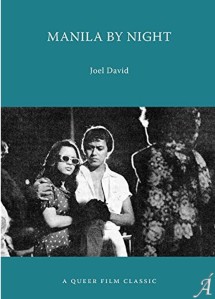
[1] In two of the most comprehensive canon surveys covering Philippine cinema, we can track the persistence of the stature of Biyaya ng Lupa. In “Ten Best Filipino Films Up to 1990” (David & Garduño), it was ranked one rung behind Anak Dalita. In the 2013 poll “100 Greatest Pinoy Films of All Time” (Labastilla), it was the only pre-1970s film in the top ten. It also holds the distinction of being the second Filipino film to be the sole subject of a book publication, after my entry Manila by Night: A Queer Film Classic (published in 2017), considered National Artist Ishmael Bernal’s most important output. I still have not been able to source the volume, Edward delos Santos Cabagnot’s Martin Heidegger’s Being and Time & Manuel Silos’s Biyaya ng Lupa; a third book, Clodualdo del Mundo Jr.’s Ang Daigdig ng mga Api: Remembering a Lost Film (published 2022) tackled the archival stature of still another “best” film by yet another National Artist, Gerardo de Leon.

[2] Camp may have been around for decades, but its acceptance by evaluators only became possible after Susan Sontag paid tribute to it in her essential 1964 essay. In Pinas film practice, campy humor became the staple, starting in the 1970s, of a loose group of directors who used to convene at the Laperal Apartments and later supported one another in a series of omnibus projects, and whose output was consequently downgraded by high-minded film evaluators. Yet once more, Fernandez preceded everyone. As a sample, in one of Malvarosa’s several familial tragedies, the following exchange occurs between the youngest and only female sibling, Rosa, and her gangster brother Leonides, who has killed a prospective holdup target and is now engaged in a shootout with Philippine Constabulary soldiers (in the provocative spirit of camp, Vic Diaz, who plays Leonides, references his physical appearance):

LEONIDES (opens door and lets her in): Why did you come here? Have you gone crazy?

ROSA: You’re the one who’s crazy! You’re deluded! Don’t you know that the law rules above us all? What you’re doing has no hope of winning! Best that you can do is surrender.

LEONIDES: Surrender? So that they can barbecue me on the electric chair? Leonides hasn’t lost his marbles yet!

ROSA: That won’t happen. You might not know it, but the law is just. If you’re innocent, you won’t be punished.

LEONIDES: Idiot! I’m far from innocent! If I weren’t guilty, why would I be in hiding?

(Scr. Consuelo P. Osorio, trans. Joel David)

[3] While I would generally downgrade quantitative measurements of achievement, especially those based on periodical award-giving, the forthcoming canon project I mentioned in the opening section (see David, Canon Decampment) has claims to providing more accurate assessments of individual filmmakers’ accomplishments: it allowed for as many, or as few, or even no available titles for every year covering the history of Philippine cinema, with works under contention re-viewed for as many times as would be necessary for a team of sufficiently informed evaluators to arrive at an assessment. Without going into quantitative specifics, I can describe that Gregorio Fernandez had, after Gerardo de Leon, the most number of entries, with all the rest of their contemporaries limited to one or two films each.

[4] Rap Fernandez, grandson of Gregorio Fernandez via his son Rudy and the latter’s wife Lorna Tolentino, replied to my query on the allegation by stating: “I was only made aware of the rumor through the research I conducted for my thesis on Gregorio but I know for a fact that this is blatantly untrue. There were even rumors that my father was Merle and Gregorio’s secret son but that’s just completely false.” A niece of Merle, Jane Po, affirmed not just the falsity but also the implausibility of such a scenario. (Both exchanges were conducted via Facebook Messenger.)

[5] Gregorio Fernandez introduced Rudy to Sampaguita Pictures in time for the musical teen-idol trend mentioned earlier, but the son probably shared his elder sister Merle’s dilemma of being too fair for the preferences of the early 1970s mass audience, aside from coming in when the trend (along with bomba) was at its peak. Rap Fernandez pointed out Merle’s involvement in finding opportunities for Rudy; she also grieved over his death from a terminal illness, maintaining that she had lost someone she deeply cared for (interview with Leavold & Palisa).

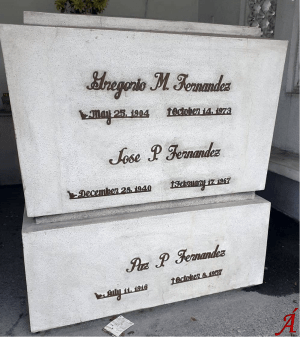
[6] Standard information sources also mistakenly identify Fernandez’s wife as Pilar Padilla. The prospect is certainly believable, since the actress apparently made at least one film with Fernandez as director and actor, titled Dalawang Daigdig [Two Worlds], and chose to be inactive not long afterward. However, no source lists her year of death – which is entirely factual because as of this writing (November 2023), she holds the record at 94 years as the country’s longest-living star-level performer. Below is the MyHeritage genealogy website where both names are announced and the differences between them unresolved, followed by a photo of the tombstones of Gregorio, Paz, and their son (and Rudy’s older brother) Jose, who had also killed himself, ten years after his mother passed away.

Courtesy of Rap Fernandez


[7] It would make sense to place Gregorio Fernandez’s peak in the 1950s, a decade ahead of Gerardo de Leon’s, since the latter actually was nearly ten years younger. Gerry de Leon’s Terror Is a Man (1959), Women in Cages (1971), Kulay Dugo ang Gabi [The Blood Drinkers] (1964), and Ibulong Mo sa Hangin [Blood of the Vampires] (1964) hold varying degrees of favorable regard for cineastes who specialize in B-film production.

Back to top

Appendix: An Archival Summary of the Gregorio Fernandez Filmography
[Posted separately]

Works Cited

Cabagnot, Edward delos Santos. Martin Heidegger’s Being and Time & Manuel Silos’s Biyaya ng Lupa. Quezon City: University of the Philippines Press, 2018.

Daroy, Petronilo Bn. “Main Currents in the Filipino Cinema.” Readings in Philippine Cinema. Ed. Rafael Ma. Guerrero. Manila: Experimental Cinema of the Philippines, 1983. 95-108.

David, Joel. Canon Decampment. Quezon City: Amauteurish Publishing, 2023.

———. Manila by Night: A Queer Film Classic. Vancouver: Arsenal Pulp Press, 2017.

David, Joel, and Melanie Joy C. Garduño. “Ten Best Filipino Films Up to 1990.” Fields of Vision: Critical Applications in Recent Philippine Cinema. Quezon City: Ateneo de Manila University Press, 1995. 95-108. 125-36.

Del Mundo, Clodualdo Jr. Ang Daigdig ng mga Api: Remembering a Lost Film. Manila: Film Development Council of the Philippines & De La Salle University Press, 2022.

English, James F. The Economy of Prestige: Prizes, Awards, and the Circulation of Value. Cambridge, Mass.: Harvard University Press, 2005.

Labastilla, Skilty. “100 Greatest Pinoy Films of All Time.” Society of Filipino Film Reviewers. Online post, 2013.

Leavold, Andrew, and Daniel Palisa, dirs. The Last Pinoy Action King. Documentary. Reflection Films, Death Rides a Red Horse, and Quiapost Productions, 2015.

Lumbera, Bienvenido. “Pelikula: An Essay on Philippine Cinema.” Tuklas Sining: Essays on the Philippine Arts. Ed. Nicanor G. Tiongson. Manila: Cultural Center of the Philippines, 1991. 190-229.

Osorio, Consuelo P., scr. Malvarosa. Dir. Gregorio Fernandez. LVN Pictures, 1958.

Sarris, Andrew. The American Cinema: Directors and Directions 1929-1968. 1968. New York: Octagon, 1982.

Sontag, Susan. “Notes on ‘Camp.’” Against Interpretation and Other Essays. New York: Dell Publishing, 1966. 277-93.

Back to top


Experimental Cinema of the Philippines: A Hasty Recollection

The Experimental Cinema of the Philippines once appeared as a category in my list of pre-internet non-journal non-newspaper periodicals, which provides an incomplete picture of the agency’s persistence in my output. For this reason I thought of providing this landing page, essentially a provisional and still gap-filled collection. I happened to have just a few materials from the agency and only one from the Manila International Film Festival, which was officially one of the ECP’s departments but repudiated by the director-general (originally slated to be Imelda Marcos but preempted by her daughter Ma. Imelda a.k.a. Imee). These were the publications I brought along with me to my graduate studies abroad, to serve as basic research material; as it turned out, everything else I left back home – periodicals, videos, and memorabilia – was either pilfered or damaged by typhoons and/or termites.

11011The discovery of a building proposal, submitted in 1981 by the United Nations Educational, Scientific and Cultural Organization, classified as restricted and titled “The Manila Film Centre,” was something I found online, presumably after having been cleared for whatever was confidential about it. The historical structure appears to have followed the proposal, implying that the former First Lady was closely involved in its design from the start.

Back to top

The Film Palace: A Divergence

Regarding the collapse of the Manila Film Center scaffolding during its construction in November 1981, attributed to careless building procedures, I have consistently presented the following qualifications:

  • the architect in charge, Froilan Hong, had extensive global academic preparation and experience in modernist construction (he was Dean of the national university’s College of Architecture around that period), so he understandably contested the number of victims – of which, typically, an exact number will never be determined;[1]
  • also, anyone then who still remembered the temblor-triggered collapse of the Ruby Tower residential building about a decade earlier (an event that vicariously traumatized Filipino architects and contractors everywhere, including my father) would not be tempted to cut corners in a far more complicated undertaking.

Since the martial-law regime imposed a news blackout for over a day, I have found it impossible to confirm any preliminary report of the incident even in foreign-press accounts. For this reason, two dates are also mentioned in various reports (either the 17th or the 18th), possibly arising from the confusion caused by the delay in the release of information.

11011The national dailies that carefully printed similar-sounding news acknowledged that some workers died but that construction activities had resumed. As anyone with sufficient experience with media psychology could have foretold, several speculations – ranging from natural to metaphysical – emerged to clarify, embellish, or challenge the official version of events.

11011For my part, I can only add what first-hand experience could affirm: on the (still-to-be-determined) date of the incident, I was in the vicinity of the construction, along with the rest of the public-relations staff, winding up overnight preparations required to beat some printing deadline for the production of materials for the MIFF. Our office at the Philippine International Convention Center faced the same parking lot where the MFC was rising dextrally, so occasionally we would peer out to see the structure, brightly lit as if being readied for a Hollywood blockbuster, with ladders, derricks, and hoists on all sides.

11011A few hours after midnight a strong tremor shook the place. Everyone rushed to the windows to see what happened to the construction. The sight was uncanny, with workers scampering everywhere, the ladders filled with men clambering downward. From this distant spectacle we knew that something dreadful could have happened (as it did), but we had our tasks to complete and were groggy from working nonstop already.

11011I mention this specific detail because it appears in no other account except “Grains & Flickers,” the article I wrote for the 2016 book edited by JPaul S. Manzanilla and Caroline S. Hau, titled Remembering/Rethinking EDSA, as well as in my monograph Manila by Night: A Queer Film Classic (Arsenal Press, 2017). One careless commenter blurted out in a group discussion (all right, chat) that my story sounds like an exoneration of the people involved in the tragedy – neglecting the crucial facts that first, it happened, and second, I was with witnesses. Undeniably it complicates the narrative, but I wouldn’t say it exculpates the usual suspects unless one were to operate within the fully guilty-vs.-fully innocent binary to which critically ill-equipped (though unfortunately typical) netizens have become accustomed.[2]

Back to top

The Malakas at Maganda mural displayed at the entrance to the main theater of the Manila Film Center (from Lakbay ng Lakan, reprinted with permission). For a discussion, please see the Illustrational Problematics page I uploaded for my book Manila by Night: A Queer Film Classic.

A Haunting

I have to begin by expressing my mounting vexation at the number of netizens asking about the presence of ghosts in the building. Scientific and historical materialism before everything else, please (and sorry for stating what should have been obvious already). We moved in after the MIFF for which the MFC was constructed had ended, and a number of accounts correctly state that government officials were hoping for an exorcism ritual – but identify Imelda Marcos as its instigator. This made no sense, since her event had just finished and it was the ECP, led by Imee Marcos, that was to hold office in the building; it was also out of character for Mrs. Marcos, whose advisers would have dissuaded her from conducting such an exercise. (The MIFF, as an independently run ECP department, occupied an upper floor but was operated by its Deputy Director John J. Litton, who preferred to use the initials JJL.) Fortunately a former supervisor, Nena C. Benigno, provided a definitive account of Imee Marcos’s direct involvement in the ritual in a magazine interview – see Nica de Guzman’s “The Mysterious Curse of the Manila Film Center” in the Philippine edition of Esquire (November 7, 2019).

11011The news about Betty Benitez perishing in a vehicular accident after an assignation with Onofre D. Corpuz had a whiff of karmic schadenfreude about it, since Benitez was in charge of the MFC construction project. The story that what caused their car to swerve disastrously was a vision of bloodied workers crossing the street first circulated as a persistent rumor, but it was another death – that of Benigno Aquino Jr. in September 1983, returning from exile in the US – that finally facilitated the publication of the tale. It came out in a Catholic Church opposition compact, Veritas, minus any authorial credit, and added the slant that the couple, married but not to each other, was conducting an affair. I recognized the article’s stylistic flourishes as typical of a former office co-worker, Eduardo B. Pacheco, who had started expressing dissatisfaction with the government’s handling of the Aquino assassination, resigned soon afterward, and subsequently appeared in the Veritas staff box as business editor. (Pacheco lived in Pampanga after his retirement but was killed in an apparent early-morning burglary in 2012.)

11011What haunted my memory during and after my stint at the agency was an encounter with an elderly security guard. He was extraordinarily avuncular, in the manner that working-class men carry over from their drunken states when they realize how well it goes over with strangers they want to impress. I was leaving work with some of my office mates and lingered by the exit as they timestamped their employee-record (“bundy” in Noypi & Aussie English) cards. The old man started talking about how he’d been guarding the place during the construction period, so I asked if he witnessed the collapse of the scaffolding. He talked at length about workers who lost their limbs, if not their lives, and bodies that had to be cemented over in order to meet the building completion deadline.

11011I knew he was gravely endangering himself but he seemed to be unaware of the kind of reality I’d been able to observe: Imee Marcos enrolled in the same class on Philippine nationalism that I was taking under Renato Constantino a few years earlier, and several heavyset middle-aged barong-clad men, definitely not national-university types, presented their registration credentials and positioned themselves all over the classroom while she sat in the center. I thought I could just warn him another time, when less of a crowd would be standing around … but he never showed up again afterward.

11011He could have been fired, or transferred, or just scared away from his job – but this was martial law, and it was never advisable to assume anything less than the worst. If I’d been one of the over-imaginative (though frankly airheaded) cinema attendants who loved indulging in ghost tales and never wanted for listeners prepped by the MFC’s bloody history, I would have spread the story that he must have been one of the fallen workers who wanted his version of events told right, a revenant who returned to the afterlife upon accomplishing his mission. It would have been a far less distressing account than the real-life possibilities I had to accept.

Back to top

Other ECP Materials in Ámauteurish!

I’d reviewed a few films that came out during this period, including the ECP productions except the last one. I’d still been working out a critical voice and perspective then, so I’d prefer not to list these titles here, although anyone interested for whatever reason will be able to find the films in this blog’s Reviews section.

11011The release (in more ways than one) of the Ishmael Bernal film Manila by Night may be regarded as the ECP’s final positive contribution to Pinas pop-culture history: it was banned upon completion in early 1980 and screened with seemingly uncountable cuts and deletions – the most severely censored movie ever in local cinema. After the MIFF’s reliance on pornographic films in order to fund the First Lady’s world-scale bacchanals followed a few months later by the killing of Aquino, the MFC sounded out a call for artistic sex-themed products.[3] I remember writing an informal letter to an official suggesting that MbN should be considered a prime candidate because it was officially accepted for the Berlin International Film Festival competition (though prevented from leaving at the time because of the First Lady’s disapprobation); it won the local critics’ award despite its badly mangled condition; and its producer actively participated in providing well-attended titles for MFC screenings. After this I also recall processing the documentation necessary for the release of the integral version of the film for screening exclusively at the MFC.[4]

11011The definitive empirical summary of the agency’s performance lies in documents, stored on drives, that are now lost: its annual reports, all of which I researched, compiled, and wrote. The first one, titled Experimental Cinema of the Philippines: Year One, came out as a glossy publication, while the second and third were bound printouts. Why only three years, when the ECP was set up in 1981 and the EDSA uprising was in 1986? Once more, despite most accounts’ misperception, the organization existed only for as long as Imee Marcos could devote her full attention to it. After the Aquino assassination (and upon getting her now-controversial law degree from the national university), she decided to run for the interim parliament and focus on her duties therein. With the MIFF only too willing to take over the agency, she arranged for the ECP to be dissolved and a new body called the Film Development Foundation of the Philippines set up in its place. This was the body that was shut down in February 1986.

11011While it was around, the public relations department where I worked managed to come up with a magazine, SineManila, limited to a maiden issue because of a nasty turf war waged by a military agent and her staff who insisted that her department’s tiny magazine, Filipino Film Review (my complete file of which was lost), be the only ECP publication that the public could access. We also managed to come up with only one in-house publication, Jario Scenario, since the ECP at this stage was nearing its transition to the FDFP.

11011Since the officials in our department were outsourced from the National Media Production Center (now the Philippine Information Agency), we were obliged to serve all ECP departments including the MIFF. (Recall the opening account where our experience of the tremor that caused the MFC tragedy was due to one of several all-nighters necessitated by an impending MIFF printer’s deadline.) The start of my employment was right after the MIFF dry-run edition, during which I managed to secure passes for the critics circle and experienced the kind of overload that led me to regard filmfests as less-than-ideal venues for appreciating movies.

11011The next year’s (first regular) MIFF was the one held at the MFC building, already and inevitably notorious even before it opened. It had Satyajit Ray as chair of the competition jury, and honored a now-forgotten film, 36 Chowringhee Lane, Aparna Sen’s debut as a director, defeating entries by the likes of Roger Donaldson, Rainer Werner Fassbinder, Lawrence Kasdan, Karel Reisz, François Truffaut, and Peter Weir. A daily magazine, Manila Film International (of which my complete file was also irretrievably damaged), was published but not by our department. The next year’s winner was another close-to-forgotten entry, the late Yu Wigong’s Memories of Old Peking (a.k.a. My Memories of Old Beijing), but unlike the previous year, it also had Filipino films in competition: Oro, Plata, Mata (which won a special jury prize) by Peque Gallaga and Moral by Marilou Diaz-Abaya.

Back to top

Essential Readings

In coordination with the now-defunct Metro Manila Commission, the ECP and MIFF launched separate publications the next year. The ECP’s was a book edited by Rafael Ma. Guerrero, titled Readings in Philippine Cinema – as definitive a text as it was possible to compile up to that point. The MIFF had strictly supplementary material, also edited (though uncredited) by Guerrero, titled Focus on Filipino Films. The eponymously titled film module that the latter accompanied can well be regarded as the highlight of all the MIFF editions put together: a nearly ideal canon-formation project that conscripted film experts who screened available films (though only once) and deliberated on whether they should be included or not; new prints of the selected titles were then struck, with French and English subtitles. Eye-opener accounts such as “Manila’s Angels,” Elliott Stein’s article in Film Comment, made exceptions in a properly critical report of the MIFF’s proceedings in order to express admiration for several of the module entries.

11011Needless to add, this first-time attempt was never to be replicated thereafter. Many of the now faded prints are regarded as still the most acceptable available copies of their specific titles, with digital remastering the only possible future stage for them. The next year’s MIFF reverted to the dry-run dimension, to be able to evade the then-growing united-front movement that arose in protest over the Aquino assassination.

11011A still insistently forward-thinking ECP administration proceeded with its last batch of productions, which gave me the opportunity to interview Soltero director Pio de Castro III on location in Baguio – at the Hyatt Terraces, the same hotel that collapsed from another tremor several years after. They also assigned me to attend the courses of the lately introduced undergraduate film specialization at the national university, to be able to eventually set up the ECP’s own education program. I countered that, since I already held a bachelor’s diploma from the institute that proffered the degree, I would need only a few extra units in order to earn the new baccalaureate itself. I thought my proposal would have come across as audacious, but then there were already less tasks to attend to with the “indefinitely postponed” MIFF and the impending transition of the director-general to her interim Batasang Pambansa commitment. The February 1986 ouster of the Marcos administration occurred during my final semester of undergrad film studies, so just like in my first bachelor’s degree, I was once more a working student who was out of a job upon graduation.[5]

Back to top

Notes

I do acknowledge that the memoir format will better serve some of the material presented here, but I prefer not to let this opportunity pass in case I wind up unable to complete the writing project. So I will name this early the people to whom I plan to dedicate the forthcoming effort: the ones (possibly entirely men, but we have no way of knowing any longer) who unwillingly and prematurely gave up their lives for the construction of the hideously pretentious building where we had to work for too long. The ouster of the Marcos regime was not bloody enough to redress the violence visited on you (as well as on countless others), and the silence with which your annihilation was completed.

[1] A letter sent by Baltazar N. Endriga, former chair and president of the Cultural Center of the Philippines, states that Froilan Hong counted seven fatalities and recapitulates the standard account of how “the scaffolding supporting the platform into which concrete was being poured collapsed and the seven workers fell to their deaths. The bodies of all seven were then retrieved and given the proper rites befitting the dead. [Hong] belied the popular story that many workers were buried alive in concrete and that in the hurry to finish the construction, they were simply entombed under the Film Center’s bowels” (“Account on the 1981 Manila Film Center Deaths,” Inquirer.net, February 26, 2021). Endriga does not state his involvement in the project or whether Hong was present during the accident and/or rescue operations.

[2] I did manage to secure recent official confirmation that short night tremors, ranging from moderate to strong, hit Luzon during both dates, after the Philippine Institute of Volcanology and Seismology referred my query to the Philippine Atmospheric, Geophysical and Astronomical Services Administration. (Since PHIVOLCS was founded only after the incident, in September 1982, the tracking of earthquakes during the period in question was performed by PAGASA.) I have no knowledge of the reliability of the government’s seismographic instruments or record-keeping activities during that time, however, so these questions will have to be regarded for now as compounding the other problem I mentioned of determining the exact date of the MFC tragedy. The worst possible outcome from this admittedly traumatic incident would be a Mandela phenomenon, where the local and global public proceeds from a belief that the accident was caused by sheer carelessness and nothing else; there was carelessness in the obscene haste by which the project was rushed, but only an unanticipated tremor could have caused the internal scaffolding to collapse – which, tragically, turned out to be the case.

[3] Not surprisingly, the MIFF concerned itself with the same goal, since it had already reaped profits from adults-only screenings from all over (downtown venues were censorship-exempt during the festival period). Producers were convened at the MFC’s MIFF office for specific instructions as to what they may be allowed to present – in porn parlance, tits & asses as well as simulated sex scenes. The ECP, for its part, provided support in the form of flyers and warm bodies for the Concerned Artists of the Philippines’s anti-censorship rallies.

11011When the expected moralist backlash occurred, with the chief of the Board of Censors for Motion Pictures asserting her presidential appointment and thereby operating at the same governmental level as Imee Marcos, a high-ranking MIFF official issued a statement that the films were smutty because producers were deliberately violating the limits that the government prescribed. The producers themselves, who were constant visitors at the MFC because of other services such as funding subsidies and tax rebates, replied (in strict confidence, understandably) that it was this same top MIFF official who kept pestering them to shoot far raunchier scenes even if these no longer had any relevance to the films being considered. Said official was blasted on national television after February 1986 by Lino Brocka, for his opportunistic claim that he had been supportive of the anti-Marcos opposition all along.

MbN, as restored by the Marcos regime.

[4] What mystifies me is why members of the critics circle (who that time congratulated me for actualizing the release of the uncensored print) insist on calling the film anything except the title its producer and director-writer provided: because the film that their awards honored was not titled Manila by Night? (City after Dark was the censored version, while Manila after Dark does not even apply to any movie whatsoever, although check out this kink in my argument.) The same government that banned, then censored, the film, also restored the original title when it was approved for an MFC screening. As the person designated to host the premiere night’s program, I saw with my own eyes the words “Manila by Night” projected onscreen during the movie’s opening credits.

[5] I might as well provide one of the plausible urban myths that some media colleagues of mine claim as factual, since it does denote a happy ending and resembles my experience: one of Imee Marcos’s bodyguards supposedly realized that his official enrollment in the same courses she was taking at the national university was an opportunity for self-advancement, and actually completed for his own credit the same undergraduate and law degrees that she claimed to have finished (though without any official documentation in her case); he passed the bar exam and no longer had to risk his life for the sake of any high-ranking government bigwig. Some day some enterprising investigative journalist will have to uncover the truth (or falsity) of this singularly marvelous story.

Back to top


National Artist Endorsement for Ricky Lee

Dated October 20, 2020, and addressed to the Order of National Artist Secretariat; forwarded via channels.

I am strongly endorsing Ricardo A. Lee, more popularly known as Ricky Lee, for the Order of the National Artist, for his achievements in the fields of film and literature. I am familiar with several of Lee’s output since our tenure as colleagues in the Manunuri ng Pelikulang Pilipino, from which we separately organized a film-revival and book-publication proprietorship, Cine Gang. Aside from holding what was then the most successful revival series, we managed to publish a bestseller, a back-to-back edition of Lee’s scripts for Marilou Diaz-Abaya’s Brutal and Laurice Guillen’s Salome; the book was not just the country’s first screenplay publication but also won a National Book Award during the first year of the Manila Critics Circle.

11011In the process of my own growth as film critic and scholar, I count as my direct influences Bienvenido Lumbera and Ricky Lee. Lumbera provided me with basic principles in evaluating film samples; Lee encouraged me to work on style, expression, and perception, and taught me that risk-taking was useful even if it resulted in failure, as long as I managed to draw lessons for further growth from it.

11011These were of course the same principles that Lee observed for his own productivity. In undertaking advanced studies in cinema, I determined for myself that Philippine film culture has been fortunate in having three definite contemporaneous geniuses in different fields: Ishmael Bernal in directing, Nora Aunor in performing, and Ricky Lee in writing – by which I refer not just to scripts and fiction but also film journalism and criticism. As you can tell from this list, only one has been honored with the Order of the National Artist, and posthumously at that. I might also add here that my critical duties have not been affected by this conclusion. That is, I still have on record certain work by the three individuals where I expressed reservations or objections to some of their output.

11011My determination of the exceptional giftedness of an artist derives from my study of critical and creative processes. As far as my own praxis has enabled me, I can definitively say that the line dividing criticism and artistic production is an artificial and unnecessary one: as much as I allow myself the benefit of drawing from journalistic and literary modes in writing, I have also learned to be grateful when I can observe artists demonstrating a process of critical self-reflection, deciding on ways to upgrade their output accordingly, and sharing with the rest of society the fruits of what is necessarily difficult-yet-invisible labor.

11011One needs the benefit of time as well as resources to be able to reveal such evidence of constant reflection and innovation. Artists capable of intensive critical processing would be those whose output can be mapped out over several years, providing any evaluator with periods where their concerns remained consistently remarkable, followed by succeeding periods where their approaches shifted, generally for the better. An artist’s initial success in her or his early strategies would be the means by which she or he could be able to harness whatever elements may be necessary for inspiration or execution.

11011This is the reason why in Lee’s case, I would advise evaluators to look beyond his record in film, just as Bernal once participated in theater, television, and journalism, and Aunor has crossed over into theater, television, the recording arts, and now new media. After demonstrating, early enough in his career, an ability to pull off the most challenging literary applications in film scriptwriting, Lee continued providing occasionally rewarding material, but also allowed people who completed his scriptwriting workshops to make names for themselves.

11011Instead of opting to rest on his laurels, he resumed published writing and drew in techniques, insights, even personalities from local cinema, in an impressive array of journalistic and fiction pieces. Hence to list the “best Ricky Lee writing” would involve a dizzying crisscross of genres and formats: Ishmael Bernal’s Himala, Marilou Diaz-Abaya’s Moral, and Lino Brocka’s Gumapang Ka sa Lusak, among several others, for screenplay; Si Tatang at mga Himala ng Ating Panahon, for book anthology; Pitik-Bulag sa Buwan ng Pebrero, for published stage play; Trip to Quiapo, for writing manual; Sa Puso ng Himala, for commemorative volume; Para Kay B and Si Amapola sa 65 na Kabanata, for the novel (admittedly I still have to read his more recent work); “Kabilang sa mga Nawawala,” for metafiction; “Mga Batang Lansangan” series, for reportage; a clutch of short stories, interview articles, and film criticism too accomplished to subject to any kind of ranking among themselves; and so on (with biographical material – his own and others’ – announced among his forthcoming projects).

11011No other Filipino, not even Lee’s mentor Nick Joaquin, has had such a distinctive, variegated, and high-caliber record in a wide array of literary forms (although admittedly Joaquin does put up a good fight in short fiction). I have witnessed Lee occasionally being penalized by award-giving bodies for refusing to be confined to only one style, format, and/or genre. That to my mind is not how critical thinkers should think, or how genuinely creative artists should be permitted to proceed. I have always set out to warn students of criticism, including aspiring reviewers, to never set limits for the output of any artist under study, since the latter’s liberation from the boundaries set by tradition can also release us (as critic-evaluators) from fixed expectations in style and analysis.

11011There may be other significant reasons to endorse Lee for the Order. I trust that letters of endorsement from other individuals or institutions may be able to mention these, although from my own perspective, I can also maintain that excellence in artistic performance cannot be attained without a concomitant impeccability in one’s character. Lee’s personal willingness to assist in the education of children of indigent families is a little-known fact that even he might refuse to divulge or confirm, but it motivated many of his friends, myself included, to pledge to emulate his example when we attained the financial capability to do so.

11011Inasmuch as I mention little-known output, to bring our focus back to the concern of writing: Lee has an entire body of literature that he wrote or co-wrote using aliases or without credit, or ghostwrote for others (including Lino Brocka’s much-reprinted acceptance speech for the Magsaysay Award). Having the stature of a National Artist would enable friends and researchers to dig up as much of this body of work as can be salvaged for proper crediting and archiving, to add to the undiscovered gems that only a select group of people have been privy to so far.

11011I trust I have managed to articulate as much of the justification that I can formulate for Lee’s proclamation as National Artist of the Philippines. Thank you for your attention. Please do not hesitate to contact me if you have further questions about this letter.

Á!

Back to top


Transcript of a Mobile Phone Interview of Peque Gallaga by Monchito Nocon

The following material was provided by Monchito Nocon for the research I was conducting on the making of Ishmael Bernal’s Manila by Night (1980). On the occasion of Peque Gallaga’s demise on May 7, 2020, I requested Monchito’s permission to post the content on Ámauteurish! for its research value. Everything that follows is what I copied from what he provided. To further enlarge on some of Gallaga’s points, I added some excerpts from interviews he gave for the Brocka, Bernal, and the City exhibit at the De La Salle – College of Saint Benilde in 2019; these appear as endnotes.

Background: In 2012, I was connected with the Film Development Council of the Philippines (FDCP), where I was in charge of the Media Desk that, among other responsibilities, published the official newsletter, with me serving as editor-writer. Prior to this in 2009, the Philippines was presented a most generous gift by the Pusan International Film Festival: a scanned copy (2K) of Manila by Night.

11011The FDCP was thus looking at completing Manila by Night’s full restoration, leading up to a possible premier on the big screen. It was to be a potentially big event, and I was tasked with doing a cover story on the film for the newsletter. So I immediately sent an email to Peque Gallaga, Manila’s production designer, who graciously promised to write me something posthaste.

11011However, as it happened, Peque was in the midst of moving house in his native Bacolod, and, in the frenzy, couldn’t find the chance to sit down and write. He offered instead to do a long-distance phone interview, which I welcomed and arranged (Figure 1).

Figure 1. Email reply from Peque Gallaga.

11011The following is the transcript of that interview, which I did on my own volition. As there was no way for me then to record a mobile phone conversation, I had to transcribe everything in real time, by longhand! I also took the liberty of adding headings to make it more comprehensible. Alas, I failed to save the article draft, the publication of which was eventually scrapped as the restoration project never got off the ground.

Peque gives a behind-the-scenes peek into working on Manila by Night

  • [I first worked] with Bernie in Girlfriend – it was love at first sight! We got along well and I brought with me my Bacolod team.
  • It was an ambitious project!
  • [Scriptwriter] Ricky Lee – he marked the whole year [in the film] through the feasts
  • Douglas Quijano, I, and Bernie went to all the night spots – it was an eye-opener – to pick up information.
  • All scenes were shot in Manila after midnight – at 2 a.m. – with the crowd directed [to appear as if it was earlier in the evening].
  • We recreated the vibe [of Manila].
  • We went to a masahista [massage] joint.
  • Bernie did a sit-down with the masahista – did an interview – picking up on what they do. He got into the daily minutiae.
  • She [Cherie Gil] ran the whole stretch in different takes, and covered the geography.[1]
  • They really swam in Manila Bay!
  • [Quotes Bernal in relation to a scene Peque wanted to have reshot – the one with floating candles on Manila Bay. Sergio Lobo, the DOP, failed to properly get his instructions in shooting that scene, and instead of a fuzzy, surreal scene, you could actually see the candles afloat]: “A film can never be perfect. There has to have a rough edge … a mistake … a human aspect.”[2]
  • Does that scene (referring to the above) make sense to you? Concerned with reality.
  • [Along] San Pedro etc. – William [Martinez] pours water over his head – a cleansing – a religious statement.

Peque on Manila, the city

  • It’s not the Manila that it used to be – [you now have] drugs, fringe elements. It just shows that Manila hasn’t changed – the city that hasn’t worked.

Peque on Bernal’s directing style

  • [Bernal] wanted to show reality, not a polished version.
  • He was very classical – close-ups with actors – makes them more dramatic.
  • Long shots tell the story.
  • [He would] sit down with the actors to talk with them regarding the script.
  • Don’t be afraid to ask them [the actors] the most intimate questions.
  • [He created] an intimate bond with performers – not on a boss-employee level but something more personal.[3]

Notes

[1] When her character Kano starts being chased by narcotics police, she runs from Sauna Turko along Roxas Blvd. toward Rizal Park, turns right at Mabini Bridge (the side street that traverses the estero of Fort San Antonio de Abad between Bangko Sentral ng Pilipinas and Ospital ng Maynila Medical Center) and around the former Harrison Plaza, until she gets cornered and caught at the intersection of Mabini and Vito Cruz (now P. Ocampo) Streets. [Thanks to Dr. Juan Martin Magsanoc for determining the formal name of the Mabini Bridge stretch.]

[2] “I talked to Sergio Lobo who was the cameraman [for Manila by Night]. I said, ‘For their LSD sequence what I want to do is to get those little cups for the candles and float them by fitting them in small Styropors. But is it possible if you can put Vaseline around your lens so that it will just be out-of-focus lights and it’s only the faces of Cherie and William that are going to be seen, so that all of a sudden these lights come on?’ He said ‘Yeah just paint the Styropor orange so that the lights would still be warm.’ So we bought about 200 [candles on Styropor] and on two [small outrigger boats], we lit each and every one of them and swept them with bamboo so that as the scene goes on these things start floating in. When we saw the rushes, I said, ‘Bernie, that’s shit! He didn’t defocus it in any way!’ All of a sudden they were surrounded by stupid candles and Styropors. ‘It’s ridiculous. This is really bad. We have to reshoot it!’ He said ‘No, just remember this scene will keep you humble the rest of your life.’” [From “Brocka-Bernal Interviews, 2018-2019,” for the exhibit Brocka, Bernal, and the City, January 24 to April 29, 2019, at the De La Salle – College of Saint Benilde’s School of Design and Arts.]

[3] “It’s very funny. He called me up and said ‘Peqs! Listen, I’ve been talking bad about you okay, but you have to understand, I’m the old guy, you’re coming up, your movie’s beautiful, I’m jealous, and … it’s only human, OK? We’re still friends.’ And I said, ‘Okay Bernie. I haven’t heard you say anything about it.’ He answered ‘Well I’ll be quoted … but beyond all that, I love you.’ I said ‘I love you too Bernie.’

11011“I don’t think I saw him after that anymore. So much so that when Marilou Diaz-Abaya called me up and said, ‘We need your help, Bernie’s dead,’ I said, ‘I’m busy, I can’t make it, I have to finish something first.’ She said, ‘Come on, that’s Bernie, he’s your friend.’ I said ‘I’m sorry I can’t make it, I can’t make it,’ so she hung up [after] she told me where it was. I stayed there for a while and I said ‘That’s right, Bernie’s my friend.’ So I got in the car and went, not to the wake. His body had just been brought in [to the morgue]. Mel Chionglo was there, Marilou, one or two others. And they said, ‘Oh you’re here, you should be here, we’re his friends.’ I said ‘Yeah, what do you want me to do?’ ‘Well we’re choosing coffins now and everything we seem to choose are six figures – 300,000 [pesos], 250,000. We have to work this out, what can you do?’ I said, ‘I’ll watch his body.’ So I went and sat down and I watched them not only dress him up, but put the big needle to remove all the dead blood, wash him, et cetera. I just stayed there until everything was done and they dressed him up and I remember combing his hair. That’s the last time I saw Bernie.” [From “Brocka-Bernal Interviews, 2018-2019,” for the exhibit Brocka, Bernal, and the City, January 24 to April 29, 2019, at the De La Salle – College of Saint Benilde’s School of Design and Arts.]

Back to top


A Salute to Our Pinay Filmmakers

While preparing for the end, Marilou Diaz-Abaya gave a series of interviews worth re-reading once in a while. Respect the audience, was her admonition to indie practitioners. Work to develop their preferred product, which then as now meant rom-com films.

11011Responses by local gatekeepers melded with Euro-festival jurors to ensure that this crucial bit of advice be downgraded and ignored as quickly as possible. Only high-art, alienating, complex-but-inconclusive films were fielded to foreign filmfests & local critics’ competitions, where they dominated the prizes for the past several years. Filmmakers (often women) who so much as deviated from the poverty-focused extreme aestheticizations that these taste-mongers upheld, were scolded for supposedly betraying progressive ideals.

11011As it turned out, it was women (with an occasional male director or two) who laid the foundations of the Pinoy rom-com in the 1990s, another batch who strengthened it in the 2000s, and still another group hard at work during this decade in transforming it.

11011One would have to be an ideologically arrested thinker to believe that their output is automatically invalidated by the popular acclaim that it so rightfully earns. For one thing, several of the current practitioners did dabble in indie work, and (as if observing Diaz-Abaya’s advice) brought over what strengths they developed to tweak, improve, and revise the rom-com format.

11011The fact that the most prominent Pinoy international film festival, San Francisco’s FACINE, wound up honoring a rom-com entry, its jurors smitten by its unexpected warmth and delicacy, affirms that our women filmmakers are on the right track. The Young Critics Circle also gave their major prizes to women working in documentaries – and in a rom-com project.

11011If progressive is seen as any effort that upgrades the public’s habits by meeting its demands halfway, and regards genre exercises as a means of conveying new insights and possibilities, then this is certainly a trend worth attending to. The promise of viewing pleasure would just be icing on the cake, a reward for finally coming to terms with an audience that is truly our own.

[Posted March 25, 2019, on Facebook]