
“Balot”
Directed by Marius Talampas
Written by Greggy Gregorio & Ash Vidal

Casanova cornered in “Surprise, Surprise.”
Once in a while popular culture bestows a piece that most of us can take to heart without having to burn our wallets or spend hours to track it down and watch it. The fact that film historian and curator Paolo Cherchi Usai could include “Surprise, Surprise” (dir. Frank Budgen, 1991), a British Airways commercial, in his list of all-time ten-best entries for Sight & Sound magazine’s 2002 survey, demonstrates how canon-formation rules about budget, running time, reception, and authorial talent don’t have to limit our capacity to recognize when a rare exception, originating from nothing but intelligent and intensive cultural assimilation and processing, comes along.
11011The whole point about “Surprise, Surprise,” as those of us who might have seen it on a streaming source have realized, is that despite its “universal” predicament of a two-timer caught in the act, it could be better appreciated by those who could identify more closely with the ad’s audience and their culture, if not those who were situated in the theater where the reflexive event took place. A recent advertising short, titled “Balot” and produced by the still-youthful Gigil Agency[1] for the Philippine branch of Royal Crown Cola, requires even further preparation for those unfamiliar with Philippine culture; those whose encounters span decades will, needless to add, possess greater advantages.
11011Prior to “Balot,” RC Cola was in fact better known for absurdist Japanese-style ad products, always humorous but occasionally lacking in what Noypi pop-culture experts would term hugot (roughly, emo-content). Gigil itself attained some notoriety for a pandemic-themed beauty ad that had PC viewers in fits of (sanitized) hand-wringing, forcing its sponsor to pull out the presentation. “Balot” takes its own share of risks, but these pay off in various degrees of satisfaction, primarily because the creative team opted to wholeheartedly embrace the culture that its target audience presumably shares.
11011It opens with a mother calling her family together as she spreads on the dining table the treats she was able to take home (hence the title, since balot literally means wrapping up) from a neighbor’s birthday party. As she starts taking out increasingly impressive dishes from her bag, a faint breeze blowing on her family’s faces suggests that myth-making is about to take place. When an entire pot of rice is followed by a whole roast piglet, the strains of a fondly remembered movie theme song begin playing, with a somewhat familiar voice crooning the somewhat apt stanza that begins with “Balutin mo ako ng hiwaga ng iyong pagmamahal” (Wrap me up in the wonder of your love).[2]

Eken Afuang Matsunaga as Sharon Cuneta in “Balot.”
11011The song continues as party balloons float up from the mother’s bag, followed by the birthday celebrator, a party clown, and finally the song’s singer, Sharon Cuneta. The cultural insight this revelation interplays with is that the act of taking home excess food from a gathering was made less potentially embarrassing by people euphemistically calling it “sharon” – as in “I’ll sharon whatever remains of that later.” When Cuneta herself found out, she good-naturedly hailed and celebrated the appropriation of her name in one of her recent social media posts, in the same teasing spirit that the advert performs. When the extra-large soft drink product is finally taken out and poured, its label descriptor states “Mega Litro,” once more an acknowledgment of Cuneta’s stature as the final multimedia star in Philippine pop culture, prior to its splintering into the several niches that typify millennial-era conditions.
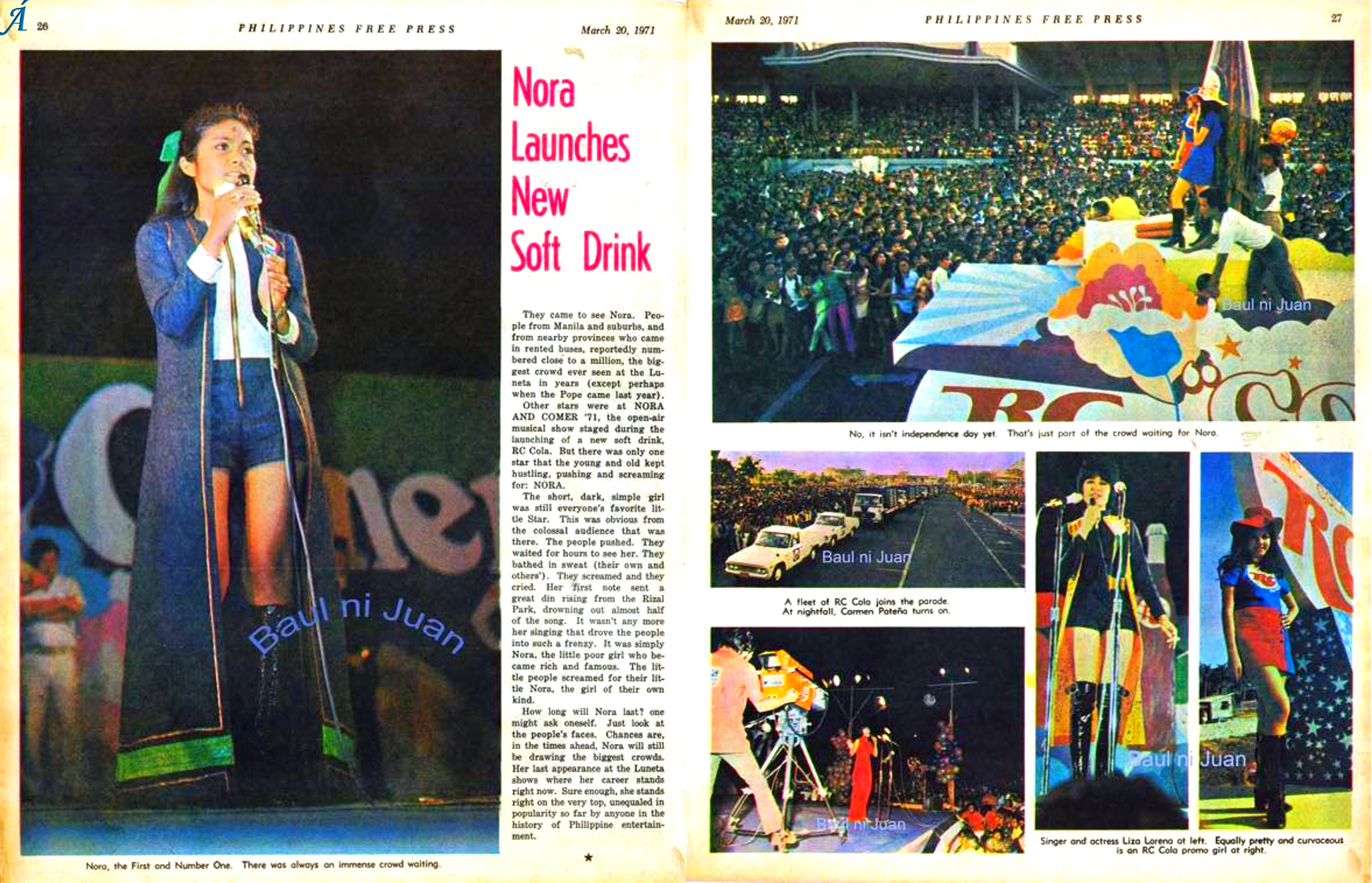
11011In a social-media exchange, Cuneta specialist Jerrick Josue David (not a relation) further explained why the Sharon performance in “Balot” had that touch of the uncanny about it, beyond the narrative’s own marvelous turn. “Bituing Walang Ningning” (“Star without Sparkle,” from the eponymous 1985 film) may have been Cuneta’s most successful movie theme song, but neither singer nor voice in the ad was literally Sharon herself. Like the film as a whole, the impersonation – by drag artist Eken Afuang Matsunaga, with vocals by Leah Patricio – functions as a freestanding star tribute. This proceeds from another Sharonian quality claimed nearly exclusively by the country’s biggest star, Nora Aunor: only these two have on record the presence of drag queens drawn directly from their mass adulators, whose professional careers are premised on replicating their idols’ respective personas.[3] (Sadly, Cuneta’s most famous impersonator, Ate Shawee, passed away during the pandemic.)
11011“Balot” will be capable of sustaining a few theoretical discussions for those inclined to swing in that direction. The fusion of fantastic elements with an identifiably lower-class context could be one starting point, alongside the fearless deployment of narrative elements associated with mainstream (a.k.a. “masa”) aesthetics coupled with a reflexive thrust more audacious than what “Surprise, Surprise” attempted – all packed within a shorter running time. Those who feel guilty about immersing in the manifold pleasures the ad conveys might want to track the points where their educational training made them believe that this element was unworthy of valuation. Perhaps rewatching “Balot,” now or at a later moment, might help clarify these and a few other questions.
Notes
First published April 24, 2023, as “Sharon Torch Song Used in Absurd Soda Ad” in The FilAm. Thanks to Grace Leyco, Gigil public relations officer, for providing prompt and comprehensive information. Below is an English-subtitled version.
[1] “Gigil” is commonly listed as one of the several foreign words that describe a universally recognizable condition but possess no singular equivalent in English (e.g. see this posted BBC short video report). It denotes a physiological response – the clenching of one’s teeth and fingers in the presence of excessive adorability or, less commonly, severe annoyance. One of the word’s implications is that the expresser has to control herself or she could wind up hurting the object of cuteness, reminiscent of the hyperbolic English expression “I could just eat you up.” The closest that Western academia has come to describing “gigil” was at a 2013 conference where Yale researchers proposed the term “cute aggression” – see Carrie Arnold, “Cuteness Inspires Aggression,” Scientific American (July 2013). [Update: As of March 2025, the latest edition of the Oxford English Dictionary now includes the word “gigil,” a definitely more useful – not to mention cuter – term than “cute aggression.”]
[2] The English translation of the stanza sung in “Balot” is as follows:
Wrap me up in the wonder of your love
Let it blanket this luster that won’t last
I’d rather be a star that doesn’t sparkle
If I could win your endless devotion instead.
From “Bituing Walang Ningning”
(Willy Cruz, 1985)
[3] A stardom-studies link between the far-and-away two genuine stars of the Philippines’s so-called Second Golden Age of Philippine Cinema, Sharon Cuneta and Nora Aunor, was first articulated by global film scholar Bliss Cua Lim. See “Sharon’s Noranian Turn: Stardom, Embodiment, and Language in Philippine Cinema,” Discourse: Journal for Theoretical Studies in Media and Culture 31.3 (Fall 2009): 318-58.
[For a larger image, please click on picture.]




















 ORCID ID


Crinkled Lives
Erotica Manila: Foursome
Directed by Lawrence Fajardo
Written by Lawrence Fajardo, Jimmy Flores, & Miguel Legaspi
Pinas fanboy film culture must have worn itself out, or else we’d be hearing lamentations about how our filmmakers have started regressing. After several contemporary talents made their names with increasingly longer modernist works, we now find their successors focused on shorter-length material, sometimes even geared toward televised or streaming platforms. But thank goodness for the dissipation of high-art pretension, or we wouldn’t be able to recognize how some of our best and brightest have been able to respond to the challenge of encapsulating entire narrative worlds within delimited timespans.
11011The possibility was first raised when Erik Matti announced that his sequel to On the Job (2013), titled On the Job 2: The Missing 8 (2021), would be adapted into a six-part miniseries for HBO, with the original film comprising the first two episodes. Then last year, the best entries to the first ShoutOut short film competition were compiled into a two-hour anthology, slated for exhibition at this year’s Cinemalaya Philippine Independent Film Festival. (Essential disclosure: I was chair of the board of jurors that evaluated the films and provided prizes and citations for outstanding titles and participants.) Titled ShoutOut Pinas 2022, the omnibus work is reminiscent of the 2020 anthology Septet: The Story of Hong Kong, where seven filmmakers provided historical dramas covering specific decades in the former British crown colony’s history. [Update: A recent discovery uncovered a now-lost local title, Wanted: Johnny L (1966), which had, like ShoutOut Pinas 2022, five directors participating: Cesar Amigo, Gerardo de Leon, Eddie Romero, Cirio H. Santiago, and Teodorico Santos.]
Film buff (Alex Medina) and pickup girl (Azi Acosta) exchange notes during a screening of Celso Ad. Castillo’s erotic classic Isla. [Erotica Manila “Cinema Parausan” screen cap]
11011The film that resulted from the concatenated episodes, titled Erotica Manila: Foursome and announced as Vivamax’s intended entry to international filmfest competitions, dispenses the expected turns commonly regarded as weaknesses in standard narrative construction: well before the close of an hour, the focus shifts to the next episode’s primary character, who always happens to be a passerby at the close of the preceding story. Fajardo being Vivamax’s fair-haired inhouse talent (after the apparent departure of the unlamented and unmissed Darryl Yap), carnal fireworks ensue, with unexpected and generally satisfying twists just as the next main character happens along. The agents that the narrative follows are male, but the film’s sexual politics turn increasingly scary, funny, and (unusual for Fajardo) queer, with women providing the plot points on which the stories pivot.
Triumphant cougar (Mercedes Cabral) gloats after bedding a young intern (Vince Rillon) on the set of her latest project. [Erotica Manila “The MILF & the OJT” screen cap]
Back to top
11011The film’s apparent rationale for these shifts – standard in series presentations but usually associated with carelessly developed “trash” material – is its immersion in media activities: from film spectatorship initially, through content management, culminating in actual production, where a predatory older actress preempts her gay directors in laying their horny young assistant. The final episode, set in an urban slum among irregularly employed denizens, might consequently appear to be unrelated to the preceding series; yet its throwback to the poverty-porn trend in Philippine independent cinema makes it the perfect closing material, and then some. The heightened degree of pathos actually masks disturbing sexual-slapstick developments, complete with (technically) a happy ending. The scene where a husband is unaware, while performing in bed, that he’s nailing more than just his wife – these and several other WTF moments actually serve to challenge viewers to LOL if they think they can.
11011It helps to be aware, in approaching EMF, that its director specializes in multicharacter narratives – the Philippines’s most successful practitioner of this fiendishly difficult format since the heyday of Ishmael Bernal. In explaining how he and his coscriptwriters (Jimmy Flores and Miguel Legaspi) conceptualized the project, he initially envisioned a singular intertwined plot. After working out the major lines of action, however, he realized that each one might be misunderstood or trivialized if it were to be juxtaposed with the others, and that the sensational incidents that attend each one would strain the narrative’s credibility if these were presented as simultaneously occuring.
Slum dweller (Felix Roco) feels a revitalized longing for his wife after passing by a sex-film setting. [Erotica Manila “Death by O” screen cap]
Notes
First published July 20, 2023, as “Carnal Fireworks in Erotica Manila” in The FilAm. Screenshots supplied by the director.
[1] For essential capsule evaluations of each episode, see the uploads on the Movie Reviews album of the Facebook account of Jojo Devera.
[2] The comedic elements align Erotica Manila: Foursome, alongside the rare sex-themed movies directed by Ishmael Bernal and Celso Ad. Castillo, with the classics of the US’s so-called Golden Age of Porn. Treatments of sexuality in Pinas cinema tend to capitulate to the guilt-ridden prescriptions of Catholicism as well as the antiseptic preferences of high art.
Back to top
Leave a comment | tags: Commentaries | posted in Film Criticism