Tag Archives: Profession

My Big Fat Critic Status

Before the days of personal computers, I had to draft everything on a typewriter, correct it, and type (and sometimes retype) the final version. I diligently kept all my drafts, as well as the latter-day floppy drives of the Commodore 64 where I managed to finalize my first two book manuscripts. Nearly everything was lost to floods and pilferage, though for some reason, the draft of the letter I wrote to the Filipino film critics’ circle survived. This was not the first time I mentioned my concerns about the group’s obsession with its much-vaunted awards, but this was the moment I first expressed my misgivings directly to the group. (The addressee, then-chair Gino Dormiendo, also subsequently left.) Needless to add, I never returned after taking this “leave,” and neither did the group members stop with their annual ceremonies. Upon my return from US graduate studies, I was asked (via an emissary) to consider rejoining, but by then I felt that our differences had become too vast to be reconcilable.
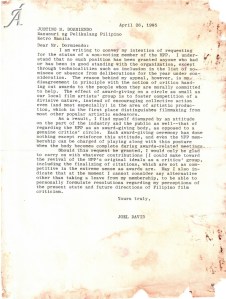
Letter re Manunuri status
April 26, 1985

Justino M. Dormiendo
Manunuri ng Pelikulang Pilipino
Metro Manila

Dear Mr. Dormiendo:

I am writing to convey my intention of requesting for a change in status to that of a non-voting member of the MPP. I understand that no such position has been granted anyone who had been or has been in good standing with the organization, except through technicalities such as inclusion in the list of nominees or absence from deliberations for the year under consideration. The reason behind my appeal, however, is my disagreement in principle with the notion of critics handing out awards to the people whom they are morally committed to help. The effect of award-giving on a circle as small as our local film artists’ community is to foster competition of a divisive nature, instead of encouraging collective action even (and most especially) in the area of artistic production, which in the first place distinguishes filmmaking from most other popular artistic endeavors.

11011As a result, I find myself dismayed by an attitude on the part of the industry and the public as well – that of regarding the MPP as an award-giving body, as opposed to a genuine critics’ circle. Each award-giving ceremony has done nothing except reinforce this attitude, and even the MPP membership can be charged with playing along with this posture when the body becomes complete mainly during awards-related meetings.

11011Should this request be granted, I would only be glad to carry on with whatever contributions I could make toward the revival of the MPP’s original ideals as a critics’ group, including the finalizing of citations, which are not as competitive in the sense that awards are. I must also indicate that at the moment I cannot consider any alternative other than taking a leave from my membership, to be able to personally formulate resolutions regarding my perceptions of the present state and future directions of Filipino film criticism.

Yours truly, etc.

Back to top


Skinema

Before embarking on what has turned out to be a new permanent position overseas, I proposed a special-topics course for graduate students, who presumably would be mature enough to handle it. When my Filipino colleagues said that “pornography and feminism” sounded fine but academic, I facetiously said “Then let’s call it ‘Skinema’” – and I couldn’t shake off the coinage thereafter from their minds. The proposal was easy for me to formulate, since I’d been paying dutiful attention to the marvelous genre of American pornography during my graduate-school years, and short of living in the state where the industry thrives, none would be more ideal than New York City, where it all started a little over 40 years ago with Gerard Damiano’s era-defining Deep Throat. (Speaking of which, one of the award-winning stars in the US porn industry was a former student of mine, but that should be the subject of a write-up all its own.) In the center of Washington Square Park, from which the village area emanates, I could face in any direction and identify at least one X-rated specialty theater, all of them (except the ones up north, which were the first to be shut down under the mayoralty of Rudolph Giuliani) unidentifiable from the outside, recognizable only by the box office that first greets those who venture within.

11011Unfortunately in preparing for a course to be taught at the University of the Philippines Film Institute, I could not include any local readings (I couldn’t find anything of substance) or videos on the same order as the foreign titles readily available, apart from Peque Gallaga’s soft-core Scorpio Nights (1985). In fact I refused to list any title for screening whatsoever, just in case any of the right-wing religious fundamentalists infesting the College of Mass Communication might manage to get their paws on a copy of the syllabus; the incident where an Opus Dei-controlled student council requested the police to raid the faculty of the college during a screening of Martin Scorsese’s then-banned The Last Temptation of Christ (1988) impressed on me the realization that today our students would not hesitate to turn us in, the same way our student-years’ teachers would have had. Nevertheless for what would be essentially an introductory survey program, I drew mainly from the X-Rated Critics Organization’s Hall of Fame list, alongside Nagisa Oshima’s Ai no corrida (1976) and Jang Sunwoo’s Gojitmal (1999), plus the Gallaga entry, issued the standard start-of-sem warning, and plunged in.

11011As I’ve been implying, I sought mainly to point out how productive this type of genre study could be, and in fact some aesthetic satisfaction may be realized if we viewed the titles in historical context (hence my insistence on porn classics, although there was simply no way to avoid Deep Throat). Close to mid-semester, impressed by the students’ enthusiasm and imaginative responses, I suggested a creative option in place of the announced midterm exam. Everyone took the offer and turned in storyline proposals, a few of which were good enough to submit for subsidy funding.

11011The buzz the course created continues to circulate, and I’m sure everyone learned enough, including the institute: an elective titled “Cinema, Gender, and Other Identities” is now listed. My own realization came as a surprise as well. When I had my first sabbatical (actually a half-year, which is an arrangement possible in Korea), the UPFI asked me if I could lecture – for free, for reasons too complicated to go into; for an equally complex set of reasons I acceded. Then of course “Skinema” was the first thing they mentioned, and I discovered I’d somehow become too timid to agree. “I’ve done that already, so anyone who took the course should be the next one to teach it” was my defensive response. I’ll probably need some basic level of professional help if I want to sort out what happened, but meanwhile I’m providing here, for what it’s worth, a copy of the syllabus that we’d used.

Á!

Back to top