
Desktop mode is strongly recommended.
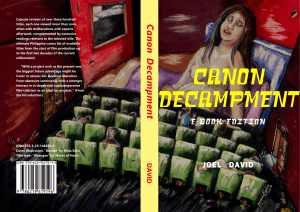
Click here to go to the Canon Decampment landing page.
The draft of an appendix entry for the 2023 edition of the online-only Canon Decampment, which I decided to revise and eventually jettison, since I planned to expand the contents while processing the downloadable digital edition:
From the arbitrary limit of 100 titles, the total number of films included in the current volume’s final list reached exactly 160, the composite number having been a welcome indication of a determined pursuit of standards that may be awkwardly described as openhearted yet lofty (a useful way of confirming true love, if I may say so).[1]
11011In terms of my libertarian orientation, a higher total would have definitely resulted if I had my way, but then I’d also have too many moments of wondering whether a level of consistency was successfully maintained. This frame of mind is annoying (to put it kindly) to me, and I also used to wonder how other self-identified critics—not just in the Philippines, to be fair—could sustain such an attitude toward film appreciation; but at the point where whatever career I’ve carved out might have to contend with a permanent shutdown, I’ll just have to accept that several anomalies will remain in place long after I’ve left.
11011Meanwhile, this quantitative exercise, which should be open-ended and ultimately futile (because quality production will not have stopped at 2020, among other reasons), will still be able to yield several useful points as well as several intriguing insights. I’ve harped enough on the qualitative limits of canon-formation at every point I could throughout this book, so all we’re left with here is just the “facts,” such as they are. Starting with the above annual production chart, certain conventional practices in Pinas film criticism can already be emphasized, qualified, or repudiated. The first would be the near-zero record from the start of Philippine film activity in the 1900s all through the 1940s. Film production maintained a healthy level of output throughout its first century even during the Japanese occupation, with a number of pre-war releases and an epic coproduction included in the current canon listing. (I can point to an “expert” who claimed in print that two discrete years during the past quarter century, plus the entire period of Japanese occupation, resulted in zero film productions—entirely verifiable false claims, as any quick internet search will disclose.)
Note
[1] Curiously enough, this figure happens to be close enough to the first appendix in Philippine Cinema: 1897–2020, the history book written by Gaspar A. Vibal and Dennis Villegas and edited by Teddy O. Co. Titled “Notable Philippine Films, 1898–2020” (322–24), the list included nonextant works, non-features, and foreign-produced titles “selected on the basis of ratings, recommendations, awards and honors, and popularity” (324) drawn from sixteen sources including the first canon survey I conducted and arbitrarily cut off and identified as “Top 50 Films,” as tabulated in the Annex of Patrick F. Campos’s “On Film Polls and Pinoy Rebyu: Interview with Skilty C. Labastilla” (Plaridel, vol. 14, no. 2, July–December 2017, pp. 203–05). However weakly or coincidentally, this affirms for me that canon listings for Philippine cinema can no longer comfortably reside within a 100-title limit.
Back to top
Return to Canon Decampment contents
Go to alphabetized filmmakers list
The aforementioned draft ended with an incomplete sentence that soon became inaccurate: “The fact that we had minimal or no canonizable works for certain stretches during the past century” [end of draft]. Herewith’s the subsequent text I uploaded on my Facebook post of October 15, 2026, with a photo file appended at the end:
The canon project always made me feel guilty for its reliance on dated approaches regarding auteurism and canonization. Its premise was even more old-fashioned, although soc-science types would be more aware than laypersons about my longstanding misgivings regarding empirical methods.
11011Then again, everyone seems to be obsessed with counting in pop culture anyway, so that guarantees some longterm readership for the book. Celeb-obsessives (fans actually, but I don’t judge since I also indulge my faves outside of canon projects) seem to prefer the PDF file, because they could use the search function to see how many of their preferences show up. Unsurprisingly, last year’s National Artists for Film in writing and performing arts scored highest in their fields.
11011But what if we did determine the most qualified according to number of achievements, in an honest-to-goodness national comprehensive film canon effort? (Of which only one exists, not just in Pinas but in the world, and it’s free, you’re welcome.) A number of these auteurs of course have already been installed in the Order of NAs, but you’ll be surprised who else hasn’t showed up. Ishmael Bernal and Lino Brocka kept playing catchup with each other until the dust settled with Ishma having an edge, 15 films to Lino’s 14. The others with ten or more titles were unsurprisingly both from the Second Golden Age, but amazingly they’re usually or always overlooked—Mel Chionglo with 11 and Chito S. Roño with 10.
11011As we go further we find names from the past who might have had larger counts if their films weren’t lost: Gerardo de Leon with 8 (plus a codirected title), Gregorio Fernandez with 6, Ramon Estella tying with Lamberto V. Avellana’s 4. Except for last year’s NA Marilou Diaz-Abaya, those with 5 titles and above awaiting their turn are: Maryo J. de los Reyes, Mario O’Hara, Mike De Leon, and Toto Natividad with 7 each, Celso Ad. Castillo, Jeffrey Jeturian, and Laurice Guillen each tying with Marilou’s 6. Fernando Poe Jr.’s a special case: he also has 6 solo titles, but he codirected 2 more and starred in a few others he didn’t direct.
Back to top
Return to Canon Decampment contents
Go to alphabetized filmmakers list
11011Filmmakers with 5 titles each are all still active: Adolfo Alix Jr., Brillante Mendoza, Khavn, and Ralston Jover. Those with 4 each once more belong to a mix of eras, with Eddie Romero and Bert Avellana already honored: Carlos Siguion-Reyna, Elwood Perez, Joyce Bernal, Lawrence Fajardo, and Yam Laranas, although Peque Gallaga’s 4 should also be in addition to the 3 he codirected with Lore Reyes. My warning about the rest is that if they’re still around, then they can add to their numbers if the project didn’t observe a 2020 cutoff.
11011Hence 3 films each: Antoinette Jadaone, Dan Villegas, Danny L. Zialcita, Emmanuel H. Borlaza, Gil Portes, Irene Villamor, Joel Lamangan, Jose Javier Reyes, Joselito Altarejos, Keith Deligero, Lav Diaz, Pablo Santiago, Sigrid Andrea Bernardo, and Tikoy Aguiluz. 2 each: Arnel Mardoquio, Artemio Marquez, Augusto Salvador, Bobby A. Suarez, Christian Linaban, Ellen Ongkeko-Marfil, Francis Posadas, Giancarlo Abrahan, Jade Castro, Jon Red, Mae Cruz-Alviar, Mikhail Red, Monti Parungao, Olivia M. Lamasan, Pam Miras, Raya Martin, Richard Somes, Rico Maria Ilarde, Romy Suzara, Tara Illenberger, Tata Esteban, and Wenn V. Deramas.
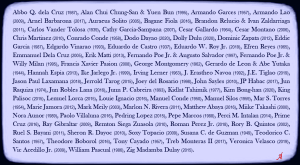
11011The vast majority have one each, most of them made during the present millennium, but with a number of these names having been foreign-born (because “Philippine cinema” can’t be essentialized to mean works made only by native-born folks, just as several nonlisted items might as well be called anything but Filipino). I just compiled them, alphabetized according to given name, and included their title’s year of release in the attached picture file, as a way of honoring practitioners who succeeded in such a complex and stressful undertaking; I included the codirectors of FPJ and Manong Gerry, and mention here that Kidlat Tahimik, Manuel Conde, Nora Aunor, and Armando Lao are already members of the Order.
Back to top
Return to Canon Decampment contents
Go to alphabetized filmmakers list
Á!











 ORCID ID

