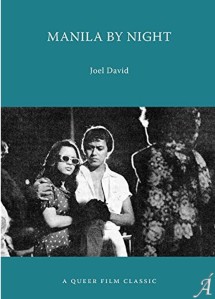
Author Archives: Joel David

About Joel David

Unknown's avatar
Teacher, scholar, & gadfly of film, media, & culture. [Photo of Kiehl courtesy of Danny Y. & Vanny P.]

Writing Pinas Film Commentary: Inklings #2

This next batch of tips focuses on the writing process, specifically on the issues that responsive film critics need to resolve before and during the act of writing.

Review or critique, or is there a difference? (Part 1)

As in the question regarding the difference between criticism and literature, there should be none in this case. The only trouble is that in practice, most people insist on one or the other type of output, accepting that one (criticism) is superior to the other (reviewing). When in fact the only difference that matters is that between good and bad commentary. No one should be surprised to come across bad criticism just as good reviewing can and does exist. And no, I won’t allow us to fall into the trap laid by the late John Simon (unfortunately idolized by an entire generation of Pinoy film critics), that reviewing is just bad criticism.[1]

11011We can proceed by viewing each activity in terms of the frame of mind the author brings to it. Reviewing involves a micro perspective while criticism is macro exertion. One will seem easier than the other – except again for the earlier precept I brought up: the seemingly simple or fun diversion is in fact what’s fraught with more danger and renders the writer prone to failure and embarrassment. If you need any proof, just take a look at the reviews that the “official” critics circle (there’s only one) requires of its members when awards season happens along.

11011Each member makes a valiant effort to prove the qualification of the author as an expert in Philippine cinema, but sinks from the homogeneity of the militaristic call to arms to defend the institution’s selections. Uniformity only looks impressive on troops, preferably those about to engage in actual warfare, but film commentary made to order to fortify the year’s canon fails against the macro challenge of upholding canons in the first place, vis-à-vis the always-urgent need to inspect and figure out the actual preferences of the mass audience … that the supposedly progressive circle avows as its primary beneficiary.

11011The surest way I can suggest to determine for yourself if you’re ready to embark on an extensive activity of providing film commentary will sound counter-intuitive. You will hear professions of passion, or at least of satisfaction, from nearly all the film appreciators you’ll encounter. It’s like a declaration of faith: I’m so into film, I live it and breathe it and can’t help but talk and write about it all the time – wait is this real celluloid OMG I just have to kiss it, yakety-yak. Pay no heed to this buffer-than-thou nonsense. When you find yourself engaged by a film-generated idea regardless of whether the film text in question affects you emotionally or aesthetically, then you’ll be in a better position to conduct research and evaluation than self-proclaimed film commentators.

11011On the other hand, if you find yourself impassioned by specific film releases and feel that your audience badly needs to be educated by you or a group you represent, the best course of action would be to pause until the delusion passes. If it morphs into an overpowering moral crusade, look for the nearest tall structure, climb up, and jump off.

Back to top

Review or critique, or is there a difference? (Part 2)

So micro or macro, which one should be it? Both, whenever possible. The reviewer who overlooks context, history, and the interplay of ideas just because these interfere with the call to provide subjective responses will just as surely fail as the critic who refuses to be honest with herself and dismisses the imperative of engaging the reader. The pros of each activity do not license the commenter to shunt aside the requisites that will ensure a well-rounded piece of work.

11011Finally, as if we didn’t have enough stumbling blocks to watch out for, I’ll be pointing out what to me is the most crucial one. This occurs when academically prepared authors venture into writing on pop culture. As I already made clear, I hold no judgment when people from any other (or from no) discipline attempt to tackle film material. The trouble arises when a subconscious form of colonial mentality takes hold, wherein the writer purports to display an expert grasp of existing (usually Western) theory and uses it to size up a local artifact, with the native sample always likely to fail in relation to the abstract ideal.

11011This would be pathetic if it were not utterly insidious. Any human exertion, in any period and place, rarely measures up to whatever perfect formal counterpart we can conjure up (its ideal essence, as expressed by Plato). This tendency comes from a secularization of biblical hermeneutics, which refers to the struggle to arrive at a correct and definitive interpretation of so-called holy scripture. Since our and our instructors’ training is rooted in theological assumptions, and our cultural capital derives from demonstrating competence in European languages starting with English, preferably prepped in Western institutions, we wind up with scholars who think they’ve been equipped with critical ideas and methods, eager to present themselves as proponents of whatever may have been hip or cool or edgy in the places where they studied.

11011We can and should value anyone who elucidates for us any new ideas, from any place, that happen along. But the more valuable critic is the one who realizes that theory, even and especially foreign ones, can be subject to critical analysis as well – can be challenged, modified, overturned, even rejected, depending on its evaluation in relation to urgent contemporary material conditions. (Even scripture should be treated the same way, but that’s not the war that needs to be won here yet; or rather, that war’s already been won.) So is this the best that any film critic can get – conversant with theory yet critical of it, sufficiently familiar and accepting of the film(s) under study? Not quite. Remember another even earlier point I raised, about humility. That should always remain the first object of any aspirant’s critical consideration: oneself.

Back to top

Watch and read the necessary texts more than once.

Pauline Kael, who I mentioned earlier, was famous for, among other things, claiming that she only needed to watch a film once in order to review it.[2] The resultant prose was brilliant, complex, witty, insightful, though sometimes premised on irrelevant detail or a possible misreading. I have read other film philosophers, starting with the foundational authors Sergei Eisenstein and André Bazin, and I recall a few instances where they talk about a contemporary or then-forthcoming function of film on the basis of a possibly indefensible assumption. (Speaking of philosophers, be very wary when Marxist-identified thinkers presume to write on film, unless you already subscribe to their ideology and there’s nothing else anyone can do for you; in fact nothing I can write about, with all my carefully finessed and updated Marxist notions, will be of help in that case.[3])

11011Advanced film thinkers – and I do include Kael in this category, despite the insistent rejection of her by many of my peers – don’t really have to be dependent on matching their ideas with any ordinary film release. When you are ready to do some theorizing of your own, after taking a comprehensive survey of film products and mastering all the relevant film and non-film ideas, then you can be dismissive of entire traditions and generations of practitioners if you think your notions will justify such radical purging.

11011In the meanwhile, you’ll just have to take my word for this: nothing will boost the critical credibility of any newcomer as a solid reading of a film-text coupled with a reliable grasp of related material, just as nothing will ensure long-standing embarrassment than a confidently declared conclusion that amounts to fake news. To be sure, a lot of pop-culture products get misread fairly often, by large sectors of the public. Our goal of course is to have, whenever possible, the certainty of accurate perception.

11011How you arrive at the right number of repetitions will depend on the conditioning you allowed yourself. For people of my generation, when getting to watch a film in itself was a luxury, with the product constantly in danger of getting lost for good, I could allow myself an occasional exception. (Many of the celluloid films I’d reviewed, and many more that I’d seen before I started writing on film, are in fact permanently lost.) But during the present historical moment, when films are increasingly easier to access, two screenings – one for gut response, another for note-taking – should be the minimum requirement.

11011What if a movie is just not worth watching twice? If your job is resident reviewing, you owe it to your own mental and emotional well-being to avoid those types of products whenever possible; your first desideration is to convince your superior, or yourself, to focus on titles that you can engage with, and allow yourself to stretch on your own terms. Remember as well that what you find unacceptable may be premised on entirely subjective responses. If you can’t stand, say, reptiles, body fluids, poor lighting, screaming voices, slapstick, atheism, or people of a certain race or gender (all conditions I’ve noted in people I’ve met through the years), then you’ll have to recognize that these may be conditions that don’t normally exist in the case of expert practitioners. You’d have to work on your own limitations first, and foreground these same limitations when you write. It would be ethically questionable to keep assailing your pet peeves while keeping your preferences closeted. People will not (and should not) be forgiving when they’re able to figure out what quirks you insisted on indulging.[4]

Back to top

Pay attention to your stylistic approach, to determine its adequacy.

As if working out your ideas weren’t hard enough, you’ll also have to be careful about how you’ll be expressing those ideas. Many starting critics adopt a shoot-from-the-hip approach, in the hope – and even confidence, if they’re less bright – that the resultant tone marks them as honest and straightforward. News flash: critics since ancient times have been writing that way, and absolutely no one remembers who they are today except for a few names mentioned in passing by annoyed authors; even worse, no one bothered to preserve what they wrote. The senior authors you may have read writing that way have either paid their dues in better-considered commentaries in their earlier period, or are just slumming around in an area that they think provides easy pickings (and should be denounced for it, but better just leave that to other senior authors like me).

11011Notice I mentioned tone, a really tricky stylistic permutation that involves the manipulation of elements like diction and syntax. It’s easier to achieve when you’ve attained a level of literary competence that allows you to play around as you write. People rarely display a mastery of tone at the outset, which is a way of saying that most writers have not fully attained the style they aspire to master.[5]

11011But here’s a secret most successful writers won’t tell you: whatever style you think you want for yourself, someone already pulled it off earlier, possibly in an unrelated genre. So part of your preparation, apart from reading the ideas you wish to contend with and viewing closely the films you wish to write about, is to read strictly for pleasure. Check out as many authors as you can read, in the cultural contexts that you find fascinating, until you find a writer whose voice seems to sound like how you would want to be heard by others (needless to add, we’re referring here to the printed, or digital, page).

11011This subjective type of reading should add to your store of ideas, but you should really be doing it in order to study how the author set those ideas down in a way that engaged you, her reader. As if that weren’t burdensome enough, I’d add that you should seek at least one other author with an approach opposed to the one you favor, but who also winds up provoking your interest. Meaning, keep reading on – which is why pleasure should be your primary purpose. If you’re able to find the best anti-writer to your earlier discovery (meaning someone whose voice you wouldn’t mind adopting as well), you’ll be able to perceive a dialectical difference in literary approaches, which may be able to contribute more effectively to the development of your own writing.[6]

11011I’ll close with two important pieces of advice along this line, but I’ll start with the one that I already mentioned at the start of this manual: never listen to a teacher who tells you specifically how to write, again unless you share enough ideological sentiment with this person and wouldn’t mind being considered her clone. But then why are you still reading this?

11011The second and possibly most important word of advice I as a writer can impart, is: be funny whenever you can. If a situation seems too grim and apocalyptic to laugh at, and you write about it unironically, like some prophet bearing the promise of a solution you somehow arrived at, then you should know that you’re already failing. Because you can always – spoiler alert – laugh at yourself. Try it and see: self-deprecation, when pulled off successfully, can ease your readers into some difficult or complex set of ideas that you want to present. And when you start out with that tone, you wind up committing yourself to a project that includes entertainment (at your own expense, if necessary) – always a noteworthy goal, in filmmaking as well as in criticism, despite what awards-obsessed practitioners might say.

Back to top

Notes

[1] From page 10 of John Simon’s “A Critical Credo” in Private Screenings.

[2] See pages 18-19 of George Malko’s “Pauline Kael Wants People to Go to the Movies.”

[3] Bias deserves its own extensive discussion. I recognize that it’s difficult to function effectively when devoid of it, but what I’d caution against is ideological bias of any kind. Media experts recognize that the most ideologically independent institutions (wire agencies, for example, or top-ranked academic journals) are the ones for whom reliability becomes a primary selling point. In this sense, ideological pandering becomes an easy way out, with sets of more-or-less fixed groups of appreciators and haters.

[4] The standard realization in psychology, originating from Freud, that hatred is actually a reflection on the state of mind of the hater has finally become acceptable in popular discourse, thanks to the efforts of race and feminist activists. Several Filipino authors and auteurs who traversed this shift in perspective will inevitably manifest reversals in their output. A favorite example of mine in Philippine cinema is Lino Brocka, about whom I’ve written more extensively elsewhere, most recently in my Manila by Night monograph as well as the corrigenda (actually a list of problematics) I posted on Ámauteurish!

[5] The first classroom exercise in my Pinas film-crit courses requires each student to write a personal letter to her best friend in order to point out a socially embarrassing habit that the friend needs to attend to. This comes directly from my experience of writing negative reviews in formal (a.k.a. “objective”) language and then running into the filmmaker in one of the many social occasions that a then-small industry enjoyed sponsoring. I’ve written elsewhere about their responses, which were always unfailingly fair and professional. I’ll be writing more about this, but not for and in the present text.

[6] Maybe a childhood fascination with cockfights (whose cruel methods appalled me only much later) accounted for this drive to find opposing authorial styles. I remember listing a number of favorite writers, but the ones whom I regarded as equally matched in terms of social awareness and linguistic innovation were Charles Dickens and William Faulkner. Even today when I read anything that reminds me of one, I’d find myself seeking out a sample of the other just to ask myself which one I’d consider more successful.

Back to top

You call these writing tips?

The mechanics of learning writing is what school attendance is for. Ideally a student should have sufficient competence in at least one language, official or otherwise, by the completion of secondary studies. College-level training could then supply the equivalent of what I endorse for authors anxious about stylistic expertise: the study of literature, to be able to identify models they can emulate and eventually surpass. Before the internet made a wide range of style guides (at least in English) available, I would spend study or work breaks rereading an author I admired, alongside one of many standard writing reviewers. During my earlier years, I would also draw up a list of style questions that I would ask from, starting with my high-school writing mentors. These could probably be served at present by the practice of crowdsourcing on social media, although my own efforts never yielded answers as satisfactory or definitive as when I looked up experts in person. For one practical bit of advice: master an academic stylebook (I’d recommend, for English writers, the Modern Language Association of America’s, since it’s formulated for humanities authors) and make any adjustments you feel will be useful, so long as you maintain consistency in your writing. Once in a while, look up a much older and necessarily dated reference (such as H.W. Fowler’s A Dictionary of Modern English Usage) in order to have a sense of where today’s notions of (beyond-political) correctness came from.

Back to top
Proceed to next section
Return to previous section
Return to table of contents

Writing Pinas Film Commentary: Inklings #1

What I will be drawing up will be ten matters to keep in mind. Following these will ensure that you’re on the right track, since I came by some of these insights from trial and error and use these as a way of making sure that I remain within a zone of confidence while still allowing myself some leeway for productivity.[1]

There is no such thing as too much preparation.

This applies to everything in life, not just in one’s profession. But it’s a simple matter to overlook when dealing with so-called easy material. In fact, people who study everyday “fun” things – food, sex, recreation, pets – will be the first ones to tell you that the ease with which they can be apprehended is misleading. From teaching for the past decade-plus at what is essentially an institute of technology, I’ve had several exchanges with instructors and students in engineering and the sciences who wind up confessing that they never imagined that film studies could be so fiendishly complicated a challenge.

11011Just as important is the issue of what preparation is the right kind. I’ve had students assigned to complete a semestral project laboring for the first few weeks over what title they wanted to use – when they explained their problem to me, I told them to just go with “Untitled.” Other students I was asked to advise were incapable of tearing themselves away from such long-debunked frameworks like anti-contraception or the validity of Ayn Rand’s ideas or the efficacy of underground “water veins” for health treatments; usually these were imparted to them by well-meaning but horribly incompetent parents, so be careful what you pass on if you’re some impressionable person’s adult authority.[2] I’ve also been unable to forget a scholar who came all the way from a tropical island, only to complain that his host country’s food was too spicy and the weather was getting too cold (with winter still a few months away), plus his war-trained colleagues were too masculinist.

11011Always, the common denominator in these cases is an excessive sense of privilege that blinds people into believing that no other questions about their specific set of convictions need to be entertained. The students’ influential figures – family, school, church, sometimes even government – misguidedly assured them that they were already equipped for some misplaced reason: they were rich enough, pedigreed enough, “blessed” enough, and so on, so that anything they tossed out in public deserved to elicit gratitude for their sheer effort.[3]

11011So we may as well begin with the right attitude for this kind of undertaking. In one word, humility. When you think you’ve done your best, be prepared to accept if someone else did better, and take a long hard look at your output vis-à-vis the superior one: inevitably, that one will have had better preparation behind it. Within the circles of doctoral degree-holders, we find this syndrome as well. Most so-called doctors of philosophy (mediocre ones, by definition) will throw their weight around and claim that they don’t need to know more than they do because some higher institution accredited them already; but the very best ones will speak truthfully in saying that they still have a long way to go, even after retirement. The value of the doctorate is in teaching where and how to seek knowledge, how to validate and evaluate it, and how to deploy it in scholarship; in the age of Google and Wikipedia, only unstable personalities will claim to be stable geniuses who’ll know everything.

11011A final observation I’ll be making is that writing, like any other profession, always presents the danger of roteness, when you achieve a level of competence that enables you to produce work according to a set schedule, format, vocabulary, etc. Nothing wrong if it’s a bread-and-butter activity, and if you made sure that no one else can excel on the same level in the first place. I would argue from long experience, however, that what can be fulfilling about writing – even critical writing – is that every challenge met (successfully or otherwise) is an entirely new experience every time: “I have a smattering of things I’ve learned from different teachers … [but] nothing I can count on, and that makes it more dangerous. But then the danger makes it more exciting.”[4] In that respect, writing is really as much a performing art as anything else, a point I hope to maintain at several points throughout this manual.

Back to top

Start with the long view: history, theory, long-form study.

This is just the beginning of the paradox I mentioned, where something that should be easy because everyone enjoys it requires more intensive preparation compared with some less-appreciated subjects.[5] Many students of film love to show off technical buzzwords that are now readily accessible in online glossaries – montage, lenses, light sources, transition effects, performative style, and so on. A few others will come prepared with terms like actualities, Classical Hollywood, New Wave (or its foreign-language equivalent), and any number of isms – neorealism, Expressionism, feminism, etc.

11011These should suffice for any global citizen, but news alert: we are not just “any global citizen.” People of the Philippines bear certain distinctions that mark them off from other population groups – first Far East Asian colony of any European power, first (and only) formal US colony, first (claimed) anticolonial revolution in Asia, and so on. And the invention and propagation of cinema is closely tied in with this history. It is not some benign or neutral technology that lends its usefulness to anyone interested in facilitating social change. Film history books will say that the first governmental use of film was Vladimir Lenin’s declaration that it should be deployed (by the Soviet Union) to promote international socialism, but how many people, even in the Philippines, are aware that Americans were already using it – and declaring its usefulness – to convince people in the US as well as the Philippine Islands that American colonization was morally justified and needed by our ancestors, the very victims of imperialist expansion?[6]

11011The next obvious question is something that’s been so neglected – because it’s been unasked, but that’s no excuse. What value then should we hold for a medium that has also proved helpful for our own purposes of change? (One, we should add, whose imperial country’s representatives faced censorship threats from their own officials when they produced films in the colony.) Are we really the ones, or the only ones, entitled to its use? What happens when our own audiences refuse to watch the movies our artists so painstakingly planned and funded and completed, only to discover that foreigners were more receptive to them?

11011Beyond this last still-vexed question, we have an impasse regarding the status of theory. At some point in the past, right after the people-power revolt in 1986, the local intellectual community was all agog over the emergence of all the “post” theorizing, starting with poststructuralism, proceeding to postmodernism, postfeminism, postracism, postgender … until someone came up with post-theory. And of course, what we know today as film has really been post-film for some time now: celluloid was phased out in Pinas even earlier than in most other countries, while the debates over film specificity (the issue of what technique was essential to defining film) were “answered” with some finality in the 1950s in France.[7]

11011As you will see, and probably be alarmed by, there is no excuse to be as unaware of these issues regarding film and the theories it raised, as there is no reason to be ignorant of how film (as well as preceding media like photography and print, and succeeding media like radio and TV) was used by all the colonizing forces that occupied the country: the Spaniards (who introduced it, during the eve of the execution of Jose Rizal), the Americans (who reintroduced it and made it a social and industrial institution), even the Japanese. Next time you’re tempted to crow about “film for social change,” imagine first the voice of Donald Trump countering, “You should be glad we bigly developed that unpresidented medium and made it available for the rest of the world, instead of claiming it for yourself. Sad.”

Back to top

Look inward at your personal motive(s).

All social intercourse necessarily involves a certain degree of narcissism, so it won’t be useful denying that fact or decrying its presence in others. It bears repeating, though: narcissism only becomes a liability when it’s enabled by privilege – of any kind, even a justified one. I know, a prominent local film authority once went on record to say that film critics should have the proper academic qualification, by which he meant, ideally, a doctorate in film. Bad news: I have one, and I never assumed that I was qualified, even when I still had to get one and knew I’d be able to, if the opportunity presented itself. For all our complaints about American personalities, one of the best cultural takeaways I had was that, in any “best” institution, people called everyone else by the nicknames they prefer.

11011What this means is that you might have enough of a record to demand respect from everyone else, but if you stumble, you stumble, and you can’t expect anyone to say she saw you walk straight unless you bribe or bamboozle her. The informality of American culture ensures this: we called everyone by their first names because if they were professors, they all had doctorates; if they didn’t, they could probably earn it eventually; and even if they already had their degrees, someone else will always be able to come along and excel as well as or better than they did, so they were always aware that they had to constantly prove themselves.

11011You can imagine how this worked out for me in an East-Asian Confucian situation, where people always had to defer to others for being old, or male, or wealthy, or superior in position, and so on. A few people would insist on their privilege, but the outcome was always predictable: these turned out to be the same people who’d never be able to boost their names beyond the degrees that they already had.

11011We also have to mention here the special case of critics who aspire to make a name so that they can be accepted as auteur personalities. A film critic is always-already an auteur personality, but we’re talking about the example of people from an era when the medium was still insufficiently developed, so it was always possible for an aesthetician to articulate a vision for improving film practice, then engage in that same area in order to illustrate her point.

11011If that’s what motivates you, well and good if you own up to it, but keep in mind a few things: first, when you want to talk critically about someone’s command of audiovisual language, better be ready to prove your own expertise in the present language you’re using; second, success in crossing-over will not be predictable even so – Philippine cinema is littered with the figurative corpses of competent film critics who wound up with less-than-impressive movies; third, cynically motivated criticism, where you provide mediocre and/or slapdash output because you’re biding yourself for the big industry break, will result in readers so turned off that they won’t want to have anything to do with you.[8] Again, if you’re privileged enough not to care, go ahead and write what you want and give yourself the break you think you deserve; but don’t be surprised if no one is impressed by the results.

Back to top

Insist on the use of basic study tools.

“Basic” is always relative, but assuming you’re a layperson, these refer to such methods as research, critical analysis, and scientific review. These sound academic, and they are, at least in origin, but people who’ve been working in scholarly disciplines long enough already own the key to making them work for anyone. It has to do with the previous bit of advice – knowing yourself – and making sure, in the face of objections from all over, that this is exactly what you want to do. When that happens, all the negative responses you’ll hear from people forced into the activity (too many things to read and watch, too much theory to work through, too much drafting and revision to undertake, and so on) will not matter. What’s work to others will be fun for you.

11011And if you think you’ll be “rewarding” yourself by promising that you’ll shift to creative processes later, here’s some bad news that should really be good news except for cynics and cheats: you’ll still continue needing the same tools I mentioned, though not in the same way obviously, and with a different form of end-result. But go ahead, look for the best art practitioners in the field you think you’ll excel in, determine how much productive discourse their work can engender, and see if you can argue that critical thinking had nothing whatsoever to do with it. The less-informed commentators will fall back on the usual magical explanations – that the artist’s a genius, touched by inspiration, lucky to possess good genes, and so on. It’s fine to dwell on fantastic speculations once in a while, but you’ll be fooling yourself if you think great work appears despite the absence of adequate materials that also prove useful in exercises as mundane as scholarly research and publication.

11011At this stage, we may as well turn to the conclusion that’s been obvious to anyone who’s practiced in productivity that makes use of critical and creative principles. Word of warning: this will prove so unthinkable that whenever I venture to mention it, I get responses that range from objections to violent denunciations. To be honest, it’s usually other academics who feel behooved to register their disagreement, probably because their profession is premised on (the artificiality of) specialization. The only fact I can state in my defense is that it works for me, and for the artists that I count as the best we can identify around us.

11011The point I’m about to mention is simple: there is no difference between criticism and artistic output. This should be obvious to anyone who regards any kind of writing as literature, but you will find Filipino critics who claim to be fully invested in praxis, who’ll nevertheless say otherwise. I’ve been fortunate though in collaborating with artists and writers who share the same regard for these essential values. This entire text is premised on that belief, so the only real choice for people conflicted about the usefulness of rules imposed in certain professional contexts like newsrooms or classrooms is to regard the prospective result as just another literary genre.

11011The formal requirements for criticism, like the ones that apply to poetry, fiction, dramatic writing, and so on, are simply sets of rules that any serious practitioner looks into opportunities to challenge and possibly overturn. It bears repeating here, that a teacher who prescribes a fixed approach to writing style is in fact ensuring that none of her students will be able to surpass her, just as she never will be able to surpass herself; although in the end, I always hold the students accountable for studying criticism without being critical enough to see when they’ve been trapped in someone else’s self-imposed strictures.

Back to top

Notes

[1] Acknowledging here the influence of the excellent lecture, “That Crafty Feeling,” given by Zadie Smith at the Columbia University Writing Program, where she admits her reluctance to prescribe approaches to writing, and instead proffers a list of markers that she observes when she writes her novels.

[2] I was still in US graduate school when the tide began to turn against the so-called Satanic Panic trend in North America. This began in the 1980s when day-care centers had proliferated to accommodate children of working mothers. Within a cultural atmosphere of dread and paranoia fed by televangelists who preached about the literal existence of angels and demons, parents, social workers, and investigators “interviewed” children and convinced them that they had repressed memories of their teachers engaging them in devil worship that involved sex orgies, bestiality, human sacrifice, and similar other outlandish claims. Several day-care centers had to shut down, their personnel languishing in prison despite a complete absence of evidence. For a comprehensive account, see David Hechler’s The Battle and the Backlash. A number of cases were dismissed and overturned in the 1990s. A direct line may be drawn from this scandal to the conspiratorial QAnon claims of the Donald Trump presidency.

[3] Same reason why I tend to gravitate toward rural and university-belt schools, where there’s less of a hurdle in reorienting young people toward more rational and scientific thought processes. Unfair as it may sound, my once-regular exercise in clearing out cobwebs in my mind’s chambers, prior to starting another academic year, saddled me with impatience in instructing people who still have to be taught this basic exercise in mental hygiene.

[4] Meryl Streep, as quoted by Karina Longworth (12).

Back to top

[5] The only review of my book that I felt compelled to answer was ironically an appreciative one, that nevertheless complained that I had a “penchant for unfamiliar words and ambiguous phrases” and named terms that were actually current in film, performance, and cultural studies. I was admittedly harsh but I was probably on alert regarding the implicit attitude of “why give me a hard time when it’s only about movies?” See “The Reviewer Reviewed,” which I posted in the Extras section’s FWIW subsection of Ámauteurish!

[6] See Vladimir Ilyich Lenin’s “Directives on the Film Business” in Lenin Collected Works. For a detailed account of Dean Worcester’s photographic and film documentations in the Philippines as well as the New York Times’s enthusiastic reception, see Mark Rice’s Dean Worcester’s Fantasy Islands; a fuller context is provided in Alfred W. McCoy’s Policing America’s Empire. Note that despite the term “Pinas” in the title of this manual, I do not make a claim for any distinct Filipinoness in what I write, beyond the fact that I identify primarily as a scholar of the country’s pop culture.

[7] Several essays by André Bazin, notably “The Ontology of the Photographic Image,” “The Myth of Total Cinema,” “The Evolution of the Language of Cinema,” and “The Virtues and Limitations of Montage” – all in the first volume of What Is Cinema? – are regarded as the first in a long line of often contentious give-and-takes on the issue. David Bordwell, namechecked in a mini-appendix, regards Bazin’s theorizations as central to what he termed a “dialectical version” of film history, in On the History of Film Style (46-82).

[8] The only instance of a Filipino film critic successfully making a transition to filmmaking turned out to be triumphant at both ends: Ishmael Bernal had been publishing superior reviews during the late New Criticism period, with his other critical colleagues (somewhat dubiously) organizing themselves into the critics circle I mentioned earlier. Further disclosure: I once accepted an invitation to join this same circle, early in my own stage as nationally published writer. On the other hand, if you intend to maintain equal or stronger presence in scholarship, then my advice is to steer clear of the national university’s misguided example of granting tenure and promotion points for “creative” output (all the while complaining about the humanities faculty’s paucity in research), and look more closely into screen media practice research. Sometimes abbreviated as SMPR, this area of study is fairly recent, although unfortunately its rationale and methods fall outside the scope of this manual.

Back to top

But where are the shortcuts?

The short and sweet answer is: there are none. The downside of academic preparation becoming possible for aspiring film practitioners is that graduates get the impression that essential lessons from the past have been codified and handed down to them. But the existential condition is necessarily already absent. When people once envisioned a career premised on film expertise, without the benefit of formal studies, they had to draw up their own personal programs and find ways of identifying possible limits and loopholes in what they studied – and seeking ways to resolve those problems. This explains why a majority of earlier practitioners were lacking in many ways, compared to the pleasing and predictable consistency of applicants since the introduction of film-studies programs in the country. It also explains why (the lesser number of) gifted oldtimers tended to have career longevity, compared to the contemporary wealth of impressive debut outputs that wind up their makers’ best work, if not their only one. In effect, the most accomplished among the Golden-Age practitioners had no recourse except (but then also had enough time) to achieve the equivalent of master’s degrees before they presumed to knock on history’s doors. Given the state of graduate programs in Pinas, though, I wouldn’t say that completing a formal one today would provide a useful answer either.

Back to top
Proceed to next section
Return to previous section
Return to table of contents


Writing Pinas Film Commentary: Turning Point

Caught up in the planning and implementation of book and media projects that university tenure finally enabled me to pursue, I realized only with the approach of my retirement that my work, and concomitantly my output as Pinoy film commenter, is about to end in a few years. I’ve been able to witness the early part of my film-writing activity – consisting of reviews of recent releases, as well as the middle portion of my series of output, comprising canonical exercises – being replicated in film publications as well as in blogs and even social-media posts. I’m still awaiting a critical mass, pun intended, to take up research-based historicizing, theorizing, and critical revision, plus an upgrade of what we might unfairly regard as “lower” forms like gossip writing and celebrity analysis.

11011But if anyone tells me I should begin to prepare to accept the end of my contributions and witness how succeeding generations build up, change, or demolish them, all I’ll say is that I started doing so already. I’ll still need to complete a couple of vital book projects and perhaps a memoir, and prepare for my idea of a hedonistic retirement where I can pick out what I want to write on and attend to it at the pace I feel would be most workable, while mentoring some of the better talents around if they feel that they could be productive with my help, without any promise from me of institutional rewards.

11011Meanwhile the inevitable question: are there tips for writing film commentary that I can leave behind? Something that any layperson can go over and then approach film writing better prepared than before she read what I wrote (namely, as it turns out, this manual). I wish the answer were as simple as a yes or no, but only partly because of my academic orientation, I must say: it’s both a yes and a no. What I mean by this is: I cannot give writing tips other than anything that might arise from direct experience. Which means, that kind of advice will not be useful unless you find yourself in exactly the same situation I once had, dealing with the same personalities during that same period. You can of course watch out for analogous or comparable setups and use any of these lessons as guide, but it will be better to see if another approach will work better so you can be more assured of your capabilities and have something to write about afterward.

Back to top
Proceed to next section
Return to previous section
Return to table of contents


Writing Pinas Film Commentary: Forebearance

Film is an illusion. The audience just sees a lot of shadows on the screen. The emotion is in the audience. The trick is giving them something that unleashes that and suddenly they endow the images with their emotion. My theory is, when people say a movie is beautiful, I don’t think it can be unless there is beauty in the audience.

Francis Ford Coppola[1]

Essential disclosure first: I’ve never enjoyed teaching film criticism the same way I relish teaching theories of film (some more than others, understandably). My reluctance in teaching writing that requires the development of personal style is precisely because of what the term denotes: writing style is something that one approaches the same way that one deals with knowledge – incrementally, instructed by the best available models, ideally with sufficiently useful feedback and room for failure, shaped primarily by one’s needs and preferences.

11011Fortunately film programs never want for instructors eager to teach students how to write on film.[2] From another perspective, this was the reason I could not take the Paulettes, named after their idol and role model Pauline Kael, as seriously as the original: there has been only one occasion in film history for a female critic with a jazz-inflected writing style who made no bones about the subjectivity of her responses and took to demolishing all opposing opinions mercilessly; no matter how delightfully she wrote and spoke, the act of replicating her quirks and mannerisms in another time and place no longer seemed essential. When I noticed Filipino film students writing the same way that their teachers did, I felt sorrier for their being unable to realize what was delimiting and sometimes flawed about their instructors’ prescriptions.

11011On the other hand, once I had completed the apprenticeship I set out for myself by performing as resident film critic of a weekly newsmagazine in the late 1980s to early 1990s, I became increasingly focused on scholarly writing. As I just finished pointing out, I managed to figure out that, like any other literary genre, film commentary set out an entire clutch of rules to follow, but the basic requisites for competent film writing remained unchanged. Those who have been following my output even during the past few years will also realize that I’ve allowed myself the pleasure of engaging in scandal discourse, an activity I couldn’t get enough of, to be honest about it. Unfortunately the incidence of sensational showbiz developments that could withstand allegorizing as an embodiment of the national condition has been rarer than color celluloid prints from the studio-system era.

Notes

[1] From“Life Is a Great Screenwriter,” an interview feature by James McMahon.

[2] Another matter I have tackled elsewhere but can’t pursue here: writing on film, to me, involves the widest possible spectrum of activity, including scriptwriting and celebrity-gossip reporting; generally a bad writer in one area will wind up writing badly elsewhere. One may elect to do careless film commentary with the resolve to rein in one’s gifts until a “real” industry break comes along or until a “worthy” literary undertaking presents itself, but this kind of cynicism merely masks a poverty of spirit that will always become evident at crucial moments to knowledgeable observers.

Back to top
Proceed to next section
Return to table of contents


Writing Pinas Film Commentary

Original Digital Edition (2021)
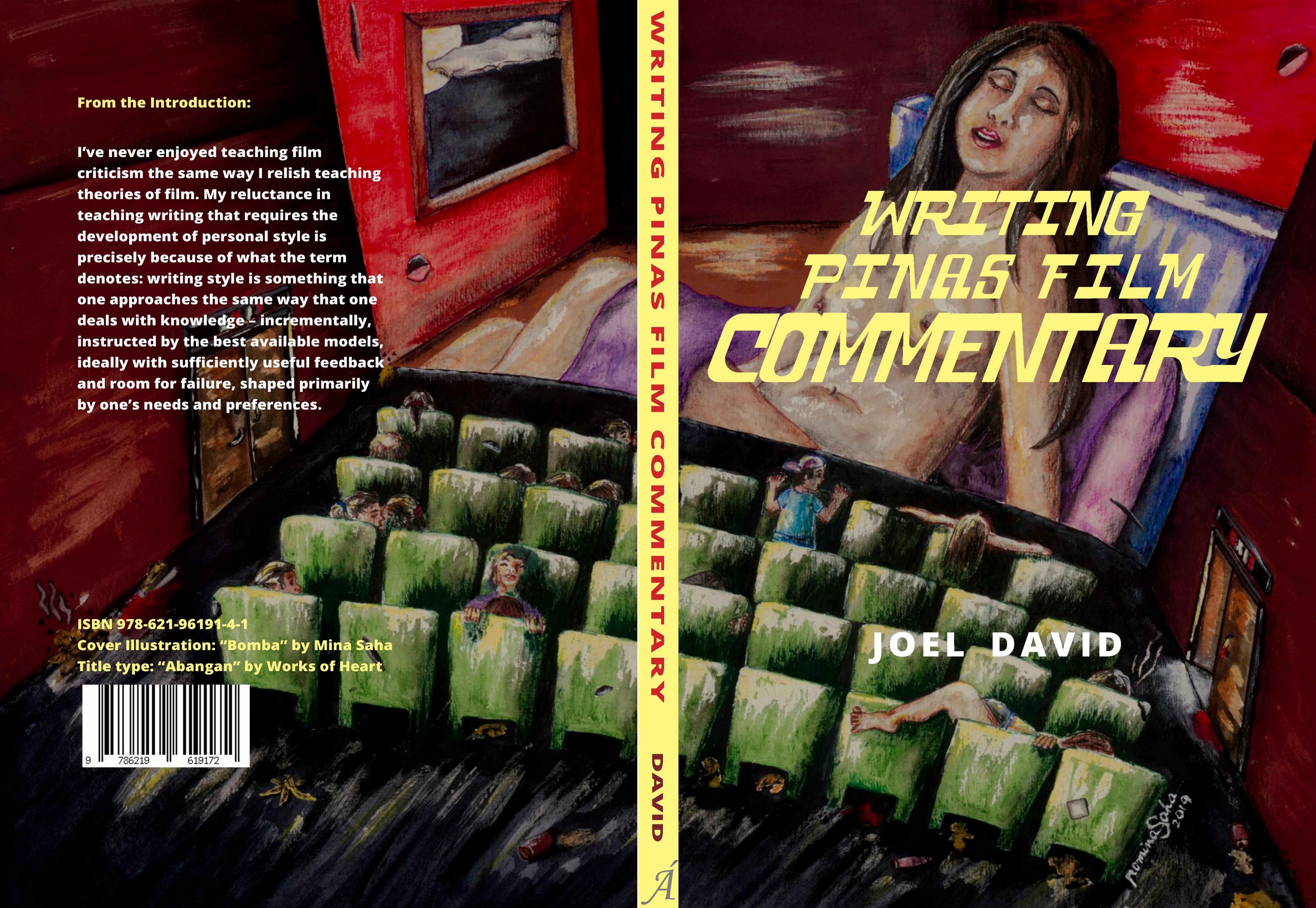
Cover design by Paolo Miguel G. Tiausas
“Bomba” © 2019 by Mina Saha
[Click on pic to enlarge]

ACKNOWLEDGMENTS

Writing Pinas Film Commentary’s entire text was written during the Covid-19 pandemic that left me (and several other citizens) stranded in foreign locales. The Twosome Place coffeehouse branch of Inha University in Incheon, Korea, became my virtual workplace during the several months it was allowed to operate, under the first-rate management of Lee Sanghun, with my occasional craving for Turkish coffee adequately covered by Sinan Çakiltepe’s Itaewon diner. Affairs in the home country were worked out by my brother Aris David, colleague Ellen Ongkeko-Marfil, and scholars Juan Miguel Manansala and John Cris Velasquez. Upon deactivating from social media and discovering I preferred to remain virtually stranded as well, my connections to the digital world were sustained by a small circle of contacts, primarily Mauro Feria Tumbocon Jr. and Jerrick Josue David (not a relation). An accumulation of self-doubt was relieved by welcome news from Louie Jon A. Sánchez.

11011As always I managed to count on my colleague, Ha Ju-Yong, to make sure I could accomplish official work requirements that entail reporting or coordinating in my host country’s language (which I still to struggle to learn, embarrassing as that sounds), with Kwon Sungjin and Yoo Hee-chan taking care of the more casual end. The work of scholars from all over such as Patricio N. Abinales, Lulu Torres-Reyes, Caroline S. Hau, and Paul Grant continues to inspire me to be productive, and I share with overseas Filipinos everywhere the fond hope that in a future that ought to arrive soon, we can finally thank everyone who helped us in person, rather than in print. The individual with the most impact on my development as a writer was my high-school English teacher, Teret de Villa, now a professorial lecturer at the national university’s Open University; I dedicated my first book to her and my other HS English teachers, but her influence abides throughout all my publications. In the same spirit of acknowledging formative influences, this book is dedicated to the first circle of friends I made in Korea: 박신구, 박해석, 손범식, 유태윤.

Disclaimer: The manuscript occasionally makes use of literary devices, including satire, hyperbole, and absurd humor, and thereby assumes basic competence in comprehension. The author will not be responsible for any person who observes a literal application of these passages in real life.

National Library of the Philippines CIP Data

David, Joel.
11011Writing Pinas film commentary / Joel David. — Original Digital Edition. — Quezon City : Amauteurish Publishing, [2020], © 2021.
1101152+vi pages ; 30 cm

11011ISBN 978-621-96191-7-2

110111. Film criticism — Philippines — Handbooks, manuals, etc. 2. Film criticism — Philippines. 3. Philippine essays (English). I. Title.

791.43702841101111011PN19951101111011P120210039

US Copyright Office Certificate of Registration:
TXu 2-255-122

Digital Object Identification:
DOI

Back to top

Contents
© 2021 by Amauteurish Publishing
All Rights Reserved

Introduction: Forebearance

Turning Point

Inklings 1
• There is no such thing as too much preparation
• Start with the long view: history, theory, long-form study
• Look inward at your personal motive(s)
• Insist on the use of basic study tools
11011Break: But where are the shortcuts?

Inklings 2
• Review or critique, or is there a difference? (Part 1)
• Review or critique, or is there a difference? (Part 2)
• Watch and read the necessary texts more than once
• Pay attention to your stylistic approach, to determine its adequacy
11011Break: You call these writing tips?

Inklings 3
• Be prepared to revise constantly
• Submit or upload your text, then attempt further revisions
• Own your errors
• Careful with the claims you make
11011Break: What about my actual motives?

Persistence of Vision

Mini-Appendices [including Works Cited section]
11011• A: Self-Study
11011• B: Deconstruction

Works Cited

Back to top


Acceptance message for the 2021 Gawad Balagtas for Film Criticism

The Covid-19 global pandemic necessitated an online program for the recognition ceremony of the annual awards of the Unyon ng mga Manunulat sa Pilipinas (Writers Union of the Philippines). With three minutes set as the limit for the recorded acceptance message, I read out the text below.[1].

An anachronistic pabebe wave to everyone.[2] I will admit that my response to the news of winning the Gawad Balagtas was immensely moving, partly because it reminded me that people at home were keeping tabs on me, and partly because these people represented an organization for whom criticism used to be distinct from (and less essential than) literature. The big secret I’ve kept to myself was that I never regarded criticism as any different from other forms of literature. I could sense throughout my career that some artists and authors appreciated the efforts I invested in my output, just as I also admired them when they were able to critique their own work and plow back their lessons and insights in their future products.

11011The reason why the UMPIL recognition is meaningful for a still-active critic like me is that the field where I function has been making occasionally valiant efforts at moving forward, to keep up with advances in other areas of criticism as well as in art and literature. But the distractions of more lucrative options in public relations as well as the dangerous assumption that film criticism should never challenge its readers’ intelligence all conspire against introducing new ideas and approaches.

11011This is why whenever I step back to assess how far I’ve been able to arrive, my journey was extensive only in terms of time and space. As public intellectual, I always feel like I’ve barely moved from where I started. I am hopeful that UMPIL will allow me the option of meandering down new pathways, playing with new concepts, championing practitioners who I feel have been overlooked, stumbling around once in a while, and maybe looking like I’m having too much fun – because I’ve learned that that’s the best way that difficult innovations can be announced and implemented.

11011I always delight in pointing out how I keep attacking canon-formation activities but ironically have to set up canons the right way in the first place. And at this stage in my life, I find myself being canonized as well, sometimes by institutions whose premises and motives I find necessary to contend with. This of course is always the risk we face when we announce our approbation of individuals who are still capable of, and intent on, changing.

11011For all the timeliness of the Gawad Balagtas, the careful deliberation that I’m sure must have gone in deciding to add me to the roster, and the symbolic consequence of being cited by the most credible and accomplished community of Pinas citizens, considerately extending their reach overseas, in defiance of a still-ongoing historic health disaster: my sincerest gratitude, lubos na pasasalamat sa inyo, 여러분 정말 더럽.[3]

Notes

Thanks to the people who provided advice on what I should (and shouldn’t) be saying: 박신구, 박해석, and 손범식, as well as to 권성진 for helping me pick out an appropriate final greeting. Special shoutout to UMPIL Board Member Louie Jon A. Sánchez, who made sure I had enough time to prepare for the occasion.


[1] The text of the citation was in Filipino and appears in the preceding illustration. It may be translated as follows:

For his vigilant advocacy of his field of practice, his faithful guidance in its nationalist and democratic aspirations, and his interventions in upholding film as a vital component of the everyday life of Filipinos and as a crucial factor in the unfolding of the history of the Philippines.

11011He is not only foremost in his field, but also the primary developer of [Philippine] film criticism, which has become a flourishing and indispensable literary form because of his tireless contributions.

[2] “Pabebe” is a Taglish term that may be approximated as “trying to be baby-like.” It was first used for the popular phenomenon on Philippine TV that enjoyed its own coinage, AlDub. The baby-ism specifically referred to a voiceless character appropriating the beauty-queen wave, which in turn was an imitation of the Queen of England’s distinctive hand wave.

[3] The standard utterance, “yeoreobun jeongmal dureob,” is a comic insult that translates to “you’re all really dirty.” The L and R sounds are represented by the same letter (ㄹ) in the Korean featural system, so with the adjustment of a consonant in the last word (to “duleob”), the statement aurally registers as “you’re really all the [ones I] love” in Konglish. Understandably, the wordplay will be recognizable mostly to younger generations of Koreans.

Back to top


List of Illustrational Problematics for Manila by Night: A Queer Film Classic

Illustrational Problematics is a self-descriptive category spun off from the list of textual problematics. I designated it to explain issues with visual content. These affect pages 38, 45, 50, 82, and 127. For discussions of textual problematics, click here. To return to the corrigenda page, click here. The problematics are listed according to the order they appear in the book; for a topical list of issues linked to the discussions:

Bernal, Elena (Ishmael’s mother)
Bongbong at Kris (1987), play by Boy Noriega
Estregan, George, pic of Eric (1969)
Iginuhit ng Tadhana (1965), “Bongbong” Marcos in
Manila Film Center’s Malakas at Maganda mural
11011• Si Malakas, si Maganda, at si Mahinhin (1980)
Paloma, Pepsi rape case
Presidential children as film performers
When It Is a Gray November in Your Soul Coffee Shop

Page 38, Figure 4:

Several elements in this pair of pictures are capable of generating discussions in themselves, but would detract significantly from the concerns of the book text. To bring up a novel example: one figure is common to both – Ferdinand “Bongbong” Marcos Jr., only son of the Marcos couple and latter-day frustrated vice presidential aspirant. This detail would alter most people’s impression that the first presidential offspring to perform in movies was Corazon Aquino’s daughter Kris. (At one point, Lino Brocka was considering casting Imee Marcos in the title role of his Cannes breakout entry Insiang, but fortunately managed in time to cast aside that phantasmagoria; see pp. 125-26 of Jo-Ann Q. Maglipon’s “The Brocka Battles,” in Lino Brocka: The Artist and His Times, ed. Mario A. Hernando, Manila: Sentrong Pangkultura ng Pilipinas, 1993, pp. 118-54.) During the euphoric period that followed the 1986 “people-power” revolt that deposed the Marcoses and installed Cory Aquino, playwright Bienvenido M. Noriega Jr. (formerly with Imee Marcos’s Experimental Cinema of the Philippines) wrote a popular stage comedy premised on a speculative Romeo & Juliet-inspired romance titled Bongbong at Kris (1987).

Back to top

Page 45, Figure 7:

I would have preferred to use the evocative pic below (click to enlarge) in place of this solo portrait of Elena Bernal. Unfortunately its source, the phenomenal Pro Bernal Anti Bio volume (Manila: ABS-CBN Publishing, 2017) – drafted as an autobiography of Ishmael Bernal, passed on to his confidant Jorge Arago, and completed by Angela Stuart-Santiago in honor of her late friends – came out about the same time as Manila by Night: A Queer Film Classic. It would also have corrected the commonly misspelled and uncompleted name of the café run by Bernal, with “When It Is a Gray November in Your Soul Coffee Shop” rather than “When It’s a Grey November in Your Soul.”

Back to top

Page 50, Figure 9:

The pic in question came from a framed entry in Cinema Paraiso (Film Paradise), an exhibit of Filipino movie memorabilia with film screenings and lectures, held February to April 2003 at the National Commission for Culture and Arts gallery in Intramuros, Manila. According to historian and archivist Teddy Co, one of the organizers, “It’s actually from my collection of bomba magazines, ca. 1969-70. I cannot find the issue anymore so I cannot name the magazine and what month it was in. The other exhibit curators were Josephine Atienza and Cesar Hernando…. The pic was in a section called A History of Kissing in Filipino Movies, starting from the first smooch between Dimples Cooper and Luis Tuazon to a digitally rendered kiss from Lastikman [dir. Tony Y. Reyes, 2003]” (Facebook Messenger exchange, June 5, 2020). The explanation may be too long for a caption and should be written as a footnote.

Back to top

Page 82, Figure 15:

I could have replaced either one of two exterior shots of the Manila Film Center with the mural in the lobby, painted by Victor Cabisada Jr. and Peter Alcántara, then-impossible to access after a fire damaged the building (see this blog’s header image). In September 2020, an art historian, John Paul “Lakan” Olivares, posted the pic below (click to enlarge), apparently taken when the object was still new, on his blog Lakbay ng Lakan, and granted me permission to use the illustration. It depicts the native myth of the first cis couple, Malakas (strong) and Maganda (beautiful), the latter resembling Imelda Marcos; both were supposedly locked together in a node of bamboo, pecked open by a curious bird. Although many other Malakas at Maganda murals with the same intent of identifying the Marcoses as first Filipinos can still be found in various government buildings, the Manila Film Center version was far and away the best-rendered of the lot.


11011Incidental observation, which I admit being unprepared to fully comment on: the couple were notoriously sensitive to criticism (not to mention mockery) about themselves, but the biggest queer-themed hit up to that point, Danny L. Zialcita’s Si Malakas, si Maganda, at si Mahinhin [The Strong, the Pretty, and the Timid] (Trigon Cinema Arts, 1980), came out around this time. The surest speculation I can make is that, inasmuch as the movie was released just as the controversy over Manila by Night was making headlines all over the world, Imelda was certainly not going to risk her culture-czarina status over what appeared to be a potboiler that would never attract the same amount of attention as the production she deemed was a smear on her dream of setting up what she termed the City of Man.

Back to top

Page 127, Figure 26:

Re the caption: upon the prompting of director-writer and actor Bibeth Orteza, a close associate of the accused comedians (one of whom had died), I reread available material on the controversy and was surprised to find that the case for reasonable doubt was strong. Pepsi Paloma advanced her accusation of rape in the media on the basis of a photograph where she was apparently being held against her will. Splashed on the front pages of tabloids and now inexplicably unavailable, the picture showed Joey de Leon kissing an unwilling Paloma, with the other comedians looking on with amusement. The worst that the picture denotes would be molestation, rather than rape.


11011The photographer was Guada Guarin, an actress who was also a ward of talent manager Rey de la Cruz; she has since refused to speak on the matter, as do the surviving accused. The rape story attracted renewed attention from an extended article and its follow-ups that were subsequently withdrawn by the Philippine Daily Inquirer, after the current Philippine Senate President, who was part of the comedy team but not present during the incident, successfully contested the timeline of events claimed in the articles (see “INQUIRER.net Statement on the Pepsi Paloma Stories,” July 5, 2018).

11011I had to conclude that the rape accusation may have been one of the publicity gimmicks de la Cruz (whom I’d interviewed more than once) was known for. The softdrink beauties and the comedy trio used to have their own regular projects with Regal Films (also Manila by Night’s production outfit). When the production company severed its ties with de la Cruz and his talents as a result of the controversy, that indicated to me that the accused had enough of a strong case to demand that Regal either take their side or risk a lawsuit.

11011The circumstances behind the incident, where the alleged rapists invited the actresses to visit a room in a five-star hotel, had no indication of coercion or the use of an incapacitating agent; each side claimed that the other was enthusiastic about extending invitations to visit the room. The last few weeks before Paloma announced she was dropping her case, only de la Cruz continued to denounce the comedians. The Senate President, unfortunately, is a right-wing pro-Church bigot with the expected sexist and homophobic trains of thought; the condition gives rise to less-informed liberals readily believing that he shares the same type of malevolence with his associates – which, according to people within showbiz circles, is far from true. Everyone familiar with the team avers that incumbent Pasig City Mayor Vico Sotto, regarded as a future liberal favorite for national politics, holds values closer to his father than to his uncle.

11011As a direct result of the suppression of the Inquirer articles, several misimpressions about the incident have proliferated. In one instance, Eraserheads frontperson Ely Buendia found it necessary to debunk the long-standing rumor that the song “Spoliarium” (titled after the celebrated 1884 painting of Juan Luna) was about the rape of Pepsi Paloma. One other verifiably erroneous claim making the rounds of internet posts concerns the ungrammatical suicide note supposedly left by Paloma, stating “This is a crazy planets.” This was in fact the message left by a near-contemporaneous suicide, Stella Strada, who like Paloma also became famous as a sex-film ingenue.

Back to top

Á!


List of Textual Problematics for Manila by Night: A Queer Film Classic

Textual Problematics is the term I use to refer to issues that occasionally are unresolved, or that otherwise would be too cumbersome to attend to, within the physical and/or editorial limits of the publication. Most of these issues already inhered in the material during the process of its creation, although in one instance, the problem arose some time after publication. They range from the aforementioned complication in attribution, to a queer controversy involving a different film, to the usual quirks in historical interpretation. These affect pages 11-12, 36-38, 53-59, 56, 57n10, 61, 64, 69, 78-79, 88, 111, 128, and 148-49. For discussions of illustrational problematics, click here. To return to the corrigenda page, click here. The problematics are listed according to the order they appear in the book; for a topical list of issues linked to the discussions:

Availability of First Golden Age titles
Bernal, Ishmael
11011• Cooperation with the Metro Manila Commission
11011• Traumatized in his first film project
Book writing process, including close reading
Brocka, Lino’s last-minute rejection of commerce-vs.-artistry binary
Censorship politics during the Marcos presidency
Manila by Night (1980)
11011• As a comedy film
11011• Erroneous title (Manila after Dark)
11011• Production design problem
11011• Storyline
Maynila: Sa mga Kuko ng Liwanag (1975)
11011• Internal censorial troubles
11011• Missing sequences’ similarities with Midnight Cowboy (1969)
Pito ang Asawa Ko, Huwag Tularan (1974)
11011• Falling out with film producer
11011• Homage to a François Truffaut film
Plot & structure, rather than characters
Smorgasbord movies
11011• Iginuhit ng Tadhana (1965), elements in
11011• Partial list of prototypes

Pages 11-12:

I prepared for the project by rereading some of my favorite volumes in the British Film Institute Film Classics series (renamed BFI Film and TV Classics) as well as some of the recent Queer Film Classics texts. As far as I could tell, their approaches reflected their respective authors’ scholarly concerns. What they all had in common though was close readings of the specific films after which each volume was titled. In anticipation of this exercise, I drafted a detailed account of Manila by Night’s plotline, running for several pages. To my relief, the editors described it as too long and asked for a story summary instead. (I posted on Ámauteurish! the said extensive storyline.)

11011In writing out the book, I had to provide expositions of the Philippines and its cinema in the first of the standard three chapters, so I thought I could do the close reading in the second chapter. But then I wound up explicating Philippine queer cinema and the auteur I was covering, and in the final chapter I had to explain how the multicharacter movie functioned as a politically responsive genre product. I provided some relevant technical observations and decided to see where the editors might think I could insert the missing close reading of the entire film. To be honest, though, I thought that any scene-by-scene analysis would disrupt the textual flow, if not stanch it altogether. So once more I was relieved when their list of revisions did not include the specification I dreaded.

Back to top

Pages 36-38:

In a manner of speaking, the first Ferdinand Marcos biopic that Sampaguita Pictures produced had the trappings of a smorgasbord production (see page 88) – multi-episodic and multi-directed – except where it mattered: it featured a singular (pseudo-)heroic character. I am only certain of the availability of few of the proto-smorgasbord Sampaguita films in this listing, Tony Cayado’s Mga Ligaw na Bulaklak and Kaming mga Talyada, Armando Garces’s Sino ang Maysala?, as well as the final one referenced here, Iginuhit ng Tadhana: The Ferdinand E. Marcos Story. All the other ones are apparently lost. Will update if any of the others surfaces. [Update: An apparent smorgasbord-movie predecessor, produced by LVN Pictures and more aligned in fact with the late-1950s bad-boy Lo’ Waist Gang trend initiated by Larry Santiago of Premiere Productions, has surfaced: Barkada [Gang], a 1958 release directed by Lou Salvador Sr., may be accessed at Mike de Leon’s Citizen Jake Vimeo page.]

Back to top

Pages 53-59:

I ought to express with utmost care the dynamics behind censorship as a political process during the Marcos martial-law era. When the Philippines began to acquire a higher global profile and a then-upstart studio, Regal Films, made its bid for overseas presence via Manila by Night, only someone with the right combination of motives and connections could step up and make sure that the powers-that-be develop an animosity toward the film. Why against Ishmael Bernal but not against the Cannes Film Festival celebrants, Lino Brocka and Mike de Leon? The person in question, Marichu Vera-Perez Maceda, may have been connected as much with Brocka, or at least with the Philippine Educational Theater Association, as with the Marcoses. Brocka and de Leon worked for Maceda’s outfit. Bernal however had a celebrated falling-out over Huwag Tularan: Pito ang Asawa Ko, the film project he completed with Sampaguita Pictures, the studio run by her father, after the latter shot additional scenes without the director’s approval. This means that reports of her behavior in mediating between the conflicting sides in the censorship controversy must be subjected to intensive critical scrutiny.

11011I had the opportunity to observe, as an insider in the Marcos film agency, how Maceda opted for the program that directly handled the disbursement of funds to favored film projects. When a project she produced potentially conflicted with the output of Marilou Diaz-Abaya, an associate of Bernal, I heard her make an excessively dramatic claim to mediating between the creative team and the forces of censorship. Bernal carefully demonstrated deference for someone who was after all part of the inner circle of the First Lady, but condemned her in the strongest terms after she left, for once more finding ways to advance her political and financial standing at the expense of some of the most outstanding films of the time. The Philippine critical community continues to hold Maceda in high esteem, mainly because of her association with a noteworthy period in film history; for this reason the many significant accomplishments of her family’s studio (active during and beyond the First Golden Age) will have to be qualified with the underhanded intrigues she fomented during a period when the act of opposing figures of power carried inordinate political, professional, and personal risks.

Back to top

Page 56, second (parenthesized) sentence:

Bernal’s familiarity with official government communication policy derived from his working relation with another functionary, similar in terms of access to power as the two-faced censoring agent in the preceding entry, but benevolent for a change. Marita Manuel, whose tracks since the end of the Marcos dispensation have become scarce, ran Metro Manila Commission, one of many agencies that accommodated people with radical backgrounds who needed to be “rehabilitated” after a spell in political detention. By this means Marcos was able to harness talent that would have otherwise remained dormant or that would have returned to underground activities. In 1980, apparently as a means of mollifying the government, she initiated a “documentary” project titled Manila, with Bernal directing and several of the Manila by Night talents appearing. Rediscovered in 2018, the 45-minute curiosity was more of a travelogue that aimed to persuade foreign viewers to tour the city. See Edwin P. Sallan, “Ishmael Bernal’s ‘Lost’ Manila Docu Evokes Nostalgia,” Daily Tribune (July 8, 2018).

Back to top

Page 57, footnote 10:

This may well be an unnecessary inclusion but I’ll just be placing it here for thoroughness’s sake. Manila by Night’s still-ongoing troubles begin with its title, which for some reason left-identified Pinas cultural officials refuse to use. City after Dark was the military censors’ designation, so any film screened with that title should be considerably shorter and replete with aural deletions of cusswords and references to the capital city. The claim I made however that another moniker, Manila after Dark, does not exist anywhere in Philippine cinema now has to be qualified, as of mid-2021, with the streaming release of Joel C. Lamangan’s Lockdown. It’s a meta-detail though, since it’s a fiction within a fiction, fascinating in itself and utterly attuned to the world envisioned by Manila by Night. A police-protected proprietor’s illicit vidjakol website – which provides erogenous solo-male or man-on-man displays for paying customers – is depicted as using the title in question, as screen-capped below. (The internet-specific coinage vidjakol, a pun on “video call,” is a portmanteau conflating “video” with the Tagalog slang word for masturbation, jakól, from the word “ejaculate.”)

Screen cap from Joel C. Lamangan’s 2021 film Lockdown.

Back to top

Page 61, end of first paragraph:

The out-of-court settlement between the author of the novel Sa mga Kuko ng Liwanag and the production team of the film adaptation Maynila: Sa mga Kuko ng Liwanag may have involved a demand from the novelist to delete the improvised gay-hustler sequences. The current existing product, including the Blu-ray versions released by the British Film Institute and the Criterion Collection, contains the section from Julio Madiaga (Rafael Roco Jr.) wandering the Metropolitan Theater’s adjacent Mehan Garden, where he is befriended by Bobby (Jojo Abella), through Julio’s first night at Bobby’s apartment where he witnesses Bobby accommodating a client, to his initial attempt at gay-for-pay sex in the brothel where Bobby works.

11011We may be allowed to speculate here (based on scriptwriter Clodualdo del Mundo Jr.’s account) that Edgardo Reyes, the novelist, demanded that the entire rentboy detour be excised, while Lino Brocka held fast on retaining its opening section. The fact that a literary figure insisted on anti-queer censorship while a filmmaker immersed his material in homophobic imaging – both artists left-identified and left-supported – may be reflective of a period when perversion was regarded as immoral rather than potentially transgressive. Hence unlike Manila by Night, Maynila’s censorial difficulties were internal, waged by one progressive side against another, one outraged by the attempt “to sissify a manly novel about an ever-masculine city” (actual words used in an article written by a defender of the novelist’s claims) and the other insistent on presenting the underworld of male hustling in the worst possible light.

Back to top

Page 64, second paragraph, third sentence continuing to next page:

The Ideal Theater sequence recalls a similar episode in John Schlesinger’s Midnight Cowboy (1969), where Joe Buck (Jon Voight), broke and homeless after being fleeced by “Ratso” Rizzo (Dustin Hoffman), agrees to be fellated by a student (Bob Balaban) in a grindhouse along the Deuce, the stretch of pre-Disneyfied 42nd Street known for sleaze and petty crime. Afterward the latter reveals he has no money, angering Joe but ending with him letting the kid go. Midnight Cowboy turns out to have had a broader connection with Maynila, in the sense that, symptomatic of their era, their moralism and homophobia were in effect rewarded by top industry prizes in their respective countries.

11011Similar incidents in both films culminate in a more striking parallel, where male strangers behave abusively. Both narrative heroes, their fists clenched and shaking with rage, restrain themselves from further attacking the men – with Joe Buck clutching a broken bottle and Julio Madiaga managing to return a lady’s snatched handbag.

Back to top

Page 69, second sentence:

My primary source for this still-to-be-standardized insight has been Ricky Lee, who kept me updated during the making of Gumapang Ka sa Lusak [Dirty Affair] (1990), the project he was working on with Lino Brocka. Lee mentioned how delighted Brocka was that he could accept an outright commercial assignment yet imbue it with political relevance. This occurred at a felicitous intersection in Brocka’s career, where he had accumulated enough skills in a wide variety of popular genres during the precise historical moment when demonizing elected officials became extremely profitable box-office material. Lee devised a postmodern narrative that blended elements of the dance musical, suspense, melodrama, action, comedy, and soft-core porn to which Brocka once devoted specific projects in the past, within a brazenly reflexive premise. Brocka rose to the challenge while making sure to enjoy himself in the process, and was rewarded with not just what may have been his strongest box-office hit, but also a recognizable mass following: when he died in an accident the year after, the folk-hero dimension of his wake and funeral march would have been the envy of popular movie stars. A summary of Lee’s account appears on page 76 of Jose Dalisay Jr.’s “From Gingoog to Greenhills: Lino and His Writers” (in Lino Brocka: The Artist and His Times, ed. Mario A. Hernando, Sentrong Pangkultura ng Pilipinas, 1993, pp. 74-85).

Back to top

Page 78-79, second sentence:

One consequence of David Bordwell’s formulation would be a study focused on plot and structure rather than on characters. A noteworthy example would be Dan Hassler-Forest’s well-regarded master’s thesis titled “Multiple Narrative Structures in Contemporary Cinema” (University of Amsterdam, April 1999).

Back to top

Page 88, Figure 18:

The “first” smorgasbord title is nominal; Sampaguita Pictures had been known for multi-performer presentations as early as the late 1950s, with Tony Cayado’s Mga Ligaw na Bulaklak [Wildflowers] (1957). A sampling of titles up to and including the year of Maraming Kulay ang Pag-ibig [Love Has Many Colors] (1966), featuring large casts in “epic” narratives: Armando Garces’s Sino ang Maysala? [Who Is to Blame?] (1957) Ding M. de Jesus’s Ginang Hukom [Madame Judge] (1960); Octavio Silos’s Mga Kwela sa Eskwela [The Cool Kids of School] (1963); Tony Santos’s Pinakamalaking Takas (ng 7 Atsay) [Biggest Escape (of 7 Domestic Helpers)] (1963); Mar S. Torres’s Bathing Beauties and Mga Bata ng Lagim [Kids of Horror] (1964); Tony Cayado’s Kaming mga Talyada [We Who Are Sexy] (1962), Mga Batang Iskwater [Slum Kids] and Pitong Desperada [Seven Women Bandits] (1964); Octavio Silos’s Mga Batang Bakasyonista [Vacationing Kids], Mga Batang Milyonaryo [Millionaire Kids], and Mga Batang Artista [Showbiz Kids] (1964); Conrado Conde’s Apat na Kagandahan [Four Daughters] (1965); Octavio Silos’s Mga Batang Turista [Tourist Kids] (1965); Jose de Villa’s Paano Kita Lilimutin [How Will I Forget You] (1966); and Luciano B. Carlos’s Jamboree ’66 (1966).

11011Closer to the multiply directed example of Maraming Kulay ang Pag-ibig would be Sweet Valentines, directed by Tony Cayado, Conrado Conde, Rosa Mia, Octavio Silos, Carlos Vander Tolosa, Jose de Villa, and Romy Villaflor (1963); and Umibig Ay Di Biro [Love Is No Joke], directed by Emmanuel H. Borlaza, Luciano Carlos, Conrado Conde, Rosa Mia, Octavio Silos, Carlos Vander Tolosa, and Romy Villaflor (1964). All were produced by Sampaguita Pictures and/or its subsidiary, VP Pictures; in the instance of Pinakamalaking Takas, Sampaguita linked up with a rival studio’s subsidiary, Dalisay Pictures. Pitong Desperada was by Ambassador Productions, but its talents and stars were all also identified with Sampaguita.

11011The other First Golden Age studios were of course more than willing to replicate the success of the Sampaguita projects. LVN Pictures produced the recently rediscovered Barkada [Gang] (dir. Lou Salvador Sr.) in 1958, which Premiere in turn repurposed into its successful Lo’-Waist Gang bad-boy films. This may have possibly convinced Sampaguita to find a way to profit from an innovation it initiated – hence the smorgasbord concept as well as the Stars ’66 batch of talents, two strategies that proved influential (because profitable) throughout the Second Golden Age and thereafter. Interestingly, two mid-1950s titles by Premiere Productions featured omnibus projects by different filmmakers: Apat na Kasaysayang Ginto [Four Golden Stories] (1956), with Gerardo de Leon, Cesar Gallardo, Cirio H. Santiago, & Teodorico C. Santos; and Bicol Express (1957), with Josefino Cenizal, Abraham Cruz, Gerardo de Leon, Efren Reyes, Eddie Romero, Cirio H. Santiago, & Teodorico C. Santos (an incredible seven segments!). Such chutzpah may have derived from the studio’s reputation for prestige, in terms of boasting of award-winning film artists. No surprise, however, in the subsequent observation that Filipino film releases may have occasionally lengthened, requiring ten-hour screenings in two instances so far, but none have attempted an equivalent number of filmmakers working in a singular commercial project.

11011Final unrelated though intriguing insight: the initial smorgasbord film practice of recruiting several directors, each of whom would direct an episode in an omnibus project, was observed in two competing entries from 1965 that were anything-but-multicharacter: the then-incumbent president’s campaign film Tagumpay ng Mahirap [Triumph of the Poor] (featuring directors associated with Premiere, specifically Lamberto V. Avellana, Gerardo de Leon, & Eddie Romero) as well as the pseudo-heroic Sampaguita production Iginuhit ng Tadhana [Drawn by Destiny]: The Ferdinand E. Marcos Story (dir. Conrado Conde, Jose de Villa, & Mar S. Torres), annoyingly available for what it’s worth. (Also FWIW, Sampaguita was where then-hopeful movie aspirant Imelda Romualdez screen-tested, before she was Marcosed away.) The smorgasbord and Stars ’66 trends were launched the year after FM won, when an interesting new era for Pinas cinema (and Pinas history) took off. As far as I could find, the multi-directed local film presentation has culminated so far with the 3.5-hour-long Dugo at Pag-ibig sa Kapirasong Lupa [Blood and Passion on a Parcel of Land], released June 12, 1975 (the third Independence Day after the declaration of martial law), with five segments handled by Ding M. de Jesus, Cesar Gallardo, Armando A. Herrera, Johnny Pangilinan, & Romy Suzara.

Back to top

Page 111, first paragraph:

Around the time I was drafting the book, Manila by Night production designer Peque Gallaga reminisced, on his own and on others’ Facebook posts, regarding his participation in the project. He expressed extreme frustration with the cinematographer’s failure to use the proper filters for the breakwater sequence. Ishmael Bernal also mentioned this as one of the scenes he wanted to trim for the print expected to be finalized for the film’s Berlinale participation – which Moritz de Hadeln overruled (see page 55).

11011Gallaga’s recollection of his problem went as follows: “I talked to Sergio Lobo who was the cameraman. I said, ‘For their LSD sequence what I want to do is to get those little cups for the candles and float them by fitting them in small Styropors. But is it possible if you can put Vaseline around your lens so that it will just be out-of-focus lights and it’s only the faces of Cherie [Gil] and William [Martinez] that are going to be seen, so that all of a sudden these lights come on?’ He said ‘Yeah just paint the Styropor orange so that the lights would still be warm.’ So we bought about 200 [candles on Styropor] and on two [small outrigger boats], we lit each and every one of them and swept them with bamboo so that as the scene goes on these things start floating in.

11011“When we saw the rushes, I said, ‘Bernie, that’s shit! He didn’t defocus it in any way!’ All of a sudden they were surrounded by stupid candles and Styropors. ‘It’s ridiculous. This is really bad. We have to reshoot it!’ He said ‘No, just remember this scene will keep you humble the rest of your life’” (“Brocka-Bernal Interviews, 2018-2019,” for the exhibit Brocka, Bernal, and the City, January 24 to April 29, 2019, at the De La Salle – College of Saint Benilde’s School of Design and Arts, excerpted from “Peque on Bernie: Full Interview,” posted on YouTube by Benilde Campus Art).

11011A further insight that necessarily entails provisional and speculative conclusions was provided by one of Bernal’s colleagues, who must remain anonymous for now: Bernal was bullied by the cinematographer on the set of his first film assignment, Ah, Ewan! Basta sa Maynila Pa Rin Ako! (I am indebted to the innovative and dedicated archivist Jojo Devera for this exclusive bit of information.) Apparently angered and/or traumatized enough to refuse directorial credit (too late for the celluloid print, but observed in all the film’s print announcements), Bernal’s maltreatment may account for his hesitation in trying out other directors of photography until years later, when younger filmmakers could assure him of the reliability of their own cinematographers. Once more, homophobia (on the part of the house staff of Virgo Productions) may have factored in their engagement with the then-newbie. (See footnote 15 on page 99.)

11011Regarding the cinematographer fondly addressed as Mang Serge, one must also keep in mind that, apart from the aforementioned bullying that Bernal experienced in his first film project, he also insisted on maintaining Lobo during the period when the latter had to prepare for retirement. Lobo had provided superior work in his earlier output for Bernal, but it became apparent around this time that the lure of better-paying co-production projects with foreign investors was proving too strong to ignore. They would continue collaborating on several major projects for a couple of years afterward, but Bernal finally yielded to his associates’ request to consider other directors of photography. Unfortunately, a prospective project with Conrado Baltazar, Lino Brocka’s signature cinematographer, fell through with Baltazar’s sudden demise due to an accident. [Update: the Eddie Garcia Law, intended to secure the on-set safety of workers in the film and television industries, was passed in 2024, more than three decades after Baltazar’s case.] Most of his major projects after Manila by Night were helmed by Manolo Abaya, husband of the director he mentored, Marilou Diaz-Abaya; other DOPs in subsequent Bernal films read like a who’s who of the best younger talents in the field.

Back to top

Page 128, second sentence of second paragraph:

Not a correction, more of a reminder for myself. I heard of Huwag Tularan: Pito ang Asawa Ko years before I saw it, which meant I’d seen most of François Truffaut’s films by then. I vaguely remembered a connection between a Truffaut film and this specific Bernal title, so I concluded that it must have been L’Homme qui aimait les femmes, since their main characters resembled each other. (Pito ang Asawa Ko is privileged by the same queer twist that appeared in a near-contemporaneous Truffaut film, La nuit américaine, and I insist on following the popular practice of dropping Huwag Tularan since it was imposed by the censors and was not present in initial publicity announcements.) In writing the Queer Film Classic text I checked the usual sources, and was flabbergasted at how my memory had tricked me: The Man Who Loved Women (as it was known in English) came out three years after Pito ang Asawa Ko.

Back to top

Pages 148-49, paragraph in common:

I ought to have proposed considering Ishmael Bernal as a comic filmmaker, with Manila by Night as black comedy – similar to the way that a review of Robert Altman’s Nashville was anthologized in The National Society of Film Critics on Movie Comedy (ed. Stuart Byron, Grossman, 1977). In fact, I would venture even further and claim that the film is the closest that Philippine narrative culture has ever gotten to Menippean satire (elaborated in, among others, Northrop Frye’s Anatomy of Criticism: Four Essays, Princeton University Press, 1957). The perspective would have been unthinkable for people who approach the text with advanced knowledge of its censorship troubles. The notion of laughter as subversive force, however, would have considerably explained why its persecution by the Marcos administration exceeded that of the other city movie, Lino Brocka’s Maynila: Sa mga Kuko ng Liwanag. This would also have enabled me to raise issues of masquerade and irony more logically.

Back to top

Á!


NUT’s Kernel

When I started looking out for bylines of prolific Filipino writers in English, Nestor U. Torre’s was the one I wound up reading most often. His writing style could be summed up in a string of adjectives that would soon be considered embarrassing, if not unacceptable, for anyone caught up in the call to resist Ferdinand E. Marcos’s then-emergent fascism.

11011He didn’t help matters for his standing among progressives when martial law was finally declared, and he moved from the opposition’s already-shuttered Manila Chronicle to the Philippines Daily Express, edited by a brother of the First Lady. Yet this was the period of the ascendancy of Torre (or NUT as he preferred to refer to himself) as film commentator. He was also known as the director-writer of Crush Ko si Sir (1971), a pre-ML vehicle for Lino Brocka’s muse Hilda Koronel. A few years later, a movie by another gifted critic-director, Ishmael Bernal, would attempt the same sly reference to Macoy’s womanizing, but the censors by then were sharp and fast enough to take action: Aliw, Sir! simply became Aliw [Pleasure] (1979).

11011These connections will become significant later, but not enough focus was placed then on NUT’s film writing, just as it was relegated to the background in nearly all the tributes paid to him by his colleagues in theater. This was the moment when film was setting out to stake its claim as a creative activity worth taking seriously. Most reviewers, then as now, claimed academic credentials and wrote accordingly. Like Bernal, however, NUT stepped in from an immersion in pop culture. Academia eventually came around to appreciating that kind of orientation, but it was too late for the likes of NUT.

11011Hence the (usually self-serving) drama of asking after theoretical foundations and political allegiances was just about to assert itself, but NUT first made sure that the local intelligentsia would be enthralled and challenged by the prospect of film analysis and evaluation written for its own sake. He published film reviews in a breezy, amused, occasionally ironic, sometimes self-deprecating manner (hence his acronym), in a style that serious students of English literature recognized as highly accomplished. Of his Chronicle-era batch, only Bernal came close, but then “Ishma” eventually pulled away by attaining success as a filmmaker.

11011When a NUT review appeared in the Express, some of my classmates and professors would engage in discussion about it. I remember a senior stating that his take on Steven Spielberg’s Jaws (1975) was better than what came out in foreign newspapers – so I did spend some time afterward at the national university’s main library to check out the claim. Around this time an announcement involving NUT came out, one that I was still too young to realize was ominous: he and the other reviewers published by the Express were forming a critics’ organization, with NUT as founding chair.

11011I was to subsequently become a member of this group, the Manunuri ng Pelikulang Pilipino (Filipino Film Critics Circle), which was how I learned about NUT’s departure. He was able to work on his last film project, Ang Isinilang Ko Ba’y Kasalanan? [Is It Wrong to Give Birth?] (1977), the year after the group launched its still-ongoing annual awards. At the meeting where it was discussed, the other members raised questions pertaining to its lack of political content and its derivative quality. He walked out and never showed up again.

Back to top

11011The MPP prided itself on objectivity and admitted being harsher on its own members who aspired to industry practice. NUT’s misfortune was that he was the first to be subjected to this type of critical interrogation; ironically another founding member, Behn Cervantes, released Sakada [Plantation Peons] during the year of the MPP’s founding.[1] It had enough so-called social relevance to be considered subversive and was eventually banned by the government. Not surprisingly, it elicited rave reviews from the MPP members and was able to receive citations in major film categories, though its later unavailability excluded it from the awards competition.

11011Still another founding member, Pio de Castro III, came up with Soltero [Bachelor] in 1984 and was rewarded with nominations from the group for direction, performance, and technical categories. Yet although AIKBK was completely bypassed, it had qualities that placed it a cut above the other two films: it featured eight women at a well-known halfway house for unwed mothers-to-be, and although the narrative finally gave precedence to the male superintendent burdened by empathizing with the expectant mothers, several of the individual stories succeeded in focusing attention on the plight of outcast women.

11011I remember AIKBK coming out a few months after Brocka’s Lunes, Martes, Miyerkules, Huwebes, Biyernes, Sabado, Linggo [Monday through Sunday] (1976), which had almost the same number of female characters but which more easily capitulated to the central tale of a son seeking his mother and discovering how she worked as a has-been hooker in Olongapo. Unfortunately these last two films may be lost for good, so we have no way of revaluating the merits of NUT’s entry vis-à-vis the others. All I can attest, to the best of my recollection, is that it left a far more positive impression on me than all the other films I mentioned except for Aliw, which finally succeeded in interweaving its fallen-women tales into an impressive equal-opportunity balancing act.

11011I had only one interaction with NUT, years after he gave up most “creative” film activities including his distinctive brand of film reviewing.[2] We were covering a 1980s film set troubled by serious conflicts among the artists and producers. Upon arriving, he immediately launched into an expertly parodic performance of film buffery (not all that far removed from buffoonery): he would mention an obscure decades-old movie title and state what its opening-day gross was, then he would start mentioning bit players no one ever heard of, as well as running times of ancient films no one had seen. “Isn’t it great to waste everyone’s time with information no one will ever need?” he went.

11011I later asked him what he thought film critics should be doing if they wanted to make a positive contribution. “Make sure to connect,” he said, “and don’t take things too seriously.”[3] Bibeth Orteza, whom I remember made the strongest impression in AIKBK (where she was ironically only one of two newcomers), once mentioned that NUT was determined to compile an anthology of his early articles – so at least his stature as film critic could be recouped. This was before he had his stroke in 2018, after which his mother died, he contracted Covid-19, and passed away last April 6, at 78. He was determined to recover from his stroke, but got exposed to the pandemic virus via his physiotherapy program. He will be remembered for several accomplishments like public relations and theater activities, but not for far more significant ones, which will remain one more cultural anomaly in our time that demands to be redressed.

Notes

First published April 14, 2021, as “NUT to Film Critics: ‘Don’t Take Things Too Seriously,’” in The FilAm, and reprinted as “Writer, Director, Critic Nestor U. Torre, 78,” in the May 2021 issue of The FilAm: Newsmagazine Serving Filipino Americans in New York. The author acknowledges discussions on NUT with Lulu Torres Reyes, Mauro Feria Tumbocon Jr., and Jerrick Josue David.

[1] The only social-media posts that acknowledged NUT’s stint as founding chair of the local critics circle came first from Mauro Feria Tumbocon Jr., head of the FACINE International Film Festival, and later from the Directors Guild of the Philippines. All the Manunuri ng Pelikulang Pilipino came out with was a post announcing the birthday of its oldest founding member.

[2] One positive result for Pinas pop-culture commentary was NUT’s turn to television criticism, explicated in Louie Jon A. Sánchez’s exemplary assessment in Filipino, titled “Kritisismong Pantelebisyon at si Nestor U. Torre Jr. [Television Criticism and Nestor U. Torre Jr.]”: “During Torre’s active period, he was the only one who focused insistently on reviewing programs in the hurried and impatient medium. When his byline started appearing less frequently starting in 2018, after he suffered a stroke, there was also a decline, in my view, of a high quality of commentary on television in our publications” (Squeeze News Agency Services, April 14, 2021; my translation). See as well “Mga Kislap-Diwa: Ilang Tala sa Mga Gawa ni Nestor Torre Jr. [Ingenious Insights: Some Notes on the Output of Nestor U. Torre Jr.]” by the same author (also SNAS, April 14, 2021). [Usage note: Since Torre’s more recent bylines eschewed the suffix “Jr.,” I have opted to drop it as well. Always NUT, never NUTJ.]

[3] As someone who occasionally gets scolded for supposedly incompatible elements in my writing, I can confirm for myself, and anyone who cares to take notice, that I don’t always faithfully conform to the prescriptions of my predecessors. (Sometimes I even perform the exact opposite of what they advice, but that’s a subject for another article.) The incompatibility I mentioned hinges on my pursuit of useful – and inevitably serious – insights while aspiring to wield the airiest tone I can muster. This constitutes my guarantee to myself that every writing activity poses a formal challenge constantly in danger of failure. Certain contexts are more permissive than others in allowing this anomalous combination (blogs included, fortunately), and such precarious balancing acts don’t always succeed, but I draw some lines whenever necessary: against airheaded whiners who think I should settle for simpler ideas, and against high-minded pretenders who disavow the usefulness of laughter.

Back to top


Listing of Publications: Reverse Chronological Order

Warning: you might find this (incomplete but still-growing) section too extensive for casual browsing. For chronologically ordered listing, click here.

11011A number of entries may appear bloated because of my insistence in tracking where they may have been reprinted; similarly, the reprints would be extended by the acknowledgments of original publication. I do not hold copies any longer of everything listed here. The claim I can make, however, is that each entry existed in a legally definable published format (including on the internet) that I once laid eyes on, if not actually possessed, except for a number of reviews whose non-publication arose from the editor’s backward orientation or the periodical’s inability to come out. When I realized that I would have to leave most of my collected materials behind to commence graduate studies abroad, I endeavored to list everything I had – a wise decision, since nearly the entirety of my possessions were either pilfered or damaged by the time I returned. My work as university faculty similarly inculcated in me the discipline of summarizing my output every yearend.

11011Pointedly missing from this list are three types of mimeographed material, some of which I was able to jot down, as well as news items generated in my capacity as journalism intern or reporter. The latter were contractually anonymized although my initials started appearing as taglines in some of the later published material; but the requirement of writing up to four reports a day, none of which were guaranteed to see print unless a desk editor happened to favor them, resonates in the most disagreeable way with me. Of the mimeo publications, one was legitimate but literally juvenile: my stint as editor-in-chief of the low-end student paper of my public elementary school (during the time when such institutions were markedly superior to private schools, which I had also attended). The other two types, where I first made use of pseudonyms, were juvenile in other senses: college-era fundamentalist-Christian newsletters and orthodox-Marxist underground propaganda, both types of which are, for better or worse, still around, and not much different from each other, if I may speak from direct experience.

11011To jump to half-decade marks, please click here for: 2020; 2015; 2010; 2005; 2000; 1995; 1990; 1985; 1980. To find an entry’s link in the blog, enter the title in the Search box in the footer (for the website version). Or track the source of the article using these means of identification: book titles (including anthologies and conference proceedings) in Books; journal and non-journal titles in Articles; non-journal periodicals after 2016 and independent statements in Remarks; and all other unclassifiable texts in Extras. If you’re searching for any number of commentaries on film, book, or stage titles, I recommend you look them up in Reviews instead, or in Auteurs & Authors if you prefer to search according to artist. For a tentative evaluation of these listings as tallied data entries, I prepared a page titled Empiricals.

Back to top

2023

David, Joel. Canon Decampment (Quezon City: Amauteurish Publishing, 2023).

David, Joel. “Bringing Theater to the Home.” The PETA Milestone Book Project. Eds. Brenda Fajardo, CB Garrucho, Maribel Legarda, & Beng Cabangon (Quezon City: Philippine Educational Theater Association, 2023 forthcoming).

———. “Chaotic Waters and Well-Tempered Specters: The Philippines as Source of Overseas Labor.” Mobility in Islandic Geographies and Textual Representations in Literature, Culture, and Media Forms. Proceedings of the 2023 International Colloquium on Literary and Cultural Studies. (Jeju Island: Konkuk University & National Research Foundation of Korea, 2023): 45-51.

———. “Introduction: A Forum on Genders and Sexualities in Asian Cinema.” Kritika Kultura 40 (February 2023): 272-75. Posted online.

———. “From Hostesses to Working Girls: Sex Workers in Late 1970s Philippine Cinema.” Kritika Kultura 40 (February 2023): 276-310. Posted online.

———. “Anonymity & Its Discontents.” On social-media practice by unidentified film critics. Amauteurish! (February 9, 2023).Posted online.

———. “Sharon Torch Song Used in Absurd Soda Ad.” Originally titled “Pop for All Seasons.” Review of “Balot,” dir. Marius Talampas, advertising short produced by Gigil Agency for RC Cola Philippines. The FilAm (April 24, 2023).Posted online.

———. “Pop for All Seasons.” Review of “Balot,” dir. Marius Talampas, first published April 24, 2023, as “Sharon Torch Song Used in Absurd Soda Ad” in The FilAm. Amauteurish! (April 26, 2023). Posted online.

———. “Trauma at Length.” Review of Florentina Hubaldo, CTE, dir. Marius Talampas. Amauteurish! (May 7, 2023). Posted online.

———. “Mystique of the Past.” Separately posted update to “An Intro to Chapter 16 of Marcos’ Lovey Dovie,” published February 2, 2021, in Ámauteurish! Amauteurish! (May 11, 2023).Posted online.

Back to top

2022

David, Joel. “The Marcos Dictatorship and the Irreparable Damage to a Family, the Filipino Experience.” Abridgment of “The Marcos Dictatorship and the Irreparable Damage to a Family,” published September 18, 2012. The FilAm: Newsmagazine Serving Filipino Americans in New York 47 (January 2022): 14. Print edition.

———. “The Political Is Personal.” Review of “Marcos and Memory: The Past in Our Future,” Sheila Coronel’s Adrian E. Cristobal Lecture of the Writers Union of the Philippines. The FilAm (March 6, 2022). Posted online.

———. “The Political Is Personal.” Expanded version of review of “Marcos and Memory: The Past in Our Future,” Sheila Coronel’s Adrian E. Cristobal Lecture of the Writers Union of the Philippines, first published March 6, 2022, in The FilAm. Amauteurish! (March 10, 2022).Posted online.

———. “Jesusa Sonora Is Gone; Long Live Susan Roces.” Obituary for Susan Roces. The FilAm (May 24, 2022). Posted online.

———. “The Studio System’s Final Movie Queen.” Expanded version of “Jesusa Sonora Is Gone; Long Live Susan Roces,” first published May 24, 2022, in The FilAm. Amauteurish! (May 27, 2022).Posted online.

———. “What Lies Above: A Mini-Commentary.” On the failure of editorial supervision of cultural submissions in self-identified “serious” local publications. Amauteurish! (June 3, 2022).Posted online.

———. “National Artist Endorsement for Ricky Lee.” Letter addressed to the Order of National Artist Secretariat, dated October 20, 2020, uploaded February 2, 2021, embargoed until the proclamation of awardees. Amauteurish! (June 11, 2022).Posted online.

———. “A Season of Comebacks.” On the recently declared batch of recipients of the Order of the National Artist, coinciding with the presidential win of Ferdinand Marcos Jr., son of the dictator who openly patronized cultural activities. Amauteurish! (June 26, 2022).Posted online.

———. “This Genre Which Is Not One.” UNITAS: Semi-Annual Peer-Reviewed International Journal of Advanced Research in Literature, Culture, and Society 95.2 (July 2022): 315-47. Posted online.

———. “A Formative Sojourn.” On the process of learning about best and worst practices in film criticism based on organizational experience. Amauteurish! (August 6, 2022).Posted online.

———. “Artist in a Hurry.” Obituary for Cherie Gil. The FilAm (August 7, 2022). Posted online.

———. “Artist in a Hurry.” Expanded version of obituary for Cherie Gil, first published August 7, 2022, in The FilAm. Amauteurish! (August 9, 2022).Posted online.

———. “From Cloud to Resistance.” On political film criticism in the Philippines, comprising three separate uploads: Part 1, “The Problem of Our Critical Approaches” (August 30, 2022); Part 2, “Toward a More Responsive Critical Practice” (September 7, 2022); and Appendix, “‘Category E’ Samples.” Amauteurish! (September 13, 2022).Posted online.

———. “Shout Out Film Festival Citations.” Tiered award results as determined by a board of jurors. Amauteurish! (October 16, 2022).Posted online.

Back to top

2021

David, Joel. Writing Pinas Film Commentary. (Quezon City: Amauteurish Publishing, 2021). Posted online.

———. “Videodisc Piracy as an Instance of Resistance.” International Journal of Diaspora & Cultural Criticism 11.1 (January 2021): 98-137. Posted online.

———. “Selected Exchanges.” In Queries section. Amauteurish! (January 13, 2021). Posted online.

———. “An Intro to Chapter 16 of Marcos’ Lovey Dovie.” Belated tribute to Dovie Beams (1932-2017). Amauteurish! (February 2, 2021). Posted online.

———. “Experimental Cinema of the Philippines: A Hasty Recollection.” Landing page (et al.) for uploaded ECP materials. Amauteurish! (February 15, 2021). Posted online.

———. “Bibliographic Mini-Essay 3: The Rise in Spin-offs.” Amauteurish! (February 21, 2021). Posted online.

———. “[Nestor U. Torre] to Film Critics: ‘Don’t Take Things Too Seriously.’” The FilAm (April 14, 2021). Posted online.

———. “NUT’s Kernel.” Expanded version of “[Nestor U. Torre] to Film Critics: ‘Don’t Take Things Too Seriously,’” previously published April 14, 2021, in The FilAm. Amauteurish! (April 15, 2021). Posted online.

———. “Writer, Director, Critic Nestor U. Torre, 78.” Abridgment of “NUT to Film Critics: ‘Don’t Take Things Too Seriously,’” published April 14, 2021, in The FilAm. The FilAm: Newsmagazine Serving Filipino Americans in New York 39 (May 2020): 9. Print edition.

———. “Acceptance Message for the 2021 Gawad Balagtas for Film Criticism.” Amauteurish! (May 1, 2021). Posted online.

———. “An Error in the Urian’s Internet Record.” Amauteurish! (July 16, 2021). Posted online.

———. “In Nerisa, Viva Brings Back Regal’s Low-Budget Blockbuster Formula.” Review of Nerisa, dir. Lawrence Fajardo. The FilAm (August 23, 2021). Posted online.

———. “Siren Call.” Expanded version of review of Nerisa, dir. Lawrence Fajardo, first published August 23, 2021, as “In Nerisa, Viva Brings Back Regal’s Low-Budget Blockbuster Formula” in The FilAm. Amauteurish! (August 25, 2021). Posted online.

———. “A Missing Installation in the Philippine Pantheon.” Draft of an article on director-actor Gregorio Fernandez (1904-73). Amauteurish! (September 13, 2021). Posted online.

———. “Macho Dancing Goes Virtual in Joel Lamangan’s Lockdown.” Review of Lockdown, dir. Joel C. Lamangan. The FilAm (September 27, 2021). Posted online.

———. “Nether Nation.” Expanded version of review of Lockdown, dir. Joel C. Lamangan, first published September 27, 2021, as “Macho Dancing Goes Virtual in Joel Lamangan’s Lockdown” in The FilAm. Amauteurish! (September 28, 2021). Posted online.

———. “Nearly 3 Decades-Old FACINE Is the Longest-Running Fil-Am Film Festival.” The FilAm (October 30, 2021). Posted online.

———. “Macho Dancing Goes Virtual in Joel Lamangan’s Lockdown.” Abridgment of the same-titled article published September 27, 2021, in The FilAm. The FilAm: Newsmagazine Serving Filipino Americans in New York 45 (November 2021): 13. Print edition.

———. “Every Tier a Victory; Or Why Film Awards Don’t Have to Be So Divisive.” Published as a postmortem to “Nearly 3 Decades-Old FACINE Is the Longest-Running Fil-Am Film Festival,” in the October 30, 2021, issue of The FilAm. Amauteurish! (November 16, 2021). Posted online.

———. “FACINE: The Longest-Running FilAm Film Festival at Nearly 3 Decades.” Abridgment of “Nearly 3 Decades-Old FACINE Is the Longest-Running Fil-Am Film Festival,” published October 30, 2021, in The FilAm. The FilAm: Newsmagazine Serving Filipino Americans in New York 46 (December 2021): 14. Print edition.

Back to top

2020

David, Joel. Authoring Auteurs: The Comprehensive Pinas Film Bibliography (Quezon City: Amauteurish Publishing, 2020). Posted online.

———. “Authoring Auteurs: A Bibliographical Essay.” In relation to the Comprehensive Pinas Film Biblio posted on December 4, 2019. Amauteurish! (January 18, 2020). Posted online.

———. “Bibliographic Mini-Essay 1: The Aunor Effect in Philippine Film Book Publications.” A spinoff of the bibliographical essay “Authoring Auteurs,” posted on January 18, 2020. Amauteurish! (January 28, 2020). Posted online.

David, Joel, and Joyce L. Arriola. “Film Criticism in the Philippines: Introduction to a Symposium.” UNITAS: Semi-Annual Peer-Reviewed International Journal of Advanced Research in Literature, Culture, and Society 93.1 (May 2020): 1-16. Posted online.

David, Joel. “Auteurs & Amateurs: Toward an Ethics of Film Criticism.” UNITAS: Semi-Annual Peer-Reviewed International Journal of Advanced Research in Literature, Culture, and Society 93.1 (May 2020): 17-36. Posted online.

———. “My Peque Gallaga Interview.” Commemoration of the recently departed filmmaker. Amauteurish! (May 9, 2020). Posted online.

———. “Peque’s Rage: A Retelling.” Abridgment of “My Peque Gallaga Interview,” printed in Amauteurish! on May 9, 2020. The FilAm (May 12, 2020). Posted online.

———. “Peque’s Rage: A Retelling.” Abridgment of the same-titled article published May 9, 2019, in The FilAm. The FilAm: Newsmagazine Serving Filipino Americans in New York 28 (June 2020): 17. Print edition.

———. “Corrigenda & Problematics for Manila by Night: A Queer Film Classic.” A supplement to the Arsenal Pulp Press 2017 publication. Amauteurish! (June 6, 2020). Posted online.

———. “Remembering Anita Linda: She Devoted Her Life So Completely to Her Craft that It Defined Her.” Tribute to the late film actress. ABS-CBN News Channel [ANCX, formerly ABS-CBNnews.com] (June 13, 2020). Posted online.

———. “Comprehensive Pinas Film Biblio: Reverse-Chronologized.” Amauteurish! (June 22, 2020). Posted online.

———. “Empiricals; or the Bearable Heaviness of Having-Been.” Amauteurish! (June 29, 2020). Posted online.

———. “Mother Pinas, Onscreen.” Expanded version of “Remembering Anita Linda: She Devoted Her Life So Completely to Her Craft that It Defined Her,” published June 13, 2020, in ABS-CBN News Channel. Amauteurish! (July 9, 2020). Posted online.

———. “Bibliographic Mini-Reviews: Memoirs & Bios.” Amauteurish! (July 30, 2020). Posted online.

———. “The Marcos Dictatorship and the Irreparable Damage to a Family.” Abridgment of “The Marcos Dictatorship and the Irreparable Damage to a Family and the Filipino Experience,” published September 18, 2012, in The FilAm. The FilAm: Newsmagazine Serving Filipino Americans in New York 30 (August 2020): 8. Print edition.

———. “By Way of an Epilogue: Commemorating Laura Samson (September 1, 1953 – September 10, 2020).” Commemoration of the co-conceptualizer and publisher of Wages of Cinema (University of the Philippines Press, 1998). Amauteurish! (September 16, 2020). Posted online.

———. “Comprehensive Pinas Film Biblio: Alphabetized List by Title.” Amauteurish! (October 2, 2020). Posted online.

———. “Comprehensive Pinas Film Biblio: Chronologized List: Earliest to Latest.” Amauteurish! (October 4, 2020). Posted online.

———. “The Masses Matter: A Review of Manila by Night: A Queer Film Classic by Joel David.” Translation of “Mahalaga ang Marami: Rebyu ng Manila by Night: A Queer Film Classic ni Joel David” by Chuckberry J. Pascual, 2020 in Pelikula: A Journal of Philippine Cinema. Amauteurish! (December 21, 2020), pp. 76-77. Posted online.

Back to top

2019

David, Joel. Millennial Traversals: Outliers, Juvenilia, & Quondam Popcult Blabbery. Book Edition (single-volume, back-to-back). Quezon City: Ámauteurish Publishing, 2019.

———. “Theater, Film, & Everything in Between.” Introduction. Two Women as Specters of History: Lakambini & Indigo Child by Rody Vera. Ed. Ellen Ongkeko Marfil (Quezon City: Ateneo de Manila University Press, 2019): xiii-xxii.

———. “A Salute to Our Pinay Filmmakers.” Amauteurish! (March 26, 2019). Originally posted March 25, 2019, on Facebook.

———. “Auteurs & Amateurs: Toward an Ethics of Film Criticism (Lecture Version).” Plenary lecture delivered during the International Conference on Ethical Literary Criticism: Celebrating Literature as a Distinctive Ethical Expression. Amauteurish! (May 1, 2019). Posted online.

———. “Manoy Takes His Leave.” Tribute to the late Eddie Garcia. The FilAm (June 23, 2019). Posted online.

———. “Manoy Takes His Leave.” Tribute to Eddie Garcia, first published June 23, 2019, in The FilAm. Amauteurish! (June 27, 2019). Posted online.

———. “Di/Visibility: Marks of Bisexuality in Philippine Cinema.” Survey article. Journal of Bisexuality 19.3 (September 2019): 440-54. Posted online.

———. “The Barrettos and the Privilege of Behaving Badly.” On the latest saga in the long-running showbiz family scandal. The FilAm (October 28, 2019). Posted online.

———. “Showbiz Babylon: A Tribute-of-Sorts to the Barretto Sisters.” Expanded version of “The Barrettos and the Privilege of Behaving Badly,” published October 28, 2019, in The FilAm. Amauteurish! (October 29, 2019). Posted online.

———. “Barretto Sisters: The Privilege of Behaving Badly.” Abridgment of “The Barrettos and the Privilege of Behaving Badly,” published October 28, 2019, in The FilAm. The FilAm: Newsmagazine Serving Filipino Americans in New York 22 (December 2019): 6. Print edition.

———. “Comprehensive Pinas Film Biblio: Categorized.” Amauteurish! (December 4, 2019). Posted online.

———. “Comprehensive Pinas Film Biblio: Alphabetized.” Amauteurish! (December 4, 2019). Posted online.

Back to top

2018

David, Joel. “The Storyline of Ishmael Bernal’s Manila by Night (1980).” Originally drafted for Arsenal Pulp Press’s Manila by Night: A Queer Film Classic. Amauteurish! (February 9, 2018). Posted online.

———. “Parallel Growths.” Kolum Kritika on the 30th Anniversary. Kritika Kultura 30/31 (February-August 2018): 90-91. Posted online.

———. “Farewell Farewell, Bernardo Bernardo” “Toward the End, a Hopeful Outlook for the Philippines.” The FilAm (March 21, 2018). Posted online.

———. “Farewell Farewell, Bernardo Bernardo.” First published March 21, 2018, in two parts, as “Farewell Farewell, Bernardo Bernardo” and as “Toward the End, a Hopeful Outlook for the Philippines,” The FilAm. Amauteurish! (March 23, 2018). Posted online.

———. “Statement on the Availability of Filipino Films during the Internet Era.” Amauteurish! (April 15, 2018). Posted online.

———. “High Five for Ninotchka Rosca’s Gang of 5.” Abridgment of “High Five for Ninotchka Rosca’s Sanaysay Anthology,” published February 21, 2013, in The FilAm. The FilAm: Newsmagazine Serving Filipino Americans in New York 3 (May 2018): 6. Print edition.

———. “Amid the Nightmare of War, a Coming-of-Age.” Review of Balangiga: Howling Wilderness, dir. Khavn. The FilAm (July 16, 2018). Posted online.

———. “Innocence Regained.” Review of Balangiga: Howling Wilderness, dir. Khavn, first published July 16, 2018, as “Amid the Nightmare of War, a Coming-of-Age” in The FilAm. Amauteurish! (July 30, 2018). Posted online.

———. “Queerness as Defiance in Manila by Night.” Lecture delivered during the launch of Angela Stuart-Santiago’s Pro Bernal, Anti Bio. Amauteurish! (August 7, 2018). Posted online.

———. “The Millennial Traversals of Millennial Traversals.” Lecture delivered during the launch of the University of Santo Tomas’s UNITAS website. Amauteurish! (August 16, 2018). Posted online.

———. “Signal Rock and a Hard Place.” Review of Signal Rock, dir. Chito Roño. Philippine Entertainment Portal (August 17, 2018). Posted online.

———. “Signal Rock and a Hard Place.” Review of Signal Rock, dir. Chito Roño, first published August 17, 2018, in the Philippine Entertainment Portal. Amauteurish! (August 24, 2018). Posted online.

———. “Tears Go By.” Review of Ang Pamilyang Hindi Lumuluha, dir. Mes de Guzman. All Things Sharon (October 18, 2018). Posted online.

———. “Tears Go By.” Review of Ang Pamilyang Hindi Lumuluha, dir. Mes de Guzman, first published October 18, 2018, in All Things Sharon. Amauteurish! (December 25, 2018). Posted online.

Back to top

2017

David, Joel. Manila by Night: A Queer Film Classic. Queer Film Classics series, eds. Thomas Waugh & Matthew Hayes. Vancouver, BC: Arsenal Pulp Press, 2017.

———. Various entries for Film, vol. 6 of the Cultural Center of the Philippines Encyclopedia of Philippine Art, ed. Nicanor G. Tiongson (Manila: CCP & the Office of the Chancellor, University of the Philippines Diliman, 2017): “Aksyon” (with Lynn Pareja, updated by Mesandel Arguelles), 112-13; “Animation” (with Lynn Pareja, updated by Michael Kho Lim), 114-17; “Horror” (with Lynn Pareja, updated by Erika Carreon), 134-35; “Komedi” (with Lynn Pareja, updated by Mesandel Arguelles), 136-38; “Musical” (with Lynn Pareja & Nicanor G. Tiongson, updated by Johann Vladimir J. Espiritu), 139-40; “Acting in Film” (with Justino Dormiendo, updated by Johann Vladimir J. Espiritu), 146-47; “Cinematography” (with Nick Cruz, updated by Elvin Valerio and Clodualdo del Mundo Jr.), 161-64; “Distribution in Film” (with Rosalie Matilac, updated by Albert Almendralejo), 179-82; “Producing for Film” (with Nick Cruz & Rosalie Matilac, updated by Jose Javier Reyes, 196-99; “Sound Recording in Film” (with Nick Cruz, updated by Rica Arevalo), 210-11; and “Training and Education for Film” (with Lynn Pareja, updated by Johann Vladimir J. Espiritu), 213-14.

David, Joel. “Velasco, Johven.” Theater, vol. 9 of the Cultural Center of the Philippines Encyclopedia of Philippine Art, ed. Nicanor G. Tiongson (Manila: CCP & the Office of the Chancellor, University of the Philippines Diliman, 2017) 796.

호세 에르나니 S. 다비드. “녹슨 팔과 가려운 손가락; 두테르테 대통령의 마약과의 전쟁에 대한 문화적 시각.” 제5회 국가폭력과 트라우마 국제회의. Trans. n.a. (Gwangju: Trauma Center, 2017) 103-12.

David, Jose Hernani S. “Rusty Arms and Itchy Fingers: A Cultural Perspective on President Duterte’s War on Drugs.” The 5th International Conference on State Violence and Trauma. (Gwangju: Trauma Center, 2017) 113-27.

David, Joel. “Contestable Nation-Space: Cinema, Cultural Politics, and Transnationalism in the Marcos-Brocka Philippines. By Rolando B. Tolentino. Quezon City: University of the Philippines Press, 2014. Pp. 267 + xii. ISBN-10: 971-5427359; ISBN-13: 978-9715427357.” Book review. International Journal of Asian Studies (January 2017): 112-15. Posted online.

———. “Pop Culture and Halalan 2016.” First published May 15, 2016, as “How Pop Culture, Social Media Played a Role in Halalan 2016” in The FilAm. Amauteurish! (January 2, 2017). Posted online.

———. “Vampariah as Subversive Aswang Film.” Originally titled “Peerless Vampire Killers.” Review of Vampariah, dir. Matthew Abaya. The FilAm (January 12, 2017). Posted online.

———. “Peerless Vampire Killers.” Review of Vampariah, dir. Matthew Abaya, first published January 13, 2017, as “Vampariah as Subversive Aswang Film” in The FilAm. Amauteurish! (January 23, 2017). Posted online.

———. “Remembering the Forgotten War: Origins of the Korean War Film and Its Development during Hallyu.” Kritika Kultura 28 (February 2017): 112-46. Posted online.

———. “The Transnational Pastime: An Interview with Joel David.” Interviewed by Paul Douglas Grant. Plaridel: A Philippine Journal of Communication, Media, and Society 14.1 (June 2017): 135-45. Posted online.

———. “Seeds in the Garden of Letters: A Review of The End of National Cinema by Patrick F. Campos.” Humanities Diliman: A Philippine Journal of Humanities 14.2 (July-December 2017) 153-57. Posted online.

———. “Film May Be Dead, But Film Culture Is Alive and Well.” Review of Respeto, dir. Treb Monteras II. The FilAm (August 18, 2017). Posted online.

———. “Film May Be Dead, but Film Culture Is Alive and Well.” Review of Respeto, dir. Treb Monteras II, first published August 18, 2017, in The FilAm. Amauteurish! (September 18, 2017). Posted online.

———. “Tribute to Bangy Dioquino.” Delivered May 2013. Amauteurish! (October 5, 2017). Posted online.

Campos, Patrick F. “On Film Polls and Pinoy Rebyu.” Interview of Skilty C. Labastilla. Plaridel: A Philippine Journal of Communication, Media, and Society 14.2 (November 2017): 195-205. With Annex, titled “Matrix of Top 51 Films in the 1989 Joel David Poll and the 2013 Pinoy Rebyu Poll of the Best Filipino Films of All Time,” 203-05. Posted online.

David, Joel. “Muzzled Bombardments: The Philippine Film Canon and Its Discontents.” Roundtable on the Filipino Film Canon. Plaridel: A Philippine Journal of Communication, Media, and Society 14.2 (November 2017): 221-31. Posted online.

———. “A Certain Tendency: Europeanization as a Response to Americanization in the Philippines’s ‘Golden Age’ Studio System.” UNITAS: Semi-Annual Peer-Reviewed International Journal of Advanced Research in Literature, Culture, and Society 90.2 (November 2017): 24-53. Posted online.

———. “The First Glory Awards (2017): A Mini-Album.” Amauteurish! (November 23, 2017). Posted online.

Back to top

2016

David, Joel. Book Texts: A Pinoy Film Course, original digital edition (Amauteurish, 2016).

———. “Grains and Flickers.” Remembering/Rethinking EDSA, eds. JPaul S. Manzanilla and Carolyn Hau (Mandaluyong City: Anvil, 2016): 172-87.

———. “Manay Revisits Manila by Night.” Interview with Bernardo Bernardo. Amauteurish! (January 26, 2016). Formerly posted online, now an Appendix in Manila by Night: A Queer Film Classic.

———. “Roads Less Traveled.” Review of Lakbay2Love, dir. Ellen Ongkeko-Marfil. Rappler (February 10, 2016). Posted online.

———. “Annual Filipino Film Production Chart.” Amauteurish! (February 25, 2016). Posted online.

———. “Grains & Flickers.” First published 2016 in Remembering/Rethinking EDSA (ed. JPaul S. Manzanilla and Caroline S. Hau, Mandaluyong City: Anvil). Amauteurish! (March 25, 2016). Posted online.

———. Millennial Traversals: Outliers, Juvenilia, & Quondam Popcult Blabbery. Part II: Expanded Perspectives – special issue of UNITAS: Semi-Annual Peer-Reviewed International Journal of Advanced Research in Literature, Culture, and Society (May 2016). Posted online.

———. “How Pop Culture, Social Media Played a Role in Halalan 2016.” Commentary on the 2016 Philippine presidential election campaign. The FilAm (May 15, 2016). Posted online.

———. “Doy del Mundo on a Controversy over Maynila: Sa mga Kuko ng Liwanag.” Interview with Clodualdo del Mundo Jr. Amauteurish! (July 2, 2016). Posted online.

———. “In Ma’ Rosa, Cannes Best Actress Jaclyn Jose Plays a Meth Dealer with Eloquence, Warmth.” Originally titled “Ice with a Face.” Review of Ma’ Rosa, dir. Brillante Ma. Mendoza. The FilAm (July 14, 2016). Posted online.

———. “Searched For, But Not Missing.” Review of Ang Nawawala, dir. Marie Jamora. Amauteurish! (September 1, 2016). Posted online.

———. “Fallout over ‘A Lover’s Polemic’.” Amauteurish! (September 19, 2016). Posted online.

———. “Cold Word Wars: Philippine Film as a Critical Activity.” 2016 FACINE Gawad Lingap Sining Lecture, delivered October 18, 2016 at the Diego Rivera Theater, City College of San Francisco. Amauteurish! (October 19, 2016). Posted online.

———. “The Role of the Film Critic in Cultural Discourse.” Abridged version of “Cold Word Wars: Philippine Film as a Critical Activity.” 2016 FACINE Gawad Lingap Sining Lecture. The FilAm (October 23, 2016). Posted online.

———. “President Duterte’s War on Drugs.” Delivered October 6, 2016 at the People’s Solidarity for Participatory Democracy auditorium. Amauteurish! (November 27, 2016). Posted online.

———. “A Festival in Flux.” First published December 22, 2016, as “MMFF: A Festival in Flux” in Philippine Daily Inquirer. Amauteurish! (December 22, 2016). Posted online.

Back to top

2015

David, Joel. Millennial Traversals: Outliers, Juvenilia, & Quondam Popcult Blabbery. Original digital edition. Amauteurish, 2015.

———. Millennial Traversals: Outliers, Juvenilia, & Quondam Popcult Blabbery. Part I: Traversals within Cinema – special issue of UNITAS: Semi-Annual Peer-Reviewed International Journal of Advanced Research in Literature, Culture, and Society (May 2015). Posted online.

———. “Pinoy Filmfests ca. 2013.” Review of the All Masters Edition of the 2013 Sineng Pambansa National Film Festival. First published February 2014 in The Manila Review. Amauteurish! (June 30, 2015). Posted online.

———. “A Lover’s Polemic.” First published August 2013 as “Pinoy Film Criticism: A Lover’s Polemic” in The Manila Review. Amauteurish! (July 1, 2015). Posted online.

———. “On Nora Aunor and the Philippine Star System: An Introduction.” Guest Editor’s introduction. Kritika Kultura 25 (August 2015): 46-48. Posted online.

———. “Firmament Occupation: The Philippine Star System.” Kritika Kultura 25 (August 2015): 248-84. Posted online.

———. “Historical Film Depicts Antonio Luna’s Fall and Rise.” Originally titled “Antonio Luna’s Fall and Rise.” Review of Heneral Luna, dir. Jerrold Tarog. The FilAm (October 15, 2015). Posted online.

———. “Alien Abjection amid the Morning Calm: A Singular Reading of Horror Films from beyond Southeast Asia.” Plaridel: A Philippine Journal of Communication, Media, and Society 12.2 (August 2015): 201-23. Posted online.

———. “Intrigues, Maneuvers, Interventions: Screen Images of the Korean War and its Aftermath.” Keynote lecture. 4PKSS: Proceedings of the 4th Philippine Korean Studies Symposium (Quezon City: University of the Philippines Department of Linguistics, 2015): 25-49.

Back to top

2014

David, Joel. The National Pastime: The Digital Edition. Revision, update, & digitalization of The National Pastime: Contemporary Philippine Cinema (1990). Amauteurish, 2014.

———. Fields of Vision: The Digital Edition. Revision, update, & digitalization edition of Fields of Vision: Critical Applications in Recent Philippine Cinema. Amauteurish, 2014.

———. Wages of Cinema: The Digital Edition. Revision, update, & digitalization edition of Wages of Cinema: Film in Philippine Perspective. Amauteurish, 2014.

———. “Pinoy Filmfests circa 2013.” The Manila Review 4 (February 2014): 29-32. Posted online.

———. “Phantom Limbs in the Body Politic: Filipinos in Foreign Cinema.” Plaridel 11.1 (February 2014): 35-60.

———. “Norte, a Four-Hour Ideological Tearjerker by Lav Diaz.” Originally titled “Beyond Borders.” Review of Norte, dir. Lav Diaz. The FilAm (March 12, 2014). Posted online.

———. “Sight & Sound ’02.” Inside account of the process of my submission to the decadal poll. Amauteurish! (May 30, 2014). Posted online.

———. “A National Artist We Deserve.” The FilAm (June 21, 2014). Posted online.

———. “Nora Aunor: A National Artist We Deserve.” Rappler (June 23, 2014). Posted online.

David, Joel, and Ha Ju-Yong. “A Revaluation of the Use of Trauma as an Approach to Understanding Contemporary Korean Cinema.” Asian Studies: Journal of Critical Perspectives on Asia 50.1 (2014): 16-50.

Back to top

2013

David, Joel. “A Benediction We Deserve.” The FilAm (February 13, 2013). Posted online.

———. “High Five for Ninotchka Rosca’s Sanaysay Anthology.” Originally titled “High Five.” Review of Gang of 5: Tales, Cuentos, Sanaysay ([Los Angeles]: Mariposa Center [for Change], 2012). The FilAm (February 21, 2013). Posted online.

———. “Across the Korean Peninsula, Unease in the Morning Calm.” The FilAm (April 18, 2013). Posted online. Rpt. as “Kwentong Kapuso: Unease in the ‘Land of the Morning Calm,’” GMA News Online (April 19, 2013), also posted online.

———. “OFWs in Foreign Cinema: An Introduction.” Guest Editor’s introduction to Monograph Section. Kritika Kultura 21/22 (August 2013): 557-59. Posted online.

———. “Phantom in Paradise: A Philippine Presence in Hollywood Cinema.” Kritika Kultura 21/22 (August 2013): 560-83. Posted online.

———. “Pinoy Film Criticism: A Lover’s Polemic.” The Manila Review 3 (August 2013): 6-8 [n.b.: print edition is erroneously indicated as issue “1”]. Posted online.

———. “On the Job: On the Edge.” Originally titled “On the Edge.” Review of On the Job, dir. Erik Matti. The FilAm (September 12, 2013). Posted online.

———. “The OFW Finds Well-Deserved Recognition in Hollywood (Part 1).” Originally titled “A Desire Named Oscar,” first part. Including review of Ilo Ilo, dir. Anthony Chen. The FilAm (December 4, 2013). Posted online.

———. “Metro Manila and Transit: Ambitious, Impressive (Part 2).” Originally titled “A Desire Named Oscar,” second part. Reviews of Metro Manila, dir. Sean Ellis; and Transit, dir. Hannah Espia. The FilAm (December 4, 2013). Posted online.

Back to top

2012

David, Joel. “The Dolphy Conundrum.” The FilAm (July 16, 2012). Posted online. Rpt. as “Kwentong Kapuso: The Dolphy ‘Riddle,’” GMA News Online (July 17, 2012), also posted online.

———. “Introduction.” Guest Editor’s introduction to Forum Kritika: A Closer Look at Manila by Night. Kritika Kultura 19 (August 2012): 6-13. Posted online.

———. “Film Plastics in Manila by Night.” Kritika Kultura 19 (August 2012): 36-69. Posted online.

———, transcription and notes. “Ishmael Bernal’s Manila by Night.” Screenplay, with transcription by Alfred A. Yuson. Kritika Kultura 19 (August 2012): 172-272. Posted online.

———. “The Marcos Dictatorship and the Irreparable Damage to a Family and the Filipino Experience.” Review of Subversive Lives: A Family Memoir of the Marcos Years, by Susan F. Quimpo & Nathan Gilbert Quimpo. Originally titled “Disorder & Constant Sorrow (A Review of Subversive Lives).” The FilAm (September 18, 2012). Posted online. Rpt. as “The Marcos Regime and Its Impact on the Pinoy Family,” GMA News Online (September 18, 2012), also posted online.

———. “Marilou Diaz-Abaya, 57: Rule Breaker, Risk Taker.” Obituary. Originally titled “The Carnal Moral of a Brutal Miracle.” The FilAm (October 12, 2012). Posted online. Rpt. as “Acclaimed Filmmaker Marilou Diaz-Abaya Was a Rule Breaker,” GMA News Online (October 12, 2012), also posted online.

———. “High Drama and Low Humor in Ricky Lee’s New Fiction about a Cross-Dressing Manananggal.” Review of Si Amapola sa 65 na Kabanata, by Ricky Lee. Originally titled “The Novel Pinoy Novel.” The FilAm (November 8, 2012). Posted online. Rpt. as “What Republicans Could Have Learned from Ricky Lee’s Amapola,” GMA News Online (November 9, 2012), also posted online.

———. “Thinking Straight: Queer Imaging in Lino Brocka’s Maynila (1975).” Plaridel 9.2 (August 2012): 21-40.

———. “Glimpses of Freedom: Independent Cinema in Southeast Asia [by] May Adadol Ingawanij & Benjamin McKay, eds, Ithaca: Cornell Southeast Asia Program Publications, 2012, viii+246 pp.” Book review. Southeast Asian Studies 1.3 (December 2012): 529-33. Posted online.

Back to top

2011

David, Joel. “Primates in Paradise: Critical Possibilities of the Milieu Movie.” Kritika Kultura 17 (August 2011): 70-104. Posted online.

———. “Punch Tackles Fil-Korean’s Search for Mother.” Film review of Wandeugi, dir. Lee Han. ABS-CBNnews.com (November 28, 2011). Posted online. Rpt. in Chinese News of Las Vegas (November 28, 2011); Filipinos Abroad (November 27, 2011); H3 blog (November 28, 2011); MabuhayCity.com (November 28, 2011); Philippine Times of Southern Nevada (November 28, 2011); Saigon News of Las Vegas (November 28 2011); US News Las Vegas (November 28, 2011); US News Los Angeles (November 28, 2011) – all posted online.

Back to top

2010

David, Joel. “A Few Insights into our Asian Casanovas.” Pinoy Voices column. JungAng Daily (January 25, 2010): 11. Posted online.

———. “The Sins of the Fathers.” Viewpoints (formerly Pinoy Voices) column. JungAng Daily (April 12, 2010): 11. Posted online.

———. “2 Guys Watching Avatar.” Viewpoints (formerly Pinoy Voices) column. JungAng Daily (March 8, 2010): unpublished. Anthologized in Millennial Traversals, Part I: Traversals within Cinema 154-57. Posted online.

———. “Sighs and Whispers.” Film review of Biyaheng Lupa, dir. Armando Lao. Philippine Star (May 2, 2010): E2. Posted online.

David, Joel, and Ha Ju-Yong. “A Yearning for Tenderness in Korean Cinema.” Global Makeover: Media and Culture in Asia, ed. Danilo Araña Arao (Quezon City and Seoul: Development Center for Asia Africa Pacific and Asian Media and Culture Forum, 2010) 35-54.

David, Joel. “Orientalism and Classical Film Practice.” Global Makeover: Media and Culture in Asia, ed. Danilo Araña Arao (Quezon City and Seoul: Development Center for Asia Africa Pacific and Asian Media and Culture Forum, 2010) 139-54.

———. “Las edades de oro del cine Filipino: Una reevaluación crítica.” Cinema Filipinas: Historia, teoría y crítica fílmica (1999-2009), ed. Juan Guardiola ([Andalucía]: Juna de Andalucía, Consejería de Cultura Fundación El Legado Andalusí, [2010]) 37-48.

———. “The Golden Ages of Philippine Cinema: A Critical Reassessment.” Cinema Filipinas 217-24.

Back to top

2009

David, Joel. “Translating Time: Cinema, the Fantastic, and Temporal Critique [by] Bliss Cua Lim, Durham: Duke University Press, 2009, 246+xiv pages.” Book review. Asian Journal of Women’s Studies 15.4 (Winter 2009): 124-32.

———. “Retrospective: Serbis Review.” Film review of Serbis, dir. Brillante Ma. Mendoza. Philippine Entertainment Portal (May 31, 2009). Posted online.

———. “A New Role for Korea in Asia.” Korea Times (June 2, 2009): 15. Posted online.

———. “Kim Dae-jung & the Aquinos.” Korea Times (August 24, 2009): 4. Posted online.

———. “Boses Is for the World.” Film review of Boses, dir. Ellen Ongkeko-Marfil. Philippine Daily Inquirer (October 16, 2009): F2. Posted online.

———. “Clueless Global Hybrid, Now Showing.” Film review of I Come with the Rain, dir. Tran Anh Hung. Pinoy Voices column. JungAng Daily (November 9, 2009): 11. Posted online.

———. “Heartbreak in Mindanao.” Pinoy Voices column. JungAng Daily (December 14, 2009): 11. Posted online.

———. [“Film-Writing.”] Excerpt of book review. Si Tatang at mga Himala ng Ating Panahon: Koleksyon ng mga Akda by Ricky Lee. (Quezon City: Writers Studio Foundation, 2009) 11. Originally in National Midweek (February 8, 1989): 27-28.

———. “Context: An Introduction.” Hulmahan/Huwaran Atbp.: The Film Writings of Johven Velasco, ed. Joel David (Quezon City: University of the Philippines Press, 2009) ix-xiv.

데이비드, 조엘. “냉전시기필리핀의영화정책.” 냉전 아시아의 문화풍경 2: 1960~1970년대, trans. 김수현 (Seoul: Institute for East Asian Studies, SungKongHoe University, 2009) 277-96.

Back to top

2008

David, Joel. “Awake in the Dark: Philippine Film During the Marcos Era.” Philippine Studies: Have We Gone Beyond St. Louis? ed. Priscelina Patajo Legasto (Quezon City: University of the Philippines Press, 2008) 227-43.

———. “The Cold-War and Marcos-Era Cinema in the Philippines.” Paper read at the 8th ASEAN Inter-University Conference on Social Development (Manila, 2008).

———. “Understanding Film.” Paper read at the University of the Philippines College of Mass Communication Faculty Colloquium (Quezon City, 2008).

———. “The Philippine Culture Industry (with Emphasis on Cinema).” Paper read at the Institute of Asian Studies Colloquium. SungKongHoe University (Seoul, 2008).

Back to top

2007

데이비드, 조엘. “필리핀의 냉전 영화정책” and “Cold-War Film Policy in the Philippines.” 동아시아 냉전문화의 역학: 1960~70년대 냉전기 동아시아 지역의 문화변동과 국민국가의 문화정치학 세미나, 성공회대학교 동아시아연구소, translator unknown (Seoul: Institute for East Asian Studies, SungKongHoe University, 2007) 74-86 and 186-99 resp. Paper read at the Dynamics of Cold War Culture in East Asia: Cultural Changes in the Region during the Cold War in the 1960s-70s and Cultural Politics of the Nation-State conference sponsored by the Institute for East Asian Studies, Sungkonghoe University (Seoul, 2007).

Back to top

2006

David, Joel. “Queer Shuttling: Korea – Manila – New York.” Queer Film and Video Festival Forum, Take Two: Critics Speak Out section. Ed. Chris Straayer and Thomas Waugh. GLQ: A Journal of Lesbian and Gay Studies 12.4 (2006): 614-17.

———. “Indochine and the Dynamics of Gender.” Proceedings of the Whither the Orient: Asians in Asian and Non-Asian Cinema Conference, Kimdaejung Convention Center, Gwangju, Korea, 28-29 October 2006, ed. Joel David (Seoul: Asia Culture Forum, 2006) 248-72.

———. “Indochine and the Politics of Gender.” Asian Journal of Women’s Studies 12.4 (Winter 2006): 61-93.

———. “Condemned Property: Film Piracy in the Philippines.” Paper read at The Film Scene: Cinema, the Arts, and Social Change conference sponsored by the Film Culture Project of the Department of Comparative Literature, Department of Music, and the Centre of Asian Studies, University of Hong Kong (Hong Kong, 2006).

Back to top

2005

David, Joel. “Cutthroat Archipelago: Video Piracy in and around the Philippines.” Culture Industry and Cultural Capital: Transnational Media Consumption and the Korean New Wave in East Asia: Conference Proceedings, ed. Kim Shin-dong. Paper read at the Culture Industry and Cultural Capital: Transnational Media Consumption and the Korean New Wave in East Asia conference sponsored by the Institute for Communication Arts & Technology, Hallym University (Seoul, Korea, 2005).

———. “Introduction.” Ordinary People, Extraordinary Lives: A Folio by the Feature Writing Class, Fall Semester 2004-2005, School of Communication, Hallym University (Chuncheon: Hallym University, 2005) 3.

———. “Growing Old in New York (or Small World, Big Apple).” Personal essay. The Hallym Post 21 (May 2, 2005): 4.

———. “A Yearning for Tenderness: A Scenario for Korean Cinema.” Paper for “Waves from Korea and Japan in a Cross-Cultural Context” panel at the National, Transnational, and International: Asian Cinema in the Context of Globalization – Centennial Celebration of Chinese Cinema conference sponsored by the Shanghai University School of Film and TV Arts and Technology, Beijing University Department of Arts Studies, and (US) Asian Cinema Studies Society (Shanghai and Beijing, China, 2005).

Back to top

2004

David, Joel. “Sabel: Heaven in Mind.” Film review of Sabel, dir. Joel C. Lamangan. Philippine Star (July 11, 2004): E6. Posted online. Also posted online at Regalfilms.com. Rpt. as “They Don’t Make Films Like Sabel Anymore,” Philippine Daily Inquirer (July 13, 2004): A23.

———. “They Don’t Make Films Like Sabel Anymore.” Film review of Sabel, dir. Joel C. Lamangan. Philippine Daily Inquirer (July 13, 2004): A23. Also posted online at Inq7.net. Originally published as “Sabel: Heaven in Mind,” Philippine Star (July 11, 2004): E6.

———. “Literalized Communities: The Pinoy Milieu Movie’s Aesthetic and Social Dimensions.” Ramon Cojuangco Professorial Chair lecture read at the UP College of Mass Communication Faculty Colloquia (Quezon City, 2004).

———. “Multiple Choices, Multiple Voices: Critical Possibilities of the Milieu Movie.” Paper read at the 40th Communication Colloquium, Institute for Communication Arts & Technology, Hallym University (Chuncheon, Korea, 2004).

Back to top

2003

David, Joel. “A Certain Tendency: Europeanization as a Response to Americanization and Other Issues in the ‘Golden-Age’ Studio System.” Paper read at the Sangandaan: Arts and Media in Philippine-American Relations, 1899-2002 conference sponsored by the University of the Philippines and the Filipino American National Historical Society (Quezon City, 2003).

———. “Chosen Few: Minimal Multi-Character Patterns in Recent Filipino Films.” Paper read at the Freeze-Frame: New Issues in Philippine Cinema conference sponsored by the University of the Philippines Visayas Cebu College (Cebu City, 2003).

Back to top

2002

David, Jose Hernani Segovia. Primates in Paradise: The Multiple-Character Format in Philippine Film Practice (New York University, 2002 and Ann Arbor: University Microfilms International, 2002). UMI 3048810.

David, Joel. “Ten Best Films of All Time” contribution. Sight & Sound, British Film Institute magazine (September 2002): 29. Posted online.

Back to top

2001

David, Joel. Reviews and essays. The Urian Anthology 1980-1989, ed. Nicanor G. Tiongson (Quezon City: Tuviera, 2001). Originally published in various print outlets.

Back to top

2000

David, Joel. “Philippine Film History as a Site of Postcolonial Discourse.” Geopolitics of the Visible: Essays on Philippine Film Cultures, ed. Rolando B. Tolentino (Quezon City: Ateneo de Manila University Press, 2000) 3-12.

Back to top

1998

David, Joel. Wages of Cinema: Film in Philippine Perspective. Quezon City: University of the Philippines Press, 1998.

———. “A Question of Appositeness: Structuralism to Poststructuralism.” Wages of Cinema: Film in Philippine Perspective (Quezon City: University of the Philippines Press, 1998) 3-13.

———. “The Multiple-Character Film Format.” Wages of Cinema 14-25.

———. “Genre Pastiche in the Horror Film.” Wages of Cinema 26-37.

———. “Auteur Criticism: A Non-Recuperative Reappraisal.” Wages of Cinema 38-47. Originally read at the New York University Annual Student Conference (New York, 1994).

———. “A Cultural Policy Experience in Philippine Cinema.” Wages of Cinema 48-61. Originally read at the Socio-Politics of the Cinema of the Philippines panel at the Asian Cinema (Poetics & Politics) Annual Ohio University Film Conference (Athens, 1994).

———. “Viable Lessons From Another Third-World Model.” Wages of Cinema 65-79.

———. “Race as Discourse in Southeast Asia Film Ethnographies.” Wages of Cinema 80-91.

———. “Ideas in Philippine Film: A Critical Survey.” Wages of Cinema. 92-101. Originally read in altered form at the Pelikulang Pilipino: A Review of Contemporary Philippine Cinema forum at Columbia University, sponsored by Liga Filipina and Arkipelago (New York, 1994).

———. “Practice Makes Perfect: Alternative Philippine Cinema.” Wages of Cinema. 102-12. Originally read at the (In)Dependent Film Practice in a Third-World Setting panel of the Society for Cinema Studies Annual Conference (Syracuse, 1994).

———. “A History of the History of a History-To-Be.” Wages of Cinema. 113-28. Originally read at the PeregriNations: The Philippines as a Nation in Cinema panel of the Society for Cinema Studies Annual Conference (New York, 1995).

———. “Gender as Masquerade in the Vietnam-War Film.” Wages of Cinema 131-45. Originally read at the New York University Annual Student Conference (New York, 1995).

———. “Film in the Light of the ‘History’ of Sexuality.” Wages of Cinema 146-56.

———. “Pornography and Erotica: Boundaries in Dissolution.” Wages of Cinema 157-68.

———. “Womanliness as (Masculine) Masquerade in Psychoanalytic Film-Texts.” Wages of Cinema 169-79.

———. “Postcolonial Conundrum: Third-World Film in Perverse Perspective.” Wages of Cinema. 180-200. Originally read at the New York University Annual Student Conference (New York, 1996).

Back to top

1995

David, Joel. Fields of Vision: Critical Applications in Recent Philippine Cinema. Quezon City: Ateneo de Manila University Press, 1995.

———. “The ‘New’ Cinema in Retrospect.” Fields of Vision 1-36. Anthologized in The Urian Anthology 1990-1999, ed. Nicanor G. Tiongson (Manila: University of the Philippines Press, 2010) 58-83.

Back to top

1994

David, Joel. Various entries for Philippine Film, vol. 8 of the CCP Encyclopedia of Philippine Art, ed. Nicanor G. Tiongson (Manila: Cultural Center of the Philippines, 1994): “Aksyon” (with Lynn Pareja) 82-83; “Animation” (with Lynn Pareja) 83-84; “Horror” (with Lynn Pareja) 90; “Komedi” (with Lynn Pareja) 90-91; “Musical” (with Lynn Pareja & Nicanor G. Tiongson) 92-93; “Acting” (with Justino Dormiendo) 96-97; “Cinematography” (with Nick Cruz) 105-07; “Distribution” (with Rosalie Matilac) 112-14; “Production” (with Nick Cruz & Rosalie Matilac) 124-28; “Sound Recording” (with Nick Cruz) 134-36; and “Studies and Training” (with Lynn Pareja) 136-37.

David, Joel. Various entries for Philippine Literature, vol. 9 of the CCP Encyclopedia of Philippine Art, ed. Nicanor G. Tiongson (Manila: Cultural Center of the Philippines, 1994): “Movie Times” 473; “Notes on Philippine Cinema” 475; “Readings in Philippine Cinema” 484-85; and “The Urian Anthology 1970-1979” 495.

Back to top

1993

David, Jose Hernani S. “Fictions in Flux: Documentary Dimensions of Philippine Cinema.” Paper read at the Documenting Fictions: Documentary Dimensions of the Fiction Film conference sponsored by the Centre Universitaire de Luxembourg American Studies Center, Clark European Center in Luxembourg, Fondation Promomedia, Bibliotheque Nationale, Cinematheque Municipale, and the American Embassy. Luxembourg City, 1993.

———. “Queer Representation in Philippine Cinema.” Paper read at the Lesbian, Gay, Bisexual, and Transgender Community Center sponsored by the Gay Asian & Pacific Islander Men of New York. New York, 1993.

———. “Moving Out of the Outhouse: A Who’s Who in Alternative Filmmaking.” Kultura 6.1 (April-June 1993): 34-40.

Back to top

1992

David, Joel. “Adaptation Comes of Age.” Opera review of Giacomo Puccini’s La Bohéme, dir. Rolando Tinio. Manila Standard (submitted 1992). Anthologized in Millennial Traversals, Part II: Expanded Perspectives 1-3. Posted online.

———. “Some Words on Film Awards.” MediaWatch. [N.d. 1992?]: [Pp. undetermined, 3 pp. + 2-p. sidebar titled “List of Film Awards for 1991 Productions”].

———. “Black and Blue and Red.” Film review of Bayani, dir. Raymond Red. Manila Standard (July 1, 1992): 19.

Back to top

1991

David, Joel. “Sequacious and Second-Rate.” Comparative film review of Pido Dida 2 (Kasal Na), dir. Tony Cruz, and Anak ni Baby Ama, dir. Deo J. Fajardo Jr. National Midweek (submitted 1991): unpublished. Anthologized in Fields of Vision 71-74.

———. “Persistence of Vision.” Film review of Bakit Kay Tagal ng Sandali, dir. Chito Roño. National Midweek (submitted 1991): unpublished. Anthologized in Fields of Vision 47-51.

———. “No End in Sight.” Film review of Kung Tapos Na ang Kailanman, dir. Lino Brocka. National Midweek (submitted 1991): unpublished. Anthologized in Fields of Vision 62-65.

———. “Maryo J. and Mr. de los Reyes.” Comparative film review of My Other Woman and Underage Too, both dir. Maryo J. de los Reyes. National Midweek (submitted 1991): unpublished. Anthologized in Fields of Vision 44-47.

———. “Indigenous Ingenuity.” Film review of Andrea, Paano Ba ang Maging Isang Ina?, dir. Gil Portes. National Midweek (submitted 1991): unpublished. Anthologized in Fields of Vision 56-62.

———. “Directors-Editors.” Comparative film review of Kaaway ng Batas, dir. Pepe Marcos, and Angel Molave, dir. Augusto Salvador. National Midweek (submitted 1991): unpublished. Anthologized in Fields of Vision 41-44.

———. “Horse Yearender.” 1990 in review. National Midweek (February 27, 1991): 30.

———. “Class Clamorers.” Comparative film review of Too Young and Shake, Rattle & Roll II, dir. Peque Gallaga and Lore Reyes, and Biktima and Ama … Bakit Mo Ako Pinabayaan?, dir. Lino Brocka. National Midweek (February 13, 1991): 28-29. Anthologized in Fields of Vision 92-97.

———. “Great Philippine All-Time One-Shot Awards Ceremony.” National Midweek (February 20, 1991): 28-29. Anthologized as “All-Time One-Shot Awards Ceremony” in Fields of Vision 137-42.

———. “Three Careers.” Comparative film review of Umiyak Pati Langit, dir. Eduardo Palmos, Bago Matapos ang Lahat, dir. Joselito “Abbo” de la Cruz, and Ganito Ba ang Umibig?, dir. Laurice Guillen. National Midweek (March 27, 1991): 28-29. Anthologized in Fields of Vision 37-41.

Back to top

1990

David, Joel. The National Pastime: Contemporary Philippine Cinema. Pasig City: Anvil, 1990.

———. “A Second Golden Age.” Kultura 2.4 (January-March 1990): 14-26.

———. “A Second Golden Age: An Informal History.” The National Pastime 1-17. Originally published in Kultura.

———. Reviews and essays. The National Pastime. Originally published in various print outlets.

——— [uncredited]. “After the Revolution.” Film review of Orapronobis, dir. Lino Brocka. National Midweek (January 10, 1990): 28-29. Error in missing credit acknowledged in “Self-Criticism Department” (January 17, 1990): 43. Anthologized in The National Pastime 185-89.

———. “From ‘Sister Stella L.’ to ‘Starzan.’” 1980s Philippine cinema in review. National Midweek (January 24, 1990): 14-16.

———. “Slugged Out.” Comparative film review of Imortal, dir. Eddie Garcia, and Ang Bukas Ay Akin: Langit ang Uusig, dir. Laurice Guillen. National Midweek (January 31, 1990): 30-31. Anthologized in The National Pastime 147-50.

———. “Carnival Cinema.” Exhibition review of Cinevision 2000’s “Adventures of America.” National Midweek (February 7, 1990): 28-29. Anthologized in Fields of Vision 102-05.

———. “…And the First Shall Be the Last.” Film review of The Last Temptation of Christ, dir. Martin Scorsese. National Midweek (March 14, 1990): 31.

———. “’80s Foreign Fare.” 1980s foreign cinema in review. National Midweek (March 28, 1990): 28-29.

———. “No End in Sight.” Film review of Kung Tapos Na ang Kailanman, dir. Lino Brocka. National Midweek (March 28, 1990): 29-30. Anthologized in Fields of Vision 62-65.

———. “Bienvenido Lumbera.” Interview (cover title “Critic in Academe). National Midweek (April 4, 1990): 20-22, 46.

———. “Levels of Independence.” Attempted definition of indie cinema. National Midweek (April 25, 1990): 29-30.

———. “Soldier Blues.” Film review of Casualties of War, dir. Brian De Palma. National Midweek (May 9, 1990): 29.

———. “Ma(so?)chismo.” Comparative film review of Barumbado, dir. Willy Milan, and Kasalanan ang Buhayin Ka, dir. Francisco Posadas. National Midweek (May 23, 1990): 30. Anthologized in Fields of Vision 82-84.

———. “Firmament Occupation.” Discussion of star system. National Midweek (May 30, 1990): 29-30. Anthologized in Fields of Vision 114-16.

———. “I.O.U.” Film review of Kahit Singko Hindi Ko Babayaran ang Buhay Mo, dir. Jesus Jose. National Midweek (June 6, 1990): 31. Anthologized in Fields of Vision 85-87.

———. “Men & Myths.” Film review of Bala at Rosaryo, dir. Pepe Marcos. National Midweek (June 6, 1990): 31. Anthologized in Fields of Vision 80-82.

———. “Head Held High.” Film review of Gumapang Ka sa Lusak, dir. Lino Brocka. National Midweek (June 20, 1990): 28-29. Anthologized in Fields of Vision 65-68; and in The Urian Anthology 1990-1999, ed. Nicanor G. Tiongson (Quezon City: University of the Philippines Press, 2010) 148-51.

———. “Record-Breaking Blues.” Originally titled “Blues Hit Parade.” Discussion of blockbusters. National Midweek (June 27, 1990): 28. Anthologized in Fields of Vision 116-18.

———. “Film on Film.” Film review of Big Flick in the Sky, dir. Kenneth M. Angliongto. National Midweek (June 27, 1990): 29.

David, Joel, with Melanie Joy C. Garduño. “The 10 Best Filipino Films.” Cover story, titled “The 10 Best Filipino Films Ever Made.” National Midweek (July 4, 1990): 3-9. Anthologized as “Ten Best Filipino Films Up to 1990” in Fields of Vision 125-36.

David, Joel. “Gloria in Excessus.” Film review of Glory, dir. Edward Zwick. National Midweek (July 4, 1990): 30.

———. “Frontline.” Film review of Born on the Fourth of July, dir. Oliver Stone. National Midweek (August 22, 1990): 30.

———. “Cool Film.” Film review of Hot Summer, dir. Mel Chionglo. National Midweek (September 5, 1990): 29. Anthologized in Fields of Vision 51-53.

———. “Mudslung.” Comparative film review of Ibabaon Kita sa Lupa, dir. Toto Natividad, and Ayaw Matulog ng Gabi, dir. Carlo J. Caparas. National Midweek (September 19, 1990): 31. Anthologized in Fields of Vision 87-89.

———. “Demachofication.” Film review of Kristobal, dir. Francis Posadas. National Midweek (September 26, 1990): 30. Anthologized in Fields of Vision 77-80.

———. “Worth the While.” Listing of “memorable” ’80s film scenes. National Midweek (September 26, 1990): 30-32. Anthologized in Fields of Vision 119-24.

———. “World’s Longest Footnote.” “From the author’s forthcoming Anvil Publishing volume, Contemporary Philippine Cinema: Reviews and Criticism [sic – title should read The National Pastime: Contemporary Philippine Cinema].” National Midweek (October 3, 1990): 30. Anthologized as “World’s Longest Prequel” in The National Pastime 198-99.

———. “Film Critics Speak.” “Prepared by Mike Feria, Patrick Flores, and the author as State of Criticism statement of the Young Critics Circle.” National Midweek (October 3, 1990): 32. Anthologized in Fields of Vision 80-82. Anthologized in Fields of Vision 107-09.

———. “Woman-Worthy.” Comparative film review of Kasalanan Ba’ng Sambahin Ka?, dir. Chito Roño, and Hahamakin Lahat, dir. Lino Brocka. National Midweek (October 17, 1990): 28-30. Anthologized in Fields of Vision 74-77.

———. “Classroom as Theater.” Discussion of film education policy. National Midweek (October 17, 1990): 31-32. Anthologized in Fields of Vision 105-07.

———. “Nothing Much about Ado.” Film review of Pido Dida (Sabay Tayo), dir. Tony Cruz. National Midweek (October 24, 1990): 28. Anthologized in The Urian Anthology 1990-1999, ed. Nicanor G. Tiongson (Quezon City: University of the Philippines Press, 2010) 136-37; and as “Family Affairs” in Fields of Vision 69-71.

———. “Updates.” Short discussions of the horror, sex, and action genres; melodrama; performers; formats; and media. National Midweek (October 24, 1990): 30. Anthologized in The National Pastime 65, 151, 97, 83, 163 resp.

———. “Movable Fists.” Comparative film review of Walang Awa Kung Pumatay, dir. Junn P. Cabreira, Iisa-Isahin Ko Kayo, Francis Posadas, and Apoy sa Lupang Hinirang, dir. Mauro Gia Samonte. National Midweek (November 28, 1990): 30. Anthologized in Fields of Vision 89-92.

———. “Sedulously Cebuano.” Film review of Eh … Kasi … Bisaya!, dir. Junn P. Cabreira. National Midweek (November 28, 1990): p. unkn. Anthologized in Fields of Vision 97-99.

———. “Film Reviewing and Criticism I,” “Film Reviewing and Criticism II,” & “Film Reviewing and Criticism III.” National Midweek (December 5, 12, & 26 [resp.], 1990): 29, 30, & 29-30 resp. Anthologized as “Film Reviewing and Criticism” in The National Pastime 42-47.

Back to top

1989

David, Joel. “To Give Critical Support to Filmmakers.” Kultura. Quarterly journal of the Sentrong Pangkultura ng Pilipinas. 2.1 (April-June 1989): 52-56. Originally titled “Film Reviewing and Film Criticism” and anthologized as “Film Reviewing and Criticism” in The National Pastime 42-47.

———. “Filmfest Flimflam.” 1988 Metro Manila Film Festival evaluation. National Midweek (January 18, 1989): 8-9. Originally titled “Filmfest Flimflammery”; with cover citation and sidebar “MMFF Winners” 9.

———. “Local Cinema ’88.” 1988 yearend evaluation of Filipino films. National Midweek (January 25, 1989): 28-29.

———. “Film-Writing.” Book review of Ricardo Lee’s Si Tatang at mga Himala ng Ating Panahon. National Midweek (February 8, 1989): 27-28. Anthologized in The National Pastime 161-62. Excerpted in Ricky Lee, Si Tatang at mga Himala ng Ating Panahon: Koleksyon ng mga Akda (Quezon City: Writers Studio Foundation, 2009) 11.

———. “Roño’s Rondos.” Comparative film review of Itanong Mo sa Buwan and Si Baleleng at ang Gintong Sirena, dir. Chito Roño. National Midweek (March 1, 1989): 29-30. Anthologized as “Roño’s Rondo,” excluding Si Baleleng review, in The Urian Anthology 1980-1989 236-37.

———. “High-Flying.” Video review of Imelda: Paruparong Bakal, dir. Chito Roño. National Midweek (March 15, 1989): 32. Anthologized in The National Pastime 81-82.

———. “Macho Dancer: Text vs. Texture.” Cover story, film review of Macho Dancer, dir. Lino Brocka. Kultura 2.2 (July-September 1989): 26-33. Originally titled “Text vs. Texture” and anthologized in The National Pastime 179-84.

———. “Empire of the (Risen) Sun.” Cover topic, interpretive report on contemporary Japanese film scene. National Midweek (April 12, 1989): 3-7.

———. “An Awakening.” Film review of Pahiram ng Isang Umaga, dir. Ishmael Bernal. National Midweek (April 12, 1989): 32. Anthologized in The National Pastime 172-74.

———. “Short Subjects.” Comparative film review of Mga Kuwento ng Pag-ibig, dir. Jun Cabreira, Luciano Carlos, and Artemio Marquez, and 3 Mukha ng Pag-ibig, dir. Emmanuel H. Borlaza, Lino Brocka, and Leroy Salvador. National Midweek (May 10, 1989): 28-29. Anthologized in The National Pastime 68-70.

———. “Life after Life.” Comparative film review of Mississippi Burning, dir. Alan Parker, and They Live, dir. John Carpenter. National Midweek (June 21, 1989): 29-30.

David, Jose Hernani S. “Ethics First (Rather than Aesthetics).” The National Pastime 190-97. Originally read at the Aspects of Philippine Film panel of the Third International Philippine Studies Conference. Quezon City, 1989.

Back to top

1988

———. “A Festival to Forget.” 1987 Metro Manila Film Festival evaluation. Conjuncture [Institute for Popular Democracy publication] 1.4 (January 1988): 8.

———. “Chauvinist’s Nightmare.” Film review of Kumander Gringa, dir. Mike Relon Makiling. National Midweek (January 13, 1988): 33-34. Inside pages erroneously bear “1987” as year. Anthologized in The National Pastime 91-93 and in The Urian Anthology 1980-1989 136-39.

———. “The Curse of Good Intentions.” 1987 Metro Manila Film Festival evaluation. National Midweek (January 20, 1988): 29-31.

———. “Movie(?) of ’87.” Film review of Film Trilogy on the Theme of Poverty and Prostitution, dir. Rosa ng Maynila. National Midweek (January 27, 1988): 29-30. Anthologized as “Movie(?) of the Year” in The National Pastime 75-77 and in The Urian Anthology 1980-1989 260-63.

———. “Bad Takes for the Film Industry,” Conjuncture 1.5-6 (February-March 1988): 8.

———. “’87 in Review: Quo Vadis?” 1987 yearend evaluation of Filipino films. National Midweek (February 3, 1988): 30-31.

———. “Image-Building.” Film review of Huwag Mong Itanong Kung Bakit, dir. Eddie Garcia. National Midweek (February 3, 1988): 31-32.

———. “Down But Not Out.” Comparative film review of Nektar, dir. Francis Posadas, and Tubusin Mo ng Dugo, dir. Pepe Marcos. National Midweek (February 17, 1988): 28-29. Anthologized in The National Pastime 56-58.

———. “Reversals.” Film review of Misis Mo, Misis Ko, dir. Carlos Siguion Reyna. National Midweek (March 2, 1988): 35-36. Anthologized in The National Pastime 138-40 and in The Urian Anthology 1980-1989 238-40.

———. “Renewal of Appreciation.” Film review of Manila by Night, dir. Ishmael Bernal. National Midweek (March 16, 1988): 4-5. Anthologized in The National Pastime 169-71.

———. “Moments of Truth.” Comparative film review of Anak ng Cabron, dir. Wilfredo Milan, and Afuang: Bounty Hunter, dir. Mike Relon Makiling. National Midweek (March 23, 1988): 29-30. Anthologized in The National Pastime 59-61.

———. “Form and Function.” Comparative film review of Silent Voice, dir. Mike Newell, and Full Metal Jacket, dir. Stanley Kubrick. National Midweek (April 6, 1988): 30-31.

———. “Komiks Without Pain.” Film review of Saan Nagtatago ang Pag-ibig?, dir. Eddie Garcia. National Midweek (April 13, 1988): 31.

———. “Balancing Acts.” Film review of Hati Tayo sa Magdamag, dir. Lupita A. Kashiwahara. National Midweek (April 27, 1988): 29-30.

———. “Slow Train to Thailand.” Interpretive report on contemporary Thai film scene. National Midweek (July 20, 1988): 20-22.

———. “Studious Studios.” Interpretive report on re-emergence of Filipino studio system. National Midweek (July 20, 1988): 30-31. Anthologized in The National Pastime 126-28.

———. “Progressions, Retrogressions.” Comparative film review of Isusumbong Kita sa Diyos, dir. Emmanuel H. Borlaza, Kapag Napagod ang Puso, dir. Maryo J. de los Reyes, and Nagbabagang Luha, dir. Ishmael Bernal. National Midweek (August 24, 1988): 31-32. Originally titled “Progressions” and anthologized in The National Pastime 141-43.

———. “Bioflicks.” Comparative film review of Operation: Get Victor Corpus, the Rebel Soldier, dir. Pablo Santiago, Balweg: The Rebel Priest, dir. Butch Perez, and Kumander Dante, dir. Ben (M-7) Yalung. National Midweek (October 26, 1988): 29-30. Anthologized in The National Pastime 62-64.

David, Joel. “Perils of Politics.” Film review of A Dangerous Life, dir. Robert Markowitz. National Midweek (submitted November 1988): unpublished. Anthologized in The National Pastime 78-80.

———. “Campout.” Comparative film review of Natutulog Pa ang Diyos, dir. Lino Brocka, Paano Tatakasan ang Bukas, dir. Emmanuel H. Borlaza, and Sa Puso Ko Hahalik ang Mundo, dir. Artemio Marquez. National Midweek (November 9, 1988): 33. Anthologized in The National Pastime 144-46.

———. “Causes for Cerebration.” Comparative film review of Tiyanak, dir. Peque Gallaga and Lorenzo Reyes, and Babaing Hampaslupa, dir. Mel Chionglo. National Midweek (December 21, 1988): 28-29. Anthologized in The National Pastime 53-55.

———. “Perils of Politics.” Unpublished film review of A Dangerous Life, dir. Robert Markowitz. Submitted to National Midweek, 1988. Anthologized in The National Pastime 78-80.

Back to top

1987

Legaspi, Jojo. “Exploring the World of Dreams.” Film review of Dreamscape, dir. Joseph Ruben. National Midweek (January 7, 1987): 49.

———. “Ten Years of the Metro Filmfest.” National Midweek (January 28, 1987): 39-40.

———. “Niño’s Comeback.” Film review of Kontra Bandido, dir. J. Erastheo Navoa. National Midweek (February 11, 1987): 41. Anthologized in The National Pastime 86-87.

———. “Waiting for a Renaissance.” 1986 yearend evaluation of Filipino films. National Midweek (February 11, 1987): 42-43.

———. “The Return of the Melodrama.” Film review of Kung Aagawin Mo ang Lahat sa Akin, dir. Eddie Garcia. National Midweek (March 18, 1987): 45. Anthologized as “Return of the Melodrama” in The National Pastime 132-33.

David, Joel. “Film Book Publishing.” Philippines Communication Journal 3 (June 1987): 76-79. Rpt. as “Film Books,” National Midweek (December 9, 1987): 34-35.

———. “Searching for Options.” Film review of Kid … Huwag Kang Susuko!, dir. Peque Gallaga. National Midweek (August 19, 1987): 37-38. Anthologized in The National Pastime 110-11.

———. “Mid-Year in Review.” 1987 mid-year evaluation of Filipino films. National Midweek (August 26, 1987): 41-42.

———. “O’Hara Strikes Again.” Film review of Tatlong Ina, Isang Anak, dir. Mario O’Hara. National Midweek (September 2, 1987): 40-41. Anthologized in The National Pastime 103-05.

———. “Film Education Comes of Age.” National Midweek (September 16, 1987): 31-33.

———. “Secret Love.” Film review of Mga Lihim ng Kalapati, dir. Celso Ad. Castillo. National Midweek (September 23, 1987): 34.

———. “Romero’s Flip-Flop.” Film review of Hari sa Hari, Lahi sa Lahi, dir. Eddie Romero for Philippine version and Hsiao Lang and Chou Lili for Chinese version. National Midweek (September 23, 1987): 35. Anthologized in The National Pastime 26-27.

———. “Gay Days.” Film review of Ako si Kiko, Ako si Kikay, dir. Mike Relon Makiling. National Midweek (September 30, 1987): 33-34. Anthologized as “Gross, Gaudy, & Gay” in The National Pastime 88-90.

———. “Classics for College Kids.” National Midweek (October 7, 1987): 32-33.

———. “Mellow Drama.” Film review of Paano Kung Wala Ka Na, dir. Mel Chionglo. National Midweek (October 14, 1987): 36. Anthologized in The National Pastime 134-35.

———. “Grave Burden.” Film review of Pasan Ko ang Daigdig, dir. Lino Brocka. National Midweek (October 21, 1987): 34.

———. “People Power & Cinema.” National Midweek (October 28, 1987): 36. Anthologized as “People-Power Cinema” in The National Pastime 124-26 and as “People Power and Cinema” in The Urian Anthology 1980-1989 56-59.

———. “Regal Fest.” 1987 Regal Films retrospective National Midweek (submitted November 1987): unpublished.

———. “Movie Worker.” Autobiographical account for cover feature on theme “Ordinary People.” National Midweek (November 4, 1987): 15-16.

———. “Bloody Fine.” Film review of The Untouchables, dir. Brian De Palma. National Midweek (November 11, 1987): 36, 44.

———. “Earthbound.” Film review of Pinulot Ka Lang sa Lupa, dir. Ishmael Bernal. National Midweek (November 18, 1987): 36.

———. “Child’s Play.” Film review of Takot Ako, Eh!, dir. Mario O’Hara. National Midweek (November 25, 1987): 34-35. Anthologized in The National Pastime 94-96.

———. “Preeminence of Film as Artistic Mass Medium.” Philippines Communication Journal 5 (December 1987): 43-48. Originally titled “Reflections on a National Pastime”; includes sidebar “Filmography of Titles Cited” 48.

———. “Home Sweet Home.” Theater review of Elsa Martinez Coscolluela’s Sa Tahanan ng Aking Ama, translated by Raul Regalado. National Midweek (December 2, 1987): 34-35. Anthologized in The National Pastime 158-60.

———. “Reactions to UP Film Major’s Letter.” “Feedback” section, addressed to “My dear Mr. UP Film Major.” National Midweek (December 2, 1987): 42-43.

———. “Film Books.” National Midweek (December 9, 1987): 34-35. Originally published as “Film Book Publishing” in Philippines Communication Journal 3 (June 1987): 76-79.

———. “Failed-Safe.” Film review of Walang Karugtong ang Nakaraan, dir. Leroy Salvador. National Midweek (December 16, 1987): 33. Anthologized in The National Pastime 136-37.

———. “The Devil to Pay.” Film review of The Witches of Eastwick, dir. George Miller. National Midweek (December 23, 1987): 35-36.

Back to top

1986

David, J. Hernani. “Censorship and Other Compromises.” New Day, weekend supplement of Business Day (September 15, 1986): 13. Anthologized in The National Pastime 40-41.

David, Joel. “Mike de Leon at His Best in Bilanggo sa Dilim.” Film review of Bilanggo sa Dilim, dir. Mike de Leon. New Day (September 22, 1986): 15. Includes sidebar “Mike de Leon Filmography” 15. Anthologized as “Return to Form” (without sidebar) in The National Pastime 35-37 and in The Urian Anthology 1980-1989 256-59.

———. “A Film Writer’s Experience.” Interview with Ricardo Lee. New Day (September 29, 1986): 13.

———. “The Fantasy World of Rey de la Cruz.” Interview. New Day (October 6, 1986): 12, 14.

———. “Underground, in the Heat of the Night.” Interpretive report on Filipino pornographic komiks. New Day (October 13, 1986): 17. Anthologized in The National Pastime 154-57.

———. “Triumph of 16mm. Film.” “Fantalk” column, film review of Damortis, dir. Briccio Santos. New Day (October 20, 1986): 13. Anthologized as “Triumph in 16mm.” in The National Pastime 71-74.

———. “The Business of Pleasure in ’Gapo.” Interpretive report on Olongapo City. New Day (October 27, 1986): 13-14.

———. “Where Have All Horror Films Gone?” Survey of Filipino horror films. New Day (November 3, 1986): 13. Anthologized as “Where Has All the Horror Gone?” in The National Pastime 50-52.

———. “School Lures Film Buffs to Pioneer UP Course.” New Day (November 10, 1986): 13.

———. “Local Cinema in Today’s Mass Media.” Philippines Communication Journal [quarterly publication of the University of the Philippines Institute of Mass Communication] 1 (December 1986): 69-71. Anthologized as “Film Since February 1986” in The National Pastime 120-23.

Legaspi, Jojo. “Epic Grandstanding.” Film review of The Mission, dir. Roland Joffe. National Midweek (December 10, 1986): 40(?).

Back to top

1985

David, Joel. “Historical Lessons.” Film review of Virgin Forest, dir. Peque Gallaga. Manila Standard (submitted 1985): unpublished. Anthologized in Millennial Traversals, Part I: Traversals within Cinema 60-61. Posted online.

———. “Major Bid.” Film review of Bulaklak sa City Jail, dir. Mario O’Hara. Tinig ng Plaridel (submitted 1985): unpublished. Anthologized in The National Pastime 100-02 and in The Urian Anthology 1980-1989 203-05.

———. “Bulaklak sa City Jail.” Excerpt of unpublished film review of Bulaklak sa City Jail, dir. Mario O’Hara. Ikasiyam na Gawad Urian, MPP souvenir program (March 15, 1985): n.p. Erroneously attributed to “Tinig, a UP publication.”

———. “Search Point.” Personal essay. Ang Aninag (October 1985): 4, 7. Originally titled “Searchpoint.”

Back to top

1984

David, Joel. “Perseverance in a Neglected Dimension.” Interview with soundperson Ramon Reyes. Diliman Review 32.2 (March-April 1984): 66-72. Includes sidebar “Partial Filmography” 69.

———. “Scenario.” Editor’s introduction. SineManila, maiden issue of Experimental Cinema of the Philippines film journal (July-September 1984): 1.

———, introducer and translator. “The Screenplay of ‘Ang Magpakailanman,’” Raymond “Goto” Red, screenwriter. SineManila (July-September 1984): 14-20. Rpt. without credit in Nick Deocampo, Short Film: Emergence of a New Philippine Cinema (Metro Manila: Communication Foundation for Asia, 1985) 143-48.

———. “Critics’ Quarterly Citations.” Report. SineManila (July-September 1984): 44.

———. “Manila Short Film Competition.” Report. SineManila (July-September 1984): 44.

———. “The Critic as Creator.” Interview with Pio de Castro III. Philippine Collegian (December 4, 1984): 4, 7.

Deloso, Rollie. “Review: Misteryo sa Tuwa.” Film review of Misteryo sa Tuwa, dir. Abbo Q. de la Cruz. Bulletin Today (December 28, 1984): 27.

Back to top

1983

ALR Contributor. “Trends: A Fillip for Film Books.” Asiaweek [international weekly newsmagazine; in Literary Review section] (February 25, 1983): 46-47.

David, Joel. “In Defense of Oro.” Opening installment of comparative review of Oro, Plata, Mata, dir. Peque Gallaga, and Moral, dir. Marilou Diaz-Abaya, in Eddie Pacheco’s “Simply Divine” column. Sunday Special, supplement of Times Journal (May 1, 1983): 10. Originally titled “Transcendence” and anthologized in The National Pastime 106-09.

———. “Transcendence.” Concluding installment of comparative review of Oro, Plata, Mata, dir. Peque Gallaga, and Moral, dir. Marilou Diaz-Abaya, in Eddie Pacheco’s “Simply Divine” column. Sunday Special (May 8, 1983): 10. Anthologized in The National Pastime 106-09.

———. “Filipino Films Well-Received in Moscow.” Interview with Ishmael Bernal re Himala. Times Journal (July 10, 1983): 20, 19.

———. “Maestro Bandido: Refreshing Change, Precious Insights.” Film review of Maestro Bandido, dir. Reginald King. Times Mirror, afternoon newspaper of Times Journal (Aug. 15, 1983): 8.

———. “Repression and Rebellion.” Film review of Pedro Tunasan, dir. Celso Ad. Castillo. Jario Scenario, official monthly newsletter of the Experimental Cinema of the Philippines (September 1983): 4.

———. “An Everyday Tragedy.” Feature. Jario Scenario (September 1983): 3, 6.

———. “Dope Godfather: Petty, Deficient.” Film review of Dope Godfather, dir. Junn P. Cabreira. Times Mirror (September 13, 1983): 8.

———. “ECP: Indispensable to Movie Industry.” “Special Report on Film Industry” in Supplement section. Manila Evening Post, afternoon daily newspaper (September 28, 1983): 5.

———. “Pagputi: Birds of Omen.” “The New Cinema” section, film review of Pagputi ng Uwak, Pag-itim ng Tagak dir. Celso Ad. Castillo. The Urian Anthology 1970-1979, ed. Nicanor G. Tiongson (Manila: Morato, 1983) 268-71. Originally published in Philippine Collegian (July 26, 1978): 3, 6.

Back to top

1982

David, Joel. “Ragtime (USA), dir. Milos Forman.” Film review. The Review (February 1982): 13.

———. “Man of Iron (Poland), dir. Andrzej Wajda.” Film review. The Review (February 1982): 14-15.

———. “Insurgency in These Islands.” Feature article. The Review (March 1982): 28-31. Includes as sidebar “The 10-Point Program of the National Democratic Front,” rpt. from Southeast Asia Chronicle (May-June 1978).

———. “Holy Pain.” “Literary Folio” short story. Observer. [Sunday supplement of Times Journal, vice Parade] (May 16, 1982): 24-26. Anthologized in The Literary Apprentice 1981-1982 (Quezon City: UP Writers Club, 1982) 142-51.

———. “Waiting for Godard.” Film review of Batch ’81, dir. Mike de Leon. Who (June 16, 1982): 19-20. Anthologized in The National Pastime 32-34.

———. “Naked Debut.” Film review of Hubad na Gubat, dir. Lito Tiongson. The Review (August 1982): 43.

———. “Cinemasex.” Survey of Filipino sex films. Who (August 25, 1982): 20-22.

———. “Philippine Fisheries: A Fish-Eye View.” Feature article. The Review (September 1982): 23-25.

———. “Holy Pain.” Short story. The Literary Apprentice 1981-1982. University of the Philippines Writers Club anthology. Quezon City: UPWC, 1982. 142-51. Originally published in Observer (May 16, 1982): 24-26.

———. “Revolutionary from the Center.” The Review Corner interview with Nilo S. Tayag re the Daop Palad program. The Review (September 1982): 48.

———. “Big Hopes for Short Films.” The First Experimental Cinema of the Philippines’ Annual Short Film Festival [souvenir program] (November 16-21, 1982): 28-31. Rpt. Who (Nov. 24, 1982): 19-20.

Back to top

1981

David, Joel. “Local Cinema ’80: New Directions for a New Decade.” Yearend evaluation of Filipino films. The Review (January 1981): 13-17.

———. “Nine Days that Shook the Campus.” Feature article. The Review (February 1981): 6-11. Originally published in Philippine Collegian (February 2, 1979): 7; includes sidebar “A Loss Remembered,” feature on Pastor Mesina, Jr. as recounted by his parents.

———. “A Festival to Forget.” Interpretive report on Manila ’81 Event. The Review (February 1981): 51.

———. “Manila by Night Under the Knife: Those Scissors-Happy Censors Don’t Know What They’ve Missed.” Who (February 21, 1981): 28-29. Original of “Bernal’s Manila by Night Mangled,” Times Journal (December 18, 1980): 25-26.

———, transcriber and introducer. “A Review Exclusive: Manila by Night.” Original screenplay by Ishmael Bernal. The Review (March 1981): 23-41.

———. “Brocka’s Satire is Effective.” Film review of Kontrobersyal, dir. Lino Brocka. Times Journal (April 3, 1981): 21-22.

David, Joel, and Geselle Militante. “Student Activism through the Years.” Feature article. The Review (June 1981): 24-29. Includes as sidebar Roberto Z. Coloma, “The Continuing Myth.”

David, Joel. “The Value of Humility.” “Book shorts” review of Philippine Prehistory: An Anthropological Overview of the Beginnings of Filipino Society and Culture by F. Landa Jocano. The Review (June 1981): 61.

———. “Oversimplifying Class Conflicts.” “The Arts” film review of Burgis, dir. Lino Brocka. Who (August 1, 1981): 16.

———. “Our Critical Condition.” Fictional forum on Filipino film criticism. The Review (September 1981): 41-44. Derived from “How to Become a Film Critic,” Who (November 28, 1981): 27-29.

———. “Pinoy in Gangsterland.” Survey of Filipino gangster films. The Review (October 1981): 10-12.

———. “Hateful Love.” Film review of Endless Love, dir. Franco Zeffirelli. The Review (October 1981): 55-56. Originally titled “Brainless Love.”

———. “Sense (or Its Absence) in Censorship.” The Review (November-December 1981): 11-13.

———. “Exceptions.” Comparative film review of Kamakalawa, dir. Eddie Romero, and Kisapmata, dir. Mike de Leon. The Review (November-December 1981): 44-45. Anthologized in The National Pastime 28-31.

———. “How to Become a Film Critic.” “The Arts” feature. Who (November 28, 1981): 27-29. Original of “Our Critical Condition,” The Review (September 1981): 41-44.

Back to top

1980

David, Jose Hernani S. “Malou Mangahas: Child of the Seventies.” “Campus” feature. Who [Who? renamed] (January 5, 1980): 32-33, 35.

———. “Rumpus at the International School.” “Campus” feature. Who (January 19, 1980): 1, 7. Original published as “At the International School: A Striking Story,” Philippine Collegian (January 23, 1980): 1, 7.

David, Joel. “A Festival to Forget.” “The Arts” feature, omnibus film review of 1979 Metro Manila Film Festival entries. Who (January 19, 1980): 40, 42.

David, Jose Hernani S. “At the International School: A Striking Story.” Interpretive report. Philippine Collegian (January 23, 1980): 1, 7.

———. “The World According to Aguila.” “Entertainment” feature, film review of Aguila, dir. Eddie Romero. Who (February 2, 1980): 44, 46. Anthologized in The National Pastime: Contemporary Philippine Cinema (Pasig City: Anvil, 1990) 20-23 and in The Urian Anthology 1980-1989, ed. Nicanor G. Tiongson (Quezon City: Tuviera, 2001) 142-45.

———. “A Clockwork Yellow.” “The Arts” feature, film review of The China Syndrome, dir. James Bridges. Who (February 22, 1980): 24-25, 42.

———. “The Night the Critics Gave Out Their Awards.” Interpretive report. Philippines Daily Express (March 4, 1980): 20-21.

———. “Why Aguila Was a Success at the Box-Office.” Interpretive report. Philippines Daily Express (March 6, 1980): 20-21.

———. “The World is a Newspaper.” Column. Tinig ng Plaridel [University of the Philippines Institute of Mass Communication official newspaper] (March 19, 1980): 8. Rpt. in Who (June 7, 1980): 42.

———. “Lighting Up the Countryside: Lesson in Rural Electrification.” Book review of Lighting Up the Countryside: The Story of Electric Cooperatives in the Philippines by Frank H. Denton. Daluyan [Development Academy of the Philippines bimonthly magazine] 80.1 (May-June 1980): 34- 39.

David, Joel. “Cartooning in the Philippines: A Win, Lose, and Draw Proposition.” “The Arts” feature, critical interviews of Willy Aquino, Pol Galvez, and Boy Togonon. Who (May 17, 1980): 27-29.

———. “Star-Building Pays.” Critical interviews of Dr. Rey de la Cruz, Jesse Ejercito, and Douglas Quijano. Times Journal (May 26, 1980): 21, 23.

David, Jose Hernani S. “The World is a Newspaper.” “Essay” feature. Who (June 7, 1980): 42. Originally published in Tinig ng Plaridel (March 19, 1980): 8.

———. “Second Thoughts on Kramer vs. Kramer.” Film review of Kramer vs. Kramer, dir. Robert Benton. Parade [Sunday supplement of Times Journal] (June 8, 1980): 5. Originally titled “Kramer vs. Women.”

———. “Star-Crossed.” Film review of Star Trek: The Motion Picture, dir. Robert Wise. Parade (June 15, 1980): 20.

———. “Palaban Puts Up a Decent Fight.” Film review of Palaban, dir. Eddie Romero. Times Journal (June 28, 1980): 23. Anthologized as “A Decent Fight” in The National Pastime 24-25.

———. “Rural Immersion for Career Executives.” Book review of The Indang Experience by Ledivina V. Cavino and Emma B. Vineza. Daluyan (July-August 1980): 46-48.

David, Joel. “In Bongga: Commercialism Triumphs Again.” Film review of Bongga Ka ’Day, dir. Maryo J. de los Reyes. Times Journal (August 1, 1980): 23.

David, Jose Hernani S. “Rural Organizations: In Search of Foolproof Answers.” Book review of Rural Organizations in the Philippines, ed. Marie S. Fernandez. Daluyan (November-December 1980): 36, 39.

David, Joel. “Just Another Brocka Film.” Film review of Angela Markado, dir. Lino Brocka. Times Journal (November 21, 1980): 28. Anthologized as “Just Another Exercise” in The National Pastime 175-78.

———. “Bernal’s Manila by Night Mangled.” Comparative report on Manila by Night (preview version) and City after Dark (censored version), dir. Ishmael Bernal. Times Journal (December 18, 1980): 25-26. Original published as “Manila by Night under the Knife: Those Scissors-Happy Censors Don’t Know What They’ve Missed,” Who (February 21, 1981): 28-29.

Back to top

1979

David, J. Hernani S. “When Enough is Enough.” “Tugon” column. Philippine Collegian (January 25, 1979): 8.

———. “The Provisional Directorate of the Diliman Commune, Feb. 1-9, 1971: 9 Days that Shook the Campus.” Feature article. Philippine Collegian (February 2, 1979): 7. Revised and published in The Review (February 1981): 6-11.

———. “NPC Under Water.” “Tugon” column. Philippine Collegian (February 2, 1979): 12.

———. “Oil Mighty.” “Tugon” column. Philippine Collegian (February 22, 1979): 8.

———. “Winning Editorials: Student Participation in University Affairs.” Philippine Collegian (March 2, 1979): 7.

———. “Oil Mighty II.” “Tugon” column. Philippine Collegian (April 20, 1979): 4.

David, Jose Hernani Segovia. “The Events in the Diliman Campus on February 1-9, 1971: A Historical Study.” Undergraduate thesis for B.A. Journalism. Bridget Zubiri, adviser. University of the Philippines, April 1979.

David, Joel. “Focus on the BPI Economic Garden.” Feature article. Greenfields 9.11 (November 1979): 40-45; with sidebar “The Plant Propagators,” 44-45.

David, Jose Hernani S., and Miguel Y. Puzon. “Introducing Fiberglass Fishing Boats in the Philippines.” “Research Features” section. Fisheries Today [Fishery Industry Development Council quarterly magazine] (November 4, 1979): 49-50.

David, Jose Hernani S. “Valiant Try.” Film review of Aliw, dir. Ishmael Bernal. Who (submitted November 1979). Anthologized in The National Pastime: Contemporary Philippine Cinema (Pasig City: Anvil, 1990).

Back to top

1978

David, Joel. “A New Twist to an Old Game.” “Common People” section. Who? [weekly magazine] (May 20, 1978): 6-7.

David, J. Hernani S. “The Student Regent: Work to Do.” “Winning Editorials (Topic: ‘Student Regent, Tuition Fee Hike and Minimum Wage’)” feature. Philippine Collegian [University of the Philippines official weekly student newspaper] (June 16, 1978): 3.

———. “Changes We’d Like to See.” “Innovations” column, “based on the editor’s entry to the layout phase of this year’s editorial exams.” Philippine Collegian (June 16, 1978): 8, 6.

———. “Today’s Press Systems: Four Tunes Western Theorists Sing.” Book review of Four Theories of the Press by Fred S. Siebert, Theodore Peterson, and Wilbur Schramm. Philippine Collegian (June 23, 1978): 3, 6.

———. “Pressed Freedom.” Editorial. Philippine Collegian (June 23, 1978): 8.

———. “Question Time.” “Tugon” column. Philippine Collegian (July 12, 1978): 8.

———. “The Fire Cure.” “Tugon” column. Philippine Collegian (July 20, 1978): 8.

———. “Birds of Omen.” Film review of Pagputi ng Uwak, Pag-itim ng Tagak dir. Celso Ad. Castillo. Philippine Collegian (July 26, 1978): 3, 6. Anthologized in The Urian Anthology 1970-1979, ed. Nicanor G. Tiongson (Manila: Morato, 1983) 268-71.

———. “A Semestral Carol.” “Tugon” column. Philippine Collegian (August 9, 1978): 8.

———. “Low Flight.” “Tugon” column. Philippine Collegian (September 8, 1978): 8.

———. “Youths Stage September 21 Rally.” Interpretive report. Campus Journal [University of the Philippines Institute of Mass Communication semestral laboratory newspaper] (October 2, 1978): 1, 6.

———. “A Clockwork Crimson.” “Tugon” column. Philippine Collegian (October 4, 1978): 12, 10.

———. “Behind Bicutan.” “Tugon” column. Philippine Collegian (November 16, 1978): 8.

Back to top

1975

David, Jose Hernani S. “Trivia.” “Deliberations” column. Ang Aninag (January-February 1975): 3.

Back to top

1974

David, Jose Hernani S. “Facing the Drug Abuse Problem.” “Piece of Mind” column. Ang Aninag (July-September 1974): 12.

———. “Of Population Boom and Errata.” “Deliberations” column. Ang Aninag (October-December 1974): 3.

———. “Eva Fernandez.” “Camera On” feature. Ang Aninag (October-December 1974): 5.

———. “Animal Farm: A Fairy Story by George Orwell.” Book review. Ang Aninag. (October-December 1974): 6.

———. “Lidy Nacpil.” “Camera On” feature. Ang Aninag (Christmas 1974): 3.

———. “But for the Lovers by Wilfrido Nolledo” and “Magister Ludi (The Glass Bead Game) by Hermann Hesse, translated by Richard and Clara Winston.” Book reviews. Ang Aninag (October-December 1974): 4.

Back to top