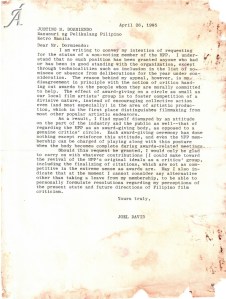
As a member of the faculty at the Philippine national university, I provided a few statements that never failed … to be ignored. (One colleague reportedly tossed a letter I wrote directly into the nearest trash bin.) My purpose was to make sure I articulated my position, especially if said position happened to be unpopular with everyone else’s. In this instance, the statement also got dismissed by administration officials and the college went on to institute a singular annual life-achievement prize, which turned out to affirm the interests of the critics’ group (and the orthodox Communists controlling it) – but a critique of that specific prize will have to await some further study, and a quick evaluation of the aforementioned organized critics was one of the incidental findings in my later article, “A Lover’s Polemic.” To jump to later sections, please click here for: Early Years; Enter the Critics; Corrective Attempts; Genuine Scholarly Recognition; Looking Forward; and Notes.
Film awards perform a privileged function in a national cinema as historically significant as that of the Philippines.[1] Among several by-now-all-too-common observations, two items stand out, effectively bookending the history of Philippine cinema in the 20th century: first, the medium was introduced by Spanish colonizers and utilized by the Americans as a means of modernizing local culture; and second, Filipinos remain some of the most avid movie-goers (and movie producers) in the world.[2] This position statement is proffered to my faculty colleagues at the University of the Philippines Film Institute, in line with the plan of the current Dean of the College of Mass Communication to strengthen the college’s presence in Philippine media through the provision of annual awards for noteworthy achievements and significant modes of practice.[3] In the course of discussion I will be looking at the history of movie awards in the Philippines, with particular emphasis on those dispensed by film critics; I will then attempt to evaluate existing awards practice using critical thinking and dissemination as a controlling ideal; finally I will propose ways in which our institute’s awards for film can constitute an improvement over current practice.
Back to top
Early Years
The proliferation of Filipino movie awards is a relatively recent phenomenon. In fact the earliest local awards on record coincide with the available celluloid history of post-World War II Philippine cinema – serendipitously, some of the first winners also happen to number among the earliest preserved films.[4] It is worth mentioning that the awards referred to, named after José Rizal’s heroine Maria Clara, were organized and administered by media commentators, as were the awards that succeeded the Maria Clara and that held sway for over two decades, those of the Filipino Academy of Movie Arts and Sciences (hereafter FAMAS).
11011Lest we overlook the role exercised by a just-as-important player, the Philippine government, city-based awards started to be handed out during the second decade of the FAMAS’s existence.[5] Both types of awards – government and press – continue, with varying degrees of credibility and occasional bouts of controversy, to the present. A difference in purpose distinguishes one from the other: at best, the commentators’ award provides recognition for works which may have been overlooked commercially or critically during their initial run, with a strong credibility factor compensating for the belatedness of the acknowledgment; at best, too, the local-government prize may be limited to a handful of entries, but the winners, if genuinely deserving of the prize, enjoy a boost in their box-office earnings.
11011A third type of award is what may be called the openly institutional award. The FAMAS, although nominally an academy, did not really exclusively consist of film practitioners; the local filmfest awards, while sponsored by local governments, could display partisanship only at the risk of being criticized by oppositionists in mass media. Only one institution with equivalent political clout claims for itself a moral supremacy beyond the judgment of mortals: the Catholic Church, which, through the Catholic Mass Media Awards, provides the “good cop” counterpart to the “bad cop” of its historically determined tendencies toward censorship.
11011The FAMAS remained the force to be reckoned with into the so-called Second Golden Age of Philippine cinema. Without the self-critical perspective that could have been provided by members of the industry, and with the increased commercial activity brought about by the rise of the independents after the collapse of the studio system during the 1960s, the results of the FAMAS began exhibiting signs of wear, possibly of internal corruption.[6] Even the recognition that the organization gave Lino Brocka’s consecutive mid-’70s triumphs, Tinimbang Ka Ngunit Kulang (1974) and Maynila: Sa mga Kuko ng Liwanag (1975), did not guarantee in the public’s estimate that the FAMAS would be able to sustain the same consistent credibility that it did during the peak of the studio system’s best and brightest, notably Gerardo de Leon’s.[7]
Back to top
Enter the Critics
Thus was the stage set, so to speak, for the emergence of film critics. The Manunuri ng Pelikulang Pilipino (Filipino Film Critics Circle), in the public mind, promised an alternative to what was then the only major player in Philippine film award-giving, the FAMAS. The MPP’s Urian Award promised reform in principle and in practice, with both areas so self-idealistic that their observation had been as flawed in some years as they had been perfected in others. Ideologically, the Urian subscribed to a still-prevalent misreading of Maoist prescriptions on art and literature, with form regarded independently of its purportedly superior partner, content.[8] Thus, “in the case of two films which are equally well-made, the film with the more significant subject matter [was] to be preferred” by the group.[9]
11011Methodologically, the critics announced a two-part system consisting of intensive film coverage, with re-screenings prescribed for front-running titles, and of decision-making by consensus. Such a mode of practice had had the effect of upending and sometimes reversing expectations for so-called critical favorites, when films without strong initial impact but which proved capable of sustaining multiple screenings won over early long-term favorites.
11011To see where the MPP had been, in practice, boxed in by its own declarations, one will have to return to its “Criteria for Evaluation.” Its tenets, on the one hand, merely expound on the importance given to content using nationalist ideals, expressed as “a truthful portrayal of the human condition as perceived by the Filipino [dealing] with the Filipino experience to which the greater number of moviegoers can relate.”[10] On the other hand, its prescriptions for form enumerate criteria according to conventional categories drawn from standard local and international practice – i.e., picture, direction, screenplay, acting, cinematography, production design, editing, sound, and music.[11] The increasingly lavish spectacles indulged in by the group point to the soundness – and profitability – of this strategy.
Back to top
Corrective Attempts
Encouraged by the MPP’s success vis-à-vis the FAMAS, a number of other sectors in Philippine film and media sought to institute their own awards system, using the same political strategy the MPP provided: pinpoint an existing awards group (usually still the FAMAS), evaluate the group’s shortcomings and weaknesses, and present a new-and-improved version. Thus the Film Academy of the Philippines, which laid claim to being the true local movie academy by virtue of its formation by industry-based guilds, came up with the FAP Awards. The Philippine Movie Press Club, in frankly admitting that its membership comprised film journalists rather than critics or industry practitioners, set up its Star Awards.[12]
11011One last award-giving group took on the challenge of rectifying what it perceived were the errors of the Urian. As one of the Young Critics Circle’s founding members, I and Mauro Feria Tumbocon Jr., another former MPP member, concluded that what could have been the YCC’s strong suit – its claim to having academically trained members – turned early enough into its liability, when the ivory-tower tendency of a number of colleagues manifested itself in the form of highbrow arrogance directed against industry practitioners. More insidiously, the use of fashionable Western-derived theory became the weapon by which such self-proclaimed nationalists caused irreparable damage in their relations with serious-minded practitioners, all the while lacking the critical willingness to train such deconstructive approaches on the theories themselves. Since the theories as applied remained distinctively associated with their hemisphere of origin, the YCC’s deconstructive project (itself a Western-derived methodology) can be seen as nothing more than a transmutation of colonial mentality in its use of center-derived frameworks applied to a Third-World margin’s progressive cultural concerns.
11011The YCC projects an image of scholarly seriousness, coupled with disdain for the showbiz trappings of all the other awards ceremonies. However, the limitations of its members’ origins in non-film-specific disciplines comes out in its illiberality, particularly its refusal to recognize mainstream achievements even as it directs attention to a few maverick, possibly deceitful, accomplishments. Its own ceremonies enact a symbolically disturbing spectacle of coercing industry personalities to go to the State University and face a seminar-type crowd that hypocritically downplays the trappings of celebrity in favor of straight-faced discourse.
Back to top
Genuine Scholarly Recognition
The UP Film Institute therefore enjoys a position of having critically engaged faculty who also happen to be involved in the medium as teachers, observers, commentators, and practitioners.[13] The UPFI faculty members also have access to a film theater and a flexible screening program that could facilitate the revaluation of the year’s achievements, in addition to film-viewing privileges outside of UP. Their use of theory can be guaranteed as rigorous in terms of both aesthetic evaluation and sociological discourse. Best of all, their relationship with the industry does not have to be premised on an us-or-them binary, a long-running and fruitless form of self-policing that actually had its roots in the MPP’s defensiveness regarding some of its members’ avowed intentions to become industry practitioners. Since the UPFI faculty, by virtue of the impending publish-or-perish requisite coupled with recognition for creative output, will have to be at least occasional practitioners, the prospect of guarding against members “crossing over” to the other camp becomes moot and, literally, academic.
11011My proposal to my colleagues at the UPFI does not differ much from the same set of reforms I presented verbally to the YCC (rejected in print by the group’s then-chair, who was running a series of attacks against members perceived as critical of the YCC core’s self-proclaimed “deconstructive” project). Listed are the various elements of the proposal:
- The US model of critics’ awards, which proceeds from a rough tallying of members’ choices, does not improve on the local version, since the constituency of each US critics’ organization is too large to allow for consensus-by-deliberation. European practice is more feasible. The German critics’ awards, which recognize films according to categories such as “Outstanding” and “Noteworthy,” are closer to a democratic ideal, since any number of winners (including a no-winner decision) can be declared.
- Films should not be classified according to budget, length, or mode of production. The time may also be apt for dispensing with the barriers between celluloid and digital, between installations and screenings, and between broadcasts and theatrical presentations. Hence, any number of short, alternative, digital, even full-out experimental works may be recognized alongside any number of full-length commercial releases, instead of prominence being handed to the latter and the former being relegated to a comparatively minor category (i.e., Best Short/Student Film).[14]
- Prizes for individual achievement are conventionally delimited in current practice by fixed categories and by single-entry recognitions. In this instance, international festival practice is more apposite. Categories may be opened according to their relevance for the year in question, rather than in observance of the standard requisite of having a definite number awaiting nominations and singular winners. Also, practitioners can be recognized for a clutch of achievements, if such happens to be their contribution for the year, instead of the usual practice of the awards body singling out just one representative accomplishment for each person.
- Institutions may also be recognized, in order to encourage their leadership in promoting progressive film awareness and culture.
- Foreign-film distributors may be given recognition for releasing non-Filipino movies regarded as difficult or daring because of their aesthetic or ideological content.
- The recognition should not take the form of trophies. Short citations on parchment can be handed out to each winner. The announcement of the awards could also easily incorporate these citations. The nomination process should be deemed essential only for award-givers bent on arousing public curiosity in order to sell a show; for a truly discourse-oriented system as the UPFI’s should be, the announcement of nominees should be skipped altogether.
- A recognition ceremony does not need to manifest the pretension of a discursive session. Since the citations were already publicized, the winners may just be invited to a celebratory event, preferably including a meal for the honorees, possibly in coordination with the CMC’s larger awards event. (In the event the CMC cannot yet implement its college-wide awards system, the UPFI can hold its own until it becomes possible for the college to integrate its awards programs.)
11011Membership in the UPFI Film Awards Desk, although de facto in the sense that it consists of the country’s film faculty, should also be allowed a certain degree of versatility and voluntariness. Hence, a call for participation in the Desk should be made annually by the UPFI Director; the Desk members elect a Chair, who then serially assigns Desk members (including herself or himself) to cover current film releases, local and foreign, as close as possible to the opening date. Film coverage consists of earliest-possible dispatches by the assigned viewer on whether the release should be seen by the rest of the Desk members, and whether the release raises issues that need to be addressed by the Desk. Quarterly citations may be announced, and at year’s end films being considered for awards should be shortlisted (the equivalent of being nominated) and re-viewed, but not publicized.
11011Desk members should be able to challenge any other member perceived as involved in films under deliberation, if such involvement induces a bias on the part of said member, whether for the film or against rival entries. Such a member will then have to inhibit herself or himself, if necessary via a memo from the Director, from the Desk’s deliberation processes.
Back to top
Looking Forward
A system of award-giving that allows itself flexibility in determining formats and categories will be in tune with still-evolving changes in film technology. Moreover, it will emphasize the fluid nature of aesthetic preferences and the collaborative nature of film-production activity. In order to stress the importance of critical discursiveness, however, the UPFI awards should operate within the context of a vital and continuing research agenda, where, as an example, the awards’ citations function as encapsulated insights for full-length articles. The awards themselves would then serve as enticements for the general public to read up on writings by the members of the faculty, with a possible mechanism for feedback to be set up eventually.
11011The future direction of film may be regarded as dead-ended, if the decline in local production were to be taken pessimistically. However, said decline may also be seen as parallel to the historical drop in book production when journalism first emerged, and the retreat into safer commercial strategies when television started to challenge the cultural hegemony of film. The provision of narrative pleasure continues to the present anyway, whether in print or via imagery, regardless of past challenges. In fact the turn-of-the-millennium example in American popular music might be more instructive: although the production of studio-style efforts declined, the actual number of new CD releases set historical records, precisely because of the democratization of the means of production and dissemination. Once this access to formerly exclusive (and unreasonably expensive) production and distribution applies to filmmaking, the complaint by local moguls that they could not make as many movies as they used to will be drowned by the ready availability of personal films everywhere.
11011The system of awards proposed in this statement will be unique from the outset, and potentially responsive, liberal, and discourse-oriented. More important, in recognizing the unpredictable nature of collaborative endeavors, it assumes a position of humility in relation to popular culture while inviting the best contributions from some of the best-qualified evaluators in the country. The UPFI faculty ought therefore to proceed forthwith.
Back to top
Notes
[1] Submitted to the faculty of the University of the Philippines Film Institute on July 4, 2003 at the College of Mass Communication, Diliman, Quezon City. I expressed appreciation to my then-junior colleagues at the UPFI – specifically Roehl Jamon, Edic Piano, and Johven Velasco – for their comments and encouragement.
[2] For a summary of the introduction of film in the Philippines, see Ernie de Pedro, “Overview of Philippine Cinema,” Filipino Film Review 1.4 (Oct.-Dec. 1983) 26-27. A past edition of the Guinness Book of World Records cited Filipinos as most consistent movie-goers in the world, based on the average number of times a citizen goes to the movies during a certain period. Current editions use absolute measures (total number of citizens who go to the movies), which results in China topping the list. Re production activity, instead of the usual total number of films (which has resulted in India being undisputed topnotcher), one might set said number against total population for a per-capita figure. In this case, even with lessened film-production activity, the Philippines would still be “more active” than India. See Joel David, “Primates in Paradise: The Multiple-Character Format in Philippine Film Practice,” unpub. diss., New York University, 2001.
[3] Nicanor G. Tiongson, “Vision, Mission, and Goal Presentation,” submitted to the Nomination Committee for the Deanship Search of the University of the Philippines College of Mass Communication (Quezon City, March 19, 2003) 6.
[4] The Manila Times, after declaring in its past pages its choices of best film, set up its Maria Clara Awards, which lasted two years, in 1950. The last winner, Gerardo de Leon’s Sisa, is still available as a duplicate print. See “Exhibit Module 7: Filipino Film Awards” in Cinema Paraiso: An Exhibition of Cinema Artifacts and Memorabilia, exhibit catalog (Manila: National Commission for Culture and the Arts, 2003) n.p.
[5] The Manila Film Festival was established in 1966 and expanded to include other cities and municipalities as the Metro Manila Film Festival in 1975 (“Exhibit Module 7: Filipino Film Awards” in Cinema Paraiso, ibid.). The MMFF’s Christmas-season playdate, however, was first realized in 1976 – a watershed year in many other ways, yielding as it did a bumper crop of quality productions before as well as during the festival itself, and heralding the first Urian awards. See “Filmography: Philippine Movies 1970-1979” in The Urian Anthology 1970-1979 (Quezon City: Morato, 1983) 501.
[6] The startling breakout films of Lino Brocka and Ishmael Bernal, Tubog sa Ginto (1970) and Pagdating sa Dulo (1971) respectively, received only token FAMAS prizes (direction and screenplay resp.) during their years of release, overshadowed by such conventional blockbusters as Armando de Guzman’s Mga Anghel na Walang Langit (1970) and Gerardo de Leon’s Lilet (1971).
[7] Another way of looking at the FAMAS’ predicament during this period was that it insisted on rewarding the likes of Gerardo de Leon, even after the master’s evident decline – cf. Lilet’s win as best film.
Back to top
[8] The binaristic separation of form and content in progressive Philippine cultural writing was first formulated in the texts of Amado Guerrero (pseud.), who maintained that “[a revolutionary national culture] must adopt certain traditional and modern cultural forms and infuse these with content that enhances the national-democratic revolution” (Philippine Society and Revolution, 1970 [Hayward, Calif.: Philippine Information Network Service, 1996] 119-20). For all its similar reductiveness in its approaches to aesthetic and literary problematics, no such configuration can be found as a controlling framework in Mao Zhedong’s “Talks at the Yenan Forum on Literature and Art” (May 1942), Mao Tse-Tung on Literature and Art (London: Anglo-Chinese Educational Institute, n.d.) 1-44. I am grateful to Professor Wei Jiang for helping to clarify that such a misreading of Mao was prevalent even among native Chinese Communists.
[9] “MPP Criteria for Film Evaluation,” The Urian Anthology 1970-1979 2.
[10] Ibid.
[11] Ibid. In further subservience to Western dimorphic and hierarchic practice, local acting awards, including the MPP’s own, are subdivided according to gender (actor/actress) and prominence (lead/supporting). Such a surplus of awards for performances is also evidence of star personalities holding sway over the proceedings, at the expense of more productive auteurist considerations such as the contributions of directors, writers, and craftspeople. In the face of this concession to populist preferences, conservative containment is evident in the insistence on matching one performance per performer (a premise that promotes commodity fetishism) as well as in the refusal to acknowledge gradations and fluctuations between the sexes and between leads and non-leads.
[12] The most highly regarded among these newcomers was at one point the PMPC’s Star Awards, and the reason hinged on the worthiness of the example set by the MPP: the PMPC also observed the same practice of multiple screenings and consensus-based decision-making, in some years generating better-received results than the Urian. Implicit in this proliferation of local movie awards is the set of circumstances that made the development paradoxical: these were the worsening years of martial rule, when other forms of mass media suffered unstinting repression by government and military forces. The government of Ferdinand and Imelda Marcos, however, zeroed in on film as their preferred showcase of libertarian democracy, even setting up a support system, the Experimental Cinema of the Philippines, which eventually challenged the government’s own censorship board. Hence no one was surprised when even the Metro Manila Commission enlarged, geographically and monetarily, on the concept of local-government festivals by launching the Metro Manila Film Festival during the most profitable season, the yearend Christmas break, and when the country further expanded its film scene in global terms via the short-lived Manila International Film Festival.
[13] Here of course I am shamelessly deploying flattery and in danger of lying through my teeth. The members of the UPFI faculty who have any measure of intellectual and ethical integrity can be counted on the fingers of one hand, and the rest are marked by scholarship that ranges from questionable to nonexistent and by an administrative record that veers from callous to corrupt.
[14] The MPP came around shortly after I circulated this statement and recognized digital products, a few years before local industrial production turned exclusively digital. It also continued including extra-length films (all by Lav Diaz), although it has continued to segregate “short” films in a separate category. I make no claim to having influenced the group by this or any other form of commentary: if they kept refusing to recognize digital products, they would have wound up without a “job,” in the form of their profitable annual awards ceremony. I should also mention here that a third local critics group (where I also participated), called Kritika, operated for a few years in the early 1990s and adhered to all these procedures, including the ones in succeeding entries on this list.
[Submitted in December 2003 to the College Executive Board (care of the Dean) of the University of the Philippines College of Mass Communication]
Back to top
Return to Millennial Traversals contents

















 ORCID ID


The Reviewer Reviewed
I responded to a review of my work only once, with decidedly mixed feelings. I would have preferred to keep quiet, as I had earlier, regarding more vicious and unfounded attacks on my work and person. At this point, however, I felt that I could not bypass the opportunity to point out the differences between the reviewer’s expectations and the objectives that should have been readily discernible in the book being reviewed. Unfortunately (probably because of the bad blood I had accumulated from enduring earlier attacks), my response had an unnecessarily sharp edge that I now wish I could have blunted before sending the letter. For this reason I initially decided to conceal the details of publication, which I am certain the author, a senior colleague, would have preferred as well.[1] The digital edition of Fields of Vision is posted on this blog.
Unfocused View of RP Cinema
Nicasio Cruz, SJ
Reading Joel David’s Fields of Vision can produce a feeling like that generated by a lively intellectual conversation: the sense of challenge and excitement that comes from an encounter with a fine mind thinking deeply about important matters. One may disagree with some of his opinions and applications, but one can hardly avoid being stimulated by the scope of David’s scholarship and reasoning.
11011This book is a learned and provocative work, precisely because it raises so many questions that get at the heart of the challenges on the study of Philippine cinema. That it does not answer all the questions it raises is far less important than that it calls the reader into the conversation on different terms.
11011The book is neatly divided into three parts: Panorama, Viewpoints, and Perspectives. Part I is an overview of the New Cinema in retrospect, tracing the effects and influences of neorealism, cinéma vérité, film noir, and surrealism on Philippine cinema. This chapter is the most informative and a welcome contribution by the scholarly author to our deeper understanding of our own local cinema.
11011The big problem I encountered not only in this chapter but throughout the book is, David’s train of thought is something difficult to follow because of his peculiar style of writing and his penchant for unfamiliar words and ambiguous phrases, such as “imbricated” (ix), “multiplicity of participations” (3), “high-gear editing” (40), “shimmying exoticism” (13), “overscaled meddling” (108).
11011Part II contains the main body of the book. It is divided into sections with some titillating subtitles: “Demachofication,” “Sequacious Cebuano,” “Movable Fists,” “Mudslung.” Under each heading are listed the movies under consideration.
11011This chapter, though, creates some problem for the readers who are not familiar with the movies of the 1970s and ’80s. For instance, how could the reader understand what the author is talking about a certain a movie, if he does not know anything about the movie?
11011Take this example: “Nevertheless the device in Hot Summer has been wisely confined to the movie’s expository portion. Once the entire framework has been set up, the finishing touches admirably point up to a sound internal logic at work, employing the same principle of sensible character-based development observed in Paano Kung Wala Ka Na” (53).
11011I myself have not seen either Hot Summer or Paano Kung Wala Ka Na. An example of a scene or scenes from either or both of the movies cited would enable the reader to understand and appreciate what David is trying to say.
11011David could have given an excerpt from the movie Biktima to illustrate what he calls “an excessive cocksureness of approach” (95), which he averred victimized that movie.
11011For me, the best part of the book is Part III, where David proposed a list of Filipino film highlights (“Worth the While”) to prove that film as a medium still contains the country’s most consistent artistic achievements.
11011Noteworthy also is “Ten Best Filipino Films Up to 1990,” a credible selection of the ten best collated from the individual choices of more than thirty respectable film artists, film critics, directors, producers, and academicians.
11011The Ten Best list is sure to generate controversy. David himself, after collating and tabulating everything, concluded that the number of respondents was still not exhaustive, that there is still a critical community somewhere left untapped. But the list should be regarded as the beginning of a healthy debate, rather than the final word on the matter.
11011Taken as a whole, the book is a gold mine for which film students and film buffs can only be grateful. What the book perhaps lacks in focus is amply compensated by a wealth of informative material about Philippine cinema. It will be a most welcome addition to any film library here and abroad.
[Published June 14, 1996, in Philippine Daily Inquirer, p. C2]
Back to top
Letter to the Editor
July 4, 1996
Thelma Sioson San Juan
Lifestyle Editor
Philippine Daily Inquirer
1263 Makati City
Philippines
Dear Thelma –
I received a copy of a review of Fields of Vision in the Inquirer (June 14) through my publisher, but I didn’t have the time to write a response until today’s US holiday, Independence Day, ironically liberated me from my work schedule.[2] Nicasio Cruz’s review was appreciative and encouraging, and also evinced an attempt to be critical at the same time. I have not had problems with critics expressing reservations about my books, although for the first time, I feel that I need to contest a number of Cruz’s premises.
11011To begin with, Cruz’s complaint that the writing uses “unfamiliar words and ambiguous phrases” is something that may be expected from a layperson. However, any academic ought to be able to determine the meaning of a word like “imbricated”; a media professor ought to be able to know what “high-gear editing,” “multiplicity of participations,” and “overscaled meddling” refer to, unless film, performing-arts, and cultural-policy terms happen to lie outside her or his sphere of expertise. Someone urgently needs to introduce the poor fellow to that basic research tool called a dictionary, upon which he might realize that whatever is “unfamiliar” and “ambiguous” about these examples may have all been a function of his hazy sensibility.
11011Even more serious is the clear possibility that Cruz may not have been reading carefully enough. For one thing, he misquoted one of the book’s articles’ titles – i.e., “Sequacious Cebuano,” which is meaningless, was a mix-up of two different titles, “Sequacious and Second-Rate” and “Sedulously Cebuano.” Furthermore, he ascribed to me the phrase “shimmying exoticism,” when in fact in the published text it is in the plural, enclosed in quotes, and attributed to John Grierson in the latter’s description of the work of Robert Flaherty. More glaringly, “multiplicity of participations” is not only similarly quoted and attributed, but is also immediately followed in the book by a paraphrase of Roland Barthes’s semiotic redefinition.
11011The surest indicator that Cruz may have been expecting a book of reviews when in fact he was presented with a body of criticism was when he demanded that the articles should have presented “an example [sic] of a scene or scenes from … the movies cited [to] enable the reader to understand and appreciate what David is trying to say.” The premise in reviewing is that the reader may be encouraged in or discouraged from watching a current release; in criticism, on the other hand, the reader is expected to have seen the item being discussed (or eventually make the effort to watch it), regardless of the author’s appreciation of or antipathy toward it.
11011Moreover, when did serious discourse ever make a claim to accurately represent the texts it was dealing with? A critique of, say, Crime and Punishment or The Bridges of Madison County (either the books or the films made from them) could never hope to fully recount their texts’ contents, and would only waste space and printer’s ink in trying to do so, when a journal or index or annotated bibliography might be able to provide that same function more effectively. If supplying a plot summary were necessary to the discussion, then by all means such a summary should be expected. But when Cruz gripes that he does not understand what an “excessive cocksureness of approach” means and expects to find it in the movie’s narrative, he just might be in the dark regarding the embarrassingly antique insight that film is primarily a visual medium.
11011I would not even bother to speculate as to the possible reasons why Cruz thinks that an anthology should have “focus,” and what he thinks this focus should be. It saddens me to note that Cruz has not grown much in the intervening years. Is his notion of film theory still a matter of (mis)taking the elements of film in the context of Classical Hollywood practice as the theory of film? Does he still refer derisively to Philippine movies when searching for samples of “bad” or “failed” applications in relation to the Hollywood model? Does the fact that a university press decided anyway to publish my manuscript indicate anything to him about how far gone the times have changed in relation to his ideas?
11011Thank you for providing this opportunity to engage in dialogue with one of your reviewers. I could have hoped for a more constructive exchange – a “multiplicity of participations” in effect, post Barthes – but my responses were imbricated in the excessive cocksureness, resulting in overscaled meddling, of the said reviewer’s “shimmying exoticisms,” to borrow once more from the late great Grierson.
Sedulously yours,
Joel David
New York City
Notes
[1] The demise of Nicasio D. Cruz, SJ, in 2017 has made it possible for me to identify him as the author of the review, without worrying about any possible repercussion for him at his educational institution.
[2] I was unable to track the details of publication of my response. All I had were messages from friends informing me that my letter to the editor had come out.
Back to top
Comments Off on The Reviewer Reviewed | tags: Commentaries | posted in Film Criticism