Doy del Mundo on a Controversy over Maynila: Sa mga Kuko ng Liwanag

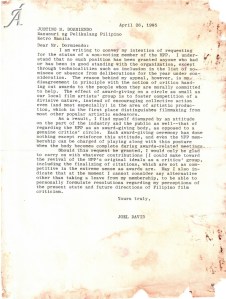
This is the source interview for an article I wrote, titled “Thinking Straight: Queer Imaging in Lino Brocka’s Maynila (1975),” published in the August 2012 issue (volume 9, issue 2) of Plaridel: A Philippine Journal of Communication, Media, and Society. The respondent, Clodualdo del Mundo, Jr., was a founding member of the Filipino film critics circle and a retired professor of communication at De La Salle University. He is known as the scriptwriter for the majority of Mike de Leon films, but he first made his mark with the screenplay of Lino Brocka’s Maynila: Sa mga Kuko ng Liwanag [Manila: In the Claws of Darkness]. The interview was conducted via email in mid-2012, as a way of seeking out supplementary information for the article.

I drafted a paper for a special issue on queer media. I mentioned special early cases of controversies on queer politics in Philippine cinema. In looking at the case of Maynila, I remembered an article that came out in The Literary Apprentice, the journal of the University of the Philippines Writers Club. I re-read it once more and I was surprised at how offensive it sounded this time, in spite of its best intentions. Do you mind if I ask you a few questions regarding the film adaptation of [Edgardo Reyes’s novel] Sa mga Kuko ng Liwanag (1967)? I hope you could provide some insights and/or correct any misimpressions I might have.

11011I saw the original run of Maynila (in July 1975), but ever since then, from its reissue after sweeping the Filipino Academy of Movie Arts and Sciences awards to all subsequent rescreenings and video transfers, it’s been missing several sequences. That’s why when the article mentioned that 1/4 of the movie consisted of the gay-hustler underworld, it becomes accurate only when the point of reference is the original cut. Does this first version still exist anywhere or was there a conscious and/or official decision to trim the film? If it’s the second case, then would you know if the missing footage is lost for good?

The first version was re-edited by [Maynila’s producer and cinematographer] Mike de Leon for foreign exhibition (e.g. film festivals). I don’t think Lino was consulted about it. I did support Mike in doing the re-editing. Basically, the gay segment was shortened – it was unnecessarily long. I doubt if the first version exists anymore.

One recent academic paper claimed that Edgardo Reyes sued Lino for changes done to the narrative (presumably including the detour of Julio Madiaga into Bobby’s profession). It seemed, even from the still-existing scenes, that the dialogue-writing differed from the rest of the film. How improvisatory were these scenes – i.e., were you required/requested to provide scenes or lines or an entire narrative arc?

When Lino made the suggestion to add the excursion into the gay underworld, I asked him and Mike to clear it with Edgardo Reyes. I doubt if they did. Anyway, Lino and I talked about his ideas. Finally, I scripted it myself. The dialogue would naturally differ from the rest of the film. The character of Bobby belongs to a different group. The dialogue separates him from the world of the construction workers.

Back to top

The article I mentioned proceeded from a homophobic framework – that the novel, like its protagonist, was masculine, and the film adaptation “emasculated” it. (Strangely, the way the author expressed it sounded extremely homoerotic – a deep affection for Julio, representing Tondo, representing Manila, representing the country, in unconscious synecdochical distensions.) He identified Lino and you as responsible for the changes he regarded as unworthy of the source material. Yet the depiction of the gay underworld was similarly and ironically homophobic. I don’t remember this kind of discussion being conducted in mainstream media, but were these issues being raised in venues outside of a university journal? For example, in tabloids or in seminars? Or was this the only instance where the gender “shortcomings” of the movie were brought up?

I think the “homophobic” readings did not happen at the time. I could be wrong, though. The main concern, then, was how faithful was the film to the original source.

Lino’s interview with Hammy Sotto (published in the Cultural Center of the Philippines’ commemorative volume) seemed to assume that the original, extended version (ending with a beach scene where Bobby attempts to seduce Julio and the latter walks out on him in disgust) was still in existence. Interestingly, Lino explains that the purpose of providing the Julio-as-hustler scenes was to make the character as “fallen” (my interpretation) as Ligaya. The author of the article found this offensive, saying in effect that it’s unfair to “reward” Julio with a quickie in a cheap hotel room, a scene which he described as hackneyed, preceded as it was by a viewing of a Holy Week Christ’s-passion movie. Was this departure from the novel in the original draft of the script? How involved was Lino in revising the material?

The Julio-Ligaya sequence is in the original screenplay. Lino changed the location, though. In the screenplay, after the chance meeting in Santa Cruz Church, Julio and Ligaya move to a moviehouse (the movie was the production designer’s touch – based on what was available at the time). Then, they move to a restaurant. Lino changed the location to a motel room. It’s a credible change and it adds a dimension to the characters of Julio and Ligaya. My reading was more romantic – Ligaya’s storytelling was more subdued, controlled, perhaps more subtle. Lino had a different idea. Ligaya’s unfolding was more emotional, more direct (forget subtlety at this point of the film). I respect Lino’s change of location and consequent interpretation.

11011Lino wanted to create a metaphor for a different level of exploitation. Julio is exploited not only economically, he is exploited physically and spiritually. Your “fallen” interpretation is an interesting one. I agreed with Lino – he was the more experienced among us and had a better understanding of his audience. The film would have not been done if Lino did not have his way. My best alternative was to be involved in writing the script.

Portions of the article ridicule you for not being prepared (in the sense that you weren’t a Tondo native, among other things). I wanted to formulate questions around these but I found these assumptions too objectionable to even dignify. I had a few occasions interacting with a certain group of writers to which the author might have belonged – they generally taught university courses, wrote criticism and fiction (including poetry), and were insufferably masculinist and unapologetically homophobic as a consequence. I just concluded that their indulgence in the less-“masculine” professions of teaching and writing induced this kind of neurosis – essentially confirming the typical psychoanalytic finding that phobes are projecting on others certain qualities that they fear in themselves. No questions coming up about this, I’m just sharing my own annoyance with that type of mentality, thankfully no longer in mainstream vogue from what can be observed in the younger generations.

Yeah, I remember the author’s critique that I was not familiar with the setting of the novel so much so that I had to “visit” the places like a tourist. I visited the places to help me visualize the scenes. The novel appealed to me for its cinematic qualities and significance. I regretted (then) that the author and company did not appreciate a middle-class screenwriter tackling a proletarian novel.

11011In one school tour that we did during the showing of Maynila, I remember the same critique being asked. I just said that I was glad that I did not have to collaborate with the reigning administration in doing my work (the author of the article was working in a Marcos agency at the time).

Back to top

Á!


Grains & Flickers

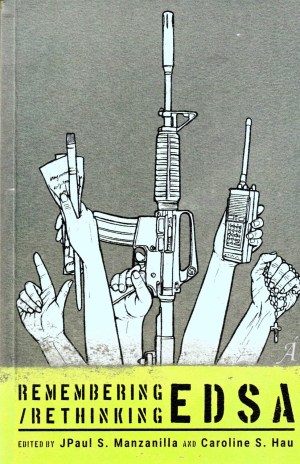
Article (with updates and corrections – see endnotes) that appeared in the “Revolution across Generations” section of Remembering/Rethinking EDSA (ed. JPaul S. Manzanilla and Caroline S. Hau, Mandaluyong City: Anvil, 2016), pp. 172-87. The book itself won the Best Anthology prize of the National Book Awards from the Manila Critics Circle, administered by the National Book Development Board. Kindly purchase your full copy via Amazon or the Anvil Publishing website. To jump to later sections, please click here for:

Personal as Political;
Cultural Politics;
Daughter Rising;
ECP in Focus: Alternative Screenings;
ECP in Focus: Archives;
ECP in Focus: Education;
ECP in Focus: Funding;
ECP in Focus: International Film Festival;
ECP in Focus: Production;
ECP in Focus: Ratings for Tax Rebates;
ECP in Focus: Support Activities;
Way of All Flesh; and
Sources, Dedication, & Notes.

Remembering - Rethinking EDSA

No sane academic would argue against the prevailing consensus that the Marcos dictatorship, as a socio-economic experiment, had proved unsuccessful, if not downright catastrophic. The irony is that among other major Asian countries, the Philippines had been alone in effectively suffering for nothing. All the other ASEAN members, more or less following the example of Korea, emerged as fast-developing economies during or immediately after their authoritarian ordeals. Koreans, in fact, have proved so grateful for the legacy of Park Chung-hee, Ferdinand Marcos’s counterpart, that they enabled his daughter to become the first female President in their own still mostly patriarchal system. Lee Kuan Yew, for his part, has remained influential decades after the restoration of democracy to Singapore, and has taken upon himself the task of criticizing the Philippines for its refusal to return to an authoritarian arrangement as a developmental strategy.

11011Over a quarter-century since the ouster of the Marcoses, the present has brought what many commentators worryingly describe as a mellowing of the Filipinos’ perception of the havoc the couple had wreaked on the country. Per this logic, Pinoys supposedly have short memories, or are inherently masochistic or manipulable, or are simply incapable of determining what would be best or worst for them. The same critics would also be the first to acknowledge that most presidencies since that of Ferdinand Marcos have ranged from unexceptional to awful, and therefore these observers unknowingly trip over themselves in the pro-people march they believe they are in step with: if we hold, for our people’s sake, that most post-Marcos Pinoy presidents have similarly betrayed the people’s trust, would it not be possible to accept that the people are just as capable of perceiving this and exercising their judgment by way of voting back to power the same entities that they had earlier spurned, in effect telling the succeeding oligarchs that the latter are no better, if not outright worse, than the Marcoses?

11011I certainly would be horrified at the prospect of Imelda Marcos or her son being installed as Chief Executive – yet she was precisely the person I voted for, during the only time she ran as President (and the last time I exercised my right to vote). She certainly had a snowball in hell’s chance of winning, but since the satirically motivated University of the Philippines professors’ attempt to nominate perennial nuisance candidate Pascual Racuyal had fizzled during the snap elections that ousted her husband, I figured that no other nuisance would be as flamboyant and annoying as our own Iron Butterfly; and if no one else ever voted for her, then my own ballot would serve, however quixotically, as a voice in the wilderness, heralding not the arrival of any savior, but the impossibility (since confirmed, to my mind) of finding one.

11011My own mellowness toward the martial-law years has evolved differently. When I ultimately felt myself caught up in the wave of diasporic Pinoy labor, I thought this was the very worst long-term economic legacy bequeathed by the Marcos presidency. What had been intended as a stop-gap measure (the same way it was deployed in Korea – where, aptly enough, my OFW-ness eventually led me) had become the Philippines’ primary source of income and growth. Then I started seeing first-hand how overseas employers were being won over by whatever specific package of social skills and work ethic that Filipinos had grown up with, and I found myself grateful that the home country remained a nicer place to return to than if it had been ravaged by the type of industrialization that would have boosted standard-issue national development. That plus our taken-for-granted near-total press freedom would ensure for us (assuming our luck holds out) that, however belatedly we embark on the path of growth, we would never be subject to the machinations that require sufficient obfuscation in order for dictatorships, transnational interests, foreign-based religions, and other self-interested parties to implement their agenda.

Back to top

Personal as Political

The manner in which I arrived at this latter-day position vis-à-vis the Marcos dictatorship was foreshadowed by the lessons I drew from my direct interaction with the period. As a high-school and subsequently a college student at the University of the Philippines, I had early on admired and later emulated the senior students who were committed to the activist cause of criticizing and mobilizing against the Marcos presidency, later the martial-law regime. Momentous events such as the First Quarter Storm and the Diliman Commune filtered down to my level of awareness not via my disapproving though sympathetic parents, but through my firebrand uncle, a scholar at the elite Ateneo de Manila University, for whom they were acting as guardians. I’d had enough of an early association with activist organizations so that when martial law was declared, my mother woke me up to inform me that she had buried my Little Red Book and other paraphernalia in the backyard, and wanted to ensure that I had no other seditious materials tucked away elsewhere.

11011An intense dalliance with evangelical conversion and missionary preparation made me feel then that I had wasted my early college years, but my return to activism provided me with the readiness to recognize that full orthodox-Marxist commitment entailed a similar suspension of critical and humane judgment, a reliance on faith – in leaders, in organizations, in Machiavellian methods, in a promised form of government, and in an unchanging conception of progressivity. When I realized that such a volatile combination of ideals could result in unwelcome tragedy (described by an elderly colleague as “necessary sacrifices” toward the attainment of revolutionary triumph), I determined that I would never be able to abide such a cost. A bus full of solicitous and comradely soldiers, on a provincial trip I took, drove the point home even more urgently: I would not want these people coming to harm, and I would be unable to refuse mourning them as intensely as I had mourned the death-in-action of an activist acquaintance of mine. The people being served, the working class being upheld, would include the soldier, the jailer, the policeman, the executioner, even if they had been tasked to carry out the basest interests of the state. How that principle can be realized I had no clue about – my introduction to Michel Foucault’s ideas would arrive later – although I had to contend with the fact that the institutional Left as I knew it would never stand for it, just as organized religion would never allow for the possibility of an otherwise undeniably godless universe.

11011The requisites of everyday survival bore down on me almost immediately afterward, circa the late 1970s. Armed with a bachelor’s degree and an extensive record in what is still known as committed journalism, I found that the only doors that I could open were those of publications willing to accept freelance contributions for little better than a hundred pesos or so each. To play safe, I avoided the political and economic analyses that I had focused on as a student journalist, and turned to cultural reportage. Eventually one of these periodicals, a monthly magazine, hired me, but the media grind of observing deadlines, negotiating with data sources, jockeying with editors, and jostling with fellow writers took its toll. In two years I resigned and was again in search of employment, and the only media-related institution actively seeking interested applicants happened to be the newly launched Marcos film institution, the Experimental Cinema of the Philippines.

11011The phenomenon of anti-Marcos individuals eventually working for a government institution was such a distinctive commonplace that most activists then were convinced that, if they succeeded as underground figures and survived the dangers of incarceration, they would eventually be “rehabilitated” in one of the several government think-tanks of the period, starting with the University of the Philippines-based Presidential Center for Advanced Studies, and might even be deployed to one of the more people-oriented agencies such as the the one for housing (where my uncle, among others, wound up); they could attempt to maintain their integrity by teaching at the national university instead – which again was in fact still just one more government entity. If not then to death or arrest in armed struggle, or to opting out and climbing the corporate ladder or migrating abroad or living off an inheritance or wealthy spouse, all remaining anti-government roads led to the same profoundly ironic destination: government service.

ecp-id

Back to top

Cultural Politics

I was most fully aware of the paradox I had allowed myself to stumble into, despite the fact that I never reached the point of being arrested and forced to join government, when I was scheduled to be interviewed for my security clearance. I had just by then met the late Maita Gomez, a former socialite and beauty queen who had joined the Philippine underground and who years later agreed to undergo interrogation as part of the condition for her resurfacing. I would probably never be able to mimic the authority and confidence with which she responded, but I certainly could make use of the sharp logic she used. So when the same question, “Can you identify some of the people you associated with?” came up, I paraphrased her answer as best as I could: “Everyone, including me – we all used aliases that we regularly changed for our mutual protection. If I recall any of those names right now, they would no longer be the same as they were when I knew them.” Although Maita said that that answer had sufficed in her case, I was still surprised when my own interviewers nodded right afterward and signed my clearance forthwith. For an institution being run by the Marcoses’ eldest child! (By the time an acquaintance told me he believed I had sold him and his friends out, I was capable of formulating my own useful reply: “The fact that you’re still around [and unstoppable in your idiocy, I wanted to add] is proof that you weren’t that important to me or anybody else.”)

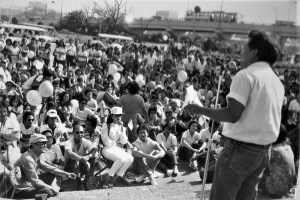
11011Right upon reporting for work, I was introduced to the major fissure that would define how we would function and why the institution (from the perspective of outsiders) would take such weird directions. The institution was the Experimental Cinema of the Philippines, formally defined as an umbrella organization that would function as a support agency for the local film industry. The activity we were preparing for was the Manila International Film Festival, which the ECP would support but would refuse to be affiliated with. The personnel of the ECP’s public relations department, where I was head writer, were on detail from the National Media Production Center, just as a few other personnel were from the dreaded National Intelligence Security Agency. The key to our understanding of how the different forces interacted was in observing Marcos family politics, primarily the tumultuous relationship between the two Imeldas (mother and daughter, the latter nicknamed Imee) and the claims they made on Ferdinand Senior, the omniscient and omnipotent martial-law patriarch.

11011Hence the ECP’s repudiation of the MIFF reflected Imee’s refusal to be associated with the vulgarities and excesses of her mother, although as NMPC employees under the directorship of Gregorio Cendaña (an Imelda protégé), we had not much of an option except to work as much for the international film festival as for the ECP itself. MIFF work, in fact, was more intensive, requiring several late-night and occasionally overnight sessions. During one of these all-nighters, a strong tremor hit the city, and everyone instinctively rushed to the windows of the Philippine International Convention Center to see what had happened at the nearby construction project, the Manila Film Center. By then we were used to unusual spectacles such as full-grown coconut trees materializing overnight at the vast parking lot that both buildings shared. The post-tremor vision, however, was something that anyone who had seen it would remember for the rest of her life: workers were scrambling down the ladders leaning on the Parthenon-inspired structure as well as scurrying down the Odessa-like steps surrounding it, like panic-stricken insects pouring out of an abruptly distressed anthill.[1]

11011The notoriety of the government’s response would thereafter epitomize the Marcos regime’s gross mishandling of workers’ welfare, with victims of the collapsed scaffolding paying the highest price for the construction’s timely completion. Those trapped but still alive in the quick-drying cement had their limbs amputated, while those who had died were buried under further layers. Up to the present, certain pro-Marcos apologists occasionally affirm the official line that the tragedy could not have been as extensive as the few hundreds alleged by the opposition. Yet the visual evidence that we had witnessed, confirmed by the account of an elderly security guard (who later inexplicably disappeared), was apparently sufficient to alarm Imee Marcos, who was easing into her role as Director-General of the ECP. Prior to moving our offices from the convention center to the new building, she (not Imelda, as erroneously and illogically reported in book accounts) insisted on performing a cañao, a native exorcism ritual.[2]

11011Urban legends abounded regarding the building. Various staff members reported uncanny sightings of men who looked like construction-site peons – not unexpected from the excitable youthful minds of star-struck theater and office assistants. But when the Imelda associate in charge of the project was driving in Tagaytay and died upon crashing into a tree, conversation dwelled not so much on the fact that she was with her alleged paramour (another prominent and married Marcos official), but rather that she supposedly swerved to avoid colliding with a sudden apparition of spectral laborers. The account first surfaced as a report in Veritas, a now-defunct opposition newsmagazine published by the Catholic Church; the article was anonymously written, but some of us in the public relations department recognized the style as belonging to Eddie Pacheco, Imee’s then-recently resigned (and now recently deceased) speech writer.

Back to top

Daughter Rising

The Experimental Cinema of the Philippines flourished for over two years. It had been earlier launched, with much fanfare, in bare form and with a different name as one of the several agencies to be run by Imelda Romualdez Marcos. In a surprise twist, on January 29, 1982, Ferdinand Marcos signed Executive Order 770 creating the ECP, effectively overriding the earlier institution and handing over its functions to his daughter, Imee. The process of its formation was transparent enough, so that the most prominent film artists (who were opposition in association and practice) provided advice; the most vocal Marcos critic among them, Lino Brocka, hailed the choice of Imee in one of his rare local interviews.

11011The ECP thrived for the nearly three years that Imee Marcos took active charge of its operations. The intra-familial intrigue that centered on her – the kidnapping and rescue of her then-boyfriend, the man who had married and subsequently separated from Aurora Pijuan, a Miss International title-holder much admired for her exceptional beauty – was followed closely within the organization, with a concomitant celebration when Tommy Manotoc finally came out, as it were, with her in an official function. Imee’s insistence on her personal preferences, even to the point of contravening her parents, was consistent with her lifestyle, which could be best described as bohemian – at least as far as her understandably harassed security circle could accommodate it, and which has most likely never been seen before or since in any Philippine presidential family circle.

11011Her participation in small theater productions and enrollment at the University of the Philippines, circa late ’70s, were socially acceptable enough to be covered in media. (She and I in fact were classmates once, although as a then-aspiring activist I had no inkling that I would eventually be working for her.) Among the several first-hand accounts I remember from friends, her late-night food trips to gang-ridden Chinatown and closed-door pot sessions with artists made her a fascinating subject. She would occasionally walk around in extremely informal garb and spout the semi-obscene lingo exclusively associated that time with gay men (who were its acknowledged source), sex workers, and transgressive artists. Her reputation for intelligent discourse has not diminished through the years, and in fact was enhanced upon her post-EDSA return to public official duties, sharply contrasting with the behavior and character of subsequent presidential children.

11011At this point I venture to interject a further measure of the loss suffered by the country’s failed authoritarian experiment. Again the basis for comparison is Korea, whose dictator, Park Chung-hee, had a meet-and-greet with Ferdinand Marcos during the 1966 convention of the SEATO (Southeast Asia Treaty Organization, predecessor of the ASEAN), where Park allegedly felt slighted by Marcos’s condescending attitude. Park’s assassination in 1979, preceding Marcos’s ignominious death in exile by a decade, was followed by even more rapid economic development for his already highly industrialized country, in contrast with the several traumatic years of negative growth that immediately succeeded the Marcos era in the Philippines. Hence while Park Geun Hye, Chung-hee’s daughter, eventually emerged as the strongest contender to her country’s highest elective position, Imee Marcos could only hope to ride as far as the discontent of the Filipino population with successive regimes could propel her and the other surviving Marcoses back to power.

11011Yet the irony in this situation is that, while Park Geun Hye could only maintain (and succeed with) a conservative political position, the Marcoses, probably to their own surprise, found themselves taking an increasingly open anti-US position once American officials withdrew support for them and cast their lot with the local opposition. Ferdinand Sr. was a virtual prisoner in Hawaii, refusing treatment for the disease that he knew would eventually kill him; Imelda was hauled off to court and mocked severely enough in public to win sympathy from her jurors; Imee, after returning to the Philippines and upon her election to Congress, sided with a Leftist bloc in criticizing such prevalent US interests as joint military exercises and intellectual property issues.[3] If not for the association with her parents (marked by her upholding of her family’s material interests and exacerbated by her reconciliation with her eccentric, possibly borderline-insane mother), we could probably do worse with the recent turn toward dynasticism in presidential choices than selecting someone with the intelligence of Ferdinand, the charisma of Imelda, the experience of decades in Malacañang, an exposure to global realpolitik, an appreciation of the potency of culture, and a willingness to challenge figures of authority, ranging from her parents to the country’s neocolonial bullies.[4] I would definitely not lift at hand if this, by some fantastic turn of events, were to come to pass; but I would also be unable to look away.

Back to top

ECP in Focus

A count-our-blessings principle would behoove us to acknowledge the only definite area where Marcos-era government intervention was more positive than otherwise. And once more, the object lesson remains: what a priceless heritage we could have had if the energy, creativity, integrity, and resources of these types of contributions were bestowed on more essential areas of the economy – where future generations could take the cue from their elders and seek, not foreign employment opportunities, but profitable and globally cutting-edge ventures that would position the country as the major Asian player that its pre-Marcos past had promised.

11011Unlike the Marcos regime’s state- or crony-owned monopolies that debilitated the national economy and depleted the dictatorship’s reserves of goodwill, the ECP sought simultaneously to lead by example and provide the necessary material support for local producers to follow suit. It would conduct an annual scriptwriting contest and produce the winning entries; subsidize productions by providing loans for meritorious projects; grant tax rebates on the basis of quality; screen significant local and foreign films in censorship-exempt venues; conduct extensive education and training programs; and preserve existing productions, restoring endangered ones if necessary.

11011The obvious connection of such a conglomeration of functions with the present lies in an occasionally acknowledged point made by historically inclined observers: that when Philippine movie production, along with the country’s few remaining minor industries, collapsed from the pressures of neoliberal globalization during the late-’90s Asian crisis induced by the International Monetary Fund and World Bank’s interventions, the only means by which film was revived was via a close observance, mostly by the private sector, of the ECP strategy. In fact one could provide a checklist (herewith alphabetically arranged) of the aforementioned ECP functions and easily find one or more contemporary counterparts:

  • Alternative screenings. The ECP’s Alternative Cinema Department was the organization’s most active arm (more impressive considering that videocassettes had not yet proliferated), scheduling daily screenings at the Manila Film Center’s main theater and twin regular theaters, and occasionally at the several classroom-sized screening rooms, where workshops would also be conducted. These venues’ exemption from censorship reached a point where the government revised its film-censorship arm to one that purportedly reviewed films and left the task of regulation up to the producer or distributor. Nevertheless, film artists were able to find sufficient inspiration and organization to mobilize protests, openly supported by the ECP, against the Board of Review for Motion Pictures and Television as an incompatible and conflictive government entity; its chair, Maria Kalaw Katigbak, retaliated by asserting her stature as a direct appointee of the Office of the President, thereby declaring that her office could be abolished only by the President himself. The contemporary venues that partake of the MFC’s censorship-free status would be the two far-less-active government film-exhibition outlets, at the Cultural Center of the Philippines and the University of the Philippines Film Institute’s Adarna Theater.

  • Archives. Then as now, this has been the most difficult operation to maintain, owing to the combustible nature of early celluloid and the deteriorative properties of latter-day stocks. The problem extends to other original forms of media (newsprint and video), all of which conspire to turn Philippine media (and mediated Philippine) history into an increasingly urgent race against the ravages of time and weather. After my personal copies of the ECP’s extensive annual reports (which I had written, aptly in coordination with the Film Archives of the Philippines) were lost to the elements, for example, I could not find copies stored anywhere else. A reconstruction of these basic documents would entail a close surveying of the mostly now-defunct newspapers active during the period – incomplete copies of which were stored in disarray. The other, more vital sources, those of tabloids, were in far worse condition for those attempting to conduct research into the period. The media industry’s recent digital turn has fostered a false sense of archival security among practitioners; they witness the permanence of print or audiovisual material on drives and the electronic cloud and believe that these could outlast analogue versions, when in fact data degradation and corruption occur faster than properly stored celluloid or paper. With increasingly unpredictable global climate conditions, electromagnetic disturbances could conceivably endanger entire swaths of vulnerable data repositories. Whenever possible, analogue storage ought always to be the preferred means, with digital versions serving only as backup and disseminative material.
  • Education. The ECP envisioned an expansion of its Film Education Department’s workshops to eventually include accreditable college courses, with bachelor’s and graduate degrees to follow. During ECP’s last year, the University of the Philippines announced the country’s first undergraduate degree program in film, a fortuitous preemption of the ECP’s plans, considering how transitory the agency turned out to be. A measure of how innovative the ECP’s officials were can be seen in their response to this development: since I already held a degree from not just the same university but from the mass-communication institute (now college) that offered it, the Director-General’s office granted me the privilege to pursue a second degree in the new major while drawing salary for fulfilling specific assignments – in effect, becoming a working scholar of the agency. Two years later, when I had completed the requirements, I was the country’s first (and only) film degree-holder, with a few other academic distinctions to show for it … but by then the Marcos regime was no longer around, having been ousted by the people-power revolt of February 1986. Another plan, that of introducing film appreciation at earlier school levels, has since then similarly become run-of-the-mill enough to be taken for granted in the country.[5]
  • Funding. The ECP’s Film Fund Department, responsible for granting subsidies for private producers, suffered from the political favoritism that characterized areas in the organization that were dominated by Marcos’s wife, represented in this case by a Blue Lady whose studio-mogul parents had been associated during the 1960s with the hagiographic film-bios of the Marcos couple’s electoral campaigns. The department’s process of evaluating proposals in terms of their combination of merit plus profitability was honored more in the breach than in the observance, resulting in films that were mostly critically ignored if not panned, and even worse, that failed to recover their producers’ (and ECP’s) investments. The solution, as practiced by contemporary institutions such as Cinemalaya and CinemaOne, was to determine choices on the bases of the results of open scriptwriting contests (see film production listing below), and to subsidize significantly inexpensive (and potentially more profitable) digital productions.
  • International film festival. The Manila International Film Festival’s editions started with the MFC’s construction disaster and ended with pornographic film screenings – a reprise of the bread-and-circuses tactic exploited by the Marcos presidency during the early-’70s Leftist unrest that preceded the declaration of martial law; just as the earlier sex-film trend bore a term, bomba, drawn from the period, so did the later MIFF editions and post-Imee screenings generate their own descriptor, penekula (a portmanteau comprising “penetration” plus “pelikula”). Even at over a decade old, the privately funded contemporary counterpart, the Cinemanila International Film Festival, cannot hope to attain the MIFF’s top ranking with the global film festival federation – a distinction that, outside of Europe, only Manila had shared with the major film festivals of Cannes, Venice, and Berlin. The current stop-gap solution, already generating its own set of problems, is to enable outstanding local films to join foreign festivals, to the problematic point where local filmmakers can already completely dispense with the need to court the patronage of the Philippine audience. A more noteworthy achievement, showcased in the final still-named MIFF of 1983, was a module of a few dozen Philippine movies selected by a group of experts, of which new 35-mm. prints were processed and subtitled; a few of these entries now stand as the only remaining integral copies available, despite their expected color-fade and vinegar syndrome. A contemporary institutional counterpart effort still has to be realized on the same scale, notwithstanding the significantly more affordable availability of digital technology.[6]
  • Production. Like the ECP Film Fund, the Film Production function, this one directly under the Office of the Director-General, proved to be unsustainable after two years. However, the impact of this activity continues to be felt to the present. The ECP’s announcement of a scriptwriting contest to determine the choices for full production support created a model that has been regarded since as best practice for institutions with interest in and the capacity for implementing prestige projects and introducing new talent. As proof, its first batch of films, Ishmael Bernal’s Himala and Peque Gallaga’s Oro, Plata, Mata (both from 1982), continue being hailed as successful samples of epic-scale cinema with contrasting values (one current and the other period, one by a veteran and the other by a debuting director, one with the country’s top star and the other with a number of new performers, one socially critical and the other celebratory, etc.). The lessons here may be cautionary in nature: in order to sustain this type of activity (which faltered during its second year of operations and folded up afterward), the ECP should have paced itself more slowly until it had been able to accumulate a pool of sufficiently trained talent, the way that today’s prestige-festival producers draw from the countless film programs and workshops of various universities and academies. On the other hand, the current emphasis on relatively affordable digital media yields to mainstream outfits the privilege of producing big-budget celluloid projects, in effect preempting any possibility for Philippine cinema to return to alternative epic-scale productions.[7]
  • Ratings for tax rebates. By far the most exemplary and least controversial of the ECP’s departments, the Film Ratings Board only needed to be revived, title and all, and implemented in the present in order to continue servicing local cinema without calling attention to itself, in the exact area, taxation, where the industry has been experiencing greater burden than most other major film capitals around the world. By calibrating the level of tax relief according to a select group’s perception of a film product’s quality, the FRB encourages at least a token measure of production values, and implicitly critiques the proliferation of award-giving bodies by appending a practical advantage to the recognition it provides. Like any workable type of merit-based government support, it remains susceptible to influence-peddling and ideological containment, typically of conservative and middle-brow persuasion. Constant media attention and occasional extensive revaluations may be the best possible way of maintaining the optimal performance – not just of the FRB but of other self-serious canon-building bodies.

  • Support activities. The MFC provided rental space for several film agencies, not all of them commercially oriented. The Movie Workers Welfare Fund’s Film Institute held office at a basement floor, where it would conduct workshops for super-8mm. production, then screen the results at the ECP Annual Short Film Festival. Upon the ECP’s closure, the “parent” institution, the Cultural Center of the Philippines (the MFC was located in what is still known as the CCP Complex), continued the short-film competition, in what has turned out to be the closest to an unbroken ECP activity. The ECP’s Public Relations Division published Sinemanila, while the Film Ratings Board came up with Filipino Film Review – both of them outlets for articles, reviews, and criticism. Even in mainstream film activity, several titles all the way to 1986, after the ouster of the Marcoses, were ECP-related, either as winners or as finalists in the scriptwriting contest, subsidized projects of the Film Fund, and/or graded productions by the FRB. Personalities associated with the agency made bigger names in various industry, media, and educational capacities after their stint in government.

Back to top

Way of All Flesh

The ECP was fairly fortunate in not having had to endure the disgrace of being formally shut down or privatized along with the rest of the Marcos-era government agencies and corporations. This occurred through a technicality: upon her election to the Batasang Pambansa (the Marcos-era National Assembly), Imee Marcos decided to focus more intently on her legislative responsibilities and resigned from her ECP position. In order to effect changes in accordance with a different set of interests (mostly associated with international-festival plans, uncensored film screenings, and co-productions with foreign financiers), the ECP was dissolved by presidential decree on September 30, 1985, and a new institution, called the Film Development Foundation of the Philippines, set up in its stead.[8]


11011The same set of core personnel were given the option to remain with the FDFP, although for some of us at the National Media Production Center, production work for the government’s TV station suddenly seemed more attractive after all. How implicated was the NMPC in the raging controversy of the decade – the assassination of Benigno S. Aquino, Jr.? It was responsible for the airport security cameras, which suspiciously turned out blank during the precise date and time that the event took place. A few key personnel, also initially involved with the ECP, resigned during the period between the assassination and the 1986 snap presidential elections. No one doubted the close links between the First Lady and the NMPC director, particularly during periods when Mrs. Marcos would embark on her foreign shopping sprees and we the employees would find our salaries delayed by a few days, sometimes up to a week.

11011Not surprisingly, several familiar faces from the Manila Film Center offices materialized at the people-power barricades of February 1986. The dictatorship, which had continued in practice even after its formal lifting around the time that the ECP was founded, was finally genuinely vanquished. My dreams as student activist had been suddenly realized, with the symbolically afflicted Manila Film Center initially abandoned and presently condemned. I had thought the price to be paid, a suspension of my other set of dreams, this time as cultural activist, might be set down as an updated category of necessary sacrifices. I set out to write the first article declaring the closure of a filmic Golden Age, endeavored to cover the intervening period as its most active film critic, and attempted some continuity with the ECP’s ideals via the UP film program. I had to give up on these aspirations one after another at some later point, but that tale awaits a further telling.

A Note on Sources

Several materials on the Marcos dictatorship, plus a few on the Marcos family’s interventions in Philippine film culture, can now be accessed from online material. A few of this article’s other sources are in Korean-language books and websites, researched and translated for me by Lee Kumchong of the University of Queensland. The article was not intended as a comprehensive summary or a definitive history; such a task needs to be accomplished, but could not be accommodated within the terms of the subjective tone that I’d opted to deploy. I wish to acknowledge the assistance provided by Jo-Ann Q. Maglipon, who had originally directed me to her ECP contacts in addition to freelance opportunities; Nena C. Benigno and Guia P. Yonzon, my ECP supervisors; an online circle comprising Bayani Santos, Jr., Flor Caagusan, Oona Thommes Paredes, Daisy Catherine Mandap, Antonio VA Hilario, Frank Cimatu, Marian Pastor Roces, Ronald Rios, and Gigi de Beaupré, who helped me thresh out the difficulty of being Ma. Imelda “Imee” Marcos; Bliss Cua Lim, who alerted me to the “revival” of the ECP in the so-called contemporary Pinoy indie movement; Ernie de Pedro, Director of the Film Archives section, and Theo Pie, who assisted me with the ECP’s annual reports; and Toby Miller, who introduced me to and instructed me in the concept of cultural policy. To Marilou Diaz-Abaya, who sought to reconcile polarized forces in her work, always aiming true and often succeeding beautifully, this article is dedicated.

Back to top

Notes since the publication process
of Remembering/Rethinking EDSA

[1] In Marcos Martial Law: Never Again (Mandaluyong City: Anvil, 2016), Raïssa Robles quotes “Abdon Balde Jr., who supplied ready-mix concrete for this project. He suspected that in the rush to complete [sic], cement was poured in sections with insufficient shorings and scaffolding, causing these to collapse in the early morning hours of November 17, 1981” (159). Balde’s explanation overlooks the tremor that hit the city during the said date. The most intensive film coverage of the MIFF, Elliott Stein’s “Manila’s Angels” in Film Comment 19.5 (Sept.-Oct. 1983): pp. 48-55, is also unaware of the cause of the tragedy.

[2] In an interview, Nena C. Benigno, then the Director of the Public Relations Division, said that “Imee refused to occupy the building. ‘Ayokong pumasok diyan! [I don’t want to enter that place!]’ She ordered all these exorcism rites. Or else we would never step in there” (Tats Manahan, “What Lies Beneath,” Rogue [November 2015]: 86-93). For added information on the origins of the Manila Film Center and the agency that would eventually reside in it, see “The Manila National Film Centre,” a 1981 UNESCO Technical Report.

[3] Ruben Carranza, former commissioner with the Presidential Commission on Good Government, explained why the surviving Marcoses harbored resentment toward the US: “they [refused] to pay the $2 billion judgment against them won by 10,000 victims of human-rights violations during the Marcos dictatorship. They were cited in contempt by a US court. [In addition] they were ordered to pay a fine of $100,000 per day for the 10 years between 1995 and 2005 – and counting – that they refused to pay that judgment” (Facebook post, April 10, 2016).

[4] The April 3, 2016, report of the International Consortium of Investigative Journalists identified Imee Marcos and her three sons by Tommy Manotoc as associated with offshore shell companies listed in the leaked documents of the Panamanian law firm Mossack Fonseca. This was in addition to an earlier ICIJ exposé, the 2013 Offshore Leaks Probe, which also revealed Imee Marcos as the beneficiary of a secret trust, Sintra, formed in the British Virgin Islands. The apparent Marcos family strategy was to maintain a clean name for Ferdinand Marcos Jr. in order to enable him to restore the family to political power.

[5] Ward Luarca, Officer-in-Charge of the Film Education Department, took charge of film appreciation and scriptwriting workshops jointly conducted by Rolando Tinio and Pio de Castro III. In a Facebook account, he stated that he “took over the organizing of the Short Film Festival…. Then the series of acting workshops conducted by Laurice Guillen and her group from Actors Company. And also the Film School Board which [Agustin] Hammy Sotto and I organized whose members were from the academe or actual film practitioners who included Gigi [Javier Alfonso] (of the UP film program)…; Manny [Reyes] of the Manunuri ng Pelikulang Pilipino [Filipino Film Critics Circle] and De La Salle University; Marilou Diaz-Abaya; Eddie Romero; Fr. [Nicasio] Cruz, SJ; and reps from St. Paul University, Philippine Women’s University, and other schools and institutions. We brought film appreciation sessions to students, of which the ECP Cine Club was the agency to reach them…. To be fair, the bomba [sex-themed] films also benefited us for our salaries and occasional bonuses, when funding stopped after Ninoy’s assassination, and ECP had to be self-funding” (Response to Facebook post of Edward delos Santos Cabagnot, Sept. 26, 2018, 8:40 p.m.).

[6] Since this article was drafted, three types of restoration activities have taken place, all digital in nature. In increasing prolificacy, these would be: international, as typified by Martin Scorsese’s World Cinema Project’s efforts (in coordination with the Film Development Council of the Philippines) for Lino Brocka’s Cannes Film Festival entries; institutional, undertaken mainly by the “Sagip Pelikula” [Save Our Films] program of ABS-CBN Film Archives and Central Digital Lab, for a large proportion of their products as well as works they consider classics; and private initiative, exemplified in the Magsine Tayo! (now-defunct) postings of video collector Jojo Devera and the Citizen Jake collection of Mike de Leon, comprising mostly LVN titles.

[7] While I would hesitate recommending non-commercial blockbuster budgets as a matter of principle, I would recognize that creativity may now extend to the realm of financial sourcing – e.g., foreign co-productions or festival-circuit distributions have proved to be feasible options even in the past, and may be enhanced with more new-millennium options such as internet-based fund-raising or alternative video distribution strategies.

[8] Corrigendum: The print version of this article mistakenly cites the name “Film Development Council of the Philippines,” which is the contemporary incarnation of the FDFP. Many thanks to Ramon Sixto C. Nocon for reminding me of the difference.

Back to top


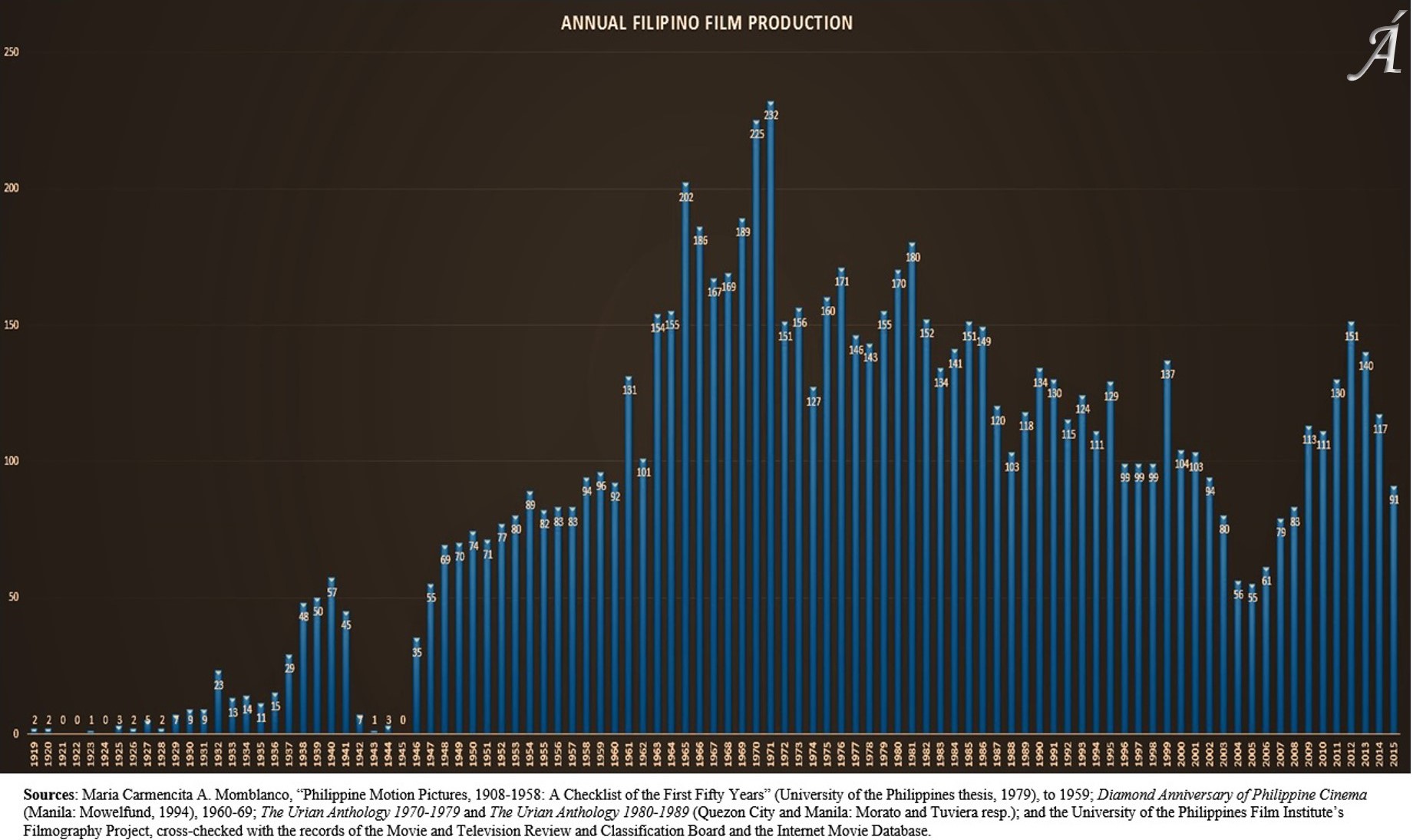
Annual Filipino Film Production Chart

Annual Filipino Film Production Chart

[For a larger image, please click on picture.]

From the draft of a forthcoming manuscript:[1]

If we inspect the record of Filipino film production, we also find the medium overcoming all kinds of crises – the World War II Japanese occupation (1941-45), the declaration of martial law (1972), the anti-fascist people-power revolt (1986), the IMF-WB financial crunch (late 1990s) that overlapped with the death of celluloid production. In each instance the rate of production fell, even reaching zero during the Japanese era; but the restoration of relative stability always saw an upsurge in local industrial output – ahead of other media, and in the case of the last crisis, ahead of other Filipino industries (several of which never fully recovered).

Addendum (January 8, 2016):

I have decided to include below a timeline of historical events relevant to a basic understanding of the Philippines and its cinema. My intention was to convert the chart above into an interactive illustration, where one would be able to click on the peak points of certain years and see a timeline entry. Since that would take too much time and effort for me to attend to at the moment, I thought the next best thing would be to provide the timeline itself.

TIMELINE OF EVENTS

Year Event Total
1896 Execution of Jose Rizal; outbreak of Revolution against Spain.
1897 First film screenings held in the Philippines.
1898 Triumph of Revolution against Spain; US purchases the Philippines from Spain for $23 million in Treaty of Paris.
1899 Outbreak of Philippine-American War.
1900 —α—
1901 Franklin Bell introduces reconcentration camps, prefiguring hamletting in Vietnam.
1902 Jacob “Howling” Smith razes Samar, third largest Philippine island; first labor unions organized.
1903 —α—
1904 US declares end of Philippine “insurrection”; Igorots exhibited as dog-eating head-hunters at St. Louis World’s Fair.
1905 Writ of habeas corpus selectively suspended due to “banditry.”
1906 —α—
1907 Revolutionary General and Tagalog Republic President Macario L. Sakay, tricked into surrendering, is hanged by the US colonial government for alleged banditry.
1908 US colonial government sets up American University of the Philippines.
1909 —α—
1910 Northern nativist leader Apo Ipé captured and executed.
1911 Southern nativist leaders Papa Pablo and Papa Otoy killed in separate battles.
1912 Two Americans simultaneously produce films on the life of José Rizal, declared national hero by US.
1913 —α—
1914 —α—
1915 —α—
1916 Nonhistorical Philippine films start production.
1917 First peasant unions formed.
1918 —α—
1919 First Filipino-produced film completed. 2
1920 —α— 2
1921 —α—
1922 —α—
1923 Anti-American campaign wins senatorial seat for Manuel L. Quezon. 1
1924 Quezon joins independence mission in US, subsequently charged as bogus by nationalist Senator Claro M. Recto.
1925 —α— 3
1926 —α— 2
1927 —α— 5
1928 —α— 2
1929 Major censorship case held on nationalist-themed film release; first imported talkie screened. 7
1930 Communist Party of the Philippines founded; Filipino community attacked in California race riot. 9
1931 Millenarian peasants raid Tayug in Central Luzon. 9
1932 Communist Party outlawed by Supreme Court; first Filipino-produced sound film, George Musser’s Ang Aswang [The Vampire], released. 23
1933 First film sound stage in the Philippines set up. 13
1934 Constitutional Convention held. 14
1935 US inaugurates Philippine Commonwealth, mass protests ensue; first film color laboratory opens. 11
1936 Quezon starts first of two four-year terms as President, to be interrupted by World War II. 15
1937 —α— 29
1938 —α— 48
1939 Falangista movement unites clergy and landlords vs. organized peasants and laborers. 50
1940 Quezon declares limited state of national emergency. 57
1941 Japanese bomb American military installations in the Philippines a few hours after Pearl Harbor, General Douglas MacArthur orders retreat. 45
1942 Bataan and Corregidor fall to Japanese; movie production is state-controlled, theaters turn to stage presentations. 7
1943 Japanese-supervised National Assembly members elected; speaker is Benigno Aquino Sr. 1
1944 First Philippine-set anti-US propaganda movie, The Dawn of Freedom (Abe Yutaka, dir., assisted by Gerardo de Leon), is released by state film agency Eiga Heikusa. 3
1945 Filipino guerrillas, with help from returning Americans, expel Japanese; US reoccupies the Philippines.
1946 Communist anti-Japanese forces wage insurgent war; US grants political independence to the Philippines, arranges special rights for US investors. 35
1947 Military bases agreement signed, providing vast tracts of rent-free land to US. 55
1948 Vertically integrated studio system stabilizes, predominates throughout next decade. 69
1949 —α— 70
1950 President Elpidio Quirino suspends writ of habeas corpus due to insurgency. 74
1951 —α— 71
1952 —α— 77
1953 Former Defense Secretary Ramon Magsaysay elected President, assists US in Vietnam. 80
1954 —α— 89
1955 —α— 82
1956 —α— 83
1957 Magsaysay dies in plane crash, is succeeded by Carlos P. Garcia, who initiates Filipino-First Policy. 83
1958 World Bank and International Monetary Fund begin giving “aid” and loans to the Philippines. 94
1959 —α— 96
1960 Intensive independent film activity destablizies studio monopoly of production and distribution. 92
1961 US supports Diosdado Macapagal, who becomes next President. 131
1962 Macapagal lifts exchange controls, allows devaluation of Philippine peso. 101
1963 —α— 154
1964 —α— 155
1965 Ferdinand E. Marcos elected President; bio-movie produced as part of his campaign. 202
1966 Marcos resumes extending assistance to US in Vietnam. 186
1967 Nativists led by Tatang de los Santos massacred en route to the presidential palace. 167
1968 Philippine Army’s plan to invade Sabah in Malaysia results in massacre of Muslim trainees; Islamic separatists organize; Communist party re-established. 169
1969 Marcos reelected for second (and Constitutionally last) term; Communist New People’s Army founded. 189
1970 Progressive sectors initiate First Quarter Storm protests; hard-core film pornography flourishes. 225
1971 Marcos suspends writ of habeas corpus; radical students proclaim the “Provisional Directorate” at UP campus. 232
1972 Marcos declares martial law through Presidential Decree 1081; Catholic Bishops and US Chamber of Commerce voice support. 151
1973 New Constitution ratified by viva voce. 156
1974 Lino Brocka’s first independently produced triumph, Tinimbang Ka Ngunit Kulang [Weighed But Found Wanting], starts New Philippine Cinema. 127
1975 First Metro Manila Film Festival is held in June. 160
1976 Military takes over censorship board; film critics organize; MMFF playdate is moved to lucrative Christmas break. 171
1977 Kidlat Tahimik’s Mababangong Bangungot [Perfumed Nightmare] wins critics prize at Berlinale. 146
1978 Interim national assembly elections (where Imelda Marcos is topnotcher) charged with fraud. 143
1979 Brocka is introduced at Cannes’s Directors Fortnight through his film Insiang; Ishmael Bernal’s Manila by Night is banned for a year. 155
1980 First of annual dry-runs held for Manila International Film Festival; Brocka’s Jaguar competes in Cannes. 170
1981 Lifting of martial law, with extensive curtailment of civil and economic rights still in place. 180
1982 First of two annual Manila International Film Festivals leads to Experimental Cinema of the Philippines, formed by Executive Order 770. 152
1983 Senator Benigno Aquino Jr. assassinated upon arrival from US at Manila International Airport. 134
1984 Reagans welcome Marcoses to White House in state visit; UP introduces undergraduate-level film-degree program. 141
1985 ECP dissolved over mounting protests; new government body, Film Development Foundation of the Philippines, screens hard-core films at Manila Film Center. 151
1986 “People-power” uprising ousts Marcos, installs Aquino’s widow Corazon; Mike de Leon’s full-length video film Bilanggo sa Dilim [Prisoner of the Dark] screens at Sony’s short-lived Wave Cinema. 149
1987 Constitutional Convention stipulates unrepeatable six-year term for President. 120
1988 —α— 103
1989 Refusing burial, Marcos dies in exile in Hawaii. 118
1990 First of series of right-wing coups d’etat is staged against Aquino administration. 134
1991 Mount Pinatubo eruption causes worst volcanic havoc in 20th century; Brocka dies in car crash. 130
1992 Marcos cousin Fidel Ramos, endorsed by Aquino, wins presidential election. 115
1993 Kidnapping incidents of Chinese-Filipinos for ransom escalates; violent film melodramas, spearheaded by Aquino’s daughter, become most popular local genre. 124
1994 —α— 111
1995 —α— 129
1996 Collapse of Asian economies stalls Philippine recovery; Bernal dies of heart failure. 99
1997 Globalization begins via ratification of General Agreement on Tariffs and Trade. 99
1998 Movie action hero Joseph Estrada wins presidential election. 99
1999 —α— 137
2000 Accused of profiteering from illegal gambling, Estrada is impeached by House of Representatives. 104
2001 Second “people-power” revolt forces Estrada to resign; Vice President Gloria Macapagal-Arroyo, daughter of then-incumbent President whom Marcos defeated in 1965, is sworn in as successor; Lav Diaz begins his long-form series with Batang West Side [West Side Avenue]. 103
2002 M.A. Film introduced at newly founded UP Film Institute. 94
2003 —α— 80
2004 Arroyo wins full term in controversial presidential elections by defeating Fernando Poe Jr. (who dies a few months later); critics give best-film prize to 11-hour-plus digital film, Lav Diaz’s Ebolusyon ng Isang Pamilyang Pilipino [Evolution of a Filipino Family]. 56
2005 CineManila (international festival), Cinemalaya (local fest), and Cinema One (TV-sponsored film productions) subsidize and exhibit digital films; digital movies Ang Pagdadalaga ni Maximo Oliveros [The Blossoming of Maximo Oliveros] (Aureus Solito, dir.) and Kubrador [The Bet Collector] (Jeffrey Jeturian, dir.) garner local and foreign-festival prizes. 55
2006 “Commercial appeal” is used as major criterion in the Metro Manila Film Festival. 61
2007 —α— 79
2008 —α— 83
2009 Brillante Mendoza’s Kinatay [Butchered] wins Best Director at Cannes Film Festival; Cathy Garcia-Molina’s You Changed My Life breaches Php 200 million threshold. 113
2010 Benigno Simeon Aquino III (son of Corazon) wins presidential election. 111
2011 Star Cinema sets and breaks three of its own box-office records in succession. 130
2012 Ateneo de Manila University’s Kritika Kultura journal features special issue on Manila by Night. 151
2013 —α— 140
2014 Lav Diaz’s Mula sa Kung Ano ang Noon [From What Is Before] wins Golden Leopard at Locarno International Film Festival; Aquino rejects National Commission for Culture and the Arts’s recommendation of Nora Aunor as National Artist. 117
2015 Jerrold Tarog’s Heneral Luna [General Luna] becomes most successful indie-digital production in history. 91
2016 Rodrigo Duterte wins presidential election; Lav Diaz’s Hele sa Hiwagang Hapis [A Lullaby to the Sorrowful Mystery] wins Golden Lion at Venice Film Festival, Jacklyn Jose wins Best Actress at Cannes for Brillante Mendoza’s Ma’ Rosa, Paolo Brillantes wins Best Actor at Tokyo International Film Festival for Jun Robles Lana’s Die Beautiful; Khavn de la Cruz sets Guinness world record for “longest film concert” via Simulacrum Tremendum’s screening at International Film Festival Rotterdam. TBA

Note

[1] The “manuscript” mentioned here became available in early 2018 as Manila by Night: A Queer Film Classic (Vancouver: Arsenal Pulp Press, 2017).

Back to top


Book Texts – Manay Revisits Manila by Night

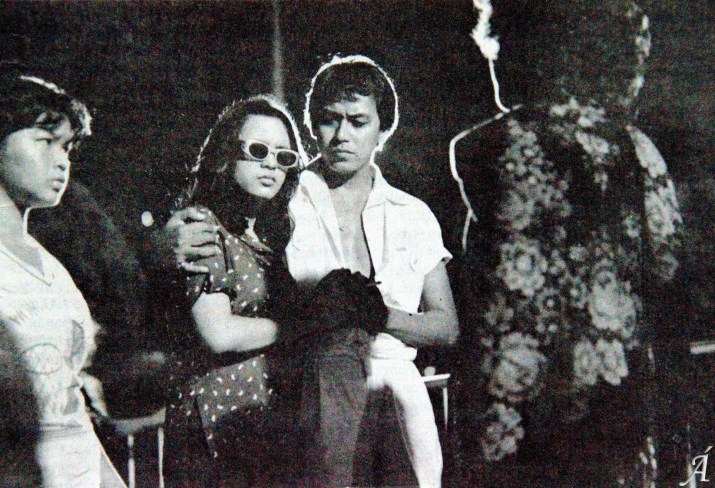
As part of a research project on Ishmael Bernal’s Manila by Night (1980), I drew up a questionnaire for the movie’s lead performer, Bernardo Bernardo. To put it more accurately, Bernardo was one of the movie’s dozen-plus lead performers, since the movie was (and remains) an outstanding achievement in multiple-character film storytelling. I dug deep into what I remembered of the film as a new member of the Manunuri ng Pelikulang Pilipino (Filipino film critics circle), which decided to reward the movie with multiple prizes, including best film and, for Bernardo, best actor. Bernardo provided answers that carefully qualified certain long-held assumptions about the film, and shared insights into how groundbreaking his characterization was by triangulating the relationships among the character (Manay), the actor (Bernardo), and the director-scriptwriter (Bernal). Ironically, as he would expound at length in the interview, the stereotyping he faced as a result of his depiction of Manay resulted in his decision to take a break from Philippine theater and media arts. Philippine performing arts endured a long spell without its most successful theater-to-film crossover actor when Bernardo decamped for the US in 2002; there he continued to reap accolades and awards for his stage activities, notably for his direction of and performance in The Romance of Magno Rubio. Also exceptional is Bernardo’s ability to be frank, gregarious, and playful in his interview responses – a throwback to his years as a journalism major and Varsitarian editor-in-chief at the University of Santo Tomas, as well as his later specialization in witticism-laden dinner-theater blockbusters. Since his return he has kept busy onstage and onscreen, with theater roles (including Shakespeare’s Haring Lear) and prominent film projects (last year’s multi-awarded Imbisibol, dir. Lawrence Fajardo); his latest film, Lav Diaz’s Hele sa Hiwagang Hapis, will be competing at the Berlin International Film Festival – where Manila by Night was also originally slated to participate, until it was banned from export by the martial-law censors. He has also been neck-deep in what we might recognize as “legacy” projects, including teaching (at the new MINT College and the University of the Philippines Film Institute) as well as memoir-writing.
Manay, Bea, and mystic

You mentioned on your Facebook page that you and Ricky Lee were consulted by Ishmael Bernal regarding the plotline of Manila by Night (MbN). The final film also includes Ricky, Peque Gallaga, Mel Chionglo, Jorge Arago, Joe Carreon, Toto Belano, and George Sison as “script consultants.” Were you the only MbN performer who participated in conceptualizing the film at this (pre-production) or any other stage?

I was among the last actors to be cast in Manila by Night and, consequently, was not privy to the pre-production discussions regarding the script of the film. However, I did have a meeting prior to the first day of shooting with the film’s production designer Peque Gallaga and film director Ishmael Bernal to discuss the character’s look and to clarify the character arc of Manay Sharon, the gay couturier I was cast to play.

11011Manay, I soon found out, was a self-confessed neurotic and well-intentioned meddler (with a “Rosa Rosal” social-worker complex) who also happens to have a penchant for juggling multiple lovers on the side; and, as written in the script, Manay would not only link the lives of several key denizens of the seamy underbelly of Manila’s nightlife, he would also function in the narrative, in Bernal’s own words, as “the conscience of the city.”

11011Curious, I asked Bernal, “Why a gay character as the conscience of the city?” And Bernal’s breathtakingly direct response was: “Why not?”

11011Queer vision at work; unblinkingly defiant. Spoken like the true conscience of a country in turmoil, during the Martial Law years. (I am now reminded of an article written by Pablo Tariman years later, after the demise of Ishmael Bernal and Lino Brocka, where he quotes Marilou Diaz-Abaya on the artistically incisive roles that two great Filipino film directors Brocka and Bernal had played in Philippine cinema and history. As Diaz-Abaya succinctly stated: “They both made films in the most challenging times and they responded with valor. Their kind of artistic nobility is now dead.” And, of course, they both happened to be gay.)

11011Additionally, Bernal explained that his approach to filming MbN was going to be ensemble-focused and improvisation-driven. And in so many words, Bernal pointed out that Manay Sharon was not going to be a variation of the stereotypical flaming queen then in vogue in Filipino movies. The tenor of the discussion suggested rather strongly that Manay’s character was going to be complex and that a certain gravitas was going to be required.

11011The closest I came to being consulted directly regarding the MbN narrative was during an informal post-production meeting convened by Bernal. He wanted to weigh the pros and cons of scenes that could be “sacrificed” in order to trim MbN to a more suitable running time (eventually, around 2 hours and 30 minutes). Bernal found the film a bit long.

11011Bernal invited script consultant Ricky Lee and I to the informal assessment of the film over coffee at the lobby of the Manila Garden Hotel. I felt so flattered and honored to be sitting with these creative geniuses in a group discussion, I did not dare ask why I was even invited. Still, I have to take some credit for saving one of the crucial scenes of William Martinez. At one point, Bernal announced that he was thinking about editing out the monologue of William Martinez (Alex) – an intoxicated Ode to Manila, delivered during an All Soul’s Day midnight swim along the breakwater of Manila Bay. It was evident on Bernal’s face that he was not particularly fond of William’s acting in that scene.

11011I reminded Bernal that other key characters in the film share their personal “Ode to Manila”; and, that since William’s journey, that of a young man losing his innocence in the dark streets of Manila, was central to the story – it would be important to hear William/Alex’s voice (regardless of the fact that it was dubbed by character actor Dante Castro to give it more, uh, character).

11011Bernal thought about it for a while, with that signature “inscrutable Bernie” expression on his face, and then calmly decided that he would instead trim the scene of Charito Solis with Johnny Wilson. The one he obviously liked – where the loving parents tearfully worry about their troubled son. It provides stark contrast to the scene where Charito and Johnny go on a moral rampage and nearly beat their son Alex to death for taking drugs.

11011Bernal announced he would trim to the quick Charito Solis’s tender but longish monologue about the birth of Alex that concludes that scene. And then, with a dramatic Bernal sigh, he said, “I will deal with Chato [Charito Solis] later.”

Bernal once mentioned that because of the absence of a shooting script, all the scenes in the film were to be improvised, a method he first attempted in Aliw. To what extent did he enact this improvisation? For example – did he provide you with lines or were you allowed to propose dialogue before or during the shoot?

Although it is true that there were no conventional shooting scripts provided, there were definitely scraps of paper on the set with key dialogue for the film character’s objectives for the day. On a typical shoot, with Bernal’s approval, I would ad lib during blocking rehearsals to bookend the philosophical riffs of Manay that Bernal wrote. Bernal understood that this process helped me to give the dialogue a more conversational, spontaneous feel.

11011A striking example of this collaborative improvisation method at work can be seen in the Misericordia Street scene. This was an ambitious, visually complicated tracking shot with long dialogue between the characters as Manay walked Bea (Rio Locsin) and Gaying (Sharon Manabat) home. The movement of the characters and their dialogue had to be timed accurately for continuity. My rehearsed ad libs allowed for timing adjustments as the camera followed us down the Binondo street lined with prostitutes, beggars, funeral parlors, funeral-wreath shops and delivery services, a real-life curbside altar for Catholic streetwalkers, and for a touch of humor, Virgie’s friend Miriam (Aida Carmona), an aging prostitute, haggling with a prospective client about the price of a blowjob while munching on a fried banana.

11011I am convinced that even with the absence of an actual shooting script, all the film’s sequences and key dialogues were very well thought-out in advance. There must have been a lot of pre-prod work because many of the setups tended to be complicated, and the visuals layered with societal references. Consequently, with the meticulous preparation, we were provided with a solid structure that allowed room for improvisation on location.

Back to top

Was his level of improvisation consistent in the case of the other actors? Meaning, for example, was everyone allowed or encouraged to provide lines or modify their characters’ behavior?

I was not involved in many of the shooting days and may have missed out on some improvisations on the set. But on the other location shoots of MbN that I did visit, the actors stuck pretty much to what was rehearsed, hewing close to the words that Bernal would “feed” the actors. There was hardly any improvisation, although occasional paraphrasing would occur. Usually the adjustments were contextual, depending on the location, situation, or who among the characters were involved.

11011I am inclined to think that Bernal gave me more leeway in improvising lines because of my background in theater and scriptwriting.

The exchanges you had with Kano (Cherie Gil) at Sauna Turko, with Bea (Rio Locsin) in Misericordia, and with Febrero (Orestes Ojeda) in Luneta were detailed, witty, and occasionally philosophical. The standard expectation is for the writer (in this case also the director) to provide some pages for the actors to memorize before the shooting schedule. Was this the case for these specific scenes?

The core elements of the dialogue came from Bernal. Without question, all of the philosophical forays in the MbN scenes were entirely Bernal’s. However, I will shamelessly admit that most of the punchlines in the scenes I was involved with were mine – resulting from my improvisations under the director’s watchful eyes. Sometimes, Bernal would even come up with a “topper” to end a scene that he was already editing in his mind; like, for instance, the Sauna Turko scene.

11011The accidental first encounter of Kano (Cherie Gil) and Manay somehow evolved into something reminiscent of an ironic vaudeville routine with Kano as the “feeder”/straight man and Manay as the comic who delivers the punch lines. What previously began as an exploratory repartee led to a philosophical discussion about “True Love,” done in a single long take; and then, for Bernal’s cherry of a philosophical “topper,” a tighter medium shot favoring Manay saying: “Alam mo yan, ilusyones lang yan. Ang sey nila pag natu-true love daw, gumaganda ang buhay. Pero ako pag umiibig ako, nagkakaputa-puta!” [“You know, it’s all an illusion. They say when you fall in love, life becomes beautiful. But me, when I fall in love, life gets all fucked up!”].

Among the rest of the major characters, only Evita Suarez (Mitch Valdes) was the closest, circumstantially speaking, to Manay. They moved in the same milieu, shared some friends, and displayed literate references in their lines of dialogue. Yet MbN also positions Evita differently. She disparages the working-class men that Manay and his friends prefer, and name-drops the rich and powerful – the types of people that Manay presumably avoids. In the Luneta scene with Febrero, we see a different circle of friends, also non-upper crust but mystics or bohemians. This invests Manay with the ability (not available to any other character) to cross class boundaries. What type of “character background” did Manay possess, and was this background provided by you or by Bernal? For example, was he born rich, did he migrate to the city, and so on; was he intended to resemble people in the Malate circle – Ernest Santiago, for example?

You’re right in saying that Manay has the ability (not available to any other character in the story) to cross class boundaries. Indeed, apart from the fun company of the 1970s “fag hag” Evita, Manay appears to avoid the rich and powerful. I had no scenes with the “sosyal” types even if these moneyed folks would logically be the clientele of Manay’s spacious Malate atelier. As written, Manay was more at home with the people of the streets, the working class, and night creatures.

11011In a telling manner, Bernal did not provide me with a character background. All I had was the sketchiest overview of the plotline. On our first meeting, I was expecting that I would at least be given a complete script for text analysis and character study. There was none. Other than some notes about coloring my hair a lighter tone, shaping my eyebrows, and wearing casually stylish outfits that had to be white, I was pretty much left on my own. It was like “that’s it, we’re done.” I was “It”: As Is, Where Is. Things basically evolved in real time, unfolding as we moved forward.

11011Significantly, Bernal gave me the freedom to cast my personal friends to play my “barkada” [entourage cum confidantes] in the movie. He knew I would be myself, feeling more at home and relaxed in my ensemble scenes with people I really knew. Heeding the director’s orders, I chose longtime friends who weren’t “butch types,” whom a couturier like Manay wouldn’t mind hanging out with, namely choreographer Bobby Ongkiko, character actor Manny Castañeda, and designer Ube Abeleda. Additionally, Bernal threw in a bit player, whose name escapes me,[1] as the designated “alalay” [gofer] – a logical choice since this character also works for Manay as a seamstress in his Malate shop.

11011Now, why would Bernal give me so much freedom? At the risk of sounding presumptuous, I feel it’s because Bernal really knew me. Before Bernal cast me in MbN, we’d been friends for seven years, sharing jokes and drinks and the company of eccentric friends at bohemian watering holes and gay bars (Indios Bravos, Dutch Inn, Coco Banana) and at the Luneta Park – all considered notoriously gay hangouts during the Martial Law years.

11011Maybe Bernal saw in me a reflection of his own or Manay’s personality. That we were actually sisters under the skin, so to speak, with a shared capacity to display barbed “taray” [bitchiness], droll humor, reckless promiscuity, bullheadedness, and irrational distrust of love relationships. Or, maybe he realized I was what he had in mind all along. Maybe. I am reminded of what Hollywood acting coach Larry Moss once said, “90 percent of directing is casting. So, if you cast someone that you believe can do the role, then get out of their way…. Trust your actor” (“Acting Coach Larry Moss,” posted April 13, 2010 on YouTube).

11011I felt Bernal trusted me. I noticed that he was very sparing with words when he was directing me. He only said what was needed; with a lit cigarette between his fingers, he would flick his wrist, to punctuate a directorial phrase such as: “Bernie, too macho” (regarding the New Year scene where I angrily attack Alex outside the Sumpak Gay Bar); or, with arms akimbo while thinking deeply, “it has to be a cathartic cry – of Greek Tragedy proportions” (as a preparation for my nervous breakdown scene outside the funeral parlor).

11011The only time I think I disappointed Bernal as an actor was in my final scene at my atelier when he asked me to go crazy while carrying a small image of the Sto. Niño as a prop. Manay finds religion, I asked myself. This coda follows my climactic breakdown scene at the funeral parlor. I didn’t know where to go from there. Being a fairly well-adjusted queer person at that time, my range of crazy was rather limited. All I could give Bernal was a tired “Sisa” moment with the wild eyes. I heard Bernal mutter: “Ay, hindi siya marunong maloka!” [He does not know how to act crazy!]. I couldn’t. And since the short scene was being shot in a rush, we had to settle for depression.

11011Of course, since that time, my spectrum of crazy has expanded considerably.

Back to top

Because of your character’s intensive interaction with certain key characters, a few friends suggested to Bernal that Manay might be MbN’s central character (“author’s mouthpiece,” according to one critic during the Urian deliberations). Bernal insisted however that all the characters were of equal importance. Yet there’s also the background story of Bernal picking you out from theater, unlike the other lead actors who were part of the Regal stable – plus possibly a shared nickname (Bernie, for both Bernardo and Bernal). What is your take on this issue of Manay’s centrality in the narrative?

In a sense, I would agree with Bernal’s insistence that “all the characters were of equal importance” because to me, I see all of the characters in MbN as his “mouthpieces” – all aspects of Bernal, if you will, with each character verbalizing Bernal’s varied thoughts on what is seductive and repellent about life in Manila.

11011However, by insisting on the equal importance of all the characters, Bernal could have been deflecting attention from Manay’s role as central character in MbN precisely because he did not want people to perceive Manay as “Bernal’s alter ego.”

11011I must confess that up to now I am convinced that Manay is the alter ego of Bernal – the director/scriptwriter. Bernal was very specific. He told me directly during our first production meeting that this gay character is “the conscience of the city.”

11011Out of all the characters in MbN, Bernal chose Manay to be his inner voice. In the film, Manay chooses to be a guide for the people he cared enough for, ostensibly to lead them toward a sense of what is morally right or wrong. As fleshed out, Manay became a hopeful, helpful, but ultimately helpless guide doomed by his own hubris – blind to his own flaws, he betrays those who fail to meet his expectations, while he himself is eaten up by his own addiction, promiscuity, and lies.

11011Manay was a flawed conscience. But more (Robert) Altmanesque than I expected. Beyond the celebrated Hollywood director’s influence on Bernal’s ensemble-focused and improvisation-driven films, it seems like the two directors share the same thoughts about human behavior. In a tribute to Altman in 2007, a telling insight shared by Robert’s son Michael seemed to resonate strongly with Bernal’s conflicted creation: Manay, the hater of lies. Michael revealed that his father was “not so much a lover of truth as a hater of lies” (David Carr, “A Very Altmanesque Tribute to Altman,” New York Times, February 21, 2007).

11011This Altmanesque thought echoes in Bernal’s Luneta Park scene where Manay betrays the duplicitous Ade/Alma Moreno to Febrero/Orestes Ojeda: “Hoy, hindi ako nagmamalinis, ha? Sa lahat ng ayoko sa tao yung nagsisinungaling. Nanloloko! Aba the minute na magsinungaling sa ’yo kalimutan mo na. Ano ka, loka?… Ano bang klaseng babae yang kabit mo? Saang impyerno mo bang napulot yang putang demonyitang yan?… Talagang sa panahong ito, wala kang mapagkakatiwalaan” [I’m not saying like I’m Mr. Clean, okay? If there’s anything I hate, it’s a two-faced hustler! A liar! The minute a person lies to you, get rid of her. Are you crazy?… What kind of tramp is your lover?… From what hellhole did you dig up that devil of a whore?… I’m pretty sure, these days, there’s no one you can trust].

11011Manay’s lines here practically mirror his more playful caveat to Alex/William during their first tryst: “Alam mo naman ako, nyurotika at tensyonada. Sa lahat ng hindi ko ma-take yung nanloloko at nandadaya, eh. Marami nang masasamang tao sa mundo, huwag na nating dagdagan pa” [You should know that I am neurotic and intense. Of all the things I hate in this world, what I really can’t stand are cheaters and liars. The number of evil people in this world has multiplied, let’s not add ourselves to their numbers].

11011It is tempting to oversimplify and simply risk calling Manay a gay jiminy cricket who is tragically blind to the errors of his own ways. But I think it is more telling of Bernal than Manay that the character seems above reproach and blind to his own flaws. Bernal makes Manay’s promiscuity funny and attractive; his drug addiction unexposed (although Bernal had me behaving more neurotic and looking “increasingly wasted” on screen as my relationship with Alex soured, Manay’s addiction was never shown; by contrast, Virgie, Alex, and even Vanessa were shown indulging in drugs); and, his innate distrust of people coupled with his penchant to manipulate relationships as almost acceptable quirks of a neurotic.

11011Thus, in the Binondo scene, it was as if the blind was leading the blind. When Manay walks Bea and Gaying home, Manay professes in Bernal’s words: “That is the tragedy of my life: lahat nakikita ko. Mga hindi ko dapat makita, nakikita ko. Maski wala namang dapat makita, nakikita ko pa rin. Loka…. Lahat ng tao sa mundo luko-luko, ’di ba? Ang mga mukhang inihaharap nila sa atin, hindi naman yan ang tunay nilang mukha eh, ’di ba?… Maraming mukha ‘yang mga tao…iba yan ng iba, ’di ba? Patong-patong” [I see everything. Things that I shouldn’t see, I see. Even when there’s nothing to see, I see something. Crazy…. All the people in the world are crazy, aren’t they? The faces they confront us with, those aren’t their real faces, right?… People have lots of faces…they keep changing, don’t they?… One on top of the other].

11011Was life overlapping with art? Was Bernal in denial? Only his friends who lived with him would know.

Some critical commentary noted how Bernal was an effective director of women mainly because he insisted that they mimic him (notably in the case of Elizabeth Oropesa). This could have accounted for a critic’s “author’s mouthpiece” comment. Considering that you had played a range of roles, this depiction of a dominant campy character, which hewed close to Bernal’s personality – was this something you consciously modeled on him? For example, did Bernal say outright “I want you to play someone like me?”

There may be some truth in the story that Bernal insisted that his actresses mimic him. I can see Bernal in Charito Solis’s movements (the comically aborted lovemaking with Johnny Wilson), her stage business (the Bernal twist on the Joan Crawford fetish for cleanliness), and the rat-a-tat delivery of her lines, broken by sudden shifts of mood.

11011In my case, Bernal did not say outright, “I want you to play someone like me.” To begin with, we were both “butch” types who have a flair for camping things up for fun. And so that part was a no-brainer. I just intuited that maybe I should copy some of his mannerisms, such as the way he smoked cigarettes and used his arms when making a point. Bernal’s body language was that of an educated person who was proud and sophisticated, controlled; but, during unguarded moments he tended to be effeminate, and a few notches short of verging on the hysterical. I could see me in him.

11011You see, when Bernal gave me his favorite white shirt to wear in the movie, I did not see it as just a kind gesture. Somehow, I thought Bernal wanted me to be him.

Manay came out, as it were, during a time when these types of characters were considered objects of ridicule (dominated by Dolphy, with Roderick Paulate starting to emerge with his Rhoda persona). Manay’s predecessors in film would be two gay characters in Lino Brocka’s films, Eddie Garcia’s character in Tubog sa Ginto and Dolphy’s in Ang Tatay Kong Nanay [My Mother the Father] (plus peripheral characters like Soxie Topacio’s in Tatlo, Dalawa, Isa [Three, Two, One] and Orlando Nadres’s in Tinimbang Ka Ngunit Kulang [Weighed But Found Wanting]). Did you sense anything in Bernal and his friendly rivalry with Lino, where he set out to “improve” on these weak/tragic predecessors by presenting a strong, out gay character for a change?

No idea on this one. It would have been interesting to hear Bernal’s views on Maynila: Sa mga Kuko ng Liwanag [Manila: In the Talons of Light] or even Tubog sa Ginto [Dipped in Gold].

Manay’s most intense non-sexual bonding was with the lesbian couple (Kano and Bea). It’s probably easier to argue from these two, plus Manay’s relationships with straight men (Febrero and Alex), that queerness is the central gender position of MbN. As far as you could tell, did Bernal set out deliberately to create a queer text, or did MbN turn out that way simply because that was the nature of underworld late-night denizens in Philippine urban culture?

When asked whether or not I consider queerness is the central gender position of MbN, I am tempted to echo Bernal’s testy blanket rejoinder about the virtues of queerness: “Why not?”

11011In Bernal’s Manila by night, gay rules. And in this queer world, you can’t take the gay out of the city and you can’t take the city out of the gay. Queerness propels the narrative of MbN. It is Manay – Bernal’s designated conscience of the city – whose queer interests drive him to insinuate himself into people’s lives as the city’s well-intentioned meddler, who takes it upon himself to guide people toward bettering their lives. Ultimately, however, Manay reveals himself to be a flawed conscience, a duplicitous do-gooder who betrays the people he supposedly cares for because they failed to meet his moral standards (from which he appears to be exempt).

11011For the Queen of Denial, drug addiction and infidelity are unforgivable, but the worst sin of all is deceitfulness. After all, Manay does not lie; he just does not tell the truth.

Back to top

Manay (the character) was also observed – or criticized, by conservative sectors – as promiscuous. Were these elements in the character (a preference for casual sex and straight-identified men, for example) part of Bernal’s personal character?

I was not witness to Bernal’s promiscuity, although I heard interesting stories. We both caught the tail-end of the Free Love Movement of the 1960s and in the relative innocence of the 1970s we weren’t quite ready to give up being Flower Children. I was 33 years old when we filmed MbN. It was the pre-AIDS/HIV period, and we were fearless. And from what I heard, yes, we both liked our straight-identified men.

Your success in performing Manay might have also delimited your prospects in film assignments (as it did Roderick Paulate’s), since a lot of your future significant roles demanded that you use a similar persona. Did this predictability and media stereotyping contribute to your decision to take an extended leave from Philippine performing arts?

For some time, I was doing mostly “macho” straight roles in plays and musicals on stage for theater companies such as Julie Borromeo’s TOP Productions, Lamberto V. Avellana’s Barangay Theater Guild and Zeneida Amador’s Repertory Philippines. After essaying back-to- back butch parts in The King and I, Tatarin [Fertility Ritual], and They’re Playing Our Song, I took on a couple of high-profile gay roles because I felt left out when Lino Brocka cast some of my friends (Soxie Topacio, Larry Leviste, and Orlando Nadres) with Dolphy in Ang Tatay Kong Nanay in 1978.

11011I appeared as Fidel in Orlando Nadres’s Hanggang Dito na Lamang at Maraming Salamat [Only Up to Here and Thank You] with Dennis Roldan (Efren) and Fanny Serrano (Julie) at the Metropolitan Theater under the direction of Mario O’Hara. And, close on its heel, as the outrageous lead role in Boys in the Band Part II, at the Century Park Sheraton – a performance that Bernal caught, where I was flaming enough to burn the ballroom down. My decision to change camps, as it were, proved to be propitious. Within the week, he had MbN’s project coordinator Douglas Quijano call me to tell me that the role of Manay was mine if I was interested. And, after some drama with a take-it-or-leave-it pittance-of-a-talent fee and a subsequent heart-to-heart with Bernal, I took the role.

11011At about this time, some of my theater friends were already expressing their concern that I might get typecast, which was a threat I had avoided for the past six years in theater. I was aware that public perception by the larger mass audience can delimit my prospects for a variety of roles in films, especially after the tabloid brouhaha about my torrid kissing scenes with Orestes Ojeda and William Martinez. Soon after the initial previews of MbN, I sensed stereotyping was rearing its head when film director Maryo J. de los Reyes and scriptwriter Jake Tordesillas kept wooing me to essay another controversial gay role in their next film, Pag-Ibig Ko, Hatiin Niyo [My Love, Please Share]. Not wanting to dip in the same pool twice in a row, I said “No” and the role went to Orlando Nadres. I did not mind. I felt Bernal and I had created something truly special in the queerness of Manay, and I did not want to compete with myself.

11011After I won the Urian Award for Best Actor in the role of Manay, I found myself stereotyped for good. Although Bernal was set on casting me in a complete turnaround role as a macho butcher in Belyas [Belles], a passion project for Jesse Ejercito’s “seven belles” for Seven Star Productions (Chanda Romero, Alma Moreno, Lorna Tolentino, Amy Austria, Daria Ramirez, Beth Bautista, and Elizabeth Oropesa), the film was shelved. Instead, Bernal cast me in a cameo in his next movie, Pabling [Playboy], as a ditzy gay couturier. Other offers for TV and film were predictably for the same persona.

11011Luckily, the era of dinner theater comedies had begun and I appeared in a succession of “sex comedy” hits with Chanda Romero, Gloria Diaz, Pinky de Leon and Cherie Gil. For legit theater, I ended the decade with lead roles in the musical Katy! for Musical Theater Philippines, and La Cage aux Folles for Repertory Philippines. However, due to the economic crisis in the Philippines in the late 1980s, I had to migrate to Singapore to work as artistic project manager for Singapore’s Haw Par Villa Theme Park and lived in the city-state for two years.

11011Upon my return to the Philippines, I found that my gay persona was still in demand. I was cast as the comic nemesis of the Philippines’ Charlie Chaplin, the iconic Dolphy, in the TV sitcom Home along da Riles [Home along the Rails], which was a major hit that ran for 11 years on ABS-CBN Channel 2. This outstanding and profitable partnering with the King of Comedy subsidized my low-paying theater work in Tagalog with Tanghalang Pilipino of the Cultural Center of the Philippines, where I appeared in landmark productions of Noli Me Tangere [Touch Me Not], El Filibusterismo [The Subversive], Kalantiyaw, Mac Malicsi, and Ang Balkonahe [The Balcony], among others.

11011I thought I finally found the formula for a balanced life. Unfortunately, showbiz was assuming a corporate face and it was increasingly being run by suits; and, as a result, overall decisions for productions were being turned over to “creative committees.” Dissatisfied, I left for the US and lived there for twelve years.

The usual motherhood-statement questions: First, would Bernal, in your opinion, still have any importance in today’s digital-independent scene? Why or why not?

Bernal was brilliant. A gifted director and scriptwriter like Bernal would have been awesome in today’s digital-independent scene, liberated from antediluvian constraints. Unstoppable! For me, Bernal’s breathtaking talent for storytelling and creating compelling characters remains unsurpassed. I feel like life simply overtook him. He was going through a low period but he could have bounced back. Easily.

Second, is MbN still significant in a future (which is our present) where there has been increasing acceptance of non-normative lifestyles?

I will sound biased but I remain unapologetic. I believe MbN will remain significant because it is a classic that showcases the formidable creative talents of a film director at his peak. Film may be a product of its time, but MbN is more than just about a city or a particular time. It is more than just queerness. I saw it recently and it still looks and feels contemporary, unlike other films of the ’70s that haven’t aged well. With MbN, Bernal has woven timeless cinematic magic with his unique gift for storytelling and an uncanny ability to create believable, flat-out fascinating characters.

Note

[1] Identified as Jun Macapinlac in Bernardo Bernardo’s July 4, 2016, Facebook query.

Back to top


Malvarosa (1958) Sequence Breakdown

Directed by Gregorio Fernandez
Written by Consuelo P. Osorio
From a story by Clodualdo del Mundo, Sr.
Transcription by Joel David

  1. Int., Prosa’s house, night. Damian arrives home and argues with his wife, Prosa, who arrived from a mah-jongg session and failed to prepare dinner; to appease him, she announces she is pregnant.
  2. Ext.-int., Prosa’s house, day. A neighbor convinces Prosa to have her fortune told; she learns she will have five male children but her youngest will be a daughter. She decides to name the boys to fit the acronym “Malva,” while the girl is named Rosa.
  3. Ext., Prosa’s house, day. All grown up now, Alberto takes leave of Rosa to serve in the church sacristy; Melanio pesters her to prepare his shirt for a date; Leonides asks for food; Vedasto pokes fun at his parents for their gambling and drinking; Avelino asks for his school allowance. Rosa, who is earning a living as a laundress, explains how Avelino should be assisted so he could earn a degree and admonishes her brothers to honor their parents. Damian arrives asking for Prosa and leaves in a huff to look for her. Candido, Rosa’s suitor, tries to convince Rosa to marry him so he could look after her, but she tells him of her dream to help Avelino before leaving her family, causing Candido to fret from disappointment.
  4. Int., church, day. Alberto complains of how the neighbors taunt his family because of the life of dissipation led by his parents. The priest tells him to have faith and promises to speak with Damian and Prosa for their children’s sake.
  5. Ext., corner store, night. While appealing to the corner-storeowner to extend his credit for another bottle of booze, Damian is fetched by Candido, who pays off Damian’s debt with the store.
  6. Int., mah-jongg parlor, night. Damian refuses to go with Candido and instead fetches Prosa at the mah-jongg session. The couple create a scene by quarreling in public.
  7. Ext., railway tracks, night. Damian berates Prosa for her gambling addiction, she in turn upbraids him for drinking. They walk home far apart from each other. Damian stumbles on the railway tracks as a train arrives and runs over him.
  8. Ext.-int., Prosa’s house, night. At Damian’s wake, Avelino and Vedasto walk among the guests looking to make extra change from betting on parlor games. Rosa cries from embarrassment over her brothers’ conduct, Candido tries to comfort her, Leonides warns him not to get too fresh with his sister, Candido in turn assures Leonides of his decent intentions. Two of Melanio’s mistresses arrive and start quarreling, forcing Melanio to break them apart. Candido tells Rosa he does not mind her family’s scandalous reputation; Rosa expresses pity for her mother, now unable or unwilling to respond to her environment since Damian’s fatal accident.
  9. Int., community clinic, day. The doctor explains to Avelino and Candido how Prosa is still sane but in a state of shock caused by melancholia over the death of her husband. He tells them that an upswell of happiness could overpower her grief and restore her to normalcy.
  10. Ext., corner store, night. After imbibing some beer to assuage her grief, Prosa walks home
  11. Ext., railway tracks, night. Prosa sees a vision of Damian on the tracks. She approaches the vision but he disappears. She breaks down near the tracks.
  12. Int., Prosa’s house, night. Unable to find her mother at home, Rosa asks Leonides, who responds with indifference. A neighbor tells them where Prosa can be found.
  13. Ext., railway tracks, night. Rosa and Leonides fetch their mother.
  14. Int., Prosa’s house, night. Back home, Leonides blames Rosa for neglecting their mother. Rosa asks Vedasto to prepare some coffee for Prosa, but he is too lazy to get up.
  15. Int., Melanio’s love nest, night. Melanio is with another of his mistresses, a third one, who also has a child by him. He wants to borrow some money from her, but she tells him that since he told her to quit her job as an entertainer, she could barely make ends meet from the allowance he gives her.
  16. Int., Prosa’s house, day. Worried about Prosa, Rosa asks Vedasto to buy some medicine. He agrees but spies on Rosa to find out where she keeps her money – in a jar in a kitchen cabinet. Before he goes on his errand he steals her money.
  17. Ext., Prosa’s neighborhood, day. Alberto controls his temper when some neighbors describe him as a sinful sacristan, in reference to his family. He meets Miling, a girl he fancies, but her disapproving mother pulls her away from him.
  18. Ext., Avelino’s school, day. Avelino’s classmates discuss the forthcoming student election. Some of them want Avelino to run because of his good grades (and good looks), but others want a wealthier candidate.
  19. Ext.-int., Prosa’s house, day. Rosa takes on more laundry requests from the neighbors. She gives Avelino his school lunch as Melanio arrives and asks for a loan. Rosa checks her money but doesn’t find it. She accuses Leonides of stealing it. Leonides calls Vedasto to ask if the latter has it. Vedasto, the guilty party, denies any knowledge of its whereabouts and implies that Avelino or Alberto might be culpable. Rosa rejects his suggestion and her “bad” brothers accuse her of playing favorites. Melanio questions her judgment of supporting Avelino’s studies, but when she denounces them for their complacency, Melanio hits her and taunts Avelino. Rosa has to prevent them from coming to blows.
  20. Ext., Prosa’s neighborhood, night. Walking home from church, Alberto runs into Candido and relates how he is thinking of giving up church service because of his difficulty in coping with people who mock him. Candido tries to discourage him, but some neighbors tell them that Prosa is once more lying near the railway tracks.

    Back to top

  21. Ext., railway tracks, night. Alberto and Candido go to fetch Prosa, Alberto pleads with her to stop drinking.
  22. Ext., Prosa’s house, day. Melanio’s three mistresses arrive but, with Melanio not home yet, Rosa greets them. Each mistress brings her child by Melanio and demands that Rosa take care of the kid. Rosa faults them for falling for her negligent and improvident brother. When they refuse to leave she threatens them with a laundry paddle.
  23. Ext., Prosa’s neighborhood, day. The mistresses meet Melanio on his way home and complain about Rosa’s treatment of them.
  24. Int., Prosa’s house, day. Avelino helps Rosa prepare lunch when Melanio arrives. When Rosa defends her conduct with his mistresses, Melanio attempts to hit her but Avelino stops him and the two brothers engage in a fistfight. Melanio threatens to leave home.
  25. Ext., Prosa’s house, day. As Rosa, Avelino, and Candido search for Melanio, police arrive with a warrant of arrest for the polygamist.
  26. Ext., Prosa’s neighborhood, day. The police arrest Melanio to face the mistress who filed charges against him.
  27. Ext., Miling’s neighborhood, day. Alberto meets Miling and asks if he could pay her a visit at home. Miling’s mother sees them and forbids her daughter from socializing with Alberto because of the degeneracy of his family.
  28. Ext., empty lot, day. Candido takes Rosa to an empty lot that he plans to buy for her and build his dream house on when they marry.
  29. Ext., Prosa’s neighborhood, night. Some neighborhood thugs see Alberto and make fun of him by imitating Prosa’s breakdowns by the railway tracks. Alberto scuffles with them. A policeman passing by breaks up the melée.
  30. Int., Prosa’s house, night. Alberto pleads once more with his mother to stop drinking. Deluded, Prosa thinks Damian’s still alive, waiting by the railway tracks. Alberto gets impatient with Prosa, Avelino and Rosa intervene, Alberto leaves forthwith.
  31. Ext., Miling’s house, night. Alberto goes to Miling’s house but her mother objects that it’s too late at night and that she disapproves of Alberto’s family. Alberto gets into an argument with her but Miling’s mother calls for the police, causing Alberto to leave.
  32. Int., Prosa’s house, night. Prosa asks for Alberto, who hasn’t returned home. Concerned, Avelino and Rosa look for him. Leonides and Vedasto refuse to help them.
  33. Int.-ext., Miling’s house, night. Miling goes to the bathhouse to take a shower when Alberto breaks in and attempts to rape her. She screams to her mother for help and the police arrive.
  34. Ext., Miling’s neighborhood, night. A mob chases Alberto but the parish priest stops them.
  35. Ext., church, night. Alberto runs into the church remorseful over what he has done. Rosa finds out from the mob what happened.
  36. Int., church, night. A sacristan asks Alberto what’s wrong, but Alberto pushes him aside and runs up the belfry.
  37. Ext.-int., church, night. The priest calms down Miling’s mother. Rosa looks for Alberto in the church. The sacristan directs her toward the belfry, where she discovers Alberto has hanged himself.
  38. Int., bar, night. Leonides turns rowdy while drinking from despondency over Alberto’s suicide. Maximo introduces him to his boss, a criminal mastermind.
  39. Ext., isolated road, night. When their getaway vehicle is cut off, Leonides shoots and kills an officer, then runs for cover. The rest of the gang gets caught.
  40. Int., nightclub, night. Candido and Rosa search for Leonides in a nightclub but find Vedasto there instead. He refuses to help them find Leonides. Tony, one of the regulars, approaches Vedasto and expresses interest in Rosa.

    Back to top

  41. Int., Prosa’s house, day. The police call on Rosa to help in capturing Leonides. Rosa and Candido go with them.
  42. Ext.-int., Leonides’s hideout, day. Returning gunfire, Leonides refuses to surrender. Rosa runs into his hideout to plead with him. Leonides knocks her out but is felled by a sniper’s bullet. Rosa regains consciousness and screams when she finds her brother dead.
  43. Int., nightclub, night. Impressed by Tony’s wealth and generosity, Vedasto agrees to ask Rosa to work for Tony as his personal secretary.
  44. Ext., Prosa’s house, day. Vedasto arrives home loaded with food treats. He announces that he has found a job for Rosa. Avelino volunteers to work but Vedasto discourages him, since he is still in school. Candido cautions Rosa but she is determined to make good in her new job. Peeved, Candido tells her she can take the job and a new boyfriend any time she wants to.
  45. Ext., Prosa’s neighborhood, day. Next morning, Rosa, Avelino, and Vedasto wait for a ride. Avelino’s classmate passes by in her car and offers him a ride, which he accepts.
  46. Int., Tony’s office, day. Vedasto introduces Rosa to Tony at the latter’s office.
  47. Int., Prosa’s house, night. After hours, Rosa describes to Avelino and Vedasto how she wishes she had real work to do instead of just sitting around and reading komiks and magazines. Vedasto tells her to be responsive to her boss.
  48. Ext., empty lot, day. Avelino, Vedasto, Rosa, and Prosa visit the suburban lot that Candido took Rosa to earlier. Rosa is sad for still not having reconciled with Candido.
  49. Int., Tony’s office, night. At the office, Tony asks Rosa to work overtime.
  50. Ext., Prosa’s neighborhood, night. Candido meets Avelino on his way to visit Rosa but learns that she hasn’t arrived yet. Candido volunteers to fetch her from work.
  51. Ext., corner store, night. Vedasto treats his friends to a round of drinks. He sees Candido and follows him to Tony’s office.
  52. Int., Tony’s office, night. Tony flirts with Rosa, then begins harassing her. Candido arrives and trounces Tony. Vedasto tells Candido to mind his own business but Candido reprimands Vedasto. Candido leaves with Rosa, prompting Vedasto to threaten her.
  53. Ext., Prosa’s house, day. As Avelino leaves for school next morning, Prosa wonders where Rosa is. Vedasto arrives and tells Avelino that she has eloped with Candido. Avelino leaves to confront the couple. Vedasto then tells Prosa that Rosa is dead. Prosa lights a candle to pray for Rosa.
  54. Ext., Prosa’s neighborhood, day. Avelino finds Candido and demands an explanation. Candido describes how he arranged for Rosa to stay with one of her friends, Nena, whom they meet and who corroborates Candido’s story. Nena also says that Rosa left for home.
  55. Ext., Prosa’s house, day. Vedasto forbids Rosa from entering their home and smears her reputation in front of the community, saying she slept with Candido. Tearful and helpless, Rosa runs away.
  56. Ext., railway bridge, day. Avelino and Candido find Rosa about to leap from the railway bridge. They manage to prevent her from killing herself, but when Avelino finds out what Vedasto has done, he sets off to punish his brother.
  57. Ext.-int., Prosa’s house, day. Avelino and Vedasto come to blows as the candle that Prosa lit falls and starts burning the wooden floor. Prosa has fainted from grief and fails to notice the fire.
  58. Ext.-int., Prosa’s house, day. Rosa and Candido stop Avelino and Vedasto’s fistfight. They see the house burn. Candido runs inside and manages to save Prosa, but the house goes up in flames.
  59. Ext., railway tracks, day. Prosa declares that they must start anew, Vedasto asks for everyone’s forgiveness, and the survivors – Prosa, Rosa, Avelino, Vedasto, and Candido, walk down the railway tracks to a new life.
  60. Ext., empty lot, day. End credits appear over Candido’s suburban lot.

Back to top

Á!


My Big Fat Critic Status

Before the days of personal computers, I had to draft everything on a typewriter, correct it, and type (and sometimes retype) the final version. I diligently kept all my drafts, as well as the latter-day floppy drives of the Commodore 64 where I managed to finalize my first two book manuscripts. Nearly everything was lost to floods and pilferage, though for some reason, the draft of the letter I wrote to the Filipino film critics’ circle survived. This was not the first time I mentioned my concerns about the group’s obsession with its much-vaunted awards, but this was the moment I first expressed my misgivings directly to the group. (The addressee, then-chair Gino Dormiendo, also subsequently left.) Needless to add, I never returned after taking this “leave,” and neither did the group members stop with their annual ceremonies. Upon my return from US graduate studies, I was asked (via an emissary) to consider rejoining, but by then I felt that our differences had become too vast to be reconcilable.

Letter re Manunuri status
April 26, 1985

Justino M. Dormiendo
Manunuri ng Pelikulang Pilipino
Metro Manila

Dear Mr. Dormiendo:

I am writing to convey my intention of requesting for a change in status to that of a non-voting member of the MPP. I understand that no such position has been granted anyone who had been or has been in good standing with the organization, except through technicalities such as inclusion in the list of nominees or absence from deliberations for the year under consideration. The reason behind my appeal, however, is my disagreement in principle with the notion of critics handing out awards to the people whom they are morally committed to help. The effect of award-giving on a circle as small as our local film artists’ community is to foster competition of a divisive nature, instead of encouraging collective action even (and most especially) in the area of artistic production, which in the first place distinguishes filmmaking from most other popular artistic endeavors.

11011As a result, I find myself dismayed by an attitude on the part of the industry and the public as well – that of regarding the MPP as an award-giving body, as opposed to a genuine critics’ circle. Each award-giving ceremony has done nothing except reinforce this attitude, and even the MPP membership can be charged with playing along with this posture when the body becomes complete mainly during awards-related meetings.

11011Should this request be granted, I would only be glad to carry on with whatever contributions I could make toward the revival of the MPP’s original ideals as a critics’ group, including the finalizing of citations, which are not as competitive in the sense that awards are. I must also indicate that at the moment I cannot consider any alternative other than taking a leave from my membership, to be able to personally formulate resolutions regarding my perceptions of the present state and future directions of Filipino film criticism.

Yours truly, etc.

Back to top


The Reviewer Reviewed

I responded to a review of my work only once, with decidedly mixed feelings. I would have preferred to keep quiet, as I had earlier, regarding more vicious and unfounded attacks on my work and person. At this point, however, I felt that I could not bypass the opportunity to point out the differences between the reviewer’s expectations and the objectives that should have been readily discernible in the book being reviewed. Unfortunately (probably because of the bad blood I had accumulated from enduring earlier attacks), my response had an unnecessarily sharp edge that I now wish I could have blunted before sending the letter. For this reason I initially decided to conceal the details of publication, which I am certain the author, a senior colleague, would have preferred as well.[1] The digital edition of Fields of Vision is posted on this blog.

Unfocused View of RP Cinema
Nicasio Cruz, SJ

Reading Joel David’s Fields of Vision can produce a feeling like that generated by a lively intellectual conversation: the sense of challenge and excitement that comes from an encounter with a fine mind thinking deeply about important matters. One may disagree with some of his opinions and applications, but one can hardly avoid being stimulated by the scope of David’s scholarship and reasoning.

11011This book is a learned and provocative work, precisely because it raises so many questions that get at the heart of the challenges on the study of Philippine cinema. That it does not answer all the questions it raises is far less important than that it calls the reader into the conversation on different terms.

11011The book is neatly divided into three parts: Panorama, Viewpoints, and Perspectives. Part I is an overview of the New Cinema in retrospect, tracing the effects and influences of neorealism, cinéma vérité, film noir, and surrealism on Philippine cinema. This chapter is the most informative and a welcome contribution by the scholarly author to our deeper understanding of our own local cinema.

11011The big problem I encountered not only in this chapter but throughout the book is, David’s train of thought is something difficult to follow because of his peculiar style of writing and his penchant for unfamiliar words and ambiguous phrases, such as “imbricated” (ix), “multiplicity of participations” (3), “high-gear editing” (40), “shimmying exoticism” (13), “overscaled meddling” (108).

11011Part II contains the main body of the book. It is divided into sections with some titillating subtitles: “Demachofication,” “Sequacious Cebuano,” “Movable Fists,” “Mudslung.” Under each heading are listed the movies under consideration.

11011This chapter, though, creates some problem for the readers who are not familiar with the movies of the 1970s and ’80s. For instance, how could the reader understand what the author is talking about a certain a movie, if he does not know anything about the movie?

11011Take this example: “Nevertheless the device in Hot Summer has been wisely confined to the movie’s expository portion. Once the entire framework has been set up, the finishing touches admirably point up to a sound internal logic at work, employing the same principle of sensible character-based development observed in Paano Kung Wala Ka Na” (53).

11011I myself have not seen either Hot Summer or Paano Kung Wala Ka Na. An example of a scene or scenes from either or both of the movies cited would enable the reader to understand and appreciate what David is trying to say.

11011David could have given an excerpt from the movie Biktima to illustrate what he calls “an excessive cocksureness of approach” (95), which he averred victimized that movie.

11011For me, the best part of the book is Part III, where David proposed a list of Filipino film highlights (“Worth the While”) to prove that film as a medium still contains the country’s most consistent artistic achievements.

11011Noteworthy also is “Ten Best Filipino Films Up to 1990,” a credible selection of the ten best collated from the individual choices of more than thirty respectable film artists, film critics, directors, producers, and academicians.

11011The Ten Best list is sure to generate controversy. David himself, after collating and tabulating everything, concluded that the number of respondents was still not exhaustive, that there is still a critical community somewhere left untapped. But the list should be regarded as the beginning of a healthy debate, rather than the final word on the matter.

11011Taken as a whole, the book is a gold mine for which film students and film buffs can only be grateful. What the book perhaps lacks in focus is amply compensated by a wealth of informative material about Philippine cinema. It will be a most welcome addition to any film library here and abroad.

[Published June 14, 1996, in Philippine Daily Inquirer, p. C2]

Back to top

Letter to the Editor

July 4, 1996

Thelma Sioson San Juan
Lifestyle Editor
Philippine Daily Inquirer
1263 Makati City
Philippines

Dear Thelma –

I received a copy of a review of Fields of Vision in the Inquirer (June 14) through my publisher, but I didn’t have the time to write a response until today’s US holiday, Independence Day, ironically liberated me from my work schedule.[2] Nicasio Cruz’s review was appreciative and encouraging, and also evinced an attempt to be critical at the same time. I have not had problems with critics expressing reservations about my books, although for the first time, I feel that I need to contest a number of Cruz’s premises.

11011To begin with, Cruz’s complaint that the writing uses “unfamiliar words and ambiguous phrases” is something that may be expected from a layperson. However, any academic ought to be able to determine the meaning of a word like “imbricated”; a media professor ought to be able to know what “high-gear editing,” “multiplicity of participations,” and “overscaled meddling” refer to, unless film, performing-arts, and cultural-policy terms happen to lie outside her or his sphere of expertise. Someone urgently needs to introduce the poor fellow to that basic research tool called a dictionary, upon which he might realize that whatever is “unfamiliar” and “ambiguous” about these examples may have all been a function of his hazy sensibility.

11011Even more serious is the clear possibility that Cruz may not have been reading carefully enough. For one thing, he misquoted one of the book’s articles’ titles – i.e., “Sequacious Cebuano,” which is meaningless, was a mix-up of two different titles, “Sequacious and Second-Rate” and “Sedulously Cebuano.” Furthermore, he ascribed to me the phrase “shimmying exoticism,” when in fact in the published text it is in the plural, enclosed in quotes, and attributed to John Grierson in the latter’s description of the work of Robert Flaherty. More glaringly, “multiplicity of participations” is not only similarly quoted and attributed, but is also immediately followed in the book by a paraphrase of Roland Barthes’s semiotic redefinition.

11011The surest indicator that Cruz may have been expecting a book of reviews when in fact he was presented with a body of criticism was when he demanded that the articles should have presented “an example [sic] of a scene or scenes from … the movies cited [to] enable the reader to understand and appreciate what David is trying to say.” The premise in reviewing is that the reader may be encouraged in or discouraged from watching a current release; in criticism, on the other hand, the reader is expected to have seen the item being discussed (or eventually make the effort to watch it), regardless of the author’s appreciation of or antipathy toward it.

11011Moreover, when did serious discourse ever make a claim to accurately represent the texts it was dealing with? A critique of, say, Crime and Punishment or The Bridges of Madison County (either the books or the films made from them) could never hope to fully recount their texts’ contents, and would only waste space and printer’s ink in trying to do so, when a journal or index or annotated bibliography might be able to provide that same function more effectively. If supplying a plot summary were necessary to the discussion, then by all means such a summary should be expected. But when Cruz gripes that he does not understand what an “excessive cocksureness of approach” means and expects to find it in the movie’s narrative, he just might be in the dark regarding the embarrassingly antique insight that film is primarily a visual medium.

11011I would not even bother to speculate as to the possible reasons why Cruz thinks that an anthology should have “focus,” and what he thinks this focus should be. It saddens me to note that Cruz has not grown much in the intervening years. Is his notion of film theory still a matter of (mis)taking the elements of film in the context of Classical Hollywood practice as the theory of film? Does he still refer derisively to Philippine movies when searching for samples of “bad” or “failed” applications in relation to the Hollywood model? Does the fact that a university press decided anyway to publish my manuscript indicate anything to him about how far gone the times have changed in relation to his ideas?

11011Thank you for providing this opportunity to engage in dialogue with one of your reviewers. I could have hoped for a more constructive exchange – a “multiplicity of participations” in effect, post Barthes – but my responses were imbricated in the excessive cocksureness, resulting in overscaled meddling, of the said reviewer’s “shimmying exoticisms,” to borrow once more from the late great Grierson.

Sedulously yours,

Joel David
New York City

Notes

[1] The demise of Nicasio D. Cruz, SJ, in 2017 has made it possible for me to identify him as the author of the review, without worrying about any possible repercussion for him at his educational institution.

[2] I was unable to track the details of publication of my response. All I had were messages from friends informing me that my letter to the editor had come out.

Back to top


Book Texts: A Pinoy Film Course

Original Digital Edition (2016)
Cover design by Paolo Miguel G. Tiausas
“Bomba” © 2019 by Mina Saha
[Click on pic to enlarge]

The books I’d written as sole author were meant to be read chronologically (according to date of original publication). However, as several undergraduate students and laypersons made clear to me, that kind of effort would require an investment in which they did not (yet?) have the time or effort to commit. Hence I thought of providing Book Texts: A Pinoy Film Course, essentially a select list of recommended articles – not so much a “best of” and more of an appetizer course, pardon the semi-academic pun. This should not be construed as an introduction to Philippine cinema (although I do have a forthcoming book, SINÉ, that attempts to fulfill that function). Neither should it be considered an introduction to Philippine film criticism, or even that evasive creature that we may call “Joel David’s film criticism.” I provided a descriptor in the subtitle, and that ought to sum it up, with emphasis on the first word (cum letter) in “a Pinoy film course.”

11011Each entry is followed by the originating book title, abbreviated as follows: “NP” for The National Pastime (1990), “FV” for Fields of Vision (1995), “WC” for Wages of Cinema (1998), “MT1” for Part I of Millennial Traversals (2015), “MT2” for Part II of Millennial Traversals (2016) [click here for the unified blog entry containing both parts], “MbN” for Manila by Night: A Queer Film Classic (2017), and “AP” for Amauteurish Publishing (current); journal credits include “AJWS” for the Asian Journal of Women’s Studies and “HD” for Humanities Diliman. After the source is the year of publication – not of the collection, but of the article. A short annotation, which may or may not overtly indicate the urgency of reading the article, ends each entry.

Back to top

11011To access sections without having to scroll downward, please click on any of the following:


National Library of the Philippines CIP Data

David, Joel.
11011Book texts : a Pinoy film course / Joel David. — Original Digital Edition. — Quezon City : Amauteurish Publishing, [2016], © 2016.
11011N/A pages ; N/A cm

11011ISBN 978-621-96191-5-8
110111. Motion pictures — Reviews. 2. Motion pictures — Philippines. III. Philippine essays (English). I. Title.

791.43095991101111011PN1993.71101111011P020200162

11011“Manay Revisits Manila by Night” and “Seeds in the Garden of Letters” © 2017 by Amauteurish Publishing; “Manoy Takes His Leave” © 2019 by Amauteurish Publishing.

US Copyright Office Certificate of Registration:
TXu 2-255-103

Back to top

Discourses

Essays that look intensively at specific films or at film-intensive issues.

Autobio

Personal write-ups that could help people understand the writer’s psychology, to dispel any lingering illusion of objectivity.

  • World’s Shortest Prequel (NP 1990). Or why my writing turned out the way it did, if childhood experience were ever capable of explaining anything.
  • The Last of Lino (FV 1995). What the death of a major local practitioner signified to someone (like me) who had always regarded his output with some reservation and ambivalence.
  • Ordinary People: Movie Worker (MT2 1987). A second stint at media freelancing, with the same meager income and a status adjustment from writer to laborer.
  • A Cultural Policy Experience in Philippine Cinema (WC 1998). In the slipstream of a distinctive degree of cultural patronage, that of a film “support” agency mandated by the Marcos dictatorship.
  • Small Worm, Big Apple (MT2 2005). Graduate studies (and survival) in New York City, during the eve of 9/11.

Back to top

Pinoy Film Reviews I – Celluloid (Pre-1990s) Era

The core of any critical practitioner derives from the active consumption of cultural output within an extensive time frame – never an easy or affordable option. This was the period when local film flourished, then floundered, because of the instability wrought by the defeat of the Marcos dictatorship.

  • Exceptions (NP 1981). A comparative review of Eddie Romero’s Kamakalawa and Mike de Leon’s Kisapmata (both 1981), that still relied on the style-vs.-substance approach.
  • Down but Not Out (NP 1988). Another comparative review, this time of Francis “Jun” Posadas’s Nektar and Jose “Pepe” Marcos’s Tubusin Mo ng Dugo (both 1988), that looks at genre products with still a nod to issues of formal quality.
  • Chauvinist’s Nightmare (NP 1987). Mike Relon Makiling’s Kumander Gringa (1987) and why its under-the-radar commercialism allowed it to get away with potshots aimed at a few sacred cows of the time.
  • O’Hara Strikes Again (NP 1987). Mario O’Hara’s Tatlong Ina, Isang Anak (1987) as a demonstration of its director’s capacity to draw pleasure from formulaic material.
  • Mellow Drama (NP 1987). An attempt to draw from literary history in reviewing Mel Chionglo’s Paano Kung Wala Ka Na (1987).
  • Campout (NP 1988). Camp (actually campiness) as a determinant of preference in evaluating Lino Brocka’s Natutulog Pa ang Diyos, Emmanuel H. Borlaza’s Paano Tatakasan ang Bukas?, and Artemio Marquez’s Sa Puso Ko Hahalik ang Mundo (all released in 1988).
  • After the Revolution (NP 1989). Lino Brocka’s Orapronobis (1989) engendered controversial responses among, predictably, conservative sectors, but even members of the intelligentsia had their misgivings; this review seeks to bridge the differences between the film and its better-intentioned interlocutors.

Pinoy Film Reviews II – Late Celluloid Era (The 1990s)

The film industry recovered after the people-power uprising, enough to recall the Marcos-era glory years and still unaware of the forthcoming storms to be induced by globalization trends, specifically the late-’90s Asian economic crisis and the digital turn in film production.

  • Persistence of Vision (FV 1990). The culmination of my attempt to describe and uphold an operatic sensibility in cinema, via Chito Roño’s Bakit Kay Tagal ng Sandali? (1990).
  • Indigenous Ingenuity (FV 1990). My effort at foregrounding my personal participation in Gil Portes’s Andrea, Paano Ba ang Maging Isang Ina? (1990) resulted in censorship by an editor who should have known better, and in expulsion from the publication (without the courtesy of a letter informing me of the decision).
  • Head Held High (FV 1990). A review that welcomed a successful turn in Lino Brocka’s Gumapang Ka sa Lusak (1990), from his usual separation of box-office projects from political statements, to a film that demonstrated that contradictory elements need not be jettisoned from one’s intended undertaking.
  • Family Affairs (FV 1990). The emergence of a politically sponsored star and her genuinely talented sidekick is interrogated in this review of Tony Cruz’s Pido Dida (Sabay Tayo) (1990).
  • Men and Myths (FV 1990). A state-of-the-genre look at the action film (with dramatic and comedic elements adding extra spice) as embodied in Pepe Marcos’s Bala at Rosaryo (1990).
  • I.O.U. (FV 1990). One of the occasional progressive trends that emerged in Pinoy action cinema (see “Head Held High” earlier), evaluated alongside the movie’s director-star persona, in Jesus Jose’s (a.k.a. Lito Lapid’s) Kahit Singko Hindi Ko Babayaran ang Buhay Mo (1990).
  • Movable Fists (FV 1990). Further possible twists in the treatment of action material, in Junn P. Cabreira’s Walang Awa Kung Pumatay (1990), Francis (Jun) Posadas’s Iisa-Isahin Ko Kayo (1990), and Mauro Gia Samonte’s Apoy sa Lupang Hinirang (1990).
  • Sedulously Cebuano (FV 1990). The last pre-digital Cebuano-language movie, Junn P. Cabreira’s Eh … Kasi … Bisaya! (1990), deserved a commemoration all its own.
  • Black & Blue & Red (MT1 1992). In the tradition of short-format filmmakers who graduate to full-length projects, Raymond Red’s Bayani (1992) acquired the additional cache of representing a movement with messianic-artist claims.

Back to top

Pinoy Film Reviews III – Digital Era

By the end of the first decade of the new millennium, local production had gone totally digital – unknowingly foreshadowing what more developed countries would eventually be doing.

  • Heaven in Mind (MT1 2004). The new Pinay and her journey, tracked and celebrated in Joel Lamangan’s Sabel (2004).
  • Survivor’s Guilt (MT1 2009). Why the personal is social, and how a filmic discourse on trauma such as Ellen Ongkeko-Marfil’s Boses (2009) can provide insight and entertainment without compromising one for the other.
  • Sighs and Whispers (MT1 2009). The fullness of the aesthetic potential of the debut film, as emblematized by Armando Lao’s Biyaheng Lupa (2009).
  • On the Edge (MT1 2013). Pinoy action cinema redux, featuring Erik Matti’s On the Job (2013).
  • A Desire Named Oscar (MT1 2013). Among other distinctions, 2013 was the year that three countries submitted films featuring Filipino characters for Oscar consideration: Singapore with Anthony Chen’s Ilo Ilo, UK with Sean Ellis’s Metro Manila, and the Philippines with Hannah Espia’s Transit.
  • Antonio Luna’s Fall and Rise (MT1 2015). The historical epic, and a misunderstood (anti)hero, are recuperated in Jerrold Tarog’s Heneral Luna (2015).
  • Ice with a Face (MT1 2016). Jaclyn Jose’s Cannes-winning performance provides (among many other things) a starting point in assessing Brillante Ma. Mendoza’s new level of achievement in Ma’ Rosa (2016).

Foreign Film Reviews

I maintain that an appreciation of foreign cinema should mainly assist in understanding local products, not the other way around; my grad-school exposure to a wide array of world cinema and film styles further affirmed this conviction.

  • Form and Function (MT1 1987). Mike Newell’s Silent Voice (a.k.a. Amazing Grace and Chuck) and Stanley Kubrick’s Full Metal Jacket (both 1987) provide insights on the necessary specificities of war themes in contemporary cinema.
  • …And the First Shall Be the Last (MT1 1990). A typically Catholic neurosis in pop culture, where an allegedly heretical text turns out to be ultimately pro-religion (though not always pro-Church), obtains in Martin Scorsese’s The Last Temptation of Christ (1988).
  • Wet Noodles (MT1 2009). Orientalism by a fellow Oriental? Something to ponder in Trần Anh Hùng’s I Come with the Rain (2009).
  • Two Guys, While Watching Avatar (MT1 2009). Plato as stand-up comedian, an approach that once more horrified square print editors, in my review of James Cameron’s all-time money-maker Avatar (2009).
  • Hit in the (Multi)Plexus (MT1 2011). A Korean blockbuster, Lee Han’s Wan-deuk-i [Punch] (2011), based on a novel with a Vietnamese migrant-wife character, whose nationality in the movie was changed to Pinay.

Back to top

Non-Film Reviews

Film is a language, as are all other forms of cultural expression. Appreciating one specific form while rejecting all others is a sign that the critic urgently needs to move forward.

  • Home Sweet Home (NP 1987). A theater presentation, Elsa Martinez Coscolluela’s In My Father’s House (1987), which was originally submitted as a film proposal.
  • Time and Again (AJWS 2009). Feminism as a means of engaging with salient philosophical debates on time and imagination, via Bliss Cua Lim’s essential volume Translating Time (2009).
  • Disorder & Constant Sorrow (MT2 2012). The martial-law era recounted as family saga, from the experiences of the Quimpo clan, in Subversive Lives (2012).
  • The Novel Pinoy Novel (MT2 2011). Language, memory, imagination, identity – all deliriously blended into an unforgettable experience, in Ricky Lee’s Si Amapola sa 65 na Kabanata (2011).
  • Seeds in the Garden of Letters (HD 2017). The once and future prospects for Philippine film studies, compiled in Patrick F. Campos’s monumental volume The End of National Cinema (2016).

Commentaries: Pinas

Film is culture, and therefore culture impinges on film, directly or otherwise. I originally envisioned these types of mini-editorials, breathers from the frankly debilitating rigors of film reviewing, as potential frameworks for future studies, and I’ve in fact managed to expand some of them in later material.

  • People-Power Cinema (NP 1987). A year after the February 1986 uprising that restored democratic processes, the film industry had yet to fully recover – the films that commemorated the event were paradoxically unpopular.
  • Studious Studios (NP 1988). A short (numerological) reconsideration of the political economy of the Philippine studio system.
  • Shooting Crap (FV 1990). The controversial toilet-humor trend and its alleged purveyor, Joey de Leon; or why the carnivalesque can’t always be dismissed out of hand.
  • Fleshmongering (FV 1990). Just shallow proof that some amateurish film “authority” wasn’t first at historicizing these trends, and even then misnaming them left and right despite the proliferation of available texts and witnesses.
  • Firmament Occupation (FV 1990). A redefinition of the much-maligned star system, to take into account the implication of the word “system.”
  • Blues Hit Parade (FV 1990). A pathologization of producers’ obsession with blockbusters.

Back to top

Commentaries: Elsewheres

No film issues get raised in these “non-Pinas” articles, which I guess buttresses the point I’m making; but it also helps any kind of reader to know that the writer proceeds from a specialization in cinema.

  • A New Role for Korea (MT2 2009). Or how the Philippines could have turned out, given a different set of historical circumstances.
  • Crescent Tense (MT2 2009). The massacre in Maguindanao as an index of long-simmering Muslim-Christian tensions.
  • Asian Casanovas (MT2 2010). “Cablinasian” Tiger Woods, Korean Lee Byung-hun, and Pinoy Manny Pacquiao as randy celebs, positioned at the intersection of race and gender.
  • The Sins of the Fathers (MT2 2010). The ending of innocence, courtesy of duly certified shepherds of the flock.

Features

Pinoy film people, all in the mainstream. No apologies on my end.

  • Love Was the Drug (MT2 2009). The introduction to the anthology left behind by the genuinely beautiful Johven Velasco.
  • The Dolphy Conundrum (MT2 2012). The difficulty of ascertaining whether the country’s top comedian deserved to be honored as a National Artist.
  • Manoy Takes His Leave (AP 2019). The sudden departure of another extremely productive talent and the many treasurable samples he left behind.
  • The Carnal Moral of a Brutal Miracle (MT2 2012). The insufficiently appreciated Marilou Diaz-Abaya, thoroughly prepared (as always) for the end of life.
  • A National Artist We Deserve (MT2 2014). Nora Aunor, deprived of an honor that belonged to her before anyone else.

Back to top

Interviews

A more intensive type of feature, where the voice of the subject is foregrounded.

Metacriticism

The criticism of film criticism, from “scientific” to “social” approaches.

  • Film Critics Speak (FV 1990). A statement on the condition of film criticism in the country.
  • Ten Best Filipino Films Up to 1990 (FV 1990). An exercise in canon-building, too successful for its own good.
  • One-Shot Awards Ceremony (FV 1991). A declaration of all-time achievements in specific categories – an idle exercise, admittedly, but also one that immerses in the pleasures of film evaluation.
  • Levels of Independence (MT2 1990). The genealogy of what might actually constitute “independent” local cinema.
  • Pinoy Filmfests ca. 2013 (MT1 2013). A look at the sudden proliferation of film festivals during the era of digital film production, with focus on the first Sineng Pambansa entries (specifically Peque Gallaga & Lore Reyes’s Sonata, Joel Lamangan’s Lihis, and Elwood Perez’s Otso).
  • A Lover’s Polemic (MT2 2013). Film criticism in the Philippines.

Back to top


Millennial Traversals – Foreign Film Reviews II (Exertions)


Thank you for your interest in Millennial Traversals, my fourth sole-authored book. In addition to its distinction as, to my knowledge, the Philippines’s first complete open-access (non-journal) volume, it has reappeared as a print edition of UNITAS, the semi-annual peer-reviewed journal of the University of Santo Tomas – which has also reposted it online. Please click on this link to open Part I: Traversals within Cinema, where the article you are seeking can be found. You may also find more information on the blog page of Millennial Traversals.

Á!


Problems in Philippine Film Awards

As a member of the faculty at the Philippine national university, I provided a few statements that never failed … to be ignored. (One colleague reportedly tossed a letter I wrote directly into the nearest trash bin.) My purpose was to make sure I articulated my position, especially if said position happened to be unpopular with everyone else’s. In this instance, the statement also got dismissed by administration officials and the college went on to institute a singular annual life-achievement prize, which turned out to affirm the interests of the critics’ group (and the orthodox Communists controlling it) – but a critique of that specific prize will have to await some further study, and a quick evaluation of the aforementioned organized critics was one of the incidental findings in my later article, “A Lover’s Polemic.” To jump to later sections, please click here for: Early Years; Enter the Critics; Corrective Attempts; Genuine Scholarly Recognition; Looking Forward; and Notes.

Film awards perform a privileged function in a national cinema as historically significant as that of the Philippines.[1] Among several by-now-all-too-common observations, two items stand out, effectively bookending the history of Philippine cinema in the 20th century: first, the medium was introduced by Spanish colonizers and utilized by the Americans as a means of modernizing local culture; and second, Filipinos remain some of the most avid movie-goers (and movie producers) in the world.[2] This position statement is proffered to my faculty colleagues at the University of the Philippines Film Institute, in line with the plan of the current Dean of the College of Mass Communication to strengthen the college’s presence in Philippine media through the provision of annual awards for noteworthy achievements and significant modes of practice.[3] In the course of discussion I will be looking at the history of movie awards in the Philippines, with particular emphasis on those dispensed by film critics; I will then attempt to evaluate existing awards practice using critical thinking and dissemination as a controlling ideal; finally I will propose ways in which our institute’s awards for film can constitute an improvement over current practice.

Back to top

Early Years

The proliferation of Filipino movie awards is a relatively recent phenomenon. In fact the earliest local awards on record coincide with the available celluloid history of post-World War II Philippine cinema – serendipitously, some of the first winners also happen to number among the earliest preserved films.[4] It is worth mentioning that the awards referred to, named after José Rizal’s heroine Maria Clara, were organized and administered by media commentators, as were the awards that succeeded the Maria Clara and that held sway for over two decades, those of the Filipino Academy of Movie Arts and Sciences (hereafter FAMAS).

11011Lest we overlook the role exercised by a just-as-important player, the Philippine government, city-based awards started to be handed out during the second decade of the FAMAS’s existence.[5] Both types of awards – government and press – continue, with varying degrees of credibility and occasional bouts of controversy, to the present. A difference in purpose distinguishes one from the other: at best, the commentators’ award provides recognition for works which may have been overlooked commercially or critically during their initial run, with a strong credibility factor compensating for the belatedness of the acknowledgment; at best, too, the local-government prize may be limited to a handful of entries, but the winners, if genuinely deserving of the prize, enjoy a boost in their box-office earnings.

11011A third type of award is what may be called the openly institutional award. The FAMAS, although nominally an academy, did not really exclusively consist of film practitioners; the local filmfest awards, while sponsored by local governments, could display partisanship only at the risk of being criticized by oppositionists in mass media. Only one institution with equivalent political clout claims for itself a moral supremacy beyond the judgment of mortals: the Catholic Church, which, through the Catholic Mass Media Awards, provides the “good cop” counterpart to the “bad cop” of its historically determined tendencies toward censorship.

11011The FAMAS remained the force to be reckoned with into the so-called Second Golden Age of Philippine cinema. Without the self-critical perspective that could have been provided by members of the industry, and with the increased commercial activity brought about by the rise of the independents after the collapse of the studio system during the 1960s, the results of the FAMAS began exhibiting signs of wear, possibly of internal corruption.[6] Even the recognition that the organization gave Lino Brocka’s consecutive mid-’70s triumphs, Tinimbang Ka Ngunit Kulang (1974) and Maynila: Sa mga Kuko ng Liwanag (1975), did not guarantee in the public’s estimate that the FAMAS would be able to sustain the same consistent credibility that it did during the peak of the studio system’s best and brightest, notably Gerardo de Leon’s.[7]

Back to top

Enter the Critics

Thus was the stage set, so to speak, for the emergence of film critics. The Manunuri ng Pelikulang Pilipino (Filipino Film Critics Circle), in the public mind, promised an alternative to what was then the only major player in Philippine film award-giving, the FAMAS. The MPP’s Urian Award promised reform in principle and in practice, with both areas so self-idealistic that their observation had been as flawed in some years as they had been perfected in others. Ideologically, the Urian subscribed to a still-prevalent misreading of Maoist prescriptions on art and literature, with form regarded independently of its purportedly superior partner, content.[8] Thus, “in the case of two films which are equally well-made, the film with the more significant subject matter [was] to be preferred” by the group.[9]

11011Methodologically, the critics announced a two-part system consisting of intensive film coverage, with re-screenings prescribed for front-running titles, and of decision-making by consensus. Such a mode of practice had had the effect of upending and sometimes reversing expectations for so-called critical favorites, when films without strong initial impact but which proved capable of sustaining multiple screenings won over early long-term favorites.

11011To see where the MPP had been, in practice, boxed in by its own declarations, one will have to return to its “Criteria for Evaluation.” Its tenets, on the one hand, merely expound on the importance given to content using nationalist ideals, expressed as “a truthful portrayal of the human condition as perceived by the Filipino [dealing] with the Filipino experience to which the greater number of moviegoers can relate.”[10] On the other hand, its prescriptions for form enumerate criteria according to conventional categories drawn from standard local and international practice – i.e., picture, direction, screenplay, acting, cinematography, production design, editing, sound, and music.[11] The increasingly lavish spectacles indulged in by the group point to the soundness – and profitability – of this strategy.

Back to top

Corrective Attempts

Encouraged by the MPP’s success vis-à-vis the FAMAS, a number of other sectors in Philippine film and media sought to institute their own awards system, using the same political strategy the MPP provided: pinpoint an existing awards group (usually still the FAMAS), evaluate the group’s shortcomings and weaknesses, and present a new-and-improved version. Thus the Film Academy of the Philippines, which laid claim to being the true local movie academy by virtue of its formation by industry-based guilds, came up with the FAP Awards. The Philippine Movie Press Club, in frankly admitting that its membership comprised film journalists rather than critics or industry practitioners, set up its Star Awards.[12]

11011One last award-giving group took on the challenge of rectifying what it perceived were the errors of the Urian. As one of the Young Critics Circle’s founding members, I and Mauro Feria Tumbocon Jr., another former MPP member, concluded that what could have been the YCC’s strong suit – its claim to having academically trained members – turned early enough into its liability, when the ivory-tower tendency of a number of colleagues manifested itself in the form of highbrow arrogance directed against industry practitioners. More insidiously, the use of fashionable Western-derived theory became the weapon by which such self-proclaimed nationalists caused irreparable damage in their relations with serious-minded practitioners, all the while lacking the critical willingness to train such deconstructive approaches on the theories themselves. Since the theories as applied remained distinctively associated with their hemisphere of origin, the YCC’s deconstructive project (itself a Western-derived methodology) can be seen as nothing more than a transmutation of colonial mentality in its use of center-derived frameworks applied to a Third-World margin’s progressive cultural concerns.

11011The YCC projects an image of scholarly seriousness, coupled with disdain for the showbiz trappings of all the other awards ceremonies. However, the limitations of its members’ origins in non-film-specific disciplines comes out in its illiberality, particularly its refusal to recognize mainstream achievements even as it directs attention to a few maverick, possibly deceitful, accomplishments. Its own ceremonies enact a symbolically disturbing spectacle of coercing industry personalities to go to the State University and face a seminar-type crowd that hypocritically downplays the trappings of celebrity in favor of straight-faced discourse.

Back to top

Genuine Scholarly Recognition

The UP Film Institute therefore enjoys a position of having critically engaged faculty who also happen to be involved in the medium as teachers, observers, commentators, and practitioners.[13] The UPFI faculty members also have access to a film theater and a flexible screening program that could facilitate the revaluation of the year’s achievements, in addition to film-viewing privileges outside of UP. Their use of theory can be guaranteed as rigorous in terms of both aesthetic evaluation and sociological discourse. Best of all, their relationship with the industry does not have to be premised on an us-or-them binary, a long-running and fruitless form of self-policing that actually had its roots in the MPP’s defensiveness regarding some of its members’ avowed intentions to become industry practitioners. Since the UPFI faculty, by virtue of the impending publish-or-perish requisite coupled with recognition for creative output, will have to be at least occasional practitioners, the prospect of guarding against members “crossing over” to the other camp becomes moot and, literally, academic.

11011My proposal to my colleagues at the UPFI does not differ much from the same set of reforms I presented verbally to the YCC (rejected in print by the group’s then-chair, who was running a series of attacks against members perceived as critical of the YCC core’s self-proclaimed “deconstructive” project). Listed are the various elements of the proposal:

  • The US model of critics’ awards, which proceeds from a rough tallying of members’ choices, does not improve on the local version, since the constituency of each US critics’ organization is too large to allow for consensus-by-deliberation. European practice is more feasible. The German critics’ awards, which recognize films according to categories such as “Outstanding” and “Noteworthy,” are closer to a democratic ideal, since any number of winners (including a no-winner decision) can be declared.
  • Films should not be classified according to budget, length, or mode of production. The time may also be apt for dispensing with the barriers between celluloid and digital, between installations and screenings, and between broadcasts and theatrical presentations. Hence, any number of short, alternative, digital, even full-out experimental works may be recognized alongside any number of full-length commercial releases, instead of prominence being handed to the latter and the former being relegated to a comparatively minor category (i.e., Best Short/Student Film).[14]
  • Prizes for individual achievement are conventionally delimited in current practice by fixed categories and by single-entry recognitions. In this instance, international festival practice is more apposite. Categories may be opened according to their relevance for the year in question, rather than in observance of the standard requisite of having a definite number awaiting nominations and singular winners. Also, practitioners can be recognized for a clutch of achievements, if such happens to be their contribution for the year, instead of the usual practice of the awards body singling out just one representative accomplishment for each person.
  • Institutions may also be recognized, in order to encourage their leadership in promoting progressive film awareness and culture.
  • Foreign-film distributors may be given recognition for releasing non-Filipino movies regarded as difficult or daring because of their aesthetic or ideological content.
  • The recognition should not take the form of trophies. Short citations on parchment can be handed out to each winner. The announcement of the awards could also easily incorporate these citations. The nomination process should be deemed essential only for award-givers bent on arousing public curiosity in order to sell a show; for a truly discourse-oriented system as the UPFI’s should be, the announcement of nominees should be skipped altogether.
  • A recognition ceremony does not need to manifest the pretension of a discursive session. Since the citations were already publicized, the winners may just be invited to a celebratory event, preferably including a meal for the honorees, possibly in coordination with the CMC’s larger awards event. (In the event the CMC cannot yet implement its college-wide awards system, the UPFI can hold its own until it becomes possible for the college to integrate its awards programs.)

11011Membership in the UPFI Film Awards Desk, although de facto in the sense that it consists of the country’s film faculty, should also be allowed a certain degree of versatility and voluntariness. Hence, a call for participation in the Desk should be made annually by the UPFI Director; the Desk members elect a Chair, who then serially assigns Desk members (including herself or himself) to cover current film releases, local and foreign, as close as possible to the opening date. Film coverage consists of earliest-possible dispatches by the assigned viewer on whether the release should be seen by the rest of the Desk members, and whether the release raises issues that need to be addressed by the Desk. Quarterly citations may be announced, and at year’s end films being considered for awards should be shortlisted (the equivalent of being nominated) and re-viewed, but not publicized.

11011Desk members should be able to challenge any other member perceived as involved in films under deliberation, if such involvement induces a bias on the part of said member, whether for the film or against rival entries. Such a member will then have to inhibit herself or himself, if necessary via a memo from the Director, from the Desk’s deliberation processes.

Back to top

Looking Forward

A system of award-giving that allows itself flexibility in determining formats and categories will be in tune with still-evolving changes in film technology. Moreover, it will emphasize the fluid nature of aesthetic preferences and the collaborative nature of film-production activity. In order to stress the importance of critical discursiveness, however, the UPFI awards should operate within the context of a vital and continuing research agenda, where, as an example, the awards’ citations function as encapsulated insights for full-length articles. The awards themselves would then serve as enticements for the general public to read up on writings by the members of the faculty, with a possible mechanism for feedback to be set up eventually.

11011The future direction of film may be regarded as dead-ended, if the decline in local production were to be taken pessimistically. However, said decline may also be seen as parallel to the historical drop in book production when journalism first emerged, and the retreat into safer commercial strategies when television started to challenge the cultural hegemony of film. The provision of narrative pleasure continues to the present anyway, whether in print or via imagery, regardless of past challenges. In fact the turn-of-the-millennium example in American popular music might be more instructive: although the production of studio-style efforts declined, the actual number of new CD releases set historical records, precisely because of the democratization of the means of production and dissemination. Once this access to formerly exclusive (and unreasonably expensive) production and distribution applies to filmmaking, the complaint by local moguls that they could not make as many movies as they used to will be drowned by the ready availability of personal films everywhere.

11011The system of awards proposed in this statement will be unique from the outset, and potentially responsive, liberal, and discourse-oriented. More important, in recognizing the unpredictable nature of collaborative endeavors, it assumes a position of humility in relation to popular culture while inviting the best contributions from some of the best-qualified evaluators in the country. The UPFI faculty ought therefore to proceed forthwith.

Back to top

Notes

[1] Submitted to the faculty of the University of the Philippines Film Institute on July 4, 2003 at the College of Mass Communication, Diliman, Quezon City. I expressed appreciation to my then-junior colleagues at the UPFI – specifically Roehl Jamon, Edic Piano, and Johven Velasco – for their comments and encouragement.

[2] For a summary of the introduction of film in the Philippines, see Ernie de Pedro, “Overview of Philippine Cinema,” Filipino Film Review 1.4 (Oct.-Dec. 1983) 26-27. A past edition of the Guinness Book of World Records cited Filipinos as most consistent movie-goers in the world, based on the average number of times a citizen goes to the movies during a certain period. Current editions use absolute measures (total number of citizens who go to the movies), which results in China topping the list. Re production activity, instead of the usual total number of films (which has resulted in India being undisputed topnotcher), one might set said number against total population for a per-capita figure. In this case, even with lessened film-production activity, the Philippines would still be “more active” than India. See Joel David, “Primates in Paradise: The Multiple-Character Format in Philippine Film Practice,” unpub. diss., New York University, 2001.

[3] Nicanor G. Tiongson, “Vision, Mission, and Goal Presentation,” submitted to the Nomination Committee for the Deanship Search of the University of the Philippines College of Mass Communication (Quezon City, March 19, 2003) 6.

[4] The Manila Times, after declaring in its past pages its choices of best film, set up its Maria Clara Awards, which lasted two years, in 1950. The last winner, Gerardo de Leon’s Sisa, is still available as a duplicate print. See “Exhibit Module 7: Filipino Film Awards” in Cinema Paraiso: An Exhibition of Cinema Artifacts and Memorabilia, exhibit catalog (Manila: National Commission for Culture and the Arts, 2003) n.p.

[5] The Manila Film Festival was established in 1966 and expanded to include other cities and municipalities as the Metro Manila Film Festival in 1975 (“Exhibit Module 7: Filipino Film Awards” in Cinema Paraiso, ibid.). The MMFF’s Christmas-season playdate, however, was first realized in 1976 – a watershed year in many other ways, yielding as it did a bumper crop of quality productions before as well as during the festival itself, and heralding the first Urian awards. See “Filmography: Philippine Movies 1970-1979” in The Urian Anthology 1970-1979 (Quezon City: Morato, 1983) 501.

[6] The startling breakout films of Lino Brocka and Ishmael Bernal, Tubog sa Ginto (1970) and Pagdating sa Dulo (1971) respectively, received only token FAMAS prizes (direction and screenplay resp.) during their years of release, overshadowed by such conventional blockbusters as Armando de Guzman’s Mga Anghel na Walang Langit (1970) and Gerardo de Leon’s Lilet (1971).

[7] Another way of looking at the FAMAS’ predicament during this period was that it insisted on rewarding the likes of Gerardo de Leon, even after the master’s evident decline – cf. Lilet’s win as best film.

Back to top

[8] The binaristic separation of form and content in progressive Philippine cultural writing was first formulated in the texts of Amado Guerrero (pseud.), who maintained that “[a revolutionary national culture] must adopt certain traditional and modern cultural forms and infuse these with content that enhances the national-democratic revolution” (Philippine Society and Revolution, 1970 [Hayward, Calif.: Philippine Information Network Service, 1996] 119-20). For all its similar reductiveness in its approaches to aesthetic and literary problematics, no such configuration can be found as a controlling framework in Mao Zhedong’s “Talks at the Yenan Forum on Literature and Art” (May 1942), Mao Tse-Tung on Literature and Art (London: Anglo-Chinese Educational Institute, n.d.) 1-44. I am grateful to Professor Wei Jiang for helping to clarify that such a misreading of Mao was prevalent even among native Chinese Communists.

[9] “MPP Criteria for Film Evaluation,” The Urian Anthology 1970-1979 2.

[10] Ibid.

[11] Ibid. In further subservience to Western dimorphic and hierarchic practice, local acting awards, including the MPP’s own, are subdivided according to gender (actor/actress) and prominence (lead/supporting). Such a surplus of awards for performances is also evidence of star personalities holding sway over the proceedings, at the expense of more productive auteurist considerations such as the contributions of directors, writers, and craftspeople. In the face of this concession to populist preferences, conservative containment is evident in the insistence on matching one performance per performer (a premise that promotes commodity fetishism) as well as in the refusal to acknowledge gradations and fluctuations between the sexes and between leads and non-leads.

[12] The most highly regarded among these newcomers was at one point the PMPC’s Star Awards, and the reason hinged on the worthiness of the example set by the MPP: the PMPC also observed the same practice of multiple screenings and consensus-based decision-making, in some years generating better-received results than the Urian. Implicit in this proliferation of local movie awards is the set of circumstances that made the development paradoxical: these were the worsening years of martial rule, when other forms of mass media suffered unstinting repression by government and military forces. The government of Ferdinand and Imelda Marcos, however, zeroed in on film as their preferred showcase of libertarian democracy, even setting up a support system, the Experimental Cinema of the Philippines, which eventually challenged the government’s own censorship board. Hence no one was surprised when even the Metro Manila Commission enlarged, geographically and monetarily, on the concept of local-government festivals by launching the Metro Manila Film Festival during the most profitable season, the yearend Christmas break, and when the country further expanded its film scene in global terms via the short-lived Manila International Film Festival.

[13] Here of course I am shamelessly deploying flattery and in danger of lying through my teeth. The members of the UPFI faculty who have any measure of intellectual and ethical integrity can be counted on the fingers of one hand, and the rest are marked by scholarship that ranges from questionable to nonexistent and by an administrative record that veers from callous to corrupt.

[14] The MPP came around shortly after I circulated this statement and recognized digital products, a few years before local industrial production turned exclusively digital. It also continued including extra-length films (all by Lav Diaz), although it has continued to segregate “short” films in a separate category. I make no claim to having influenced the group by this or any other form of commentary: if they kept refusing to recognize digital products, they would have wound up without a “job,” in the form of their profitable annual awards ceremony. I should also mention here that a third local critics group (where I also participated), called Kritika, operated for a few years in the early 1990s and adhered to all these procedures, including the ones in succeeding entries on this list.

[Submitted in December 2003 to the College Executive Board (care of the Dean) of the University of the Philippines College of Mass Communication]

Back to top
Return to Millennial Traversals contents