Gawad Lingap Sining citation

The 23rd Annual Filipino International Cine Festival

Filipino Arts & Cinema International (FACINE)
is pleased to honor
Professor Jose Hernani S. David
with the
Gawad Lingap Sining
Art Nurturing Award

for his exemplary work in Filipino film criticism and scholarship. His writings on Filipino cinema are widely considered as original, provocative, and insightful, with remarkable awareness of the contending yet complementary forces of the artistic pursuit of the filmmaker and the prerogatives of the mass audience; and his firm belief that film criticism is important in the development of film culture in the Philippines and elsewhere.

Given this 18th day of October in the year 2016,
on the occasion of
FACINE/23: the 23rd Annual Filipino International Cine Festival
held on October 18, 2016,
at the Diego Rivera Theater, City College of San Francisco,
and on October 19-22, 2016,
at the Roxie Theater in San Francisco, California, USA.

(Sgd.) Mauro Feria Tumbocon, Jr.
Founder/Director, FACINE

Á!


President Duterte’s War on Drugs

pspd-announcement PSPD announcement

I’d like to thank all of you who made time to be here to listen to this short lecture on a major development, possibly the first turning point, in the Philippines’s history in the twenty-first century. Thanks as well to the People’s Solidarity for Participatory Democracy for having the patience to stand by when I said earlier this year that I didn’t feel prepared to talk about my country’s newly elected President, Rodrigo Duterte. That was because I remained in Korea for most of the previous winter break to be able to work on a book project, and returned to the Philippines during summer to get a feel of ground-level sentiment. I still don’t feel fully confident about what I can say about the current presidential regime, but I might be able to have a better sense now, about a few matters that might remain intangible even to native intellectuals.

11011The so-called War on Drugs by Mr. Duterte has been attributed to a number of causes, only one of which can be confirmed with finality. That single cause would be the psychological reason, and like all psychological case studies, it is framed by a narrative: Sebastian, or Bastê, the younger son of Digong (the nickname of Mr. Duterte) was supposedly seriously addicted to illegal drugs and almost permanently ruined by his habit. Upon witnessing Bastê’s suffering, his father decided to wage a merciless battle against drug personalities – providers, suppliers, even addicts – until the problem would be exterminated from the face of the earth, or at least the city of Davao when he was mayor, and now the Republic of the Philippines during his presidency.

11011Like most originary narratives, this tale has a legendary dimension to it, and this quality serves to invest Mr. Duterte’s anti-drug campaign with the aura of a crusade: not merely a war, but a just and holy war. But legends in modern contexts also allow leaders a significant amount of leeway, if they manage to convince their followers of the legend’s righteousness and provoke a sufficient degree of cultural anxiety: witness the panic over racial impurity propagated by Adolf Hitler, or the worry over big-government intervention stoked by Ronald Reagan, or the decline of American supremacy proclaimed by Donald Trump. About a hundred miles away in this same peninsula, we have Kim Jong-un, whose very existence is premised on an assumption of a legendary, or maybe even super-legendary, persona.

11011The implication we can derive from these examples is that originary narratives are useful in seizing the imagination of a leader’s followers, but any political problem that results from it cannot be solved on the level of cultural resistance alone, by demolishing or deconstructing the legend, for example. In the case of Mr. Duterte’s war on drugs, we are confronted by a number of predicaments, and I wish to focus on three of these, each one related to the others, and all of them involving the Duterte administration in confrontation with a small but articulate and well-publicized opposition:

Back to top

First, the unsolved killings that have resulted, more than half of over three thousand as of last count and still rising, are declared as extrajudicial and state-sanctioned by the opposition, while the Duterte administration denies its involvement in them and declares these cases as “under investigation”;

Second, the human-rights issue in the killings is considered fairly cut-and-dried by the opposition, wherein the murdered individuals are deprived of due process and are therefore victims of human-rights violations; the administration’s apologists, on the other hand, are reaching for essential redefinitions of the term “human rights” to cover the rights of upright citizens against criminal violations, as well as the applicability of human rights to developed situations only; and

Third, the rash of killings is regarded by certain sectors of the opposition as one element in a larger schema, one where the administration promotes peace with armed rebel groups, pivots away from the country’s long-term Western alliances to turn toward China and Russia, and forms a largely unopposed and popular dictatorial government. This return of repressed tyranny, according to this scenario, is strengthened by coalitions with orthodox Communists, Islamic militants, and business figures, distinct from the oligarchic families that once agitated for the ouster of Ferdinand Marcos thirty years ago.

11011From my semi-amateurish observations of social media and occasional dialogues with sensible figures on both pro-administration and opposition sides, I would say that the opposition has more solid footing in the case of the first two issues, involving the legality of the killings and their human-rights component. The administration may deny that it had approved some or even all of the killings, but Mr. Duterte had gone on record, during his campaign and after he became President, that he wanted to see all drug personalities dead. This sweeping statement definitely included addicts, regardless of the conventional perception that, like his son Bastê, they may have been merely victims of drug lords and pushers. In terms of human rights, the administration’s supporters tend to suffer from a fanaticism and/or euphoria that affects their ability to follow rational and critical thought processes. This accounts for their unnecessary complication of the concept of human rights – a concept that has been and should be formulated as simply as possible in order for it to be universally applicable.

11011What shows up in these two problems are characteristics that mark both Mr. Duterte and his followers, and make any attempt at evaluating contemporary Philippine politics convoluted and probably impossible to resolve – and even more difficult to confront directly, as US President Barack Obama found out when Duterte lashed out at him. We have what appears to be a predilection for contradictory statements expressed with expletives and obscenities on the part of the President, and echoed in many of his followers, who it seems derive license and inspiration to also be rude and illogical in their encounters with less-devoted observers.

11011The third issue is where the differences between the administration and the opposition acquire some historical resonance. When oppositionists warn that Duterte may be laying the groundwork for the declaration of martial law, they are raising the specter of the dictatorship of Ferdinand Marcos, whom Duterte considers the “best president” the country ever had. Here we may argue that Duterte is outright deluded, unless by “best” we mean the ability to plunder the national economy while depriving entire sectors of society of not just their basic freedoms, but sometimes even their lives. Duterte made this statement during his campaign, so it may have been possible that he was courting the support of the Ilocano-speaking northern provinces. From his mother’s record as anti-Marcos activist, he may have had enough awareness that the Philippine experiment with dictatorship was the only instance in Asia where a once-prosperous country had wound up impoverished as a result. Even Indonesia, which supposedly had a worse case of plunder during the term of Suharto, managed to join the Asian developing nations’ circle while he was still in power.

Back to top

11011Explanations for the Philippines’s developmental travails are more complicated than simply stating that the country had a rapacious and self-deluded tyrant at the helm, but that should be a topic for another session. The real issue in terms of the irreconcilability between Duterte’s followers and his critics is the same entity that provided the first and most sustained opposition to Marcos before and during martial law: the Philippine Left, which used to be unified under the Communist Party and its legal organization, the National Democratic Front. After the Party found itself marginalized by the people-power uprising that ousted Marcos, internal criticisms directed at its leadership intensified and came to a head when the Party members were divided between those who supported the founding leadership, called reaffirmists or RAs, and the rejectionists or RJs.

11011Both sides had their party-list candidates as well as prominent personalities who participated in the post-Marcos electoral processes. But during the presidency prior to Duterte’s, the RJs aligned themselves with social democrats and became identified with the winning candidate, Benigno “PNoy” Aquino III. In a dramatic political turnaround, the RAs cast their lot during the previous election with Duterte, who won by castigating Aquino and his party for their anti-people policies. In many ways, the residue of this mutually destructive struggle between Left-identified groups dominates the responses to Duterte. The reaffirmists are being upheld by the present administration via the nearly concluded peace talks, while the most extreme among the rejectionists argue that Duterte is unsuited for the presidency and that the Vice President, Leni Robredo, should be upheld in his stead. (To her credit, Robredo maintains critical support for Duterte and repudiates the clamor to install her as Duterte’s replacement.)

11011Thus the prevailing attitudes toward Duterte disavow any middle ground. The few people I know who come from either the pro-Digong or anti-Digong camp, who opt to criticize Duterte without advocating for his overthrow, get shouted down, sometimes abusively, by their own friends, and get accused of selling out to the other camp. On my own Facebook posts, I get identified sometimes as a Duterte supporter or “dutertard,” other times as an apologist for Aquino’s yellow-wearing Liberal Party or “yellowtard.” In terms of the killings, one could not argue for long that the President should reverse his policy and attend to the other demands of his office. Either you accept the President and agree that all the killings are justified, or you denounce the killings and automatically conclude that this President should be replaced.

11011This is ironic for Left-leaning individuals, who should possess the capacity for critical thinking and complex analysis, but that is the point where we find the state of Philippine politics at this time. Thank you for listening, and I hope to be able to find possible insights and solutions from your responses.

Back to top


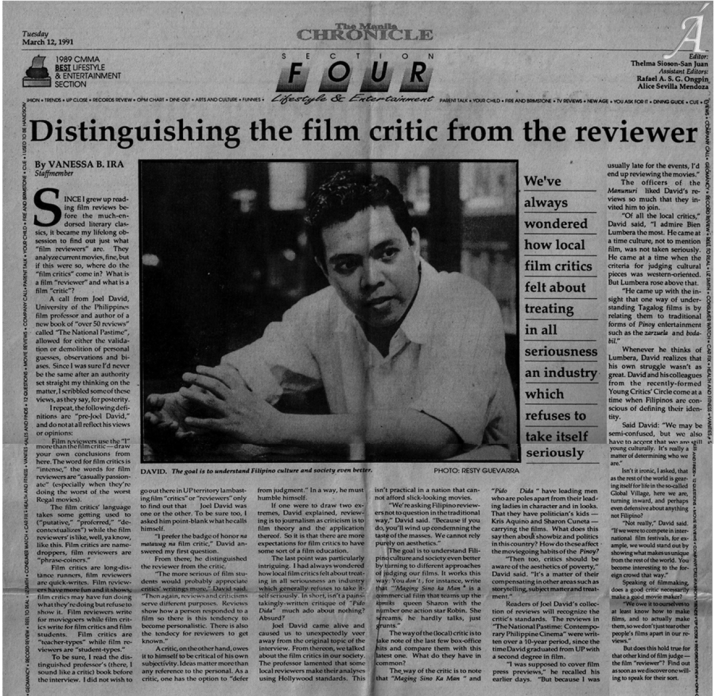
Cold Word Wars: Philippine Film as a Critical Activity

This is the full text of the Filipino Arts & Cinema International’s first Gawad Lingap Sining Lecture, held at the City College of San Francisco’s Diego Rivera Theater, famed for the muralist’s Pan American Unity, a fresco originally completed in 1940 for the Golden Gate International Exposition. The lecture was delivered on October 18, 2016, as part of that year’s FACINE Filipino International Cine Festival’s opening ceremony. To jump to later sections, please click here for: Critical Thinking; Self-Colonization; Differences; Effective Expression; and Notes.

diego-rivera-stage
(Photo courtesy of Daniel Park)

Many thanks to Filipino Arts & Cinema International, Philippine American Writers and Artists, and the Philippine Studies Department of the City College of San Francisco, plus an additional expression of gratitud y apreciación to the memory of the great Diego Rivera. I might as well provide a necessary personal disclosure in case you might wonder: Mauro Tumbocon Jr. and I have been acquaintances since the early 1980s, when I was working with the Experimental Cinema of the Philippines and he was with a pharmaceutical company, writing film reviews and articles on the side. We mirrored each other’s experiences as members of the Filipino Film Critics Circle, and when we found out we had similar misgivings about the group, we set out to found alternate critics’ groups. One of them, the Young Critics Circle, is still active to this day. We have had some differences, as all healthy friendships should have, but I think our similarities always somehow enable us to surmount them. Just don’t get us started talking about our goddess, Nora Aunor.

11011I had originally planned to look into what we may describe as trouble spots in the course of the development of film criticism in the Philippines, but as I understand, this venue, the City College of San Francisco, has both a film program and a Philippine Studies program. I also read up once more some of the basic texts, mostly on literary criticism by Terry Eagleton, but these seemed too distant and quaint today, except for a fairly recent text titled Outside Literature, by Tony Bennett[1] – the Australian professor, not the Italian-American crooner. In the end I decided to just confine my lecture to the less-obscure controversies that people in this setting might be able to recognize. Not to go too far off-tangent, but if you’ve been monitoring developments in the Philippines, you might have noticed that people there have been polarized since the election campaign period that started a year ago, and the situation has never eased up, and probably even worsened. There are two main voices: one, the newly empowered, or some might say re-empowered, people in the administration of Rodrigo Duterte; and another, the group of people identified with the previous administration of Benigno Aquino III, who see themselves as marginalized by the present government.

11011For me, the predicament is a simple one. If you object to certain or all of the current government’s policies, could you still be called a supporter of the Duterte administration? The way that the existing discourse has worked out, the answer is no. Either you’re pro-Duterte and accept everything he had set out to do, including discarding due process for drug suspects and restoring Ferdinand Marcos to a position of prestige, or you object to these two things, plus maybe Duterte’s propensity for cursing and appointing some less-than-stellar officials, and advocate for his impeachment so he can be replaced with a more “acceptable” option. Now I’ve witnessed the overthrow of two Philippine Presidents in the past, and the aftermath has never been lovely – sometimes it even gets worse in some ways than before. But I also cannot abide people getting killed just because of a problem that is really social and psychological in nature, and that has been solved in other countries only by radically turning its premise upside down and legalizing drug use. But try insisting loudly enough, say on Facebook or Twitter, that you want this and other government policies revised or discarded, but by the same government, not by a new one. I and similarly minded friends share the same stories of experiencing bullying of various degrees – from both sides, the pro-government and the anti-Duterte factions.

Back to top

Critical Thinking

Why am I bringing this up in a discussion of criticism? Because it is precisely the absence of critical thinking that leads to such a disastrous state of affairs, on a national and maybe even overseas scale at that. For people like us who’re familiar with the process, it seems entirely plausible that one can accept a leader but not certain of her or his policies. Yet this fairly simple turn of logic will be seen by many Filipinos, even those outside the country, as implausible and even nearly blasphemous. Philippine cultural training, as implemented by its educational institutions, is still reliant on the top-down dissemination of knowledge and the propagation of assumptions that are meant to be beyond questioning, or what we now call deconstruction.

11011So when you engage in the practice of criticism, you actually benefit yourself and your readers, if your goal is to keep growing as a practitioner. But you also have the potential of applying your skills to a wider cross-section of the body politic, evaluating issues of varying complexities, according to how the solutions can best benefit the widest and most needful sectors of society. Just close your eyes and imagine you’re watching a multidirectorial melodramatic saga by Lino Brocka, with multi-stranded plotlines from Ishmael Bernal, focused on the dispossessed as Brillante Mendoza does, and with an endless running time courtesy of Lav Diaz; that would be a great and scary and funny and tragic movie, and that would also be Philippine politics, or maybe even American politics, who knows.

11011We’re all aware that discussions of politics are always in danger of intensifying without ever being resolved, so let me pretend to be subtle and diplomatic, and switch gears without warning, hoping that no one notices. Regarding our topic, Philippine film criticism, the first thing that I think any entry-level person should be aware of appears to be something that many practitioners lack. They can’t be blamed for it because the issue remains shrouded in the mist of colonial history. But it would be indispensable if we were to devise a means of distinguishing the practice from its global counterparts. What I refer to here is the fact that film, in particular, was originally introduced during the late Spanish era, in the 1890s, by investors who wanted to turn a profit, as they still do today. But when the Spaniards were shortly thereafter replaced by the Americans, the fast-evolving media of photography, and later film, were deliberately deployed by colonial officials, led by Interior Secretary Dean Worcester, to rationalize the colonization project.

11011Worcester and the periodicals that reviewed his output, including the New York Times, participated in this acknowledgment of the righteousness of the US occupation of the Philippines.[2] This is of special historical import, because when you read up on state cultural policy for cinema, this detail is overlooked in favor of a later development, when Vladimir Lenin declared that film would be the means for the Soviet Union to propagandize for international socialism. Thus when we speak of critical commentary on turn-of-the-century Philippine-produced photographic and cinematographic products, we are really talking about a perspective with two characteristics that were typical for that situation: first, it assumes the supremacy of visual technology; and second, it considers the interest of the Philippine subjects, who provide the raw material for these products, as incidental at best and insignificant at worst.

11011I wish to emphasize that this situation, which I’d call sordid if you’ll allow me to be subjective, applied to both the production of film and the output of criticism. And from over a hundred years ago, I would like to abruptly bring us all to the present, where film had just ended its reign as the country’s primary means of entertainment, its “national pastime,” to use the title I provided for my first book. It was so successful that at one point, during the 1980s, Filipinos appeared in the Guinness Book of World Records as the most avid movie-goers in the world.[3] As an industry, the medium was always one of the first to bounce back during the several periods of wartime and peacetime upheavals, even after the IMF-World Bank Asian crisis of the late ’90s demolished most of the country’s medium- and small-scale industries. In fact Philippine cinema’s latest recovery is a testament to its people’s ability to make do with whatever resources are still accessible to native practitioners. Just as the Soviet filmmakers responding to Lenin’s call turned a shortage of film stock into the rapidly intercut juxtapositions that we identify with Soviet montage, so did Filipino filmmakers confront the prohibitive cost of celluloid production by simply junking it and making do with far more affordable video technology, initially setting up their own projectors in film theaters just to be able to screen their work.

Back to top

Self-Colonization

All this will sound like over-valorizing a trend that has somehow become standard by now, but at that time, I had just returned to the home country after completing my graduate studies in the US, and I can attest to the anxiety and humiliation felt by the digital-filmmaking pioneers, who thought that what they were making was not “authentically” film because it was not in celluloid. The celluloid-to-digital transition was completed in the Philippines before it was undertaken everywhere else, and succeeded so overwhelmingly that the industry was able to develop an industry-within-an-industry, a burgeoning independent-cinema scene, complete with its own series of competing festivals, auteurs and canons, and critical appreciators. The connection with the early years of US colonization becomes apparent when we look at an orientation that bothered a few mature critics and some young ones as well. Films were being finished for the explicit purpose of making a splash in overseas festivals, with a preference for those in Europe, and any record of rejection by the Filipino audience could be spun around into the claim that the artist, like the messianic biblical prophet, was without honor in her or his own country.

11011In that way, and at that moment, we managed to achieve American self-colonization, producing cultural artifacts that made use of the local audience’s real lives as raw material, but which were never intended for their own consumption and appreciation. The complicity of contemporary film commenters was troubling enough so that the then-chair of the original critics circle went on record to denounce them, preferring to call them film bloggers rather than critics, and demonized as well their propensity for scrounging for perks, in the form of free trips to foreign film competitions, as members of the jury (Tolentino 184).[4] I use the past tense in describing this state of affairs, because the situation has peaked, and with that peak, its possible closure has become discernible. This peak actually occurred in recent months, when Filipino entries in the so-called Big Three European film festivals won major prizes, including best film at one point. The Woman Who Left, the film by Lav Diaz that won the Venice Film Festival’s Golden Lion prize, starred the former President and CEO of the country’s biggest film and TV conglomerate.[5] Diaz inscribed his own career circle, since his early films were produced by what was then the Philippines’s most successful studio, Regal Films, before he sought fuller autonomy via the combination of independent financing and digital production that I mentioned earlier.

11011For me, the lesson here is an affirmation of what I had always believed in: that among all possible types of professionals, artists (including writers) have the capacity to change for the better, with the rest of society and the world waiting to testify, to act as witnesses. Critics, when they’re lucky, should be in the position to herald the good news, or to demand for it when necessary. As you can sense, I’ve made another supposedly subtle segue into the ethics of film criticism, and wasted the previous minutes on a necessary but too-lengthy introduction. Don’t do that unless you’ve been granted exclusive control over a microphone and a guarantee that no questions will be asked right afterward. But honestly, if anyone were to ask me right now what she or he needs to prepare to get into film criticism, I would first respond by answering: what for? Is there an urgent need for it, a life-and-death situation that has the potential to turn tragic if another option, another desire intervenes and replaces this first one?

11011Like all defensive responses, this one reflects on me, the questioner, rather than the one being questioned. I was probably lucky in starting out in criticism before formal film training became a possibility in the Philippines, and figured out all the other necessities along the way. I was naïve enough, and the field was new enough, so that I could take stock of existing samples and say, “I could certainly write better than many of these people.” I was determined to become conversant with film theory and history, on my own if necessary, and at the very least become known as a film critic who could outwrite anyone else within the limited and insular circle of local practitioners. When I was invited to join the formal critics’ organization while barely out of college, that indicated for me that I’d been taking the right steps. Yet almost as soon as I’d signed the proverbial membership card, I’d taken my first misstep: an inordinately harsh denunciation of a commercial exercise by Lino Brocka. Manila being the tiny capital city that believes itself to be larger than what it is, I inevitably bumped into Brocka within the same week the review came out, and made the acquaintance as well of several other practitioners, a couple of whom also happened to be concurrent members of the critics’ circle.

Back to top

Differences

I never really had a sudden falling-out with the group, only a gradual and incremental accumulation of differences, based primarily on the circle’s insistence on annual award-giving as its nearly exclusive means of self-validation.[6] For me, that would be like winning every possible essay-writing prize and saying that I deserve this elevated recognition right now, because of the external evidence of my literary ability. But rather than recount the many disappointments I had with the Filipino Film Critics Circle, I’d prefer to share with you the positive lessons I picked up along the way. First, the members’ practice of rewatching films in contention as many times as necessary until they’re able to arrive at a consensus, was something I’d already been doing, but it reaffirmed my personal realization that films deserved as much close and precise observation as we bestow unquestioningly on fine arts and literary products. I am currently in the process of completing a canon project, over half a decade in the making, and the same procedure of making sure that the canon team’s choices can withstand more than one screening has led to some unanticipated discoveries and reversals.

11011Second, the ability of colleagues who can productively engage in metacritical discussions, where we critique one another’s criticism, is a rarity even among fellow critics, but an invaluable treasure when it comes along. During the period of my membership, the most important sessions I had were not the ones where the group determined the fate and reputation of the community of artists it claimed to support, by selecting individual award winners and causing resentment and disappointment among the rest. Instead, it was the moments when Professor Bien Lumbera, then and now its most senior member, would discuss with me the process of writing critical commentary, and explain the nuances of tone, diction, insight, structure, and rhetoric. To be honest, I found more of this type of rapport after I left the group, when I made the acquaintance of Mau Tumbocon here as well as a few other critics, and expanded my network to include classmates in graduate school and students at the film institute of the national university. I may as well also qualify that, among people capable of collegial interactions, differences can sometimes transmute into serious disputes, aggravated by the various side issues that tend to be raised by aggrieved parties in both camps. But since critical activity is as much reactive to subsequent social, aesthetic, ideological, and technological developments, even as it seeks to influence these phenomena in return, we find ourselves hailing the people we once thought we had given up for good, just as I had tended to grow apart from some groups with whom I once thought I could share long-term visions.

11011Third, and perhaps most unexpected though thoroughly commonsensical when you ponder it over, is the humbling discovery that critical thinking is not the exclusive province of critics. The greatest artists throughout history, in all corners of the world, had made that discovery for themselves, and their special gift to critics is the difficult-yet-productive exercise we get when we undertake a study of their body of work. I was already aware that Ishmael Bernal, for example, was conducting an intensive and radical reworking of the medium of film for Philippine subject matter and audiences, before I even learned that he was also once a film critic. This ties in with my insistence on literary polish and innovation for critical practitioners. I cannot count how many times I had cringed when I read critics complaining about a film’s lack of elegance and creativity, in the kind of writing that would be the very exemplification of the disappointments that their authors wanted to point out.

11011The last matter I wish to raise about criticism is the one that causes a crucial but often unnoticed division among practitioners themselves. I first got an inkling of it after I published my second book, essentially a more specialized anthology of my reviews supplemented by a basic but extensive critical study and a few canon-forming attempts. I was worried that reviewers might complain about how obsolete the issues it was raising were, since my intention was to demonstrate that those critical exercises first needed to be done right before they could be abandoned in favor of more current approaches. Instead, the most extensive local-daily reaction dwelled on the fact that some of the words I used went beyond journalistic-level samples. When I speculated what the reviewer must have thought about film writing, I concluded that he actually had a laudatory assumption: that discussions on film don’t have to be complicated, because film is accessible to a lot of people to begin with.

Back to top

Effective Expression

Yet I could not bring myself to accept this premise. To me, the fact that people respond enthusiastically to a phenomenon should never be seen as a weakness to pamper, but rather as an opportunity to elevate discourse. Of course we find extreme examples where the enthusiasm for theoretical engagement turns into a refusal to be comprehensible. Once more, the person who has trained in effective expression, where ideas that are drawn from credible and knowledgeable sources, can be re-worded for the sake of the lay reader, would have an edge here. The ideal for the critic would be the generation of relevant, complex, and progressive ideas in the simplest language that said ideas could embody without betraying or compromising their content. The tension in this formulation derives from a false opposition between the scholarly writer and the journalist, or what I once innocently echoed as the critic and the reviewer. To me, these distinctions matter less today; I wouldn’t agree with the late John Simon that reviewing is just bad criticism,[7] but rather that everything, not just reviewing but even film reporting, can be criticism. The contemporary film critic would, or should, actually function as both: as someone who keeps abreast of new writings in cinema and media studies, who also seeks to popularize these ideas when they pertain to certain recent film releases or trends.

11011There are two points I could never over-emphasize in this regard. One is that the use of theory in writing reviews may or may not be foregrounded, but it should be capable of providing a framework for the critic’s take on the film or films being discussed. Another is that this framework is not the usual operationalizing of correctly understood concepts that we learn to do in school. Theory, as our fellow YCC founder Patrick D. Flores put it, is a matter that should be engaged, not applied (193).[8] This means that while the critic may explain her harsh or dismissive take on a film by referring to the underlying principles of a theory, the critic should also ensure that she had managed to evaluate the theory in terms of its appositeness, relevance, explanatory potential, progressiveness, and other questions essential to what we may call theory appreciation. Too often, we come across readings of non-Western cultural samples where the critic has regurgitated recent theory and wound up displaying her grasp of sometimes new ideas at the expense of prejudging the native product.

11011I would like to end by saying that while I may have accumulated this collection of insights on what an effective film critic would be like, I would be lying to you if I denied that I sometimes fall short of one or more of the ideals that I recounted in the course of this lecture. I also look forward to learning a few more tricks along the way, if I can still have the good fortune of discovering them. The biggest misgiving I had with this recognition is that from hereon, there would be less room for me to commit mistakes, the source of some of my most-enduring lessons. But then I could also have a better platform by which I could tell the current and forthcoming generations of Filipino film critics to prepare as best as they could, and once they have taken stock of their preparation, to take a step or two further into what they think is unexplored, probably even questionable, territory. Be well-conditioned, but don’t forget to take risks. People will give you a once-over because you’re dealing with a medium that’s close to their hearts. Make sure you’re ready to give in return more than what they expect, not only because they might appreciate the effort, but because you owe yourself a useful lesson each time you send out your contribution to our now-growing stock of cultural discourse.

11011Thank you for paying attention. I wish you all the best experience before, during, and after watching movies.

Back to top

Notes

The author acknowledges the assistance provided by the Inha University Faculty Research Grant. Many thanks to Ha Ju-Yong, Lee Sang Hun, Park Shin-gu, Park Haeseok, Son Boemshik, Park Jinwoo, Yu Taeyun, Jek Josue David, Mauro Feria Tumbocon Jr., Alexei Masterov, Nora & Pete Luayon, Ohny Luayon, Ann-Marie Alma Luayon-Tecson, Lewis Tecson, Marita Jurado, and Carlo Jurado.

[1] Tony Bennett, Outside Literature (London: Routledge, 1990). Other texts consulted include The World, the Text, and the Critic (Cambridge, Mass.: Harvard University Press, 1983) by Edward Said; and The Function of Criticism: From the Spectator to Post-Structuralism (London: Verso, 1984), Marxism and Literary Criticism (London: Routledge, 1976), The Significance of Theory (Oxford: Basil Blackwell, 1990), and Walter Benjamin, or Towards a Revolutionary Criticism (London: Verso, 1981) – all by Terry Eagleton.

[2] See Mark Rice, Dean Worcester’s Fantasy Islands: Photography, Film, and the Colonial Philippines (Ann Arbor: University of Michigan Press, 2014), 118-55. Also see “Calls Wild Men Our Wards,” New York Times (December 31, 1913): 7, qtd. in Rice.

[3] Guinness Book of World Records (Samford, Conn.: Guinness Media, 1983).

[4] Rolando B. Tolentino, “Hinahanap, Kaya Nawawala” [Searched For, Therefore Missing], 182-84; in Patrick F. Campos (ed.), “A Round Table Discussion on Poetics and Practice of Film Criticism,” Plaridel: A Philippine Journal of Communication, Media, and Society 13.1 (2016): 149-217.

[5] Lav Diaz (dir. & scr.), Ang Babaeng Humayo [The Woman Who Left], perf. Charo Santos-Concio, John Lloyd Cruz, Michael de Mesa, Nonie Buencamino, Shamaine Buencamino, Mae Paner (prod. Sine Olivia Pilipinas & Cinema One Originals, 2016).

[6] See Joel David, “My Big Fat Critic Status,” Ámauteurish! Extras (1985), posted online.

[7] John Simon, “A Critical Credo,” Private Screenings: Views of the Cinema of the Sixties (New York: Macmillan, 1967): 1-16.

[8] Patrick F. Campos (ed.), “A Round Table Discussion on Poetics and Practice of Film Criticism,” Plaridel: A Philippine Journal of Communication, Media, and Society 13.1 (2016): 148-84.

Back to top


Searched For, But Not Missing

Ang Nawawala [What Isn’t There]
Directed by Marie Jamora
Written by Marie Jamora and Ramon de Veyra

After over a decade of existence, the Cinemalaya Philippine Independent Film Festival has garnered its share of controversies, many of them centered on differences between officials and practitioners, often proving beneficial to both sides because of the publicity that inevitably attends such spectacles. Lost in the shuffle would be an increasing number of titles that deserve as much (if not more) attention, but that get shunted aside because of jurors’ preferences and the festival audience’s tendency to take their cue from media mileage. Among the titles I had the good fortune to stumble across, I remember Arah Jell Badayos and Margaret Guzman’s Mudraks [Mom] (2006) and Vic Acedillo’s Ang Nerseri [The Nursery] (2009), well-observed modest films whose central performances by established actresses (Rio Locsin and Jaclyn Jose respectively) apparently could not lift them out of the cycle that regularly smothers the entries that do not generate their own hype. Ellen Ongkeko-Marfil’s Boses [Voices] (2008) was a special case – an entry locked out by the jury but that proved so popular among audiences that it became, via a series of still-continuing special screenings, the festival’s highest income-generating production.

11011Marie Jamora’s Ang Nawawala (2012) possesses its own special package of scandal. It was denounced during the festival period by organized critics from academe (overlapping categories, in the case of the University of the Philippines College of Mass Communication and the Manunuri ng Pelikulang Pilipino or Filipino Film Critics Circle). Rolando Tolentino, the then-concurrent UPCMC dean and MPP chair, published a review in Filipino whose title described the film as “Burgis na Juvenalia” or bourgeois juvenalia (see screen capture) – a serendipitous error when we realize that juvenalia is not the same as juvenility (the reviewer’s likely intended word), but rather that it refers to the celebration of Juvenal, the Roman poet and satirist. Moreover, in a separate article (excerpted in my entry, Fallout over “A Lover’s Polemic”), Tolentino recounted the dissenters to his review by way of downgrading “film bloggers” as presumably inferior to critics like him and his fellow MPP members.

Burgis na Juvenalia

Back to top

11011While I take care to avoid responding to specific reviews, and regard Ámauteurish! as primarily an archival blogsite, my recent viewing of Ang Nawawala convinced me to make an exception to my personal policy of watching a film at least twice, with at least one theatrical screening, in order to provide some (admittedly limited) critical intervention. Tolentino’s review mistakenly opens by stating that the film has “Walang self-reflexive [sic] gesture o take sa pagiging mayaman at pribilehiyado [no reflexive gesture or take on being rich and privileged].” One would wonder what movie the reviewer managed to watch, when the entire narrative of Ang Nawawala, anchored on a main character who refuses to speak, turns on reflexivity at every opportunity. The reviewer worries that he might be mistaken for “minamaliit ang ganitong uri [demeaning the members of the (wealthy) class]” – quite disingenuous considering the circumstances of the MPP members’ pelf and power; and begins his conclusion by saying that “May ipinapanganak na problematiko ang ganitong pagtahak ng buhay ng maykaya, lalo pa bilang binary oposisyon sa pangkalahatang tema ng indie cinema, ang abang uri [this treatment of the life of the wealthy gives rise to a problematic, especially in the form of a binary opposition with the general theme of indie cinema, which is the poor class].”

11011Not surprisingly, Tolentino disapproves of the warm Cinemalaya audience reception to Jamora’s film, since he insists on his preconceived notion that “indie cinema” should preoccupy itself with the poor, and imposes this bias in literal terms – i.e., once a filmmaker turns her attention to the higher-than-poor classes, then she has wound up betraying his cherished Cinemalaya ideal. The implication of Tolentino’s premise is astounding in its vulgarity, not only because of its (vulgar-)Marxist origin, but also because it winds up dismissing the vast bulk of global art and literature, if we were to regard only material about “the poor class” (let alone the question of whether these were produced by the same class) as worthy of serious consideration.

11011Fortunately, Ang Nawawala stands a good chance of outliving such prescriptive guilt-by-association. It invokes the haunting of history by allowing a specter from the main character’s past, in the form of his long-dead twin brother, to engage him in debate regarding his recent actuations, including his decision to remain mute to everybody else; the living brother finally manages to score his own point by telling the ghost (or memory) that if he had been alive, he might have turned out gay – a rather weak riposte, considering how queerness has no longer become the devastating insult it had once been. By this means the brothers maintain a comic-melancholy balance between affection and regret, complicated by their awareness that their mother would have preferred the dead brother to survive.

11011The fact that the brothers are played by real-life twins adds resonance to the performances, with Jamora providing Dominic Roco (as the survivor) with a distinctive opportunity to play out his man-boy vibe, reminiscent of (and for me, preferable to) the persona that Aga Muhlach once purveyed. Their mother, who wreaks inadvertent cruelty in her performance of heartbreak, is essayed with a surprisingly fragile expertise by Dawn Zulueta; her resolution, one of several in the film, brings the proceedings to a head and rewards the curious viewer with an emotional satisfaction rare in familial depictions in indie cinema.

11011The aforementioned series of resolutions would be regarded in proper narrative classes as a weakness, but then each succeeding one manages to build up on what had preceded it, and Jamora would not be the first potentially major filmmaker who didn’t know, or maybe didn’t care, how to effectively end a genuinely fruitful journey. In fact one of the biggest lessons that could be drawn from the work of possibly the best local director, Ishmael Bernal, lies precisely in this direction: that once you have taken your audience on a trip that they never had before, you may be excused for worrying less about how the trip should end. (When I accidentally found out that Jamora had been mentored by Marilou Diaz-Abaya, a lot of her aesthetic choices suddenly invoked an unbearable nostalgia, as well as a solid logic: Diaz-Abaya herself had been mentored by Bernal.)

11011Ang Nawawala should have been recognized as the best debut film by a Pinay filmmaker (with the best pop-music soundtrack of all time as bonus), possibly exceeding even Laurice Guillen’s Kasal? [Wedding?] (1980), and it doesn’t detract from its achievement when we acknowledge that Hannah Espia’s even more impressive Transit arrived the year after, in 2013, along with Sigrid Andrea Bernardo’s Ang Huling Cha-Cha ni Anita [Anita’s Last Cha-Cha]. With the only successful contemporary film studio, Star Cinema, already dominated by women directors, we may just be witnessing the indie scene starting to mimic one of the mainstream trends worth emulating.

Back to top

Á!


Fallout over “A Lover’s Polemic”

After “A Lover’s Polemic” came out in The Manila Review (August 2013, pp. 6-8), the University of the Philippines College of Mass Communication invited me to participate in a rather awkwardly titled “A Round Table [sic] Discussion on Poetics and Practice of Film Criticism.” Without anyone informing me outright, I knew that the event was motivated by the impulse of the members of the Manunuri ng Pelikulang Pilipino (Filipino Film Critics Circle) to engage me in public, possibly to defend its practice. In the article I wrote, I acknowledged some positive contributions of the MPP, but I also maintained that several current problems in local film criticism could be traced to its shortcomings. The college dean at the time, Rolando B. Tolentino, also happened to be the MPP chair, and of the final list of participants, three out of seven (including Tolentino) were members of the circle. All the participants except one were faculty at the CMC, and three of them were members of the Young Critics Circle. Inasmuch as I was a former member and corporate secretary of the MPP, a founding member of YCC, and founding Director of the CMC’s Film Institute, it made sense for me to participate in the roundtable even if I knew, from past experience, that the MPP could recognize its weaknesses and resolve to confront them – but would continue anyway with its more lucrative counter-critical practice of award-giving. Unfortunately the roundtable was scheduled on March 19, 2014, when I had to be back at work in Korea.

11011The contributions were published in the vol. 13, no. 1 (2016) issue of Plaridel: A Philippine Journal of Communication, Media, and Society, where I happen to be a member of the International Advisory Board, and where Tolentino is Editor-in-Chief. As expected, the pieces written by MPP members displayed varying degrees of pique, starting with none: my former adviser and criticism mentor Bienvenido Lumbera provided a short and charming autobiographical account (“Kung Paano Ako Nakapasok sa Film Criticism” [How I Started in Film Criticism] 162-63) of how his interest in literature eventually extended to film. Former CMC dean Nicanor G. Tiongson (in “Critiquing the Filipino Film Today: Notes for the Round-Table Discussion on Film Criticism” 171-78) made attempts at reviewing a number of recent releases using the MPP’s antiquated criteria and then, apropos of nothing, claimed that one of the “qualifications that are necessary to be able to analyze and evaluate films well” included “a healthy respect for other critics in order to encourage dialogue; and above all, an attitude of balance and fairness, which is free of all personal agenda and self-promotion” (177-78) – strange words, considering their source.

11011The meanest attacks were rendered, surprisingly enough, by Tolentino, who had requested letters of support from me for his deanship candidacy. Titled “Hinahanap, Kaya Nawawala” [Searched For, Therefore Missing] (178-84), the rambling presentation revisited the quarrels Tolentino had with what he called “film bloggers (a.k.a. critics)” over Marie Jamora’s Ang Nawawala [What Isn’t There] (2012). Tolentino’s text is in Filipino, so I have provided excerpts below of relevant passages, with italicized translations in English. (Many thanks to Jek Josue David for correcting the translations.)

Back to top

…nanghihimok na ang dalubhasa na lamang ng disiplina ang may natatanging papel, katungkulan, at kaalaman para sa pagpapaunlad ng disiplinang araling pelikula (178).

[Like any other area, that of film studies] ensures that only experts in the field would have the right, duty, and knowledge in developing the discipline….

Pero hindi nangyari ito, o hindi pa nangyayari ito. Sumpa ng midya ng pelikula na ang lahat ng nakapanood ay may awtoridad na makapagbigay ng kaniyang kuro-kuro sa pinanood na palabas, na ang publiko ay awtoridad – bilang konsumeristang nagbabayad – sa kaniyang karanasan bilang manonood. At walang ipinagkaiba ito sa teritoryalisasyon ng mga kritiko sa iba’t ibang disiplina sa humanidades at agham panlipunan na tumahak din ng landas tungo sa pagpapalawig ng pelikula hindi sa isang disiplinang pampelikula na panuntunan kundi sa kanilang disiplina’t espesyalisasyon (178-79).

But it didn’t happen, or hasn’t happened yet. The curse of the film medium is that every viewer has the authority to convey her opinion on what she has seen, that the public has expertise – as paying consumers – in their experiences as viewers. This is no different from the territorialization of critics in various disciplines of humanities and social sciences in expanding film’s potential not within its own discipline but rather in their own fields of discipline and specialization.

Tila isinasaad, dahil popular ang midya ng pelikula, kailangan ay popular din ang paraan ng paglalahad ng teksto at konteksto nito: diyaryo, magazin, libro, at ang kasalukuyang pamamayagpag ng diskurso ng pelikula sa internet (179).

What’s asserted [is that], because the medium of film is popular, then the means of explicating its texts and contexts should also be popular: newspapers, magazines, books, and the current supremacy of film discourse on the internet.

Ang isang sumunod na sumpa sa kritisismong pelikula ay ang Internet, at ang pagsulpot ng pigura ng film blogger…. Mas mabilis silang magsulat, at may kalakaran sila ng pagsulat na may apela sa mga 35 porsiyento ng mamamayang may akses sa internet – kalakhan, kabataan, at gitnang uri. At kung nagsusulat sila sa Ingles, nababasa sila ng mundo ng mga art film festival, at naiimbitahan sa press junket at film junket, kundi man, maging jury pa sa mga ito. Ang kalakaran ng pagsulat ay may gaan at maraming patutsada na wala naman sa mismong pelikula pero nasa konteksto ng gitnang uri’t virtual public na intelektuwal na nagsusulat, at ng karanasan nito ng panonood at pagsusulat, kundi man ng kaniyang gitnang uring buhay (179).

A later curse on film criticism is the Internet, and the emergence of the figure [sic] of film bloggers…. They write faster, and their writings appeal to the 35 percent of the population who have access to the internet – majority [or mainstream, since “kalakhan” means greater majority], youth, and middle class. When written in English, they are read by the art-film festival communities and get invitations to press and film junkets, and even get appointed as jury members in these events. Their writing is airy and has several innuendos not present in the film itself but in relation to how they see and write about the film as middle-class, virtual public intellectuals, if not in the context of their middle-class life experiences.

At ito namang peg ng mga film blogger (a.k.a. critics) ang siya ring pumapaimbalot sa isa pang quasi-, kundi man, pseudo-intelektuwal na publikasyon sa internet, The Manila Review, na ang apuhap din – batay sa “wafazan” ng mga interesadong indibidwal sa Facebook – ay tungo sa kontrobersiya’t espektakulo ng mga “intelektuwal” na lumelevel sa putikan at burak kapag umeestima ng puna at kritisismo (180).

And the standard of these film bloggers (a.k.a. critics) is also what suffuses another quasi-, if not, pseudo-intellectual publication on the internet, The Manila Review, that attempts to aspire – based on the “wafazan” of interested individuals on Facebook – toward controversy and the spectacle of “intellectuals” who thrive on mud and filth when evaluating attack and criticism.

In the interest of following through on Tolentino’s attacks on Ang Nawawala and “film bloggers,” I viewed Jamora’s film and made an exception to Ámauteurish!’s policy of functioning strictly as an archival website, by blogging my own review of the film. It may also be worth noting that Tolentino’s negative review of the film was posted on his own blog.

Á!

Back to top


An Intro to “A Brief on Sa mga Kuko ng Liwanag

This is to introduce the essay discussed in my article “Thinking Straight: Queer Imaging in Lino Brocka’s Maynila (1975),” which came out in the August 2012 issue (volume 9, number 2) of Plaridel: A Philippine Journal of Communication, Media, and Society. Written by the late Ave Perez Jacob, the essay, titled “A Brief on Sa mga Kuko ng Liwanag (or Why Maynila Should Ever Be Masculine),” was published in the December 1975 issue (volume 48, number 1) of The Literary Apprentice, the official publication of the University of the Philippines Writers Club. It appears with the permission of the issue’s editorial board, comprising Professor Delfin L. Tolentino, Jr. and Messrs. Herminio S. Beltran, Jr. and P.T. Martin. Many thanks to Theo Pie for sourcing the essay, and to Vince Cuizon for photographing the pages.

Á!


Doy del Mundo on a Controversy over Maynila: Sa mga Kuko ng Liwanag

This is the source interview for an article I wrote, titled “Thinking Straight: Queer Imaging in Lino Brocka’s Maynila (1975),” published in the August 2012 issue (volume 9, issue 2) of Plaridel: A Philippine Journal of Communication, Media, and Society. The respondent, Clodualdo del Mundo, Jr., was a founding member of the Filipino film critics circle and a retired professor of communication at De La Salle University. He is known as the scriptwriter for the majority of Mike de Leon films, but he first made his mark with the screenplay of Lino Brocka’s Maynila: Sa mga Kuko ng Liwanag [Manila: In the Claws of Darkness]. The interview was conducted via email in mid-2012, as a way of seeking out supplementary information for the article.

I drafted a paper for a special issue on queer media. I mentioned special early cases of controversies on queer politics in Philippine cinema. In looking at the case of Maynila, I remembered an article that came out in The Literary Apprentice, the journal of the University of the Philippines Writers Club. I re-read it once more and I was surprised at how offensive it sounded this time, in spite of its best intentions. Do you mind if I ask you a few questions regarding the film adaptation of [Edgardo Reyes’s novel] Sa mga Kuko ng Liwanag (1967)? I hope you could provide some insights and/or correct any misimpressions I might have.

11011I saw the original run of Maynila (in July 1975), but ever since then, from its reissue after sweeping the Filipino Academy of Movie Arts and Sciences awards to all subsequent rescreenings and video transfers, it’s been missing several sequences. That’s why when the article mentioned that 1/4 of the movie consisted of the gay-hustler underworld, it becomes accurate only when the point of reference is the original cut. Does this first version still exist anywhere or was there a conscious and/or official decision to trim the film? If it’s the second case, then would you know if the missing footage is lost for good?

The first version was re-edited by [Maynila’s producer and cinematographer] Mike de Leon for foreign exhibition (e.g. film festivals). I don’t think Lino was consulted about it. I did support Mike in doing the re-editing. Basically, the gay segment was shortened – it was unnecessarily long. I doubt if the first version exists anymore.

One recent academic paper claimed that Edgardo Reyes sued Lino for changes done to the narrative (presumably including the detour of Julio Madiaga into Bobby’s profession). It seemed, even from the still-existing scenes, that the dialogue-writing differed from the rest of the film. How improvisatory were these scenes – i.e., were you required/requested to provide scenes or lines or an entire narrative arc?

When Lino made the suggestion to add the excursion into the gay underworld, I asked him and Mike to clear it with Edgardo Reyes. I doubt if they did. Anyway, Lino and I talked about his ideas. Finally, I scripted it myself. The dialogue would naturally differ from the rest of the film. The character of Bobby belongs to a different group. The dialogue separates him from the world of the construction workers.

Back to top

The article I mentioned proceeded from a homophobic framework – that the novel, like its protagonist, was masculine, and the film adaptation “emasculated” it. (Strangely, the way the author expressed it sounded extremely homoerotic – a deep affection for Julio, representing Tondo, representing Manila, representing the country, in unconscious synecdochical distensions.) He identified Lino and you as responsible for the changes he regarded as unworthy of the source material. Yet the depiction of the gay underworld was similarly and ironically homophobic. I don’t remember this kind of discussion being conducted in mainstream media, but were these issues being raised in venues outside of a university journal? For example, in tabloids or in seminars? Or was this the only instance where the gender “shortcomings” of the movie were brought up?

I think the “homophobic” readings did not happen at the time. I could be wrong, though. The main concern, then, was how faithful was the film to the original source.

Lino’s interview with Hammy Sotto (published in the Cultural Center of the Philippines’ commemorative volume) seemed to assume that the original, extended version (ending with a beach scene where Bobby attempts to seduce Julio and the latter walks out on him in disgust) was still in existence. Interestingly, Lino explains that the purpose of providing the Julio-as-hustler scenes was to make the character as “fallen” (my interpretation) as Ligaya. The author of the article found this offensive, saying in effect that it’s unfair to “reward” Julio with a quickie in a cheap hotel room, a scene which he described as hackneyed, preceded as it was by a viewing of a Holy Week Christ’s-passion movie. Was this departure from the novel in the original draft of the script? How involved was Lino in revising the material?

The Julio-Ligaya sequence is in the original screenplay. Lino changed the location, though. In the screenplay, after the chance meeting in Santa Cruz Church, Julio and Ligaya move to a moviehouse (the movie was the production designer’s touch – based on what was available at the time). Then, they move to a restaurant. Lino changed the location to a motel room. It’s a credible change and it adds a dimension to the characters of Julio and Ligaya. My reading was more romantic – Ligaya’s storytelling was more subdued, controlled, perhaps more subtle. Lino had a different idea. Ligaya’s unfolding was more emotional, more direct (forget subtlety at this point of the film). I respect Lino’s change of location and consequent interpretation.

11011Lino wanted to create a metaphor for a different level of exploitation. Julio is exploited not only economically, he is exploited physically and spiritually. Your “fallen” interpretation is an interesting one. I agreed with Lino – he was the more experienced among us and had a better understanding of his audience. The film would have not been done if Lino did not have his way. My best alternative was to be involved in writing the script.

Portions of the article ridicule you for not being prepared (in the sense that you weren’t a Tondo native, among other things). I wanted to formulate questions around these but I found these assumptions too objectionable to even dignify. I had a few occasions interacting with a certain group of writers to which the author might have belonged – they generally taught university courses, wrote criticism and fiction (including poetry), and were insufferably masculinist and unapologetically homophobic as a consequence. I just concluded that their indulgence in the less-“masculine” professions of teaching and writing induced this kind of neurosis – essentially confirming the typical psychoanalytic finding that phobes are projecting on others certain qualities that they fear in themselves. No questions coming up about this, I’m just sharing my own annoyance with that type of mentality, thankfully no longer in mainstream vogue from what can be observed in the younger generations.

Yeah, I remember the author’s critique that I was not familiar with the setting of the novel so much so that I had to “visit” the places like a tourist. I visited the places to help me visualize the scenes. The novel appealed to me for its cinematic qualities and significance. I regretted (then) that the author and company did not appreciate a middle-class screenwriter tackling a proletarian novel.

11011In one school tour that we did during the showing of Maynila, I remember the same critique being asked. I just said that I was glad that I did not have to collaborate with the reigning administration in doing my work (the author of the article was working in a Marcos agency at the time).

Back to top

Á!


Grains & Flickers

Article (with updates and corrections – see endnotes) that appeared in the “Revolution across Generations” section of Remembering/Rethinking EDSA (ed. JPaul S. Manzanilla and Caroline S. Hau, Mandaluyong City: Anvil, 2016), pp. 172-87. The book itself won the Best Anthology prize of the National Book Awards from the Manila Critics Circle, administered by the National Book Development Board. Kindly purchase your full copy via Amazon or the Anvil Publishing website. To jump to later sections, please click here for:

Personal as Political;
Cultural Politics;
Daughter Rising;
ECP in Focus: Alternative Screenings;
ECP in Focus: Archives;
ECP in Focus: Education;
ECP in Focus: Funding;
ECP in Focus: International Film Festival;
ECP in Focus: Production;
ECP in Focus: Ratings for Tax Rebates;
ECP in Focus: Support Activities;
Way of All Flesh; and
Sources, Dedication, & Notes.

Remembering - Rethinking EDSA

No sane academic would argue against the prevailing consensus that the Marcos dictatorship, as a socio-economic experiment, had proved unsuccessful, if not downright catastrophic. The irony is that among other major Asian countries, the Philippines had been alone in effectively suffering for nothing. All the other ASEAN members, more or less following the example of Korea, emerged as fast-developing economies during or immediately after their authoritarian ordeals. Koreans, in fact, have proved so grateful for the legacy of Park Chung-hee, Ferdinand Marcos’s counterpart, that they enabled his daughter to become the first female President in their own still mostly patriarchal system. Lee Kuan Yew, for his part, has remained influential decades after the restoration of democracy to Singapore, and has taken upon himself the task of criticizing the Philippines for its refusal to return to an authoritarian arrangement as a developmental strategy.

11011Over a quarter-century since the ouster of the Marcoses, the present has brought what many commentators worryingly describe as a mellowing of the Filipinos’ perception of the havoc the couple had wreaked on the country. Per this logic, Pinoys supposedly have short memories, or are inherently masochistic or manipulable, or are simply incapable of determining what would be best or worst for them. The same critics would also be the first to acknowledge that most presidencies since that of Ferdinand Marcos have ranged from unexceptional to awful, and therefore these observers unknowingly trip over themselves in the pro-people march they believe they are in step with: if we hold, for our people’s sake, that most post-Marcos Pinoy presidents have similarly betrayed the people’s trust, would it not be possible to accept that the people are just as capable of perceiving this and exercising their judgment by way of voting back to power the same entities that they had earlier spurned, in effect telling the succeeding oligarchs that the latter are no better, if not outright worse, than the Marcoses?

11011I certainly would be horrified at the prospect of Imelda Marcos or her son being installed as Chief Executive – yet she was precisely the person I voted for, during the only time she ran as President (and the last time I exercised my right to vote). She certainly had a snowball in hell’s chance of winning, but since the satirically motivated University of the Philippines professors’ attempt to nominate perennial nuisance candidate Pascual Racuyal had fizzled during the snap elections that ousted her husband, I figured that no other nuisance would be as flamboyant and annoying as our own Iron Butterfly; and if no one else ever voted for her, then my own ballot would serve, however quixotically, as a voice in the wilderness, heralding not the arrival of any savior, but the impossibility (since confirmed, to my mind) of finding one.

11011My own mellowness toward the martial-law years has evolved differently. When I ultimately felt myself caught up in the wave of diasporic Pinoy labor, I thought this was the very worst long-term economic legacy bequeathed by the Marcos presidency. What had been intended as a stop-gap measure (the same way it was deployed in Korea – where, aptly enough, my OFW-ness eventually led me) had become the Philippines’ primary source of income and growth. Then I started seeing first-hand how overseas employers were being won over by whatever specific package of social skills and work ethic that Filipinos had grown up with, and I found myself grateful that the home country remained a nicer place to return to than if it had been ravaged by the type of industrialization that would have boosted standard-issue national development. That plus our taken-for-granted near-total press freedom would ensure for us (assuming our luck holds out) that, however belatedly we embark on the path of growth, we would never be subject to the machinations that require sufficient obfuscation in order for dictatorships, transnational interests, foreign-based religions, and other self-interested parties to implement their agenda.

Back to top

Personal as Political

The manner in which I arrived at this latter-day position vis-à-vis the Marcos dictatorship was foreshadowed by the lessons I drew from my direct interaction with the period. As a high-school and subsequently a college student at the University of the Philippines, I had early on admired and later emulated the senior students who were committed to the activist cause of criticizing and mobilizing against the Marcos presidency, later the martial-law regime. Momentous events such as the First Quarter Storm and the Diliman Commune filtered down to my level of awareness not via my disapproving though sympathetic parents, but through my firebrand uncle, a scholar at the elite Ateneo de Manila University, for whom they were acting as guardians. I’d had enough of an early association with activist organizations so that when martial law was declared, my mother woke me up to inform me that she had buried my Little Red Book and other paraphernalia in the backyard, and wanted to ensure that I had no other seditious materials tucked away elsewhere.

11011An intense dalliance with evangelical conversion and missionary preparation made me feel then that I had wasted my early college years, but my return to activism provided me with the readiness to recognize that full orthodox-Marxist commitment entailed a similar suspension of critical and humane judgment, a reliance on faith – in leaders, in organizations, in Machiavellian methods, in a promised form of government, and in an unchanging conception of progressivity. When I realized that such a volatile combination of ideals could result in unwelcome tragedy (described by an elderly colleague as “necessary sacrifices” toward the attainment of revolutionary triumph), I determined that I would never be able to abide such a cost. A bus full of solicitous and comradely soldiers, on a provincial trip I took, drove the point home even more urgently: I would not want these people coming to harm, and I would be unable to refuse mourning them as intensely as I had mourned the death-in-action of an activist acquaintance of mine. The people being served, the working class being upheld, would include the soldier, the jailer, the policeman, the executioner, even if they had been tasked to carry out the basest interests of the state. How that principle can be realized I had no clue about – my introduction to Michel Foucault’s ideas would arrive later – although I had to contend with the fact that the institutional Left as I knew it would never stand for it, just as organized religion would never allow for the possibility of an otherwise undeniably godless universe.

11011The requisites of everyday survival bore down on me almost immediately afterward, circa the late 1970s. Armed with a bachelor’s degree and an extensive record in what is still known as committed journalism, I found that the only doors that I could open were those of publications willing to accept freelance contributions for little better than a hundred pesos or so each. To play safe, I avoided the political and economic analyses that I had focused on as a student journalist, and turned to cultural reportage. Eventually one of these periodicals, a monthly magazine, hired me, but the media grind of observing deadlines, negotiating with data sources, jockeying with editors, and jostling with fellow writers took its toll. In two years I resigned and was again in search of employment, and the only media-related institution actively seeking interested applicants happened to be the newly launched Marcos film institution, the Experimental Cinema of the Philippines.

11011The phenomenon of anti-Marcos individuals eventually working for a government institution was such a distinctive commonplace that most activists then were convinced that, if they succeeded as underground figures and survived the dangers of incarceration, they would eventually be “rehabilitated” in one of the several government think-tanks of the period, starting with the University of the Philippines-based Presidential Center for Advanced Studies, and might even be deployed to one of the more people-oriented agencies such as the the one for housing (where my uncle, among others, wound up); they could attempt to maintain their integrity by teaching at the national university instead – which again was in fact still just one more government entity. If not then to death or arrest in armed struggle, or to opting out and climbing the corporate ladder or migrating abroad or living off an inheritance or wealthy spouse, all remaining anti-government roads led to the same profoundly ironic destination: government service.

ecp-id

Back to top

Cultural Politics

I was most fully aware of the paradox I had allowed myself to stumble into, despite the fact that I never reached the point of being arrested and forced to join government, when I was scheduled to be interviewed for my security clearance. I had just by then met the late Maita Gomez, a former socialite and beauty queen who had joined the Philippine underground and who years later agreed to undergo interrogation as part of the condition for her resurfacing. I would probably never be able to mimic the authority and confidence with which she responded, but I certainly could make use of the sharp logic she used. So when the same question, “Can you identify some of the people you associated with?” came up, I paraphrased her answer as best as I could: “Everyone, including me – we all used aliases that we regularly changed for our mutual protection. If I recall any of those names right now, they would no longer be the same as they were when I knew them.” Although Maita said that that answer had sufficed in her case, I was still surprised when my own interviewers nodded right afterward and signed my clearance forthwith. For an institution being run by the Marcoses’ eldest child! (By the time an acquaintance told me he believed I had sold him and his friends out, I was capable of formulating my own useful reply: “The fact that you’re still around [and unstoppable in your idiocy, I wanted to add] is proof that you weren’t that important to me or anybody else.”)

11011Right upon reporting for work, I was introduced to the major fissure that would define how we would function and why the institution (from the perspective of outsiders) would take such weird directions. The institution was the Experimental Cinema of the Philippines, formally defined as an umbrella organization that would function as a support agency for the local film industry. The activity we were preparing for was the Manila International Film Festival, which the ECP would support but would refuse to be affiliated with. The personnel of the ECP’s public relations department, where I was head writer, were on detail from the National Media Production Center, just as a few other personnel were from the dreaded National Intelligence Security Agency. The key to our understanding of how the different forces interacted was in observing Marcos family politics, primarily the tumultuous relationship between the two Imeldas (mother and daughter, the latter nicknamed Imee) and the claims they made on Ferdinand Senior, the omniscient and omnipotent martial-law patriarch.

11011Hence the ECP’s repudiation of the MIFF reflected Imee’s refusal to be associated with the vulgarities and excesses of her mother, although as NMPC employees under the directorship of Gregorio Cendaña (an Imelda protégé), we had not much of an option except to work as much for the international film festival as for the ECP itself. MIFF work, in fact, was more intensive, requiring several late-night and occasionally overnight sessions. During one of these all-nighters, a strong tremor hit the city, and everyone instinctively rushed to the windows of the Philippine International Convention Center to see what had happened at the nearby construction project, the Manila Film Center. By then we were used to unusual spectacles such as full-grown coconut trees materializing overnight at the vast parking lot that both buildings shared. The post-tremor vision, however, was something that anyone who had seen it would remember for the rest of her life: workers were scrambling down the ladders leaning on the Parthenon-inspired structure as well as scurrying down the Odessa-like steps surrounding it, like panic-stricken insects pouring out of an abruptly distressed anthill.[1]

11011The notoriety of the government’s response would thereafter epitomize the Marcos regime’s gross mishandling of workers’ welfare, with victims of the collapsed scaffolding paying the highest price for the construction’s timely completion. Those trapped but still alive in the quick-drying cement had their limbs amputated, while those who had died were buried under further layers. Up to the present, certain pro-Marcos apologists occasionally affirm the official line that the tragedy could not have been as extensive as the few hundreds alleged by the opposition. Yet the visual evidence that we had witnessed, confirmed by the account of an elderly security guard (who later inexplicably disappeared), was apparently sufficient to alarm Imee Marcos, who was easing into her role as Director-General of the ECP. Prior to moving our offices from the convention center to the new building, she (not Imelda, as erroneously and illogically reported in book accounts) insisted on performing a cañao, a native exorcism ritual.[2]

11011Urban legends abounded regarding the building. Various staff members reported uncanny sightings of men who looked like construction-site peons – not unexpected from the excitable youthful minds of star-struck theater and office assistants. But when the Imelda associate in charge of the project was driving in Tagaytay and died upon crashing into a tree, conversation dwelled not so much on the fact that she was with her alleged paramour (another prominent and married Marcos official), but rather that she supposedly swerved to avoid colliding with a sudden apparition of spectral laborers. The account first surfaced as a report in Veritas, a now-defunct opposition newsmagazine published by the Catholic Church; the article was anonymously written, but some of us in the public relations department recognized the style as belonging to Eddie Pacheco, Imee’s then-recently resigned (and now recently deceased) speech writer.

Back to top

Daughter Rising

The Experimental Cinema of the Philippines flourished for over two years. It had been earlier launched, with much fanfare, in bare form and with a different name as one of the several agencies to be run by Imelda Romualdez Marcos. In a surprise twist, on January 29, 1982, Ferdinand Marcos signed Executive Order 770 creating the ECP, effectively overriding the earlier institution and handing over its functions to his daughter, Imee. The process of its formation was transparent enough, so that the most prominent film artists (who were opposition in association and practice) provided advice; the most vocal Marcos critic among them, Lino Brocka, hailed the choice of Imee in one of his rare local interviews.

11011The ECP thrived for the nearly three years that Imee Marcos took active charge of its operations. The intra-familial intrigue that centered on her – the kidnapping and rescue of her then-boyfriend, the man who had married and subsequently separated from Aurora Pijuan, a Miss International title-holder much admired for her exceptional beauty – was followed closely within the organization, with a concomitant celebration when Tommy Manotoc finally came out, as it were, with her in an official function. Imee’s insistence on her personal preferences, even to the point of contravening her parents, was consistent with her lifestyle, which could be best described as bohemian – at least as far as her understandably harassed security circle could accommodate it, and which has most likely never been seen before or since in any Philippine presidential family circle.

11011Her participation in small theater productions and enrollment at the University of the Philippines, circa late ’70s, were socially acceptable enough to be covered in media. (She and I in fact were classmates once, although as a then-aspiring activist I had no inkling that I would eventually be working for her.) Among the several first-hand accounts I remember from friends, her late-night food trips to gang-ridden Chinatown and closed-door pot sessions with artists made her a fascinating subject. She would occasionally walk around in extremely informal garb and spout the semi-obscene lingo exclusively associated that time with gay men (who were its acknowledged source), sex workers, and transgressive artists. Her reputation for intelligent discourse has not diminished through the years, and in fact was enhanced upon her post-EDSA return to public official duties, sharply contrasting with the behavior and character of subsequent presidential children.

11011At this point I venture to interject a further measure of the loss suffered by the country’s failed authoritarian experiment. Again the basis for comparison is Korea, whose dictator, Park Chung-hee, had a meet-and-greet with Ferdinand Marcos during the 1966 convention of the SEATO (Southeast Asia Treaty Organization, predecessor of the ASEAN), where Park allegedly felt slighted by Marcos’s condescending attitude. Park’s assassination in 1979, preceding Marcos’s ignominious death in exile by a decade, was followed by even more rapid economic development for his already highly industrialized country, in contrast with the several traumatic years of negative growth that immediately succeeded the Marcos era in the Philippines. Hence while Park Geun Hye, Chung-hee’s daughter, eventually emerged as the strongest contender to her country’s highest elective position, Imee Marcos could only hope to ride as far as the discontent of the Filipino population with successive regimes could propel her and the other surviving Marcoses back to power.

11011Yet the irony in this situation is that, while Park Geun Hye could only maintain (and succeed with) a conservative political position, the Marcoses, probably to their own surprise, found themselves taking an increasingly open anti-US position once American officials withdrew support for them and cast their lot with the local opposition. Ferdinand Sr. was a virtual prisoner in Hawaii, refusing treatment for the disease that he knew would eventually kill him; Imelda was hauled off to court and mocked severely enough in public to win sympathy from her jurors; Imee, after returning to the Philippines and upon her election to Congress, sided with a Leftist bloc in criticizing such prevalent US interests as joint military exercises and intellectual property issues.[3] If not for the association with her parents (marked by her upholding of her family’s material interests and exacerbated by her reconciliation with her eccentric, possibly borderline-insane mother), we could probably do worse with the recent turn toward dynasticism in presidential choices than selecting someone with the intelligence of Ferdinand, the charisma of Imelda, the experience of decades in Malacañang, an exposure to global realpolitik, an appreciation of the potency of culture, and a willingness to challenge figures of authority, ranging from her parents to the country’s neocolonial bullies.[4] I would definitely not lift at hand if this, by some fantastic turn of events, were to come to pass; but I would also be unable to look away.

Back to top

ECP in Focus

A count-our-blessings principle would behoove us to acknowledge the only definite area where Marcos-era government intervention was more positive than otherwise. And once more, the object lesson remains: what a priceless heritage we could have had if the energy, creativity, integrity, and resources of these types of contributions were bestowed on more essential areas of the economy – where future generations could take the cue from their elders and seek, not foreign employment opportunities, but profitable and globally cutting-edge ventures that would position the country as the major Asian player that its pre-Marcos past had promised.

11011Unlike the Marcos regime’s state- or crony-owned monopolies that debilitated the national economy and depleted the dictatorship’s reserves of goodwill, the ECP sought simultaneously to lead by example and provide the necessary material support for local producers to follow suit. It would conduct an annual scriptwriting contest and produce the winning entries; subsidize productions by providing loans for meritorious projects; grant tax rebates on the basis of quality; screen significant local and foreign films in censorship-exempt venues; conduct extensive education and training programs; and preserve existing productions, restoring endangered ones if necessary.

11011The obvious connection of such a conglomeration of functions with the present lies in an occasionally acknowledged point made by historically inclined observers: that when Philippine movie production, along with the country’s few remaining minor industries, collapsed from the pressures of neoliberal globalization during the late-’90s Asian crisis induced by the International Monetary Fund and World Bank’s interventions, the only means by which film was revived was via a close observance, mostly by the private sector, of the ECP strategy. In fact one could provide a checklist (herewith alphabetically arranged) of the aforementioned ECP functions and easily find one or more contemporary counterparts:

  • Alternative screenings. The ECP’s Alternative Cinema Department was the organization’s most active arm (more impressive considering that videocassettes had not yet proliferated), scheduling daily screenings at the Manila Film Center’s main theater and twin regular theaters, and occasionally at the several classroom-sized screening rooms, where workshops would also be conducted. These venues’ exemption from censorship reached a point where the government revised its film-censorship arm to one that purportedly reviewed films and left the task of regulation up to the producer or distributor. Nevertheless, film artists were able to find sufficient inspiration and organization to mobilize protests, openly supported by the ECP, against the Board of Review for Motion Pictures and Television as an incompatible and conflictive government entity; its chair, Maria Kalaw Katigbak, retaliated by asserting her stature as a direct appointee of the Office of the President, thereby declaring that her office could be abolished only by the President himself. The contemporary venues that partake of the MFC’s censorship-free status would be the two far-less-active government film-exhibition outlets, at the Cultural Center of the Philippines and the University of the Philippines Film Institute’s Adarna Theater.

  • Archives. Then as now, this has been the most difficult operation to maintain, owing to the combustible nature of early celluloid and the deteriorative properties of latter-day stocks. The problem extends to other original forms of media (newsprint and video), all of which conspire to turn Philippine media (and mediated Philippine) history into an increasingly urgent race against the ravages of time and weather. After my personal copies of the ECP’s extensive annual reports (which I had written, aptly in coordination with the Film Archives of the Philippines) were lost to the elements, for example, I could not find copies stored anywhere else. A reconstruction of these basic documents would entail a close surveying of the mostly now-defunct newspapers active during the period – incomplete copies of which were stored in disarray. The other, more vital sources, those of tabloids, were in far worse condition for those attempting to conduct research into the period. The media industry’s recent digital turn has fostered a false sense of archival security among practitioners; they witness the permanence of print or audiovisual material on drives and the electronic cloud and believe that these could outlast analogue versions, when in fact data degradation and corruption occur faster than properly stored celluloid or paper. With increasingly unpredictable global climate conditions, electromagnetic disturbances could conceivably endanger entire swaths of vulnerable data repositories. Whenever possible, analogue storage ought always to be the preferred means, with digital versions serving only as backup and disseminative material.
  • Education. The ECP envisioned an expansion of its Film Education Department’s workshops to eventually include accreditable college courses, with bachelor’s and graduate degrees to follow. During ECP’s last year, the University of the Philippines announced the country’s first undergraduate degree program in film, a fortuitous preemption of the ECP’s plans, considering how transitory the agency turned out to be. A measure of how innovative the ECP’s officials were can be seen in their response to this development: since I already held a degree from not just the same university but from the mass-communication institute (now college) that offered it, the Director-General’s office granted me the privilege to pursue a second degree in the new major while drawing salary for fulfilling specific assignments – in effect, becoming a working scholar of the agency. Two years later, when I had completed the requirements, I was the country’s first (and only) film degree-holder, with a few other academic distinctions to show for it … but by then the Marcos regime was no longer around, having been ousted by the people-power revolt of February 1986. Another plan, that of introducing film appreciation at earlier school levels, has since then similarly become run-of-the-mill enough to be taken for granted in the country.[5]
  • Funding. The ECP’s Film Fund Department, responsible for granting subsidies for private producers, suffered from the political favoritism that characterized areas in the organization that were dominated by Marcos’s wife, represented in this case by a Blue Lady whose studio-mogul parents had been associated during the 1960s with the hagiographic film-bios of the Marcos couple’s electoral campaigns. The department’s process of evaluating proposals in terms of their combination of merit plus profitability was honored more in the breach than in the observance, resulting in films that were mostly critically ignored if not panned, and even worse, that failed to recover their producers’ (and ECP’s) investments. The solution, as practiced by contemporary institutions such as Cinemalaya and CinemaOne, was to determine choices on the bases of the results of open scriptwriting contests (see film production listing below), and to subsidize significantly inexpensive (and potentially more profitable) digital productions.
  • International film festival. The Manila International Film Festival’s editions started with the MFC’s construction disaster and ended with pornographic film screenings – a reprise of the bread-and-circuses tactic exploited by the Marcos presidency during the early-’70s Leftist unrest that preceded the declaration of martial law; just as the earlier sex-film trend bore a term, bomba, drawn from the period, so did the later MIFF editions and post-Imee screenings generate their own descriptor, penekula (a portmanteau comprising “penetration” plus “pelikula”). Even at over a decade old, the privately funded contemporary counterpart, the Cinemanila International Film Festival, cannot hope to attain the MIFF’s top ranking with the global film festival federation – a distinction that, outside of Europe, only Manila had shared with the major film festivals of Cannes, Venice, and Berlin. The current stop-gap solution, already generating its own set of problems, is to enable outstanding local films to join foreign festivals, to the problematic point where local filmmakers can already completely dispense with the need to court the patronage of the Philippine audience. A more noteworthy achievement, showcased in the final still-named MIFF of 1983, was a module of a few dozen Philippine movies selected by a group of experts, of which new 35-mm. prints were processed and subtitled; a few of these entries now stand as the only remaining integral copies available, despite their expected color-fade and vinegar syndrome. A contemporary institutional counterpart effort still has to be realized on the same scale, notwithstanding the significantly more affordable availability of digital technology.[6]
  • Production. Like the ECP Film Fund, the Film Production function, this one directly under the Office of the Director-General, proved to be unsustainable after two years. However, the impact of this activity continues to be felt to the present. The ECP’s announcement of a scriptwriting contest to determine the choices for full production support created a model that has been regarded since as best practice for institutions with interest in and the capacity for implementing prestige projects and introducing new talent. As proof, its first batch of films, Ishmael Bernal’s Himala and Peque Gallaga’s Oro, Plata, Mata (both from 1982), continue being hailed as successful samples of epic-scale cinema with contrasting values (one current and the other period, one by a veteran and the other by a debuting director, one with the country’s top star and the other with a number of new performers, one socially critical and the other celebratory, etc.). The lessons here may be cautionary in nature: in order to sustain this type of activity (which faltered during its second year of operations and folded up afterward), the ECP should have paced itself more slowly until it had been able to accumulate a pool of sufficiently trained talent, the way that today’s prestige-festival producers draw from the countless film programs and workshops of various universities and academies. On the other hand, the current emphasis on relatively affordable digital media yields to mainstream outfits the privilege of producing big-budget celluloid projects, in effect preempting any possibility for Philippine cinema to return to alternative epic-scale productions.[7]
  • Ratings for tax rebates. By far the most exemplary and least controversial of the ECP’s departments, the Film Ratings Board only needed to be revived, title and all, and implemented in the present in order to continue servicing local cinema without calling attention to itself, in the exact area, taxation, where the industry has been experiencing greater burden than most other major film capitals around the world. By calibrating the level of tax relief according to a select group’s perception of a film product’s quality, the FRB encourages at least a token measure of production values, and implicitly critiques the proliferation of award-giving bodies by appending a practical advantage to the recognition it provides. Like any workable type of merit-based government support, it remains susceptible to influence-peddling and ideological containment, typically of conservative and middle-brow persuasion. Constant media attention and occasional extensive revaluations may be the best possible way of maintaining the optimal performance – not just of the FRB but of other self-serious canon-building bodies.

  • Support activities. The MFC provided rental space for several film agencies, not all of them commercially oriented. The Movie Workers Welfare Fund’s Film Institute held office at a basement floor, where it would conduct workshops for super-8mm. production, then screen the results at the ECP Annual Short Film Festival. Upon the ECP’s closure, the “parent” institution, the Cultural Center of the Philippines (the MFC was located in what is still known as the CCP Complex), continued the short-film competition, in what has turned out to be the closest to an unbroken ECP activity. The ECP’s Public Relations Division published Sinemanila, while the Film Ratings Board came up with Filipino Film Review – both of them outlets for articles, reviews, and criticism. Even in mainstream film activity, several titles all the way to 1986, after the ouster of the Marcoses, were ECP-related, either as winners or as finalists in the scriptwriting contest, subsidized projects of the Film Fund, and/or graded productions by the FRB. Personalities associated with the agency made bigger names in various industry, media, and educational capacities after their stint in government.

Back to top

Way of All Flesh

The ECP was fairly fortunate in not having had to endure the disgrace of being formally shut down or privatized along with the rest of the Marcos-era government agencies and corporations. This occurred through a technicality: upon her election to the Batasang Pambansa (the Marcos-era National Assembly), Imee Marcos decided to focus more intently on her legislative responsibilities and resigned from her ECP position. In order to effect changes in accordance with a different set of interests (mostly associated with international-festival plans, uncensored film screenings, and co-productions with foreign financiers), the ECP was dissolved by presidential decree on September 30, 1985, and a new institution, called the Film Development Foundation of the Philippines, set up in its stead.[8]


11011The same set of core personnel were given the option to remain with the FDFP, although for some of us at the National Media Production Center, production work for the government’s TV station suddenly seemed more attractive after all. How implicated was the NMPC in the raging controversy of the decade – the assassination of Benigno S. Aquino, Jr.? It was responsible for the airport security cameras, which suspiciously turned out blank during the precise date and time that the event took place. A few key personnel, also initially involved with the ECP, resigned during the period between the assassination and the 1986 snap presidential elections. No one doubted the close links between the First Lady and the NMPC director, particularly during periods when Mrs. Marcos would embark on her foreign shopping sprees and we the employees would find our salaries delayed by a few days, sometimes up to a week.

11011Not surprisingly, several familiar faces from the Manila Film Center offices materialized at the people-power barricades of February 1986. The dictatorship, which had continued in practice even after its formal lifting around the time that the ECP was founded, was finally genuinely vanquished. My dreams as student activist had been suddenly realized, with the symbolically afflicted Manila Film Center initially abandoned and presently condemned. I had thought the price to be paid, a suspension of my other set of dreams, this time as cultural activist, might be set down as an updated category of necessary sacrifices. I set out to write the first article declaring the closure of a filmic Golden Age, endeavored to cover the intervening period as its most active film critic, and attempted some continuity with the ECP’s ideals via the UP film program. I had to give up on these aspirations one after another at some later point, but that tale awaits a further telling.

A Note on Sources

Several materials on the Marcos dictatorship, plus a few on the Marcos family’s interventions in Philippine film culture, can now be accessed from online material. A few of this article’s other sources are in Korean-language books and websites, researched and translated for me by Lee Kumchong of the University of Queensland. The article was not intended as a comprehensive summary or a definitive history; such a task needs to be accomplished, but could not be accommodated within the terms of the subjective tone that I’d opted to deploy. I wish to acknowledge the assistance provided by Jo-Ann Q. Maglipon, who had originally directed me to her ECP contacts in addition to freelance opportunities; Nena C. Benigno and Guia P. Yonzon, my ECP supervisors; an online circle comprising Bayani Santos, Jr., Flor Caagusan, Oona Thommes Paredes, Daisy Catherine Mandap, Antonio VA Hilario, Frank Cimatu, Marian Pastor Roces, Ronald Rios, and Gigi de Beaupré, who helped me thresh out the difficulty of being Ma. Imelda “Imee” Marcos; Bliss Cua Lim, who alerted me to the “revival” of the ECP in the so-called contemporary Pinoy indie movement; Ernie de Pedro, Director of the Film Archives section, and Theo Pie, who assisted me with the ECP’s annual reports; and Toby Miller, who introduced me to and instructed me in the concept of cultural policy. To Marilou Diaz-Abaya, who sought to reconcile polarized forces in her work, always aiming true and often succeeding beautifully, this article is dedicated.

Back to top

Notes since the publication process
of Remembering/Rethinking EDSA

[1] In Marcos Martial Law: Never Again (Mandaluyong City: Anvil, 2016), Raïssa Robles quotes “Abdon Balde Jr., who supplied ready-mix concrete for this project. He suspected that in the rush to complete [sic], cement was poured in sections with insufficient shorings and scaffolding, causing these to collapse in the early morning hours of November 17, 1981” (159). Balde’s explanation overlooks the tremor that hit the city during the said date. The most intensive film coverage of the MIFF, Elliott Stein’s “Manila’s Angels” in Film Comment 19.5 (Sept.-Oct. 1983): pp. 48-55, is also unaware of the cause of the tragedy.

[2] In an interview, Nena C. Benigno, then the Director of the Public Relations Division, said that “Imee refused to occupy the building. ‘Ayokong pumasok diyan! [I don’t want to enter that place!]’ She ordered all these exorcism rites. Or else we would never step in there” (Tats Manahan, “What Lies Beneath,” Rogue [November 2015]: 86-93). For added information on the origins of the Manila Film Center and the agency that would eventually reside in it, see “The Manila National Film Centre,” a 1981 UNESCO Technical Report.

[3] Ruben Carranza, former commissioner with the Presidential Commission on Good Government, explained why the surviving Marcoses harbored resentment toward the US: “they [refused] to pay the $2 billion judgment against them won by 10,000 victims of human-rights violations during the Marcos dictatorship. They were cited in contempt by a US court. [In addition] they were ordered to pay a fine of $100,000 per day for the 10 years between 1995 and 2005 – and counting – that they refused to pay that judgment” (Facebook post, April 10, 2016).

[4] The April 3, 2016, report of the International Consortium of Investigative Journalists identified Imee Marcos and her three sons by Tommy Manotoc as associated with offshore shell companies listed in the leaked documents of the Panamanian law firm Mossack Fonseca. This was in addition to an earlier ICIJ exposé, the 2013 Offshore Leaks Probe, which also revealed Imee Marcos as the beneficiary of a secret trust, Sintra, formed in the British Virgin Islands. The apparent Marcos family strategy was to maintain a clean name for Ferdinand Marcos Jr. in order to enable him to restore the family to political power.

[5] Ward Luarca, Officer-in-Charge of the Film Education Department, took charge of film appreciation and scriptwriting workshops jointly conducted by Rolando Tinio and Pio de Castro III. In a Facebook account, he stated that he “took over the organizing of the Short Film Festival…. Then the series of acting workshops conducted by Laurice Guillen and her group from Actors Company. And also the Film School Board which [Agustin] Hammy Sotto and I organized whose members were from the academe or actual film practitioners who included Gigi [Javier Alfonso] (of the UP film program)…; Manny [Reyes] of the Manunuri ng Pelikulang Pilipino [Filipino Film Critics Circle] and De La Salle University; Marilou Diaz-Abaya; Eddie Romero; Fr. [Nicasio] Cruz, SJ; and reps from St. Paul University, Philippine Women’s University, and other schools and institutions. We brought film appreciation sessions to students, of which the ECP Cine Club was the agency to reach them…. To be fair, the bomba [sex-themed] films also benefited us for our salaries and occasional bonuses, when funding stopped after Ninoy’s assassination, and ECP had to be self-funding” (Response to Facebook post of Edward delos Santos Cabagnot, Sept. 26, 2018, 8:40 p.m.).

[6] Since this article was drafted, three types of restoration activities have taken place, all digital in nature. In increasing prolificacy, these would be: international, as typified by Martin Scorsese’s World Cinema Project’s efforts (in coordination with the Film Development Council of the Philippines) for Lino Brocka’s Cannes Film Festival entries; institutional, undertaken mainly by the “Sagip Pelikula” [Save Our Films] program of ABS-CBN Film Archives and Central Digital Lab, for a large proportion of their products as well as works they consider classics; and private initiative, exemplified in the Magsine Tayo! (now-defunct) postings of video collector Jojo Devera and the Citizen Jake collection of Mike de Leon, comprising mostly LVN titles.

[7] While I would hesitate recommending non-commercial blockbuster budgets as a matter of principle, I would recognize that creativity may now extend to the realm of financial sourcing – e.g., foreign co-productions or festival-circuit distributions have proved to be feasible options even in the past, and may be enhanced with more new-millennium options such as internet-based fund-raising or alternative video distribution strategies.

[8] Corrigendum: The print version of this article mistakenly cites the name “Film Development Council of the Philippines,” which is the contemporary incarnation of the FDFP. Many thanks to Ramon Sixto C. Nocon for reminding me of the difference.

Back to top


Annual Filipino Film Production Chart

Annual Filipino Film Production Chart

[For a larger image, please click on picture.]

From the draft of a forthcoming manuscript:[1]

If we inspect the record of Filipino film production, we also find the medium overcoming all kinds of crises – the World War II Japanese occupation (1941-45), the declaration of martial law (1972), the anti-fascist people-power revolt (1986), the IMF-WB financial crunch (late 1990s) that overlapped with the death of celluloid production. In each instance the rate of production fell, even reaching zero during the Japanese era; but the restoration of relative stability always saw an upsurge in local industrial output – ahead of other media, and in the case of the last crisis, ahead of other Filipino industries (several of which never fully recovered).

Addendum (January 8, 2016):

I have decided to include below a timeline of historical events relevant to a basic understanding of the Philippines and its cinema. My intention was to convert the chart above into an interactive illustration, where one would be able to click on the peak points of certain years and see a timeline entry. Since that would take too much time and effort for me to attend to at the moment, I thought the next best thing would be to provide the timeline itself.

TIMELINE OF EVENTS

Year Event Total
1896 Execution of Jose Rizal; outbreak of Revolution against Spain.
1897 First film screenings held in the Philippines.
1898 Triumph of Revolution against Spain; US purchases the Philippines from Spain for $23 million in Treaty of Paris.
1899 Outbreak of Philippine-American War.
1900 —α—
1901 Franklin Bell introduces reconcentration camps, prefiguring hamletting in Vietnam.
1902 Jacob “Howling” Smith razes Samar, third largest Philippine island; first labor unions organized.
1903 —α—
1904 US declares end of Philippine “insurrection”; Igorots exhibited as dog-eating head-hunters at St. Louis World’s Fair.
1905 Writ of habeas corpus selectively suspended due to “banditry.”
1906 —α—
1907 Revolutionary General and Tagalog Republic President Macario L. Sakay, tricked into surrendering, is hanged by the US colonial government for alleged banditry.
1908 US colonial government sets up American University of the Philippines.
1909 —α—
1910 Northern nativist leader Apo Ipé captured and executed.
1911 Southern nativist leaders Papa Pablo and Papa Otoy killed in separate battles.
1912 Two Americans simultaneously produce films on the life of José Rizal, declared national hero by US.
1913 —α—
1914 —α—
1915 —α—
1916 Nonhistorical Philippine films start production.
1917 First peasant unions formed.
1918 —α—
1919 First Filipino-produced film completed. 2
1920 —α— 2
1921 —α—
1922 —α—
1923 Anti-American campaign wins senatorial seat for Manuel L. Quezon. 1
1924 Quezon joins independence mission in US, subsequently charged as bogus by nationalist Senator Claro M. Recto.
1925 —α— 3
1926 —α— 2
1927 —α— 5
1928 —α— 2
1929 Major censorship case held on nationalist-themed film release; first imported talkie screened. 7
1930 Communist Party of the Philippines founded; Filipino community attacked in California race riot. 9
1931 Millenarian peasants raid Tayug in Central Luzon. 9
1932 Communist Party outlawed by Supreme Court; first Filipino-produced sound film, George Musser’s Ang Aswang [The Vampire], released. 23
1933 First film sound stage in the Philippines set up. 13
1934 Constitutional Convention held. 14
1935 US inaugurates Philippine Commonwealth, mass protests ensue; first film color laboratory opens. 11
1936 Quezon starts first of two four-year terms as President, to be interrupted by World War II. 15
1937 —α— 29
1938 —α— 48
1939 Falangista movement unites clergy and landlords vs. organized peasants and laborers. 50
1940 Quezon declares limited state of national emergency. 57
1941 Japanese bomb American military installations in the Philippines a few hours after Pearl Harbor, General Douglas MacArthur orders retreat. 45
1942 Bataan and Corregidor fall to Japanese; movie production is state-controlled, theaters turn to stage presentations. 7
1943 Japanese-supervised National Assembly members elected; speaker is Benigno Aquino Sr. 1
1944 First Philippine-set anti-US propaganda movie, The Dawn of Freedom (Abe Yutaka, dir., assisted by Gerardo de Leon), is released by state film agency Eiga Heikusa. 3
1945 Filipino guerrillas, with help from returning Americans, expel Japanese; US reoccupies the Philippines.
1946 Communist anti-Japanese forces wage insurgent war; US grants political independence to the Philippines, arranges special rights for US investors. 35
1947 Military bases agreement signed, providing vast tracts of rent-free land to US. 55
1948 Vertically integrated studio system stabilizes, predominates throughout next decade. 69
1949 —α— 70
1950 President Elpidio Quirino suspends writ of habeas corpus due to insurgency. 74
1951 —α— 71
1952 —α— 77
1953 Former Defense Secretary Ramon Magsaysay elected President, assists US in Vietnam. 80
1954 —α— 89
1955 —α— 82
1956 —α— 83
1957 Magsaysay dies in plane crash, is succeeded by Carlos P. Garcia, who initiates Filipino-First Policy. 83
1958 World Bank and International Monetary Fund begin giving “aid” and loans to the Philippines. 94
1959 —α— 96
1960 Intensive independent film activity destablizies studio monopoly of production and distribution. 92
1961 US supports Diosdado Macapagal, who becomes next President. 131
1962 Macapagal lifts exchange controls, allows devaluation of Philippine peso. 101
1963 —α— 154
1964 —α— 155
1965 Ferdinand E. Marcos elected President; bio-movie produced as part of his campaign. 202
1966 Marcos resumes extending assistance to US in Vietnam. 186
1967 Nativists led by Tatang de los Santos massacred en route to the presidential palace. 167
1968 Philippine Army’s plan to invade Sabah in Malaysia results in massacre of Muslim trainees; Islamic separatists organize; Communist party re-established. 169
1969 Marcos reelected for second (and Constitutionally last) term; Communist New People’s Army founded. 189
1970 Progressive sectors initiate First Quarter Storm protests; hard-core film pornography flourishes. 225
1971 Marcos suspends writ of habeas corpus; radical students proclaim the “Provisional Directorate” at UP campus. 232
1972 Marcos declares martial law through Presidential Decree 1081; Catholic Bishops and US Chamber of Commerce voice support. 151
1973 New Constitution ratified by viva voce. 156
1974 Lino Brocka’s first independently produced triumph, Tinimbang Ka Ngunit Kulang [Weighed But Found Wanting], starts New Philippine Cinema. 127
1975 First Metro Manila Film Festival is held in June. 160
1976 Military takes over censorship board; film critics organize; MMFF playdate is moved to lucrative Christmas break. 171
1977 Kidlat Tahimik’s Mababangong Bangungot [Perfumed Nightmare] wins critics prize at Berlinale. 146
1978 Interim national assembly elections (where Imelda Marcos is topnotcher) charged with fraud. 143
1979 Brocka is introduced at Cannes’s Directors Fortnight through his film Insiang; Ishmael Bernal’s Manila by Night is banned for a year. 155
1980 First of annual dry-runs held for Manila International Film Festival; Brocka’s Jaguar competes in Cannes. 170
1981 Lifting of martial law, with extensive curtailment of civil and economic rights still in place. 180
1982 First of two annual Manila International Film Festivals leads to Experimental Cinema of the Philippines, formed by Executive Order 770. 152
1983 Senator Benigno Aquino Jr. assassinated upon arrival from US at Manila International Airport. 134
1984 Reagans welcome Marcoses to White House in state visit; UP introduces undergraduate-level film-degree program. 141
1985 ECP dissolved over mounting protests; new government body, Film Development Foundation of the Philippines, screens hard-core films at Manila Film Center. 151
1986 “People-power” uprising ousts Marcos, installs Aquino’s widow Corazon; Mike de Leon’s full-length video film Bilanggo sa Dilim [Prisoner of the Dark] screens at Sony’s short-lived Wave Cinema. 149
1987 Constitutional Convention stipulates unrepeatable six-year term for President. 120
1988 —α— 103
1989 Refusing burial, Marcos dies in exile in Hawaii. 118
1990 First of series of right-wing coups d’etat is staged against Aquino administration. 134
1991 Mount Pinatubo eruption causes worst volcanic havoc in 20th century; Brocka dies in car crash. 130
1992 Marcos cousin Fidel Ramos, endorsed by Aquino, wins presidential election. 115
1993 Kidnapping incidents of Chinese-Filipinos for ransom escalates; violent film melodramas, spearheaded by Aquino’s daughter, become most popular local genre. 124
1994 —α— 111
1995 —α— 129
1996 Collapse of Asian economies stalls Philippine recovery; Bernal dies of heart failure. 99
1997 Globalization begins via ratification of General Agreement on Tariffs and Trade. 99
1998 Movie action hero Joseph Estrada wins presidential election. 99
1999 —α— 137
2000 Accused of profiteering from illegal gambling, Estrada is impeached by House of Representatives. 104
2001 Second “people-power” revolt forces Estrada to resign; Vice President Gloria Macapagal-Arroyo, daughter of then-incumbent President whom Marcos defeated in 1965, is sworn in as successor; Lav Diaz begins his long-form series with Batang West Side [West Side Avenue]. 103
2002 M.A. Film introduced at newly founded UP Film Institute. 94
2003 —α— 80
2004 Arroyo wins full term in controversial presidential elections by defeating Fernando Poe Jr. (who dies a few months later); critics give best-film prize to 11-hour-plus digital film, Lav Diaz’s Ebolusyon ng Isang Pamilyang Pilipino [Evolution of a Filipino Family]. 56
2005 CineManila (international festival), Cinemalaya (local fest), and Cinema One (TV-sponsored film productions) subsidize and exhibit digital films; digital movies Ang Pagdadalaga ni Maximo Oliveros [The Blossoming of Maximo Oliveros] (Aureus Solito, dir.) and Kubrador [The Bet Collector] (Jeffrey Jeturian, dir.) garner local and foreign-festival prizes. 55
2006 “Commercial appeal” is used as major criterion in the Metro Manila Film Festival. 61
2007 —α— 79
2008 —α— 83
2009 Brillante Mendoza’s Kinatay [Butchered] wins Best Director at Cannes Film Festival; Cathy Garcia-Molina’s You Changed My Life breaches Php 200 million threshold. 113
2010 Benigno Simeon Aquino III (son of Corazon) wins presidential election. 111
2011 Star Cinema sets and breaks three of its own box-office records in succession. 130
2012 Ateneo de Manila University’s Kritika Kultura journal features special issue on Manila by Night. 151
2013 —α— 140
2014 Lav Diaz’s Mula sa Kung Ano ang Noon [From What Is Before] wins Golden Leopard at Locarno International Film Festival; Aquino rejects National Commission for Culture and the Arts’s recommendation of Nora Aunor as National Artist. 117
2015 Jerrold Tarog’s Heneral Luna [General Luna] becomes most successful indie-digital production in history. 91
2016 Rodrigo Duterte wins presidential election; Lav Diaz’s Hele sa Hiwagang Hapis [A Lullaby to the Sorrowful Mystery] wins Golden Lion at Venice Film Festival, Jacklyn Jose wins Best Actress at Cannes for Brillante Mendoza’s Ma’ Rosa, Paolo Brillantes wins Best Actor at Tokyo International Film Festival for Jun Robles Lana’s Die Beautiful; Khavn de la Cruz sets Guinness world record for “longest film concert” via Simulacrum Tremendum’s screening at International Film Festival Rotterdam. TBA

Note

[1] The “manuscript” mentioned here became available in early 2018 as Manila by Night: A Queer Film Classic (Vancouver: Arsenal Pulp Press, 2017).

Back to top


Book Texts – Manay Revisits Manila by Night

As part of a research project on Ishmael Bernal’s Manila by Night (1980), I drew up a questionnaire for the movie’s lead performer, Bernardo Bernardo. To put it more accurately, Bernardo was one of the movie’s dozen-plus lead performers, since the movie was (and remains) an outstanding achievement in multiple-character film storytelling. I dug deep into what I remembered of the film as a new member of the Manunuri ng Pelikulang Pilipino (Filipino film critics circle), which decided to reward the movie with multiple prizes, including best film and, for Bernardo, best actor. Bernardo provided answers that carefully qualified certain long-held assumptions about the film, and shared insights into how groundbreaking his characterization was by triangulating the relationships among the character (Manay), the actor (Bernardo), and the director-scriptwriter (Bernal). Ironically, as he would expound at length in the interview, the stereotyping he faced as a result of his depiction of Manay resulted in his decision to take a break from Philippine theater and media arts. Philippine performing arts endured a long spell without its most successful theater-to-film crossover actor when Bernardo decamped for the US in 2002; there he continued to reap accolades and awards for his stage activities, notably for his direction of and performance in The Romance of Magno Rubio. Also exceptional is Bernardo’s ability to be frank, gregarious, and playful in his interview responses – a throwback to his years as a journalism major and Varsitarian editor-in-chief at the University of Santo Tomas, as well as his later specialization in witticism-laden dinner-theater blockbusters. Since his return he has kept busy onstage and onscreen, with theater roles (including Shakespeare’s Haring Lear) and prominent film projects (last year’s multi-awarded Imbisibol, dir. Lawrence Fajardo); his latest film, Lav Diaz’s Hele sa Hiwagang Hapis, will be competing at the Berlin International Film Festival – where Manila by Night was also originally slated to participate, until it was banned from export by the martial-law censors. He has also been neck-deep in what we might recognize as “legacy” projects, including teaching (at the new MINT College and the University of the Philippines Film Institute) as well as memoir-writing.

Manay, Bea, and mystic

You mentioned on your Facebook page that you and Ricky Lee were consulted by Ishmael Bernal regarding the plotline of Manila by Night (MbN). The final film also includes Ricky, Peque Gallaga, Mel Chionglo, Jorge Arago, Joe Carreon, Toto Belano, and George Sison as “script consultants.” Were you the only MbN performer who participated in conceptualizing the film at this (pre-production) or any other stage?

I was among the last actors to be cast in Manila by Night and, consequently, was not privy to the pre-production discussions regarding the script of the film. However, I did have a meeting prior to the first day of shooting with the film’s production designer Peque Gallaga and film director Ishmael Bernal to discuss the character’s look and to clarify the character arc of Manay Sharon, the gay couturier I was cast to play.

11011Manay, I soon found out, was a self-confessed neurotic and well-intentioned meddler (with a “Rosa Rosal” social-worker complex) who also happens to have a penchant for juggling multiple lovers on the side; and, as written in the script, Manay would not only link the lives of several key denizens of the seamy underbelly of Manila’s nightlife, he would also function in the narrative, in Bernal’s own words, as “the conscience of the city.”

11011Curious, I asked Bernal, “Why a gay character as the conscience of the city?” And Bernal’s breathtakingly direct response was: “Why not?”

11011Queer vision at work; unblinkingly defiant. Spoken like the true conscience of a country in turmoil, during the Martial Law years. (I am now reminded of an article written by Pablo Tariman years later, after the demise of Ishmael Bernal and Lino Brocka, where he quotes Marilou Diaz-Abaya on the artistically incisive roles that two great Filipino film directors Brocka and Bernal had played in Philippine cinema and history. As Diaz-Abaya succinctly stated: “They both made films in the most challenging times and they responded with valor. Their kind of artistic nobility is now dead.” And, of course, they both happened to be gay.)

11011Additionally, Bernal explained that his approach to filming MbN was going to be ensemble-focused and improvisation-driven. And in so many words, Bernal pointed out that Manay Sharon was not going to be a variation of the stereotypical flaming queen then in vogue in Filipino movies. The tenor of the discussion suggested rather strongly that Manay’s character was going to be complex and that a certain gravitas was going to be required.

11011The closest I came to being consulted directly regarding the MbN narrative was during an informal post-production meeting convened by Bernal. He wanted to weigh the pros and cons of scenes that could be “sacrificed” in order to trim MbN to a more suitable running time (eventually, around 2 hours and 30 minutes). Bernal found the film a bit long.

11011Bernal invited script consultant Ricky Lee and I to the informal assessment of the film over coffee at the lobby of the Manila Garden Hotel. I felt so flattered and honored to be sitting with these creative geniuses in a group discussion, I did not dare ask why I was even invited. Still, I have to take some credit for saving one of the crucial scenes of William Martinez. At one point, Bernal announced that he was thinking about editing out the monologue of William Martinez (Alex) – an intoxicated Ode to Manila, delivered during an All Soul’s Day midnight swim along the breakwater of Manila Bay. It was evident on Bernal’s face that he was not particularly fond of William’s acting in that scene.

11011I reminded Bernal that other key characters in the film share their personal “Ode to Manila”; and, that since William’s journey, that of a young man losing his innocence in the dark streets of Manila, was central to the story – it would be important to hear William/Alex’s voice (regardless of the fact that it was dubbed by character actor Dante Castro to give it more, uh, character).

11011Bernal thought about it for a while, with that signature “inscrutable Bernie” expression on his face, and then calmly decided that he would instead trim the scene of Charito Solis with Johnny Wilson. The one he obviously liked – where the loving parents tearfully worry about their troubled son. It provides stark contrast to the scene where Charito and Johnny go on a moral rampage and nearly beat their son Alex to death for taking drugs.

11011Bernal announced he would trim to the quick Charito Solis’s tender but longish monologue about the birth of Alex that concludes that scene. And then, with a dramatic Bernal sigh, he said, “I will deal with Chato [Charito Solis] later.”

Bernal once mentioned that because of the absence of a shooting script, all the scenes in the film were to be improvised, a method he first attempted in Aliw. To what extent did he enact this improvisation? For example – did he provide you with lines or were you allowed to propose dialogue before or during the shoot?

Although it is true that there were no conventional shooting scripts provided, there were definitely scraps of paper on the set with key dialogue for the film character’s objectives for the day. On a typical shoot, with Bernal’s approval, I would ad lib during blocking rehearsals to bookend the philosophical riffs of Manay that Bernal wrote. Bernal understood that this process helped me to give the dialogue a more conversational, spontaneous feel.

11011A striking example of this collaborative improvisation method at work can be seen in the Misericordia Street scene. This was an ambitious, visually complicated tracking shot with long dialogue between the characters as Manay walked Bea (Rio Locsin) and Gaying (Sharon Manabat) home. The movement of the characters and their dialogue had to be timed accurately for continuity. My rehearsed ad libs allowed for timing adjustments as the camera followed us down the Binondo street lined with prostitutes, beggars, funeral parlors, funeral-wreath shops and delivery services, a real-life curbside altar for Catholic streetwalkers, and for a touch of humor, Virgie’s friend Miriam (Aida Carmona), an aging prostitute, haggling with a prospective client about the price of a blowjob while munching on a fried banana.

11011I am convinced that even with the absence of an actual shooting script, all the film’s sequences and key dialogues were very well thought-out in advance. There must have been a lot of pre-prod work because many of the setups tended to be complicated, and the visuals layered with societal references. Consequently, with the meticulous preparation, we were provided with a solid structure that allowed room for improvisation on location.

Back to top

Was his level of improvisation consistent in the case of the other actors? Meaning, for example, was everyone allowed or encouraged to provide lines or modify their characters’ behavior?

I was not involved in many of the shooting days and may have missed out on some improvisations on the set. But on the other location shoots of MbN that I did visit, the actors stuck pretty much to what was rehearsed, hewing close to the words that Bernal would “feed” the actors. There was hardly any improvisation, although occasional paraphrasing would occur. Usually the adjustments were contextual, depending on the location, situation, or who among the characters were involved.

11011I am inclined to think that Bernal gave me more leeway in improvising lines because of my background in theater and scriptwriting.

The exchanges you had with Kano (Cherie Gil) at Sauna Turko, with Bea (Rio Locsin) in Misericordia, and with Febrero (Orestes Ojeda) in Luneta were detailed, witty, and occasionally philosophical. The standard expectation is for the writer (in this case also the director) to provide some pages for the actors to memorize before the shooting schedule. Was this the case for these specific scenes?

The core elements of the dialogue came from Bernal. Without question, all of the philosophical forays in the MbN scenes were entirely Bernal’s. However, I will shamelessly admit that most of the punchlines in the scenes I was involved with were mine – resulting from my improvisations under the director’s watchful eyes. Sometimes, Bernal would even come up with a “topper” to end a scene that he was already editing in his mind; like, for instance, the Sauna Turko scene.

11011The accidental first encounter of Kano (Cherie Gil) and Manay somehow evolved into something reminiscent of an ironic vaudeville routine with Kano as the “feeder”/straight man and Manay as the comic who delivers the punch lines. What previously began as an exploratory repartee led to a philosophical discussion about “True Love,” done in a single long take; and then, for Bernal’s cherry of a philosophical “topper,” a tighter medium shot favoring Manay saying: “Alam mo yan, ilusyones lang yan. Ang sey nila pag natu-true love daw, gumaganda ang buhay. Pero ako pag umiibig ako, nagkakaputa-puta!” [“You know, it’s all an illusion. They say when you fall in love, life becomes beautiful. But me, when I fall in love, life gets all fucked up!”].

Among the rest of the major characters, only Evita Suarez (Mitch Valdes) was the closest, circumstantially speaking, to Manay. They moved in the same milieu, shared some friends, and displayed literate references in their lines of dialogue. Yet MbN also positions Evita differently. She disparages the working-class men that Manay and his friends prefer, and name-drops the rich and powerful – the types of people that Manay presumably avoids. In the Luneta scene with Febrero, we see a different circle of friends, also non-upper crust but mystics or bohemians. This invests Manay with the ability (not available to any other character) to cross class boundaries. What type of “character background” did Manay possess, and was this background provided by you or by Bernal? For example, was he born rich, did he migrate to the city, and so on; was he intended to resemble people in the Malate circle – Ernest Santiago, for example?

You’re right in saying that Manay has the ability (not available to any other character in the story) to cross class boundaries. Indeed, apart from the fun company of the 1970s “fag hag” Evita, Manay appears to avoid the rich and powerful. I had no scenes with the “sosyal” types even if these moneyed folks would logically be the clientele of Manay’s spacious Malate atelier. As written, Manay was more at home with the people of the streets, the working class, and night creatures.

11011In a telling manner, Bernal did not provide me with a character background. All I had was the sketchiest overview of the plotline. On our first meeting, I was expecting that I would at least be given a complete script for text analysis and character study. There was none. Other than some notes about coloring my hair a lighter tone, shaping my eyebrows, and wearing casually stylish outfits that had to be white, I was pretty much left on my own. It was like “that’s it, we’re done.” I was “It”: As Is, Where Is. Things basically evolved in real time, unfolding as we moved forward.

11011Significantly, Bernal gave me the freedom to cast my personal friends to play my “barkada” [entourage cum confidantes] in the movie. He knew I would be myself, feeling more at home and relaxed in my ensemble scenes with people I really knew. Heeding the director’s orders, I chose longtime friends who weren’t “butch types,” whom a couturier like Manay wouldn’t mind hanging out with, namely choreographer Bobby Ongkiko, character actor Manny Castañeda, and designer Ube Abeleda. Additionally, Bernal threw in a bit player, whose name escapes me,[1] as the designated “alalay” [gofer] – a logical choice since this character also works for Manay as a seamstress in his Malate shop.

11011Now, why would Bernal give me so much freedom? At the risk of sounding presumptuous, I feel it’s because Bernal really knew me. Before Bernal cast me in MbN, we’d been friends for seven years, sharing jokes and drinks and the company of eccentric friends at bohemian watering holes and gay bars (Indios Bravos, Dutch Inn, Coco Banana) and at the Luneta Park – all considered notoriously gay hangouts during the Martial Law years.

11011Maybe Bernal saw in me a reflection of his own or Manay’s personality. That we were actually sisters under the skin, so to speak, with a shared capacity to display barbed “taray” [bitchiness], droll humor, reckless promiscuity, bullheadedness, and irrational distrust of love relationships. Or, maybe he realized I was what he had in mind all along. Maybe. I am reminded of what Hollywood acting coach Larry Moss once said, “90 percent of directing is casting. So, if you cast someone that you believe can do the role, then get out of their way…. Trust your actor” (“Acting Coach Larry Moss,” posted April 13, 2010 on YouTube).

11011I felt Bernal trusted me. I noticed that he was very sparing with words when he was directing me. He only said what was needed; with a lit cigarette between his fingers, he would flick his wrist, to punctuate a directorial phrase such as: “Bernie, too macho” (regarding the New Year scene where I angrily attack Alex outside the Sumpak Gay Bar); or, with arms akimbo while thinking deeply, “it has to be a cathartic cry – of Greek Tragedy proportions” (as a preparation for my nervous breakdown scene outside the funeral parlor).

11011The only time I think I disappointed Bernal as an actor was in my final scene at my atelier when he asked me to go crazy while carrying a small image of the Sto. Niño as a prop. Manay finds religion, I asked myself. This coda follows my climactic breakdown scene at the funeral parlor. I didn’t know where to go from there. Being a fairly well-adjusted queer person at that time, my range of crazy was rather limited. All I could give Bernal was a tired “Sisa” moment with the wild eyes. I heard Bernal mutter: “Ay, hindi siya marunong maloka!” [He does not know how to act crazy!]. I couldn’t. And since the short scene was being shot in a rush, we had to settle for depression.

11011Of course, since that time, my spectrum of crazy has expanded considerably.

Back to top

Because of your character’s intensive interaction with certain key characters, a few friends suggested to Bernal that Manay might be MbN’s central character (“author’s mouthpiece,” according to one critic during the Urian deliberations). Bernal insisted however that all the characters were of equal importance. Yet there’s also the background story of Bernal picking you out from theater, unlike the other lead actors who were part of the Regal stable – plus possibly a shared nickname (Bernie, for both Bernardo and Bernal). What is your take on this issue of Manay’s centrality in the narrative?

In a sense, I would agree with Bernal’s insistence that “all the characters were of equal importance” because to me, I see all of the characters in MbN as his “mouthpieces” – all aspects of Bernal, if you will, with each character verbalizing Bernal’s varied thoughts on what is seductive and repellent about life in Manila.

11011However, by insisting on the equal importance of all the characters, Bernal could have been deflecting attention from Manay’s role as central character in MbN precisely because he did not want people to perceive Manay as “Bernal’s alter ego.”

11011I must confess that up to now I am convinced that Manay is the alter ego of Bernal – the director/scriptwriter. Bernal was very specific. He told me directly during our first production meeting that this gay character is “the conscience of the city.”

11011Out of all the characters in MbN, Bernal chose Manay to be his inner voice. In the film, Manay chooses to be a guide for the people he cared enough for, ostensibly to lead them toward a sense of what is morally right or wrong. As fleshed out, Manay became a hopeful, helpful, but ultimately helpless guide doomed by his own hubris – blind to his own flaws, he betrays those who fail to meet his expectations, while he himself is eaten up by his own addiction, promiscuity, and lies.

11011Manay was a flawed conscience. But more (Robert) Altmanesque than I expected. Beyond the celebrated Hollywood director’s influence on Bernal’s ensemble-focused and improvisation-driven films, it seems like the two directors share the same thoughts about human behavior. In a tribute to Altman in 2007, a telling insight shared by Robert’s son Michael seemed to resonate strongly with Bernal’s conflicted creation: Manay, the hater of lies. Michael revealed that his father was “not so much a lover of truth as a hater of lies” (David Carr, “A Very Altmanesque Tribute to Altman,” New York Times, February 21, 2007).

11011This Altmanesque thought echoes in Bernal’s Luneta Park scene where Manay betrays the duplicitous Ade/Alma Moreno to Febrero/Orestes Ojeda: “Hoy, hindi ako nagmamalinis, ha? Sa lahat ng ayoko sa tao yung nagsisinungaling. Nanloloko! Aba the minute na magsinungaling sa ’yo kalimutan mo na. Ano ka, loka?… Ano bang klaseng babae yang kabit mo? Saang impyerno mo bang napulot yang putang demonyitang yan?… Talagang sa panahong ito, wala kang mapagkakatiwalaan” [I’m not saying like I’m Mr. Clean, okay? If there’s anything I hate, it’s a two-faced hustler! A liar! The minute a person lies to you, get rid of her. Are you crazy?… What kind of tramp is your lover?… From what hellhole did you dig up that devil of a whore?… I’m pretty sure, these days, there’s no one you can trust].

11011Manay’s lines here practically mirror his more playful caveat to Alex/William during their first tryst: “Alam mo naman ako, nyurotika at tensyonada. Sa lahat ng hindi ko ma-take yung nanloloko at nandadaya, eh. Marami nang masasamang tao sa mundo, huwag na nating dagdagan pa” [You should know that I am neurotic and intense. Of all the things I hate in this world, what I really can’t stand are cheaters and liars. The number of evil people in this world has multiplied, let’s not add ourselves to their numbers].

11011It is tempting to oversimplify and simply risk calling Manay a gay jiminy cricket who is tragically blind to the errors of his own ways. But I think it is more telling of Bernal than Manay that the character seems above reproach and blind to his own flaws. Bernal makes Manay’s promiscuity funny and attractive; his drug addiction unexposed (although Bernal had me behaving more neurotic and looking “increasingly wasted” on screen as my relationship with Alex soured, Manay’s addiction was never shown; by contrast, Virgie, Alex, and even Vanessa were shown indulging in drugs); and, his innate distrust of people coupled with his penchant to manipulate relationships as almost acceptable quirks of a neurotic.

11011Thus, in the Binondo scene, it was as if the blind was leading the blind. When Manay walks Bea and Gaying home, Manay professes in Bernal’s words: “That is the tragedy of my life: lahat nakikita ko. Mga hindi ko dapat makita, nakikita ko. Maski wala namang dapat makita, nakikita ko pa rin. Loka…. Lahat ng tao sa mundo luko-luko, ’di ba? Ang mga mukhang inihaharap nila sa atin, hindi naman yan ang tunay nilang mukha eh, ’di ba?… Maraming mukha ‘yang mga tao…iba yan ng iba, ’di ba? Patong-patong” [I see everything. Things that I shouldn’t see, I see. Even when there’s nothing to see, I see something. Crazy…. All the people in the world are crazy, aren’t they? The faces they confront us with, those aren’t their real faces, right?… People have lots of faces…they keep changing, don’t they?… One on top of the other].

11011Was life overlapping with art? Was Bernal in denial? Only his friends who lived with him would know.

Some critical commentary noted how Bernal was an effective director of women mainly because he insisted that they mimic him (notably in the case of Elizabeth Oropesa). This could have accounted for a critic’s “author’s mouthpiece” comment. Considering that you had played a range of roles, this depiction of a dominant campy character, which hewed close to Bernal’s personality – was this something you consciously modeled on him? For example, did Bernal say outright “I want you to play someone like me?”

There may be some truth in the story that Bernal insisted that his actresses mimic him. I can see Bernal in Charito Solis’s movements (the comically aborted lovemaking with Johnny Wilson), her stage business (the Bernal twist on the Joan Crawford fetish for cleanliness), and the rat-a-tat delivery of her lines, broken by sudden shifts of mood.

11011In my case, Bernal did not say outright, “I want you to play someone like me.” To begin with, we were both “butch” types who have a flair for camping things up for fun. And so that part was a no-brainer. I just intuited that maybe I should copy some of his mannerisms, such as the way he smoked cigarettes and used his arms when making a point. Bernal’s body language was that of an educated person who was proud and sophisticated, controlled; but, during unguarded moments he tended to be effeminate, and a few notches short of verging on the hysterical. I could see me in him.

11011You see, when Bernal gave me his favorite white shirt to wear in the movie, I did not see it as just a kind gesture. Somehow, I thought Bernal wanted me to be him.

Manay came out, as it were, during a time when these types of characters were considered objects of ridicule (dominated by Dolphy, with Roderick Paulate starting to emerge with his Rhoda persona). Manay’s predecessors in film would be two gay characters in Lino Brocka’s films, Eddie Garcia’s character in Tubog sa Ginto and Dolphy’s in Ang Tatay Kong Nanay [My Mother the Father] (plus peripheral characters like Soxie Topacio’s in Tatlo, Dalawa, Isa [Three, Two, One] and Orlando Nadres’s in Tinimbang Ka Ngunit Kulang [Weighed But Found Wanting]). Did you sense anything in Bernal and his friendly rivalry with Lino, where he set out to “improve” on these weak/tragic predecessors by presenting a strong, out gay character for a change?

No idea on this one. It would have been interesting to hear Bernal’s views on Maynila: Sa mga Kuko ng Liwanag [Manila: In the Talons of Light] or even Tubog sa Ginto [Dipped in Gold].

Manay’s most intense non-sexual bonding was with the lesbian couple (Kano and Bea). It’s probably easier to argue from these two, plus Manay’s relationships with straight men (Febrero and Alex), that queerness is the central gender position of MbN. As far as you could tell, did Bernal set out deliberately to create a queer text, or did MbN turn out that way simply because that was the nature of underworld late-night denizens in Philippine urban culture?

When asked whether or not I consider queerness is the central gender position of MbN, I am tempted to echo Bernal’s testy blanket rejoinder about the virtues of queerness: “Why not?”

11011In Bernal’s Manila by night, gay rules. And in this queer world, you can’t take the gay out of the city and you can’t take the city out of the gay. Queerness propels the narrative of MbN. It is Manay – Bernal’s designated conscience of the city – whose queer interests drive him to insinuate himself into people’s lives as the city’s well-intentioned meddler, who takes it upon himself to guide people toward bettering their lives. Ultimately, however, Manay reveals himself to be a flawed conscience, a duplicitous do-gooder who betrays the people he supposedly cares for because they failed to meet his moral standards (from which he appears to be exempt).

11011For the Queen of Denial, drug addiction and infidelity are unforgivable, but the worst sin of all is deceitfulness. After all, Manay does not lie; he just does not tell the truth.

Back to top

Manay (the character) was also observed – or criticized, by conservative sectors – as promiscuous. Were these elements in the character (a preference for casual sex and straight-identified men, for example) part of Bernal’s personal character?

I was not witness to Bernal’s promiscuity, although I heard interesting stories. We both caught the tail-end of the Free Love Movement of the 1960s and in the relative innocence of the 1970s we weren’t quite ready to give up being Flower Children. I was 33 years old when we filmed MbN. It was the pre-AIDS/HIV period, and we were fearless. And from what I heard, yes, we both liked our straight-identified men.

Your success in performing Manay might have also delimited your prospects in film assignments (as it did Roderick Paulate’s), since a lot of your future significant roles demanded that you use a similar persona. Did this predictability and media stereotyping contribute to your decision to take an extended leave from Philippine performing arts?

For some time, I was doing mostly “macho” straight roles in plays and musicals on stage for theater companies such as Julie Borromeo’s TOP Productions, Lamberto V. Avellana’s Barangay Theater Guild and Zeneida Amador’s Repertory Philippines. After essaying back-to- back butch parts in The King and I, Tatarin [Fertility Ritual], and They’re Playing Our Song, I took on a couple of high-profile gay roles because I felt left out when Lino Brocka cast some of my friends (Soxie Topacio, Larry Leviste, and Orlando Nadres) with Dolphy in Ang Tatay Kong Nanay in 1978.

11011I appeared as Fidel in Orlando Nadres’s Hanggang Dito na Lamang at Maraming Salamat [Only Up to Here and Thank You] with Dennis Roldan (Efren) and Fanny Serrano (Julie) at the Metropolitan Theater under the direction of Mario O’Hara. And, close on its heel, as the outrageous lead role in Boys in the Band Part II, at the Century Park Sheraton – a performance that Bernal caught, where I was flaming enough to burn the ballroom down. My decision to change camps, as it were, proved to be propitious. Within the week, he had MbN’s project coordinator Douglas Quijano call me to tell me that the role of Manay was mine if I was interested. And, after some drama with a take-it-or-leave-it pittance-of-a-talent fee and a subsequent heart-to-heart with Bernal, I took the role.

11011At about this time, some of my theater friends were already expressing their concern that I might get typecast, which was a threat I had avoided for the past six years in theater. I was aware that public perception by the larger mass audience can delimit my prospects for a variety of roles in films, especially after the tabloid brouhaha about my torrid kissing scenes with Orestes Ojeda and William Martinez. Soon after the initial previews of MbN, I sensed stereotyping was rearing its head when film director Maryo J. de los Reyes and scriptwriter Jake Tordesillas kept wooing me to essay another controversial gay role in their next film, Pag-Ibig Ko, Hatiin Niyo [My Love, Please Share]. Not wanting to dip in the same pool twice in a row, I said “No” and the role went to Orlando Nadres. I did not mind. I felt Bernal and I had created something truly special in the queerness of Manay, and I did not want to compete with myself.

11011After I won the Urian Award for Best Actor in the role of Manay, I found myself stereotyped for good. Although Bernal was set on casting me in a complete turnaround role as a macho butcher in Belyas [Belles], a passion project for Jesse Ejercito’s “seven belles” for Seven Star Productions (Chanda Romero, Alma Moreno, Lorna Tolentino, Amy Austria, Daria Ramirez, Beth Bautista, and Elizabeth Oropesa), the film was shelved. Instead, Bernal cast me in a cameo in his next movie, Pabling [Playboy], as a ditzy gay couturier. Other offers for TV and film were predictably for the same persona.

11011Luckily, the era of dinner theater comedies had begun and I appeared in a succession of “sex comedy” hits with Chanda Romero, Gloria Diaz, Pinky de Leon and Cherie Gil. For legit theater, I ended the decade with lead roles in the musical Katy! for Musical Theater Philippines, and La Cage aux Folles for Repertory Philippines. However, due to the economic crisis in the Philippines in the late 1980s, I had to migrate to Singapore to work as artistic project manager for Singapore’s Haw Par Villa Theme Park and lived in the city-state for two years.

11011Upon my return to the Philippines, I found that my gay persona was still in demand. I was cast as the comic nemesis of the Philippines’ Charlie Chaplin, the iconic Dolphy, in the TV sitcom Home along da Riles [Home along the Rails], which was a major hit that ran for 11 years on ABS-CBN Channel 2. This outstanding and profitable partnering with the King of Comedy subsidized my low-paying theater work in Tagalog with Tanghalang Pilipino of the Cultural Center of the Philippines, where I appeared in landmark productions of Noli Me Tangere [Touch Me Not], El Filibusterismo [The Subversive], Kalantiyaw, Mac Malicsi, and Ang Balkonahe [The Balcony], among others.

11011I thought I finally found the formula for a balanced life. Unfortunately, showbiz was assuming a corporate face and it was increasingly being run by suits; and, as a result, overall decisions for productions were being turned over to “creative committees.” Dissatisfied, I left for the US and lived there for twelve years.

The usual motherhood-statement questions: First, would Bernal, in your opinion, still have any importance in today’s digital-independent scene? Why or why not?

Bernal was brilliant. A gifted director and scriptwriter like Bernal would have been awesome in today’s digital-independent scene, liberated from antediluvian constraints. Unstoppable! For me, Bernal’s breathtaking talent for storytelling and creating compelling characters remains unsurpassed. I feel like life simply overtook him. He was going through a low period but he could have bounced back. Easily.

Second, is MbN still significant in a future (which is our present) where there has been increasing acceptance of non-normative lifestyles?

I will sound biased but I remain unapologetic. I believe MbN will remain significant because it is a classic that showcases the formidable creative talents of a film director at his peak. Film may be a product of its time, but MbN is more than just about a city or a particular time. It is more than just queerness. I saw it recently and it still looks and feels contemporary, unlike other films of the ’70s that haven’t aged well. With MbN, Bernal has woven timeless cinematic magic with his unique gift for storytelling and an uncanny ability to create believable, flat-out fascinating characters.

Note

[1] Identified as Jun Macapinlac in Bernardo Bernardo’s July 4, 2016, Facebook query.

Back to top