
This is the full text of the Filipino Arts & Cinema International’s first Gawad Lingap Sining Lecture, held at the City College of San Francisco’s Diego Rivera Theater, famed for the muralist’s Pan American Unity, a fresco originally completed in 1940 for the Golden Gate International Exposition. The lecture was delivered on October 18, 2016, as part of that year’s FACINE Filipino International Cine Festival’s opening ceremony. To jump to later sections, please click here for: Critical Thinking; Self-Colonization; Differences; Effective Expression; and Notes.

(Photo courtesy of Daniel Park)
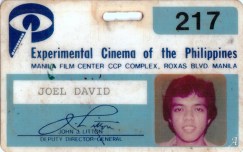
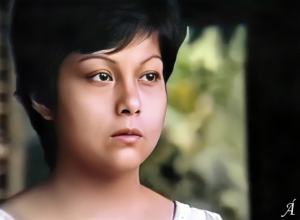
Many thanks to Filipino Arts & Cinema International, Philippine American Writers and Artists, and the Philippine Studies Department of the City College of San Francisco, plus an additional expression of gratitud y apreciación to the memory of the great Diego Rivera. I might as well provide a necessary personal disclosure in case you might wonder: Mauro Tumbocon Jr. and I have been acquaintances since the early 1980s, when I was working with the Experimental Cinema of the Philippines and he was with a pharmaceutical company, writing film reviews and articles on the side. We mirrored each other’s experiences as members of the Filipino Film Critics Circle, and when we found out we had similar misgivings about the group, we set out to found alternate critics’ groups. One of them, the Young Critics Circle, is still active to this day. We have had some differences, as all healthy friendships should have, but I think our similarities always somehow enable us to surmount them. Just don’t get us started talking about our goddess, Nora Aunor.
11011I had originally planned to look into what we may describe as trouble spots in the course of the development of film criticism in the Philippines, but as I understand, this venue, the City College of San Francisco, has both a film program and a Philippine Studies program. I also read up once more some of the basic texts, mostly on literary criticism by Terry Eagleton, but these seemed too distant and quaint today, except for a fairly recent text titled Outside Literature, by Tony Bennett[1] – the Australian professor, not the Italian-American crooner. In the end I decided to just confine my lecture to the less-obscure controversies that people in this setting might be able to recognize. Not to go too far off-tangent, but if you’ve been monitoring developments in the Philippines, you might have noticed that people there have been polarized since the election campaign period that started a year ago, and the situation has never eased up, and probably even worsened. There are two main voices: one, the newly empowered, or some might say re-empowered, people in the administration of Rodrigo Duterte; and another, the group of people identified with the previous administration of Benigno Aquino III, who see themselves as marginalized by the present government.
11011For me, the predicament is a simple one. If you object to certain or all of the current government’s policies, could you still be called a supporter of the Duterte administration? The way that the existing discourse has worked out, the answer is no. Either you’re pro-Duterte and accept everything he had set out to do, including discarding due process for drug suspects and restoring Ferdinand Marcos to a position of prestige, or you object to these two things, plus maybe Duterte’s propensity for cursing and appointing some less-than-stellar officials, and advocate for his impeachment so he can be replaced with a more “acceptable” option. Now I’ve witnessed the overthrow of two Philippine Presidents in the past, and the aftermath has never been lovely – sometimes it even gets worse in some ways than before. But I also cannot abide people getting killed just because of a problem that is really social and psychological in nature, and that has been solved in other countries only by radically turning its premise upside down and legalizing drug use. But try insisting loudly enough, say on Facebook or Twitter, that you want this and other government policies revised or discarded, but by the same government, not by a new one. I and similarly minded friends share the same stories of experiencing bullying of various degrees – from both sides, the pro-government and the anti-Duterte factions.
Why am I bringing this up in a discussion of criticism? Because it is precisely the absence of critical thinking that leads to such a disastrous state of affairs, on a national and maybe even overseas scale at that. For people like us who’re familiar with the process, it seems entirely plausible that one can accept a leader but not certain of her or his policies. Yet this fairly simple turn of logic will be seen by many Filipinos, even those outside the country, as implausible and even nearly blasphemous. Philippine cultural training, as implemented by its educational institutions, is still reliant on the top-down dissemination of knowledge and the propagation of assumptions that are meant to be beyond questioning, or what we now call deconstruction.
11011So when you engage in the practice of criticism, you actually benefit yourself and your readers, if your goal is to keep growing as a practitioner. But you also have the potential of applying your skills to a wider cross-section of the body politic, evaluating issues of varying complexities, according to how the solutions can best benefit the widest and most needful sectors of society. Just close your eyes and imagine you’re watching a multidirectorial melodramatic saga by Lino Brocka, with multi-stranded plotlines from Ishmael Bernal, focused on the dispossessed as Brillante Mendoza does, and with an endless running time courtesy of Lav Diaz; that would be a great and scary and funny and tragic movie, and that would also be Philippine politics, or maybe even American politics, who knows.
11011We’re all aware that discussions of politics are always in danger of intensifying without ever being resolved, so let me pretend to be subtle and diplomatic, and switch gears without warning, hoping that no one notices. Regarding our topic, Philippine film criticism, the first thing that I think any entry-level person should be aware of appears to be something that many practitioners lack. They can’t be blamed for it because the issue remains shrouded in the mist of colonial history. But it would be indispensable if we were to devise a means of distinguishing the practice from its global counterparts. What I refer to here is the fact that film, in particular, was originally introduced during the late Spanish era, in the 1890s, by investors who wanted to turn a profit, as they still do today. But when the Spaniards were shortly thereafter replaced by the Americans, the fast-evolving media of photography, and later film, were deliberately deployed by colonial officials, led by Interior Secretary Dean Worcester, to rationalize the colonization project.
11011Worcester and the periodicals that reviewed his output, including the New York Times, participated in this acknowledgment of the righteousness of the US occupation of the Philippines.[2] This is of special historical import, because when you read up on state cultural policy for cinema, this detail is overlooked in favor of a later development, when Vladimir Lenin declared that film would be the means for the Soviet Union to propagandize for international socialism. Thus when we speak of critical commentary on turn-of-the-century Philippine-produced photographic and cinematographic products, we are really talking about a perspective with two characteristics that were typical for that situation: first, it assumes the supremacy of visual technology; and second, it considers the interest of the Philippine subjects, who provide the raw material for these products, as incidental at best and insignificant at worst.
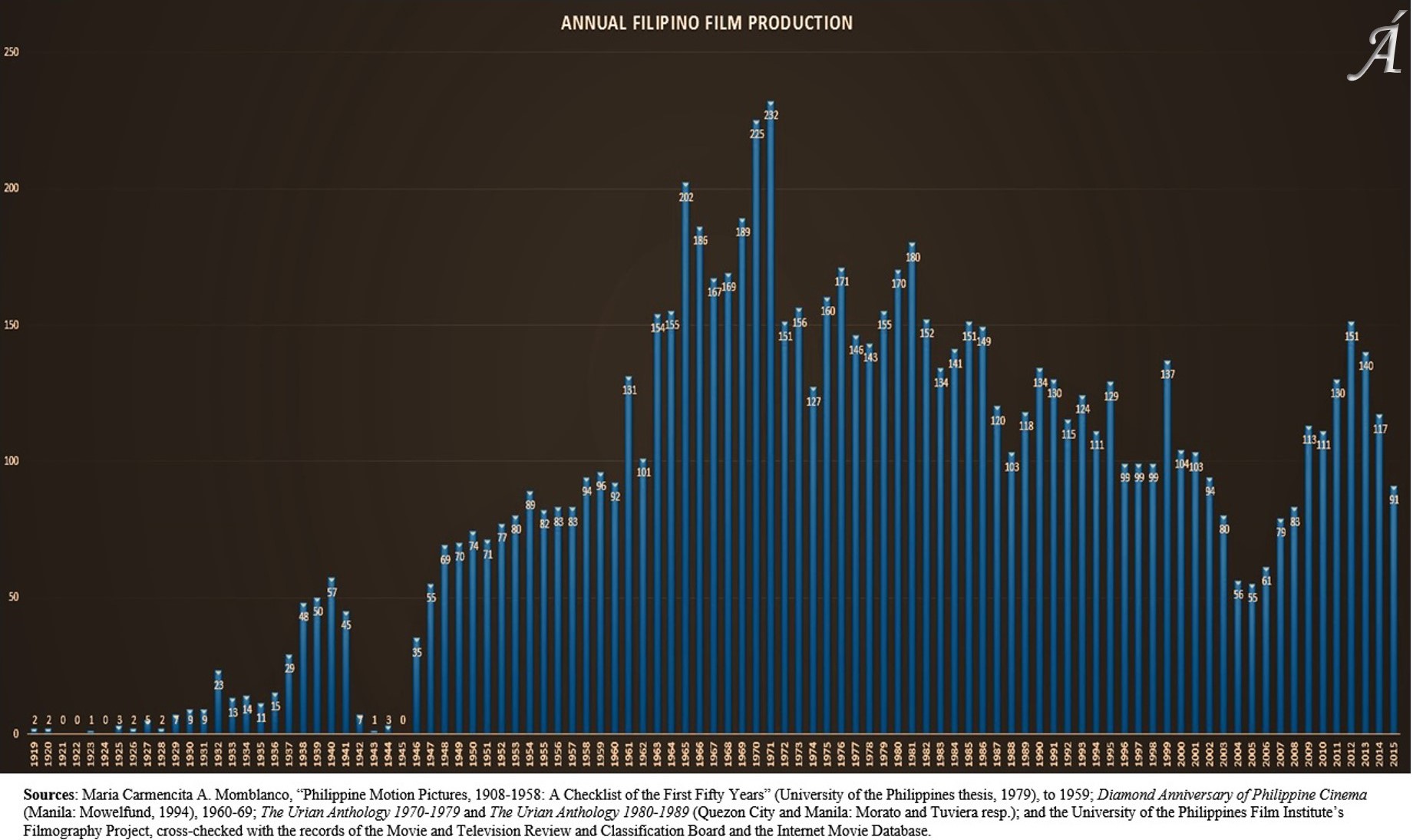
11011I wish to emphasize that this situation, which I’d call sordid if you’ll allow me to be subjective, applied to both the production of film and the output of criticism. And from over a hundred years ago, I would like to abruptly bring us all to the present, where film had just ended its reign as the country’s primary means of entertainment, its “national pastime,” to use the title I provided for my first book. It was so successful that at one point, during the 1980s, Filipinos appeared in the Guinness Book of World Records as the most avid movie-goers in the world.[3] As an industry, the medium was always one of the first to bounce back during the several periods of wartime and peacetime upheavals, even after the IMF-World Bank Asian crisis of the late ’90s demolished most of the country’s medium- and small-scale industries. In fact Philippine cinema’s latest recovery is a testament to its people’s ability to make do with whatever resources are still accessible to native practitioners. Just as the Soviet filmmakers responding to Lenin’s call turned a shortage of film stock into the rapidly intercut juxtapositions that we identify with Soviet montage, so did Filipino filmmakers confront the prohibitive cost of celluloid production by simply junking it and making do with far more affordable video technology, initially setting up their own projectors in film theaters just to be able to screen their work.
All this will sound like over-valorizing a trend that has somehow become standard by now, but at that time, I had just returned to the home country after completing my graduate studies in the US, and I can attest to the anxiety and humiliation felt by the digital-filmmaking pioneers, who thought that what they were making was not “authentically” film because it was not in celluloid. The celluloid-to-digital transition was completed in the Philippines before it was undertaken everywhere else, and succeeded so overwhelmingly that the industry was able to develop an industry-within-an-industry, a burgeoning independent-cinema scene, complete with its own series of competing festivals, auteurs and canons, and critical appreciators. The connection with the early years of US colonization becomes apparent when we look at an orientation that bothered a few mature critics and some young ones as well. Films were being finished for the explicit purpose of making a splash in overseas festivals, with a preference for those in Europe, and any record of rejection by the Filipino audience could be spun around into the claim that the artist, like the messianic biblical prophet, was without honor in her or his own country.
11011In that way, and at that moment, we managed to achieve American self-colonization, producing cultural artifacts that made use of the local audience’s real lives as raw material, but which were never intended for their own consumption and appreciation. The complicity of contemporary film commenters was troubling enough so that the then-chair of the original critics circle went on record to denounce them, preferring to call them film bloggers rather than critics, and demonized as well their propensity for scrounging for perks, in the form of free trips to foreign film competitions, as members of the jury (Tolentino 184).[4] I use the past tense in describing this state of affairs, because the situation has peaked, and with that peak, its possible closure has become discernible. This peak actually occurred in recent months, when Filipino entries in the so-called Big Three European film festivals won major prizes, including best film at one point. The Woman Who Left, the film by Lav Diaz that won the Venice Film Festival’s Golden Lion prize, starred the former President and CEO of the country’s biggest film and TV conglomerate.[5] Diaz inscribed his own career circle, since his early films were produced by what was then the Philippines’s most successful studio, Regal Films, before he sought fuller autonomy via the combination of independent financing and digital production that I mentioned earlier.
11011For me, the lesson here is an affirmation of what I had always believed in: that among all possible types of professionals, artists (including writers) have the capacity to change for the better, with the rest of society and the world waiting to testify, to act as witnesses. Critics, when they’re lucky, should be in the position to herald the good news, or to demand for it when necessary. As you can sense, I’ve made another supposedly subtle segue into the ethics of film criticism, and wasted the previous minutes on a necessary but too-lengthy introduction. Don’t do that unless you’ve been granted exclusive control over a microphone and a guarantee that no questions will be asked right afterward. But honestly, if anyone were to ask me right now what she or he needs to prepare to get into film criticism, I would first respond by answering: what for? Is there an urgent need for it, a life-and-death situation that has the potential to turn tragic if another option, another desire intervenes and replaces this first one?
11011Like all defensive responses, this one reflects on me, the questioner, rather than the one being questioned. I was probably lucky in starting out in criticism before formal film training became a possibility in the Philippines, and figured out all the other necessities along the way. I was naïve enough, and the field was new enough, so that I could take stock of existing samples and say, “I could certainly write better than many of these people.” I was determined to become conversant with film theory and history, on my own if necessary, and at the very least become known as a film critic who could outwrite anyone else within the limited and insular circle of local practitioners. When I was invited to join the formal critics’ organization while barely out of college, that indicated for me that I’d been taking the right steps. Yet almost as soon as I’d signed the proverbial membership card, I’d taken my first misstep: an inordinately harsh denunciation of a commercial exercise by Lino Brocka. Manila being the tiny capital city that believes itself to be larger than what it is, I inevitably bumped into Brocka within the same week the review came out, and made the acquaintance as well of several other practitioners, a couple of whom also happened to be concurrent members of the critics’ circle.
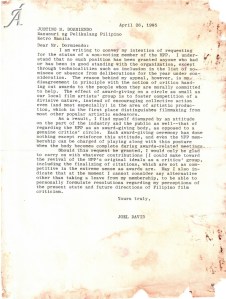
I never really had a sudden falling-out with the group, only a gradual and incremental accumulation of differences, based primarily on the circle’s insistence on annual award-giving as its nearly exclusive means of self-validation.[6] For me, that would be like winning every possible essay-writing prize and saying that I deserve this elevated recognition right now, because of the external evidence of my literary ability. But rather than recount the many disappointments I had with the Filipino Film Critics Circle, I’d prefer to share with you the positive lessons I picked up along the way. First, the members’ practice of rewatching films in contention as many times as necessary until they’re able to arrive at a consensus, was something I’d already been doing, but it reaffirmed my personal realization that films deserved as much close and precise observation as we bestow unquestioningly on fine arts and literary products. I am currently in the process of completing a canon project, over half a decade in the making, and the same procedure of making sure that the canon team’s choices can withstand more than one screening has led to some unanticipated discoveries and reversals.
11011Second, the ability of colleagues who can productively engage in metacritical discussions, where we critique one another’s criticism, is a rarity even among fellow critics, but an invaluable treasure when it comes along. During the period of my membership, the most important sessions I had were not the ones where the group determined the fate and reputation of the community of artists it claimed to support, by selecting individual award winners and causing resentment and disappointment among the rest. Instead, it was the moments when Professor Bien Lumbera, then and now its most senior member, would discuss with me the process of writing critical commentary, and explain the nuances of tone, diction, insight, structure, and rhetoric. To be honest, I found more of this type of rapport after I left the group, when I made the acquaintance of Mau Tumbocon here as well as a few other critics, and expanded my network to include classmates in graduate school and students at the film institute of the national university. I may as well also qualify that, among people capable of collegial interactions, differences can sometimes transmute into serious disputes, aggravated by the various side issues that tend to be raised by aggrieved parties in both camps. But since critical activity is as much reactive to subsequent social, aesthetic, ideological, and technological developments, even as it seeks to influence these phenomena in return, we find ourselves hailing the people we once thought we had given up for good, just as I had tended to grow apart from some groups with whom I once thought I could share long-term visions.
11011Third, and perhaps most unexpected though thoroughly commonsensical when you ponder it over, is the humbling discovery that critical thinking is not the exclusive province of critics. The greatest artists throughout history, in all corners of the world, had made that discovery for themselves, and their special gift to critics is the difficult-yet-productive exercise we get when we undertake a study of their body of work. I was already aware that Ishmael Bernal, for example, was conducting an intensive and radical reworking of the medium of film for Philippine subject matter and audiences, before I even learned that he was also once a film critic. This ties in with my insistence on literary polish and innovation for critical practitioners. I cannot count how many times I had cringed when I read critics complaining about a film’s lack of elegance and creativity, in the kind of writing that would be the very exemplification of the disappointments that their authors wanted to point out.
11011The last matter I wish to raise about criticism is the one that causes a crucial but often unnoticed division among practitioners themselves. I first got an inkling of it after I published my second book, essentially a more specialized anthology of my reviews supplemented by a basic but extensive critical study and a few canon-forming attempts. I was worried that reviewers might complain about how obsolete the issues it was raising were, since my intention was to demonstrate that those critical exercises first needed to be done right before they could be abandoned in favor of more current approaches. Instead, the most extensive local-daily reaction dwelled on the fact that some of the words I used went beyond journalistic-level samples. When I speculated what the reviewer must have thought about film writing, I concluded that he actually had a laudatory assumption: that discussions on film don’t have to be complicated, because film is accessible to a lot of people to begin with.
Yet I could not bring myself to accept this premise. To me, the fact that people respond enthusiastically to a phenomenon should never be seen as a weakness to pamper, but rather as an opportunity to elevate discourse. Of course we find extreme examples where the enthusiasm for theoretical engagement turns into a refusal to be comprehensible. Once more, the person who has trained in effective expression, where ideas that are drawn from credible and knowledgeable sources, can be re-worded for the sake of the lay reader, would have an edge here. The ideal for the critic would be the generation of relevant, complex, and progressive ideas in the simplest language that said ideas could embody without betraying or compromising their content. The tension in this formulation derives from a false opposition between the scholarly writer and the journalist, or what I once innocently echoed as the critic and the reviewer. To me, these distinctions matter less today; I wouldn’t agree with the late John Simon that reviewing is just bad criticism,[7] but rather that everything, not just reviewing but even film reporting, can be criticism. The contemporary film critic would, or should, actually function as both: as someone who keeps abreast of new writings in cinema and media studies, who also seeks to popularize these ideas when they pertain to certain recent film releases or trends.
11011There are two points I could never over-emphasize in this regard. One is that the use of theory in writing reviews may or may not be foregrounded, but it should be capable of providing a framework for the critic’s take on the film or films being discussed. Another is that this framework is not the usual operationalizing of correctly understood concepts that we learn to do in school. Theory, as our fellow YCC founder Patrick D. Flores put it, is a matter that should be engaged, not applied (193).[8] This means that while the critic may explain her harsh or dismissive take on a film by referring to the underlying principles of a theory, the critic should also ensure that she had managed to evaluate the theory in terms of its appositeness, relevance, explanatory potential, progressiveness, and other questions essential to what we may call theory appreciation. Too often, we come across readings of non-Western cultural samples where the critic has regurgitated recent theory and wound up displaying her grasp of sometimes new ideas at the expense of prejudging the native product.
11011I would like to end by saying that while I may have accumulated this collection of insights on what an effective film critic would be like, I would be lying to you if I denied that I sometimes fall short of one or more of the ideals that I recounted in the course of this lecture. I also look forward to learning a few more tricks along the way, if I can still have the good fortune of discovering them. The biggest misgiving I had with this recognition is that from hereon, there would be less room for me to commit mistakes, the source of some of my most-enduring lessons. But then I could also have a better platform by which I could tell the current and forthcoming generations of Filipino film critics to prepare as best as they could, and once they have taken stock of their preparation, to take a step or two further into what they think is unexplored, probably even questionable, territory. Be well-conditioned, but don’t forget to take risks. People will give you a once-over because you’re dealing with a medium that’s close to their hearts. Make sure you’re ready to give in return more than what they expect, not only because they might appreciate the effort, but because you owe yourself a useful lesson each time you send out your contribution to our now-growing stock of cultural discourse.
11011Thank you for paying attention. I wish you all the best experience before, during, and after watching movies.
The author acknowledges the assistance provided by the Inha University Faculty Research Grant. Many thanks to Ha Ju-Yong, Lee Sang Hun, Park Shin-gu, Park Haeseok, Son Boemshik, Park Jinwoo, Yu Taeyun, Jek Josue David, Mauro Feria Tumbocon Jr., Alexei Masterov, Nora & Pete Luayon, Ohny Luayon, Ann-Marie Alma Luayon-Tecson, Lewis Tecson, Marita Jurado, and Carlo Jurado.
[1] Tony Bennett, Outside Literature (London: Routledge, 1990). Other texts consulted include The World, the Text, and the Critic (Cambridge, Mass.: Harvard University Press, 1983) by Edward Said; and The Function of Criticism: From the Spectator to Post-Structuralism (London: Verso, 1984), Marxism and Literary Criticism (London: Routledge, 1976), The Significance of Theory (Oxford: Basil Blackwell, 1990), and Walter Benjamin, or Towards a Revolutionary Criticism (London: Verso, 1981) – all by Terry Eagleton.
[2] See Mark Rice, Dean Worcester’s Fantasy Islands: Photography, Film, and the Colonial Philippines (Ann Arbor: University of Michigan Press, 2014), 118-55. Also see “Calls Wild Men Our Wards,” New York Times (December 31, 1913): 7, qtd. in Rice.
[3] Guinness Book of World Records (Samford, Conn.: Guinness Media, 1983).
[4] Rolando B. Tolentino, “Hinahanap, Kaya Nawawala” [Searched For, Therefore Missing], 182-84; in Patrick F. Campos (ed.), “A Round Table Discussion on Poetics and Practice of Film Criticism,” Plaridel: A Philippine Journal of Communication, Media, and Society 13.1 (2016): 149-217.
[5] Lav Diaz (dir. & scr.), Ang Babaeng Humayo [The Woman Who Left], perf. Charo Santos-Concio, John Lloyd Cruz, Michael de Mesa, Nonie Buencamino, Shamaine Buencamino, Mae Paner (prod. Sine Olivia Pilipinas & Cinema One Originals, 2016).
[6] See Joel David, “My Big Fat Critic Status,” Ámauteurish! Extras (1985), posted online.
[7] John Simon, “A Critical Credo,” Private Screenings: Views of the Cinema of the Sixties (New York: Macmillan, 1967): 1-16.
[8] Patrick F. Campos (ed.), “A Round Table Discussion on Poetics and Practice of Film Criticism,” Plaridel: A Philippine Journal of Communication, Media, and Society 13.1 (2016): 148-84.









 ORCID ID

