Category Archives: Book

Canon Decampment: Preface & Introduction

PREFACE

The manuscript began as a project with Summit Media. My retirement as tenured professor at Inha University necessitated the sudden uploading of the text I prepared on my blogsite in 2023. That time, the films selected totaled around 120. Since that seemed inadequate to me, I picked out several from the titles initially rejected in the original publication project and embarked on an intensive re-viewing of possibly overlooked material. Several owners and distributors were also warming up to the open-access concept and started uploading their holdings on streaming websites, mostly YouTube but also specialized or subscription outlets. For a short spell, the Singapore Film Archives made available its films, including those made for Malay-language distribution by Philippine directors in the 1950s and 1960s; the late Teddy Co alerted me to their availability and forwarded a few others in better or more complete shape. With the advent of artificial intelligence programs, online transcription and/or translation services proliferated online so I was finally able to work out a system for watching these titles, overlooked in all assessments of Philippine cinema except for vague and often incorrect mentions in some historical accounts.

11011I wish to extend thanks to the editor of the now-defunct YES Magazine, Jo-Ann Q. Maglipon, as well as her inhouse staff, for undertaking a film-viewing and deliberation process that was both extensive and intensive. The book title indicates my readiness to let go of canon exercises after this point. I will still be celebrating outstanding work as it comes along, but the practice of determining whether it belongs on an all-time-best list will just have to be taken up by other interested parties—of which I’m sure history will never run out of eager and willing participants. The following are people to whom I owe thanks for calling my attention (whether they were aware of it or not) to titles I may have dismissed or never considered before: Jerome Gomez, Ellen Ongkeko-Marfil, Ricky Lee, Jim Paranal, Emmanuel Dela Cruz, and Monchito Nocon. Crucial to the completion of the mechanics of the project are Park In-kyu, Lee Jinhyoung, Lee Sanghun, Jeong Yeongjae, Kim Min Tae, Choi Hyun, Angelo Magat, Eric Magat, and Sinan Çakiltepe.

11011I’d opt to acknowledge, if I could, all the students I ever taught, regardless of how they opted to regard me afterward. I only hope that I’ve managed to seem higher-evolved than I did in the past, although of course several things (starting with the concern for teaching) deserve to remain the same. If I were to pick out just one name to represent the best of the rest, it would be Corina Bedonia Millado, over whom I’d been exultant for the past several decades and who’ll deserve more accolades than I could bestow.

11011I’ll also have to acknowledge the specific founding members of the critics group who provided me with examples worth emulating: Clodualdo del Mundo Jr., for his careful, rigorous, and persistent scholarship, and the late Petronilo Bn. Daroy, for his constant upgrading of his analytic skills and his deployment of wit and humor. Other founding members were also useful in showing me the pitfalls and weaknesses to avoid, but I’m sure readers will understand why their names will be better left unmentioned unless I need to undertake a closer critical assessment of film criticism in the country.

11011An undertaking of this nature requires two forms of indispensable support. The first and more unusual one is constant pampering, which I knew that I could ensure for myself by remaining in Korea after my retirement: I had to be able to watch the film entries in a receptive frame of mind, and accomplish my writing without castigating myself for some overlooked real-life task or other. But it also entailed a hometown support system, which I thought I could avoid calling on if I could complete the project within the lump-sum retirement benefits that I treated as my personal writing grant. When it ran out before I could finalize the writing, I knew that I had to call on my siblings, where we had the unusual and embarrassing understanding that their eldest will have to be their juvenile. Two of my youngest brothers, Aaron and Nides, were ironically the first to depart, but they and my only sister Peewee performed all the considerable support activities that I could not provide for myself. This time around, my next-elder brothers Aris and Nonoy took charge of raising the funds that the completion phase required.

11011The other form of support was reliable expertise in terms of assessing, discussing, and even sourcing materials. Four friends, two of whom I’d never even met yet in person, allowed themselves to be conscripted in various online message threads and responded as close to real time as they could, considering we were all based in various territories (Manila and two US time zones). All of us shared, in varying degrees and sometimes with different objects, faith in progressive politics, gender critique, popular culture, and star scholarship, with each one having sometimes overlapping areas in terms of temporal and regional familiarities: Jek David’s millennial coverage, Jojo Devera’s insider expertise, Epoy Deyto’s fond familiarity with critically neglected cinema, and Mau Tumbocon’s historical and global reach. Our exchanges were sometimes contentious, often funny, always lively—and I maintain that if the capsule reviews I wrote in consultation with this team were to be properly credited, then their names should be part of the book credits. I could not always accommodate everything that they or anyone else recommended, and I’m sure they might have disagreed with some of my choices, but that was always a limitation on my end, not theirs. Anyone familiar with our ad hoc collective will recognize that the full listing is as much theirs as it is mine.

A note on translation: Several of the tech credits and synopses were done by staff members of YES Magazine. I cross-checked as best as I could, with group rescreenings providing opportunities to adjust credit and storyline details that were in error. We referred generally to the Internet Movie Database with caution, but generally relied on what existing film sources evinced. A measure of how seriously Philippine film preservation has suffered from negligence lies in how many basic credits can no longer be reconstructed, even with deep archival research. The historically invaluable collection of critic-archivist Jojo Devera has proved to be the most helpful in terms of rare-film information. The volume Lilas: An Illustrated History of the Golden Ages of Cebuano Cinema by Paul Douglas Grant and Misha Boris Anissimov was likewise a repository of useful data, as were Mike De Leon’s Citizen Jake outlets, the Pelikulove website of feminist output, and the several YouTube channels of major Pinas studios. The Video 48 posts of Simon Santos and the (currently deactivated) Baul ni Juan uploads of James de la Rosa were indispensable for their untampered features of rare print materials. The language specified in each entry will be understood to be the country’s current national languages (English and Filipino), unless the spoken language is exclusively or primarily in English. When provided, additional writing sources will also be mentioned. In a few instances, I listed actors who did not appear in the film credits.

Back to top

INTRODUCTION

When a colleague inquired as to what I wanted out of this project, I was stumped. Until we got to talking about some time we shared when I was in graduate school—which was how I remembered a New York icon and blurted out, “To emulate Florence Foster Jenkins and be remembered for a long time, even if I get laughed at for what I’m doing.” I wasn’t kidding, since the many times I hung out at the classical CDs section of the many record shops in the village, the surest way to initiate pleasant, sometimes hysterical, conversations with strangers was by bringing up her name. And though we may have started out laughing, we somehow wound up with some tone of reverence that enabled us to move on and talk about other personal faves.

11011Colleague was expectedly amused, but raised the next stump-worthy question: if you’re the equivalent of FFJ, what does that make of all the other practitioners? After reflecting on and off for months on my reply that “why should that worry me?” I finally realized that there was no other possible valid answer. The older ones will think I was always mistaken and they were right all along, while the younger ones, if they had any ambition, will be looking for ways to equal or supplant this output. The original critics org where I opted to participate for a few formative years organized an event much later that I labeled Stalinistic, in which the oldest conciliatory founder was soon gone, the current oldest said that I should respect critics who hand out awards and never criticize same-statured colleagues (presumably referring to himself), and the current pre-retired elder one claimed I was wrong because I refused to subscribe to his prescription of honoring independent productions that wallowed in poverty depictions that eschewed mainstream appeal and deployed high-art strategies instead.[1]

11011After the near-completion of this project, I realized that the introductory essay I drafted for the original digital edition was too extensive, not to mention defensive, and would be better situated in a collection of articles on critical reflexivity. Hence nothing should stop the curious reader from proceeding forthwith to the canonical choices with their respective writeups, although a recounting of the project’s origins would be helpful. It started as a top-100 listing and soon broke free of that round number. Since the planned print version never came out in time to enable my retirement clearance, I continued making additions and self-publishing the results on my blog—with the clarification that the project was far from finished at that stage.

11011With the present “E-Book Edition,” it can still be further finalized in future, mainly with the remastering of previously damaged or missing files or the recovery of long-presumed-gone prints such as Celso Ad. Castillo’s Burlesk Queen (1977) or Lino Brocka’s Mananayaw (The Dancer, 1978). Ironically, the practice I followed was instilled by the critics group I mentioned, which apparently no longer observes it: repeat screenings to ensure that a work is capable of sustaining long-term appreciation for any number of reasons, with research into production circumstances and discussions with experts to see if we can arrive at any form of consensus. Plus another measure abhorred by the founding members since it challenged their admitted capitalist ideal: the recognition of several possible honorees in any given year, along with the jettisoning of fixed technical or performative categories if these have no relevance to any given text under discussion.

Back to top

The Quanti-Quali Dilemma

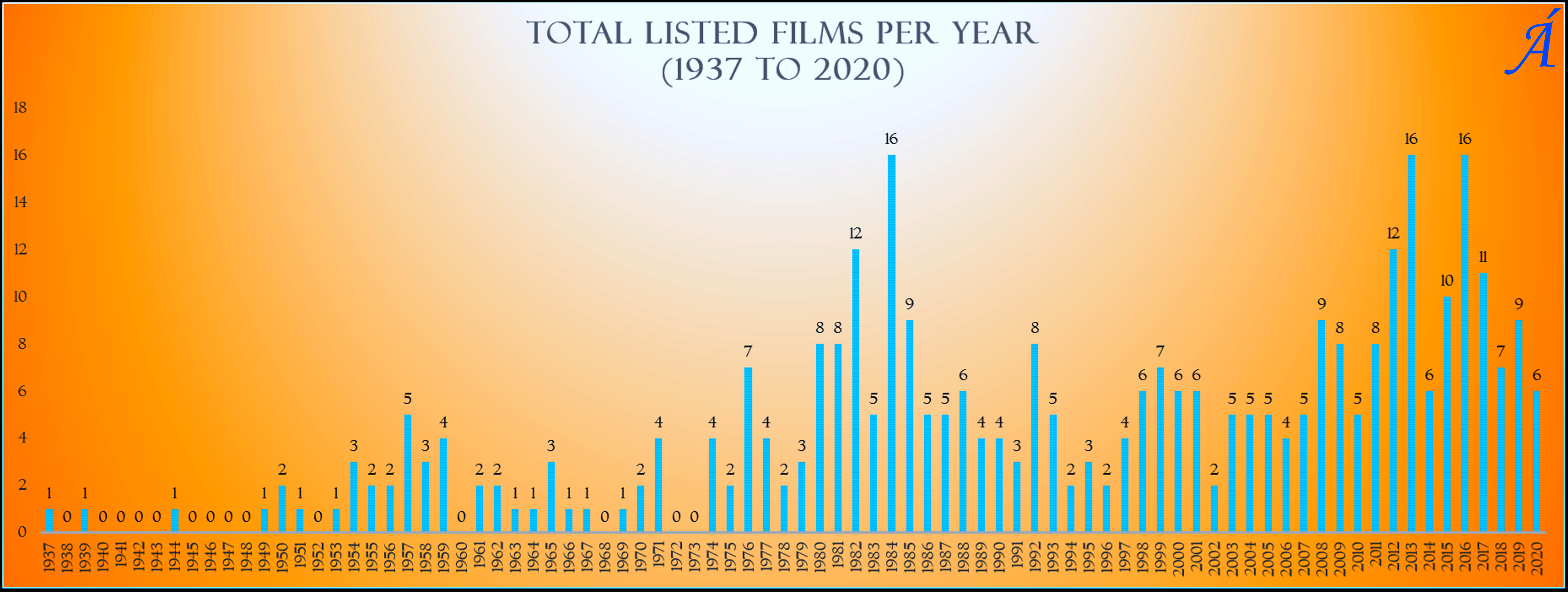
[For a larger image, please click on picture.]

We’ll start at the end, with a rather awkwardly positioned graph of the entries in this study according to year of release. I hope to have made it as scientific as possible via careful selection, but my leftish ideals ensured that a number of titles championed by individuals or institutions would never show up in the text. To make it worse, which is ironically better for me, I conducted this exercise as a final stab, minimizing the possibility of requiring corrections and leaving the task of inspecting post-2020 titles (as well as reinspecting everything from the beginning) up to future interested parties.

11011Regarding the trends that show up in the graph, we can see a partial confirmation of the claim of the founding members of the Manunuri ng Pelikulang Pilipino or Filipino Film Critics Circle (hereafter FFCC) that 1976, the year of the group’s first awards ceremony, was the best of any such period in Philippine cinema. Their self-serving nature, however, is shown up in the output of the succeeding years: more outstanding films came out during the crisis years comprising the first half of the 1980s, culminating in the people-power protests that followed the assassination of Senator Benigno S. Aquino Jr. and leading to the ouster of the Marcos Sr. dictatorship.

11011What makes the record remarkable is that anyone who lived through this era would not remember any critical celebration of the achievements of the country’s film artists. I’d ascribe this appalling negligence to the orthodox-Marxist orientation of film responders, spelled out in a much-reprinted FFCC member’s screed that true artistic progressivity will always be preempted in an antiprogressive system, and therefore the urgent task lies in changing the system itself first. For better or worse, critical thinking had outgrown this constricting reliance on economic determinism as a tool for critical analysis, but the terms of its arrival in the country still had to occur a few years later, accompanied by violent debates instigated by covertly antipopular sectors.

11011The next rising trend, while not as towering as the first one, occurred during the current millennium, peaking up to the cutoff year of this study. A vulgar materialist would probably readily attribute this to the technological shift from celluloid to digital, although the more impressive results from the preceding period answer the obvious question of why there haven’t there been more canonizable works when production costs have significantly diminished since then. The answer may of course be overdetermined by technological shifts in production and strategic adjustments in distribution, paralleled globally by the rise in digitalization and internet patronage. But an unforeseen factor lies in the essential lie that fuels award-giving film activities, that only one winner in permanently prearranged categories can be selected every year, a nonsensical logic that our practitioners have wisely ignored, for the most part.

11011The decision that emboldened me to pursue this project was not really an exceptional one, if we look at antecedents of cinema: most academically defensible literary canon presentations will find the specification of a decimally round number (meaning one that ends in five but preferably in zero) arbitrary and possibly indefensible. Yet all the film-canon lists I rounded up, including a few of those I was associated with in the Philippines, either observed round-number limits or, in one case, insisted on a lowest-possible total. In this case, serendipitously enough, that final number (350 titles) turned out to be semiround.

11011Hence to my mind, Canon Decampment can stake the claim to creating the first loose canon (awful pun intended) in film listings, anywhere in global film literature that I know. My self-avowed goal was to keep accumulating as many titles as I could defensibly classify as worthy of inclusion, regardless of all possible standard limitations of origin, genre, language, period, budget, format, and so on. The only technical limits I observed were that the entries should be available full-length feature films, using standard global filmfest specs of a one-hour minimum running time.

11011I needed also to set limits of as liberal a definition as possible of formal and ideological progressivity, since I had to draft capsule reviews for each entry, or occasionally pairs and, in rare instances, a series of entries. No further explications will be necessary beyond this point, since the entries ought to be able to speak for themselves, except to mention that product availability dictated when I could finish.

11011The best of Philippine cinema once beckoned, and now I can finally take leave.

Note

[1] See “On Poetics and Practice of Film Criticism in the Philippines–A Roundtable Discussion,” Plaridel: Journal of Communication, Media, and Society, volume 13, issue 1, June 2016, pp. 148–150, doi:10.52518/2016.13.1-09cmps.

Back to top

Á!


Canon Decampment: Yam Laranas

[Click here (recommended) for desktop mode.]

1—Radyo

English Title: Radio
Year of Release: 2001
Director: Yam Laranas
Screenwriters: Yam Laranas & Jon Red
Producer: Viva Films

Cast: Rufa Mae Quinto, Jeffrey Quizon, R.J. Leyran, Louie Medel, Tado, Bojo Molina, Katya Santos, Goms Burza, Lucy Quinto, Michelle Mercado, Raul Dillo, Shermaine Santiago, Mardi Gozum, Ronnie Lazaro, Mike Lloren, Soliman Cruz, Jon Red, Randy Punsal, Raul Morit, Ardenia Albarida, Noel Sandoval, Nido de Jesus, Mac Alejandre, Renato del Prado

Mila conducts a popular radio talk program every morning with her co-anchor George. Several listeners phone in to share their dreams and problems. Among them is Ruben, a sales promoter in the hallway of a congested shopping mall, where no one pays him any attention and Myla, a saleslady whom he longs for, mocks him for his lowly position. After he requests Mila to play a song for Myla, whom he calls his girlfriend, she scolds him; when he calls up Mila to narrate what happened, she and George treat him dismissively. He relives the childhood trauma of his mother’s cruel treatment, murders and rapes and dismembers Myla, then calls up the DJ to drop hints about what he did. His killing spree just started, however, and as detectives take an interest in his identity, his begins obsessing over Mila.

2—Sigaw

English Title: The Echo
Year of Release: 2004
Director: Yam Laranas
Screenwriters: Roy Iglesias & Yam Laranas
Producers: Megavision Films, Regal Entertainment, GMA Films

Cast: Jomari Yllana, Richard Gutierrez, Iza Calzado, Angel Locsin, James Blanco, Ella Guevara, Lui Manansala, Tessie Villarama, Pocholo Montes, Ronnie Lazaro, Geric Albero

Marvin finally was able to rent his own apartment, where his girlfriend occasionally drops by to visit. He has difficulty sleeping though because he keeps hearing loud noises from the occupants of another room, where a hotheaded police officer shouts at and beats up his wife and their young daughter. One night, the wife knocks on Marvin’s door to ask him to look after her daughter while she tries to calm down her husband, who’ll be arriving soon. Marvin hesitates to get involved but he takes pity on the girl. He tells his GF that he’s starting to see bloody apparitions of the mother and daughter and she confesses that she has started experiencing the same thing. During a particularly scary encounter, the couple decide to leave the apartment and watch a feel-good movie, but the visions find a way to haunt them there as well.

The predicament in approaching whiz-kid product is that the practitioner may be so gifted that younger appreciators as well as foreign observers (who amount to the same thing, when one thinks about it) might wind up fostering the same cycle of formalist appreciation that entraps Western artists in a rut from which they can only escape by rejecting the system wholesale and starting over in another area or activity, if they have the resources for renewal. The evidence played out early enough, when the start of the current millennium encouraged Philippine film critics to name the next Golden-Age harbingers, as if such an era can be heroically determined by any number of individuals. Yam Laranas would be a perfectly archetypal sample, with a pair of films that stirred excitement among responders despite the presence of elements that would have given pause to any past Pinas expert. The delightful and heart-pounding Radyo, for example, proceeds from a traumatization brought about by a Hitchcockian phallic mother, minus Sir Alfred’s usual winky perspective; even more seriously, the film’s entire social world takes a stance against the now-grownup victim, who responds with mountingly perverse cruelty. The later Sigaw is a more sober affair, although at the expense of its women characters turning passive instead of reprising the bullying or taunting that they did in Radyo, and with (once more) the progressive-sanctioned demonization of its distinctly working-class player for being an armed representative of “the system.” With these caveats in mind, one can nevertheless still immerse in impressively conceived settings where Laranas gives himself free rein to disrupt audience expectations and even introduce reflexive moments that comment on the material without enforcing a separation from the onscreen events. In Radyo, the female host spins a hit record made by the actress who plays the character, with her sidekick interjecting a salacious pun; in Sigaw, the lead couple take refuge in a film screening but find even that space haunted. These moments of grace actually induce an unexpected retrospective dimension, allowing discerning audiences to add insight to their pleasure.[1]

Back to top
Return to Canon Decampment contents
Go to alphabetized filmmakers list

1—Abomination

Year of Release: 2018
Director: Yam Laranas
Screenwriters: Paolo Vacirca & Oscar Fogelström
(From a story by Yam Laranas & Gin de Mesa)
Producers: Unitel Productions, Underground Logic, Hit Productions

Cast: Tippy dos Santos, Maritoni Fernandez, Justine Peña, Paul Holmes, Lukas Enrique, Lexi Fernandez, Lexi Schulze, David Bianco, Leigh Halliwell, Emma Brennan, Kuya Manzano, Spyke Perez, Janelle Olafson, Pinky Amador, Ramon Perez, Andy Kun, Robert Zialcita, James Svendsen, Merhzad Tamadon Khan, Henry Lo, Sam Turner, Dada Hassan, Aaron Hewson, Raul Venigas, Ibu Benedict, Remus Husussan, Anne Feo, John Moseley, Alexandra Santos, Viviana Flores, Manuel Velasco, Eddie Ngo, Mahle.

Rachel is found lying in the middle of an empty road, unconscious. When she awakens, she asks the doctor to contact her mother but the latter refuses to speak to her. A senior doctor informs her that the person she claims to be died a few months earlier so the police are fetching her for questioning. She escapes and attempts to contact her family, then her best friend. She remembers how her mother, as a single parent, had difficulty handling her. When she doesn’t take meds to control her mood swings, she beats up her classmates for imagined slights and her mother has to force her to apologize. One night, she attends a small party thrown by Dan, who’s aware of Rachel’s unstable condition and knows how to take advantage of it.

2—Nightshift

Year of Release: 2020
Director & Screenwriter: Yam Laranas
Producers: Viva Films, Aliud Entertainment, ImaginePerSecond

Cast: Yam Concepcion, Michael de Mesa, Mercedes Cabral, Jeffrey Quizon, Soliman Cruz, Ruby Ruiz, Mayen Estanero, Roman Perez Jr., Irma Adlawan, Caleb Santos, Joel Garcia, Karenina Romualdez, Brian Bamunuachchi, Jonjon Maceda, Maryanne Climaco, Lita Loresco, Sigrid Polon, Christian Villete, Rafael Atun, Jessa Mae Gajo, Shaider Vargas, Mico Akashi Dagaas, Antonio Adlawan, Mary Ann Tan, Liberty Galvez, Red Musni, Edith Monsanto, Gerard Gevera, Jessica Nunez, Brenda Porcadilla, Sofia Nicole Mabalay, Isabel Tepase, Regina Miano, Jackylyn Miano, Prince John Dale Pampanga, Coleen Que, Laline Yulo, Ariel Guevarra, Albert Logacho, Allan June Pampanga, Cherry Favors, Jam Sehani, Richard Macorol

Jessie Pardo reports for her first day of duty as night-time morgue assistant to Doctor Alex. The sight of various dead bodies unsettles her, particularly in their expulsion of gases and cadaveric spasms. Fortunately Doc Alex is patient, considerate, and avuncular, even encouraging her to take breaks, which she refuses. A strong typhoon causes occasional electrical brownouts, worsening Jessie’s jumpiness. Two morgue assistants try to humor her but after she catches them stealing from the corpses, she sets some professional distance with them. A mother pleads to be let in so she could see the body of her daughter, but the only outsiders allowed after hours are police investigators. When her replacement fails to arrive because of the storm, Doc Alex volunteers to keep her company; he suffers a heart attack, however, and has to be rushed to hospital, thus leaving Jessie alone in the company of the unalive.

The unusual yet unobserved progression in Yam Laranas’s filmmaking career was his consistency in working within genre material, despite the fact that even his younger colleagues were collecting trophies from overseas festivals and local critics’ competitions. In so doing, he quietly managed to accumulate a filmography that demonstrated attempts at reworking genre tropes, mostly with qualified success, as these things expectedly turn out. His later projects exhibit a willingness to accept ambitious challenges in some cases, as well as expertise comparable to global practitioners when he opts to flex his abilities. Abomination is an example of the former type of effort, a work that purports to be set in a fictional North American city named Monte Maria but (save for apparent establishing outoor shots) was produced entirely in the Philippines; in addition, it bounces around (occasionally with superimposed announcements) its lead character’s developmental stages, corresponding with her unstable psychological condition. Both these attempts work with such a high degree of credibility that when the mystery’s solution unfolds, it turns out to be far more artificial than the film’s naturalistic accomplishment, much like an M. Night Shyamalan viewing experience feels after everyone and her aunt are already familiar with how the riddles in The Sixth Sense (1999) are going to be answered. The key will be a matter of taking Abomination’s final sequences as part of the earlier time-fragmented journey and regarding these with as much skepticism as the rest of the plot, then look forward to the next Laranas entry. Nightshift, for its part, will be more standard-issue—which means its sources of pleasure will be in the way Laranas extracts time-worn values such as the buildup of dread alongside well-executed jump scares, the direction of actors (notably an atypically avuncular Michael de Mesa, whose unexpected benevolence is positively uncanny), and a final-act narrative explication that doesn’t overstay its welcome. More and better work will be in store from this talent, and we can only hope it won’t take too long in coming.

Note

[1] Patrick D. Flores’s commentary on the reflexive element in Sigaw articulates this point in full: “That the cinema is revisited creates another dimension within the scenario, as it finally implicates the institution of spectatorship as party to the conspiracy of representation, of making a particular language of the real utterable at the expense of its impossibility (not yet possible), which as we learn here can never be abandoned” (“The Restive Condition,” Young Critics Circle Film Desk, June 2, 2008, posted online). The Radyo DJ character, on her part, announces that she’ll be playing a hit song by Rufa Mae Quinto titled “Ikikiss Kita” or “I’ll Kiss You,” with her co-anchor adding “sabay hug,” meaning “with a hug.” The actual Quinto song is “Kiss Kita Sabay Hug” (Nonoy Tan & Ed Calumpang, 2002) which, when articulated fast enough to elide the aspirate, sounds like “I’ll kiss your testicle.” The reflexive play proceeds apace when the character sings along to the record and their voices sound exactly alike.

Back to top
Return to Canon Decampment contents
Go to alphabetized filmmakers list

Á!


Canon Decampment: Theodore Boborol

[Click here (recommended) for desktop mode.]

Vince & Kath & James

Year of Release: 2016
Director: Theodore Boborol
Screenwriters: Daisy Cayanan, Kim Noromor, Anjanette Haw
(From a story by Daisy Cayanan, Kim Noromor, Anjanette Haw, based on the book of the social series Vince & Kath by Jenny Ruth Almocera, writing as Queen Elly)
Producer: Star Cinema

Cast: Julia Barretto, Joshua Garcia, Ronnie Alonte, Maris Racal, Ina Raymundo, Shamaine Buencamino, Ana Abad Santos, Jeric Raval, Alan Paule, Manuel Chua, Joshua Zamora, Axel Torres, Milo Elmido Jr., AJ Urquia, Sarah Carlos, Pontri, Gerry Bricenio, Kim Andaya, Kelley Day, Jessica Marasigan, Jose Sarasola, Rafa Esplana, Paul Pujante, Uajo Manarang, Pamela Gonzales, Pauline Palomique, Jan Urbano, Hessa Isabelle Gonzales, Curse and Bless, Mark Joshua Edrosa

Kath, a campus beauty queen, and James, a varsity basketball player, find each other attractive. Vince, who also fancies Kath, endeavors to keep amusing her, knowing that she finds him annoying. Vince’s mother has a new hubby whom Vince can’t get along with, so she asks James’s mother to allow him to live with his friend. Kath’s mother also has to deal with her husband abandoning his family when he found another partner while working abroad. Kath and Vince enroll in their university’s internship program so Vince uses the opportunity to get close to Kath. But because his varsity practice demands a lot of his time, James asks Vince to impersonate him using his well-developed social-media skills. Because of Vince’s efforts, Kath and James become steadies, although Kath can’t deny Vince’s charm and sincerity.

A loose adaptation of Edmond Rostand’s 1897 play Cyrano de Bergerac, Vince & Kath & James not only updates the 17th-century setting to the present millennium but also relocates the drama from Paris to Metro Manila. The romantic and comic elements function satisfactorily, although V&K&J has to proceed necessarily wordily, with Vince, the Cyrano equivalent, articulating his sublimated passion using James’s alias as well as an anonymous viral account of someone who expresses himself, haiku-like, in exactly six words every time. Kath, who falls for both of Vince’s ruses, maintains some propriety by having a giggly best friend, Maxine, who comments on everyone’s motivation but most of all on Kath’s emotional development. Kath’s own realization, drawn from her mother’s domestic struggle, that she must learn to look beyond surface attractiveness in men, leads predictably enough to her reassessing James’s maturity and his overreliance on Vince, with her resentment that Vince agreed to masquerade online as James constituting the final obstacle to their happy ending. In fact a more reliable anchor for an appreciation of the narrative is the film’s roots in the briefly popular social-series phenomenon, where it was originally titled Vince & Kath and utilized another updated format, the epistolary narrative, with the story unfolding via screenshots of fictional messages from SMS and chat exchanges between the characters; the series proved popular enough to be spun off into a 24-chapter book version (another now-less-popular format) early the same year that the expanded film version came out. The intertextual references have since extended beyond the film’s originary material. Vince and Kath bond over a shared enthusiasm for Olivia M. Lamasan’s Got 2 Believe (2002), which starred the real-life aunt of the V&K&J leading lady but became a record blockbuster because of the death of its male lead, allegedly due to depression caused by his breakup with his costar. The Vince and Kath character players would figure out in their own subsequently messy breakup, while the Maxine performer would first be featured in the social-media scandal of the year before recuperating her belated status as extremely capable performer and sensible netizen. These reflexive elements can no longer be regarded as independent of the media product they attend, and it would be specious to insist they don’t impinge on one’s awareness to those with access to such information, much as stars’ personas will always be crucial to the appreciation of their showcase features and just as the actual Cyrano de Bergerac’s biography inevitably haunts the staging of the play (and their adaptations) about him.

Back to top
Return to Canon Decampment contents
Go to alphabetized filmmakers list

Á!

Canon Decampment: Rico Maria Ilarde

[Click here (recommended) for desktop mode.]

Sa Ilalim ng Cogon

English Title: Beneath the Cogon
Year of Release: 2005
Director: Rico Maria Ilarde
Screenwriters: Rico Maria Ilarde & Mammu Chua
(From a story by Rico Maria Ilarde)
Producers: DuduyPlus Co. & Modern Films Production

Cast: Yul Servo, Julia Clarete, Dido de la Paz, Raul Morit, Eugie Rodriguez, Ramon Bautista, At Maculangan, Rico Orbita, Hector Macaso, R.A. Rivera, Katya Guerrero, Una Ilarde, Jun Sabayton, Joel Torre, Rico Maria Ilarde, Stephanie Lim

During a violent robbery where Pepito betrays his companion Ruel, their getaway driver Sam realizes that he’ll also be rubbed out. His military training enables him to overpower Pepito and he’s able to flee with the money, with Pepito’s body in the trunk. Sam recalls how Pepito conscripted him in the operation during their stint in prison, with the sponsorship of crime boss Johnny-B. Realizing he’ll be in trouble explaining why his companions are dead, Sam takes a turn in the road and finds an abandoned mansion, where he shacks up. He finds a beautiful maiden whom he later learns is named Katia, who leaves wrapped food in front of the house every day, with the package always gone the next day. Sam makes Katia’s acquaintance and they fall for each other, but Sam also realizes that Johnny-B’s manhunt is closing in on him.

After a short spell of creating horror that focused on the emergence of the monstrous, Pinas-reared and US-trained Rico Maria Ilarde (son of a famous broadcast-media personality) opted for material that centered on citizens continually victimized by the psychosocial horrors visited on them by brutes of patriarchy, with the monster making a full appearance almost as an afterthought. Sa Ilalim ng Cogon nearly stacks its moral dialectics in favor of wholesome innocence, but the underworld where its drama plays out does not permit such oversimplifications, so the film’s main characters conduct a careful recounting of what transgressions they or their loved ones have committed and explain to each other (and to the audience) how their future actuations could help them attain a cleaner, though never a perfect, condition. Such moral clarity extends to the peripheral characters, but never in the typical self-explanatory mode that fulfills humanist principles while raising realist appreciators’ eyebrows. The monster’s begetter is left to subsist in the ruins of his good child’s memory, but the the members of other “family,” comprising a criminal operator and his henchpersons, become miniatures of complex individualities. The leader may be expectedly benevolent in his ruthlessness, but his unruliest and least predictable follower is provided with enough motivation, despite limited screen time, by starting out as the male lead’s prison inmate and ending with a kicker of a closing line. One might also accuse Ilarde of idealizing these personalities, but anyone who’s hung out with a wide variety of antisocial types will recognize that many of them are capable of developing political and globalist perspectives. If ever the moribund action-film genre can somehow restore itself back to dominance, SInC will be one of the most useful templates available.

Back to top
Return to Canon Decampment contents
Go to alphabetized filmmakers list

Altar

Year of Release: 2007
Director: Rico Maria Ilarde
Screenwriters: Rico Maria Ilarde & Mammu Chua
(From a story by Rico Maria Ilarde)
Producers: Cinema One Originals & DuduyPlus Co.

Cast: Zanjoe Marudo, Nor Domingo, Dimples Romana, Dido de la Paz, Krista Miller, Raul Morit, Anna Marie Faybyshev, Katya Guerrero, Ranny Comia, Edd Toralba, Johnny Barnes, Mildred Formanez

Hoping for an opportunity for construction work, Anton Marquez makes the acquaintance of Lope, but Mang Erning, the contractor, runs out of openings for them. When he recognizes Anton as his favorite boxer, however, he offers the two a live-in position repairing a rundown mansion on the outskirts of the city. It turns out that Anton foreswore the sport after his last opponent died from his blows to the head; Mang Erning warns the two that they have access to all the rooms in the house except the basement. While on an outdoor break, the two make the acquaintance of a pair of domestic help in the neighborhood, with Lope readily making out with one of them. Anton asks his designated partner, Angie, to check out on the internet the meaning of some words found on the entrance to the basement. Anton tells her that he keeps seeing a vision of a girl in white asking for his help, but when she’s finally able to look up the words, she warns him that he and Lope are in danger.

As in the instance of Sa Ilalim ng Cogon (Beneath the Cogon, 2005), the second film collaboration of Rico Maria Ilarde and his producer-scriptwriter Mammu Chua set itself apart from his previous output despite his usual hybrid approach to material. Altar harks back to his concerns with ritualistic supernatural horror, premised on an admonition never to trespass a proscribed area. The Bluebeard reference will be recognizable to fairy-tale enthusiasts, but this time, the damsel in distress is a veteran boxer, traumatized by his own expertise in inadvertently killing a competitor. The implicit feminization of the working-class citizen, already made to line up in the hope of getting selected for paid work, and pledging to follow his employer’s preferences as if he didn’t have any desires of his own, is affirmed by the higher power in the basement when it punishes his high-spirited and hedonistic coworker. The narrative itself takes a few ironic turns but never grants the full triumph that Bluebeard’s last wife supposedly attains in some optimistic versions of the tale. But Ilarde’s constancy is just as admirable, if somewhat disconcerting to anyone raised on a diet of Philippine popular narratives: the lowly folk who populate his stories are as casually invested with wisdom as the best of them would be in real life, though the question of why this property should be so rarely realized in film-stories made for them might be worth closer inspection by students of social psychology.

Back to top
Return to Canon Decampment contents
Go to alphabetized filmmakers list

Á!


Canon Decampment: Ray Gibraltar

[Click here (recommended) for desktop mode.]

Wanted: Border

Additional Language: Hiligaynon
Year of Release: 2009
Director: Ray Gibraltar [as Ray Defante Gibraltar]
Screenwriters: Ray Gibraltar & John Iremil E. Teodoro
(With poetry credit for John Iremil E. Teodoro)
Producer: Cinema One Originals

Cast: Rosanna Roces, Joy Louise Evidente, Kristoffer Rhys Grabato, Publio Briones III, Raffy Tejada, Edward Divinagracia, Dante Amaguin, Joan Paulette Libo-on, Edgrado Amar, Rheno Mar Soqueño, Boyet Zuluaga, Kukok Piconcillo, Nemia Guinabo, Farida Kabayao, Edgar Gayorgor, Sol Alquizar, Dennis Ascalon, Mona Pico, Pamela Falcis, Alf Alacapa, Rick Roco, The Boys, A.J. Aurelio, Faith Javellana, Edrelita Sebio, Audie Barbasa, Arnel Sumpay, Sunshine Teodoro, Peter Paul Deocos, Teatro Busilak (University of Iloilo), Western Institute of Technology, USA Little Theater

Mama Saleng is a religious enthusiast who wants to be crucified for Holy Week as part of her devotion to “Gino-o” or Lord, a strangely attired deity that apparently only she sees. She runs a dormitory with an eatery on the ground floor that has attained local fame for its specialization in kansi, a sour soup traditionally made from beef shanks. Her secret is that she uses human meat, usually from boarders she slaughters when she thinks that no one will come looking for them. Her familiarity with violence arises from a childhood trauma, when she witnessed her family fatally attacked by townspeople for allegedly being aswang or flesh-eating monsters. Her unhinged assistant Andres volunteers to perform the killings, while her foodie neighbor Shine develops an appetite for her cooking. A video filmmaker requests permission to document her establishment while an abused young girl believes she has found refuge in Mama Saleng’s place. A visitor unexpectedly drops by who reminds her of the time she fell in love with a military official whose mission was to hunt down antigovernment rebels.

A single viewing will instantly make understandable why Wanted: Border earned positive notices but faded as soon as the next indie cause célèbre came along. It starts with horror-film atmospherics premised on the penny-dreadful serial narratives that gave rise to a figure most famously embodied in Sweeney Todd. The violation of the taboo of cannibalism unsurprisingly recurs in times and places of desperate poverty, although never directly in terms of the consumption of human flesh but rather in the availability of animals as food—usually from piggeries adjacent to morgues, although reports of fish that may have fed on the bodies of murdered gamblers dumped in Taal Lake nearly triggered social panic in the more recent past. Yet the practice remains more intimate and regular than we like to assume, as Sigmund Freud reminded his readers of the ritual of partaking of a divine being’s blood and body during Communion. WB, titular misspelling and all, sets itself distantly enough, by locating the narrative in rural terrain separated from the capital as much by water as by language, and by refusing to allow horror to dominate the proceedings. The strategy succeeds primarily because of the presence of Rosanna Roces as Mama Saleng, one of the rare actors who retains an earthiness no matter what register she performs in, and enables the characters who interact with her to exhibit contradictions despite the emergence of distinguishing qualities: the comic devourer, the scarily psychotic butcher, the melodramatic abuse survivor, the amoral media professional. These properties come to a head in the military officer, whose love affair with Saleng provided her with the opportunity to embark on the adventure that would define her for us. The material of WB may be repulsive in the telling and the recollection, but it’s also capable of satisfying an appetite for the insightfully twisted, if one is fortunate enough to be seized by such a tendency.

Back to top
Return to Canon Decampment contents
Go to alphabetized filmmakers list

Á!


Canon Decampment: Christian Linaban

[Click here (recommended) for desktop mode.]

Aberya

Additional Language: Cebuano
English Translation: Hitch
Year of Release: 2012
Director: Christian Linaban
Screenwriters: Christian Linaban & Ara Chawdhury
(Inspired by a short screenplay by Ariel Llanto)
Producers: Cinema One Originals, Dream Arts Productions, Epicmedia Productions

Cast: Will Devaughn, Mercedes Cabral, Nicholas Varela, Iwa Moto, Publio Briones III, Gil Maningo, Marilou Lucente, Winsse Villanueva, Jeffrey Ogario, Ralph Padilla, Gabby Nazareno, Syrel Lopez, Darling Dame, Ione Blanche Enriquez, Ara Chawdhury, Steph Jarina, Paolo Varela, Alex Uypuanco, Bambi Beltran, Misha Anissimov, Faith Bernardes, Boy Rupita, Arman Tajanlangit, Edgar Kalinawan, Richard Hearsay, Junjun Paraiso, Homer Medici, Nathaniel Rubio, Kahlil de Pio, Cedric Butron, Ligaya Rabago, Tom Jopson, Anton Java, Roma Oyson, Christian Linaban, Aldrin Sanchez, Raul Luche Jr., Raulito Mendiola, Khriss Bajade, Ada Jimenez, Gerard Miguel Aribe, Gelo Sanjorjo, Vince Rabanes, Josh Salvacion, Frances Villa, Robbi Villa

Four Cebu-based characters’ stories unfold as each one is introduced. Lourd Villegas is a Filipino-American concerned for his parents’ home country’s welfare and future. He schedules several girlfriends, one for each day of the week, but considers getting serious with Angel, a Manileña. Unknown to him, Angel is actually an escort for Congressman Sta. Maria, who’s running on the promise of moral renewal. Angel hangs out with Sta. Maria’s son Mike, who introduces her to various substances, many of which he concocts himself, and provides her with what he calls a Delorean, which makes her transform into a nun named Sister Celeste. Because of her heightened state, Celeste confesses some of her transgressions to Mike, but his father’s more worried because of the discovery of a porn video on the internet that has his son’s name even though he wears a mask. Eden, his partner in the video, attracts Mike, in whom she thinks she might have found a way to evade the scandal that already got her fired from her nurse’s job.

The one time that a Philippine production was described as inspired by Max Ophüls’s La ronde (The Round, 1950, adapted from Alfred Schnitzler’s 1897 play Reigen) was in an annual country report by the late Agustin Sotto for the now-defunct Film International, when he mentioned Ishmael Bernal’s then-banned Manila by Night (1980). The reference was inadequate and inaccurate, since the Bernal film was arguably far more significant and innovative and departed in many ways from a sample that the director never acknowledged, unlike Robert Altman’s Nashville (1975). The millennial regional production of Christian Linaban’s Aberya was in its own turn compared by reviewers to Quentin Tarantino’s Pulp Fiction (1994), premised on its La ronde-like structure of morally compromised characters who pass around heterosexual favors as casually as they consume recreational drug cocktails concocted by Mike, a Congress official’s stoner kid. Once more the comparison is misleading and reflects more on the observers’ inadequate understanding than anything else. As its title suggests, archness is far from any concern of Aberya’s, although irony is arguably an inevitable component of this type of narrative material. The film begins with a citizen who’s several times removed (as a free-floating Philippine-American) from the place for which he professes concern, an urban center distinct from and subservient to the so-called imperial capital of Metro Manila. The characters with whom he interacts, both women, bring up the drug dealer who’s also both supplier and indifferent lay, although their sexual carelessness results at one point in a scandal that disrupts the equilibrium that they all take for granted, as fairly comfy middle-class subjects. For all their lighthearted and cynical affect, they’re still unable to resist responding to the slings and arrows that the ideal of financial comfort and emotional maturity launches at them—which is how they find a convergence that they might have hoped for but can’t afford to maintain. In being so low-key in dispensing its perceptivity, Aberya demonstrates how cinematic potential can be more productively realized in setting enough distance from the country’s cultural center.

Back to top
Return to Canon Decampment contents
Go to alphabetized filmmakers list

Superpsychocebu

Language: Cebuano
Year of Release: 2016
Director & Screenwriter: Christian Linaban
(From a story by Christian Linaban & Nicolo Manreal)
Producers: Panumdaman Pictures & &

Cast: John Dino, Wes Bacareza, Christian Saavedra, John Mark Maglana, Rapi Sescon, Angelica Gamolo, Joshua Aquino, Lyka Flare Ruela, Steph Jarina, Zerah Esmero

Tired of the usual safe means of getting high, a man approaches Pancho, an adventurous friend who believes in living outside the norm. Pancho recommends a friend who might be able to tell him how to access a drug called Superpsychocebu, which made everyone who tried it unable to forget the experience. The seeker goes to meet Sexy Samson, who commissions a promo video and tells him to seek out a beach-dweller named Beauregard. The latter takes him on a boat ride and professes the life-changing properties of Superpsychocebu, recommending that he look for Hesus, with an unnamed but unpredictable girl driving him to the forest where he lives. Also calling himself Joshua, Hesus transforms into several personalities before handing the sought-after substance to the seeker, who becomes a famous personality and calls himself Idol.

Viewers who approach Superpsychocebu thinking that it would be more of the director’s previous film, Aberya (Hitch, 2012), might find themselves adrift at several points in the viewing experience, as the lead character turns out to be. Calling it the country’s first stoner film also won’t withstand scrutiny after sufficient acquaintance with Pinas film history, with several titles from the 1970s onward from the likes of Celso Ad. Castillo, Peque Gallaga, Tata Esteban, and even Christian Linaban already laying claim; maybe calling it “the first stoner’s film” might be defensible, if it didn’t sound too nitpicky. All this is by way of cautioning that Superpsychocebu should be approached differently from any of the aforementioned samples, including the foreign models that set the template. For despite its appropriation of the habits and optics associated with drug culture, the film’s social world is incidental, a means for its lead character to journey toward, or actually tunnel into, the pursuit of the ultimate high. Like any kind of commitment, such a goal would inevitably prove frustrating, as psychoanalysts from Sigmund Freud to Jacques Lacan once determined in their studies of desire. Yet the only means that narrative texts can complete their journeys is to pretend that desire is attainable, and to celebrate its acquisition. Superpsychocebu “rewards” its hero, starting with the name he bestows on himself, but it also raises complications attendant to his new-high existence, which points to the mystery without having to ask it: where will the next high come from? Philippine critics have been trained to downplay such issues as insufficiently philosophical, much less political, but the mere fact that a millennium-era regional film has raised it, suggests that the repudiation itself brings up the essential critical question of who benefits from policing the issues we allow ourselves to confront.

Back to top
Return to Canon Decampment contents
Go to alphabetized filmmakers list

Á!


Canon Decampment: Edgardo Vinarao

[Click here (recommended) for desktop mode.]

Tatak ng Kriminal

English Translation: Mark of the Criminal
Year of Release: 1993
Director: Edgardo Vinarao [as Edgardo “Boy” Vinarao]
Screenwriter: Amado Lacuesta
(Based on Pablo S. Gomez’s same-titled komiks material)
Producer: FLT Films International

Cast: Eddie Garcia, Tetchie Agbayani, Johnny Delgado, Jean Saburit, Beth Tamayo, Berting Labra, Fred Moro, Manjo del Mundo, Romy Romulo, Edwin Reyes, Vangie Lablan, Rey Solo, Nonoy de Guzman, Eddie Tuazon, Herminio “Butch” Bautista, Ester Chavez, Jose “Kaka” Balagtas, Ding Concepcion, Tony Tacorda, Boy Sta. Maria, Bebeng Amora, Joe Baltazar, Eddie Samonte, Ben Rivera, Ben Malit, Buddy Salvador, Cesar Villanueva, Johnny Ramirez, Danny Labra, Boy Alano, Tom Calunsod, Freddie Roberto, Jimmy Flores, Robert Roncales, Rudy Vicdel, Tony Concepcion, Mario Cruz, Julito Nunez, Michael Manzano, Jun Tañajura, Rene Tanajura, Allan Ancieto, Ariel Henson, Ramon Fernandez, Marie Barbacui, Panchito

After his release from prison, Gojo confronts his mortal enemy Bito to ask if he might be aware of the whereabouts of his daughter Jessica, who’d be a teenager by this time. Bito’s henchpeople throw him out; afterward, a police officer expels him for vagrancy while he sleeps on a bench at night in the people’s park. He finally wanders into a taxi station, where the drivers befriend him and vow to help him find Jessica. As it turns out, Bito housed Gojo’s wife Laura, after Gojo killed Bito’s brother; Bito beats up Laura everyday and takes an unhealthy interest in Jessica. After casing Bito’s house, Gojo is surprised when Laura emerges and boards his taxi. Laura confesses her regret in shacking up with Bito and tells him she entrusts Jessica to the care of a pragmatic but sympathetic dance instructor.

Close to the same year that Eddie Garcia broke out as renowned action star when his Andres Manambit: Angkan ng Matatapang (Clan of the Brave, dir. Ike Jarlego Jr., 1992) won major prizes at the Metro Manila Film Festival, he featured in a smaller-budgeted but fairly competently made action-spiced family melodrama, where he plays a taxi driver during a period when people in that profession were regularly victimized, sometimes murdered, by holdup individuals or groups, although more prominently publicized were the passengers similarly victimized by gangs using taxis as their snare. The fact that Garcia was already elderly by then—in fact, he would die from an on-set accident while literally performing a millennium-era action role—would befit the postmortem commemoration of his late-era specialization, when he lent his name to the law meant to safeguard the safety of participants in film and TV productions. Tatak ng Kriminal though points to a less-observed problem in Garcia’s generational principles. One could never really automatically fault performers who accede and attempt to excel in roles for which they get hired by producers of all types; but Garcia’s parallel career as director began with Cold War secret-agent films as well as a defense for the convicted rapist of Annabelle Huggins (Ang Manananggol or The Advocate, 1963), culminating in the 1960s with the reelection biopic of Ferdinand Marcos Sr. (Pinagbuklod ng Langit or Bound by Heaven, 1969), before resuming late into the Second Golden Age with left-leaning women-positive material for the major stars of the period, although conflicting at one point with the activist directors guild. His final film performance was in an overt critique of the fascist dictatorship, Benedict Mique’s ML (2018), but one would be hard-put to find a Garcia action-star role remotely similar to what he essayed in TnK. We can argue that his Andres Manambit character, a righteous police officer, set a trend that was difficult for him to buck. Nevertheless he landed the TnK assignment and invested it with the pathos and humor that won him a following among action aficionados, with the character’s underclass identification helping to temper the smugness of his smart-alecky persona. The cab driver’s long-sought reunion with his unsuspecting though endangered daughter, escorted by the golden-hearted feminist madame who protects her (another of the narrative’s casual virtues), occasions a wordless set piece worthy of any of the age’s experts, and affirms Garcia’s mastery of film performance despite the technocratic approach he tended to prefer.

Back to top
Return to Canon Decampment contents
Go to alphabetized filmmakers list

Á!


Canon Decampment: Pam Miras

[Click here (recommended) for desktop mode.]

Pascalina

Year of Release: 2012
Director & Screenwriter: Pam Miras
Producers: Cinema One Originals, Tito & Tita

Cast: Marie Veronica Santiago, Jet Leyco, Anna Vecin, Jessie Silvestre, Randy Punsal, Sanchi Catura, Peewee O’Hara, Cara Eriguel, Alex Medina, Ian Galliguez, Danzen Santos, Marija Vicente, Cora Buenaventura, Rey dela Cruz, Jericho Vega, Jasper Manlangit, Virginia Marcos, Ian Lomongo, Jacyn Esquillon, Ally Lumbera, Teng Cortez, Timmy Harn, Malay Javier, Lili Esquillon, Vicente Diaz, Aila Torre, Kev Abadam, Ei Salcedo, Paolo Domingo, John Arzadon, Divine Aucina, Andrei Lumbera

Pascalina Lagumbay, Lina for short, wakes up on a day packed with a series of unfortunate events. She picks the wrong color for her hair, forgets to shut the faucet, leaves on time for work but has to chase a thief who snatches her bag then cops a feel before he lets go, discovers a new nurse at her workplace station, confronts her boss while red dye streaks her face and uniform—and gets informed that she’s been fired, although her boss pays for the sandwich that she couldn’t buy; her boyfriend Jeff screws her beyond the literal sense, by introducing to her his flirty office coworker who’ll be accompanying him to an out-of-town assignment. She manages to find employment in the same building where Jeff works, but when she meets her sisters for a family get-together, an elderly though unrelated aunt arrives and tells them that their blood relative, to whom she’s devoted, is about to die and needs to pass on her power as an aswang or flesh-devouring monster. No one believes her although Lina, always the pushover, agrees to accompany the lady to visit their sick aunt.

Of the many possibly obscure titles in the canon list, Pascalina will be sure to reward the adventurous viewer setting out to uncover difficult-to-access samples. Its primary distinction lies in purveying an urban-set horror narrative, a rare achievement considering how most successful horror films have to locate themselves in rural wildernesses, the better to distance the viewer from the double wallop of antinatural material packaged in a technologically sophisticated medium: any shred of doubt by the film artists in their material gets automatically aggrandized at the expense of believability in the presentation. Pascalina preempts these pitfalls by bravely harnessing its Third-cinema limitations. As confirmed by the filmmaker (via Messenger reply on April 23, 2026), it made use of low-end technology during a time when digital production still had to attain its now-standard 4k polish, via the use of the Digital Harinezumi, a plastic toy camera whose manufacturing company halted production a decade ago; the low-resolution imagery might require some playback adjustments—which will nevertheless be entirely worth the trouble. The content is perfectly matched to the technology, with the aswang or flesh-eating candidate introduced as a mousy pushover, bullied by everyone who encounters her, reminiscent of the title character in Aki Kaurismäki’s Tulitikkutehtaan tyttö (The Match Factory Girl, 1990),[1] complete with casually abusive boyfriend. Both dark comedies immerse in developmental detritus and deploy the strategy of enabling identification with central figures disadvantaged by class and gender, so badly treated by people who have to survive by turning a blind eye to any evidence of humanity, that the audience looks forward to their inevitable tipping point. What adds to the movies’s cognitive shock, beyond the negligence visited on it by a critical community confident that it knew better, is the fact that Lina’s pain was also counted as insufficient by political history. A few years after the movie’s release, the larger social horror of murderous extrajudicial violence would descend on a people already stripped of basic decency and barely able to cope with everyday survival.

Back to top
Return to Canon Decampment contents
Go to alphabetized filmmakers list

Medusae

Year of Release: 2017
Director & Screenwriter: Pam Miras
Producer: Quiapost Productions

Cast: Desiree del Valle, Carl Palaganas, Liz Alindogan, Cris Garrido, Rico Fernandez, Edna Leal, Roberta de Leon, Jocelyn Tan, Rener Concepcion, Ria Miranda, Lee Marvin Torres, Honey Grace Mendoza, Jaime Dominguez, Justin Halili, Nori Ann Napeñas, Ana Velle N. Surreda, Glenda A. Alcala, Jayson A. Leal, Ricky Dator, Elson Leal, Joselyn de Guzman, Leonito A. Orantia, Wilfredo Vilanueva, Onel Matriano, Dante Atimtar, Joselyn Paz, Jimmy Laynes, Reynaldo Map, Rodel Buefano, Junar Luna, Rogelio Kinagpisan, Dionisio Laynes, Mamert Asis, Nono Cabrera, Reynaldo Mapi, Benido Embili, Glicerio Cabrera, Rex Rigodon, Federico Coronel, Romana Verzo, Paterno Calamigan, Tomas Santos, Camille Abigaille Yumang, Ayla de Joya, Gerald Nacua

Since her son Luni had been acting up and was expelled from his school, single mother Alfa takes him to her documentary assignment in a remote fishing village. Luni misses his city friends and easily gets bored by the slow pace of life in the village, so Alfa makes sure to provide him with sufficient sunscreen for his albinic condition and asks him to help her as soundperson during her first interview. Later she quarrels with him when she discovers that he failed to record the answers of the respondent in her first interview. He refuses to accompany her the next day so she locks him in their hut, but when she returns, she finds him gone. A health worker informs her that someone who might be her son arrived with serious jellyfish stings, but when she gets to the clinic, she’s told that he left with another adult. When she checks the closed-circuit recording, she sees Luni leaving with what appears to be her blind twin. She starts worrying about the town’s belief that firstborn children are ritually offered to the sea in exchange for bountiful harvests, but the townspeople tell her to accept her loss just as they accepted theirs in the past.

Medusae encapsulates the predicament of single parenthood, with the further onerosity of a career woman’s situation demonstrated by an initially jarring positioning of extreme samples. In contrast with Alfa, her child Luni is young, male, melanin-deprived, understandably immature; the only definite similarity between them is their fierce intelligence and its resultant stubbornness. Alfa makes an effort to accommodate Luni’s expectations but draws the line in her devotion to her filmmaking career, discovering too late that Luni regards the latter as the equivalent of a rival sibling. She recovers from her anger in scolding him for his negligence in assisting her, but by then his alienation from her (and disappointment in himself) has escalated, and the film, along with her persona, splinters in irrecoverable ways. This schematic description undersells Pam Miras’s confident execution, notably her purveyance of an unsentimental melancholy, appropriate to a recollection of childhood as a domain that can never be revisited once a subject has outgrown it. In the end, the plurality of the titular Medusa extends beyond the motherly options available to Luni; in being as much feminized by his youth and helplessness, and monstrous in the demands he imposes, he becomes as much his mother’s Gorgon as her own self-imposed challenge to thrive in the profession that yielded the work that contained their story.

Note

[1] A more contentious point for me is how, despite being an earlier and comparatively impoverished production, Pascalina succeeds in what Lorcan Finnegan’s Nocebo (2022) aspired to demonstrate, although the latter admittedly had global scope and an overt denunciation of neoliberal exploitation. For a discussion of Nocebo’s depiction of overseas Filipino workers, alongside Ruben Östlund’s Triangle of Sadness from the same year, see Joel David, “Chaotic Waters and Well-Tempered Specters: The Philippines as Source of Overseas Labor,” Kritika Kultura, vol. 43, March 2024, pp. 222–249, doi:10.13185/1656-152x.2084.

Back to top
Return to Canon Decampment contents
Go to alphabetized filmmakers list

Á!


Canon Decampment: Eduardo W. Roy Jr.

[Click here (recommended) for desktop mode.]

Lola Igna

English Translation: Grandma Igna
Year of Release: 2019
Director: Eduardo W. Roy Jr.
Screenwriters: Eduardo W. Roy Jr. & Margarette Labrador Garcia
Producers: Film Development Council of the Philippines, Hong Kong Asia Film Financing Forum, EMBA Productions

Cast: Angie Ferro, Yves Flores, Meryll Soriano, Maria Isabel Lopez, Royce Cabrera, Jojo Riguerra, Soliman Cruz, Armando A. Reyes, Peewee O’Hara, Joel Saracho, Rener Concepcion, Conching Ani, Shantel Ruiz Galang, Gemma Amacaha, Sarah Pagcaliwagan, Chamyto Aguedan, Star Orjaliza, Jilla Sara, Sang Pascual, Robert Manalo, Hernand Timoteo Tulud, Rodel Pamarez, Jayson de Guzman Gonzales, Regie Delaluna

With all her contemporaries gone, Ignacia converses with her memory of them, impatient to end her existence and exasperating her daughter Nida. Her small town, where she’s known as Lola Igna, is excited by the news that she might be proclaimed the oldest woman in the world, with Nida claiming exclusive rights to sell merchandise based on this possibility. A small group of followers call for her to awaken from her siesta and greet them, but she hurls a container of her piss at them. Tim, a young teener, walks up to her and introduces himself as the son of her estranged daughter, Ana. He accompanies Lola Igna on her rounds but after she sees an image of her late husband and converses with one of the kids that she delivered as a midwife, who dies soon after, she decides to ask Tim to prepare her coffin. When the result of the oldest-person contest doesn’t favor her, she’s relieved to be rid of the crowd around her house. But then Ana, who broke up with the man who made Tim run away, shows up, heavy with child.

Alter-indie enthusiasts will find a possibly dismaying anomaly in Lola Igna, which may be expected of them but comprises no one’s loss but theirs. The material adheres to old-time realist melodrama, reliant on nonmainstream funding only because it won’t fulfill contemporary expectations of blockbuster cinema. But a closer look will reveal the mechanics of why it succeeds on its own terms. The narrative material is constructed on the persona of Angie Ferro, who was at the age when accomplishing any task or gesture requires considerable patience on the part of any observer. What makes the treat exceptional is that, unlike most serious performers, Ferro never aspired to a level of finesse and dignity. Her delivery was always broad, until straight-talking directors advised her to perform for the intimacy of a camera rather than for the apprehension of an auditorium. She never became defensive about her urinary incontinence, which resulted in a passel of amused anecdotes among her fellow stage performers—in fact, in her opening sequence in LI, her character empties her bladder in a chamber pot that she maintains throughout the film for her personal convenience, including as a means of dispersing fans who disrupt her siesta. Most impressively, Ferro foregrounded all the physical vexations of aging, from tooth gaps to osteoporotic posture, and leaned into the now-disciplined theatricality that results in an always-arresting screen presence. Anita Linda, Rustica Carpio, and an aged-for-her-age Nora Aunor demonstrated how worn-out bodies can be bearers of significances that younger performers can only dream of conveying, but Ferro trumped them with a tough honesty and tender humor that did not deny the infirmity of old age but refused to surrender to its mortal implications either. The surest measure of her achievement lies in how the movie’s plot developments no longer have to depend on novelty or unpredictability: whether or not a forthcoming episode can be anticipated, the reward will be contained in Ferro’s response, and she never disappoints in being raw, funny, and ironically suffused with sweet youthfulness.

Back to top
Return to Canon Decampment contents
Go to alphabetized filmmakers list

Á!


Canon Decampment: Miike Takashi

[Click here (recommended) for desktop mode.]

The Guys from Paradise

Additional Language: Japanese
Year of Release: 2000
Director: Miike Takashi
Screenwriters: Izō Hashimoto & Itaru Era
(From the novel Tengoku Kara Kita Otoko-tachi by Hayashi Yōji)
Producers: Asahi National Broadcasting Co., Excellent Film, Hammers

Cast: Kikkawa Kōji, Yamazaki Tsutomu, Endō Kenichi, Okina Kaei, Muzahashi Kenji, Kanayama Kazuhiko, Ōtsuka Nene, Oikawa Mai, Monsour del Rosario, Kitami Toshiyuki, Oikawa Mitsuhiro, Sako Hideo, Takenaka Naoto, Pocholo Montes, King Gutierrez, Jess Lapid, Kaye Tuano, Joey Galvez, Levy Ignacio, Oikawa Mai, Kanayama Kazuhiko, Kitami Toshiyuki, Rene Hawkins, Vic Felipe, Lindsay Kennedy, Efren Reyes Jr., Boy Roque, Rey Bejar, Alex Cunanan, Jun Dauz, Alex Braquit, Cris Daluz, Aileen Joy, Sonny Cabalda, Leo Valdez, Philip Supnet, Noe Endaya, Shaina Miguel, Jazi Cruz, Jane Perez, Abby Moscaidon, Bobit Dominguez, Sammy Bernabe, Miyamoto Seiya, Shojima Takeshi, Sako Hideo

Hayasake Kohei, a salaryman of Sanyu Trading, is caught with a kilogram’s worth of heroin and incarcerated in Manila City Jail, where he gets to know a small group of Japanese prisoners. Yoshida, who says he fled Japan after killing some gangsters, hires Kohei to represent him in business transactions, which they accomplish by bribing the guards so they can get around outside. Kohei absconds with Yoshida’s money but when he gets to his hotel, his wife’s no longer in his room. Yoshida finds him and warns him not to trick him again. Kohei realizes his wife and his lawyer are cheating on him so he dismisses them both. He then decides to use the money he left with a Filipino chef who runs a Japanese restaurant, but when the chef discovers what the package contains, he flees with it. Sakamoto, a pedophile inmate, drugs Kohei and attempts to sell him to organ harvesters but Yoshida saves him. When a prison riot erupts with the Noypi inmates ganging up on the Japanese, a Philippine prisoner whom Yoshida cheated helps them escape. While driving away, they see a child crying over her injured mother; they take her to her village, where Sakamoto uses his medical knowledge to treat her.

Casual film observers might be delighted to find out that one of Japan’s major film talents elected to adopt the only novel written by one of his compatriots, which happened to be Pinas-set, and devoted his considerable influence to make it happen. Hard-core followers of Miike Takashi, however, might be in for a disappointment, if they hadn’t heard about The Guys from Paradise yet (an unlikely possibility). It has none—actually a few, which might as well be counted as nothing—of the incessant, viscerally horrific, sometimes outright cartoonish violence that made his fan favorites so slavishly venerated: Audition and Dead or Alive (both 1999) and Visitor Q and Ichi the Killer (both 2001), to name just a few. The primary distinction that TGfP shares with the general run of Miike films is the role that irony plays in the narrative; in fact, irony in the film takes precedence over violence, so much so that when violence finally makes its appearance, it still operates on the principle of reversal. These irruptions initially cause perplexity, particularly with Kohei, the lead character, who winds up regarding them as lessons he has to learn in order to survive. The first definitive sign that developments will refuse to follow normal logic is when Kohei witnesses a prison riot: the sounds are recognizable from any other city-jail film, but the participants all seem to be enjoying themselves, delighting in what is after all a departure from the monotony of regimented existence, just as, on a later occasion, a thunderstorm makes everyone rejoice in the rare opportunity to have a clean shower. Yoshida, the gang leader, makes fun of the trans woman whom he regards as maid and mistress, but mourns for the only time in the film when she dies trying to save him. Sakamoto, who was arrested for child rape, cures the mother of a girl who calls for help, and selflessly uses his indispensable medical expertise on her townmates. At the point of no return, when the Japanese prisoners are menacingly surrounded by the rest of the inmates, Brando, the singular Filipino prisoner with an axe to grind against Yoshida, saves them in the surest way possible, by scattering money that the other prisoners hasten to collect. The final narrative irony might be impossible to accept, even if the film already dropped broad hints from the very beginning that Miike would be subsuming his cinematic skills to the source novel’s properties. But a historical parallel, also involving another Japanese novelist, might be instructive: Suehiro Tetchō was befriended by Jose Rizál while the two were traveling by ship to Europe in 1888, and subsequently published Nanyo no Daiharan (Severe Disturbance in the South Seas, Sumyodo, 1891), in which a Rizál-like figure rebels against Spanish occupation in Pinas and is assisted in his aspiration by the Emperor of Japan.[1] Strange though wondrously interventionist, these artists from a northern archipelago; further studies ought to proceed forthwith.

Note

[1] An early source for information on the interaction between the two authors would be Josefa Saniel’s “Jose Rizál and Suehiro Tetchō: Filipino and Japanese Political Novelists,” Asian Studies, vol. 2, no. 3, 1964, pp. 353–371. Renewed contemporary interest in these two derived from Benedict Anderson’s final volume Under Three Flags: Anarchism and the Anti-Colonial Imagination, Verso Books, 2006 (later republished as The Age of Globalization: Anarchists and the Anti-Colonial Imagination), where he referred to Caroline S. Hau and Shiraishi Takashi’s research, subsequently published as “Daydreaming about Rizal and Tetchō: On Asianism as Network and Fantasy,” Philippine Studies, vol. 57, no. 3, 2009, pp. 329–388, doi:10.13185/2244-1638.1684. I am grateful to Professor Epoy Deyto for providing me with access to The Guys from Paradise, and to Professor Michiyo Yoneno-Reyes for information, unavailable at English-language internet sources, on novelist Hayashi Yōji, whom I initially mistook for Hayashi Jyouji.

Back to top
Return to Canon Decampment contents
Go to alphabetized filmmakers list

Á!