
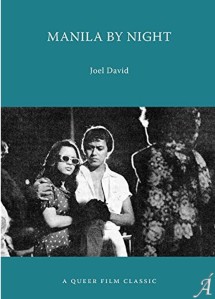
As part of a research project on Ishmael Bernal’s Manila by Night (1980), I drew up a questionnaire for the movie’s lead performer, Bernardo Bernardo. To put it more accurately, Bernardo was one of the movie’s dozen-plus lead performers, since the movie was (and remains) an outstanding achievement in multiple-character film storytelling. I dug deep into what I remembered of the film as a new member of the Manunuri ng Pelikulang Pilipino (Filipino film critics circle), which decided to reward the movie with multiple prizes, including best film and, for Bernardo, best actor. Bernardo provided answers that carefully qualified certain long-held assumptions about the film, and shared insights into how groundbreaking his characterization was by triangulating the relationships among the character (Manay), the actor (Bernardo), and the director-scriptwriter (Bernal). Ironically, as he would expound at length in the interview, the stereotyping he faced as a result of his depiction of Manay resulted in his decision to take a break from Philippine theater and media arts. Philippine performing arts endured a long spell without its most successful theater-to-film crossover actor when Bernardo decamped for the US in 2002; there he continued to reap accolades and awards for his stage activities, notably for his direction of and performance in The Romance of Magno Rubio. Also exceptional is Bernardo’s ability to be frank, gregarious, and playful in his interview responses – a throwback to his years as a journalism major and Varsitarian editor-in-chief at the University of Santo Tomas, as well as his later specialization in witticism-laden dinner-theater blockbusters. Since his return he has kept busy onstage and onscreen, with theater roles (including Shakespeare’s Haring Lear) and prominent film projects (last year’s multi-awarded Imbisibol, dir. Lawrence Fajardo); his latest film, Lav Diaz’s Hele sa Hiwagang Hapis, will be competing at the Berlin International Film Festival – where Manila by Night was also originally slated to participate, until it was banned from export by the martial-law censors. He has also been neck-deep in what we might recognize as “legacy” projects, including teaching (at the new MINT College and the University of the Philippines Film Institute) as well as memoir-writing.
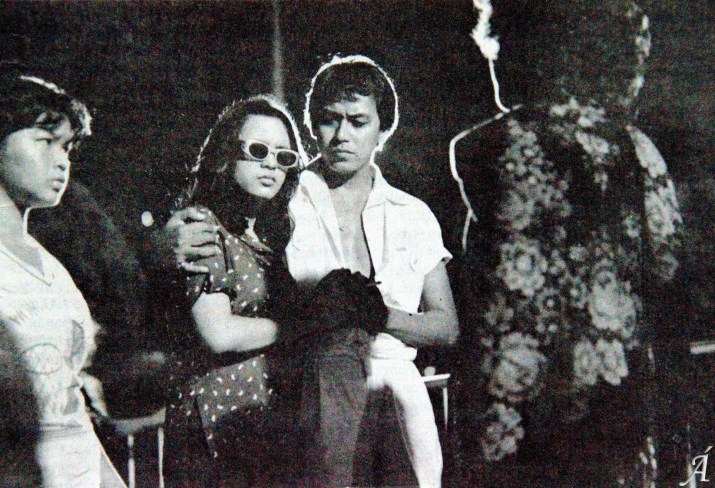
You mentioned on your Facebook page that you and Ricky Lee were consulted by Ishmael Bernal regarding the plotline of Manila by Night (MbN). The final film also includes Ricky, Peque Gallaga, Mel Chionglo, Jorge Arago, Joe Carreon, Toto Belano, and George Sison as “script consultants.” Were you the only MbN performer who participated in conceptualizing the film at this (pre-production) or any other stage?
I was among the last actors to be cast in Manila by Night and, consequently, was not privy to the pre-production discussions regarding the script of the film. However, I did have a meeting prior to the first day of shooting with the film’s production designer Peque Gallaga and film director Ishmael Bernal to discuss the character’s look and to clarify the character arc of Manay Sharon, the gay couturier I was cast to play.
11011Manay, I soon found out, was a self-confessed neurotic and well-intentioned meddler (with a “Rosa Rosal” social-worker complex) who also happens to have a penchant for juggling multiple lovers on the side; and, as written in the script, Manay would not only link the lives of several key denizens of the seamy underbelly of Manila’s nightlife, he would also function in the narrative, in Bernal’s own words, as “the conscience of the city.”
11011Curious, I asked Bernal, “Why a gay character as the conscience of the city?” And Bernal’s breathtakingly direct response was: “Why not?”
11011Queer vision at work; unblinkingly defiant. Spoken like the true conscience of a country in turmoil, during the Martial Law years. (I am now reminded of an article written by Pablo Tariman years later, after the demise of Ishmael Bernal and Lino Brocka, where he quotes Marilou Diaz-Abaya on the artistically incisive roles that two great Filipino film directors Brocka and Bernal had played in Philippine cinema and history. As Diaz-Abaya succinctly stated: “They both made films in the most challenging times and they responded with valor. Their kind of artistic nobility is now dead.” And, of course, they both happened to be gay.)
11011Additionally, Bernal explained that his approach to filming MbN was going to be ensemble-focused and improvisation-driven. And in so many words, Bernal pointed out that Manay Sharon was not going to be a variation of the stereotypical flaming queen then in vogue in Filipino movies. The tenor of the discussion suggested rather strongly that Manay’s character was going to be complex and that a certain gravitas was going to be required.
11011The closest I came to being consulted directly regarding the MbN narrative was during an informal post-production meeting convened by Bernal. He wanted to weigh the pros and cons of scenes that could be “sacrificed” in order to trim MbN to a more suitable running time (eventually, around 2 hours and 30 minutes). Bernal found the film a bit long.
11011Bernal invited script consultant Ricky Lee and I to the informal assessment of the film over coffee at the lobby of the Manila Garden Hotel. I felt so flattered and honored to be sitting with these creative geniuses in a group discussion, I did not dare ask why I was even invited. Still, I have to take some credit for saving one of the crucial scenes of William Martinez. At one point, Bernal announced that he was thinking about editing out the monologue of William Martinez (Alex) – an intoxicated Ode to Manila, delivered during an All Soul’s Day midnight swim along the breakwater of Manila Bay. It was evident on Bernal’s face that he was not particularly fond of William’s acting in that scene.
11011I reminded Bernal that other key characters in the film share their personal “Ode to Manila”; and, that since William’s journey, that of a young man losing his innocence in the dark streets of Manila, was central to the story – it would be important to hear William/Alex’s voice (regardless of the fact that it was dubbed by character actor Dante Castro to give it more, uh, character).
11011Bernal thought about it for a while, with that signature “inscrutable Bernie” expression on his face, and then calmly decided that he would instead trim the scene of Charito Solis with Johnny Wilson. The one he obviously liked – where the loving parents tearfully worry about their troubled son. It provides stark contrast to the scene where Charito and Johnny go on a moral rampage and nearly beat their son Alex to death for taking drugs.
11011Bernal announced he would trim to the quick Charito Solis’s tender but longish monologue about the birth of Alex that concludes that scene. And then, with a dramatic Bernal sigh, he said, “I will deal with Chato [Charito Solis] later.”
Bernal once mentioned that because of the absence of a shooting script, all the scenes in the film were to be improvised, a method he first attempted in Aliw. To what extent did he enact this improvisation? For example – did he provide you with lines or were you allowed to propose dialogue before or during the shoot?
Although it is true that there were no conventional shooting scripts provided, there were definitely scraps of paper on the set with key dialogue for the film character’s objectives for the day. On a typical shoot, with Bernal’s approval, I would ad lib during blocking rehearsals to bookend the philosophical riffs of Manay that Bernal wrote. Bernal understood that this process helped me to give the dialogue a more conversational, spontaneous feel.
11011A striking example of this collaborative improvisation method at work can be seen in the Misericordia Street scene. This was an ambitious, visually complicated tracking shot with long dialogue between the characters as Manay walked Bea (Rio Locsin) and Gaying (Sharon Manabat) home. The movement of the characters and their dialogue had to be timed accurately for continuity. My rehearsed ad libs allowed for timing adjustments as the camera followed us down the Binondo street lined with prostitutes, beggars, funeral parlors, funeral-wreath shops and delivery services, a real-life curbside altar for Catholic streetwalkers, and for a touch of humor, Virgie’s friend Miriam (Aida Carmona), an aging prostitute, haggling with a prospective client about the price of a blowjob while munching on a fried banana.
11011I am convinced that even with the absence of an actual shooting script, all the film’s sequences and key dialogues were very well thought-out in advance. There must have been a lot of pre-prod work because many of the setups tended to be complicated, and the visuals layered with societal references. Consequently, with the meticulous preparation, we were provided with a solid structure that allowed room for improvisation on location.
Was his level of improvisation consistent in the case of the other actors? Meaning, for example, was everyone allowed or encouraged to provide lines or modify their characters’ behavior?
I was not involved in many of the shooting days and may have missed out on some improvisations on the set. But on the other location shoots of MbN that I did visit, the actors stuck pretty much to what was rehearsed, hewing close to the words that Bernal would “feed” the actors. There was hardly any improvisation, although occasional paraphrasing would occur. Usually the adjustments were contextual, depending on the location, situation, or who among the characters were involved.
11011I am inclined to think that Bernal gave me more leeway in improvising lines because of my background in theater and scriptwriting.
The exchanges you had with Kano (Cherie Gil) at Sauna Turko, with Bea (Rio Locsin) in Misericordia, and with Febrero (Orestes Ojeda) in Luneta were detailed, witty, and occasionally philosophical. The standard expectation is for the writer (in this case also the director) to provide some pages for the actors to memorize before the shooting schedule. Was this the case for these specific scenes?
The core elements of the dialogue came from Bernal. Without question, all of the philosophical forays in the MbN scenes were entirely Bernal’s. However, I will shamelessly admit that most of the punchlines in the scenes I was involved with were mine – resulting from my improvisations under the director’s watchful eyes. Sometimes, Bernal would even come up with a “topper” to end a scene that he was already editing in his mind; like, for instance, the Sauna Turko scene.
11011The accidental first encounter of Kano (Cherie Gil) and Manay somehow evolved into something reminiscent of an ironic vaudeville routine with Kano as the “feeder”/straight man and Manay as the comic who delivers the punch lines. What previously began as an exploratory repartee led to a philosophical discussion about “True Love,” done in a single long take; and then, for Bernal’s cherry of a philosophical “topper,” a tighter medium shot favoring Manay saying: “Alam mo yan, ilusyones lang yan. Ang sey nila pag natu-true love daw, gumaganda ang buhay. Pero ako pag umiibig ako, nagkakaputa-puta!” [“You know, it’s all an illusion. They say when you fall in love, life becomes beautiful. But me, when I fall in love, life gets all fucked up!”].
Among the rest of the major characters, only Evita Suarez (Mitch Valdes) was the closest, circumstantially speaking, to Manay. They moved in the same milieu, shared some friends, and displayed literate references in their lines of dialogue. Yet MbN also positions Evita differently. She disparages the working-class men that Manay and his friends prefer, and name-drops the rich and powerful – the types of people that Manay presumably avoids. In the Luneta scene with Febrero, we see a different circle of friends, also non-upper crust but mystics or bohemians. This invests Manay with the ability (not available to any other character) to cross class boundaries. What type of “character background” did Manay possess, and was this background provided by you or by Bernal? For example, was he born rich, did he migrate to the city, and so on; was he intended to resemble people in the Malate circle – Ernest Santiago, for example?
You’re right in saying that Manay has the ability (not available to any other character in the story) to cross class boundaries. Indeed, apart from the fun company of the 1970s “fag hag” Evita, Manay appears to avoid the rich and powerful. I had no scenes with the “sosyal” types even if these moneyed folks would logically be the clientele of Manay’s spacious Malate atelier. As written, Manay was more at home with the people of the streets, the working class, and night creatures.
11011In a telling manner, Bernal did not provide me with a character background. All I had was the sketchiest overview of the plotline. On our first meeting, I was expecting that I would at least be given a complete script for text analysis and character study. There was none. Other than some notes about coloring my hair a lighter tone, shaping my eyebrows, and wearing casually stylish outfits that had to be white, I was pretty much left on my own. It was like “that’s it, we’re done.” I was “It”: As Is, Where Is. Things basically evolved in real time, unfolding as we moved forward.
11011Significantly, Bernal gave me the freedom to cast my personal friends to play my “barkada” [entourage cum confidantes] in the movie. He knew I would be myself, feeling more at home and relaxed in my ensemble scenes with people I really knew. Heeding the director’s orders, I chose longtime friends who weren’t “butch types,” whom a couturier like Manay wouldn’t mind hanging out with, namely choreographer Bobby Ongkiko, character actor Manny Castañeda, and designer Ube Abeleda. Additionally, Bernal threw in a bit player, whose name escapes me,[1] as the designated “alalay” [gofer] – a logical choice since this character also works for Manay as a seamstress in his Malate shop.
11011Now, why would Bernal give me so much freedom? At the risk of sounding presumptuous, I feel it’s because Bernal really knew me. Before Bernal cast me in MbN, we’d been friends for seven years, sharing jokes and drinks and the company of eccentric friends at bohemian watering holes and gay bars (Indios Bravos, Dutch Inn, Coco Banana) and at the Luneta Park – all considered notoriously gay hangouts during the Martial Law years.
11011Maybe Bernal saw in me a reflection of his own or Manay’s personality. That we were actually sisters under the skin, so to speak, with a shared capacity to display barbed “taray” [bitchiness], droll humor, reckless promiscuity, bullheadedness, and irrational distrust of love relationships. Or, maybe he realized I was what he had in mind all along. Maybe. I am reminded of what Hollywood acting coach Larry Moss once said, “90 percent of directing is casting. So, if you cast someone that you believe can do the role, then get out of their way…. Trust your actor” (“Acting Coach Larry Moss,” posted April 13, 2010 on YouTube).
11011I felt Bernal trusted me. I noticed that he was very sparing with words when he was directing me. He only said what was needed; with a lit cigarette between his fingers, he would flick his wrist, to punctuate a directorial phrase such as: “Bernie, too macho” (regarding the New Year scene where I angrily attack Alex outside the Sumpak Gay Bar); or, with arms akimbo while thinking deeply, “it has to be a cathartic cry – of Greek Tragedy proportions” (as a preparation for my nervous breakdown scene outside the funeral parlor).
11011The only time I think I disappointed Bernal as an actor was in my final scene at my atelier when he asked me to go crazy while carrying a small image of the Sto. Niño as a prop. Manay finds religion, I asked myself. This coda follows my climactic breakdown scene at the funeral parlor. I didn’t know where to go from there. Being a fairly well-adjusted queer person at that time, my range of crazy was rather limited. All I could give Bernal was a tired “Sisa” moment with the wild eyes. I heard Bernal mutter: “Ay, hindi siya marunong maloka!” [He does not know how to act crazy!]. I couldn’t. And since the short scene was being shot in a rush, we had to settle for depression.
11011Of course, since that time, my spectrum of crazy has expanded considerably.
Because of your character’s intensive interaction with certain key characters, a few friends suggested to Bernal that Manay might be MbN’s central character (“author’s mouthpiece,” according to one critic during the Urian deliberations). Bernal insisted however that all the characters were of equal importance. Yet there’s also the background story of Bernal picking you out from theater, unlike the other lead actors who were part of the Regal stable – plus possibly a shared nickname (Bernie, for both Bernardo and Bernal). What is your take on this issue of Manay’s centrality in the narrative?
In a sense, I would agree with Bernal’s insistence that “all the characters were of equal importance” because to me, I see all of the characters in MbN as his “mouthpieces” – all aspects of Bernal, if you will, with each character verbalizing Bernal’s varied thoughts on what is seductive and repellent about life in Manila.
11011However, by insisting on the equal importance of all the characters, Bernal could have been deflecting attention from Manay’s role as central character in MbN precisely because he did not want people to perceive Manay as “Bernal’s alter ego.”
11011I must confess that up to now I am convinced that Manay is the alter ego of Bernal – the director/scriptwriter. Bernal was very specific. He told me directly during our first production meeting that this gay character is “the conscience of the city.”
11011Out of all the characters in MbN, Bernal chose Manay to be his inner voice. In the film, Manay chooses to be a guide for the people he cared enough for, ostensibly to lead them toward a sense of what is morally right or wrong. As fleshed out, Manay became a hopeful, helpful, but ultimately helpless guide doomed by his own hubris – blind to his own flaws, he betrays those who fail to meet his expectations, while he himself is eaten up by his own addiction, promiscuity, and lies.
11011Manay was a flawed conscience. But more (Robert) Altmanesque than I expected. Beyond the celebrated Hollywood director’s influence on Bernal’s ensemble-focused and improvisation-driven films, it seems like the two directors share the same thoughts about human behavior. In a tribute to Altman in 2007, a telling insight shared by Robert’s son Michael seemed to resonate strongly with Bernal’s conflicted creation: Manay, the hater of lies. Michael revealed that his father was “not so much a lover of truth as a hater of lies” (David Carr, “A Very Altmanesque Tribute to Altman,” New York Times, February 21, 2007).
11011This Altmanesque thought echoes in Bernal’s Luneta Park scene where Manay betrays the duplicitous Ade/Alma Moreno to Febrero/Orestes Ojeda: “Hoy, hindi ako nagmamalinis, ha? Sa lahat ng ayoko sa tao yung nagsisinungaling. Nanloloko! Aba the minute na magsinungaling sa ’yo kalimutan mo na. Ano ka, loka?… Ano bang klaseng babae yang kabit mo? Saang impyerno mo bang napulot yang putang demonyitang yan?… Talagang sa panahong ito, wala kang mapagkakatiwalaan” [I’m not saying like I’m Mr. Clean, okay? If there’s anything I hate, it’s a two-faced hustler! A liar! The minute a person lies to you, get rid of her. Are you crazy?… What kind of tramp is your lover?… From what hellhole did you dig up that devil of a whore?… I’m pretty sure, these days, there’s no one you can trust].
11011Manay’s lines here practically mirror his more playful caveat to Alex/William during their first tryst: “Alam mo naman ako, nyurotika at tensyonada. Sa lahat ng hindi ko ma-take yung nanloloko at nandadaya, eh. Marami nang masasamang tao sa mundo, huwag na nating dagdagan pa” [You should know that I am neurotic and intense. Of all the things I hate in this world, what I really can’t stand are cheaters and liars. The number of evil people in this world has multiplied, let’s not add ourselves to their numbers].
11011It is tempting to oversimplify and simply risk calling Manay a gay jiminy cricket who is tragically blind to the errors of his own ways. But I think it is more telling of Bernal than Manay that the character seems above reproach and blind to his own flaws. Bernal makes Manay’s promiscuity funny and attractive; his drug addiction unexposed (although Bernal had me behaving more neurotic and looking “increasingly wasted” on screen as my relationship with Alex soured, Manay’s addiction was never shown; by contrast, Virgie, Alex, and even Vanessa were shown indulging in drugs); and, his innate distrust of people coupled with his penchant to manipulate relationships as almost acceptable quirks of a neurotic.
11011Thus, in the Binondo scene, it was as if the blind was leading the blind. When Manay walks Bea and Gaying home, Manay professes in Bernal’s words: “That is the tragedy of my life: lahat nakikita ko. Mga hindi ko dapat makita, nakikita ko. Maski wala namang dapat makita, nakikita ko pa rin. Loka…. Lahat ng tao sa mundo luko-luko, ’di ba? Ang mga mukhang inihaharap nila sa atin, hindi naman yan ang tunay nilang mukha eh, ’di ba?… Maraming mukha ‘yang mga tao…iba yan ng iba, ’di ba? Patong-patong” [I see everything. Things that I shouldn’t see, I see. Even when there’s nothing to see, I see something. Crazy…. All the people in the world are crazy, aren’t they? The faces they confront us with, those aren’t their real faces, right?… People have lots of faces…they keep changing, don’t they?… One on top of the other].
11011Was life overlapping with art? Was Bernal in denial? Only his friends who lived with him would know.
Some critical commentary noted how Bernal was an effective director of women mainly because he insisted that they mimic him (notably in the case of Elizabeth Oropesa). This could have accounted for a critic’s “author’s mouthpiece” comment. Considering that you had played a range of roles, this depiction of a dominant campy character, which hewed close to Bernal’s personality – was this something you consciously modeled on him? For example, did Bernal say outright “I want you to play someone like me?”
There may be some truth in the story that Bernal insisted that his actresses mimic him. I can see Bernal in Charito Solis’s movements (the comically aborted lovemaking with Johnny Wilson), her stage business (the Bernal twist on the Joan Crawford fetish for cleanliness), and the rat-a-tat delivery of her lines, broken by sudden shifts of mood.
11011In my case, Bernal did not say outright, “I want you to play someone like me.” To begin with, we were both “butch” types who have a flair for camping things up for fun. And so that part was a no-brainer. I just intuited that maybe I should copy some of his mannerisms, such as the way he smoked cigarettes and used his arms when making a point. Bernal’s body language was that of an educated person who was proud and sophisticated, controlled; but, during unguarded moments he tended to be effeminate, and a few notches short of verging on the hysterical. I could see me in him.
11011You see, when Bernal gave me his favorite white shirt to wear in the movie, I did not see it as just a kind gesture. Somehow, I thought Bernal wanted me to be him.
Manay came out, as it were, during a time when these types of characters were considered objects of ridicule (dominated by Dolphy, with Roderick Paulate starting to emerge with his Rhoda persona). Manay’s predecessors in film would be two gay characters in Lino Brocka’s films, Eddie Garcia’s character in Tubog sa Ginto and Dolphy’s in Ang Tatay Kong Nanay [My Mother the Father] (plus peripheral characters like Soxie Topacio’s in Tatlo, Dalawa, Isa [Three, Two, One] and Orlando Nadres’s in Tinimbang Ka Ngunit Kulang [Weighed But Found Wanting]). Did you sense anything in Bernal and his friendly rivalry with Lino, where he set out to “improve” on these weak/tragic predecessors by presenting a strong, out gay character for a change?
No idea on this one. It would have been interesting to hear Bernal’s views on Maynila: Sa mga Kuko ng Liwanag [Manila: In the Talons of Light] or even Tubog sa Ginto [Dipped in Gold].
Manay’s most intense non-sexual bonding was with the lesbian couple (Kano and Bea). It’s probably easier to argue from these two, plus Manay’s relationships with straight men (Febrero and Alex), that queerness is the central gender position of MbN. As far as you could tell, did Bernal set out deliberately to create a queer text, or did MbN turn out that way simply because that was the nature of underworld late-night denizens in Philippine urban culture?
When asked whether or not I consider queerness is the central gender position of MbN, I am tempted to echo Bernal’s testy blanket rejoinder about the virtues of queerness: “Why not?”
11011In Bernal’s Manila by night, gay rules. And in this queer world, you can’t take the gay out of the city and you can’t take the city out of the gay. Queerness propels the narrative of MbN. It is Manay – Bernal’s designated conscience of the city – whose queer interests drive him to insinuate himself into people’s lives as the city’s well-intentioned meddler, who takes it upon himself to guide people toward bettering their lives. Ultimately, however, Manay reveals himself to be a flawed conscience, a duplicitous do-gooder who betrays the people he supposedly cares for because they failed to meet his moral standards (from which he appears to be exempt).
11011For the Queen of Denial, drug addiction and infidelity are unforgivable, but the worst sin of all is deceitfulness. After all, Manay does not lie; he just does not tell the truth.
Manay (the character) was also observed – or criticized, by conservative sectors – as promiscuous. Were these elements in the character (a preference for casual sex and straight-identified men, for example) part of Bernal’s personal character?
I was not witness to Bernal’s promiscuity, although I heard interesting stories. We both caught the tail-end of the Free Love Movement of the 1960s and in the relative innocence of the 1970s we weren’t quite ready to give up being Flower Children. I was 33 years old when we filmed MbN. It was the pre-AIDS/HIV period, and we were fearless. And from what I heard, yes, we both liked our straight-identified men.
Your success in performing Manay might have also delimited your prospects in film assignments (as it did Roderick Paulate’s), since a lot of your future significant roles demanded that you use a similar persona. Did this predictability and media stereotyping contribute to your decision to take an extended leave from Philippine performing arts?
For some time, I was doing mostly “macho” straight roles in plays and musicals on stage for theater companies such as Julie Borromeo’s TOP Productions, Lamberto V. Avellana’s Barangay Theater Guild and Zeneida Amador’s Repertory Philippines. After essaying back-to- back butch parts in The King and I, Tatarin [Fertility Ritual], and They’re Playing Our Song, I took on a couple of high-profile gay roles because I felt left out when Lino Brocka cast some of my friends (Soxie Topacio, Larry Leviste, and Orlando Nadres) with Dolphy in Ang Tatay Kong Nanay in 1978.
11011I appeared as Fidel in Orlando Nadres’s Hanggang Dito na Lamang at Maraming Salamat [Only Up to Here and Thank You] with Dennis Roldan (Efren) and Fanny Serrano (Julie) at the Metropolitan Theater under the direction of Mario O’Hara. And, close on its heel, as the outrageous lead role in Boys in the Band Part II, at the Century Park Sheraton – a performance that Bernal caught, where I was flaming enough to burn the ballroom down. My decision to change camps, as it were, proved to be propitious. Within the week, he had MbN’s project coordinator Douglas Quijano call me to tell me that the role of Manay was mine if I was interested. And, after some drama with a take-it-or-leave-it pittance-of-a-talent fee and a subsequent heart-to-heart with Bernal, I took the role.
11011At about this time, some of my theater friends were already expressing their concern that I might get typecast, which was a threat I had avoided for the past six years in theater. I was aware that public perception by the larger mass audience can delimit my prospects for a variety of roles in films, especially after the tabloid brouhaha about my torrid kissing scenes with Orestes Ojeda and William Martinez. Soon after the initial previews of MbN, I sensed stereotyping was rearing its head when film director Maryo J. de los Reyes and scriptwriter Jake Tordesillas kept wooing me to essay another controversial gay role in their next film, Pag-Ibig Ko, Hatiin Niyo [My Love, Please Share]. Not wanting to dip in the same pool twice in a row, I said “No” and the role went to Orlando Nadres. I did not mind. I felt Bernal and I had created something truly special in the queerness of Manay, and I did not want to compete with myself.
11011After I won the Urian Award for Best Actor in the role of Manay, I found myself stereotyped for good. Although Bernal was set on casting me in a complete turnaround role as a macho butcher in Belyas [Belles], a passion project for Jesse Ejercito’s “seven belles” for Seven Star Productions (Chanda Romero, Alma Moreno, Lorna Tolentino, Amy Austria, Daria Ramirez, Beth Bautista, and Elizabeth Oropesa), the film was shelved. Instead, Bernal cast me in a cameo in his next movie, Pabling [Playboy], as a ditzy gay couturier. Other offers for TV and film were predictably for the same persona.
11011Luckily, the era of dinner theater comedies had begun and I appeared in a succession of “sex comedy” hits with Chanda Romero, Gloria Diaz, Pinky de Leon and Cherie Gil. For legit theater, I ended the decade with lead roles in the musical Katy! for Musical Theater Philippines, and La Cage aux Folles for Repertory Philippines. However, due to the economic crisis in the Philippines in the late 1980s, I had to migrate to Singapore to work as artistic project manager for Singapore’s Haw Par Villa Theme Park and lived in the city-state for two years.
11011Upon my return to the Philippines, I found that my gay persona was still in demand. I was cast as the comic nemesis of the Philippines’ Charlie Chaplin, the iconic Dolphy, in the TV sitcom Home along da Riles [Home along the Rails], which was a major hit that ran for 11 years on ABS-CBN Channel 2. This outstanding and profitable partnering with the King of Comedy subsidized my low-paying theater work in Tagalog with Tanghalang Pilipino of the Cultural Center of the Philippines, where I appeared in landmark productions of Noli Me Tangere [Touch Me Not], El Filibusterismo [The Subversive], Kalantiyaw, Mac Malicsi, and Ang Balkonahe [The Balcony], among others.
11011I thought I finally found the formula for a balanced life. Unfortunately, showbiz was assuming a corporate face and it was increasingly being run by suits; and, as a result, overall decisions for productions were being turned over to “creative committees.” Dissatisfied, I left for the US and lived there for twelve years.
The usual motherhood-statement questions: First, would Bernal, in your opinion, still have any importance in today’s digital-independent scene? Why or why not?
Bernal was brilliant. A gifted director and scriptwriter like Bernal would have been awesome in today’s digital-independent scene, liberated from antediluvian constraints. Unstoppable! For me, Bernal’s breathtaking talent for storytelling and creating compelling characters remains unsurpassed. I feel like life simply overtook him. He was going through a low period but he could have bounced back. Easily.
Second, is MbN still significant in a future (which is our present) where there has been increasing acceptance of non-normative lifestyles?
I will sound biased but I remain unapologetic. I believe MbN will remain significant because it is a classic that showcases the formidable creative talents of a film director at his peak. Film may be a product of its time, but MbN is more than just about a city or a particular time. It is more than just queerness. I saw it recently and it still looks and feels contemporary, unlike other films of the ’70s that haven’t aged well. With MbN, Bernal has woven timeless cinematic magic with his unique gift for storytelling and an uncanny ability to create believable, flat-out fascinating characters.
Note
[1] Identified as Jun Macapinlac in Bernardo Bernardo’s July 4, 2016, Facebook query.











 ORCID ID
 Ámauteurish!