Tag Archives: Commentaries

Madonna of the Revolution

Lakambini [Noblewoman]
Directed by Arjanmar H. Rebeta
Written by Rody Vera

The biggest still-to-be-resolved controversy about the Philippines’s anticolonial revolution, the first in Asia, centers on the status of Andrés Bonifacio, founder of its liberation army, the Katipunan. Most adequately schooled natives would be aware that recognition of his stature as head of the country’s liberated territories was wrested by a faction that derided his status as uneducated and low-born, despite overwhelming evidence that he’d attained higher levels of historical and political awareness, a result of persistent self-education, than his critics. As a result of duplicitous maneuvering, he and his brother were subjected to a mock trial and summarily executed, their bodies never found despite an arduous month-long search covering two mountains by his widow, Gregoria de Jesús.

11011Also known as Oryang, de Jesus specified Lakambini as her nom de guerre, in acknowledgment of her husband’s position as Lakan or ruler. She accused agents of the usurpation forces of rape and was warned that she could be targeted for assassination. Julio Nakpil, one of her late husband’s lieutenants, married her and kept her safe, enabling her to survive nearly half a century after Bonifacio’s death. A lesser-known fact is that Bonifacio had appointed her his Vice President, which would have made her his successor if the revolution had not been betrayed by Emilio Aguinaldo.

Rocco Nacino & Paulo Avelino (left) as the young Andrés Bonifacio and Julian Nakpil; and Spanky Manikan (right) as the elderly Julian Nakpil. [Screencaps by the author]

11011Oryang not surprisingly lived out the rest of her life as a traumatized and oppressed figure, although she drew enough inspiration from her years of struggle to be able to codify the lessons she picked up. The challenge for anyone attempting to accomplish a feature film about her would be manifold enough to discourage profit-oriented entities such as the Metro Manila Film Festival, which refused to provide financing for Lakambini (not the only prestige project it turned down in a long history of more questionable entries than memorable ones). Aside from the whopping budgetary requirement of recreating scenes over a century in the past, an extensive millennial-era release had also tackled the same biographical narrative – Lav Diaz’s eight-hour Hele sa Hiwagang Hapis (2016).

Lovie Poe (left) and Elora Españo (right) as the young Gregoria de Jesús. [Screencaps by the author]

11011As if these travails weren’t enough, the Lakambini project suffered from scheduling complications as well as a surfeit of newly uncovered information and insights provided by contemporary historical developments, duly documented by the production team. The feature was initially meant to be a joint project of Jeffrey Jeturian and Ellen Ongkeko-Marfil, with the latter eventually deciding to assume creative producer functions. The final film credits Arjanmar H. Rebeta as director, but also makes use of the aforementioned interview materials as well as subsequent footage where a new actor, Elora Españo, replaced Lovi Poe; still one more actor, Gina Pareño, portrayed Oryang as an elderly citizen.

Gina Pareño as the elderly Gregoria de Jesús. [Screencap by the author]

11011To be sure, the use of multiple actors to portray the same character had already been attempted in earlier films, notably in That Obscure Object of Desire (1977), Luis Buñuel’s well-received last film. But where Buñuel’s purpose was to illustrate the central male character’s shifting perceptions, Lakambini’s turn (as articulated in the film by its director) serves to impress on the viewer the possibility of Oryang representing not one fixed type, but the fuller array of Philippine womanhood. The film’s purpose is further heightened by the actors’ capabilities, with Pareño, an entire cluster of her own share of well-publicized trauma and triumph behind her, ushering the text’s literal mergence of fiction and fact in a remarkable final sequence that will be permanently imprinted on the memory of anyone who watches it.

11011The only possible hesitation for most audiences, apart from the film’s formal novelty, would be the unremitting sadness of Oryang’s story: not only was she, like the revolution, violated by the very people expected to support her cause, she also lived through all three periods of vicious colonization, dying during World War II before the country attained any form of liberation. She allows herself some consolation in hearing the news of the failure of the fraudulent president’s attempt to legitimize his bloody power-grab via national elections, but issues perhaps the most important historical principle ever made by any Philippine political entity: that history, in its own time, will unmask hidden iniquity (preceding by a few decades Martin Luther King’s much-quoted statement on the arc of the moral universe bending toward justice).

11011Yet the filmmakers involved in the project had been capable in the past of creating difficult reflexive material with light-handed, even comic applications.[1] The daring with which they packaged the narrative of Gregoria de Jesús has not only accurately represented her as a polysemic figure, capable of addressing folks from several generations and persuasions and possibly even nationalities; it has also made her recognizable to millennial audiences, with their preference for experiencing multimedia banter and tolerance for crisscrossing various levels of reality. Lakambini has enabled her to step into the here and now, and the pleasant surprise is that her messages continue to resonate.

Note

Previously published July 27, 2025, in The FilAm. Non-essential disclosures: I was present during the feature film’s first day of shooting, intending to occasionally attend in order to observe a post-celluloid production, since the technological transition to digital occurred while I was busy writing my doctoral dissertation. I was also chair of the board of jurors during the short film festival where Arjanmar H. Rebeta’s entry (see note below) won several prizes. Finally, before production started, I wrote “Theater, Film, & Everything In-Between,” effectively an introduction to Two Women as Specters of History: Lakambini and Indigo Child by Rody Vera (Ateneo de Manila University Press, 2019), the annotated and translated screenplays of two prizewinning films; the book, also a prizewinner, was edited by Ellen Ongkeko-Marfil.

[1] Each of the names who directorially participated had works that may be classified as reflexive but in differing respects: Ellen Ongkeko-Marfil’s last completed film, Indigo Child (2016), was a documentation of a restaged play; Arjanmar H. Rebeta’s previous work, “Libro for Ransom” (2023), was a short film on an investigative journalist’s pursuit of the truth behind the disappearance and recovery of the novels of José Rizal in 1961. Jeffrey Jeturian had two titles, Tuhog (Larger than Life, 2001) and Bikini Open (2005), the first a tracking of the process of the adaptation of a rape case for a commercial film project and the second a mockumentary on a beauty contest.

Back to top


A Measure of Devotion

Faney [Fan]
Directed & written by Adolfo Borinaga Alix Jr.

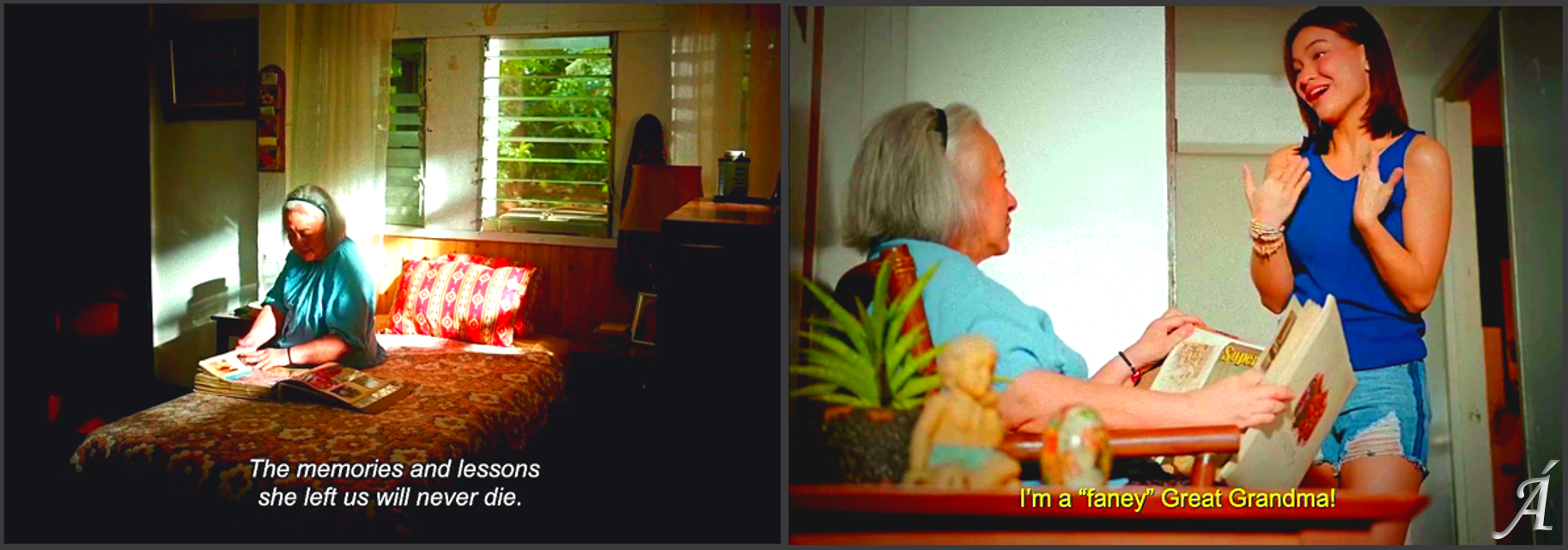
Left: Milagros (Laurice Guillen), hearing the news about Nora Aunor’s death, goes over her collection of Noranian memorabilia. Right: Bea (Althea Ablan), discovering her great-grandmother’s devotion, introduces the word “faney,” contemporary slang for fan. [Faney, Frontrow Entertainment, Intele Builders, Noble Wolf, AQ Films; screen caps by author. Click on pic for clearer images.]

The reverberation of a life after one has died is no longer new because of the dissemination of media-generated popular culture. It should be no surprise that the departure of Nora Aunor has affirmed what film critic and Jefferson public service awardee Mauro Feria Tumbocon Jr. described as “a subgenre yet to be named, where Aunor plays herself as singer-performer” – except that in the recently released Faney, she no longer exists in our world. The film, part of a substantial list of works already completed (some with her still alive in them), is evidence of how intensively she focused on the legacy she wanted to leave behind: not in terms of trophies or material wealth, but in the record of solid performances that she became known for since her emergence as the country’s most capable actor in the 1970s.

Recovering from the shock of hearing the news, Milagros “remembers” her idol by performing highlights from her favorite Aunor films – left, Bilangin ang Bituin sa Langit (1989, dir. Elwood Perez) and right, Himala (1982, dir. Ishmael Bernal). [Faney, Frontrow Entertainment, Intele Builders, Noble Wolf, AQ Films; screen caps by author. Click on pic for clearer images.]

11011Faney also testifies to how carefully she cultivated artistic alliances, with Adolfo Alix Jr. taking the place of Mario O’Hara, whose untimely demise from leukemia she mourned openly. Alix was more prolific than O’Hara and already had a few noteworthy projects when he and Aunor first collaborated, but again like O’Hara, his growth trajectory found a grounding that it had been seeking out. Part of the confidence he needed was provided by Aunor herself, since her sheer presence in any type of undertaking always assured, at minimum, an exceptional delivery and a sense that she’d intervened in the project not for highlighting or glamorizing herself, but for enriching the text’s sociopolitical possibilities.

Back to top

Left: Outside the funeral parlor of Aunor’s wake at Heritage Memorial Park, Pacita M. (Roderick Paulate) accosts an interloper whom he recognizes as belonging to a rival camp. Right: After a sabunutan (hair-pulling contest), the rival’s toupee comes off, which Pacita M. then treats it like a washer in sipa (a native footbag-like game). [Faney, Frontrow Entertainment, Intele Builders, Noble Wolf, AQ Films; screen caps by author. Click on pic for clearer images.]

11011One byproduct of her renewed productivity, after an extended sabbatical in the US, lies in the number of industry participants who had been formerly indifferent, sometimes even hostile, toward her. Faney features a comic turn by Roderick Paulate in his famed Rhoda persona, playing a devotee who’s accused by another fanatic of betraying a rival star, with whom he erupts in a hair-pulling contest. The character who first mentions the film title is played by Althea Ablan, who’s typically millennial in her adulation of a fictional boy band, while her grandmother is essayed by long-time Aunor associate Gina Alajar, serving as the voice of caution regarding her own mother’s overwhelming, decades-spanning fanaticism.

Left: Wandering on the memorial park grounds, Milagros runs into Edgar (Bembol Roco), with whom she has a wordless, inconclusive confrontation. Right: Ian de Leon, Nora’s biological son, who thanks the mostly elderly fans who showed up at Heritage, is embraced tearfully by Milagros, with Bea realizing that Noranian fandom has been more enduring than her own K-pop fanaticism. [Faney, Frontrow Entertainment, Intele Builders, Noble Wolf, AQ Films; screen caps by author. Click on pic for clearer images.]

11011The great-grandmother on whom the narrative turns (described as “emotionally wrought yet effective” by film expert Jojo Devera[1]) is embodied by Laurice Guillen, who springs a few surprises with her presence. She’d trained in theater, as Paulate also did, and where Aunor once immersed in productively: anyone fortunate enough to have seen this trio in their respective stage appearances would instantly understand why theater’s any actor’s true medium. But after several film directors, including the otherwise reliable Lino Brocka, could not maximize her performative potential, she found her own footing when she ventured into film directing. The first jaw-dropper is in how she never had any solo-lead film roles all this time, with Faney constituting only her third, after Jay Altarejos’s Guardia de Honor last year and Alix’s Karera in 2009. The more startling revelation is how perfect she turns out to be for the part, as if all the years of being kept from disclosing her full store of histrionic talent enabled an outpouring of, to use the proper descriptor, Noranian proportions.

Back to top

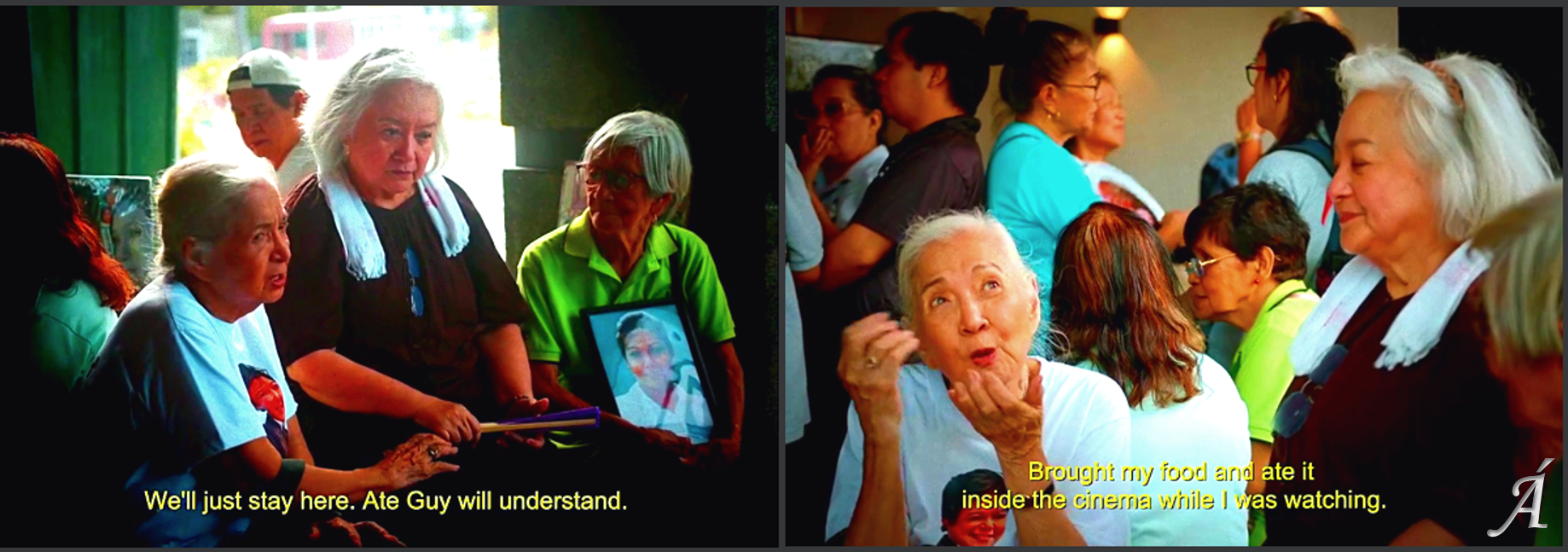
Left: Informed that the parlor will have to close early for that day, the fans decide to continue waiting outside. Right: After Milagros says that she accepted any actor paired with Aunor, Lola Flor (Perla Bautista) says that she preferred the blockbuster Guy & Pip (Tirso Cruz III) love team most of all and describes how she would stay all day in the movie house and made sure to eat without taking her eyes off the screen. [Faney, Frontrow Entertainment, Intele Builders, Noble Wolf, AQ Films; screen caps by author. Click on pic for clearer images.]

11011Only favorable results can arise out of such an approach. The film’s few technical imperfections can be overridden by such an all-infusive display of prowess, with several introspective moments held fast by the eloquence of her appearance: where Aunor made her eyes speak volumes, Guillen deploys her entire face – an even more effective mechanism, truth be told. Her penultimate silent moment is when she encounters a male contemporary who we also see for the first time, and no words need to be uttered for us to deduce that he had shared a past with her. This also serves as a throwback to the climax of Aunor with Vilma Santos in Ishmael Bernal’s Ikaw Ay Akin (1978), which is not the only reflexive moment in the film. In fact the entire outing offers a cornucopia of references for any avid pop-culture follower, starting with the aliases the followers give themselves – “Bona” for Milagros (Guillen’s character) and “Pacita M.” for Paulate’s hell-raising smarty-pants – as well as wisecrack exchanges that sound increasingly familiar until the characters declare the titles of the source films.

Left: Still lighthearted, Pacita M. narrates a low point in his life, when (like many Noranians) he had to work overseas and be unable to see Aunor in person for several years. Right: Milagros returns with her granddaughter Babette (Gina Alajar) and Bea to visit Aunor’s grave at the Heroes Memorial Cemetery. [Faney, Frontrow Entertainment, Intele Builders, Noble Wolf, AQ Films; screen caps by author. Click on pic for clearer images.]

11011But it’s in the self-owned silent moments where Guillen makes her mark. The first one, when Milagros hears the news of Aunor’s death and brings out her memorabilia collection, sets the tone of melancholy over loss and aging with the comic undercurrent of insistent, undying obsession. The last one, where she stands with her family over Aunor’s grave and gazes in the distance, will reward any open-hearted viewer with an unexpected moment of grace that doesn’t have to be spoiled in a review. Just make sure to allow Faney to make the mark that Aunor left for us to savor.

Note

First published June 14, 2025, as “Laurice Guillen Is a Devoted Nora Fan in Tribute Film Faney,” in The FilAm.

[1] Devera also provided a later insight, confirmed by the director, to account for how the film was able to make the most of the presence of crowds at Heritage Memorial Park as well as the prevalent air of melancholy that descended on the city: Alix conceptualized and cast the film as soon as the news of Aunor’s death broke out, and took the actors to the relevant locales during the period of her wake.

Back to top


Counteractive

Kontrabida [Villain]
Directed by Adolfo Borinaga Alix Jr.
Written by Jerry B. Gracio

After completing work on Kontrabida, Nora Aunor was finally declared National Artist, minus the execrable intrusion of any political leader or showbiz rival (essential disclosure: in June 2014, The FilAm was the first publication to criticize the ill-advised decision by President Benigno Aquino III to drop her name from the list of submissions). What should have been happy news, however, turned out distressing for her followers: she endured a severe medical emergency, declared dead at one point but revived through the intervention of an understandably panicked health team.

Anita as a haughty society matron, in her opening dream sequence. [Screen cap from Kontrabida, courtesy of Magsine Tayo!]

Back to top

11011Kontrabida might therefore be the last opportunity to watch a consummate Aunor film, although the hesitation of casual viewers would be understandable. Its director’s track record has been spotty, and the Metro Manila Film Festival’s consistent rejection of its participation is reminiscent of its judgment on her own auteur project, Greatest Performance, in 1989. Yet what traces remain of GP suggest an ambitious and exemplarily performed work, one of the MMFF’s gravest missteps in a long list of embarrassments. Kontrabida’s an even more egregious instance of insider politicking and institutional negligence.

11011Any initial viewing will instantly distinguish the film as reminiscent of Aunor’s case history during her peak premillennial years, when filmmakers would be able to realize significant achievements by simply having her on board; her skills in streamlining, clarifying, and amplifying character attributes was (and remains) second to none, ascribable to her intensive experience in creative processes and immersion in her compatriots’ sociological concerns. Kontrabida has also turned out to be her first millennial project that references her stature as queer icon, resisting the typical indie practitioner’s tendency to recognize her considerable store of gifts by unnecessarily pedestalizing her.

Jaclyn Jose as Dolly, a devoted fan of Anita. [Screen cap from Kontrabida courtesy of Magsine Tayo!]

Back to top

11011The best way of extracting the film’s potential would be by focusing on the persona that she proffers, inasmuch as Aunor appears in every scene. Early in the plot, her Anita Rosales prepares to dispose of the bric-a-brac she accumulated as a movie supporting player, including her only acting trophy. Any devoted Philippine cinema observer would readily recognize that the object happens to be Anita Linda’s only Maria Clara award, the first institutional prize ever handed out for local film achievement. A fan of hers shows up to purchase it, and it turns out to be played by the recently departed Jaclyn Jose – who professes so much devotion that she decides to return the item to its owner.[1]

11011The parallelisms with film history are profound and moving, yet unobtrusive enough to remain hidden for those who prefer to ignore them. Aunor was the actor who set out to challenge Linda’s First Golden Age stature as the country’s greatest performer and succeeded due to her marshaling of her own privileges as the most successful star in Pinas cinema as well as the upgrade in resources and sensibility of the Second Golden Age; Jose meanwhile carved out her own niche in depicting characters ravaged beyond redemption by poverty and managed to snag the much-coveted Cannes Film Festival best actress prize in the process.

Anita comforts her intellectually challenged neighbor Jai after his father went berserk during his mother and her new partner’s wedding. [Screen cap from Kontrabida courtesy of Magsine Tayo!]

Back to top

11011Linda had been gone by the time Kontrabida was made (her final starring role was also in an Alix film), but neither Aunor nor Jose, just like Linda before them and unlike a long list of their contemporaneous performers, make an effort to recapture their appearance during their Golden Age glory years. The weight they put on, the wrinkles, lumps, and veins on their faces, their slower movements and weaker physical capacities – all affirm their lifetime aspiration to enable their audiences to identify with them. In this instance, they constitute a redefinition of glamour for those who care to ponder on these matters: that it might mean conforming to a near-unattainable youthful ideal for the vast majority, but it could also mean the fulfillment of long-cultivated potential offered for widespread and long-term public consumption: talent, to paraphrase Pauline Kael, will always be a surer guarantee of glamour.

11011Alix of course had collaborated long enough with Aunor to be able to provide unintrusive details that function like humor devices, and then some: Anita begins by slapping someone in her high-camp dream where she plays a society matron, but gets slapped symbolically by her working-class existence in a crisis-ridden administration; she may have retained ownership of her acting trophy, but we eventually get to see how Aunor herself regards these empty symbols of triumph;[2] she lives in a world where those who recognize her adulate her for her past attainments, but she pays the closest attention to people taken for granted by everyone else.

After helping her rehearse for her comeback role, Ramon asks Anita to dance with him. [Screen cap from Kontrabida courtesy of Magsine Tayo!]

Back to top

11011Toward a later part of the film, Alix introduces Bembol Roco, one of her few male contemporaries who has perfectly understood that one must complement Aunor in order to survive a scene with her, in the role of her infirm ex-husband Ramon. The exchanges of scripted lines between them play on their characters’ real-life circumstances and display the warmth and collegiality that their long-time immersion in Philippine film culture has enabled. Anita then forms a pistol with her fingers and aims it at Ramon, then reflexively remarks “bad acting” about herself. The gesture’s payoff is earth-shattering but doesn’t have to be spoiled in a review. Kontrabida nonetheless deserves to be watched for all the tremendous pleasure and pain that the full life of a genuine film artist has brought to the project.

Notes

First published November 18, 2024, as “Nora Returns Minus the Glamour of the Glory Years,” in The FilAm.

[1] Dolly claims that Anita turned her life around by inspiring her to avenge herself on her wrongdoers. In her real-life career, Jaclyn Jose became a much sought-after camp presence in TV drama by specializing in comically snobbish aristocrats, similar to the characters that Anita dreams that she portrays, but directly opposed to Nora Aunor’s actual movie persona.

11011Her first significant interview was titled “Walang Bold sa Langit [Bold Not Allowed in Heaven]” (1986), conducted by Ricky Lee, retitled “May Bold Ba sa Langit? [Is Bold Allowed in Heaven?]” and reprinted in his 2009 anthology Si Tatang at Mga Himala ng Ating Panahon: Koleksyon ng mga Akda or Old Man and the Miracles of Our Time: Collection of Writings, pp. 70-74). In it, Jose mentioned watching Ishmael Bernal’s Himala [Miracle] (1982) for her lesson in acting excellence and described how she wished she could perform on the same level that Nora Aunor had demonstrated, attaining maximal impact via the smallest of gestures. A final Noranian intertext occurs in Emmanuel Dela Cruz’s 2005 film Sarong Banggi [One Night], where Jose’s character, also named Jaclyn, professes fanaticism toward Aunor, her fellow Bicol-born native. (Thanks to Deo Antazo for this vital recollection.)

Nora Aunor on the set of Kontrabida, with Anita Linda’s memento. [Photo by Adolfo Borinaga Alix Jr.]

[2] I am indebted to critic-archivist Jojo Devera, not just for providing access to Kontrabida, but also for pointing out the function that Anita Linda’s Maria Clara trophy signifies in the plot of the film.

Back to top


First Blush

Unang Tikim [First Taste]
Directed by Roman Perez Jr.
Written by Mariane Maddawat

Launched during the start of the current decade, the Vivamax arm of Viva Films swiftly dominated the subscription streaming services of Philippine cinema and never let up since. The answer will be obvious to anyone who checks out Netflix and several other so-called over-the-top (meaning bypassing middle agencies) services: specialized products, less costliness for the consumer, absence of censorship. It also doesn’t take a lot of figuring out to determine what material the service focuses on, which is what the majority of homesick overseas kabayans demand – sex, as much as the average film presentation can contain without devolving into gonzo pornography, softcore style.

11011Philippine-based recognition mechanisms still have to give Vivamax its due,[1] but an American film festival, the FACINE International, already gave its grand prize last year to Lawrence Fajardo’s Erotica Manila: Foursome, a concatenation of TV-style shorts. Its gold winner for short film was a hard-hitting satire titled “How to Make an Effective Campaign Ad,” directed by Roman Perez Jr., who also took charge of the first theatrically released Vivamax project, titled Unang Tikim (literally First Taste, officially translated as First Time).

The first couple, Yuna and Becca. [Unang Tikim, Pelikula Indiopendent & Viva Films; screen cap by author]

Back to top

11011So far the film has attained the stature of moderate box-office performer, running into its second week in selected venues – certainly a far more preferable fate than the usual theatrical flop that characterizes even major releases nowadays. More surprising is the type of theme tackled by Unang Tikim: sex, as expected of a Vivamax production, but with the primary relationship transpiring between two women. To be sure, positively depicted lesbian narratives are not new to Philippine cinema, although they occur with far less frequency than gay-male stories. Marilou Diaz-Abaya, the first woman-filmmaker National Artist, arguably started the trend in 1986 with Sensual, also a “bold” (or sex-themed) venture like Unang Tikim.

11011The primary points to make regarding other early attempts at recuperating same-sex love stories between women is that first, they were mostly featured as subplots in straight-centered narratives; and second, they had to contend with the usual homophobic demonization of gay women in local releases. (I can only remember one other premillennial release, Mel Chionglo’s I Want to Live from 1990, as another woman-positive presentation; an earlier “event” movie, Danny L. Zialcita’s T-bird at Ako [Lesbian and Me] from 1982, resorted to visiting violence on its lesbian character, although it nevertheless features a sharply observed turn from another National Artist, Nora Aunor.)

The rival couple, Yuna and Nicco. [Unang Tikim, Pelikula Indiopendent & Viva Films; screen cap by author]

Back to top

11011The digitalization of film production during the millennial era brought with it a number of well-realized women’s love stories, most of it from independent producers, with Sigrid Andrea Bernardo’s 2013 Ang Huling Cha-Cha ni Anita (Anita’s Last Cha-Cha) standing out for being a coming-of-age tale, the distaff counterpart of Aureus Solito’s Ang Pagdadalaga ni Maximo Oliveros (The Blossoming of Maximo Oliveros) from 2005. In a remarkable category all its own is Joel Lamangan’s Sabel, a 2004 film based on the seemingly incredible though real life-based odyssey of a woman who started out as an easy-going teenager, entered the nunnery after giving birth, married the prisoner who raped her, then emerged after a long disappearance as a rebel warrior committed to a female spouse. (Sabel and I Want to Live were both scripted by yet another recent National Artist, Ricky Lee.)

11011Unang Tikim constitutes a throwback to the earlier sexualized treatments of lesbian film narratives, with one character’s bisexuality providing the crisis in the plot. It also desists from dealing primarily with “developments” in which one or the other character suffers physical homophobic retaliation – possibly a lack when we inspect actual lesbian stories, but strangely affecting in this case because of the respite it provides from the usual judgmental approach. The fact that Perez, in less than a decade of practice, has overseen well over a dozen film projects, alongside Vivamax’s determination to mount a widescreen-worthy attraction, has resulted in a work of ineffable sensuality and beauty.

Held by Nicco, Yuna finds support from Becca. [Unang Tikim, Pelikula Indiopendent & Viva Films; screen cap by author]

Back to top

11011What must have added to non-Vivamax viewers’ fascination is the fact that an impressive stable of talents has been residing in the studio – most of them necessarily excluded from mainstream TV-centered programs because of their readiness to bare flesh and engage in activities that may be considered less-than-wholesome, to put it mildly. The film embraces the central female couple’s class difference and even occasional bouts of rage alongside their expressions of passion, but always with a tenderness in its approach to their pain; when such respect for the humanity of Others is extended to the male interloper in their story, that kind of treatment makes total sense in the course of the unfolding of their difficulties.

11011The only complaint one might raise about Unang Tikim is how the measure of its throwback is too far off in the past,[2] so that the complications provided by more recent lesbian film romances seem to be way in advance of the characters’ fates. As if to dig in further, it provides a closure that nearly elevates its realistic material to the realm of the fantastic. But in terms of a narrative tradition that cannot boast of having enough happy endings, what the film purveys deserves to be regarded as an intervention worth maintaining.

Notes

First published August 23, 2024, as “A Lesbian-Positive Film” in The FilAm.

[1] On August 18, 2024, after I had drafted and submitted this review to The FilAm for publication, the Young Critics Circle announced that they were nominating Lawrence Fajardo’s Erotica Manila: Foursome, the same aforementioned FACINE gold prizewinner, for their Film Desk’s annual competition in all their available categories except first film. One of the few instances where I was glad to be proved wrong by my homegrown colleagues.

[2] Upon the filmmaker’s recommendation, I watched a previous film he made, titled Sol Searching (2018), and was appalled at the critical negligence it suffered, despite its clear superiority to nearly all the other titles released during the same period. In a social-network post, I speculated that this may also have been due to the work’s throwback properties, reminiscent of unpolished celluloid material as well as the “developmentalist” media policies of the early martial-law period during the presidency of Ferdinand Marcos Sr.

Back to top


Afflictions

The Hearing
Directed by Lawrence Fajardo
Written by Honelyn Joy Alipio

The twentieth edition of the Cinemalaya Independent Film Festival actually featured a number of entries that betokened its coming of age, inevitably disappointing certain sectors who would have preferred more of their type of cinema than see other samples being given equal time. One could construct a formal spectrum ranging from documentary to mainstream-starred feature and find various netizen voices clamoring for each one while deriding all the rest as unworthy of inclusion.

11011This may actually be a positive indicator of the event’s inclusivity (or its cynicism, if one were to adopt a more negative stance). Each of the entries was marked by its configuration of what “independence” meant for its own specific application, with the real-world intimidation of an entry that had to be consequently pulled from exhibition effectively rupturing the limits of this mode of practice: Lost Sabungeros, a documentary on 36 missing cockfighting enthusiasts, was announced as cancelled without any definite reason, fueling speculation regarding the intervention of prominent business and/or political figures implicated in the report’s findings.

11011Having no direct access to any screening, I can only provide cursory notes on critical responses to some of the entries as well as provisional commentary on one text made available by its production group. Advocates for reality-based film production have glommed onto Alipato at Muog (Ember and Fortress), directed by JL Burgos, about the well-known abduction and disappearance of his brother Jonas in 2007. Hysterical responses have also been expressed regarding Kip Oebanda’s Balota (Ballot), on the adversity endured by a public-school teacher tasked with delivering election results, played by deglamorized TV and movie star Marian Rivera (“the masses are stupid … putangina” went one contradiction-laden writeup). Several other commentators who foregrounded their ideal of neorealist-inspired indie practice (i.e., no professional performers, narrative drawn from real life, advancing a social problem that proper legislation could solve, if only) endorsed Richard Jeroui Salvadico and Arlie Sweet Sumagaysay’s Tumandok, on a Visayan Ati community’s struggle to raise funds to legalize their land claims.

Back to top

Lucas stares accusingly at Father Mejor, with the other townspeople unaware of the tension. [The Hearing, Cinemalaya, Pelikulaw, & Center Stage Productions, screen cap by the author]

11011As it turned out, The Hearing, the only entry to which I was granted access, embodied some of the most problematic responses in the commentaries of festival observers. No one denied the timeliness and urgency of its message, yet even its most enthusiastic responders couldn’t get over the fact that it wasn’t as polished as a feature film ought to be.[1] Its exceptional condition reminded me of an entry during the 2008 edition, Ellen Ongkeko-Marfil’s Boses (Voices), which was the festival’s only advocacy film – and the only movie excluded that year from a festival prize. That period of over a decade and a half in the past was certainly more saturated in indie idealism, with a self-declared film authority dominating the since-suspended Cinemalaya Film Congress in order to ensure that any hint of mainstream accommodation be exposed, denounced, and sidelined.

11011The Hearing will certainly bear close scrutiny as a bellwether of how far attitudes have shifted, if they ever did at all. So far, film analysts still feel stumped by their standard academic preparation in evaluating a work according to its several elements – a vexatious paradox, to say the least, since all those elements had already been brought together in order to arrive at a finalized work. The key to approaching such a film is in recognizing how its function as an advocacy piece aligns it more closely with the documentary than with feature-filmmaking tradition. As such, any viewing pleasure it provides will only happen to be coincidental.

Back to top

Asked to demonstrate how the violation occurred, Lucas relives his trauma all over again. [The Hearing, Cinemalaya, Pelikulaw, & Center Stage Productions, screen cap by the author]

11011The mise-en-scène immediately makes this purpose apparent. In keeping with its reduction in resources, the film’s characters are situated front and center, with the camera functioning as conversation partner. The strategy motivates the verbal exchanges, as it would in a regular feature film; but since the main character is speech-and-hearing impaired, his point-of-view shots are rendered with severely muted sounds, wherein his companions take time to use gestures or request sign-language users to convey their statements to him. The fact that the film refuses to violate his infirmity by, in effect, jump-cutting to the verbal articulations of his companions demonstrates how this type of advocacy filmmaking upholds the documentary project in accepting what historical reality has provided. We (as audiences) will just have to find our filmic pleasures in other ways.

11011The film also acknowledges the narrative’s real-life origin in skipping over the character’s judicial triumph – a gift of a grand jump-cut if there ever was one. We witness the siblings attempting to amuse themselves, and their parents taking in their children’s happiness while demonstrating some anxiety over a future in which they had isolated themselves from the largesse provided by clerical privilege; devastation eventually arrives in the form of statistical information flashed right before the closing credits. The Hearing offers no easy way out for its audience, inasmuch as its own characters had none of their own either. What it provides in exchange is the close, admittedly uncomfortable, association with the kind of person we would normally take pains to avoid if we could. The few sad moments it extracts ought to count as fair exchange.

Note

First published August 12, 2024, as “An Unpolished Film with a Timely Social Justice Message” in The FilAm.

[1] In February 2025, Lawrence Fajardo completed a tuned-up version of the film, effectively reducing its running time by about ten minutes. This may be considered the equivalent of a (so far unannounced) director’s cut. See the reconsidered review by Jojo Devera, “Passion and Compassion,” in his Sari-Saring Sineng Pinoy blog (uploaded February 13, 2025).

Back to top


Corrosive Criticism

Last month’s just-concluded Cinemalaya Philippine Independent Film Festival, the first after a full year of the presidency of Ferdinand Marcos Jr., yielded a few controversies, the latest of which was centered on the pullout of a politically themed film from the opening ceremony – allegedly because it was censored (per political sectors), or possibly because seven hours was too long to wait out a ceremonial entry (per festival organizers). This would not be surprising, considering that the pre-ousted Marcos family was known to be the most culturally obsessed among Philippine presidential administrations; although truth be told, at the peak of the Marcos Sr. presidency, any politically (and even sexually) daring movie would have been shown at the government’s Manila Film Center venue without anyone bothering to bat a false eyelash.

11011Prior to the current uproar, a commotion over a social-network film reviewer boiled over and took much longer to simmer down. In fact the said reviewer had already been writing for over a year, but the only filmmakers who objected were the ones working for a streaming outlet specializing in sex-themed material. (Personal disclosure: I acceded to several friends’ request to criticize the reviewer and uploaded an article to my blog, my first this year, for that purpose; see “Anonymity & Its Discontents.”) This for me remains the key to the trouble that the festival had with this specific evaluator. The participants – artists, readers, even the reviewer himself – operated from not just an outmoded but also a long-unworkable set of assumptions. No wonder no resolution could be worked out.

11011The premise I’m referring to is the one on which the entire concept of Cinemalaya rests: that of identifying and subsidizing a vanguard of “best” emerging film artists. The necessarily politicized process this generates can be tracked to a well-intended system of adequate training – way back when no such option was available in the country; so even from the start, only aspirants who were sufficiently privileged because of class and/or nationality could actually achieve the necessary qualifications. Meaning it was never sufficient to just be talented and motivated; some form of social entitlement (wealth, foreign training, industry contacts) would more often than not prove more effective. To better articulate the criteria and identify those who best exemplified the worthiness of outstanding aspirants, elite institutions – government and education, conveniently overlapping in the national university – volunteered to make their presence palpable.

Back to top

11011What this led to was a clutch of spectacles by which film commentary would be nearly exclusively identified: annual exercises, in the form of festivals, that showcase entries preselected by supposedly discriminating evaluators, plus sets of prizes either for this closed system or for the entire industry, nearly all of which enact a dramatic process that can still occasionally prove captivating and suspenseful. Said process begins when a group of “deserving” talents would be announced, from which a circle of self-proclaimed authorities would eventually declare (during “normal” conditions) one winner. One can see how entrenched this mentality is when several sets of academe-based groups continue to follow this annual ritual despite supposedly being more alert to its deleterious effects, starting with fostering divisiveness in the community of artists.

11011Hence the fascinating particulars of the Cinemalaya brouhaha, where the aforementioned Facebook reviewer provided rankings for the competition entries, culminating in an alternate set of awards. The complaints predictably came from filmmakers whose works were given low grades, with attendant unflattering commentary. What made this response dubious on its face is immediately evident: would they have voiced any objection if they were given higher evaluations? Earlier outed as singular and biologically male, the reviewer himself posted his rationale – that since film screenings are costly, he’s providing a service to the general public by assessing for them which entries he believes are worth watching and which ones should be shunned.[1]

11011A more sensible set of comments focused on the reviewer’s six-plus scoring system (from zero to five stars), which he had earlier expanded to include negative numbers. At some point, he wound up with a negative-infinity score for a movie he regarded as the worst, then realized that another movie was even worse and awarded it with a square root of negative-infinity score. This attempt to display mathematical competence is innumerate to anyone with a casual familiarity with basic principles in the field.[2] The actual issues, which everyone missed out on, is also what the entire existing system of film evaluation fails to do. First, determining film worth according to quantifiable standards of art, or relevance, or morality, no longer really matters as much as figuring out the issues that generated the work and how its audience responded to it. Hence the reviewer’s attempt at further refining his criteria (the equivalent of the award-givers’ categories) is a step forward … in the wrong direction.

Back to top

11011Second, which was the topic I’d posted about earlier, by presuming to write about practitioners who have no option except to announce their identities, the reviewer will have no ethical justification for insisting on his anonymity. Is the country under a system of colonization or fascism, when underground literature historically became indispensable? Or are the film practitioners capable of criminally endangering those who criticize them? These are only rhetorical questions, of course. The non-rhetorical one is: why is the community of publicists protecting this reviewer’s identity, and why are the complaining artists not seeing anything anomalous about this? The scary answer is – because they all agree that film evaluation can only be expressed one way, by ranking one another, and the more difficult scientific and cultural work doesn’t have to get done. The ultimate winner here is none other than our reviewer-ranker, the one who (in a better world) deserves to be positioned at the bottom of the heap, representing the award-giving critics who can laze around and write unthinkingly and assert their power over industry practitioners when the season for holding their trophies aloft arrives once more.

Notes

First published August 31, 2023, as “Film Critico Incognito” in The FilAm. The specified social-network critic took down all the posts referenced in this article. I am maintaining the current piece as a cautionary example, since in this type of instance, a vacancy left by anyone who attained virality can be easily replaced by some other interested party.

[1] This ranking system was first propagated by a member of the Filipino Film Critics Circle in the 1970s-80s, so it makes sense that other members of this group will be tolerant, if not supportive, of this reviewer. Anyone sufficiently familiar with this system will readily see how cultural products of all types are notoriously irreducible to preordained criteria. The most artistically innovative ones, in fact, demand that their evaluators observe a new set of standards, while the most popularly successful ones demand an entirely different set of approaches premised on historical conditions.

11011In fact, the Cinemalaya outcry echoed an earlier quarrel, this time between the reviewer and Marcos-family hagiographer Darryl Yap. With an army of fanatical followers of his Vincentiments page, Yap was able to lodge enough complaints against the reviewer to get the latter’s page suspended on Facebook. He also posted a photograph of the reviewer’s masked face but desisted from identifying him by name (presumably easily accomplishable by referring to the guest list of any screening attended by the person he wanted to denounce). The reviewer, meanwhile, frantically uploaded material supportive of Bongbong Marcos’s then-already defeated adversary, Leni Robredo.

11011Other close observers have similarly pointed out how the reviewer exhibits biases favoring certain queer or Chinoy filmmakers; whatever the implications of these preferences, the reviewer’s insistence on shielding himself from further inspection places him in an unearned special category, elevated in his own mind and possibly those of other publicists, critics, artists, and his own set of social-network fanatics, all of whom seem to accept his anonymous stature as a right only he had earned one way or another. More disturbingly, in terms of pandering to their respective admirers, Yap conducts himself with relatively more dignity and confidence, despite having to contend with more persistent trolls.

Back to top
[2]
The reviewer’s technical troubles begin with his ranking scheme: since he initially awarded anywhere from zero to five stars, he would write a specific score out of five (from 0/5 through 5/5). In overstepping these arithmetical specifications by providing negative points, his goal was obviously to demonstrate greater distance from the lowest possible value, which is 0/5 or zero. Negative-infinity, however, can be conceptually proved to be no different from infinity (which is why it is extremely rarely invoked in real-world applications, e.g. astronomy or nuclear physics), while the square root of a negative number would be an impossible value. But if we assume that a square root of a number can be taken before turning it negative, then because of the negative placement, the supposedly smaller value is actually larger: say our limit of infinity is 9 (and therefore -9 is negative-infinity); its square root is 3, which then makes -3 actually closer to zero and therefore higher than -9. So the intended lower value (square root of negative infinity) is demonstrably higher than the value that purportedly diminishes it (negative infinity).

11011More deplorable than this abstractional weakness is the reviewer’s moral failure in posting insulting or abusive comments against the films he regards as unworthy of his high scores. Not surprisingly, his followers find this behavior delightful, thus further inciting their pseudo-expert’s immature conduct. Yet again, the educational training of a school population encouraged (even by purportedly progressive educators) to regard pop-culture artifacts as deserving of dismissive treatment results in such lumpenbourgeois spectacles. Lost in this cheap grasping for maximum virality is the reality that any industrial undertaking in a developing country will always be under threat of collapse, with any number of breadwinners facing the possibility of resorting to more desperate forms of fund-raising as a result. In short, regardless of the ranking that any critic assigns to any completed film, the recuperation of its investment will mean, first and foremost, that its workers can continue to hope in the prospect of a follow-up project. From this perspective, any critic who aims to impede this drive for productivity deserves to be regarded as no better than an antiproletarian henchperson.

Back to top


Crinkled Lives

Erotica Manila: Foursome
Directed by Lawrence Fajardo
Written by Lawrence Fajardo, Jimmy Flores, & Miguel Legaspi

Pinas fanboy film culture must have worn itself out, or else we’d be hearing lamentations about how our filmmakers have started regressing. After several contemporary talents made their names with increasingly longer modernist works, we now find their successors focused on shorter-length material, sometimes even geared toward televised or streaming platforms. But thank goodness for the dissipation of high-art pretension, or we wouldn’t be able to recognize how some of our best and brightest have been able to respond to the challenge of encapsulating entire narrative worlds within delimited timespans.

11011The possibility was first raised when Erik Matti announced that his sequel to On the Job (2013), titled On the Job 2: The Missing 8 (2021), would be adapted into a six-part miniseries for HBO, with the original film comprising the first two episodes. Then last year, the best entries to the first ShoutOut short film competition were compiled into a two-hour anthology, slated for exhibition at this year’s Cinemalaya Philippine Independent Film Festival. (Essential disclosure: I was chair of the board of jurors that evaluated the films and provided prizes and citations for outstanding titles and participants.) Titled ShoutOut Pinas 2022, the omnibus work is reminiscent of the 2020 anthology Septet: The Story of Hong Kong, where seven filmmakers provided historical dramas covering specific decades in the former British crown colony’s history. [Update: A recent discovery uncovered a now-lost local title, Wanted: Johnny L (1966), which had, like ShoutOut Pinas 2022, five directors participating: Cesar Amigo, Gerardo de Leon, Eddie Romero, Cirio H. Santiago, and Teodorico Santos.]

Film buff (Alex Medina) and pickup girl (Azi Acosta) exchange notes during a screening of Celso Ad. Castillo’s erotic classic Isla. [Erotica Manila “Cinema Parausan” screen cap]

11011One might be able to conjure up the riskiest possible combination for this type of project: a playfully sex-themed series which features minimal interactions among the main characters (since each entry was conceived as an independent featurette), made for the local streaming service condemned by moralistically impelled commentators in social media.[1] Nothing in the content and format of Erotica Manila, a four-episode program still screening at Vivamax, indicates any attempt at formulating any grand or problem-solving social statement. Yet when the filmmaker, Lawrence Fajardo, suggested to film-critic acquaintances to watch the series sans intervening credits – as yet another regular-length movie, in effect – an accomplished entertainment made itself evident, with the promise of further insights affirmed by subsequent viewing.

11011The film that resulted from the concatenated episodes, titled Erotica Manila: Foursome and announced as Vivamax’s intended entry to international filmfest competitions, dispenses the expected turns commonly regarded as weaknesses in standard narrative construction: well before the close of an hour, the focus shifts to the next episode’s primary character, who always happens to be a passerby at the close of the preceding story. Fajardo being Vivamax’s fair-haired inhouse talent (after the apparent departure of the unlamented and unmissed Darryl Yap), carnal fireworks ensue, with unexpected and generally satisfying twists just as the next main character happens along. The agents that the narrative follows are male, but the film’s sexual politics turn increasingly scary, funny, and (unusual for Fajardo) queer, with women providing the plot points on which the stories pivot.

Triumphant cougar (Mercedes Cabral) gloats after bedding a young intern (Vince Rillon) on the set of her latest project. [Erotica Manila “The MILF & the OJT” screen cap]

Back to top

11011The film’s apparent rationale for these shifts – standard in series presentations but usually associated with carelessly developed “trash” material – is its immersion in media activities: from film spectatorship initially, through content management, culminating in actual production, where a predatory older actress preempts her gay directors in laying their horny young assistant. The final episode, set in an urban slum among irregularly employed denizens, might consequently appear to be unrelated to the preceding series; yet its throwback to the poverty-porn trend in Philippine independent cinema makes it the perfect closing material, and then some. The heightened degree of pathos actually masks disturbing sexual-slapstick developments, complete with (technically) a happy ending. The scene where a husband is unaware, while performing in bed, that he’s nailing more than just his wife – these and several other WTF moments actually serve to challenge viewers to LOL if they think they can.

11011It helps to be aware, in approaching EMF, that its director specializes in multicharacter narratives – the Philippines’s most successful practitioner of this fiendishly difficult format since the heyday of Ishmael Bernal. In explaining how he and his coscriptwriters (Jimmy Flores and Miguel Legaspi) conceptualized the project, he initially envisioned a singular intertwined plot. After working out the major lines of action, however, he realized that each one might be misunderstood or trivialized if it were to be juxtaposed with the others, and that the sensational incidents that attend each one would strain the narrative’s credibility if these were presented as simultaneously occuring.

Slum dweller (Felix Roco) feels a revitalized longing for his wife after passing by a sex-film setting. [Erotica Manila “Death by O” screen cap]

11011Those inclined to dismiss the resultant episodic format might want to direct their attention not just to the ancient folkloric texts adapted as an outstanding film series (dubbed the “Trilogy of Life”) by Pier Paolo Pasolini but also to a classic European play, written over a century ago and filmed during mid-20th century as La Ronde by Max Ophüls. With these as reference points, EMF features the same careful attention to plot and character as the latter, while partaking of the graphic and life-affirming bawdiness of the former. Beyond Fajardo’s implicit critique of his multistrand specialization as well as the cunningly parodic handling of standard Noypi “indie” elements, EMF restores a refreshing measure of humor long missing in local sex films since the demise of Celso Ad. Castillo (duly referenced in the opening narrative).[2] With a fairly small team of technical experts sharpened by several years of intensive experience on soft-core material, plus the large stable of attractive and enthusiastic actors that the country’s most successful production house could readily summon, Fajardo has wound up with a heretofore unclassifiable but definitely superior amusement, in many ways his (and Vivamax’s) best output so far.

Notes

First published July 20, 2023, as “Carnal Fireworks in Erotica Manila” in The FilAm. Screenshots supplied by the director.

[1] For essential capsule evaluations of each episode, see the uploads on the Movie Reviews album of the Facebook account of Jojo Devera.

[2] The comedic elements align Erotica Manila: Foursome, alongside the rare sex-themed movies directed by Ishmael Bernal and Celso Ad. Castillo, with the classics of the US’s so-called Golden Age of Porn. Treatments of sexuality in Pinas cinema tend to capitulate to the guilt-ridden prescriptions of Catholicism as well as the antiseptic preferences of high art.

Back to top

Pop for All Seasons

“Balot”
Directed by Marius Talampas
Written by Greggy Gregorio & Ash Vidal

Casanova cornered in “Surprise, Surprise.”

Once in a while popular culture bestows a piece that most of us can take to heart without having to burn our wallets or spend hours to track it down and watch it. The fact that film historian and curator Paolo Cherchi Usai could include “Surprise, Surprise” (dir. Frank Budgen, 1991), a British Airways commercial, in his list of all-time ten-best entries for Sight & Sound magazine’s 2002 survey, demonstrates how canon-formation rules about budget, running time, reception, and authorial talent don’t have to limit our capacity to recognize when a rare exception, originating from nothing but intelligent and intensive cultural assimilation and processing, comes along.

11011The whole point about “Surprise, Surprise,” as those of us who might have seen it on a streaming source have realized, is that despite its “universal” predicament of a two-timer caught in the act, it could be better appreciated by those who could identify more closely with the ad’s audience and their culture, if not those who were situated in the theater where the reflexive event took place. A recent advertising short, titled “Balot” and produced by the still-youthful Gigil Agency[1] for the Philippine branch of Royal Crown Cola, requires even further preparation for those unfamiliar with Philippine culture; those whose encounters span decades will, needless to add, possess greater advantages.

11011Prior to “Balot,” RC Cola was in fact better known for absurdist Japanese-style ad products, always humorous but occasionally lacking in what Noypi pop-culture experts would term hugot (roughly, emo-content). Gigil itself attained some notoriety for a pandemic-themed beauty ad that had PC viewers in fits of (sanitized) hand-wringing, forcing its sponsor to pull out the presentation. “Balot” takes its own share of risks, but these pay off in various degrees of satisfaction, primarily because the creative team opted to wholeheartedly embrace the culture that its target audience presumably shares.

11011It opens with a mother calling her family together as she spreads on the dining table the treats she was able to take home (hence the title, since balot literally means wrapping up) from a neighbor’s birthday party. As she starts taking out increasingly impressive dishes from her bag, a faint breeze blowing on her family’s faces suggests that myth-making is about to take place. When an entire pot of rice is followed by a whole roast piglet, the strains of a fondly remembered movie theme song begin playing, with a somewhat familiar voice crooning the somewhat apt stanza that begins with “Balutin mo ako ng hiwaga ng iyong pagmamahal” (Wrap me up in the wonder of your love).[2]

Back to top

Eken Afuang Matsunaga as Sharon Cuneta in “Balot.”

11011The song continues as party balloons float up from the mother’s bag, followed by the birthday celebrator, a party clown, and finally the song’s singer, Sharon Cuneta. The cultural insight this revelation interplays with is that the act of taking home excess food from a gathering was made less potentially embarrassing by people euphemistically calling it “sharon” – as in “I’ll sharon whatever remains of that later.” When Cuneta herself found out, she good-naturedly hailed and celebrated the appropriation of her name in one of her recent social media posts, in the same teasing spirit that the advert performs. When the extra-large soft drink product is finally taken out and poured, its label descriptor states “Mega Litro,” once more an acknowledgment of Cuneta’s stature as the final multimedia star in Philippine pop culture, prior to its splintering into the several niches that typify millennial-era conditions.

11011In a social-media exchange, Cuneta specialist Jerrick Josue David (not a relation) further explained why the Sharon performance in “Balot” had that touch of the uncanny about it, beyond the narrative’s own marvelous turn. “Bituing Walang Ningning” (“Star without Sparkle,” from the eponymous 1985 film) may have been Cuneta’s most successful movie theme song, but neither singer nor voice in the ad was literally Sharon herself. Like the film as a whole, the impersonation – by drag artist Eken Afuang Matsunaga, with vocals by Leah Patricio – functions as a freestanding star tribute. This proceeds from another Sharonian quality claimed nearly exclusively by the country’s biggest star, Nora Aunor: only these two have on record the presence of drag queens drawn directly from their mass adulators, whose professional careers are premised on replicating their idols’ respective personas.[3] (Sadly, Cuneta’s most famous impersonator, Ate Shawee, passed away during the pandemic.)

11011“Balot” will be capable of sustaining a few theoretical discussions for those inclined to swing in that direction. The fusion of fantastic elements with an identifiably lower-class context could be one starting point, alongside the fearless deployment of narrative elements associated with mainstream (a.k.a. “masa”) aesthetics coupled with a reflexive thrust more audacious than what “Surprise, Surprise” attempted – all packed within a shorter running time. Those who feel guilty about immersing in the manifold pleasures the ad conveys might want to track the points where their educational training made them believe that this element was unworthy of valuation. Perhaps rewatching “Balot,” now or at a later moment, might help clarify these and a few other questions.

Back to top

Notes

First published April 24, 2023, as “Sharon Torch Song Used in Absurd Soda Ad” in The FilAm. Thanks to Grace Leyco, Gigil public relations officer, for providing prompt and comprehensive information. Below is an English-subtitled version.

[1] “Gigil” is commonly listed as one of the several foreign words that describe a universally recognizable condition but possess no singular equivalent in English (e.g. see this posted BBC short video report). It denotes a physiological response – the clenching of one’s teeth and fingers in the presence of excessive adorability or, less commonly, severe annoyance. One of the word’s implications is that the expresser has to control herself or she could wind up hurting the object of cuteness, reminiscent of the hyperbolic English expression “I could just eat you up.” The closest that Western academia has come to describing “gigil” was at a 2013 conference where Yale researchers proposed the term “cute aggression” – see Carrie Arnold, “Cuteness Inspires Aggression,” Scientific American (July 2013). [Update: As of March 2025, the latest edition of the Oxford English Dictionary now includes the word “gigil,” a definitely more useful – not to mention cuter – term than “cute aggression.”]

[2] The English translation of the stanza sung in “Balot” is as follows:

Wrap me up in the wonder of your love
Let it blanket this luster that won’t last
I’d rather be a star that doesn’t sparkle
If I could win your endless devotion instead.

From “Bituing Walang Ningning”
(Willy Cruz, 1985)

[For a larger image, please click on picture.]

[3] A stardom-studies link between the far-and-away two genuine stars of the Philippines’s so-called Second Golden Age of Philippine Cinema, Sharon Cuneta and Nora Aunor, was first articulated by global film scholar Bliss Cua Lim. See “Sharon’s Noranian Turn: Stardom, Embodiment, and Language in Philippine Cinema,” Discourse: Journal for Theoretical Studies in Media and Culture 31.3 (Fall 2009): 318-58.

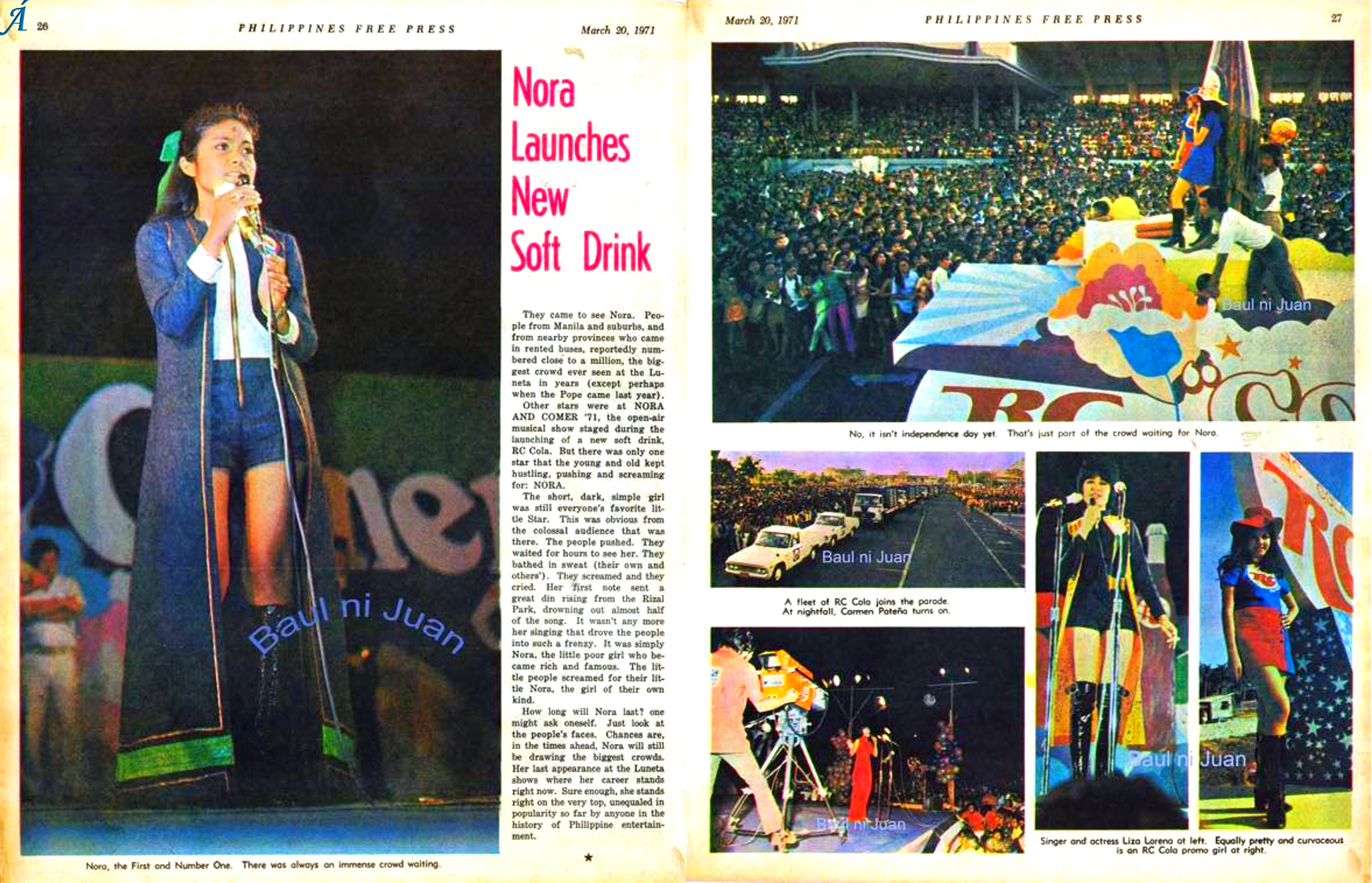
Update: The connection between Aunor and RC Cola turned out to have spanned over half a century. After Gigil Agency released its pop-culture entry for 2024, a less well-received parody of Aunor’s prestige vehicle Himala (dir. Ishmael Bernal, 1982), Mauro Feria Tumbocon Jr. posted an eyewitness account. He recollected that when the softdrink had its Philippine launch in 1971, Aunor, who was tapped to announce the product, “had to be flown in a helicopter just to be onstage on time” inasmuch as “a pandemonium of fans swarmed all parts of the national park in Manila” (Facebook, April 14, 2024). More impressively, the photographs and report that accompanied Tumbocon’s account came out in the March 20, 1971, issue of the Philippines Free Press, the country’s most prestigious periodical, where Nick Joaquin had originally published his culture-changing valuation “Golden Girl.”

Back to top


A Formative Sojourn

The primary difficulty for me in writing this piece is that certain influential personalities are involved. Their ability to strike back (as they once already did) is not what gives me pause. The truth is that they’ve made a number of positive contributions, so I wouldn’t want to override the good they’ve done by providing an account of what they did wrong. I don’t have the expert fictionist’s skill in detailing moral triumph and failure in the same person, so the only claim I’ll make for now is that these were truths whose bases were definitive in my experience, but which I figured out only in retrospect, sometimes after years of doubts and after consultations with colleagues who were in a better position to clarify the issues I was pondering.

11011I’ll make my starting point the now-infamous article where I ascribed the problems of film criticism to the well-intentioned but ultimately calciferous influence of the Filipino Film Critics Circle (henceforth FFCC): it sought to provide a corrective to the corruption-ridden choices of the spurious Filipino film academy (about a half-decade before an actual film academy comprising practitioners’ guilds was formed), but could not extricate itself from the valorization that a supposedly credible awards system provided. My claim to credibility proceeds from the fact that I was once a member of this group, and attempted to redefine my membership to exclude my participation in its awards activity. I was dissuaded by the then-chair (now gone), and I realized, also in retrospect, that the group had no means of recognizing and initiating any activity – say, of advanced learning, which was my goal – that had nothing to do with its annual recognition ceremony.

11011So I strove to function as an unaffiliated critical practitioner, returning to college to pursue the country’s first undergraduate program in film, and garnering a “resident film critic” post in a short-lived weekly periodical (where my initially pseudonymous reviews led to an invitation to join the same critics’ org that I’d distanced myself from, until the group’s contact person uncovered my identity). It also led to my participation in alternative critics’ groups, with other former members as well as active critics who didn’t relish the idea of being identified with the group I left. After completing foreign graduate studies and returning to the Philippines, I was sounded out by all the existing critics groups that I’d been involved in, including (yet again) the FFCC. I decided I could operate better by maintaining distance from these orgs, which was how I was able to formulate my critique of Philippine film criticism’s troubles being derived from the backward and unproductive example set by the FFCC.

11011The members’ response was over the top, although I should not have been surprised. Many of the members were officials at the University of the Philippines Film Institute, which I had set up and led until I left in disgust over the politicking indulged in by these same FFCC members. The then-dean said outright that he preferred faculty who got their degrees locally, like he did – a major hint that he wanted other FFCC members to take over my position; when his long-time ally and writer advised me that I was bound for more trouble if I stayed on, I took advantage of the lifting of the standard two-year travel ban for US-educated scholars and accepted an offer from a Korean university, also to be able to repay my graduate-student loans.

Back to top

11011When my critique lambasting the FFCC was published, the UPFI faculty organized a “roundtable” that I was unable to join because my teaching schedule had already begun. It turned out to be a Stalinist-style denunciation session where the UPFI participants cum FFCC members claimed, in so many words, that they did not deserve to be criticized – without naming me or the article I wrote. The same (now-former) dean who wanted me replaced by colleagues (who could not pass their screening committees because of alleged corruption) said that the most credible critics in the country were the ones who proved their integrity by dispensing awards “that could not be bought” (my translation of his words from the Filipino), in a transcription of a discussion that was subsequently deleted from the journal that reprinted the roundtable’s papers. What remained instead was still a carefully formulated set of specifications of “the qualifications that are necessary to be able to analyze and evaluate films well,” including “A healthy respect for other critics in order to encourage dialogue; and ¶Above all, an attitude of balance and fairness, which is free of all personal agenda and self-promotion.”

11011That of course was an intellectual fallacy premised on an extremely problematic assumption – that “other critics” are automatically worthy of respect and thereby deserve “an attitude of balance and fairness.” The more vital question in so far as my own approaches are concerned is: why was I anonymized? This is not a matter of egotism on my end, as those who know me will be able to attest; rather, it disenables the outside observer from tracking the writer’s source of annoyance and checking out the article I wrote, where I set my argument in no uncertain terms. Typically after the fact, I managed to deduce why the writer had to write that way: to put it bluntly, I’m not the one living in a glass house. In the same issue where the article came out, the lecture by that year’s Plaridel Awardee for Film was published. That awardee was Nora Aunor, who was not the first PAF; that distinction was given to Aunor’s rival, Vilma Santos, during the deanship of the same writer who responded to my critique of the FFCC.

11011In fact, the primary social-network controversy over the declaration of Aunor as recipient of the Order of the National Artist centered on why Santos did not get it at the same time, or even earlier than Aunor. Where did this conceit come from? Followers of Santos would need more than just her record as the first PAF, since Aunor was not only the first FFCC best actress winner but also the first in her batch of performers to win the FFCC life-achievement prize. The source of their clamor is: the FFCC gave more best-actress trophies to Santos, and those for Aunor were often shared with other winners. After years of going over the various historical incidents, in consultation with contemporaries who were also close observers during the period of these two performers’ emergence and rivalry, I concluded that I had enough to provide an explanatory account. It will involve exactly the same critical personality I’ve been referring to, regarded at the moment as the most senior authority among FFCC members, and it will not result in a rosy image. Even then, I’ll have to leave out a lot more supporting details just so we can follow the most basic narrative through-line.

11011Fortunately (in the ironic sense), my tenure with the FFCC covered the years when Santos won her first acting trophy, and followed it with two more in as many years – an FFCC record not equalled before or since. This specific personality I’ve been referring to, an FFCC founding member and former chair and subsequently former national university mass communication dean, was the most enthusiastic campaigner for Santos during this entire period. This caused major expressions of outrage during Santos’s first win, since Aunor was defeated for what was subsequently regarded as one of the best performances in local cinema. In fact the films of both actresses had the same director and scriptwriter, both of whom had been reliable practicing critics; not surprisingly, both expressed strong disagreement with the results. (Personal disclosure: I was the first person to make this declaration regarding Aunor’s output, in an assessment of film performances during the Second Golden Age, which I was also first to name; I subsequently qualified my upholding of both items in updates to the lead article in my first book, The National Pastime.)

Back to top

11011Why did I and most other people not find anything suspicious about this member’s campaigns for Santos? Because, among other things, he had on record an article, typically old-fashioned in its reliance on dualisms in order to uphold orthodox-left principles. The article discussed a set of values in Philippine cinema, stating that then-current filmmaking practice was lacking because of its reliance on spectacle, martyr characters, optimistic narratives, but first and foremost, fair-skinned performers. The oppositions he raised would be easily deconstructible by college freshmen (though not in the Philippines, sadly) but in case we prove incapable of figuring it out, he proceeded to articulate the solutions. The first, of course, was in upholding “kayumanggi” or brown-colored actors, naming Aunor as first exemplar.

11011Fast-forward to the current millennium, after Santos earned her record-breaking FFCC trophies even for performances that were vitally flawed like the first one she won for, and Aunor losing or tying with others during the several decades when she had peaked as performer. Why would this person desist from identifying me when I never hesitated to call out his organization and colleagues for their several problematic actuations? During a casual exchange with a former FFCC member who became a successful scriptwriter with his own gripes against the group, we got to talking about this anomaly and I suddenly made a deduction, which my conversation partner said he was aware of from the beginning. Because what was playing out, specifically with the person in question, was not admiration for Santos, but hostility toward Aunor. This became evident when I thought further back, during the year I first joined the group. Aunor nearly lost her second acting prize – for a film that she had favored for the yearend film festival. The film that she disfavored was the one that the critic in question had scripted.

11011One other conversation I had boosted this new interpretation of events. It was with the only surviving Second Golden Age filmmaker who had never won an FFCC award despite his coming up with the year’s best film at least twice. “They never gave me an award,” he told me, “because of what I did with [the FFCC member’s] script.” He described it as unworkable and even improperly formatted, so much so that he needed to ask a more experienced scriptwriter to help; said veteran writer was associated with non-prestigious commercial projects, so presumably the member felt insulted. This amounted to two people whom the member wanted to penalize, and the FFCC was the means by which he could carry it out. No wonder, after asserting his association with the FFCC and their fairness in dispensing their awards, he needed to be discreet in attacking me. And for the record, I may as well provide the essential conclusion: the relative artistic accomplishments of Vilma Santos and Nora Aunor, among others, were mostly only incidental considerations when it came to the FFCC deciding on whether or not they deserved to win.

Back to top

Á!


The Political Is Personal

“Marcos and Memory: The Past in Our Future”
Sheila Coronel
2022 Adrian E. Cristobal Lecture

One curious development, still within the first quarter of the third year of a history-changing global pandemic, is that the audiovisual material which most Filipino netizens are burring over at the moment is expectedly streaming, but it’s neither a film nor a TV series. It’s the latest installment of the decade-plus Adrian E. Cristobal Lecture Series, sponsored by the Writers Union of the Philippines. Titled “Marcos and Memory: The Past in Our Future,” the material promised topical urgency in the wake of the so-far certain possibility of the Marcos family recapturing the seat of power that their patriarch, Ferdinand Sr., occupied for over two decades and refused to let go until he was expelled by a popular uprising.

11011The Marcos strategy – proffering the only son instead of his smarter sisters – resonates with the Catholicized culture’s belief in a messiah sent by a stern father to point the way to salvation; it also dodges the gender association with the still-alive and possibly already-daft Imelda, notorious during her heyday for her tackily excessive shopping sprees and hatred of anything that reminded her of how dirt-poor she used to be. This is enhanced by the likelihood that the sisters may be in charge of their father’s plundered billions, with Imee exposed when her grandchildren’s names were listed as beneficiaries in the Pandora Papers leakage in 2021, and side reports of the ongoing Credit Suisse scandal reminding readers that the Marcos couple were some of the bank’s most infamous confidential depositors.

Portions of the pseudonymous contracts drawn up with Credit Suisse by the Marcos couple. From Raissa Robles, “How the Law Caught Up with the Philippines’ Imelda Marcos and Her Stolen Millions,” South China Morning Post (November 17, 2018).

11011The Marcos campaign has proved particularly divisive for the generation that was able to participate in the anti-dictatorship movement that became an inexorable force when oppositionist-in-exile Benigno S. Aquino Jr. was assassinated upon his return to the country in August 1983. Those who count themselves as keepers of the democratic flame lament that later generations have been miseducated and incapable of the intelligence and strength of character to resist the Marcoses’ brazen attempt to launder their ill-gotten wealth, if not add a few billions more. A number of people who reversed course point to the post-Marcos administrations’ failure in preventing the reassumption of political influence of sectors that Marcos had started to marginalize, specifically the old oligarchy and the church (exempting pro-US neocolonial compradors, of which even Marcos strove to depict himself as one).

The Marcos regime: at the start (1965 presidential campaign) and at the end (1986 people-power uprising). From “Marcos and Memory,” courtesy of Sheila Coronel.

Back to top

11011Most people invested in the issue would have picked one or the other position to uphold; a select few would have rejected both. Sheila Coronel, Toni Stabile Professor of Professional Practice in Investigative Journalism at Columbia University, performed the most unexpected act of deconstruction imaginable, by placing herself in both camps in order to explain why the Marcosist phenomenon is more deeply entrenched than we think, and why in order to confront it, we must begin by confronting ourselves. The premise of her lecture turns inside-out the self-righteous tendency to regard the support for the Marcoses as our Other, a monstrosity that only needs to be identified so it can be successfully resisted.

Sheila Coronel with her father, lawyer Antonio Coronel. From “Marcos and Memory,” courtesy of Sheila Coronel.

11011“If Marcos has such a hold on our collective imagination, it is in part because of the lies and half-truths he and his courtiers have told over and over again until they were accepted as fact,” Coronel leads off. “The Marcoses have been at this since 1935…. The rewriting of history didn’t begin after the fall [of the regime in 1986].”[1] Coronel then proceeds to recall how her own father, a well-known lawyer, defended individuals accused of acting on behalf of the martial-law administration. “He teased me about my objections to his clients but not to the shoes and dresses his lawyer’s fees bought me.”

11011The level of familiarity with which Coronel spells out her argument paradoxically provides her with an authority missing in those of us who profess to stand apart from the loyalty and devotion that the Marcoses inspire. (Essential disclosure: Coronel was a classmate and campus-journalism colleague during my first undergraduate program at the national university – and those of us who closely observed her could already see her capacity for ambitious, reflexive, research-based writing; her many global distinctions since then confirmed her determination to use her gifts in the service of the least-privileged among us.)

11011Toward the end of her narrative-driven account, she shared her recurrent nightmare of repeatedly attempting to write but with her pen failing to generate any ink. This is the point where she prescribes a call to action. Accepting the worst qualities that the Marcoses represent as an essential component of the Philippine character could easily result in our quiescence, if not despair. On the contrary, Coronel maintains, “resisting normalization means resisting disempowering narratives.”

11011It would be pointless to continue finding fault with whoever we believe should have been responsible for ensuring that the Marcoses’ record of atrocities and abominations be inscribed in the country’s educational curriculum, but just to make our terms clear (and affirm Coronel’s point): our historians and popular-culture artists have done everything they could to set the record down, even when the Marcos patriarch was still around. Coronel’s text (available both as a live recording and as a published transcription[2]) suggests ways in refining, if not redefining, the Marcos narrative, and if the present trend persists, it will soon be time to designate our younger subjects to take charge of fixing the mess that their elders left them in.

Back to top

Notes

First published March 6, 2022, in The FilAm; reprinted in May 2022 issue ofThe FilAm: Newsmagazine Serving Filipino Americans in New York.

[1] I thought of going over Roland Barthes’s 1957 text Mythologies (trans. Annette Lavers, New York: Noonday, 1972) to check if he had any suggestions on how to “read” the delivery of a lecture. He didn’t cover the topic, but I came up with something more useful: “Myth on the Right” (150-56), which for some reason I completely forgot after thinking it would be applicable in discussing the then-recently deposed Marcos dictatorship. As part of a section titled Myth Today (as opposed to the book’s eponymous primary section), Barthes describes myth as being “statistically” on the right, and enumerates seven rhetorical forms that typify bourgeois myth, all fascinating but too complicated to bring up here. The first property he mentions, for example, is inoculation, “which consists in admitting the accidental evil of a class-bound institution the better to conceal its principal evil” (151). The succeeding figures are: the privation of History; identification; tautology; neither-norism; the quantification of quality; and the statement of fact.

[2] Still on the matter of approaches to evaluating a lecture, all the academic discussions I could find dealt with transcriptions rather than with audiovisual material; I look forward to more balanced coverage now that streaming websites have made available some of the more famous recordings by prominent thinkers of the recent past. Regarding “Marcos and Memory,” which was delivered live at the Facebook page of the Unyon ng mga Manunulat ng Pilipinas, the recording has been uploaded on the organization’s YouTube page, along with preliminary material and subsequent Q&A exchanges. Coronel’s draft, on the other hand, was reprinted in Rappler as well as in Positively Filipino, MindaNews (with a Cebuano translation), and the Philippine Center for Investigative Journalism (which Coronel founded). The audio recording of the lecture has also been posted on the PCIJ’s Spotify channel.

Back to top