Authoring Auteurs: A Bibliographical Introduction

Note: This article makes extensive reference to the “Comprehensive Pinas Film Biblio,” listed by author(s), that I posted in several versions. To find any title in the bibliography via its alphabetical arrangement, please click here, and to inspect the categories I used as well as the titles within them, please click here. To jump beyond the introduction, click here for: Methodology; Beginnings; Initial Attempts; Potentials; and Notes.

Click on pic to enlarge. Exact totals may have shifted since the date of posting
(updated to February 2021).

This pair of graphs will be as good a place to start as any. They don’t purport to depict the entire range of books written on Philippine cinema, although as far as I can surmise, they’re as exhaustive as I’ve been able to get so far. I started working on my list, in earnest, over a year ago, although I always had a “comprehensive bibliography” to-do folder on my desktop a few months since I launched Amauteurish! over five years ago. I imagine some pre-2020 titles might be added here and there, and even fewer titles may be deleted.[1]

11011In my announcement of the project on Facebook, I mentioned that I wrote about Philippine film books a few decades ago, and didn’t need more than a few pages to list everything available then.[2] As it turned out, a few more titles with aspects of Pinas film production as their coverage were printed before the generally acknowledged “first” Filipino film book, Vicente Salumbides’s self-published Motion Pictures in the Philippines, came out in 1952. The Salumbides text continues to stake a qualified claim nevertheless, since it was the country’s first non-institutional film book, although its subjective and self-lionizing perspective didn’t impel me to take better care of the photocopy I made of the now-rare original.

11011Why two graphs when only one history’s being described? The answer lies in the unusual abundance that crowds the upper graph’s right side. For a more logical starting point, I focused on the portion containing the film-propelled – and film-supportive – presidency of Ferdinand E. Marcos: just as his pre-martial law regime marked the peak period of Philippine film production, including three years (1965, 1970, and 1971) when local output exceeded 200, his martial-law dictatorship (1972-81 though actually extending to 1986) also appeared to coincide with an increasingly active production of books on Philippine cinema, from one or nothing in the beginning to over twenty in the last several years.[3]

Back to top

Methodology

My personal collection formed a core of references that I used every so often in the articles I wrote, so the list actually began as a more in-depth annotated bibliography I drew up in fulfillment of a special projects class I took under my dissertation adviser, Robert Sklar. He had planned to incorporate some data in a future update of Film: An International History of the Medium (New York: Harry N. Abrams, 1993). As I narrated in my introduction to the 2014 digital edition of Wages of Cinema: Film in Philippine Perspective, my soft copy of the file was irretrievably lost because of a highly unstable system of digital storage, coupled with my usual carelessness. A far more immeasurable loss, and not just for me, was Professor Sklar’s death from an accident in 2011.

11011The e-book format enabled me to collect (and, more important, lug around) far more books than I could physically carry in their dead-tree editions. So it would be small exaggeration, at most, to say that I literally held (or beheld) more than half of these texts. I managed to cull a number that were initially unfamiliar to me, although they showed up in one of several online catalogues, and subjected as many as I could to actual confirmations – with their authors, whenever possible, or with researchers or collectors. I also managed to acquire or confirm basic publication details in the same way, with file photos of title and copyright pages.[4]

11011I devised an admittedly subjective list of categories that I later carefully uploaded to Excel spreadsheets, to be able to watch out for questionable entries and, in one case, determine when the most active publisher, Anvil, moved from one city to another. With two chronological sortings, one for the entire bibliography in general and another for books within each category, I managed to come up with the graphs I mentioned (using the former) and a list of firsts (using the latter). The trickiest qualifier I must disclose is that several titles, foreign as well as local, are not primarily film-specialized, or even film-oriented.

11011I made a separate list comprising film books as strictly defined, but the more recent publications successfully challenged the assumptions behind such a purist approach: not only because screen cultural studies is definitionally interdisciplinary, but also because authors from other countries and specializations find no problem in interweaving Philippine cinema in their narratives and analyses of nation, culture, and language. Hence I capitulated to the more pleasant (because easier) option of counting each entry as one, regardless of whether it was entirely on cinema, with or without full emphasis on the Philippines.

Back to top

First of the Firsts

I already mentioned Vicente Salumbides’s book as still-qualifiably the first Filipino film book. Prior to his publication, what we have is a fascinating array of colonial material – American and, at one point, Japanese. The US publications focus on the industry and its relation to government policy as well as on profit-generation, while the Japanese film book (by Abe Yutaka and Hitō Hankengun) more impressively looks into a singular government production, Abe Yutaka and Gerardo de Leon’s Dawn of Freedom (Eiga Haikyūsha & Toho, 1944). When regarded as colonial models for scholarship, it would be possible to say, discomfortingly for those with even a passing acquaintance of our foreign colonizers, that the US film books in the Philippines set a frankly deplorable and persistent orientation premised on moral anxiety – a continuation of a prefilmic Hispanic tradition, actually – while the Japanese book hewed closer to the tenets of aesthetic film appreciation, notwithstanding the propagandistic intent of the film it covered.

11011Salumbides’s book should have been followed by similar (and better) texts, but something about its period of emergence – the First Golden Age of roughly the 1950s – was inconducive to such a trend. (Unfortunately, I must give over any further interpretive prerogative here to scholars of Cold War culture. Too many cats to skin, or horses to shoe, or cakes to bake.) It remained then for the country’s self-styled counterfeit messiah and his former aspiring-starlet of a First Lady to provide the impetus for film-book publications. Fortunately, culture was the only area where they were most benign, or least rapacious, and film provided a high-profile means of displaying the democratic values they claimed to uphold.

11011The first formal film study in book form appeared as a chapter by critic-filmmaker T.D. Agcaoili, endorsing New Criticism, in a textbook co-edited by Gloria D. Feliciano, founding Dean of the then-Institute (now College) of Mass Communication in the national university. Like Agcaoili, none of the Nouvelle Vague-styled aspiring filmmakers who emerged right afterward to write for the Manila Chronicle, comprising Ishmael Bernal, Nestor U. Torre, and Behn Cervantes, had their own book publications, unless we count Torre’s monograph on history for the Cultural Center of the Philippines’s Tuklas Sining [Art Discovery] series as well as Bernal’s planned autobiography, Pro Bernal Anti Bio, passed on to Jorge Arago and completed by Angela Stuart Santiago.

11011With the declaration of martial law in 1972, one name appears and marks the rest of film-book publication in the Philippines thereafter. For three successive years, a book bore her name, starting with Jose Martinez Reyes’s Nora Aunor: Tagumpay sa Bawat Awit [Triumph in Every Song] during the final pre-martial law year, followed by Rustum G. Quinton’s Ang Tunay na Kasaysayan ni Nora Aunor, Superstar [The True Story of Nora Aunor, Superstar] in 1972, and culminating with Herbert L. Vego’s Getting to Know Nora. With primarily political texts by Guillermo de Vega, Simeon G. del Rosario, and Primitivo Mijares intervening, Aunor figured once again in a series of books by Nick Joaquin (writing as Quijano de Manila), who headlined, as it were, each book with a star interview as its main attraction. Despite spotlighting the youngest entrant (Joaquin’s other books featured Amalia Fuentes, Gloria Diaz, Joseph Estrada, and Fernando “Ronnie” Poe Jr.), Nora Aunor and Other Profiles became the bestselling entry and most prized collectible of the series – a vindication for Joaquin, who once narrated that he was cajoled by his colleagues for opting to write on a bakya or masscult figure.[5]

11011The abidance of what we may call the Aunor effect continued through the years, and when it might end may be impossible to determine. The first multi-volume non-anthological film book was a biography of hers, written by Baby K. Jimenez. The first auteurial anthologies dealt with a producer (Monina Mercado’s, on Narcisa B. de Leon) and a director (Mario A. Hernando’s, on Lino Brocka) – both of whom, incidentally, were gone by the time the books appeared – but the first anthology on a Filipino performer was Nestor de Guzman’s Si Nora sa mga Noranians [Nora to the Noranians].

11011Only filmmakers, led by Brocka, Ishmael Bernal, and Kidlat Tahimik, have otherwise showed up in scholarly book collections overseas, with Nora Aunor nearly the only actor mentioned by name; in one instance, a study of Sharon Cuneta by Bliss Cua Lim (in Andrea Bandhauer and Michelle Royer’s Stars in World Cinema), the article is titled “Sharon’s Noranian Turn” – an indication of Aunor’s iconic stature. The first special journal issue (which I edited, for Kritika Kultura’s August 2015 issue) to focus on Philippine stardom was titled On Nora Aunor and the Philippine Star System. A tell-all memoir by Ricardo Lee is in the works, and several other scholars have signaled their intention to provide further book-length entries to the Noraniana Collection (incidentally the name as well of the special section in the Iriga Public Library that features available media materials on Aunor, as well as a Facebook page of de Guzman’s, fully titled the Noraniana Collection Project, that provides information and updates on said materials).

11011The larger consequence of the Aunor effect is that more books on Filipino film auteurs – almost 80, as of the current count – have been published than in any other category; this includes a number of Who’s Who-styled collections, of which a number that only incidentally feature showbiz personalities might still show up sooner or later.[6] Histories (in the arrangement I provided) follow quite some distance behind, while screenplays managed to catch up only after I included teleplays, novelizations, and behind-the-scenes accounts. I found I also needed to combine books on screen cultural studies and political economy, as well as personal anthologies of reviews and criticism, in order to have totals in each category that did not depart too excessively one from another.

Back to top

The Other Firsts

The same year, 1983, that Baby K. Jimenez’s two-volume Ang True Story ni Guy [The True Story of Guy] came out, two anthologies of reviews and criticism were published. The first, Readings in Philippine Cinema (ed. Rafael Ma. Guerrero), deserves to have a longer-lasting impact because of the scholarly usefulness of its selections; the second, The Urian Anthology 1970-1979 (ed. Nicanor G. Tiongson), has become better-known mainly because the critics’ group behind it continued to spew out decadal installments. (Personal disclosure: I was a member of the organization and appeared in some of the later volumes long after I left the group.) The Aunor effect was palpable even in the non-biographical texts: she was the first Best Actress awardee in the critics’ annual awards, and was featured in the only celebrity article, “Cinderella Superstar,” written by National Artist for Literature Virgilio S. Almario (a.k.a. Rio Alma) and anthologized in the Guerrero collection.[7]

11011The obvious gap left to fill would be for a singular-author anthology – which came out the next year, in Isagani R. Cruz’s Movie Times. Several other authors (including the present one) followed suit, and even writers creating or compiling materials in other areas made sure to include a chapter, if not a section, on cinema. With the banishment of the Marcoses, a new sociological trend, premised on qualitative analysis and engagement with poststructural theory, began to make its presence felt. Many of the personal anthologies acknowledged this swing in film studies, although the first volume dedicated entirely to the approach was a slim and now-rare collection published by the Cultural Center of the Philippines, titled Unang Pagtingin sa Pelikulang Bakbakan: Tatlong Sanaysay [A First Glance at the Action Film: Three Essays] and written by Zeus A. Salazar, Agustin Sotto, and Prospero Reyes Covar.

11011As for the first history text, again Salumbides’s Motion Pictures in the Philippines may be regarded as an initial book-length attempt, enriched and expanded by several article-length accounts in various collections. A number of specialized histories preceded the first general one, Bienvenido Lumbera’s Pelikula: An Essay on the Philippine Film (1989): a problematic defense of martial-law censorship policies in Film and Freedom (1975) by Guillermo de Vega, Ferdinand E. Marcos’s mysteriously assassinated presidential assistant; Joe Quirino’s projected (though not completed) three-volume History of the Philippine Cinema series opener, Don Jose [Nepomuceno] and the Early Philippine Cinema (1983); and Nick Deocampo’s Short Film: Emergence of a New Philippine Cinema (1985).

11011The first screenplay published in book form was actually a back-to-back edition of Ricky [as Ricardo] Lee’s Brutal/Salome (1981), featuring Marilou Diaz-Abaya’s 1980 film and Laurice Guillen’s 1981 entry respectively (personal disclosure: I was a member of Cine Gang, the outfit that published the text). As in the case of Nora Aunor, the succeeding screenplays published during the decade were also by Lee: Moral (1982), Bukas … May Pangarap [Tomorrow … There’s a Dream] (1984), and Himala [Miracle] (1982) in Si Tatang at mga Himala ng Ating Panahon [Old Man and the Miracles of Our Time] (1988), with only Bienvenido M. Noriega Jr.’s Soltero [Bachelor] managing to intervene in 1985. Surprisingly, the first novelization – of Romy V. Suzara’s Mga Uod at Rosas [Caterpillars and Roses] (1982) – came out after the millennium; not surprisingly, it was by the film’s scriptwriter, Edgardo M. Reyes, whose other novels served as bases for a number of film adaptations.[8] The WWII-era’s only singular film book (by Abe Yutaka and Hitō Hankengun, mentioned earlier) was succeeded by a still, strictly speaking, non-Filipino behind-the-scenes account, of Gene Cajayon’s The Debut (2000), written by Cajayon, John Manal Castro, and Dawn Bohulano Mabalon.

11011Book chapters on, or descriptions of, Philippine cinema began appearing in foreign-published volumes on Third World (later Third) film and media, from the late 1970s onward, with Fredric Jameson’s controversial lionization of Kidlat Tahimik’s Mababangong Bangungot [Perfumed Nightmare] (1977), in The Geopolitical Aesthetic (1992), considered one of the early high points. The first foreign-published books on the national cinema were about the Marcoses’ involvement in film activities, both of which were part of the anti-dictatorship movement’s output: Primitivo Mijares’s The Conjugal Dictatorship of Ferdinand and Imelda Marcos (1976), with its sensational “The Loves of Marcos” chapter detailing the President’s supposedly multiple dalliances with movie stars and celebrities; and Hermie Rotea’s Marcos’ Lovey Dovie (1983), on the steamy romance between Macoy and Dovie Beams, the American starlet he handpicked to play the woman he loved in Jerry Hopper’s Maharlika (1970), his self-alleged heroic exploits during World War II that were subsequently repudiated by his own US Army superiors. Mijares shortly disappeared under suspicious circumstances, and his teenage son’s corpse was dropped from a plane in a badly mutilated condition.

11011The first Philippine film book not published in Manila was Stars in the Raw (1982) by Jessie B. Garcia, the same author who wrote “The Golden Decade of Philippine Movies” (1972, reprinted in Rafael Ma. Guerrero’s aforementioned Readings on Philippine Cinema) – the article that first recognized a local Golden Age, in this case the studio-controlled system from after WWII to the 1950s. The book was published in Bacolod, as was his unauthorized Vilma Santos bio Queen Vi (1984), while another book, on tragic sex-film star Claudia Zobel, came out the same year in Iloilo City.[9] Nick Deocampo’s Short Film (1985) was the first non-script film book translated into another language (by Mark Garner and Matxalen Goiria into Spanish), as El Cortometraje (1986).

11011In the 1990s, two “official” reference materials on Pinas cinema were edited by Nicanor G. Tiongson, then the Director of the Cultural Center of the Philippines: Tuklas Sining [Art Discovery]: Essays on the Philippine Arts (1991) had a chapter by Bienvenido Lumbera titled “Philippine Film” that was in the main a historical summary; while the CCP Encyclopedia of Philippine Art (1994) had a volume, Philippine Film, that was later updated (as simply Film) in the encyclopedia’s second edition, published in 2017. Like the same editor’s Urian Anthology decadal series by the Filipino Film Critics Circle, these publications were bulky, glossy, and extremely expensive even by middle-class standards.

Back to top

Quo Vadis

The ubiquity of internet media initially lulled me into thinking that a bibliographic project, even semi-annotated like the one I completed, may no longer be necessary, much less convenient. The constant emergence of new information would be relentless, and the preponderance of false data could prove frustrating to everyone but the most dedicated researchers. Nevertheless, after taking out bibliographical material that I thought were either unwieldy (theses or dissertations) or unnecessary (martial law-era bulletins), I imagined I had a sufficiently manageable list – only to see it growing way beyond the original size I tried cutting down in the first place.

11011The most active film-book publisher in the country has been Anvil Publishing, which started in 1990 (with The National Pastime, also my first book) and amassed a total of 36 titles, or 43 if we include the earlier National Book Store publications. The university presses come next – the University of the Philippines’s with 31 books, Ateneo de Manila University’s with 16, and the University of Santo Tomas’s with 10. The Cultural Center of the Philippines a.k.a. Sentrong Pangkultura ng Pilipinas had about a dozen, but the title of “most active” can be claimed only by the newly established publishing arms of two studios: Viva Films’ VRJ Books came up with 15 volumes in 2016-19, or nearly four film books per year, while ABS-CBN Publishing had 18-plus books in 2015-19, or about three per year. This would be logical when we consider that both outfits are dedicated to entertainment titles, but it also leads us down another pathway: books that resulted from social-network postings, inasmuch as these sources not only allow drafts to be reviewed (by peers and trolls alike), corrected, and compiled, but also to generate public interest prior to publication.[10]

11011A so-far final new-media mark is to have books exist exclusively online. At this time, people buy them less and less from on-site stores and book fairs, and increasingly from internet sellers. Younger readers have become resourceful enough to seek out soft copies in a gray area where copyright claimants have become too negligent, or greedy, or both, thereby forfeiting their moral claim to prosecute people who make their products available to less-privileged citizens all over the web. Amauteurish! (pardon the promo) seeks to make as many titles as possible available for free or at minimal cost, while Shonenbat Collective on Facebook provides distribution for a so-far small number of books. These and forthcoming future initiatives have preempted government and academic resources from taking charge of on-the-ground book development, and deserve to prevail for as long as netizens find purchase in discursive activities outside of institutional interferences.

Back to top


Notes

[1] The types of books that I took out appear in the bibliography’s landing page. Later exclusions included Bela Padilla’s 100 Tula ni Bela [100 Poems of Bela] (Pasig City: VRJ Books, 2017), since it was a literary entry that was not a novelization, screenplay, or memoir, premised on the film titled 100 Tula Para Kay Stella [100 Poems for Stella], dir. Jason Paul Laxamana (Viva Films, 2017), that the author had starred in; and Gemma Cruz Araneta’s 50 Years in Hollywood: The USA Conquers the Philippines (Quezon City: Gemma Cruz Araneta, 2019), which was essentially a history text whose title intended to draw attention to an expression that the author attributed to her mother, Carmen Guerrero-Nakpil. Stanley Karnow’s description in his book, In Our Image: America’s Empire in the Philippines (New York: Ballantine, 1989), of the Philippines spending “three centuries in a Catholic convent and fifty years in Hollywood” (Chapter 1), has become the most well-known appropriation. An exception I had to include was Queen Elly’s Vince & Kath series, described in endnote 10.

[2] In “Film Book Publishing,” Philippines Communication Journal 3 (June 1987): 76-79. One final category that could constitute a bibliography all its own would be the sources, acknowledged or otherwise, of material used in Philippine film projects. (When the films themselves become the source, as in novelizations or published scripts, they’re included in the listing I made.) Anyone who came of age during the Second Golden Age would understand my reticence: the wider critical community, led mainly by literary scholars, became obsessed over the issue of originality, wrongheadedly regarding it as a form of anticolonial resistance.

11011Local film critics were unfortunately – and (I must add) irresponsibly – unaware of the Cinema Novo movement, as explicated in Robert Stam and Ismail Xavier’s “Transformations of National Allegory: Brazilian Cinema from Dictatorship to Redemocratization” (reprinted in Robert Sklar and Charles Musser’s 1990 collection Resisting Images: Essays on Cinema and History). Of particular relevance here is the movement’s valuation of the symbolic function of anthropophagy, where pop-cultural cannibalism (or the local reappropriation of First World exports) is considered a worthy means of educating the audience about the artificiality of material from colonial centers, as well as of replicating the First World’s exploitation of its colonies from the vantage point of the dispossessed. The concept, for those who wish to delve further, is related to and overlaps with the carnivalesque, an even more prominent quality of Brazilian cinema.

[3] For the rate of total local film production, see the “Annual Filipino Film Production Chart,” covering 1919 to 2015, that I posted on this blog. I may have to add here that I have opted for a more liberal definition of what constitutes a book beyond the standard prescription of the United Nations Educational, Scientific and Cultural Organization of “a non-periodical printed publication of at least 49 pages, exclusive of the cover pages, published in the country and made available to the public” (“Recommendation Concerning the International Standardization of Statistics Relating to Book Production and Periodicals,” adopted during the 1964 General Conference in Paris; italics mine). Typical of several university press series, a non-periodical monograph or collection shorter than 49 inside pages, which presents basic identity markers overtly or implicitly (such as title, author[s], editor[s], publisher[s], copyright claim, and year of publication), ought to suffice in the Philippine context.

[4] A year-long full-time stint, equivalent to a graduate-level internship, where I assisted the editor of the Modern Language Association Bibliography, made me familiar with the basic elements required in bibliographic listings. (Vital missing element in my own sets: total number of pages of body text and preliminaries – generally overlooked in most other biblio lists as well.) The MLA office was just around the block from the Tisch School of the Arts, which would have made it ideal save for the fact that since my coursework was complete by then, I didn’t have any use for its proximity to school. The organization’s political intramurals would be another story altogether, deserving of its own fuller account. For a useful summary of the concept of otraslevaia bibliografiia or the special (or subject) bibliography, as explicated in Soviet-era practice, see the translated entry from The Great Soviet Encyclopedia (3rd edition, 1970-1979), titled “Special Bibliography.”

[5] Click here for the headline article in Nick Joaquin’s bestseller. The term “bakya crowd” was coined by director Lamberto V. Avellana to explain why his quality productions did not make money. Supposedly the members of the audience, who were unsophisticated enough to wear noisy bakya or wooden shoes in movie houses, did not have the capacity to appreciate his works. To refute his argument, Jose F. Lacaba wrote “Notes on Bakya: Being an Apologia of Sorts for Filipino Masscult” for the January 31, 1970 issue of the Philippines Free Press, as well as “Movies, Critics, and the Bakya Crowd” for the March 1979 issue of the Art Association of the Philippines Liham [Letter] – both reprinted in his blog Ka Pete (click here for the former and here for the latter). In response, Avellana claimed in his last interview that he was misunderstood – that he intended the term as an endearment, not an insult (Ernie A. de Pedro, “Portrait of a Director: Lamberto Avellana,” Filipino Film Review, vol. 2, no. 1, January-March 1985, pp. 22-27).

[6] Other artists who have written their own overt autobiographical accounts are Daisy H. Avellana, Mark Bautista, Rustica Carpio, Celso Ad. Castillo, Wenn V. Deramas, Jerry B. Gracio, J. Eddie Infante, Maine Mendoza, Pilar Pilapil, Armida Siguion-Reyna, and Jake Zyrus. Film artists who have been written about in book form include, aside from Lino Brocka and Narcisa B. de Leon, Lamberto V. Avellana (by Simon Godfrey Rodriguez, Nina Macaraig-Gamboa, and Wylzter Gutierrez), Gabby Concepcion (by George Vail Kabristante), Manuel Conde (by Nicanor G. Tiongson), Carmen de la Rosa (by Manuel B. Fernandez and Ronald K. Constantino), Dolphy (by Bibeth Orteza), Mona Lisa (by Celine Beatrice Fabie), Robin Padilla (by Deo J. Fajardo), Piolo Pascual (by David Fabros), Fernando Poe Jr. (by Alfonso B. Deza), and Vicente Salumbides (by Boy Villasanta, in addition to Salumbides’s own first-person text), plus the recently terminated love team of Nadine Lustre and James Reid, a.k.a. Team Real (by Christianne Dizon). More biographical accounts are discussed in endnote 9.

[7] Pointed out in a Facebook comment (January 28, 2020) by the same Aunor scholar, Nestor de Guzman, mentioned earlier. I am indebted to this same person for the details of publication (unavailable in standard bibliographic sources, online or in the real world) of several Aunor volumes in this bibliography.

[8] Emphasizing this in an endnote rather in the body text, so as not to sound too insistent: close observers would have noticed by this point that the Aunor effect had already occurred twice. She was the star of Himala [Miracle] and Mga Uod at Rosas [Caterpillars and Roses] (both 1982 films). The Ricky Lee anthology where Himala first appeared was his first book to be reprinted, in 2009; further to that, Lee also republished his script in an exemplary behind-the-scenes volume, Sa Puso ng Himala [In the Heart of Miracle] in 2012.

[9] In relation to endnote 6, special mention may be made here of two cases: the cited book on Vilma Santos, Queen Vi, by Jessie B. Garcia, that was pulled from circulation for allegedly disparaging her parents; and possibly the most innovative semi-autobiography ever published in the country, titled Pro Bernal Anti Bio, initiated by Ishmael Bernal, passed on to Jorge Arago, and completed by Angela Stuart Santiago. Bernardo Bernardo announced he was at work on a memoir before he passed away in 2018; titled Acting with Legends: Myth Pa Po Ako! [I’m Still a Myth!], it is projected to be available in 2021 (confirmed by its project manager, Noel Ferrer, via an August 4, 2020, message on Facebook Messenger). Finally, although Brocka is the most cited filmmaking auteur in the bibliography, Aunor not only preceded him, but also exceeds him by a definitive margin.

[10] As of this moment, I am unaware of any other attempts at creating books compiled from social network posts except for Richard Bolisay’s Break It to Me Gently (2019) as well as (partially) Ishmael Bernal, Jorge Arago, and Angela Stuart Santiago’s Pro Bernal, Anti Bio (2017). Millennial Traversals, the digital book I uploaded in 2015, is an unusual case in that it was reprinted in the University of Santo Tomas journal UNITAS’s May 2015 and May 2016 issues, which in turn were reprinted in 2019 as a back-to-back book edition by Amauteurish Publishing.

11011Another trend in the direction of film production is typified by the Vince & Kath series by Queen Elly, originating as fictionalized Facebook exchanges (labeled a “textserye” and later a “social serye”) among its characters, compiled and published in 2016 as a digital volume by ABS-CBN Publishing, and turned into a film, Theodore Boborol’s Vince & Kath & James (Star Cinema, 2016); the book was then followed by six sequels with individual subtitles: Books 2-5, also titled Vince & Kath, were subtitled Remember, Promise, Walang Titibag [None Can Destroy], and Cheer and Var (Vince and Kath’s nicknames), respectively; Books 6-7, titled Vince & Kath & James, were subtitled The Reunion and The Finale, respectively, but it was Books 5 & 6 that were developed in conjunction with the film (from an email reply dated April 1, 2020, by Roumella Nina L. Monge). For this reason I included the series in the bibliography (see Literary Adaptations & Accounts section).

Back to top


Entries in the 2 Editions of the CCP Encyclopedia of Philippine Art

The second edition of the Cultural Center of the Philippines Encyclopedia of Philippine Art, ed. Nicanor G. Tiongson (Manila: CCP & the Office of the Chancellor, University of the Philippines Diliman, 2017, ISBN 978-971-8546-70-3), is a noteworthy improvement over the first – except, again, for the exorbitant selling price. Now comprising 12 volumes, including two for literature, it however overlooked several books on film, an area which has been booming way before the millennium and shows no sign of letting up. (Just in time then for my uploading in Ámauteurish! of a fairly comprehensive bibliography on Philippine cinema.) I had the same contributions in Film (Volume 6, ISBN 978-971-8546-63-5) for this edition, plus an additional one in Theater (Volume 9, ISBN 978-971-8546-63-6). Special thanks to Maricor E. Jesalva, Cultural Attaché, for making available for scanning the set owned by the Embassy of the Republic of the Philippines in Seoul, Korea.

11011These entries are listed below, starting with a file of the preliminaries of the Film volume, including (for good measure) the page where I’m featured, and ending with General Sources, listing the materials I had written. The same warning I sounded regarding my entries in the first edition still applies: these articles had been co-written, relied on dated auteurist perspectives, and were occasionally outright erroneous. Scanned PDF copies, in order of pagination:

Preliminaries (Vol. 6, Film: cover, frontispiece, title, copyright, staff, contents), to page xv;
• “Aksiyon” (with Lynn Pareja, with notes from Pio de Castro III, Bienvenido Lumbera, & Nicanor G. Tiongson; updated by Mesandel Arguelles), 112-13;
• “Animation” (with Lynn Pareja, with notes from Pio de Castro III, Bienvenido Lumbera, & Nicanor G. Tiongson; updated by Michael Kho Lim), 114-17;
• “Horror” (with Lynn Pareja, with notes from Pio de Castro III, Bienvenido Lumbera, & Nicanor G. Tiongson; updated by Erika Carreon), 134-35;
• “Komedi” (with Lynn Pareja, with notes from Pio de Castro III, Bienvenido Lumbera, & Nicanor G. Tiongson; updated by Mesandel Arguelles), 136-38;
• “Musical” (with Lynn Pareja & Nicanor G. Tiongson, with notes from Pio de Castro III & Bienvenido Lumbera; updated by Johann Vladimir J. Espiritu), 139-40;
• “Acting in Film” (with Justino Dormiendo, with notes from Pio de Castro III, Bienvenido Lumbera, & Nicanor G. Tiongson; updated by Johann Vladimir J. Espiritu), 146-47;
• “Cinematography” (with Nick Cruz, with notes from Pio de Castro III, Bienvenido Lumbera, & Nicanor G. Tiongson; updated by Elvin Valerio and Clodualdo del Mundo Jr.), 161-64;
• “Distribution in Film” (with Rosalie Matilac, with notes from Pio de Castro III, Bienvenido Lumbera, & Nicanor G. Tiongson; updated by Albert Almendralejo), 179-82;
• “Producing for Film” (with Nick Cruz & Rosalie Matilac, with notes from Pio de Castro III, Bienvenido Lumbera, & Nicanor G. Tiongson; updated by Jose Javier Reyes, with notes from Johann Vladimir J. Espiritu), 196-99;
• “Sound Recording in Film” (with Nick Cruz, with notes from Pio de Castro III, Bienvenido Lumbera, & Nicanor G. Tiongson; updated by Rica Arevalo), 210-11;
• “Training and Education for Film” (with Lynn Pareja, with notes from Pio de Castro III, Bienvenido Lumbera, & Nicanor G. Tiongson; updated by Johann Vladimir J. Espiritu), 213-14;
• “Studies” with entries on Isagani R. Cruz’s Movie Times (1984), 386, and Emmanuel A. Reyes’s Notes on Philippine Cinema (1989) and Rafael Ma. Guerrero’s edited volume Readings in Philippine Cinema (1982), 388, plus an entry covering my first three books – The National Pastime: Contemporary Philippine Cinema (1990), Fields of Vision: Critical Applications in Recent Philippine Cinema (1995), and Wages of Cinema: Film in Philippine Perspective (1998) – by Eileen Ang, 386-87;
• “David, Joel” (by Rosalinda Galang, updated by Elmer L. Gatchalian), 427;
• “General Sources,” 566-67; and
• “Velasco, Johven” (Vol. 9, Theater, including cover; updated from Bonifacio P. Ilagan’s text), 796.

Back to top

11011For those interested in looking further (or going further back), the following are my entries in the first edition of the CCP Encyclopedia of Philippine Art, ed. Nicanor G. Tiongson (Manila: Cultural Center of the Philippines, 1994, ISBN 971-8546-23-5). Scanned PDF copies, in order of pagination, from Philippine Film, Volume 8 (of 10 volumes, ISBN 971-8546-31-6):

• “Aksyon” (with Lynn Pareja), 82-83;
• “Animation” (with Lynn Pareja), 83-84;
• “Horror” (with Lynn Pareja), 90;
• “Komedi” (with Lynn Pareja), 90-91;
• “Musical” (with Lynn Pareja & Nicanor G. Tiongson), 92-93;
• “Acting” (with Justino Dormiendo), 96-97;
• “Cinematography” (with Nick Cruz), 105-07;
• “Distribution” (with Rosalie Matilac), 112-14;
• “Production” (with Nick Cruz & Rosalie Matilac), 124-28;
• “Sound Recording” (with Nick Cruz), 134-36;
• “Studies and Training” (with Lynn Pareja), 136-37.

11011Finally, a batch of material I forgot about and recently rediscovered from the same encyclopedia edition’s Volume 9, titled Philippine Literature (ISBN 971-8546-32-4). Most were written by me, but I included the entries on my first book as well as on me as author, plus a film-book entry (Bien Lumbera’s) that I did not write:

• Isagani R. Cruz’s Movie Times, 473;
• Joel David’s The National Pastime, 474;
• Emmanuel A. Reyes’s Notes on Philippine Cinema, 475;
• Rafael Ma. Guerrero’s (as ed.) Readings in Philippine Cinema, 484-85;
• Bienvenido Lumbera’s Revaluation: Essays on Philippine Literature, Cinema and Popular Culture (entry written by M.T. Wright), 485-86;
• Nicanor G. Tiongson’s (as ed.) The Urian Anthology 1970-1979, 495; and
David, Joel (entry written by Rosalinda Galang), 575.

Back to top

Á!


Showbiz Babylon: A Tribute-of-Sorts to the Barretto Sisters


Pique and pulchritude: Claudine, Gretchen, and Marjorie (left to right), the protagonists of the Barretto family scandal, 2019 edition. (Instagram collage courtesy of ABS-CBNNews.com.) To jump to later sections, click here for: New Blood; Trophy BFs; Weaker Sex; and Notes.

“La dénonciation du scandale
est toujours un hommage rendu à la loi.”
– J. Baudrillard[1]

Since celebrity scandals observe the same cycle of fostering fatigue among the public after a period of intense engagement, don’t be surprised if the latest Barretto family intrigue has mellowed, if not dissipated, by the time you read this. Before the first member of the family emerged on the national stage, “Barretto” used to be better known as the location of a coastal drive along Subic Bay, where girlie bars featuring women from all over the country catered to American GIs willing to spend their precious dollars for rest and recreation (even if they wound up getting neither).

11011This made the Barretto clan locally prominent citizens in so far as any red-light area could bestow respectability. (It might help to remember that the illustrious residents of Malate also reside adjacent to another former red-light district, Ermita.) Hence Gretchen Barretto, or her handlers, did not feel the need to use another family name when she was launched as part of the second batch of mixed-gender Regal Babies. Unfortunately, the rival Viva Films studio had just launched its monstrously successful all-male Bagets batch, and Rey de la Cruz had an all-female troupe, the Softdrink Beauties, claiming whatever (frankly prurient) interest could be generated in good-looking women.

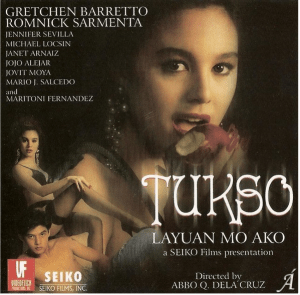
11011So the Regal Babies II were destined for certain oblivion, with a bravely determined Gretchen languishing in supporting roles.[2] She was barely noticeable in Lino Brocka’s Miguelito: Batang Rebelde (1985), for example, banking on her classy features but limited by her narrow range as a performer. By the 1990s, she had shed enough of her premature flab and gained enough height to look alluring enough for male-gaze purposes. Robbie Tan, founder-manager of Seiko Films, profitably deduced that the public had tired of sex sirens who looked and behaved like they came from the wrong side of the tracks. He devised a series of projects that objectified seemingly unattainable porcelain beauties led by Gretchen, turned his outfit into a major player in the process, and made the first Barretto star (Figure 1).[3]

Figure 1. Gretchen Barretto in one of Seiko Films’ early “sex-trip” hits, Abbo Q. de la Cruz’s Tukso: Layuan Mo Ako (1991).

New Blood

Another Barretto quietly took Gretchen’s place as constant second-stringer: Claudine, her younger sister. Unlike her predecessor, Claudine handled her years of relative obscurity as an opportunity to hone her performative skills. Her walk in the sun had a healthier component to it, by conventional moralist standards: she came of age when romantic comedies succeeded in displacing all the other then-profitable local film genres – horror, action, comedy, even her elder sister’s soft-core melodramas – and managed to prove her mettle alongside the peak capability of Vilma Santos, in Rory B. Quintos’s Anak (2000).

11011An accident of fate though propelled Claudine to a stature never attained by Gretchen. It was, unfortunately, a tragedy, the first indication that the Barrettos could only really soar on the wings of bad news. Just as Gretchen became a star by shedding her clothes, Claudine captured the public imagination when she broke up with her buena-familia boyfriend Rico Yan, grandson of a former army chief and ambassador during the presidency of Ferdinand E. Marcos. The heartbroken beau repaired to a Palawan resort, where he failed to awaken on an Easter Sunday, of all days, after a night of heavy drinking (Figure 2).

Figure 2. Claudine Barretto’s Instagram memento of the last note sent her by Rico Yan, posted after the latter died.

11011The public response was hysterical, with Yan’s wake and funeral march overshadowing those of two National Artists for Music, Lucio San Pedro and Levi Celerio. A reporter from the rival of Yan’s home station happened to be at the resort and scooped its competitor, which in turn avenged itself by preventing all other TV stations from occupying vantage points during Yan’s wake. Best of all, for Claudine’s fortune, her co-starrer with Yan, Olivia M. Lamasan’s Got 2 Believe (2002), had just opened in theaters, with Yan’s death catapulting it to record-blockbuster status.

Trophy BFs

This made of Claudine an even bigger star than her Ate Gretchen, and acrimonious vibes from the sisters’ perceived rivalry began getting airtime, with then-incipient social media paying due interest. Gretchen became the constant partner of businessman and media mogul-aspirant Antonio “Tonyboy” Cojuangco, while Claudine linked up with and eventually married another alumnus of De La Salle University, Raymart Santiago (of the well-known brood fathered by producer-director Pablo Santiago, preceded in showbiz by his elder brothers Rowell and Randy). Their mother Inday declared her preference for Claudine – a position eroded by her daughter’s on-cam pummeling of one of the roughneck Tulfo brothers (Figure 3) and her later separation from her husband amid speculation of excessive drug use, with Gretchen openly declaring her sympathy for Raymart.

Figure 3. Screen cap of mobile phone video taken by onlooker of Claudine Barretto and Raymart Santiago beating up Mon Tulfo for allegedly recording a quarrel they had with airport personnel.

Back to top

11011Which brings us to the latest teapot tempest. The situation could not be more high-profile, with the country’s chief executive, a family friend, attending the wake of the just-deceased Barretto patriarch. Gretchen and Claudine had patched up their differences, and Gretchen attended ostensibly to reconcile with her mother. A third Barretto showbiz aspirant, Marjorie, who never attained the same level of stardom as her younger sisters, refused President Duterte’s admonition to greet Gretchen, alleging that her niece, Nicole, was traumatized by Gretchen spiriting away a lover, businessman Atong Ang. (A full report of the incident, alongside related coverage, appears in Nikko Tuazon’s “Who Is Nicole Barretto?” published at Philippine Entertainment Portal, October 21, 2019.)

11011In a sensational tell-all TV interview, a remarkably articulate and sensible-sounding Marjorie acknowledged that after the collapse of her own marriage to Dennis Padilla (actually Dencio Padilla Jr., son of a late well-loved comedian), she bore a love-child to Recom Echiverri, a former mayor of Caloocan City; this was by way of her pointing out that Ang was also very much married, and that Gretchen was thereby being unfaithful to Cojuangco, who similarly was hitched to someone else.

11011Predictably, Gretchen denied any physical relationship between her and Ang (Figure 4), a sufficiently credible assertion when we consider how she never balked at admitting any of her past indiscretions. The clarifications and counter-accusations will continue for some time, until the family arrives at a level of accommodation acceptable to the major players in the current fracas.

11011What conclusions can we draw from the situation? One is that the Barretto sisters are smart and determined enough in stretching their media mileage, notwithstanding the occasional evidentiary recordings of such social slip-ups as Claudine’s fistfight with Mon Tulfo or the screams and hair-pulling (with the Presidential Security Group atypically befuddled) that erupted during Miguel Alvir Barretto’s wake.

11011Marjorie’s subsequent TV interview effectively effaced an earlier scandal caused when her daughter, Julia, admitted boinking hunky star Gerald Anderson, who was supposedly committed to another star, Bea Alonzo.[4] Julia claimed that she had broken up with male starlet Joshua Garcia (just as Anderson’s relationship with Alonzo had supposedly ended), but also subsequently wound up denying that she was the mistress of another elderly entrepreneur, Ramon Ang.

Figure 4. One of Gretchen Barretto’s series of socnet posts mocking the charges made by her elder sister Marjorie and referencing Recom Echiverri.

Back to top

Weaker Sex

Another conclusion we can make is that males involved in any capacity in this dustup will be better off keeping quiet. Atong Ang appeared in one of those obviously staged “ambush interviews” coddling his legal family while declaring he had never diddled any of the Barrettos. Assuming he was truth-telling, he was also effectively saying (awkwardly, at that) that some of his Barretto friends were lying. The family patriarch, in contrast, was ironically better off reposing in a coffin: even with Gretchen recapitulating her accusation that he had molested her, no one will want to continue speaking ill of the dead.

11011As pointed out by the late film scholar Johven Velasco in his book article on Rico Yan,[5] a number of influential talk-show personalities were penalized by their TV stations, after they revealed that the deceased young star, upon learning that Claudine had allegedly been unfaithful to him, had obtained Ecstasy tablets to counter his depression. The reality that it could be factual didn’t matter as much as the possibility that a recently dead star might be slandered.

11011An even more significant conclusion that Velasco makes, echoed by social experts looking at the current familial flameout, is that any scandal’s staying power derives from what it says about us, more than about the family itself. In this instance, it’s women claiming for themselves what moral authorities used to say only men were entitled to: the privilege of behaving badly (“war of the courtesans,” to use a semi-complimentary description by expat artist Therese Cruz). The scope even has the trigenerational impact of classical Greek tragedy, a curse being passed on from parents to children to their children’s children.

11011A fast-declining generation might remember when a similar phenomenon used to command the attention of the media and public, not just in the Philippines but also overseas: the Marcos family saga, from the patriarch’s womanizing and his wife’s philistinic overcompensation, through their rebellious daughter’s romance with an oppositionist scion (including a kidnapping and fall-guy killing that foreshadowed the murder of Benigno Aquino Jr.), to their exile and triumphant return to a country that seemingly, masochistically, has not had enough of their excesses. Thankfully, the worst that the Barrettos can visit on themselves and their public will never be as malevolent as their higher-profile media predecessors had been.

Back to top

Notes

First published October 28, 2019, as “The Barrettos and the Privilege of Behaving Badly,” in The FilAm. An abridged version of this article, titled “Barretto Sisters: The Privilege of Behaving Badly,” was reprinted in the December 2019 issue of The FilAm: Newsmagazine Serving Filipino Americans in New York. (Click on pic below of newsmag version to open PDF file.)


[1] From Jean Baudrillard, Simulacres et Simulation (Paris: Éditions Galilée, 1981): “The denunciation of scandal always pays homage to the law,” trans. Paul Foss, Paul Batton, and Philip Beitchman (Los Angeles: Semiotext[e], 1983).

[2] Incidental disclosure: some time after completing my second undergraduate degree (film, at the national university), I was a freelance production assistant in a Regal Films project, Emmanuel H. Borlaza’s Asawa Ko, Huwag Mong Agawin (1987), a Vilma Santos-starrer that featured the 1960s tandem of Amalia Fuentes and Eddie Gutierrez; Santos played the mistress of Gutierrez (and rival of Fuentes), while her much younger boyfriend was essayed by Gabby Concepcion, an original (first-batch) Regal Baby. A then-deferential and reclusive Gretchen Barretto was cast as one of the older couple’s neglected children.

[3] In much the same way that an early martial law-era pop-culture term, “bold,” was introduced by Regal Films, the country’s longest-running major studio, to distinguish its soft-core entries from the pre-martial law period’s more overtly sex-themed “bomba,” Robbie Tan felt the need to distance his productions from the late Marcos-era’s hard-core “penekula films.” Seiko Films did this by first appropriating “sex-trip,” abbreviated as ST, and later introduced an English coinage, “titillating film.” See “Fleshmongering” in Fields of Vision: Critical Applications in Recent Philippine Cinema (Quezon City: Ateneo de Manila University Press, 1995), 112-14.

[4] An update, as of late 2020: after having starred in the aptly titled rom-com Between Maybes (dir. Jason Paul Laxamana, 2019), Julia Barretto and Gerald Anderson sent out broad social-media hints that they have remained … conjoined, as it were. Their apparently unsullied contentment may yet prove to be its own scandal, by standing out as the only happy ending in the 2019 Barretto saga. Even better (though worse for us gossip hounds), Julia claimed that she and Joshua Garcia are going gangbusters as friends, with the more showbiz-savvy Julia mentoring her exemplary sport of an ex.

[5] “Rico Yan: Posthumously Recognized and Constructed,” in Huwaran/Hulmahan Atbp.: The Film Writings of Johven Velasco, ed. Joel David (Quezon City: University of the Philippines Press, 2009), 24-38.

Back to top


Manoy Takes His Leave

The sudden end to the long and productive life of actor-director Eddie Garcia was unnecessarily tragic, with corporate negligence compounding the foolhardiness of an artist too game to retire at an age when most other people would have completed two or more entire careers. The evaluation of netizens is on the mark in this case: Garcia’s willingness to take risks, typical of his approach throughout an extended and colorful career, should have been tempered by the studio that had apparently bet on countering the most successful serial program of the moment by showcasing, among other novelties, the physical agility of the country’s oldest active action performer.[1]

11011First appearing as a contract actor by the most star-obsessed among the 1950s First Golden Age studios, Garcia’s unconventional attractiveness positioned him a degree apart from full star stature: he could occasionally headline a project, but never the romantic leads that required the Euro-mestizo prettiness claimed by any number of now-forgotten actors. Having decided to make the most of a range of skills that allowed him to dabble in genres as disparate as horror, action, comedy, even soft-core melodrama, as leading man or villain, he settled on making himself indispensable as a competent ensemble performer who could draw on reserves of brilliance in case the role happened to demand it of him.

11011His filmography of over 650 film appearances (a possible local record) attests to the success of his strategy, but he had a higher purpose in mind: to be able to carve out a parallel career as film director. His choices were informed by the same principle of populist entertainment that he maintained for his acting career. One can see how his efforts could be occasionally penalized for being too mainstream, in a system that prized (then as now) “independent” efforts: when his best film, Saan Nagtatago ang Pag-ibig? (1987), came out, the Filipino critics’ group declared that no film during that year was worth considering for its annual prizes. Saan Nagtatago has since then been regarded as one of the high points in Pinoy melodrama.

11011Observers were also prone to concluding that his expertise as director accounted for his actorly acumen. This may be safely accepted as conventional wisdom, in conjunction with his pronouncement that his original dream was to be a military official. His work ethic, arriving about an hour ahead of call time, lines already committed to memory, was typical of performers of his generation, and those of theater-trained actors even today. Yet there were fault lines in this ultra-professional approach, and it occasionally showed up in his filmmaking record. He directed (and won his first directorial award for) the second biographical campaign movie of Ferdinand Marcos, Pinagbuklod ng Langit (1969). When later, the then-newly founded directors’ guild declared a boycott of the film projects of Gabby Concepcion, Garcia defied guild president Lino Brocka by accepting a Concepcion assignment for Viva Films.

Back to top

11011Ironically, Garcia’s acting projects with Brocka constituted his most rewarding body of work. He had memorable roles in the first few films of Ishmael Bernal, showed up in some of Eddie Romero’s more ambitious projects, and endeared himself to camp fans in the sex-comedies of Danny L. Zialcita. But as the most politically committed Filipino director, Brocka required effective representations of political villainy, and no one delivered the goods as well as Garcia, in a series of acclaimed works: Tinimbang Ka Ngunit Kulang (1974), Miguelito: Batang Rebelde (1985), and Gumapang Ka sa Lusak (1990), among others. Their collaboration was cemented early on, in Brocka’s second film assignment and first serious work, Tubog sa Ginto (1970), still arguably the highest peak in male Philippine film performance.

11011The mystery in Tubog lies in how Brocka managed to create his best queer film during the period when he still had to come around as an openly queer artist. His later “out” movies, notably Macho Dancer (1988), pale in comparison to the early work. People tended to ascribe some credit to Garcia, to his admission that he conducted intensive research among colleagues in the industry, plus his earlier attempt in essaying a comic version of the closeted authority in Kaming mga Talyada (1962), affirmed by his subsequent willingness to tackle similar roles (comic and dramatic) even in his old age – including his last film assignment, Rainbow’s Sunset (2018). To be honest, the results were always mixed and not as definitive as Tubog itself; in a comic ensemble work, Mga Paru-parong Buking (1985), he was upstaged predictably by Bernardo Bernardo and unexpectedly by George Estregan.

11011Eight years ago, in one of those confluences that make pop culture an endlessly fascinating phenomenon for its devotees, several identifiably masculine actors admitted to past same-sex experiences. One of them was Garcia, who said that his own episode occurred early, when he was 15, as part of a quest to determine his own preference. One could look at the group of confessors and note for the record that they were all extremely accomplished performers. Yet the measure of the audience’s distractability, as well as Garcia’s own volatility, is that most people remembered his queer performances, but not his own acknowledgment of the roots of his appreciation. All in all an occasionally spotty record then, but generously strewn with gems worth treasuring: rarely have we been so lucky.

[First published June 23, 2019, in The FilAm]

Note

[1] In the wake of the tragedy, the studio, GMA-7, announced that its series, Rosang Agimat, was shelved. The new program was intended to challenge ABS-CBN’s long-dominant Ang Probinsyano, where Garcia had (ironically) also been a featured player.

Back to top


Auteurs & Amateurs: Toward an Ethics of Film Criticism (Lecture Version)

Many thanks to the International Association for Ethical Literary Criticism for inviting me to deliver a plenary lecture on ethical film criticism. I may not also be everyone’s idea of a film critic, especially if you bump into me during more casual occasions than a literary conference. In my own feeble defense, I would begin by mentioning that what we might count as the basic output of a film critic, the movie review, was one of my earliest articles as a campus journalist, over forty years ago (David, “Birds of Omen” 43-45) – but let’s keep that scandalous detail to ourselves, shall we.

11011Since then, my odyssey as a Filipino film critic was marked by a few firsts: first fresh college graduate to be invited to the Filipino film critics circle, first former student activist to work in the Marcos dictatorship’s film agency, first and only graduate of the country’s undergraduate film program (my second degree actually), first to publish a local prizewinning book in film criticism, first Filipino to be accepted to a doctoral film program, first director of the national university’s film institute; although one last first – to teach a graduate course in pornography and feminism – will again be probably not to everyone’s liking or appreciation.

11011I take this personalized narrative-based mode because the lessons I learned about ethical practice in film criticism were hard-earned and initially defiant of then-existing values and ideas. But before we move on to what those insights might be, allow me to point out a problem, more of a kink really, in the expression “ethical practice in film criticism.” What I mean by this is that, contrary to commercial practitioners’ expectations, and in line with the thrust of the conference, film criticism always-already presumes ethical practice. This would be its most vital, though also most obvious, resemblance to literary criticism.

11011I may also need to make clear this early that I depart from the premise of what we term ethical literary criticism in a crucial manner. One way of understanding why this distinction must be made is in the industrial definition of film production as opposed to literary activity. To better comprehend the comparison, let’s consider each sphere during the recent past when media technologies had yet to begin converging in digital formats, and were therefore distinct from one another. In literature, the entire manufacturing activity comprising the use of all types of printing and copying machines, plus binding and distribution systems, can never be fully equated with actual literary production. A significant, unknowable, but possibly greater amount of literature is necessarily created privately, almost entirely by individuals, and an invaluable amount resides in the collection and maintenance of written material, not all of it printed in the still-contemporary sense.

11011Film, on the other hand, is emblematic of what we should really call the post-literary mass medium, in the sense that without the presence of an industry, it would not exist – except, at best, as theater. From beginning to end of the filmmaking process, one or more machines are operated by technical specialists, even in the case of the simplest possible type of production, the home movie. In fact the most distinct type of movie we recognize today, the film event, is premised on industrial spectacularization, with its megabudget appropriation, cast of thousands, reliance on preexisting commodities such as hit prequels or comic books, and global distribution system, with a showcasing of the latest digital-graphic applications as an essential component of its attraction.

Back to top

11011My sentimental education regarding this matter proceeded from my stint in the Marcos-era film agency, heightened by my film-school internship, and concretized in the year-long freelance work I conducted, in effect replicating what I did right after completing my first degree, in journalism. Allow me to interject here that freelancing in media is the one thing I would never recommend to any fresh graduate, unless she or he has a masochistic streak. Nevertheless, I had enough of a background in student activism and government service to sustain me with a few overweening delusions: first, that scouting the field for the best option can be done while earning a living; second, that media outfits would be fair enough to reward hard work rooted in academic training; and third and most unreasonable of all, that a free radical could effect some changes significant enough to improve the system.

11011In my short autobiographical account of my stint as production assistant for a mainstream studio, I mentioned a notion I’d hoped for that somehow became a reality: today, graduates of any of the country’s few film programs get hired by film and media outfits on a regular basis (David, “Movie Worker” 13). An even luckier few of these degree-holders manage to skip an on-the-job training process and make local and sometimes global waves with their first few film projects. Yet the lesson that impacted my practice as film critic did not appear in this account I wrote. It was something I formulated later, after returning to film commentary by being designated the resident film critic of a prominent weekly newsmagazine.

11011I will admit that I wished that when I first stated my newly formulated ethical premise, my colleagues hailed me as harbinger of a useful and progressive insight. In reality, I collected a number of verbally abusive responses then, and still do so occasionally today. Strangest of all, for me, is the fact that these almost entirely come from representatives of the national university, bastion of claims to Marxist ideals in the country. My aforementioned premise runs as follows. Because of its industrial nature, film practice enables individuals to support themselves and their families and acquaintances. We kid ourselves if we merely focus on the high-profile examples of celebrities and producers and major creative artists: the majority of people working on any sufficiently busy project would actually be working-class, as I had been when I worked in the industry.

11011When a project ends, one could sense a festive atmosphere, with people simply relieved that the struggles and headaches that they sustained through several weeks, sometimes months or even years, of mostly physical labor, have finally come to an end. Yet on the ground, there would also be palpable anxiety: which upcoming project can they latch onto, in order to be able to continue maintaining a decent source of income? Corollary to this is their hope that the project they just finished earn back its investment, if not become a hit, because this means the producer would be able to bankroll a future film, with the strong possibility of rehiring them.

11011I tracked this logic to its extreme conclusion and realized that its ethical core was solid enough to apply to any kind of project. Even a supposedly aesthetically dubious undertaking, like a genre film, or a socially disreputable effort, like a trash or pornographic entry, still represents a godsend to any impoverished member of the film crew. And if the said dismissible output makes a killing at the box-office, this may be unwelcome news to society’s moral and aesthetic guardians, but it certainly portends nothing but glad tidings for the project’s collaborators – its producers and artists, of course, but its workers as well, silent though they may be.

Back to top

11011I was taken aback, and still tend to have the same response, by the magnitude of the hostility exhibited by academe-trained experts whenever I attempted to articulate this critical premise. In retrospect, of course, I can see where my should-be colleagues were coming from. The class-based orientation of orthodox Marxist training behooves them to focus on the role of captains of industry – producers, financiers, investors – and subject their judgment of a film product to the moral depredations wrought by capital. As a consequence, profitability, according to this view, should be its own reward already, so a movie that hits pay dirt ought to meet higher expectations or face critical dismissal. Bound up with this judgmental mindset would be the known political sympathies of the major entities behind the production, as well as the operations of narrative formulas, with genre projects suggesting a questionable set of motives, and “low” or “body” genres confirming the producers’ and filmmakers’ surrender to decadence.

11011The one auspicious and relatively recent development on this front is that a progressive strain in feminist thinking, which we might call the sex-positive anti-censorship school (Kleinhans and Lesage 24-26), has set out to recuperate these modes of practice that once resulted in what we might term film detritus, or types of movies that so-called respectable experts and institutions would have jettisoned from any canon-forming activity; some of the more familiar examples would include pornography, horror, tearjerker melodrama, toilet-humor and slapstick comedy, home and diaristic movies, even advertising and propaganda.

11011This development was affirmed on several institutional fronts during the last few years of the 20th century. For example, of the over 200 titles classified as “condemned” or “offensive” by the US Catholic Church’s Legion of Decency from 1936 to 1978 (Catholic News Service), several showed up in the so-called Vatican Film List (SDG), which were supposedly endorsements to the faithful of nearly 50 titles, presented by the Pontifical Commission for Social Communications on the occasion of cinema’s first centenary in 1995. What this meant was that movies once regarded as immoral by religious standards, were later admired as insightful windows into the human condition. When I was in the process of completing my cinema-studies doctorate, the top-ranked American film schools started announcing courses on US skinflicks of the 1970s, now regarded as a Golden Age in porn production; a previously X-rated film, John Waters’s Pink Flamingos (1972), was an arthouse hit, as was an even earlier entry, Faster, Pussycat! Kill! Kill! (1965), described as Russ Meyer’s tribute to bosomania. Films with outright pornographic sequences can at present be submitted to compete in the A-list film festivals of Europe, and even win major awards for the effort.

11011What this made evident to me was the fact that in popular culture, no pre-existing judgment is guaranteed to last forever. Just as the historical heroics and Biblical epics and costume dramas that once dominated US Academy Awards are only screened for camp amusement today, and the downgraded B-movies of that same era are now considered essential to studies on the development of film language (Monaco 7-10), so can we indulge in the engaging exercise of identifying which contemporary forms of audiovisual media happen to endure the disapprobation of authorities in government, academe, and corporate-sponsored institutions. Only those among us who still cling to beliefs in eternal verities in approaches to popular culture, will be dismayed by the constant revision and repudiation of standards that mark contemporary evaluations of film and cultural artefacts, and will probably be surprised when today’s so-called trash items become tomorrow’s objets d’art.

Back to top

11011I might need to clarify, however, that my insistence on recognizing the cruciality of continuing film-production activity to the sustenance of an industry, does not imply that I desisted from formulating negative commentary during the six-year period when I had to turn in reviews on a weekly basis. What my premise precluded, in my personal practice, was the use of sweeping condemnations like “worst movie ever made,” unless I could mix in tonal shadings of irony or camp. Put another way, anything that could lead to the conclusion that such-and-such a release should never have been made would make me think more than twice: I could just as well be commenting on the potboilers I had worked on, and if they’d never been made, how would I have survived?

11011How then should I evaluate the moral worth of a film that I had to review? The answer to this entailed a two-stage procedure, one building on the other, and once more provoking unusual controversy. The first necessitated a bout of critical self-awareness on my end, a condition that applies as much to resident critics as to contemporary bloggers, especially those who set out to cover sudden concentrations of new or old releases, such as film festivals or retrospectives. When an editor or publisher stipulates that the critic must review everything on a given slate, the latter ought to initiate a constant negotiation regarding which releases are accordant with her level of competence or interest, and which ones lie beyond the scope of her abilities. I was fortunate during my resident-critic years that the movie industry was churning out up to four local releases a week, not to mention the far bigger amount of foreign releases that were being distributed. So picking out a film or two or more, out of five to ten choices, was a far better ratio than the one-to-one requirement imposed by some internet websites on their reviewers.

11011The second stage, as I mentioned, was when troubles would arise – not with my casual readers, but with my self-appointed critics. The method I observed took shape after the usual formal-slash-sociological, form-and-content approaches I used, left more questions than answers in their wake. Mostly these would revolve on another bout of self-doubt: how sure was I that any declaration I made was certain to hold up through an unpredictable future? As an example, a canon-creation project for Philippine cinema, ongoing for nearly a decade already, yielded several surprises when we went through the few major films of the past half-century (David and Maglipon). Among the movies released during the martial-law period of 1972 to 1986, for example, several titles acclaimed for their political daring felt, in retrospect, like melodramas in desperate search of significance. What stood out today, with some of them increasing in stature and integrity, were the honest-to-goodness flat-out melodramas, dismissed by film critics of the time for being flighty, apolitical, decadent, tending toward camp, and produced by a studio suspected of reveling in covert sponsorship from the dictatorial regime.

11011The ideal critical approach would therefore set down any conclusion we can make about a movie as strictly provisional, subject to further developments in cultural and political history. But what about the more problematic film-texts I mentioned earlier – i.e., the movies that enjoyed popular patronage? Would there be a means of presenting findings about these releases without falling into the trap of the high art-vs.-low culture binary? The only method I could think of during the time was to contact actual members of the mass audience. When I’d encounter friendly get-togethers in the congested neighborhoods where I resided, I’d approach the people I knew and chat about the movies they just watched or were planning to watch. Refreshingly, these were people who were unconcerned about my academic intent or the impression they would give about themselves among the intelligentsia. So when I asked them for the reasons behind their choices, they never felt obliged to genuflect before the altar of moral worth or aesthetic significance. What they’d provide instead was a unique though residual form of cultural logic, more helpful in elucidating why any current box-office hit was raking it in, regardless of its critical standing.

Back to top

11011Even today, one could see this deplorable and potentially tragic separation between the chattering classes, which would include all of us here, and the mass audience, or the public at large, or what we increasingly recognize as the majority of online netizens. When confronted with the reality of inconsistencies in voters’ choices, our colleagues would tend to explain this away by describing them as uneducated, unsophisticated, devoid of higher moral senses, vulnerable to petty corruption, oblivious to the consequences of their decisions. This type of academically acceptable though horrifically anti-progressive approach was what I attempted to evade via the admittedly casual anthropological research I conducted before setting out to articulate my responses to any contemporary film release during my time as resident critic. Once again, for reasons that I cannot (and prefer not to) fathom at this time, colleagues tended to react violently when I set this out as a prescription.

11011The first time I laid it out, rather than used it as a means of explicating specific popular films, a trend in Philippine cinema was arousing the ire of people across various political divides, even opposing ones. This was during a time, a few years after the world-famous February 1986 “people power” uprising, when the surest guarantee of box-office performance was for any movie to resort to toilet humor (David, “Shooting Crap” 109-10). Characters would be seen on prime-time TV trailers clutching their tummies or butts, rushing to toilet cubicles, with diarrheic sounds emanating from inside and characters in the vicinity responding to what appear to be unpleasant odors. The exponent of this funky trend was a comedian named Joey de Leon, still-popular today, whose latest exploit was a wildly successful comic-romantic setup that played out during the real-time real-life segment of a noontime variety show (Zamora).

11011Gamely accepting the challenge to defend his use of toilet humor on a TV talk show, de Leon found himself confronting the right-wing pro-Church chair of the censors board, as well as a leftist academic famed for being occasionally censored and thrown in jail by the martial-law government of Ferdinand Marcos. During a time when the members of the left-leaning Concerned Artists of the Philippines were conducting a series of rallies to protest post-Marcos censorship policies, this was the one remarkable moment when representatives of both sides came together for a common cause – to castigate de Leon’s reliance on a borderline-obscene strategy for provoking audience laughter. I criticized the spectacle via the following remark:

to question a person on the basis of principle is a simple thing to do, but when that principle happens to enjoy popular support, then the possibility of claiming to be better than the majority, antithetical to the democratic premise of raising questions on their behalf in the first place, emerges. This puts the … “critic” in a position too awkwardly similar to that of the cultural censor, who derives his raison d’être from the perverse notion that the people, even (or especially) in a democracy, could not know what is good for them. (David, “Shooting Crap” 110)

Back to top

11011One direct aftermath was that a few years later, I encountered the aforementioned artist-academic during my graduate studies in the US, and got berated by him for violating some code of bourgeois behavior that I could not decipher. I later figured out that it might have been because of the article I had written: I had taken extra care not to mention him by name, but there was certainly no denying the widespread coverage of his full-on theatrical performance as offended moral guardian on live TV. What I could have explained, if he had been able to simmer down and engage in a sober discussion, was that the moviegoers I had talked with certainly did not regard themselves as cultural dupes longing or willing to be taken in by a possibly cynically motivated comic talent. The key lay in the still-prevalent euphoria over the people-power event, when the country’s major artists all focused on projects that would commemorate the ouster of a long-entrenched tyrant and the restoration of democratic institutions.

11011The movie audience responded to these predictable and frankly sanctimonious texts by withholding their patronage of local film releases. As a result, from an average of nearly 170 films produced during the Marcos years, sometimes hitting as high as over 230 productions in one year, the local industry came up with 120 titles the year after people power and barely 100 the year after (David, “Annual Filipino Film Production Chart”); many of these in fact were sex films intended for the minimally policed rural circuit. The country’s most successful studio, Regal Films, managed to persuade audiences to resume their movie-going habit by providing comic fantasies featuring a breakout child actor, Aiza (now Ice) Seguerra (“Aiza Seguerra”). While these appealed to women and child viewers, Joey de Leon found a means of filling the gap for more mature audiences, including males, by seizing on a deliberately uncouth rejection of the spiritualistically inspired religious revivalism induced by what people still refer to today as the “miracle at EDSA.”

11011The difficulty of pursuing this particular configuration of critical framework cum method is further complicated by the stylistic demands it makes on expression. The principle I follow stems from the differentiation between academic writing and criticism. The only Filipino film critic recognized as a National Artist, Bienvenido Lumbera, prescribed an approach to writing criticism that conflated it with scholarship: “the writer must not be imprisoned by cuteness or [snark]. I think that’s a very strong tendency when one is beginning to write, when you fall in love with a manner, an expression, a point that you want to make, and you put that across and sacrifice the object you’re talking about” (Lumbera 72).

11011My own response, as a graduate-studies scholar confronted with the demand to observe an “objective” and “impersonal” presentation of research findings, was to constantly seek ways to query, if not subvert, this requirement, rather than allow an entire arsenal of literary possibilities to go to waste. In doing so, I managed to realize that the process of deconstructive jouissance can operate beyond analytics, via the mechanics of style. In criticism, especially in reviewing for a general readership, the playpen covers a far wider territory. The expressive demands may be greater, but the potential to involve the reader in formally discursive challenges, with the commentary providing a fixed reflexive coordinate to the film or films being discussed, would be worth the extra effort of drafting what we may call the creative critique.

11011The ideal to strive for would be an industrial intervention, where the critic helps articulate, for the artist as well as the audience, the film-text’s historical significance and significations, the development of the project’s auteur or auteurs, the industrial limits posed by budget, technology, and training, and how these may be overcome, and the larger social, political, cultural, regional, and global concerns (if any) where text, auteur, and audience may position themselves in pursuit of further insights or benefits. Such instances of intensive interactions among critics, creatives, and consumers have been few and far between, in the experience of Philippine cinema. Nevertheless, they have been known to happen, and have generally proved fulfilling for all parties concerned. The goal in observing a useful and progressive ethical approach to film criticism would be to ensure that critics’ contributions to the growth and development of cinema become a more-or-less permanent feature of creative cultural activity.

Back to top

Works Cited

Aiza [sic] Seguerra.” Wow Celebrities! (August 1, 2008).

Catholic News Service (Media Review Office). “Archived Movie Reviews.” United States Conference of Catholic Bishops. No date.

David, Joel. “Annual Filipino Film Production Chart.” Ámauteurish! (February 25, 2016).

———. “Birds of Omen.” Philippine Collegian (July 26, 1978): 3, 6. Reprinted in Millennial Traversals: Outliers, Juvenilia, & Quondam Popcult Blabbery (Part I: Traversals within Cinema) in UNITAS: Semi-Annual Peer-Reviewed International Online Journal of Advanced Research in Literature, Culture, and Society 88.1 (May 2015): 43-45.

———. “Movie Worker.” National Midweek (November 4, 1987): 15-16. Reprinted in Millennial Traversals: Outliers, Juvenilia, & Quondam Popcult Blabbery (Part II: Expanded Perspectives) in UNITAS: Semi-Annual Peer-Reviewed International Online Journal of Advanced Research in Literature, Culture, and Society 89.1 (May 2016): 13-16.

———. “Shooting Crap.” National Midweek (April 4, 1990): page(s) unkown. Reprinted in Fields of Vision: Critical Applications in Recent Philippine Cinema (Ateneo de Manila University Press, 1995): 109-12.

David, Joel, and Jo-Ann Q. Maglipon. SINÉ: The YES List of 100+ Films That Celebrate Philippine Cinema. Summit Media, 2019 (forthcoming).

Greydanus, Steven D. “The Vatican Film List.” DecentFilms: Film Appreciation and Criticism Informed by Christian Faith. No date.

Kleinhans, Chuck, and Julia Lesage. “The Politics of Sexual Representation.” Jump Cut 30 (March 1985): 24-26.

Lumbera, Bienvenido. “Critic in Academe.” Interview. National Midweek (April 4, 1990): 20-22, 46. Reprinted in Millennial Traversals: Outliers, Juvenilia, & Quondam Popcult Blabbery (Part II: Expanded Perspectives) in UNITAS: Semi-Annual Peer-Reviewed International Online Journal of Advanced Research in Literature, Culture, and Society 89.1 (May 2016): 65-74.

Meyer, Russ (director). Faster, Pussycat! Kill! Kill! Scriptwriter Jack Moran. Performed by Tura Satana, Haji, Lori Williams, Ray Barlow, Susan Bernardo, Mickey Foxx, Dennis Busch, Stuart Lancaster, Paul Trinka. EVE Productions, 1965.

Monaco, James. The New Wave: Truffaut, Godard, Chabrol, Rohmer, Rivette. Oxford University Press, 1976.

Waters, John (director & scriptwriter). Pink Flamingos. Performed by Divine, David Lochary, Mary Vivan Pearce, Mink Stole, Danny Mills, Edith Massey, Channing Wilroy, Cookie Mueller, Paul Swift. Dreamland, 1972.

Zamora, Fe. “Netizens Go Gaga over AlDub.” Philippine Daily Inquirer (August 17, 2015).

Back to top


A Salute to Our Pinay Filmmakers

While preparing for the end, Marilou Diaz-Abaya gave a series of interviews worth re-reading once in a while. Respect the audience, was her admonition to indie practitioners. Work to develop their preferred product, which then as now meant rom-com films.

11011Responses by local gatekeepers melded with Euro-festival jurors to ensure that this crucial bit of advice be downgraded and ignored as quickly as possible. Only high-art, alienating, complex-but-inconclusive films were fielded to foreign filmfests & local critics’ competitions, where they dominated the prizes for the past several years. Filmmakers (often women) who so much as deviated from the poverty-focused extreme aestheticizations that these taste-mongers upheld, were scolded for supposedly betraying progressive ideals.

11011As it turned out, it was women (with an occasional male director or two) who laid the foundations of the Pinoy rom-com in the 1990s, another batch who strengthened it in the 2000s, and still another group hard at work during this decade in transforming it.

11011One would have to be an ideologically arrested thinker to believe that their output is automatically invalidated by the popular acclaim that it so rightfully earns. For one thing, several of the current practitioners did dabble in indie work, and (as if observing Diaz-Abaya’s advice) brought over what strengths they developed to tweak, improve, and revise the rom-com format.

11011The fact that the most prominent Pinoy international film festival, San Francisco’s FACINE, wound up honoring a rom-com entry, its jurors smitten by its unexpected warmth and delicacy, affirms that our women filmmakers are on the right track. The Young Critics Circle also gave their major prizes to women working in documentaries – and in a rom-com project.

11011If progressive is seen as any effort that upgrades the public’s habits by meeting its demands halfway, and regards genre exercises as a means of conveying new insights and possibilities, then this is certainly a trend worth attending to. The promise of viewing pleasure would just be icing on the cake, a reward for finally coming to terms with an audience that is truly our own.

[Posted March 25, 2019, on Facebook]


Tears Go By

Ang Pamilyang Hindi Lumuluha
Directed & written by Mes de Guzman

The narrative of Philippine movie stardom attained a final, irrevocable peak with Sharon Cuneta. One may validate this statement by dissecting the manifold categories that made possible the preeminence of Nora Aunor, the biggest star in the country’s history, and inspecting how the other aspirants measure up. From star-texts scholar and close Cuneta observer Jek Josue David (no relation), the three most crucial aspects would be multimedia (or multifunctional) expertise, longevity, and persistence of fan devotion. This would make Cuneta Aunor’s only contemporaneous match, following a number of mostly male predecessors: Fernando Poe Jr., Dolphy, and (from an earlier batch) Carmen Rosales. I would add that most of these names, from the 1960s onward (and thereby excluding Rosales), had their own production outfits.

11011Aunor’s edge over most stars is that she commuted effortlessly between mainstream and independent projects (although in a technical sense, outfits set up and owned by stars made them not just independent, but literally part of a star system). Cuneta’s own difference was that the production outfit associated with her, Viva Films, was actually a major studio rather than a company where she could call the shots for other people’s projects. It would be erroneous however to presuppose that she never had any so-called indie projects. Her very first starring role, in fact, was in a Sining Silangan Production, and prior to this she had short appearances in a number of other non-studio movies. Since the present millennium, she also appeared in a Unitel as well as an OctoArts film.

11011Ang Pamilyang Hindi Lumuluha (hereafter APHL) is the closest Cuneta has come to an Aunor-type indie undertaking: not only does the production company bear (half) her name, but the project itself partakes of several elements reminiscent of her earlier indie-project attempt, Mark Meily’s Crying Ladies (2003): proletarian material, offbeat handling, moral ambiguity. Yet in this instance, APHL also exhibits the same difficulty that digital-era indie-filmmakers have with legends like Aunor. Perhaps overwhelmed by their stardom and dedication to excellence, the newer generation seems hesitant in (perhaps incapable of, but let’s hope I’m wrong) crafting roles that would challenge these performers, enabling them to break out of the mold that their personas invoke.

11011In this specific instance, Cuneta starts out as a landowner abandoned by her husband and children, who displaces her heartache and longing by attempting to reunite the supposedly propitious title clan in her unoccupied guesthouse, and winds up banishing the family members upon realizing how they had tricked her into believing the folk-mystic claims about them. The benevolent-hacendera character suggests a throwback (or perhaps, though less likely, a tribute) to her erstwhile rival Kris Aquino’s familial circumstances. The situation also enables her character’s dramatic highlight, a breakdown scene where the issues she repressed finally surface – and it is a measure of Cuneta’s ability that she remains as grounded in this openly melodramatic resolution as she is in the rest of the film.

11011The missed opportunity in this case is suggested by the presence of the sidekick character Bebang, played by Moi Marcampo (surnamed Bien in the credits). Cora, Cuneta’s character, is actually presented from Bebang’s perspective – which results in Marcampo having more screen time. More significantly, she winds up with a greater opportunity to indulge in wacky antics with concomitant witty lines while embodying an essentially tragic figure, recognizable to OFWs, of a migrant worker forced to endure alienation and abuse out of filial devotion to an utterly self-interested parent. Interestingly, Cuneta had portrayed several aspects of Bebang before: not just as a migrant worker in Chito S. Roño’s Caregiver in 2008, but also as an Aunor-type rags-to-riches aspirant during the end of her onscreen romantic partnership with her ex-husband. (For an exhaustive evaluation of this period, see Bliss Cua Lim’s article “Sharon’s Noranian Turn.”)

11011APHL could have been an opportunity for the Cuneta audience to witness how she could have improved on, say, Dorina Pineda of Emmanuel H. Borlaza’s Bituing Walang Ningning (1985) or Lupe Velez of Lino Brocka’s Pasan Ko ang Daigdig (1987). From the 1990s onward, people found increasingly lesser reason to doubt her ability in delineating characters closer to her real-life condition. APHL provides further confirmation of her expertise in essaying a family-centric elderly woman abandoned by her kinfolk, leavening the presentation via the use of astute comic timing and enriching it through judicious deployment of dramatic moments that build up to her final outburst.

11011It will always be worth a sitting, if only for affording the spectacle of Sharon Cuneta inhabiting a distinctly indie-movie universe. She allows herself to be deglamorized, dresses up in robes and pajamas and duds, goes on drunken rants and a climactic hysterical breakdown. Through it all she demonstrates the bottom-line confirmation of stardom: that she can let herself go onscreen, and still retain the allure and incandescence of the same young teen who once devoted herself to a public that could never get enough of the conflicted middle-class strong-woman representation she embodied. Her sun is far from having set, and APHL is proof of her readiness to venture into other modes, other landscapes. Aunor has had enough semi-successful or even failed movies that serve as revelatory treats for her fans when they get tired of her usual fare; Cuneta, in many ways the final Filipino star, is coming up with that kind of legacy for herself.

[First published October 18, 2018, in All Things Sharon]

Back to top


Manila by Night: A Queer Film Classic

Click on image to enlarge cover pic.
To order from the publisher, please click here.
To access the corrigenda & links to problematics, please click here.

From the INTRODUCTION (pp. 17-24):

As soon as I started the professional life that I had yet to fully chart, Manila by Night was ready to mark my steps. I had just completed the first of two bachelors degrees  at the University of the Philippines (declared the national university in 2008), but my preparation for a career in journalism did not work out as I (and my circles of friends) thought it would. The anti-dictatorship movement I had participated in prescribed a brand of Marxism that I later learned went by a few names, with “orthodox” being the less-offensive term. I decided to distance myself from the political and economic analyses on which I’d built my name as a campus journalist, and focused on cultural reporting. My internships also alerted me to the existence of values that I knew I could never take seriously – the cultivation of sources (the more exclusive or exceptional, the better), for example, and the drive to out-scoop everyone else. I decided to give freelancing a shot, and when I couldn’t shape a sufficiently interesting story out of a cultural (usually film) event, I’d turn in a review instead.

11011By late 1979, I’d made enough of a buzz to be invited to the award-giving film critics circle. I also heard of a movie about Manila nightlife – which I’d been discovering on my own as a restless, hyperactive insomniac. When I was invited to a preview of Manila by Night, I was stunned to discover a lot of the personalities, locales, and lingo that I’d familiarized myself with since college. It was like I didn’t have to wait until nightfall any longer: I could just step into the screen, and that would be the city I had come to know. It wasn’t a pretty sight, but it was electric, erotic, vulgar, violent, dangerous, and loving, all in ways that the US-supported and Catholic Church-sanctioned dictatorship of Ferdinand E. Marcos would find embarrassing, if not outright immoral. It was too good to be untrue, so to speak, so I resolved to watch it as often as I could in case the regime decided to destroy all existing copies and consign the film to oblivion.

11011Which nearly came to pass. Before I could arrange to watch another preview, news came out that the movie had been banned by the then-militarized Board of Censors for Motion Pictures, a body that had tussled with Manila by Night director-writer Ishmael Bernal a few times already for too-earthy sex scenes in his previous films. “No worries,” said those in charge of the film, since the movie would be making its debut in an international venue anyway, having just been personally selected by Moritz de Hadeln to compete at the Berlin International Film Festival. Bernal, whom I’d met as a critics circle member, provided me with cassette tapes on which a playback of the audio track was recorded, with instructions to transcribe the dialog and provide a literal translation to be used as a guide by the German subtitler. The tapes were low-end, obviously second-hand, and I had to return them right after using them; if I’d known they would be the source of the only available “integral” version of the film, I would have asked for a better recording. A “where-are-they-now” epilogue was also hastily assembled by the producers for the Berlinale screening, to mollify the censors by making the claim that the intransigent characters were punished while the rest became upright citizens worthy of Ferdinand Marcos’s “New Society.”

11011After I turned in my work, a grapevine report circulated in film circles, about Imelda Marcos, with her typical flair for the dramatic, watching the movie and breaking down afterward. Everyone’s worst fear was confirmed: the movie would remain in limbo until the First Lady could be persuaded otherwise. I requested the copy of the transcription I made from Bernal so it could be printed, “uncensored,” in the March 1981 issue of The Review, a now-defunct monthly periodical in which I wrote and occasionally edited special issues. In November 1980, a few months before the script came out, the movie itself was approved for local release, with a four-page censors’ permit – the longest that had ever accompanied a Philippine screening. Since all mention of “Manila” (dubbed “City of Man” by the increasingly unstable Imelda) was disallowed, the movie’s title was changed to City after Dark.

Back to top

11011The deliberation session for the critics’ annual awards was understandably turbulent. Along with a few other members, I insisted that any recognition given to City after Dark would be tantamount to validating what the censors had done. This resulted in a surprising inconsistency in the awards results, including a win for Best Picture but a loss for Best Director (one senior member mentioned that Bernal deserved to be “taught a lesson” regarding the lack of surface polish in his work). The logic was certainly bizarre – if the mangled version of the film deserved to win, then its strength derived primarily from its directorial virtues. From this point onward I began to question the Hollywoodian logic behind the critics’ awards activities, and have since sworn to premise my critical output on the assumption that, among other things, their earlier methods of multiple screenings and intensive deliberations may be useful, but their divisive, formalist, and canonical social-realist approach to award-giving deserved nothing but condemnation, if not contempt.

11011Meanwhile, the publicity team behind Manila by Night continued to conduct previews of the uncensored version – and I continued to attend as many of them as I could. I’d seen Robert Altman’s Nashville (1975), Bernal’s takeoff text, during its week-long run in Manila, and began paying close attention to attempts by other filmmakers, as well as by Bernal himself, to replicate this specific approach to the multiple-character film narrative. Despite the trauma experienced by Manila by Night, the multicharacter film format succeeded so well that it became a recognizable and distinct genre in Philippine film practice, with filmmakers (and a few critics) describing its samples as “milieu movies” and producers as well as talent managers introducing new faces in batches meant to appear as equal lead performers in as many film projects as they could sustain.

11011A few years later, the anti-dictatorship movement began to pose a serious challenge to Ferdinand Marcos’s presidency. I was working at the Experimental Cinema of the Philippines (ECP), the government film agency, and was surprised by the ease by which I was able to circulate a request to screen Manila by Night (not City after Dark) and process the paperwork for its release. The agency also assigned me to complete the then newly introduced undergraduate film program at the national university. Even before the people-power uprising of February 1986, the ECP was dissolved, but my new degree enabled me to start teaching as an instructor, and eventually helped me wangle a Fulbright grant for graduate studies in the US. My doctoral dissertation dealt, predictably enough, with the multicharacter film format.

11011During my last trip to Manila, I had an informal discussion with Bernal (a mini-interview of sorts), and managed to extract from him a promise to sit for an interview for my dissertation on multicharacter cinema. I told him I’d be drafting a set of questions and would send them to him before my next trip home. While I was away, he passed away from cerebral aneurysm, joining the legendary realm where Manila by Night continues to flourish. I decided to forgo all trips outside the US until I had completed my dissertation. My residency deadline was looming, and I was hastily drafting my manuscript on September 11, 2001, when my parents called to ask if everything was all right. The first tower crashed right after I turned on the television, and from that point on I knew that returning to the Philippines might not be the best option, but it was the only definite line of action that would be open to me in the near future. Bernal had been gone for over half a decade, and Philippine cinema was about to abandon celluloid production and embrace the digital era for good.

Back to top

From ACKNOWLEDGMENTS (pp. 9-10):

Profuse thanks to Patricio N. Abinales, Thelma E. Arambulo, Tina Baluyut, Joey Baquiran, Vicky Belarmino, Bernardo Bernardo, Pete Bilderback, Karen Blackstein, Marivic Buquis-Tjardes, Flor Caagusan, Patrick F. Campos, Veronica Caparas, Robert Cerda, Mel Chionglo, Leloy Claudio, Sylvia Estrada Claudio, Divine Go David, Gigi Felix-Velarde David, Jek Josue David, Nestor de Guzman, Nicolo del Castillo, Archie del Mundo, Lizbeth de Padua, Jojo Devera, Cynthia Estrada, Patrick D. Flores, Peque Gallaga, Alfredo Garcia, Melanie Joy C. Garduño, Paul Grant, Ju-Yong Ha, Maurine Haver, J. Pilapil Jacobo, Marne Kilates, Ricardo Lee, Bliss Cua Lim, Sergio Lobo, Jo-Ann Q. Maglipon, Juan Miguel Manansala, Gina Marchetti, Ibarra Mateo, Joe McElhaney, Toby Miller, Carla Montemayor, Roselle Monteverde, Jude Ortega, Ellen Ongkeko-Marfil, Ellen J. Paglinauan, Vanessa Pallarco, Haesuk Park, Inkyu Park, Shin-gu Park, Sybil Jade Peña, Elwood Perez, Theo Tisado Pie, Benjamin Pimentel, Ethel Pineda, Jane Po, Rowena Raganit, Winston Raval, Lore Reyes, Ramon Reyes, Roselle Leah K. Rivera, Ninotchka Rosca, Filomeno S. Sta. Ana III, Angela Stuart Santiago, Aida Santos, Bayani Santos Jr., Teresita Santos, Ophelia Miller Segovia, Vincenz Serrano, Minsun Shim, Irene Balucos Sia, Boemshik Son, Robert Sklar, Francis Sollano, Robert Stam, Lauren Steimer, Chris Straayer, Lulu Torres-Reyes, Mauro Feria Tumbocon Jr., Violeda A. Umali, Charmian Uy, JC Velasquez, Taeyun Yu, Jovy Zarate, and Zhang Zhen.

11011I’ve been fortunate to work with some outstanding editors in the past, but with Matthew Hays and Thomas Waugh, I saw my early manuscript shape-shift in ways I couldn’t always anticipate, with the revised version always a new text whose acquaintance I was happy to make. They’ve been at this task for nearly a decade, without any remuneration, so while I imagine that the impending end of the Queer Film Classics series may be a relief of sorts, it would also open up a gap that other people ought to consider filling. Publishers Brian Lam and Robert Ballantyne, editors Susan Safyan and Tara Nykyforiak, and designer Oliver McPartlin are also part of the series, and while I interact mainly with professors Waugh and Hays, I occasionally correspond with the other participants in the project; as the book begins to take final shape, I can only be grateful that their commitment is just as complete and indispensable. (Portions of this manuscript have appeared in my articles in Kritika Kultura and Plaridel.)

Library and Archives Canada CIP

David, Joel, author
11011Manila by Night : a queer film classic / Joel David.

(Queer film classics)
Issued in print and electronic formats.
ISBN 978-1-55152-707-9 (softcover). – ISBN 978-1-55152-708-6 (HTML)

110111. Manila by Night (Motion picture). 2. Bernal, Ishmael – Criticism and interpretation. I. Title. II. Series: Queer film classics

PN 1997.M363D38 20171101791.43’721011C2017-906836-9
PN 1997.M363D38 20171101791.43’721011C2017-906837-7

Back to top

Contents of the Queer Film Classics Edition
© 2017 by Joel David & Arsenal Pulp Press; All Rights Reserved

PRELIMINARIES

Title Page; Copyright; Table of Contents; Dedication: For Ishmael Bernal (1938-96); Acknowledgments; Synopsis; Credits; Introduction (1-24)

BODY TEXT

Chapter I. Manila by Day: Fifty Years of Hollywood (25-69)

Movies and the Philippines
Master’s Tool
Language without Words
“Ishma” and Manila by Night
The Origin of Manila by Night
Controversies
The Berlinale Connection
The Other Manila Movie

Sidebar: A Pinoy Queer-Cinema Mini-Canon (70-75)

Chapter II. Manila by Night: City of Mania (76-115)

Many-Peopled Narratives
The Philippine Moviegoer
A Perverse Approach
Technique as Politics
Voyeuristic Restlessness
The Queering of Technique
The Mirror Effect
Sound Logic
Wow and Flutter

Sidebar: A Multicharacter-Movie Supplementary List (116-119)

Chapter III. Beyond Manila: Cinema & Nation in Crisis (121-158)

Locale as an Entity
Babies and Beauties
Triangulations
The Multicharacter Movie Genre
Road Not Taken
Milieu Realism
A “Straight” Way Forward
Gender Types
The Other(ed) Queer Character
Radical Potential

END MATTER

Conclusion; Appendix: Manay Revisits Manila by Night: An Interview with Bernardo Bernardo; References; Filmography & Theater Productions; Index; About the Author; About the Editors; Titles in the Queer Film Classics Series (159-208)

RELATED LINKS

  • A special folio on the film now opens this blog’s Extras section.
  • Corrigenda for this specific edition are available here, while a discussion of the text’s problematics, originally incorporated in the corrigenda page, has been expanded and separated out, with one for textual issues and another for illustrational issues.
  • To read the book lecture “Queerness as Defiance in Manila by Night,” please click here.
  • For a detailed storyline originally drafted for this book, please click here.

REVIEWS IN JOURNALS
(in chronological order)

Josen Masangkay Diaz, “Third Cinema, Queer Technique, and Manila’s Multiple Characters,” Jump Cut: A Review of Contemporary Media 59 (Fall 2019).

Ronald Baytan, “On Bernal’s Homage to Manila: A Review of Joel David’s Manila by Night: A Queer Film Classic,” Plaridel: A Philippine Journal of Communication, Media, and Society 16.2 (December 2019).

Chuckberry J. Pascual, “Mahalaga ang Marami: Rebyu ng Manila by Night: A Queer Film Classic ni Joel David,” Pelikula: A Journal of Philippine Cinema 5 (2020); click here for the English translation.

Back to top


Book Launch Lecture: Millennial Traversals

Millennial Traversals had a long and involved narrative behind its emergence. Invited to lecture during the website launch of the University of Santo Tomas’s UNITAS journal, I took the opportunity to discuss what turned out to be two volumes’ worth of special UNITAS journal issues. This occurred less than a week after I delivered a lecture on another recent book of mine, Manila by Night: A Queer Film Classic. (To enlarge the pics at the bottom, please click on them. To go to the Millennial Traversals book feature on this blog, please click here.)

THE MILLENNIAL TRAVERSALS OF MILLENNIAL TRAVERSALS

Thank you for attending this occasion and allowing me the honor to speak in commemoration of the launch of the UNITAS website. My own contribution comprises two volumes of Millennial Traversals, which I had originally uploaded as an open-access book on my own website. I’d had occasion to go over this book several times – from conceptualizing it to finalizing it for its digital version to correcting, revising, and updating it further for what would now be its so-far final version.

11011Some of you might be able to read the finer (or shall we say bloodier) details of how Millennial Traversals took shape in its present form on the UNITAS website, so I might as well own up to certain motivations that I had to be careful in expressing on the page. Since the originally intended volume was non-print, I wanted to take advantage of certain freedoms unavailable to me during the times I was preparing my earlier book manuscripts for what we now call dead-tree publications. That explains the extra-long complete title, which goes Millennial Traversals [colon] Outliers [comma] Juvenilia [comma, ampersand] Quondam Popcult Blabbery – all this even before we get to the title of each part. For the same reason, I put together a digital manuscript that was a few times longer than any book I had previously published, whether as author or as editor.

11011What I did not anticipate, of course, was the fact that UNITAS was now being handled by a long-term acquaintance of mine. Professor Lulu Torres-Reyes and I had been coordinating since the start of the current decade, on articles, lectures, and special issues for Kritika Kultura, the journal she founded and edited at the Ateneo de Manila University. But we had actually started out as casual acquaintances for almost four decades, when we would join informal film screenings and discussions organized by mutual friends of ours. So it was no surprise to me that she had proved receptive to film-studies materials, and that when she tried her own hand at film scholarship, she met with resounding success here and in Korea, the country where I work.

11011When the process of transforming Millennial Traversals into the edition that can now be found on the UNITAS website was completed, I stepped back and considered what significance the project might have had, if any. I was of course thrilled that I could claim to have a book that first took shape as an open-access digital text, and wound up in a printable version afterward. All my previous books took the opposite course – from print editions in their original incarnations, to online versions on my website. I don’t know of any instance of a Philippine text that observed the format shift that Millennial Traversals underwent, although the possibility might exist somewhere. At this point, all I care to announce is that it happens to be the first local film publication that first came out in digital format. It would also be the first that passed through a print format, and wind up in still another digital format, in another website.

Back to top

11011What proved uncanny for me was when I finally stared at the book covers, I flashed back to the first few journal issues I ever bought, as a high-school student at the University of the Philippines. I realized later that these must have been dissertations that were deemed outstanding at the time, but each one provided me with the double satisfaction of collecting a book as well as a journal copy in one volume. Millennial Traversals is of course an anthology of my output, in keeping with the nature of all my previous sole-authored publications. It marks my farewell to this arrangement, and has been followed by the manuscripts for a film monograph on Manila by Night (recently published by Arsenal Pulp Press in Canada) and for a canonical listing of Philippine film entries for the publisher of YES! magazine, Summit Media.

11011Hence Millennial Traversals is and isn’t a book volume publishable as a journal issue. It is physically a UNITAS publication, in two separate issues in fact. But in its original incarnation, it was intended as a blog feature, then-unique in the Philippines, with several ambitious and probably ultimately imperfectible goals:

• first, it sought to compile my responses to Filipino films from the late 1970s to the present: of over 30 titles covered, about ten are hard to track or possibly permanently lost;

• second, it also aimed to demonstrate certain ethical functions that were part of my self-valuation as a film critic, including my insistence on financial independence from investors, the attendance of theatrical screenings with a paying audience, the re-watching of titles I planned to review in order to take down detailed notes on the text and its spectators, and the cultivation of an audience perspective that requires the readers’ participation by watching any film being commented on, regardless of my subjective response;

• third, it refused the then-fashionable practice of standing apart from practitioners in the industry, because of the so-called intentional fallacy – when in fact the author should be a primary source of the work’s always-complicated journey from conception to exhibition; and

• fourth, it gestured toward basic critical attempts concerning certain cherished beliefs among film critics, starting with certain notions that implicated myself and resulting in a few awkward examples of self-deconstruction.

11011The urgency of foregrounding these values was conveyed to me by friends who were closely observing the then-burgeoning film-blogging scene, complicated by the top academic and critics’ official’s statement that film bloggers deserved to be dismissed if they could not present any degree that would qualify them as film commenters. Considering that baccalaureate-level film education was either too exclusivist (available at the national university) or too expensive (in private universities), the remark was unfair and ironically elitist, given the author’s leftist bona fides.

11011A few critic and filmmaker friends attempted to convince me to intervene directly, by pointing out the problem in such an assumption, among other horrendous conclusions made by the same official. I opted to time my confrontations carefully, in the form of a book review and a rare exclusive blog statement. But the option of leading by example was always best practice for me, so I set about looking over the never-before-anthologized materials I could compile. I did not expect that the entire undertaking would be treated as a book, but a few netizens informed me that they were printing out the pages I had put together and binding them as voluminous textual collectanea.

Back to top

11011I made sure to warn people on social media that Millennial Traversals existed first and foremost as an open-access internet upload. I preferred that people would explore various categories according to whatever piqued their interest, maybe moving forward or back if any of the contiguous articles seemed worth inspecting further, or returning to the table of contents via a readily available hyperlink in case they wanted to check out another section or approach or issue. Within certain articles I also provided links to other articles, in the same book or in my other volumes, or sometimes to other websites.

11011I knew that this qualified notion of interactivity could be replicated in a printout of the text, but with much more difficulty. Yet I was also aware that the strictly open-access arrangement was an unstable format. Every semester I would receive a query or two from new social network acquaintances asking whether the digital editions of my books would be downloadable. My answer for nearly the past half-decade has always been the same: eventually. The transformation of digital text files into downloadable material is complicated by the fact that e-books exist in various formats. I would need to set up my own business firm in order to transact businesses with a cover designer and layout artist as well as apply for International Standard Book Numbers, one for each freaking format including the open-access version.

11011Needless to say, I don’t have the full luxury of attending to these concerns as speedily as I’d prefer. This accounts for my relief in UNITAS enabling Millennial Traversals to reside on its website. The original digital edition is gone for good, except for the few enthusiasts who printed it out. About 20 to 30 percent of the content was revised, since certain indeterminate or open-ended articles could last longer on the internet, given the medium’s wonderful capacity for self-correction or self-updating – a property that academics of my generation are just starting to realize and exploit. On the other hand, a book, even in journal’s clothing, is meant to be forever. As those of us who’ve been publishing might already know, perfection only appears to be an ideal, but it turns out to be too utopic to reach, the more ambitious the writing project becomes.

11011I’d also proffer here the wisdom I picked out from all the senior authors who’d anthologized their own articles before I started with my first volume in 1990, and which might prove useful to those considering the same kind of project. The principle of perfection-as-mirage applies: it would be impossible to identify your best entries and expect the rest to aspire to the same level of achievement. It would also be highly inadvisable to rank your articles according to your or others’ perception from best to worst or vice versa, and follow that order in anthologizing. The other obvious sequence, the time-determined one of following the articles’ chronology or reverse-chronology, similarly poses the question of the author’s rising or falling level of competence.

Back to top

11011Yet, from my earliest attempt onward, I found that following these problematic procedures worked best in helping me arrive at a useful structure. Counter-intuititively, I also felt more confident whenever I had more material than I could use, rather than picking out only the ones that fit a preconceived theme or thesis. This is because when you start reading more closely in order to fix typos and observe the publisher’s style requirements, you may realize that a section may require the equivalent of breathing space, or that an intensively discursive exercise could do with a stylistic coda – a function best fulfilled by a relatively throwaway article or two.

11011I apologize to colleagues of mine for whom these so-called lessons might already be old news. I found myself wandering down this introspective path regarding Millennial Traversals, by way of letting everyone know that I’m aware of the manifold difficulties a journal staff undergoes, on a seemingly endless basis. As soon as one issue, essentially an anthology, is completed, the next one has to be set in motion, preferably overlapping with the previous one. I once went through this kind of grind during my undergraduate and early-graduate years, and it brought out a side of me that I prefer to forget. I cannot even imagine having to contend with the additional challenge of preparing multiple volumes for uploading online.

11011The only source of comfort for me is that Professor Torres-Reyes could not have been any more qualified for this kind of challenge than she is at this moment. When you see her supervising the day-to-day requisites of the job with her usual humor and light touch, you can take my word that her approach comes from a long-drawn-out and contentious experience in her previous station at Kritika Kultura. Thanks to everyone for your attention, and more particularly to Lulu, the UNITAS staff, and the University of Santo Tomas.

Announcement of the event, along with a photo of the turnover of complimentary copies (pic courtesy of Cory Quitoriano); as well as a commemorative pose with UNITAS editor Lulu Torres-Reyes, filmmaker Ellen Ongkeko-Marfil, and contributor and educator Bayani Santos Jr. (pic courtesy of E. Ongkeko-Marfil).

(Delivered on August 16, 2018, at the UNITAS Seminar Room, St. Raymund de Peñafort Building, University of Santo Tomas, España Boulevard, Sampaloc, Manila)

Back to top


Signal Rock and a Hard Place

Directed by Chito Roño
Written by Rody Vera

Signal Rock is a deceptively simple film whose complications begin with its current emergence in the public consciousness. It is released as an entry to the Pista ng Pelikulang Pilipino, so to single it out as the excellent entry that it is should not be taken as a downgrading of the other entries. To make matters worse, the PPP follows yet another event, the older Cinemalaya Philippine Independent Film Festival, so audiences who already splurged in watching this year’s entries might be understandably reluctant to spend further on the current (and pricier) lineup. PPP also features previously unreleased films from earlier festivals – this time a more definite guarantee of jury approval, notwithstanding the Cinema Evaluation Board’s weirdly moralistic downgrading of a couple of aspirants.

11011In fact, some of the PPP entries are also regional films like Signal Rock – Tara Illenberger’s Iloilo-set High Tide and Arnel Barbarona’s Manobo tale Tu Pug Imatuy come to mind, as well as the only one I’ve seen of the lot, Khavn’s CEB-victimized Balangiga: Howling Wilderness, which like Signal Rock is also set in Samar. A comparison of Balangiga and Signal Rock would be a useful place to start then. Where Balangiga’s narrative enlarges on the incomprehensible historical trauma of genocidally motivated colonial warfare, Signal Rock demonstrates the impact that globalization has made on even a far-flung Third-World island.

11011The movie is the director’s and writer’s second project set in Biri island, part of a municipality in Northern Samar – which makes it one of the Visayan islands closest to Luzon.[1] Their earlier Biri film, Badil (2013), featured a young man attending to his father’s unsavory (and ultimately bloody) vote-buying activities during an election period where the still-running mayor asks for support from his cohorts. Intoy, the Biri lad at the center of Signal Rock, is more recognizably provincial, by our usual cynical-urbane standards: laid-back, easy-going, content with helping everyone and indulging in occasional youthful hijinks, with an equally indulgent police chief making sure that he and his homies get their token share of punishment.

Back to top

11011His initiation into worldliness, in more ways than one, occurs when he falls in love with a local lass, whose father regards him as unworthy for a prospective in-law. Intoy’s naïveté catches himself off-guard: he could have known the kind of future he’d be facing if he reflected on the troubles that his sister had been struggling with as an abusive foreigner’s mistress, forced to seek refuge by herself in a foreign land. The lesson becomes even more pronounced in the dilemma of his best friend, whose childhood sweetheart returns as the now-prosperous wife of an elderly Caucasian, upon which his still-besotted friend is reduced to being his ex-girlfriend’s paramour. Intoy’s epiphany, that the women of the town are being groomed to work for – and eventually be claimed by – overseas masters, is something that most Filipino intellectuals have known for some time. Signal Rock’s first singular achievement is in restoring the sting to this revelation, by allowing the kind of Filipino we used to know to be overcome by it.

11011That insight alone would have been enough to add depth to any number of romantic comedies (and you might find it unusual for me to claim here that Signal Rock is, literally, a romantic comedy – more conventional in fact that the contemporary mainstream versions whose terms were set four years ago by That Thing Called Tadhana, Antoinette Jadaone’s indie-crossover hit). But the director-writer team have a better treat in store: where the usual melodrama, even the long-drawn-out telenovelas, would bypass a bureaucratic process and get by with merely mentioning it, the movie delineates the process itself and draws dramatic tension out of it, as well as some light comedy, essential suspense, and insightful glimpses into small-town relationships. Here the filmmakers manage to traverse the tricky depiction of desperation and corruption among the destitute without falling into the trap of poverty porn, via the still-rare culturalist strategy of refusing to pass judgment on any of the characters and by partaking of any instance in their celebration of their existence, no matter how paltry or seemingly pathetic.

11011This approach even enables them to engage in reflexive touches, as when the plot follows Intoy’s venture into Manila’s talons of neon, thereby equating his character with that of Julio Madiaga in Lino Brocka’s Maynila: Sa mga Kuko ng Liwanag. In this particular instance, Signal Rock signifies its ideological superiority over Philippine cinema’s global critics’ favorite, just as Christian Bables’s performance as Intoy will prove to be more enduring than Bembol Roco’s still-impressive Julio M.: Maynila may remain one of the most technically accomplished Filipino film epics ever made, but none of its identity problems (sexism, homophobia, racial and anti-lumpen prejudice) mars Signal Rock’s engagement with a wide variety of working-class and lumpenprole types. A mother’s hard-heartedness toward her husband is explained via his past cruelty and negligence toward her; the said husband (Intoy’s father) is able to draw on his limited English-language expertise in order to redeem his daughter’s own standing as an overseas resident; a hotheaded fratricidal slacker retains enough of a conscience to surrender to authorities thanks to his close relationship with the parish priest, with whom he may or may not be lovers; and so on. The movie’s emphasis on mostly male characters derives not from a desire to heroize them (least of all Intoy), but from the circumstantial result of women abandoning the community in order to earn a living for everyone via foreign labor.

Back to top

11011The clue to understanding how the film can pull off the delightful hat trick of melding process, lead character, and community into one arresting narrative is in looking over the director’s background. I don’t refer to the fact that he happens to be a Samareño who acquired familiarity with the Philippine capital as well as with other global centers, or that his father was the longest-serving minister of Ferdinand Marcos’s martial-law administration while he oversaw the “alternative cinema” screening schedule of the Experimental Cinema of the Philippines. Chito Roño is generally overlooked in accounts of still-active survivors of the Marcos-era Golden Age, partly because of the progressive sector’s eagerness to reject anyone associated with the regime, but also partly because he devoted himself to so-called “low” genres, specifically those dealing with sex, horror, lurid melodrama, and action films centered on women.

11011Those who bothered to look more closely into his output were rewarded with some of the most innovative attacks as well as delectable performances in commercial cinema, in packages that weren’t burdened by the “prestige” imprint. More than Badil, Signal Rock would be the equivalent of David Lynch abandoning his usual offbeat material and methods in order to do his appropriately titled 1999 film, The Straight Story. Yet the same creative and critical sensibility infuses Signal Rock’s “regular” world. Intoy’s awakening to illicit relationships, for example, begins when he witnesses his friend resume his affair with his now-married girlfriend, and intensifies when the town mayor confides in him the paternity of his illegitimate son. When he starts witnessing people in similarly unexpected and possibly incriminating situations, he learns to practice discretion – a skill that comes in handy when he finally meets up with his girlfriend in the big city.

11011Roño’s directorial flourishes are more foregrounded in Signal Rock than they were in Badil, yet they remain unintrusive (as discreet as Intoy learns to be) – a sign of the filmmaker’s maturation. In the first few scenes with the title object alone, we already see expert overlappings of image and sound so that more than one event transpires in single scenes; the first time Intoy visits the place by himself, we hear the wind transformed into the sound of a woman weeping.[2] The movie is so full of these throwaway gems that the only advisable response I can provide for a first screening is to sit back and take in the pleasure of a conglomeration of talents who love what they do and know how to go about making it happen.

[First published August 17, 2018, in the Philippine Entertainment Portal]

Note

[1] Because of the Northern Samar islands’ diagonal position in relation to Luzon, Capul island lies closer to Sorsogon Province although Biri is the northernmost Visayan municipality.

[2] Interestingly, the similarly named Signal Hill, in St. John’s, Newfoundland, was named for its setting as the site of the first wireless transatlantic transmission, when Guglielmo Marconi awaited a signal from England on December 12, 1901. See Diana Lambdin Meyer, “Canada’s Vital Role in the Communications Revolution” (BBC.com, September 2, 2017).

Back to top