Important: A listing of all the entries in all the categories, alphabetized by author, can be found here, while the entries in reverse-chronological order can be found here. To return to the landing page, click here. Any notes that follow each entry’s year of publication are annotations made by the author, which fall under copyright. Out-of-print books and chapters that I wrote or edited may be found in this blog’s Books section. “Literary Adaptations” refers mainly to novelizations but also includes short stories and a stage musical that were based on film releases.
11011The following will take you to other categories after Local Anthologies (although entries in the last item, Forthcoming Titles, will not appear in the other iterations of the bibliography):
Local Anthologies
Almario, Virgilio S., ed. 101 Filipino Icons. Quezon City: Adarna House, 2007.
Coronel, Sheila S., ed. From Loren to Marimar: The Philippine Media in the 1990s. Quezon City: Philippine Center for Investigative Journalism, 1999.
Feliciano, Gloria D., and Crispulo J. Icban Jr., eds. Philippine Mass Media in Perspective. Quezon City: Capitol, 1967. T.D. Agcaoili, “Movies.”
Guerrero, Rafael Ma., ed. Readings in Philippine Cinema. Manila: Experimental Cinema of the Philippines, 1983.
De la Torre, Visitacion “Chit” R. Cultural Icons of the Philippines. Makati City: Tower Book House, 2002.
Del Mundo, Clodualdo Jr., ed. Spirituality and the Filipino Film. Film and Faith series. Manila: Communication Foundation for Asia, 2010.
Del Mundo, Clodualdo Jr., and Jose Mari Magpayo, eds. Philippine Mass Media: A Book of Readings. Manila: Communication Foundation for Asia, 1986. Mario A. Hernando, “Against All Odds: The Story of the Filipino Film Industry (1978-1982)”; Bienvenido Lumbera, “Problems in Philippine Film History”; Eduardo Sazon, “Film Distribution and Exhibition.”
Feliciano, Gloria D., and Crispulo J. Icban Jr., eds. Philippine Mass Media in Perspective. Quezon City: Capitol, 1967. T.D. Agcaoili, “Movies.”
Guerrero, Rafael Ma., ed. Readings in Philippine Cinema. Manila: Experimental Cinema of the Philippines, 1983.
Guevara-Fernandez, Pacita, ed. Keeping the Flame Alive: Essays in the Humanities. Diamond Jubilee Publication. Quezon City: University of the Philippines Press, 1983. Behn Cervantes’s “Ganyan Lang Talaga Yan [That’s Just How It Is]” describes the Philippine situation as “a large market that can be redirected in its tastes and attitudes so that they [sic] can dictate what types of movies should be made.”
Kintanar, Thelma B., “and Associates.” The University of the Philippines Cultural Dictionary for Filipinos. Quezon City & Pasig City: University of the Philippines Press & Anvil Publishing, 1996. “Communication and Mass Media.”
Maglipon, Jo-Ann Q. Primed: Selected Stories 1972-1992. Reportage on an Archipelago series. Pasig City: Anvil Publishing, 1993. “MIFFed [Manila International Film Festival]”; “Free the Artist!”; “The Republic of the Philippines vs. Lino Brocka, et al.”; “Canuplin: The Little Tramp Time Left Behind”; “Erap [Joseph Estrada]”; “Phantoms of the Cinema”; “Starlight, Starbright”; “Mega Mother Lily [Monteverde]: Superstar for All Seasons.”
Manzanilla, JPaul S., and Caroline S. Hau, eds. Remembering/Rethinking EDSA. Mandaluyong City: Anvil Publishing, 2016. Joel David, “Grains & Flickers”; Patrick D. Flores, “A Cinema in Transition: Initial Incursions.”
Patajo-Legasto, Priscelina, ed. Filipiniana Reader: A Companion Anthology of Filipiniana Online. Quezon City: University of the Philippines Open University, 1998. Clodualdo del Mundo Jr., “Komiks: An Industry, a Potent Medium, Our National ‘Book,’ and Pablum of Art Appreciation” & “Philippine Television: A History of Politics and Commerce”; Patrick D. Flores, “Philippine Cinema and Society”; Bienvenido Lumbera, “Brocka, Bernal & Co.: The Arrival of New Filipino Cinema” & “Problems in Philippine Film History”; Soledad S. Reyes, “The Philippine Komiks”; Nicanor G. Tiongson, “Becoming Filipino: 1565-1898”; Rolando B. Tolentino, “‘Inangbayan’ (Mother-Nation) in Lino Brocka’s Bayan Ko: Kapit sa Patalim (My Country: Clutching a Knife [Malaya Films & Stephan Films], 1985) and Orapronobis (Fight for Us [Bernadette Associates International], 1989).”
———, ed. Philippine Studies: Have We Gone Beyond St. Louis? Quezon City: University of the Philippines Press, 2008. Joel David, “Awake in the Dark: Philippine Film during the Marcos Era”; Eleanor Sarah D. Reposar, “Carlo Vergara’s ZsaZsa Zaturnnah and the Tradition of Subversion in Philippine Komiks”; Johven [as Jovenal] D. Velasco, “‘Feminized’ Heroes and ‘Masculinized’ Heroines: Changing Gender Roles in Contemporary Phiippine Cinema?”
Paz, Consuelo J., ed. Ginhawa, Kapalaran, Dalamhati: Essays on Well-being, Opportunity/Destiny, and Anguish. Quezon City: University of the Philippines Press, 2009. Patrick D. Flores, “Hanapbuhay sa mga Pelikula ni Nora Aunor [Occupation in the Films of Nora Aunor].”
Pertierra, Raul, and Eduardo F. Ugarte, eds. Cultures and Texts: Representations of Philippine Society. Quezon City: University of the Philippines Press, 1994.
Peterson, Andrea L., Gaspar A. Vibal, Christopher A. Datol, and Nicanor A. Lajom. Fifty Shades of Philippine Art: Philippine Cinematic Art. 50 Shades of Philippine Art series. Quezon City: Vibal, 2020.
Reyes, Soledad S., ed. Kritisismo: Mga Teorya at Antolohiya para sa Epektibong Pagtuturo ng Panitikan [Criticism: Theories and an Anthology for the Effective Teaching of Literature]. Pasig City: Anvil Publishing, 1992. Isagani R. Cruz, “Si Lam-ang, si Fernando Poe Jr., at si Aquino: Ilang Kuro-Kuro tungkol sa Epikong Filipino [(Mythological figure) Lam-ang, (film auteur) Fernando Poe Jr., and (Benigno S.) Aquino (Jr.): A Few Ideas on the Philippine Epic].”
———. Salungat [Opposed]: A Soledad S. Reyes Reader. Ed. David Jonathan Y. Bayot. Academica Filipina series. Quezon City: Vibal Foundation, 2012. “Si Erap Para sa Mahirap [Joseph Estrada for the Poor]: The Discourse of the Powerless”; “Fernando Poe Jr.: The Making of a Legend.”
Tiongson, Nicanor G., ed. Broadcast Arts. Vol. 10 (of 12 vols.) of Cultural Center of the Philippines Encyclopedia of Philippine Art. 2nd edition. Manila: Cultural Center of the Philippines & the Office of the Chancellor, University of the Philippines Diliman, 2017. No equivalent volume in the 1st edition of the CCP Encyclopedia of Philippine Art.
———, ed. Film. Vol. 6 (of 12 vols.) of Cultural Center of the Philippines Encyclopedia of Philippine Art. 2nd edition. Manila: Cultural Center of the Philippines & the Office of the Chancellor, University of the Philippines Diliman, 2017. Equivalent volume of Philippine Film, vol. 8 in the 1st edition of the CCP Encyclopedia of Philippine Art.
———, ed. Philippine Film. Vol. 8 (of 10 vols.) of CCP [Cultural Center of the Philippines] Encyclopedia of Philippine Art. 1st edition. Manila: Sentrong Pangkultura ng Pilipinas, 1994. 2nd edition’s equivalent volume is titled Film.
———, ed. Tuklas Sining [Art Discovery]: Essays on the Philippine Arts. Manila: Sentrong Pangkultura ng Pilipinas, 1991.
———, ed. The Urian Anthology 1970-1979. Quezon City: Manuel L. Morato, 1983. “Selected essays on tradition and innovation in the Filipino cinema of the 1970s by the Manunuri ng Pelikulang Pilipino: with about 550 photos and illustrations and a filmography of Philippine movies, 1970-1979” (title page descriptor).
———, ed. The Urian Anthology 1980-1989. Manila: Antonio P. Tuviera, 2001. Includes filmography of 1980-89 Philippine film releases.
———, ed. The Urian Anthology 1990-1999. Quezon City: University of the Philippines Press, 2010. Includes filmography of 1990-99 Philippine film releases.
———, ed. The Urian Anthology 2000-2009: The Rise of the Philippine New Wave Indie Film. Quezon City: University of the Philippines Press, 2013. Includes filmography of 2000-10 Philippine film releases.
Tolentino, Rolando B., ed. Geopolitics of the Visible: Essays on Philippine Film Cultures. Quezon City: Ateneo de Manila University Press, 2000.
Tolentino, Rolando B., Patrick F. Campos, Randy Jay C. Solis, and Choy S. Pangilinan, eds. Communication and Media Theories. Media and Communication Textbook Series. Quezon City: University of the Philippines Press, 2014. Isagani R. Cruz, “Si Lam-ang, si Fernando Poe Jr., at si Aquino: Ilang Kuro-Kuro tungkol sa Epikong Filipino [(Mythological figure) Lam-ang, (film auteur) Fernando Poe Jr., and (Benigno S.) Aquino (Jr.): A Few Ideas on the Philippine Epic]”; Rolando B. Tolentino, “Masses, Power, and Gangsterism in the Films of Joseph ‘Erap’ Estrada”; Soledad Reyes, “Ang Mambabasa/Manonood, ang ‘Mass Media,’ at ang Paglikha ng Kahulugan [The Reader/Viewer, the ‘Mass Media,’ and the Production of Meaning]”; Patrick D. Flores, “Bodies of Work: Sexual Circulation in Philippine Cinema”; Eulalio R. Guieb III, “Worlding the Third World (O Kung Paanong Nagkadaigdig ang Ikatlong Daigdig sa mga Pelikula ni Kidlat Tahimik) [Or How the Third World Became Worlded in the Films of Kidlat Tahimik].”
Tolentino, Rolando B., and Gary C. Devilles, eds. Kritikal na Espasyo ng Kulturang Popular [Critical Spaces of Popular Culture]. Quezon City: Ateneo de Manila University Press, 2015.
Tolentino, Rolando B., and Josefina M.C. Santos, eds. Media at Lipunan [Media and Society]. Media and Communication Textbook Series. Quezon City: University of the Philippines Press, 2014. Nicanor G. Tiongson, “The Politics of Film Censorship.”
Torres-Yu, Rosario, ed. Kilates: Panunuring Pampanitikan ng Pilipinas [Appraisal: Critical Literature of the Philippines]. Quezon City: University of the Philippines Press, 2006. Isagani R. Cruz, “Si Lam-ang, si Fernando Poe Jr., at si Aquino: Ilang Kuro-Kuro tungkol sa Epikong Filipino [(Mythological figure) Lam-ang, (film auteur) Fernando Poe Jr., and (Benigno S.) Aquino (Jr.): A Few Ideas on the Philippine Epic].”
Yoneno-Reyes, Michiyo, ed. East Asian Popular Culture: Philippine Perspectives. Quezon City: University of the Philippines Asian Center, 2013.
Young Critics Circle[’s Film Desk]. Sampúng Taóng Sine [Ten Film Years]: Philippine Cinema 1990-1999. Manila: National Commission for Culture and the Arts, 2002.
———. Sining ng Sineng Filipino [Art of the Filipino Film]. Aklat Sanyata series. Quezon City: University of the Philippines Sentro ng Wikang Filipino, 2009.
Back to top
Non-Filipino Publications
(with chapter/s or section/s on Philippine cinema)
Abel, Richard, ed. Encyclopedia of Early Cinema. London: Routledge, 2005. Nick Deocampo, “The Philippines.”
Aitken, Ian, and Camille Deprez, eds. The Colonial Documentary Film in South and South-East Asia. Edinburgh: Edinburgh University Press, 2016. José B. Capino, “Figures of Empire: American Documentaries in the Philippines.”
Aitken, Stuart C., and Leo E. Zonn, eds. Place, Power, Situation and Spectacle: A Geography of Film. Lanham, MD: Rowman & Littlefield, 1994. Gerald M. Macdonald’s “A Mapping of Cinematic Places: Icons, Ideology, and the Power of (Mis)Representation” provides an assessment of Kidlat Tahimik’s Mababangong Bangungot [Perfumed Nightmare] (Zoetrope Studios, 1977).
Armes, Roy. Third World Film Making and the West. Berkeley: University of California Press, 1987.
Barker, Joshua, Erik Harris, and Johan Lindquist, eds. Figures of Southeast Asian Modernity. Honolulu: University of Hawai’i Press, 2014. José B. Capino, “Domestic Helper.”
Barrow, Sarah, Sabine Haenni, and John White, eds. The Routledge Encyclopedia of Films. Abingdon, Oxon: Routledge, 2014. José B. Capino, “Manila: In the Claws of Neon / Maynila: Sa mga Kuko ng Liwanag[, dir. Lino Brocka (Cinema Artists, 1975)].”
Baumgärtel, Tilman, ed. A Reader on International Media Piracy: Pirate Essays. MediaMatters series. Amsterdam: Amsterdam University Press, 2015. Tilman Baumgärtel, “The Triumph of the Pirates: Books, Letters, Movies, and Vegan Candy – Not a Conclusion.”
———, ed. Southeast Asian Independent Cinema. Hong Kong: Hong Kong University Press, 2012. Tilman Baumgärtel, “The Downside of Digital: A German Media Critic Plays Devil’s Advocate.”
Cheung, Esther M.K., Gina Marchetti, and Tan See-Kam, eds. Hong Kong Screenscapes: From the New Wave to the Digital Frontier. Hong Kong: Hong Kong University Press, 2011. Roger Garcia, John Woo, & Jessica Hagedorn’s “Alternative Perspectives/Alternative Cinemas: Modern Films and the Hong Kong Experimental Scene” comprises “a discussion of a representative program of experimental films by three filmmakers – Jim Shum, Comyn Mo, and [Filipino] Raymond Red, all produced in Hong Kong and Manila in the 1980s under Garcia’s Modern Films Productions company, and shown at the Hollywood/Hong Kong at the Borders: Alternative Perspectives, Alternative Cinema symposium in April 2004” (chapter description in Oxford Index).
Ciecko, Anne Tereska, ed. Contemporary Asian Cinema: Popular Culture in a Global Frame. Asian Cinema series. New York: Berg, 2006. José B. Capino, “Philippines: Cinema and Its Hybridity (Or You’re Nothing but a Second-Rate, Trying Hard Copycat).”
De Jesús, Melinda L., ed. Pinay Power (Peminist Critical Theory): Theorizing the Filipina/American Experience. New York: Routledge, 2005. The phrase Peminist Critical Theory does not appear on the cover; includes Celine Parreñas Shimizu, “Theory in/of Practice: Filipina American Feminist Filmmaking.”
Dissanayake, Wimal, ed. Melodrama and Asian Cinema. Cambridge Studies in Film. Cambridge University Press, 1993. Teresita A. Herrera and Wimal Dissanayake, “Power, Pleasure, and Desire: The Female Body in Filipino Melodrama.”
Doraiswamy, Rashmi, and Latika Padgaonkar, eds. Asian Film Journeys: Selections from Cinemaya. New Delhi: Wisdom Tree & [Network for the Promotion of Asian Cinema], 2010. Teddy Co, “New Philippine Cinema: Season of Hope”; Luis H. Francia, “Unchanging Times”; Aruna Vasudev & Philip Cheah, “Interview: Lino Brocka, On His Own Terms”; Clodualdo del Mundo Jr., “Eddie Romero [dir.]: Reviewing This Is the Way It Was … How Is It Today?” (Hemisphere Pictures, 1976); Noel Vera, “Call Him Ishmael [Bernal]”; Teddy Co, “Ramon A. Estella: Troubadour Filmmaker.”
Downing, John, ed. Film & Politics in the Third World. New York: Autonomedia, 1986. Luis Francia, “Philippine Cinema: The Struggle against Repression.”
Feng, Peter X., ed. Screening Asian Americans. New Brunswick: Rutgers University Press, 2002. Rolando B. Tolentino, “Identity and Difference in ‘Filipino/a American’ Media Arts.”
Fujiwara, Chris, ed. The Little Black Book [of] Movies: Over a Century of the Greatest Films, Stars, Scenes, Speeches and Events that Rocked the Movie World. London: Cassell Illustrated, 2007. “Part expert selection of [1,000] seminal moments, part glorious celebration of 100 years of cinema” (product description); includes contributions by Nick Deocampo and Noel Vera.
Gever, Martha, John Greyson, and Pratibha Parmar, eds. Queer Looks: Perspectives on Lesbian and Gay Film and Video. New York: Routledge, 1993. Nick Deocampo, “Homosexuality as Dissent / Cinema as Subversion: Articulating Gay Consciousness in the Philippines.”
Grossman, Andrew, ed. Queer Asian Cinema: Shadows in the Shade. New York: Harrington Park Press, 2000. Co-published simultaneously as Journal of Homosexuality’s vol. 39, nos. 3-4 issues; Rolando B. Tolentino, “Transvestites and Transgressions: Panggagaya [Mimicry] in Philippine Gay Cinema.”
Guneratne, Antony R., and Wimal Dissanayake, eds. Rethinking Third Cinema. New York: Routledge, 2003. Sumita S. Chakravarty’s “The Erotics of History: Gender and Transgression in the New Asian Cinema” closes with a discussion of Ishmael Bernal’s Himala [Miracle] (Experimental Cinema of the Philippines, 1982) as an example of the “relationship between eroticism and spirituality, [exploring] its implications for Filipino constructions of history and identity.”
Hanna, Monica, and Rebecca A. Sheehan, eds. Border Cinema: Reimagining Identity through Aesthetics. New Brunswick: Rutgers University Press, 2019. José B. Capino, “Filipinos at the Border: Migrant Workers in Transnational Philippine Cinema.”
Holmlund, Chris, ed. American Cinema of the 1990s. New Brunswick: Rutgers University Press, 2008. José B. Capino, “Cinema and the Usable Past.”
Ingawanij, May Adadol, and Benjamin McKay, eds. Glimpses of Freedom: Independent Cinema in Southeast Asia. Ithaca, NY: Cornell Southeast Asia Program Publications, 2012. Tilman Baumgärtel, “The Piracy Generation: Media Piracy and Independent Film in Southeast Asia”; Eloisa May P. Hernandez, “The Beginnings of Digital Cinema in Southeast Asia”; Alexis A. Tioseco, “Like the Body and the Soul: Independence and Aesthetics in Contemporary Philippine Cinema”; John Torres, “Piracy Boom Boom.”
Lehman, Peter, ed. Pornography and Culture. New Brunswick: Rutgers University Press, 2006. José B. Capino, “Asian College Girls and Oriental Men with Bamboo Poles: Reading Asian Pornography.”
Kung, Kaby Wing-Sze, ed. Reconceptualizing the Digital Humanities in Asia: New Representations of Art, History and Culture. Digital Culture and Humanities series no. 2 (Challenges and Developments in a Globalized Asia). Singapore: Springer Nature, 2020. Jose Gutierrez III, “Cinematic Contemplation Online: The Art and Philosophy of Life-world Series (2017)”; regarding Life-world Series, dir. Joni Gutierrez (Hong Kong Baptist University, 2017).
Lent, John A. The Asian Film Industry. Texas Film Studies Series. Austin: University of Texas Press, 1990. “Philippines” (case study).
———, ed. Broadcasting in Asia and the Pacific: A Continental Survey of Radio and Television. International and Comparative Broadcasting series. Philadelphia: Temple University Press, 1978.
Lopez, Lori Kido, and Vincent Pham, eds. The Routledge Companion to Asian American Media. Routledge Media and Cultural Studies Companions. New York: Routledge, 2017. Cecilia S. Uy-Tioco, “Transnational Ties: Elite Filipino Migrants and Polymedia Environments.”
Malone, Peter, ed. Through a Catholic Lens: Religious Perspectives of 19 Film Directors from Around the World. Communication, Culture, and Religion Series. Lanham, MD: Rowman & Littlefield Publishers, 2007. Nicasio Cruz, “The Legacy of Lino Brocka.”
Manalansan, Martin F., and Augusto F. Espiritu, eds. Filipino Studies: Palimpsests of Nation and Diaspora. New York: New York University Press, 2016. Robert Diaz’s “Redressive Nationalisms, Queer Victimhood, and Japanese Duress” discusses the claims of Walter Dempster Jr. a.k.a. [Walterina] Markova: Comfort Gay [male enslaved for sex work by the Japanese Imperial Army during World War II], dir. Gil Portes (RVQ Productions, 2000).
Marchetti, Gina, and Tan See Kam, eds. Hong Kong Film, Hollywood and the New Global Cinema. London: Routledge, 2007. Bliss Cua Lim, “Generic Ghosts: Remaking the New ‘Asian Horror Film.’”
Miller, Toby, ed. The Routledge Companion to Global Popular Culture. New York: Routledge, 2015. Talitha Espiritu, “Performing Native Identities: Human Displays and Indigenous Activism in Marcos’s Philippines.”
Murray, Raymond. Images in the Dark: An Encyclopedia of Gay and Lesbian Film and Video (Revised and Updated). London: Titan Books, 1998. Originally published 1994; includes an entry on Macho Dancer, dir. Lino Brocka (Award Films, Special People Productions, & Viva Films, 1988).
Parks, Lisa, and Shanti Kumar, eds. Planet TV: A Global Television Studies Reader. New York: New York University Press, 2002. José B. Capino, “Soothsayers, Politicians, Lesbian Scribes: The Philippine Movie Talk Show.”
Rodell, Paul A. Culture and Customs of the Philippines. Culture and Customs of Asia series. Westport, CT: Greenwood Press, 2002. “Festivals, Theater, Film, Media, and Other Entertainment.”
Shiel, Mark, and Tony Fitzmaurice, eds. Cinema and the City: Film and Urban Societies in a Global Context. Oxford: Blackwell Publishers, 2001. Rolando B. Tolentino, “Cityscape: The Capital Infrastructuring and Technologization of Manila.”
Shohat, Ella, and Robert Stam, eds. Multiculturalism, Postcoloniality, and Transnational Media. Rutgers Depth of Field Series. New Brunswick: Rutgers University Press, 2003. Talitha Espiritu, “Multiculturalism, Dictatorship, and Cinema Vanguards: Philippine and Brazilian Analogies.”
Tam Kwok-kan, Wimal Dissanayake, and Terry Siu-han Yip, eds. Sights of Contestation: Localism, Globalism and Cultural Production in Asia and the Pacific. Hong Kong: Chinese University Press, 2002. Rolando B. Tolentino, “Subcontracting Imagination and Imageries of Bodies and Nations: The Philippines in Contemporary Transnational Asia Pacific Cinemas.”
Back to top
Manuals & Reports
Andres, Tomas D. How to Enjoy a Film Intelligently for Value Education. [Manila]: Our Lady of Manaoag Publishers, 1987.
ASEAN Country Reports on Film. Manila: Office of Media Affairs [of the] National Media Production Center, 1983. “A project of the Working Group on Film of the [Association of Southeast Asian Nations] Committee on Culture and Information” (self-description); includes “The Film Industry in the Philippines.”
A Campaign for Public Decency and Civic Morality. Manila: Santo Tomas, 1912.
Cultural Center of the Philippines in Cooperation with the Centennial Commission. The CCP Centennial Honors for the Arts. Manila: CCP, 1999. Includes entries for Nora Aunor, Daisy H. Avellana, Ishmael Bernal, Salvador F. Bernal, Amelia L. Bonifacio, Ryan Cayabyab, Benjamin H. Cervantes, Manuel Conde, Ernani J. Cuenco, Mike de Leon, Narcisa B. de Leon, et al.
Cultural Center of the Philippines Library. Union Catalog on Philippine Culture: Film. CCP Library Research Guide Series no. 4. Manila: Cultural Center of the Philippines Library, 1990.
David, Joel. Authoring Auteurs: The Comprehensive Pinas Film Bibliography. Original digital edition. Quezon City: Ámauteurish Publishing, 2020. Available exclusively at the Ámauteurish! website.
Del Mundo, Clodualdo Jr. Writing for Film. [Manila]: Communication Foundation for Asia, 1981.
Deocampo, Nick, ed. Sinegabay: A Film Study Guide. Pasig City: Anvil Publishing, 2008.
Directory of Filipino Women in Radio, TV & Film Media. [Manila]: National Commission on the Role of Filipino Women, National Printing Office, and Philippine Information Agency, 1992.
Export Trade Promotion, Philippines Bureau of. A Profile on Motion Pictures. Product Profile series. [Manila]: Product Research and Strategy Group, Bureau of Export Trade Promotion, Department of Trade & Industry, 1989.
Fernandez, Ricardo V., ed. Film Directory of the Philippines. [Manila: Philippine Motion Pictures Producers Association?], 1978.
Ferrer, Noel D. Mag-Artista Ka! Mga Dapat Mong Malaman Para Sumikat sa Showbiz sa Tamang Paraan, sa Tamang Panahon [Be a Star! What You Should Learn to Get Famous in Showbiz in the Right Way, at the Right Time]. Mandaluyong City: Anvil Publishing, 2015. Filipino version of Sisikat Din Ako!
———. Sisikat Din Ako! [I’ll Also Get Famous!] Your Guide to Making Your Mark in Show Business. Mandaluyong City: Anvil Publishing, 2015. English version of Mag-Artista Ka!
Film Development Council of the Philippines. Philippine Film Catalogue. Pasig City: Film Development Council of the Philippines, [2007].
Gutierrez-Ang, Jaime. Tanglaw Introduction to Film: An Outcomes-Based Text Manual in Film Aesthetics, Appreciation, Theory and Criticism for the Filipino Student. Manila: Mindshapers, 2014.
Intellectual Property Code of the Philippines and Related Laws: With Movie and Television Review and Classification Board (PD 1986), Videogram Regulatory Board (PD 1987), Children’s Television Act of 1997 and Others. Manila: Central Book Supply, 1998.
Internal Revenue, Philippines Bureau of. Cinematographic Film Regulations: Administrative Order No. 50. Manila: Bureau of Internal Revenue, 1918.
Itiel, Joseph. Philippine Diary: A Gay Guide to the Philippines. San Francisco: International Wavelength, 1989. Lists film theaters in major cities where gay cruising occurred circa the late 1980s.
Kenny, James, and Isabel Enriquez Kenny, eds. Making Documentaries & News Features in the Philippines. Pasig City: Anvil Publishing, 1996.
Lacaba, Jose F., ed. The Films of ASEAN. Quezon City: Association of Southeast Asian Nations Committee on Culture and Information, 2000. Clodualdo del Mundo Jr., “Philippines.”
———. Showbiz Lengua: Chika and Chismax about Chuvachuchu [Showbiz Lingo: Small Talk and Gossip about Everything]. Pasig City: Anvil Publishing, 2010. A “compilation of 68 columns that [the author] wrote for YES! Magazine from 2003 to 2009” (Jose F. Lacaba, Ka Pete blog, November 2010).
Lacuesta, Angelo Rodriguez [as Sarge Lacuesta], and Mookie Katigbak-Lacuesta. Walking the City of Literature: A Film and Literary Guide to Quezon City. Quezon City: Office of the City Mayor, 2020.
Lee, Ricky. Trip to Quiapo: Scriptwriting Manual. Quezon City: Bagong Likha Publishing, 1998.
Lim, Jonah Añonuevo. Creative Imaging: An Introduction to Film. [Dumaguete City]: Jonah Lim, 1998.
Makabenta, Yen, ed. Book of the Philippines. Manila: Research and Analysis Center for Communications and Aardvark Associates, 1976. Includes biographies for Nora Aunor, Lamberto V. Avellana, et al.
Malay, Tato. How to Become a Star.. Now!!! The Seven Universal Laws and Principles of Attraction to Be a Star. [Metro Manila]: Tato Malay, 2020. Philippine-edition cover is titled 7 Universal Laws and Principles of Attraction to Be a Star and contains the all-caps text “Nobody gives you a break except yourself, you attract it,” while the foreign edition excludes the text The Seven Universal Laws and Principles of Attraction to Be a Star from the cover though not in bookstore listings; emphasis is on local and foreign musicians including crossover talents Lea Salonga, Rico J. Puno, Andrew E., Marco Sison, Jojo Alejar, and Jenine Desiderio (double-dot ellipsis in original title).
Movie and Television Review and Classification Board. Implementing Rules and Regulations Pursuant to Section 3(a) of Presidential Decree No. 1986: The Movie and Television Review and Classification Board (MTRCB). Quezon City: Office of the President, Republic of the Philippines, 1997.
National Commission for Culture and the Arts. Bilang Filipinas: A Primer on Philippine Cultural Statistics. Manila: NCCA, 2017. “Bilang” means both counting and representing.
Orellana, Ricky. Mowelfund Film Institute Catalog. Quezon City: [Movie Workers Welfare Fund] Film Institute, 2001.
Pichay, Nicolas B. A Guide to the Intellectual Property Code of the Philippines: Understanding the Law, Empowering the Artist. Pasig City: Anvil Publishing, 2010.
Presidential Decree No. 1986 Creating the Movie & Television Review and Classification Board and Implementing Rules and Regulations, 2004. [Manila]: MTRCB, [2004].
Silver Book: A Movie Directory of the Philippines. [City & publisher unkn.], 1949.
Sulong Pilipina! Sulong Pilipinas! [Forward Filipina! Forward Philippines!] A Compilation of Filipino Women Centennial Awardees. Manila: Women Sector [of the] National Centennial Commission, 1999. Includes Liwayway A. Arceo, Fides S. Asensio, Nora Aunor, Daisy H. Avellana, Susana C. de Guzman, Narcisa B. de Leon, et al.
Tolentino, Rolando B. Keywords: Essays on Philippine Media Cultures and Neocolonialisms. Quezon City: Ateneo de Manila University Press, 2016.
Trzcinski, Kevin, and Owen Hughes. Philippines Media Yearbook. Hong Kong: Cornerstone Associates Ltd., 1996.
United States Business and Defense Services Administration’s Scientific, Motion Picture, and Photographic Products Division. Motion Pictures Abroad: Philippines. Washington, DC: US Government Printing Office, 1958.
Way, Eugene Irving. Motion Pictures in Japan, Philippine Islands, Netherland East Indies, Siam, British Malaya, and French Indo-China. Trade Information Bulletin No. 634, series of the United States Bureau of Foreign and Domestic Commerce. Washington, DC: Government Publishing Office, 1929.
Back to top
Screenplays & Teleplays
Baltazar, Dwein. Exes Baggage. Quezon City: ABS-CBN Publishing, 2018. Screenplay of Exes Baggage, dir. Dan Villegas (Black Sheep, 2018).
Bernal, Ishmael. Manila by Night. Screenplay of Manila by Night, dir. Ishmael Bernal (Regal Films, 1980). See Joel David, A Closer Look at Manila by Night, in Studies, Festschrifts, & Special Journal Issues.
Bonifacio, Bobby Jr., and Juvy G. Galamiton. Hospicio [Hospice]: The Original Screenplay. Quezon City: ABS-CBN Publishing, 2018. Screenplay of Hospicio, dir. Bobby Bonifacio Jr. (Cinema One & Project 8 Corner San Joaquin Projects, 2018).
Chuaunsu, Jen, and Katherine Labayen. Isa Pa, with Feelings [Once More, with Feelings]: The Original Screenplay. Quezon City: ABS-CBN Publishing, 2019. Screenplay of Isa Pa, With Feelings, dir. Prime Cruz (Black Sheep & APT Entertainment, 2019). Includes “interviews with cast and crew, and exclusive content inside” (cover description).
Del Mundo, Clodualdo Jr. Maynila: Sa mga Kuko ng Liwanag [Manila: In the Claws of Neon], ’Merika [with Gil Jose Quito], at Alyas Raha Matanda [with Herky del Mundo]: Tatlong Dulang Pampelikula [Three Screenplays]. Manila: De La Salle University Press, 1992. Screenplays of Maynila: Sa mga Kuko ng Liwanag, dir. Lino Brocka (Cinema Artists, 1975); and ’Merika, dir. Gil Portes (Adrian Films, 1984).
Del Mundo, Clodualdo Jr., and Mike de Leon. Rizal [and] Bayaning 3rd World [3rd World Hero]: Dalawang Dulang Pampelikula [Two Screenplays]. Manila: De La Salle University Press, 2000. Screenplays of Rizal, dir. Mike de Leon (unfinished); and Bayaning 3rd World, dir. Mike de Leon (Cinema Artists, 2000).
Deocampo, Nick. Beyond the Mainstream: The Films of Nick Deocampo. Ed. Lolita R. Lacuesta. Pasig City: Anvil Publishing, 1997. Production notes and essays on short filmmaking, plus the screenplays of the following short films by the author: “Oliver” (Deocampo, 1983); “Children of the Regime” (Deocampo, 1985); “Revolutions Happen Like Refrains in a Song” (Deocampo, 1987); “Ynang-Bayan [Mother-Country]: To Be a Woman Is to Live in a Time of War” (Deocampo, 1991); “Memories of Old Manila” ([Movie Workers Welfare Fund] Film Institute, 1993); “Isaak” (Metro Manila Film Festival Executive Committee, 1994); and “Sex Warriors and the Samurai” (Deocampo, 1995).
De Veyra, Lourd Ernest H. History with Lourd: Tsismis Noon, Kasaysayan Ngayon [Once Rumor, Now History]. Pasig City: Summit Publishing, 2018. The volume “gathers in book form noteworthy episodes from the multi-awarded history program of the same name which ran on TV5 from 2013 to 2016” (Summit Books website).
Dimaranan, Irma V. Naglalayag [Silent Passage]. Quezon City: University of the Philippines Press, 2006. Screenplay of Naglalayag, dir. Maryo J. de los Reyes (Angora Films, 2004).
Garcia, Fanny A., and Armando Lao, eds. Pitong Teleplay [Seven Teleplays]. Pasig City: Anvil Publishing, 1995. TV scripts by Ricky Lee, Armando Lao, Lualhati Bautista, Jose F. Bartolome, Rosalie Matilac, Dado C. Lumibao, and Fanny A. Garcia.
Hau, Caroline S., Isabelita O. Reyes, and Katrina Tuvera, eds. Querida [Paramour]: An Anthology. Mandaluyong City: Anvil Publishing, 2013. Ricky [as Ricardo] Lee, Raquel Villavicencio, and Ishmael Bernal, Relasyon [Affair], screenplay of the film, dir. Ishmael Bernal (Regal Films, 1982).
Jadaone, Antoinette. Alone/Together. Quezon City: ABS-CBN Publishing, 2019. Screenplay of Alone/Together, dir. Antoinette Jadaone (Black Sheep & Project 8 Corner San Joaquin Projects, 2019).
Lapus, John. Pang MMK [For (the television program) Maalaala Mo Kaya / Would You Remember]: The Original Screenplay. Quezon City: ABS-CBN Publishing, 2018. Screenplay of Pang MMK, dir. John Lapus (Cinema One Originals, 2018).
Laurel, Pedro C. Jr., Ramonfelipe A. Sarmiento, and Rody [as Rodolfo C.] Vera. Tatlong Dulang Pampelikula [Three Screenplays]. Quezon City: University of the Philippines Press, 2003. Pedro C. Laurel Jr., “Ang Diego at Gabriela: Lagablab sa Ilocos [The (story of) Diego and Gabriela: Firestorm in Ilocos]”; Ramonfelipe A. Sarmiento, “Batingaw [Chime]”; Rody [as Rodolfo C.] Vera, “Senyor Pascual.”
Lee, Ricky [as Ricardo Lee]. Brutal/Salome. [Quezon City]: Cine Gang, 1981. Back-to-back screenplays of Brutal, dir. Marilou Diaz-Abaya (Bancom Audiovision, 1980); and Salome, dir. Laurice Guillen (Bancom Audiovision, 1981). The script of Salome was reprinted and translated in a foreign edition in 1993.
——— [as Ricardo Lee]. Bukas … May Pangarap [Tomorrow … There’ll Be a Dream]. [Quezon City: Markenprint, 1984]. Screenplay of Bukas … May Pangarap, dir. Gil Portes (Tri Films, 1984).
——— [as Ricardo Lee]. Moral. [Quezon City]: Seven-Star Productions, 1982. Screenplay of Moral, dir. Marilou Diaz-Abaya (Seven Stars Productions, 1982).
——— [as Ricardo Lee]. Salome: A Filipino Filmscript by Ricardo Lee. Trans. Rofel G. Brion. Madison: Center for Southeast Asian Studies, University of Wisconsin, Madison, 1993. Screenplay of Salome, dir. Laurice Guillen (Bancom Audiovision, 1981). Originally published untranslated in 1981.
———. Sa Puso ng Himala [In the Heart of Miracle]. Quezon City: Philippine Writers Studio Foundation, 2012. Screenplay of Himala, dir. Ishmael Bernal (Experimental Cinema of the Philippines, 1982), production notes, interviews.
——— [as Ricardo Lee]. Si Tatang at mga Himala ng Ating Panahon: Koleksyon ng mga Akda [Old Man and the Miracles of Our Time: Collection of Writings]. Quezon City: Bagong Likha Publications, 1988. Screenplay of Himala, dir. Ishmael Bernal (Experimental Cinema of the Philippines, 1982), reviews of other films, and interview articles; reprinted in 2009.
———. Si Tatang at mga Himala ng Ating Panahon: Koleksyon ng mga Akda [Old Man and the Miracles of Our Time: Collection of Writings]. Special edition. Quezon City: Writers Studio Foundation, 2009. Screenplay of Himala, dir. Ishmael Bernal (Experimental Cinema of the Philippines, 1982), reviews of other films, and interview articles; reprinted [as Ricardo Lee] from 1988.
Lee, Ricky [as Ricardo Lee], Jun Lana, and Peter Ong. Ang Screenplay ng José Rizal [The Screenplay of José Rizal]. Makati City: Butz Jimenez and Jimmy Duavit for GMA Network, 1999. Screenplay of José Rizal, dir. Marilou Diaz-Abaya (GMA Films, 1998).
Lee, Ricky [as Ricardo Lee], Raquel Villavicencio, and Ishmael Bernal. Relasyon [Affair], screenplay of the film, dir. Ishmael Bernal (Regal Films, 1982). See Caroline S. Hau, Isabelita O. Reyes, and Katrina Tuvera, eds., Querida [Paramour]: An Anthology.
Lim, Jeanne. In My Own Little Corner: Stories and Screenplays. Tubao Book Series of the Davao Writers Guild. Manila: National Commission for Culture and the Arts, 2009. “No Passport Needed,” dir. Pepe Diokno (Cinemalaya Independent Film Festival, 2006); and Gulong, dir. Sockie Fernandez (Creative Programs, 2007).
———. Tradisyon: Two Screenplays. Tubao Book Series of the Davao Writers Guild. Manila: National Commission for Culture and the Arts, 2009. “Tradisyon follows the life of Ramon Co, a patriarch of [a] Filipino-Chinese family…. Laloma [sic] [is] set in the eponymous cemetery” (NCCA website description).
Lim, Noel F., Joey Agbayani, and David Hontiveros. Hotel Purgatorio. Los Angeles: Dizzy Emu Publishing, 2020. Unproduced filmscript.
Mella-Salvador, Shaira, Raymond Lee, and Laurice Guillen. Tanging Yaman [A Change of Heart], the Film Book: Screenplay. Pasig City: Anvil Publishing, ABS-CBN Consumer Products & Star Cinema, 2001. Screenplay of Tanging Yaman, dir. Laurice Guillen (Star Cinema, 2001).
Mique, Benedict. MOMOL Nights: The Original Screenplay. Quezon City: ABS-CBN Publishing, 2019. Screenplay of MOMOL Nights, dir. Benedict Mique (Dreamscape Digital & Lonewolf Films, 2019); MOMOL is the anagram for “make-out make-out lang” or engaging in “merely” non-penetrative sexual activity.
Noriega, Bienvenido M. Jr. Soltero [Bachelor]. Trans. Rolando S. Tinio. Quezon City: New Day Publishers, 1985. Screenplay of Soltero, dir. Pio de Castro III (Experimental Cinema of the Philippines, 1984).
Pulido, Rod. The Flip Side: A Filipino American Comedy. Chicago: Tulitos, 2002. Screenplay of The Flip Side, dir. Rod Pulido (Pure Pinoy, 2001).
Reyes, Emmanuel A. Malikhaing Pelikula: Mga Sanaysay Tungkol sa Pelikulang Pilipino [Creative Film: Essays on Philippine Cinema]. Makati: Media Plus, 1996. Includes the screenplays of Dreaming Filipinos (Manny Reyes Productions, 1991) and Suwapings [The Laughing Barrio] (Safari Films, 1994), both directed by the author [as Manny Reyes].
Rivera, Frank G., and Mars Ravelo. Frank G. Rivera’s Darna, Etc.: Screenplays Based on Characters Created by Mars Ravelo. Manila: University of Santo Tomas Publishing House, 2003. Adaptations by Frank G. Rivera of Mars Ravelo stories, including two produced films: Darna, dir. Joel Lamangan (Viva Films, 1991); and Dyesebel, dir. Emmanuel H. Borlaza (Viva Films, 1995; co-written with Borlaza).
Rodis, Girlie, ed. Ang Larawan [The Portrait]: From Stage to Screen. Mandaluyong City: Anvil Publishing, 2017. Includes the screenplay by Alemberg Ang, Loy Arcenas, Ryan Cayabyab, Waya Gallardo, Celeste Legaspi, Dennis Marasigan, Girlie Rodis, & Rolando Tinio of Ang Larawan, dir. Loy Arcenas (Culturtain Musicat Productions, 2017).
Sayles, John. Amigo [Friend]: Screenplay. Culver City, CA: Anarchist’s Convention Films, 2009. Screenplay of Amigo, dir. John Sayles (Anarchist’s Convention Films, 2010); paywalled access available online via John Sayles Blog.
Sycip, Rinka. Miss Granny. Pasig City: VRJ Books, 2018. Screenplay of Miss Granny, dir. Joyce Bernal (Viva Films & N2 Productions, 2018), remake of Soo-sang-han geun-yeo, dir. Dong-hyuk Hwang (Yeinplus Entertainment & CJ Entertainment, 2014); also “with lots of scenes not found in the movie, and several photos from the movie itself” (Viva Books website).
Vera, Rody. Two Women as Specters of History: Lakambini [Noblewoman] and Indigo Child. Ed. Ellen Ongkeko-Marfil. Quezon City: Ateneo de Manila University Press, 2019. Screenplays of Lakambini, dir. Ellen Ongkeko-Marfil & Jeffrey Jeturian (unfinished); and Indigo Child, dir. Ellen Ongkeko-Marfil (Erasto Films, 2017).
Villamor, Irene Emma. Meet Me in St. Gallen. Pasig City: VRJ Books, 2018. Screenplay of Meet Me in St. Gallen, dir. Irene Emma Villamor (Spring Films & Viva Films, 2018).
———. Sid & Aya (Not A Love Story). Pasig City: VRJ Books, 2018. Screenplay of Sid & Aya (Not A Love Story), dir. Irene Emma Villamor (Viva Films & N2 Productions, 2018).
Back to top
Literary Adaptations & Accounts
Bernardo, Sigrid Andrea. Kita Kita [I See You]: The Novel. Pasig City: VRJ Books, 2018. Novelization of Kita Kita, dir. Sigrid Andrea Bernardo (Spring Films, 2017).
Cabahug, Eric. Deadma Walking [Superciliously Walking]. Pasig City: VRJ Books, 2017. Novelization of Deadma Walking, dir. Julius Alfonso (T-Rex Entertainment Productions, 2017); “dedma,” a contraction of “dead malice” (a transliteration of “patay malisya”), refers to feigning ignorance.
Cais, Ethelinda. Mr. and Mrs. Cruz: The Novel. Pasig City: VRJ Books, 2018. Novelization of Mr. and Mrs. Cruz, dir. Sigrid Andrea Bernardo (IdeaFirst & Viva Films, 2018).
Cajayon, Gene, John Manal Castro, and Dawn Bohulano Mabalon. The Debut: The Making of a Filipino American Film. Chicago: Tulitos, 2001. Regarding The Debut, dir. Gene Cajayon (5 Card Productions, Celestial Pictures, Center for Asian American Media, National Asian American Telecommunications Association, Visual Communication, 2000).
Coppola, Eleanor. Notes: On the Making of Apocalypse Now. 1979. London: Faber and Faber, 1995. Regarding Apocalypse Now, dir. Francis Ford Coppola (American Zoetrope, 1979).
Cowie, Peter. The Apocalypse Now Book. 2000. Boston, Mass.: Da Capo Press, 2001. “The making of Francis Ford Coppola’s epic [American Zoetrope, 1979], based on unprecedented access to his private archives,… with 80 photographs, and exclusive detailed descriptions of material restored by Coppola for Apocalypse Now Redux (2001)” (cover description).
David, Adam, Carljoe Javier, Noel Pascual, and Mervin Malonzo. Shake Rattle & Roll: Kahindik-hindik na Klasikong Katatakutan [Terrifying Horror Classics]. Quezon City: ABS-CBN Publishing, 2016. Based on Shake, Rattle & Roll II, dir. Peque Gallaga & Lore Reyes (Regal Films, 1990).
Elly, Queen. Vince & Kath series. 7 volumes, with vols. 6 & 7 titled Vince & Kath & James. Quezon City: ABS-CBN Publishing, 2016. Origin of and takeoff from Vince & Kath & James, dir. Theodore Boborol (Star Cinema, 2016). Originally a “textserye” (“social serye” on the book covers) appearing on Facebook, comprising exchanges among the characters, with the later books bearing individual titles: Book 2, Remember; Book 3, Promise; Book 4, Walang Titibag [None Can Destroy]; Book 5, Cheer and Var (Kath & Vince’s respective terms of endearment); Book 6, The Reunion; and Book 7, The Finale. (Per Roumella Nina L. Monge, in an email exchange, “books 5 & 6 were developed alongside the creation of the film.”)
Flores, Pao. She’s the One: The Novel. Quezon City: ABS-CBN Publishing, 2018. Novelization of She’s the One, dir. Mae Czarina Cruz (ABS-CBN Film Productions & Star Cinema, 2013).
Gacoscos, Blaise C. Just a Stranger. Pasig City: VRJ Books, 2019. Novelization of Just a Stranger, dir. Jason Paul Laxamana (Viva Films, 2019).
Gomez, Jerome. Batch ’81: The Making of a Mike de Leon Film. Singapore: Asian Film Archive, 2017. Regarding Batch ’81, dir. Mike de Leon (MVP Pictures, 1982).
Goyo: Ang Batang Heneral [The Young General]: The History Behind the Movie. Mandaluyong City: Anvil Publishing, 2018. Regarding Goyo: Ang Batang Heneral, dir. Jerrold Tarog (TBA Studios, Artikulo Uno Productions, & Globe Studios, 2018); containing “an interview with Isagani Giron” (cover description).
Icabandi, Arlo. Clarita: Hanggang Saan Ka Kayang Dalhin ng Iyong Pananampalataya? [How Far Can Your Faith Take You?]. Quezon City: ABS-CBN Publishing, 2019. Novelization of Clarita, dir. Derick Cabrido (Black Sheep, Purple Pig, & Clever Minds, 2019).
———. Double Twisting Double Back: The Novel. Quezon City: ABS-CBN Publishing, 2018. Novelization of Double Twisting Double Back, dir. Joseph Abello (Cinema One Originals, #TeamMSB, & Black Maria Pictures, 2018).
Jimenez, Ruby Rosa A., ed. Heneral Luna: The History Behind the Movie. Mandaluyong City: Anvil Publishing, 2015. Regarding Heneral Luna, dir. Jerrold Tarog (Artikulo Uno Productions, 2015), based on “an interview with Dr. Vivencio R. Jose, author of The Rise and Fall of Antonio Luna” (cover text).
Lacap, Iris. Barcelona: A Love Untold. Quezon City: ABS-CBN Publishing, 2019. Novelization of Barcelona: A Love Untold, dir. Olivia M. Lamasan (ABS-CBN Film Productions & Star Cinema, 2016).
———. Crazy Beautiful You: The Novel. Quezon City: ABS-CBN Publishing, 2017. Novelization of Crazy Beautiful You, dir. Mae Czarina Cruz [as Mae Cruz-Alviar] (ABS-CBN Film Productions & Star Cinema, 2015).
Lacuesta, Angelo Rodriguez, ed. Contra Mundum [Against the World]: On the Film Restoration of Nick Joaquin’s A Portrait of the Artist as Filipino. [Quezon City]: Miguel P. de Leon Publishing, 2015. Regarding A Portrait of the Artist as Filipino, dir. Lamberto V. Avellana (Diadem Productions & Cinema Artists Philippines, 1965). See Girlie Rodis (ed.), Ang Larawan [The Portrait]: From Stage to Screen, for the text of the play.
Lasar, Charmaine. Hello, Love, Goodbye: The Novel. Quezon City: ABS-CBN Publishing, 2019. Novelization of Hello, Love, Goodbye, dir. Cathy Garcia-Molina (Star Cinema, 2019).
———. The Hows of Us: The Novel. Quezon City: ABS-CBN Publishing, 2018. Novelization of The Hows of Us, dir. Cathy Garcia-Molina (ABS-CBN Film Productions & Star Cinema, 2018).
Laxamana, Jason Paul. 100 Tula Para Kay Stella [100 Poems for Stella]. Pasig City: VRJ Books, 2017. Novelization of 100 Tula Para Kay Stella, dir. Jason Paul Laxamana (Viva Films, 2017).
Leavold, Andrew. The Search for Weng Weng. Melbourne: LedaTape Organisation, 2017. On the filming of The Search for Weng Weng documentary, dir. Andrew Leavold (Death Rides a Red Horse & Turkeyshoot Productions, 2013).
Makinwander [Maki De Luna]. Between Maybes. Quezon City: ABS-CBN Books, 2019. “A novel based on the motion picture” (cover description) of Jason Paul Laxamana, titled Between Maybes (Black Sheep, 2019).
Malanum, Ash M. Unforgettable. Pasig City: VRJ Books, 2019. Novelization of Unforgettable, dirs. Perci Intalan & Jun Robles Lana (Viva Films & Ideafirst, 2019).
Pichay, Nicolas B. Maxie: Book & Lyrics by Nicolas B. Pichay, Adapted from the Screenplay of Michiko Yamamoto. Manila: University of Santo Tomas Publishing House, 2017. Based on Ang Pagdadalaga ni Maximo Oliveros [The Blossoming of Maximo Oliveros], dir. Aureaus Solito (Cinemalaya & UFO Pictures, 2005).
Reyes, Edgardo M. Mga Uod at Rosas [Caterpillars and Roses]. Quezon City: C & E Publishing, 2010. Novelization of Mga Uod at Rosas, dir. Romy V. Suzara (Ian Film Productions, 1982).
Sevilla, Juan Miguel. One More Chance. Quezon City: ABS-CBN Publishing, 2015. Novelization of One More Chance, dir. Cathy Garcia-Molina (ABS-CBN Film Productions & Star Cinema, 2007).
Travers, Steven. Coppola’s Monster Film: The Making of Apocalypse Now. Jefferson, NC: McFarland, 2016. Regarding Apocalypse Now, dir. Francis Ford Coppola (American Zoetrope, 1979).
Viva Films. Miracle in Cell No. 7. Pasig City: VRJ Books, 2019. Regarding the production of Miracle in Cell No. 7, dir. Nuel C. Naval (Viva Films, 2019), remake of 7-beon-bang-ui seon-mul, dir. Hwan-kyung Lee (Fineworks & CL Entertainment, 2013).
Yap, Darryl. Jowable [Lover Material]. Pasig City: VRJ Books, 2019. Novelization of #Jowable, dir. Darryl Yap (Viva Films & VinCentiments, 2019). Based on videos first posted on Facebook; “jowa” is a contraction of “jowawa,” originally gay lingo for asawa or spouse, with the first sound replaced by “j-” (sometimes “sh-”) as a pseudo-French affectation from the 1970s.
Yutaka Abe, and Hitō Hakengun. Dawn of Freedom: A Toho Super Production. [Manila: Eiga Haikyūsha, 1943.] Commemorative volume for Dawn of Freedom, dirs. Abe Yutaka and Gerardo de Leon (Eiga Haikyūsha & Toho, 1944).
Back to top
Reviews & Criticism
(single-author anthologies)
Bolisay, Richard. Break It to Me Gently: Essays on Filipino Film. Makati City: Everything’s Fine, 2019. Compiled primarily from author’s blog, Lilok Pelikula [Sculpting Film].
Campos, Patrick F. The End of National Cinema: Filipino Film at the Turn of the Century. Quezon City: University of the Philippines Press, 2016.
Cruz, Isagani R. Movie Times. Manila: National Book Store, 1984.
Dalisay, Butch. A Richness of Embarrassments and Other Easy Essays. Quezon City: University of the Philippines Press, 2020. “Couple, Clan, and Country” is a review of Dekada ’70, dir. Chito Roño (Star Cinema, 2002); “Learning from Lino” is an account of the author’s scriptwriting experience with Lino Brocka.
David, Joel. Book Texts: A Pinoy Film Course. Original digital edition. Quezon City: Amauteurish Publishing, 2016. A collection drawn from previous book publications, available exclusively at the Ámauteurish! website.
———. Fields of Vision: Critical Applications in Recent Philippine Cinema. Book edition. Quezon City: Ateneo de Manila University Press, 1995. Revised & updated for a digital edition in 2014.
———. Fields of Vision: The Digital Edition. Quezon City: Amauteurish Publishing, 2014. Revision & update of the 1995 book edition, available at the Ámauteurish! website.
———. Millennial Traversals: Outliers, Juvenilia, & Quondam Popcult Blabbery. Book edition. Quezon City: Amauteurish Publishing, 2019. Also available online as editions of UNITAS: Semi-Annual Peer-Reviewed International Online Journal of Advanced Research in Literature, Culture, and Society: Part 1 (Traversals within Cinema) in vol. 88, no. 1 (May 2015) and Part 2 (Expanded Perspectives) in vol. 89, no. 1 (May 2016). More information at the Ámauteurish! website.
———. The National Pastime: Contemporary Philippine Cinema. Book edition. Pasig City: Anvil Publishing, 1990. Revised & updated for a digital edition in 2014.
———. The National Pastime: The Digital Edition. Quezon City: Amauteurish Publishing, 2014. Revision & update of the 1990 book edition, available at the Ámauteurish! website.
———. Wages of Cinema: Film in Philippine Perspective. Book edition. Quezon City: University of the Philippines Press, 1998. Revised & updated for a digital edition in 2014.
———. Wages of Cinema: The Digital Edition. Quezon City: Amauteurish Publishing, 2014. Revision & update of the 1998 book edition, available at the Ámauteurish! website.
Deyto, Epoy. Krisis at Pelikula: Mga Paunang Tala tungkol sa mga Imahe at Eksena sa Panahon ng Digma [Crisis and Film: Preliminary Notes about Images and Scenes during a Time of War]. Pasig City: TollidBilly & Shonenbat Collective, 2018. Available at the author’s Missing Codec blog.
———. The Years of Permanent Midnight and Other Unedited Essays. 2018. Pasig City: TollidBilly & Shonenbat Collective, 2020. Available at the author’s Missing Codec blog; new issue includes an additional essay.
Flores, Patrick D. Sites of Review: Critical Practice in Media. San Pablo City: Oraciones, 1996.
Garcellano, Edel E. First Person, Plural: Essays. Quezon City: Edel E. Garcellano, 1987.
———. Interventions. Manila: Polytechnic University of the Philippines Press, 1998.
———. Knife’s Edge: Selected Essays. Ed. Caroline S. Hau. Quezon City: University of the Philippines Press, 2001.
Goquingco, Leonor Orosa. Curtain Call: Selected Reviews, 1957-2000. Quezon City: University of the Philippines Press, 2001. Includes reviews of performances of film actor Nora Aunor at the Philippine Educational Theater Association.
Guillermo, Alice. Frisson: The Collected Criticism of Alice Guillermo. Ed. Patrick D. Flores & Roberto G. Paulino. Quezon City: Philippine Contemporary Art Network, 2019. “The Walking Tall Syndrome”; “National Identity and the Artist”; “The Many Faces of Censorship”; “Rejecting the Anti-Women in Art and Media”; “Book-Burning in the 20th Century,” on the censorship of the Isip Pinoy [Pinoy Mentality] TV program. Available at the Philippine Contemporary Art Network website.
———. Images of Change: Essays and Reviews. Quezon City: Kalikasan Press, 1988.
Lumbera, Bienvenido. Abot-Tanaw: Sulyap at Suri sa Nagbabagong Kultura at Lipunan [Purview: Glancing and Critiquing a Changing Culture and Society]. Quezon City: Linangan ng Kamalayang Makabansa, 1987.
———. Revaluation: Essays on Philippine Literature, Cinema and Popular Culture. [Quezon City]: Index, 1984. Reprinted and expanded as Revaluation 1997.
———. Revaluation 1997: Essays on Philippine Literature, Cinema and Popular Culture. Manila: University of Santo Tomas Publishing House, 1997. Reprint of 1984 edition with additional 22 articles and interview.
———. Re-Viewing Filipino Cinema. Mandaluyong City: Anvil Publishing, 2011. Includes articles previously published in Revaluation (1984 & 1997).
———. Writing the Nation / Pag-akda ng Bansa. Quezon City: University of the Philippines Press, 2000. Revision of several previously anthologized film articles.
Reyes, Emmanuel A. Notes on Philippine Cinema. Manila: De La Salle University Press, 1989. Includes an interview conducted for the documentary Vic Silayan: An Actor Remembers, dir. Manny Reyes (Manny Reyes, 1984).
Tobias, Mel. One Hundred Acclaimed Tagalog Movies: Sineng Mundo [Film World], Best of Philippine Cinema. Vancouver: Peanut Butter Publishing, 1998.
Velasco, Johven. Huwaran/Hulmahan Atbp. [Model/Mold Etc.]: The Film Writings of Johven Velasco. Ed. Joel David. Quezon City: University of the Philippines Press, 2009.
Vera, Noel. Critic after Dark: A Review of Philippine Cinema. Singapore: BigO Books, 2005.
Zafra, Jessica. Twisted Flicks. Pasig City: Anvil Publishing, 2003.
Back to top
Histories: Early to Before Marcos
Balce, Nerissa. Body Parts of Empire: Visual Abjection, Filipino Images, and the American Archive. Ann Arbor: University of Michigan Press, 2016.
Barnouw, Erik. Documentary: A History of the Non-Fiction Film. 1974. 2nd. rev. ed. Oxford: Oxford University Press, 1993. Mentions Thomas Alva Edison’s fake documentaries produced to propagandize the US’s bid to expand its overseas territories, including the colonization of the Philippines.
Brody, David. Visualizing American Empire: Orientalism and Imperialism in the Philippines. Chicago: University of Chicago Press, 2010. “Strange Travelogues: Charles Longfellow in the Orient” is about the son of Henry Wadsworth Longfellow; against his father’s wishes, he toured Asian countries, settled in the Philippines, transformed his appearance, and accumulated souvenirs & photographs (in effect, an archive) of himself and his environment.
Constantino, Ronald K., and Ricardo F. Lo, eds. The Golden Years: Memorable Tagalog Movie Ads 1946-1956 (From the Collection of Danny Dolor). Manila: Danny Dolor, 1994.
Day, Tony, and Maya H.T. Liem, eds. Cultures at War: The Cold War and Cultural Expression in Southeast Asia. Studies on Southeast Asia No. 51. Ithaca, NY: Southeast Asia Program Publications, 2010. Francisco Benitez, “Filming Philippine Modernity During the Cold War: The Case of Lamberto [V.] Avellana.”
Del Mundo, Clodualdo Jr. Native Resistance: Philippine Cinema and Colonialism, 1898-1941. Manila: De La Salle University Press, 1998.
Deocampo, Nick. Cine: Spanish Influences on Early Cinema in the Philippines. Vol. 1 (out of 5) of Reflections on One Hundred Years of Cinema in the Philippines series. Manila: Cinema Values Reorientation Program, National Commission for Culture and the Arts, 2007. Succeeded by Film.
———, ed. Early Cinema in Asia. Bloomington: Indiana University Press, 2017.
———. Eiga: Cinema in the Philippines during World War II. Vol. 3 (out of 5) of Reflections on One Hundred Years of Cinema in the Philippines series. Mandaluyong City: Anvil Publishing, 2016. Preceded by Film (2011) and succeeded by Alter/Native (2021).
———. Film: American Influences on Philippine Cinema. Vol. 2 (out of 5) of Reflections on One Hundred Years of Cinema in the Philippines series. Mandaluyong City: Anvil Publishing, 2011. Preceded by Cine (2007) and succeeded by Eiga (2016).
Enriquez, Elizabeth L. Appropriation of Colonial Broadcasting: A History of Early Radio in the Philippines, 1922-1946. Quezon City: University of the Philippines Press, 2008. Includes a CD-ROM of available audio samples.
Goodman, Grant K., ed. Japanese Cultural Policies in Southeast Asia During World War II. New York: MacMillan, 1991. Motoe Terami-Wada, “The Japanese Propaganda Corps in the Philippines: Laying the Foundation.”
Guardiola, Juan. El imaginario colonial: Fotografia en Filipinas durante el periodo Español 1860-1898 [The Colonial Imaginary: Photography in the Philippines during the Spanish Period 1860-1898]. Barcelona: Casa Asia, [2006].
Halili, Servando D. Jr. Iconography of the New Empire: Race and Gender Images and the American Colonization of the Philippines. Quezon City: University of the Philippines Press, 2006.
Holt, Elizabeth Mary. Colonizing Filipinas: Nineteenth-Century Representations of the Philippines in Western Historiography. Quezon City: Ateneo de Manila University Press, 2002. “History as Visual Spectacle”; “Filipinas and Photography.”
Kramer, Paul A. The Blood of Government: Race, Empire, the United States, and the Philippines. Chapel Hill: University of North Carolina Press, 2006. Includes accounts of Dean C. Worcester’s activities and banning in the Philippines of the newsreel coverage of the heavyweight championship fight between Jack Johnson and James J. Jeffries, where Johnson (a black man) defeated his white contender.
Quirino, Joe. Don Jose [Nepomuceno] and the Early Philippine Cinema. History of the Philippine Cinema series no. 1. Quezon City: Phoenix Publishing House, 1983. First in the author’s projected 3-volume history series; no other volumes followed.
Rice, Mark. Dean Worcester’s Fantasy Islands: Photography, Film, and the Colonial Philippines. Ann Arbor: University of Michigan Press, 2014.
Salumbides, Vicente. Motion Pictures in the Philippines. Manila: V.S., 1952.
Sklar, Robert. Movie-Made America: A Cultural History of American Movies. Revised and updated. New York: Vintage Books, 1994. First published as Movie-Made America: A Social History of the American Movie (New York: Random House, 1975); Sklar observed that “because whenever wars were in progress the US government would pressure Hollywood to assist in the war effort, ‘echoes and shadows’ of the Viet Nam conflict could only be provided” via the Blood-Island film cycle initiated by Gerardo de Leon’s Terror Is a Man, a.k.a. Creature from Blood Island (Lynn-Romero Productions & Premiere Productions, 1959), a takeoff from H.G. Wells’s The Island of Doctor Moreau (1896) (from Joel David, “Phantom Limbs in the Body Politic,” Plaridel, vol. 11, no. 1, February 2014).
Sotto, Agustin. Pelikula: An Essay on the Philippine Film, 1897-1960. Tuklas Sining [Art Discovery] series. [Manila]: Sentrong Pangkultura ng Pilipinas, 1992. Continued in Bienvenido Lumbera’s Pelikula: An Essay on the Philippine Film, 1961-1992 and supplemented by Nestor U. Torre’s Pelikula: An Essay on Philippine Film, Touchstones of Excellence.
Thompson, Kristin. Exporting Entertainment: America in the World Film Market, 1907-34. London: British Film Institute Publishing, 1985. Describes how the Philippines, as the sole US colony, became the regional center for distribution of Hollywood film prints – which were flawed or easily damaged, since the Orient was regarded as a “junk” market: “90% of the prints from American exchanges were worn almost beyond being showable, with splices, torn sprockets, ends and titles missing” (per an exhibitor’s account).
Torres, Cristina Evangelista. The Americanization of Manila: 1898-1921. Quezon City: University of the Philippines Press, 2010. Includes accounts of Dean C. Worcester’s activities.
Vergara, Benito M. Displaying Filipinos: Photography and Colonialism in Early 20th Century Philippines. Quezon City: University of the Philippines Press, 1995.
Back to top
Histories: Marcos Years & After
(including material that culminates during Ferdinand Marcos’s presidency)
Almajose, Kathy, and JV Ramos. Kakaibang Tingin, Kakaibang Titig [Different Look, Different Gaze]: An Appreciation of the Golden Period in Philippine Cinema. [Batangas City]: La Abuela Publishing House, 2013.
Baluyut, Pearlie Rose S. Institutions and Icons of Patronage: Arts and Culture in the Philippines during the Marcos Years, 1965-1986. Manila: University of Santo Tomas Publishing House, 2012.
Baumgärtel, Tilman, ed. Kino-Sine: Philippine-German Cinema Relations. Makati City: Goethe-Institut Manila, 2007.
The Best of Ang Pinaka [The Most]. Pasig City: Summit Publishing, 2016. Cover is spiked with text including “Kilig na [Thrilling] Showbiz Loveteams”; “Convincing Evidence Aliens Are Real”; “Exotic Pinoy Food”; “Controversial Selfies”; “#GGSS [Gandang-Ganda (or Guwapong-Guwapo) sa Sarili, meaning Feeling Beautiful (or Handsome) about Oneself]”; “Amazing Wonders ng Pilipinas [of the Philippines]”; “Featuring Some of the Funniest, Wittiest, and Most Memorable Episodes from [Global Media Arts Network]’s Award-Winning Info-tainment Show!”; “Plus! A Whole New List of Topics na Magpapatawa, Mananakot, at Magpapakilig sa Lahat [that Will Amuse, Scare, and Titillate Everyone]!”
Infante, J. Eddie. Inside Philippine Movies, 1970-1990: Essays for Students of Philippine Cinema. Quezon City: Ateneo de Manila University Press, 1991.
Constantino, Renato. Insight & Foresight. Quezon City: Foundation for Nationalist Studies, 1977. “Entertainment as Tranquilizer” contains a reference to the author’s Manila Chronicle article “Nora Nora” (February 27, 1971), with a footnote qualifying its criticism of Nora Aunor’s lack of “progressive content” by acknowledging her 1976 productions, Mario O’Hara’s Tatlong Taóng Walang Diyos [Three Godless Years] (NV Productions) and Lupita Aquino-Kashiwahara’s Minsa’y Isang Gamu-gamo [Once a Moth] (Premiere Productions); per Nestor de Guzman’s research.
———. Synthetic Culture and Development. Quezon City: Foundation for Nationalist Studies, 1984. Rare direct mention of cinema in the nationalist author’s texts (from Patrick D. Flores’s findings).
Cruz, Denise. Transpacific Femininities: The Making of the Modern Filipina. Durham: Duke University Press, 2012. “Transpacific Femininities, Multimedia Archives, and the Global Marketplace” discusses the figure of Imelda Marcos via David Byrne & Fatboy Slim’s musical Here Lies Love: A Song Cycle about Imelda Marcos & Estrella Cumpas (Nonesuch Records & Todomundo, 2010), and describes how the deluxe edition’s DVD makes use of images from “footage of late 1970s and early 1980s club scenes [and] news clips of violence and revolt during the martial law years,” as well as scenes from Iginuhit ng Tadhana [Determined by Destiny]: The Ferdinand E. Marcos Story, dir. Conrado Conde, Jose de Villa, & Mar S. Torres (777 Films & Sampaguita Pictures, 1965).
De la Cruz, Khavn, Dodo Dayao, and Mabie Alagbate. Philippine New Wave: This Is Not a Film Movement. Quezon City: Noel D. Ferrer, MovFest, and Instamatic Writings, 2010.
De Vega, Guillermo. Film and Freedom: Movie Censorship in the Philippines. Manila: De Vega, 1975. Includes reviews of Tubog sa Ginto [Dipped in Gold], dir. Lino Brocka (Lea Productions, 1970); and Kung Bakit Dugo ang Kulay ng Gabi [Why Blood Is the Color of Night], dir. Celso Ad. Castillo (AA Productions, 1973).
Del Mundo, Clodualdo Jr., ed. Making Waves: 10 Years of Cinemalaya [Philippine Independent Film Festival]. Mandaluyong City: Anvil Publishing, 2014.
Deocampo, Nick. El Cortometraje: Surgimiento de un nuevo cine filipino. Trans. Mark Garner & Matxalen Goiria. Bilbao: Certámen Internacional del Cine Documental y Cortometraje, 1986. Spanish translation of Short Film (1985).
———. Films from a “Lost” Cinema: A Brief History of Cebuano Films. Quezon City: [Movie Workers Welfare Fund] Film Institute, 2005.
———, ed. Lost Films of Asia. Pasig City: Anvil Publishing, 2006.
———. Short Film: Emergence of a New Philippine Cinema. Ed. Alfred A. Yuson. Manila: Communication Foundation for Asia, 1985. Translated to Spanish as El Cortometraje (1986).
Espiritu, Talitha. Passionate Revolutions: The Media and the Rise and Fall of the Marcos Regime. Ohio University Research in International Studies Southeast Asia Series No. 132. Athens: Ohio University Press, 2017. “National Discipline and the Cinema”; “The New Politics, Lino Brocka, and People Power”; “The Force of National Allegory.”
Fantauzzo, Laurel. The First Impulse. Mandaluyong City: Anvil Publishing, 2017. On the unsolved September 2009 murder case of film critics Alexis Tioseco and his Slovenian partner Nika Bohinc.
Francisco, Butch. Eat Bulaga: Ang Unang Tatlong Dekada [Lunchtime Surprise: The First Three Decades]. Pasig City: TAPE, 2010. On the still-running daily noontime TV program that first aired in 1979.
Grant, Paul Douglas, and Misha Boris Anissimov. Lilas [Film]: An Illustrated History of the Golden Ages of Cebuano Cinema. Cebu City: University of San Carlos Press, 2016.
Hau, Caroline S. Necessary Fictions: Philippine Literature and the Nation, 1946-1980. Quezon City: Ateneo de Manila University Press, 2000. “Alien Nation” discusses the characters of Quiroga in José Rizal’s Noli Me Tángere [Touch Me Not] (1887), Ah Tek in Edgardo M. Reyes’s Sa mga Kuko ng Liwanag [In the Claws of Neon] (1967), and Wei-fung in Ricardo Lee’s short story “Huwag, Huwag Mong Kukuwentuhan ang Batang si Wei Fung [Don’t, Don’t Tell Stories to Young Wei Fung]” (1969) – works and/or authors associated with films; Necessary Fictions is complemented by another text by the same author, titled On the Subject of the Nation: Filipino Writings from the Margins, 1981-2004 (2004).
Hedman, Eva-Lotta E., and John T. Sidel. Philippine Politics and Society in the Twentieth Century: Colonial Legacies, Postcolonial Trajectories. Politics in Asia series. London: Routledge, 2000. Discusses the “mockery of mimicry” in the films of Joey de Leon and Rene Requiestas.
Hernandez, Eloisa May P. Digital Cinema in the Philippines, 1999-2009. Quezon City: University of the Philippines Press, 2014.
I Am Bubble Gang: The Bubble Gang 20th Anniversary Commemorative Comedy Chronicles. Pasig City: Summit Publishing, 2015. Cover text includes “IMBG” as a logo framed by “The Show – The Cast – The Viewers – The Network.”
Infante, J. Eddie. Inside Philippine Movies, 1970-1990: Essays for Students of Philippine Cinema. Quezon City: Ateneo de Manila University Press, 1991.
Kasaysayan at Pelikula [History and Film]: 100 Years of Cinema in the Philippines. Manila: National Centennial Commission, Presidential Management Staff, and Movie and Television Review and Classification Board, 1998.
Lumbera, Bienvenido. Pelikula: An Essay on the Philippine Film. [Manila]: Sentrong Pangkultura ng Pilipinas, 1989. Later expanded in the Tuklas Sining [Art Discovery] series by Lumbera, Agustin Sotto, and Nestor U. Torre.
———. Pelikula: An Essay on the Philippine Film, 1961-1992. Tuklas Sining [Art Discovery] series. [Manila]: Sentrong Pangkultura ng Pilipinas, 1992. Continuation of Agustin Sotto’s Pelikula: An Essay on the Philippine Film, 1897-1960 and supplemented by Nestor U. Torre’s Pelikula: An Essay on Philippine Film, Touchstones of Excellence.
Mijares, Primitivo. The Conjugal Dictatorship of Ferdinand and Imelda Marcos. San Francisco: Union Square Publications, 1976. “The Loves of Marcos,” on Ferdinand Marcos’s predilection for movie stars, having married a beauty queen and aspiring film performer. Revised & annotated in 2017.
———. The Conjugal Dictatorship of Ferdinand and Imelda Marcos: Revised and Annotated. Quezon City: Bughaw, 2017. Original published in 1976.
Perdon, Renato. Footnotes to Philippine History. Manila: Manila Prints, 2008. Includes a citation of Himala [Miracle], dir. Ishmael Bernal (Experimental Cinema of the Philippines, 1982), in discussing religious belief.
Rafael, Vicente L. White Love and Other Events in Filipino History. American Encounters/Global Interactions series. Durham: Duke University Press, 2000. “Patronage, Pornography, and Youth: Ideology and Spectatorship during the Early Marcos Years.”
Rotea, Hermie. Marcos’ Lovey Dovie. Los Angeles: Liberty Publishing, 1983. On the affair between then-President Ferdinand E. Marcos and Dovie Beams, leading lady of Maharlika, dir. Jerry Hopper (Roadshow Films International & Solar Films, 1970); Beams sued Rotea for allegedly pilfering some of her personal items pertaining to her account of her romance with Marcos, whom she professed to still love years later.
Samson, Laura, Brenda V. Fajardo, Cecilia B. Garrucho, Lutgardo L. Labad, and Ma. Gloriosa Santos Cabangon. A Continuing Narrative on Philippine Theater: The Story of PETA (Philippine Educational Theater Association). Quezon City: Philippine Educational Theater Association, 2008. “PETA’s Foray into Broadcast Theater.”
Torre, Nestor U. Pelikula: An Essay on Philippine Film, Touchstones of Excellence. Tuklas Sining [Art Discovery] series. [Manila]: Sentrong Pangkultura ng Pilipinas, 1994. Supplementary to Agustin Sotto’s and Bienvenido Lumbera’s 1992 Pelikula accounts.
Vasudev, Aruna, Latika Padgaonkar, and Rashmi Doraiswamy, eds. Being & Becoming: The Cinemas of Asia. New Delhi: MacMillan, 2002. Clodualdo del Mundo Jr., “Philippines: Liver & Alive (1990s-2001)”; Luis H. Francia, “Side-stepping History: Beginnings to 1980s.”
Vibal, Gaspar A., and Dennis S. Villegas. Philippine Cinema: 1897-2020. Ed. Teddy Co. Quezon City: Vibal Foundation, 2020. A “lavishly illustrated art book [that] not only provides a dazzling retrospective of over a hundred years of Philippine cinema…. The volume also boldly looks at the seamier side of the industry” (cover description).
Yeatter, Bryan L. Cinema of the Philippines: A History and Filmography, 1897-2005. Jefferson, NC: McFarland, 2007.
Yu-Jose, Lydia N., ed. The Past, Love, Money and Much More: Philippines-Japan Relations since the End of the Second World War. Quezon City: Ateneo de Manila University Press, 2008. Tito Genova Valiente, “The Japanese in the Filipino Cinematic Space.”
Back to top
Studies, Festschrifts, & Special Journal Issues
Africa, Antonio P. Expressions of Tagalog Imaginary: The Tagalog Sarswela and Kundiman in Early Films in the Philippines (1939-1959). Full issue of UNITAS: Semi-Annual Peer-Reviewed International Online Journal of Advanced Research in Literature, Culture, and Society, vol. 89, no. 2. Manila: University of Santo Tomas, 2016.
Arao, Danilo, ed. Media and Communication Discourse. Special issue of Plaridel: A Philippine Journal of Communication, Media, and Society, vol. 6, no. 2. Quezon City: College of Mass Communication [of the] University of the Philippines, 2009. Jose Gutierrez III, “Images of the Mother in Lino Brocka Films: 1970-1991.”
Avecilla, Victor, and Josefina Santos, eds. Media and Freedom. Special issue of Plaridel: A Philippine Journal of Communication, Media, and Society, vol. 4, no. 1. Quezon City: College of Mass Communication [of the] University of the Philippines, 2007. Armida Vallejo Santiago, “The Liberative Role of Discourse in Articulating Women’s Issues and Concerns in Filipino Melodramatic Films from 1990 to 2000”; Leticia Tojos, “Empowering Marginalized Filipinos Through Participatory Video Production.”
Bayot, David Jonathan Y., ed. Inter/Sections: Isagani R. Cruz and Friends. Pasig City: Anvil Publishing, 2010. “A festival of writings by mentors, colleagues, friends, and students – writing in honor of [film & literary critic] Isagani R. Cruz” (David Jonathan Y. Bayot).
Campos, Patrick F., ed. Intellectuals, the Public Arena, and the Nation. Special issue of Plaridel: A Philippine Journal of Communication, Media, and Society, vol. 13, no. 1. Quezon City: College of Mass Communication [of the] University of the Philippines, 2016. Joyce Arriola, “Visual Artists as Literary Artists: Fantasy and Folklore in 1950s Komiks-to-Film Adaptations.”
Chua, Jonathan, Rosario Cruz-Lucero, and Rolando B. Tolentino, eds. A Reader in Philippine Film: History and Criticism (Essays in Honor of [film & culture critic] Nicanor G. Tiongson). Quezon City: University of the Philippines Press, 2017.
David, Joel, ed. A Closer Look at Manila by Night. Forum of Kritika Kultura, no. 19. Quezon City: Department of English [of the] Ateneo de Manila University, 2012. A study of Manila by Night, dir. Ishmael Bernal (Regal Films, 1980); includes the screenplay by Ishmael Bernal, transcribed by Joel David and translated to English by Alfred A. Yuson.
———, ed. [Overseas Filipino Workers] in Foreign Cinema. Monograph of Kritika Kultura, nos. 21 & 22. Quezon City: Department of English [of the] Ateneo de Manila University, 2014.
———, ed. On Nora Aunor and the Philippine Star System. Forum of Kritika Kultura, no. 25. Quezon City: Department of English [of the] Ateneo de Manila University, 2015.
David, Joel, and Joyce Arriola, eds. Film Criticism in the Philippines. Special issue of UNITAS: Semi-Annual Peer-Reviewed International Online Journal of Advanced Research in Literature, Culture, and Society, vol. 93, no. 1. Manila: University of Santo Tomas, 2020.
David, Joel, and Violeda A. Umali, eds. Media and the Diaspora. Special issue of Plaridel: A Philippine Journal of Communication, Media, and Society, vol. 11, no. 1. Quezon City: College of Mass Communication [of the] University of the Philippines, 2014. Louie Jon A. Sánchez, “Koreanovelas, Teleseryes, and the ‘Diasporization’ of the Filipino/the Philippines”; Joel David, “Phantom Limbs in the Body Politic: Filipinos in Foreign Cinema”; Andrew Leavold, “Bamboo Gods and Bionic Boys: A Brief History of the Philippines’ B Films.”
David, Rina, and Pennie Azarcon de la Cruz. Towards Our Own Image: An Alternative Philippine Report on Women and Media. PWRC Pamphlet Series no. 1. [Manila]: Philippine Women’s Research Collective, 1985. Continued in Wilhelmina S. Orozco’s Towards Our Own Image.
Encanto, Georgina, ed. Media and History. Special issue of Plaridel: A Philippine Journal of Communication, Media, and Society, vol. 3, no. 2. Quezon City: College of Mass Communication [of the] University of the Philippines, 2006. Michael Hawkins, “The Colonial Past in the Postcolonial Present: Eddie Romero’s Cavalry Command [Cirio H. Santiago Film Organization & Premiere Productions, 1958]”; Joyce Arriola, “The Impact of United States Colonization on the Rizalian Tradition in Cinema and Literature: A View of the Popular Arts as Postcolonial Historiography.”
Enriquez, Elizabeth L., ed. Media and Gender Identity. Special issue of Plaridel: A Philippine Journal of Communication, Media, and Society, vol. 10, no. 2. Quezon City: College of Mass Communication [of the] University of the Philippines, 2013. Rommel B. Rodriguez, “Representasyon ng Pagkalalaki sa Pelikulang Bakbakan ni FPJ [Representation of Masculinity in the Action Film of Fernando Poe Jr.].”
———, ed. Media, Gender and Sexuality. Special issue of Review of Women’s Studies, vol. 20, nos. 1-2. Quezon City: Center for Women’s Studies [of the] University of the Philippines, 2010.
Gimenez-Maceda, Teresita, Amado Anthony G. Mendoza III, and Galileo S. Zafra, eds. Bien! Bien! Alagad ng Sining, Anak ng Bayan [Art’s Adherent, the Nation’s Offspring]. Festschrift for Bienvenido L. Lumbera. Quezon City: University of the Philippines Sentro ng Wikang Filipino, 2020. Roland B. Tolentino, “Desire, Neoliberalism, Hollywood, and Asian Cinemas”; Romulo P. Baquiran Jr., “Pagtagos ng Mitiko at Modernidad sa mga Piling Metasineng Tula/Sugidanon [Infusion of Myth and Modernity in Selected Metafilmic Poetry / Panay Epics].”
Ha Ju-yong, ed. Hallyu in and for Asia. Forum of Kritika Kultura, no. 28. Quezon City: Department of English [of the] Ateneo de Manila University, 2017. Joel David, “Remembering the Forgotten War: Origins of the Korean War Film and Its Development during Hallyu”; Maria Luisa Torres Reyes, “Multicultural Bildungsroman: Coming of Age between Han and Sana.”
Grant, Paul Douglas, ed. Vernacular and Regional Cinemas in the Philippines. Special issue of Plaridel: A Philippine Journal of Communication, Media, and Society, vol. 17, no. 2. Quezon City: College of Mass Communication [of the] University of the Philippines, 2020.
Jacobo, Jaya, ed. Nora [Aunor]. Special issue of Bikol Studies: Perspectives & Advocacies, issue no. 1. Naga City: Ateneo de Naga University, 2020.
Labiste, Ma. Diosa, ed. Duterte and Disinformation. Special issue of Plaridel: A Philippine Journal of Communication, Media, and Society, vol. 17, no. 1. Quezon City: College of Mass Communication [of the] University of the Philippines, 2020. Adjani Guerrero Arumpac, “Regenerative Documentary: Posthuman Art in the Context of the Philippine Drug War”; Carlo Gabriel “Choy” Pangilinan, “Mula kay GMA Hanggang kay Duterte: Kritika sa Ilang Dokumentaryong Politikal at Pagmamapa sa Tunguhin ng Dokumentaryo sa Panahong Pinapaslang ang Politikal [From (Philippine Presidents Gloria Macapagal Arroyo) to (Rodrigo Roa) Duterte: A Critique of Selected Political Documentaries and a Mapping of Documentary Trends during the Slaughter of Political (Participants)].”
Momblanco, Maria Carmencita A. “Philippine Motion Pictures, 1908-1958: A Checklist of the First Fifty Years.” Master’s thesis, 2 vols. University of the Philippines, 1979.
Ner, Sonia P., Louise Arianne C. Ferriols, and Angelo J. Aguinaldo. Filming in the Philippines. [Pasig City]: Film Development Council of the Philippines, [2018].
Olgado, Benedict Salazar, ed. Cinema and the Archives in the Philippines. Special issue of Plaridel: A Philippine Journal of Communication, Media, and Society, vol. 15, no. 2. Quezon City: College of Mass Communication [of the] University of the Philippines, 2018. Bliss Cua Lim, “Fragility, Perseverance, and Survival in State-Run Philippine Archives”; Bernadette Rose Alba Patino, “From Colonial Policy to National Treasure: Tracing the Making of Audiovisual Heritage in the Philippines”; Rosemarie O. Roque, “Artsibo at Sineng Bayan: Pagpapanatili ng Kolektibong Alaala at Patuloy na Kolektibong Pagsalungat sa Kasinungalingan at Panunupil [Archive and National Cinema: Preserving Collective Memory and the Continuing Collective Resistance against Lies and Repression]”; Nick Deocampo, “Envisioning a Rhizomic Audio-Visual Archiving for the Future.”
Orozco, Wilhelmina S. Towards Our Own Image: An Alternative Philippine Report on Women and Media. PWRC Pamphlet Series no. 2. [Manila]: Philippine Women’s Research Collective, 1985. Continued from Rina David and Pennie Azarcon de la Cruz’s Towards Our Own Image.
Pasadilla, Gloria O., ed. The Global Challenge in Services Trade: A Look at Philippine Competitiveness. Makati City: Philippine Institute for Development Studies and German Technical Cooperation, 2006. Gloria O. Pasadilla and Angelina M. Lantin, “Audiovisual Services Sector: Can the Philippines Follow ‘Bollywood’?”
Pertierra, Raul, ed. Cultural Hybridities of the Philippines. Special issue of Asian Studies: Journal of Critical Perspectives on Asia, vol. 47. Quezon City: Asian Center [of the] University of the Philippines, 2011. Mizhelle D. Agcaoili, “Hybrid Identities: Filipino Fansubbers of Japanese Media and Self-Construction.”
Philippine LGBT-Related Films, Including: Masahista [Masseur, dir. Brillante Mendoza (Gee Films Productions International & Centerstage Productions, 2005)], Aishite Imasu 1941: Mahal Kita [I Love You, dir. Joel Lamangan (Regal Films, 2004)], Miguel/Michelle [dir. Gil Portes (Forefront Films, 1998)], Macho Dancer [dir. Lino Brocka (Award Films, Special People Productions & Viva Films, 1988)], Ang Lalaki sa Buhay ni Selya [The Man in Selya’s Life, dir. Carlos Siguion-Reyna (Reyna Films & Star Pacific Cinema, 1987)], The Blossoming of Maximo Oliveros [dir. Aureaus Solito (Cinemalaya & UFO Pictures, 2005)], Paper Dolls (film) [dir. Tomer Heymann (Claudius Films, L.M. Media, Heymann Brothers Films, & The Film Sales, 2006)], Twilight Dancers [dir. Mel Chionglo (Centerstage Productions, 2006)], Burlesk King [dir. Mel Chionglo (Seiko Films, 1999)], Markova: Comfort Gay [dir. Gil Portes (RVQ Productions, 2000)]. [Toronto: Hephaestus Books, 2011.]
Portus, Lourdes M., ed. Communication and Media Studies in Asia. Special issue of Plaridel: A Philippine Journal of Communication, Media, and Society, vol. 7, no. 2. Quezon City: College of Mass Communication [of the] University of the Philippines, 2010. Taeyun Yu, “Eastern Gunslingers: Andrew Cunanan and Seung-Hui Cho in Western Media Imaginary.”
Promkhuntong, Wikanda, and Bertha Chin, eds. Fandom and Cinephilia in Southeast Asia. Special issue of Plaridel: A Philippine Journal of Communication, Media, and Society, vol. 16, no. 2. Quezon City: College of Mass Communication [of the] University of the Philippines, 2019. Richard Bolisay, “‘Yes, You Belong to Me!’ Reflections on the JaDine [James Reid & Nadine Lustre] Love Team Fandom in the Age of Twitter and in the Context of Filipino Fan Culture”; Leticia Tojos, “Empowering Marginalized Filipinos Through Participatory Video Production.”
Santiago, Arminda Vallejo, ed. Youth and Media. Special issue of Plaridel: A Philippine Journal of Communication, Media, and Society, vol. 8, no. 2. Quezon City: College of Mass Communication [of the] University of the Philippines, 2011. Jongsuk Ham, “Fluid Identities in the Structure of Cyberspace: A Comparison of Philippine and Korean Experiences”; Pamela Marie Cruz, “Ang Karanasan ng Nakaraan sa Gunitang Viswal: Pagsusuri sa mga Pelikulang Romantiko sa Baguio [The Past Experienced via Visual Recollection: Critique of Romantic Films (set in) Baguio].”
Sarmenta, Severino R. Jr., ed. Movies that Matter: A Festschrift in Honor of [film critic & professor] Nicasio D. Cruz, S.J. [Quezon City]: Office of Research and Publications, Loyola Schools, Ateneo de Manila University, 2008.
Sollano, Francis, and Jose Mari B. Cuartero, eds. Interdisciplinarity in the Philippine Academia: Theory, History, and Challenges. Forum of Kritika Kultura, nos. 33 & 34. Quezon City: Department of English [of the] Ateneo de Manila University, 2020. Louie Jon A. Sánchez, “Ilang Eksplorasyon sa Pag-Aaral ng Kulturang Popular sa Filipinas [Some Explorations in the Study of Popular Culture in the Philippines].”
Tiongson, Nicanor G., ed. Media and Folklore. Special issue of Plaridel: A Philippine Journal of Communication, Media, and Society, vol. 6, no. 1. Quezon City: College of Mass Communication [of the] University of the Philippines, 2009. Patrick F. Campos, “The Fantasy-Adventure Films as Contemporary Epics, 2000-2007”; Alvin Yapan, “Nang Mauso ang Pagpapantasya: Isang Pag-aaral sa Estado ng Kababalaghan sa Telebisyon [When Fantasizing Was in Vogue: A Study on the State of Wonderment on Television].”
———, ed. Media and History. Special issue of Plaridel: A Philippine Journal of Communication, Media, and Society, vol. 10, no. 1. Quezon City: College of Mass Communication [of the] University of the Philippines, 2013. José S. Buenconsejo, “Orientalism in the Narrative, Music and Myth of the Amok in the 1937 Film Zamboanga [dir. Eduardo de Castro, prod. Filippine Productions]”; Ma. Rina Locsin, “A Brief History of the Baguio Sine.”
Tiongson, Nicanor G., and Violeda A. Umali, eds. Critical Voice in Media Studies. Special issue of Plaridel: A Philippine Journal of Communication, Media, and Society, vol. 1, no. 1. Quezon City: College of Mass Communication [of the] University of the Philippines, 2004. José B. Capino, “Prosthetic Hysteria: Staging the Cold War in Filipino/American Docudrama”; Johven [as Jovenal] Velasco, “Filipino Film Melodrama of the Late 1950s: Two Case Studies of Accommodation of Hollywood Genre Models”; Anne Marie G. de Guzman, “Philippine Experimental Film Practice: Influences and Directions through the Films of Roxlee.”
Tolentino, Rolando B., ed. Media and Popular Culture. Special issue of Plaridel: A Philippine Journal of Communication, Media, and Society, vol. 2, no. 2. Quezon City: College of Mass Communication [of the] University of the Philippines, 2005. Emil Flores, “The Concept of the Superhero in Filipino Films.”
———, ed. Queer Media and Representations. Special issue of Plaridel: A Philippine Journal of Communication, Media, and Society, vol. 9, no. 2. Quezon City: College of Mass Communication [of the] University of the Philippines, 2012. Joel David, “Thinking Straight: Queer Imaging in Lino Brocka’s Maynila[: Sa mga Kuko ng Liwanag / Manila: In the Claws of Neon, dir. Lino Brocka, prod. Cinema Artists] (1975)”; J. Neil C. Garcia, “Postcolonial Camp: Hybridity and Performative Inversions in ZsaZsa Zaturnnah [Ze Moveeh, dir. Joel Lamangan, prod. Regal Films, Regal Multimedia, & Ignite Entertainment (2006)].”
———, ed. Vaginal Economy. Special issue of Positions: Asia Critique, vol. 19, no. 2. Durham: Duke University Press, 2011. On “Cinema and Sexuality in the Post-Marcos, Post-Brocka Philippines” (guest editor’s introduction).
United States Information Agency Office of Research. Audience Reaction to IMV Films. Series E-7-76. [Washington, DC]: USIA Office of Research, 1976. Audience tests in the Philippines, Colombia, and Lebanon.
Virrey, Teodoro. Ang Pelikulang Tagalog… [The Tagalog Movie…]. Publications of the Institute of National Language, vol. 4, no. 11. Manila: Bureau of Printing, 1938.
Yoneno-Reyes, Michiyo, & Yuko O. Hirano, eds. Filipino Nurse Migration under [Japan-Philippines Economic Partnership Agreement]. Special issue of Asian Studies: Journal of Critical Perspectives on Asia, vol. 52, no. 2. Quezon City: Asian Center [of the] University of the Philippines, 2016. Angelo Arriola, review of Anthony Chen’s Ilo Ilo (Singapore Film Commission, Ngee Ann Polytechnic, & Fisheye Pictures, 2013); Domar Balmes, review of Lawrence Fajardo’s Imbisibol (Sinag Maynila & Solar Entertainment, 2015).
Back to top
Auteurist Materials
Bailey, Cameron, Frederic Maire, Piers Handling, Sergio Wolf, Wieland Speck, Kim Dong-Ho, Marco Muller, Michel Ouedraogo, and Li Cheuk-to. The Future of Film: 100 New Directors. Take 100 series. London: Phaidon Press Ltd., 2010. Each of ten film festival directors – representing Locarno, Toronto, Buenos Aires, Berlin, Pusan, Venice, Ouagadougou (Burkina Faso), and Hong Kong – selected ten of “the world’s most exceptional emerging film directors” along with a representative recent film from each one (from the Library of Congress’s publisher description); includes Philippine filmmakers Raya Martin with Maicling Pelicula nañg Ysañg Indio Nacional [A Short Film About the Indio Nacional] (Atopic films & The Hubert Bals Fund of the Rotterdam Festival, 2005), Brillante Mendoza with Masahista [The Masseur] (Gee Films International & Centerstage Productions, 2005), Pepe Diokno with Engkwentro [Clash] (Cinemalaya Foundation, 2009), and Auraeus Solito with Ang Pagdadalaga ni Maximo Oliveros [The Blossoming of Maximo Oliveros] (Cinemalaya Foundation & UFO Pictures, 2005).
Bandhauer, Andrea, and Michelle Royer, eds. Stars in World Cinema: Screen Icons and Star Systems Across Cultures. London: I.B. Tauris, 2015. Bliss Cua Lim, “Sharon’s Noranian Turn: Stardom, Race, and Language in Philippine Cinema” discusses Sharon Cuneta’s successful replication of Nora Aunor’s early rags-to-riches-via-singing film persona.
Buensalido, Joy, and Abe Florendo. 100 Women of the Philippines: Celebrating Filipino Womanhood in the New Millennium. Makati City: Buensalido & Associates, 1999. Including Ophelia Alcantara-Dimalanta, Zeneida Amador, Nora Aunor, Marilou Diaz-Abaya, Laurice Guillen, Lea Salonga, Vilma Santos, Sharon Cuneta, Regine Velasquez, Monique Wilson, et al.
Capino, José B. Martial Law Melodrama: Lino Brocka’s Cinema Politics. Berkeley: University of California Press, 2020.
Carballo, Bibsy M. Filipino Directors Up Close: The Golden Ages of Philippine Cinema, 1950-2010. Pasig City: Anvil Publishing, 2010.
Coenen, Michael. The Apocalypse of Marlon Brando: Death and Retribution in the Philippine Jungle. St. Paul, MN: Ex Nihilo Media, 2019. Fiction “inspired by real events” (back cover), specifically the making of Francis [Ford] Coppola’s Apocalypse Now (1979).
Cordero-Fernando, Gilda, and M.G. Chaves. Pinoy Pop Culture. [Manila]: Bench/Suyen Corp., G.C. Fernando, and M.G. Chaves, 2001.
De Guzman, Nestor, ed. Si Nora Aunor sa mga Noranian: Mga Paggunita at Pagtatapat [Nora Aunor to the Noranians: Remembrances and Confessions]. Quezon City: Milflores Publishing, 2005.
Del Mundo, Clodualdo Jr., and Shirley Lua, eds. Direk [Director]: Essays on Filipino Filmmakers. Critical Voices series. Eastbourne, East Sussex: Sussex Academic Press, 2019.
Devera, Jojo. Si Elwood, Pelikula, Atbp. [Elwood, Film, Etc.]. Quezon City: Jojo Devera, 2011. A study of Elwood Perez as filmmaker.
Deza, Alfonso B. Mythopoeic Poe: Understanding the Masa as Audience through the Films of Fernando Poe Jr. Manila: Great Books Publications, 2006.
Dizon, Christianne, ed. Team Real: Your All-Access Pass into James Reid & Nadine Lustre’s World. Pasig City: VRJ Books, 2017.
Fabros, David. Piolo, Believing: A Pictorial Biography of Piolo Pascual. Quezon City: Vibal Foundation, 2007. On the contemporary producer & actor.
Escudero, Love Marie [screen name Heart Evangelista]. Styled With Heart. Pasig City: Summit Publishing, 2019. “Besides letting readers in on her styling mindset, Heart also lets them into her private life by sharing stories about her family, her showbiz beginnings, her life with Senator Chiz Escudero and their dogs, and the penchant for painting that has led her to hold art exhibits, create handbag paintings, and have her very own collection under womenswear label Kamiseta” (Summit Media website); preceded by This Is Me, Love Marie (2015).
———. This Is Me, Love Marie. Pasig City: Summit Publishing, 2015. “The very first beauty guide by a Filipino actress” (Summit Media website); succeded by Styled With Heart (2019).
Fernandez, Manuel B., and Ronald K. Constantino. A Tribute to the Movie Queen Carmen Rosales: Ang Tangi Kong Pag-ibig [My Only Love]. Makati City: DLD Publishing, 2013.
Gamboa, Jose T. Brocka: The Filmmaker without Fear. Modern Heroes for the Filipino Youth series. Makati City: Bookmark, 2013. On Filipino director Lino Brocka.
Garcia, Jessie B. A Movie Album Quizbook. Iloilo City: Erehwon Books & Magazines, 2004.
———. Showbiz Uncensored. [Iloilo City]: Moviola Publishing House, [1995].
———. Stars in the Raw. Bacolod City: [publisher unkn.], 1982.
Gonzalez, Vernadette Vicuña. Empire’s Mistress, Starring Isabel Rosario Cooper. Durham: Duke University Press, 2021. On movie actor Elizabeth Cooper, nicknamed Dimples, famed for the first onscreen kiss in Jose Nepomuceno’s Ang Tatlong Hambog [The Three Braggarts] (Malayan Movies & Nepomuceno Productions, 1926), who later became the consort of General Douglas MacArthur.
Guarneri, Michael. Conversations with Lav Diaz. Bologna: Massimiliano Piretti Editore, 2020.
Hernando, Mario A., ed. Lino Brocka: The Artist and His Times. Manila: Sentrong Pangkultura ng Pilipinas, 1993.
Jameson, Fredric. The Geopolitical Aesthetic: Cinema and Space in the World System. Perspectives series. Bloomington: Indiana University Press, 1992. “Art Naïf and the Admixture of Worlds” is an appreciation of Kidlat Tahimik’s Mababangong Bangungot [Perfumed Nightmare] (Zoetrope Studios, 1977).
Kalaw-Tirol, Lorna. Above the Crowd. Pasig City: Anvil Publishing, 2000. More showbiz-focused than Public Faces, Private Lives.
———. Public Faces, Private Lives. Pasig City: Anvil Publishing, 2000. Emphasizes less prominent celebrities than Above the Crowd.
Kapur, Jyotsna, and Keith B. Wagner, eds. Neoliberalism and Global Cinema: Capital, Culture, and Marxist Critique. New York: Routledge, 2011. Bliss Cua Lim, “Gambling on Life and Death: Neoliberal Rationality and the Films of Jeffrey Jeturian.”
Kim Youna, ed. Women and the Media in Asia: The Precarious Self. London: Palgrave Macmillan, 2012. Bliss Cua Lim, “Fandom, Consumption and Collectivity in the Philippine New Cinema: Nora and the Noranians.”
King, Jenny. Great & Famous Filipinos. [Cainta, Rizal]: Worldlink Marketing Corp., 2002. Includes a number of pop-culture figures.
Lanot, Marra PL. Darna & Other Idols. Mandaluyong City: Anvil Publishing, 2012. Feature articles on Ryan Agoncillo, Gina Alajar, Lualhati Bautista, Ryan Cayabyab, Lucy & Richard Gomez, Marian Rivera, Rosanna Roces, Vilma Santos & Ralph Recto, Ali Sotto, et al.
———. Deja Vu & Other Essays. Quezon City: University of the Philippines Press, 1999.
———. The Trouble with Nick [Joaquin] & Other Profiles. Philippine Writers series. Quezon City: University of the Philippines Press, 1999. Includes “That Gal Named Guy” (nickname of film actor Nora Aunor).
Lo, Ricardo F. Conversations Pa More. Pasig City: VRJ Books, 2016. Sequel of Conversations with Ricky Lo (2001).
———. Conversations with Ricky Lo. Mandaluyong City: Anvil Publishing, 2001. Followed by Conversations Pa More (2016).
———. Star Studded. Makati City: Virtusio Books, 1995.
Martinez, Jose Reyes, ed. Nora Aunor: Tagumpay sa Bawat Awit [Triumph in Every Song]. Sitsiritsit Special No. 1. Quezon City: Asia-Pacific Publications, 1971. “Book-length fully illustrated biography” featuring various topics plus “her songs, with guitar chords” (cover description).
McCarthy, Todd, and Charles Flynn. Kings of the B’s: Working within the Hollywood System. New York: E.P. Dutton, 1975. “Eddie Romero.”
Mercado, Monina A., ed. Doña Sisang and Filipino Movies. [Quezon City]: Vera-Reyes, 1977. Articles on Narcisa Buencamino de Leon (founder of LVN Pictures), her professional principles, and the films she produced; includes a filmography of LVN productions from 1939 to 1961.
The National Artists of the Philippines. Manila: Cultural Center of the Philippines & Anvil Publishing, 1998. Followed by The National Artists of the Philippines 1999-2003 (2003). Lena S. Pareja, “Lamberto V. Avellana (Theater/Film, 1976): An Innate Love for Truth and Beauty”; Amadis Ma. Guerrero, “Gerardo de Leon (Film, 1982): Views from the Master Filmmaker”; Ramil Digal Gulle, “Rolando S. Tinio (Theater/Literature, 1997): The Song of Rolando: Creative Genius.” The entry “Lino Brocka (Film/Broadcast Arts, 1997): Human Being, Artist, Filipino” contains the following tagline credits: the Ramon Magsaysay Awards Foundation program brochure (September 1985), Mario A. Hernando, and Marilou Diaz-Abaya.
The National Artists of the Philippines 1999-2003. Manila: Cultural Center of the Philippines & Anvil Publishing, 2003. Preceded by National Artists of the Philippines (1998). Justino Dormiendo, “Ishmael Bernal (Film, 2001): The Finest Poet of Philippine Cinema”; Lena S. Pareja, “Eddie Romero (Film, 2003): World-Class Filmmaker.”
Ocampo, Ambeth. Bonifacio’s Bolo. Pasig City: Anvil Publishing, 1995. Includes “The Nora Aunor Mystique.”
Orengo, Oscar Fernández. 44 cineastas Filipinos / 44 Filipino Filmmakers / 44 mga Sineastang Pilipino. [Manila]: Instituto Cervantes de Manila, 2011.
Protacio, Romeo M. Romualdo. Balik Tanaw [Recollection]: The Filipino Movie Stars of Yesteryears. [San Diego]: Asian Journal San Diego, [2010]. “Volume I” and “By Dr. Romy Protacio” appear on front cover.
Renske, David. Cirio H. Santiago: Unbekannter Meister des B-Films [Unknown Master of B-Films]. Birkenfeld, Germany: Creepy*Images, 2020. “Unlike our other publications this book is very text-heavy and therefore in German language only! But we are already discussing the release of an English version as well” (Creepy*Images website announcement).
Rodriguez, Simon Godfrey, Nina Macaraig-Gamboa, and Wylzter Gutierrez. Legacy. Modern Heroes for the Filipino Youth series. Makati City: Bookmark & Studio Graphics Corp., 2015. On film & theater director Lamberto V. Avellana.
Sala, Letty T., and Felipe L. Reyes, eds. Glimpses: Essays, Letters, Memoirs (A Selection from the Writing Class from February to April, 2009). “Book concept” and foreword by Monina Allarey Mercado. Quezon City: Gabriel Books, 2009. A chapter by Michelle Gallaga comprises essays on her family, including her parents, producer-scriptwriter Madeleine Gallaga and director Peque Gallaga.
Screenwriters Guild of the Philippines. Artista sa Pelikula ’85 / Actors’ Yearbook ’85. [Manila]: Fil-Asia Graphics, 1986.
Tiongson, Nicanor G. The Cinema of Manuel Conde. Manila: University of Santo Tomas Publishing House, 2008. On the director, producer, and actor a.k.a. Juan Urbano, including a filmography of his productions.
Tolentino, Rolando B. Contestable Nation-Space: Cinema, Cultural Politics, and Transnationalism in the Marcos-Brocka Philippines. Quezon City: University of the Philippines Press, 2014. On the anti-dictatorship activism of film director Lino Brocka during the regime of Ferdinand E. Marcos.
———. Richard Gomez at ang Mito ng Pagkalalake, Sharon Cuneta at ang Perpetwal na Birhen at Iba Pang Sanaysay ukol sa Bida sa Pelikula Bilang Kultural na Texto [Richard Gomez and the Myth of Masculinity, Sharon Cuneta and the Perpetual Virgin and Other Essays about Movie Stars as Cultural Texts]. Pasig City: Anvil Publishing, 2000.
V., Michael. The Bubble Bible by Bitoy. Pasig City: Summit Publishing, 2015. Featuring characters created by the author for the Bubble Gang TV comedy program.
Uy, Liz. StyLIZed: Liz Uy’s 10 Style Essentials. Pasig City: Summit Publishing, 2014. From the film and TV performer and stylist; “each essential featured in the book was modeled by her friends and celebrity clients like Georgina Wilson, Julia Barretto, Anne Curtis, Sarah Geronimo, Isabelle Daza, Marian Rivera, Bianca Gonzales, Bea Alonzo, Toni Gonzaga, and of course, Kris Aquino” (Summit Media website).
Vego, Herbert L. Getting to Know Nora. Manila: Herbert L. Vego, 1973. On film actor Nora Aunor, published “with permission from Philippines Daily Express” (cover text).
Velarde, Emmie G. All-Star Cast. Quezon City: Cine Gang, 1981.
———. Show Biz, Seriously: A Collection of Essays and Feature Articles. Manila: University of Santo Tomas Publishing House, 2011.
Velasquez, Regine. Bongga sa Kusina [Fab in the Kitchen]: Recipes from Sarap Diva. Pasig City: Summit Publishing, 2016. “Sarap” means “delicious,” although “sarap diva” also resembles gayspeak for “yummy, isn’t it.”
Back to top
Memoirs
Avellana, Daisy Hontiveros. The Drama of It: A Life on Film and Theater. Pasig City: Anvil Publishing, 2009. Stage & film performer’s memoir of her life with Lamberto V. Avellana.
Bautista, Mark. Beyond the Mark. Pasig City: VRJ Books, 2018. Singer, actor, & model’s coming-out narrative.
Bernal, Ishmael, Jorge Arago, and Angela Stuart Santiago. Pro Bernal Anti Bio. Manila: ABS-CBN Publishing, 2017. Biography of Ishmael Bernal, authorizing Jorge Arago, completed by Angela Stuart Santiago.
Bernardo, Kathryn. Everyday Kath: Kathryn Bernardo’s 365 Ways To Be Your Own Teen Queen. Pasig City: Summit Publishing, 2016. “Compiles 365 anecdotes, lessons and tips that you can use so you can also become your own Teen Queen” (Facebook page).
Carpio, Rustica C. Shuttling through Stage and Screen. Manila: Far Eastern University Publications, 2008. Veteran performer’s memoir.
Castillo, Celso Ad. Celso Ad. Castillo: An Autobiography & His Craft. [Manila]: CELCAS Film Entertainment, 2013.
Deramas, Wenn V. Direk 2 da Poynt [Direct(or) to the Point]. Pasig City: VRJ Books, 2016. Written and published autobiography, posthumously launched.
Fabie, Celine Beatrice. Mona Lisa: A Portrait from the Memoirs of a Grandmother. Parañaque City: Mona Lisa Publication, [2013]. On the globally renowned film performer.
Fajardo, Deo J. Robin Padilla: Bad Boy ng Showbiz [Bad Boy of Showbiz]. [Manila]: Concept Society, 1993. On the controversial lifestyle of a member of the respected Padilla clan.
Fernandez, Marie P. My Life with My Brother Rudy Fernandez. [City unkn.]: Marie P. Fernandez, 2008. On the late action star, son of film director Gregorio Fernandez; book has “Daboy” (Rudy Fernandez’s nickname) on cover but not on title page.
Garcia, Jessie B. Claudia Zobel: An Untold Story. Iloilo City: [publisher unkn.], 1984. On the short life of the sex-film star.
———. Queen Vi: An Intimate Biography. Bacolod City: Jessie B. Garcia, 1984. On film star Vilma Santos; allegedly unauthorized and pulled from distribution after initial sales.
Gracio, Jerry B. Bagay Tayo [We’re Compatible]. Pasay City: Visprint, 2018. On the scriptwriter’s professional experience and intense personal relationship with Raymond Reña, nicknamed “Pitbull”; accompanied by a simultaneously published book of poetry titled Hindi Bagay [Incompatible].
Infante, J. Eddie. All the Stars in the Sky: An Autobiography. Manila: Front Page Newsmakers, 1978. On the actor and director Eddie Infante, whose heyday was during the First Golden Age of the 1950s.
Jimenez, Baby K. Ang True Story ni Guy, Ikalawang Aklat [The True Story of Guy, Volume Two]. Quezon City: Mass Media Promotions, 1983. On film actor Nora Aunor; in 2 vols.
———. Ang True Story ni Guy, Unang Aklat [The True Story of Guy, Volume One]. Quezon City: Mass Media Promotions, 1983. On film actor Nora Aunor; in 2 vols.
Joaquin, Nick [as Quijano de Manila]. Amalia Fuentes and Other Etchings. [Manila]: National Book Store, 1977.
——— [as Quijano de Manila]. Gloria Diaz and Other Delineations. [Manila]: National Book Store, 1977.
——— [as Quijano de Manila]. Joseph Estrada and Other Sketches. [Manila]: National Book Store, 1977.
——— [as Quijano de Manila]. Nora Aunor and Other Profiles. [Manila]: National Book Store, 1977.
——— [as Quijano de Manila]. Ronnie Poe and Other Silhouettes. [Manila]: National Book Store, 1977. “Ronnie Poe” is the nickname of actor, director, and producer Fernando Poe Jr.
Kabristante, George Vail. Gabby [Concepcion]. Quezon City: Jingle Clan Publications, 1982. On the then-emerging teen star.
Lee, Ricky. Kulang na Silya at Iba Pang Kuwentong Buhay [Missing Chairs and Other Life Stories]: Essays on Life and Writing. Quezon City: Philippine Writers Studio Foundation, 2020. Reminiscences and lessons by the country’s premiere scriptwriter.
Mendoza, Maine. Yup, I Am that Girl. Pasig City: Summit Publishing, 2017. On the comedian, host, and viral internet personality who attained TV prominence with the AlDub kalyeserye (street series) via a fictional romance with Alden Richards.
Nepales, Ruben. My Filipino Connection: The Philippines in Hollywood. Mandaluyong City: Anvil Publishing, 2013. Includes articles on Bernardo Bernardo, Vanessa Hudgens, Charice Pempengco [deadname of Jake Zyrus], Darren Criss, Bessie Badilla, Matthew Libatique, Ramona Diaz, Mikey Bustos, et al.
Orteza, Bibeth. Dolphy: Hindi Ko Ito Narating Mag-isa [I Did Not Attain This by Myself]. Quezon City: Kaizz Ventures, 2008. Authorized biography of actor-producer Rodolfo Vera Quizon, a.k.a. Dolphy.
The Philippine Screen Golden Book Album ng mga Artista [Album of Actors]: Favorite Movie Stars with Autographed Fotos. [Manila: Philippine Screen Publishing, 1952.]
Pilapil, Pilar V. The Woman without a Face: The Life Story of Pilar Pilapil. Pasig City: Pilar Pilapil Foundation, 2006. Autobiography of the beauty queen and actor.
Quinton, Rustum G. Ang Tunay na Kasaysayan ni Nora Aunor, Superstar [The True History of Nora Aunor, Superstar]. Manila: RMD&A Publishing, 1972.
Ramsey, Sansu. Elizabeth Ramsey: Queen of Philippine Rock n’ Roll. Scotts Valley, CA: CreateSpace Independent Publishing Platform, 2017. Authorized biography of the late multimedia entertainer, of Jamaican and Spanish descent, by her daughter.
Richards, Alden. Alden Richards: In My Own Words. Pasig City: Summit Publishing, 2016. On the actor who attained TV prominence with the AlDub kalyeserye (street series) via a fictional romance with Maine Mendoza.
Robledo, Aniceto. Artist Becomes Delegate of God (Artistang Naging Alagad ng Diyos): Completely Authorized and Illustrated Biography of Msgr. Aniceto Robledo. Quezon City: Fidimica Enterprises, 1972. Religious testimonial of film actor Aniceto Robledo, known for Ang Lumang Simbahan [The Old Church], dir. Jose Nepomuceno (Malayan Movies, 1928).
Siguion-Reyna, Armida, and Nelson A. Navarro. Armida. Quezon City: ABS-CBN Publishing, 2015. Comprising “The Unfinished Memoirs” by Armida Siguion-Reyna; and “Armida Siguion-Reyna: The Singer and the Song” by Nelson A. Navarro.
Silverio, Julio F. Sulyap sa Buhay ng mga Artistang Pilipino [Glimpse into the Life of Philippine Movie Actors]. Manila: National Book Store, 1973.
Tobias, Mel. Life Letters: Stories of a Wanderer. Vancouver: New Hogarath Press, 2003.
———. Memoirs of an Asian Moviegoer. Hong Kong: South China Morning Post, 1982.
Villasanta, Boy [as Julianito “Boy” Villasanta]. Tio Ticong: Pelikula at Pulitika (Vicente Salumbides) [Uncle Ticong: Film and Politics (of) Vicente Salumbides]. Manila: University of Santo Tomas Publishing House, 2002.
Zyrus, Jake. I Am Jake. Mandaluyong City: Anvil Publishing, 2018. Transition account of the singer deadnamed Charice Pempengco.
Back to top
Cultural Studies & Political Economy
Alatas, Syed Hussein. The Myth of the Lazy Native: A Study of the Image of the Malays, Filipinos and Javanese from the 16th to the 20th Century and Its Function in the Ideology of Colonial Capitalism. London: Frank Cass, 1977.
Ancheta, Maria Rhodora G. Halakhak [Laughter]: National Humor in Philippine Popular Cultural Forms. Quezon City: University of the Philippines Press, 2017. Includes studies on comic strips, digital media, and the films of Dolphy.
Arriola, Joyce L. Pelikulang Komiks [Comics Films]: Toward a Theory of Filipino Film Adaptation. Quezon City: University of the Philippines Press, 2019.
———. Postmodern Filming of Literature: Sources, Contexts, and Adaptations. Manila: University of Santo Tomas Publishing House, 2006.
Beller, Jonathan. Acquiring Eyes: Philippine Visuality, Nationalist Struggle, and the World-Media System. Quezon City: Ateneo de Manila University Press, 2006. “Directing the Real: Orapronobis [Fight for Us, dir. Lino Brocka (Bernadette Associates International, 1989)] against Philippine Totalitarianism (2000)”; “Third Cinema in a Global Frame: Curacha[: Ang Babaeng Walang Pahinga / A Woman without Rest, dir. Chito Roño (Regal Films, 1998)], Yahoo! and Manila by Night [dir. Ishmael Bernal (Regal Films, 1980)].”
Cabagnot, Edward delos Santos. Martin Heidegger’s Being and Time & Manuel Silos’s Biyaya ng Lupa [Blessings of the Land]. Media and Communication series. Quezon City: University of the Philippines Press, 2018. A study of the 1927 Seit und Zeit text (in English translation) vis-à-vis Biyaya ng Lupa, dir. Manuel Silos (LVN Pictures, 1959).
Cañete, Reuben Ramas. Masculinity, Media, and Their Publics in the Philippines: Selected Essays. Media and Communication series. Quezon City: University of the Philippines Press, 2014. “Subjects of [the] essays in the book include post-EDSA homoerotic cinema, outright pornography, Bench billboard ads, Manny Pacquiao, and the [University of the Philippines’s symbolic] Oblation” (UP Press Facebook announcement).
Capino, José B. Dream Factories of a Former Colony: American Fantasies, Philippine Cinema. Minneapolis: University of Minnesota Press, 2010.
Cielo, Carlo. White AF. [Pasig City]: Shonenbat Collective, 2019. A “loose account of the current ‘whiteness’ in Pinoy politics and culture” (product self-description); available at Shonenbat Collective on Facebook.
David, Joel. Manila by Night: A Queer Film Classic. Queer Film Classics series, eds. Thomas Waugh & Matthew Hays. Vancouver: Arsenal Pulp Press, 2017. A study of Manila by Night, dir. Ishmael Bernal (Regal Films, 1980).
De la Paz, Cecilia S., and Patrick D. Flores. Sining at Lipunan [Art and Society]. Aklat Sanyata series. Quezon City: University of the Philippines Sentro ng Wikang Filipino, 2014. 2nd edition of Patrick D. Flores & Cecilia S. de la Paz’s Sining at Lipunan (1997).
Del Rosario, Simeon G. The Subversive Impact: Sakada [Plantation Laborer] of Behn Cervantes (A Critique). Quezon City: Simeon G. del Rosario, 1976. A study of Sakada, dir. Behn Cervantes (Sagisag Films, 1976).
Feng, Peter X. Identities in Motion: Asian American Film and Video. Durham: Duke University Press, 2002. “The Camera as Microscope: Cinema and Ethnographic Discourse” discusses Bontoc Eulogy, dir. Marlon Fuentes & Bridget Yearian (Corporation for Public Broadcasting & National Asian American Telecommunications Association, 2008).
Flores, Patrick D., and Cecilia Sta. Maria de la Paz. Sining at Lipunan [Art and Society]. Aklat Sanyata series. Quezon City: University of the Philippines Sentro ng Wikang Filipino, 1997. 2nd edition (2014) is listed as de la Paz & Flores.
Garcia, J. Neil C. Philippine Gay Culture: Binabae to Bakla, Silahis to MSM [Invert to Gay, Bisexual to Men Who Have Sex with Men]. Quezon City: University of the Philippines Press, 2008. Reprint of Philippine Gay Culture, the Last Thirty Years: Binabae to Bakla, Silahis to MSM (1996). Mentions problematic depictions of queer sexualities in Philippine commercial cinema.
———. The Postcolonial Perverse: Critiques of Contemporary Philippine Culture, Volume 1. Quezon City: University of the Philippines Press, 2014. Table of Contents contains the heading “Volume One: The Postcolonial”; includes “Philippine Cinema: The State of the Art.”
Gutierrez, Ben Paul B., ed. Cases on Arts and Culture Management in the Philippine Setting. Quezon City: University of the Philippines Press, 2003. Manuel C. Dioquino Jr., “E-mail Conversations with Keith [Sicat] and Sari [Dalena]” (married film directors).
Hamamoto, Darrell Y. Monitored Peril: Asian Americans and the Politics of TV Representation. Minneapolis: University of Minnesota Press, 1994. Includes discussions of Francis Ford Coppola’s Apocalypse Now (American Zoetrope, 1979), the work of Lino Brocka, and the impact of the Marcos regime.
Hau, Caroline S. The Chinese Question: Ethnicity, Nation, and Region in and Beyond the Philippines. Quezon City: Ateneo de Manila University Press, 2014. Includes discussions of the works of scriptwriter Ricardo Lee and producer Lily Monteverde (particularly Regal Films’ Mano Po [Your Blessing, Please] series), as well as of Armando Garces’s Dragnet (1973, scripted by Lee), Eddie Romero’s Ganito Kami Noon … Paano Kayo Ngayon? [As We Were] (1976), and Mark Meily’s Crying Ladies (2003).
Hosillos, Lucila V. Movies in a Third World Country. Third World Studies Dependency series no. 15. [Quezon City]: Third World Studies Program [of the] University of the Philippines College of Arts and Sciences, 1978.
Isaac, Allan Punzalan. American Tropics: Articulating Filipino America. Critical American Studies Series. Minneapolis: University of Minnesota Press, 2006. Includes discussions of Philippines-set mid-century Hollywood productions as well as of Andrew Cunanan, subject of several films & TV specials as the spree killer whose last victim was Gianni Versace.
Isla, Veronica L. The Face of Urban Poverty in the Cinema of [Lino] Brocka. Quezon City: University of the Philippines Press, 2020.
Keppy, Peter. Tales of Southeast Asia’s Jazz Age: Filipinos, Indonesians and Popular Culture, 1920-1936. Singapore: National University of Singapore Press, 2019.
Kwon Dong Hwan. Westernized Visual Representation of Jesus and the Construction of Religious Meanings: A Reception Analysis of The Jesus Film (1979) among the Mangyan Tribes. Asbury Theological Seminary Series in Christian Revitalization Studies. Lexington, KY: Emeth Press, 2015. Study of The Jesus Film, dirs. John Krish & Peter Sykes (Inspirational Films & The Genesis Project, 1979).
Lico, Gerard. Edifice Complex: Power, Myth, and Marcos State Architecture. Quezon City: Ateneo de Manila University Press, 2003. “The Cultural Center of the Philippines Complex,” with emphasis on the catastrophic construction history of the Manila Film Center.
Lim, Bliss Cua. Translating Time: Cinema, the Fantastic, and Temporal Critique. Durham: Duke University Press, 2009. The book “interweaves scholarship on visuality with postcolonial historiography” (Duke University Press website) and discusses horror samples including Itim [The Rites of May], dir. Mike de Leon (Cinema Artists, 1976); Haplos [Caress], dir. Antonio Jose Perez (Mirick Films International, 1982); and Aswang [Viscera Sucker], dir. Peque Gallaga & Lore Reyes (Regal Films, 1992).
Lim, Michael Kho. Philippine Cinema and the Cultural Economy of Distribution. Cham, Switzerland: Palgrave Macmillan, 2019.
Martin, Fran, Peter A. Jackson, Mark McLelland, and Audrey Yue, eds. AsiaPacifiQueer: Rethinking Genders and Sexualities. Urbana: University of Illinois Press, 2008. Ronald Baytan, “Bading na Bading [Really Queer]: Evolving Identities in Philippine Cinema.”
Orsal, Cesar D. Movie Queen: Pagbuo ng Mito at Kapangyarihang Kultural ng Babae sa Lipunan [Formation of the Myth and Cultural Dominance of Women in Society]. Quezon City: New Day Publishers, 2007.
Pascual, Chuckberry J. Pagpasok sa Eksena: Ang Sinehan sa Panitikan at Pag-aaral ng Piling Sinehan sa Recto [Scene Entrance: The Movie House in Literature and the Study of Selected Theaters along Recto (Avenue)]. Quezon City: University of the Philippines Press, 2016.
Pertierra, Raul. The Anthropology of New Media in the Philippines. IPC Culture and Development Series No. 7. Quezon City: Institute of Philippine Culture, Ateneo de Manila University, 2010.
Remoto, Danton. Rampa: Mga Sanaysay [Sashay: Essays]. Pasig City: Anvil Publishing, 2008. Includes discourses on Freddie Aguilar, Nora Aunor, Ishmael Bernal, Darna, Joel Lamangan, Manila by Night [dir. Ishmael Bernal (Regal Films, 1980)], and Miss Saigon.
Reyes, Soledad S. From Darna to ZsaZsa Zaturnnah: Desire and Fantasy (Essays on Literature and Popular Culture). Pasig City: Anvil Publishing, 2009. Includes studies on komiks-to-film crossovers including the title texts.
———. Pagbasa ng Panitikan at Kulturang Popular: Piling Sanaysay, 1976-1996 [Reading Literature and Popular Culture: Selected Essays, 1976-1996]. Quezon City: Ateneo de Manila University Press, 1997.
Salazar, Zeus A., Agustin Sotto, and Prospero Reyes Covar. Unang Pagtingin sa Pelikulang Bakbakan: Tatlong Sanaysay [A First Glance at the Action Film: Three Essays]. Manila: Sentrong Pangkultura ng Pilipinas, 1989.
San Juan, E. Jr. From Globalization to National Liberation: Essays of Three Decades. Quezon City: University of the Philippines Press, 2008. “Allegories of National Liberation” discusses Savage Acts and Fairs – possibly Savage Acts, dir. Pennee Bender, Joshua Brown, and Andrea Ades Vasquez (American Social History Productions, 1995) – as well as Lino Brocka’s opposition to Imelda Marcos’s edifice complex; similar passages appear in a number of earlier books by the author.
See, Sarita Echavez. The Decolonized Eye: Filipino American Art and Performance. Minneapolis, MN: University of Minnesota Press, 2009. “An Open Wound” discusses Angel Velasco Shaw’s experimental documentary Nailed (Angel Velasco Shaw, 1992).
Shimizu, Celine Parreñas. The Hypersexuality of Race: Performing Asian/American Women on Screen and Scene. Durham: Duke University Press, 2007. Includes discussions of the film releases Francis Ford Coppola’s Apocalypse Now (American Zoetrope, 1979) and PJ Raval’s Call Her Ganda (Unraval Pictures, Fork Films, & Naked Edge Films, 2018); the stage musical Miss Saigon (with Lea Salonga and Monique Wilson originally cast as title characters in 1989); the stag movie Philippino Couple (1970-71); and the author’s short films “Mahal Means Love and Expensive” (1993), “Her Uprooting Plants Her” (1995), “Super Flip” (1997), and “The Fact of Asian Women” (2002).
———. The Proximity of Other Skins: Ethical Intimacy in Global Cinema. New York: Oxford University Press, 2020. Chapters tackle Gerardo Calagui’s Mga Gabing Kasinghaba ng Hair Ko [Those Long Haired Nights] (Epicmedia & Outpost Visual Frontier, 2017) and PJ Raval’s Call Her Ganda (Unraval Pictures, Fork Films, & Naked Edge Films, 2018); Brillante Mendoza’s Tirador [Slingshot] (Centerstage Productions, Rollingball Entertainment, & Ignite Media, 2007), Serbis [Service] (Centerstage Productions, Swift Productions, & Asian Cinema Fund, 2008), and Ma’ Rosa (Centerstage Productions, 2016); and Ramona S. Diaz’s Imelda (CineDiaz, ITVS, & String and Can, 2004) and David Byrne’s Here Lies Love (Nonesuch Records & Todomundo, 2010-17).
———. Straitjacket Sexualities: Unbinding Asian American Manhoods in the Movies. Asian America series. Stanford: Stanford University Press, 2012. “The Marvelous Plenty of Asian American Men: Independent Film as a Technology of Ethics” discusses The Debut, dir. Gene Cajayon (5 Card Productions, Celestial Pictures, Center for Asian American Media, National Asian American Telecommunications Association, Visual Communication, 2000), among other titles.
Sotto, Agustin, and Marilou Diaz-Abaya. Political and Social Issues in Philippine Film: Two Perspectives. Political and Social Change Working Paper Series, No. 12. Canberra: Department of Political and Social Change, Division of Politics and International Relations, Research School of Pacific and Asian Studies, Australian National University, [1995].
Tadiar, Neferti X.M. [as Neferti Xina M. Tadiar]. Fantasy-Production: Sexual Economies and Other Philippine Consequences for the New World Order. Hong Kong: Hong Kong University Press, 2004. “Himala, Miracle [dir. Ishmael Bernal (Regal Films, 1980)]: The Heretical Potential of Nora Aunor’s Star Power.”
———. Things Fall Away: Philippine Historical Experience and the Makings of Globalization. Post-Contemporary Interventions series. Durham: Duke University Press, 2009. Mentions Nora Aunor and the career boost given by her performance in The Flor Contemplacion Story, dir. Joel Lamangan (Viva Films, 1995); discusses Sharon Cuneta’s stature as “arguably the most popular female movie star in the Philippines today”; and erroneously ascribes the “Second Golden Age” concept to an essay by Bienvenido Lumbera.
Tolentino, Rolando B. Si Darna, ang Mahal na Birhen ng Peñafrancia, si Pepsi Paloma [Darna, the Blessed Virgin of Peñafrancia, (and) Pepsi Paloma]. Kulturang Popular Series No. 3. Pasig City: Anvil Publishing, 2004.
———. Indie Cinema at mga Sanaysay sa Topograpiya ng Pelikula ng Filipinas [Indie Cinema and Essays on the Topography of Philippine Cinema]. Manila: University of Santo Tomas Publishing House, 2016.
———. National/Transnational: Subject Formation and Media in and on the Philippines. Quezon City: Ateneo de Manila University Press, 2001. “‘Inangbayan’ (Mother-Nation) in Lino Brocka’s Bayan Ko: Kapit sa Patalim (My Country: Clutching a Knife [Malaya Films & Stephan Films], 1985) and Orapronobis (Fight for Us [Bernadette Associates International], 1989)”; “Issues of the ‘Filipino/a’ in Asia-Pacific American Media Arts”; “Kidlat Tahimik in the Rhetoric of First World Theory”; “Subcontracting Imagination and Imageries of Bodies and Nations.”
———. Paghahanap ng Virtual na Identidad [The Search for Virtual Identity]. Kulturang Popular Series No. 5. Pasig City: Anvil Publishing, 2004.
———. Sipat Kultura: Tungo sa Mapagpalayang Pagbabasa, Pag-aaral at Pagtuturo ng Panitikan [Culture View: Toward the Liberative Reading, Study and Teaching of Literature]. Quezon City: Ateneo de Manila University Press, 2007.
Trice, Jasmine Nadua. City of Screens: Imagining Audiences in Manila’s Alternative Film Culture. Durham: Duke University Press, 2021.
Villasanta, Boy. Exposé: Peryodismong Pampelikula sa Pilipinas [Movie Journalism in the Philippines]. Manila: University of Santo Tomas Publishing House, 2007.
———. Seksinema. San Pedro, Laguna: World Publishing, 2009.
Yapan, Alvin, and Glenda Oris, eds. Burador [Draft]. Quezon City: Ateneo de Manila University Press, 2010. Classical & contemporary studies on Philippine popular culture.
Back to top
Conference Proceedings & Film/Festival Brochures
Aguila, Almond Pilar, Danilo Araña Arao, Alfonso Deza, Lourdes Portus, and Fernando Paragas, eds. Proceedings of the 8th ASEAN [Association of Southeast Asian Nations] Inter-University Conference on Social Development. CD-ROM format. Quezon City: University of the Philippines, Union Network International – Asia and Pacific, Free Trade Alliance, & National University of Singapore, 2008. Sheryl Rose M. Andes, “A Peek at the Winners of the Most Gender-Sensitive Film Awards of the Metro Manila Film Festival”; David R. Corpuz, “Subverting Zsa-Zsa Zaturnnah: A Critique of the Original Graphic Novel and Stage and Film Adaptations of Ang Kagila-gilalas na Pakikipagsapalaran ni Zsa-Zsa Zaturnnah [The Spectacular Adventures of Zsa-Zsa Zaturnnah]”; Joel David, “The Cold War and Marcos-Era Cinema in the Philippines”; Jongsuk Ham, “Online Games and Gender Issues in South Korea and the Philippines”; Roy Nicolas R. Molon Jr., “Women in a Better Light”; Danny Yu, “Gun-Toting Orientals: Global and Local Media Coverage of Andrew Cunanan and Cho Seung Hui.”
AMAUAN Filipino American Multi-Arts Center and Anthology Film Archives. Films by Lino Brocka: A Retrospective, November 14 [to] December 2, 1990, American Film Archives. AMAUAN Notebook series 7.1. New York: AMAUAN Filipino American Multi-Arts Center, 1990.
Arao, Danilo, ed. Global Makeover: Media and Culture in Asia. Seoul: Asian Media and Culture Forum & Development Center for Asia Africa Pacific, 2010. Conference proceedings, including Patrick F. Campos, “The New Fantasy-Adventure Film as Contemporary Epic, 2000-2007”; Joel David, “Orientalism and Classical Film Practice”; and Shirley Palileo-Evidente, “The Alternative Metaphor in Metaphors: Discursive ‘Readings’ on Language, Symbols, and Enculturation in Philippine Cinema and other Media.”
Barte, Gina V., ed. Panahon ng Hapon: Sining sa Digmaan, Digmaan sa Sining [The Japanese Period: Art in War, War in Art]. Studies on Philippine Art and Society, 1942-1945 series. Manila: Sentrong Pangkultura ng Pilipinas, 1992. Exhibition & conference publication, including Agustin Sotto, “War and the Aftermath in Philipine Cinema”; and Motoe Terami-Wada, “Strategy in Culture: Cultural Policy and Propaganda in the Philippines, 1942-1945.”
Bolisay, Richard, ed. Daang Dokyu: A Festival of Philippine Documentaries. Philippines [city unkn.]: FilDocs, 2020. A “DokBook” for the eponymous film festival; available as an Issuu digital file at the Daang Dokyu website.
David, Joel, ed. Proceedings of the Whither the Orient: Asians in Asian and Non-Asian Cinema Conference, Kimdaejung Convention Center, Gwangju, Korea, 28-29 October 2006. Seoul: Asia Culture Forum, 2006.
De Guzman, Nestor, and Albert M. Sunga, eds. Nora Aunor: Through the Years…. San Juan City: Ace Entertainment, 2004. Commemorative volume for the Through the Years concert.
De la Cruz, Enrique B., and Pearlie Rose S. Baluyut, eds. Confrontations, Crossings, and Convergence: Photographs of the Philippines and the United States, 1898-1998. Los Angeles: Asian American Studies Center Press, 1998. A “companion to the photographic display [titled] Confrontations, Crossings and Convergence, on exhibit at UCLA’s Fowler Museum from August 19, 1998 to January 3, 1999[, as] curated by Enrique B. de la Cruz and Pearlie Rose Baluyut of UCLA’s Asian American Studies Center and art history department respectively, and Rico Reyes, an innovative, San Francisco-based artist” (from Augusto Fauni Espiritu’s review in the Journal of Asian American Studies).
Dhar, Nirmal. Bhin Desher Cinema [Cinema from Foreign Countries]. Howrah, India: Sahajpaath Publishers, 2019. In Bengali, for the Cinema Federation’s International Film Festival; 101 movies from countries outside India, including Posas [Shackled], dir. Lawrence Fajardo (Quantum Films & Cinemalaya Foundation, 2012).
Diamond Anniversary of Philippine Cinema. Brochure for the 43rd awards ceremony of the Filipino Academy of Movie Arts and Sciences. Manila: [Movie Workers Welfare Fund], 1994. Includes a filmography of Philippine productions from the beginning to 1993 prepared by Lynn Pareja; significant for being the first published listing of Filipino movies made during the 1960s.
Diaz-Abaya, Marilou. José Rizal. Quezon City: University of the Philippines College of Mass Communication, 1999. Commemorative volume for José Rizal, dir. Marilou Diaz-Abaya (GMA Films, 1998).
Experimental Cinema of the Philippines. Year One. Annual report. Metro Manila: ECP Public Relations Division, 1983.
Film Academy of the Philippines. Filmography of Filipino Films, 1982. [Manila]: Film Academy of the Philippines, [1983]. Launch publication for what has been subsequently called the Luna Awards, first held in 1984.
Film Blockbusters from the Philippines. [Manila]: Manila International Film Festival, [1981]. “Dry run” for the regular MIFF, to be held starting the next year.
The First Experimental Cinema of the Philippines Annual Short Film Festival: November 16-21, 1982, Manila Film Center, [Cultural Center of the Philippines] Complex. Manila: ECP, 1982.
Focus on Filipino Films: A Sampling, 1951-1982. Manila: Manila International Film Festival, [1983]. Brochure for a special module selected by the Filipino Film Screening Committee and presented during the second MIFF edition, accompanied by freshly struck positive prints subtitled in English & French.
Guardiola, Juan, ed. Cinema Filipinas: Historia, teoría y crítica fílmica (1999-2009) [Philippine Cinema: History, Theory, and Film Criticism (1999-2009)]. [Andalucía]: Juna de Andalucía, Consejería de Cultura Fundación El Legado Andalusí, [2010]. Retrospective volume, with English translations.
Hanan, David, ed. Film in South East Asia: Views from the Region (Essays on Film in 10 South East Asia – Pacific Countries). Hanoi: Southeast Asia-Pacific Audio Visual Archive Association. Agustin Sotto, “Philippines: A Brief History of Philippine Cinema.”
Higgins, Steve. Still Moving: The Film and Media Collections of the Museum of Modern Art. New York: Museum of Modern Art, 2006. Features Bona, dir. Lino Brocka (NV Productions, 1980).
Ishizaka Kenji, ed. Philippine Film Festival: Fiesta of the Filmmakers. Introducing Southeast Asian Cinema series no. 3. Tokyo: Masaru Inoue, 1991.
———, ed. Symposium on Gerardo de Leon. Tokyo: Japan Foundation & [Association of Southeast Asian Nations] Culture Center, 1995.
Kim Young-woo, ed. Centennial Anniversary of the Philippine Cinema: Cinema, as a Response to the Nation. Busan: Busan International Film Festival, 2018. Retrospective volume, with Korean translations.
Lico, Gerard. PA(ng)LABAS: Architecture + Cinema – Projection of Filipino Space in Film. Manila: National Commission for Culture and the Arts, 2009.
———. PA(ng)LABAS: Architecture + Cinema – Projection of Filipino Space in Film. 2nd ed. Quezon City: Arc Lico International Services, 2020. “A new essay tracing the development and decline of Filipino cinema houses, referred to in this book as Popcorn Palaces, is the main highlight of this book and features rare archival images” (author’s Facebook announcement).
Loriga, Renato. Autohystoria: Visioni postcoloniali del nuovo cinema filippino [Postcolonial Visions of the New Filipino Cinema]. Studi postcoloniali di cinema e media series no. 4. Canterano, RM: Aracne editrice, 2016. A study of Autohystoria, dir. Raya Martin (Cinematografica, 2007).
Pelikula at Lipunan [Film and Society]: Festival of Filipino Film Classics and Short Films. [Quezon City]: National Commission for Culture and the Arts Cinema Committee, Film Academy of the Philippines, and Movie Workers Welfare Fund, 1994.
Reyes, Soledad S., ed. Reading Popular Culture. Quezon City: Office of Research and Publications [of the] Ateneo de Manila University, 1991. Papers presented at the First National Conference on Popular Culture at the Ateneo de Manila University on November 17-19, 1988; includes Ruth Elynia Mabanglo, “Mula sa Altar nina Huli at Maria Clara: Imahen ng Babae sa Ilang Dramang Pilipino [From the Altar of (José Rizal characters) Huli and Maria Clara: Images of Women in Selected Philippine Dramas]”; and Soledad S. Reyes, “Women on Television.”
San Juan, Edgar, Son-hwa Yi, Aramch’an Yi, and Hye-jong Mok. Kidlat Tahimik. JIFF ch’ongso series. [Jeonju]: Jeonju International Film Festival, 2011. On film director Kidlat Tahimik.
Shaw, Angel Velasco, and Luis H. Francia, eds. Vestiges of War: The Philippine-American War and the Aftermath of an Imperial Dream, 1899-1999. New York: New York University Press, 2002. In conjunction with an exhibit titled Vestiges of War, “a project of Asian/Pacific/American Studies Program and Institute, New York University”; includes Nick Deocampo, “Imperialist Fictions: The Filipino in the Imperialist Imaginary.”
Solomon R. Guggenheim Museum. Empire and Memory: Repercussions and Evocations of the 1899 Philippine-American War. [New York: Solomon R. Guggenheim Museum, 1999.]
Varnedoe, Kirk, Paola Antonelli, and Joshua Siege, eds. Modern Contemporary: Art Since 1980 at MOMA. New York: Museum of Modern Art, 2000. Features Bona, dir. Lino Brocka (NV Productions, 1980).
Forthcoming Titles[1]
Bernardo, Bernardo. Acting with Legends: Myth Pa Po Ako! [I’m Still a Myth!]. Publisher TBA, 2021.
Co, Teddy. FFF: Film Festival Flaneur. Publisher TBA, 2024.
David, Joel. Genders and Sexualities in Asian Cinemas. Forum of Kritika Kultura, no. 39. Quezon City: Department of English [of the] Ateneo de Manila University, 2022.
———. Writing Pinas Film Commentary. Quezon City: Amauteurish Publishing, 2021.
David, Joel, and Jo-Ann Q. Maglipon. Sine: 100+ Films That Celebrate Philippine Cinema (pre-revised title). Mandaluyong City: Summit Media, 2021.
De Chavez, Jeremy C., ed. Archipelagothic: Studies in the Philippine Gothic. Anthem Studies in Gothic Literature. London: Anthem Press, 2021.
De Leon, Mike. Last Look Back [tentative title]. Publisher & date TBA.
Deocampo, Nick. Alter/Native: History of Philippine Alternative Cinema. Vol. 4 (out of 5) of Reflections on One Hundred Years of Cinema in the Philippines series. Publisher TBA, 2021. Preceded by Eiga (2016).
Henares, Ivan Anthony, Kyno Aquino, and Lia Pangilinan. Kapampangan Ku: Encyclopedia of Kapampangan Biographies. Angeles City: Center for Kapampangan Studies & Holy Angel University Press, 2021. Tikoy Aguiluz, apl.de.ap, Carlo Catu, Joel David, Ryzza Mae Dizon, Dolphy, Sarah Geronimo, Cherie Gil, Lito Lapid, Ferdinand Lapuz, Jason Paul Laxamana, Cecile Licad, Melanie Marquez, Coco Martin, Brillante Mendoza, Elwood Perez, Rosa Rosal, Lea Salonga, Nicanor Tiongson, Vilma Santos, Robby Tantingco, et al.
Leavold, Andrew. Aloha Little Manila. Makati City: Archivo 1984, 2021. On the distribution of Filipino releases in Hawai’i, California, and Guam.
Lee, Ricky. Trip to Quiapo, Part 2. Publisher TBA, 2021. Sequel to the 1998 scriptwriting manual.
———. Untitled anthology of screenplays. Publisher TBA, 2021.
———. Untitled biography of Nora Aunor. Publisher TBA, 2021.
Quintos, Jay Jomar F., ed. The Invisibility of the Visible: Emancipated Mindanaw and Sulu in Philippine Cinema. Davao: University of the Philippines Mindanao, 2021.
Sánchez, Louie Jon A. Abangán: Mga Pambungad na Resepsiyon sa Kultura ng Teleserye [Watch: Initial Reception in TV Series Culture]. Manila: University of Santo Tomas Publishing House, 2021.
Note
[1] Kindly apprise the blog author of any additions, modifications, or deletions in the final (Forthcoming) category listings via the Ámauteurish! Queries page.
Back to top

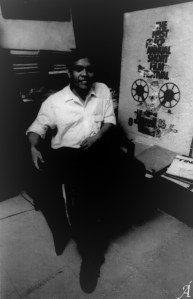
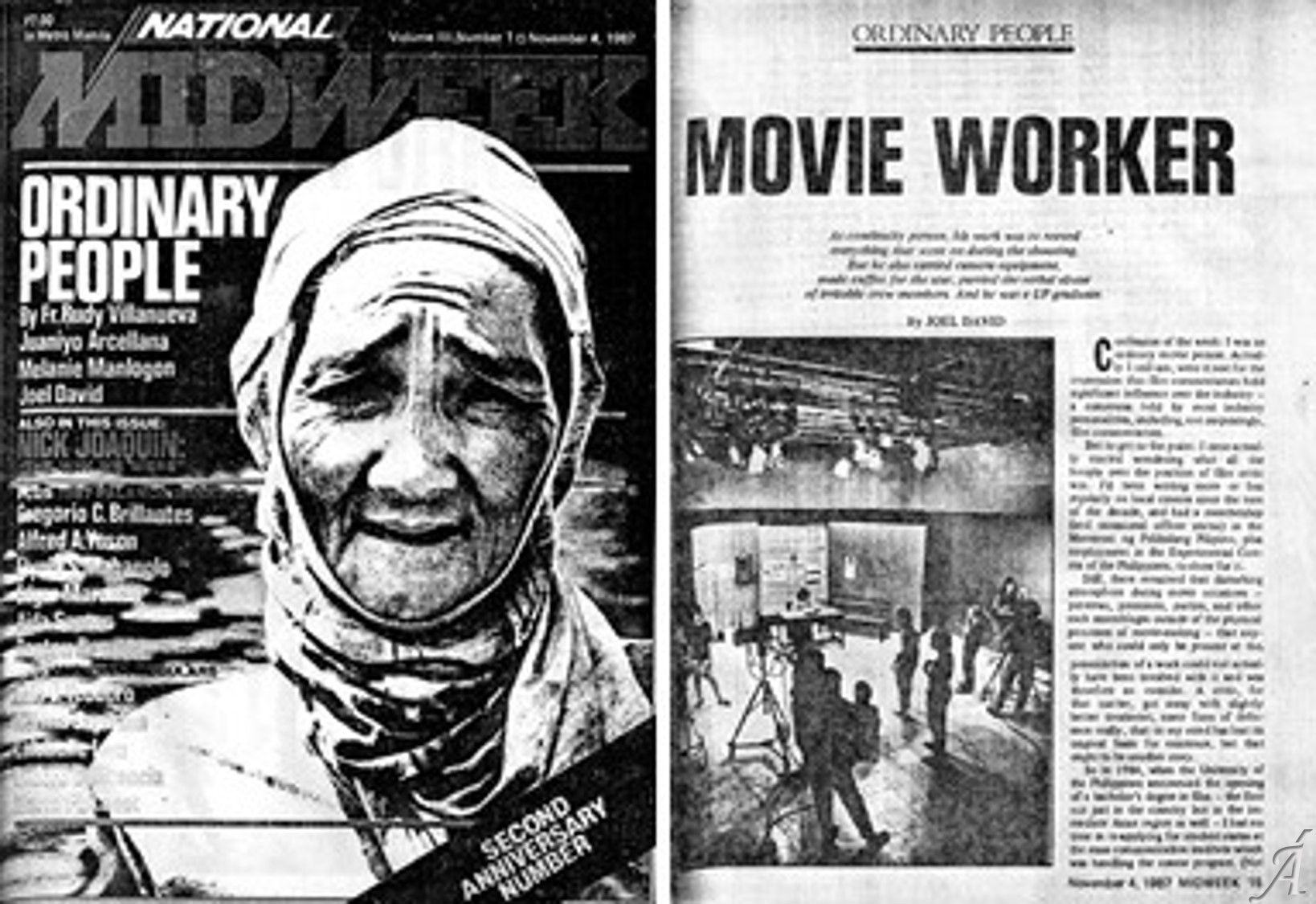


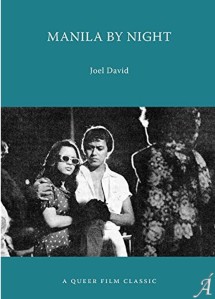








 ORCID ID
 Ámauteurish!